




Abstract
Among all the factors that influence the success of preschool programs, none is more important than the quality of the teaching workforce. The design and delivery of effective approaches to professional development (PD) are central to the support of the early childhood education workforce. In this article, we provide a model outlining the PD features that help to ensure that PD is effective, as well as the program- and policy-level supports needed to implement this type of PD as a part of local, state, and federal preschool programs. Throughout the article, we summarize recent research that is refining our understanding of the characteristics of effective PD, and we draw from research as well as our own experience in working with Head Start and state preschool programs across the country to illuminate challenges and promising practices in implementing effective PD at scale.
Among all the factors that influence the success of preschool programs, none is more important than the quality of the teaching workforce. The most effective teachers offer cognitively stimulating and emotionally supportive interactions and are able to teach young children the early literacy, math, and social-emotional skills that they need to thrive (Yoshikawa et al., 2013). But too few children across the country have access to these types of teaching and learning experiences (Hamre, 2014), in large part due to a workforce that is often unprepared (Institute of Medicine & National Research Council, 2015). The challenges of recruiting and supporting an effective teaching workforce are not unique to preschool. There is an increasing focus nationwide on reforming teacher preparation (Zeichner, 2014) and ongoing professional development (PD; Gulamhussein, 2013) across preK–12 to ensure more effective teaching. But preparing and supporting effective preschool teachers is often even more challenging than supporting teachers in K–12 settings, due to factors such as varying licensing requirements and the patchwork of early childhood systems. Furthermore, the scale of the challenge is remarkable. Recent estimates suggest the need for >100,000 new bachelor-level preschool teachers by the end of this decade (Whitebook, Phillips, & Howes, 2014). Many of the challenges related to supporting a well-prepared workforce cut across early childhood sectors, including child care, Head Start, and state preschool. Others are unique to particular sectors, such as the challenges faced in supporting some preschool teachers who work in public school buildings, where the PD offered is often focused on topics of limited salience to their role in supporting young learners. For preschool expansion efforts to be successful, the field must better address these challenges and find ways to ensure that preschool teachers have access to the educational and training experiences that they need to be effective in the classroom.
In this article, we discuss the latest research on effective methods for training and supporting preschool teachers and the ways in which this research can inform practice in the context of rapid expansion of preschool programs. Although the focus is on preschool programs (programs serving 3- and 4-year-olds), we draw, where relevant, from the broader early childhood education (ECE) research (e.g., infant and toddler programs) as well as from the K–12 literature. Having a well-trained workforce requires hiring teachers with educational experiences that help prepare them to teach (preservice), as well as the provision of ongoing in-service PD experiences that help ensure that teachers have the knowledge and skills they need to support children’s development and learning. It is beyond the scope of this article to discuss both pre- and in-service training in detail. Given the fact that there is a much stronger research base on in-service, compared with preservice, supports for teachers, the bulk of the article focuses on PD supports for teachers after they join the workforce. However, much of the information conveyed is relevant to preservice programs as well. We define PD broadly to incorporate all forms of training, coursework, and coaching provided to teachers to support their practice.
At the broadest level, a review of the ECE PD literature suggests that teachers who experience intentionally designed and high-quality PD can make meaningful changes to their teaching practice and that these can translate to improved outcomes for children (Fukkink & Lont, 2007; Kraft, Blazar, & Hogan, 2016; Markussen-Brown et al., 2017; Werner, Linting, Vermeer, & Van IJzendoorn, 2016). However, we also know that many PD efforts, even well-designed ones, fail to significantly affect practice (e.g., Lonigan, Farver, Phillips, & Clancy-Menchetti, 2011), especially when delivered at larger scale (e.g., Piasta et al., 2017). We also know that too few teachers currently working in early childhood programs have access to the types of PD experiences that are most likely to be effective. For preschool expansion efforts to succeed, we need to pay serious attention to current PD systems and greater collaboration among researchers and practitioners in understanding the following: how to design and implement, at scale, the elements of PD that make it impactful; the program leadership approaches necessary to enact these more effective PD elements; and the policy reforms needed to facilitate large-scale shifts in the ECE PD systems that support preschool programs. In this article, we summarize research on effective approaches to PD, provide data on the extent to which these approaches are used by preschool programs across the country, and offer examples of the research-to-practice gaps from our experiences working with large-scale early childhood initiatives. We conclude with some recommendations for research-practice partnerships that may advance the field of early childhood PD and help ensure that more preschool teachers are prepared to support the young learners in their classrooms.
Research-to-Practice Gap in Preschool PD
There is no doubt that PD has the ability to lead to substantive changes in teachers’ practice. Recent meta-analyses of PD for early childhood educators have shown positive effects at the classroom, educator, and child levels. In the social-emotional domain, targeted interventions on child care providers’ interactions with children led to higher-quality classroom environments, adult-child interactions, and child behaviors (Werner et al., 2016). In the language and literacy domain, PD improved teaching and children’s phonological awareness and alphabet knowledge (Markussen-Brown et al., 2017). Both these meta-analyses observed larger effects on proximal outcomes (e.g., classroom- or teacher-level outcomes) than distal outcomes (e.g., child-level outcomes), a finding that is common in the PD literature when child outcomes are measured.
But designing and implementing PD that significantly affects teachers and children is not easy. Even when PD demonstrates impacts, effect sizes are small (Markussen-Brown et al., 2017), and there are many examples of well-designed and intensive PD that does not have a significant impact on practice or child outcomes (Lonigan et al., 2011). One of the most recent examples of this is a study of a state-sponsored PD model that included a 30-hour course on literacy and language development and teaching practices, offered alone as well as in conjunction with coaching (Piasta et al., 2017). The study is unique in its scope (>500 teachers) and in being one of the few well-controlled studies of early childhood PD developed and implemented by practitioners rather than researchers. The PD was relatively intensive and focused on teaching practice, and it included job-embedded supports for taking learning from coursework into the classroom, meeting many of the criteria that we discuss later as being important in the design of effective PD. However, teachers randomly assigned to take the course or the course plus coaching showed very few changes in their knowledge or practice over an 18-month period. The authors suggest that many of the challenges in implementing effective PD at scale may have led to the lack of effects. In this article we draw from the literature and our experience to help more clearly articulate some of the program and policy factors that may limit impacts of PD when delivered at scale.
Throughout this article, we also draw from the literature to provide information on what typical preschool programs are currently doing to train and support their teachers and the ways in which this aligns, or does not align, with research recommendations. Unfortunately, in many cases, there is limited research or information available on what is happening in programs at scale, so we also draw extensively from our experiences working with these programs to help articulate some of the barriers to the adoption of effective PD practices as well as some innovative approaches to improvement. In particular, we draw from the lead author’s experience in supporting Head Start programs as a part of the National Center for Quality Teaching and Learning, as well as deep engagement in supporting the 11 school divisions across Virginia that are implementing preschool expansion (Virginia Preschool Initiative–Plus [VPI+]). Although these experiences are not intended to be representative of the full landscape of what is happening in preschool PD across the country, they do provide a window into some of the real-life challenges faced by programs working to enact effective approaches to PD in the context of preschool expansion.
A Model for the Delivery of Effective PD
Figure 1 lays out a conceptual model for the delivery of effective PD, outlining the specific PD elements that are critical to helping ensure that it has significant impacts on teachers’ practice and, ultimately, children’s development and learning. This model draws heavily from other similar frameworks (e.g., Desimone & Garet, 2015; Zaslow, Tout, Halle, Vick Whittaker, & Lavelle, 2010); however, it is unique in the addition of an explict articulation of some program and policy elements that can support the enactment of effective PD. Even the very best PD approaches will not work at scale if programs do not implement them well and if there are not policies that facilitate that implementation.
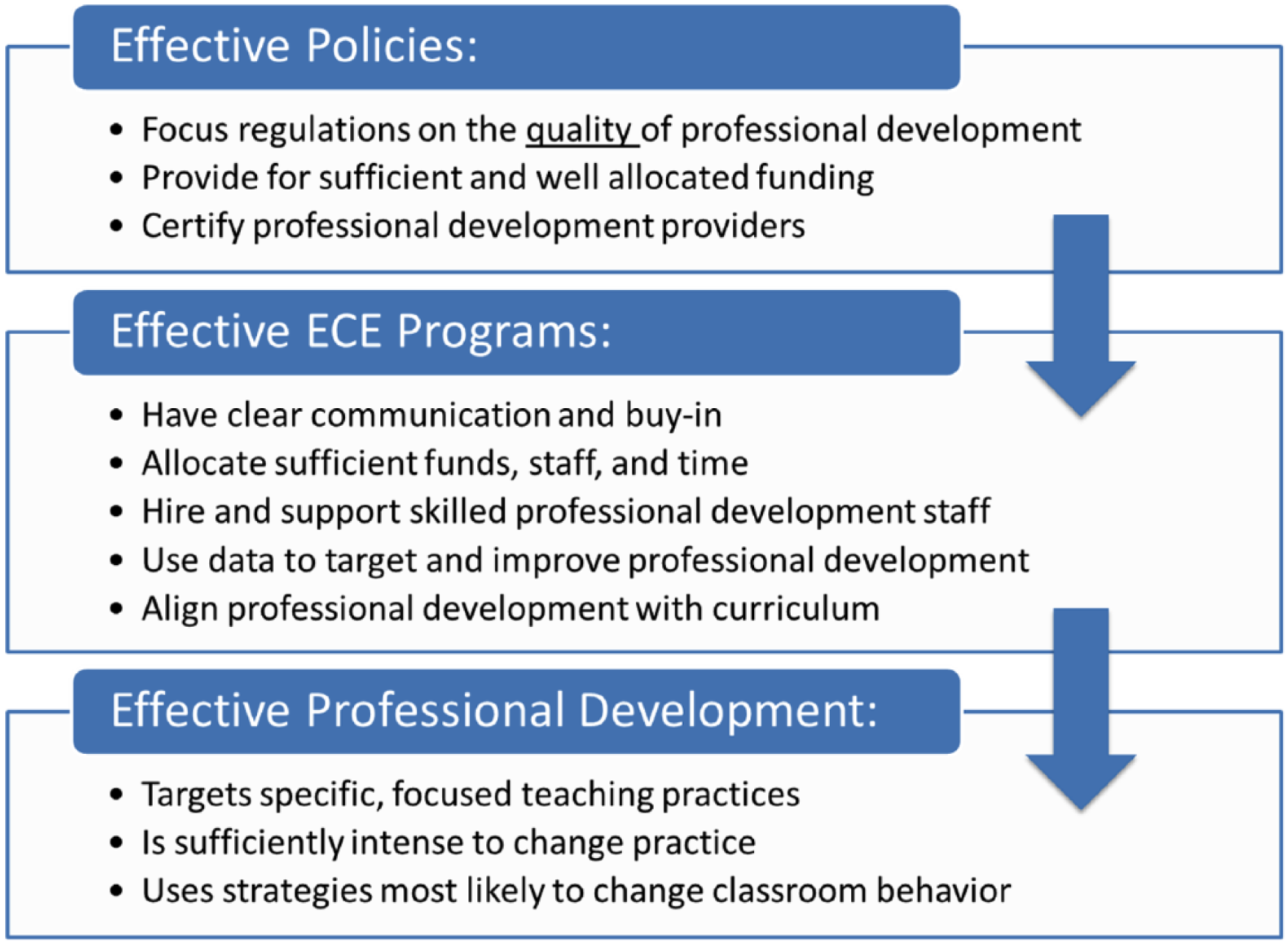
Preschool policy, program, and professional development (PD) elements to enhance impact. This figure summarizes the policy, program, and PD elements that are critical to helping ensure that PD has significant impacts on teachers’ practice and, ultimately, children’s development and learning.
PD Elements That Support Positive Outcomes
There is relatively broad agreement in the field about characteristics of effective PD, both specific to early childhood and within the broader educational literature (Desimone & Garet, 2015; Zaslow et al., 2010). Effective PD is targeted on specific and clearly articulated evidence-based teaching practices; it is sufficiently intense to change targeted practices; and it uses PD strategies that promote behavioral change.
Targeting Specific, Focused, and Clearly Articulated Evidence-Based Teaching Practices
The most central element of effective PD is the extent to which it targets teaching practices known to promote positive outcomes for students (Zaslow et al., 2010). If we are expecting PD to result in changes in children’s learning and development, then it is essential that PD be explicit in its focus on practices that are known to promote those outcomes (Diamond & Powell, 2011; Hamre, Downer, Jamil, & Pianta, 2012). All of the studies reviewed for recent meta-analyses of PD in ECE (e.g., Markussen-Brown et al., 2017) met this basic criterion. Most of these PD models are based on theories of change that derive their practice focus from extensive research linking those practices to specific child outcomes. Some effective PD models focus on teacher knowledge in addition to practice, but a focus on knowledge alone is unlikely to make substantive changes to teachers’ daily work in the classroom (Yoon, Duncan, Lee, Scarloss, & Shapley, 2007). Embedded in this definition of a focus on practice is not just that the practices are evidence based but that there is some precision in the articulation of these practices such that PD providers and teachers are very clear about the specific practices on which they are focusing.
One way to help ensure that the focus of PD is on elements of teaching that promote positive outcomes for children and that this focus is specific and explicit is to use validated observational measures as an explicit part of the PD model. By using observational measures that have been shown to predict children’s learning and development to provide a framework for defining and envisioning teaching practice within PD, there is greater confidence that the PD will focus on teaching practices that matter and that those providing the PD will have a consistent framework and lens for understanding what those practices look like.
There are a number of effective PD models designed around the Classroom Assessment Scoring System (CLASS; Pianta, LaParo, & Hamre, 2008). MyTeachingPartner (MTP; Pianta, Mashburn, Downer, Hamre, & Justice, 2008) is a video-based coaching model that has demonstrated positive impacts on teaching practice and student outcomes (Downer et al., 2011; Pianta et al., 2017). Coaches trained to deliver MTP must pass the reliability certification for CLASS; then, they are trained to use that lens as they edit videos and write prompts for teachers that focus on specific CLASS-based teaching practices. Making the Most of Classroom Interactions (MMCI), which was developed as a college course (Hamre et al., 2012), more formally educates teachers about effective teacher-child interactions through heavy use of video exemplars in a clearly scoped and sequenced set of workshops. Importantly, both these programs have demonstrated impacts on teaching practice, not only as a part of university-led research, but in practice-led, scaled-up implementations as well (Early, Maxwell, Ponder, & Pan, 2017).
There are also examples of the systematic use of validated observational tools to support a focus on practice in the content domains. Hemmeter, Fox, and Snyder (2013) have used the Teaching Pyramid Observation Tool (TPOT; Fox, Hemmeter, & Snyder, 2014) to guide their coaching work focused on supporting children’s social and emotional skills. The TPOT measures a set of evidence-based practices known to promote positive behavior among young children. Coaches using their intervention conduct TPOT observations to inform the focus of their work with teachers. Several studies have shown that this approach leads to changes in teachers’ practice (Hemmeter et al., 2013; Hemmeter, Hardy, Schnitz, Adams, & Kinder, 2015) as well as teacher-reported and observed improvements in children’s social skills. Landry, Anthony, Swank, and Monseque-Bailey (2009) have built many of their effective coursework and coaching approaches explictly from the CIRCLE Teacher Behavior Rating Scale (Landry, Crawford, Gunnewig, & Swank, 2002), an observational measure clearly articulating 50 specific teaching behaviors that have been linked to children’s development and learning in both the social-emotional and literacy domains. Across these models, there is clear and consistent focus on a specific set of teaching practices that the research literature has identified as critical to children’s learning and development, and those delivering the PD are trained on the observational tools as a way of helping to ensure that these practices remain at the center of their work with teachers.
The explicit use of an observational measure is not required to develop PD that focuses on evidence-based teaching practices. Many PD programs with demonstrated impacts have used other methods to identify the teaching practices of focus (e.g., Piasta et al., 2012; Williford et al., 2017). As just one example, Barton, Fuller, and Schnitz (2016) developed a performance feedback model for preservice teachers that targeted seven teacher practices for supporting children in inclusive settings. These practices were chosen to align with those recommended by the Division for Early Childhood: descriptive praise, emotion labeling, joint attention modeling, promoting social interactions, choices, precorrections, and language expansions. In summary, across almost all models of effective PD, there is a very explicit focus on evidence-based practices, and the PD provides detailed descriptions of what these practices look like that can help guide PD providers and teachers to intensively focus on elements of teaching that will translate into positive outcomes for children.
Suggesting that PD should focus on evidence-based teaching practices may seem incredibly obvious, but our experience and the limited data available on this point suggest that much PD available to teachers does not have this type of focus. In one review of 256 published studies of ECE PD, only 25% had an explicit focus on teaching practices (Snyder et al., 2012), and the majority of this practice-focused PD targets more generalized teaching practices, early literacy, and/or social-emotional teaching. There are far fewer examples of PD that focus on areas such as math and science teaching (Schachter, 2015). The picture is likely even more bleak if we think about the typical experience of teachers working in ECE. Our experiences working in Head Start and state prekindergarten programs across the country, for example, suggest that preschool teachers often spend the majority of their PD time in school- or district-wide PD days that are not at all focused on early childhood teaching.
One of the bright spots in this work at scale is that programs are increasingly using validated observational measures to guide coaching and other PD efforts. Because of the use of CLASS as a part of Head Start monitoring and in more than 20 states’ Quality Rating and Improvement Systems, many programs are now much more intentionally focused on providing PD and coaching on the types of teacher-child interactions described by CLASS. Some programs have adopted fully developed, rigorously tested PD and coaching models, such as MTP and MMCI. But many more programs are developing their own resources and supports to enhance teaching practice in ways that are explicitly or implicitly aligned with CLASS. For example, the National Center for Quality Teaching and Learning developed a comprehensive suite of online resources focused on elements of teacher-child interactions, such as following children’s leads and scaffolding children’s learning. Similar online resources are available to align with the CIRCLE Teacher Behavior Rating Scale, through the University of Texas and Children’s Learning Institute, and with elements of the TPOT through the Center on the Social and Emotional Foundations for Early Learning. There is not yet much evidence on the extent to which the use of these types of publicly available resources may lead to improved teaching practice when used at large scale, but it is one example of ways in which the field is working to more systematically support a focus of PD efforts on teaching practices that we know support children’s learning and development. It is likely that the ultimate impact of these resources is largely dependent on the other elements of effective PD, discussed later.
Providing Sufficient Intensity and Duration to Promote Changes in Practice
Having the right content to focus on is an important start, but for PD to change teaching practice in meaningful ways, there is a need for a match between the intended objective and the intensity and duration of the PD offering (Zaslow et al., 2010). Research has generally suggested that more intensity and a greater duration of PD lead to more substantive changes in teachers’ practice (Garet, Porter, Desimone, Birman, & Yoon, 2001; Markussen-Brown et al., 2017). In their meta-analysis of PD focused on early literacy and language outcomes, Markussen-Brown and colleagues (2017) found a range in intensity among the studies they included, from 6 to 450 hr, and they revealed greater changes in teaching practice among PD programs with greater intensity.
Unfortunately, we do not know exactly how much PD is enough, and it is likely that the answer to that question is highly dependent on the desired outcome. PD targeting smaller elements of practice can change as a result of relatively moderate intensity PD. For example, the Promoting Early Literacy in Licensed Care was designed to be a modest intervention in terms of its dosage and cost (Gerde, Duke, Moses, Spybrook, & Shedd, 2014). This course consisted of five sessions, each lasting 2 hr, for a total of 10 hr of PD. Results of the Promoting Early Literacy in Licensed Care course found significant effects on providers’ literacy knowledge and practices but no evidence of impacts on children’s literacy outcomes.
Some recent research more explicitly examines the ways in which intensity and duration in ECE PD may influence changes in teaching practice. Pianta and colleagues (2014) demonstrated that more cycles of coaching generally led to greater changes in practice among teachers receiving MTP coaching. But they also found some differences in the dosage required to change different types of teaching practices, with teachers generally requiring more coaching to change instructional elements of their teaching (up to 13 cycles) rather than their classroom management strategies (up to 7 cycles).
Even more compelling work comes from studies that have systematically varied intensity and duration in ways that provide stronger causal evidence. For example, in a study conducted by Landry, Swank, Anthony, and Assel (2011), teachers participated in nine online workshops and received in-person mentoring twice a month across a year. However, some teachers received this intervention for 1 year, while others received it for 2 years. Results suggest that 1 year of the intervention had significant effects on teachers’ language and literacy instructional practices, but there was not an additional impact on teaching practice based on a second year of coaching. However, there were larger impacts on children’s learning for those teachers receiving 2 years of intervention. Given that it takes some time for teachers to make changes in their practice, it may be that children in teachers’ classrooms during the first year of PD would not have enough exposure to the improvements in practice to show demonstrable impact. This type of systematic variation of PD dosage in research studies will be very helpful in refining our understanding of how much PD is needed to support specific types of practice changes.
There are limited data on the intensity and duration of PD provided to teachers across the country. We do know that programs have been working to increase the intensity of PD, with a particular focus on increasing coaching. Initiatives such as the mentor-coach grants and practice-based coaching trainings from the Office of Head Start, the expansion of Quality Rating and Improvement Systems programs, and the provision of additional resources for quality improvements as a part of the federally funded preschool expansion grants have likely led to more teachers having access to coaches. This is a positive change, although there is much to be learned about how to ensure that these types of investments lead to the intended practice changes.
Our experience suggests that even when programs devote more resources to providing intensive PD and coaching, intensity and duration vary in notable ways. The VPI+ grant required each VPI+ teacher to complete at least 30 hr of PD and to receive up to 40 hr of coaching. Coach log data from the first year suggest that on average teachers received about two coaching visits a month, but there was notable variability in this across divisions, coaches within divisions, and teachers within coaches (SRI International, 2016). Some of this variability relates to program factors discussed later, such as coach caseloads, and some is very intentional, with coaches spending more time with teachers who need more support. But in reviewing these data with coaches and coordinators, it also became clear that some of this variation was not really intentional at all but rather the result of a lack of a clear plan or expectations for how to ensure that each teacher received the level of support that she or he needed to change the practices that were targeted.
There is some evidence that the intensity and duration of PD on a particular element of practice may be more driven by coaches’ background and ideology than teachers’ needs (Hamre, Pianta, Burchinal, DeCoster, & Downer, 2015). Among 14 coaches supported to deliver MTP across 10 sites, there was notable variability in how much coaches chose to focus on the different CLASS domains and/or literacy practices across all their teachers (caseload range, 9–15). For example, one coach spent the majority of her time with teachers focused on instructional support and literacy (65%), while another spent only about 20% of her time focused on these areas. Qualitative analysis suggests that these foci were not explained by dramatically different needs across the teachers with whom the coaches were working but rather by the coaches’ own orientation. Those with backgrounds as literacy coaches tended to focus their teachers more on literacy, whereas those with mental health backgrounds spent more time focused on social-emotional elements of the MTP process. This coach-level variability is notable in that it was observed even when coaches were following a coaching model that provides a clear structure for the focus of coaching. The variability also suggests that supporting coaches to provide sufficient dosage and intensity on specific practices for each teacher likely requires fairly intensive training and support for coaches, as well as a strong match between coach background knowledge and orientation and the focus of the coaching work, factors later discussed in greater detail.
Use of PD Practices That Promote Teacher Behavior Change
Beyond knowing what PD should focus on and for how long, there is a clear need to determine the specific types of PD experiences that are most likely to change teachers’ practice. Despite the call that Sheridan, Edwards, Marvin, and Knoche (2009) made for much more research on the processes and practices of PD that promote positive outcomes for teachers and children, the field has yet to make very strong progress on this front. At the most global level, there is evidence that many forms of PD can be effective, including coursework, more intensive workshops, and coaching (Markussen-Brown et al., 2017). Several studies that have used planned variation in PD approaches have demonstrated stronger impacts for coursework plus coaching than coursework alone (Landry et al., 2009; Neuman & Cunningham, 2009). A meta-analysis of language and literacy–focused PD packages for early childhood teachers found that the inclusion of a coaching component resulted in significantly better teacher practice (d = .68 with coaching, d =.22 without coaching; Markussen-Brown et al., 2017). In alignment with this support of coaching, most research suggests that some level of individualized follow-up with teachers best supports positive outcomes. In their meta-analysis, Werner et al. (2016) found that programs that included individualized follow-up for teachers had significantly bigger effect sizes on teacher outcomes than did programs without that type of follow-up.
But many PD programs, even those written up in peer-reviewed publications, do not have any follow-up (Snyder et al., 2012), and most early childhood teachers do not have access to coaches. According to data from the National Survey of Early Care and Education (Tout, Halle, Datta, & Snow, 2015), only 36% of preschool teachers reported receiving any coaching, mentoring, or consultation in the past year. Our experience working with VPI+ suggests that many preschool programs, even those operating within school districts, do not have sufficient resources to provide intensive coaching to teachers, a point we return to in the program section.
Given the high cost of intensive follow-up and coaching, it is important to note that there are examples of PD interventions that can change teacher practice without this component. For example, in the MMCI courses that focus on CLASS, teachers receive about 3 hr of training on each CLASS dimension (e.g., teacher sensitivity, concept development), but they do not get individual coaching on their implementation of these practices in the classroom. When MMCI was implemented as a part of Georgia prekindergarten, researchers found evidence of impacts on multiple domains of teachers’ practice (Early et al., 2017).
Beyond these broader categories of coaching and/or intensive follow-up, there is a need to articulate the more specific PD approaches that lead to improved practice. Other reviews have cited elements such as the inclusion of collaborative teacher teams (Zaslow et al., 2010) and the provision of active learning opportunities for teachers, rather than more passive PD programs in which teachers simply receive information (Desimone & Garet, 2015). Increasingly, many effective PD models have teachers actively analyzing videos of their own or others’ teaching practice as a way to help them really understand what good teaching looks like (Chen & McCray, 2012; Hindman et al., 2015), and there is evidence that teachers who watch more of these types of videos do change their practice more (Pianta et al., 2014).
But the reality is that there is a long way to go before the field can more definitely say what specific PD and coaching practices are most effective. It would be helpful for future research to better categorize and study the specific components of PD that lead to changes in teaching practice. Snyder et al. (2012) attempt to categorize these components in their summary of the characteristics of early childhood PD. They note that most PD studies include methods for observation (59%) and verbal feedback (58%). Many include modeling (35%) and written feedback (22%). Less frequently used methods are role-play (4%) and side-by-side verbal support (6%). But we do not know how essential these elements are to leading to practice changes. So, for example, how does verbal versus written feedback compare as a method for a coach to share observations with teachers? And what exactly might the added value of video review be, above and beyond the much more frequent practice of a coach observing and then talking with a teacher? Answers to these more refined questions would help the practice world more easily implement PD and coaching models with the greatest impact.
Summary of PD Elements and a Push Toward Use of Evidence-Based Models of PD
For PD to have an impact on children’s development and learning, it is important that it target specific evidence-based teaching practices, is sufficiently intense, and uses methods that actively engage teachers in learning and reflective experiences that will lead them to change their daily behavior in the classroom. There are numerous examples of PD meeting these criteria that have demonstrated impacts in rigorous evaluations. There are also counterexamples in which these features are in place without observing significant impacts, and as we point out through this section, too few teachers have access to these types of experiences. It may be that some of the program and policy features that we describe in the next sections play a role in these challenges.
Before moving on to the program and policy factors, however, it is important to note that although we talk about each PD element separately, for teachers they come together in a set of experiences that are either clearly articulated, scoped, and sequenced or disorganized and haphazard, without focus and clarity. Our experience suggests that the latter is much more common than the former. Although there are many reasons for this, one particularly important element is that in practice the people on the ground delivering PD and coaching are often having to make decisions about each of these elements (focus, intensity, and format) on their own, with very little guidance. This is in contrast to those PD providers and coaches delivering most evidence-based models, which typically lay out very specific guidance that helps make their daily work of supporting teachers much easier. Just as teachers benefit from following a curriculum to guide their daily practice in the classroom, most coaches and other PD providers could be much better supported by learning to deliver fully developed PD models. This rarely happens in practice. For example, in their study of coaching happening as a part of a Quality Rating and Improvement System, Isner et al. (2011) reported that very few programs used any formal manual or set of materials to guide coaches’ daily practice. This is a point we return to at the end of the article as we discuss the scaling of specific evidence-based PD models as one way to help address the research to practice gaps noted earlier.
There are, however, positive examples of work happening to support more systematic PD and coaching efforts at large scale. In work led by Mary Louise Hemmetter and colleagues (National Center on Quality Teaching and Learning [NCQTL], 2015), the NCQTL developed a model of practice-based coaching for Head Start programs, building the framework and training resources by drawing from several evidence-based coaching models. Although practice-based coaching does not offer detailed guidance around all of the focus, intensity, and methods decisions that coaches need to make, it does provide more structure than is found in typical Head Start program coaching work. The NCQTL trained and supported hundreds of programs using this model through Head Start’s broad training and technical assistance network. As with many of these broad training and technical assistance network efforts, we have no evidence of the impact of practice-based coaching as delivered in typical Head Start programs, and this is an area for further study as more programs use it as the basis for their coaching efforts. The rollout of practice-based coaching, however, made clear to the NCQTL leadership team that simply providing programs with a coaching model was not sufficient to lead to effective coaching. A number of program-level factors were major barriers to implementation.
Program Resources, Structures, and Process to Support Effective PD
The organizations that run preschool programs, whether they are school districts, Head Start agencies, or community organizations, are responsible for establishing and implementing many of the structures and processes that can either support or inhibit effective PD. Just as K–12 leaders are responsible for making decisions that can drive instructional improvements at scale (Bryk, Sebring, Allensworth, Luppescu, & Easton, 2010), ECE program leaders make many decisions that ultimately influence the impact of PD: communication and buy-in about PD approaches; allocation of funding, staff, and time; training and support for PD staff; data use; and alignment of PD with other program elements. Even PD programs that were successful when delivered at a smaller scale may fail during scale-up as a result of some of these factors that are critical to strong large-scale implementations. This is a point we return to at the end of this section.
Clear Vision, Communication, Expectations, and Buy-In
Leaders vary in the extent to which they have a clear vision about the types of instructional practices that should be occurring in their program each day, and this vision, or lack thereof, can play a major role in the types of PD that are offered to teachers. Some programs are very focused on a rather narrow set of outcomes, such as children’s literacy performance, and thus place great emphasis on PD on effective literacy instruction. Others may have a much more diffuse focus in ways that lead to the lack of a coherent model of PD. The best PD happens when leaders use data to determine the areas of need for their program, identify effective approaches to support teachers’ practice in these areas, and then work to clearly communicate their vision and expectations to everyone in the program (Whalen, Horsley, Parkinson, & Pacchiano, 2016). Too often, the many people tasked with supporting teacher improvement within an organization are making independent decisions about how to focus their time and effort, in ways that fail to maximize precious PD time and money—and too rarely do teachers have a say in the types of PD they are offered. The most effective leaders not only set a vision but have the skills necessary to support buy-in across the program (Mattera, Lloyd, Fishman, & Bangser, 2013).
Allocation of Sufficient Funding, Staff, and Time
Once a vision is set, what resources are required to deliver effective PD at scale, and how do programs most effectively and efficiently allocate funding, staff, and time in ways that can help ensure that PD efforts have the intended impact? Unfortunately, we have limited research to answer this question. On the cost side, most evidence-based models in the literature were funded through supplementary grants that covered costs for staff, training, and materials, and few PD programs undertake cost analysis. But, undoubtedly, investment in good PD does require allocating resources to cover staff time and training in ways that help ensure that they are providing the types of PD outlined earlier. Most preschool programs are funded at very low levels, at least as compared with their K–12 counterparts, and thus may lack sufficient resources to hire coaches or support some of the more intensive work described so far.
But it is also the case that many programs do not spend the resources that they have in ways that lead to effective PD approaches. This became very clear in our work with Head Start programs as we supported the implementation of practice-based coaching. Many programs started that work saying that they did not have enough money to do coaching. However, as we worked with them more closely, they were able to see how they could begin more intensive coaching programs by reallocating staff time in ways that required minimal additional funds (NCQTL, 2015). For example, some programs identified expert teachers who could be released during the week for short periods to support coaching efforts. Others modified roles of staff working as education specialists to spend less time on administrative duties and more time working directly with teachers. Programs also found creative ways of creating release time for teachers, including scheduling coaching during nap times and having administrators cover classrooms for short periods of the day.
Our experience working with VPI+ suggests that even when resources are sufficient to support very intensive PD, program leaders make very different decisions about using those funds. In particular, VPI+ school divisions made very different decisions about how to allocate coaches in terms of their coach:teacher ratios. Among the 14 coaches working in the first year of the grant, the average coach had 17.3 teachers on their caseload, but there was huge variation (SRI International, 2016). Some had small caseloads (four teachers) that enabled them to have weekly intensive meetings with teachers, while others were tasked with coaching up to 32 teachers in ways that limited the intensity of coaching. For some coaches, it was a full-time job; for others, they had substantial other duties, including family engagement work and/or disability coordination. Even full-time coaches reported frequently getting pulled into other program activities, such as recruitment, in ways that took them away from their coaching work.
To support effective PD, it is important for program leaders to recognize all of the various barriers that they face and spend time coming up with creative solutions. For example, some programs have moved to the use of more remote coaching models that use video conferencing to connect teachers and coaches as one way to reduce travel time, particularly for coaches working in rural settings where travel among sites can use of the majority of a coach’s time (e.g., Early et al., 2017; Powell, Diamond, Burchinal, & Koehler, 2010). Many coordinators in VPI+ have also worked over time to have their preschool teachers have their own dedicated PD time together, rather than getting pulled out to district-wide PD that may be less relevant to their work. Although there is a clear need for more resources in most preschool programs, effective leaders find ways to support targeted and intense PD even with limited financial and staffing resources available.
A Skilled PD and Coaching Workforce
Just as teachers are key to the success of the students in their classroom, the success of PD efforts depends in large part on the people who are delivering the training and coaching to teachers. From a program perspective, this means hiring, training, and providing ongoing support to the PD workforce. This is an area without much research, and many evidence-based PD models fail to provide much detail about these elements of program delivery. Our review of the literature suggests that among the evidence-based PD models that provide details on their PD workforce, the most distinguishing features are that they are typically experienced ECE teachers, often with a master’s degree, and that they have relatively extensive training and ongoing support in the particular PD model (McCollum, Hemmeter, & Hsieh, 2011; Piasta et al., 2012; Powell et al., 2010). Lloyd and Modlin (2012), reporting on their delivery of three different coaching models in Head Start programs, suggest that successful coaches had three major skills: knowledge of the specific coaching model, general coaching and consultation skills, and knowledge of early childhood development and teaching.
There is some alignment here to what we see happening in programs across the country. Data suggest that programs often hire PD staff with ECE teaching experience and advanced degrees. Among Head Start staff hired as a part of the mentor-coach grant work, almost all had bachelor degrees, and 45% had a master’s degree or higher (Howard et al., 2013). Half the coaches hired for that work had ≥18 years’ experience in ECE, and only 20% had <5 years’ experience. Similarly, coaches within VPI+ were often very experienced and well-educated early childhood teachers. Prior experience coaching is much less common, with the majority of coaches hired for the Head Start mentor coaching work and VPI+ having <2 years of prior coaching experience.
There is a much more notable gap between evidence-based programs and what we see in the field when it comes to the training and ongoing support of PD and coaching staff. In most cases, when described, evidence-based models have fairly intensive initial training as well as weekly supervision of coaches (Isner et al., 2011). This is rarely the case in the field. Within the Head Start mentor-coaching work, most Head Start coaches reported getting some training and ongoing supervision, but very little of this was specific to coaching (Howard et al., 2013). Only 16% of the coaches interviewed described any specific training that they received related to coaching. Most training was either self-directed (e.g., “looking for resources online or independently reading resources that they thought could help their work with staff”) or focused on assessments and/or grantee and programmatic information. Ongoing supervision varied widely and was typically provided by Head Start directors rather than a coaching expert. Although the engagement of site-level administrators is important to the success of coaching (Lloyd & Modlin, 2012), these administrators often do not have the expertise needed to provide meaningful feedback and support to coaches.
Using Data to Target and Improve PD
Given limited resources, it is essential for programs to use data to guide decisions about who needs PD, on what topics, in what forms, and with what intensity (Mead & Mitchel, 2016). There is very little guidance on these decisions from the literature because most evidence-based models are developed with a specified topic, form, and intensity and then tested with a set of volunteer teachers within a program. Data may be used by these evidence-based models within the specific PD approach (e.g., observations to inform the focus of coach cycles), but rarely is it used at the program level to decide who within a program should receive what types of supports.
Using data to inform PD has been a major focus of our work with Head Start grantees and VPI+ school divisions. In both cases, this work started with supporting programs to examine child outcome and classroom observational data to determine areas of strength and challenge within each organization. In VPI+, we have supported programs to think about targeting PD efforts toward no more than two key school readiness domains, to help ensure sufficient focus and intensity. We then worked with programs to think about the needs that they had across the division versus those that seemed to be more variable across teachers within their program. So, for example, several school divisions noted a need to focus on math and instructional support across all their teachers, while noting that a few teachers were still underperforming in supporting children’s literacy skills. In this case, the division could focus division-wide PD and some follow-up coaching on math and instructional support, while having coaches provide more individualized and intensive supports around literacy to a smaller number of teachers who either were new to the program or simply had not benefited from prior years’ PD that focused on effective literacy instruction.
Many early childhood programs lack expertise in the data-based decision making needed to engage in this type of process (Derrick-Mills, 2015; Mead & Mitchel, 2016). Although most programs collect and use child outcome data to support individualized approaches to instruction, fewer programs use these data at the program level to drive PD efforts (Zweig, Irwin, Kook, & Cox, 2015). Programs often struggle to know how to ask the right questions of their data and often do not have expertise in the more technical skills required to efficiently collect, maintain, analyze, and interpret data. Even programs that use systems designed to support data use, such as Teaching Strategies GOLD, are challenged in knowing how to run the reports that they need and to analyze the data at the program level.
The most sophisticated programs use data not only to guide the focus of PD but to track the implementation and success of their PD efforts. Lloyd and Modlin (2012) describe a relatively simple but effective method for supporting the coaching delivered as a part of the Head Start CARES project. They used brief online surveys, logs, and fidelity reports to help support technical assistance and management in their monitoring of implementation of coaching. Similar systems are provided with the scaled-up version of MTP (Early et al., 2017). Even the simplest information, such as logs of the frequency of contacts between teachers and coaches, can be powerful in improving the intensity of coaching if they are used to monitor coach efforts and provide feedback. Unfortunately, this level of implementation data is rarely used by programs in systematic ways to support program improvement. In their case studies with four programs, Isner et al. (2011) found only one of the four used any methods to track implementation of coaching.
Alignment With Curriculum and Other Program Elements
In the most well-functioning ECE programs, PD is not a separate task but is well integrated into the larger work of the program (Zaslow et al., 2010). In particular, the extent to which PD is aligned with the classroom curricula is an important factor in success (Desimone & Garet, 2015). Several recent studies help demonstrate how a lack of integration with curriculum may limit PD program impacts. The first study of the MTP coaching model found impacts on children’s literacy (Mashburn et al., 2008) and social-emotional skills (Hamre, Pianta, Mashburn, & Downer, 2012). In this initial trial, the CLASS-based video coaching was coupled with literacy and social-emotional curricula. In a subsequent trial, in which the teachers receiving the coaching worked in a number of different programs and used a variety of curricular approaches, MTP demonstrated an impact on children’s self-regulation skills but not on their literacy or social-emotional skills (Pianta et al., 2017). There is some evidence to suggest that literacy impacts were stronger in settings that had a targeted literacy curriculum and in which teachers were observed to have the materials and approaches that supported early literacy (Hamre et al., 2015). Other studies have come to similar conclusions (Mendive, Weiland, Yoshikawa, & Snow, 2016).
Programs face significant challenges in aligning PD, coaching, and curricular efforts. As programs adopt new curricula, they are faced with having to make decisions about how much of their PD and coaching time should focus on curricular implementation versus other program needs. Even if programs want to provide intensive training and support for teachers around evidence-based curricula, these supports are not always available at scale. The publishing companies that disseminate curricula typically are not equipped or incentivized to provide this type of support. Among VPI+ teachers in 11 school districts, only 19% reported receiving significant training (≥16 hr) on the curricula that they were using (SRI International, 2016). A slightly larger percentage (20%) reported receiving almost no training (≤4 hr across the year). Rates of training were slightly higher in school districts that were using a new curriculum (25% had ≥16 hr of training). Among teachers working in districts where they did not adopt a new curriculum, 34% reported having ≤4 hr training on the curriculum.
Summary of Program Elements That Support Effective PD
Programs can support the delivery of effective PD through setting and communicating a clear vision and getting buy-in; allocating sufficient funds, staff, and time to the effort; adequately training and supporting staff; using data to help inform and evaluate PD; and ensuring that the PD efforts are well aligned to the larger program goals and efforts. As with our description of PD elements, these program elements were described in isolation but in reality travel together through the decision making of program leaders. The most effective programs have well-trained and organized leaders who are improvement oriented and who are sophisticated in their use of data to drive an ongoing continuous improvement process that helps them orient resources effectively toward specific goals (Derrick-Mills, 2015; Lieberman, 2017; Mead & Mitchel, 2016). There is great variability in these dispositions and skills among the ECE leadership workforce, and there is clearly a need for more training and support for principals, program directors, and coordinators. As Lieberman (2017) points out, this may be a particular issue in community-based child care settings where the educational requirements and training available for directors are typically quite low.
One promising model to build leadership capacity is the ECE Professional Development Initiative (ECE PDI), developed by Ounce of Prevention (Whalen et al., 2016), which engages ECE leaders, coaches, teachers, and other staff in ongoing learning cycles focused explicitly on “organizational systems, instructional planning and implementation, fidelity in the delivery of PD, and children’s early achievement.” An initial implementation study on this model shows strong fidelity and some positive changes in leadership knowledge and focus (Whalen et al., 2016). Future research will help unpack the extent to which program-level PD with leaders can help lead to more focused and intensive PD and ultimately better outcomes for teachers and children.
There is a need for much more research on the ways in which these program elements may affect the successful implementation of effective approaches to PD at large scale. Even within relatively controlled research studies, impacts are typically much smaller in larger-scale implementations than in smaller ones (e.g., Kraft et al., 2016), and PD developers often pay too little attention to these issues in the design and initial testing of their programs in ways that create challenges for later implementation at scale. For example, most coaching interventions with demonstrated impacts rely on coaches that were trained and supported by program developers. But few ECE programs have the resources or desire to have outside coaches but rather want their own coaches trained to deliver programs. There are a few examples of models that have been tested with program staff serving as coaches or deliverers of PD (e.g., Early et al., 2017; Mattera et al., 2013), but we need more research on whether models initially developed to use external coaches can be equally effective with coaches internal to the program. Perhaps more important, we need coaching and other PD programs that are designed to be delivered by internal staff. If programs are developed in the context of the existing constraints (i.e., lack of staff with coaching experience, limited time to coach), they may be easier to scale down the road.
Policy Regulations and Resources to Enhance Effective PD
Just as PD staff can be supported in their efforts by effective program elements, programs can be supported by district, state, and federal policies that better enable effective approaches to PD. It is beyond the scope of this article to detail these policies at length, but we touch on a few critical elements to which policy makers must attend to make substantive improvements to the ways in which PD is rolled out as a part of preschool expansion efforts. Changes to PD regulations, the provision of additional resources, and the training and certification of PD professionals could enhance programs’ abilities to deliver effective PD and ultimately help ensure that the expansion of preschool leads not only to more programs but to higher-quality programs.
Regulations Focused on Quality, Not Just Quantity, of PD
Currently most states, school districts, and Head Start programs simply require a certain number of clock hours of PD for teachers to complete each year, which provides very few incentives for programs or individual teachers to engage in more systemic improvement efforts. The 2015 National Institute for Early Education Research yearbook (Barnett et al., 2016) reports a huge range in these requirements across states. At the high end, states such as California, Massachusetts, New York, and Texas require >100 hr a year. At the low end, many states require ≤15 hr (e.g., Colorado, Georgia, Kansas, Minnesota, Mississippi, Nebraska, and Oregon). Allowing teachers and programs total flexibility in the way in which these hours are allocated does nothing to ensure that teachers have access to the type of intentional and intensive PD described earlier.
One way in which states have tried to address this challenge is by requiring teachers, directors, and/or coaches to articulate clear PD plans. For example, within VPI+, all teachers are required to have an individualized PD plan that gets updated twice a year, specifying the specific PD and coaching that each teacher will receive and whether it was completed. Similar plans were required by Kentucky (Rous, Grove, Cox, Townley, & Crumpton, 2008) and as a part of First 5 California’s CARES-Plus program. Many states are also improving their registry systems for ECE teachers in ways that may support these efforts at scale (National Registry Alliance, 2013b). These registry systems are somewhat limited in most places, often simply tracking members of the ECE workforce, their credentials, and PD attended. They also are often sector specific and voluntary and may be less likely to include teachers working in state preschool programs (Ryan & Whitebook, 2012). However, as the registries become more advanced and universal in application, they may allow for the policy makers to move from requiring only a certain number of hours to requiring, for example, the completion of PD that meets certain benchmarks.
Provision of Sufficient Funding
Programs also need sufficient funding to engage in more intensive PD efforts, and many preschool programs are simply not funded at high-enough levels to provide the staff and other resources needed to support effective PD. For example, the per-pupil cost of prekindergarten in most states is dramatically lower than that of their K–12 counterpoints (Barnett et al., 2016). This severely limits the capacity of programs to invest in more intensive PD options, such as coaching. As was the case at the program level, this is not just about having enough money but also ensuring that the funds that are allocated are used in ways that can best support programs to deliver effective PD. The Office of Head Start and many states invest heavily in centralized training and technical assistance networks to help support programs in their PD efforts. Our experience with these efforts is mixed. In working as a part of NCQTL, we saw many strong examples of the ways in which these centralized resources can help support more effective PD methods, such as the work around practice-based coaching and the development of high-quality, freely available PD resources. However, there is also much inefficiency in these centralized systems, and there is no evidence on whether they succeed in their goal of ultimately improving the quality of teaching and learning in programs. It is an open question whether providing more of these resources directly to programs to fund local PD efforts would have a stronger impact on practice, but it seems a question worthy of further study.
Certification of PD Providers
Currently, there are very few rigorous systems for documenting the expertise and effectiveness of PD providers. Some states do require PD providers to register and complete some training (National Registry Alliance, 2013a). However, these systems are typically voluntary and are not particularly stringent in their requirements for PD providers. Thus, there is little expectation that hiring a registered PD provider will help ensure more effective PD. There is a clear need for more intensive training and certification programs for PD providers and coaches. There are some examples of this on which to build, such as the University of Colorado Early Childhood Coaching Certificate, which is a three-course series focused on developing specific coaching and organizational change skills. But as of now, these programs are the exception, and rarely do PD staff who are hired by preschool programs have this type of training and experience.
Summary of Policy Regulations and Resources to Support PD
Policy makers have a number of tools for supporting more effective PD, and many states are working to use these tools to leverage reforms to the PD landscape. Recent federally funded initiatives, such as the Race to the Top Early Challenge grants and Preschool Expansion grants, have provided states with additional resources to build the infrastructure and data systems needed to help ensure a more effective ECE teaching workforce. The impact of these programs is yet to be seen, but early reports do suggest some progress on goals related to improving the quality of the ECE workforce (U.S. Department of Education & U.S. Department of Health and Human Services, 2014).
One important element of state efforts that is important to this discussion but beyond the scope of the current article is the extent to which preservice training is supporting more effective teachers. To the extent that teachers are better prepared before they start teaching, in-service PD could target more refined teaching practices rather than focus on the basic elements of teaching young children. Many states are focusing on revising the competencies required for ECE teachers and working to build clearer pathways toward licensure and certification (Glazer et al., 2017). For these efforts to be successful, they will need to attend to the extent to which preservice training meets the criteria noted regarding effective elements of PD. In particular, preservice programs need to explicitly focus not just on knowledge and theory but on actual teaching skills and provide teachers in training with intensive opportunities to practice these new skills and get ongoing feedback and support. The state agencies charged with supporting preschool expansion should attend to opportunities to engage in the broader dialogues happening within states regarding teacher preparation reform as one way to help ensure a more effective pool of teachers for preschool expansion efforts.
Research and Practice Partnerships Focused on Enhancing Impact of PD
Although we know that PD can work to enhance teaching and learning, we also know that there is much work to do to better support teachers across the country as a part of preschool expansion efforts. We offer some initial insights into elements of effective PD as delivered at scale, but many questions remain unanswered. Too often researchers and practitioners have addressed these questions separately in ways that have increased the research-to-practice gaps. In this final section, we briefly highlight two distinct pathways toward closing this gap that will require much closer collaborations among researchers and practitioners. The first is developing partnerships focused on scaling and testing already-proven models of PD, and the second is supporting researcher-practitioner partnerships that collect actionable data on PD efforts as a part of larger continuous improvement work in large preschool programs.
At-Scale Implementation of Effective Models for PD
One route through which programs can deliver evidence-based PD is by using existing models that have been rigorously tested in research. Berlin (2014) argues that if we want our social innovations to have an impact, we must encourage the use of programs that have demonstrated that they can promote positive outcomes. As noted, there are effective models in the world of ECE PD. However, there are a number of barriers to these programs being implemented at scale, and as Berlin suggests, the success of these efforts will depend in part of the ways in which program developers are able to build the systems needed to sustain high levels of implementation quality even when the programs are being delivered at large scale. To date, few of the models that have been tested in smaller, university-run random controlled trials have also been tested when delivered in scaled-up implementations.
One of the greatest barriers here is that most evidence-based PD models are simply not available to preschool programs. The VPI+ grant placed a strong emphasis on the use of evidence-based coaching models, and we have worked over the past 2 years to support the 11 school divisions to implement these models. A few chose to implement MTP and/or MMCI because of the focus in VPI+ on effective teacher-child interactions and CLASS. However, others wanted to choose coaching models more focused on particular content areas, such as math and social-emotional development. But when we attempted to contact program developers to find out how these programs could get access to existing evidence-based coaching models, most did not have the systems needed to support these requests. As suggested by Pianta, Hamre, and Hadden (2012), scalable PD requires not only an effective model but also the systems designed to support strong implementation of the model within existing ECE program structures. Many university-developed PD models simply do not have such systems in place, and researchers may lack the resources or incentives to build these systems. Unlike curricula, which can be sold to publishers for broad dissemination, scaling PD requires developing the capacity to train and support large numbers of PD providers and coaches, and there are not many organizations that have taken this on as an explicit focus of their work. There are a number of other evidence-based PD models in the early childhood space working on scaling, some with federal i3 funding (i.e., Investing in Innovation Fund)—such as ExCELL-e, focused on language and literacy PD and coaching (Hindman et al., 2015), and Erikson’s Early Math Collaborative (Chen & McCray, 2012). As these efforts move forward, it will be important to use the well-developed implementation science literature to help assess and refine the success of these scaling efforts.
There is also a need for researchers to make sure that they are developing and testing models that can be scaled most easily. Researchers are often incentivized to develop intensive and expensive PD approaches designed explicitly to achieve the greatest impact and therefore become most likely to receive additional research funding. However, these large and sometimes complicated PD approaches are often challenging for ECE programs to implement well. Online PD offerings, including coursework, provide one way to more effectively and efficiently scale PD with high levels of fidelity (LoCasale-Crouch, Hamre, Roberts, & Neesen, 2016), and opportunities in this space are likely to increase in coming years.
Research-Practice Partnerships
The educational research community has placed a greater emphasis in recent years on developing meaningful, ongoing, and collaborative relationships with practice partners in ways that are explicitly intended to close research-to-practice gaps like those highlighted in this article. For these collaborations to be successful, researchers and practitioners need to work together to ensure that the results are both rigorous and relevant, a point made recently in an essay by Tseng and Gamoran (2017, p. 1): “Researchers who want their work to matter in policy and practice should begin by identifying the questions of greatest relevance and then bring the highest standards of theoretical and methodological rigor to those questions.”
Although there remains a need for studies on the impact of PD, researchers also need to partner with programs to answer questions about the implementation and scale-up of PD, such as “How do we train our internal coaches in ways that support effective coaching?” and “How do we best use data to help target and individualize PD?” Several ongoing partnerships in the early childhood space—as in New York City’s partnership with New York University, Boston’s collaboration with Harvard, and Louisiana’s partnership with the University of Virginia—offer the possibility of working together to help support more effective PD programs at scale.
Summary
The scale-up of preschool will not succeed without paying sufficient attention to the systems in place to hire, train, and support effective teachers. As discussed in this article, policy makers, program leaders, and PD providers will need to work together to ensure that sufficient resources are allocated toward the enactment of targeted, intensive, and individualized PD experiences for teachers and that these resources are used wisely to ensure that they have the strongest possible impact. This will require system building and serious attention to how to support strong PD and program leadership at scale. Research-to-practice partnerships during preschool scale-up can help us better understand how to scale previously developed effective PD programs as well as how local programs can most effectively design and support their own PD systems. Given the efforts in place across the country, it seems likely that the next decade will bring much more knowledge in this area and help support many more programs across the country to provide PD that has demonstrable impacts on teachers and ultimately best supports young children’s learning and development.
Footnotes
Authors’ Note
Bridget Hamre, the lead author, is the cofounder and part owner of Teachstone Training Inc., a company that was founded to help implement the CLASS and aligned PD programs, including MTP and MMCI, at broad scale. These programs are discussed in the article. Dr. Hamre complies with all university policies regarding managing conflict of interest.