




Abstract
Past studies have demonstrated the educational impact of achievement goals, but have not yet captured their effects at a critical learning moment—students’ response to negative feedback and their subsequent engagement with error remediation opportunities. We used event-related potentials to investigate how neural substrates of feedback processing were influenced by a within-subjects manipulation of mastery and performance goals. Task goal framing did not affect event-related potentials to performance feedback, but did modulate neural activity predicting successful learning. Under a mastery frame, successful learning modulated fronto-temporal activity linked with semantic processing; under a performance frame, it modulated parieto-occipital activity linked with perceptual processing. A match (“fit”) between task and personal goals intensified these neural differences under both goal frames, but mastery goals were additionally sensitive to goal presentation order. Mastery goals may motivate better learning strategies, but are more vulnerable to modulation by students’ own goal dispositions and prior experiences.
Educators increasingly acknowledge the importance of motivational beliefs and goals of both the student and the instructor in students’ success in the classroom and beyond (e.g., Anderman & Patrick, 2012). With the current national focus on high-stakes assessment to gauge student learning and academic success, however, many educators’ goals are increasingly focused on normative comparisons of students’ and schools’ test scores (Meece, Anderman, & Anderman, 2006). As a result, these teachers spend more time preparing students for the test and less time promoting in-depth mastery of content (Au, 2011). In the context of such a performance-oriented environment, students may experience a reduction in intrinsic motivation for learning (Murayama & Elliot, 2009) and less persistence in the face of challenge (Wolters, 2004), as opposed to when mastery of the material is emphasized.
In the present study, we asked the following: How does framing a challenging task as performance focused or mastery focused affect how students process feedback and use it to update their knowledge? We draw on selective attention research (Kiyonaga & Egner, 2013) and goal-setting theory (Locke & Latham, 2006) to hypothesize that achievement goals function similarly to other types of top-down goals in that they increase attention to goal-relevant information. Thus, in an environment oriented toward performance goals (PGs), students may primarily orient attention toward information about answer accuracy (i.e., performance feedback), but potentially at the price of reduced attention to and/or shallower processing of feedback that would help one learn and correct any errors (i.e., learning feedback). When the environment is oriented toward mastery goals (MGs), however, it may be easier to maintain attention toward deep processing of learning feedback, even after receiving repeated signals of failure (i.e., negative performance feedback) and even if updating and correcting the erroneous knowledge requires substantial effort.
To test these hypotheses, we manipulated task emphasis on PGs or MGs in the context of a challenging general knowledge recall task (e.g., “Who was dipped in the River Styx?”; see also Butterfield & Mangels, 2003; Mangels, Butterfield, Lamb, Good, & Dweck, 2006; Whiteman & Mangels, 2016). Importantly, after an attempt to answer each question, two separate types of feedback were provided: (1) “performance” feedback that indicated only whether the initial response was correct or incorrect, followed a few seconds later by (2) “learning” feedback, which provided the correct answer. Motivational beliefs and goals are most likely to be activated under conditions of academic challenge (cf. E. S. Elliott & Dweck, 1988), and yet this is when feedback has the potential to provide the greatest learning value (Tricomi & DePasque, 2017). Thus, we titrated initial accuracy to a failure level (30% correct) and assessed whether students were able to use the learning feedback to correct their initial errors on a subsequent surprise retest.
In addition to retest performance as a behavioral measure of learning, we recorded event-related potentials (ERPs) during both types of feedback presentation. ERPs are advantageous for addressing our research questions because they are capable of measuring how feedback processing is affected by attention and related to learning processes in a manner that is direct and covert, unlike self-report and behavioral measures (for review, see Luft, 2014). ERPs also have the temporal resolution to observe processes that may occur within only a few hundred milliseconds after feedback onset. ERPs have been used extensively to study neural activity at the time of initial study that predicts successful retrieval (i.e., difference due to memory [Dm] effects; Paller & Wagner, 2002). Here, we adopt this Dm analysis approach to examine whether orienting task goals toward PGs or MGs influences learning-related activity predictive of successful retest error correction.
Achievement Goals and Learning-Relevant Processes
The present study focuses on two achievement goal types previously shown to be important for students’ educational outcomes: MGs and PGs (Dweck, 1986; Elliot, 1997; Nicholls, 1984). The achievement goal literature has traditionally highlighted the benefit of MGs, which place emphasis on learning and effort. Students who endorse MGs report greater use of learning strategies that involve deeper processing of the material (Elliot & McGregor, 1999; Grant & Dweck, 2003), as well as greater effort, intrinsic motivation, and persistence (e.g., Anderman & Patrick, 2012; Linnenbrink, 2005; Meece et al., 2006; Murayama & Elliot, 2009). PGs, which stress the importance of proving one’s ability or outperforming peers, have traditionally been perceived as being detrimental to achievement, based on findings showing that students who endorse this goal are more likely to report use of superficial rather than deep studying strategies and increased evaluation anxiety (Elliot & McGregor, 1999), as well as more self-handicapping behaviors (Urdan, 2004).
In alignment with research on personal goals, findings from classroom-based research demonstrate that when students perceive learning as the classroom focus, they are less likely to withdraw effort or engage in maladaptive coping strategies in the face of difficulty (Lau & Nie, 2008; see also Linnenbrink, 2005). These findings might suggest that an MG focus would allow students to stay engaged more deeply with material even as difficulty emerges. However, studies directly addressing students’ cognitive processes during learning have not necessarily found that MG task framing improves memory performance when compared with a control condition (Barker, McInerney, & Dowson, 2002; Graham & Golan, 1991). Rather, PG framing has often demonstrated stronger effects on memory performance, in terms of both memory benefits (e.g., Barker et al., 2002) and impairments (e.g., Graham & Golan, 1991). Interestingly, these effects are observed only when the task is directed toward a semantic (deep) level of encoding, versus a shallow level, which might suggest that PG framing effects emerge only when there is opportunity for variability in how attention is allocated at a conceptual level.
More recently, Murayama and Elliot (2011) found that inducing PGs or MGs during learning affected the phenomenology of the retrieval experience, suggesting that these goals may engage different types of encoding and/or retrieval processes. Specifically, they used a remember-know recognition paradigm to distinguish items that were confidently “remembered” along with retrieval of the initial encoding experience from those that the individual may “know” had appeared, but for which such episodic encoding details are lacking. Participants who generated words under a PG framing demonstrated a higher proportion of correct “remember” responses on an immediate test, whereas participants engaging with the task under MG framing had a greater proportion of correct “know” responses. Whereas a “remember” response generally reflects encoding processes that lead to vivid recollection of the encoding event, including its perceptual details (see also Rajaram, 1996), a “know” response appears to reflect item familiarity and is more likely to be supported solely by conceptual or perceptual fluency (for review, see Eichenbaum, Yonelinas, & Ranganath, 2007). Yet, even though these results provide indirect evidence of process-level differences in learning across goal frames, measuring ERP Dm effects during the presentation of learning feedback can provide a more direct way to determine whether PGs and MGs differ in how they influence the learning process.
Past ERP Studies of Achievement Goals and Learning
Recently, there has been growing interest in extending the understanding of the effects of achievement beliefs and goals by examining their effects on neural correlates of error monitoring (e.g., DePasque Swanson & Tricomi, 2014; for review, see Tricomi & DePasque, 2017), including studies that specifically use ERP methods (Moser, Schroder, Heeter, Moran, & Lee, 2011; Schroder et al., 2017; Schroder, Moran, Donnellan, & Moser, 2014). To our knowledge, however, this is the first ERP study examining the effects of an achievement goal manipulation on feedback-based learning, particularly learning involving general knowledge. Nonetheless, we can draw some predictions for the current study from Mangels et al. (2006), which measured ERPs during a similar general knowledge paradigm, but focused on individual differences in personal beliefs and goals. As we describe here, that study found some initial support for the hypothesis that these goals result in differential outcomes in feedback-based learning though attention toward performance or learning feedback.
Although the primary focus of Mangels et al. (2006) was on the effects of holding an incremental or entity mindset toward intelligence (i.e., theory of intelligence; Dweck, 2000), we found that (1) those who believed that intelligence was malleable (incremental view) were more likely to hold stronger personal MGs than those who believed intelligence to be a fixed ability (entity view) and (2) those who endorsed an entity view were more likely to hold stronger personal PGs related to proving that ability. In support of the view that a focus on proving ability would enhance the salience of performance feedback, students endorsing an entity view exhibited an enhanced anterior P3a waveform to negative, but not positive, feedback.
The anterior P3a is a midlatency component typically associated with the interruption of ongoing processing for the purpose of orienting attention to novel, unexpected, or otherwise salient events (Friedman, Cycowicz, & Gaeta, 2001; Polich, 2007). It occurs just after the earlier feedback-related negativity (FRN), a component that is strongly implicated in the evaluation of outcome valence and expectancy (Gehring, Goss, Coles, Meyer, & Donchin, 1993; Holroyd & Coles, 2002). The FRN did not differ between entity and incremental theorists in the work by Mangels et al. (2006), suggesting that theory of intelligence did not influence initial error detection but rather, affected the extent to which negative feedback arrested attention and disrupted ongoing processing. Important for the present study, that study also looked for correlations between personal PGs and P3a amplitude in incremental and entity theorists. Greater endorsement of PGs was positively correlated with an increased P3a to errors regardless of theory of intelligence, although this correlation consistently reached significance only when errors were unexpected (i.e., when the subjects strongly thought that their response would be correct and it was not).
Whereas the amplitude of the P3a to negative performance feedback was enhanced for individuals who might find this information more threatening to their goals of proving ability, the distribution of memory-related activity measured during presentation of the correct answer appeared to favor individuals who held an incremental view. Although a Dm analysis found multiple electrode sites that evidenced sensitivity to learning outcomes—including electrodes in right occipital, bilateral temporal, and right frontal/anterior frontal regions—incremental theorists exhibited enhanced activity versus entity theorists over only the left temporal sites putatively involved in more conceptual levels of processing (e.g., Binder & Desai, 2011). Activity at other memory-sensitive regions, including occipital sites that are typically implicated in basic perceptual identification of visual stimuli (e.g., Taylor & Thut, 2012), was similar across entity and incremental theorists.
Given that previous neurophysiological studies have consistently found left inferior prefrontal and anterior temporal regions to be associated with semantic retrieval and selection (Binder & Desai, 2011; see also Köhler, Paus, Buckner, & Milner, 2004; Mangels, Picton, & Craik, 2001; Nessler, Johnson, Bersick, & Friedman, 2006; Yvert, Perrone-Bertolotti, Baciu, & David, 2012), one interpretation of these findings is that entity and incremental theorists both engaged in perceptual processing of learning feedback, but those with an incremental mind-set further processed the information to a deeper, more conceptual level. This processing difference may have been responsible for incremental theorists’ 10% advantage in retest performance. Yet, although the findings of Mangels et al. (2006) provide some guidance for which ERPs to examine in the present study, that study did not measure the relationship between Dm activity and personal PGs or MGs. Moreover, personal goals and classroom goals do not always predict the same patterns of behavior (Murayama & Elliot, 2009; Wolters, 2004).
Personal-Task Goal Interactions
An important consideration in understanding the effects of achievement goals on learning processes are the personal goals and beliefs that individuals bring to the learning context and how they interact with the task framing (Harackiewicz & Sansone, 1991). Personal-task goal “fit” encompasses a broad construct typically defined as a match between aspects of an individual and his or her task environment that lead to positive outcomes. Although various perspectives and theories exist that provide insight into the mechanisms underlying the benefits of fit, one perspective relevant to the present investigation is that fit leads to better outcomes than nonfit because a person’s task engagement increases when there is a match between personal and environmental goals (cf. Higgins, 2005, 2006).
Research examining classroom and personal achievement goals provide evidence for personal-task goal fit effects. For instance, some studies have shown that regardless of whether the students endorse a MG or PG, they report higher levels of intrinsic motivation (Murayama & Elliot, 2009), effort (Wolters, 2004) and end-of-semester interest (Barron & Harackiewicz, 2003) when learning in an environment that they perceive to be consistent with their goal. For PGs, this “fit” effect was specific to students who aligned their performance motivation with an “approach” orientation (i.e., performance approach [PAP] goals). Generally speaking, when either performance or mastery is linked with an approach orientation (i.e., toward success) as opposed to an avoidance orientation (i.e., away from failure), students show greater persistence, effort, challenge appraisals, and performance facilitation (Elliot & McGregor, 2001; Elliot, Shell, Henry, & Maier, 2005). Interestingly, there is evidence of “devaluing” from nonfit when individuals concerned about avoiding performance failure (i.e., performance avoidance [PAV] goals) learn in a PAP environment. These students report lower academic self-concept (Murayama & Elliot, 2009), lower engagement (Barron & Harackiewicz, 2003), and reduced use of adaptive metacognitive strategies (Wolters, 2004). These findings further suggest that the orientation of the goal plays a significant role in determining the person-task fit. Thus, in addition to manipulating task-level goal framing, we measured individual differences in personal performance and mastery achievement goals and the positioning of these goals along the axis of approach and avoidance motivation (Elliot & McGregor, 2001).
Present Study: Predictions
In the present study, we used ERPs to understand how orienting task instructions toward a PG or MG influenced attention to performance and learning feedback, as well as the consequent effects on the ability to use this feedback to correct errors on an immediate surprise retest. Building on findings from a related study (Mangels et al., 2006), we predicted that task goals would not influence the initial detection of errors (i.e., the FRN), but that a PG might enhance ERP indices of orienting to negative performance feedback (i.e., the P3a). Additionally, a PG would result in Dm effects for learning feedback that were limited to perceptual levels and thus, focused over occipital sites, whereas an MG would result in a distribution of Dm effects that would additionally extend to the left temporal sites putatively associated with conceptual, semantic processes. An MG would also result in associated advantages in retest error correction.
We also evaluated whether personal achievement goals and/or the order in which task goals were presented moderated behavior or ERP measures. Given the matching/fit literature, we expected that when task instructions emphasized a PG, participants who endorsed personal PGs more strongly would exhibit more adaptive responses (i.e., greater retest performance and enhanced Dm effects), with a parallel pattern of correspondence predicted for personal and task MGs. In contrast, a mismatch between personal and task goals was expected to result in maladaptive effects. Given that our task goals were not explicitly approach or avoidance oriented, we did not necessarily predict greater fit for either the approach versus avoidance aspects of the personal goals. However, if fit effects emerged more strongly along one of these aspects, it might inform how students were implicitly interpreting the task goals.
Finally, we note that in an educational setting, students may transition between classrooms that foster different achievement goals or even receive messages of multiple goals from the same classroom (Patrick, Anderman, Ryan, Edelin, & Midgley, 2001; Schwinger & Stiensmeier-Pelster, 2011). To mimic these situations, we manipulated task goals within the same participant, allowing us to additionally explore whether there were asymmetrical transition effects between blocks of questions answered under PG- and MG-oriented task environments, depending on which goal was encountered first. Although we did not have specific predictions about how the order in which task goals were presented might affect our outcome measures, exploration of such effects might nonetheless inform how individual students adapt to changing classroom contexts in the course of their daily academic experience.
Methods
Participants
Forty undergraduate students (21 females) participated in the study (35% Caucasian, 42.5% Asian, 20% Hispanic or Latino, 2.5% African American). All participants met the criteria for physiological studies involving visual-verbal stimuli (18–29 years old, right-handed, gained fluency in English before age 5, normal or corrected-to-normal vision/hearing, not currently taking psychoactive medications, no history of neurological or substance abuse disorders). All participants fully consented and received $10/hour or course research credit. Of our initial sample, 26 students were retained who provided clean electroencephalography (EEG) data and exhibited stable individual differences in achievement goals and first test accuracy within the titration target (see online supplement for full details on exclusion/inclusion). In this final sample, half received the MG instruction first, and half received the PG instruction first.
Personal achievement goals
Personal achievement goals were measured with an adapted version of the Achievement Goals Questionnaire (Elliot & McGregor, 2001), wherein we replaced “in this class” with “in my courses.” Students were asked to indicate their identification (1 = not true at all true of me, 7 = very true of me) with three statements measuring each of the following four academic goals: PAP goal (e.g., “It is important for me to do better than other students”), mastery approach (MAP) goal (e.g., “I want to learn as much as possible from my courses”), PAV goal (e.g., “My goal in my courses is to avoid performing poorly”), and mastery avoidance (MAV) goal (e.g., “I worry that I may not learn all that I possibly could in my courses”). Goals were measured at a pretest screening phase and on the day of testing (mean ± SD interval of 19 ± 18 days between the two phases), and the mean across these two measurements for each of the three questions for each goal was used for analysis (after excluding subjects who had large inter-test variation).
Although there is ongoing debate whether parametric tests are appropriate for evaluating Likert scale data (e.g., Carifio & Perla, 2008), our composite goal scores achieved the necessary conditions for parametric testing (i.e., normal distribution, homogeneity of variance). Therefore, we proceeded with an analysis of variance (ANOVA) to understand the extent to which personal goals were endorsed by participants in our sample (see also Sullivan & Artino, 2013). The ANOVA included within-subject factors of personal achievement goal type (performance vs. mastery) and orientation (approach vs. avoidance), as well as the between-subjects factor of group in which the participant was tested (order of goal instruction: PG first vs. MG first).
Overall, our participants endorsed an approach orientation more strongly, F(1, 24) = 9.6, p < .01, but this was moderated by a significant interaction with goal type, F(1, 24) = 7.5, p < .02. Tukey’s HSD (honest significant difference) post hoc comparisons indicated no difference in PAP and PAV goals (see Table 1). However, they did endorse MAP goals more strongly than MAV goals. There were no main effects or interactions involving group (i.e., order of goal instruction; all Fs < .3, ps > .6).
Personal Achievement Goals

Note. Values are presented as mean (SE). PG = performance goal; MG = mastery goal.
Materials
The stimuli were drawn from a pool of 400 general knowledge questions that covered a range of academic domains, including world and U.S. history, geography, literature, music and art history, religion, and the natural and physical sciences. A previous norming study with a large population of Baruch undergraduates was used to determine the average difficulty of each question. Only questions with correct answers that were familiar to 98% of the normative population were included in the pool. The mean difficulty of the overall stimulus pool was 30% (i.e., on average, questions were answered correctly by 30% of the normative sample). All correct answers were single words, 3 to 12 letters in length, and unique to one question. The current version of the normed general knowledge question set is available for noncommerical use at http://www.mangelslab.org/bknorms.
Design and Procedure
Participants were prescreened with questions about their achievement goals, demographics, and eligibility for future psychology studies. Eligible participants were contacted and scheduled for the main study, where they first retook the achievement goal questionnaires that they had taken during the screening session. Then, after being prepared for EEG testing, participants started the general knowledge task.
The task consisted of an initial test of 200 general knowledge questions, divided into two blocks of 100 questions, each of which was preceded by instructions emphasizing either normative performance (PG) or learning (MG). Performance on this test was titrated to ~30% accuracy in each block (see online supplement for titration algorithm details).
This first test was followed by a surprise retest of all items that had been initially answered incorrectly. Although participants were not informed that they would be retested on incorrect items, they were told that they would be answering two blocks of questions separated by a break. In the sections that follow, we provide details of how the task goal instructions were framed, followed by details of the trial structure, and finally, a description of the retest.
Instruction framing
At the outset of the experiment, participants were told that they would be asked to answer some general knowledge questions and that their answers would be assisting the experimenters in identifying and developing new stimuli for use in future studies. They were asked to give their best effort in coming up with a one-word response to each question and then rate their confidence in its accuracy. The computer would then give feedback about whether their answer was correct or incorrect, followed by the correct answer. They were told that they did not have to worry about perfect spelling because the computer program would be able to compensate for minor spelling errors.
Then, prior to each block of questions, they were given specific instructions with either a PG or MG orientation (see online supplement for verbatim instructions). The PG instruction emphasized the importance of response accuracy and generated a normative focus by mentioning that students’ performance would be directly compared with that of other university students. In contrast, the MG instruction emphasized learning and problem solving over accuracy. The order of goal instruction was counterbalanced across subjects.
Instructions were provided on the computer screen (and simultaneously through audio) prior to the start of the question block. Participants received a reminder of the instructions for that block halfway through (after 50 questions). Before receiving instructions for each block, they viewed a short (1 min) video of scenic photography depicting neutral city landscapes and nature. The purpose of this video was to neutralize participants’ focus prior to reading about each task goal instruction and create contextual separation between the two blocks.
At the end of each 100-question block, we conducted a manipulation check where we assessed memory for each goal instruction (see online supplement for details of manipulation check methodology and results). Although our manipulation check questions assessed instruction recall rather than actual goal adoption, it appeared that our framing instructions acted primarily to emphasize or deemphasize a performance focus, while the level of mastery focus remained more stable across condition.
Trial structure
The event sequence in an individual trial is illustrated in Figure 1. Students typed an answer to each question or “xxx” if they could not make an educated guess (i.e., “omit responses”). Except for omit responses, they then rated their confidence in the accuracy of their answer on a 7-point scale (1 = sure wrong, 7 = sure right). The feedback sequence, following their response, included a fixation crosshair on the center of the screen (2.5 s), followed by performance feedback (1 s). Positive performance feedback consisted of a green asterisk paired with a high tone; negative performance feedback consisted of a red asterisk paired with a low tone (see online supplement for details on the matching algorithm used to determine if a response was correct or incorrect). Following this feedback, the crosshair was then presented (2.5 s), followed by the learning feedback (correct answer) for 2 s.
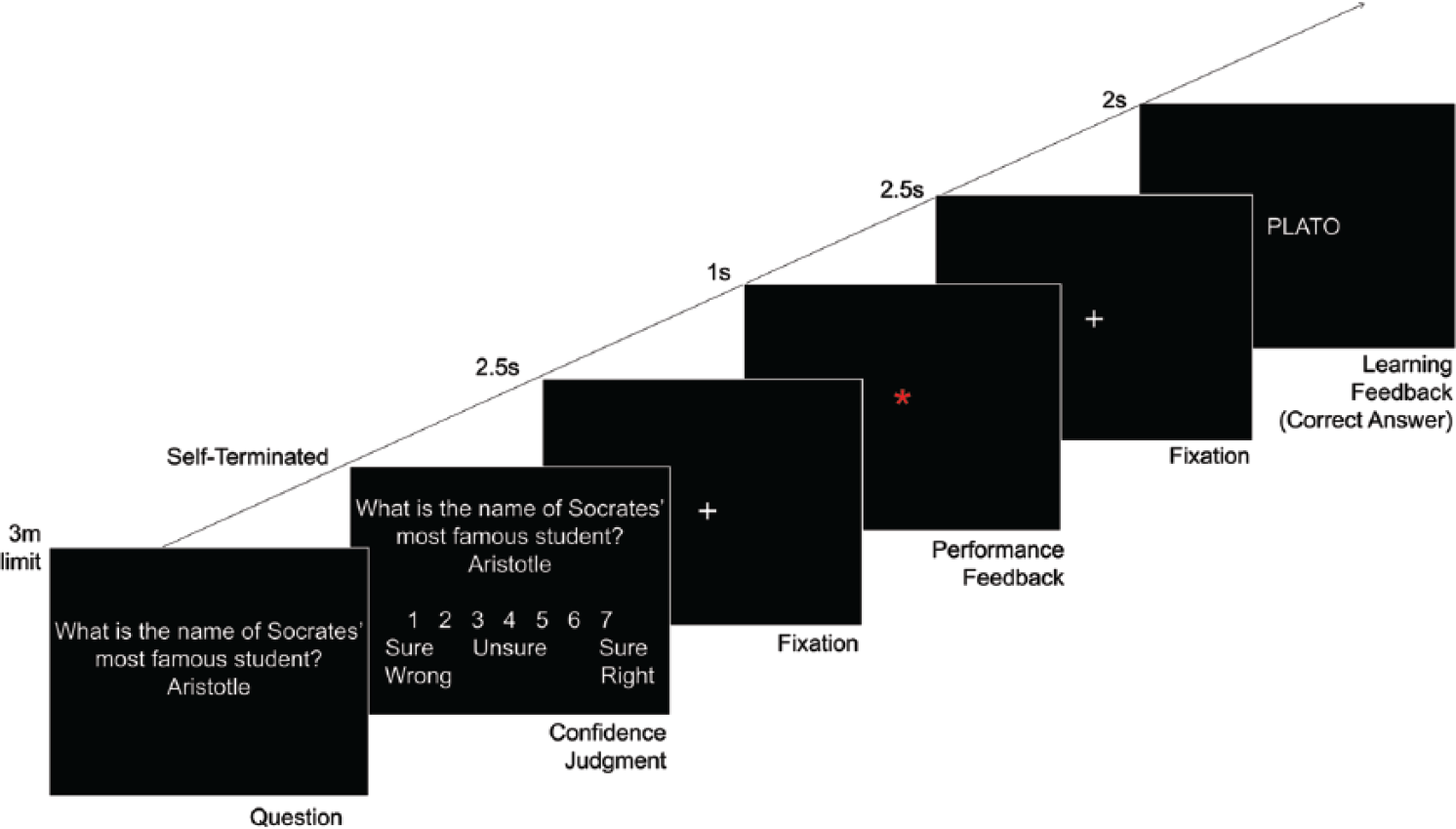
Trial sequence of an incorrect response. After participants provided an answer, they were asked to rate their confidence (1–7) in that answer. During performance feedback, an incorrect answer (shown here) resulted in a red asterisk with a low tone. A correct answer resulted in a green asterisk with a high tone. At the end of the trial, the learning feedback (i.e., correct answer) was displayed.
After a delay of ~15 min from completion of the first test, during which the EEG cap was removed, participants returned to the booth to begin the retest. In this phase, they were prompted to answer all the questions that they had answered incorrectly at first test. No specific achievement goal instructions were given during the retest, and items from the first and second blocks of the test were intermixed in a random order. Participants were not explicitly informed that they would be answering incorrect first test items during the second phase, just that they would be answering additional questions. During debriefing, all participants reported being surprised about the retest.
EEG Recording and ERP Data Reduction
Continuous EEG was recorded only during the first test with a sintered Ag/AgCl 64-electrode Quick-Cap and amplified with Neuroscan Synamps 2 with an A/D conversion rate of 500 Hz and a bandpass of DC-100 Hz. Impedance was kept <11 kΩ. EEG was initially referenced to Cz and then converted to an average reference offline. We compensated for blinks and other eye movement artifacts with two to six PCA-derived ocular components (BESA 5.2). Offline, the EEG was cut into epochs time locked to feedback presentation (performance feedback: –100 to 1,000 ms, poststimulus; learning feedback: –100 to 1,500 ms, poststimulus). We could not analyze the final 500 ms of the learning feedback because of increased eye and muscle noise during that part of the epoch.
Following baseline correction to the 100-ms interval preceding the stimulus, epochs containing excessive noise (±100 mV) were rejected, and the remaining epochs were averaged to create the ERPs. A 35-Hz low-pass filter and a 0.15-Hz high-pass filter were applied before averaging. ERPs to performance feedback were averaged as a function of accuracy (correct, incorrect) and instruction frame (PG, MG). ERPs to learning feedback were averaged for incorrect first test responses only, as a function of subsequent memory at the retest (later corrected, not corrected) and instruction frame.
Data Analysis
Behavioral analyses
We analyzed the proportion of first-test and retest questions answered correctly in a series of 2 × 2 mixed model ANOVAs: Goal (PG vs. MG) × Order (PG first vs. MG first). For behavioral and ERP analyses, we conducted Tukey’s HSD post hoc tests to address interactions, where appropriate.
ERP analyses
To identify the FRN, we focused on the ERP waveform time locked to negative feedback at Fz (see Figure 2) and identified the peak amplitude of the largest negative-going deflection between 200 and 400 ms for each participant. For the frontal P3a, we focused on the ERP waveform at Fz that was time locked to positive feedback, and we identified the peak amplitude of the largest positive-going deflection between 275 and 425 ms for each participant. Because it was often difficult to identify an FRN to positive feedback or a P3a to negative feedback, we measured the peak amplitudes of these components at the same latency as the FRN to negative feedback and P3a to positive feedback, respectively (see also Whiteman & Mangels, 2016). To increase reliability of the amplitude measurements, we used mean windows of ±25 ms around these peaks for analyses (see also Luck & Gaspelin, 2017; Mangels et al., 2006; Whiteman & Mangels, 2016). Both the FRN and the P3a were analyzed with a 2 × 2 × 2 mixed model ANOVA: Goal (PG vs. MG) × Order (PG first vs. MG first) × Response Accuracy (correct vs. incorrect).

Performance feedback. Grand mean waveforms illustrating the feedback-related negativity (FRN) and P3a at their Fz maximum, as a function of task frame and response accuracy. PG = performance goal; MG = mastery goal.
Our analysis of the ERPs related to learning feedback focused on electrodes along the inferior anterior-posterior axis of the scalp. Our time frame of interest was the 400- to 800-ms period where memory-related effects were maximal in the grand mean waveforms (see Figure 3). To test the hypothesis that a PG frame would be associated with less semantic processing of the learning feedback than an MG frame, we compared Dm effects at inferior fronto-temporal regions (left hemisphere: average of FT9/T7; right hemisphere: average of FT10/T8), with Dm effects over the parieto-occipital regions (left hemisphere: average of PO3/O1; right hemisphere: average of PO4/O2). By simplifying the electrode factor to this single average value for each region, we were left with a 2 × 2 × 2 × 2 × 2 mixed model ANOVA (see online supplement for additional ERP analysis details): Region (fronto-temporal vs. parieto-occipital) × Hemisphere (left vs. right) × Goal (PG vs. MG) × Subsequent Memory (corrected vs. not corrected at retest) × Order (PG first vs. MG first).

Learning feedback. Grand mean waveforms averaged as a function of task goal instruction and later error correction on the surprise retest at selected electrodes along the fronto-central midline and anterior-posterior axis of the inferior temporal region. Electrode positions, depicted by the blue circles, provide relative placement only. PG = performance goal; MG = mastery goal.
Results
Behavioral Effects
First-test and retest accuracy
First-test and retest performance, as a function of goal instruction and instruction order, are shown in Table 2. Titration was successful in bringing first-test performance in each goal condition to ~30% correct. Although the use of titration greatly reduced the magnitude and variance of between-subject differences in first-test performance, we still found a significant Goal × Order interaction at first test, F(1, 24) = 4.9, p < .05. Tukey’s HSD post hoc tests indicated that participants had slightly higher accuracy in the second block, regardless of the instructions for that block. Although general practice effects may have contributed to this slight improvement, it is possible that the efforts of the titration algorithm to bring performance down to 30% resulted in the harder questions from the pool being depleted by the first block. Indeed, the questions in the second block were marginally easier (based on accuracy ratings from normative data) than those in the first block, F(1, 24) = 3.6, p < .07. Response confidence was also analyzed as a function of Accuracy (corrects vs. errors), Goal, and Order factors. As expected, participants were more confident in correct answers (M = 5.2, SEM = .09) than incorrect answers (M = 2.5, SEM = .11), F(1, 24) = 426.6, p < .001, but this effect did not interact with Goal and/or Order.
Percentage Recalled at First Test and Retest
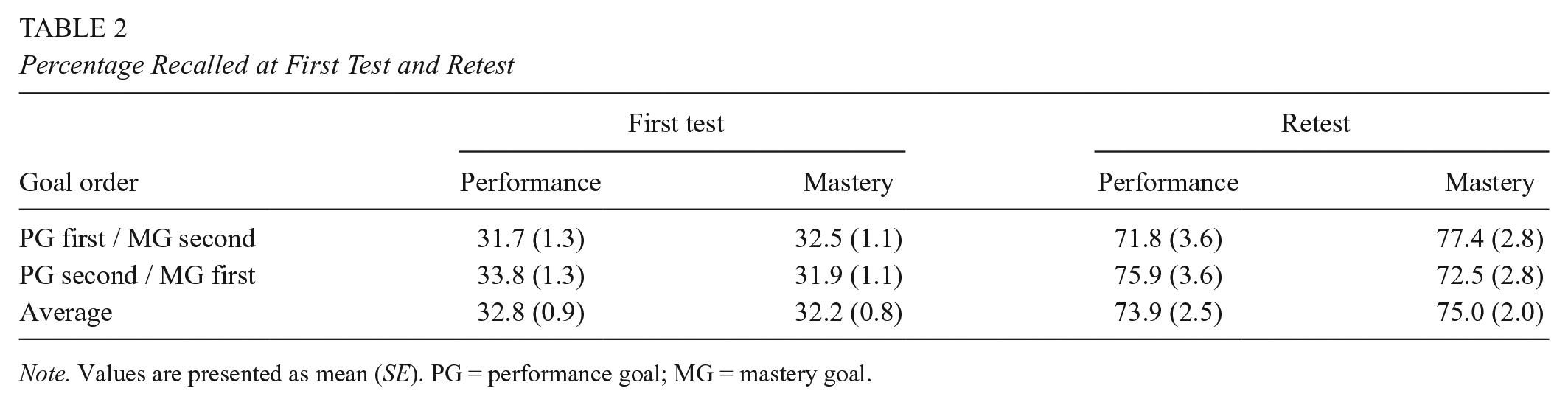
Note. Values are presented as mean (SE). PG = performance goal; MG = mastery goal.
Turning to retest performance, we first note that even after titration minimized interindividual differences, the relationship between accuracy at first test and retest remained highly correlated under both goal instructions (rs > .56, ps < .005). To provide additional control for any impact that these small differences might have had on retest error correction, we first regressed out first-test accuracy from retest performance, then took the residual and added back the mean (see also Whiteman & Mangels, 2016). We calculated this adjusted retest performance measure separately for each goal condition. Using these adjusted measures, we found that the proportion of items that participants corrected at retest did not differ by either Goal or Order overall. Although there was a marginal Goal × Order interaction, F(1, 24) = 3.67, p = .07, post hoc tests failed to reveal any significant differences between conditions. Thus, we did not support the prediction that an MG instruction would result in better error correction than a PG instruction.
ERP Effects
Performance feedback
Figure 2 illustrates the ERP waveforms at Fz associated with processing positive and negative performance feedback under each goal instruction. Consistent with past studies demonstrating the sensitivity of the FRN to negative feedback, we found that negative outcomes elicited a more negative-going FRN than positive outcomes overall, F(1, 24) = 35.59, p < .001. Also in accordance with previous findings, the P3a, which is typically larger for novel stimuli, was somewhat larger for the relatively “rare” positive feedback (i.e., 30% of trials), as indicated by a marginal overall effect of Accuracy, F(1, 24) = 3.48, p = .07. However, neither of these waveforms demonstrated significant main effects of Goal or interactions between Goal and Accuracy (Fs < 1.8, ps > .19). Although some effects of Goal did emerge in the context of interactions with Order, these may reflect the tendency of the P3a to show habituation effects over the duration of the experiment (see online supplement for details). Thus, our results did not support our basic prediction that the P3a, either overall or to negative feedback in particular, would be enhanced under a PG goal versus an MG goal.
Learning feedback
Consistent with predictions that goal instruction would influence the neural effects related to successful encoding of the learning feedback, we found not only a robust overall difference between later-corrected and not-corrected items, F(1, 24) = 10.6, p < .005, but also a significant interaction among subsequent memory, goal, and region, F(1, 24) = 12.0, p < .005. Investigating this 3-way interaction further, post hoc tests revealed that under the MG instruction, learning feedback later retrieved successfully on the retest only elicited significantly greater negative-going activity than later forgotten items over the fronto-temporal region, whereas under the PG instruction, memory-related effects were significant only over the parieto-occipital region (see Figures 3 and 4). The apparent double dissociation in distribution of these subsequent memory effects as a function of goal instruction is highlighted in Figure 4a. Goal order did not significantly interact with these effects (p > .9).

Learning feedback: Dm difference waves. (A) Mean amplitude of Dm difference waves (corrected–not corrected on the surprise retest) from 400 to 800 ms, as a function of task goal instruction and electrode group (fronto-temporal vs. parieto-occipital), collapsed over hemisphere. Error bars illustrate the standard error of the mean. (B) Scalp topography of the mean Dm difference waves from 400 to 800 ms as a function of task frame, showing views of the left and right hemispheres. White electrodes highlight the fronto-temporal and parieto-occipital electrodes included in our analyses. Dm = difference due to memory; PG = performance goal; MG = mastery goal.
In addition, we found a significant interaction among subsequent memory, region, and hemisphere, F(1, 24) = 5.4, p < .05, and a weak trend toward this interaction being moderated further by Goal, F(1, 24) = 3.1, p = .09. Post hoc comparisons focusing on the significant 3-way interaction of memory, region, and hemisphere demonstrated that the posterior memory-related effects were significant only over the right hemisphere, but frontal memory-related effects were significant across both hemispheres (see Figure 4b). Neither of these interactions was influenced by Order (Fs < 1.1, ps > .2). Given that hemisphere moderated the relationship between subsequent memory and region (and perhaps goal to some extent as well), we opted to include hemispheric differences when we next considered how personal achievement goals might moderate the relationship between task goals and memory-related activity.
Moderating Effects of Personal Achievement Goals
These analyses explored whether the personal achievement goals that the student brought to the task moderated the influence of each task goal on the retest and the ERP measures of interest (i.e., FRN, P3a, and Dm amplitudes). The regression model for each dependent variable included the four continuous personal achievement goal subscales—PAP, PAV, MAP, and MAV—averaged across prescreen and day of testing, as well as the order of goal instruction (dummy codes: 0 = PG first, 1 = MG first) and interactions between goal order and each of the four personal goals. The first level of the model included only main effects of personal goals and order. The second level added all interaction terms.
To keep the models from being underpowered given our relatively small sample size, we conducted regressions for the PG and MG instruction frames separately, rather than including task goal and all associated interactions as additional levels. All predictor variables were centered on their respective means. To streamline reporting of our findings, we report only betas that are significant (p < .05) or marginally significant (.1 > p > .05), when the overall model is also significant. However, tables of all regression results can be found in the online supplement.
Retest performance
Neither regression model reached significance for either the PG or MG conditions (all Fs < 2.0, all ps > .12). Thus, in addition to the overall lack of goal manipulation effects on retest performance, we did not find evidence for modulation of retest performance by match or mismatch with personal goals.
Performance feedback: FRN and P3a
We did not find evidence for goals moderating any of the FRN or P3a responses (all Fs < 1.0, all ps > .47).
Learning feedback (Dm effects)
For these analyses, we focused on predicting the difference in amplitude between later-corrected and not-corrected items on the retest (i.e., Dm difference wave). It is important to keep in mind that memory-related activity at these sites was always more negative going for later-corrected items; thus, a larger difference between corrected and uncorrected items is represented by a more negative value for the Dm difference wave (i.e., Dm effect). Correspondingly, negative beta values indicate that stronger endorsement of a particular achievement goal (i.e., PAP, PAV, MAP, MAV) is associated with an enhanced Dm effect.
We conducted separate regressions at each of the four regions considered in the main analysis (i.e., left fronto-temporal, right fronto-temporal, left parieto-occipital, right parieto-occipital), for each of the two goal instruction conditions. Of these analyses, only the following analyses yielded significant models: (1) right occipital-parietal Dm effect under PG instruction and (2) left and right fronto-temporal Dm effects under MG instruction. Table 3 summarizes the fit and nonfit effects at these sites as a function of task and personal goal type, including any interactions with goal order.
Summary of Personal-Task Goal Interactions Involving Dm Effects

Note. Arrows pointing upward (↑) indicate greater Dm effects (i.e., larger amplitude differences between first-test learning feedback later remembered vs. forgotten on the retest). Arrows pointing downward (↓) indicate smaller Dm effects. An effect is listed as “overall” if it was found as a main effect. Effects that interacted with goal order are depicted in the order description row (i.e. MG first or MG second).
† = .05 < p < .10, * = p < .05, ** = p < .01, *** = p < .001.
For the right parieto-occipital region under a PG, only the Level 1 model reached significance, F(5, 20) = 2.84, p < .05, and the results were relatively straightforward. Consistent with a fit perspective, greater endorsement of PAP goals (i.e., a PG match) predicted a marginally larger negative-going Dm effect, b = −0.76, β = −.35, t(20) = −2.01, p = .06, whereas greater endorsement of MAV goals (i.e., a PG mismatch) predicted a smaller Dm effect, b = 0.75, β = .39, t(20) = 2.27, p < .05. No other significant main effects were found (ps > .15).
At both fronto-temporal sites, however, the Level 2 models were significant: left fronto-temporal sites, F(9, 16) = 4.84, p < .01; right fronto-temporal sites, F(9, 16) = 4.20, p < .01. First, considering the main effects only, we found that, at left fronto-temporal sites, MAP (i.e., an MG match) predicted a larger Dm effect, regardless of instruction order, b = −1.06, β = −.54, t(16) = −3.87, p < .005, providing support for a fit effect (this MAP effect was also significant in the Level 1 model, p < .01; see online supplemental text). At right fronto-temporal sites, the Level 2 model also revealed a marginal main effect for PAV predicting a smaller Dm effect (i.e., an MG mismatch), b = 0.27, β = .29, t(16) = 1.87, p = .08, thereby providing some support for a nonfit effect.
Investigating these Level 2 models further, however, revealed interactions with instruction order that emerged for all personal goals except MAP (all ps < .05). Although these effects also generally supported predictions regarding fit/nonfit effects, they further qualified these as being specific to a particular instruction order. First, simple slope analyses (Aiken & West, 1991) indicated that MAV predicted a larger left fronto-temporal Dm effect (i.e., an MG match effect) when students experienced the MG instruction second, b = −0.75, β = −.46, t(16) = −2.15, p < .05, but not when the MG instruction was presented first, b = 0.21, β = .13, t(16) = 0.77, p = .45. PAP goals, however, predicted only a smaller left fronto-temporal Dm effect (i.e., an MG mismatch effect), when MG instruction was presented first—MG/first: b = 1.10, β = .59, t(16) = 2.65, p < .05; MG/second: b = −0.21, β = −.11, t(16) = −0.64, p = .54.
A significant nonfit effect was also found for PAV goals at the right fronto-temporal sites when mastery was presented second, b = 0.78, β = .85, t(16) = 4.44, p < .001, but not when it was presented first, b = −0.25, β = −.27, t(16) = −1.10, p = .29. Finally, somewhat unexpectedly, PAV goals also exhibited a marginally beneficial influence on the left fronto-temporal Dm effect when the MG instruction was presented second—MG/second: b = −0.44, β = −.39, t(16) = −2.13, p = .05; MG/first: b = 0.35, β = .31, t(16) = 1.34, p = .20.
Discussion
Our primary question concerned how framing a challenging test of general knowledge as focused on a PG or MG influenced the neural response to performance and learning feedback, as well as the ability to use this feedback to correct errors on a subsequent surprise retest. Achievement goals are thought to provide individuals with a framework that guides how they attend to and interpret achievement-relevant information (Ames, 1992; Locke & Latham, 2006). Drawing on past behavioral (e.g., Graham & Golan, 1991; Lau, Liem, & Nie, 2008) and ERP (Mangels et al., 2006) research, we predicted that PGs would bias attention toward performance feedback, particularly negative feedback that impugned ability, but be associated with shallower processing of learning feedback. In contrast, we expected that MGs would bias attention toward learning feedback in a manner that would lead to deeper encoding of that information and better subsequent recall.
We did not find strong evidence for the PG instruction biasing attention toward performance feedback; however, we did find evidence for framing instruction influencing the distribution of neural activity associated with successful encoding of corrective learning feedback (i.e., Dm effects) in a pattern suggestive of the predicted goal-based differentiation between perceptual and conceptual processing. Specifically, PG framing was associated with stronger Dm effects over parieto-occipital scalp regions, consistent with regions implicated in visuoperceptual processes (for review, see Taylor & Thut, 2012). MG framing, however, was associated with stronger Dm effects over fronto-temporal scalp regions, proximal to regions implicated more in semantic, conceptual processes (for review, see Binder et al., 2016; see also Lai & Mangels, 2007; Mangels et al., 2001; Nessler et al., 2006).
The magnitude of these encoding-related neural differences was influenced by whether the task goal matched students’ trait achievement goals or not. In addition, some of these effects were moderated by the order in which goal frames were presented, suggesting that asymmetries in the ability of students to transition fluidly between goals. Yet, despite these effects of task and personal goals on encoding-related neural activity, no behavioral differences in retest performance were apparent on the immediate surprise retest. In the following sections, we discuss the observed neural effects in relation to our predictions, their relation to retest performance, and implications for learning in the classroom.
Performance feedback
The FRN and P3a showed the expected overall enhancement to negative and positive feedback, respectively, yet neither waveform demonstrated a clear overall relationship to task or interaction with personal goals. These findings contrast with the robust effects of personal PGs on the P3 to negative feedback found by Mangels et al. (2006). Although it is not unprecedented to find that personal goals and task goals affect behavior differently (Murayama & Elliot, 2009; Wolters, 2004), it was somewhat more surprising that we did not find effects of personal goals on the P3a amplitude. Thus, we did not replicate the personal goal findings on the P3a from Mangels et al. (2006).
There are some important differences between that study and the present one, however. First, the measure of personal PGs and MGs from Mangels et al. (2006) came from Grant and Dweck (2003) and did not include the approach-avoidance axis. Second, Mangels et al. found the strongest relationship between personal PGs and P3a amplitude to negative feedback following errors that had been endorsed as correct with high confidence. These types of errors may be particularly salient to individuals with strong PGs, as they represent an error not only in knowledge, but also in their metacognition about that knowledge (Butterfield & Mangels, 2003; Metcalfe, Butterfield, Habeck, & Stern, 2012). Had the present study not had to sacrifice the power to subdivide effects along levels of confidence in favor of having the power to examine the manipulation of frame in a within-subjects design, stronger effects of task and personal achievement goals may have emerged.
Learning feedback
In contrast to the lack of clear task goal effects on neural correlates of performance feedback processing, robust influences were found for the neural correlates of successful encoding of the learning feedback (i.e., correct answer). Our analysis of the 400- to 800-ms period following onset of the learning feedback replicated the basic subsequent memory effects found in similar ERP studies (Butterfield & Mangels, 2003; Mangels et al., 2001; Nessler et al., 2006; Whiteman & Mangels, 2016); correct answers later retrieved on the subsequent surprise retest exhibited more negative-going activity over multiple inferior sites spanning occipital to posterior frontal regions, compared with those that were forgotten (i.e., differences due to memory [Dm]). Importantly, however, we found that students presented with these learning opportunities under a PG frame exhibited Dm effects primarily over posterior (parieto-occipital) regions, whereas under a MG frame, Dm effects shifted to fronto-temporal regions.
Neurocognitive studies indicate that processing of visual-verbal stimuli progresses from initial visual perceptual and lexical processes—localized in more posterior regions of the visual ventral stream, to semantic retrieval—localized in anterior portions of the temporal lobe and posterior-inferior regions of the prefrontal cortex (although there are also reciprocal connections from the anterior regions back to posterior regions; Binder & Desai, 2011; Carreiras, Armstrong, Perea, & Frost, 2013; Hauk, 2016). Thus, one interpretation of the goal-related dissociation in localization of Dm effects observed here is that under a PG frame, Dm effects were driven by differences in sustained attention to perceptual features of the answer, whereas under an MG frame, they were driven by differences in the degree of semantic processing. Such effects of task goals on the neural substrates for learning would converge with previous research findings that MGs support deeper, more adaptive, and more resilient learning styles (Elliot & McGregor, 1999; Grant & Dweck, 2003; but see Senko, Hulleman, & Harackiewicz, 2011). These findings also appear to converge with those of Murayama and Elliot (2011), who found that PGs enhanced remember responses, whereas MGs enhanced know responses to verbal stimuli at an immediate test. Correspondingly, Mangels et al. (2001) found that Dm effects over left anterior temporal regions supported subsequent know responses, but sustained activity over bilateral occipitotemporal regions (and frontal poles) supported remembering.
Personal-task (environment) goal fit
Within these frame-specific Dm patterns, we also found compelling evidence supporting the importance of a match or mismatch between students’ personal goals and the goals emphasized by the task instruction. In support of the benefits of a personal-task goal match, fit effects (i.e., larger Dm effects) were found for MAP and MAV goals in the MG frame and for PAP goals in the PG frame. Nonfit effects (i.e., reduced Dm effects) were found for PAP and PAV goals in the MG frame and for MAV goals in the PG frame (see Table 3).
Taken together, these results suggest that fit between task goals and personal goals can have a direct impact on the extent to which particular neural substrates for successful learning are engaged. Indeed, the only sites where personal goals influenced Dm effects were those where task goal differences had been found. This suggests that personal goals had additive (or subtractive) effects on the strength of the task goal influence, rather than independent effects. These synergistic effects were not specific for either the approach or avoidance orientation of a given goal type and, in the case of the left fronto-temporal region, occurred for both. However, whereas the fit effects in the PG frame were not influenced by instruction order, order influenced all but the effect for MAP in the MG frame. We turn to the effects of instruction order next.
Transition (order) effects
Manipulating task goals within the same subject provided an opportunity to ask how effectively students could navigate between successively presented task goals. Order effects in within-subjects designs are typically viewed as a nuisance at best, but here we saw them as meaningful information that could provide insight into the experience of the typical student, who might move between different goal frames as he or she transitions between classrooms or even between tasks within a given classroom.
Although some order effects emerged for behavioral (i.e., initial test and retest) and performance feedback (i.e., FRN, P3a) measures, to a large extent these could be explained as the result of titration constraints, general practice effects, habituation, or other effects that were not specific to goal instruction. With respect to learning, order did not influence the robust effects of goals found on the spatial distribution of Dm effects. These latter findings suggest that participants rapidly modified their level of processing of the learning feedback in response to the change in frame despite minimal changes in other aspects of task context (i.e., room or task type).
Interesting transition effects emerged during examination of the personal-task goal interactions on the fronto-temporal Dm effect, however. At the left and right fronto-temporal sites, MG Dm effects were significantly influenced by avoidance goals (MAV or PAV) when students had to transition from a PG to an MG. This suggests that repeatedly experiencing negative feedback in a PG environment may have activated avoidance goals, making them more influential in determining how learning feedback was processed when students then switched to the MG frame. It also may have resulted in some residual activation of the PG, as suggested by the paradoxical enhancement of the left fronto-temporal Dm effect by PAV goals under this MG frame (i.e., acting in the manner of a “fit” effect; see also online supplemental text for discussion of carryover effects in the manipulation check).
Taken together, although these analyses were exploratory and require further replication, they suggest that learning in MG environments is more vulnerable to carryover effects from previous learning contexts or at least from PG learning contexts. Personal-task goal interactions in the PG frame were not affected by order. Moreover, when the MG frame was presented first, as the de novo goal, personal-task goal effects were dominated only by approach goals (MAP and PAP) in the expected directions.
Limitations
An important question arising from these findings is why task framing led to qualitative differences in the neural patterns supporting successful encoding, yet these differences were not reflected in behavioral outcomes (i.e., error correction on the surprise retest). One possibility is that the encoding processes preferentially used under PG and MG frames were equally effective in supporting error correction, at least on an immediate test. Notably, Murayama and Elliot (2011) also did not find goal frame effects on overall immediate test performance, but only when subdividing recognition performance by phenomenological experience (remember/know).
Behavioral effects in the present study may have been more evident if the retest been more demanding, potentially by presenting the full set of 200 questions, rather than just testing those questions that were initially incorrect, or by using a longer retest delay. Indeed, Murayama and Elliot (2011) found that the MG frame resulted in marginally greater “remember” responses on a delayed (1 week) retest, whereas PG framing had no effect, suggesting that information encoded under an MG frame decayed at a slower rate. Currently, we are replicating and extending the present work by examining the effects of MG and PG goal framing on immediate and 1-week delayed tests that include both initially correct and incorrect items.
Conclusions and Relevance to Education
Neuroscience approaches to educationally relevant issues can complement behavioral work by providing insights into mechanisms underlying successful learning, thus providing entry points for intervention. In the present study, we demonstrate how changes to task goal framing of only a few words can have a significant influence on the neurocognitive processes that students use when presented with corrective feedback—a learning tool ubiquitous to many classrooms. Task achievement goals emphasizing interest and learning (i.e., mastery) resulted in error correction engaging neural regions putatively associated with conceptual processing, whereas an emphasis on performing well relative to others engaged regions associated more with perceptual processing. Although this goal manipulation did not result in differential test performance outcomes on an immediate test, neural evidence showing underlying differences in how students achieved similar levels of performance is still valuable. Perceptual processes might lead to a vivid initial memory, yet for general knowledge, which draws heavily on retrieval from semantic memory, encoding processes that support conceptual processing are more adaptive and ultimately lead to better long-term learning (Murayama & Elliot, 2011; cf. Tulving, 1985).
As the general benefits of MGs and incremental mind-sets become more popularized (e.g., http://mindsetscholarsnetwork.org/), leading more schools and educators to consider shifting classroom or task contexts to a mastery focus, it is important to consider factors that may moderate the success of these programs in accelerating student learning. Students enter classrooms with their own personal goals, which may or may not match with those emphasized by the educational environment. Findings from the present study suggest that a match between personal and task goals can intensify the type of cognitive processing promoted by the task instruction, whereas a mismatch can reduce it (see also Rodriguez, Romero-Canyas, Downey, Mangels, & Higgins, 2013). Additionally, in real-world educational situations, students may transition among multiple classrooms, with different task goals and levels of challenge. Our findings suggest that a full understanding of how students learn in a mastery environment must consider the level of performance orientation and personal competence experienced in the immediately previous situation.
In summary, although we find generally supporting evidence for emphasizing a MG during a challenging feedback-based learning task, it is important to consider that one task goal does not necessarily “fit” all students equally well, nor should educators consider task goals in isolation, unaffected by the task situations that preceded it. As such, this study can contribute to a greater understanding of how (and when) classroom achievement goals influence learning processes, thus contributing to the growing dialogue among research, practice, and policy in the effort to understand how these factors should (responsibly) integrate into the classroom to support learning over time.
Footnotes
Acknowledgements
All authors made substantial contributions to this manuscript: J.A.M. and S.R. developed the study; S.R. and B.G.C. tested subjects; and all authors analyzed data, prepared figures, and wrote the manuscript. S.R. and B.G.C. were funded at various points through an National Science Foundation Graduate Research Fellowship, and J.A.M. was funded by a Professional Staff Congress–City University of New York Research Award. S.R. also received some funding support from Columbia University through her graduate mentor, E. Tory Higgins. We additionally thank Dan Lurie, Anika Sierk, and Olta Hoxha for their assistance to S.R. and B.G.C. in running subjects.
Authors
JENNIFER A. MANGELS is professor and chair of psychology at Baruch College, a senior college of the City University of New York (CUNY), as well as doctoral faculty in the CUNY Neuroscience Collaborative and the Cognition, Language, and Development programs at the CUNY Graduate Center. Her work integrates behavioral and neuroscience methods to understand how the motivation of the individual learner and social context in which that individual is learning work together to facilitate or inhibit one’s achievement on challenging, academically-relevant tasks.
SYLVIA RODRIGUEZ is currently the director of research & implementation at Mindset Works, Inc. Her research interests include motivation, student academic achievement, and mind-set.
YULIYA OCHAKOVSKAYA is currently a PhD candidate at the CUNY Graduate Center. Her research employs methods of neuroscience (electroencephalography/event-related potential, transcranial direct current stimulation) to examine the influences of achievement goals on student motivation and learning.
BELÉN GUERRA-CARRILLO is an National Science Foundation graduate student fellow in the Department of Psychology in the University of California, Berkeley. She studies the neural and cognitive mechanisms that underlie the plasticity of higher cognition, using a variety of methodologies, (e.g., large data sets, eye tracking, neuroimaging).
References
Supplementary Material
Please find the following supplemental material available below.
For Open Access articles published under a Creative Commons License, all supplemental material carries the same license as the article it is associated with.
For non-Open Access articles published, all supplemental material carries a non-exclusive license, and permission requests for re-use of supplemental material or any part of supplemental material shall be sent directly to the copyright owner as specified in the copyright notice associated with the article.
