




Abstract
The Common Core State Standards (CCSS) require students to read grade-level text with “scaffolding as needed.” The current study examines the effectiveness of interactional scaffolding, which is responsive in-person support an expert provides to a novice reader in order to support the reader’s comprehension during reading instruction, for 213 young adolescents learning within a four-lesson small-group guided-reading intervention (N = 196 instructional sessions). The intervention taught students, many of whom were reading below grade level, to use comprehension strategies as they read CCSS-style complex texts. To support student reading, tutors were encouraged to choose from a set of interactional scaffolds to contingently respond to student needs as they arose. Multilevel regression indicated that motivational scaffolding—but not vocabulary, fluency, comprehension or peer scaffolding—predicted growth on standardized reading comprehension. Implications for research and practice are discussed.
Supporters of increasing text complexity have argued that easier, ability-matched text “ultimately denies students the very language, information, and modes of thought they need most to move up and on” (Adams, 2011, p. 6). According to Shanahan (2013), pre-CCSS standards that did not specify text complexity resulted in “emptily requiring particular mental gymnastics during reading, without consideration of challenge levels” (p. 6). Yet increasing text complexity may have unintended consequences. Hiebert and Mesmer (2013) point out that the evidence supporting the CCSS rationale for increased text complexity is largely from the high school level, and younger readers may be vulnerable if texts become more challenging without accompanying support. Sanden (2014) argues that subjecting students to constant struggle with texts at the edges of their capabilities may affect their motivation to read (Guthrie, Wigfield, & You, 2012; McRae & Guthrie, 2009). Here, teachers who properly support students as they read complex texts could change frustrating experiences into successful ones.
Experimental research has shown that interactional scaffolding, which is responsive in-person support an expert provides to a novice reader in order to support the reader’s comprehension, is effective in supporting student reading when more-scaffolded interventions are compared to less-scaffolded comparison groups (e.g., Alfassi, 1998; Diehl, Armitage, Nettles, & Peterson, 2011; Lysynchuk, Pressley, & Vye, 1990; Palincsar & Brown, 1984; Scharlach, 2008). These interventions, however, merely establish that scaffolding works to support reading, without providing an understanding of which dimensions of scaffolding support comprehension, especially for readers of complex texts. In fact, little research exists about how to scaffold students who are reading complex texts above their ability levels. The intervention reported in this study builds on promising research about interactional scaffolding to investigate the specific kinds of scaffolding that best support student comprehension.
Defining and Framing Interactional Scaffolding
Across education research and practice, scaffolding is a popular construct that has been defined in a myriad of ways. Consequently, researchers have lamented that the term’s lexical breadth has made it difficult to precisely specify the construct (Belland, 2014; Pea, 2004; Palincsar, 1998; Putambekar & Hubscher, 2005; Stone, 1998). One consistent trend in the research, however, has been for researchers to distinguish between interactional scaffolding (Athaneses &de Oliveira, 2014; Hammond & Gibbons, 2005), defined as support provided by humans and responsive to a learner’s immediate needs, and planned scaffolding, which is the support provided by tools and curriculum that can be extended across settings but is not contingent upon the immediate needs of individual learners (Stone, 1998; Putambekar & Hubscher, 2005; Van de Pol, Volman, & Beishuzen, 2010). Interactional scaffolding captures the dynamic, responsive nature of face-to-face scaffolding between a scaffolder and scaffoldee, which could also include a scaffolder encouraging a student to use a planned scaffold, as when teacher asks a student to use a glossary, as long as that scaffold is used in response to an observed student need. Conversely, planned scaffolding indicates that the scaffold was predetermined before the start of a lesson—perhaps thoughtfully so and based on an awareness of the learner’s needs but not in direct response to needs observed during a lesson.
Planned scaffolds and curriculum have been studied and provide a foundation for reader support. Research suggests, however, planned scaffolds can also inadvertently overscaffold student thinking (Applebee & Langer, 1983; Daniel, Martin-Beltrán, Peercy, & Silverman, 2015). Therefore, research must expand on the existing experimental evidence base suggesting the effectiveness of interactional scaffolding in order to generate nuanced understandings of the effectiveness of particular forms of interactional scaffolding while students read complex text. In other words, although CCSS Appendix A includes both planned scaffolds, such as textual features (i.e., glossaries, diagrams, etc.), and broadly specified interactional scaffolds, such as teacher assistance and class discussion, what is missing is understanding how educators are responding to student needs with interactional scaffolding as they read complex texts. The current study examines this question by exploring the link between student reading comprehension and reading tutors’ varied use of interactional scaffolds that occurred within the fixed framework of the planned scaffolding of the lesson plans and scripts.
For a theoretical understanding of why interactional scaffolding would be consequential for supporting reading, we examine the sociocultural origins of the term and its connections to the work of Vygotsky (1978). Although the term was first used by Wood, Bruner, and Ross (1976), Cazden (1979) was the first to connect it to Vygotsky’s “zone of proximal development” (ZPD). Vygotsky claimed that learning processes in the ZPD are activated “only when the child is interacting with people in his environment” (Vygotsky, 1978, p. 90), and these interactions are eventually internalized as the child’s independent developmental achievement. In this study, the complex texts were deliberately selected (per CCSS guidelines) to provide a challenging ZPD for the students, and the social interactions with the tutors and peers around the complex texts (i.e., the interactional scaffolding) were crucial mechanisms of learning. Finally, although the learning itself is social and interactive, the eventual developmental achievement is the goal of the students independently comprehending complex texts.
To build upon Vygotsky’s work, Wertsch (1984) pointed out three key elements of interactive learning in the ZPD: situation definition, semiotic mediation, and intersubjectivity. The situation definition is the student’s and expert’s disparate initial representation of the learning tasks, which are reconciled through semiotic mediation, the process of experts and novices using tools and signs to mediate their learning interactions. Finally, intersubjectivity is the end goal of scaffolding where the novice now shares the expert’s representation of the task. In this study, the texts’ reading levels are largely well above the students’, meaning that the tutors had to work to mediate those disparities through the semiotic mediation of interactional scaffolding, and the tutors’ goal was to achieve intersubjective understandings of the complex texts.
Wertsch’s work can be linked to three important characteristics of scaffolding established in a major review by Van de Pol and colleagues (2010): contingency on students’ learning needs, transfer of responsibility for the learning from the teacher to the student, and fading of the support over time. For scaffolding to be contingent on student learning needs, educators must carefully attend to students’ initial situation definitions. Then, the process of transferring responsibility to the student is enacted through semiotic mediation, and the teacher fades support as the student moves closer toward an intersubjective understanding of the reading task. In this study, the tutors were trained to scaffold contingently on student needs as they arose and then immediately remove those scaffolds to encourage the transfer of responsibility for reading to the student, and the scaffolding was faded as students approached the goal of intersubjective comprehension of complex texts.
Linking Interactional Scaffolding to Reading
Although much work broadly links interactional scaffolding with reading comprehension (Alfassi, 1998; Lee, 1995; Lysynchuk et al., 1990; Palincsar & Brown, 1984; Rosenshine & Meister, 1994), less is known about specific scaffolds that support adolescent readers. Findings from the scaffolding literature have led to largely general findings. 1 These include noting that effective teachers use interactional scaffolding that builds on students’ contributions to discussions (Boyd & Rubin, 2006; D. Fisher & Frey, 2010; Gaskins, Rauch, Gensemer, & Cunicelli, 1997; Mariage, 1995) and that effective interactional scaffolding capitalizes on students’ prior knowledge (Athaneses & de Oliveira, 2014; Lee, 1995; Moss, Lapp, & O’Shea, 2011; Wortham, 1995). In addition, research also suggests that comprehension strategy instruction (i.e., planned curricular scaffolding) can be effectively supplemented by interactional scaffolding that supports the enactment of those comprehension strategies (Lutz, Guthrie, & Davis, 2006; Many, 2002; Scharlach, 2008). The general nature of these findings may be because the vast majority of studies have considered taxonomies of interactional scaffolding that focus on the general cognitive architecture of scaffolding through modeling, demonstrating, prompting, cuing, and so on (e.g., D. Fisher & Frey, 2010; Roehler & Cantlon, 1997), rather than considering taxonomies specific to reading and grounded within reading theories (see Reynolds & Goodwin, 2016, in a separate analysis of this data set).
Examining scaffolding aligned with theories of reading can be done using multiple lenses. From a cognitive frame, interactive models of reading, like Rumelhart’s (1984), suggest that reading occurs simultaneously at the letter, word, sentence, and text levels. For young adolescent readers, then, taxonomies supporting vocabulary, fluency, and comprehension would be needed as letter-related processing has become automatic at this developmental stage. Another important dimension of scaffolding the reading of complex texts involves the sociocultural context for reading, including working with peers, engaging in textual discussions, and attending to motivational needs of readers (Applebee, Langer, Nystrand, & Gamoran, 2003, Guthrie et al., 2004; RAND Reading Study Group, 2002). Thus, taxonomies that also include peer and motivational scaffolds would likely provide important understandings of reading supports. Below, we describe scaffolds that might be helpful within each of these reading-related areas as well as provide examples within Appendix A.
Vocabulary
For adolescents, processing at the word level mainly involves supporting vocabulary knowledge. Even for younger students, interactional vocabulary scaffolding has been shown to support vocabulary and comprehension when compared to instruction with just planned scaffolding (Brabham & Lynch-Brown, 2002; Pentimonti & Justice, 2010). To consider how vocabulary scaffolding might be operationalized for adolescents, Nagy (2007) suggested that vocabulary is acquired through three main routes: morphology (i.e., analyzing roots, prefixes, and suffixes), definitions, and context clues. Consequently, contingent upon student needs, vocabulary scaffolds that include general prompts to attend to vocabulary, encouraging students to use morphology, providing definitions and examples, and using context clues would likely support students’ reading at the word level, which then would support larger comprehension.
Fluency
Fluency scaffolds would likely benefit sentence-level processing. This is because as Kuhn and Stahl’s (2003) review of fluency literature suggests, improved prosody and automaticity make text similar to oral language. Thus, for students needing supports of sentence-level processing, scaffolds that encourage students to read like conversationalists or radio announcers and to pay attention to the prosodic clues in punctuation would likely help (Paige, Rasinski, Magpuri-Lavell, & Smith, 2014; Rasinski, 2003). Similarly, as students were reading sentences and paragraphs of text at a time as part of the curricular planned scaffolding, supplemental interactional scaffolds, like pointing to the words as students read or asking students to reread sections, also likely support sentence-level processing (A. Cole, 2006) as a route toward increased comprehension.
Comprehension
At the text level, much research has shown that students should be encouraged to employ strategic approaches to comprehending what they read (for a summary, see RAND Reading Study Group, 2002). This crucial approach was embedded in the planned scaffolding of the lesson plans in the intervention, which focused on teaching students to use comprehension strategies as they read. It was hypothesized, however, because of the research that links interactional comprehension scaffolding to reading comprehension (Lutz et al., 2006; Many, 2002; Scharlach, 2008), that additional interactional comprehension support provided on a contingent basis could facilitate student comprehension. To specify this additional support, scaffolds could prompt students to activate their preexisting strategies for reading. In addition, research has shown comprehension benefits for encouraging students to provide textual evidence for their claims (Celani, McIntyre, & Rightmyer, 2006; Jadallah et al., 2011). Furthermore, because comprehension monitoring has long been linked to increased comprehension (Baker & Anderson, 1982; Palincsar & Brown, 1984), comprehension scaffolds could encourage students to monitor their comprehension as they read. Finally, much research has shown that students’ background knowledge about a text is an important factor in their comprehension (Anderson, 1984; Langer, 1984). Thus, comprehension scaffolds offer routes for tutors to activate existing prior knowledge or provide necessary background information, if needed, for students to comprehend the complex texts.
Peer
Research suggests that providing social contexts where students discuss text with each other can build comprehension (Applebee et al., 2003; Monteiro, 2013; Nystrand, 2012), especially for English language learners (ELLs; M. Cole, 2014). Thus, peer scaffolds in which students read jointly or search for textual evidence together could be effective scaffolds. Peer scaffolding, however, has been primarily studied as a planned scaffold rather than as an interactional scaffold (i.e., M. Cole, 2014; Fuchs, Fuchs, & Kazdan, 1999). Therefore, in our study, multiple peer routes were hypothesized to allow tutors a broad spectrum to choose from to be as contingent as possible on students’ comprehension needs.
Motivation
Research has shown that reading motivation is a complex and multidimensional construct (Guthrie & Davis, 2003; Guthrie & Klauda, 2014). For adolescents, informational texts, such as those suggested by the CCSS and used in this study, present different and more complex motivational challenges than fictional texts (Ho & Guthrie, 2013). To account for this, the planned scaffolding of the intervention curriculum followed several criteria established by research (Guthrie et al., 2004; Guthrie, Wigfield, & VonSecker, 2000) by emphasizing knowledge goals through purposeful reading to answer questions such as “What is it like to live in space?”, provision of real-world interactions (i.e., interactional scaffolding) connected to topics, using comprehension strategy instruction, and supporting student collaboration. The challenge, however, was to establish a set of interactional scaffolds that would encourage student motivation and engagement on a moment-to-moment level.
A key study by Lutz et al. (2006) offers a promising rationale for understanding interactional scaffolding for reading motivation. This study linked teachers’ scaffolding of student engagement in complex literacy tasks to increased reading comprehension, finding that teachers’ interactional scaffolding decisions could either support or undermine students’ engagement with complex literacy tasks. Their results suggested that both moment-to-moment engagement and high task complexity were necessary for reading comprehension growth. To foster moment-to-moment engagement, motivational scaffolds in which tutors strive to maintain engagement in the complex text reading through creating an atmosphere of games, races, time limits, and competitions could support student reading. In addition, Margolis and McCabe’s (2006) discussion of how to support reading motivation for struggling readers within fixed instructional frameworks includes temporary extrinsic reinforcers as potential parts of a motivational scaffolding portfolio. Although these reinforcers are not a long-term motivational strategy, they offer opportunities for teachers to reward persistence and encourage participation in challenging tasks. Finally, research links teachers’ praise for strategy use to improved student thinking and reading comprehension, and so praise was conceptualized as motivational scaffolding (Lutz et al., 2006; Jadallah et al., 2011; Lin et al., 2014). Although these six motivational scaffolds are not a substitute for long-term reading motivation, they are appropriate ways to build and maintain moment-to-moment engagement during brief intervention using challenging complex texts.
Current Study
Research has provided a theoretical specification of interactional scaffolding and reading, and experimental evidence that suggests that scaffolding is effective. Our study moves beyond the typical focus on general scaffolding and explores the effectiveness of five categories of interactional scaffolds (vocabulary, fluency, comprehension, motivation, and peer) grounded in reading theories in predicting growth in reading comprehension for young adolescents. To eliminate potential confounds, we hold planned scaffolds, like curriculum, constant and we also place the interactional scaffolding within the reading of complex, grade-level texts in order to deepen understanding of how educators can support readers in reading complex texts.
Method
Participants
Student participants were 215 ethnically and linguistically diverse young adolescents from four urban public middle schools in the southeastern United States. The schools were selected for their many readers who would find reading complex texts at their grade level challenging. Participants were mostly fifth and sixth graders (56% and 40%, respectively), but there were also a few seventh and eighth graders (3% and 1%, respectively). 2 The students’ ethnic backgrounds were 18% White, 55% Black, 25% Hispanic, and 2% Asian, and their language backgrounds were 61% English fluent, 17% ELLs, and 22% language-minority youth (LMY). Students classified as ELLs received special ELL services at school, whereas LMY had tested out of receiving services and spoke a language other than English at home. The majority of ELLs and LMY spoke Spanish, with smaller numbers speaking Urdu, Yoruba, Lao, Arabic, Haitian-Creole, Amharic, French, Kurdish, Indian, and Bantu. In addition, 8% of the sample received special education services. Participants were largely low income, with 86% of the sample eligible for federal free or reduced-price lunch. Finally, most of the sample scored low in reading achievement. On their most recent state reading assessment, 66% of the test takers scored at the basic or below-basic level, and on the standardized reading comprehension pretest, 74% scored below the 50th percentile for their grade, with the modal decile being the bottom 10%. Figure 1 shows the distribution of student reading abilities on the pretest measure.

Histogram of student reading comprehension pretest percentile scores (Test of Silent Reading Efficiency and Comprehension).
Scaffolding was provided by 12 tutors who varied in teaching experience: four were or had been certified, full-time teachers; four were undergraduate education majors; three were master’s candidates in education; and one was a PhD student in literacy education with experience teaching reading classes. Furthermore, six tutors had worked previously in these schools, deepening their understanding of the instructional context. We deliberately selected tutors with a variety of experience levels because this is similar to the variability present in real-world instructional settings—particularly when reading content-area informational texts, some of which are taught by language arts teachers and others by content-area teachers with less experience teaching reading. Additionally, both Juel (1996) and Gaskins and colleagues (1997) have found that inexperienced tutors can be effective in one-on-one and small-group situations. One of our teachers (who led 78 sessions) has a master’s and PhD in reading instruction, suggesting likely effectiveness in interactional scaffolding of reading instruction. Another teacher (who led 31 sessions) has over 20 years of teaching experience. Overall, the four tutors who were certified teachers taught 80% of the sessions, so although the tutors ranged in experience levels, the large majority of the sessions were led by experienced, certified teachers.
Procedure
Scaffolding data were collected as part of a larger study that examined the effectiveness of comprehension strategy instruction in supporting reading comprehension (Goodwin, 2016; Goodwin & Perkins, 2015; Reynolds & Goodwin, 2016). Students were pre- and posttested on measures of vocabulary, reading comprehension, word-reading fluency, and morphological awareness, with assessment sessions taking approximately 50 minutes and occurring within 1 to 2 weeks of instruction. As this analysis focuses on scaffolds that support reading comprehension growth, the two comprehension assessments described below were used.
Overall, scaffolds occurred during four 30-minute guided reading lessons, which took place at various places around the students’ schools during the regular school day. As the lessons were supplemental, students continued to receive their regular English language arts instruction during the study. Due to school scheduling considerations, 37% of sessions occurred twice per week for 2 weeks, and 63% were weekly sessions for 4 weeks. At the end of each instructional session, tutors marked the scaffolds they used on a common document, allowing the research team to track which scaffolds were used during each session.
Scaffold Design
As described in the theoretical framing, a list of interactional scaffolds was created by the second author and one of the tutors, who together have over 30 years of teaching experience. The scaffolds were created with reading theories in mind and to facilitate readers’ access to text above their reading levels and are presented in Appendix A.
The vocabulary scaffolds take four approaches (Nagy, 2007). They ask students to activate their own strategic knowledge about words (Vocabulary Scaffolds 1–4), invite students to analyze the word’s morphology for clues to its meaning (Vocabulary Scaffolds 5–7), allow tutors to provide definitions and examples (Vocabulary Scaffolds 9–10), and encourage students to use context clues to determine the meaning of the word (Vocabulary Scaffold 11). The fluency scaffolds take two routes (Kuhn & Stahl, 2003): asking students to use punctuation and emphasizing prosodic reading (Fluency Scaffolds 1–2) and using gestural cues and repeated reading to encourage students to recognize phrasal and sentence-level units of meaning (Fluency Scaffolds 3–4). Comprehension scaffolding (e.g., Scharlach, 2008) prompted students to activate their prior knowledge of comprehension strategies (Comprehension Scaffolds 1–2), provide evidence from the text (Comprehension Scaffold 3), monitor their ongoing comprehension (Comprehension Scaffolds 4–5), and activate their prior knowledge about textual content (Comprehension Scaffolds 6–9). The eight peer scaffolds were developed to offer multiple routes for tutors to choose from based on their assessment of students’ needs and the social climate of their groups. For example, if students appeared to be willing to work together, scaffolding might support collaborative construction of comprehension (Peer Scaffolds 1–5). Or, for more reticent groups, Peer Scaffold 6 encourages more student-to-student conversation. Perhaps, if a student needed help, another student’s support could have been helpful (Peer Scaffolds 7–8). Finally, for motivational scaffolding (Lutz et al., 2006), scaffolds were developed to use games, time limits, competition, and races (Motivational Scaffolds 1–4); offer small incentives for student participation (Motivational Scaffold 5); and use high fives or other verbal praise to encourage students (Motivational Scaffold 6). Overall, these scaffolds were the operationalization of this study’s theoretical framework.
Below is an example of the scaffolding as it occurred in the intervention. In this example, the tutor had asked the students to read aloud from a text about the Space Shuttle liftoff in radio announcer voices (Fluency Scaffold 4). Then, the tutor had asked “Sharon,” a sixth grader and native speaker of Arabic, to pick a clue from the passage to answer the question, “What is it like to be in space?”
After the fluency scaffold, the tutor scaffolds at the comprehension level by asking Sharon to make a connection to the text (Comprehension Scaffold 2) and asking her to explain what the astronauts feel like (Comprehension Scaffold 5). Then, sensing Sharon’s need for more support, the tutor hones in with vocabulary scaffolding in Turns 5 through 12 and puts the word back in the full context in Turn 13 (Vocabulary Scaffold 11). This interaction demonstrates how scaffolding emerged across interactive levels and was contingent upon students’ emerging learning needs. This section also demonstrates how, although the scaffold list was developed ahead of time and thus appears like planned scaffolding, the deployment of the scaffolds was contingent on students’ needs and was thus delivered as interactional scaffolding.
Intervention Design
The scaffolds were delivered as part of the intervention, where students read two informational texts chosen as exemplars of the CCSS focus on informational text and text complexity: The first two lessons used Rosa (Lexile Level 900 [900L]; Giovanni, 2005), and the third and fourth lessons used To Space and Back (1090L; Ride & Okie 1986). Because the majority of our students were fifth and sixth graders, Rosa was chosen to be at the high end of the CCSS Grades 4-to-5 band (which ranges from 770L to 980L; NGACBP & CCSSO, 2010), and To Space and Back was chosen to be at the high end of the Grades 6-to-8 band (which ranges from 955L to 1155L). Given our students’ comparatively low reading levels, these texts were chosen because it was expected that successful reading would require tutors’ interactional scaffolding.
To deliver the intervention, tutors were provided with scripts and materials for each of the four half-hour sessions. These plans served as planned scaffolds, which provided the common structure within which the interactional scaffolds were used. The plans taught two comprehension strategies (visualizing and making connections) and emphasized CCSS skills, such as citing evidence, determining the meanings of words within text, and learning to use grade-appropriate academic vocabulary. Each lesson plan used a planned motivational structure where the group moved along a game board as they shared textual details that would help them solve the day’s detective case. As part of a separate experimental analysis, the intervention randomly assigned each student group to one of two conditions that used the same plans and materials: About half the groups received instruction in the two comprehension strategies (n = 99 students, 104 sessions), and the remaining were taught the two strategies plus an additional morphological problem-solving strategy (n = 116 students, 111 sessions). Thus, vocabulary, fluency, comprehension, and motivation were already built in to the planned scaffolding of the instruction, and the scaffolding in this study measures the tutors’ additional support in these dimensions. For an extended description of the intervention curriculum, see Goodwin (2016) and Goodwin and Perkins (2015).
In all the lessons, tutors used the same lesson plan scripts, and students read from the same portions of the same texts. This design allowed us to incorporate contingency, as scaffolds could be chosen by the tutors based directly on student needs and their situation definitions of the task. Fading and transfer of responsibility were also part of our design, given that tutors worked closely with their students, recognizing their evolving situation definitions and adjusting the level of scaffolding or removing it entirely. Figure 2 shows an example of the tutors’ lesson plan scripts (i.e., the framework of planned scaffolding), aligned with the corresponding student text (i.e., the mediational means) and possible contingent interactional scaffolding opportunities for the tutors. This figure illustrates how the planned scaffolding in the left column used the mediational means of the text in the center column to provide a fixed framework across lessons, and the right column contains possible examples of interactional scaffolds the tutors could have selected based on their contingent assessment of their particular students’ needs.

Diagram separating the planned scaffolding (left column) from the opportunities for interactional scaffolding (right column), aligned to the guided reading text (center column).
Tutor Training and Reliability of Scaffolds
Before the intervention, all tutors participated in two intensive 1.5-hour training sessions. Tutors were introduced to the instructional materials and key elements of the intervention, watched a video of instruction, and practiced teaching with a partner. Next, the tutors received the materials and lesson plans, videotaped a practice teaching session, and sent it to the principal investigator (the second author), who watched the video and provided feedback. Before teaching, tutors’ videos had to demonstrate correct implementation of the curriculum.
Tutors were then taught to identify the interactional scaffolds within an instructional video. To ensure that all tutors had similar definitions of scaffolds, each had to identify the scaffolds in the video with a reliability of .80 before teaching. Reliability of tutor scores compared to the principal investigator’s master code, calculated as Cronbach’s alpha, ranged from .80 to .97, with an average reliability of .85. To provide further evidence of tutors’ ability to accurately identify scaffolding in their own instruction, scaffolds from a subsample of sessions (31%, 60 out of 196) were observed and independently coded by a research team member. Interrater agreement ranged between 85% and 95% across the five categories of scaffolds, with Cohen’s κ values ranging between 0.65 and 0.75. 3 These observations suggest that the tutors were trustworthy identifiers of the scaffolds used in their own instruction. More information about tutor training is included in Appendix B.
Measures
Student Reading Comprehension
To assess reading comprehension, two standardized measures were selected: the Test of Silent Reading Efficiency and Comprehension (TOSREC) and a Maze task. The TOSREC is a sentence verification task that measures comprehension of increasingly difficult sentences (but not paragraphs), and the Maze is a forced-choice cloze assessment that measures passage comprehension. Although not consisting of CCSS recommended passages, these assessments were selected because they offer different methods of assessing comprehension (sentence vs. passage level) of grade-level reading materials.
TOSREC
The TOSREC (Wagner, Torgesen, Rashotte, & Pearson, 2010) assesses silent reading comprehension and efficiency by asking students to read through a list of as many sentences as possible for 3 minutes and verify whether each sentence was true. As the students read the sentences, they grow progressively more challenging, including more complex syntax and rarer vocabulary. Form B was used at pretest and Form O (an alternate form) was used for posttest. For interpretation, index scores were used. Alternative-form reliability for fifth and sixth graders is .89, suggesting good reliability between forms of the test.
Maze
The Maze assessment (Fuchs & Fuchs, 1992) is a modified cloze comprehension measure where students read a passage with every nth word omitted and replaced with three choices: the correct choice, a syntactically consistent but semantically different choice, and an unrelated distractor. They must circle the correct word as many times as they can within 2.5 minutes. They receive one point for each correct response, and scoring ends after three consecutive errors. The pretest and posttest consisted of one narrative and one informational passage normed to the fifth-grade level. Standard errors for this measure have been shown to be smaller than for other reading measures, suggesting reliability (Fuchs & Fuchs, 1992). Raw scores were used for interpretation.
Data Analysis
Scaffolding Measures
During data analysis, the aggregate counts of each individual scaffold received by a group were combined into a scaffold category (e.g., vocabulary), and a sum score was created for the number of scaffolds used over the four sessions. This sum score served as an index of how much of that kind of scaffolding each student received. For example, scores on the comprehension scaffolding scale, for which there were 12 scaffolds and thus a maximum possible sum score of 48 for the four sessions, ranged from as low as 2 to as high as 27. Students with scores of 2 received only two comprehension scaffolds over the four lessons, whereas those with scores of 27 received 27 comprehension scaffolds. See Table 1 for a description of the means and variability of each scaffold category.
Descriptive Statistics for Scaffolding Measures and Reading Outcomes

Note. TOSREC scores are index scores on the nationally normed measure with national µ = 100 and σ = 15. Maze scores are raw scores. TOSREC = Test of Silent Reading Efficiency and Comprehension.
Multilevel Modeling
The students were randomly assigned to small groups of two to seven students (mean 3.5) for the reading intervention. Due to missing data, one student was dropped from the final TOSREC model (n = 214) and two from the Maze model (n = 213). These groups were nested within tutors who taught the lessons with tutors also teaching multiple small groups. Groups were also cross-classified across teachers (i.e., the students’ usual teachers) where students from the same classroom could have different tutors and students with the same tutor could have different teachers. Groups were also nested within schools where the instruction took place. Figure 3 summarizes the nesting structure of the students.

Participant nesting structure.
Considering the nature of the nested student data, we used multilevel modeling in Stata 14 to account for potential dependence across the group, tutor, teacher, and school levels. Examination of intraclass correlations (ICCs) using a guideline of 0.1 or higher (Snijders & Bosker, 2012) suggested using a three-level structure: students nested within intervention groups nested within classroom teachers. The significance of classroom teachers as a level suggests that the students’ progress during the intervention was related to the regular English instruction they were receiving at the same time. With that said, any scaffolds within the intervention that significantly predict comprehension growth would suggest that the interactional scaffolding that occurred within the intervention seemed to successfully build on the higher dosage of instruction occurring in the students’ regular English classroom. Conversely, the lack of significance of tutor-level variance (i.e., ICCs at the tutor level were less than 0.1) suggests that the different experience levels of our tutors did not have an effect on the comprehension outcomes. Although the ICCs suggested a three-level model, models showed no evidence for random slopes.
Three models were explored for each reading comprehension outcome. Model 1 was a simple model with only the pretests as predictors. Model 2 added three student demographic variables: special education status, free and reduced-price lunch status, and language background (i.e., ELL/LMY status). Intensity of instruction (i.e., receiving weekly vs. biweekly instruction) was examined as a potential control variable, but it was not found to be a significant predictor of either outcome and was dropped from the model. Because tutor-level variance was not significant enough to create clustered dependence as described above, tutor-level variables were not included in Model 2. Finally, Model 3 added the five scaffolding measures to answer the primary research question regarding which (i.e., vocabulary, fluency, comprehension, motivation, and peer) supported reading comprehension gains. The final multilevel regression equation for Model 3 for student i within tutoring group j drawn from the student’s regular English classroom k reads

Results
Examination of the descriptive data suggests variability in the amounts of interactional scaffolding across the five categories, reinforcing the potential for that instructional variability to differentially predict reading outcomes (see Table 1). Additionally, the mean pretest index score on the TOSREC was 88.5, well below the nationally normed mean of 100 as expected. The mean posttest score was higher, at 89.6, but this growth was not significant (p = .19), which was not surprising because standardized reading comprehension measures are often difficult to change through brief interventions. In contrast, students did make significant growth on the Maze measure as a result of their combined regular instruction and intervention work (Hedges’ g = 0.30, p < .001).
Table 2 shows the results for the TOSREC models. For the TOSREC, Model 1 found significant variance at the teacher, group, and student levels to explore. This variance at the teacher and group levels was largely explained by the combination of the four demographic variable controls and the five categories of scaffolds, because teacher- and group-level variance become insignificant in Model 3. For the TOSREC scores, calculating the explained variance (R squared) of the three models showed small increases as predictors were added from Model 1 to Model 2 to Model 3. 4
TOSREC Results

Note. TOSREC = Test of Silent Reading Efficiency and Comprehension; ELL = English language learner; LMY= language-minority youth.
p < .05. **p < .01. ***p < .001.
At the predictor level, results show that poverty, special education status, and ELL status predicted lower posttest TOSREC scores (p < .01), whereas LMY status significantly predicted higher scores (p < .01). Additionally, of the five types of scaffolds, motivation scaffolds were the only significant predictor of TOSREC scores, b = 0.73, t(203) = 2.62, p < .01. The coefficient of 0.73 can be interpreted to mean that each additional motivational scaffold the student received in any of the four intervention sessions predicted a 0.73-point increase in student TOSREC scores. Analysis also showed that the motivational scaffolding sum was composed of about 49% games, competitions, races, and time limits (Motivational Scaffolds 1–4), 27% token reinforcers (Motivational Scaffold 5) and 24% specific praise (Motivational Scaffold 6). Thus, it appears that tutors used all three kinds of motivational scaffolding but focused mostly on building an engaging atmosphere with games, competitions, races, and time limits. To interpret the overall size of the effect of the motivational scaffolding, Cohen’s f2, which evaluates a multilevel model with and without a coefficient of interest (Selya, Rose, Dierkier, Hedecker, & Mermelstein, 2012), was found to be 0.02 for the motivation coefficient, suggesting a small effect where motivational scaffolding explained about 2% of the variation in TOSREC scores. Although this number may seem low, recall that the intervention was only 2 hours of instruction, and motivational scaffolding only a small part of that instruction.
Providing an alternative view, the results from the Maze outcome are presented in Table 3. Results were quite different from the TOSREC results. Examining trends across models showed an increase in explained variance from Model 1 to Model 2 but no increase in explained variance from Model 2 to Model 3. 5 The R-squared value for Model 1 for the Maze was much higher than the corresponding value for the TOSREC (0.72 vs. 0.42, respectively) suggesting that prior ability (i.e., the pretest) explained much more of the variation in Maze scores than TOSREC scores. Examining the predictors in Model 3 indicated that special education, poverty, and pretest scores continued to explain significant variance (p < .05) in Maze performance as they did with the TOSREC, but in contrast, language background was not a significant predictor in either ELL or LMY classifications. For our research question, none of the five scaffold predictors were significant predictors of Maze scores.
Maze Results
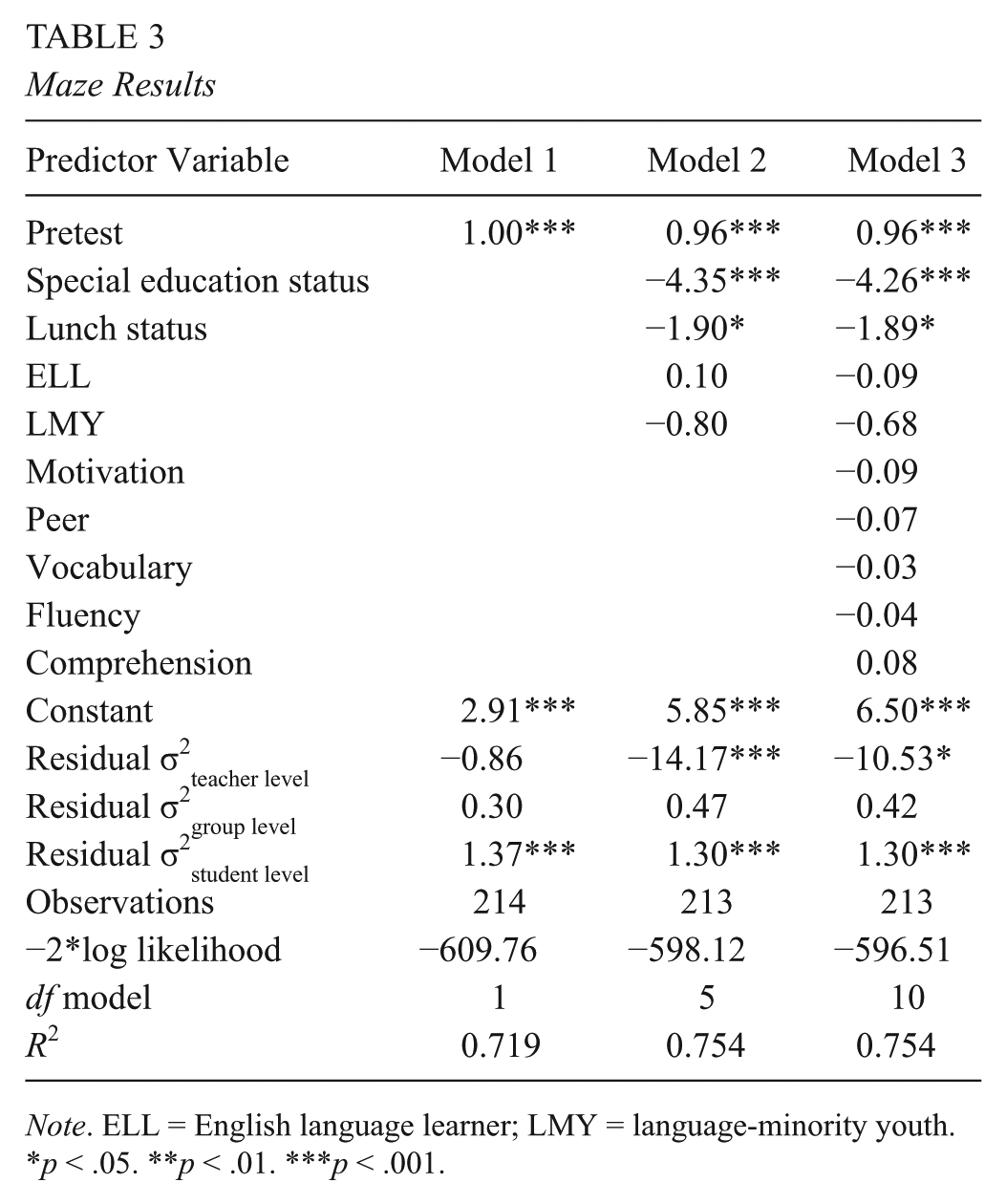
Note. ELL = English language learner; LMY = language-minority youth.
p < .05. **p < .01. ***p < .001.
Discussion
The purpose of this study was to examine effectiveness of various forms of interactional scaffolding (Athaneses & de Oliveira, 2014) grounded in reading theories in supporting adolescents’ reading of complex text. If the promise of reading increasingly challenging text is to be achieved (Adams, 2011; Shanahan, 2013), educators and researchers must identify how to support students to do so.
Maintaining Student Engagement Through Motivational Scaffolding
The significant finding of the study for educators and policymakers is that motivational scaffolding predicted comprehension growth, which suggests that low-performing readers benefit from interactional motivational scaffolding even when lesson plans already attend to motivational support. Perhaps these simple scaffolds were effective because they were easy for the tutors to use with students they did not know well and helped them build a positive and engaging motivational environment for reading challenging texts. These findings support calls for attention to motivational elements in interactional scaffolding (Belland, Kim, & Hannafin, 2013), within instructional reading curricula (Margolis & McCabe, 2006), and in complex text instruction (Sanden, 2014). Although the Common Core’s text complexity standards do not address motivational scaffolding, our results suggest instruction of Common Core–style complex texts should consider motivational scaffolding to help build and sustain engagement with those texts.
Interpreting this finding through this study’s theoretical lens suggests that when students’ and teachers’ situation definitions are initially quite disparate, as in complex text instruction, teachers may have to harness the power of their mediational means (i.e., their scaffolding) in a way that attends to students’ motivation to continue in the interaction (Wertsch, 1984). Building and maintaining interactional engagement conveys a sense of high expectations that the complex texts can be read even by students with a history of reading struggles, and both these expectations as well as the increased engagement in challenging reading may have been routes for comprehension improvement. As research has shown that teachers’ interactional scaffolding may be a mediational means toward inadvertently reducing cognitive challenge or student engagement during reading instruction (Lutz et al., 2006; McElhone, 2012), this study shows ways in which such means can be harnessed for engaging students in complex text instruction.
Vocabulary, Fluency, Comprehension, and Peer Scaffolding
Considering the four other types of scaffolds we investigated, none of them (i.e., vocabulary, fluency, comprehension, or peer) significantly predicted either measure of reading comprehension. These findings, however, are not meant to suggest that these forms of scaffolding are not effective in reading instruction. It is important to note that these scaffolds took place within a lesson plan context that already provided extensive planned scaffolding and numerous opportunities for vocabulary development, fluency practice, and comprehension strategy use. Perhaps the curriculum was already supportive enough such that additional scaffolding was not needed and that the motivational scaffolding promoted student engagement with an already rich and complex set of planned scaffolds and mediational means (i.e., the curriculum and texts).
An alternative explanation is that those forms of scaffolding take longer to be effective. Because the intervention was short (2 hours of instruction), perhaps the vocabulary, fluency, and comprehension scaffolds helped the students read the taught texts, but the brief interactional scaffolds may have failed to truly teach the students strategies that they could transfer to the posttests. For the peer scaffolds, tutors had little time to attend to building group norms of productive peer conversation and to understand the interpersonal dynamics of their groups, which are likely to be crucial factors in the effectiveness of peer learning for reading comprehension growth (M. Cole, 2014; Maloch, 2004). Future research may examine whether these scaffolds are more effective in longer-term interventions when tutors have the opportunity to understand students’ initial situation definitions of reading and build productive interpersonal environments that encourage student collaboration for comprehension.
Different Results According to Measurement Type
An additional finding of our study is that the relationship between scaffolding and reading comprehension depends on how reading comprehension is measured. Our study found that motivational scaffolds predicted growth on the TOSREC but not the Maze. This may be because the two measures approach comprehension differently. The Maze test’s approach offers more syntactic and semantic clues than the sentence verification TOSREC task. The Maze task’s two distractor choices include a syntactically invalid distractor, so students can gain item information even if they do not comprehend the semantic meaning of the sentence. Also, the Maze task asks students to read paragraphs, allowing students to build comprehension over the course of several sentences, and the linked sentences may offer comprehension clues to students. In addition, the Maze questions were all of relatively equal difficulty, because the task is simply filling in blanks within a passage leveled to fifth-grade reading norms. It may be that motivational scaffolding during the reading sessions did not transfer to texts that did not offer increasing challenges.
Conversely, the TOSREC’s sentence verification task depended less on syntactic knowledge, did not allow for passage-level comprehension, and required verification of sentences of increasing complexity. Because the TOSREC more directly assesses semantic meaning with fewer syntactic clues, it may be that the intervention’s motivational scaffolding within the comprehension instruction encouraged students to maintain engagement as they processed meaning with less attention to syntax. Another explanation for the different results, considering the contrasting difficulty structures of the measures, would be that motivational scaffolding is better suited to encouraging students to take on the increasingly challenging sentences of the TOSREC. Considering theories of knowledge transfer, Perkins and Salomon (2012) suggest that knowledge transfer across complex cognitive tasks is intimately connected to motivational and dispositional factors. In one sense, the TOSREC’s sentences of increasing complexity parallel the CCSS focus on increasing text complexity in the classroom. As CCSS-aligned tests become standard assessments across many states, educators and policymakers interested in improving student growth on standardized measures of comprehension may wish to consider more than just cognitive factors for instructional improvement.
Limitations of Our Findings
It is important to interpret findings in light of the limitations of our study. First, our motivation scaffolds were designed for a brief intervention and hence included reinforcers. Although Margolis and McCabe (2006) identify reinforcers as useful tools, they also suggest restraint in using them and emphasize that the reinforcers should be temporary, lest the students become dependent on extrinsic motivation (Dweck, 1999). In fact, we found that the reinforcers were used with restraint in this study, with reinforcers being contingent on student motivational needs and amounting to only 27% of motivational scaffolding. Given that other research suggests that token rewards can diminish intrinsic motivation for reading (Marinak & Gambrell, 2008), we do not suggest that teachers focus on token rewards systems, but we do suggest that teachers attend to interactional motivation and engagement using responsive mediational means appropriate to their classroom contexts.
Second, we also acknowledge the limitations of our measurement and research design. Without existing instruments or clear research guidelines to use in developing a measurement of scaffolding (Van de Pol et al., 2010), we relied on reading theories to guide the construction of our scaffolding measures. As research in this field grows, we call for work willing to tackle the complexities of interactional scaffolding to develop reliable and valid measures of it in classrooms. For example, future measurement studies might investigate how to measure the frequency and intensity of scaffolding in a specific lesson, which our broader measure of scaffolds across lessons did not capture. In addition, our outcome measures were chosen to see if reading ability would transfer from the intervention texts to the assessment texts, but future research should explore whether scaffolds might have an even stronger effect on taught texts. It may be that the other types of nonmotivational scaffolds help struggling readers access the grade-level complex texts being read but do not easily transfer to untaught texts. Furthermore, future research would benefit from using assessment measures involving complex grade-level materials as described by the CCSS. Finally, the nonexperimental design of this study does not allow for causal conclusions. Because the interactional scaffolds were not administered as an experimental treatment, we can say only that additional motivational scaffolds predicted reading comprehension growth. As the interactional scaffolds were administered responsively to students who appeared to need them, it is not clear if the benefits of interactional motivational scaffolding extend differentially to strong students who do not appear to need it.
This connects to our caution against generalizing to other populations of readers. This study of mostly low-performing young adolescents shows the potential benefits of motivational scaffolding, but that may not hold true for high-performing readers who may already have intrinsic motivation to read complex texts. In addition, the small-group guided-reading nature of our intervention afforded tutors the possibility of providing more individualized scaffolding, and it is not clear that our findings would translate to whole-class situations where teachers may have trouble with responsive scaffolding (Athaneses & de Oliveira, 2014). We recommend further research on motivational scaffolding for different reading abilities and in different contexts.
Implications and Conclusions
Our findings contribute to the research literature as this is the first study to systematically examine the effectiveness of different categories of interactional scaffolding and its connection to reading comprehension achievement (Rodgers, D’Agostino, Harmey, Kelly, & Brownfield, 2016; Van de Pol et al., 2010). Future research studies may find this methodology (i.e., instructors reporting on their own scaffold use) useful, as the tutors’ reports were reliable measures when compared to trained observers’ reports, which enabled collecting scaffolding data over many sessions. The significant finding about motivational scaffolding also suggests that examining interactional scaffolding at this grain size is promising, and its effects can be detected on standardized measures of independent reading. We call for more research in this area.
A recurring issue in studies of interactional scaffolding concerns how teachers can learn to do it contingently and responsively. Our motivational scaffolds were quite simple to implement, but it is important that teachers use them responsively if they are to be considered true interactional scaffolds. In addition, teachers should be sure to attend to other key dimensions of motivation for reading, such as links to real-world knowledge, student choice of materials, meaningful goals, and building growth mind-sets (Guthrie & Davis, 2003; Margolis & McCabe, 2006). For educators, it may be that our simple motivation scaffolds could serve as routes to maintaining student engagement with the complex texts while scaffolders get to know their students and lay the foundation for long-term motivation through linking instruction to their students’ worlds, lives, and goals.
The findings of this study help educators maintain moment-to-moment engagement that will sustain readers across textual challenges. In addition, our study suggests that interactional scaffolds can be reliably identified and their effects separated from curricular effects, paving the way for previously unexplored ground for researchers who wish to investigate the effectiveness of interactional scaffolds. As research into this area expands, the education community can build better understanding of how to provide interactional scaffolding to help students read complex texts.
Footnotes
Appendix A
Appendix B
Notes
Authors
DAN REYNOLDS is a doctoral candidate in the Department of Teaching and Learning at Vanderbilt University’s Peabody College. His research focuses on scaffolding students’ comprehension of increasingly complex texts.
AMANDA GOODWIN is an associate professor in the Department of Teaching and Learning at Vanderbilt University’s Peabody College. Her research interests involve examining how aspects of word knowledge, such as knowledge and awareness of morphemic units like roots and affixes, support the increased reading demands that adolescent readers face when reading content specific texts.