




Abstract
Both income inequality and the achievement test score gap between high- and low-income children increased dramatically in the United States beginning in the 1970s. Recent work by Chetty, Hendren, Kline, Saez, and Turner (2014) suggests that, unlike the test score gap, the gap in college enrollment is essentially constant. This article takes a longer historical view and investigates trends in income-based gaps in a number of schooling attainment measures using data from two cohorts of the National Longitudinal Survey of Youth (NLSY79 and NLSY97) as well as 31 birth cohorts from the Panel Study of Income Dynamics (PSID). Findings support Chetty and colleagues’ conclusion of little change in college enrollment for their cohorts but show significant increases in college enrollment gaps between Chetty and colleagues’ and prior cohorts in both the PSID and the NLSY. We further find strong evidence of growing gaps in college completion. In contrast, gaps in high school graduation have fallen, which provide at least one optimistic sign of catching up among low-income individuals. The net result of these trends is to produce a modestly increasing gap in completed schooling between children growing up in low- and high-income families.
Economic growth for much of the 20th century supported America’s promise of offering opportunities to parents and their children. In the 30 years between 1947 and 1977, a period in which the gross national product per capita doubled, the incomes of families in the lowest income bracket nearly doubled as well. 1 In contrast, as documented in countless studies, the last 35 years have been marked by increasing income inequality, with stagnant incomes for families at the bottom of the distribution and sharp increases for those at the top of it.
Has rising income inequality made it increasingly harder for low-income children to get ahead? Descriptive studies to date have focused on children’s achievement test scores and educational attainment. These studies show that as the incomes of affluent and poor American families have diverged over the past three decades, so too has the educational performance of the children in these families. Reardon (2011) documents startling growth in the income-based gap in the test scores of children born since the 1950s. Among children born around 1950, test scores of low-income (10th percentile) children lagged behind those of their better-off (90th percentile) peers by about 0.75 standard deviations. Fifty years later, this gap was 50% larger. Interestingly, the income-based gap grew despite the fact that racial gaps in test scores diminished during the same period (Magnuson & Waldfogel, 2008; Reardon, 2011).
Using data from the 1979 and 1997 National Longitudinal Surveys of Youth (NLSY79 and NLSY97), Bailey and Dynarski (2011) showed growing income-based gaps in college entry and completion for children born between the early 1960s and early 1980s. Specifically, the gap in the college entry rate between the bottom and top income quartiles increased from 39 to 51 percentage points. With respect to college completion, the top income quartile gained 18 percentage points (from 36% to 54%), but the bottom quartile rose only slightly to 9% from 5%. Similar increases in income-based gaps in high school graduation (and GED receipt) are not apparent in these data.
Duncan, Ziol-Guest, and Kalil (2015) used the 31-year time series in the Panel Study of Income Dynamics (PSID) to examine the evolution of income-based disparities in children’s completed schooling in the United States. In line with Bailey and Dynarski’s (2011) analysis of college enrollment and graduation rates and Reardon’s (2011) analysis of test scores, they found that gaps in the completed schooling of children in the top and bottom quintiles of the family income distribution increased by about half a year across the entire period, with virtually all of the increase occurring in the second half of the period. Consistent with census data, gaps in both the absolute and relative incomes of 14- to 16-year-old children in the top and bottom quintiles of the family income distribution grew sharply over the entire period; the gap in absolute income increased by $42,000. Duncan et al. showed that these increases in income inequality accounted for a more of the attainment gap trends than any other demographic predictor, including maternal education, family size, and maternal childbearing age. In the case of offspring’s completed schooling, income accounted for more than three-quarters of the increasing gaps in years of schooling between high- and low-income children. In the case of college attendance and graduation, income accounted for about half and one-quarter of the gaps, respectively.
The most recent work to enter this debate is by Chetty, Hendren, Kline, Saez, and Turner (2014; hereafter, CHKST). The authors analyzed administrative earnings records for children born between 1971 and 1993. For the 1971–1986 birth cohorts, the authors measured intergenerational mobility based on the correlation between parent and child income percentile ranks. For the cohorts born between 1987 and 1993, the authors measured mobility as the correlation between a child’s probability of attending college and his or her parents’ income rank. In contrast to the picture implied by the other studies noted here, CHKST showed that the gap in college attendance rates between children from the lowest- and highest-income families is more or less constant (at 74.5%) between the 1984 and 1989 birth cohorts, falling to 69.2% for the 1993 cohort. CHKST concluded, “The rungs of the ladder have grown further apart ([income] inequality has increased), but children’s chances of climbing from lower to higher rungs have not changed (rank-based mobility has remained stable)” (p. 141). CHKST underscored that their results for the 1984 cohort are consistent with Bailey and Dynarski’s (2011) estimates for the 1979–1982 cohorts while showing that the college attendance gap has stabilized more recently.
Current Study
We take a new look at this question by investigating trends in the income-based gaps in completed schooling using data from the two cohorts of the NLSY79 and NLSY97, as well as 31 birth cohorts from the PSID. In the case of the PSID, we pay particular attention to trends during and prior to the relatively short and recent period covered in CHKST’s analysis.
The primary aim of our analysis is to understand the nature of change over time in intergenerational attainment mobility found in the CHKST analysis. We do so using a longer period as well as additional attainment measures not available in the CHKST data. Due to sample size limitations (our data have between 200 and 250 observations per year), we first examine quintile differences, specifically the difference between the top and bottom income quintiles. We then replicate CHKST’s rank-based mobility analysis.
Our analysis consists of first comparing the income-based gaps in the schooling measures between similar NLSY and PSID cohorts. We then use the PSID to examine trends across CHKST cohorts as well as across a number of earlier cohorts. Importantly, the only schooling attainment measure to which CHKST had access was college enrollment. Our data allow us to examine completed schooling, college enrollment, and high school graduation as well.
Data
PSID Data
We use data spanning 31 cohorts born between 1954 and 1985 from the PSID (http://psidonline.isr.umich.edu). The PSID followed a nationally representative sample of families and their children from 1968 through 2013.
We identified 13,312 respondents aged 15 years (or 14 years if age 15 not available or 16 years if ages 14 and 15 not available) between 1968 and 1999 who had childhood income information. Our final analysis sample consists of 6,072 individuals observed in the PSID at age 15 between 1968 and 1999 and again at age 25 (the time at which we measure completed schooling). Those who do not have completed schooling measures at age 25 have lower childhood incomes as compared with those for whom we do have completed schooling measures. To correct for this, all analyses are adjusted for differential nonresponse by using the PSID’s attrition-adjusted weights.
Childhood income
We created two measures of annual household income when the child was 14 to 16 years old. For maximal comparability with the NLSY’s single-year measure of income, we drew a single-year measure of income in the PSID when children were 14, 15, or 16 years old. In all NLSY comparison analyses, this 1-year measure is used. To minimize classification error, other PSID analyses classify children according to the quintile of their 3-year average family income across ages 14 to 16 years. Whether the 1- or 3-year measure is used is always noted in the tables. We used the PSID’s high-quality edited measure of annual total family income (pretax), which includes taxable income and cash transfers to all household members. This measure is an aggregation of income across all family members; therefore, each individual component of this measure may have been imputed. For example, according to Duffy (2011), across all families in the 2007 PSID, the average percent of total family income that was imputed was <10%, with the median being 0%. All incomes were inflated to 2013 levels through the U.S. consumer price index.
Completed education
We focus our analysis on a continuous measure representing years of completed schooling reported at age 25 years (which, given our cohorts, are calendar years 1978–2009). This measure has a value between 1 and 17, where 1 through 16 represents the highest grade or year of school completed. The PSID assigns a value of 17 for those who report at least some postgraduate work. We also use this completed schooling measure to define a dichotomous indicator of completing high school (12+ years), attending college (13+ years), and completing college (16+ years). 2
NLSY Data
We use the two different nationally representative cohorts of the U.S. NLSY: (a) a sample of 12,686 young men and women who were 14 to 22 years old when first surveyed in 1979 (NLSY79) and (b) a sample of 8,984 young men and women who were 12 to 18 years old when first surveyed in 1997 (NLSY97). Subjects were surveyed annually from 1979 to 1993 and biennially from 1994 to 2012 in the NLSY79 and annually from 1997 to 2011 in the NLSY97.
Our analysis sample consists of (a) 4,078 respondents who were 14 to 16 years old in 1979 from the NLSY79 and (b) 5,454 respondents who were 14 to 16 years old in 1997 from the NLSY97. Our final analysis sample size is 3,188 of the 4,078 age-eligible sample members from the NLSY79 and 3,427 of the 5,454 age-eligible sample members from the NLSY97 based on our various outcomes of interest and nonmissing values for base year total family income. We adjust for differential nonresponse and oversampling of different subgroups by using the NLSY’s custom attrition-adjusted weights in all of our analyses. As detailed in the online appendix, our procedures differed somewhat from those of Bailey and Dynarski (2011).
Childhood income
We drew a single-year measure of income when children were 14, 15, or 16 years old in 1979 for the NLSY79 and in 1997 for the NLSY97. We used a study-created variable for total family income (pretax) in the base year, which includes taxable income, public assistance, and cash transfers to all household members. All incomes were inflated to 2013 levels via the U.S. consumer price index.
Completed education
We focus our analysis on a continuous measure representing years of completed schooling reported at age 25 years (calendar years 1988–1990 for NLSY79 and 2006–2008 for NLSY97). For cases where completed schooling is missing at age 25, that completed at age 26 was used. This measure has a value between 0 and 20. We also use this completed schooling measure to define dichotomous indicators for completing high school (12+ years), attending college (13+ years), and completing college (16+ years).
Results
PSID and NLSY Comparisons
We first generate consistent time-series information on completed schooling, high school and college graduation rates, and college enrollment rates (all by age 25) of children observed as adolescents in low- and high-income families (as defined by quintiles of single-year family income at ages 14, 15, or 16). Each of the 31 cohorts in the PSID contains about 200 children, so we use Lowess procedures to smooth the lines in all of our figures. The figures take advantage of the full scope of the PSID data. In the case of Tables 1 and 2, we combine six PSID cohorts centered on the starting years of the two NLSYs.
Highest Grade Completed and College Completion by Age 25 Years in the NLSY79, NLSY97, and PSID

Note. Values are estimated means within each quintile of family income, with standard errors in parentheses. Dependent variable is based on reports at age 25 years (if those values were missing, then age 26 values were used). Income data in NLSY79 and NLSY97 are based on single-year reports from 1979 and 1997 for total family income. Income data for the PSID are based on when the child is 15 years old (if not available, then age 14; if neither available, then age 16). NLSY estimates use the full samples and NLSY-developed custom weights. PSID estimates are based on PSID-supplied sampling- and attrition-adjusted weights. NLSY = National Longitudinal Survey of Youth; PSID = Panel Study of Income Dynamics.
In 1977–1981.
In 1995–1999.
Single-year total family income quintile.
High School Completion and College Attendance by Age 25 Years in the NLSY79, NLSY97, and PSID

Note. Values are estimated means within each quintile of family income, with standard errors in parentheses. Dependent variable is based on reports at age 25 years (if those values were missing, then age 26 values were used). Income data in NLSY79 and NLSY97 are based on single-year reports from 1979 and 1997 for total family income. Income data for the PSID are based on when the child is 15 years old (if not available, then age 14; if neither available, then age 16). NLSY estimates use the full samples and NLSY-developed custom weights. PSID estimates are based on PSID-supplied sampling- and attrition-adjusted weights. NLSY = National Longitudinal Survey of Youth; PSID = Panel Study of Income Dynamics.
In 1977–1981.
In 1995–1999.
Single-year total family income quintile.
Table 1 presents the average highest grade completed and college completion rates for the NLSY79, NLSY97, and PSID for two periods: the late 1970s (early cohort) and the late 1990s (later cohort). The early cohort findings represent the 14- to 16-year-olds in the NLSY79 and the 14- to 16-year-olds in the PSID between 1977 and 1981; whereas the later cohort is the 14- to 16-year-olds in the NLSY97 and the 14- to 16-year-olds in the PSID between 1995 and 1999. The average highest grade completed and college completion rates are shown for each income quintile.
Several patterns emerge from these comparisons. First, while the 2- to 3-year gap in highest grade completed between the top and bottom income quintile is a bit larger (0.2 years) in the NLSY79 and NLSY97 compared with its PSID counterparts, the 0.7-year growth in the gap between the two sets of cohorts is identical in the two data sets. Second, college completion rate differences are large (>30 percentage points) but fairly similar in the early cohort (the PSID’s rate is 2 percentage points higher than NLSY’s) and even larger in the later cohort (45–50 percentage points) but still fairly similar in the two data sets. In this case, the PSID rates grew by 17 percentage points, as compared with a growth of about 14 percentage points in the NLSYs.
Figures 1 and 2 present the Lowess smoothed years of completed schooling and college graduation rates, respectively, for all PSID cohorts, as well as the rates for the two NLSY cohorts. As with the Table 1, these figures suggest that the data sets are in close agreement in showing that gaps have grown in completed schooling and college graduation. Both figures suggest that the gap growth may have accelerated in the second half of the period covered by the PSID cohorts.

Years completed schooling at age 25 years for top- and bottom-quintile children. CHKST = Chetty, Hendren, Kline, Saez, and Turner (2014).

College graduation rates by age 25 years for top- and bottom-quintile children. CHKST = Chetty, Hendren, Kline, Saez, and Turner (2014).
Table 2 and Figures 3 and 4 present estimates from the PSID and the two NLSY cohorts of high school completion and college attendance. The gap between the top and bottom income quintiles in high school completion is larger in the NLSY early cohort versus the PSID cohort, whereas the gap in college attendance is larger in the PSID. Additionally, while the gap in high school graduation appears to be closing slightly, the gap in college attendance is widening, particularly in the NLSY.

High school graduation rates by age 25 years for top- and bottom-quintile children. CHKST = Chetty, Hendren, Kline, Saez, and Turner (2014).

College attendance rates by age 25 years for top- and bottom-quintile children. CHKST = Chetty, Hendren, Kline, Saez, and Turner (2014).
Trends Within and Between Periods
Table 3 takes full advantage of the breadth of the PSID data by presenting between- and within-period changes in attainment gaps between children in the top and bottom family income quintiles during adolescence. Comparative data from the NLSYs are shown as well. In these analyses, annual household income was averaged across the three calendar years when the child was 14 to 16 years old (3-year average income vs. the 1-year income used in the above PSID/NLSY comparisons was used for the PSID to minimize error in income quintile classification).
Between- and Within-Period Changes in Attainment Gaps Between Children in the Top and Bottom Parent Income Quintiles

Note. Bolded numbers represent the coefficients transformed into a measure of the “decadal change.” NLSY = National Longitudinal Survey of Youth; PSID = Panel Study of Income Dynamics.
Unless otherwise noted, parental family income is averaged across ages 14–16 years before quintiling. Between-period changes are based on cohorts born between 1954 and 1985 and come from ordinary least squares regressions of the given continuous or dichotomous outcome on income quintiles and interactions between income quintiles and dummy variables denoting 1971–1985 birth cohorts. Within-period change is the slopes of a two-segment linear spline function fit separately to the “top minus bottom” quintile gaps across the 1954–1970 and 1971–1985 cohorts. All regressions cluster standard errors at the family level and are based on robust estimators.
Unless otherwise noted, parental family income is reported in the interviews of 1979 (for cohorts born 1963–1965) and 1997 (for cohorts born 1981–1983) and is based on a single calendar year. Between-period changes are based on cohorts born between 1954 and 1985 and come from two sample tests of differences in gaps between “top minus bottom” quintile means.
Difference between 1954–1970 and 1971–1985 birth cohorts.
Difference between 1954–1959 and 1980–1985 birth cohorts.
Level of difference in within-period slopes.
Includes all of the cohorts from Chetty, Hendren, Kline, Saez, and Turner (2014).
p < .05. **p < .01. ***p < .001.
The first two columns concentrate on average change in attainment gaps across the PSID cohorts: column 1 shows the change in average attainment between the 1954–1970 cohorts and the 1971–1985 cohorts, and column 2 shows the change in average attainment between the first (born 1954–1960) and last (1979–1985) six PSID cohorts. The next two columns show within-period trends for CHKST’s cohorts (children born between 1971 and 1985) and the earlier cohorts available in the PSID. The final column show changes between the two sets of NLSY cohorts. To provide comparability across columns, bolded values convert coefficients into estimates of decadal change.
To obtain the coefficients in column 1, we used PSID cohorts born between 1954 and 1985 and regressed the given attainment measure on the income quintile, a dummy variable denoting the 1971–1985 birth cohort, and an interaction between income quintile and the birth cohort dummy variable. The table presents the coefficient on the interaction term, interpreted as the top-bottom gap difference between the two birth cohorts (the difference in difference). Results show that the average top-to-bottom income quintile gap in completed schooling increased by 0.56 years between the first and last halves of the period—a highly significant increase. When expressed as a decadal change, the increasing gap amounted to 0.375 years per decade. Gaps in college enrollment and college completion also increased between the periods, while gaps in high school graduation rates fell insignificantly. The college graduation gap increase was particularly striking, amounting to 17.2 percentage points between the two sets of cohorts and 11.5 percentage points per decade.
Column 2 presents estimates of the gap increases between the beginning and end of the PSID panel period, defining “beginning” by the average of the first six cohorts (1954–1959 birth cohorts) and “end” by the average of the most recent six cohorts (1980–1985 birth cohorts). To obtain these coefficients, we regressed the attainment measure on income quintile, a dummy variable denoting the 1980–1985 birth cohorts, and an interaction between income quintile and the birth cohort dummy variable. Findings suggest increasing gaps in both attending and graduating from college. Specifically, the average top-to-bottom income quintile gap in college enrollment increased by 6.5 percentage points per decade, while the college completion gap between the first 6 years and last 6 years of data increased by 10.0 percentage points per decade. In contrast, the high school graduation gap fell substantially (6.5 percentage points per decade), which led the gap in overall attainment to rise but not significantly so.
CHKST found no significant trend in college attendance across cohorts born between 1971 and 1985. Columns 3 and 4 present the coefficients on a two-segment linear spline function fit separately to the top-minus-bottom quintile gaps across the 1954–1970 and 1971–1985 cohorts. These are estimated by running a regression of the attainment measures on the income quintile, the linear spline for the two birth cohorts, and two interactions (one for the early birth cohort and income quintile and one for the later birth cohort and income quintile). Table 3 presents the coefficients on the interaction terms.
In terms of the CHKST comparison, the insignificant .003 coefficient in the “1+ years of college” row shows that college enrollment did not change significantly in the PSID across the CHKST cohorts. Only in the case of college completion was the gap trend across these 15 cohorts statistically significant—in this case increasing by 1.5 percentage points per year, or 14.8 percentage points per decade. Coefficients on high school graduation were negative but insignificant for both sets of sets of cohorts, while all of the other coefficients on the components of attainment were positive, although almost never statistically significant. In contrast to the longer periods used for the first two columns, the power to detect within-cohort trends in the PSID is not strong.
The final column presents the between-period change for the NLSY cohorts and shows a similar increase in the completed schooling gap, including both attending and graduating from college as seen in the first column for the PSID.
Rank-Based Measure
Following CHKST, we estimated each child’s rank within his or her birth cohort from poorest (1) to richest (100). Because of small sample sizes in each birth cohort within the PSID, specific ranks are assigned to a minimum of one child and a maximum of six children. We regress the educational attainment measures on this income rank for groups of birth cohorts that are weighted, and the standard errors are adjusted for presence of siblings. Because of small sample sizes, instead of estimating 31 regressions (1 for each birth cohort), we estimated 11 regressions that represent approximately 3 birth cohorts each.
Table 4 presents the between-period changes in the rank correlation for the four educational attainment outcome measures—specifically, the changes between (1) the early birth cohort (1954–1970) and the late birth cohort (1971–1985) as well as (2) the first 6 years and the last 6 years of the cohorts. Findings for years of completed schooling suggest that the relationship between income rank and years may have increased between the periods (marginally significant). Figure 5 shows the time series of slopes on the income rank measure for years of completed schooling. Taken together, these trends suggest that the relationship may be pretty equal on average.
Between-Period Changes in Attainment Gaps for Rank Correlations in PSID

Note. For PSID, between-period changes are based on cohorts born between 1954 and 1985 and come from ordinary least squares regressions of the given continuous or dichotomous outcome on the rank correlation, a dummy variable denoting 1971–1985 birth cohort (or denoting 1980–1985 birth cohort) and an interaction between the rank correlation and the birth cohort dummy variable (interaction shown). PSID = Panel Study of Income Dynamics.
Difference between 1954–1970 and 1971–1985 birth cohorts.
Difference between 1954–1959 and 1980–1985 birth cohorts.
p < .10. *p < .05. **p < .01. Results based on p < .10 reflect “may have” language (see text).

Slope of income rank for years completed schooling by age 25 years. Dashed lines represent 95% confidence interval. CHKST = Chetty, Hendren, Kline, Saez, and Turner (2014).
Table 4 (row 2) and Figure 6 present the relationship between income rank and high school graduation. The trend in ranking correlation for high school graduation is negative, mirroring the closing of the top-bottom quintile gap. Similarly, the trends are increasing for college graduation (Table 4, row 4; Figure 7), also reflective of the top-bottom income quintile differences. Table 4 (row 3) and Figure 8 present the findings for college attendance. Our findings for college attendance are comparable to CHKST’s findings for college attendance by ages 22 and 25 (CHKST Appendix Figure 5).
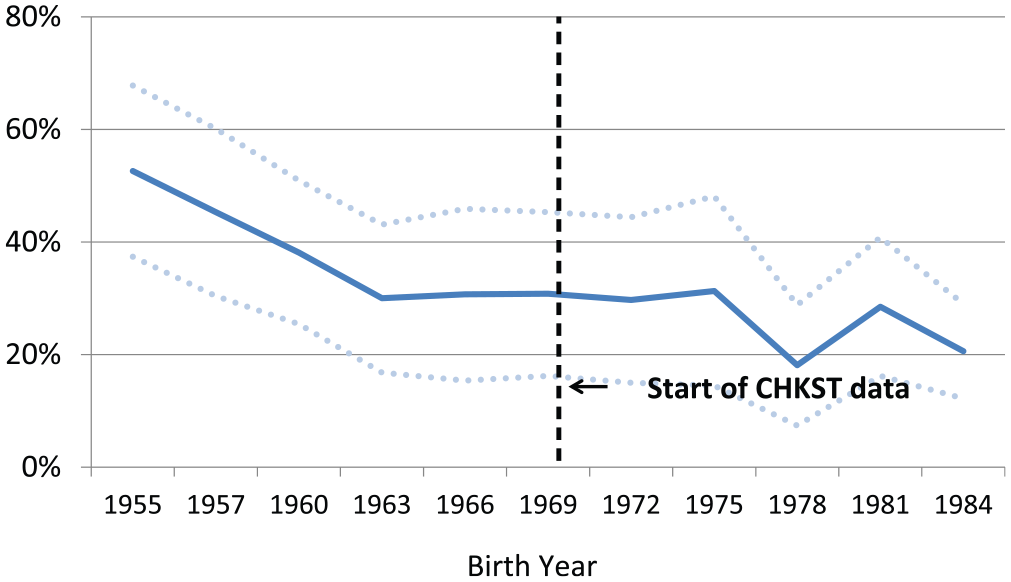
Slope of income rank for high school graduation rates by age 25 years. Dashed lines represent 95% confidence interval. CHKST = Chetty, Hendren, Kline, Saez, and Turner (2014).
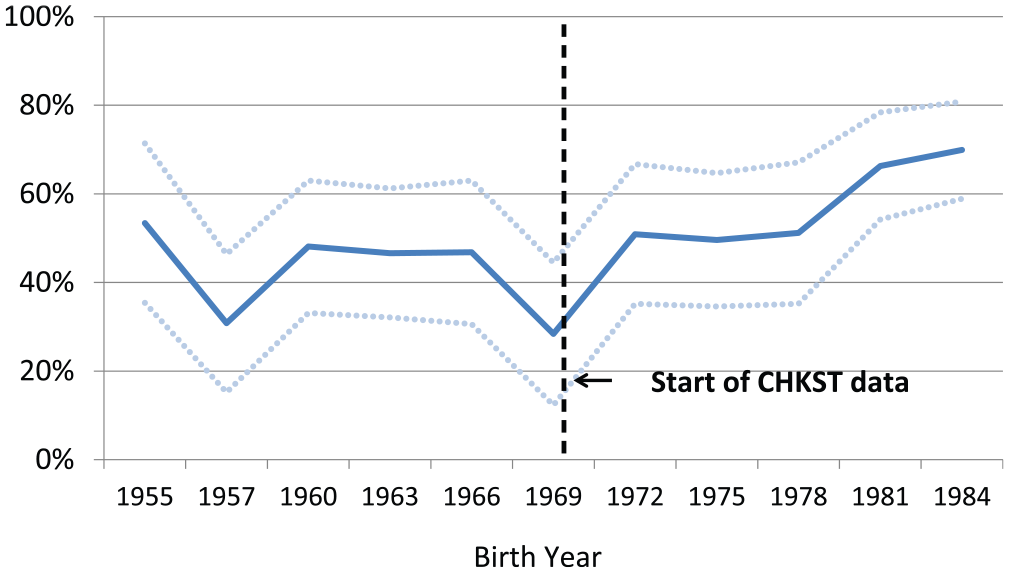
Slope of income-rank for college graduation rates by age 25 years. Dashed lines represent 95% confidence interval. CHKST = Chetty, Hendren, Kline, Saez, and Turner (2014).

Slope of income-rank for college attendance rates by age 25 years. Dashed lines represent 95% confidence interval. CHKST = Chetty, Hendren, Kline, Saez, and Turner (2014).
Summary
Our analysis was designed to both replicate and extend CHKST’s work on the income gap in college enrollment over time. In our quintile and rank analyses, we find evidence that supports their conclusion of little change in college enrollment across their cohorts. However, our longer historical view shows quite significant increases in years of completed schooling and college completion and significant decreases in high school graduation. Our findings, while similar to CHKST’s, differ from Bastedo and Jaquette’s (2011), which found that the college enrollment gap declined by age 26 for the 1954–1986 birth cohorts based on data from four National Center for Education Statistics surveys (National Longitudinal Study of 1927, the sophomore cohort of the High School and Beyond Study of 1980, the National Education Longitudinal Study of 1988, and the Education Longitudinal Study of 2002). However, the samples used in that analysis consisted only of those students who complete high school within 1.5 years of their high school graduating class and are part of an “academic preparation sample” that includes only students who meet criteria for SAT/ACT scores, high school grade point average, and/or high school grades in certain subjects. This analytic sample is more advantaged and is based on criteria that we cannot replicate in our PSID sample.
As a summary of our results, it is instructive to examine the various estimates of decadal change in top-to-bottom income gaps in the various components of educational attainment. Patterns are clearest in the case of college completion, where both the PSID and the NLSY suggest that gaps increased by around 8 to 10 percentage points per decade. The third and fourth columns of Table 3 hint that most of the action occurred in the cohorts born between 1971 and 1985 (same cohort as CHKST’s sample), but the P value for the trend differences is .13.
In contrast, high school graduation gaps fell according to all of the estimates, although here the variation in the magnitude of the fall varies quite a bit depending on the sample. That gaps rose in some components of attainment (college completion) and fell in others (high school completion) lead to somewhat muted gap increases in overall completed schooling that range from about one-sixth to one-third of a year per decade.
That the gap in high school graduation closed over the study period suggests a possible decline in inequality. One potential reason for this decline is a ceiling effect from virtually all children in the top quintile having completed high school. This means that much of the gap closing results from increases in the graduation rates for those in the bottom quintile. These trends may represent less a decline in inequality that a shifting of inequality to higher levels of education (Raftery & Hout, 1993). This is especially apparent in the increasing gap in college graduation.
Our data do not enable us to identify the mechanisms for this increasing gap in 4-year college graduation. One possibility identified by Bailey and Dynarsky (2011) is in differences in college persistence among those entering college, which increased more rapidly for children in the highest-income groups than for children in the lowest-income groups. Another is related to the fact that neither CHKST nor the PSID measures of college enrollment distinguish between 2- and 4-year colleges. A shift to 2-year colleges, particularly for low-income students, could also explain some of the consistency of the income-based gaps in college attendance. Given our findings with respect to college graduation, it is possible that income may increasingly matter for access to and completion of degrees at 4-year but perhaps not 2-year colleges.
Footnotes
Acknowledgements
This project was funded in part by the Russell Sage Foundation and the Spencer Foundation.
1.

2.
Because the Panel Study of Income Dynamics switched to a biannual survey starting in 1997, for the even years 1998–2008, the year immediately previous or immediately following the year that the respondent was 24 was used. Furthermore, education values for heads and wives are not asked annually (as they are for other family members) because for adults it does not change quickly or commonly, so in some cases the most recent data available are also used. Periodically, the Panel Study of Income Dynamics updates head/wife education, but in many cases earlier year education information is brought forward to the current year survey.
Authors
KATHLEEN M. ZIOL-GUEST, PhD is research associate professor in the Department of Humanities and Social Sciences at New York University’s Steinhardt School of Culture, Education, and Human Development, 726 Broadway, Room 524, New York, NY 10003;
KENNETH T. H. LEE is a graduate student in the School of Education at the University of California, Irvine, Irvine, CA 95697;
References
Supplementary Material
Please find the following supplemental material available below.
For Open Access articles published under a Creative Commons License, all supplemental material carries the same license as the article it is associated with.
For non-Open Access articles published, all supplemental material carries a non-exclusive license, and permission requests for re-use of supplemental material or any part of supplemental material shall be sent directly to the copyright owner as specified in the copyright notice associated with the article.
