




Abstract
This study investigated income group differences in kindergartners’ and first graders’ (N = 161) arithmetic by examining the link between accuracy and strategy use on simple and complex addition problems. Low-income children were substantially less accurate than high-income children, in terms of both percentage of correctly solved problems and the magnitude of errors, with low-income first graders being less accurate than high-income kindergartners. Higher-income children were more likely to use sophisticated mental strategies than their lower-income peers, who used predominantly inefficient counting or inappropriate strategies. Importantly, this difference in strategies mediated the relation between income group and addition. Examining underlying strategies has implications for understanding income group differences in arithmetic and potential means of remedying it via instruction.
Addition Strategies
Children can arrive at accurate and inaccurate solutions to addition problems through a variety of strategies. Examining children’s strategies provides greater insight into their understanding of arithmetic principles and numerical magnitudes than examining only accuracy (Canobi, Reeve, & Pattison, 2003; Carpenter, Franke, Jacobs, Fennema, & Empson, 1998; Geary, Bow-Thomas, & Yao, 1992; Lindberg, Linkersdörfer, Lehmann, Hasselhorn, & Lonnemann, 2013). In fact, how children solve problems has been found to be more predictive of later mathematics achievement than the accuracy with which they solve problems (Geary, 2011).
There are four main types of strategies used by children to solve addition problems: count-all, count-on, decomposition, and retrieval (Geary et al., 1992; Geary, Bow-Thomas, Lie, & Siegler, 1996; Shrager & Siegler, 1998). The count-all strategy involves counting out each addend and then counting the total (e.g., to solve 5 + 3, a child would first count to 5, then count to 3, then finally count from 1 to 8). The count-on strategy involves counting up from one addend the value of the second addend (e.g., to solve 5 + 3, a child would count from 6 to 8). Decomposition involves transforming the original problem into two or more simpler problems, using either a previously memorized number fact (e.g., to solve 7 + 6, a child might use knowledge that 6 + 6 =12 and 6 + 1 = 7, so 7 + 6 = 13) or the base-10 properties of the number system (e.g., to solve 7 + 6, a child might first add 7 + 3 to get 10 and then add 3 more to arrive at 13). The last strategy, retrieval, involves recalling the solution from memory.
Children generally begin solving addition problems by using the count-all strategy, then start using count-on, and later use retrieval for problems with sums less than 10 and decomposition on more complex problems (Torbeyns, Verschaffel, & Ghesquière, 2004). Although there is a developmental sequence to the order in which strategies emerge, children often use multiple strategies at a given point in time (Carpenter & Moser, 1984; Geary, 1994; Siegler & Shrager, 1984). For example, a kindergartner might retrieve the answer to 1 + 1 but use counting to solve 4 + 6.
Early individual differences in the frequency with which children use different strategies matter for later mathematics competence (Carr & Alexeev, 2011; Carr, Steiner, Kyser, & Biddlecomb, 2008; Siegler, 1988). Persistent overreliance on counting strategies may result in less practice using retrieval and decomposition and poorer accuracy in executing these strategies when the problem complexity demands them. Children who frequently use immature counting procedures (counting from 1 rather than from the larger addend), execute strategies inaccurately, and use retrieval rarely in first grade tend to have difficulty retrieving answers throughout elementary school. These children are often identified as having a mathematical disability (Geary, 1990; Geary & Brown, 1991; Goldman, Pellegrino, & Mertz, 1988; Jordan, Levine, & Huttenlocher, 1995). Conversely, children who frequently use mental strategies, such as decomposition and retrieval, in first and second grades tend to be more accurate solving complex problems through fifth grade (Fennema et al., 1998; Geary, 2011). Further, frequent use of decomposition in second and third grades is also related to more accurate performance on equivalence problems (e.g., 1 + 5 = __ + 2), even controlling for accuracy on math facts (Chesney et al., 2014). Thus, early differences in use of decomposition and retrieval could contribute to later individual differences in mathematics achievement.
Income Group Differences in Arithmetic
More than 20 years ago, research documented income group differences in accuracy of performance on simple addition problems. Jordan, Huttenlocher, and Levine (1992) found that middle-income kindergartners were more accurate than their low-income peers on simple number fact problems (e.g., “How much is 3 and 2?”). Follow-up studies found no income group differences among first graders in accuracy on addition problems with sums less than 9 but found middle-income first graders were more accurate than their low-income counterparts on problems with sums up to 19 (Jordan, Levine, & Huttenlocher, 1994; Kerkman & Siegler, 1993).
We hypothesized that reported income group differences in accuracy may be due to differences in strategy use. High-income preschoolers are more likely to use retrieval to solve simple addition story problems than both low- and middle-income preschoolers (Ginsburg & Pappas, 2004); thus, low-income kindergartners may continue relying on counting strategies, whereas their more affluent peers quickly and accurately use retrieval. Consistent with this idea, Griffin, Case, and Siegler (1994) found that when low-income first graders were asked to solve simple addition problems, they used inefficient counting strategies (i.e., count-all and count-on from the smaller addend) more often than middle-income first graders, who always counted on from the larger addend when they used a counting strategy (Griffin et al., 1994). In this study, unlike in previous research, we empirically examined whether differences in strategy use mediate the relation between family income and arithmetic accuracy.
Changes in instruction and in families’ use of resources, since the time of the work documenting income group differences, may mean that earlier findings no longer represent low- and high-income children’s arithmetic knowledge in present cohorts. The Common Core standards, adopted by most states in 2010, specifically describe goals for addition strategies (e.g., decomposition in first grade). To the extent that instruction has changed in accord with the new standards, current instruction in addition and addition strategies may be more targeted, and thus children from all economic backgrounds in the United States, and low-income students in particular, may be more accurate in addition and use more sophisticated strategies by first grade than previously. On the other hand, research suggests that affluent families are investing more time and money into educational activities in early childhood than before and that 4-year-olds from affluent families are more likely than those from low-income families to attend quality preschools, such that the income group differences in knowledge upon school entry is even greater than it was just 20 years ago (Duncan et al., 2007; Nores & Barnett, 2014; Ramey & Ramey, 2010). Differences in numerical knowledge upon school entry predict the rate of growth in individuals’ mathematics knowledge (Aunola, Leskinen, Lerkkanen, & Nurmi, 2004) as well as in mathematics achievement test scores as late as high school (Duncan et al., 2007; Jordan, Kaplan, Ramineni, & Locuniak, 2009). Children with poorer numerical magnitude knowledge seem less able to constrain or judge the plausibility of their responses to arithmetic problems (Bartelet, Vaessen, Blomert, & Ansari, 2014; Booth & Siegler, 2008; Ramani & Siegler, 2011) and also more likely to use less sophisticated addition strategies (Laski & Yu, 2014; Siegler, 1987; Torbeyns, Verschaffel, & Ghesquière, 2002). Thus, increases in the differences between low- and high-income children’s number knowledge upon school entry suggest income group differences in arithmetic accuracy and strategies may be even greater than previously described.
The Current Study
The current study had two purposes. The first was to describe the addition accuracy of low- and high-income kindergartners and first graders. We selected to compare low- and high-income groups, rather than low- and middle-income groups, because it is between these two groups that the greatest differences in mathematics achievement are currently observed (Reardon, 2011). Further, by high school, high-income children now outperform middle-income children by as much as middle-income children outperform low-income ones. Thus, examining the extent of differences in math knowledge between low- and high-income groups provides a more complete picture of the income gap in mathematics achievement. We were interested in whether the pattern of differences in arithmetic accuracy and strategies would be consistent with studies conducted with earlier cohorts of low- and middle-income children. In addition, because earlier studies included only simple problems, we were interested in whether the pattern of findings would differ by problem type. Thus, in the present study, children were asked to solve both simple (single-digit) and complex (mixed- and double-digit) addition problems.
On the basis of recent evidence of income group differences in number knowledge upon school entry (Bartelet et al., 2014; Booth & Siegler, 2008; Ramani & Siegler, 2011), we had two predictions. We predicted that the income group differences in addition accuracy would be present in kindergarten and would remain present in first grade. Further, we expected that the difference in accuracy would be greatest on complex problems. During kindergarten and first grade, children typically receive less classroom instruction on complex than on simple problems (National Council of Teachers of Mathematics, 2006; National Governors’ Association Center for Best Practices & Council of Chief State School Officers, 2010), thus it seemed that accuracy on these problems would be more likely to reflect income group differences in number knowledge upon school entry and opportunities for math-related activities outside of school.
Further, in our analysis of accuracy, we examined the magnitude of children’s errors based on the distance of their responses from the correct sum. We expected that higher-income children would provide incorrect answers closer to the correct sum than lower-income children. If so, this would suggest that even when they do commit errors, higher-income children have a better understanding of addition– either because they come closer to executing strategies correctly (e.g., make smaller counting errors) or because they have better knowledge of numerical magnitudes that they use to constrain their plausible responses.
The second and main purpose of the study was to examine the cognitive processes potentially underlying differences in accuracy in more depth than has been done previously. Many of the factors that have been identified as mediators of family income and math achievement, such as neighborhoods and parental investment, are distal to the learning process and not easily malleable (Akiba, LeTendre, & Scribner, 2007; Duncan & Brooks-Gunn, 1997; Hoff, Laursen, & Tardif, 2002; Leventhal & Brooks-Gunn, 2002; Magnuson, Ruhm, & Waldfogel, 2007; McLoyd, 1998). Our approach was to examine strategy use, which is directly involved in the computation process and, importantly, more malleable. Although earlier studies provided some evidence of strategy differences across income groups, they did so only for basic counting strategies on simple addition problems and did not statistically analyze the link between the use of particular strategies and accuracy. If high- and low-income children use different strategies, and this difference accounts for the relation between family income and arithmetic knowledge, then it would suggest a lever for reducing income group differences through targeted instruction related to strategies.
More specifically, we had three predictions. First, we predicted that in both kindergarten and first grade, affluent children would be more likely to use more advanced strategies, such as count-on, retrieval, and decomposition, than less affluent children because these strategies require greater numerical knowledge and experience with arithmetic. Second, we predicted that there would be a difference in children’s ability to adaptively select strategies for different problem types: Higher-income children may increasingly use a decomposition strategy, which is a more efficient and less error-prone strategy on complex problems, whereas lower-income children may persist in using counting strategies. Third, we predicted that the relation between children’s economic background (income group) and addition accuracy would be mediated by strategy use: Higher-income children may use advanced strategies more often than low-income children, which, in turn, may be related to greater accuracy.
Method
Participants
The study included 161 kindergartners and first graders: 82 low-income and 79 high-income children. The low-income children were recruited from an urban public school where the median family income was $34,000 and the percentage of children who qualified for free or reduced lunch was 84%. According to the Massachusetts 2014 school report card data, the school was comparable to other schools in the same school district in terms of math achievement scores and performed slightly better than schools with a similar low-income population (Massachusetts Department of Elementary and Secondary Education, 2014). The high-income children were recruited from suburban public schools where the median family income was more than 3 times that of the lower-income sample ($114,000) and the average percentage of children who qualified for free or reduced lunch was less than a quarter of that of the lower-income sample (13%). Reflecting the general societal correlation between income and race, the students at the higher-income school were predominantly Caucasians (63% on average) and at the low-income school were predominantly Hispanic and African American students (50% Hispanic, 45% African American). Both schools had previously participated in research projects conducted by the lead author.
The distribution of kindergartners and first graders in the two income groups was similar. Among the kindergartners, there were 31 high-income (21 female; mean age 6 years, 2 months) and 40 low-income children (23 female; mean age 5 years, 10 months). Among the first graders, there were 48 high-income (28 female; mean age 7 years, 1 month) and 42 low-income children (22 female; mean age 6 years, 10 months). All children were tested at their school during the academic year. On average, the high-income children were tested later in the school year, explaining the differences in age. Thus, we controlled for age in all analyses.
Materials and Procedure
Children met one-on-one with an experimenter in a quiet room in their schools and completed an addition task involving simple (single-digit) and complex (mixed-digit and double-digit) problems. Kindergartners solved 20 addition problems: a block of six single-digit problems (e.g., 5 + 4), a block of eight mixed-digit addition problems (e.g., 18 + 3), and another block of six single-digit problems, presented in that order. First graders solved 24 problems: the same 20 problems given to the kindergartners plus an additional four double-digit problems (e.g., 45 + 12) presented in the same block as the mixed-digit problems (see appendix for a full list of problems). The blocks of problems were ordered such that single-digit problems were presented at the beginning and end of the assessment to encourage children by starting with simpler problems and to provide relief at the end of testing. Within blocks, problems were presented in one of two random orders, which were counterbalanced across individuals within each grade and income group.
The experimenter presented one problem at a time—problems were printed on a piece of paper and read aloud. The experimenter gave children as much time as needed to solve the problem and instructed them to verbally provide the solution; children were not provided with any supplies, such as paper or pencil, but were permitted to use their fingers or count out loud. The tester observed each child and recorded any overt signs of strategy use (e.g., if the child counted out loud, the tester would mark down a counting strategy). When there were no overt behaviors, the tester asked the participant how he or she “figured it out” after an answer was provided. When the strategy was still not clear, the experimenter would probe the child with up to two additional follow-up questions. A combination of behavioral observations and retrospective self-reports has been found to lead to valid strategy classifications (Rittle-Johnson & Siegler, 1999; Siegler, 1987).
Notes and audio recordings were reviewed and children’s strategies on each problem were coded as one of three types of strategies: counting (count-all or count-on), retrieval, and decomposition. An other code was also used when the child reported using a strategy different from one of the three main strategies, reported guessing, or could not articulate a strategy and no behavioral cues were available. The retrieval code was used only on problems involving single-digit addends, because it has been generally accepted that retrieval applies to stored number facts involving single-digit numbers (e.g., Geary, Hoard, Byrd-Craven, & DeSoto, 2004). Thus, if a child reported that he or she “just knew” the answer to a mixed-digit problem (e.g., 26 + 8) and no overt behavioral cues were present, the strategy was coded as other. The data from 10% of the sample in each group of participants were examined independently by two raters, and their agreement rate was 93%. Raters consulted on all instances in which children’s reported strategy conflicted with their observed behavior and together agreed on the final code.
Results
For all analyses, age was used as a covariate. Post hoc pairwise comparisons with Bonferroni corrections were used to further explore main effects, and tests of simple effects were used to better understand the interactions.
Accuracy
Percentage correct
Table 1 presents the mean percentages of problems answered correctly by income group, grade, and problem type. Analyses comparing accuracy across groups included only attempted problems, which was >94% of problems in both income groups and not different between groups.
Accuracy on Arithmetic Problems by Income Group, Grade, and Problem Type

Percentage correct is calculated based on only the problems attempted. Standard errors are presented in parentheses.
A 2 (income: low vs. high) × 2 (grade: kindergarten vs. first grade) × 2 (problem type: simple vs. complex) repeated-measures ANCOVA found a main effect for income group, F(1, 155) = 309.72, p < .001, ηp2 = .11. As expected, high-income students’ accuracy in solving both kinds of addition problems (simple and complex) far exceeded that of their low-income peers. For example, as shown in Table 1, high-income first graders answered twice as many of the simple single-digit problems correctly as the low-income first graders, 94% versus 47%. The ANCOVA also showed a main effect of grade, F(1, 155) = 8.92, p = .003, ηp2 = .05, on the percentage of problems answered correctly. First graders solved more problems correctly than kindergartners, 63% versus 33%, respectively. There was, however, no Grade × Income Group interaction. In other words, the difference between income groups was also present among first graders on both types of problems.
The analysis also indicated that children’s accuracy varied by problem type. The ANCOVA indicated a main effect for problem type, F(1, 155) = 4.09, p = .05, ηp2 = .03, and a Problem Type × Grade interaction, F(1,155) = 13.76, p < .001, ηp2 =.08. Children answered a greater percentage of simple problems than complex problem correctly in first grade, 72% versus 53%, p < .001, but demonstrated no differences in percentage correct on the two problem types in kindergarten, 36% versus 29%, p = .21. In addition, the analysis found a three-way interaction among problem type, grade, and income group, F(1, 155) = 11.06, p = .001, ηp2 = .07. As illustrated in Figure 1, on complex problems, both groups demonstrated a comparable increase in accuracy between kindergarten and first grade. In contrast, on simple problems, low-income children demonstrated a greater increase in accuracy than high-income children, who did not have much room for improvement due to their high performance in kindergarten.

Percentage accuracy on simple and complex problems among high- and low-income kindergarteners and first graders. Error bars represent standard error.
Absolute error (AE)
To better understand the differences in children’s accuracy, we examined each child’s mean AE on the problems answered incorrectly: AE = |correct answer – child’s answer|. AE provides a continuous measure of the degree to which a child’s answers deviate from the correct magnitude. The greater the AE, the less likely the incorrect response was constrained by an understanding of numerical magnitudes or due to a counting error. Table 1 presents children’s mean AE on the arithmetic problems by income group, grade, and problem type.
A 2 (income: low vs. high) × 2 (grade: kindergarten vs. first grade) × 2 (problem type: simple vs. complex) repeated-measures ANCOVA on children’s mean AE found a main effect of income group, F(1, 155) = 80.45, p < .001, ηp2 = .34. Low-income children provided incorrect responses that were substantially farther in magnitude from the actual sum than those of high-income children, p < .001. The Grade × Income Group interaction was trending but did not quite reach significance, F(1, 155) = 3.45, p = .07, ηp2 = .02; see Figure 2.
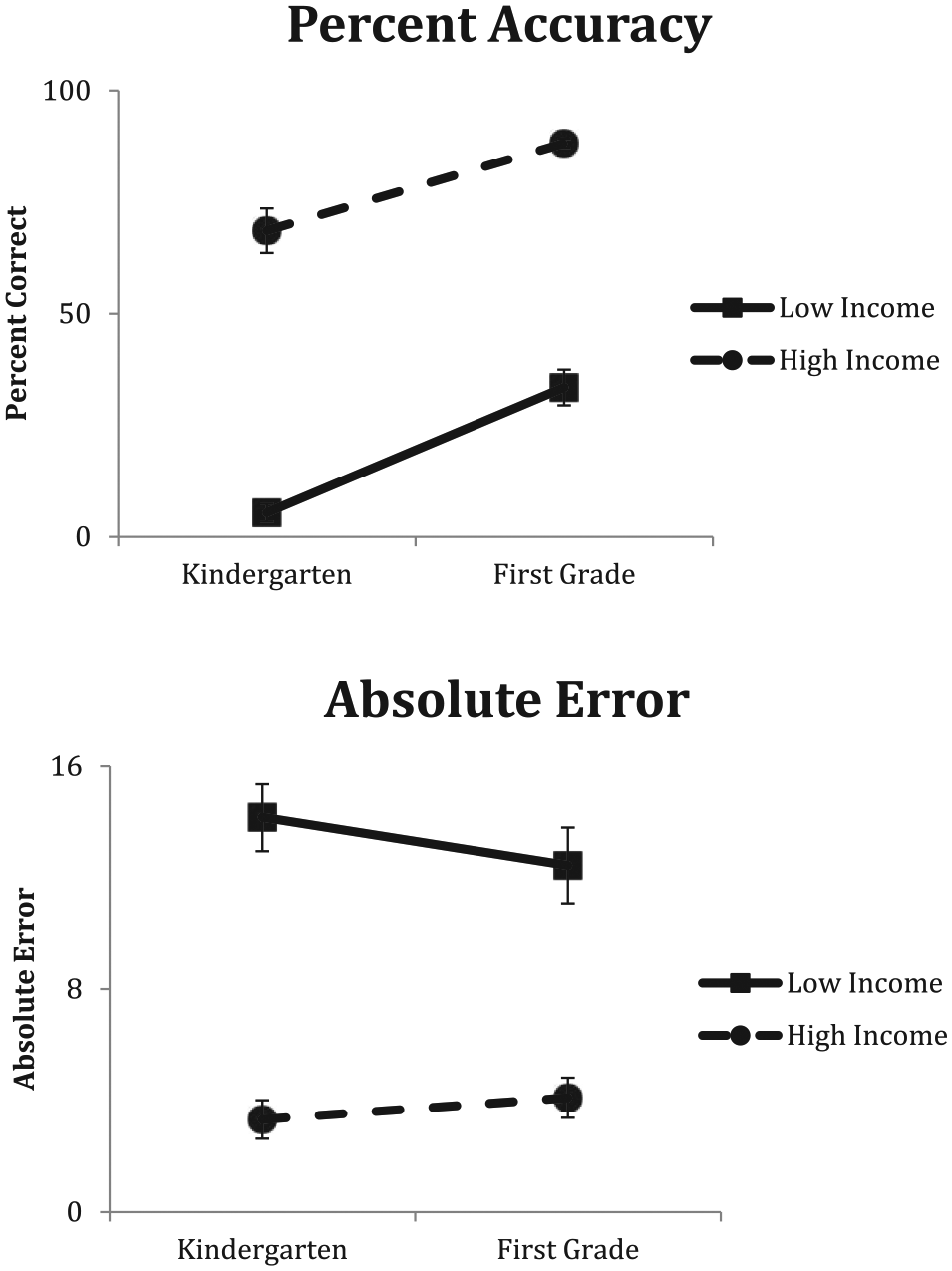
Percentage accuracy and absolute error among lower- and higher-income kindergartners and first graders.
In terms of problem type, the analyses revealed a Problem Type × Income Group interaction, F(1, 155) = 14.96, p < .001, ηp2 = .09. Although low-income children provided incorrect responses that were farther from the correct sum than those provided by high-income children, the difference in the mean AE by income groups was smaller on simple problems than on complex problems, regardless of grade.
Strategy Choice
To examine the frequency with which children used each of the four arithmetic strategies, we calculated the percentage of arithmetic problems on which individuals used each strategy. We then calculated the mean percentage of problems on which each strategy was used in each grade and each income group. Table 2 presents the mean frequency for each strategy by income group, grade, and problem type. Separate ANCOVAs were conducted using the frequency of the different strategies as outcomes.
Strategy Choice: Percentages of Simple and Complex Problems on Which Each Strategy Was Used, by Income Group and Grade
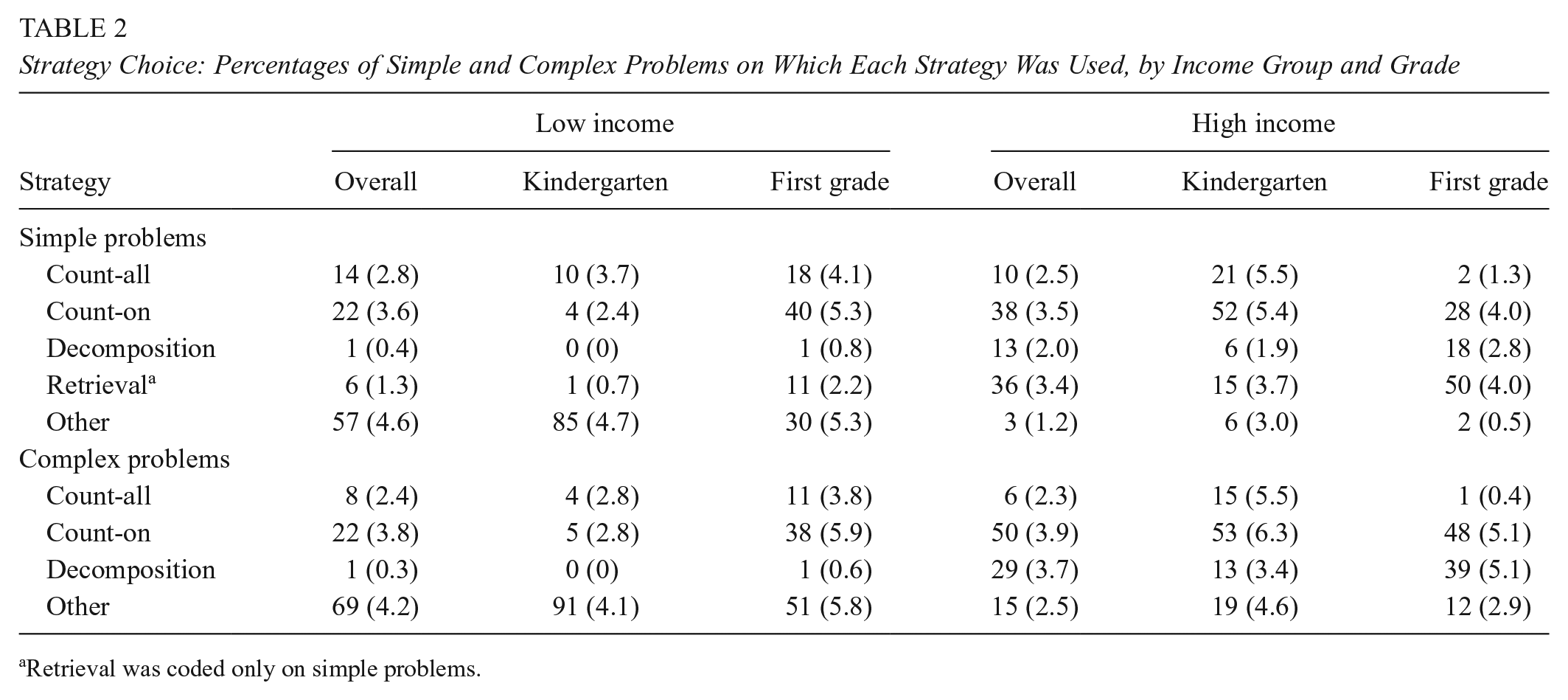
Retrieval was coded only on simple problems.
Count-all
The ANCOVA results revealed an Income Group × Grade interaction, F(1, 156) = 15.01, p < .001, ηp2 = .09. As shown in Table 2, the use of count-all increased between kindergarten and first grade among low-income children but decreased among high-income children. The analysis found no effect of problem type on the use of count-all, p = .355.
Count-on
An ANCOVA indicated a main effect for income-group, F(1, 156) = 17.31, p < .001, ηp2 = .10, as well as Grade × Income Group, F(1, 156) = 28.95, p < .001, ηp2 = .16; Problem-Type × Income Group F(1, 156) = 5.38, p = .02, ηp2 = .03; and Problem-Type × Income Group × Grade, F(1, 156) = 7.87, p = .01, ηp2 = .05, interactions. Overall, higher-income students used count-on on a greater number of problems than lower-income students (p < .001). Higher-income students used count-on more frequently on complex problems than on simple problems (p < .001), but there was no difference by problem type for low-income students. High-income first-grade students used count-on more on complex problems than on simple problems (p < .001). The frequency for which students used a count-on strategy did not vary by problem type within low-income kindergarteners and first graders or high-income kindergarteners.
Decomposition
The ANCOVA indicated main effects for grade, F(1, 156) = 4.73, p = .03, ηp2 =.03, and income group, F(1, 156) = 45.32, p < .001, ηp2 = .23, as well as Grade × Income Group, F(1, 156) = 16.47, p < .001, ηp2 = .10; Problem Type × Income Group, F(1, 156) = 14.58, p < .001, ηp2 = .10; and Problem Type × Grade × Income Group, F(1, 156) = 7.38, p = .01, ηp2 = .05, interactions. Higher-income first graders and kindergartners used decomposition more often on complex problems than on simple problems (p < .001 and p = .06, respectively), whereas lower-income students used decomposition so infrequently (less than 1% of problems), there was no difference by problem type (p = .84).
Retrieval
When examining the use of a retrieval strategy, we looked only at simple problems, because this code was not used for complex problems. A 2 (income: low vs. high) × 2 (grade: kindergarten vs. first grade) ANCOVA, controlling for age, on the percentage of simple problems on which children used retrieval indicated a main effect for income group, F(1, 156) = 53.80, p < .001, ηp2 = .26, and grade, F(1, 156) = 12.89, p < .001, ηp2 = .08, as well as a Grade × Income Group interaction, F(1, 156) = 16.36, p < .001, ηp2 = .10. Higher-income kindergarten students were over 15 times more likely to retrieve answers to simple addition problems than lower-income kindergartners, and higher-income first-grade students were almost 5 times more likely to use retrieval than their lower-income peers.
Other
An ANCOVA on the percentage of trials on which a strategy was coded as other indicated a main effect for grade, F(1, 156) = 15.39, p < .001, ηp2 = .09, and income group, F(1, 156) = 164.31, p < .001, ηp2 = .51, as well as three interaction effects: Grade × Income Group, F(1, 156) = 30.17, p < .001, ηp2 = .16; Problem Type × Grade, F(1, 156) = 4.45, p = .04, ηp2 = .03; and Problem Type × Income Group × Grade, F(1, 156) = 6.26, p = .01, ηp2 = .04. An other strategy was used more frequently on complex, than on simple problems, by high-income kindergarteners (p = .02) and first graders (p = .001) and low-income first graders (p < .001). Furthermore, lower-income children were substantially more likely than higher-income children to use a strategy other than counting, decomposition, or retrieval—that is, 12 times more likely on simple problems and about 5 times more likely on complex problems.
Because the low-income children used a strategy other than counting, retrieval, or decomposition on such a substantial percentage of problems, we explored their responses further by examining the relation between the problem addends and the sum provided. As shown in Figure 3, in both kindergarten and first grade, on over a quarter of the trials on which low-income children used an other strategy, they provided a response that reflected a lack of conceptual understanding of addition: providing a sum 1 greater than an addend (e.g., 2 + 6 = 7), naming one of the addends (e.g., 2 + 6 = 6), counting the units between the addends (e.g., 2 + 6 = 4), or concatenating the addends (e.g., 2 + 6 = 26). The remaining responses remained nondiscernible because the child reported guessing, did not articulate an explanation, or gave an explanation that did not provide any information about how he or she solved the problem (e.g., “My mom told me”).
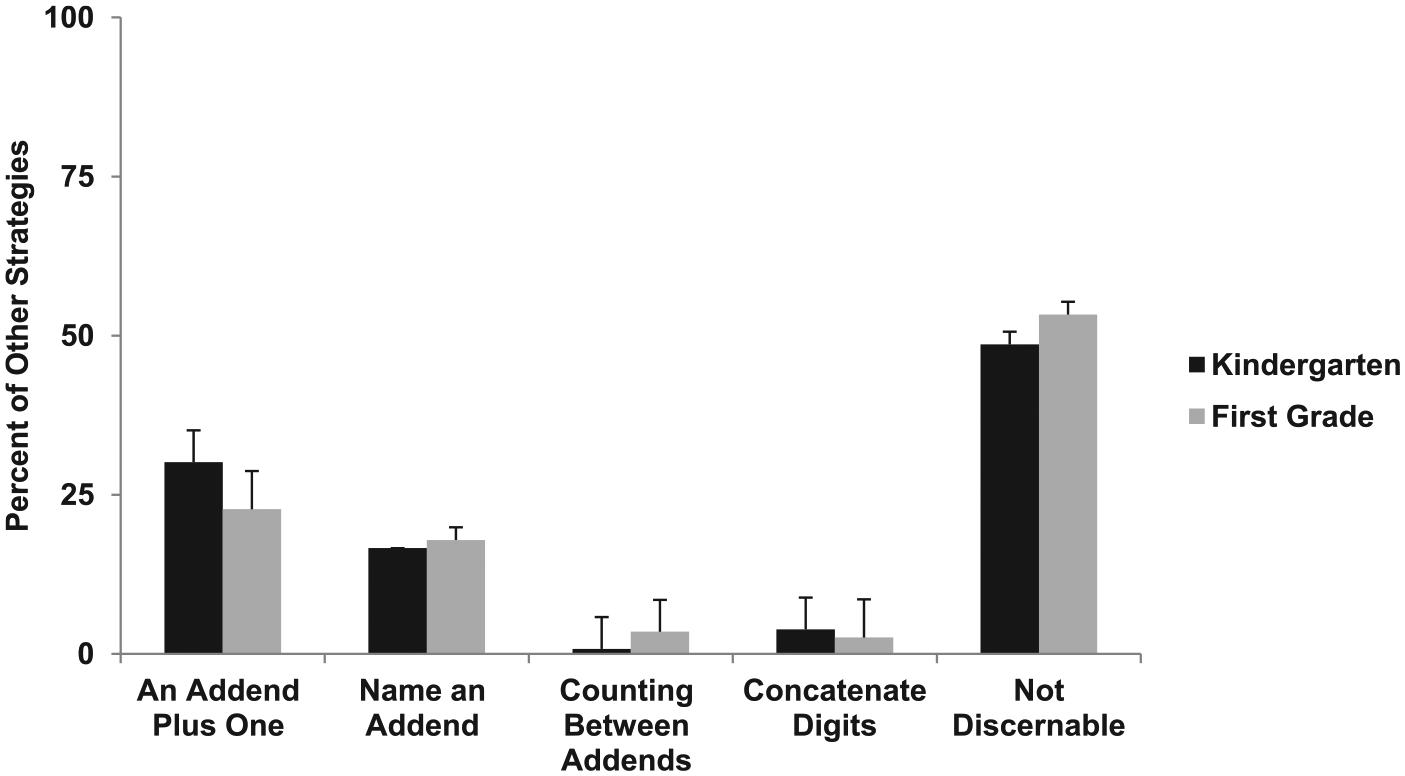
Frequency of other strategies used by low-income kindergartener and first graders. The percentages reflect the number of problems on which children used a particular strategy divided by the total number of trials on which the strategy was coded as other.
Strategy choice on complex problems accounting for basic fact knowledge
Because knowledge of basic number facts is necessary for decomposition and should constrain the use of inappropriate strategies, we examined the frequency of using decomposition on complex problems, controlling for correct retrieval on simple problems (i.e., fluency). We examined only first graders for this analysis because of the lack of variance in strategies among low-income kindergartners and because first graders solved a greater number of complex problems. The results of a MANCOVA, controlling for age and fluency, indicated a main effect of income, F(2, 85) = 9.52, p < .001, ηp2 = .18. Even when controlling for the ability to retrieve basic number facts, higher-income children used decomposition on complex problems more often than lower-income children, F(1, 85) = 7.64, p = .01, ηp2 = .18; adjusted means = 32% and 9%, respectively. At the same time, lower-income children used other more often than higher-income children, F(1, 85) = 1.60, p = .001, ηp2 = .12; adjusted means = 46% and 16%, respectively.
Relation Between Strategy Choice and Accuracy
Strategy as mediator of differences in accuracy
To test the prediction that differences in the use of more advanced strategies (count-on, retrieval, and decomposition) might account, at least in part, for income group differences in accuracy, we conducted a mediation analysis. Age was used as a covariate of both the outcome (i.e., percentage correct) and the mediator (i.e., percentage of problems on which children used a count-on, retrieval, or decomposition strategy). In addition, because the analysis above had indicated an Income Group × Grade interaction, we included grade as a moderator of the relation between income group and strategy use.
To conduct this analysis, we used the SPSS macro PROCESS, created by Preacher and Hayes (2008), to randomly select 10,000 samples with replacement from the complete data file. Regression coefficients were estimated for each of the bootstrap samples and averaged across all samples. This method allows for detection of direct and indirect effects (i.e., mediation) of income group on arithmetic accuracy via the use of advanced strategies. The indirect effect is considered to be statistically significant if the 95% confidence interval does not include zero (Preacher & Hayes, 2008). The significance of mediation effects is based on the estimates of confidence intervals and is the recommended analytic method for smaller samples.
Figure 4 presents the results of the mediation-moderation analysis including all problems. The model accounted for 88% of the variance in addition accuracy and indicated a partial mediation of income group on accuracy through strategy use. The direct effect of income group on addition accuracy (b = .30; confidence interval [CI] = [.25, .37]) was substantially lower than when the relation was examined without controlling for the percentage of problems on which children used an advanced strategy (b = .52, β = .70, p < .001). In addition, the analysis revealed conditional indirect effects—the index of moderated mediation was significant (b = −.12, CI = [−1.19, −0.02]). The product of the coefficients (a*b) for the indirect effect of income group on addition accuracy through frequency of using advanced strategies was greater for kindergartners (b = .30, CI = [.21, .40]) than for first graders (b = .20, CI = [.12, .27]).

Moderated mediation model showing the relation between income group and addition accuracy through the use of advanced strategies (i.e., count-on, decomposition, and retrieval).
To test that the mediation held regardless of problem type, we ran separate mediation models for simple and complex problems. For simple problems, we found that the effect of income group on simple addition problem accuracy through the percentage of simple problems on which children used advanced strategies was moderated by grade. The index of moderated mediation was significant (b = −.15, CI = [−.25, −.05]): The indirect effect was greater for kindergartners (b = .35, CI = [.25, .48]) than for first graders (b = .21, CI = [.12, .29]). For complex problems, a mediation, but no moderating, effect of grade was found. In this analysis, the measure of advanced strategies did not include retrieval because it was not coded for complex problems. The indirect effect of income group on accuracy through use of advanced strategies (i.e., count-on and decomposition) was b = .15 (CI = [.08, .23]). Thus, strategy choice was found to mediate the relation between income and addition accuracy on both problem types.
Matched-sample analysis
We also considered that differences in strategy use may be present even when accuracy was similar. To explore this idea, we examined the strategy use of a subsample of first graders who were matched for accuracy, looking specifically at low- (n = 12) and high-income (n = 48) first graders who correctly provided the sum to 75% or more of the simple problems. It was not possible to find a matched sample for kindergartners on any problem type or for first graders on complex problems. We found that even when low- and high-income first graders were comparably accurate on simple problems, the distribution of strategies used was different. Low-income first graders used count-all, t(58) = 2.55, p = .013, d = .58; count-on, t(58) = 3.59, p = .001, d = 1.12; and other, t(58) = 2.16, p = .035, d = .45, more frequently than higher-income first graders. On the other hand, high-income first graders used the mental strategies decomposition, t(58) = 2.64, p = .01, d = −1.05, and retrieval, t(58) = 24.01, p < .001, d = −1.51, more often.
Discussion
The results of this study replicate findings of income group differences in mathematics knowledge during the first years of schooling. By kindergarten, there was a substantial difference in the addition accuracy of children from lower- and higher-income backgrounds, which also was present in first grade, even on simple problems. The income-related differences in accuracy were mirrored by differences in strategy use: Higher-income children were far more likely to use more sophisticated strategies than their lower-income peers. Furthermore, this difference in strategy mediated the relation between income group and addition accuracy. In this concluding section, we discuss the implications of these findings for understanding income group differences in arithmetic and potential instructional implications.
Income Group Differences in Arithmetic Accuracy and Strategies
Ensuring that all children acquire arithmetic knowledge is crucial to their later success. Given the role of early math knowledge in later academic competence, as well as a range of quality of life outcomes (e.g., Duncan et al., 2007; Geary, 2014), the magnitude of the income group differences in addition accuracy observed in the present study is alarming.
The difference in performance across the income groups in the present study was substantially greater than documented with previous cohorts of low- and middle-income children. Earlier work found that low-income kindergartners correctly solved about half as many simple addition problems as their middle-income peers (Jordan et al., 1992), whereas low-income kindergartners in this study correctly solved approximately one ninth of the simple addition problems that high-income peers solved (8% vs. 73%, respectively). Further, earlier work found no income group differences among first graders in accuracy on addition problems with sums less than 9 (Jordan, et al., 1994), but in the present study, low-income first graders correctly solved fewer than half of the simple addition problems compared to high-income first graders. Even more striking was that after 1 year of instruction, the low-income first graders in this study performed worse than the high-income kindergartners, suggesting their addition knowledge was more than 1 year behind.
Not only were low-income children far more likely than their high-income peers to provide an incorrect response; their errors reflected less understanding of the conceptual basis of addition. When higher-income children answered incorrectly, their responses were quite close to the correct sum (on average, one digit away). On the other hand, low-income children’s responses were on average 11 digits away from the correct sum. Low-income children did demonstrate marked improvement in the magnitude of their errors between kindergarten and first grade, reducing the gap on that measure. Nevertheless, as a whole, the data suggest that higher-income children’s incorrect responses were plausible and resulted from minor procedural errors in executing strategies, such as miscounting one of the addends, whereas low-income children’s answers were largely implausible (e.g., naming one of the addends as the sum) and not constrained by conceptual knowledge.
The analyses of strategy use indicated that these differences in accuracy and errors stemmed from fundamental differences in the groups’ approaches to the addition problems. It was expected that higher-income children would use sophisticated strategies (count-on, decomposition, and retrieval) more frequently than their low-income peers, in part due to possessing a better understanding of numerical magnitudes and in part due to more practice with addition. Indeed, at both grade levels, high-income children were more likely to use count-on, decomposition, and retrieval than their low-income peers. Further, higher-income children adaptively selected strategies—using more decomposition on complex problems—but lower-income children (perhaps because of the lack of strategies available to them) did not. Although we had expected, on the basis of prior studies, that lower-income children might use less sophisticated counting strategies, the extent to which they used completely inappropriate strategies, such as naming one of the addends, was quite surprising. These kinds of strategies, and the resulting answers that were far from the correct response, had not been reported in any previous studies of children’s addition knowledge (e.g., Ashcraft, 1982; Geary et al., 1996; Ginsburg & Pappas, 2004; Siegler, 1988). A particularly troubling finding was that even by first grade, after 1 year of instruction that included practice with addition, low-income children used either no discernable strategy or an inappropriate one (e.g., naming one of the addends) to solve nearly one third of the simple problems, solving fewer than half of the simple problems correctly.
In other words, the higher- and lower-income children were not using the same strategies more or less effectively; rather, they used qualitatively different strategies. The matched-sample analyses found that even when low- and high-income first graders were comparably accurate on simple problems, they achieved this accuracy using different strategies. The mediation analysis indicated that the effect of children’s economic background on addition accuracy was partially accounted for by the difference in the frequency of sophisticated strategy use. The mediation was moderated by grade, indicating that income differences in strategy use accounted for differences in accuracy among kindergartners more than among first graders. The moderating effect of grade may reflect the finding that differences in strategy use across the income groups were more pronounced at kindergarten than in first grade. It could also suggest that instructional experience between kindergarten and first grade was related to increased use of more sophisticated strategies.
The pattern of the present results about arithmetic converges with recent arguments about trends in the income gap in mathematics achievement more generally (Duncan & Murnane, 2011; Reardon, 2011, 2013). First, the increase in the income gap in young children’s addition performance in this study relative to earlier work mirrors the increased gap among older children on standardized achievement measures between children from high- and low-income families. Second, the striking differences in accuracy and strategy use between low- and high-income kindergartners are consistent with evidence that the achievement gap in mathematics between children from lower- and higher-income families is present by preschool and continues to widen over the course of schooling (Duncan et al., 2007; Jordan et al., 2009; Starkey, Klein, & Wakeley, 2004; Stevenson & Newman, 1986). Third, the data lend support for the idea that differences in enrichment opportunities outside of or prior to school contribute to the income gap. Higher-income kindergartners’ were able to solve about two thirds of the complex addition problems correctly, despite the fact that instruction typically does not include these kinds of problems until at least the beginning of the first-grade year. In sum, the current findings are consistent with arguments that the opportunities that affluence affords likely contribute to the income gap in arithmetic both before and during the first years of school.
Instructional Implications and Future Directions
Much of the extant literature examining the relation between income and achievement has focused on environmental factors, such as parental investment, school quality, and neighborhood effects (Akiba et al., 2007; Duncan & Brooks-Gunn, 1997; Hoff et al., 2002; Leventhal & Brooks-Gunn, 2002; Magnuson et al., 2007; McLoyd, 1998). These factors, however, are not particularly malleable or proximal to the process of mathematical learning. On the other hand, the present study focused on a mediator of the relation between income and math achievement that is both malleable and directly involved in the computational process. As expected, the differences in low- and high-income children’s addition accuracy were in large part explained by their differences in strategies, with low-income children using either an ineffective or inappropriate strategy on the majority of problems. This raises questions about why strategies varied by income group and how instruction might ameliorate these differences.
We believe the most likely explanation is differences in prerequisite math knowledge upon school entry. The ability to execute strategies correctly is closely related to a conceptual understanding of counting and addition principles, such that there is an iterative process of development (Canobi, Reeve, & Pattison, 1998; Rittle-Johnson & Siegler, 1998). For example, children need to be able to identify which of two addends is larger and to count from a number other than 1 in order to use a count-on strategy most efficiently. Children also need to understand that the sum of any two numbers will be greater than the value of both addends. Both the strategy and absolute error analyses findings suggested that the low-income children in this study possessed little conceptual understanding of addition and numerical magnitude. They often named one of the addends as the answer, demonstrating that they were neither thinking of the part-whole relations in addition nor constraining their responses based on the magnitude of the addends. Further, after a year of instruction, the low-income first graders had lower accuracy and used less sophisticated strategies than high-income kindergartners, suggesting they needed more time to catch up. Even when controlling for knowledge of basic addition facts (i.e., percentage correct retrieval on simple problems), low-income first graders used more inappropriate other strategies than higher-income first graders.
These findings are consistent with findings that have shown substantial differences between low- and middle-income children on measures of conceptual knowledge, such as numerical magnitude comparison and number line estimation (Jordan et al., 2009; Ramani & Siegler, 2008; Siegler & Ramani, 2008), prior to kindergarten. More specifically, by age 5, middle-income preschoolers are more accurate on measures of numerical magnitude (e.g., What is more: 5 or 8?) than low-income preschoolers, and this knowledge is related to their ability to learn the answers to simple addition problems (Ramani & Siegler, 2011). Further, numerical magnitude knowledge in kindergarten predicts arithmetic fluency in first grade, above and beyond a general intelligence measure (Bartelet et al., 2014). This suggests that improving low-income children’s number knowledge before school entry may attenuate differences in arithmetic in kindergarten and first grade.
Another possible explanation for the strategy differences is that there was a difference in the curricula used with the groups in the present study that varied in terms of strategy instruction. To explore this, we examined the curricula used in participating schools and found that they were comparable in terms of instructional goals for kindergarten and first grade and that they were aligned with the Common Core State Standards. The curricular materials used with both higher- and lower-income samples included a comparable amount of arithmetic instruction, with lessons dedicated to teaching different strategies. Although the curricular emphases were similar, it is possible that the implementation varied as a result of differences in teacher quality or the approach to teaching the standards (e.g., mechanical vs. conceptual). It is also possible that lower-income children’s lack of prerequisite number knowledge impeded their learning. In other words, curricula that assume that children begin school with particular knowledge (e.g., of counting principles) may not be as effective for lower-income children as they are for higher-income children. More research is needed to understand which approaches to addition instruction are most appropriate for children with less initial knowledge.
Adapting the way manipulatives are used in instruction may help children with less knowledge acquire mental strategies. In the present study, children were asked to solve problems mentally. This requirement may have magnified differences between the groups. Previous research found that middle-income preschoolers performed comparably well when solving problems using objects or mentally, whereas low-income preschoolers were less accurate when asked to solve problems mentally (Jordan et al., 1994). Instruction in kindergarten often focuses on the use of objects and drawings to solve addition problems (National Governors’ Association Center for Best Practices & Council of Chief State School Officers, 2010). Certainly, using objects to demonstrate concepts or connect numerals to quantity can be informative initially, but an overreliance on them may prevent children from acquiring mental strategies—a particular area of weakness of lower-income children. Recent research demonstrates that fading the use of concrete representations in problem solving can promote mental representations of concepts and transfer to new problems (Fyfe, McNeil, Son, & Goldstone, 2014; McNeil & Fyfe, 2012). It would be interesting to examine if “concreteness fading” in addition instruction can facilitate low-income children’s transition to mental calculation strategies.
The pattern of strategy use across problem types in the present study also suggests that exposing children to a greater variety of problems in kindergarten and first grade may be useful for promoting the use of particular strategies. Higher-income children exhibited more adaptive strategy choice based on problem type: They used count-on and decomposition more often on complex problems than on simple problems. On the other hand, low-income children demonstrated no change in strategy preference based on problem type, even controlling for their ability to correctly retrieve sums to simple problems. Although it may seem counterintuitive to ask children who are having trouble solving simple problems to solve complex ones, there is some evidence that this can help facilitate the use of more sophisticated strategies. Children may be unlikely to broadly adopt a new strategy unless the problem difficulty makes it more advantageous (either more efficient or more accurate) than their more predominant approach. Siegler and Jenkins (1989) found that 4- and 5-year olds who demonstrated an ability to use count-on were more likely to transition to using it as their predominant strategy after being asked to solve challenge problems that included a small addend and a very large addend than when asked to solve problems with addends smaller than 5. It would be interesting to examine if introducing more complex problems into instruction, as soon as low-income children begin to use count-on, can increase the frequency with which children use more sophisticated strategies. Although the cross-sectional nature of the study prohibits making strong conclusions about change with instruction from kindergarten to first grade, the finding that the low-income first graders were less accurate and used less appropriate strategies than high-income kindergartners is alarming. Finding ways to increase the rate of change in low-income children’s strategy use during early school years is essential for reducing and eventually closing the income gap in arithmetic performance.
Footnotes
Appendix
List of Problems Administered During the Strategy Assessment, Separated by Problem Type

| Problem type | Problems |
|---|---|
| Single digit | 5 + 7 6 + 3 4 + 2 3 + 7 4 + 9 9 + 8 2 + 6 5 + 4 3 + 8 8 + 7 6 + 5 3 + 4 |
| Mixed digit | 15 + 3 6 + 41 4 + 38 26 + 8 5 + 22 18 + 3 5 + 59 |
| Double digit (first grade only) | 25 + 37 45 + 12 15 + 19 11 + 17 37 + 2 |
Acknowledgements
Thanks are due to the children, teachers, and principals who participated in this research.
Authors
ELIDA V. LASKI is an associate professor of applied developmental and educational psychology at the Lynch School of Education, Boston College, 140 Commonwealth Ave., Chestnut Hill, MA 02467;
JOANNA SCHIFFMAN is a doctoral candidate in applied developmental and educational psychology at the Lynch School of Education, Boston College, 140 Commonwealth Ave., Chestnut Hill, MA 02467;
MARINA VASILYEVA is an associate professor of applied developmental and educational psychology at the Lynch School of Education, Boston College, 140 Commonwealth Ave., Chestnut Hill, MA 02467;
ANNA ERMAKOVA is a doctoral candidate in applied developmental and educational psychology at the Lynch School of Education, Boston College, 140 Commonwealth Ave., Chestnut Hill, MA 02467;