




Abstract
Despite an increasing focus on the quality of teaching in postsecondary institutions, little research exists that examines how faculty actually plan their courses in real-world settings. In this study the idea of the “problem space” from cognitive science is used to examine how faculty construct mental representations for the task of planning undergraduate courses. Using data from free lists and retrospective interviews, I report the factors that most shape the planning space and subsequent strategies and curricular artifacts used by a group of 58 faculty. Results indicate the primacy of fixed affordances, such as workload constraints, course content, and class size, and that these constraints contribute to the routine maintenance of preexisting lecture notes and PowerPoint slides. I recommend that educational leaders consider these cultural practices when designing instructional reforms and enact policies that require faculty to engage in brief, postclass reflection that results in minor updates to these artifacts.
However, researchers are mostly focused on what happens in the classroom and not the planning that precedes the beginning of class. As higher education researcher Joan Stark observed, “Most attempts to improve teaching and learning in colleges have focused on the teacher’s role as a ‘classroom actor’ rather than as an ‘academic planner’” (Stark, 2000, p. 413). This is problematic because improved instruction is as dependent upon faculty developing a pedagogically informed approach to curriculum planning as it is to sound classroom practice (Freeman, Haak, & Wenderoth, 2011; Wiggins & McTighe, 2005). Thus, understanding the decision-making processes underlying faculty decisions about whether or not to adopt instructional innovations requires an expansive view of educational practice that encompasses their roles as planners and classroom actors.
Although a panoply of factors shapes instructional decisions, such as beliefs about teaching (Hativa & Goodyear, 2001; Hora, 2014), organizational contexts play a central role in shaping how and why faculty teach the way they do (Bastedo, 2012; Umbach & Porter, 2002). The ways in which the task environment influences how teachers approach classroom instruction (Schoenfeld, 2000; Shavelson & Stern, 1981) and policy implementation (Coburn, 2001) have long been an active area of research in K-12 settings, especially the processes whereby individuals’ prior knowledge, experience, and beliefs interact with local contexts to shape the educators’ decisions. To understand these dynamics, many scholars have drawn upon insights from cognitive science, particularly the notion that when faced with new situations, people will access prior knowledge in the form of schemas or mental models and use them to filter, frame, and connect new information to what is already encoded in memory (Spillane, Reiser, & Reimer, 2002). Because these sensemaking processes unfold in specific social, cultural, and organizational contexts, understanding how educators perceive and interpret their local environments as constraining or affording particular actions is particularly important (Greeno, 1998; Weick, 1995). Research in this area is crucial because insights into agent-situation dynamics may illuminate potentially important leverage points for affecting change (Spillane, Halverson, & Diamond, 2001).
But the literature exploring how postsecondary faculty plan and teach their courses tends to adopt a “black box” approach to the relationships among context, decision making, and practice. For example, a common way to conceptualize the influence of contextual factors on teaching is captured by a model used by Umbach (2007), which posits that a linear, causal relationship between culture and student learning exists and can be summarized as follows: “Faculty subcultures (professional, institutional, and disciplinary)→faculty teaching→student learning” (p. 266). Besides assuming a linearity of cause-effect relations that may not exist, such an approach leaves the underlying mechanisms that govern sensemaking, in general, and relations between instructional decision making and local contexts, in particular, unexamined. Promising lines of inquiry that shed light on agent-situation interactions in higher education include research of how pedagogical beliefs and goals are “filtered” by the local context (Stark, 2000) as well as how “situational factors,” such as class size, are perceived by faculty as influencing the adoption of pedagogical innovations (Henderson & Dancy, 2007). However, research in this area tends to not draw upon theory and method from fields that have long been engaged in exploring these issues, such as cognitive science and naturalistic decision making. But the factor that most inhibits the field of higher education is the lack of empirical research on the actual practices whereby faculty negotiate their real-world workplace situations while making decisions about what and how to teach their courses.
Why does the lack of descriptive research addressing such issues matter? Through fine-grained descriptions of behavior in real-world settings, descriptive research illuminates precisely what steps people take when solving problems or making solutions. Educational researchers across the K-16 spectrum have also advocated for more practice-based research on teaching and decision making, so that how and why educators make decisions in “the wild” of schools, colleges, and universities is better understood (Bastedo, 2012) instead of simply focusing on prescriptions about how educators should think and act. Further, practice-based research promises to shed light on the mechanisms by which particular outcomes, such as a hastily and poorly planned course, are constructed within complex organizational systems (Coburn & Turner, 2012). In this article, I contribute to the growing literature on educational practice by providing an analysis of how a group of postsecondary faculty made instructional decisions within the unique organizational and cultural constraints that they negotiated on a daily basis.
At the heart of this investigation is the idea of a “problem space” from research on artificial intelligence and human cognition, which refers to how a problem solver constructs or evokes (from memory) a mental representation of a task and its possible solutions (Newell & Simon, 1972). Specifically, a problem space comprises knowledge structures about the task, a set of operators or strategies for solving the task, and a goal state for the successful completion of the task. Problem solving itself unfolds when the agent “searches” within this space for the appropriate strategies to meet the goals of the task, which generally involves sifting through a delimited set of options. Insights from more recent work on naturalistic decision making also highlights the importance of the initial stage of “situation recognition,” whereby individuals perceive certain cues in the environment that in turn trigger or activate associated memories about the best courses of action (Klein, 2008). Applied to postsecondary settings, this framework illuminates the processes whereby faculty actively construct their own problem spaces within which instructional decisions are made, based on a combination of their “reading” of situational cues, their own background and beliefs, and other factors that collectively suggest certain strategies for course planning and classroom teaching.
Using these theoretical insights, I studied the instructional decisions made by a group of 58 postsecondary math and science faculty while planning their classes in three public research universities. In conducting this exploratory descriptive analysis of faculty practice in real-world settings, I analyzed data from a free-listing exercise (where respondents report the first words that come to mind for particular topics), retrospective recall interviews, and in-person observations of classroom teaching to address the following questions: (a) What factors do faculty perceive as most salient to their course planning activities? (b) What specific strategies do faculty use when planning a specific course? (c) Which curricular artifacts, if any, are developed by faculty, and how do they plan to enact them in the classroom? (d) How do these processes of course planning unfold in concrete instances? Answers to these questions shed light on the dynamic yet patterned nature of the problem spaces that faculty construct for their own teaching practices, and implications for these findings are considered in light of efforts to improve the quality of undergraduate education in the nation’s colleges and universities.
Background
Postsecondary Research on Curriculum Design
Much of the early work on course planning and curriculum design in higher education was largely conceptual, as researchers sought to develop explanatory models of planning largely to aid designers in developing and improving degree programs (Dressel, 1980; Mayhew & Ford, 1971). These efforts led to complex models that included numerous boxes and arrows denoting causal relations among factors. However, Conrad and Pratt (1983) critiqued this approach to modeling the design process for being an overly linear accounting of curriculum development that likely did not reflect real-world practice. This shift from abstracted models of curriculum design to more grounded, descriptive accounts of how faculty designed their courses in practice was also the hallmark of the research program of Joan Stark (2000). Stark hypothesized that personal characteristics, such as beliefs about teaching and learning, and experiences as an instructor would largely drive decisions about the structure and content of a course. However, these individual-level factors did not unilaterally dictate faculty behaviors but were instead “filtered” by features of the organizational context that ultimately determined how a course was designed and taught (Stark, 2000). A key finding from this research program was that planning for a previously offered course typically involved minor alterations to existing materials, or what Stark (2000, p. 420) called “routine maintenance.”
These studies represent the most comprehensive work on faculty course planning to date, but given changes in higher education in the intervening 25 years, the field would benefit from more recent empirical work on these topics (see Lattuca & Stark, 2011, for a more prescriptive approach to curriculum design). Additionally, this research was primarily survey based and failed to capture faculty decision making as it unfolded in real-world situations. As Stark (2000) noted, “Our work fell short of exploring in depth the actual decisions teachers make about course plans and curriculum” (p. 435).
Although the notion of contextual filters for decision making suggests a cognitively informed theoretical framework that examines the dynamics among perception, context, and action, it was not until scholars in the United Kingdom and Australasia began to investigate the nature of faculty thinking that postsecondary research in this area took a decidedly cognitive turn. Much of this work focused on identifying particular approaches to teaching that, in turn, were theorized to shape an instructor’s classroom practice (see Hativa & Goodyear, 2001, for a review). In one of the few studies that explicitly draws on theory from cognitive science to examine these processes, McAlpine, Weston, Berthiaume, and Fairbank-Roch (2006) drew upon the idea of problem spaces and situated cognition to examine how faculty develop internal mental models of their social and organizational environment. Building on prior critiques that research on postsecondary teaching rarely connects faculty beliefs or conceptions to observed teaching behavior (Kane, Sandretto, & Heath, 2002), the researchers interviewed two faculty before and after teaching a class, with a focus on eliciting goal statements that facilitated the construction of problem spaces and knowledge statements that guided subsequent solutions (McAlpine, Weston, Berthiaume, et al., 2006). Results indicated that more detailed and context-dependent goal and knowledge statements were used to describe specific classroom actions as opposed to course-level observations and that “complex repertoires” of knowledge were activated in relation to specific situations (McAlpine, Weston, Berthiaume, et al., 2006, p. 143). On the basis of these and related results, the authors proposed that constructs such as abstracted “conceptions” capture abstracted forms of thinking and are relatively distal from the teaching act, whereas thinking that is grounded in specific instructional acts and situations is more “tactical” and engages specialized knowledge structures (McAlpine, Weston, Timmermans, Berthiaume, & Fairbank-Roch, 2006). Although these studies do not examine the relationship between context and cognition or how decision making unfolds in real-world settings, they nevertheless represent a productive interface between the cognitive sciences and postsecondary research that this article explores in detail (see also Hora, 2012). Yet perhaps what is most limiting about research on faculty thinking is its limited accounting of the research conducted on K-12 teacher cognition.
Research on Curriculum Design and Enactment in K-12 Settings
A core idea that motivated early research on teacher cognition is that teachers are complex decision makers whose problem-solving capabilities are shaped by characteristics (and constraints) of human cognition as well as features of the instructional situation (Lee & Porter, 1990). In terms of curriculum design, researchers have pointed out that teachers adapt materials to fit their strengths and views as instructors as well as the unique needs of their students and constraints of their classrooms (Shavelson & Stern, 1981). As a result, some suggest that there is not a single form of the “curriculum” that is directly implemented in the classroom, but instead there exist three versions: the formal curriculum, which is often a text; the planned curriculum, which refers to an adapted form of the text for a particular class; and the curriculum actually enacted, which often varies considerably from the original (Gehrke, Knapp, & Sirotnik, 1992).
These distinctions were crucial for the field because they highlighted the active role teachers take in interpreting curricular materials for classroom applications. According to this view, the analytic focus should be on the teacher as he or she interprets and makes sense of the curricular text rather than on the formal curriculum and the teacher’s varying degree of fidelity to it. As such, it is important to recognize that teachers do not interact with texts in isolation, but instead they encounter them in specific contexts “that assign to the curriculum a particular meaning” (Remillard, 2005, p. 234). This is evident in part through the curricular artifact itself, which represents an important instantiation of a group’s (e.g., school district, department) cultural norms, such that the materials may act as cultural tools that mediate as well as constrain instructional behavior in subtle ways (Halverson, 2003). These insights into curriculum design and enactment highlight the importance of understanding the dynamics among agents, artifacts, and situations, an issue explored in depth by scholars examining how teacher cognition unfolds in real-world settings.
Focus on Perception in Context: The Problem Space of Decision Making
Thus, a critical problem facing the field is how to conceptualize the interactions between faculty perceptions of their contexts and subsequent teaching-related decisions. Another core idea in K-12 teacher cognition research is that the rational choice model, which posited that humans make logical decisions solely based on a deliberate search for the best alternative among all possible choices, is not sufficient to explain how educators make decisions in practice (Lee & Porter, 1990). Instead, human decision making can be seen in terms of a “bounded rationality” whereby certain principles of cognition, such as perception and memory capacity, delimit the range of possible strategies utilized to perform a given task (Simon, 1982). An important component of this perspective is that decision makers construct a simplified mental model, or cognitive representation, of the task. This model is known in cognitive science as a “problem space” and is shaped by the individual’s perception of the nature of the task, its goals, and the strategies that can best lead to the successful performance (Newell & Simon, 1972). Constructing this simplified model of the task allows the problem solver to manage the overwhelming perceptual inputs of the environment into a representation that is cognitively efficient.
Because problem spaces can be large and complex, Newell and Simon (1972) theorized that rule-like operators that link perceptions of the task with specific strategies would be used as cognitive shortcuts or “heuristics” that allow individuals to minimize cognitive load in real-world tasks (Goldstein & Gigerenzer, 2002). One type of heuristic, called a “perceived affordance,” captures the relationship between perception and potential activities within a given environment. The notion of affordances focuses on how the perception of particular objects involves both the reception of visual information as well as the instantaneous interpretation of the actionable properties of these objects (Gibson, 1979; Greeno, 1994). For example, an individual surveying a room may visually perceive a chair and certain properties related to how he or she could interact with it (e.g., sitting). Later researchers focused less on the entire range of potential actionable properties of objects and instead on those behaviors that individuals perceive as possible and desirable in a given situation (Norman, 1990). Thus, if the chair were located in a room full of professional wrestlers, perhaps the individual would perceive the chair not as an object for sitting but as a potential weapon. Over time, educators will become attuned to the constraints and affordances represented by artifacts and social regularities in their schools, and these attunements can act as heuristics for decision making (Greeno, 1998).
A New Approach to Studying Instructional Decision Making in Postsecondary Settings
So what do the concepts of problem spaces and perceived affordances have to do with the issue outlined at the outset of the article, how postsecondary faculty plan and then teach their courses? Recognizing the implications of the complexity of real-world settings for research on educational reform, Shavelson and Stern (1981, p. 461) argued that the field needs to understand teachers’ goals, the nature of their task environment, their cognitive capabilities, and the relationship among these elements in order to better understand how to support their development and growth in the profession (see also Borko, Roberts, & Shavelson, 2008). Yet at the postsecondary level, little empirical research exists in this area, and insights into the “actual decisions teachers make about course plans and curriculum” (Stark, 2000, p. 435) remain elusive. Using problem space theory as a theoretical framework allows for a more structured examination of the processes of sensemaking, which refers to individuals’ active navigation of organizational situations and step-by-step decisions about the most optimal pathways to success (Weick, 1995).
Specifically, I use the problem space construct to examine how faculty actively construct their task environments within which decisions about curriculum and instruction are made. These spaces are initially constructed based on certain environmental cues that are “read” as affordances or constraints to certain behaviors. Combined with their personal backgrounds as instructors and institutional actors, these situational factors are often associated with a circumscribed set of strategies for planning a course or a class that have proven to be successful in the past. Over time and with repeated activation by certain situations, these patterns of cue recognition and strategy selection will become stored in long-term memory as cognitive schemata or interconnected knowledge structures (Brewer & Treyens, 1981). Since the acquisition of many schemata involve social situations and/or cultural groups, it is likely that multiple people will share particular models of the world in general and problem solving in particular, which some call cultural models (Ferrare & Hora, 2014; Holland & Quinn, 1987).
In this article, I focus on four specific steps of the decision making process: (1) situation recognition, or where perceived affordances in the local context are noticed; (2) strategies or action steps for accomplishing the planning task; (3) the types of curricular artifacts created; and (4) the planned utilization of these artifacts as part of classroom teaching. (See Figure 1.)
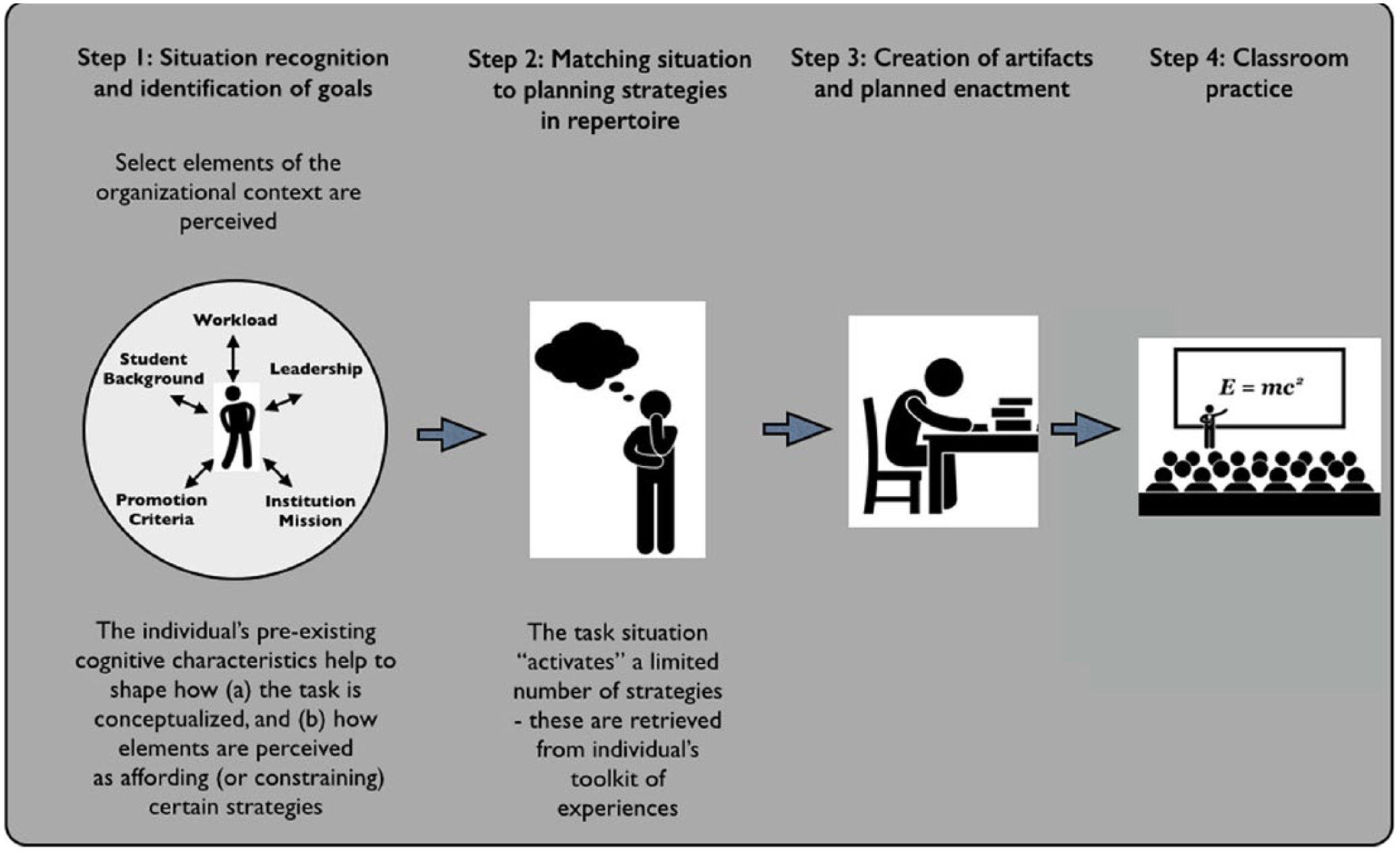
Model for construction of problem spaces during course planning.
It is important to note that this article reports the initial efforts at mapping out the problem spaces that faculty construct in the course of their daily work. Thus, as an exploratory study, many details of this process remain unexamined. Specifically, this article largely ignores the critical influences of specific cognitive schemata, such as beliefs about teaching (Fives & Beuhl, 2012; Hora, 2014), and power dynamics and cultural narratives that comprise the academic field (Bourdieu, 1988; Trowler & Knight, 2000), the inclusion of which will be important for future research in this area. Further, integrating additional theory and method from fields such as naturalistic decision making (e.g., Crandall, Klein, & Hoffman, 2006; Shattuck & Miller, 2006) and human factors (Carayon, 2006) would greatly enhance future research.
Method
This exploratory study is a descriptive analysis of faculty practice in naturalistic settings. Practice-based research is particularly important in cases where little is known about the salient variables at work and the dynamics between context and behavior (Bastedo, 2012; Halverson & Clifford, 2006). The qualitative case study method is uniquely suited to producing such rich, detailed accounts of practice (Yin, 2009). The cases analyzed in this study are of the course-planning practices of 58 faculty in math, biology, chemistry, geology, and physics departments at three large, public research universities. The three study institutions were selected on the basis of the interests of the larger study from which this analysis is drawn—that of educational practice in undergraduate science and math departments. The three institutions shared similar undergraduate populations (approximately 25,000), numbers of science and math departments, and numbers of pedagogical reforms underway. The sampling frame for this study included 170 individuals listed in the spring 2012 timetable as the instructor of record for undergraduate courses in the departments being studied. Individuals were contacted up to two times via e-mail for participation in the study, and 58 faculty ultimately self-selected into the study (see Table 1).
Description of Sample by Institution (Interviewees)

Data Collection
The data collected for this study include semistructured interviews and classroom observations, both of which are well suited to answer the four research questions motivating the study. Interview data were analyzed for the entire study sample of 58 faculty, whereas observation data were used only for the two participants in the in-depth analysis. All data were collected by three analysts who underwent extensive training in the research protocols.
Semistructured interviews
The interview protocols included a free-list exercise and a series of questions about instructional decision making. First, the free-list exercise involved asking respondents to report the first thing, using single words or short phrases, that came to mind when they thought of the contextual factors that most influenced their own course planning. The free-list technique is commonly used in cognitive anthropology research, especially to identify “emic,” or insider, cultural domains in ethnographic fieldwork (Bernard, 2011; Quinlan, 2005). The method assumes that when people report terms, they do so in order of familiarity and cognitive salience (Romney & D’Andrade, 1964).
Second, respondents were asked questions about how they planned for a specific class using a variation of the critical decision-making technique (Crandall et al., 2006; Klein, 2008), which is a retrospective think-aloud technique that elicits details about how decisions were made in specific situations. Respondents were asked to report the steps they went through while planning for a class taught that week. Follow-up probes included questions about any contextual factor that influenced the decision, curricular artifacts that resulted from the planning process, and if and how these artifacts would be used in their teaching (see also Feldon, 2010). Interviews lasted 30 to 45 minutes and were recorded and transcribed.
Classroom observations
The Teaching Dimensions Observation Protocol (TDOP) is a classroom observation instrument developed to produce fine-grained descriptions of instructional practice (see Hora & Ferrare, 2013). The version of the TDOP used in this study captured five different dimensions of teaching practice: teaching methods, pedagogical strategies, student-teacher interactions, cognitive engagement, and use of instructional technology. Within each dimension there exist several detailed codes that observers capture at 2-minute intervals in real time. Prior to gathering data in the field, the three researchers established a common understanding of each code through rigorous training that included in-depth discussions about the meaning of each code category and individual codes, practice coding of videoed class segments, and finally, the testing of interrater reliability.
Data Analysis
Salience analysis of free-list data
First, I calculated the salience of each of the terms elicited during the free-list exercise and used it as the primary indicator for situational recognition by respondents. Salience is a measure that reflects the average percentile rank of a particular term across all of the respondent lists (Smith & Borgatti, 1998). Before conducting the analysis, it was necessary to review interview transcripts to ensure that respondents provided useable data for the free list. Three respondents failed to discuss influential factors at all in their interviews, and their data were not included. In addition, 18 respondents provided information on these topics in sentence form and not single words or short phrases. In these cases, it was necessary to distill their more expansive observations into single words. To do this, two members of the research group (the author and a graduate student assistant) met and engaged in a process of data reduction, which entailed an open-coding process whereby new codes or terms were derived from the data (Bernard, 2011).
Then, because respondents listed terms that could be considered closely related but were in fact differently phrased (e.g., course material, content, and course content), a process of standardizing the terms was necessary. For this step, the same two analysts reviewed the raw data and developed a list of standardized terms. The final code list included 75 terms, and each respondent’s free-list data were then updated using these terms. I analyzed the lists using Anthropac (Borgatti, 1996), with the primary output measure being term salience for each of the groups. Salience reflects the mean percentile rank for each term across all respondent lists and indicates the degree to which a term was both frequently cited and the order in which it was reported (Romney & D’Andrade, 1964; Smith, 1993). For each individual list of terms, the salience measure is computed as

where S is the average rank of a given term across all of the free lists in the study sample, weighted by the lengths of the free lists in which the term is found. In the formula, L = length of a list (e.g., number of items in a list), Rj = position of item j in the list of terms (first item is 1), and n = number of lists in the sample. Results from this analysis were used to address the first research question that focuses on agent-situation dynamics and problem space construction.
Thematic analysis of interview data
Next, responses to questions about instructional planning were analyzed for all 58 respondents using an inductive approach to qualitative data analysis (Bernard, 2011). To identify the planning steps across respondents, the same two analysts independently reviewed a sample of 10 transcripts, and each developed a preliminary code list using an open-coding procedure. We then compared results and produced a revised code list, which was used to review another 10 transcripts. At this stage of the analysis, each successive instance of the code was compared to previous instances in order to confirm or alter the code and its definition (i.e., the constant comparative method; Glaser & Strauss, 1967). We then assessed interrater reliability by calculating the percentage of agreement between the two analysts in applying the codes (94%). After another process of revising the codes, we compiled a final code list, whereupon I then reviewed the entire data set using these codes. Using this same procedure, we reviewed the transcripts to identify curricular artifacts and whether or not these artifacts were to be used in classroom teaching. Results from this analysis were used to address Research Questions 2 and 3 regarding planning strategies and curricular artifacts.
Causal network analysis of structure and sequence of decision making
Finally, the interview transcripts and classroom observation data for two individuals were analyzed using the causal network analysis technique, which is a structured approach for identifying relationships between concepts in a graphic and time-ordered fashion (Miles, Huberman, & Saldaña, 1994). The two individuals were selected based on their working in the same discipline, as well as teaching undergraduate courses, thereby holding discipline, and teaching assignment constant. This process entailed the creation of a graphic that included each of the data sets included in the analysis: (a) free-list results, (b) planning steps, (c) curricular artifacts and planned use, and (d) classroom observation data. I analyzed the classroom observation data for each of the instructors by calculating the proportions that a particular code was observed in relation to all possible 2-minute intervals. Taken together, the graphics show what I call the “decision chains” that represent the structure and temporal nature of instructional decision making at the individual level. It is important to note that the resulting displays represent the accounts of only two respondents from the study and should not be extrapolated to entire departments or institutions. Results from this analysis were used to address Research Question 4.
Limitations
Some limitations to the study should be considered when interpreting the evidence reported in this article. First, the free-list question posed to participants did not specify the specific type of course being considered (e.g., upper or lower division), which means that different participants could have been thinking of different types of courses when answering the question. Further, because the free-list technique requires standardizing unique respondent terms, in doing so, variation between individual terms and ideas that may be important are lost. Second, the self-selected nature of the sample reduces the generalizability of the results to the larger population of faculty. This is particularly true given indications that the study sample may overrepresent certain groups, including female faculty, who compose 65% of the sample but much smaller percentages at the study sites, ranging from 33% to 45%. Finally, the disciplinary and institutional affiliation of study participants should be considered when interpreting results from this study, as these are unique contexts in which teaching and learning may be considered differently than in other disciplinary and institutional settings.
Results
In this section, I report results for the different components of problem space construction: situation recognition, actual planning steps, form of the curricular artifact, and reported use of artifacts in the classroom. Then, I report how these processes unfolded in practice.
Situation Recognition: Factors Involved in the Initial Stages of Problem Space Construction
Results from the free-list exercise capture the specific features of the task environment noticed or perceived as influential to planning processes. Results are depicted in Table 2, showing the frequency with which terms were reported, the average rank of the term, and salience scores. In the interest of space, only terms with salience scores over .10 are reported.
Free-List Results by Institution

Note. Items with more than 10% salience scores are included in the table. Additionally, the total sample number here varies from the total in the entire study sample (N = 58) because three respondents’ data were not sufficient for the free-list analysis.
Across the entire sample, faculty perceive time (.25) as the most salient organizational factor influencing their planning, followed by class size (.20) and course content (.20). These factors are notable by being relatively “fixed” or durable features of the environment that are established by departmental administrators and/or curriculum committees. The next most salient factor was the consideration of which illustrations or examples to use in teaching from either memory or textbooks (.13), and a curricular concern about the course textbook itself, particularly in regard to how material is sequenced and arranged (.12). These data indicate that when faculty consider the course design task—that is, the first stage of problem space construction—they first think about these fixed organizational factors.
Next, variability at the institution level is examined. At Institution A, time (.36), class size (.30), examples and illustrations (.15), and course content (.14) were reported, all of which mirror the results from the entire study sample. However, two student-related factors were also reported, student level (.13) and student background (.11), which indicates that considerations about students enter into design considerations for this group of faculty at Institution A. At Institution B, illustrations and examples was the most salient term (.20), followed by student career trajectory (.17), syllabi (.17), textbooks (.17), and course content (.16). These data from Institution B are notable in the prominent roles that considerations of teaching techniques and students play in the problem space construction process. At Institution C, time (.34) was the most salient factor, followed by course content (.29), class size (.20), the pedagogical consideration of making the material interesting (.14), the textbook (.14), and course level (.10). In this case, the fixed constraints of time, content, and class size constitute the primary considerations for faculty at Institution C.
In order to visualize these results within the framework advanced in this article, results from the free-list analyses for the entire sample and each institutional group are depicted in Figure 2.
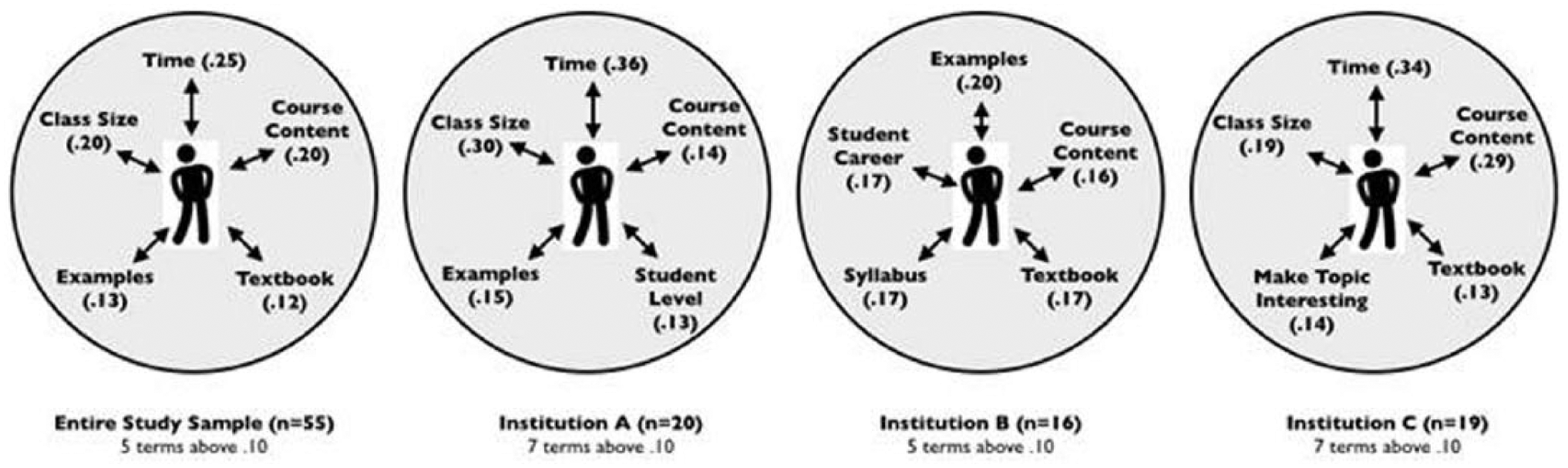
Situation recognition: Factors involved in the initial stages of problem space construction.
An interesting result is the institutional difference in terms of salience. Although it is impossible to determine the precise source of this variability, one difference among the institutions that came across in the interviews was the active and highly visible pedagogical reforms initiative underway at Institution C. Given the notion that institutional leadership and cultural norms influence individual faculty thought and behavior to a certain degree, it would not be unreasonable to assume that faculty at Institution C would be more cognizant of student and/or pedagogy-related factors. Yet, the institution where these factors are most prevalent (Institution B) is where pedagogical reforms are less prominent than at the other two study sites. It is important to recognize that the sample sizes for this study are rather small relative to the population of science, technology, engineering, and mathematics (STEM) faculty at these large research universities, and so it is possible that the study participants at Institution C reflect the perceptions of a small group of unusually student-centered instructors. Another alternative explanation is that even highly visible reform initiatives may not filter down to the level of individual faculty perceptions in a widespread and uniform fashion. In any case, the outlines of the problem spaces being constructed by faculty at Institution B are markedly different from their peers at other institutions and suggest a more student-centered conceptualization of their planning and instructional tasks.
Next, I conducted an inductive thematic analysis to ascertain if individual factors could be categorized into higher-order themes. This step led to each term being categorized into one of five groups: (a) organizational factors (e.g., time, class size), (b) curricular factors (e.g., content/topic, textbooks), (c) pedagogical considerations (e.g., pedagogical goals, making it interesting), (d) teaching techniques (e.g., examples/illustrations), and (e) student factors (e.g., student career trajectory). This organizational structure was used in the remainder of the analysis.
Planning Steps: Specific Steps Taken by Faculty When Planning Courses
After the parameters of the problem space are identified, a limited number of actual planning steps are then “activated” for instructors. In conducting the analysis, it became apparent that the five categories identified earlier (i.e., organizational, curriculum, pedagogical, teaching techniques, student) were evident in respondents’ descriptions of their planning steps; yet, in describing their actual behaviors, respondents discussed additional factors and strategies. New categories that emerged focused on actual strategies undertaken while planning and included information retrieval, information review, artifact updating, artifact preparation, class preparation, and conducting postclass reviews.
Furthermore, it was necessary in some cases to add nuance to the original five categories. These included subdividing the category of teaching techniques into three parts: illustrations and examples designed to engage students and pique interest, problems or questions designed to elicit information, and the selection of instructional technology (see Table 3).
Most Frequently Reported Planning Steps by Institution

Note. The total sample number here varies from the total in the entire study sample (N = 58) because 11 respondents’ data were not sufficient for the thematic analysis.
At this stage of planning, the curricular artifact plays a particularly influential role. In fact, the five most frequently reported planning steps directly involved the retrieval, updating, or review of a curricular artifact.
Information retrieval: Notes and slides
Many faculty in the study sample reported that in planning for a class, they retrieved existing information in the form of two types of curricular artifacts: lecture notes (23 respondents) and PowerPoint slides (14). In both cases, these artifact types had been created in previous years and preparing for the current term involved retrieving them from a file cabinet, desk drawer, or computer. As one geoscience instructor noted, all of her materials are “in the can” and just need to be retrieved annually. She taught the same course on a regular basis, so she viewed retrieval of the artifacts as both sensible in terms of time management and as a valuable resource that should be reused.
Artifact updating: Notes and slides
Another frequently reported planning step is making or updating PowerPoint slides (14) or lecture notes (12). Respondents used terms such as fine-tuning or tweaking to describe this step. Updating included making topical changes based on new research, altering activities based on recollections about what worked or did not work in prior terms, and changing artifacts based on changes in the textbook or syllabus. However, this planning step holds true only if the instructor has taught the course before or if he or she is new to a course but has inherited materials from the previous instructor. In other instances where a new course must be created, a substantial amount of work will need to be invested in creating a syllabus, gathering materials, and so on.
Information review: Textbook
Respondents (12) also discussed reviewing information in another type of curricular artifact—the textbook—as an important planning step. In these cases, prior to the beginning of the term, or immediately before a specific class, the respondent read through the relevant chapters in order to refresh his or her familiarity with the course material. In most cases, a text authored by another scholar was an important reference point during the planning process. However, in one instance, a respondent had written a textbook in her field but did not reference it because it “was all in my head” and thus did not require consulting with any external curricular resource.
Teaching technique: Problems or questions
Several faculty reported considering what types of problems or questions to include in a given class as one of their planning steps. This entailed identifying good problems to work out on the chalkboard, thinking of “thought-provoking questions” that would engage the class, or selecting questions for use in clicker-response systems. In this step, the instructor thought about and then identified problems or questions that illustrated the topic at hand while simultaneously leading students to engage with the material in a thoughtful and substantive manner.
Curricular factor: Main topic of class
Ten respondents noted that the main topic of the class was an important part of their planning. That is, in response to the question about how they planned the course, they reported a step of simply thinking about the topic being taught. Thus, considering the course material itself became an important planning strategy.
Curricular Artifacts: What Is the Physical Form of the Plan for a Particular Class?
The results reported thus far underscore the important role that curricular artifacts, such as lecture notes, play in the planning process, and so the next question is to what degree these artifacts are enacted in the classroom. The results indicate that plans primarily take two physical forms: paper lecture notes (23 respondents) and PowerPoint slides (22) (see Table 4).
Artifact Types and Planned Enactment by Discipline

Note. The total sample number here varies from the total in the entire study sample (N = 58) because 11 respondents’ data were not sufficient for the thematic analysis.
These results highlight the dominant use of these artifacts and indicate their entrenched use in academic settings. Given the importance of the enactment process whereby a static artifact is used to support or otherwise mediate action in the classroom (Remillard, 2005), it is then useful to explore the ways that respondents discussed artifact use.
First, three respondents noted that although they prepare lecture notes, they do not bring them into the classroom. For these individuals, developing the curricular artifact was a way to get their thoughts on paper and to outline a sequence of topics or problems for an upcoming class, such that the purpose of creating the artifact (i.e., lecture notes in these cases) was preparatory and not for use in the classroom. Second, 26 respondents discussed their use of artifacts (i.e., lecture notes and PowerPoint slides) in the classroom in various ways, including teaching directly from slides (11), using notes as a reference while speaking (7), copying problems onto the board (5), or using premade slides with blanks to fill in during class (3). In these cases, the notes or slides play a considerable role in guiding instruction because it is more or less directly “translated” from artifactual form to activity. Third, 15 respondents reported that their notes or slides play an important instructional role but not directly in the classroom. In these cases, eight faculty post their slides or notes on the course website prior to class, and seven rehearse their lectures before the class period.
Two Cases of Instructional Decision Making in Practice
To examine how the processes of problem space construction action unfold in real-world settings, I next examine how two instructors planned and then taught a class. The results from these cases, as they map onto the model of problem space construction advanced in this article, are depicted in Figure 3.

Model of instructional decision making for two physics instructors.
Chiyoko
“Chiyoko” is an assistant physics professor at Institution A, where she was teaching a junior-level course on electrodynamics at the time of the study. When asked to list the factors that most influenced her course-planning activities, Chiyoko reported the following: time, course content, student struggles, applications to practice, pedagogical goals, and staying on schedule. Additionally, Chiyoko volunteered that clickers were not necessary because the class was small and also that no resources were available to do a hands-on tutorials. These factors thus represented the parameters of the course-design problem space for this particular instructor.
First, Chiyoko spoke of the pressure that a limited amount of time placed on her teaching, because it inhibited her ultimate goal of ensuring that students were directly engaged with the material. Chiyoko stated that she was “trying to do the poor man’s thing of how do you involve students without killing me on time and feeling like I am constrained into a lecture format.” In these remarks about time constraints, she made clear that she was referring to both the limited time she had available in her job as well as the time constraints within a 50-minute class period. With the problem space of planning and teaching thus established in terms of time constraints and considerations about the content and student learning, Chiyoko then described her planning process.
The first step she described in planning for the observed class was to consult with the person who coordinates demonstration equipment in her department to see what equipment was available. Then Chiyoko looked at her old notes and updated them based on new developments in the literature or the news. These notes played an important role in the classroom, especially as she planned to work through a series of derivations in the observed class. As Chiyoko noted, “I am not good at deriving without notes for the board, so I will actually hold my notes in my hand as I go through and put it on the board.” In the observed class, she spent most of the instructional time lecturing at the chalkboard (behavior observed in 85% of all 2-minute intervals) but also organizing students in small groups to discuss their work (35%). She also asked many questions seeking original answers (42%) and visibly drew upon her curricular artifact (i.e., notes) throughout the class period (42%).
In summary, Chiyoko’s conceptualization of the “problem” of planning and then teaching a class on electrodynamics was largely framed by concerns about time and covering the material in ways that satisfied both the pressures of the course syllabus and the needs of her students. This formulation of the problem space then led to specific planning strategies (e.g., retrieving and updating old lecture notes) that then played a considerable role in her classroom practice (i.e., board work based on the notes). Ultimately, her teaching practices appear to be shaped by a combination of personal goals, situational constraints, and the curricular tools at hand.
Gary
“Gary” is a full professor who has worked at Institution C since 1993, where he has long been deeply engaged in physics education research. His situational awareness included references to departmental expectations for high-quality teaching, history or what was in the course before, canonical texts or what he called “universally known knowledge,” student struggles and interests, and his past experience with the course. For Gary, concerns about the canon are the starting point for thinking about the curriculum in general and a specific class on harmonic motion.
For this class, Gary drew upon materials he developed the prior year in collaboration with a postdoctoral student who was part of the teaching-reform effort at Institution C. The purpose of that intervention was to develop new PowerPoint slides, clicker questions, and in-class activities for the course based on educational research in physics. A primary reason for focusing on creating high-quality artifacts was that the departmental policy for course rotations, which involved new instructors taking over undergraduate courses every few years. Gary felt that by creating a “binder” of materials, the next instructor to take over the course would be more inclined to adopt (or adapt) these materials rather than create new ones whose quality would be unknown. Thus, the problem space for Gary’s teaching largely consisted of considerations about his students’ learning, the history and content of this particular course, and his colleagues’ expectations of what quality teaching looks like.
The plan for the class was to lecture for approximately half of the time and to use interactive tutorials for the remainder of the period. The specific materials used for this class were inherited from the previous instructor and included clicker questions, a course schedule, and lecture notes. In preparation, Gary reported that he “looked at my old lecture notes and PowerPoint slides, rewrote and reordered the slides, and stood at the blackboard and went through the lecture portion.” He also had handwritten notes from the previous year for each class and usually revised them, but for the class being observed, the notes were mostly in his PowerPoint slides and committed to memory.
During the observed class, Gary used a mixture of lecturing approaches (e.g., with PowerPoints observed in 41% of all 2-minute intervals, board work in 31%, and no media in 15%) and small-group work (44%). He also used a considerable amount of assessments (21%) that were often carried out through verbal questions seeking original information (77%) and clicker technology (41%). Ultimately, his situational awareness of student learning of the course material and related expectations of the education community acted as an overarching frame for how he approached the class. Thus, although his actual planning practices were consistent with the rest of the study sample (i.e., retrieving and fine-tuning old artifacts), the problem space itself was strongly influenced by considerations about pedagogy as opposed to time constraints.
Discussion
In this study I set out to describe how faculty plan and then teach their courses in real-world settings. In this section I elaborate on key aspects of the results and how they contribute to the literature on postsecondary teaching and learning, and implications for current efforts to encourage faculty to adopt interactive teaching techniques.
Illuminating the Black Box: The Problem Space of Curriculum and Instruction
Much like earlier work on curriculum design in higher education, which sought to identify all variables that influence the planning process (e.g., Conrad & Pratt, 1983; Lattuca & Stark, 2011), I too aimed to identify the factors that appear to shape, if not dictate, how faculty plan and then teach their classes. However, this work differs from these earlier attempts in shifting the primary analytic focus from the omniscient observer who produces comprehensive explanatory models of the world to that of a focus on teachers’ own perspective and practice. Thus, instead of focusing on inputs and outputs while assuming a black box wherein actual decisions are actually made, here the focus is on the processes of sensemaking itself.
Specifically, in this study I examined how faculty construct the problem space of teaching, or their own mental representation of the problem at hand, including those artifacts and strategies most suitable for successfully performing the task. In doing so, I build upon the work of McAlpine and colleagues (McAlpine, Weston, Berthiaume, et al., 2006). Who drew upon problem space theory as a way to investigate different types of faculty thinking. A key finding from this line of inquiry was that instead of always activating abstracted beliefs or conceptions about teaching to guide their planning, faculty reported using more concrete and specific types of goals and instructional knowledge as an actual class period grew nearer (McAlpine, Weston, Timmermans, et al., 2006). Such insights were an important corrective to assumptions that faculty drew upon just a handful of context-independent beliefs when planning their courses, but these studies did not explore how different teaching situations and contexts actually shaped subsequent planning and teaching decisions.
Thus, the current study provides the first in-depth accounting of how the postsecondary educators’ perception of contextual cues facilitates the construction of instructional problem spaces and how these mental representations then lead to subsequent decisions about curriculum and instruction. This focus on the dynamic between perception and context is important because much of human decision making is guided by habituated “attunements” to certain regularities, threats, or opportunities in the physical and social environment, whether they be perceptions that chairs are for sitting or a group of rowdy students should be handled with strict punishments (Greeno, 1998; Norman, 1990). Given the immense amount of perceptual inputs we experience on a daily basis, such attunements to constraints and affordances reduce cognitive load and make navigating our lives manageable.
Documenting those contextual factors perceived as particularly salient or important, however, is not enough, as the construction of a particular problem space carries with it certain predetermined suggestions and strategies for action. It is in delineating the relationships between perceived affordances and actual behavior that we begin to understand what the cognitive scientist Edwin Hutchins (1995) famously called “cognition in the wild,” which shed light on how specific situations lead to specific actions. This argument is also echoed by Coburn and Turner (2011), who argue that research on educators’ use of data needs to “move beyond (compiling) a list of contextual conditions” and “specify the relationship between these contextual conditions on the one hand and the process of data use on the other” (p. 180). The results of such research can be used to describe causal mechanisms that underlay decision making, document links among the macro-, meso-, and microlevels of institutional life, and perhaps most importantly, identify factors that disproportionately exert influences on educational practice (Coburn & Turner, 2012).
In the remainder of this discussion I focus on the key finding from this study—that perceived affordances related to organizational and curricular factors (i.e., time, class size, course content) appear to trigger the routine maintenance of preexisting curricular artifacts—and subsequent implications for research, policy, and practice.
Contextual Filters Revisited: Changes in Perceived Affordances in the Past 25 Years
When they considered the factors most salient to their course planning, faculty in the study sample most frequently reported a set of factors that could be considered “fixed,” or somewhat non-negotiable features of their organization’s operations and policies, including workload pressures, class size, and course textbooks. As such, the problem space for this group of faculty in 2012 was largely demarcated by an attunement to organizational and curricular elements, with considerations about students and instructional matters less influential.
These findings differ from research conducted 25 years earlier, when Stark (2000) found that the most influential factors that shaped course planning were student-related topics. Analyses of survey responses collected in 1987 from 2,311 faculty teaching introductory courses in 12 disciplines showed that the most influential factor that shaped course planning was “student characteristics,” which pertained to student ability, interest, and anticipated effort. Following this factor was “student goals” for their own careers, and the third most influential factor was a category called “pragmatic issues” that included class size, the textbook, workload, and tenure pressures. In explaining the results, Stark (2000, p. 422) speculated that other organizational factors, such as facilities and resources (sixth on the list of influential factors), were not particularly influential because they were so “traditional and familiar.”
What can explain these differences, whereby considerations about student characteristics have apparently been replaced by affordances related to “pragmatic issues?” Interestingly, Stark (2000) speculated that if her research had been conducted in 1999, factors such as instructional technology and student learning (especially regarding assessment and active learning) would have been perceived as more influential due to technological advances and the growth of reform initiatives aimed at undergraduate education in the 1990s. Although these issues were certainly mentioned in the course of our interviews with faculty, they did not play a particularly prominent role in descriptions of the planning process.
One possible explanation for these differences could be the fact that the nature of academic work and attendant pressures has changed considerably in the past 25 years. An analysis of changes in time allocation patterns among faculty between 1972 and 1992 found increases in time spent engaged in research and teaching, and decreases in time spent advising students (Milem, Berger, & Dey, 2000). Similarly, data from the HERI Faculty Survey indicate changes in the stressors that faculty perceive impacting their work lives, particularly in the arena of research productivity (see Table 5).
Factors Considered Stressors by Faculty: HERI Faculty Survey
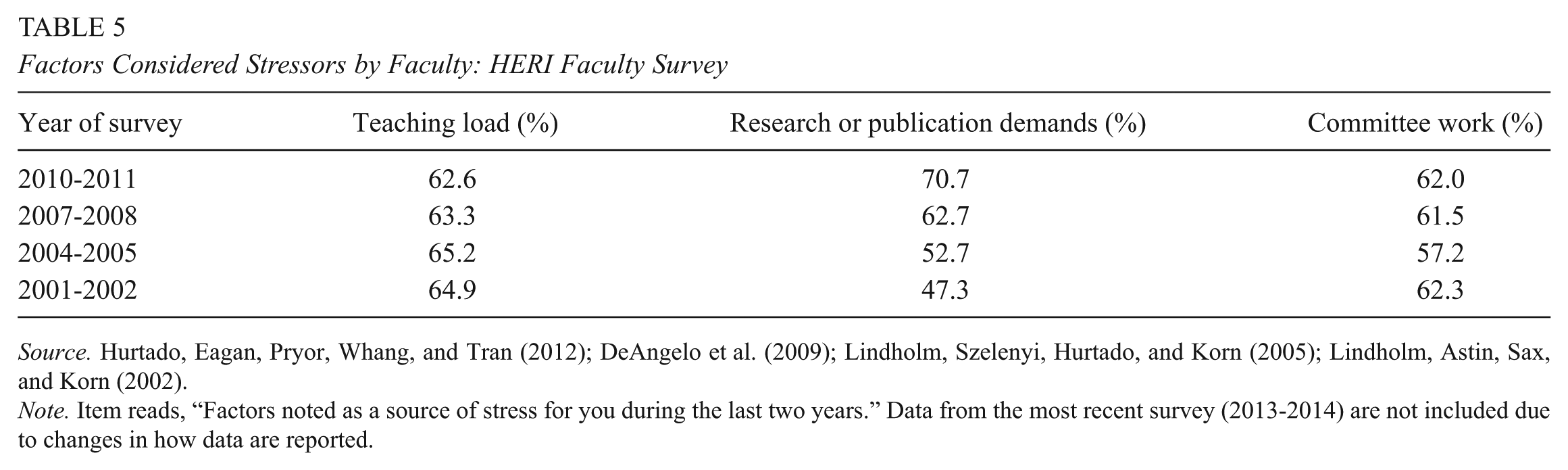
Source. Hurtado, Eagan, Pryor, Whang, and Tran (2012); DeAngelo et al. (2009); Lindholm, Szelenyi, Hurtado, and Korn (2005); Lindholm, Astin, Sax, and Korn (2002).
Note. Item reads, “Factors noted as a source of stress for you during the last two years.” Data from the most recent survey (2013-2014) are not included due to changes in how data are reported.
These data indicate a dramatic increase in research and publication expectations as a source of stress for faculty. These trends and the primacy of time constraints for the sample reported in this article highlight an important truism in regard to the status of the academic workforce in the early 21st century: Faculty are increasingly stressed about productivity expectations and thus view their work as academic planners (i.e., teachers) through the lens of workload demands and insufficient time to meet all of their professional obligations, especially those related to research. Of course, this is not surprising in light of the growth of the neoliberal model of postsecondary education, where faculty are sometimes seen as “state-subsidized entrepreneurs”—expected to secure external grants and create spin-off companies in times of declining state support and tight budgets (Slaughter & Leslie, 1997, p. 125).
Some interesting questions arise from this finding. What are the implications of a planning process that omits a deep consideration of student needs and abilities? Is it preferable to have faculty think about their students when planning a course instead of being focused on content coverage or minimizing time spent planning, and if so, why? In the case of Chiyoko, her personal goal to engage the “middle” group of students who were neither high nor low achievers appeared to have shaped how she designed her classes and selected activities in a way that led to an active and engaging classroom. At the very least, it seems that some consideration of students during the planning process, as is evident in approaches such as backwards design or problem-based learning, contributes to instruction that is well aligned with the interests and aptitudes of a particular group of students. The relative absence of student-based factors in the study sample may be indicative of a population for whom other factors, particularly those of time and related workload constraints, enters into their thought process more readily and easily.
However, these results should not be interpreted as a uniform response to the academic environment by all faculty, institutions, and disciplines. Indeed, at Institution B, the most salient factors perceived during planning were teaching techniques (i.e., examples and illustrations) and student factors (i.e., student career or degree trajectory). As previously noted, the reason for this variability is unclear, but previous evidence supports the notion that perceptions of organizational contexts vary in multiple ways. For instance, Stark (2000) found that student characteristics were perceived as more important among instructors teaching courses in professional fields (e.g., business and nursing) than other factors and that disciplinary affiliation strongly shaped course-planning steps and the way content was arranged in course syllabi.
Two additional factors may explain variations in the ways instructors perceive their environments: differences in the missions and organizational structures of different colleges and universities, and the unique backgrounds and experiences individuals bring to their work. Given that no two departments or instructors are identical, one would expect to see some variation in the ways the problem spaces of academic planning are constructed. That said, as institutions become more homogenous in terms of operations and priorities (i.e., achieving high rankings), evidence indicates that time allocation is becoming more similar even in institutions whose missions are distinct (Milem et al., 2000). But the highly individualistic nature of problem space construction necessitates that each person’s sense of his or her environment and subsequent planning strategies will vary in some fashion, based in part on the preexisting experiences and cognitive schemata each person brings to the job. For instance, an instructor can also have schemata based on his or her membership in a church, from his or her upbringing in rural Kansas, and from his or her volunteer work with at-risk high school students. The individual then becomes the site of multiple, sometimes conflicting mental models that collectively compose the “lens” through which his or her institutional context is interpreted. However, in cases where the environment allows for little autonomy and exerts considerable demands, it is possible that these affordances may trigger uniformity among instructors as they go about their planning. Such a response was evident in the recurrent use of preexisting curricular artifacts.
Strategies for Course Planning: Routine Maintenance of Existing Curricular Artifacts
The primary lenses through which faculty viewed the “problem” of course planning was through the time constraints imposed by a demanding workload, large class sizes, and course content that must be covered and taught. The data suggest that these perceived affordances influence practice by contributing to the reliance on a planning strategy that involves the least amount of time while also adhering to existing curricular demands—that of fine-tuning existing materials. This is an understandable and rational approach to one’s work, especially if a course is being taught repeatedly over the course of multiple semesters—why invest hundreds of hours in creating new notes, slides, and exams for each new term? These results are consistent with Stark’s (2000) findings from more than 20 years ago, which suggest that the routine maintenance of curricular artifacts is a deeply entrenched cultural practice among postsecondary faculty. Other types of course changes identified by Stark include routine programmatic reviews, which often take place every 3 to 5 years; major revisions conducted in response to significant problems with a course; and planning entirely new courses. But by far the most common, then and now, is the routine maintenance of existing materials, generally done with little outside assistance or input.
What are the implications for this reliance on fine-tuning existing materials? Before I answer that question, it is worth briefly considering the role that tools or designed objects play in influencing human behavior. As people interact with the designed features of their environments, whether it be a car or the instructional technology in a lecture hall, their actions are necessarily mediated and transformed by the nature of local networks of artifacts (Wertsch, 1991). So when an instructor walks into a classroom, bringing artifacts such as lecture notes or PowerPoint slides, the learning environment that is subsequently crafted for students is strongly shaped by the nature of these tools. A slideshow will necessarily guide learners’ vision to a screen and distill information into bullet points or other text that can fit on a slide. A set of paper notes with computations will likely serve as the verbatim text from which the instructor reads and/or writes on the chalkboard.
Thus, the answer to the question about the implications of relying on existing artifacts depends in part on the quality of the materials. PowerPoint slides that are jammed with text and designed with no attention to the scaffolding of learners’ understanding from basic to more complex ideas will probably result in a poor learning experience. Thus, if poorly conceived syllabi or activities are created, stored, and annually retrieved, improvement to the teaching of the person using these materials is difficult to envision. Conversely, if the materials are of high quality, even if a time-pressed instructor simply takes them out of the drawer an hour before class, it is possible the class will be more pedagogically informed than otherwise.
Consequently, a key to this process seems to be ensuring that the artifacts are well designed, but therein lies the catch-22 for faculty, as preparing such materials requires a resource that is in short supply—time. Even for faculty who are deeply committed to improving their teaching, within the parameters of their work and careers, the routine maintenance of existing artifacts is simply a sensible and in some cases the only tenable strategy. As a result, unless something is done to alter the underlying organizational conditions that shape the problem space for academic planning (e.g., course rotations, departmental policies and expectations, limited time for professional development), it is unreasonable to expect the wholesale transformation of undergraduate courses because the perception (and perhaps the reality) that no time exists for such activities is deeply entrenched in the minds of faculty.
Implications for Research, Policy, and Practice
The study reported in this article has several implications for research on teaching and learning in higher education and for policymakers and practitioners engaged in instructional improvement at the postsecondary level.
Several areas for future research are suggested by the results of this study. Research examining institutional, disciplinary, and gender differences in problem space construction and planning strategies would shed light on the degree to which the patterns reported in this article affect postsecondary instructors writ large or only STEM faculty in large research universities. Given the increase in the use of digital technologies for teaching purposes, including learning management systems and online courses, future research should also examine whether these new tools are influencing how instructors think about and conduct their work. Also, observational studies of faculty planning in situ should be conducted where researchers are able to carefully document how individuals go about their planning in real time, and studies utilizing larger sample sizes should be conducted so that the prevalence of certain perceived affordances, planning strategies, and curricular artifacts can be documented on a larger scale. Finally, given that agent-environment dynamics, artifact use, and behavior itself can be considered to be cultural activities (Holland & Quinn, 1997; Wertsch, 1991), a culturally informed analysis of the phenomena described in this article would be of great benefit to the field.
For policymakers and practitioners aiming to improve the quality of undergraduate education, one of the principal lessons from research on reform implementation in K-12 schools must be taken to heart: It is essential to understand the mental models, cultural norms, and routinized practices regarding the reform (e.g., teaching, planning) for the groups of people who are the object of reform initiatives (Spillane et al., 2002). This is based on extensive evidence indicating that new policies or initiatives will be interpreted through educators’ preexisting cognitive frameworks; and whether they are adopted, adapted, or rejected is largely dependent on how well those perceptions align with existing needs and practices. Thus, some sort of documentation of local practice is necessary, and the approach outlined in this article provides a diagnostic framework that, if used to describe how faculty navigate their organizations when planning and teaching their courses, could help identify key leverage points for change. Through brief interviews that elicit perceived affordances, recurrent planning strategies, and oft-used curricular artifacts, the analyst could readily derive an accounting of local practice that could be used as a reference document when planning and designing new initiatives or updating existing ones. Otherwise, as Paul Umbach (2007) observes in regard to leaders’ understanding of local cultures, “without this knowledge, they are driving without a roadmap” (p. 264).
Another benefit of reports that detail local practices could also be the identification of particularly propitious variables or “levers of change” that, if altered or supported, may result in changes to practice (Cobb, Zhao, & Dean, 2009; Spillane et al., 2001). The results reported in this article suggest three such levers. First, in regard to the perceived affordances reported in this article centered on workload and time constraints, an obvious response would be to somehow reduce the stress and demands on faculty regarding their research productivity and/or daily workload, although proffering such complicated solutions are beyond the purview of this article. It is essential, though, for change agents to be aware of this reality and to not operate as if faculty had ample time to engage in changing their practices. An actionable step that could be taken, however, is to ensure that student characteristics are more clearly and explicitly considered during the course-planning process by mandating that those involved in creating new courses or revising existing ones review available student feedback data. These could be course evaluations, exit interviews with graduating seniors, or focus groups conducted to satisfy accreditation requirements. Although these data may vary considerably in their quality, inserting student considerations into the planning process will increase the chances that learner needs and characteristics are embedded in the design of the course.
Second, in the more common cases where courses are simply maintained from semester to semester, I suggest that in seeking solutions to the potentially short-sighted habit of routine maintenance of lecture notes and PowerPoint slides, it is instead more feasible to ask faculty to engage in a practice described by three different instructors in this study: take notes immediately after class about what worked and what did not work in terms of teaching style, activities, sequencing of material, and so on. Upon describing this practice and being asked if she wrote these notes in her office after the class, one biologist stated,
No, I do not have that much time. I can tell right during the lecture that things are not working, and in the few minutes that I am packing up after lecture, I will make a note right on the printout of the PowerPoint slides.
This respondent then went on to state that when notes are made on the slide printout, she will immediately see and reflect upon these observations the next time she teaches the class.
Although this brief reflection about their teaching is not exactly what is recommended by those who advocate reflective practice as a cornerstone to improving professional practice (e.g., Jay & Johnson, 2002; Kane, Sandretto, & Heath, 2004; Schön, 1983), given the fixed constraints perceived by today’s faculty members in regard to their workload and attendant priorities, it is not likely that postsecondary teachers will be able to allocate hours to extensively revising their curriculum or consulting with a faculty developer. Instead, asking or even requiring faculty to make brief observations of how each class went would represent an important step in developing a sense of reflection and, ideally, continuous improvement in their practice. Additionally, amending curricular artifacts on a regular basis with new observations and insights ensures that materials are constantly evolving in response to students’ needs and reactions—an example of co-constructed materials that are far better than those designed and maintained solely be the instructor. Would this be asking too much of already overburdened faculty to respond to yet another administrative task? Perhaps, but the benefits of engaging in reflective practice outweigh the potential backlash that departmental leaders may receive. In requiring faculty to think and write about how well (or poorly) their teaching is going, their notion of the problem space of course planning could be extended beyond the immediate and habituated factors of time and course content to encompass additional considerations about students’ learning experiences.
Footnotes
Acknowledgements
The author would like to thank Xueli Wang, Joseph Ferrare, and anonymous reviewers for their comments and critiques of earlier versions of this manuscript. This research was supported by the National Science Foundation under Grant No. DRL 0814724. Any opinions, findings, and conclusions are those of the author and do not necessarily reflect the views of the National Science Foundation.
Notes
Author
MATTHEW T. HORA is an assistant professor in the Department of Liberal Arts and Applied Studies in the Division of Continuing Studies at the University of Wisconsin-Madison. His research employs theory and method from the learning sciences and cultural anthropology to examine socio-cognitive aspects of organizational change, postsecondary education and workforce dynamics, and instructional design issues in the college classroom.