




Abstract
This study uses student panel data to examine the association between algebra placement and student motivation for mathematics. Changes in achievement goals, expectancy, and task value for students in eighth-grade algebra are compared with those of peers placed in lower-level mathematics courses (N = 3,306). In our sample, students placed in algebra reported an increase in performance-avoidance goals as well as decreases in academic self-efficacy and task value. These relations were attenuated for students who had high mathematics achievement prior to algebra placement. Whereas all students reported an overall decline in performance-approach goals over the course of eighth grade, previously high-achieving students reported an increase in these goals. Lastly, previously high-achieving students reported an increase in mastery goals. These findings suggest that while previously high-achieving students may benefit motivationally from eighth-grade algebra placement, placing previously average- and low-performing students in algebra can potentially undermine their motivation for mathematics.
Keywords
There is a need for greater retention in advanced mathematics despite efforts toward universal algebra placement. High school students typically opt out of advanced mathematics courses after fulfilling courses required to graduate high school (Meece, 2006). Thus, participation in advanced mathematics is ultimately a function of access and student choice. A strong predictor of choice is student motivation (Martin, Anderson, Bobis, Way, & Vellar, 2012), and research has yet to determine the relation between changing algebra policies (any policy that guides the placement of students into algebra courses) and students’ motivation for mathematics. Recent studies raise questions about the educational effectiveness of enrolling larger proportions of students in algebra courses, suggesting that eighth-grade algebra enrollment may have unintended negative consequences such as lower mathematics test score growth for students who enter the course with relatively low mathematics skills (Clotfelter, Ladd, & Vigdor, 2012; Domina, 2014; Loveless, 2008). We hypothesize that declining student motivation in mathematics may help to explain these disappointing findings.
This case study uses the increasing eighth-grade algebra enrollment trends in an urban California school district to examine the relation between eighth-grade algebra course placement and students’ motivation for mathematics. Specifically, we investigate motivational changes for students selected into eighth-grade algebra and for eighth-grade peers enrolled in other lower-level math courses, typically pre-algebra, hereafter collectively referenced as general mathematics courses. Using two waves of motivation survey data, we estimate motivational changes for students between the fall and spring of eighth grade. Our research questions are as follow:
Research Question 1: To what extent does motivation for math change for eighth-grade algebra students compared with eighth-grade peers enrolled in general mathematics courses?
Research Question 2: Do these motivational changes vary by mathematics achievement prior to algebra course placement?
Review of Changes in Algebra Policy
In the 1980s and 1990s, the California Department of Education issued repeated calls to enroll all middle school students in advanced mathematics courses, namely, algebra, to increase progress toward universal eighth-grade algebra enrollment (Domina, McEachin, Penner, & Penner, 2015). In 1999, the state’s school accountability law attached incentives to this call, and in 2008, the state’s Board of Education voted to make algebra examinations the sole “test of record” for eighth-grade mathematics (Domina et al., 2015). This vote mandated that students demonstrate proficiency in algebra by the end of eighth grade to fulfill accountability expectations under the No Child Left Behind Act and California’s Public Schools Accountability Act (Rosin, Barondess, & Leichty, 2009). Though a universal algebra policy was never fully implemented in California, the proportion of eighth graders in California enrolled in algebra more than tripled between 1999 and 2008, rising from 16% to 51% (Rosin et al., 2009). California has since emerged as a national leader in efforts toward increased eighth-grade algebra enrollment and as such serves as a paradigmatic example of algebra efforts nationwide (Domina, Penner, Penner, & Conley, 2014). Currently, more eighth-grade students take algebra than any other math class (Domina, 2014). Though California’s adoption of the Common Core State Standards—which recommends pre-algebra content at the eighth-grade level—may slow movement toward universal algebra policies, the state’s leading policy-makers argue that universal eighth grade algebra policies should remain a priority (Wurman & Evers, 2010).
Effort toward universal eighth-grade algebra enrollment is backed by research that points to positive correlations between early algebra course-taking—for example, taking algebra in eighth grade rather than ninth—and equity in access to mathematic curricula, achievement, and educational attainment (Filer & Chang, 2008; Gamoran & Hannigan, 2000; Kurlaender, Reardon, & Jackson, 2008). Observational data indicate that students who enroll in eighth-grade algebra score higher on skills tests, show more rapid test score growth, and reach higher levels of educational attainment than their peers who enroll in less rigorous eighth-grade math courses (Gamoran & Hannigan 2000; Gamoran, Porter, Smithson, & White, 1997). However, these findings are based on observational data and are thus subject to considerable selection bias. Studies that have made progress toward estimating less biased effects of algebra course-taking in experimental or quasi-experimental settings report mixed results (for a review, see Stein, Kaufman, Sherman, & Hillen, 2011). A review of related research claimed that universal algebra policies did not lead to achievement gains without supports for struggling students, such as extended learning time for algebra instruction (Stein et al., 2011).
More recently, analyses utilizing course placement changes in North Carolina indicated that the initiative to expand eighth-grade algebra had negative effects on student achievement, especially for students who come into eighth-grade algebra courses with relatively weak mathematics skills (Clotfelter et al., 2012). Quasi-experimental evaluations of California’s Algebra-for-all policy suggest that increases in the eighth-grade algebra enrollment rates corresponded with declining mathematics achievement (Williams et al., 2011). Evaluations of Chicago’s mandated universal algebra policy found that failure rates increased, grades declined, test scores did not improve, and students were no more likely to enroll in college (Allensworth, Nomi, Montgomery, & Lee, 2009). Loveless (2013) examined variation in state enrollment patterns to see if rising enrollments in advanced eighth-grade math courses were correlated with achievement gains on the National Assessment of Educational Program (NAEP) and found that states with rising percentages of eighth graders taking algebra, or other more advanced courses such as geometry, were no more likely to raise their NAEP scores from 2005 to 2011 than states with declining percentages of eighth graders in those courses. Loveless (2013) also found that increased enrollments in Algebra I and pre-algebra were associated with decreases in mean achievement gains. These findings collectively highlight unintended negative consequences of increased algebra enrollment trends.
Motivation for Mathematics
Students’ motivation for mathematics may be a potential mechanism through which algebra course placement undermines student achievement. We hypothesize that changes in student motivation may account for some of these unintended negative consequences. Motivational beliefs are psychological mechanisms that influence students’ motivation to exert effort on learning tasks (Wigfield & Cambria, 2010; Wigfield & Eccles, 2000). We adopted two widely used frameworks for studying motivational beliefs in academic contexts—achievement goal theory and expectancy-value theory. Achievement goal theory explains why a learner engages in specific achievement-related behaviors (Kaplan, Middleton, Urdan, & Midgley, 2002), whereas expectancy-value theory predicts which activities individuals choose to engage (Wigfield & Eccles, 2000). These motivation theories, therefore, include complementary elements that help to explain both students’ achievement in math class as well as their choice to take or opt out of future math classes. Recent studies have found that operating under a perspective that examines both achievement goal and expectancy-value constructs, rather than just one or the other, delivered a more complete understanding of mechanisms contributing to change in motivation (Conley, 2012; Senko & Hulleman, 2013).
Achievement goal theory includes mastery, performance-approach, and performance-avoidance goals (Dweck & Elliott, 1983). Students with mastery goals tend to focus on developing competence and are more likely to persist in learning activities, have greater interest in their classes, and seek help (Harackiewicz, Barron, & Elliot, 1998; Harackiewicz, Barron, Tauer, Carter, & Elliot, 2000; Karabenick, 2003). Students with performance-approach goals focus on demonstrating competence, which is linked to positive associations with achievement and academic efficacy (Harackiewicz, Barron, Pintrich, Elliot, & Thrash, 2002; Pajares, Britner, & Valiante, 2000). Performance-approach goals, however, have also been found to be associated with reduced help-seeking behavior, increased anxiety, cheating, self-handicapping, low self-efficacy, reduced metacognitive strategy use, and maladaptive responses to conflict (Anderman, Griesinger, & Westerfield, 1998; Elliot & McGregor, 1999; Karabenick, 2003; Murdock, Miller, & Kohlhardt, 2004; Skaalvik, 1997). One explanation for the mixed outcomes related to performance-approach goals may be that their impact is influenced by the adoption of other concurrent goals. For example, there is evidence that performance approach goals are associated with adaptive patterns of learning when mastery goals are also espoused (Midgley, Kaplan, & Middleton, 2001). Lastly, students with performance-avoidance goals maintain goals of avoiding appearing incompetent. These goals are typically associated with procrastination, withdrawal of effort, low performance outcomes, high anxiety, disorganized study habits, help-avoidance, self-handicapping, low achievement, and low interest (e.g., Elliot & Church, 1997; Elliot, McGregor, & Gable, 1999; Middleton & Midgley, 1997; Midgley & Urdan, 2001; Skaalvik, 1997; Urdan, 2004; Wolters, 2004). In all, these goals negatively correlate with performance outcomes (Hulleman, Schrager, Bodman, & Harackiewicz, 2010).
In the expectancy-value model of achievement, expectancy for success is defined as students’ belief about how well they will do on an upcoming task, whereas task value is the degree to which a student believes that the academic task is worth pursuing (Eccles, 1983; Wigfield & Eccles, 2000; Wigfield, Tonks, & Eccles, 2004). Task value is influenced by interest (the student’s enjoyment from doing a task), attainment (the personal importance of performing well on the task), utility (how the task relates to students’ current or future plans), and cost (the anticipated effort needed to complete the task). In mathematics specifically, findings show that an individual’s expectancy for success and valuing of mathematics predict their performance in mathematics and their choices of whether to continue studying math (Wigfield & Eccles, 2000). Students’ expectancies for success are assessed as competence beliefs in the present study and are referenced as self-efficacy hereafter. 1
Hypotheses
Student motivation is influenced by the fit between the academic task and their current competence level (Eccles & Roeser, 2011). If students are placed in a course before they are able to competently perform at the level required by the course, their motivation may suffer. We expect that students placed in eighth-grade algebra who performed at a low level on their seventh-grade mathematics assessment will experience a mismatch between their current educational experiences and competence levels. These students may not have the necessary prior knowledge to meet the demands of algebra, and as a result, we expect their feelings of math efficacy to decline (Hypothesis 1). Because expectancy beliefs relate positively to subjective task value (Eccles & Wigfield, 1995), we expect their subjective task value for mathematics to also decline (Hypothesis 2). The opposite is expected for students who are placed in eighth-grade algebra and performed at a high level on their seventh-grade mathematics assessment. These students are expected to enter the course with the prerequisite skills necessary to engage successfully in algebraic learning tasks and thus bolster their efficacy and task value (Hypothesis 3).
In terms of achievement goals, mastery goals are associated with positive perceptions of academic ability and self-efficacy (Meece, Blumenfeld, & Hoyle; 1988, Midgley et al. 1998; Wolters, 2004). Specifically, students with high perceived competence are inclined to adopt mastery and performance-approach goals (Elliot, 1999), whereas those with low perceived competence tend to adopt performance-avoidance goals (Skaalvik, 1997). Thus, we expect that previously low-achieving students placed in algebra will experience an increase in performance-avoidance goals and a decrease in mastery and performance-approach goals (Hyothesis 4), with the opposite holding for previously high-achieving students placed in eighth-grade algebra (Hypothesis 5).
Method
Participants
Data are from the California Motivation Project-Mathematics (CAMP-Math). CAMP-Math is a part of the larger Math and Science Partnership—Motivation Assessment Program (MSP-MAP) funded by the National Science Foundation (NSF) that studies the role of motivation-related beliefs of students in mathematics and science courses. Our sample is a portion of students drawn from seven middle schools that are a part of a large urban unified school district in California. Students were included in the analysis if the student: (a) was in eighth grade in either the 2004–2005 or 2005–2006 school year; (b) had a valid mathematics California Standards Test (CST) score in the spring of their seventh-grade year; (c) took the General Mathematics, Algebra, or Geometry CST in the spring of their eighth grade year; and (d) had valid covariate and motivational measures for the fall and spring motivational surveys given during their eighth-grade year. Using the type of CST exam students took in the spring of their eighth-grade year as a proxy for course enrollment, we started with a sample of 4,229 students who were in eighth-grade general math, algebra, or geometry in either 2004–2005 or 2005–2006 and had valid math scores in the spring of their seventh-grade year. After using listwise deletion to filter by valid covariate and motivational measures, we were left with 3,306 students, which is approximately 78% of the total sample.
Table 1 provides a summary of the full and study samples used in our analyses. The t tests between the final sample and the eliminated sample with missing data revealed that the two groups differed significantly in the proportion of Hispanic students and Vietnamese students, prior math CST scaled scores, and the proportion of previously high-achieving and low-achieving students. The two groups differed significantly on mastery goals, self-efficacy, and task value in the fall of eighth grade and on performance-approach goals, performance-avoidance goals, and self-efficacy in the spring of eighth grade. The missing data and the aforementioned differences between the final sample and the eliminated sample suggest that results may therefore not be generalizable to the full district population. The differences, however, are small in magnitude.
Descriptive Statistics for Full (N = 4,229 Students) and Study Samples (N = 3,306 Students)

Note. Motivation scales = 1–5; math scale score range = 150–600, 150–256 = far below basic, 257–299 = below basic, 300–349 = basic, 350–413 = proficient, 414–600 = advanced; free/reduced lunch (NSLP) and English learner (EL) status scale = 0–1 (1 = yes, 0 = no); prior achievement bins: high achievement = proficient or advanced, average achievement = basic, low achievement = below basic or far below basic; CST = California Standards Test.
p < .05. **p < .01. ***p < .001.
Lastly, listwise deletion of students’ missing motivational measures resulted in a slightly different sample size for each of the motivational beliefs measured; however, adjusted sample sizes do not differ significantly on any of the variables from the study sample used in our analyses. The remaining sample was fairly evenly split by gender (1,593 males and 1,713 females), with an average age of 13.6 years (SD = 0.64) for students in the spring of eighth grade. Our analyses included Hispanic (67%), Vietnamese (14%), and White (10%) students. Other ethnic groups comprised approximately 9% of the sample and were pooled to create an “Other” ethnic category of reference. Students in the geometry group accounted for approximately 3% of the total sample and were left out of the reported results.
Figure 1 illustrates students’ seventh-grade mathematics achievement by eighth-grade math course placement. In our sample, approximately 38% of eighth-grade students were enrolled in algebra at the time of data collection, indicating that selection factors were present. A percentage closer to 100%—otherwise known as universal algebra course placement—would have indicated less of a presence of selection factors. Table 2 provides descriptive statistics and associated p values demonstrating statistically significant differences between the eighth-grade general mathematics and algebra groups. At the time of data collection, students were still selected into algebra based on variables that may have included teacher recommendation and/or parent request. The selection factors present across schools varied by school, and a school fixed effect, used in the analyses, aims to help control for this variation by addressing biases that arise from the nonrandom assignment of students to schools. 2 Despite the selection factors present at the time of data collection, the district was amid progressively moving toward universal eighth-grade algebra policy by relaxing selection policies into algebra, which is highlighted by the overlap in prior achievement distributions at the time of data collection (Figure 1). The overlap illustrates that there were students placed in algebra who had prior achievement levels that were equal to or lower than peers enrolled in general mathematics courses.

Eighth-grade math course placement by prior mathematics achievement.
Descriptive Statistics for Study Sample by Eighth-Grade Course Placement (N = 3,306 Students)

Note. Motivation scales = 1–5; math scale score range = 150–600, 150–256 = far below basic, 257–299 = below basic, 300–349 = basic, 350–413 = proficient, 414–600 = advanced; prior achievement bins: high achievement = proficient or advanced, average achievement = basic, low achievement = below basic or far below basic; CST = California Standards Test.
p < .001.
Outcome Measures
Student motivation data were collected via surveys administered during the fall (approximately four weeks after the start of the school year) and spring (approximately four week before the end of the school year) for two consecutive academic years, 2004–2005 and 2005–2006. 3 All students in class on the day the surveys were administered were invited to participate, with less than 1% opting out. Student achievement and demographic data were simultaneously collected from the district annual testing records.
Achievement Goals
Student-reported achievement goals were measured using three scales from the Patterns of Adaptive Learning Survey (PALS; Midgley et al., 1998, 2000). All items were assessed using a 5-point Likert scale ranging from 1 (not at all true for me) to 5 (very true for me). Mastery goals were assessed using items that focused on learning and understanding—for example, “My goal in math is to learn as much as I can.” Performance-approach goals were assessed using items that focused on demonstrating ability and outperforming others—for example, “My goal in math is to look smarter than other students.” Lastly, performance-avoidance goals were assessed using items that focused on not appearing incompetent—for example, “My goal in math is to avoid looking like I can’t do my work.” Achievement goal scales were anchored in the middle and at the endpoints—not at all true for me, somewhat true for me, very true for me. A complete list of items, standardized factor loadings, and internal consistencies of the scales, ranging from acceptable to good, are provided in Table 3.
Standardized Factor Loadings of Student Survey Items for Achievement Goal, Self-Efficacy, and Task Value Structure

Note. The range for scale reliability is reported for all four waves of motivation surveys included in the analyses. All standardized factor loadings are significant at p < .001. Results come from the full sample of 4,229 students. Chi-square = 3,883, df = 601, p < .001; Comparative Fit Index = 0.95; Tucker-Lewis Index = 0.95; root mean square error of approximation = 0.04; standardized root mean square residual = .04.
Source. Midgley et al. (2000).
Self-Efficacy
Students’ beliefs in their abilities were measured with the Academic Efficacy scale from PALS (Midgley et al., 2000). Self-efficacy assessed students’ judgments about their ability and confidence to perform adequately in math—for example, “How sure are you that you can do even the most difficult math work?” All items were assessed using a 5-point Likert scale. Items were anchored at the endpoints and in the middle using wording that paralleled the wording of the stem—for example, not at all sure, somewhat sure, very sure. As seen in Table 3, the standardized factor loadings for students’ self-efficacy ranged from .65 to .75, and the internal consistency was good.
Subjective Task Value
Value was assessed with four scales adapted from the work of Eccles, Wigfield, Blumenfeld, and their colleagues (Eccles & Wigfield, 1995; Eccles, Wigfield, Harold, & Blumenfeld, 1993; Wigfield et al., 1997). Four subscales assessing students’ interest, utility, attainment, and cost were supported by confirmatory factor analysis, χ2(548) = 6,492.06, goodness of fit index = .94, and root mean square error of approximation = .043 (Conley, 2012). Interest was assessed using items that focused on students’ attraction to, liking for, and enjoyment of math—for example, “I find math very interesting.” Utility was assessed using items that focused on students’ beliefs about the usefulness of math as an area of study—for example, “Math is useful to me for things I do outside of school.” Attainment was assessed using items that focused on students’ judgments about the importance of math for their sense of who they are—for example, “Thinking mathematically is an important part of who I am.” Cost was assessed using items that focused on students’ judgments about the amount of time and effort required to be successful in math—for example, “Success in math requires that I give up other activities I enjoy.” All items were assessed using a 5-point Likert scale. All but two items were anchored in the middle and at the endpoints with the anchors not at all true for me, somewhat true for me, and very true for me. The mean of the mean of each of the four value scales (utility, interest, attainment, and the reverse of cost) is used as an overall measure of task value, a practice commonly used when assessing task values in adolescents (Eccles, O’Neill, & Wigfield, 2005). The standardized factor loadings and internal consistencies for these constructs ranged from acceptable to good and are detailed in Table 3.
Predictor Measures
Eighth-Grade Course Placement
The change in students’ motivation specific to eighth-grade course placement was estimated using an algebra course dummy variable in regression analyses. Course placement was determined by which CST exam students took in the spring of eighth grade. Each middle school operated under a specific set of labeled courses making grouping across specific course placement difficult. For example, some schools enrolled students into either yearlong Algebra 1 or pre-algebra, while others enrolled students into either yearlong algebra (i.e., Algebra 1P) or a two-year algebra sequence (i.e., Algebra 1A and Algebra 1B). Students in pre-algebra or Algebra 1A were essentially exposed to a year of pre-algebra curriculum and were designated to take the General Mathematics CST in the spring of eighth grade. Students enrolled in Algebra 1 or Algebra 1P took the Algebra CST.
The CST exams cover the specific curriculum taught and were therefore used as a measure of course placement. Our study sample portrayed general alignment between the course and exam taken. Approximately 99% of the students in our study sample with valid course name data (N = 3,175 students) took the CST exam that aligned with the course they were enrolled in. Regression analyses were re-run using course names as identifiers for students placed in either algebra or lower-level math courses and returned nearly identical results to the ones presented in the present study. This check for robustness confirms the reliability of using the CST as a proxy for course placement.
Control Variables
Student-level covariates included in our analyses included race/ethnicity, gender, seventh-grade standardized state math scores, free/reduced lunch status (used as a proxy for socioeconomic status), and English learner (EL) status. Gender was a dummy variable, coded 1 for male and 0 for female. Ethnic categories were Hispanic, White, Vietnamese, and other. Participation in the National School Lunch Program (NSLP) was coded 1 for yes and 0 for no. EL status was a dummy variable coded 1 for EL and 0 for non-EL. Lastly, a cohort dummy was used to adjust for differences between students in the 2004–2005 and 2005–2006 cohorts.
Model
The conceptual model views motivation as a product of past levels of motivation and other determinants such as prior achievement, English language fluency, socioeconomic status, gender, and ethnicity. Using a lagged motivation model helps to control for omitted variable bias, and with prior motivation controlled, the analysis amounts to a study of changes in motivation across the 1-year period (NICHD Early Child Care Research Network & Duncan, 2003). Specifically, a primary goal of our analysis is to investigate the relation of eighth-grade algebra course placement and changes in students’ motivation over the course of eighth grade. For that reason, we assess changes in students’ motivational beliefs from the fall of eighth grade to the spring of eighth grade using measurements of students’ beliefs collected from students while they were enrolled in the course of interest. Thus, motivation of student i at the end of period t can be expressed as:

In Equation 1, Mot is a variable that represents each of the five measures examined in this study: mastery, performance-approach, performance-avoidance, self-efficacy, and task value. Motit and Motit–1 is student i’s motivational response at the fall and spring of eighth grade, respectively. Achit–1 is student i’s prior math achievement at time t – 1 (seventh-grade CST standardized score). Algit is a dummy variable for students placed in eighth-grade algebra, and β3 is the coefficient estimating the association of algebra enrollment on student motivation in comparison with peers enrolled in general mathematics courses. Xs are characteristics such as gender, ethnicity, EL status, cohort, and NSLP status. Time-invariant school characteristics δs(i,s) were controlled with school fixed effects using Stata’s xtreg command (StataCorp, 2011), which helps to address biases that arise from the nonrandom assignment of students to schools (Carnoy, Kilpatrick, Schmidt, & Shavelson, 2007). This adjustment ensures that the estimated links among motivation, achievement, and course placement are based on within-school variation in dependent and independent variables by considering each student’s deviation from the mean value of the variable of interest among students who share the same school. Observations of students who share a classroom are not independent of one another; thus, we cluster standard errors on classroom identification to account for the nonrandom assignment of students into classrooms. Multilevel modeling using Stata’s xtmixed command (StataCorp, 2011) and specifying school identification at Level 3 and classroom identification at Level 2 returned similar results; thus, including a school fixed effect and a clustered standard error on classroom identification was deemed sufficient to account for the nested nature of our data. Lastly, to allow for comparability across the different units of measurement, the regression analysis was based on standardized achievement and motivation variables.
The second model used in our analyses is a moderated model, which uses an interaction between the algebra course placement dummy and whether the student had high prior achievement (scored as proficient or advanced on the seventh-grade CST math assessment) or low prior achievement (scored as below basic or far below basic on the seventh-grade CST math assessment). 4 Here, motivation of student i at the end of period t can be expressed as:
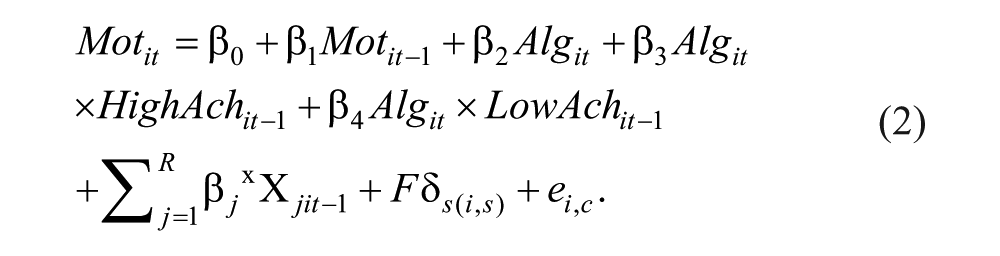
In Equation 2, we are interested in whether the association between eighth-grade algebra and motivation is different for different levels of prior achievement. A significant coefficient (β3 or β4) would indicate that students who had high prior achievement or low prior achievement experience changes in motivation that differ from the main association (β2) experienced by students performing at the basic level (referred to as average-achieving students). For simplicity purposes, results are discussed in terms of high-achieving students (students who scored at the proficient or advanced level on their seventh-grade math CST) and low-achieving students (students who performed at the below basic or far below basic level on their seventh-grade math CST).
Results
Table 4 presents descriptive information on the motivation measures for prior (seventh grade) achievement bins by eighth-grade mathematics course placement. In the fall of eighth grade, students in algebra who had average prior achievement reported significantly higher mastery goals (p < .01) than peers in general mathematics courses. Descriptive trends in Table 4 show that the difference in mastery goals between general math and algebra students are even larger for low prior achievers than for average prior achievers in the fall, but those trends are not statistically significant as a result of the smaller sample size for the low prior achievement group. Further, previously high-achieving students in algebra reported significantly higher mastery goals (p < .05), lower performance-avoidance goals (p < .05), and higher task value (p < .01) than peers in general mathematics courses. By the spring of eighth grade, previously average-performing students in algebra report significantly lower self-efficacy (p < .001) and previously high-achieving students in algebra report significantly higher mastery (p < .001) and task value (p < .01) than peers in general mathematics courses. In all, previously average-performing students in algebra do not differ significantly on most motivational measures with the exception that these students begin algebra with significantly higher mastery goals than peers in general math courses in the fall of eighth grade and differ significantly only on self-efficacy by the spring of eighth grade. By the spring, students in eighth-grade algebra have significantly lower self-efficacy than previously average-performing peers in general mathematics courses. Lastly, students across eighth-grade math courses do not differ significantly in performance-avoidance goals with the exception that previously high-achieving students in algebra begin with significantly lower performance-avoidance goals in the fall of eighth grade—in either the fall or spring of eighth grade, regardless of prior achievement.
Descriptive Information on Motivation Measures for Prior (Seventh Grade) Achievement Bins by Eighth-Grade Math Course Placement (N = 3,306 Students)

Note. Motivation scales = 1–5; prior achievement bins: high prior achievement = proficient or advanced (math scale score range = 350–600), average prior achievement = basic (math scale score range = 300–349), low prior achievement = below basic or far below basic (math scale score range = 150–299).
p < .05. **p < .01.
Achievement Goal Changes
Table 5 shows both the main associations and moderated model estimates of the relation between algebra course placement and changes in students’ achievement goals. Models 1, 2, and 3 show the main associations, indicating that on average, students enrolled in algebra reported a significant increase in performance-avoidance goals. Specifically, Model 3 shows that students in algebra reported a .13 standard deviation (hereafter σ) increase in performance-avoidance goals as compared with peers enrolled in general mathematics courses. 5
Standardized Regression Coefficients Predicting Students’ Achievement Goals (N = 3,306 Students)

Note. Standard errors in parentheses; time-invariant school characteristics are controlled in the analysis with school “fixed effects,” which amounts to including dummy variables for all but one school (using Stata’s xtreg command). Fixed effects estimates are based on within-school variation in dependent and independent variables. Algebra is in reference to the base category consisting of eighth-grade students enrolled in general mathematics. Controls are in reference to White, female, English Only (EO), and non-National School Lunch Program (NSLP) participants.
p < .05. **p < .01. ***p < .001.
Models 4, 5, and 6 show the association between algebra course placement and changes in students’ achievement goals as moderated by students’ prior (seventh grade) achievement group. In Model 4, the regression coefficient associated with the Algit predictor, .02, is the association between eighth-grade algebra course placement and students’ mastery goals for students that had an average prior math achievement (e.g., scored basic on the seventh-grade math CST) score. The significant coefficient associated with the interaction term HighAchit-1 × Algit, .10, however, shows that the association between algebra course placement and students’ mastery goals is moderated by whether or not students had high prior math achievement. Students in algebra who had high prior math achievement were associated with a .12σ (.10 + .02 = .12) increase in mastery goals relative to previously high-achieving peers in general mathematics courses.
In Model 5, the regression coefficient associated with the Algit predictor, –.06, represents the association between eighth-grade algebra course placement and students’ performance-approach goals for students who had average math achievement prior to algebra course placement. The significant coefficient associated with the interaction term HighAchit-1 × Algit, .09, shows that the association between students’ performance-approach goals and algebra course placement is moderated by whether or not students had high prior math achievement. Specifically, previously high-achieving students in algebra reported a .03σ (–.06 + .09 = .03) increase in performance-approach goals as compared with high-achieving peers in general mathematics courses.
Expectancy and Value Changes
Table 6 shows the main associations and moderated model estimates of algebra course placement and changes in students’ expectancy and value beliefs. Model 1 shows that students in algebra reported a significant decrease (.26σ) in their sense of efficacy as compared with their peers in general mathematics courses. Model 2 also shows that students in algebra, on average, reported a significantly greater decline (.14σ) in their task value than their peers in general mathematics courses.
Standardized Regression Coefficients Predicting Students’ Efficacy and Value (N = 3,306)

Note. Standard errors in parentheses; time-invariant school characteristics are controlled in the analysis with school “fixed effects,” which amounts to including dummy variables for all but one school (using Stata’s xtreg command). Fixed effects estimates are based on within-school variation in dependent and independent variables. Algebra is in reference to the base category consisting of eighth-grade students enrolled in general mathematics. Controls are in reference to White, female, English Only (EO), and non-National School Lunch Program (NSLP) participants.
p < .05. **p < .01. ***p < .001.
Models 3 and 4 show the moderated association of algebra course placement and students’ academic self-efficacy and task value. In Model 3, the regression coefficient associated with the Algit predictor, –.31, is the association between eighth-grade algebra and students’ efficacy for previously average-achieving students. These students reported a significantly greater decline (.31σ) in their sense of efficacy than their peers in general mathematics courses. The significant coefficient associated with the interaction term HighAchit–1 × Algit, .26, shows that the association between eighth-grade algebra and students’ efficacy is moderated by whether or not students had high prior math achievement. Students with high achievement prior to eighth-grade algebra course placement reported a .05σ (–.31 + .26 = –.05) decline in self-efficacy as compared with previously high-achieving peers in general mathematics courses.
In Model 4, the regression coefficient associated with the Algit predictor (–.18) is the association between eighth-grade algebra and students’ task value for previously average-achieving students placed in eighth-grade algebra. These students experienced a statistically significant .18σ decrease in task value beliefs as compared with their peers in general mathematics courses. The significant coefficient associated with the interaction term HighAchit–1 × Algit, .17, shows that the association between eighth-grade algebra and students’ task value is moderated by whether or not students had high prior math achievement. Specifically, students with high prior achievement experienced a –.01σ (–.18 + .17 = –.01) decline in task value as compared with previously high-achieving performing peers in general mathematics courses. The decline in task value that is associated with students placed in eighth-grade algebra is almost entirely attenuated for students with high prior achievement in seventh grade.
Testing the Robustness of Self-Efficacy Results
The finding that algebra course placement relates with declines in student self-efficacy is in accordance with the big-fish-little-pond effect (BFLPE) model, which posits that students compare their own academic ability with the abilities of their classmates and use this comparison as a basis for forming their own academic self-concept beliefs (Marsh, 1987). In essence, students attending schools where the average ability levels of other students are high will have lower academic self-concepts compared to equally able students attending school where the average ability is low. Extending this theory to hypothesize at the classroom level, the deleterious changes in students’ expectancy beliefs presented in Table 6 may be in part due to equally able students lowering their academic self-concept beliefs after comparing themselves to more able students. Drawing on Eccles’s (1983) expectancy-value framework to characterize students’ math self-concept beliefs, we examine a test of robustness to determine whether students’ relative standing among peers in middle school math classrooms accounts for a significant amount of change in efficacy beliefs over the course of eighth grade, regardless of algebra course placement. Appendix B presents the extended analyses incorporating both the individual (e.g., student) and group levels (class average ability) to assess the contextual effects of group-level ability on student beliefs. Findings indicate that students placed in eighth-grade algebra experience a significant decline in self-efficacy relative to peers placed in general mathematics courses, net of the class average predicting this change. This finding indicates that while the BFLPE may partially (and insignificantly) explain the decline in self-efficacy found among students placed in algebra, it does not explain the full relation between algebra course placement and self-efficacy. After controlling for class average, students placed in algebra experience a significant decline in self-efficacy relative to peers placed in general mathematics classes, suggesting our results indicating algebra course placement, regardless of changes in relative class standing, is associated with significant declines in academic self-efficacy.
Testing the robustness of results using a reduced sample of students in the overlapping portions of the achievement distribution, a constrained analysis utilizing an area of common support, as shown in the achievement distribution illustrated in Figure 1, was conducted as a robustness check of the main results reported. The constrained analyses using a subsample of students representing the overlapping portions of the achievement distribution shown in Figure 1—students in general math with a prior (seventh grade) CST score of 346 or higher and students in algebra with a prior (seventh grade) CST score of 346 or lower—improves the comparability of general math and algebra track students. Descriptive information and results are presented in Appendix C. Table A4 in the appendix presents descriptive information for the subsample of 529 students used in analysis, and t tests showed minimal differences between the subsample and study sample presented in Table 1. Table A5 in the appendix presents regression coefficients predicting students’ achievement goals, expectancy, and value. Results show coefficients predicting students’ achievement goals in the same direction as reported previously, though not statistically significant. Results show coefficients predicting statistically significant decreases in self-efficacy and task value for students in algebra relative to peers in general math courses, findings in line with the results reported previously.
Discussion
To our knowledge, this is the first study to reveal information about the association between algebra course placement and changes in students’ motivation. All research to date examining the effects, influences, and associations of algebra course placement on student outcomes has focused largely on student cognitive and achievement outcomes (for a review, see Stein et al., 2011; Domina, 2014). There is a need for research that examines outcomes such as student motivation given its influence on cognitive and achievement outcomes.
The current study examines changes in achievement goals, self-efficacy, and task value for students placed in eighth-grade algebra relative to peers placed in lower-level eighth-grade general mathematics courses. Students placed in algebra reported decreases in both self-efficacy and task value as compared with peers placed in general mathematics course, a finding that is partially in agreement with our hypotheses (Hypothesis 1 and Hypothesis 2), which predicted a change in this direction for previously low-achieving students placed in algebra. Thus, we accept these hypotheses and determine that previously average-performing students also experience a decline in self-efficacy and task value. Contrary to our hypothesis (Hypothesis 3), previously high-achieving students did not experience an increase in self-efficacy and task value—however, these declines were attenuated for previously high-achieving students placed in algebra. Partially in line with our hypothesis (Hypothesis 5), students in algebra reported higher performance-avoidance goals relative to peers in eighth-grade general mathematics courses. However, our hypotheses that this would occur only for low-achieving student was not supported. Contrary to our hypothesis, the association with performance-avoidance goals was not moderated by prior math achievement, such that students with high prior achievement were not less likely to report higher performance-avoidance goals than students with average or low prior achievement. Therefore, we partially accept this hypothesis and determine that all students in our study sample experienced an increase in performance-avoid goals. Lastly, in line with our hypothesis (Hypothesis 6), previously high-achieving students placed in algebra reported experiencing higher mastery goals and performance-approach goals relative to previously average- and low-achieving peers placed in algebra. However, previously high-achieving students did not demonstrate a decrease in these goals, as expected.
These findings, taken together, characterize an overall decline in students’ motivation for mathematics for previously average- and low-performing students placed in eighth-grade algebra. This is a concern given that increases in mastery goal orientations, expectations of success (efficacy), and task value are related to higher achievement, educational attainment, effort, and engagement (Rosen, Glennie, Dalton, Lennon, & Bozick, 2010). Further, mastery goals, self-efficacy, and task value beliefs associate positively with standardized math achievement outcomes for students in our study sample (Appendix D), suggesting that the declines in these motivational beliefs may be associated with declines on students’ proximal achievement outcomes in mathematics. Given that our results are correlational, the direction of causality cannot be determined, however. Previous research on motivation and achievement suggests a bidirectional relation in which changes in goals and changes in achievement are reciprocally linked (Zimmerman, 1989, 2011). Although the CST scores did not come until after students already reported their spring motivation, it can be argued that the achievement in the classroom prior to the CST could have been impacted by student motivation and that students’ CST scores serve as an indicator of student math achievement during the school year.
Students’ decline in task value beliefs are of particular concern given that the importance (value) that students give to a domain (e.g., math, science, and English) early in their academic careers relates significantly to the number of classes that students take in that domain in high school (Durik, Vida, & Eccles, 2006; Simpkins, Davis-Kean, & Eccles, 2006). Declines in students’ task value for mathematics may partially explain the lack of retention in advanced math courses. The cultivation of efficacy and value beliefs is critical to students’ success in algebra and subsequent decisions to pursue advanced mathematical learning. The deterioration of these beliefs may hinder the growth of a STEM workforce.
In terms of achievement goals, students in eighth-grade algebra have relatively higher performance-avoidance goals—goals that have robust empirical links to negative learning and achievement outcomes (for a review, see Hulleman et al., 2010). Lastly, previously high-achieving students placed in eighth-grade algebra have relatively higher mastery and performance-approach goals than previously average- or low-achieving achieving peers in algebra as well as peers placed in general mathematics courses. There has been support that performance-approach goals can be adaptive when mastery goals are also high (Harackiewicz et al., 2002; Midgley et al., 2001). 6
Multiple Interpretations of Results and Instructional Implications
Several interpretations are possible for our results. The motivational declines may have resulted from students being placed in algebra without adequate preparation. An alternative explanation is that the negative motivational associations of taking algebra that previously low- and average-achieving students reported may have less to do with the algebra specifically but more to do with the instructional quality. Though our data set does not include instructional quality, another research team that also found negative effects of early exposure to algebra explored the possibility that the district’s need for additional teaching support for algebra courses caused it to place less qualified teachers in those classrooms (Clotfelter et al., 2012). The authors, however, found that weaker teacher credentials did not explain the association between algebra placement and lower achievement, suggesting that the decline may not be a result of the difference in teacher quality.
Beyond teacher credentials, the measure of instructional quality takes into account a host of other variables. In a five-year study with high school students at different schools, Boaler and Staples (2008) found that social awareness and cultural sensitivity are critical factors for influencing student participation and academic success. Their primary case study was based on a school that successfully placed students of significant ethnic and economic diversity in mixed-ability math courses. More students in this school took advanced high school math courses and reported intending to continue taking math in college when compared with better-prepared students in schools with more traditional learning environments. Findings showed student success was linked to classes that valued multiple dimensions of math, such as through a task that had an open set of requirements that provided students several ways to contribute and succeed. The team also found that classrooms that developed a culture of having students justify their answers were also more successful academically. Future research can focus on instructional differences in eighth-grade mathematics classrooms and examine how they impact student motivation to inform educators on how programmatic changes can attenuate adolescent motivational decline in algebra classes.
To ameliorate declines in students’ motivation for students placed in eighth-grade algebra, policy-makers, administrators, and educators can consider implementing teaching practices that include multidimensional activities and student justification. Creating a classroom climate in which help seeking and justification is encouraged has consequences for the entire class and can especially benefit the increasingly heterogeneous algebra classes as they become less selective. The change in group composition of math ability levels that results from the push for algebra for all has implications for motivation. For example, high-achieving secondary school students reported lower collective efficacy of the group’s abilities than self-efficacy of one’s personal abilities when group processes were of low quality (Cheng, Lam, & Chan, 2008). However, when group processes were of high quality, both low and high achievers reported higher collective efficacy than self-efficacy. Group dynamics while learning therefore can impact student motivation, and in ongoing research, we are exploring whether the greater difference in ability levels in algebra could potentially be part of the explanation for the motivational declines within students. Lastly, there has been evidence that extended learning time in algebra boosts achievement and readiness for course content (e.g., Kemple, Herlihy, & Smith; 2005; Nomi & Allensworth, 2009); thus, offering extended learning time for previously average- and low-performing students might also remediate student experiences in algebra.
Policy Implications
The newly adopted Common Core State Standards recommends pre-algebra in eighth grade and algebra in ninth grade, which may lead to the eventual deceleration of eighth-grade algebra trends. In the meantime, discussion regarding algebra policies can consider refocused goals and transition from maintaining an objective for a de-tracked, universal mathematics curriculum to goals of preparing all students in all tracks to participate and succeed in algebra early enough to afford them the opportunity to reach higher-level mathematics. Further, the de-tracking goals these policies set out to accomplish in the first place have not been met as new course placement norms have gradually occurred. Since taking algebra in the eighth grade became the new normal, gifted students began taking algebra in seventh grade (Loveless, 2013). For example, in California, 8.1% (nearly 38,000 students) took the algebra end of the course exam in 2012. Essentially, striving for a curriculum for all has merely shifted up the timeline of when students take algebra. Instead, while amid the current state of accelerated enrollment in the course, schools can consider working toward incorporating students’ algebra readiness into their algebra course placement policies. Progress toward this and ultimately away from universal course placement policies can improve students’ experiences in algebra and evade motivational decline in mathematics.
Advantages and Limitations of Study Logistics
The district represented by our study sample serves a population of minority students of primarily Hispanic and Vietnamese origins, almost half of which are English language learners and most of which are socioeconomically disadvantaged. Lack of STEM engagement is particularly problematic for these underrepresented minority students. Hispanics make up 17% of the U.S. population, are our fastest growing ethnic group, and are the most likely group to drop out of the STEM pipeline before reaching and after enrolling in college (Chapman, Laird, & KewalRamani, 2010). Further, Vietnamese educational attainment is among the lowest of Asian Americans, with 72% graduating from high school and only 27% finishing college (Asian American Center for Advancing Justice, 2011). As such, our unique study sample offers information that can be used to more accurately consider the potential motivational consequences of intensifying middle school mathematics curriculum for these understudied student populations.
The district from which our sample was taken shows eighth-grade algebra enrollment trends similar to those found nationwide (Domina et al., 2015), enrolling more than 36% of eighth-grade students in algebra or higher in 2004–2005 and increasing enrollment each year to reach over 84% of eighth-grade students in algebra or higher in 2007–2008; however, the lack of a universal policy does not allow for a causal analysis of effects on student motivation. Rather, the findings presented here are associational and can be used to deliver information of the potential direction of effects that universal course placement policy can have on student motivation. Further, our study uses CST scores as the sole measure of achievement, but research has suggested that standardized exams on the math portion can include cultural and linguistic barriers that impact English language learners (Boaler & Staples, 2008). Given the large percentage of English language learners in our sample, this is a potential limitation in using standardized test scores to measure math achievement.
Conclusion
Findings from this study suggest that eighth-grade universal algebra placement may not be the panacea for increasing the on-flow and retention in the STEM pipeline and that instead, interventions are needed toward preparing all students to succeed in algebra rather than mandating them in. Evidence from this study suggests that placing low-performing students in mathematics courses for which they may not be ready can lead to reduced self-efficacy and task value in mathematics and heightened performance-avoidance goals. These changes occurring at the developmentally sensitive time of early adolescence can contribute to the downward spiraling trend between students and their motivation toward mathematics (Gottfried, Fleming, & Gottfried, 2001). Because of algebra’s foundational place as a gatekeeper to advanced math and science learning, these adverse motivational consequences can cripple students before they can climb up the STEM ladder, essentially blocking the pathways that universal algebra policy had aimed to remedy in the first place. Future directions must work to pair course placement policies and resources for students who may need these adjustments to succeed. Further, there is a need for research to connect these efforts to achievement and student motivational outcomes. These efforts can subsequently remediate adolescent motivational decline, particularly in mathematics, which will ultimately improve student access and choice to persist in mathematics and its related career paths.
Footnotes
Appendix A
Appendix B
Appendix C
Appendix D
Acknowledgements
We thank the schools, teachers, and students for taking the time to participate in this research as well as the following people for their contributions to various parts of this research: Jacquelynne Eccles, Teomara Rutherford, Katerina Schenke, Phyllis Blumenfeld, Elisabeth De Groot, Kai Cortina, Barbara Hofer, Avi Kaplan, Revathy Kumar, Steve Peck, Ed Silver, Helen Watt, Juliane Blazevski, Christina Bonney, Bridget Dever, Jeanne Friedel, Melissa Gilbert, Fani Lauermann, Lisa Linnenbrink-Garcia, Pamela MacInnis-Weir, Lauren Musu-Gillette, Toni Rogat, Erik Ruzek, Nayssan Safavian, and Akane Zusho.
Declaration of Conflicting Interests
The author(s) declared no potential conflicts of interest with respect to the research, authorship, and/or publication of this article.
Funding
The author(s) disclosed receipt of the following financial support for the research, authorship, and/or publication of this article: This research was supported in large part by a grant from the Rackham Graduate School at the University of Michigan awarded to AnneMarie Conley; a grant from the National Science Foundation (NSF) DUE-0335369 awarded to Paul Pintrich and Martin Maehr; a grant from the NSF DUE-0928103 awarded to Stuart Karabenick, AnneMarie Conley, and Martin Maehr; a grant from the NSF DUE-0929076 awarded to David Pagni and AnneMarie Conley; and an award from the Spender Foundation Award Number 201400180 awarded to Thurston Domina.
Notes
Authors
RAHILA SIMZAR is a PhD candidate at the University of California, Irvine. Her research examines the relation between math course placement policies and student motivation and affect in urban middle school mathematics classrooms.
THURSTON DOMINA is an associate professor at the University of California, Irvine. His research pairs demographic and econometric empirical methods with sociological theory to better understand the relationship between education and social inequality in the contemporary U.S.
CATHY TRAN is a PhD candidate at the University of California, Irvine. Her research applies theories from motivation and cognition to the design of learning environments, especially for science and math.