




Abstract
In this article, we discuss and expand on two novel concepts developed to better understand ethnoracial integration and variation: the ethnoracial core and the symbolic-to-consequential ethnoracial continuum. These concepts were derived from analysis of qualitative and quantitative data from the Mexican American Study Project, which showed a lasting ethnoraciality for many later-generation Mexican Americans and a high degree of within-group variation. To address the issue of ethnoracial maintenance, we introduced the concept of the ethnoracial core, which is comprised of structural and institutional forces that promote strong and enduring ethnoracial experiences. To better conceptualize within-group variation, we mapped individual experiences onto a symbolic to consequential ethnoracial continuum. While these two concepts have been well received, calls have been made to expand them to other cases and contexts. In this article, we provide an overview of these new conceptual tools and elaborate on them using diverse cases and contexts, with an eye to their broader applicability. We also provide concrete suggestions for their operationalization and measurement. With the introduction and expansion of these two concepts, our aim is to generate a more comprehensive and inclusive framework that bridges theories of immigrant integration and race/ethnicity. In doing so, we endeavor to avoid some of the weaknesses of prior theorizing, most notably the inattention to African Americans and contexts beyond the United States.
Introduction
In 1979, the concept of “symbolic ethnicity” was introduced by Herbert Gans to explain a perceived “ethnic revival” of third- and fourth-generation descendants of European immigrants in the United States (Gans 1979). He argued that this ethnicity reflected people drawing on ethnic symbols, largely independent of the ethnic cultures and organizations of their ancestors, and expressing their ethnicity primarily through identity. He viewed “symbolic ethnicity” as that which “takes on an expressive rather than instrumental function in people’s lives, becoming more of a leisure-time activity and losing its relevance, say, to earning a living or regulating family life” (p. 9). In other words, Gans viewed symbolic ethnicity as a sign of integration, in line with traditional assimilation theory. In 2003, Alba and Nee similarly argued that assimilation is taking place, but proposed a revision to traditional assimilation theory, focusing on the question of “assimilating into what?” They proposed the idea of a societal “mainstream” where “ethnic and racial origins have at most minor impacts on life chances and opportunities” (p. 12). Both concepts—symbolic ethnicity and the mainstream—now decades old, continue to be heavily cited and debated. However, both lack a conceptual counterpart.
In Durable Ethnicity: Mexican Americans and the Ethnic Core (Telles and Sue 2019), we proposed two new concepts: the ethnoracial core, to describe the role of ethnoracial structures and institutions 1 in ethnoracial maintenance, and the symbolic-to-consequential ethnoracial continuum, to describe the full range of individual expressions of ethnicity/race (or ethnoraciality). 2 In introducing these concepts, we pivoted away from theories of assimilation, shedding their problematic normative assumptions and conventional empirical foci on generational change and group 3 averages. We instead asked broader questions about the hows and whys of ethnoracial persistence, and what explains ethnoracial variation across and within groups. Insights from our combined analysis of interview and survey data led us to question whether racialization (or ethnoracialization 4 ) and identity—dominant concepts in the literature—are sufficient for understanding ethnoracial experiences. We wondered why strong ethnoracial identities and behaviors persisted for many Mexican Americans and what forces sustained them. Was it primarily because of racialization? Or continued Mexican immigration? Our data suggested there was more to ethnoracial durability. We also wondered about the positive role of ethnoraciality in individuals’ lives. Our findings of substantial within-group heterogeneity also made us question the hows and whys of ethnoracial variation within a population and how this variation may manifest in ways that include but go beyond identity. And what the role of ethnoracial institutions and structures might be in the integration process. 5 We found that many of these questions could not be adequately answered by existing concepts or theories.
These questions and reflections led us to rethink major assumptions and tendencies regarding dominant theoretical frameworks and methodological practices. Inductively, we worked to generate a concept that illustrated how ethnoraciality spans a continuum from symbolic to consequential, with consequential being an experience marked by its enduring everyday relevance that includes but goes beyond identity. We also argued that individuals’ distribution along this continuum can partly be explained by their relationship to an ethnoracial core, or the structural forces—including but not limited to racialization—that counteract mainstream forces by exerting a gravitational “pull” and facilitate ethnoracial maintenance. These two concepts capture a broader range of integration experiences within and across groups than prior theorizing has allowed. Moreover, they allow for faciliate analysis of the experiences of multiple ethnoracial populations under one conceptual framework, while bridging the often-separate literatures on immigrant integration and race/ethnicity (Aranda and Rebollo-Gil 2004; Jung 2009; Omi and Winant 2015; Sáenz and Douglas 2015; Valdez and Golash-Boza 2017).
In this article, we respond to calls for the extension of our concepts beyond the case of Mexican Americans in the U.S. Southwest (Abascal 2020; Guveli 2020; Massey 2022; Rivera 2022; Vasquez-Tokos 2020). We also update them considering recent events, as well as new empirical and theoretical insights in the literature. In addition to speaking to the concepts’ broad applicability, we provide guidance for their operationalization and measurement.
The Ethnoracial Core
Leading research on immigrant integration has focused on cultural change, social interaction, and progress in the direction of the “mainstream” (Alba and Nee 2003), “Anglo core” (Gordon 1964), or Whiteness (for critiques, see Jung 2009; Vallejo and Vasquez-Tokos 2024). The empirical focus on the United States, and particularly European Americans, has led to an overemphasis on processes of mainstream integration to the detriment of understanding counterforces associated with ethnoracial maintenance. From a global perspective, the United States does not represent typical ethnoracial formations; it is a case where assimilation is strong and encouraged. The United States possesses powerful integration forces such as monolingualism, mass public education, extensive media, and integrative labor markets, in addition to a prominent national narrative of assimilation. At the same time, its deeply racialized system has resulted in the full integration of some, but not others; exclusionary practices have served as strong counterforces to mainstream integration and fostered ethnoracial maintenance. In contrast, multiculturalism and multilingualism in European contexts have been the norm, although this has not precluded the existence of anti-immigrant sentiment and xenophobic policies. These dynamics—within the United States and globally—suggest a need for analytic frameworks that go beyond an exclusive focus on mainstream integration.
Although not commonly recognized, Milton Gordon’s (1964) classic theory of assimilation featured the idea of an “ethnic subsociety,” which he defined as
a network of organizations and informal relationships which permits and encourages the members of the ethnic group to remain within the confines of the group for all of their primary relationships and some of their secondary relationships throughout all stages of the life-cycle. (p. 34)
He viewed this “ethnic subsociety” as providing a source of ethnic identification, sense of peoplehood, and shared culture. However, recognition of ethnic subsocieties, especially their positive and communal aspects, has largely disappeared from theories of immigrant integration. Segmented assimilation theory (Portes and Zhou 1993) incorporated the role of ethnoracial communities, but focused on second-generation integration. Moreover, the concepts of the “underclass” and communities of “deliberate preservation of the immigrant community’s values and tight solidarity” (p. 82) went largely undefined.
Extending Gordon’s idea of an ethnic subsociety, we introduce the concept of the ethnoracial core to counterbalance the emphasis on the mainstream. We view the ethnoracial core as an alternative space to the mainstream, which Alba and colleagues define as “a core set of interrelated institutional structures and organizations regulated by roles and practices that weaken, even undermine, the influence of ethnic origins per se” (Alba and Nee 2003:12) or “the assemblage of the social and cultural spaces where the members of the dominant population feel at home” (Alba, Beck, and Basaran Sahin 2018:101). Along with others (e.g., Karimi and Wilkes 2023), we view the mainstream as ill-defined, which complicates the task of defining a conceptual counterpart. However, in contradistinction to the mainstream, we define the ethnoracial core as a set of dynamic forces involving structures and institutions that promote ethnoraciality, including ethnoracial social networks, neighborhoods, organizations, markets, media, and additional forces that create and enhance an ethnoracial community. As opposed to ethnoraciality being inconsequential or weakened, as Alba and colleagues suggest happens in the mainstream, in the ethnoracial core, ethnoraciality matters and is often can be strengthened. These spaces also provide comfort and a sense of belonging to group members. Although we view the mainstream and ethnoracial core as analytically distinct, they can overlap empirically (e.g., ethnic studies units housed in mainstream educational institutions).
The ethnoracial core concept visibilizes the oft-ignored forces that strengthen, maintain, or recreate ethnoraciality. This builds on prior work examining the contexts that enhance or erode ethnicity (Cornell 1996; Yancey, Eriksen, and Juliani 1976). When putting the concepts of the ethnoracial core and mainstream in direct dialogue, we can think of the ethnoracial core as a set of interrelated structures and organizations that maintain or strengthen ethnoraciality, thus counteracting or slowing the pull of mainstream integration forces. A strong ethnoracial core facilitates the “ties that bind” —shared interests, shared institutions, and shared culture (Cornell 1996). In this section, we discuss the formation and perpetuation of the ethnoracial core, the relationship between ethnoracial exclusion and the core, the core’s gravitational pull, mainstream-ethnoracial core interactions, and how we envision the ethnoracial core concept as generating a more comprehensive and inclusive framework that bridges theories of immigrant integration and race/ethnicity.
The Formation and Perpetuation of Ethnoracial Cores
We believe ethnoracial cores exist for many ethnoracial populations, albeit to different degrees. Each ethnoracial core has a unique history behind its development and perpetuation. Ethnoracial cores can be shaped and reinforced by domestic and global socio-political factors, including histories of colonization and segregation, immigration policies, ongoing ethnoracial discrimination and exclusion, immigration from the homeland, and ethnoreligious persecution. Whereas we view ethnoracial geographic concentration as necessary for the development of an ethnoracial core (at least historically), its existence requires additional ethnoracial structures and institutions. While these structures and institutions are certainly more accessible to those living in areas with high ethnoracial density, individuals who live outside areas of ethnoracial concentrations can also engage with them. We thus view ethnoracial cores as strongly overlapping with, but not reducible to, geographic concentrations such as the Black or Jewish ghetto, Mexican barrio, or other ethnic enclaves. Whereas we view ethnoracial cores (like mainstreams) as rooted in and shaped by local contexts, they can exist at multiple geographic levels including neighborhoods, cities, or broader regions.
Multiple factors can contribute to the continued existence or strengthening of ethnoracial cores. For example, continuous Mexican immigration has helped account for the persistence of ethnoraciality among Mexican Americans (Jiménez 2010). However, evidence shows that ethnoracial maintenance can also be sustained independently of immigration (Telles and Sue 2019). In this way, the ethnoracial core concept is related to, yet distinct from, the theories of immigrant replenishment (Jiménez 2010), relational assimilation (Jiménez 2017), dissimilation (Fitzgerald 2013; Jiménez and Fitzgerald 2007), and transnationalism (Levitt 2001; Smith 2006). Although important for understanding assimilation, these theories often reduce the source of ethnoraciality to the culture of the home country (see Kasinitz et al. 2008), ignoring how it is also produced in the destination. In this traditional view, ethnoracial culture is supplied only by immigrants and perhaps their transnational children.
The ethnoracial core, in contrast, captures the powerful emergent ethnoracial forces and structures that are produced locally and develop beyond the influence of a population’s homeland. For example, ethnoracial political movements, studies, art, literature, and theater, have all been created in the United States by African American, Latina/os, and Asian Americans, often independent of politics, education, and culture in Africa, Latin America, and Asia. Many of these ethnoracial organizations and structures emerged from social movements to combat U.S.-based discrimination. Despite a detachment from the ancestral homelands, these domestic endeavors are important sources of ethnoracial structures and identity for many Americans. Perhaps the best example of a powerful “homegrown” ethnoracial core is that produced by African Americans, whose contemporary culture is far removed from that of their African ancestors. Outside of the United States, ethnoracial cores can also be found. For example, Japanese Brazilians have developed literature, film, and art that is connected to Japan and Japanese cultural symbols but are, above all, Brazilian (López-Calvo 2019).
Recent scholarship has shown how ethnoracial communities can be deeply affected by “elsewhere” dynamics, or those that exist outside the destination and origin countries (Shams 2020). For example, events in Europe have affected diasporic communities of Muslims and those perceived to be part of such communities (Shams 2020). Whereas Shams discusses the effect of “elsewheres” on immigrants, we believe the concept of “elsewheres” is also applicable to their multi-generational descendants. We witnessed how the Chinese government’s response to inquiries about the origins of Covid-19 increased anti-Asian hate crimes for Asian immigrants and Asian Americans alike. Moreover, the war in Gaza affected not only immigrant communities, but also Palestinian and Jewish Americans, along with their respective organizations. Therefore, “elsewhere” dynamics can also impact, and often perpetuate ethnoracial cores. Increasing globalization is likely to intensify these dynamics in the future.
Ethnoracial Exclusion and the Ethnoracial Core
Whereas assimilation theories emphasized the gravitational forces that pull individuals toward the mainstream, newer theorizing has given more attention to forces that push individuals away from it, particularly ethnoracial exclusion (Lee and Kye 2016; Portes and Zhou 1993; Telles and Ortiz 2008; Vasquez 2011). Discussions of race as an impediment to U.S. mainstream integration surfaced with the wave of predominantly Latin American and Asian immigrants since 1965, which contrasted to early European immigration. Alba and Nee were cautiously optimistic that these newer immigrants would become part of a “changing mainstream”; they argued that civil rights laws and policies lowered barriers to mainstream integration.
Racialization scholars, in contrast, emphasized the continuing role of racism and assimilation theory’s inability to grapple with its influence in integration processes (Jung 2009; Omi and Winant 2015; Sáenz and Douglas 2015; Telles and Ortiz 2008; Treitler 2013; Valdez and Golash-Boza 2017). Along these lines, Alejandro Portes and Ruben Rumbaut (2001, 2014; Rumbaut 2008) argued that exclusion from the mainstream can lead to a “reactive ethnicity.” Such an ethnicity likely developed for many Mexican Americans after World War II when they faced continued societal exclusion despite having served in the War (Portes and Rumbaut 2014; Telles and Ortiz 2008). It also developed for East Asian Americans following the murder of Vincent Chin (Espiritu 1992) and with the COVID-19 pandemic (Abidin and Zeng 2021; Jang, Youm, and Yi 2022), and for American Muslims in the post-9/11 era (Herda 2018) and after the ISIS attacks in Paris (Shams 2020). This last example highlights how not just local conditions, but also “exogenous shocks” (Shams 2020) can foster a reactive ethnicity. Research outside the United States also suggests the potential for reactive ethnicity as a response to discrimination and exclusion, as in the case of Turks in various European countries (Çelik 2015; Guveli 2015; Verkuyten and Yildiz 2007).
States also play a crucial role in ethnoracial integration processes, including through exclusionary practices that target ethnoracial cores or block individuals’ ability to access them. Bans on refugees, revocation of temporary protection status, the curtailing of immigrant legalization policies, deportation without due process, and other forms of “legal violence” (Menjívar and Abrego 2012) can impede integration, not only into mainstreams, but also ethnoracial cores. Even for groups who have experienced some mobility, such as contemporary second-generation Mexican Americans in New York City, documentation status strongly influences integration possibilities, well-being, and life trajectories (Smith 2024). Moreover, as Cecilia Menjívar and Leisy Abrego (2012) show, even when immigration policies originate from a specific locale, their effects extend beyond national borders, creating globalized, transnational impacts. This is illustrative of the broader phenomena of historical, cultural, and geopolitical forces interacting to produce multiple forms of ethnoracial exclusion (Aranda and Rebollo-Gil 2004). In the current era, geopolitical “othering” of particular nations (e.g., China and Palestine) may also deepen domestic ethnoracial cleavages.
The State can also create exclusionary dynamics by directly targeting ethnoracial core structures and institutions. This is evident in the series of executive orders and related statements issued by the Trump Administration. For example, in 2025 the Department of Education’s Office of Civil Rights issued a directive to universities stating that it is unlawful to consider race or “segregate” students based on race in decisions related to “admissions, hiring, promotion, compensation, financial aid, scholarships, prizes, administrative support, discipline, housing, graduation ceremonies, and all other aspects of student, academic, and campus life.” 6 This language targeted ethnoracial spaces and institutions, such as ceremonies for Black graduates and campus residential communities dedicated to shared ethnoracial experiences.
Through its actions, the State may foster generate a “reactive ethnicity,” thus building up ethnoracial cores. In addition to strengthening ethnoracial identification, such exclusion can create ethnoracial spaces such as neighborhoods, schools, religious institutions, and segmented labor markets. Ethnoracial identification and the core are mutually reinforcing. For example, the U.S. institution of slavery, followed by segregation, cultivated a powerful Black racial identity, which subsequently led to the expansion of Black spaces and institutions. Ethnoracial exclusion has fueled mobilization and resistance, leading to the creation of civil rights organizations such as the National Congress of American Indians, National Association for the Advancement of Colored People, Mexican American Legal Defense and Educational Fund, Chinese American Citizen Alliance, and the establishment of parallel ethnoracial business and professional organizations, as well as ethnic studies courses and departments in universities.
More than Just Exclusion: The Gravitational Pull of the Ethnoracial Core
The incorporation of ethnoraciality into immigrant integration theorizing has primarily focused on marginalization and exclusion from the mainstream. While scholars have theorized how “push” forces can impede or slow mainstream integration, they generally stop short of examining the “pull” or draws of the ethnoracial core. Surely ethnoracial exclusion pushes individuals away from the mainstream by restricting opportunities and toward ethnoracial structures, but these ethnoracial spaces are much more than static fallback positions for the excluded, or passive alternatives to the mainstream. They have a gravitational pull of their own.
In segmented assimilation theory, Alejandro Portes and Min Zhou (1993) identified a path of positive incorporation that relies on solidarity and social support from the ethnoracial community. Within race scholarship, Karyn R. Lacy (2007) critiques scholarship that focuses on the “burden of blackness” to the neglect of recognizing the advantages of associating with a Black community. We theorize these positive incentives through the ethnoracial core concept. In the words of Vasquez-Tokos (2020), “an important aspect of the [ethnoracial] core is that even as racism is central to its construction (p. 185), it functions to include racial/ethnic minorities” (p. 2397). This inclusion can provide social, emotional, and financial benefits. For example, minority cultures of mobility have fostered ethnoracial solidarity, cross-class support networks, and participation in middle-class ethnoracial social structures and organizations (Neckerman, Carter, and Lee 1999; Portes and Zhou 1993; Vallejo 2012; Vallejo and Ramirez 2023; Vallejo and Vasquez-Tokos 2024; Zhou and Kim 2006). Similarly, ethnoracial entrepreneurship and “ethnoracial capitalism” (Vallejo and Canizales 2023) have played important roles in middle-class integration (Light and Bonacich 1988; Liu, Liang, and Chunyu 2023; Valdez 2011; Vallejo and Vasquez-Tokos 2024). 7
Regarding educational institutions, ethnoracial organizations/units/programs within predominately White institutions may provide students of color with important instrumental and emotional support and foster ethnoracial pride, which can increase school attachment (Museus 2008; Patton, Bridges, and Flowers 2011; Salerno and Reynolds 2017). Research on Asian Americans has shown that cultural institutions and social networks can reinforce success (Lee and Zhou 2015) and that ethnoracial community engagement provides an important source of social capital (Zhou and Bankston 1998). These structural and institutional “workarounds” can provide non-traditional pathways to middle-class status (Vallejo and Vasquez-Tokos 2024). Faith-based organizations can also represent an important part of ethnoracial cores and lead to ethnoracial maintenance and feelings of empowerment (Chen 2008; Chong 1998; Gates 2022; Gonzalez 2012; Jeung, Chen, and Park 2012; Park 2012). Min Zhou and Susan S. Kim (2006) describe the Korean church as “the single most important ethnic institution anchoring [the] ethnic community” (p. 14).
To summarize, although the forces leading to the creation and development of ethnoracial cores often include oppression and exclusion, ethnoracial core structures and institutions can provide numerous benefits that incentivize ethnoracial core integration. Engagement with ethnoracial cores can create bonds of intimacy, solidarity, and provide a sense of community. Moreover, it can offer a powerful sense of belonging often denied by mainstream contexts, which treat people of color as “problems” (Vasquez-Tokos 2025). Ethnoracial cores can also increase the emotional and material benefits of ethnoracial culture and identity and serve as a refuge from discrimination. Empirical evidence finds that biculturalism and bilingualism enhance cognitive capacities and academic performance (Benet-Martínez, Lee, and Leu 2006; Bialystok 2009), while forced assimilation undermines education and self-esteem (Phinney, Cantu, and Kurtz 1997; Portes and Rumbaut 2001). Societies that recognize and respect distinct cultures and identities further enhance the ability of individuals to express their ethnoraciality in positive ways. Importantly, the positive aspects of ethnoraciality need do not compromise national identity and belonging, as we illustrated in Durable Ethnicity (Telles and Sue 2019).
Mainstream–Ethnoracial Core Interaction
We do not envision the mainstream and the ethnoracial core as isolated entities; instead, we view them as interacting and exerting influence over each other. This can occur through multiple mechanisms. For example, mainstream “push” factors, most notably exclusion, can create/strengthen individual and collective ethnoracial identification and a sense of shared fate, leading to the development and strengthening of ethnoracial core institutions. These structures can provide avenues for upward mobility, middle-class integration, and a sense of national belonging, resulting in the diversification and expansion of the mainstream. Additionally, ethnoracial practices sustained by the ethnoracial core can be absorbed by and shape the mainstream. This process intensifies when mainstream ideologies are multiculturalist and ethnoracial practices are valued. Not only does this create a more diverse mainstream, but it can strengthen the ethnoracial core by incentivizing structures that support such practices.
Regarding the first mechanism, we previously discussed how exclusion can “push” individuals away from the mainstream and consequently strengthen ethnoracial core structures. In turn, the ethnoracial core can provide pathways for mainstream integration and ultimately diversify and expand the mainstream. For example, contact with ethnoracial organizations can expand individuals’ social networks and generate social capital which can be used in the mainstream, as well as foster national integration. Ethnoracial organizations often provide legal and social support for assisting members’ integration into a nation (Zhou and Kim 2006), facilitate ethnoracial entrepreneurship and occupational mobility (Liu, Liang, and Chunyu 2023; Vallejo 2012; Vallejo and Vasquez-Tokos 2024) and promote engagement with national politics (Portes and Rumbaut 2014). For example, the Chinese American Citizens Alliance highlights its dual aim of ethnoracial and national belonging in the organization’s stated purpose: “. . . to quicken the spirit of American patriotism; to [e]nsure the legal rights of its members, and to secure equal economic and political opportunities for its members.” 8 Similarly, the Islamic Society of North America has sought to construct an “‘American brand of Islam” which helps “embed Muslims more firmly in U.S. civic and political life” (Shams 2020:132–133). In this way, ethnoracial cores can shape the composition, politics, and broader dynamics of mainstreams.
Regarding the second mechanism, there is a long history of national mainstreams being influenced by or adopting ethnoracial traditions of local sub-communities, such as the German practice of treating Sunday as a leisure day (Alba and Nee 2003; Cornell and Hartmann 2007). The embrace of multiculturalism in the Americas and Europe, particularly in the 1990s, placed further value on ethnoracial difference in the mainstream. This created mainstream incentives for ethnoracial practices, such as multilingualism (Linton and Jiménez 2009). Ethnoracial identities and cultures, fostered in the ethnoracial core, can also be reinforced through the mainstream commercialization of race/ethnicity (Banks 2022). Studies have also highlighted how smaller, local mainstreams evolve. For example, in parts of California the academic success of Asian immigrant children has redefined White natives’ perceptions of achievement and the ethnoracial hierarchy (Jiménez 2017). In sum, consistent with neo-classic assimilation theory’s emphasis on a two-way process of change between American society and immigrant cultures (Alba and Nee 2003), we view the mainstream and ethnoracial core as mutually-reinforcing through a circular process.
Tomás R. Jiménez (2017) has used the concept of “relational assimilation” to describe an interactive process whereby immigrants and established individuals adapt to each other. In the European context, Maurice Crul (2024) emphasizes the multidirectional nature of integration in spaces where there are multiple immigrant groups and no clear ethnoracial majority. In our conceptualization, ethnoracial core-mainstream interactions extend beyond the presence of immigrants and their descendants, reflecting the long-standing influence of native born “minorities” and the structures they have built (and will likely continue to build) over generations. To this point, we view the ethnoracial core as also being applicable to African Americans, who have been glaringly absent from the assimilation literature (Jung 2009; Lacy 2007; Neckerman, Carter, and Lee 1999).
Bringing African Americans into Immigrant Integration Theorizing
The ethnoracial core concept seeks to bridge the literatures on immigration, ethnicity and race and bring the African American experience into conversation with theoretical frameworks of immigrant integration. The distinction between the concepts of race and ethnicity, which is common in U.S. sociology, reflects the different theoretical treatment between White immigrants and their descendants, and African Americans (Omi and Winant 2015; Steinberg [1989] 1981). However, such a division often leads to a disregard for African American culture and identity. Certainly, racism plays a primary role in the lack of African American integration, but the concept of the ethnoracial core helps to further explain the extraordinarily durable ethnicity of African Americans.
Legal segregation, social boundaries, and other forms of exclusion led to the creation of Black institutions that have fostered and sustained African American identities, cultures, and networks (Gates 2022; Lacy 2007; Patillo-McCoy 2007). Despite their exclusionary origins, these structures have served as havens in a discriminatory society and as potent sources for ethnoracial mobilization, culture, and community. For example, during the Great Migration, Black Creoles from Louisiana used Catholic institutions and social clubs to navigate segregation, preserve their culture, and create community (DuCros 2016, 2019). These spaces continue to serve Black communities and foster Black cultures and identities long after the end of the legal segregation that often led to their establishment.
The ethnoracial core concept recognizes and contextualizes the positive and supportive aspects of Blackness and Black structures. It highlights the benefits provided by Black spaces and institutions, including neighborhoods (Hunter 2013; Lacy 2007; Patillo-McCoy 2007), networks (Stack 1974), labor markets (Valdez 2011), churches (DuCros 2016; Gates 2022; McRoberts 2005), and education (Museus 2008; Patton, Bridges, and Flowers 2011). These spaces can represent a reprieve from the racism that Blacks continue to face in White spaces (Anderson 2021). They can also serve as an outlet for inspiration, uplift, and pride as can be seen in Black art, music, dance, and literature. Ultimately, the ethnoracial core concept helps fill the void left by immigrant integration theories that disregard the African American case, which has engendered mounting critique (Jung 2009; Sáenz and Douglas 2015; Treitler 2013; Valdez and Golash-Boza 2017). Like others, we argue for a more integrated and broader theorizing for understanding ethnoracial experiences.
Toward an Inclusive Framework
We view the ethnoracial core concept as having applicability for understanding a wide range of cases in the past, present, and future. In Durable Ethnicity, we went into detail about the development and manifestation of the Mexican American ethnoracial core in the U.S. Southwest. Turning to another case, the growing number of Asian American cultural, economic, and political institutions (national and pan-ethnic alike), along with historic and contemporary ethnoracialization, has led to the creation of Asian American ethnoracial cores. Asian American organizations emerged on college campuses to advocate for institutional change, such as incorporating Asian American studies courses into curriculums (Museus 2008). They also increased students’ awareness of and commitment to their ethnoracial communities (Inkelas 2004; Tuan and Shiao 2011). Asian faith-based organizations have also been shown to foster ethnoracial maintenance and empowerment, provide social and psychological support, and even facilitate business connections (Chen 2008; Chong 1998; Gonzalez 2012; Jeung, Chen, and Park 2012; Park 2012). Sharon Rebecca Y. Kim and Sharon Rebecca Y. Kim (2012) document how second-generation Korean Americans created religious spaces that are distinct from those of their immigrant parents, illustrating how ethnoracial core institutions often develop independently of the immigrant generation. Consistent with this, Christina B. Chin (2015) identified youth basketball leagues as spaces for third- and fourth-generation Japanese Americans to build community, develop cultural capital, and receive multiple forms of co-ethnic support. These ethnoracial structures can beget additional structures, as seen with Chinese entrepreneurs who establish businesses more quickly in destinations with stronger ethnoracial concentrations (Liu, Liang, and Chunyu 2023).
Ayse Guveli (2020) notes the relevancy of the ethnoracial core concept beyond the United States, particularly for debates around immigration and integration in Europe. Although Guveli (2015) finds that second-generation Turks in Europe tend to assimilate through individual religious practices, she also finds persistent ethnic identities and a growing communal religiosity, which she considers a reactive response to societal exclusion. Guveli and Lucinda Platt (2023) also find increasing religiosity among second-generation Muslim Europeans. These findings highlight the growing polarization and blocked acculturation from nativist hostilities and the need for protective environments (Drouhot 2021; Platt 2014). For Europeans of Turkish descent, responses to ethnoracialization include drawing on the religious symbols of their ancestors to build community. Ultimately, the way that specific ethnoracial cores are created and manifest is case dependent, and future research should situate them in their appropriate socio-historic contexts.
The Ethnoracial Core and Consequential Ethnoraciality
Scholars have previously identified factors such as the context of (mainstream) reception, and individual attributes including class, race, and gender as affecting ethnoracial integration (Portes and Rumbaut 2001; Valdez 2011). Others have noted how the family provides an important nucleus of ethnic socialization and social and cultural capital, especially for the first and second generation (Alba 1985; Gans 1962). But the family alone is often not sufficient for transmitting able to transmit ethnicity over multiple generations (Zhou and Bankston 1998); its ability to do so is enhanced by and can depend upon the ethnoracial core. Conversely, the family, along with the context of reception and individual attributes, can mediate individuals’ relationship with ethnoracial core institutions. These dynamics are significant as the extent of interaction with an ethnoracial core affects the degree to which an individual’s ethnoraciality is organized in more totalizing (thick, consequential) or more minimalist (thin, symbolic) ways (see Cornell and Hartmann 2007). Consequently, we cannot ignore the importance of ethnoracial cores to for contextualizing and understanding integration processes and individual-level variation.
Ethnoracial cores actively nourish ethnoraciality, contributing to its consequentiality. Not only do ethnoracial cores present an important counterforce to mainstream forces, but they also permeate the lives of those who interact with them. Interaction with, or even the mere existence of, a local ethnoracial core makes at least some aspects of ethnoracial experiences consequential in nature. In Durable Ethnicity, we argued that the ethnoracial core helps explain the wide variation in ethnoracial expressions among Mexican Americans, even of the same generation. In the following section, we outline ways to conceptualize and operationalize this variation across multiple groups and contexts.
The Symbolic-To-Consequential Ethnoracial Continuum
Consequential ethnoraciality represents the conceptual counterpart to symbolic ethnicity. In counter-distinction to symbolic ethnicity–conceptualized as an intermittent, leisure-time activity, devoid of deep cultural or ethnic community connections (Gans 1979)– we define consequential ethnoraciality as that which is (1) frequently externally imposed or used to discriminate through a process of ethnoracial “othering,” (2) a consistent aspect of one’s life, especially with regards to cultural practices, and (3) contextualized by or rooted in the presence of an ethnoracial core. As shorthand, we refer to the first component as “ethnoracialization,” the second as “cultural practices,” and the third as “ethnoracial core engagement.”
We find it productive to conceptualize individual or group-level ethnoracial expressions and experiences as residing on a continuum from wholly symbolic to wholly consequential. This approach more easily enables analysts to capture variation at three levels: across groups, across individuals within groups, and within individuals. It also recognizes that movement is not necessarily unidirectional; it can occur in either direction depending on individual circumstances and socio-historical context. Below we discuss strategies for capturing this continuum empirically.
Modeling the Symbolic-to-Consequential Ethnoracial Continuum
In Durable Ethnicity we examined survey and in-depth interview data from the Mexican American Study Project (MASP) to explore the symbolic-to-consequential ethnoracial continuum. To capture heterogeneity among respondents, we drew on the MASP survey questionnaire to create individual ethnoracial scores that we could plot along a continuum. To calculate individuals’ scores, we used relevant variables to operationalize the three components of consequential ethnoraciality (e.g., ethnoracialization: Has the respondent ever been treated unfairly because of their ethnic background?; cultural practices: In what language does the respondent usually speak to their partner/coworkers/children?; ethnoracial core engagement: How many of the respondent’s close friends are Mexican/Mexican American?). We used a standardized scale to create an individual ethnoracial score (for details see Telles and Sue 2019:68–72) and then distributed the individual scores along the continuum, with a series of kernel-density figures. Figure 1 illustrates the distribution of MASP survey respondents according to individuals’ ethnoracial scores, highlighting the sample’s substantial heterogeneity and reinforcing calls to theorize within-group diversity (Crul 2016; Monk 2022; Vertovec 2007). We also examined distributions by region, gender, class, skin color, and generation, which, among other things, revealed that generation is insufficient for understanding ethnoracial integration (Telles and Sue 2019).
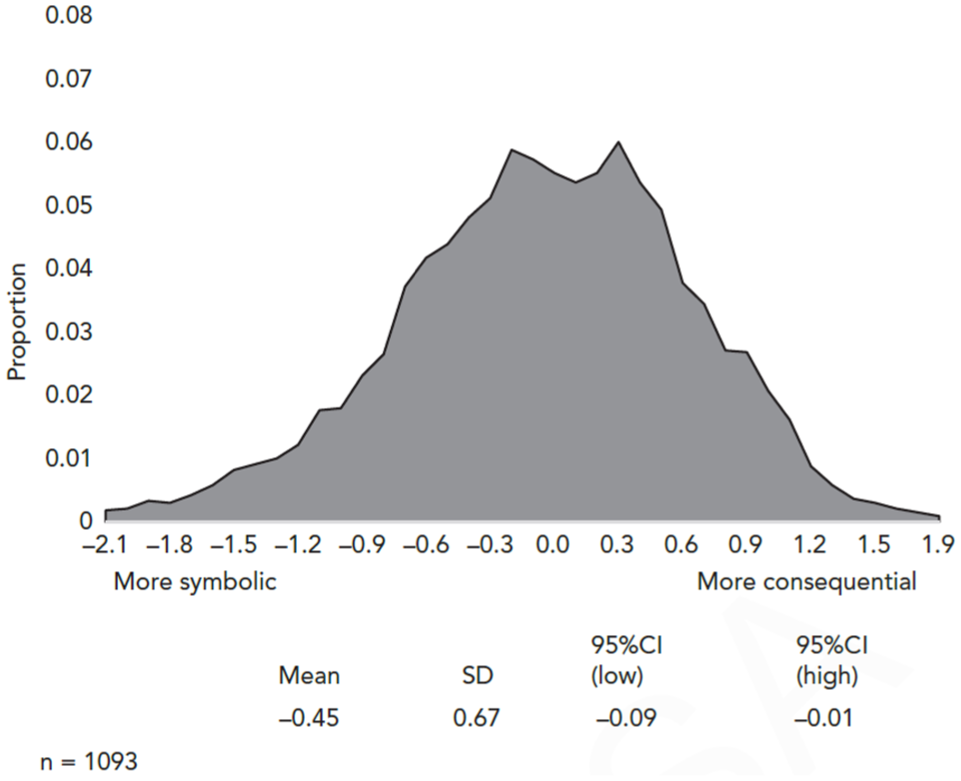
Distribution of U.S.-born survey sample on the symbolic-to-consequential ethnoracial continuum.
Not only does the continuum capture within-group variation, but it also illustrates the multiple paths to consequential ethnoraciality. Whereas scholars have emphasized racialization when explaining barriers to integration for people of color (Lee and Kye 2016; Portes and Rumbaut 2001; Portes and Zhou 1993; Sáenz and Douglas 2015; Telles and Ortiz 2008), we also view consequentiality as the product of sustained cultural practices and engagement with the ethnoracial core. While a person whose “street race” (López et al. 2018) is not White may have high levels of consequential ethnoraciality, so might a racially-ambiguous or White-passing individual who speaks their ethnoracial language daily, lives in a neighborhood with a majority of co-ethnics, and attends co-ethnoracial educational and church organizations. Also in line with our operationalization of consequential ethnoraciality, if two people are similarly racialized but one person regularly practices ethnoracial culture and engages in the ethnoracial core, and the other does not, the person with higher ethnoracial culture/core engagement would likely have a higher degree of consequential ethnoraciality. This conceptualization builds on Aranda and Rebollo-Gil (2004), who argue that “ethnoracism” includes ethnic (e.g., culture and religion) and global (e.g., histories of settlement and global ethnoracial hierarchies) dimensions. They show, for example, how global power dynamics can result in the “othering” of light-skinned Puerto Ricans, making their ethnoraciality consequential in ways that go beyond phenotype. Our concept similarly incorporates yet goes beyond theorizing that primarily views consequentiality through the lens of racialization, expanding it to capture what we view as a multi-dimensional phenomenon.
It is important to recognize how contextual and structural factors heavily influence individuals’ access to ethnoracial resources, and thus their degree of consequential ethnoraciality. As Vasquez-Tokos (2020) notes, “The cultural resources available or lacking in a person’s social environment differentially equip Mexican Americans with abilities to participate meaningfully in the ethnoracial core” (p. 2400). Clearly, physical proximity and access to ethnoracial core structures influence individuals’ ability to engage with such resources. For example, Robert C. Smith (2024) has shown how a region’s “built environment,” including local transportation systems, can affect ethnoracial integration, an observation that easily translates to ethnoracial core access.
Ethnoracial core access is also conditioned by personal attributes such as gender, sexuality, phenotype, language ability, and class (Agius Vallejo and Canizales 2016; Valdez 2011). Individual-level characteristics interact with ethnoracial structures in ways that can facilitate or block access to the ethnoracial core. For example, Black women faced exclusion and barriers to formal leadership positions in the Civil Rights Movement (Robnett 1996). Gendered social expectations, such as those deeming women as the “carriers of culture,” can also influence individuals’ inclination toward and access to sites of cultural reproduction. One study showed that LGBTQ+ individuals of Southeast Asian descent in the United States were limited in their access to ethnoracial cores because of their marginalized gender and sexual identities (Buenviaje 2025). Regarding phenotype and language, White-passing individuals or those who are not fluent their ethnic in an ethnoracial language have been shown to face challenges in ethnoracial spaces (Telles and Sue 2019). Finally, Smith (2024) documented how the meaning of (i.e., consequentiality of) being Mexican can differ by class—higher class contexts held neutral or positive views of Mexicanness, while lower class contexts held negative views—which affected individuals’ ethnoracial experiences. Overall, these examples illustrate that ethnoracial consequentiality is not solely (or even primarily) a reflection of “ethnic agency” and intent; instead, it is shaped by structural and individual-level factors.
Operationalizing Symbolic and Consequential Ethnoraciality
Maria Abascal (2020) asserts that the symbolic-to-consequential continuum framework “has the potential to integrate, under one conceptual umbrella, the experiences of diverse ethnoracial groups, from European Americans to African Americans” (p. 1388). We certainly agree and hope that future datasets will include variables to enable the mapping of different cases onto the continuum. In addition to investigating how other experiences can be captured by map onto the continuum, future research should gather additional data that directly measure symbolic and consequential ethnoraciality. Survey questionnaires could include new variables to operationalize the continuum’s three components, and qualitative research could leverage open-ended formats to uncover additional ways that people experience their ethnoraciality. Potential survey questions to gauge ethnoracialization are “Have you been treated differently because of your race/ethnicity?”; “Have people made assumptions about you based on their perception of your race/ethnicity?”; or “Have you ever been discriminated against because of your race/ethnicity?” To measure the degree to which ethnoracial cultural practices are a consistent aspect of one’s life, researchers could include the MASP questions about language (Telles and Sue 2019) but adopt a finer-grained scale to capture differences in everyday use and fluency. In populations where the retention of an ethnoracial language is not common, other measures, such as regularly cooking ethnoracial food in the home or engaging in religious practices (e.g., observing regular prayer times, not drinking alcohol, wearing religious markers, and adhering to religious gender norms, see Shams 2020) may be more appropriate indicators (see also Drouhot 2021 for discussion of the prominent role of Islam in Western Europe). Finally, to measure ethnoracial core engagement, future datasets could include measures that capture the extent to which individuals live near co-ethnics, are involved in ethnoracial organizations (including national organizations, local chapters, and clubs), educational institutions (e.g., Tribal Colleges, HBCUs, HSIs, and Chinese schools), ethnoracial church organizations, consume ethnoracial media, engage in virtual ethnoracial communities, attend ethnoracial artistic events, and frequent ethnoracial businesses. They could also investigate the factors or conditions which may facilitate or thwart efforts to engage in ethnoracial cores. As mentioned previously, when developing these measures, researchers should consider how context and individual-level characteristics such as gender, sexuality, color, class, and geography affect ethnoracial experiences and practices.
Qualitative methods can be leveraged to uncover additional forms of symbolic and consequential ethnoraciality. Exploratory interviews could help identify a wide range of factors that impact individuals’ daily lives, including ethnoracialization, cultural practices, and the structures that maintain or strengthen their ethnoraciality. Importantly, researchers should also seek to identify experiences or practices that may not be considered “ethnic” or “racial” by respondents, but which differentiate them from mainstream society. These forms of “normalized” or “invisible” ethnoraciality may surface through participant observation in public and private settings, as well as through “go alongs,” which tap into people’s daily routines. In developing new measures, it would be important to reflect on which cultural practices are distinct from the mainstream versus those which have become part of the mainstream, such as rap music, K-pop, and tacos. Methodologically creative and inductive approaches could uncover a broad array of ethnoracial experiences, as well as provide insight into how ethnoracial cores operate in specific locales. We should expect ethnoracial variation in individuals, groups, contexts, and ethnoracial core manifestations. Consequently, all measures should be tailored to specific groups and contexts, although some standardized measures may be useful for cross-group and cross-locale comparisons.
Concluding Thoughts and Future Directions
In this article we have reviewed and further elaborated on two concepts that surfaced in our study of Mexican Americans’ experiences with identity and culture: the ethnoracial core and the symbolic-to-consequential ethnoracial continuum. These concepts are versatile, enabling analysis for cross-context, cross-group, within-group, and even within-individual level comparisons. They were developed to better understand and recognize ethnoracial maintenance over generations and within-group heterogeneity observed in our data. However, reviewers of Durable Ethnicity saw the relevance of these concepts to other cases and contexts, calling for a discussion to that effect. We responded to these calls here, while also integrating new research and detailing avenues for operationalizing these concepts in future quantitative and qualitative research.
These concepts provide new analytic tools that bridge immigrant integration and race/ethnicity theorizing. The ethnoracial core and consequential ethnicity concepts serve as important counterparts to the mainstream and symbolic ethnicity, which have long dominated the literature. Additionally, our concepts seek to disrupt the Euro/White and U.S. centrism of much prior work by examining integration opportunities beyond the mainstream and incorporating African Americans and non-U.S. contexts into theories of integration. This aim is in line with calls by scholars such as Elizabeth M. Aranda and Guillermo Rebollo-Gil (2004), Jean Beaman and Orly Clerge (2024) and Katrina Quisumbing King (2018) for a comprehensive, globalized framework for studying race and ethnicity. Here, we sought to introduce concepts that can incorporate a broad range of ethnoracial groups and ethnoracial formations across the globe. As with many new analytic tools, our discussion generates more questions than it answers. For example, how much heterogeneity exists among African Americans along the symbolic-to-consequential ethnicity continuum? How does this compare to other cases such as White Americans and Mexican Americans, for example? How do histories of colonialism, geopolitics, and global power shape the consequentiality of groups in various contexts? How do ethnoracial cores affect dynamics in non-U.S. contexts, such as the experiences of multiple generations of Turks in Europe, or Japanese in Brazil and Peru?
While additional case-specific research is clearly needed, we also have broader questions: In what ways do ethnoracial cores (long-standing or emergent) affect their “members”? What exactly is the relationship between geography, demography, and ethnoracial cores? Are ethnoracial cores always rooted in geography? How might globalization and social media affect ethnoracial cores? Can ethnoracial cores exist in a virtual environment? Are the experiences of those in an ethnoracial group so divergent that group averages and generational status are of little analytic relevance? Or will the master category of “race” continue to be a tie that binds? How important is identity to ethnoraciality and the ethnoracial core? What are scholars missing by placing such a strong emphasis on identity in studies of ethnoraciality? What are the limits of racialization in explaining the micro-level and structural forces that sustain ethnoraciality? What are the positive forces that sustain ethnoraciality and promote integration? How can mainstreams and ethnoracial cores be conceptualized in contexts where no single group is dominant, as is the case with many European cities today (Crul 2016)? What role will ethnoracial cores play in contexts of increasing multiracialism and cultural pluralism? While these concepts are intended to innovate and enhance future studies, researchers of new cases and contexts should be attentive to their applicability and potential reformulation.
Current events underscore the contextual and fluid nature of these questions and their answers. In Durable Ethnicity (2019) we wrote: “Today, the popular rise in American nationalism and racism, currently tolerated and even encouraged by the state, may provoke or increase ethnoracial mobilization” (p. 195). In 2020, the infamous murder of George Floyd and others at the hands of the police sparked a racial reckoning in the United States and beyond. The backlash has drawn us into a new era of ethnoracial retrenchment in countries across the globe, marked by the rise of powerful far-right forces that often target ethnoracial populations and their ethnoracial cores. Multicultural ideology is also eroding (e.g., attacks on DEI, ethnic studies, CRT, Black Lives Matter and pro-Palestinian movements) and the effects of these changes are unclear. These shifts could animate reactive ethnicity, create/strengthen ethnoracial cores, provide fuel for social mobilizations, and increase consequential ethnoraciality. Alternatively, they could drive ethnoracial cores underground or lead to their weakening or dismantlement, although we believe this would likely be temporary.
Despite nearly all predictions to the contrary, ethnicity and race have not faded away with modernization (Cornell and Hartmann 2007) and there is no sign of their waning. Given the global surge in immigration, questions surrounding the immigrant generation have dominated current social and political discussions. Empirically, most research has been on the immigrant generation and their children as immigration across world regions is still a fairly new phenomenon. We expect that as third and fourth generations reach adulthood, interest in long-term integration will be heightened. We hope that the concepts of the ethnoracial core and symbolic-to-consequential ethnoracial continuum will not only contribute to these conversations but also serve as a bridge between these conversations and those relating to groups whose histories trace back to colonization and slavery.
Footnotes
Acknowledgements
We thank Maria Abascal, Jessica Vasquez-Tokos, Nicole Trujillo-Pagan, Bridget Eileen Rivera, David Montejano, Ayse Guveli, Doug Massey, Lucas Drouhot, and the panelists on our book forums at the Pacific Sociological Association, Eastern Sociological Society, and the Southwestern Social Science Association, for their thoughtful reviews of Durable Ethnicity. We also thank the anonymous reviewers of Sociology of Race and Ethnicity. This collective feedback has deeply influenced our thinking and shaped the direction of this article.
