




Abstract
This article examines how the community of Río Blanco in Ecuador asserted its Indigenous identity in court to defend itself against a mining company in 2017. As other countries in Latin America, Ecuador recently ratified international conventions that provide greater protections for Indigenous peoples and has incorporated key Indigenous rights into its constitution, such as the right of Indigenous communities to be consulted before a mining company can exploit their territory. However, most of the country’s population identifies as mestizo or mixed race and mestizos are ineligible for Indigenous rights. This article asks, what were the legible definitions of indigeneity that Río Blanco members and Indigenous leaders deployed in Ecuador’s courts for recognition? How do communities redefine the meaning of indigeneity in legal cases involving state recognition as Indigenous rather than mestizo? Through an analysis of court documents, I argue Río Blanco legitimated its Indigenous identity in court by presenting itself as closely tied to the land its members lived on and as nature and water protectors. Ultimately, Ecuador’s courts upheld Río Blanco’s Indigenous identity and this community’s right to a consultation, leading to the expulsion of the mining company that was exploiting their territory. The Río Blanco case shows that while Indigenous communities are at a disadvantage in court cases where the state determines racial categories and beneficiary status, Indigenous communities play an active role in redefining what it means to be Indigenous, expanding the Indigenous-mestizo boundary, and furthering Indigenous rights.
Introduction
For centuries, states have attempted to erase the existence of Indigenous people or dilute Indigenous identification in the Americas (Loveman 2014; Nobles 2000). Mestizaje, or racial mixture, ideologies spread throughout Latin America in the twentieth century and sought to assimilate Indigenous people and to whiten the population (Bonfil Batalla 1996; Martínez Casas et al. 2014). However, there has been a recent rise in Indigenous identification in the region (Del Popolo 2017). Latin American states have also recently adopted greater Indigenous rights and legal protections in their constitutions, such as the right to a prior consultation. This right, which is part of Ecuador’s constitution and International Labour Organization (ILO) Convention 169, declares that Indigenous people must be consulted before a project of exploitation can be executed in their territory, such as the extraction of minerals from a mine. ILO Convention 169 also stipulates that self-identification is the main criterion for establishing who is Indigenous. Currently, 15 countries in Latin America have ratified this convention (Falleti and Riofrancos 2018). Indigenous identification in this context has become a contested issue. This article explores how a community in Ecuador established its Indigenous identity in court and the challenges it faced from the state, who questioned its identity and the rights this community could access as Indigenous people.
Determining who is Indigenous is a contested issue 1 because this identity provides legal tools to uphold community rights against powerful transnational companies that can displace Indigenous people from their land. However, states can use the law to create strict racial boundaries and limit the rights of Indigenous peoples (C. I. Harris 1993; Torres and Milun 1995). Derrick Bell (1995) claims that the law is an instrument for maintaining the racial status quo and unpredictably provides protection for oppressed communities. Indigenous people in the United States, such as the Mashpee Tribe, have been denied their land rights based on ideas of racial purity and of Indigenous peoples being frozen in time (Torres and Milun 1995). Building on this scholarship, this article displays how the Ecuadorian courts reproduced racial domination, limiting the rights of Indigenous communities and the definitions of who is Indigenous, while Indigenous communities on the ground challenged these definitions and sought to expand what it means to be Indigenous.
While scholars have conducted extensive research on racial boundaries and the impact of diverse social factors on racial identification (Bailey 2009; Flores, Vignau Loría, and Martínez Casas 2023; Flores and Sulmont 2021; French 2009), little is known about the challenges communities in countries like Ecuador, where the majority of the population has Indigenous ancestry, face in accessing Indigenous legal rights. Race acquires different meanings in diverse contexts, and communities and individuals may employ racial identification strategically (Bailey and Fialho 2018). Furthermore, as Andrew Canessa (2007) points out regarding the embrace of Indigenous identification for political reasons in cities and for its rejection due to its negative associations in some rural communities where its members speak Indigenous languages in Bolivia, “Indigeneity can be deployed in multiple and contradictory directions” (p. 214). Racial identification is also affected by states acting as “race making” agents (Bailey 2009) and by local communities creating their own sense of belonging and ethnoracial identity from the bottom up (Hale 2015).
My empirical case focuses on Río Blanco, a community located in the southern highlands of Ecuador that was threatened by Ecuagoldmining. This mining company was polluting Río Blanco’s water sources and exerting violence on community members with private and public security forces. Although Río Blanco members primarily identified as mestizo or mixed race according to census data from 2010, this community successfully advocated for Indigenous recognition in 2017, expelling Ecuagoldmining, which was extracting minerals from their territory a year later. Río Blanco’s Indigenous identification granted this community the right to be consulted before extractive companies could operate in their territory. In the legal dispute about the violation of Río Blanco’s right to a consultation as an Indigenous community, the courts upheld their right and ordered Ecuagoldmining to cease the exploitation of their territory. I argue that in this legal case, Río Blanco engaged in legible performances of indigeneity for state recognition and redefined the meaning of being Indigenous.
My research seeks to contribute to a growing body of literature on Indigenous self-identification and policing in the Americas (McKay 2019; Paredes 2017; Rodriguez-Lonebear 2021; Telles and Torche 2019). While Indigenous peoples confront disproportionate levels of poverty and lack of access to education in Latin America (Bustelo, Frisancho, and Viollaz 2020; Comisión Económica para América Latina y el Caribe 2016), there is a global recognition of Indigenous peoples as a special group that needs protection and has a distinct culture and rights to land (United Nations 2013). Non-Indigenous racialized communities also confront discrimination, but they do not have the same legal recognition as Indigenous peoples do. While Indigenous peoples are perceived as actors who have legitimate claims to land and other protections, afro-descendants in Latin America do not have the same legal benefits or protections, despite outnumbering the Indigenous population in the region (Hooker 2005). Furthermore, Indigenous communities who have had their identity policed by the state may reject or embrace state and colonial classification systems, which were created in order to exclude them from rights and have their land taken from them (McKay 2019).
In this article, I analyze court proceedings from the legal dispute between Río Blanco and Ecuagoldmining, observing how different actors deployed indigeneity and mestizaje. I ask: What were the legible definitions of indigeneity that Río Blanco members and Indigenous leaders deployed in Ecuador’s courts for recognition? How do communities redefine the meaning of indigeneity in legal cases involving state recognition as Indigenous? Understanding the success of cases like Río Blanco, which was contingent on the recognition of its identification as an Indigenous community, is critical for the future defense of Indigenous populations and the environment. Furthermore, the case of Río Blanco shows how, despite the unequal playing field local communities are in when they confront transnational mining companies in court, they play an active role in redefining indigeneity and racial boundaries imposed by the state to limit their rights. The law may construct the rules of the game and select the eligible players in the field (Crenshaw et al. 1995), but Indigenous communities can expand who is considered an eligible player and in doing so use the courts to further their rights.
State Recognition as Indigenous
The special rights tied to Indigenous identification, which states have granted to Indigenous peoples in recent years, raise important new questions for scholars about Indigenous identity and state recognition. National laws and international agreements affect the pressure governments face to recognize communities as Indigenous and uphold Indigenous rights (Tsutsui 2018). Governments legitimate who qualifies as Indigenous by providing legal recognition and special protections for those they deem are Indigenous and failing to provide it for those they deem are not Indigenous (French 2009; Martínez Novo 2006; Tsutsui 2018). Governments also act as a “race making” agent (Bailey 2009), and communities can feel an increase in ethnic pride and identification as Indigenous when they are recognized as Indigenous by international agreements (Tsutsui 2018). Moreover, the turn to multiculturalism since the 1990s has increased Indigenous recognition and marked a shift away from national ideologies of mestizaje in Latin American countries (Flores, Loría, and Casas 2023). In this context, Indigenous identity carries an important legal weight.
Critical race scholars in the United States have long stressed the importance of the law in constructing race (Crenshaw et al. 1995). The government in the United States defined those who fell under the White category in extremely strict ways since the 1800s and delineated who was considered property and who could own property based on this classification (C. I. Harris 1993). The law was central in defining who could access the privileges of whiteness and who would be excluded from basic rights and citizenship if the courts deemed them not White (Haney-López 2006). While the one-drop rule created greater slave labor in the United States, strict blood quantum rules for American Indians diminished this population in the eyes of the state and made it easier to justify the expropriation of Indigenous land (Rodriguez-Lonebear 2021). Legal struggles over racial classification determine the basic rights populations have and the material resources they can access. My empirical case demonstrates how Río Blanco was able to successfully challenge the Ecuadorian state when this community was threatened by a mining project and redefine what it means to be Indigenous. Indigenous peoples are often pressured to perform a monolithic identity, but they negotiate, challenge, and create different ways of being Indigenous (M. Harris, Nakata, and Poata-Smith 2013).
Research on legal cases about Indigenous state recognition indicate that Indigenous peoples provide evidence of their authenticity, which may not be aligned with their own way of viewing their identity or cultural practices, in order to have the state legitimize their identity and uphold their rights. Through an exploration of legal archival data, María Montenegro (2019) argues the evidence the Office of Federal Acknowledgement considered to be legitimate for proving the American Indian authenticity of the Fernandeño Tataviam Band of Mission Indians in California reproduced racism, stereotypes, and colonial practices of exclusion. Dwanna McKay (2019) concludes that in the United States, the federal government began to police the identity of American Indians to exclude them from receiving services and benefits, but that American Indians today internalize the measures the federal government adopted to police their identity. Certificate of Degree of Indian blood cards and tribal membership cards can make American Indians feel a sense of belonging and pride in their identity.
Similarly, Desi Rodriguez-Lonebear’s (2021) research indicates the blood quantum continues to be a strong measure of tribal citizenship in the United States, and it has become even more important with high rates of American Indians marrying outside their race and a growing population of mixed-race people in the country. Although the use of the blood quantum as a measure of indigeneity and belonging did not emerge from American Indian communities, and today tribal nations are not forced to use it, blood quantum measures remain in place and are particularly prevalent in the West of the country (Rodriguez-Lonebear 2021). Rodriguez-Lonebear’s findings also show that a more inclusive way of measuring tribal citizenship is emerging in the United States, which can be seen in places where Indigenous communities have greater sovereignty. Latin American countries that have a majority mixed-race population with Indigenous ancestry, such as Ecuador, can increase understandings of Indigenous identity and state recognition in a mixed-race context.
Despite the colonial understandings of indigeneity and stereotypes that can be deployed against Indigenous peoples in courts, Indigenous communities have been able to gain state recognition and have their rights successfully upheld in court. The Xocó Indians in Brazil, a mixed-race community of African descendants whose identity was questioned by the state for years, gained Indigenous recognition in 1979 (French 2004). Legally,Jan French (2004) explains, “If some people can cease being Indians, there is no impediment for others to become Indians” (p. 671). Similarly, in Japan, the Indigenous Ainu people began to feel greater pride in their distinct cultural heritage due to the emergence of international rights discourses, and after a legal battle with a dam project which had confiscated their land, they become Japan’s first official Indigenous community to receive state recognition in 2008 (Tsutsui 2018). Thus, although states have historically sought to erase Indigenous identity and assimilate this population into non-Indigenous categories, communities can re-embrace this identity and obtain legal protections when they gain state recognition. Legal cases where Indigenous rights have been successfully upheld, such as in Río Blanco, can provide important insights about how race is constructed in courts and the tools Indigenous communities use to further their rights.
Indigenous Rights in Ecuador
While governments in Andean countries, such as Ecuador, have historically adopted policies that seek to de-indigenize the population (Loveman 2014), Indigenous people have gained greater legal recognition and Ecuador’s Indigenous movement has gained key demands that benefit this group (Becker 2012; Iza, Tapia, and Madrid 2020; Yashar 2005). Since access to newly acquired Indigenous rights adopted by the state is contingent on self-identification as Indigenous rather than mestizo, the size of Ecuador’s Indigenous population is a contentious issue. According to the Ecuadorian Census, the Indigenous population was 6.8 percent in 2000 (Instituto Nacional De Estadística y Censos 2010). However, according to the Confederation of Indigenous Nationalities of Ecuador (CONAIE), the country’s largest Indigenous organization, Indigenous peoples made up 45 percent of the country’s population this year (Chisaguano 2006). Although a consensus does not exist on the actual size of the country’s Indigenous population, Ecuador follows the trends of other Latin American countries whose Census show an increase in Indigenous self-identification (Del Popolo 2017), with 7.7 percent of Ecuadorian identifying as Indigenous in the 2022 Census (Pillalaza Piguave 2022).
The recent changes in Ecuador’s constitution and this country’s Indigenous and mestizo demographics make Ecuador a rich site for examining struggles over Indigenous identification. Few studies have focused on the dynamics of Indigenous identity in mestizo countries with mestizaje ideologies of Indigenous assimilation (Flores et al. 2023). Río Blanco’s case is also important to analyze in the context of struggles against mining developments since it occurred during the 2018 referendum where Ecuadorians voted to prohibit mining in protected and urban areas (Landeta 2017).
Indigenous peoples and mestizos have often been described by scholars as having a flexible boundary, meaning Indigenous peoples can become mestizos and cross racial boundaries with relative ease (Safa 2005; Telles 2014). Individuals identify with both categories or with one or the other depending on the situation or the way in which indigeneity is measured (De la Cadena 2000; Martínez Casas et al. 2014; Telles and Torche 2019). Thus, although the mestizo and Indigenous categories were created as separate during the colonial period, racial fluidity between Indigenous peoples and mestizos remains. However, states that seek to categorize and count their populations do not necessarily recognize this fluidity, and they can impose identities on communities that do not match their lived experiences and on the ground identification (Canessa 2007; Hale 2015). Understanding when states recognize communities as Indigenous can provide important insights about the role of communities in expanding racial boundaries and categories in courts.
Mestizaje Ideologies
Mestizos, born from the interracial mixing of Indigenous and Spanish people and the sexual exploitation of Indigenous women, became an intermediary category during the colonial period. 2 Mestizaje, however, was more than a mixture of races or a category in a colonial caste system. According to Bonfil Batalla (1996), “De-Indianization is not the result of biological mixture, but of the pressure of an ethnocide that ultimately blocks the historical continuity of a people as a culturally differentiated group” (p. 17). Thus, mestizaje was a process of erasing the existence of Indigenous people from the Americas.
Scholars have described mestizaje as an ideology of exclusion and inclusion (Wade 2005) that has flexible and at times overlapping boundaries (De la Cadena 2000; Telles 2014; Telles and Torche 2019). It provides a space in which people can move and make choices about their identity (French 2004). This exclusion and inclusion are interwoven in people’s everyday lived experiences and relationships (Wade 2005). Mestizaje further marginalizes Black and Indigenous people because it attempts to erase these identities and emphasizes whiteness, but it also allows some people to fall into the category of mestizo instead of strictly being assigned to a solely Black or Indigenous category, making it in some ways inclusive. In countries with mestizaje ideologies, mestizaje offered a way out of the Indigenous category and state recognition as Indigenous was not tied to the same resources the government granted to American Indians in the United States (Field 2002). If given the choice in this context then, Field asks, who would choose to remain Indigenous?
Despite challenging binary racial models like those of the United States, which separate Whites from non-Whites (Bonilla-Silva 2002), and having a potential for an emancipatory in between space (Anzaldúa 1987), mestizaje continues to hinder progress toward racial equality much like colorblindness does in the United States (Bonilla-Silva 2013). Tianna S. Paschel and Mark Q. Sawyer (2008) show that Black social movements and organizations in Latin America have had to overcome numerous obstacles, such as notions that race and racism do not exist in the region, to organize collectively and debunk myths about mestizaje. Thus, although mestizaje has more flexible boundaries than those in the United States’ biracial model, which Eduardo Bonilla-Silva (2002) argues is being transformed into a Latin American triracial system, this flexibility does not necessarily translate into greater rights for Indigenous people and Afro-descendants. Mestizaje depoliticizes Indigenous struggles by diluting Indigenous identification and making it more difficult for people to perceive racism (Beck, Mijeski, and Stark 2011; Kelly and Bailey 2017). Embracing a mestizo identity also makes a community ineligible for the rights and protections Indigenous people have in Ecuador’s constitution. In this article, I show how ideas of racial mixture and strict boundaries between mestizos and Indigenous people threaten Indigenous rights. Nevertheless, communities do not passively accept the mestizo Indigenous binary imposed by the state and create their own understandings of what it means to be Indigenous.
Río Blanco and the Right to a Consultation
In 1998, Ecuador incorporated in its constitution the right of Indigenous people to a consultation before a company began exploring or exploiting its territory. Ecuador also strengthened the protection the state guaranteed to Indigenous people and collective rights in its 2008 constitution (Tamariz Ochoa 2013). While 15 countries in Latin America ratified ILO Convention 169 and, thus, recognize Indigenous peoples’ right to a consultation, most, such as neighboring Peru, do not recognize this right in their constitution. Ecuador and Bolivia have the most progressive constitutions in the region since they offer significant constitutional protections to Indigenous people and were the first in the world to recognize the rights of nature, embracing Indigenous worldviews and presenting alternatives to global capitalism (Berros 2021). However, the enforcement of these protections has varied. While the mobilization of Indigenous peoples and their incorporation in Bolivian participatory institutions lead to the enforcement of the right to a consultation in Bolivia, in Ecuador this right has been poorly enforced due to Indigenous peoples not being incorporated in participatory institutions (Falleti and Riofrancos 2018).
When a judge in the province of Azuay ruled in favor of Río Blanco and ordered the suspension of Ecuagoldmining’s mining project in 2018, Río Blanco became a landmark legal case that established an important precedent in the country regarding the implementation of this newly acquired right. Months after this case was upheld, the Waoranis in the Amazon and the A’i Cofán community of Sinangoe also had their consultation right upheld in court (Defensoría del Pueblo 2019; Scazza and Nenquimo 2021). While these cases did not involve a debate about the indigeneity of its members, rather the legal issue centered on if a consultation took place or not, oil and mining companies that were exploiting these Indigenous territories illegally were forced to leave after a judge ruled in their favor. Like the community of Río Blanco, the Waoranis and A’i Cofán in the Amazon had the support of the regional branches of the CONAIE, and their struggles garnered national mobilization (Scazza and Nenquimo 2021), showing the importance of social movements for enforcing newly acquired rights.
In 2017, the Chinese company Junefield with its Ecuadorian branch Ecuagoldmining South America S.A. initiated the phase of exploitation in Río Blanco (Quizhpe 2020). This same year Río Blanco registered itself as an Indigenous Kañari Kichwa community with the support of the Confederation of Kichwa Nationalities of Ecuador (ECUARUNARI) (Bermúdez Liévano 2019), the highland branch of the CONAIE. To be legally recognized as an Indigenous community, a community must register with the Secretaría Nacional de Gestión de la Política, a public and legal institution responsible for developing policies and maintaining relationships between the national government and autonomous communities. Indigenous communities must present 10 documents as proof of their Indigenous identity: a written request, a statute declaring the formation of the new community, a declaration of self-identification, the names and identification of 30 community members, and more. According to the website of the governmental entity describing the process of legal recognition, “All people who self-identify as members of an Indigenous nationality or peoples, as Afroecuadorian and Montubio, recognized by the Ecuadorian state, may benefit from this service” (Secretaría Nacional de Gestión de la Política 2020). Thus, community recognition as Indigenous is based on the self-identification of the community. With its recognition as Indigenous Río Blanco had the right to be consulted before a project was executed in its territory, making Ecuagoldmining’s mining project illegal (Quizhpe 2020).
Methodology
Data for this project came from judicial proceedings of Río Blanco’s legal case. I analyze 67 written judicial proceedings (see Table 1). These documents range from April to August 2018 and can be accessed in the Public Prosecutor’s Office of Ecuador and the website of the Observatorio Jurídico de Derechos de la Naturaleza–Ecuador, an organization that advocates for the rights of nature and maintains records of legal proceedings related to environmental and human rights violations.
Data: Legal Proceedings of Rio Blanco, Ecuador (2018).
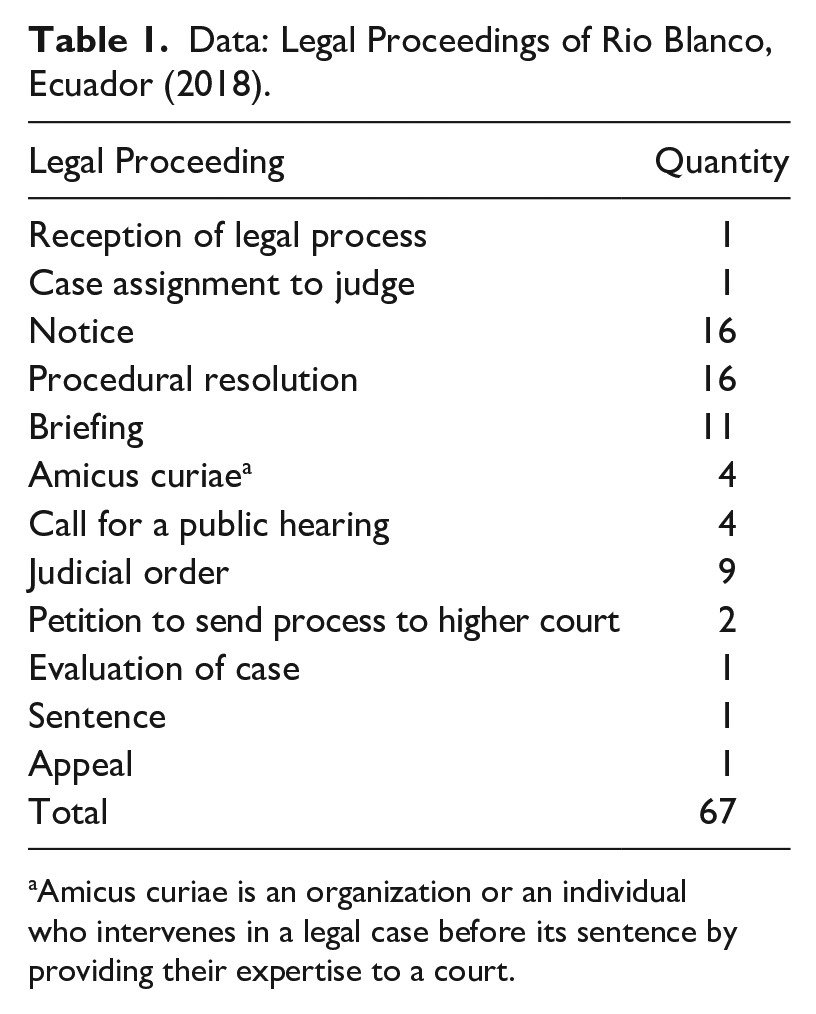
Amicus curiae is an organization or an individual who intervenes in a legal case before its sentence by providing their expertise to a court.
I selected the case of Río Blanco for this study, rather than other emblematic consultation cases in Ecuador which were not successfully upheld in court and display other issues with consultation rights (Moreno Parra 2019) because of the dispute regarding Río Blanco’s identity as Indigenous versus mestizo. This case also garnered wide national attention, generated mobilization (El Comercio 2017; El Universo 2018), and was a landmark legal case that established an important precedent in the country regarding the implementation of a consultation right for Indigenous peoples. Selecting a case involving Indigenous rights in Ecuador was also important since scholars have described this country as having the strongest Indigenous movement in Latin America (Yashar 2005), and Ecuador has implemented novel rights in its constitution that protect Indigenous peoples and nature.
These documents, like other legal documents about Indigenous state recognition, display and reproduce a live colonial racialized system, a racial contract that divides Whites from those considered “other” (Mills 1997). The evidence that non-White racialized people present in courtrooms to defend their rights has historically been placed out of context and judged strictly, while the evidence of White actors with more power is deemed legitimate (Marquez 2021). While the oral histories and traditional knowledge of Indigenous peoples in legal disputes about Indigenous recognition are dismissed, Indigenous people must prove their own existence and authenticity to the state and “rely predominantly on settler colonial documentary evidence and on legal, federal and archival guidelines of recognition” (Montenegro 2019: 4). Courtrooms, thus, are not racially neutral spaces (Crenshaw et al. 1995).
Legal proceedings are a key site of analysis for understanding how race is constructed and contested by the state and Indigenous peoples. While the law is supposed to be apolitical and neutral, making racial outcomes in court cases seem like “random consequences of aracial legal processes” (Crenshaw et al. 1995: 25), courts often make decisions about race. The law has been used in numerous instances to determine the race of a group and exclude racialized people from benefits and rights as the result of this categorization (Bailey 2009; C. I. Harris 1993; Laster Pirtle 2020; Posel 2001; Torres and Milun 1995; Tsutsui 2018). Racial boundaries are often debated in court, and criteria for racial categorization and recognition are legally outlined and defined.
I use conventional content analysis, which is based on inductive category development, rather than the testing of a theory or the use of predetermined categories. The focus of this qualitative method is on “discovering underlying meanings of the words or the content” by having the researcher submerge themselves in the data and observe the texts before they are coded (Hsieh and Shannon 2005: 1284). I focused on the interpretation and meaning of content and keywords, rather than on a count of the number of times a racialized category was used in court. I submerged myself in the legal proceedings and read over them multiple times without predetermined codes, asking why the Ministry of Mines and the Ministry of the Environment argued they had not violated Río Blanco’s right to a consultation, while Río Blanco affirmed their right to a consultation had been violated. While other lines of analysis could have emerged from the arguments made about Río Blanco’s right to a consultation, such as arguments based on the rights of nature and water, Indigenous identification was at the center of the arguments brought forth by the Ministry of Mines and the Environment against Río Blanco’s right to a consultation. After identifying this issue, I developed categories of analysis that emerged from the meaning the Ministry of Mines and the Ministry of the Environment and Río Blanco gave to Indigenous identification and rights to beneficiary status. I paid particular attention to representations of race, such as the use of the category of Indigenous, mestizo, and outsider, as well as more subtle ways of speaking about race and referring to Indigenous peoples in the courtroom. I observed descriptions of the members of Río Blanco that legitimated or delegitimated their rights as Indigenous peoples made by lawyers, witnesses, judges, as well as the testimonies of members of Río Blanco. I present my findings based on the arguments brought forth by the Ministry of Mines and Ministry of the Environment and Río Blanco about Indigenous identification and rights to beneficiary status.
The original documents are in Spanish. As a native Spanish speaker and translator, I translated the documents and attempted to maintain the original phrasing and meaning of the statements as they were expressed and recorded in court.
Findings
Río Blanco and the Ministry of Mines and Ministry of the Environment presented opposing views about the legitimacy of this community’s Indigenous identity, and, thus, Río Blanco’s claim to the Indigenous rights outlined in the country’s constitution and in ILO Convention 169. The Ministry of Mines and the Ministry of the Environment argued Río Blanco was not Indigenous and defined being Indigenous as being rural and separated from mestizos, despite the overlap and fluidity that exists between Indigenous peoples and mestizos (De la Cadena 2000; Telles 2014). Meanwhile, Río Blanco argued its community members were Indigenous because they were closely tied to the ancestral Indigenous land they lived on and were water guardians who defended nature against the threat of mining companies like Ecuagoldmining. Members of Río Blanco had to perform their indigeneity in front of the state and create an image of Indigenous authenticity that would be legally accepted in Ecuador’s courts. Greater legal protections for Indigenous peoples and the threat transnational mining companies pose to communities’ livelihood made Indigenous organizations in southern Ecuador bring forth a particular construction of indigeneity that may not have been present in different scenarios, such as in affirmative action cases in educational settings (Bailey 2009) or in programs that offer material incentives to those who identify as Indigenous (Flores and Sulmont 2021). I first present the arguments made by the Ministry of Mines and the Ministry of the Environment, which sided with Ecuagoldmining in this legal battle, and proceed to expand on the arguments made by Río Blanco members and the Indigenous organizations that supported their case. I focus on how both sides address Indigenous identity and rights to beneficiary status.
The Ministry of Mines and Ministry of the Environment: Mestizos Are Not Indigenous
The Ministry of Mines and the Ministry of the Environment argued Ecuagoldmining had the right to extract minerals in Río Blanco since the members of this community were not Indigenous. Their definitions of indigeneity were stereotyped and stricter than those of the Indigenous organizations and leaders advocating on behalf of Río Blanco. They were based on ideas of Indigenous peoples as rural and on a binary between Indigenous people and mestizos. Furthermore, the Ministry of Mines and the Ministry of the Environment argued Ecuagoldmining conducted a prior, free, and informed consultation and the necessary studies and safety measures to ensure there would be no environmental damage in the area, which the constitution states should be done in Indigenous communities. This contradicts the ministries’ argument that Río Blanco was indeed not Indigenous and, thus, no consultation was necessary.
Lawyer Carlos Izquierdo Apolo, the Mining Legal Representation Specialist of the Ministry of Mines, questioned the indigeneity of Río Blanco members and their politicized struggles. He argued that to be eligible for a consultation, a community must be an Indigenous community, not just a community. According to Izquierdo Apolo,
It is said here that the right in Article 6 [of the country’s constitution] and of ILO Convention 169 have been violated. We have to capture this concept and anchor it in real life . . . A difference is highlighted between those who are beneficiaries of these rights, certain human groups. We must decide if the plaintiffs fit these criteria. ILO Convention 169 is for Indigenous peoples. We will analyze if the plaintiffs should have collective rights. For someone to make the allegation that their rights as Indigenous communities were violated, is it necessary only that they belong to a community?
Izquierdo Apolo expressed that the court must decide if the members of Río Blanco fit the criteria of being Indigenous, and claimed belonging to a community does not guarantee access to collective rights. However, self-identification as Indigenous is the criteria set forth by the Secretaría Nacional de Gestión de la Política for a community to be recognized as Indigenous by the Ecuadorian state. As long as the community can provide the needed documentation, which is listed on the website of the Secretaría Nacional de Gestión de la Política, such as a declaration of self-identification and the names and identification of 30 community members, it can be recognized as an Indigenous community (Secretaría Nacional de Gestión de la Política 2020). Thus, there is a conflict within the state since it simultaneously grants Indigenous people recognition and the right to a consultation based on this recognition, while it attempts to limit this recognition and right through the Ministry of Mines and the Ministry of the Environment. After making this argument, Izquierdo Apolo proceeded to question the indigeneity of the organizations that supported Río Blanco and provided them with legal aid.
The Ministry of Mines argued ECUARUNARI was an organization composed of mestizos as well as Indigenous peoples. Thus, ECUARUNARI and its members had no right to represent Río Blanco. According to Izquierdo Apolo, “It’s necessary to take into account those who have been members of this organization [ECUARUNARI] historically. We can see that its members are not only Indigenous but are also mestizos.” Izquierdo Apolo draws a strict line between mestizos and Indigenous peoples. However, people who identify as mestizo may also identify as Indigenous and may not see these identities as contradictory to each other (De la Cadena 2000).
ECUARUNARI’s location in the capital of the country, Quito, was also used as proof that members of this organization were outsiders who did not reside in Río Blanco and were not members of an Indigenous community. Thus, being part of a rural Indigenous community was an integral aspect of Indigenous identification according to the Ministry of Mines and the Ministry of the Environment. While in their arguments Río Blanco used the association between Indigenous peoples, rurality, land, and nature to their advantage, the Ministry of the Environment tried to use this association to discredit the organizations that supported them and to create strict boundaries between those who were Indigenous (rural) and non-Indigenous (urban).
The Ministry of Mines and the Ministry of the Environment questioned the Indigenous identity of members of Río Blanco in other ways as well. The lawyer of Ecuagoldmining deemed the identification cards members of Río Blanco brought with them to court, which showed they resided in this community that was recognized as Indigenous, were an invalid demonstration of their indigeneity. According to Izquierdo Apolo, “Just the fact of being a resident of Molleturo 3 does not grant the right to invoke article 6 of the ILO Convention 169. There is a lack of active legitimacy, therefore.” Izquierdo Apolo proceeded to label members of Río Blanco as outsiders who did not belong to this community and referred to them as people “who are supposedly from Molleturo.”
However, the stance of governmental entities was not uniform. While the Ministry of Mines and the Ministry of the Environment sided with Ecuagoldmining and represented their interests, the public utilities company ETAPA sided with Río Blanco and gave testimony of a study conducted in this area, which showed the water sources of this community had been polluted by Ecuagoldmining. ETAPA applauded the efforts of members of Río Blanco to protect water sources for future generations, strengthening the image of members of Río Blanco as a community of Indigenous peoples who were nature’s protectors.
Río Blanco: Indigenous People Have an Important Connection to Land and Protect Nature
Members of Río Blanco and the Indigenous organizations that sided with this community justified the need for a consultation due to the Indigenous identity of this community, an identity they saw as closely tied to the Indigenous ancestral land they lived on and their role in protecting nature. Members of this community asserted their right to self-identify as Indigenous at the community level and constructed a particular meaning of being Indigenous.
According to Yaku Sacha Pérez Guartambel,
4
the lawyer representing Río Blanco and president of ECUARUNARI [2013-2019], members of Río Blanco had legitimate claims to the land Ecuagoldming was exploiting because they were protecting nature and water sources as Indigenous peoples. Río Blanco, in Pérez Guartambel’s view, was helping the state protect mother nature,
5
like the constitution of the country states it should. Ecuagoldmining was doing the exact opposite. According to Pérez Guartambel,
It is questioned if the people present here belong to the Kichwa nationality and to ECUARUNARI, and I have presented the documentation proving they do. There are 370 million hearts of Indigenous peoples [in the world], and even though we live in 20% of the territories in the 6 continents, we are the guardians of 80% of the planet’s biodiversity.
6
While the Ministry of Mines and Ministry of the Environment questioned the ethnoracial identity of community members of Río Blanco and presented a strict view of who qualified as Indigenous in court, Pérez Guartambel brought forth a different understanding of what it means to be Indigenous. He politicized this identity and gave it greater social value by defining Indigenous people as protectors of the planet’s biodiversity. Although equating indigeneity with a greater responsibility to protect nature could be interpreted as adding a burden for Indigenous peoples or as positioning Indigenous peoples as more similar to nature/the non-human than other ethnoracial categories, Río Blanco presented itself as being better equipped to protect nature as proof of its Indigenous identity. This assertion made Río Blanco’s claim to a consultation more legitimate in the eyes of the state, which recently adopted greater protections for Indigenous people and nature in its constitution.
Members of Río Blanco and their legal representatives also focused on the relationship between Indigenous people and their ancestral land. Scholars have focused on the importance of land for Indigenous identification (French 2009), and the Ecuadorian constitution also addresses the need to respect Indigenous territories, which are an integral aspect of their identity and culture. In this case, Pérez Guartambel argued that members of Río Blanco were Indigenous because they resided in an Indigenous territory where their ancestors had lived since before colonization. Pérez Guartambel also presented the research of anthropologist Florencio Delgado in 2005, which showed Río Blanco and nearby areas were archeological Indigenous sites that needed protection. Delgado’s research pointed out that Río Blanco is on Indigenous Kañari land that formed part of the famous Inca Trail in South America. Members of Rio Blanco identified as Kañari, a pre-Columbian Indigenous people, and lived off the land where their ancestors had been for centuries. Pérez Guartambel argued that those who had rights over the land were those who, like the Kañaris, had a historical presence in this ancestral territory.
In the final resolution of this case, the judge agrees with the importance of land for Indigenous peoples and states the following:
The court concludes, then, that the intimate relationship Indigenous communities have with their territory is in general an essential component of their cultural identification. An identification based on their own beliefs, which as differentiated social and political actors in multicultural and democratic societies must be recognized and respected.
The differences between Río Blanco members and the rest of Ecuadorian society were emphasized and deemed important. The judge’s declaration that multicultural and democratic societies must respect these differences and the relationship Indigenous people have to their ancestral land rather than assimilate Indigenous people, as has historically been the practice under states that espouse mestizaje ideologies, shows a shift in the relationship between the Ecuadorian state and Indigenous peoples.
While the Ministry of Mines and Ministry of the Environment in this legal case drew a strict line between being Indigenous and mestizo and emphasized traditional ways of understanding Indigenous identity and stereotypes, Río Blanco did the opposite. Río Blanco provided a more inclusive way of understanding who can qualify as Indigenous. The Ministry of Mines and Ministry of the Environment defined this community as not Indigenous since they were part of organizations that had Indigenous and mestizo members, and the Indigenous organizations that represented them legally had offices in Quito, the capital of the country, outside of this rural community. Members of Río Blanco, however, made a connection between having an Indigenous identity and protecting nature. To be Indigenous for this community did not necessarily mean to speak an Indigenous language, wear traditional clothes, or live in a rural location, as has been the case for Indigenous communities in other areas (Friedlander 1975; Villarreal 2014): it meant protecting nature. This definition provides an elevated status to a stigmatized category and opens the possibility for more communities to identify as Indigenous.
Río Blanco won its legal case in Ecuador’s courts, successfully arguing it was an Indigenous community and the state needed to uphold its consultation rights as Indigenous people. The judge in this case rejected the appeal made on behalf of Ecuagoldminig in August 2018, which highlights Río Blanco’s success in communicating a meaning of being Indigenous that could be upheld in Ecuador’s courts in a context of increased recognition of Indigenous rights. Río Blanco’s sentence forced Ecuagoldminig to cease its extractivist project and leave this community, paving the way for future consultation cases to be upheld in Ecuador based on Indigenous identification.
Discussion
Since the twentieth century, Latin American states adopted mestizaje ideologies that sought to de-indigenize the population (Loveman 2014; Nobles 2000; Yashar 2005), forcing communities out of the Indigenous category. However, in recent years, the strength of Indigenous movements and a turn toward multiculturalism have increased Indigenous recognition and rights. While scholars have focused on the policing of American Indian identity in the United States and the requirements for Indigenous recognition and beneficiary status (Mckay 2019; Nagel 1996; Rodriguez-Lonebear 2021; Torres and Milun 1995), scholars have paid little attention to the challenges communities in countries like Ecuador, where the majority of the population has Indigenous ancestry, face in receiving state recognition and accessing Indigenous rights. The Río Blanco case is part of a larger regional shift in Latin America where states are moving from an ideology of mestizaje to one of multiculturalism. While there is a long history of Indigenous oppression and Indigenous peoples continue to confront numerous disadvantages in Latin America (Bustelo et al. 2020; Comisión Económica para América Latina y el Caribe 2016), this case shows Indigenous communities also have new legal tools they can use to redefine what it means to be Indigenous and expand their rights. Months after Río Blanco won its legal case, the Waoranis in the Amazon, and the A’i Cofán community of Sinangoe in Ecuador also won their consultation rights cases in court (Defensoría del Pueblo 2019). Future consultation cases continue to be debated in Ecuadorian courts and across Latin America since 15 countries in the region ratified ILO Convention 169, which grants Indigenous people the right to a consultation (Falleti and Riofrancos 2018).
In order to have their rights upheld in court, however, Indigenous people must perform an Indigenous identity the state sees as legitimate and different from the mestizo identity. In this article, I ask then, what were the legible definitions of indigeneity that Río Blanco members and Indigenous leaders deployed in Ecuador’s courts for recognition? How do communities redefine the meaning of indigeneity in legal cases involving state recognition as Indigenous? In this study, I examined how Río Blanco, a community in Ecuador, asserted its legally recognized identity as Indigenous to defend its territory against a mining company and, in doing so, redefined what it means to be Indigenous. I find that with the support of Indigenous organizations, Río Blanco performed a legible form of indigeneity for the state that allowed this community to gain legal recognition as Indigenous and to challenge the state’s notion of what it means to be Indigenous. Río Blanco asserted itself as an Indigenous community because it protected nature and water sources. Its members were upholding Ecuador’s new 2008 constitution, which grants Indigenous people and nature greater rights, while Ecuagoldmining attempted to violate these rights and draw straight lines between who was Indigenous and mestizo.
The courts are a site of racial construction (Crenshaw et al. 1995) where racial boundaries are debated and defined, limiting who can access rights and obtain benefits based on this categorization (Bailey 2009; French 2009; Haney-López 2006; C. I. Harris 1993; Martínez Novo 2006; Tsutsui 2018). While the law is used as a tool of oppression to maintain the status quo (D. Bell 1995), and in the case of Río Blanco the Ecuadorian state sought to use it to limit the rights of an Indigenous community and uphold the private interests of a mining company, the law can also provide an opening for the expansion of rights. Río Blanco’s success in upholding its Indigenous rights and expelling a mining company from its territory occurred in the context of this oppressive use of the law and of mestizaje ideologies that dilute Indigenous struggles. However, it also took place in a context of increased state recognition of Indigenous rights and constitutional changes that made Río Blanco’s assertion of rights possible. Even in oppressive situations communities create their own ethnoracial identity from the bottom up (Hale 2015), and sometimes, as in the case of Río Blanco, they succeed in challenging how the state defines them and in accessing rights.
The findings of this research indicate that local communities play an active role in redefining Indigenous-mestizo racial boundaries and assigning meaning to racial categories in court. In countries with a majority mestizo population, such as Ecuador, Bolivia, Mexico, and Peru, the expansion of these boundaries can affect who receives beneficiary status and protections against mining companies. Governments have historically defined indigeneity in ways that do not benefit Indigenous communities or align with on the ground understandings of race. Blood quantum rules exclude Indigenous people based on blood in the United States (McKay 2019), and strict definitions of Indigenous people, such as those of the World Bank, as having to speak an Indigenous language and rely on subsistence-oriented production, exclude urban Indigenous people from beneficiary status (Corntassel 2013). Río Blanco points to a different way of understanding indigeneity and obtaining beneficiary status.
A general increase in the Indigenous identifying population in the continent, with some countries like Mexico experiencing an “Indigenous boom” (Flores et al. 2023), shows that people who identify as mestizo may also choose to identify as Indigenous and that this identification can be upheld in court for beneficiary status. In the United States, where there are high rates of American Indians marrying outside of their race and a growing population of mixed-race people in the country (Rodriguez-Lonebear 2021), understanding when states grant Indigenous rights to mixed-race communities and how Indigenous organizations assign belonging to mixed-race people is particularly important.
This issue is also pressing in countries outside of the Americas with Indigenous populations and colonial legacies, such as Australia and New Zealand. While in Ecuador state recognition as Indigenous is based on community self-identification, in Australia it is based on self-identification, descent, and acceptance in an Indigenous community (Shalley, Griffiths, and Wilson 2023). Mixed-race communities in these contexts with more strict criteria and a different demographic than that of Ecuador, where most of the population has Indigenous ancestry, may have different challenges than Río Blanco did in receiving state recognition and accessing Indigenous rights. While the number of people who self-identify as Indigenous has increased in Ecuador (Pillalaza Piguave 2022), it has decreased in Australia with people who used to self-identify as Indigenous no longer identifying in this way (Shalley, Griffiths, and Wilson 2023). Meanwhile, Indigenous peoples in countries with other forms of government, such as New Zealand, which has a constitutional monarchy with a parliamentary system, face distinct issues with state recognition since recognition, even when it does take place, is based on unequal partnerships with Indigenous peoples (A. Bell 2018).
Indigenous consultation rights and other protections Indigenous peoples and nature were granted in Ecuador’s 2008 constitution are novel, and their implications and application in the court of law may not be clear for many years. Future studies can explore the enforcement and interpretation of Indigenous rights that have recently been incorporated in constitutions or approved through international agreements in Latin America. They can also account for the strategies different actors use to enforce consultation rights and recognize Indigenous identification in diverse contexts
Footnotes
Acknowledgements
I would like to thank the community of Río Blanco and the Indigenous and environmental organizations that supported their struggle, such as the Federación de Organizaciones Indígenas y Campesinas del Azuay and the Confederation of Peoples of the Kichwa Nationality of Ecuador. I would also like to thank Ann Hironaka, Stanley Bailey, Julia Lerch, Korey Tillman, Rachel O’Toole, Edward Telles, and Edwin Amenta for their thoughtful questions and suggestions.
Funding
The author(s) disclosed receipt of the following financial support for the research, authorship, and/or publication of this article: The author received financial support for the research, authorship, and/or publication of this article from the Social Science Research Council and the Center for Global Peace and Conflict Studies at the Univeristy of California, Irvine.
