




Abstract
Much of the urban research on the daily experiences of Black men in American society has focused on Black men as perpetrators, as victims of street and gang violence, or with some carceral connection. These earlier studies highlight how racist tropes of Black men as dangerous and thus to be feared situate Black men for continuous, targeted, and aggressive actions by the state and other social actors. This places a social tax on Black men who are then bound to exercises of embodied negotiations in public social spaces where they navigate both being shunned and “disappeared” while also hyper-visible. Drawing on ethnographic data collected across several years, this article examines how Black men are targeted for aggression in mobile public spaces in Chicago, Illinois. We use public transportation as a space of interrogation because of the uniqueness of mobile places where riders and transit personnel are temporarily confined while mobile and with limited options to escape the dangers of racism and racial aggression. In these spaces, we find that (1) Black men are threatened with harm, (2) their bodies are treated as sites of fear, and (3) their well-being is risked through an institutional breach of duty to provide safety for them as passengers and transit personnel.
Introduction
A range of studies have focused on Black men’s lived experiences, including how they navigate poor urban communities (Anderson 2008), confinement in urban residences and policing (Brunson and Miller 2006; Shabazz 2015), and employment prospects and experiences (Wingfield 2013; Young 2004). These studies help reveal the ongoing and potentially compounding challenges Black men face in their daily lives. Black men’s lives, physical health, wellness, and everyday activities are impacted by a host of external factors that they constantly must negotiate to determine how they might navigate, or perhaps even avoid, particular social and public domains. For instance, recent research shows that Black men’s perceptions of neighborhood racial composition can affect their leisure-time physical activities (Ray 2017), while other work highlights the gendered racism and controlling images that accost them in the workplace (Collins 2000; Wingfield 2007). While studies focused on Black men’s lives in public have been explored, less attention has been given to their experiences on public transportation. Public transportation is a place rife for investigation given its prominence in cities like Chicago, Illinois (USA), as it serves as a major source of access to school, employment, leisure, and other routine activities.
Local news and the culture industry overly present Black men as perpetrators of violence, victims of gang-related street violence, or as shiftless (Kumah-Abiwu 2020; Young 2018). Relatedly, their exposure to the violence of racism has been captured in dramatic incidents such as the murders of George Floyd, Philando Castille, Amir Locke, or Ahmaud Arbery, to name but a few. While Black men may be able to make certain calculations about how they engage in a variety of public and social spaces, their calculus and opportunities for movement and how they negotiate other people’s surveillance and gazes are limited in mobile transportation.
Examining these mobile experiences allows for an up-close view of how these risks shape a hostile terrain that puts Black men’s safety, well-being, and humanity in jeopardy and exposes them to undignified and hostile social interactions. These mobile experiences reveal that being Black and male leaves Black men “subject to prejudices, assumptions, and predispositions of the white gaze” (Brooms and Perry 2016:178). And as we explore in this study, these experiences can disrupt Black men’s opportunities for respite in public spaces and while at work as public transit personnel. This work thus extends burgeoning literature on Black men’s lived experiences, their social interactions, and how they both are viewed and treated in U.S. society (Kumah-Abiwu 2020; Taylor et al. 2019; Wingfield 2007; Young 2018).
We extend previous analyses of Black men’s daily lives by placing an explicit focus on their experiences on public transportation in a major urban locale. Examining Black men’s experiences on public transportation, both as passengers and employees, allows for investigating important facets of their everyday lives. Such an investigation allows for interrogating how Black men are positioned in public transportation, exploring how they navigate these spaces, and unpacking how their experiences are connected to broader understandings of Black men’s lives. In the bounded spaces of public transportation, Whites (and other non-Black people) essentialize the racial identity of Black men and hold expectations for them to fit controlling images, both in their behaviors and responses to various affronts (Collins 2000; Wingfield 2007). Black men’s social identities in these bounded spaces are entrapped in ascribed characteristics, whereby they are seen as problems (Du Bois 1903 [2005]), dangerous (Brooms and Perry 2016; Yancy 2017), and shiftless (Young 2004) while simultaneously experiencing gendered racism (Brooms 2024; Watkins, Walker, and Griffith 2010; Wingfield 2007), thus compromising their public safety and everyday social life.
Public spaces, mobile and static, are a different type of space than college classrooms, stores, restaurants, or the workplace. As such, the strategies Black men use to navigate perceptions and assumptions about them along with their movement in the spaces of public transit warrant further examination. For Black men, public transportation is another space where they must negotiate denigrating views and hostilities simply because they are Black men (Brooms and Perry 2016; Young 2018). Our investigation helps expand and deepen understandings of Black men’s lived experiences with a particular focus on Black men in public space (e.g., see Anderson 2008; Staples 1986; Young 2004).
Being a Public Black Man
Earlier studies on Black men’s lives have focused primarily on the racism, discrimination, and prejudice experienced by this group in social institutions, workplaces, and social interactions in static and wide-open spaces like plazas, stores, and parks. Racism and sexism are an oppressive reality for Black men (Brooms 2024; Brooms and Perry 2016; Leverentz 2012; Scott and House 2005; Wingfield 2013). A simple stroll in the public platform is often shadowed by the raced policing of their bodies, hostility, and avoidance (Davis 2017; Feagin 2010; Rios 2011; Shabazz 2015; Young 2004). For instance, Christian Cooper was birdwatching in New York City’s Central Park in May 2020 when he asked another park goer, Amy Cooper (no relation), to leash her dog as per the rules of the designated area of the park. Not only did Amy Cooper refuse to leash her dog, but she also called the police and reported, “There’s a man, African American, he has a bicycle helmet. He is recording me and threatening me and my dog.” She also added, “I’m being threatened by a man in the Ramble, please send the cops immediately!” (Hannon 2020). Not only were Amy’s claims of being threatened completely untrue, as police found later, through this phone call she weaponized her whiteness and gender, relied on the Black man as a perpetual “threat” racial trope, which is inherently anti-Black and a Black misandric aggression, and denied Christian’s humanity and compromised his well-being.
The tendency to frame Black men’s narratives through crime rates, violence (Anderson 2008; Yancy 2017), and as assailants (Brunson and Miller 2006) has left them particularly vulnerable to all manners of racial violence. And, in part because of racial segregation and media framings, non-Blacks who encounter Black men treat them as threats. Consequently, Black men are themselves threatened by these groups: Their bodies are treated as “sites” of fear that need to be surveilled and controlled, and their humanity is under constant attack. These patterns are evinced on college campuses (Brooms 2017), through hyper-surveillance (Combs 2022), and in policing (Davis 2017). As documented across the past decade through recorded videos, social media campaigns, and the broader Movement for Black Lives, Black men are gunned down while unarmed, followed around stores and public spaces as potential criminals, disrespected even when holding the highest political office, and targeted for the use of violent imagery through various media outlets (e.g., see Brooms and Perry 2016; Combs 2022; Taylor et al. 2019).
Daily struggles with racial profiling (Brooms 2017; Brooms and Perry 2016), aggressive over-policing (Brunson and Miller 2006; Davis 2017), negative stereotypes and portrayals (Kumah-Abiwu 2020; Taylor et al. 2019; Young 2018), and the criminalization of their bodies (Miller 2021; Muniz 2014; Yancy 2017), all underscore the oftentimes exhaustive daily struggles with anti-Black racism, discrimination, and Black misandry that Black men experience and how they are situated for ongoing incivilities in public places. Although they are a population constantly under public watch (Combs 2022; Davis 2017; Yancy 2017), their lives are regularly jeopardized while managed yet, they are not protected (Miller 2021). Moreover, managing Black men’s movements while simultaneously targeting them for harassment and invisibility are forms of gendered racism that impede Black men’s lives. Given these realities, more attention is needed in exploring how Black men experience and navigate public spaces, the impact of these experiences, and how they respond.
Men’s vulnerabilities, victimization, and fears are often left out of discussions on public fears and vulnerabilities (Brownlow 2005). Prior literature also shows how this is further problematized by exaggerated Blackness (Brooms and Perry 2016; Shabazz 2015), thus the risk is disproportionate for Black men (Brownlow 2005). We advance this growing body of literature by examining how Black men’s disproportionate exposure to risk is intensified in associated mobile spaces, and how expectations of respite are often unmet. We do not fetishize Black men through a street violence victimization frame but instead focus on how their “personhood” is victimized through incivilities and indignities on public transportation.
The current study explores these exposed risks showing how this vulnerability to hostile interpersonal public encounters permeates Black men’s lifeworlds, both materially and spatially. In these spaces people show, through various tactics, the social disregard for and undesirability of Black people in general, and of Black men in particular given that they have unique social realities (Ray 2017; Young 2018). For instance, as Derrick R. Brooms (2017) articulated,
The result of the overly generic descriptors and bevy of stereotypes hurled at their racial and gender group means that Black males are targeted and profiled in public spaces, they are condemned in social settings, and they are constantly and concurrently visible and invisible. (p. 111)
We seek to further interrogate how the indignity of public surveillance, discrimination, criminalization, and other racial violence is particularly concerning for Black men especially in the bounded spaces of public transportation.
By examining public transportation, there is an opportunity to study how dominant groups treat Black men in a relatively closed and mobile setting. On these systems, experiences with racism and racial discrimination are not attenuated by class status, as middle-class Black men are also exposed to racist ideas (Ray 2017; Staples 1986; Wingfield 2013). The consequences of daily and face-to-face racism further isolate Black men in particular due to their Black maleness (Brooms and Perry 2016), as they simultaneously negotiate a social world that relegates them to permanency in the quintessential out-group (Leverentz 2012; Rios 2011; Yancy 2017), thus fracturing their humanity and disrupting their well-being. Thus, drawing on a broader study that includes over seven years of ethnographic work, this article focuses on how in mobile public spaces (1) Black men are threatened with harm, (2) their bodies are treated as sites of fear, and (3) their well-being is risked through an institutional breach of duty to provide safety for them as passengers and transit personnel. 1
Methods
Research Site: Observing Chicago’s Space
The city of Chicago is organized into 77 community areas (CAs)—which contain hundreds of neighborhoods—that have historical, political, socioeconomic, racial, and developmental importance (Figure 1). Chicago’s CAs are distinguishable through their histories, race, class, investment, and disinvestment (Sampson 2012; Squires et al. 1987; Young 2004). Residents tend to locate themselves in the city by CA, neighborhood, and/or geographical area (North, South, or West Side in larger forms). Most neighborhoods and CAs within the south and west sides of the city are majority racial minorities while CAs on the north side and downtown may be majority White, diverse, or majority minority (CMAP 2020). These patterns of segregation play out on public transportation in the city as well.
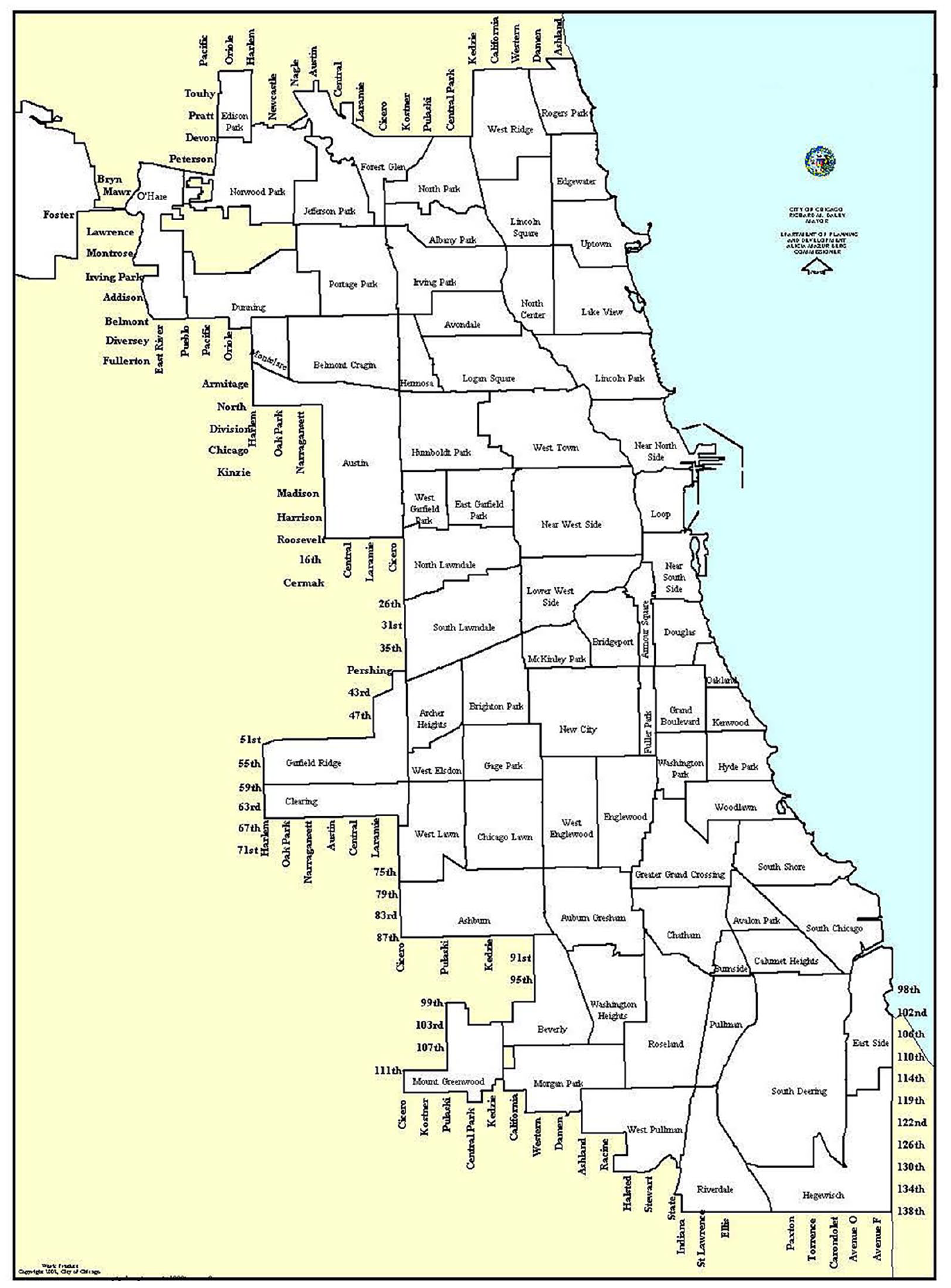
City of Chicago community areas map.
Chicago’s historic racial residential segregation has spatialized race and racialized space (Lipsitz 2007; Pattillo 2010). Historic racism in housing options and then using the consequences to overly surveil, terrorize, and over-police Black communities and Black men have left many in the city, trapped in racialized spaces (Shabazz 2015). Furthermore, Blacks and Black communities in the city continue to wrestle with the catastrophic practices that sent bulldozers through their communities and where today the residents continue to breathe in the fumes of racism from the cluttered highways that they are not being benefited from (Metropolitan Planning Council “Reconnecting Communities” 2023). Racialized housing policies, community disinvestment, and restrictive racial covenants have shaped a city where the obduracy of decades of these patterns continue to play out, even as in and out migration continues for some populations. Chicago’s transit options and patterns reflect similar racial preferences and racial discrimination patterns as housing (Purifoye 2020). These histories and trajectories situate Chicago as a laboratory from which we can better understand Black men’s public experiences in general, and their experiences on and around public transportation in particular.
Public Transportation
Public transportation is a significant part of the landscape in metropolitan Chicago, with system-wide unlinked boardings of over 284M in 2022 and with pre-pandemic boardings of 564M in 2019 (Regional Transportation Authority Mapping and Systems [RTAMS]). Public transportation systems in metropolitan Chicago are overseen by the Regional Transportation Authority (RTA). Chicago’s major transportation agency is the Chicago Transit Authority (CTA). The CTA serves the city and a few nearby suburbs. Metra is the commuter rail system.
To examine how mobile places shape Black men’s public experiences, between 2010 and 2015, 2017 and 2019, and 2021 and 2022, the authors rode public buses and trains through Chicago and its surrounding metropolis. This article includes observations on the Chicago Transportation Authority’s (CTA) Red Line train, which travels from 95th Street and the Dan Ryan expressway on Chicago’s south side to Howard Street, which is at the northernmost border of Chicago; six CTA bus routes (Routes 3, 6, 22, 146, 147, 151); and two Metra train routes (UP-W, Metra Electric). The routes were chosen because, per census data, they travel through racially and economically diverse areas of the city and suburbs while also traveling into/through downtown Chicago. Each has a diverse ridership at some point along the way which afforded the researchers with levels of diversity considerations.
The Red Line train is the busiest of the CTA’s eight elevated (“L”) routes with over 32M+ station entries (CTA 2022 Annual Report). 2 The bus routes have some of the highest overall ridership statistics in CTA’s system. Four of the CTA bus routes (22, 146, 151, 147) originate on the city’s north side in integrated or majority-White communities. The two other bus routes (3, 6) originate/end on the south side of the city in predominantly Black communities.
Metra’s Union Pacific West (UP-W) route travels from Chicago’s Ogilvie Transportation Center in the West Loop into a far western suburb in Kane County. The majority of the communities and stations stops along this route are majority White. Metra Electric travels southbound with stations in several majority-Black communities in Chicago and in the southern suburbs, unlike the UP-W (U.S. Census Bureau 2020).
Participant Observations, Positionalities, and Engagement
We traveled at various times of the day through various weather conditions. Most of the data were collected during the end of morning transit rush hours (8:00 a.m.–9:00 a.m.), mid-morning through midday (10:00 a.m.–3:30 p.m.), the latter part of evening transit rush hour and early evening (6:00 p.m.–8:00 p.m.), and occasional late evenings (10:00 p.m.–midnight), weekends, and holidays. These times were chosen because crowdedness during the morning and evening transit rush hours made certain observations difficult. Additionally, these times were chosen given our own life responsibilities and availabilities. Data were also collected at the downtown train stations for each of the Metra lines. These stations have food establishments which make it feasible to observe for long periods of time. Our notes included perceived gender and perceived race of the passengers and transit personnel.
During rides, passenger-passenger interactions were the primary focus. Interactions between the bus driver and passengers were primarily recorded during boardings and departures, as these interactions are usually quick or did not happen at all. Interactions between Metra train personnel and passengers were recorded throughout the rides. On the Metra trains, passengers must provide a ticket or purchase one from the conductor. Conductors often repeat the agency’s rules, so these interactions can be longer. We wrote copious notes as often as possible but did not audio record conversations.
To develop our analysis, we returned to the data to explore observations of Black men’s experiences on public transportation. Through preliminary analysis, we identified “negative interactions” as an initial code that then led us to explore where, how, and to what extent these experiences took place. Through additional coding, we identified three main themes: (1) perceptions of Black men, (2) treatment of Black men (both as passengers and employees), and (3) how Black men responded and tried to navigate their experiences.
The researchers rode the complete length of these transit routes. Only on rare occasions did this not happen, such as when they intentionally disembarked to gather data at a train station. As a Black woman and Black man, there were times when we blended in, such as when the ridership was mostly Black and when traveling through Black spaces. But there were also times when we may have been the only non-White in a train car on Metra or one of only a few people of color on a bus route when it reached the north side. We dressed in our everyday clothes which were casual.
We were true participants and thus behaved as passengers, interacting with pleasantries of hello to bus drivers and thank yous to transit personnel after ticket checks or when disembarking. We did not initiate conversations, but if asked a question by a passenger or if we overheard someone needing directions and could help, we did. If people drew us into a conversation, which was more likely when on the south side of the city, we engaged. As true passengers, we sometimes used our trips to run errands, attend meetings, or visit friends.
Findings
On the Train and Bus: Black Men as Potentially Dangerous
Crowded buses and trains provide a particular type of surveillance and sense of safety. The presence of transit personnel and other passengers often make it more difficult to quickly commit criminal or social offenses (such as street harassment) and escape afterward. By contrast, on both the Metra and CTA vehicles, the crowdedness of the space shaped Black men’s experiences in ways that threatened their safety and well-being depending on the time of day.
During a 2013 northbound ride on the #147 Express bus, along the Magnificent Mile (Mag Mile), a majority-White area with high-end shops and hotels, a young Black man, who was with some of his Black college friends (they all wore their college identification badges), at one point looked around. Non-Black passengers did not sit or stand near this seated group, but Black passengers did. The young man eventually said, “Everyone on here looking and saying, ‘I can’t wait ‘til they get off.’” This response could be interpreted as the young man’s awareness that many passengers (who were indeed non-Black) had avoided the spaces near them and had chosen to stand or move further back on this articulated bus, as he added that folks wanted to exit because “they like, ‘they Black and they’re loud and cussing.’” However, Black passengers had sat and stood in empty spaces by this group. When he made this statement, non-Black passengers looked down or stared at their phones. The others in the group of mostly young men (there was one woman in the group) also looked around and affirmed the uneasiness of non-Blacks on the bus.
An awareness of hostilities, which includes avoidance and averted gazes, is common among Black men by adolescence (Scott and House 2005). When the young Black man asserted that others on the bus wanted them to get off because “they like, ‘they Black and they’re loud and cussing,’” he brought attention to the racialized interaction of some of the non-Blacks in the space. Although these passengers had avoided sitting and standing directly in the space with the group, they couldn’t completely avoid them within the confines of the bus. This also meant that racism could not necessarily go unnoticed in these restricted places. Here, the patterned movement of non-Black passengers exposed a hypervisibility of this mostly Black men group and their behaviors, even though their behavior resembled that of countless amounts of non-Black folks on this same system especially after events such as the St. Patrick’s Day Parade and Cubs games, but with very different responses.
This group’s mobile risk is similar to the experiences that researchers identify for Black men in other domains (e.g., see Brooms 2017; Ray 2017; Young 2018) as they report being confronted by anti-Black and Black misandric messages upon entering certain spaces where (racialized) interactions are hyper-realized. On college campuses for instance, although the men would eventually leave the classroom after each meeting, as the Black men on the bus would eventually disembark, each reentry (next day, later in the week, etc.) introduces the possibility of reinjury. The cumulative experiences thus, as Brooms (2017) also notes, should be discussed within the context of these bounded spaces, where up close racialized and gendered interactions are nearly unavoidable. Considering spatiality is important as it also acknowledges the materiality and physicality, and thus constraints and confinement, of the experiences and the embodied consequences (Fleetwood 2004; Tuan 1977). For these Black men on the bus, active friendship activities, like talking and laughing, while the bus was in motion meant they were unavoidably visual.
The response by the young Black man, which included him stating that people would get off the bus and walk in the cold to avoid them, suggests a willingness of others to avoid the visible group of Black men, even at the cost of their own discomfort. This group, as they took note of how and who was avoiding their space, acknowledged the incivility of this mobile space. They were not verbally or physically doing anything to threaten other passengers directly, but they were laughing loudly and occasionally using choice words. They were not adhering to the be silent rule in integrated public transportation spaces (Purifoye and Brooms 2020). This combination meant they controlled the space and were knowingly, based on the young man’s comments, making Whites in particular, uncomfortable in the confined, bounded, and mobile space.
Practices of avoidance highlight Black men’s undesirableness in public spaces and reveal how Black men are often denied social freedom or civil response in integrated mobile public spaces. Avoidance, looking away, and tensing up is a patterned response to Black men in public places (Shabazz 2015; Staples 1986), including transit stations and hubs such as exampled here:
July 4, 2018 at Ogilvie Transportation Center (OTC) in the eatery, a Black man in a plaid shirt came into the space from wherever he had been standing and stood at the same tall table that a white woman was standing at eating food. He didn’t say anything to her. She first grabbed her wallet and put it in her pocket and then she grabbed the food she was eating and left. But she left all the food trash on the table as she made her quick exit. The Black male in the plain shirt proceeded to roll in the cigarette with a tobacco.
This incident highlights how the mere presence of a Black man in one’s space is often followed by actions that suggest uneasiness and where non-Blacks seek quick escape. Ogilvie Transportation Center (OTC) is in the West Loop, which is part of the Near West Side CA where the population shifted from majority Black to majority White over the past 20 years (CMAP 2020). More than transit riders visit this eatery, and the demographics are usually racially diverse, but during events such as St. Patrick’s Day, July 4, and Lollapalooza, the crowd is heavily White. The design of this eatery, which includes long tables, tall tables/counters, and other various seating, is such that sitting or standing next to a stranger while eating is quite likely, so his standing (not sitting) near her was not a phenomenon, yet she quickly left shortly after his movement. He was also being surveilled by personnel from the building who watched him and spoke into their walkie talkies about his movements. Each person communicated through their actions that he was undesirable in the space or that he “needed to be watched.” A White transient male had walked through this same space during this time picking up cups and walking up to people quietly asking for money, yet the policing gaze of the building security never turned his way, neither did people quickly abandon their tables as he approached or stood in the area.
Black men are not oblivious to the harm that they prepare for and endure in everyday interactions (Brooms 2017; Ray 2017; Young 2004). These harms are not restricted to their neighborhoods where “uncertainty about their safety” is ever-present (Young 2004:44), but it is often a concern while in transit as expressed in conversations and during interviews. Indeed, Black men may experience discomfort in the integrated public spaces of public transportation. As an example,
During a Metra Electric ride, a middle-aged Black man engaged another Black man in a conversation as we pulled out of Millennium station (which is in the Loop CA). He began by asking the other Black man if he was on the train heading to University Park. The man responded in the affirmative. The first Black man thanked him and said that he had tried to ask several White people the same question and that they ignored him by walking by as if they never heard him. “Whenever I tried to ask a White person a question to make sure I was in the right place, they kept moving like they didn’t hear me. I bet if I said ‘I’m gonna stick you up, they would have heard me then.’” The other Black man nodded, indicating a sense of shared understanding.
In this observation, the Black man who had asked for directions easily could have ended up on the train to Indiana, which also leaves from the same station. His body language, sigh of relief, and voiced frustration suggested that he was looking for not only the train, but civility, and wanted someone to care enough to help him find his way. Pedestrian traffic in the Loop is very diverse, especially compared to that along the nearby Mag Mile, but this man noted that most people he encountered that day were White. He voiced his frustration at White pedestrians and passengers ignoring him because he’s Black. These experiences meant that his transit experience, although he was walking to the station, involved incivility and posed a safety risk for him. It also suggested that he was being ignored not because he was a stranger but because he was a strange Black man and therefore dangerous and not provided civility, as he communicated. As other studies have shown, Black men are often imagined as offenders (Brunson and Miller 2006; Young 2018) and this puts them in harm’s way not only with the police, but as our evidence shows, also with those that they encounter in public spaces, including public transportation.
Treating the Black Man with Disdain on Buses and at Bus Stops
As urban sociologists have noted, pedestrians often avoid contact with strangers through various forms of disengagement (Anderson 2008; Fleetwood 2004). As observed during our trips, these avoidance activities can include reading, engaging with their smartphones, using an undirected gaze, and sleeping. These patterns of disassociation when used by many Whites and Asians were distinctive. They not only disengaged but avoided Black passengers as they boarded, and even after a Black passenger sat down next to them. For example, during a crowded northbound trip on the #147 Express bus, a Black man boarded the bus and spotted the only empty seat, which was next to a South Asian woman. He sat down and she turned and looked out the window the entire time, even though it was after 9:00 p.m. in April, thus very dark. He made a call on his cell phone as the bus approached Huron and Michigan Avenue (along the Mag Mile). Even as he conversed on the phone, she did not change her gaze. She continued to stare stoically out the window and did not move until after he got up.
Racial animus was also evident as exemplified in this hostile exchange between an East Asian woman and a Black man on a moderately crowded southbound #147 Express bus:
Most of the seats in the front of the bus were taken when a Black man boarded. He sat next to an East Asian woman who had boarded earlier with a child. The child was seated in a small stroller. She had to move the stroller in front of her to give him space to sit. [Note: The seats in the front of the bus are designated as priority seating for the elderly, disabled, and for pregnant women.] The Black man was using a cane. When seats opened up on the other side of the Black man, the Asian woman told him to “Move over a seat.” “Don’t do that man” the Black man replied when she tried to nudge him over. “Don’t do that. I have 2 kids, 20 and 40, I’m 60 years old, don’t do that.” He then told her that he had already planned to move and that he had his “act together” so there was no need to be hostile and afraid. (December 2011)
The Asian woman could have also moved after the bus emptied out, yet she responded as if it was the older, differently abled Black man’s responsibility to move and to give her and her child the space she wanted. With her nudge, she compromised his dignity.
Experiences of being treated as causes for fear and undesirable are harmful to Black men especially as we consider that these incidents often play out in front of other people. On the buses and trains, in a random but ongoing fashion, Black men were (re)positioned as “problems” that others wanted to avoid; as a result, they were susceptible to a range of hostile, unkind, and demeaning interactions that continuously rendered them as unworthy of respect or decency (e.g., see Brooms and Perry 2016; Young 2004). Such interactions and framings often result in Black men being “treated as criminal risks in need of constant, ubiquitous surveillance and control across social contexts” (Rios 2011:73). Undoubtedly, these imaginaries of Black men defile their humanity through the eyes of others, and thus they are disregarded as not deserving of dignity or civility.
This disregard and treatment as a risk was exemplified during an incident at a bus stop at Roosevelt & State Street, in the South Loop,
3
when an older Black man (mid-60s?) moved closer to two White men who were waiting for a bus:
Several people, mostly Black and White men, were standing at State & Roosevelt waiting for the #29 Street bus. The older Black man moved closer to the White men and said something. One of the White men started screaming at him. He screamed for him to get the “f–k away from me.” The Black man stated “I was just going to ask you where you got your fan.” The White man replied “no, you were going to come and ask me for it.” He continued yelling, telling the Black man to leave him alone. As the traffic light changed, a car, heading southbound (we were on the northbound side) with several young Black men approached the light. They started yelling at the White man (his voice had carried) and told him to shut up and leave the Black man alone. (June 2018)
In this interaction, the younger Black men were able to use their youth and Blackness and the often-associated fear to provide respite for the older Black man. After we all boarded the bus, the older Black man asked another Black man passenger if he was done reading the Chicago Sun-Times newspaper he was holding. He responded yes, and the Black man moved down the aisle and found a seat. This was a very different exchange than the interracial one that had occurred at the bus stop.
Black men’s freedom of movement is often disrupted as non-Blacks decide where Black men “belong,” such as not near Whites; these restrictions happen in public spaces and residential neighborhoods (e.g., see Combs 2022; Ray 2017). Such restrictions are replicated in mobile public places. In fact, a willingness to openly police Black men on trains and buses can be quite socially hostile, whereas White men are allowed to be loud, obnoxious and overly intoxicated. An example of White passengers expressing the “right to police Black men,” as if they have been granted transit authority, is exampled in this tense September 2022 exchange between a Black male passenger (BMP) and a White female passenger (WFP):
A 25-35-year-old BMP was standing in front of Protein Bar on Michigan Avenue near Randolph Street. When the #147 Express bus pulled up, he rushed past a WFP and myself, who were both waiting near and in the bus shelter. Other people were already at the door boarding. He let a few of them get on. He then boarded and started walking toward the back. The White Male Bus Driver (WMBD) said “sir, sir, you have to pay” or something similar. The BMP continued walking to the back and sat down. I was behind him. The WFP that he had basically cut in line (he cut me also) boarded and went to the back. I heard some vocal commotion and then an argument ensued. WFP—You didn’t pay your fare. Why didn’t you pay? BMP—How do you know that I didn’t pay? WFP—I would have paid for you. BMP—How do you know I didn’t pay? WFP—Because you cut the line. You cut me in line. BMP—Because you walk too slow. The WFP continued to reprimand him for cutting and skipping on his fare. BMP—You can’t talk to me like that. I’m not a child. WFP—You look like a child and act like one. At this point, the BMP starting walking toward the front of the bus, cussing, and calling the WFP a “f’ing b**ch.” He mumbled that she has no right to talk to him like that. BMP—“B**ch in back, back there talking. I ain’t paying no fare man.” WMBD—You gonna pay your fare? BMP—I ain’t paying no fare unless you want to drop me off right here. (NBC towers area) WMBD—You are getting off right here.
The bus driver informed the BMP that he would have to depart at the next bus stop. While we sat in traffic, the BMP was completely silent. Although he allowed the bus driver to express the rules, he was quickly agitated by the WFP engaging in a secondary policing of him, all the while infantilizing him by calling him “a child.” During the verbal altercation, people in the front of the bus remained forward facing. The bus’s route and its mobility meant the BMP had limited escape from the policing by the WFP until the bus stopped. He used the materiality of the bus and language to provide distance and control. He did not argue with the bus driver (the transit authority), but only with the WFP who had chosen to exert authority over his trip and his movement. Although he was in the wrong for not paying his fare, it is not an offense that requires the demeaning social responses of being infantilized that he was exposed to. As passengers on public transportation, Black men’s responses to racial affronts can be quite different than the ways they may have to contort themselves to avoid stereotypes of Black men (e.g., “angry Black man”) in responding to gendered racism in professional settings (see Wingfield 2007).
Repeatedly, in the confined and mobile spaces of the buses and in waiting areas, public Black men were out-grouped into a zone of presumed criminal risk (i.e., danger and fear) and often responded to with hostility or avoidance, including when they were seated quietly and looking off through a window. Experiences with interracial civility are limited for these men when spaces are integrated, which puts them at risk of harm. However, intraracial civility often was experienced while in transit (Purifoye and Brooms 2020), and this very well may be the only time their dignity is respected.
Intraracial civility provides an avenue to ameliorate other social harms. During a trip on a northbound #147 Express bus in July 2018, a young Black woman passenger relied on a Black male stranger to help her get to work through directions and paying for an Uber ride for the rest of the trip when she had taken the bus as far as she could. She didn’t respond to him as creepy or dangerous but thanked him and the Black male bus driver (BMBD) for helping to calm her down (she had boarded the bus visibly and verbally upset because she thought she would be late to work after an earlier bus had passed her up at the bus stop). All too often, Black men’s humanity is attacked through racial stereotyping and profiling that ultimately criminalizes their mere presence. These anti-Black aggressions negate and marginalize who Black men are and deny their humanity. In the specific example just discussed, the bus driver and passenger, as Black men, were given the freedom to express care and assistance, something that is often denied them as passengers and as bus drivers, as we discuss in the next section.
Structural Vulnerabilities
Failures to Protect Black Male Transit Workers from Harm
Black men’s exposure to social harm is not negated when they are in their official capacity as transit personnel. In fact, they experience negligence in their jobs as transit personnel—bus drivers, train conductors, and transit security. Here we primarily focus on how this harm was carried out on the luxury “family” system (as it has been described by some), the Metra train system, which mainly serves Chicago’s suburbs. The Metra Electric line has a high Black ridership. The UP-W ridership is mostly White. Metra allows drinking on its trains, except during major events/holidays such as July 4. This is a distinguishable difference from CTA rules. Drinking, or more importantly intoxicated White riders, also posed an additional risk to Black male transit workers, especially at the Ogilvie Transportation Center and on the UP-W line.
Black men transit personnel share these experiences of delegitimization and unbelonging, even as they perform their jobs. Metra transit personnel have various duties including auditing tickets, answering various questions, and communicating the transit line’s rules. However, Black Metra transit personnel, both onboard and when serving as safety or security, do not enjoy the privilege of respect and comfort that was observed with their White colleagues. The spaces on the train and the exterior communities mattered for experiences on the UP-W line, but not for Metra Electric where the heavily Black transit riders experience a transit culture of expectations to follow the rules.
Unsurprisingly, transit personnel on many of Metra’s routes and stations have more on their hands during large special events. These events were often accompanied by periods of unruliness that intensified incidences of hostility toward Black transit personnel as there are usually more people “acting up” than during traditional work commuting times. For example, annually after the St. Patrick’s Day parade, passengers flow into the Ogilvie Transportation Center (OTC) by the hundreds. Although there were many families, there was also an overabundance of drunken parade-goers (during various years of observation). People, mostly White, were drunk throughout the station. They were beyond the point of maintaining self-control; they were loud and rude and were overtly hostile to Black security and Metra personnel who tried to maintain order in the station and on boarding trains. Those wearing shirts and jackets marked “security” were all Black, but Metra police were more diverse.
Train stations are part of the bounded space of public transportation. Transit personnel (conductors and security) operate within these spaces and their authority is confined in these spaces, but for Black male transit personnel, their authority is also disenfranchised here too as exampled below:
During one incident at OTC after the 2013 St. Patrick’s Day parade, a Black male security officer (BMSO) approached two White women who had staggered off the escalators and were staggering near the doors that led to waiting trains. He stopped them and told them to calm down. One responded, “sir, I got a credit card, money don’t mean . . .” Her friend interrupted her and pulled her away. The first White woman pulled away from her friend and turned around to go back to say something else to the BMSO. She walked up to him and stood in his way. Her friend screamed at her, “You wanna get arrested?” “Just wait,” she told her friend in response, as she stood closer to the BMSO. She then turned and pulled out her phone and walked away.
In this station and on the train in the study, challenges to Black men’s authority happened more often than to White personnel. People were not always drunk during this challenge and disregard for rules. Not seeing Black men’s humanity or dignity is not restricted to just social interactions, but as noted above, it also happens while doing their job even when they are in a position of authority (i.e., see Wingfield 2013).
On the UP-W line, Black male train conductors (BMTC) appeared aware that they were outnumbered racially on and off the train as it traveled West. During large events such as St. Patrick’s Day and Cubs’ game days, they often were observed exhibiting different behaviors when aboard trains filled with White passengers. During many of these trips they did not loudly stress the rules of social order on the train, and usually quietly collected and punched tickets. During other rides, they were more vocal with passengers, saying hello, or expressing the rules of order. On the Metra Electric trains, the mostly Black transit personnel clearly and boldly expressed the rules of social order regardless of times of celebration like July 4th or the Taste of Chicago or during the weekend. This line also travels through more majority Black areas, and it was rare to ever be in a train car that was majority White.
Hostilities toward Black male transit personnel were not confined to the drunken hazes of special events though. On the UP-W, the space seems to be particularly hostile for BMTCs during routine trips. When BMTCs tried to enforce the Metra rules with White passengers who did not want to comply, other White passengers often came to the passenger’s defense, as if they were being attacked. They defended the White passenger who was wrong and vilified the BMTC, sometimes to his face and at other times after he left the car, as exemplified during this westbound trip on the 10:40 a.m. train to Elburn:
A BMTC (after Oak Park) asked a White male passenger (WMP) if he had gotten his ticket already. He said “Yeah.” The BMTC then asked him “Did you get on at Oak Park?” The WMP replied that he had boarded downtown, which suggested that his ticket had already been verified after we left the station while in a different train car or earlier by this conductor. Afterwards, a WFP who was seated elsewhere interjected and confirmed that the WMP had indeed boarded downtown. The BMTC then proceeded down the aisle and toward the center doors that lead to the next train car. When he reached the WFP who had interjected, he told her “When I ask someone a question, you don’t answer for them. O.k.?” She responded “O.k.” After the BMTC left the train car, the WMP and a few WFPs criticized the BMTC for taking their ticket (as if he wasn’t supposed to). The WMP then complained that the BMTC had judged him by his looks because he didn’t have any teeth. (July 2012)
These passengers had not only criticized the Black transit worker for doing his job in this instance, but also added another criticism referencing when he had asked a group of White teenage girls for their high school identification, because they were requesting a reduced fare. Metra rules state that you must present your high school student identification card for the student reduced fare. Although he had calmly and clearly explained this to the high schoolers, the White woman who had jumped to the White man’s defense said the Black male transit worker had “lectured those poor girls” and they were “probably traveling alone and had no one to stick up for them.” These same “poor girls” were able to convince a White male train conductor (WMTC) to give them the reduced fare later that day, even though they did not present their identification cards (researcher 1 was on the train with them both times). As demonstrated in the data provided here, there is nuance in both the social power and authority (i.e., employee) that one might wield in these types of interracial and intercultural interactions on public transportation. The transit employee can experience marginalization given his racialized-gendered identities as a Black man although he has a level of authority as a transit employee. Similarly, while the WMP may be perceived as a lower status (“no teeth”) and is a passenger (subordinated role to the transit employee), he still can call upon or benefit from the social power wielded by whiteness or White maleness (i.e., see Feagin 2010; Yancy 2017).
Here the narratives surrounding the BMTC were that of a bully and a rude bully, as one of the White women called him, even though his actions were in alignment with his duties. Their response undermined his authority and created conflict as we traveled through affluent (median income is $100K) and predominately White (64 percent) DuPage County (U.S. Census Bureau 2020). The women’s reactions to the BMTC were also examples of nice-nastiness (Purifoye 2015) as they challenged his authority with a smile, even though he was doing his job. They made several other critiques but always smiled when he came back into the train car to collect tickets from newly boarded passengers.
Because Black men often are rendered as “problems,” viewed through deficit-based lenses, and treated as disposable (e.g., see Brooms and Perry 2016; Wingfield 2013; Young 2018), acts of dismissal and denigration are part of the everyday fabric of U.S. life–across social institutions and in public spaces alike. Their being and humanity are attacked constantly even when they are engaged in routine activities of traveling and carrying out the duties and responsibilities of their jobs. Still, even with these realities, Black men continue to show up to fulfill the duties of their job despite the hostile forces and environment. As we found, these social aggressions are embodied and often impact how these Black transit personnel move and respond, or are quieter, when the train space and the exterior space were predominantly White.
The boldness with which White passengers disregarded or challenged Black male transit personnel was remarkable. BMBDs were also exposed to these hostilities that were often quick but hostile, nonetheless. For example, during a northbound trip on the #3 bus in November 2022, a White male passenger boarded the bus near the Art Institute and instead of saying hello and paying his fare, he quips to the BMBD, “Do your job man. That’s your job. Do your job man.” He then walked toward the back and took a seat. The BMBD muttered a response to a nearby Black female noting that he was doing his job. The White male seemed upset because the BMBD required him to walk to the actual bus stop to board and did not allow him to board some 50 feet ahead of it.
Public transportation provides us with the capacity to observe and examine racism in hyper-realized ways because the spaces are limited in size, constrained by mobility, and entry/exit is restricted (even in stations). Additionally, public transportation provides for a hyper-concentration of racialized incivilities and hostilities that are then hyper-realized by Black men when they are avoided, shunned, denied feelings or opportunities of safety and care that they observe being afforded to White passengers, and as their authority as transit personnel is challenged or disregarded.
Conclusion
In this study, we used ethnographic observations to explore interpersonal interactions on public transportation (buses and trains), with a particular lens on Black men’s experiences—how they are positioned and treated as well as some of their observable responses in the public sphere. Public transportation offers a unique setting to study race given the inherent boundaries of movement that are built into the infrastructure of buses and trains. Examining experiences in public transportation provides an opportunity to study how dominant groups treat Black men in a relatively closed setting. Beyond the challenges, such studies can reveal Black men’s sensemaking and agency, the efforts they engage in order to protect their sense of self and well-being in public domains, and their sense of responsibility in their professional roles and to their communities as well. Mobility intensifies the experiences of front stage racial hostilities, as Black men are unable to escape or avoid many of these hostile encounters once the trains or buses are in motion. Racism, and its associated violence, is both stressful and wearisome for Black men (Brooms and Perry 2016; Scott and House 2005; Watkins et al. 2010; Yancy 2017). Although public transportation should be a venue where people can get from place to place, it historically has been a place of contention, especially for Blacks (Purifoye and Brooms 2020). Black men who want to move about the city to go to work, school, an appointment, visit others, or the host of other things that people use public transport for, do not find such movement consistently liberating, but rather as a site of repeated degradation.
While projections of Black men as threats and criminals continue to be trifled across public narratives and sentiment and although a good deal of research has studied Black men’s experiences in static public spaces (e.g., street corners), less research attention has been given to their experiences on public transportation. This study broadens sociological knowledge about Black men’s lived experiences by exploring how they are treated and positioned in public transportation within the urban landscape. Across the findings presented in this study, we find that Black men endure a bevy of anti-Black stressors and strains in their everyday lives, which not only has implications for their health and well-being but also can impact their dispositions, engagements, performances, relationships, and sense of self. As demonstrated in our findings, Black men moving through public and mobile spaces experience out-groupness, disdain, hypervisibility, and are placed at risk as their humanity and dignity are not acknowledged.
Black Men’s Intensive Mobile Lives
Black men’s public lives are impacted by racial social histories in distinctive ways in particular bounded spaces such as on public transportation–or even public leisure spaces. Our findings demonstrate how, when in the integrated public space of public transportation, Black men can be targeted for racial aggression and gendered racial animus. Black men’s status as passengers, transit personnel, or transit security does not shield them from expressed animosity. In fact, Black men’s status is inconsequential as we found consistent mistreatment across their varied lives. That Black men simultaneously experience visibility and invisibility speaks to the rampant ways that antiblackness renders them as disposable and seemingly always out of place and unwanted. However, despite the ongoing risks and daily challenges of racism, its hostile enactments, and the stressors of these threats (Brooms 2024; Ray 2017; Taylor et al. 2019; Wingfield 2007), Black men constantly must be on guard for misrecognitions and mistreatments in their daily lives, even when traveling or working in public transportation sectors, making use of their college campuses’ spaces, or engaging in leisure activities.
These public experiences provide powerful lessons and reminders to Black men of the realness of race and racism—and some of the costs as well—that they surely face simply because they are Black men (Bell 1992; Brooms and Perry 2016; Brunson and Miller 2006; Davis 2017; Rajack-Talley and Brooms 2018; Staples 1986). Navigating this bevy of risks and experiences requires awareness, resilience, and coping strategies (e.g., see Brooms and Perry 2016; Young 2018). Additionally, being positioned and treated as perpetual threats also requires extra social duties and work that are not superimposed upon other publics. The public practices and behaviors carried out by social actors and authorities continually show that Black men live public lives without risk reduction.
Engaging racial realism (Bell 1992) invites scholars to include public transportation into the discourse on the reproduction of race-related risks that Black men endure because the effects and legacies of racism are not contained in the segregated communities and neighborhoods of the metropolis, but also are enacted in everyday interactions and experiences on public transportation. The effects of racism and segregation that continue to spill into everyday interactions and movement through public spaces is damaging for Black men and exposes them to a range of harms, such as stress, frustration, and depression, and can decrease their community engagement (Ray 2017; Watkins et al. 2010). As a result, racial aggression paints the landscape while acts of kindness are unusual. And, even further, the costs that Black men both suffer and brave continue to mount and demand more from them—more energy, more attention, and more emotional psychosocial labor.
Examinations of mobile social interactions and public transport systems reveal raced social selection that profiles Black men to embody unequal lives on public transportation. Black men are profiled and selected for unequal access to risk reduction and exposed to continual incivilities and indignities. One important implication from the current study, is the need for examining how interactions on public transportation inform the masculine scripts that Black men adopt and perform. Given the bounded context of public transportation, Black men’s coping strategies on public transportation can be informed by their masculine ideologies, which suggests that the stimuli (e.g., racial affront) are but one facet of their experience. Indeed, it may be that Black men interrupt some of their interactions through intersectional lenses that encourage different types of responses and masculine performances depending on their desired outcome, which also has implications for their health and well-being.
Footnotes
Funding
The author(s) disclosed receipt of the following financial support for the research, authorship, and/or publication of this article: The author(s) received partial financial support from the Midwest Sociological Society.
