




Abstract
The Philadelphia Negro pioneered the field of urban sociology. As a result, scholars often highlight its academic interventions that over a century after its publication remain germane to the study of cities and multiethnic populations in urban settings. While emphasis on the text’s scholarly originality and contemporary analytic relevancy is central to demonstrate its importance, consideration of The Philadelphia Negro’s book history provides an equally compelling account of its enduring significance. Book history addresses the creation of a book as a physical publication. Book history also considers the authorial choices behind infrastructural, textual adornments such as appendixes or maps. In addition, book history deals with subjects like cover art and how publishers and authors often cocreate the external visual presentation of a book’s interior contents. In this brief book history, I explore an editorial history of critical scholarly editions of The Philadelphia Negro, an analysis occasioned by a recent 2023 University of Pennsylvania Press updated edition of the text that features sociologist Elijah Anderson’s revised editorial introduction, first published in 1996. In other words, I historicize critical scholarly editions of The Philadelphia Negro to trace the book’s reception and meaning over time. I also examine selected textual and infrastructural features of each critical edition, most especially the book covers. Historical analysis of sociological writing summons historians (like me) to perform cross-disciplinary intellectual labor while it also invites sociologists to consider historical context more expansively in their assessment of sociological texts.
Keywords
In 2014, I visited Philadelphia looking for W.E.B. Du Bois. As a historian interested in social and cultural history, at the time renderings of Du Bois in the field of visual art stirred my imagination. Eventually, I found him at 6th and South Street. There I beheld artist Willis Humphrey’s Du Bois mural, a 2008 project that commemorated the Black scholar’s 1899 field-shaping study The Philadelphia Negro. 1 Inspired by twentieth-century photographs of Du Bois in Paris donning a top hat as well as Du Bois sitting in his Atlanta University faculty office, where he wrote his famous sociological text after moving from Philadelphia to Georgia, the mural’s themes celebrate and commemorate Du Bois’s sociological research carried out in Philadelphia’s Seventh Ward (Figure 1).
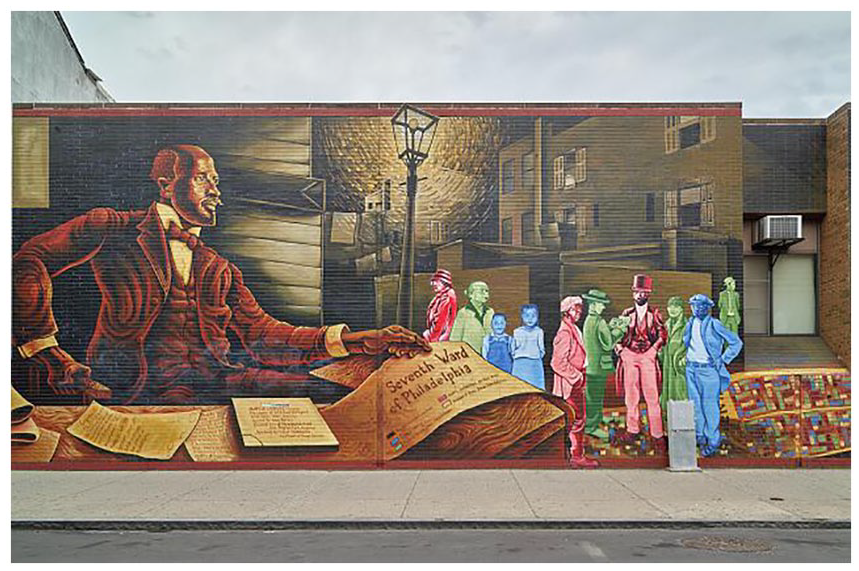
Willis Humphrey’s mural of W.E.B. Du Bois, Philadelphia, Pennsylvania.
Standing across the street from the mural, I photographed it from several angles, and walked up closer to examine the finer details of its artistry. The mural beautifully dramatizes the surveys and interviews Du Bois undertook with Black Philadelphians. It also features Du Bois’s posture as a thoughtful intellectual analyzing the documents and data he acquired and thoughtfully preparing to write up the findings.
Several years later I began to focus more on The Philadelphia Negro as a book. Reading it, and delving into the scholarship about Du Bois’s text, I started to better grasp the research methodology and innovative cross-disciplinary praxis he employed in his study. Without question, The Philadelphia Negro pioneered the field of urban sociology. It touched upon other disciplines as well, such as economics, history, and anthropology (Bay 1998). Remarkably, and importantly, it is critical to point out that an interracial duo published this groundbreaking study at the turn of the twentieth century. A mixed methodology combining social scientific analysis and history underwrote the book’s narrative. It also informed the text’s appendixes compiled by Smith College graduate and Progressive era White social worker Isabel Eaton (Aptheker 1973; Deegan 1988; T. W. Hunter 1996).
Scholars often highlight The Philadelphia Negro’s academic interventions that over a century after its publication remain germane to the study of cities and multiethnic populations in urban settings. For example, Marcus Hunter considers the sociological concept of heterogeneity—assessing and evaluating the variability of social conditions and experiences—to contextualize Du Bois’s “Black heterogeneity,” an analytical framework that accounts for the multilayered, diverse complexity of Black lives on their own terms (M. A. Hunter 2013, 2015a, 2015b). In addition to Hunter’s studies, scholars have explored The Philadelphia Negro’s other sociological and historical contents, along with the wider sociological research he continued during his career. Collectively, this scholarship has unveiled the myriad dimensions of Du Bois’s capacious intellect that over time innovatively combined multiple disciplines (Itzigsohn and Brown 2020; Loughran 2015; Morris 2015; Rabaka 2010, 2023; Rodrigues 2022; Rudwick 1974; Womack 2022; Wortham 2009; Wright 2016; Zuberi 2004).
While emphasis on the text’s scholarly originality, sociological innovation, and contemporary analytic relevancy are key ways to demonstrate its importance, consideration of The Philadelphia Negro’s book history provides an equally compelling account of its enduring significance. Book history addresses the creation of a book as a physical publication or an intellectual artifact. Book history also considers the authorial choices behind infrastructural, textual adornments such as appendixes or maps. In addition, book history deals with subjects like cover art, and how publishers and authors often cocreate the external visual presentation of a book’s interior contents (Aptheker 1989; Sinitiere 2022, 2023). 2 Thinking about The Philadelphia Negro’s history in this way brings to view Filipe Carreira da Silva and Mónica Brito Vieira’s textualized sociology that examines a book’s materiality as well as the social significance it acquires in culture through history (da Silva and Vieira 2019). Adapting Clayton Childress’s (2017) language of going “under the cover” of The Philadelphia Negro offers a way to better grasp the larger historical arc and social meaning of a book’s creation, distribution, and dissemination across culture. Relatedly, it presents a perspective on understanding a book’s editorial lifecycle—the coconstitutive work over time between authors, editors, publishers, and scholars on a book’s multiple editions, what we might call its “bibliorhythm.”
In this brief book history, I explore an editorial history of critical scholarly editions of The Philadelphia Negro, an analysis occasioned by a recent 2023 University of Pennsylvania Press updated edition of the text that features sociologist Elijah Anderson’s revised editorial introduction, first published in 1996. In other words, I historicize critical scholarly editions of The Philadelphia Negro to trace the book’s reception and meaning over time. I also examine selected textual and infrastructural features of each critical edition, most especially the book covers. Historical analysis of sociological writing summons historians (like me) to perform cross-disciplinary intellectual labor while it also invites sociologists to consider historical context more expansively in their assessment of sociological texts.
Any book history of critical scholarly editions of Du Bois’s published texts must begin with Herbert Aptheker (1915–2003). In 1946, Du Bois handpicked the White, Jewish, radical Marxist historian to edit and publish his correspondence. This editorial venture eventually encompassed all of Du Bois’s published and many of his unpublished works. In the early 1970s, in collaboration with and approval of Shirley Graham Du Bois (1896–1977)—W.E.B. Du Bois’s widow and an accomplished intellectual and activist in her own right—Aptheker signed book contracts with the University of Massachusetts Press and the academic reference publisher Kraus-Thomson Organization (KTO) in New York. Between 1973 and 1986, Aptheker edited and published nearly 50 Du Bois anthologies with both presses. He included critical editorial introductions for each volume, drawing on his personal acquaintance with W.E.B. Du Bois—a comradeship that began in 1946 and ended in 1963 with Du Bois’s death—and expansive familiarity with Du Bois’s personal papers and archives. Thus, Aptheker’s introductions featured brief book histories that addressed topics like sales figures, book reviews, errata, and other textual particularities (Sinitiere 2023). Herbert Aptheker (1989) collected them in his final book on Du Bois, The Literary Legacy of W.E.B. Du Bois.
In conjunction with Aptheker’s musings on The Philadelphia Negro stands Michael B. Katz and Thomas J. Sugrue’s (1998) W.E.B. DuBois, Race, and the City: The Philadelphia Negro and Its Legacy. While not a book history proper of Du Bois’s famous 1899 text, this edited scholarly anthology addresses the book’s expansive history and its methodological impact across the disciplines. The volume also presents a richly textured exploration of Philadelphia during Du Bois’s time there as well as historical dimensions of the city’s change over time across the twentieth century. If Aptheker’s work is integral to any book history of The Philadelphia Negro, then W.E.B. DuBois, Race, and the City is a necessary companion for such analysis as well.
It is also worth noting that Katz and Sugrue’s volume inaugurated the practice of scholarly anthologies devoted to a specific Du Bois book, a nascent and important sub-thread in the field of Du Bois studies that is a kind of meta-book history all its own. For example, to mark the centennial of The Souls of Black Folk in 2003, literary scholar Dolan Hubbard (2003) edited The Souls of Black Folk: One Hundred Years Later. Not unlike W.E.B. DuBois, Race, and the City, Hubbard’s volume included essays about Souls’ book history and the nineteenth-century historical context of its origins, along with literary and historical exposition of the text’s contents from the vantage point of autobiography, fiction, Black Studies, communication studies, whiteness studies, and classics. Following the lead of Katz, Sugrue, and Hubbard, at this moment in the third decade of twenty-first century upcoming Du Bois publication centenaries will provide ripe opportunities for expansive revisitations of his landmark books through scholarly anthologies.
While Aptheker’s critical scholarly introduction to The Philadelphia Negro appeared in 1973 with KTO, Schocken Books published the first reprint of the book in 1967 nearly 70 years after its original publication. University of Pennsylvania sociologist E. Digby Baltzell (1915–1996) authored the introduction to this edition. 3 Baltzell’s introduction presents a biographical overview of Du Bois that explores the Black scholar’s intellectual training in both the United States and Europe as a backdrop for his sociological research. The introduction also gives some attention to relevant social and political factors of Progressive era-Philadelphia that shaped the context of Du Bois’s research. Regrettably, Baltzell does not mention writer and activist Isabel Eaton, whose roughly 100-page “Special Report on Negro Domestic Service in The Seventh Ward” toward the end of The Philadelphia Negro constituted an integral portion of the study and documented her collaboration with Du Bois. By overlooking this work, Baltzell silenced Eaton’s contribution and in effect wrote her out of the book’s history. Following brief coverage of the book’s reception, Baltzell provides a sociological analysis of the city’s Black history since The Philadelphia Negro’s publication in 1899, a qualitative and quantitative reflection on then contemporary Philadelphia. A short bibliography of historic and contemporary sociological texts accompanies the introduction (Baltzell 1967).
The cover image of the Schocken edition is of a two-pane closed window with a tattered shade pulled halfway up. Visible through the window is the top of Philadelphia’s City Hall and the upper floors of several high rises. In the distance, white smoke billows out of two smokestacks, an image of Philadelphia’s (de)industrialization. This urban, skyline scene offers a striking, symbolic juxtaposition: society’s upper echelons hover above the granular street-level analysis Du Bois carried out among Black folks relegated to society’s lower rungs. With an aesthetically simple arrangement, against the black shade are the yellow and orange lettering of the book’s title and names of the author and editor.
While the Schocken edition of The Philadelphia Negro made the book more widely available, copies were evidently sparse before Baltzell finished the project. As of the 1960s, he reported that there were two copies of The Philadelphia Negro at the University of Pennsylvania. The university archives held an original copy, and there was also a microfilm copy available. Yet Baltzell revealed that he used a borrowed copy of the text to write the introduction. “I am using a copy lent me by my good friend, Professor Ira Reid of Haverford College, a one-time colleague and friend of the late Professor DuBois at Atlanta University” (Baltzell 1967: ix–x). Baltzell does not mention if Reid received his copy from Du Bois, or if Du Bois had inscribed it, for example. He offers no comment about what kind of shape the aging, 60-year-old book was in. It is certain, however, that Reid worked in close proximity to Du Bois at Atlanta University during the late 1930s and 1940s. He knew the Black scholar’s sociological work well and collaborated with Du Bois on projects like Phylon where Reid served on the editorial board after the journal launched in 1940. 4 Given Baltzell’s historical inclinations—he once commented that “I’m a sociologist looking at history” (Pencak 1996:258)—it is easy to imagine that perhaps Reid helped to provide a personal and historical background on Du Bois that informed Baltzell’s work on the Schocken introduction.
If E. Digby Baltzell’s (1967) introduction to The Philadelphia Negro framed the history of Du Bois’s urban sociology in light of contemporaneous Philadelphia, Aptheker’s editorial introduction to the KTO edition offered more expansive historical details about the Progressive era that shaped the University of Pennsylvania’s invitation for Du Bois to study Philadelphia’s Black community. Aptheker’s archival research for the introduction—including his typed notes for the introduction’s outline that features the point about Du Bois and Eaton’s interracial collaboration as well as Du Bois’s early career elitism plus reviews of The Philadelphia Negro in German and French 5 —produced biographical summaries of the network of reformers who, while not without exhibiting racist paternalism, found in Du Bois an academically trained scholar equipped to thread the needle of social science and social reform. Furthermore, Aptheker showed where The Philadelphia Negro fits into Du Bois’s early career intellectual endeavors, linking scholarship on Black life to social change, what he described as Du Bois’s “humanistic science” (Aptheker 1973:24). Like Baltzell, Aptheker covered The Philadelphia Negro’s reception history. However, he documented it more thoroughly through book reviews in scholarly journals like American Historical Review and Annals of the American Academy of Political and Social Science and popular publications such as The Nation. Finally, Herbert Aptheker’s (1973) introduction dismissed Baltzell’s editorializing about The Philadelphia Negro as too biographically centric. He argued that it was too wedded to the Cold War-era Du Bois scholarship of historians Elliott Rudwick and Francis Broderick. Aptheker derided their stark anticommunist tone about Du Bois’s late life, a position he deemed insufficiently informed about the arc of Du Bois’s scholarly career.
As an editorial matter, due to Aptheker’s fidelity to Du Bois’s words, in the KTO edition he included Du Bois’s original Preface to The Philadelphia Negro. The Preface situated Du Bois’s sociological work in Philadelphia in relation to his concurrent Farmville, Virginia study and his sociological laboratory at Atlanta University. The KTO volume is the only critical scholarly edition of The Philadelphia Negro that includes Du Bois’s short yet extremely important Preface (Chandler 2022:xiv).
Regarding the cover of Aptheker’s edition of The Philadelphia Negro, the complete KTO series of Du Bois’s writings had no cover art or images. Each hardback volume had a blank dark blue buckram cover with the book’s title, author (not editor), and Kraus-Thomson in gold lettering on the spine.
In 2007, Oxford University Press published a Du Bois series under Henry Louis Gates, Jr.’s general editorship. Each text in The Oxford W.E.B. Du Bois series contained both a series introduction and a critical editorial introduction of the specific text. This series made many of Du Bois’s long out-of-print books more widely available to a new generation of readers at more affordable rates.
Harvard sociologist Lawrence Bobo (2007) authored The Philadelphia Negro’s editorial commentary. His critical introduction spotlights Du Bois’s unique methodology, and the book’s singularly sacred place as a foundation stone in the discipline of sociology. Bobo illustrates the innovative analysis Du Bois offered of the Black family, crime, immigration, and the heterogenous dimension of Philadelphia’s Black community. Another point of strength in Bobo’s introduction is its narration of sociological scholarship on The Philadelphia Negro. Like Baltzell, Bobo fails to address Isabel Eaton’s report. Furthermore, while her name appears in footnotes as it did in the inaugural 1899 publication, the Oxford edition of The Philadelphia Negro excised her from the text. Stunningly, and inexplicably, Eaton’s “Special Report on Negro Domestic Service in The Seventh Ward” does not appear in the book at all. Unfortunately, there’s no editorial comment on this lamentable erasure.
The cover for Oxford’s edition of The Philadelphia Negro retains a uniform structure for the entire series. There is a maroon strip on the cover’s upper portion with a Du Bois photo and teal lettering of “The Oxford W.E.B. Du Bois” along with the series editor name. Centered on each cover is a photo of Du Bois (there’s a different photo for each volume) set against a teal background with the book title, author name, and editor name in black, blue, and maroon lettering. A 1919 black and white photograph of Du Bois wearing a suit and bowtie, with a finely trimmed Van Dyke beard features on The Philadelphia Negro’s cover. 6
I mention Elijah Anderson’s editorial introduction to The Philadelphia Negro last to highlight its updated 2023 version published in anticipation of the book’s 125th anniversary in 2024. Initially published in 1996, Anderson’s first editorial introduction combined lucid biographical summary of Du Bois’s early career with an assessment of The Philadelphia Negro that situated its pioneering presence in scholarship: how it anticipated both the Chicago School and the Black sociology of scholars like E. Franklin Frazier, St. Clair Drake, and Horace Cayton, among many others. The last third of the introduction, similar to Baltzell’s approach, provided a contemporaneous microhistory and sociological assessment on how Black Philadelphia changed over time since the publications of Du Bois’s book in 1899 (Anderson 1996, 1998). I wish to note that Anderson’s usage of DuBois, without the space between Du and Bois in the 1996 edition, becomes Du Bois, with the space, in the 2023 edition—a proper spelling of Du Bois’s name that is now convention and nearly uniform in scholarly publications about him.
And while Anderson does not mention Isabel Eaton in the 1996 introduction, unlike other critical editions of The Philadelphia Negro, there’s a unique feature in the 1996 (and 2023) book: a brief biographical summary of Eaton preceding her report. Authored by historian Tera Hunter, the “Historical Note” connects Eaton’s abolitionist roots in New England to her efforts at social reform and social change working in the Progressive era with people like Jane Addams and the College Settlement Association. Hunter praised the “trailblazing documentation” in Eaton’s study of Black domestic workers in Philadelphia’s Seventh Ward for the ways in which it addressed the racial implications and social antagonisms in Philadelphia surrounding such alienating, precarious labor. Hunter, like Aptheker, also pointed to the unique interracial collaboration between Eaton and Du Bois and how they remained colleagues and comrades well into the twentieth century. Du Bois even featured a biographical update on Eaton’s work in the May 1915 issue of The Crisis magazine (T. W. Hunter 1996:425–26, 1998).
Anderson’s revised editorial introduction in the University of Pennsylvania Press’s 2023 edition of The Philadelphia Negro effectively synthesizes previous editorial introductions to The Philadelphia Negro which allows for a fuller coverage of the historical backdrop of Du Bois’s urban sociology. Notably, while the new edition retains Hunter’s biographical thumbnail of Isabel Eaton, Anderson rightly acknowledges her collaboration with Du Bois in the introduction. “Du Bois conducted the study personally,” Anderson writes, “with the assistance of Isabel Eaton who contributed an appendix to the study focusing on domestic service. Together, they gathered the data, organized it, analyzed it, and formed conclusions on the basis of it” (Anderson 2023:xix–xx, emphasis added).
Anderson’s revised association of Eaton and Du Bois corresponds closely to Du Bois’s memory of their work. Upon her death in the late 1930s, Du Bois requested that the Society for Ethical Culture in New York City commemorate her life. Du Bois praised Eaton’s social scientific acumen and bold willingness to engage with interracial scholarly collaboration in an era of ongoing racist hostility. He wrote that “Miss Eaton was brave and efficient, and our collaboration is a fine memory. I cherished her frankness and intellectual honesty and am sure that part of her life will never die.” 7
In addition, Elijah Anderson’s (2023) revisions also account for the now established presence of Du Bois as a founder of sociology. Reframing his previous introduction, Anderson excels at presenting a kind of psychological profile of Du Bois as a Black sociologist and scholar at the turn of the twentieth century grappling with the intersections of race, class, history, and social progress in the face of putrid paternalism and White supremacist recrimination. Anderson’s updated introduction does not include extensive sociological analysis of contemporary Philadelphia like his 1996 reflections did. Rather, he nods to a new generation of scholars who have advanced understanding of Du Bois as an urban sociologist as well as a scholar of race, ethnicity, religion, society, and culture. Unfortunately, in this regard, he overlooks Saidiya Hartman’s probing analysis of The Philadelphia Negro in her 2019 study of social insurgents titled Wayward Lives, Beautiful Experiments. Hartman’s (2019) exploration of the underside of Philadelphia’s Seventh Ward population is an insightful counterpoint to work more broadly on Du Bois, gender, and Black elites The Philadelphia Negro. Collectively, such dual perspectives produce generative comparisons about Du Bois the elite, social scientist, and Black intellectual and the heterogenous populations of Black people in the Seventh Ward he studied and analyzed (Gillman and Weinbaum 2007). Nevertheless, Anderson points out, The Philadelphia Negro remains a “cornerstone work” (p. xxiv) in the field, a study worthy of continued attention.
The covers of Anderson’s editions of The Philadelphia Negro offer a visual contrast of Du Bois’s place in the field. The 1996 edition featured black lettering of the title, author, and editor set against a handsome orange matting with a black and white photo of Philadelphia row houses from the era of Du Bois’s work in the city (“Walking Tour,” N.d.). 8 The 2023 edition intermingles black and red lettering of title, author, and editor with four of Du Bois’s data portraits from the 1900 World’s Fair in Paris. The modernist aesthetic of the data portraits, like the row house photograph from the 1996 edition, locates The Philadelphia Negro’s subject matter to the turn of the twentieth century. Yet the data portraits on the cover of 2023 edition visually mark the renewed attention in the field to the range of Du Bois’s sociological work combining data science, historical narrative, and sociological analysis that documents the situatedness and progress of Black life (Battle-Baptiste and Rusert 2018).
Beyond the specifics of the sociological scholarship for which The Philadelphia Negro remains relevant, another way to assess its enduring vitality is to revisit it for discerning more fully Du Bois’s practice of cross-disciplinary intellectual labor. In other words, it assists with pondering: How did Du Bois execute scholarship that threaded together history, social science, literature, and data visualization, to name only a few, in The Philadelphia Negro? How did Du Bois publish historically grounded scholarship shaped by the conditions of Du Bois’s present yet animated by concerns about Black liberation in the future course of time, in history’s future unfolding?
While conversations among and between sociologists, ethnographers, and historians offer ways to think about these questions at the nexus of several disciplines (Carrera 2023; Collins 2016; Meer 2022; Rabaka 2010, 2023), philosopher Nahum Dimitri Chandler speaks more specifically to matters around The Philadelphia Negro. He calls for a more probing, slower reading, a “patient attention” (Chandler 2022:5) to Du Bois’s writings that considers the larger intellectual frameworks out of which he wrote and produced scholarship. Chandler’s point is to not consider The Philadelphia Negro in a kind of singular isolation but to explore the writings that Du Bois published on either side of this groundbreaking book such as “The Conservation of Races” in 1897 and the Farmville, Virginia report in 1898, and from December 1899, six months after The Philadelphia Negro’s completion, “The Present Outlook for the Dark Races of Mankind” (Chandler 2022:215). Paying attention to the “overlapping ensembles of [Du Bois’s] historical situation” (Chandler 2022:147) is to see what in Du Bois’s scholarly thought fed The Philadelphia Negro and in turn understand what innovative intellectual practice in The Philadelphia Negro fed subsequent scholarship that followed this landmark book.
9
For Chandler, this kind of scholarly, scientific simultaneity that probed the problem of the color line materialized in Du Bois’s intellectual labor because he “was a thinker whose practice was writing” (p. 3). He continues:
We should recall Du Bois as a thinker who thinks as writing, who thinks in writing, as a thinker who writes: in the sense that thinking is his way, his very path of existence and his vocation, and writing is his discipline, his definitive practice, his craft and artistry, or his métier. (p. 3)
It is in the process of Du Bois’s writing, his practice of documenting the Negro problem while marshaling intellectual resources to subvert it that produced the numerous texts from which scholars today can write Du Bois’s book history.
On the occasion of The Philadelphia Negro’s 125th anniversary, I am still searching for Du Bois. With now over a dozen years of research and scholarship devoted to him, I continue to discover Du Bois from new vantage points and find new dimensions of his capacious intellect. While visual art remains an interest of mine, it is the book history and archival history of Du Bois that animate my imagination today. This is where I found Du Bois for this article. Surveying the editorial history of critical scholarly editions of Du Bois’s 1899 text demonstrates its ongoing significance in sociological scholarship of the twenty-first century. It reveals how over the last half century scholars have returned to the book in search of methods and analysis that can illuminate the present—whether that present was the tumultuous and transformative 1960s or the suffocating gentrification of the 1990s and beyond. Approaching The Philadelphia Negro’s book history brings both its bibliorhythm and its historiographical significance into sharper relief. It also shows how historically situating a sociological text makes for stronger sociology and for richer, multidisciplinary history.
