




Abstract
Research has frequently remarked on the conceptual overlap of racial versus ethnic categories at the macro-level, as well as on individual-level inconsistencies across multiple dimensions of race. Less research has focused on the interpersonal negotiation of racial self-classification and identity claims-making, or on the norms that govern racial appraisal. This study uses a case at the boundaries of the Hispanic category to ask: what norms of self-classification and social appraisal do interlocuters draw on in their interpretation of ethnic categories? I answer this question using a unique dataset of posts from a college admissions forum, in which prospective applicants ask, “Am I Hispanic?” Findings reveal that ancestry forms the most rigid boundary, though interlocuters debate whether ancestry is biological or cultural. Cultural identity is also necessary, though more loosely defined. Specific, noninstitutionalized traits, such as phenotype, language, and surname, are considered neither necessary nor sufficient. Findings highlight the enduring primacy of ancestry and the importance of social appraisal in the college application context.
Introduction
In the United States, more than a century of revisions has led to the Census’ current format for racially and ethnically classifying Americans. This format uses two questions: first, is a person of Hispanic, Latino, or Spanish origin, and second, what is a person’s race? This institutional separation of racial and ethnic categories, the result of negotiations between government and advocates (Mora 2014), echoes the conceptual distinction that scholars draw between racial and ethnic differences. However, scholars also recognize that racial and ethnic categories often overlap in both their common and analytical usages, leading to active debates about whether and how to revise these questions.
At the individual level, various ways of understanding race and ethnicity are reflected in the multiple dimensions of race framework (Roth 2016), which can help us understand how individuals may experience mismatches across dimensions of race, as well as how they may experience changes within dimensions over time. Self-classification, or what people select on official forms with constrained options, is one such dimension. For example, an individual’s self-classification may change as the set of options changes (as on the U.S. Census), or as their own subjective self-identity changes.
Importantly, decisions about self-classification do not occur in isolation. Identity claims-making may be a response to incentive structures that limit resources to particular groups, leading those groups to police attempts to cross, expand, or blur boundaries (Nagel 1994; Osuji 2013; Wimmer 2008). Racial appraisal, or the process by which people classify others, may limit the extent to which identity claims are socially accepted (Roth 2018b) and is based on myriad factors, including ancestry, phenotype, and sociocultural cues (Schachter, Flores, and Maghbouleh 2021).
To date, however, research has tended to examine either the macro-level mechanisms of boundary production or individual decision-making about identity claims, with less focus on the interpersonal negotiation of boundaries (Lamont and Molnár 2002) or on the norms that govern racial appraisal. Understanding these processes can help illuminate how racial boundaries change or are maintained, which in turn has implications for understanding the lived experience of race.
This study therefore examines the negotiation of and norms around racial classification and identity claims-making, using a case that draws on the boundaries of the Hispanic 1 category. The Hispanic category is particularly illustrative of these processes, for several reasons. Criteria for membership have always been ambiguously defined (Mora 2014), and debate continues over whether Hispanic self-classification should be incorporated into the Census question on race. Prior research has documented wide variation in how people who could “count” as Hispanic choose to identify or to self-classify (Martínez and Gonzalez 2021; Mora, Perez, and Vargas 2021), and in within-person variation over time and circumstance (Roth 2018a).
This study draws on a unique dataset: posts from an online college admissions forum in which prospective applicants ask, “Am I Hispanic?” This question refers to colleges’ request that applicants provide racial and ethnic demographic data, which is used both for federally mandated reporting, and, up until 2023, for the consideration of race and ethnicity in admissions at some schools. The ensuing conversations help answer the questions: what racial or ethnic cues do these interlocuters draw upon in their interpretation of the Hispanic boundary? What are the norms of self-classification and racial appraisal? Analyses show that ancestry forms the most rigid criterion, with interlocuters drawing on definitions of Hispanic ancestry that have been institutionalized by the U.S. Census and other bodies. However, they debate whether ancestry should be interpreted as biological or cultural. Once ancestry is established, it must be combined with cultural identity, though “culture” and “identity” are both loosely defined. Other factors, such as phenotype, language, and surname, are neither necessary nor sufficient for self-classifying as Hispanic. These findings reveal the enduring importance of social appraisal and of ancestry in defining ethnoracial boundaries, which will likely remain relevant as the share of Americans with multiple ancestries continues to grow.
Background
Racial and Ethnic Classification and Claims-making
Censuses are one of the primary institutions through which the state constructs race, generating “the official language and taxonomy of race and imbu[ing] them with the authority of the state” (Hochschild and Powell 2008:62). Yet censuses are also subject to change, as populations, scientific thought, politics, and ideology evolve (Hochschild and Powell 2008). In the United States, over a century of revision has led to the Census’ current model of racially and ethnically classifying Americans through two questions. The first question asks whether a person is of Hispanic, Latino, or Spanish origin, while the second asks what a person’s race is. This institutional separation of race and ethnicity echoes the conceptual distinction that scholars draw between racial and ethnic differences; sociologists often define ethnicity as based on belief in common descent (Weber 1978), kinship, history, and symbols (Cornell and Hartmann 2007), while defining race as originating in assigned or ascribed classifications that are deployed in systems of power relations (Cornell and Hartmann 2007; Omi and Winant 1994).
However, scholars also recognize that this conceptual distinction obscures the reality that racial and ethnic categories often overlap in both their common and analytical usages (Brubaker, Loveman, and Stamatov 2004; Telles and Sue 2019; Wimmer 2008). For example, despite institutionalizing separate racial and ethnic questions, the Census Bureau itself often presents demographic analyses in which those identifying as Hispanic of any race are combined into a category that is compared against non-Hispanic White, Black, and Asian, as though it were also a racial category. 2 Indeed, some argue that in the United States, both views coexist: a binary Black-White racial schema, in which Hispanic is an ethnicity, operates alongside a Hispanicized schema, in which Latino/Hispanic is a race, alongside Black and White (Roth 2016).
This macro-level ambiguity in how racial and ethnic categories are defined, institutionalized, and used is reflected at the individual level. The multiple dimensions of race framework (Roth 2016) provides a way of understanding how individuals may experience mismatches across various ways of understanding race and ethnicity. For instance, an individual’s racial self-classification (i.e., what they check on an official form or survey with constrained options) may differ from their racial identity (i.e., how they subjectively self-identify) or from their “street race” (i.e., how they believe strangers on the street would classify them) (Vargas et al. 2021).
Individuals can also experience inconsistency within a single dimension over time. For example, changes in survey options can lead to changes in self-classification, as demonstrated in the 2000 Census, when the Census began allowing people to select multiple racial categories. Subjective self-identification can also vary across time and space. Those who have “ethnic options,” particularly third-plus generation groups who assimilate into a White mainstream, may assume ethnic roles voluntarily, depending on context (Gans 1979; Waters 1990). Others may have less “ethnic agency” in choosing “how, when, and where their ethnicity is expressed” (Telles and Sue 2019); in particular, individuals racialized as non-White or who are darker skinned may have fewer ethnic options (Lee and Bean 2010; Nagel 1994; Telles and Sue 2019; Vasquez 2010).
Moreover, individual identity claims do not occur in a vacuum. Assertions of ethnic identity may be a response to incentive structures that limit economic, political, or symbolic resources to particular groups (Nagel 1994; Wimmer 2008). In the United States, for example, funding agencies use data about people’s racial and ethnic self-classification to measure inequality and allocate resources. 3 In addition, ethnic groups may “police” attempts to cross, expand, or blur boundaries (Osuji 2013; Wimmer 2008) and raise questions about the authenticity of people’s claims to identity (Nagel 1994). Racial appraisal, or the process by which people classify others, may limit the extent to which identity claims are socially accepted (Roth 2018b) and is based on myriad factors, including ancestry, phenotype, and sociocultural cues (Schachter et al. 2021).
To date, however, most research about ethnic claims-making has examined either macro-level ambiguity or individual decision-making, via survey and interview data. This is consistent with the broader literature on boundaries, where research has cataloged the mechanisms that produce boundaries, but is less extensive when it comes to the cultural negotiation of boundaries (Lamont and Molnár 2002; for an exception, see Soto-Márquez 2019). Scholars have identified a need to understand the cultural negotiation of boundaries, as well as the norms that govern racial appraisal. Both can illuminate how racial boundaries change or are maintained, which in turn has implications for understanding the lived experience of race (Roth 2018b). This article responds to these calls.
Hispanic Classification and Identity
The Hispanic category is particularly illustrative of questions that arise around the negotiation of and norms around racial classification and claims-making, for several reasons. From its inception in the 1960s and 1970s, the category was ambiguously defined. In that era, negotiations among Mexican American and Puerto Rican activists, government agencies, and the media eventually led to the adoption of “Hispanic” as an ethnic category (Mora 2014) and its institutionalization in the Census. However, the organizations involved in its advocacy never provided official guidance on which national-origin subgroups were considered Hispanic, nor did the Census Bureau define who counted under “other Spanish.” Since then, a combination of historical inertia and political groups’ interests in maintaining existing racial categories have led to the continued use of the two-question format (Mora 2014). Nevertheless, scholars continue to debate how to best capture people’s experiences both of race and ethnicity in general, and of Hispanic identity specifically (N. Lopez 2013; Rumbaut 2009; Telles 2018).
Ambiguity both about institutionalized meanings of “Hispanic” and about the difference between racial and ethnic categories has led to wide variation in how people who could “count” as Hispanic choose to identify or to self-classify. In the 2000 Census, 43 percent of Hispanic respondents rejected the listed racial options and chose “other race” instead—compared to only 0.2 percent of non-Hispanics (Rumbaut 2009). Surveys and interviews suggest that at least some of these individuals likely identify racially as Hispano/a, Hispanic, or Latino (Flores-González et al. 2014; Itzigsohn 2004). Moreover, not all groups experience the same degree of inconsistency; across studies, Hispanic individuals (along with Native American and multiracial individuals) have much greater fluidity in self-classification than White, Black, and Asian American individuals (Roth 2018a). This fluidity is also reflected in racial appraisal: Self-identified Latinos are the group most likely to experience discordance between how they identify themselves and how they are identified by others, compared with Whites, Blacks, and Asians (Abascal 2020). Uncovering the norms that govern decisions about Hispanic classification and appraisal can thus help illuminate how racial boundaries operate.
Setting: The Case of College Admissions
The consideration of race and ethnicity in college admissions provides a fruitful setting for understanding how people negotiate norms of self-classification and appraisal. Up until 2023, colleges and universities that practiced affirmative action by considering race and ethnicity typically did so with the intent of “provid[ing] special consideration to historically excluded groups” (Okechukwu 2019:4). Latinos were among the early beneficiaries of such programs in the 1960s and 1970s (Okechukwu 2019). Although decades of anti-affirmative action activism led many universities to retreat from race-conscious admissions, about 35 percent of selective institutions considered “racial/ethnic status” as a factor in their admissions decisions in 2014 (Hirschman and Berrey 2017).
The U.S. Department of Education mandates that colleges collect racial and ethnic data from students using the Census’ two-question format. The Common Application (or “Common App”), used by more than 900 colleges and universities, thus includes the two required questions on race and ethnicity in its demographics section, though it does not specifically label them as such. Figure 1 diagrams the Common App’s two questions (as of 2020).
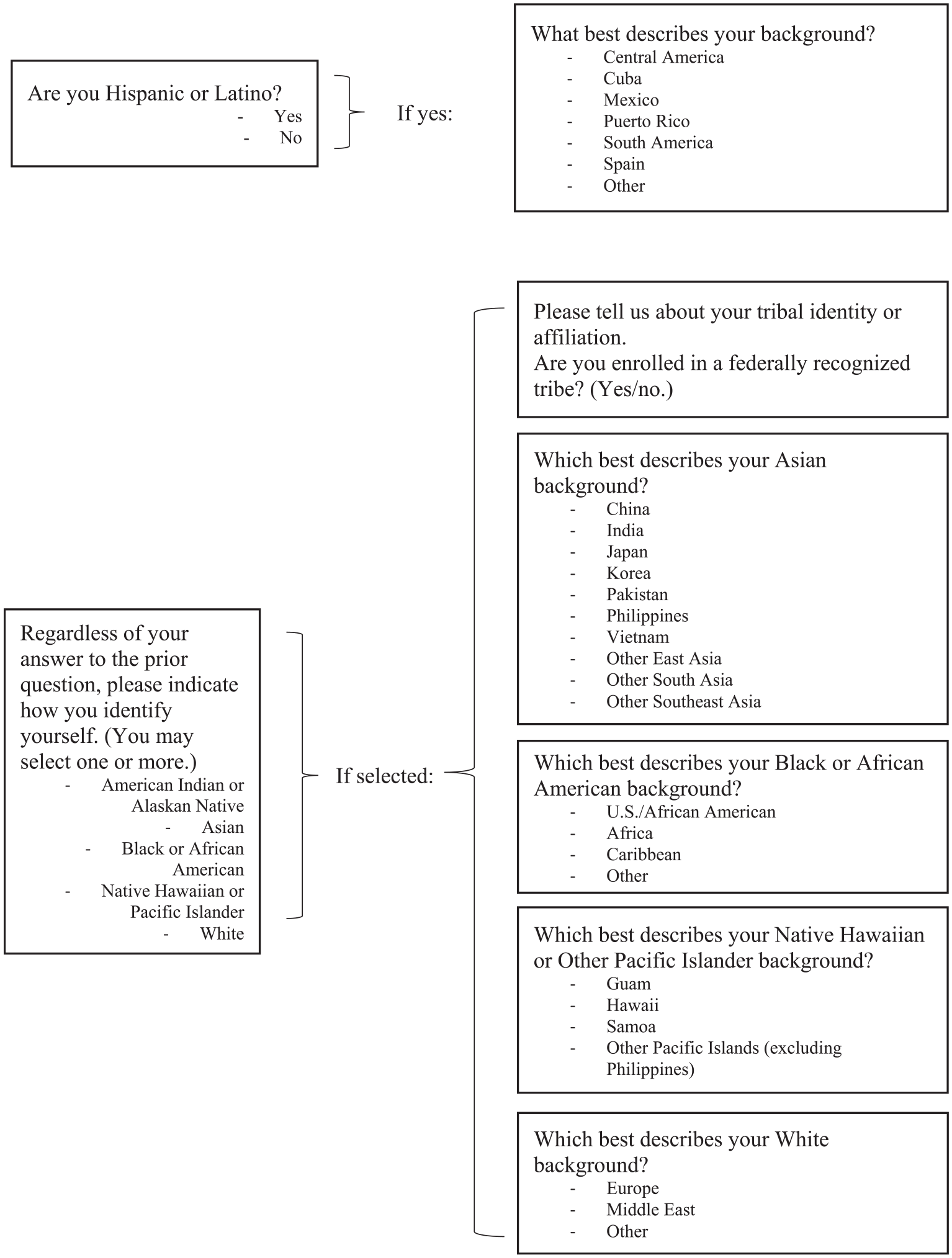
Demographic questions on the Common Application, as of 2020.
Applicants first respond to a yes/no question asking “Are you Hispanic or Latino?” Selecting “yes” reveals a follow-up question asking, “Which best describes your background?” with the following options: Central America, Cuba, Mexico, Puerto Rico, South America, Spain, and Other. The second question asks, “Regardless of your answer to the prior question, please indicate how you identify yourself. (You may select one or more.)” The options provided are American Indian or Alaskan Native; Asian; Black or African American; Native Hawaiian or Pacific Islander; and White. Selecting any option reveals a follow-up question that asks applicants to specify which background best describes them. Finally, the section specifies that the questions are “entirely optional.”
How applicants respond to these questions is not always a straightforward matter. Individuals, particularly those of multiple racial and ethnic backgrounds, may have an array of ethnic options to choose from. The decision as to whether to self-classify as Hispanic is particularly prone to ambiguity, both in its definition and in its relationship to individuals’ actual experiences of ethnicity. The college application setting adds an element of social appraisal (Roth and Ivemark 2018), in that applicants may be concerned as to whether their self-classification will survive scrutiny. Additionally, unlike for a Census question, applicants could choose to elaborate on their self-classification on open-ended portions of the application, thus providing additional cues to readers. On the contrary, common ethnoracial cues, like phenotype, are absent; research on “street race” makes clear that these physical cues have significant implications for people’s experience of discrimination (e.g., Vargas et al. 2021).
Moreover, since applicants’ responses to this question may involve material consequences, they face dueling incentives. On one hand, applicants may be invested in more porous boundaries that would allow them to self-classify in ways that they perceive as most benefiting them. On the other hand, more porous boundaries could also benefit other applicants, which could then increase competition for the limited number of seats at selective colleges.
In many of these considerations, norms of self-classification are negotiated, not in a vacuum, but in interactions with others, raising the question: under circumstances of potential material consequence, what racial or ethnic cues do interlocutors draw upon in their interpretation of the Hispanic boundary? This article specifically examines instances in which people are uncertain about their claims to Hispanic self-classification, illuminating how boundaries around the category are conceptualized. In what follows, I analyze a unique dataset drawn from a college admissions forum, which provides an organic setting for observing digital interactions.
Data and Methods
The study of boundaries can focus on communities that do not involve face-to-face contact, such as relationships mediated by technology (Lamont and Molnár 2002). Digital communities have become central to people’s social lives and to how they understand and construct their identities (Hallett and Barber 2014); they also provide spaces for people to share information that they may not otherwise in a physical space (Fine and Hancock 2017). In addition, digital spaces can allow researchers to observe how individuals interact with each other in naturally occurring settings.
In this study, I examine a selection of forum posts from College Confidential, a Web site devoted to the college application process. 4 College Confidential, which is run by the U.S.-based nonprofit organization Roadtrip Nation, bills itself as a Web site that “bring[s] candid community insights, expert advice, and career exploration under one roof for an all-in-one college and career planning experience.” According to LinkedIn, the site boasts 40 million users (College Confidential n.d.). A key feature is the site’s forums, in which users ask and answer questions about college admissions. Users request advice on topics such as standardized test preparation, financial aid, choosing which colleges to apply to, and the application process itself.
The forum is public, and an account is not required to browse the site, though anyone can register. Most registered users appear to opt for usernames that do not reveal their name or identity, which poses both benefits and limitations for research. Anonymity, coupled with the absence of the researcher, may reduce social desirability bias (Smith, Bulbul, and Jones 2017) and lead people to be more forthcoming when discussing controversial issues—such as race, ethnicity, and affirmative action. For example, digital formats like email interviews can reveal more sensitive personal information than face-to-face interviews (Murray and Sixsmith 1998).
On the contrary, I cannot systematically associate users’ posts with demographic characteristics. 5 Some users do provide clues to their identities; for example, posts in “chances” threads 6 may include race or geographic location, and usernames sometimes include markers like “mom” or gendered first names. In addition, the vast majority of posts in this study’s dataset (described in further detail below) either originated in or were moved by a moderator to a Hispanic Students sub-forum, suggesting that perhaps the posts’ readers had some prior relationship with Hispanic identity. However, these clues are impossible to verify. As a result, the theoretical disadvantage is that I cannot assess the extent to which commenters’ own identities and life histories influence their attitudes. Nevertheless, I can explore the range of claims that people make, irrespective of their background characteristics.
Data and Coding
To create the dataset used in this study, I conducted a site-specific search for “am I Hispanic” (quotations included), which led to approximately 700 search results from between 2009 and 2019. These results included both posts that used the exact phrase, as well as posts that the Web site suggested as being thematically related. These thematically related suggestions thus captured posts with alternate phrasings, such as “Does my ethnicity count as Hispanic?” and “Am I considered Hispanic?”
After removing duplicate search results (e.g., multiple hits for the same post) and one thread that was about job applications rather than college admissions, I was left with 107 original forum threads, which serve as the final dataset. A search for “am I Latino” yielded only two results, most likely because the Common Application question lists “Hispanic” first (i.e., asking, “are you Hispanic or Latino?”). Both overlapped with results for “am I Hispanic” and were thus already included. Similarly, “am I Asian” yielded only two total threads, “am I White” yielded only one thread, “am I Black” and “am I African American” yielded a combined 12 threads, and “am I Native American” yielded two threads.
I manually exported all posts and their replies into Atlas.ti for qualitative coding and analysis. I began by tagging each individual post and reply by their usernames, which allowed me to check if any individual users were particularly active. I used a grounded theory approach to create initial codes based on themes that emerged through reading the posts, such as references to phenotype, surnames, countries of origin, and the Census. Codes were refined through an iterative process; initial codes were compared and collapsed into categories, in multiple passes through the data. For example, all codes related to posters’ justifications for self-classifying as Hispanic were tagged as “Reason” codes, for example, “Reason: phenotype” and “Reason: surname.” I then used analytical memos and tables to further organize the coded data.
Finally, in quoting from forum threads, I do not edit for spelling, punctuation, or grammar, both to preserve the original presentation of the data and to avoid altering any semantic ambiguity that may result from grammatical idiosyncrasies.
Findings
Findings reveal how people negotiate norms of self-classification and appraisal in a context in which “correct” classification is perceived as important. Consistent with research suggesting that the two-question format does not reflect Hispanics’ lived experiences (Telles 2018), the Common App’s questions produce confusion among some applicants. About one-third of posts in the dataset come from people who consider themselves Hispanic but are unsure of what to check for the second question; this uncertainty is consistent with prior ethnographic research on how Latinos racially identify on the U.S. Census (Rodríguez-Muñiz 2017). Others consider themselves “half white and half Hispanic” or ask whether they should check off White or Hispanic, suggesting that they see Whiteness and Hispanicity as being equivalent or substitutable concepts. Some users are familiar with the U.S. Census’ two-question format for race and ethnicity, and therefore deduce that the Common App intends to ask first about ethnicity and then about race. Nevertheless, this incongruence, between some users’ folk understandings of race and ethnicity and how the Common App solicits this information, leads to the interactions that serve as the core data for this article. Users are uncertain about what these concepts mean, but they also have an opportunity to capitalize on this uncertainty in order to gain a perceived benefit, that of potential added consideration in the college admissions process.
The dataset contains nearly 100 questions from users 7 wondering whether they can check off Hispanic in the Common App. These posts often include background details about traits and concepts that users presumably believe are relevant to the idea of ethnicity. Here, I use “relevant” not to mean that the poster has the trait in question, only that they think it is relevant to the case. For example, the poster might say, “I don’t have a Spanish surname,” which indicates that they find surname to be relevant to the question of ethnicity, even though they themselves don’t have a Spanish surname. The concepts that appear the most often in the dataset are identity and culture, ancestry, language, surname, and phenotype. By analyzing questions and responses about each of these concepts, I determine how they are used in the negotiation of the Hispanic boundary.
Analyses reveal that discussions about what counts as Hispanic revolve around three primary categories of concepts: broad notions of culture and identity, rigid boundaries of ancestry, and noninstitutionalized but specific cultural traits such as language, surname, and phenotype. Ancestry, based on institutionalized definitions regarding the geographic origin of one’s family, is necessary but not sufficient for Hispanic self-classification. Rather, ancestry must be combined with cultural identity, itself necessary but not sufficient. Moreover, while ancestry is defined rigidly, cultural identity is defined loosely, allowing for self-determination. On the contrary, language, surname, and phenotype are neither necessary nor sufficient for identifying as Hispanic. Most importantly, since ancestry is the most rigid of these concepts, controversy about who “counts” as Hispanic revolves around questions about biological versus cultural inheritance.
Figure 2 depicts these findings as a decision tree. Although forum discussions are not themselves organized so linearly, the figure is intended to depict areas of overall consensus and of debate, as well as the hierarchy of factors under consideration.
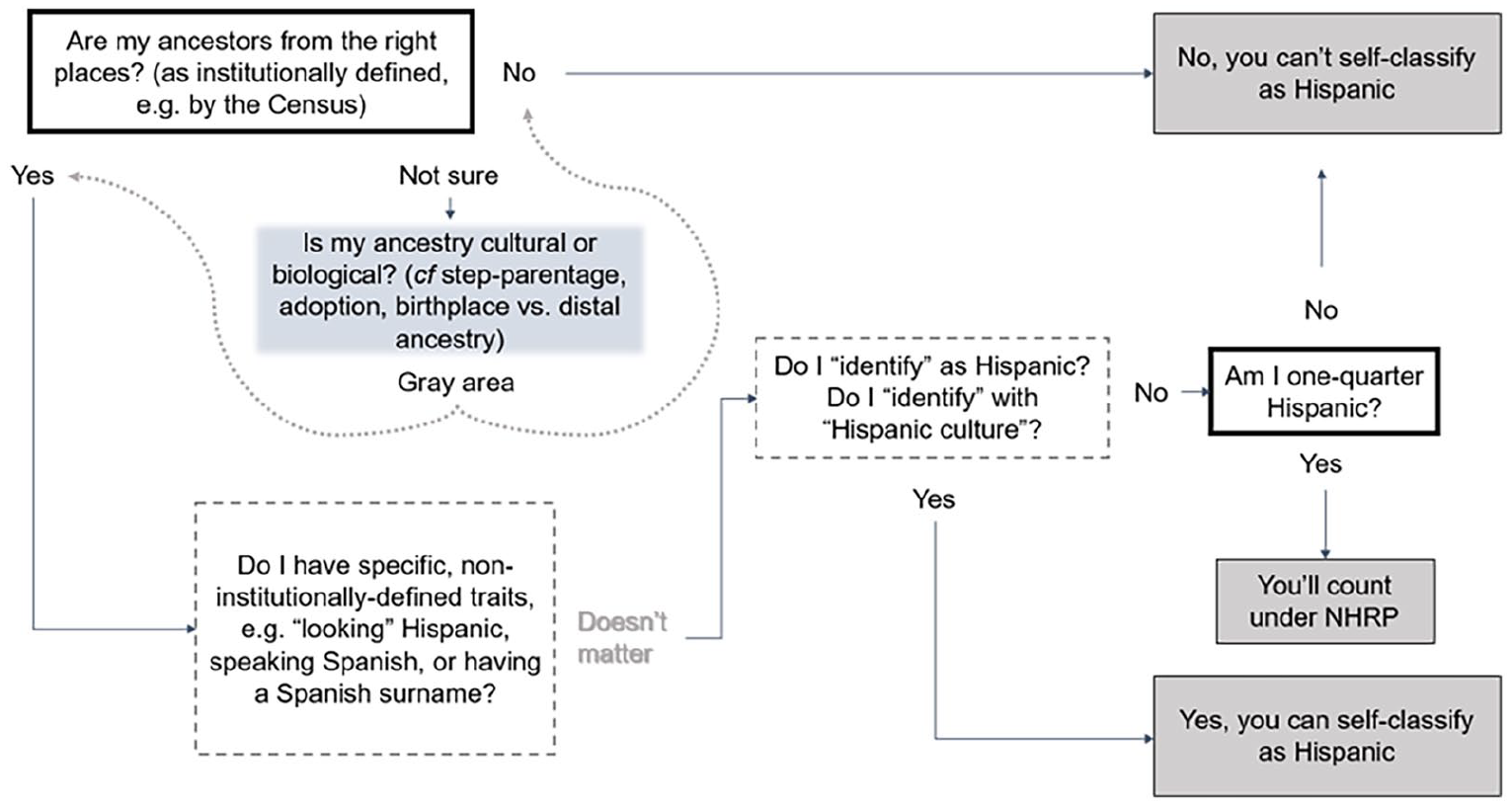
Forum users’ “am I Hispanic?” decision tree.
References to Identity and Culture, Vaguely Defined
True to Joane Nagel’s (1994) statement that identity and culture are “two of the basic building blocks of ethnicity,” these terms appear the most frequently in debates about what boxes an individual can or should check. However, forum users rarely define what they mean. This imprecision both gives room for individuals to achieve internal consistency between their self-classification and their self-identity and allows outsiders to interpret boundaries as being loose or porous.
The notions of identity and identifying are used liberally, typically to allow people to decide for themselves whether they can check off the Hispanic box. For example, in response to a poster who identified herself as Mexican-born and her husband as “white/non-Hispanic” and asked what boxes were appropriate for her daughter to check, one replier writes, “[Y]our heritage is what you believe it to be—so check the box that your [daughter] most closely identifies with. If she has not figured it out by now—this is the time to do so.” This particular replier did not leave any clues as to what might help the daughter decide if she “identifies with” a particular box.
In another instance, a user states that their ancestors were Mexican citizens prior to the founding of the Republic of Texas and have remained in Texas ever since. They ask for advice on how to categorize themselves. An ensuing exchange reads, in part:
“Do you self-identify as Hispanic or Latino outside of college applications or similar check boxes?” [. . .]
“Partly with traditions and celebrations however that’s not uncommon for Texans.” [. . .]
“If you can honestly say ‘yes’ [. . .] then it would be reasonably honest for you to say that you are Hispanic or Latino if you choose to indicate that.”
Repliers who give posters “permission” to check Hispanic most often do so because the poster has indicated that they self-identify as Hispanic. In contrast, they respond skeptically to posters who suggest that they have not previously identified as Hispanic. In other words, to use Wendy D. Roth’s (2016) multiple dimensions typology, repliers use the term “identity” to suggest that posters’ self-classification (i.e., what they check on the form) should match posters’ self-identification (i.e., what they subjectively think of themselves as).
“Culture,” too, is referenced, but imprecisely defined. In one exchange, a poster who considers themselves “half Caucasian and half Hispanic” notes that they plan to write about their “Hispanic culture” in their essays, but that they and their parents do not have Spanish last names. As a result, they fear that checking Hispanic would appear “fishy.” In reply, another user writes, “Hispanic is a cultural identification. People with all sorts of family names, facial features, skin colors, religions, and political orientations consider themselves Hispanic. Check the box and stop worrying about this.” In neither the post nor the reply is “culture” defined, except by what it is not—in this case, per the replier, culture does not include surname, phenotype, religion, or political orientation. Similar statements about “Hispanic culture” appear frequently throughout the dataset, with no elaboration on what “culture” means; for example, “One is seen by colleges as Hispanic if one comes from a Hispanic culture,” and “If you identify yourself with the Hispanic/Latino culture, then it is perfectly fine to mark your ethnicity as Hispanic/Latino.”
When users do elaborate on “culture,” they typically draw on references to food, holiday, and music—markers that are reminiscent of symbolic ethnicity, that is, voluntary claims of ethnicity that are clear, visible, and easily expressed, but that do not interfere with other aspects of life (Gans 1979). For example, one poster, identified by his username as a father, writes that his son grew up exposed to his mother’s “Hispanic culture (food, traditions, parties, futbol, Spanish mass, etc).” However, the father is concerned that the son more phenotypically resembles himself, with “very fair skin.” Repliers respond by reassuring the father, as follows:
It sounds like your [son] was exposed to his wonderful heritage and feels comfortable in all types of settings. Just from my corner, it’s not appearance, it’s identity and engagement. [My c]hildren definitely identify with our culture especially since their grandfather (my dad) is a Professor of Chicano Studies.
These responses validate the father’s use of culture, which draws primarily on symbolic claims; they also connect culture to self-identity.
The nebulousness of forum users’ appeal to “culture” is perhaps unsurprising, echoing how political stakeholders in the development of the Hispanics category similarly drew on broad and generalized appeals to culture. Undefined or primarily symbolic definitions of “culture” can elide phenotypic, national, and class differences, enabling actors to use the category’s fuzziness to their benefit (Mora 2014). In this case, the flexibility of “culture” allows users the freedom to define what it means to “identify” with Hispanic “culture” and thus to self-classify as Hispanic. However, this flexibility is bound by more rigid criteria, which I turn to next.
The Rigid Institutionalized Boundaries of Ancestry
Although forum users reference “culture” and “identity” to allow people to self-classify as they wish, these notions are superseded by ancestry, which does form a rigid boundary around Hispanic self-classification. Moreover, whereas “culture” and “identity” are generally uncontroversial, what counts as “ancestry” is the true subject of debate in the forum.
Users refer to where they, their parents, and other relatives are born or are from, and appear to be influenced by institutional definitions. Specifically, the Common App and the U.S. Census both list geographic origins in their questions about Hispanic background. If an applicant marks “yes” to “Are you Hispanic or Latino?,” they see a follow-up question that asks, “What best describes your background?” with the options, “Central America, Cuba, Mexico, Puerto Rico, South America, Spain, Other.” Likewise, users regularly cite definitions from the U.S. Census and other government agencies. The ability to trace one’s ancestry back to one of these places is thus seen as relevant to answering “yes” to the original question.
In addition to the Census, users turn to the College Board’s National Hispanic Recognition Program (NHRP). The NHRP invites Hispanic students who score well on the PSAT to apply for the award, which can then be listed on college and scholarship applications. To determine eligibility, the NHRP uses the criterion, “at least one-quarter Hispanic/Latino and originally from or descended from inhabitants of at least one of the following countries,” followed by a list of 22 countries. 8 Many users therefore refer to this one-quarter definition or otherwise define themselves using specific percentages or fractions. For example, one parent writes, “I’m 1/2 hispanic—born in South America to South American father and European mother, raised in bi-lingual household. My son is 1/4 hispanic.” Another user asks, “If an individual is 1/8 Mexican and 7/8 White, but was raised celebrating their Mexican heritage and Mexican culture, are they allowed to mark Hispanic on their college application?” Some responses to these claims reference the Census’ lack of a one-quarter criterion, suggesting that users are not beholden to the NHRP’s requirement; however, no user suggests that the NHRP’s definition is illegitimate.
The primacy of ancestry has such a strong hold that one user, a parent, received an unusual amount of pushback for asking whether their daughter could self-classify as Hispanic. This user explained that they, the parent, were born outside of Spain but lived there for eight years while growing up. The parent remained close to their Spanish friends and thought of their friends’ children as their daughter’s “Spanish ‘cousins.’” The daughter, who the user identified as “part-Asian,” lived in a predominantly Latino area and was commonly assumed to be Latina. Finally, the parent and daughter frequently conversed in Spanish.
Despite this parent’s lengthy reasoning, they faced an unusual amount of resistance from repliers on the thread, largely due to perceptions of the daughter’s lack of Spanish parentage. Although the overall trend on the forum is for users to define culture and identity in ways that maintain a porous boundary around Hispanic, this thread makes it clear that ancestry forms a rigid outer boundary, preempting claims to culture. Responses on this unusually long and heated thread include:
Our family has lived as expats in a number of different countries. That doesn’t change our ethnicity. [F]or [admissions committees] to consider her so strongly influenced by another culture that she identifies herself as part of their group and its essence, she has to do a lot more than have friends, travel and one parent lived in Spain. She is socially connected, she feels it, but she is not it. She goes home to her own family with its own identities and histories. I can be fond of other cultures, languages, or national origins, I may have lived with or near those other cultures, but none of that changes who my ancestors were. [The poster’s] daugther is welcome to talk about how much she loves her Hispanic friends and their culture. She can talk about special aspects of the culture that she embraces, enjoys and identifies with. Up to that point, everything sounds genuine. Anything beyond that would be a flat out misrepresentation.
Although the user’s daughter may meet the criterion of identifying with Hispanic culture, repliers perceive her as lacking the baseline criterion: ancestry. Moreover, these examples demonstrate that ancestry is the true subject of discussion. In this particular case, users are clear that living abroad does not count as ancestry: While the daughter may have culture, identity, and language, she does not have ancestry. In other cases, which I turn to next, the definition is less clear.
The True Debate: Is Ancestry Cultural or Biological?
If users demonstrate ancestry in accordance with institutionalized definitions, then these claims are validated by other users. Yet several threads show that what counts as demonstrating ancestry is the true subject of debate. Moreover, these examples show that although users intellectually understand that Hispanic ethnicity is “supposed to be” about culture and identity, they also default to thinking about biological inheritance. In this section, I report three examples of situations in which forum users debate cultural versus biological ancestry: a blended family, adoption, and birthplace versus distal ancestry (cf. Schut 2021).
In the first example, one user asks whether they can self-classify as Hispanic on the basis of their step-grandmother, who is “completely” Cuban and “doesn’t even speak English.” However, the user is also concerned that admissions officers will view them as suspicious if they do mark “Hispanic.” Two early responses reassure the user, drawing on the expansive notion of self-identity, as discussed previously:
If you identify as hispanic, you’re hispanic! [. . .] PS, the questions are optional so no common app cop will come knocking on your door for a DNA swab of hispanic blood =p. It’s not cheating if your grandparents are Cuban and you identify with that culture, don’t worry.
Yet the idea of “blood” remains a concern for the initial user, who responds:
Because I’m actually not blood related with my grandma who is cuban but I feel myself that I am cuban since she is my grandma and I relate to Cubans . . . This is a tricky question.
Some people agree, believing that “blood” matters:
The reality is, what are your bloodlines? If you are 1/4 Hispanic by blood and have grown up with many of the traditions then you can currently mark Hispanic as well as Caucasian. If you are of European dissent (English, German, Irish, Welsh, Swedish, etc) however grew up in Mexico due to your fathers job, you are still Caucasian. You are Hispanic if your true grandmother (the one you are related to by blood) is Hispanic. Having a Hispanic “step-grandmother” who is Cuban most certainly does not make you Hispanic.
Ultimately, the user posts that they have made a decision:
I’ve decided that I’m not going to apply as hispanic. Although I follow all the traditions and identify myself as hispanic I have no blood relation to my hispanic grandmother.
Despite the decision, one more response appears before the thread ends: “Just go for it. Nobody is going to give you a ‘hispanic’ blood test.”
These exchanges show the user grappling with whether his identification with Hispanic culture outweighs his lack of a biological tie to his step-grandmother, with repliers falling on both sides of the debate. Ultimately, biology wins out for this user.
Adoption causes similar difficulties for another user, who writes in two separate threads that their mother was adopted by a “full Hispanic” man, with no knowledge about her birth father. The user’s mother advised them to self-classify as Hispanic, but they remain unsure whether they can do so based on an adoptive tie. In what follows, one replier draws on an expansive notion of identity to suggest that the user can, saying, “If you feel Hispanic, you are,” and the user responds, “I mean I honestly do feel Hispanic [. . .] It’s just I didn’t know if the fact that she was adopted meant that I’m not truly Hispanic.” However, neither specifies what it means to “feel” Hispanic. Instead, biology remains a subject of debate, with diverging responses, including:
I don’t think you can claim to be Hispanic by osmosis. Not being related by blood is a big stretch to call yourself Hispanic. You were raised as a member of an extended family of Hispanic heritage, whether blood or adopted. Family is family where I come from, and my (adopted) cousins are my cousins, we share the same grandmother, their respective (adoptive) moms are my aunts, my mom is their aunt [. . .] So, ancestry is more than blood line for me.
These responses implicitly contrast biology with environment, such as being raised in a Hispanic family and thus absorbing a Hispanic heritage through “osmosis.” The user reports that they ultimately decided to answer “Yes” for the question about Hispanic and “White” for the question about race and that the responses to their threads provided relief about their decision.
The third and final example of negotiations over what “counts” as ancestry is whether ancestry is defined by birthplace versus more distal ancestry (cf. Schut 2021). That is, does simply being born in a country (or having a parent or grandparent be born in a country) grant a person ancestry there? Or does ancestry require geographic ties over many more generations? One recent analysis of American Community Survey data found that for South American immigrants to the United States, those from Andean countries were more likely to equate birthplace with ancestry and were more likely to identify as Hispanic/Latino. In contrast, those from Southern Cone countries (e.g., Argentina and Peru), which have longer histories of immigration from Europe, were less likely to report birthplace as ancestry (Schut 2021). Indeed, exchanges within the forum data illustrate the uncertainty that those with origins in Southern Cone countries have when it comes to identifying as Hispanic. For example, one user posts about their family history, saying,
My moms parents both immigrated here from Argentina. However, I am white (and Jewish), and her parents, although born in Argentina, descend from Polish immigrants. I am conflicted as to if I should apply as Hispanic.
Although one replier objects, saying that “the OP has no ‘Hispanic’ genes,” the majority of replies validate that this person “counted” as having Hispanic ancestry; the question then became whether they identified with Hispanic culture, as in the following two examples:
It’s an ethnicity, not a race. So the question isn’t genes but culture/tradition. As noted you can mark Hispanic but if you don’t have any Hispanic culture that you can write about then it probably will not do you much good.
In this case, the majority of replies agree that it is normal for one’s South American ancestors to themselves have (implied White) European ancestors. However, as the response about “‘Hispanic’ genes” suggests, there is not a clear-cut consensus as to the point at which one’s lineage “becomes” Hispanic. This question is explicitly raised in the post about adoption described above, with one replier asking:
Another example: there are plenty of Germans who have lived in South America for generations. Do you consider them Germans or South Americans? At what point do they become so?
Similar questions are raised throughout the dataset not only by people whose families migrated from Europe to South America, then to the United States, but by people of Asian descent born in Latin and South American countries. These questions also reflect variation in individuals’ assimilation processes, whereby later-generation immigrants, as well as those who are racialized as White, may have more latitude in how they identify.
In sum, while ancestry itself is clearly required for self-classification as Hispanic, there is less consensus about who among these individuals “counts” as having Hispanic ancestry. Moreover, biological interpretations of ancestry appear throughout these debates, echoing, however problematically, the idea of “one drop” as historically defining Blackness in the United States.
Neither Necessary Nor Sufficient: Specific and Noninstitutionalized Traits
In contrast to culture, identity, and ancestry, traits that either are more specific (i.e., as opposed to the non-specificity of “culture”) or are not institutionalized in “official” definitions of Hispanic tend to be regarded as neither necessary nor sufficient for self-classification as Hispanic. Examples of these traits are speaking Spanish, having a Spanish surname, and phenotype, all of which are among the most frequently raised traits. Forum users perceive these traits as potentially bolstering one’s claim to Hispanic self-classification based on ancestry and culture, but as insufficient on their own. Moreover, not having these traits does not preclude a person from self-classifying as Hispanic.
Language is often meaningful to ethnic identity and its use can be a core component of boundary-making processes (Anzaldúa 1999; Soto-Márquez 2019; Telles and Sue 2019). In addition, Spanish surnames have historically been linked to Hispanic populations (Word and Perkins 1996). However, exchanges on the forum suggest that neither is required to self-classify as Hispanic. For example, one poster identifies as half-Brazilian and as Latina, stating, “brazil is in latin america.” However, she remains confused about the formal definition of Hispanic, asking, “Hispanic means you speak spanish and brazil speaks portuguese, but i (coincidentally) speak both of those languages (I learned Spanish in school, does this make any difference?).” In response, another user writes that since the question asks about Hispanic or Latino, and the poster identifies as Latina, she is within her rights to check the box. Moreover, the replier adds, “No, learning Spanish does not make you latina [smiley emoji] And you can be latino/a without knowing Spanish.” The first user appears to accept this response, thanking the replier.
Likewise, another poster asks, “I’m half Caucasian, half Hispanic and was wondering if I should check the Hispanic box on college applications. My last name isn’t Spanish, and neither are my parents’.” Several repliers assuage their concern, with one referencing William Blaine Richardson III, the former governor of New Mexico, as an example of a Hispanic man with “a very un-Hispanic sounding name.”
These findings could be interpreted as an artifact of forum users’ having an incentive to keep the Hispanic boundary loose, since doing so could allow them to also claim Hispanic identity for their own (or their child’s) perceived benefit. However, surveys of Latino adults show that the majority agree that speaking Spanish and having a Spanish surname are not required to identify as Latino (M. H. Lopez, Gonzalez-Barrera, and Lopez 2017).
Finally, phenotype frequently appears in the dataset, with users drawing on physical traits such as eye, hair, and skin color, with the latter being the most frequent. For example, one user identified himself as 50 percent Hispanic from his mom’s side but went on to note: “I have light skin and blue eyes and a very Irish name (dad’s side).” Often, however, phenotype is associated only with a particular “look” without specifying traits, as in the following three examples: “. . . since my mother is American, I look white”; “many of us [of Portuguese descent] are recent immigrants and even look Latino”; and “I live with my father and stepmother (white), but I look not-white.” These users do not specify what it means to “look white,” to “look Latino,” or to “look not-white,” but instead presume that readers share a common understanding of these groups’ phenotypes.
In the ensuing conversations, however, repliers generally agree that phenotype is not relevant. For example, in response to a concern from a father that his son would be accused of “gaming the system” by identifying as Hispanic despite his “complexion & facial feature,” one replier advises him, “Relax. We (Hispanics/Latinos) come in all kinds of shades.” Unlike discussions about what counts as ancestry, which generate more back-and-forth, these types of responses about phenotype do not provoke disagreement. Like language and surname, phenotype is neither necessary nor sufficient for self-classifying as Hispanic.
That said, while users agree that a Spanish surname is not required, some users suggest that it helps to morally justify Hispanic self-classification, since individuals with Spanish surnames may face discrimination on that basis. Other users also acknowledge that while phenotype is likewise not a criterion, it does shape individuals’ experiences of discrimination and consequently their sense of identity; recall that darker-skinned individuals tend to have fewer “ethnic options” (Telles and Sue 2019; Vasquez 2010). In general, however, experiencing discrimination is not itself a prerequisite, suggesting that users conceive of self-classification in terms of individual characteristics, rather than attending to broader systems of racial hierarchy or inequality.
Discussion
In sum, findings reveal norms used in the processes of self-classification and social appraisal, in a context in which multiple cues are available and elaborated upon. Open-ended notions of “culture” and “identity” allow people to self-classify in ways that are consistent with their self-identity. However, when institutional definitions of ethnicity are highly salient, this leniency is bound by strict adherence to ancestry criteria; that is, only within the bounds of ancestry are questions of culture and self-identity relevant. Ancestry itself is primarily based on institutionalized definitions of ancestry as pertaining to geographic origin; whether ancestry itself is a biological or cultural concept is more likely to be subject to debate, as revealed in discussions about step-parentage, adoption, and distal ancestry versus birthplace. Finally, noninstitutionalized, specific traits such as speaking Spanish, having a Spanish surname, and phenotype are more likely to be viewed as irrelevant. These findings have several important implications for our understanding of the norms people draw upon in defining and applying racial and ethnic categories.
Social Appraisal, Multiple Cues, and Shifting Logics in Self-Classification
This article reveals one way in which social appraisal manifests when individuals make self-classification decisions. While many college applicants likely self-classify as Hispanic without any reservations, users who ask for advice on this forum are often concerned that they will be viewed suspiciously if they do so. Moreover, some questions explicitly posit that applicants could benefit from self-classification as Hispanic, thus incentivizing a loose definition. Both the questions and responses thus attempt to view the issue through the imagined viewpoint of admissions officers—that is, is self-classification not only appropriate, but believable? Although college admissions may seem to be an unusual case, in that self-classification appears to have tangible consequences (i.e., it may be evaluated by admissions officers), the concern about believability is not exclusive to college admissions. Indeed, Wendy D. Roth and Biorn Ivemark (2018) find that social appraisal, or surviving others’ scrutiny, is one factor that affects whether people alter their identity choices on the basis of genetic ancestry test results (see also Khanna 2004). The present setting makes these considerations explicit in a manner not typically expressed in other settings. In addition, the data includes not only individuals’ concerns about others’ scrutiny, but how those others actually respond—in other words, the scrutiny is not just hypothetical, but real. Ultimately, despite assertions that “you are [Hispanic] if you say you are” (e.g., M. H. Lopez et al. 2020), “self”-classification can entail reflecting on others’ perceptions.
Moreover, the processes of self-classification and appraisal are not static, but are, indeed, processes. This is particularly evident in conversations around name and language—found to be influential in Ariela Schachter et al.’s (2021) experiment, but in this data, ultimately declared to be unnecessary. Many people on the forum do believe that language and surname could be relevant, which is why they raise it in their initial questions. What this data shows—that other studies often cannot—is the negotiation that leads people to eventually conclude that language and surname are not necessary for Hispanic self-classification. Studies about racial appraisal often ask people to make judgments based on a snapshot—reflecting interactions such as a store clerk encountering a customer, a hiring manager reading an applicant’s name, or a police officer pulling over a driver. Some studies also include important physical cues (e.g., skin color) that are absent on a digital forum. However, these snapshots do not capture shifts in people’s appraisals based on discussion or on learning more information—for example, reading a personal statement that elaborates on a student’s ties to Hispanic culture. This case therefore builds on previous work identifying what cues are relevant, to add how people interpret and shift their understanding of those cues through discussion. In doing so, the findings lay bare the socially constructed nature of racial and ethnic categories.
The Enduring Importance of Ancestry
Examining the process of social appraisal also reveals the enduring importance of ancestry in how people conceive of the boundaries of Hispanic identity—a second major contribution of this article. This finding lies contrary to a recent conjoint experiment, which found that ancestry was critical for White respondents to categorize hypothetical profiles as White, Black, Native American, and Asian, but ancestry was not critical for Hispanic categorization; instead, name and language were more influential factors in Whites’ categorization of profiles as Hispanic (Schachter et al. 2021). I find the opposite: ancestry forms the most rigid boundary for Hispanic self-classification; name and language are viewed as irrelevant.
One possible factor in this discrepancy is that Schachter et al. operationalize ancestry as the results of a genetic ancestry test, with “Mixtec/Mayan” standing in for Hispanic ancestry. In contrast, forum users typically operationalize ancestry as geographic origin, by way of U.S. Census and other institutionalized definitions, which are perhaps more salient in the admissions context than in others. Moreover, those who are certain about how they self-classify may be less likely to look to these definitions. In addition, though genetic ancestry tests are rapidly growing in popularity, laypeople could be more accustomed to geographic origin as the standard for Hispanic ancestry. A second possible factor is that Schachter et al. use name and language as sociocultural cues. In contrast, forum users do draw on culture, but typically do not define it; when they do, they most often draw on symbolic cues, such as traditions and food. Thus, the ability to define “culture” broadly in the context of an open-ended forum may make users less likely to rely on narrower cues of name and language.
Instead, the question is not whether ancestry matters in defining Hispanicity’s outer boundaries—it does—the question is how ancestry is defined. This debate, in turn, reveals two possible meanings of ancestry when it comes to ethnicity: cultural ancestry, or the passing-down of cultural traits, versus biological ancestry, or genetic ties over generations. Whereas racial ancestry has previously been divided into the dimensions of known ancestry (based on family history) and genetic ancestry (based on genetic ancestry testing) (Roth 2016), the cultural and biological ancestry dimensions revealed in this data reflect debates on whether Hispanic is an ethnic category, a racial category, or both. These differing interpretations of ancestry suggest that researchers must be deliberate when operationalizing ancestry in experimental work. They also suggest that survey results about individuals’ origins—like that of the American Community Survey, which asks “What is this person’s ancestry or ethnic origin?”—should be interpreted as having multiple possible meanings. Future work could directly compare competing conceptions of ancestry, as well as qualitatively assess how laypeople understand it.
Finally, many of the examples discussed in the findings involve people with multiple ancestries—a population that is rapidly growing in the United States. One interpretation could be that none of these posters would ordinarily self-classify as Hispanic but are considering doing so solely to achieve an alleged boost in admissions. Many indicate partial White ancestry, consistent with scholars’ observation that Latinx identity in higher education often privileges Whiteness, with the consequence of erasing Indigeneity and Afro-Latinidad (Clealand 2022; Vega, Liera, and Boveda 2022). Certainly, some posters are explicit that their rationale is instrumental. However, others appear to genuinely grapple with the question. Indeed, in studies where respondents had no material incentive to self-classify in a particular direction, data shows that identity remains fluid for many adults of multiracial backgrounds (Horowitz and Budiman 2020).
As the share of Americans with mixed ancestries continues to grow, the types of questions presented here will also grow in relevance over time. The 2020 Census revealed significant changes in Americans’ self-classification, with four times as many people identifying as multiracial as did in 2010. Shifts in how people think about their ancestry—rather than, for example, shifts in how people think about language or surname—will likely be the drivers of future shifts in self-classification.
Footnotes
Acknowledgements
I gratefully acknowledge Maria Abascal, Jennifer Lee, and Wendy Roth for their support and critical feedback. Larry Au, Jordan Brensinger, Anna Hidalgo, Francisco Lara Garcia, Kathleen Griesbach, Greer Mellon, Adrianna Munson, and Nicholas Pang provided helpful comments on earlier drafts.
