




Abstract
Within America’s racialized social system, White people can generally navigate life as “unmarked,” oblivious to race. But for White parents of Black adopted children, everyday public interactions provide occasion to directly and vicariously experience a form of “racial gaze,” specifically via scrutiny directed toward them as parents and the bodies of their Black children. Drawing on 46 in-depth interviews with White adoptive parents of Black children, and incorporating insights from whiteness theory and research, I analyze how White parents perceive and respond to racial scrutiny. Parents describe how their ability to raise Black children feels challenged through unsolicited advice about haircare, negative comments, and perceived disapproving looks from Black strangers. These interactions provoke parents’ insecurity and anxiety such that they become more aware of their own whiteness and thus less “colorblind” than they might have been otherwise, while also resenting Black strangers for implicitly challenging their parenting abilities or the appropriateness of their parenting Black children. Findings provide novel insight into ways White Americans respond to the subjective experience of racial gaze. Given expectations of universal white innocence, competence, and colorblindness, they react with increased anxiety, hyper-vigilance, and greater guardedness around Black Americans in public to the point of resentment.
Being watched in public—whether within the context of police profiling, being followed around a grocery store, receiving glares as part of an interracial couple, or simply being in a “white-space” (Anderson 2015)—is one of the most fundamental, salient, and ubiquitous experiences known to Black Americans (Anderson 2015; Du Bois [1903] 1990; Feagin 1991; Hughey 2010; Rabelo, Robotham, and McCluney 2021; Yancy 2008). Beyond the obvious immediate consequences of white surveillance (e.g., being harassed, arrested, brutalized, or shot), Black people also experience the distal consequences of this surveillance in the constant awareness that they are being surveilled.
Research on the lived interiority of this experience, and its consequence in Black lives, has often drawn on what Frantz Fanon (1952; see also Yancy 2008) called “white gaze.” This refers both to (a) the experience of knowing that one’s Black body is being scrutinized by White people in public settings, and being defined as “other,” deviant, and inferior, and (b) how this perception is internalized, holding the power to alter one’s behavior. Like Fanon, numerous other studies have described Black Americans’ perceptions of their own bodies being surveilled by White people as provoking a variety of responses from compliance and conformity to social anxiety, shame, resentment, rage, hyper-vigilance and, for some, mental and physical illnesses (Anderson 2015; Feagin 1991; Grier and Cobbs 1992; Harris 2008; McCabe 2009; Rabelo et al. 2021).
While there remains a need for further understanding the consequences of white gaze for Black persons and other persons of color, a related, and largely unexplored question is how White Americans themselves react when they perceive they are experiencing racial gaze? Within the American racial system, White people are generally able to travel through life as “unmarked,” and oblivious to race (Edwards 2008; Hartmann, Gerteis, and Croll 2009; Mueller 2017). Moreover, White Americans often expect to be shown deference by racial minorities in public settings (Anderson 2015) or personal interactions (Feagin 1991). The felt experience of white normativity carries with it the “psychological wage” associated with security and control (Anderson 2015; Bonilla-Silva 2018; Du Bois [1935] 1992:700). But how do white Americans subjectively experience and respond to situations in which they perceive that their own white bodies are being scrutinized by non-white Americans and judged as “other” or incompetent? How do they internalize this perception, letting it shape their behaviors? Beneath this, what might White Americans’ interpretations of these situations, and subsequent reactions, reveal about their underlying racial assumptions?
This study explores these questions by drawing on in-depth interviews with 46 White adoptive parents of Black children in which they describe their interactions with both Black and White Americans in public. To be clear, I in no way suggest an equivalence between the (perceived or real) micro-aggressions that Black and White Americans report. Yet the accounts of these White parents provide novel insight into the dimensions of “post-racial” colorblindness and “hegemonic whiteness” (Hughey 2010; Lewis 2004) by highlighting White Americans’ extreme sensitivity and insecurity regarding the subject of their own whiteness as well as with reminders of their child(ren)’s Blackness.
White Normativity, Perceptions Of Victimization, And White Experiences Of Racial Gaze
There are no social situations in which the perception of racial vulnerability is completely reversed, given the historical dominance of White Americans in society at large, their unequivocal control over “legitimate” use of force, and concomitant expectation of white normativity and preferential treatment (Hughey 2010; McDermott 2020; Mueller 2017; Perry et al. 2023). However, these very racial realities make the unique situations where White Americans feel “under the racial microscope” all the more fruitful to consider. Because White people so rarely find themselves in such situations (Christerson, Emerson, and Edwards 2005; Edwards 2008; Hagerman 2018; Robnett and Feliciano 2011; Yancey and Lewis 2009), the feeling of involuntary and unavoidable observance by racial “others,” the experience of “racial gaze,” can bring into greater relief White Americans’ perceptions of themselves and those observing them.
Research on White experiences within interracial contexts shows an underlying assumption is that, given white normativity, White people will be viewed as morally upright, competent, and culturally superior if not at least the cultural standard (Edwards 2008; Hagerman 2018; Hughey 2010; Lewis 2004; McDermott 2020). The expectation that accompanies these assumptions is that White Americans should always feel relaxed, like they can just be themselves. In contrast, Black Americans must always consider how they are making White people feel. In their recent analysis of Twitter data, Veronica Caridad Rabelo et al. (2021) document how Black women’s moods, demeanor, and appearance are constantly scrutinized, applying pressure to both self-consciously encourage White people with smiles and affirmation, while also conforming to White cultural preferences of dress and hair (see also Wingfield 2010). White Americans, on the other hand, are not only less likely to be surveilled in almost any context, but even in their mistakes they are given the benefit of the doubt and allowed to be imperfect, whole human beings, in ways that people of color are often denied (Wilderson 2020). Indeed, research on White Americans involved in antiracism work shows White activists often insist their motives are beyond questioning, which limits their ability to accept critique or leadership from non-Whites (Ford and Orlandella 2015; Kleinman 1996).
Assumptions of white normativity, competence, and moral goodness also shape White Americans’ beliefs of how much race should matter and their own feelings of victimization or “reverse racism.” Kayrn D. McKinney (2003, 2013), for example, describes the experiences of White people who perceive they are in the numerical minority and resent having to adjust their cultural norms, making them feel like targets of racial scrutiny. Other research suggests white perceptions (or fears) of racial victimization likely motivate White Americans’ insistence on being “colorblind” (Hartmann et al. 2017; Knowles et al. 2009).
Unpacking rare experiences of White Americans in numerical-minority situations, several scholars (Hall and Closson 2005; Jackson 1999) focus on White students at historically Black colleges and universities (HBCUs). White students describe being nervous, apprehensive, and feeling disconnected from the Black community around them. Ronald L. Jackson (1999) also found White students at HBCUs assumed the universality of their own norms and preferences, which often led them to feel defensive for challenging their colorblind assumptions. White experiences in White-minority religious organizations reveal similar assumptions about disproportionate influence, normative moral goodness, and extreme defensiveness when challenged or made aware of racial realities (Christerson et al. 2005; Edwards 2008). These patterns may explain why studies show interracial relationships often do not produce white antiracist frames among White Americans (Byrd 2014; Cobb et al. 2015; Edwards 2008; Perry 2017; Twine 2010). In the situation of White parents of Black adopted children, the perception of racial scrutiny provides yet another complicating factor—that of White parents being made aware that their Black children are under surveillance, and by extension, they are also being scrutinized.
Tensions Over White–Black Transracial Adoption And What Public Interactions Can Reveal
The adoption of Black children by White parents has most powerfully shaped the image of transracial adoption in the American imaginary (Barn 2018; Dorow 2006; Laybourn and Goar 2022; Smith, Jacobson, and Juárez 2011; Woodward 2016). Part of this is because the Black–White binary in the United States has long served as the archetype for racial conflict. White Americans exhibit relatively less social distance between themselves and Hispanic and Asian Americans in terms of romantic partners or family members (Robnett and Feliciano 2011; Yancey and Lewis 2009), and Black Americans have historically been understood to be at the bottom of America’s racial hierarchy and “unassimilable” due to the legacy of the one drop rule (Bonilla-Silva 2018; Laybourn 2021). In fact, anti-Black stereotypes often hinder White parents from pursuing African American children adoption in the first place over other minority children overseas (Khanna and Killian 2015; Kubo 2010; Woodward 2016). Thus, the idea of transracial adoption involving White parents and Black children suggests not only racial contrasts and stereotypes but also parent–child power dynamics and questions about racial paternalism and culture.
Moreover, because child adoption most often takes place in a situation where living birth parents have either placed their child for adoption, or have had their parental rights terminated by the state, the adoption of Black children by White parents also carries with it questions about racial inequality, poverty, and the circumstances that create fragile families (Barn 2018; Goar, Davis, and Manago 2017; Jennings 2006; Laybourn and Goar 2022; Smith et al. 2011; Woodward 2016). It was that reality that gave rise to the famous position paper by the National Association of Black Social Workers (NABSW 1972:1–4) that argued “Only a Black family can transmit the emotional and sensitive subtleties of perception and reaction essential for a Black child’s survival in a racist society.” They concluded, “a white home is not a suitable placement for Black children and contend [transracial adoption] is totally unnecessary.” They instead recommended more effort be made to preserve Black families and recruit Black adoptive parents.
Research on the experiences of White parents of Black adopted children has highlighted several themes. Early thinking on transracial adoption was characterized by White parents minimizing racial and ethnic identity (Goar et al. 2017; H. Jacobson 2008; Patton 2000; Smith et al. 2011). However, as colorblind thinking has been problematized, White Americans who adopt transracially are more often confronted with the salience of racial identity and racism (Goar et al. 2017; Hill and Thomas 2002; Laybourn and Goar 2022; Smith et al. 2011). Yet studies also find that White adoptive parents of Black children often do not have extensive relationships with Black families or communities, and instead draw ideas about “culture keeping” from stereotypes or media representations of Black Americans (Bashi Treitler 2014; Laybourn and Goar 2022). Ravinder Barn (2018) describes White adoptive parents intentionally pursuing relationships with Black Americans for tips on hair and skin care, but not to understand the historical importance of hair care for the Black community or what a Black child’s hair may signify about one’s parenting (see also Russell, Wilson, and Hall 1992; Smith et al. 2011).
Other factors distinguish the experiences and perceptions of White parents who attend “culture camps” or pursue interracial “social capital” from those who interact with the Black community in public spaces. The former interactions are not only voluntary and thus reflect considerable self-selection, but they are undertaken on White parents’ terms. Moreover, interracial contexts or friendships that White Americans intentionally self-select into allow White parents to anticipate the “racial gaze” of others and engage in iterative impression management. The experience of interactions in public or semi-public spaces provides an ideal context to analyze how White Americans interpret their perceptions of racial gaze in situations of undefined racial power and when the prospect of successfully managing impressions about their parenting is more daunting.
Method
Data Collection
Various research methods have been fruitfully employed to understand the dynamics of transracially adoptive families, including content analyses of online forums (Quiroz 2007), participant observation (Jennings 2006; Patton 2000; Raliegh 2018), and, to the extent that data are available, survey analysis (C. K. Jacobson, Nielsen, and Hardeman 2012; Perry 2017). However, in-depth interviews are a historically common method because they provide interviewees the opportunity to articulate their own perceptions and experiences. Thus, they are not only an effective means of answering questions like those of the current study, but they represent a particularly empowering approach (Barn 2018; Goar et al. 2017; H. Jacobson 2008; Laybourn 2021; Laybourn and Goar 2022; Smith et al. 2011). My analyses draw on data from semi-structured, in-depth interviews with 46 White adoptive families of Black children, taken from a larger sample of 87 adoptive families (Perry 2017).
Data collection for the overall project began in Summer 2013 and continued iteratively until 2017. I employed a combination of purposive and snowball sampling to select interviewees. Because racial interactions and attitudes often vary by region of the country, I sought to achieve a large measure of regional diversity in my sample. I started with one or two families I knew through previous connections in each region, and I asked these families to connect me with other adoptive families in each area to interview. Adoptive families were often quite enthusiastic about being interviewed for the study, with only one family declining to participate.
Interviews were occasionally conducted with the adopted children present (if they were infants or toddlers), but most interviews were conducted with only the parents in the room. Interviews were conducted in person (N = 32), over video call (N = 12), and only occasionally over the phone (N = 2). Interviews lasted anywhere from 1 to 3 hr, with the average interview lasting a little over 1 hr. Interview questions included social backgrounds and life experiences of the parents, religious commitments and communities of support, the adoption experience itself, and day-to-day life since the adoption. The latter sort of questions were left open-ended such as “What have your experiences been like in public with your [child(ren]?” Questions about issues of race, perceptions, and reactions were most often asked as follow-up questions, not originally part of the interview protocol. Interviews were conducted and digitally recorded by the author, professionally transcribed, and cross-checked for accuracy.
Sample Characteristics
Sample characteristics are shown in Table 1. Families were primarily from Illinois (N = 17), Texas (N = 11), Georgia (N = 9), and Ohio (N = 3), but 6 were from other states as well. The sample of 46 parents also included 12 interviews with adoptive parents who were leaders of adoption and foster care organizations or authors of popular books on these subjects. Unlike the other parents who were recruited through snowball sampling, these parents were initially contacted because of their adoption or foster care advocacy but were also asked questions about their parenting experiences. Analyses did not suggest their organizational or advocacy roles shaped their responses to experience-specific questions.
Parents Interviewed.
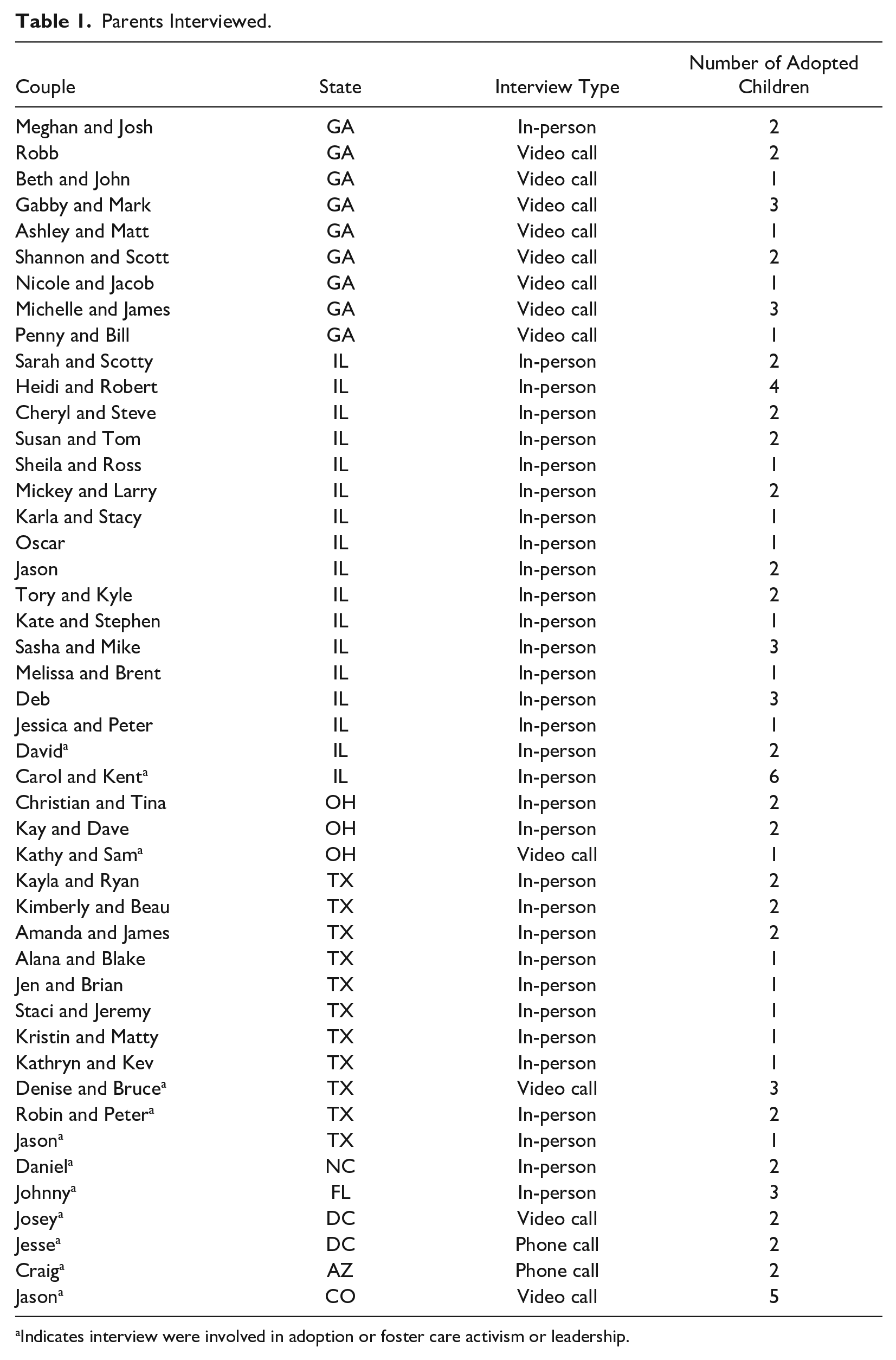
Indicates interview were involved in adoption or foster care activism or leadership.
The majority of the interview sample consisted of married, college-educated parents. Only one of the couples was lesbian and married, and the rest were heterosexual and married. All parents were White. Most of the Black adopted children were from foster care, though a large minority were adopted from Africa (primarily from Ethiopia, but also South Africa) or adopted through a private agency. Adopted children ranged in age from infant to young adult, with the vast majority of adopted children in the families being under 10 years old. Families were a mix of those who already had their own biological children, had biological children during or after their adoption of Black children, or only had adopted children.
Data Analysis
I used sensitizing concepts from previous research, and I analyzed and coded my interview data, line-by-line, along with a variety of salient themes. While I do not present the contrasts in this study, I used my interviews with families of non-Black children (Hispanic, Asian, and White) as a comparison to see whether the patterns I observed among parents of Black adopted children were unique or fairly common to adoptive parents in general or transracially adoptive parents. The emerging themes revolving around racialized bodies, hair care, and tensions involving White–Black transracial adoption made apparent that the experiences of White adoptive parents of Black children are unique among adoptive parents. My presentation of findings focuses exclusively on the interviews with the 46 families of Black adopted children.
Positionality Statement
As is often the case in studies of adoption (Dorow 2006; Laybourn 2021; Perry 2017; Quiroz 2007), the author has a personal connection to the topic. Being raised as a White person in an adoptive family with Black siblings, this undoubtedly drew my interest to the subject and made me sensitive to issues that families might experience. But I also felt that being open about my experiences with transracial adoption helped put participants at ease to share their own experiences.
Public Interactions and White Experience Of Racial Gaze
White parents repeatedly recount what they perceive as racially motivated challenges to their parenting ability in the form of unsolicited advice from Black strangers, or what they perceive to be negative comments or disapproving looks from Black strangers in public settings. White parents linger in thought on these interactions and internalize them, such that even the threat of similar future interactions with Black people in public provoke insecurity and anxiety. They describe becoming constantly vigilant about how Black strangers are viewing them both in-relation-to their children and through their children’s appearance while also resenting and fearing the Black community for calling attention to their whiteness and implicitly challenging their parenting ability. In this unique situation where White Americans themselves experience a form of racial gaze, their self-described perceptions and reactions―greater anxiety, hyper-vigilance, resentment, and guardedness around Black people in public―underscore the generalized assumption of white competence (in this case, at parenting Black children). These reactions also suggest that perceived challenges to these assumptions ironically create greater distance between them and the Black community, despite the Black child in their home.
Perceived Judgments on One’s Parenting Abilities
One of the most consistent stories reported by White adoptive parents, and particularly mothers, is the experience of receiving unsolicited advice and feedback from Black strangers (almost always women) in public spaces about their Black children’s hair. Commenting on the randomness of these interactions, Amanda, a White mother with a Black adopted daughter in Texas recounted “I had a lady come up at Chick-Fil-A and say, ‘Hey you shouldn’t put a headband on her hair, because it’ll break.’ And I’ve had people run me down in the parking lot and give me advice.” Some White parents recount these experiences as merely annoying, while others found them offensive or unsettling. Almost all parents described this as a normal occurrence that happened often enough that it required them to think twice about leaving the house with their Black children if their hair was not styled well-enough to where they could avoid comments from strangers. Sarah, an adoptive mother in Chicago elaborated, You definitely get the strange looks, and always got people telling me how to do [my daughter’s] hair, and that kind of stuff. But that’s always . . . everywhere I go. I’m like I have been doing her hair for eight and a half years. I do know how to do it, it’s just not been a good day. (laughs) You know? I just didn’t have time to make it look perfect today or whatever. And so [my daughter] sees that kind of stuff and is like “Why are [Black strangers] so concerned about my hair?”
At the end of this quote, Sarah points out that her daughter also noticed being scrutinized by strangers, but recognizing this was uncommon. White parents nearly always focused on how perceptions of racial gaze, even when directed toward their children, reflected on them personally. A number of families described these unsolicited public interactions with Black strangers as stressful or frustrating. Jen and Brian are a White couple in Texas, living with one biological daughter and one Black daughter whom they adopted from foster care. They explained,
The most frustrating thing is when Black women—strangers, start giving me advice. I’m like, “I’m not an idiot. I’m doing my research.” And [my daughter’s] hair will look great, and everything will be perfect, but they all come give me advice.
Or sometimes [my daughter’s] hair doesn’t look great and the assumption is it’s because I don’t know how to do it, not because I just didn’t do it that way.
Right, yeah. I was lazy that day. Whereas if I was Black and I didn’t do it that day, no one would [say anything]. And I have one friend who is adopted, and she’s like, “Oh, I think it’s so sweet that they want to help.” I’m like, “Oh, that’s great of you. I think it’s frustrating. Because they treat me like I’m ignorant.”
Just as in both accounts above, most White parents resented the implication that they did not know how to do their Black daughter’s hair and were quick to point out in the interview, and sometimes to the Black strangers giving advice in the moment, that they might have just been too busy to do it, or felt lazy that day. Similar to accounts of white antiracists in Matthew Hughey’s (2010) research, Jen expresses her frustration with what she perceived as a double standard or a case of reverse-racism against her as a White woman. Specifically, she felt a Black mother would have been able to escape the public scrutiny directed at her daughter’s hair, while Jen as a White mother is not. This situation is particularly instructive because research on the importance of hair in the Black community and particularly among lower income populations as an expression of motherly competence suggests Jen’s assumption is quite wrong. A Black daughter’s hair would certainly be a matter of public scrutiny to the Black community and would reflect on the parenting abilities of the mother (Russell et al. 1992:81–93).
Gabby, a White adoptive mother of three Black children in Georgia elaborated on the frustration she feels with the pressure to have her children’s hair “perfect” as a reflection on her parenting: I have a (white) friend who doesn’t leave the house unless her (adopted) kids’ hair is perfect, because it’s a reflection on her, and I don’t really care. I mean, I go out in my pajamas, and if my kid’s hair is a little bit messed up, I don’t really care that much . . . I know how to do their hair. I know how to fix it. I don’t have a problem with it, but just because one morning we rush out the door really quickly, there’s an assumption there that I’m not doing something right because of the way that they look.
Beneath the implication that the White parents did not know how to fix their Black child’s hair, White parents suspected this was merely an expression of Black Americans generalized and deeper assumption that White people are unfit parents of Black children. Thus, White parents perceived Black strangers’ attention to their children’s hair as a micro-aggression and subtle challenge to their parenting abilities. This often-elicited defensiveness and resentment on the part of White parents. Gabby and her husband Mark illustrate this perception and response.
I think it was last Christmas, I was in Waffle House, and I just had [my daughter] with me, and this (Black) lady came up to me and she started telling me how I needed to do her hair and keep her moisturized and stuff, and I was really offended by it actually, because it was a Sunday, and we had run late for church, and I just didn’t have time to really make it look nice, and this lady just would not stop talking to me about it, and I felt vindicated, because it was like two or three days later we were walking into Walmart, and I had put some twists in [my daughter’s] hair so it looked really nice, and I saw [the same Black lady] walking out of Walmart as I was walking in, and she recognized us, and I looked at her and I said, “See, I do know how to do hair!” And I mean, I was being kind of rude about it, but she was just so pushy about—a lot of it has to do with hair. Even with [my son], you know, making sure that the lines are straight and stuff. Random (Black) people around town, they just see him as not having his lines straight on his head. Who cares? But [Black strangers] do, and it’s very important to them.
It is important, but I don’t think it’s necessarily about the hair. I think what [Black strangers] might think, so I’m maybe assuming here, is that well, if you can’t do the hair right, what else are we not doing right? So hair is something [Black strangers] can latch onto. It’s like well, it’s hair, this is horrible [said sarcastically]. It’s just something to point to as a reason we shouldn’t be [parenting Black children]. So that’s what they walk away with in their head.
Like Mark said, I think that’s just something physical for [Black strangers] to latch onto to talk about, and not really—without having to go to the deeper issue.
Mark admits that he is assuming what Black strangers who see his family in public spaces are thinking. Yet he and Gabby both agree that Black Americans believe White people should not be parenting Black children and Black strangers will scrutinize the hair of their Black children as validation for their belief.
Responding with Anxiety and Hyper-vigilance
A number of White parents recounted their fear of scrutiny from Black strangers in public spaces about their hair and described this as something that was a constant stress. When I asked Kayla, mother in Texas, whether she received comments on her daughter’s hair, she explained, Yeah, I do. Or looks. I have recently gotten a good [look], but yeah . . . That was tough with hair, as far as hair goes. Like I feel like when I know that I need to do her hair and people are going to be looking and stuff, so yeah. It’s a stress. Big stress.
Sasha, another mom talked about the perceptions involving her Black daughter’s hair causing anxiety, I would say that it makes me a little nervous, you know, if there’s someone that I don’t know—and I know that that’s a big deal in [the Black] community—if there’s someone that I don’t know and they come up to us like, in a restaurant and they want to see them, I immediately look at [my daughter] in particular—at her hair—and like, I want to lick my hand and smooth her hair down.
A number of the parents explained that the fear of judgment or scrutiny from Black strangers in public spaces was a major motivation for learning how to do their Black daughter’s hair well and made them hyper-vigilant about how their children appeared in public. Even when they did not understand why Black strangers would be so concerned with their daughter’s hair, avoiding their judgment was enough motivation to learn and perfect Black hair care. Ashley in Georgia, who initially felt consternation over the perceptions of Black strangers, beamed with pride in describing how her husband had become skilled in preparing their Black daughter’s hair: [We get] a lot of hair compliments, because my husband has taken it upon himself to learn how to do her hair. . . . [Hair] is one aspect that I feel self-conscious about, but that was more in the beginning, because now I know that [the daughter’s] hair does look good, but like, in the beginning I was like, you know, [Black strangers are] just going to look at her and say, oh, you know, “White lady’s trying to do her hair,” you know, type of a thing, so I’m very thankful that [the husband] sort of took that on and has practiced and practiced on it to be able to make it look really good. So I feel like I don’t worry about that anymore, but I did initially.
Importantly, Ashley projects that Black strangers would center the mother’s race (“White lady . . .”) in their negative evaluation of her daughter’s appearance, and it was this thought that formerly made her “self-conscious” and “worry” before her husband learned proper hair care.
Though White parents frequently recounted feeling stared at by Black strangers in public, not all of these parents interpreted the looks negatively. Yet even when they felt embraced by the Black community, they were still made ever aware of their own whiteness and their children’s Blackness by comments about their hair. Nicole and Jacob adopted a Black son from South Africa. Nicolle shared, I mean, we get looks. I don’t know what they are. I mean, I can make assumptions of what I think they’re thinking. We haven’t had any negative comments. I mean, [Black strangers] might say something about how soft his hair is or how manageable it looks, because he’s colored, he’s not Black South African, so he has white South African in his family line at some point, so his hair is a little bit different than other African Americans. But I would say on the whole, African Americans are like, all over him, they think he’s the cutest thing ever and just very sweet to us. And we live downtown, so our neighborhoods are Black so they all are awesome with him. We really haven’t had anything negative, but I just always want to be, I mean, [the husband] works in [the inner city school district] and had some comments before he came home from the women teachers—Black women teachers about, you know, “Make sure [the white mom] keeps his tape [fade] on up and make sure, you know, she isn’t or this and that.”
White parents were often puzzled by these public interactions, feeling unable to empathize with the importance of hair to the Black community, and wondering whether these interactions signified something else. A number explained how they depended on Black friends to help them understand something about the interactions and the Black community. These explanations seemed to make White parents both more understanding of the importance of hair, while also feeling a greater sense of scrutiny and wariness of Black strangers. For example, the feeling of being watched and judged by Black strangers was confirmed for Amanda, a Texas mother, by one of her Black friends: “I was telling one of my Black girlfriends about [a street interaction with a Black woman] the other day and she was like, ‘[Black women] are judging you, just so you know. They’re watching you’.” Beth and John, a couple in Georgia with an adopted African son, also recounted a Black friend explaining to them the importance of hair in the Black community: Taking care of African American hair is a big deal, so I try to be good about that and I think some of it’s—can be silly but some of it can be—I mean, I have a really great friend who’s African American who has known me a whole long time and she would tell me “That’s a big deal.” And now I notice when I see white moms with Black children and it makes me mad, because I feel like they aren’t taking the time to understand, you know, the [Black children’s] culture or how that is going to be a big deal for them when they get older or whatever—taking care of their hair. So it’s things like that we want to be aware of, but then we also don’t want to put too much stock into.
Ashley in Georgia recounted how she asked her Black friend why people in the Black community paid so much attention to her Ethiopian daughter’s hair: She just said your children are a reflection of you and for Black ladies, she said it is so hard for us to grow our hair out so we spend a lot of time getting things done to it and taking care of it and all that, so if the little girl’s hair is done well, then it just shows that you’re caring for them. And she just said to me people who don’t know [the children are] Ethiopian are going to—if they have any questions about why you have these Black children from their community, you know, they just—make sure you’re doing what you need to be doing with them and their hair is the most outward sign you’ve got, whereas for my white kids, it was making sure their faces were clean and their clothes matched.
Living in a society where White cultural values and preferences are taken as a given (Edwards 2008; Hagerman 2018; Lewis 2004; McDermott 2020; Perry et al. 2023), White parents of Black adopted children are often bewildered and frustrated by the experience of feeling scrutinized on the basis of their own race or their children’s Black bodies. For some, the Black emphasis on hair as an indicator of parenting quality seemed foreign and “silly,” which tended to make these White parents feel insecure and resentful at having their parenting judged by what they perceived as someone else’s standard. Others felt more understanding after the meaning of Black hair was explained by Black friends. But even these messages were held at a distance as Beth above explained, “So [the importance of Black hair] is something we want to be aware of, but then we also don’t want to put too much stock into.”
From Perceptions about Their Parenting to White Parents in General
White parents also described feeling “scowls” glares, or even direct confrontations from Black strangers upon seeing White parents with Black adopted children. These White parents interpreted these interactions as Black strangers disapproving of their parenting Black children. Some were more understanding of why Black Americans would feel negatively about White people adopting Black children, but all who recounted these interactions felt misunderstood and resentful that their intentions or abilities were questioned.
Some negative interactions revolved around scowls or stares White parents felt they received from Black strangers. While no words of disapproval were expressed by Black strangers in such instances, White parents felt extremely sensitive and bothered by these looks, and the disapproval they felt it signified. Kathy and Sam are a young couple from Cincinnati with a Black adopted daughter. Kathy recounted their experience at a restaurant: We’ve experienced some African-American people being really rude to us or hateful to us because we have [Black children]. We were in a restaurant and this family was really rude to us because we had this African-American baby. They were just, like, the woman kept like looking at us, and nearly like sneering at us, and I—God, I was wearing [my adopted daughter] in a little front pack carrier, and went to the restroom and came back, and her daughter said something about “Oh, what a cute baby,” and her husband then started making just some kind of clipped pleasantries, because I responded to the little girl, but the woman just continued sneering, and it was just the weirdest—I’ve never experienced this before.
This instance expresses the heightened sensitivity to perceived disapproval. Despite the Black mother saying no words, and her male partner and daughter complimenting the baby and making “pleasantries,” Kathy interpreted and summarized the exchange as “this family” being “really rude to us because we had this African American baby,” based solely on perceived “sneering” from the Black mother.
Other interactions went beyond perceived disapproving looks to insensitive comments or teasing. Tory and Kyle are a young White couple in Chicago with two adopted Black boys, one from Africa and the other from foster care. They described interactions on the street or bus, and how these were perceived as micro-aggressions calling attention to the racial disparity between them and their Black children, and implying disapproval. Kyle explained, I might notice (racial) things more than I used to notice, for instance . . . African Americans will perceive us differently depending on kind of—It’s almost more of an economic barrier more than a racial barrier, that we’ve noticed. So if Tory is on the bus heading to [lower income, urban part of town] she might get some comments made, like some less than positive comments in her hearing, you know? Whereas if we are in a middle class neighborhood, [Black strangers are] talking to the children.
So Kyle believes that it may be a combination of race and lower-income status that might influence certain Black strangers to make negative comments about Tory and her Black children within earshot. When I asked Tory about some of the negative comments she had heard, she recounted, I’ve heard things like . . . Well, the one incident Kyle is talking about is I was riding the bus with the boys, and there was a little (Black) boy who was probably seven or eight who very loudly was saying “You’re not his mom. How can you be his mom?” Which that didn’t bother me, because kids say things like that, but he had an adult with him, and instead of the adult saying—explaining it to his son, he just laughed, and so the kid just kept saying it louder, so then several people on the bus were laughing, and it was just kind of one of those uncomfortable situations of like, you know, really?
Later in the interview, Kyle recalled a few more instances, I remember pretty early on like a car full of girls drove by and said, “Where’d you get that baby?” and drove away. And we had someone say “Hey, they’re like Brad and Angie!” [laughs] That one made us laugh.
Later, however, Kyle explains they are more likely to experience negative looks than comments. When I asked him who these looks come from, he replied, “Mainly Black people.” Another couple in Chicago, Susan and Tom, recounted how their adoption of Black children had made them more aware of racial situations, particularly as it related to looks they received in public places: It’s amazing how much more in tune you are to other people when you’re out and about now that this situation has arrived . . . And it’s hard because you don’t want to indulge yourself in that or like, make things an issue that aren’t an issue, but it’s like—I don’t know, I just feel like you just have this radar on you of like, wanting to protect [the children], I guess. So it’s like, even though they’re going to have no idea what people’s looks mean right now, you know, if I’m standing in a grocery line or whatever and somebody next to me has like, this scowl on their face as they look at me, like—it’s just bothersome.
When I asked Susan and Tom who they received “scowls” from in grocery lines, the mother recalled, I feel like it’s a variety. I don’t think I could necessarily lump it into a . . . or make a generalization about the type of person. I remember that conversation came up [in one of our adoption classes] and I remember voicing in that class that I often feel more judged by African American people when I have [my children] and again, it might just be me imposing that upon myself, but often I just feel like I get more looks of disapproval from the African American community than from the white community.
I followed up this statement by asking why Susan felt like she might get disapproving looks from African Americans. She answered, I think part of it is just going back to some of the things that I feel like I’ve picked up on in some of the books is like—a white person not being able to raise them Black. So reading the interview of the person who goes through high school and college and is constantly having to deal with the notion of they don’t act Black, they don’t talk Black, they don’t look Black in their hair or whatever, so I think a big part of me holds on to that a little bit, like it’s like [Black strangers] don’t think I can raise [my Black children] the way that they’re “supposed to be raised” as a Black young man or a Black young girl. So I think that might be part of it. I think another thought that goes through my head sometimes is that maybe thinking that I’m [parenting a Black child] to get a pat on my back or to feel like I helped somebody and that goes through my head sometimes. Those are some thoughts that I have, whether those are actually what [Black strangers] are thinking I have no idea, but that’s what I think they might be thinking.
Like others, Susan acknowledges that she is interpreting “looks of disapproval,” based only on assumptions of what Black strangers may be thinking. But her assumptions center her as the victim of anti-white prejudice perpetrated by those Black strangers (assuming she cannot properly raise Black children or that she is parenting for self-serving reasons), who will dissect the racial performance of her Black children to draw their conclusions about her. Thus, the Black bodies of her children are objects of scrutiny, but ultimately extensions of the scrutiny she perceives as directed toward her.
Deb is an unmarried attorney in Chicago with three Black adopted children from Africa, all HIV positive from their birthmother who is now deceased. Deb reported similar perceptions of disapproving looks from Black women: I have gotten looks from some Black women who I think are not all that happy that I’ve adopted Black children and I get that, too, but I don’t get it. I can feel a little defensive. Like, sometimes if I get one of those looks, I want to say, do you want to adopt an HIV positive child from Africa who has attachment issues and has HIV? You know, because I think the answer would be no, and so I’m like—so no mom, or me? You know, it’s like that’s the defensive side of me, but on the other hand, I do understand again, in this country, culturally the Black world is different and so I think that a Black woman who’s giving me that look is wondering, “Is she going to introduce them, is that child going to be okay, are they going to be white in Black skin, are they . . .?” You know, all of those kind of questions. I get them, but I don’t—you know.
Deb expresses feeling “defensive” about the looks she receives from Black women, and inside she entertains the idea of challenging those women as to whether they would like to adopt children who are HIV positive. Yet, she is also sympathetic to the idea that they might be wondering if a White woman is going to raise the children with sensitivity to what it means to be Black in America.
Beneath these suspicions of Black opposition to White people parenting Black children were often stories of the NABSW’s (1972) infamous position paper. Most of these families could not recount the full name of the NABSW or even articulate the details behind their position on transracial adoption. All they understood from previous conversions with others was that the NABSW opposed transracial adoption, and by extension, Black Americans were also likely to oppose their adoption. For example, I asked Kathy from Cincinnati why she felt the Black woman had been sneering at her in the restaurant. She explained, After [the restaurant experience], we went to an [adoption] support group meeting at our church, and there was an African-American pastor on staff at the time, and he was talking about how I guess there was a big study in the 70s, and I’m going to totally butcher this, but he was talking about this study in the 70s where these African-American sociologists were essentially saying that giving African-American children to White families was like committing cultural genocide. And so then I just thought well maybe that’s still kind of the mindset with some people. Like then that attitude made a little bit more sense. Like maybe this is what they’ve been told, like they—I don’t know.
Similarly, Alana and Blake, a Texan couple with a Black infant daughter recounted, The case worker that was assigned to this—the case was African American and our—our attorney told us that she was very upset about the adoption in the sense that, we’re a white family adopting a Black baby and that, you know, there is a National Association of Black Social Workers, I guess whose goal is to keep Black babies in Black families so based off that experience, there’s been a couple of times where I felt apprehension and worry more so about what Black people might think of us adopting Black baby.
An older couple in Georgia, Penny and Bill, who had adopted a Black child recounted similar experiences. Penny described an interaction she had shopping in the mall.
So we would go shopping and I had lost my (Black) daughter. I can’t find my
daughter and then when we find each other, oh, we would get the look, you know, because I’m just about as white as they come and she was pretty dark and I just had fun with it, you know, we both did. [My daughter] and I both did, but I remember one time hearing a Black woman say that white people don’t have any business raising Black children.
Really? Somebody said that directly to you or just said it within earshot?
Within earshot. Yeah. White people don’t have any business raising Black children and that all we want to do is make them white. I didn’t address it. I just ignored it, but again, that’s just part of that racism, I think, in the Black community towards whites and I don’t know if it’s just part of the South or if it’s everywhere. I’m thinking it’s everywhere.
Other couples recounted borderline hostile confrontation from Black strangers in public places. Melissa, an adoptive mother in the Northwest Chicago suburbs explained, My favorite story here was I had [my daughter] at the mall. Ebony Black skin, perfect complexion, gorgeous baby, and we were at the international food court, and I’m standing in a line, waiting to get some lunch or whatever, and all of a sudden I hear this scream and I turn around and here is this large Black woman almost running at me and she comes this far from my nose, “Where did you get that [baby]?” And this other woman is going “Come on, get away, stop.” And I’m not going to say foster or anything because you don’t do that. I’m like, what do I do here? I’m not prepared for this at all. And the other woman drags her away. It’s like, what just happened here?
Some families explicitly contrasted their interactions with Black strangers to those with White strangers. These were informative for understanding the symbolic meaning of transracial adoption for White Americans compared with those in Black communities. For example, Robin and Peter, an older White couple in Texas recalled, All Caucasian people will make comments like do you babysit, are you foster, and they want a lot of detail. Like they want to know what’s going on, and so we feel like we have to be protective. Or they’ll say things like you’ve just done such a wonderful thing. Like you have blessed this child, like when really we’re the blessed ones.
So White people in public, no doubt thinking their questions harmless, may feel entitled to information about the relationship between the parents and their Black children. Or their attitudes reflect their paternalistic views of White parents and Black children, namely, that White parents are “rescuing” Black children from an otherwise less positive situation (i.e., with Black birthparents or kin). Importantly, the Texas couple expressed that they would gently correct these mistaken assumptions on the part of White strangers, and assert that White people are not entitled to know the details of their family situation, nor do the parents feel that they are rescuing children, but they in fact have been “blessed” by the children.
Conclusions
The experience of “white gaze” has been largely ubiquitous for Black Americans and is attended with responses ranging from intentional ignoring to rage, social anxiety, hyper-vigilance, shame, and even clinical distress (Anderson 2015; Feagin 1991; Grier and Cobbs 1992; Harris 2008; McCabe 2009; Rabelo et al. 2021). To be sure, such an experience could never wholly be shared by White Americans given the historical legacies of racism, current racial and economic power dynamics, and psychological wages of whiteness. Nevertheless, social situations in which White people have opportunity to feel scrutinized on the basis of race—to experience a form of racial gaze—reveal much about the normative assumptions of hegemonic whiteness and White Americans’ reactions when such norms are violated.
My interviews with White adoptive parents of Black children reveal that White parents respond to comments and perceived looks from Black strangers in public spaces with extreme sensitivity and insecurity regarding the subject of their own whiteness and their own children’s Black bodies. The White parents repeatedly read interactions with Black strangers in public spaces as explicit or implicit challenges to their parenting ability. Though responses to unsolicited advice, insensitive comments, or perceived scowls could be mildly annoying, White parents often found them so bothersome that they were anxious about venturing out in public with their children. Others became hyper-vigilant about caring for their Black children’s appearance, lest they be perceived as incompetent parents and/or ignorant White people. Frequently White parents expressed frustration with Black strangers about the implication that White parents did not know what they were doing or that Black children might be better off with Black families. These reactions underscore the racialized assumptions about normative white innocence and competence (even at raising Black children) and the resentment they feel when either is questioned.
This study extends our understanding of American racial dynamics in several important ways. Outside of unique organizational situations where White Americans self-select into attending a largely non-White religious organization (Christerson et al. 2005; Edwards 2008) or an HBCU (Hall and Closson 2005; Jackson 1999), little research has explored how White Americans react to situations in which they feel as if they have been (or will be) involuntarily confronted with their own whiteness. Hughey’s (2010) interviews show white antiracist activists can feel singled-out and victimized based on their race, highlighting normative assumptions about White victimhood and Black pathology. Yet these views express more generalized perceptions rather than documenting interactions or contexts in which they emerge. In my interviews, White parents reacted in ways somewhat similarly to how Black Americans report responding to “white gaze”: social anxiety, hyper-vigilance, resentment, etc. Yet unlike Black Americans, such situations are so uncommon for White people that the very thought of experiencing disapproving looks or comments pushed them toward the rare (for them) experience of constant racial awareness. They were made constantly aware that they would be judged as a White person in public. Their children’s appearance would also be judged as a Black person, yet in a way that reflected on the parents’ own whiteness.
This racial awareness was combined with normative whiteness that assumes competence, moral uprightness, and cultural supremacy (Edwards 2008; Hagerman 2018; Hughey 2010; Lewis 2004). This often manifested itself in exasperation that their motives might be impugned or bewilderment at why their children’s Black hair would matter so much to Black strangers. The source of White parents’ resentment, it seemed, was not only at being made constantly aware of their own whiteness, but at having to conform to an ethnic cultural practice (e.g., certain expectations for hair care) that they felt were “silly.” In sum, findings suggest White parents reacted to perceptions of racial scrutiny as we might expect of those who typically enjoy structural and cultural hegemony when their competence at all things is doubted rather than expected. That is to say, they often responded with offense, self-consciousness, and even resentment.
White Americans, of course, also enjoy the privilege of being able to avoid most situations of racial gaze, and normally do so (Christerson et al. 2005; Hagerman 2018). White responses to these occasional experiences in public help clarify why transracial adoption—at least in this case the White adoption of Black children—cannot be expected to serve as a unique bridging or boundary-erasing opportunity for White and Black Americans. In addition to the complicated history and power dynamics between White parents and Black children, the interactions recounted in the interviews reveal that White parents could just as easily end up being more resentful of the Black community for offering advice or ostensibly disapproving of White parenting. Given the freedom most White adoptive parents would enjoy to self-select out of such interactions, the result might be even greater racial isolation as White parents move to predominantly white spaces or self-select into interracial relationships where white normative competency and moral goodness would be affirmed.
My findings also extend insights from other empirical contexts. For example, White reactions to the facial expressions of Black strangers—particularly Black women—recall what Black women experience at work. According to Rabelo et al. (2021; see also Wingfield 2010), Black women in the workplace are often judged based on perceived “scowls,” and are thus forced to perform friendliness to comfort their White co-workers. In my case, even though White parents perceive that they are under the microscope, it is Black strangers who are being judged by their looks or comments. In this way, Black Americans still cannot escape white gaze.
Footnotes
Acknowledgements
The author thanks the many parents who shared their thoughts and experiences. Thanks also go to Ian Carrillo, Gerardo Marti, and Penny Edgell for their feedback.
