




Abstract
Efforts have been under way by Indigenous peoples to reanimate governance that includes people of all ages and genders. Simultaneous initiatives to decolonize science within environmental fields must confront how settler colonial systems can continue to operate under the guise of partnership. Indigenous feminist theories aid understanding of ongoing colonialism alongside heteropatriarchy and racism with attempts to dismantle oppression in everyday practice. The author examines governance in a North American environmental science partnership consisting of Indigenous and non-Indigenous climate scientists. Using a mixed-methods social network approach, the author evaluates central actors in the national-scale climate science organization on the basis of intersectional identities, relational ties, and structural leadership roles. Findings indicate that Indigenous women and youth were not among core governance dominated by elder Indigenous men and White women. However, Indigenous women consistently bridged distant members back into the group and provided less visible labor to support the organization. These did not translate to decision-making roles. The author argues that Indigenous values of relational reciprocity and self-determination need to supersede the rhetoric of diversity in environmental fields. The case demonstrates the importance of inclusive Indigenous governance to decolonize environmental partnerships and the potential lack of legitimacy should unexamined notions of tradition be used to obscure settler colonial dominance.
Efforts have been under way by Indigenous peoples to reanimate Indigenous governance that includes people of all ages and genders in view of colonial disruptions throughout the past 500 years. Coincident with the harms, dispossessions, and ideologies of colonialism, climatic changes further threaten Indigenous collective continuance (Fenelon and Trafzer 2014; Norgaard, Reed, and Bacon 2018; Whyte 2014). Indigenous peoples are leading efforts to address climate change through time-tested ecological sciences, while also among the groups that have been disempowered within institutional science fields. Climate change groups are making efforts to diversify environmental sciences. However, meaningful inclusion within dominant climate science is not merely a matter of increasing Indigenous presence but of reclaiming inclusive Indigenous governance. Such reclaiming decolonizes how climate science is done so that Indigenous peoples can conduct science in ways that further empower their communities. Inclusive governance also rebuilds Indigenous peoples’ relationships with one another: person to person, across Native Nations, and with other-than-human entities inhabiting culturally important ecosystems (Hall and Fenelon 2009; Whyte 2016).
Predating the formation of North American nation-states, Indigenous networks have served alliances that strengthen Native peoples through trade and negotiated land tenure agreements (Dunbar-Ortiz 2014; Trosper 2003). Contemporary Indigenous networks can involve coalitional partnerships fraught with tensions about racialization of American Indians and very notions of tradition (Arvin, Tuck, and Morrill 2013). Yet resurgences of Indigenous traditional ecological knowledges within climate change coalitions must confront how oppressive systems can continue to operate under the guise of partnership. Indigenous feminisms provide analytic concepts often left out of environmental science efforts that intend to empower. At stake are how the reclaiming of traditions can give rise to entrenched forms of power wrought through colonialism, including heteropatriarchy and racism.
Recent scholarship on race and ethnicity has opened wider theoretical debates about settler colonialism within sociology (Fenelon 2016; Fenelon and Trafzer 2014; McKay forthcoming; Norgaard and Reed 2017; Norgaard et al. 2018; Robertson 2015; Steinman 2016). Indigenous sociologists and Indigenous feminist scholars address connections between racialization, colonialism, disenfranchisement, and patriarchy as foundational to understanding reproductions of unequal social relations (e.g., Arvin et al. 2013; Goeman and Denetdale 2009; Hall and Fenelon 2009; Meissner and Whyte 2017). This article is a response to recent calls for sociological studies on settler colonialism and attempts to dismantle oppression in everyday practice (Fenelon 2016; Glenn 2015). I do this through examination of governance in a North American environmental science partnership consisting of Indigenous and non-Indigenous climate scientists. Using a mixed-methods social network approach and Indigenous sociological framework, I evaluate central actors in the large-scale climate science organization on the basis of intersectional identities, relational ties, and structural leadership roles. The multi-institutional group was formed in 2012 with core intentions to bring together Indigenous and dominant climate sciences. Indigenous women and men in this national-scale organization, as extensive knowledge holders focused on environmental change, are well poised to reconfigure institutional climate sciences. However, in this article I ask, How well are such environmental partnership initiatives embracing inclusive Indigenous peoples’ governance through decision-making roles?
Indigenous peoples have long argued that decolonization work must focus on original values such as relational reciprocity and inclusion of all ages and genders (Denetdale 2006; Green 2007; Kimmerer 2015; McGregor 2004; Smith 2012; Whyte 2014). Indigenous feminist scholarship calls into question notions of tradition that originate from and bolster settler colonial intents (Arvin et al. 2013; Goeman and Denetdale 2009; Meissner and Whyte 2017). Entrenched inequalities in ecological sciences remain an ongoing problem, while dominant climate change discourses tend not to focus on such critical questions (Cameron 2012; Marino 2012; Whyte 2014). In this article I analyze decision-making roles in coalitional efforts that seek to revive traditional knowledges through environmental partnerships to empirically trace levels of inclusive Indigenous governance. The next section outlines how Indigenous feminist theories challenge the connected triad of colonialism, racism, and heteropatriarchy. I also discuss sociological arguments for engagement with Native North American theorizing. The following section further situates this study by describing Indigenous peoples’ actions to decolonize institutional climate sciences from within. Next, I explain the engaged social network approach with the large-scale case study network and participants. The final sections describe the research findings and discuss implications for inclusive governance as it becomes strained through the workings of settler colonialism.
Indigenous Feminisms Challenge Colonialism, Racism, and Heteropatriarchy
By “Indigenous peoples,” I refer to diverse sovereign entities original to contested lands now claimed by colonial nation-states, who share languages, cultures, kin belonging, and histories that emerge through relationships with distinct places (McKay forthcoming; TallBear 2013). Globally, more than 370 million Indigenous persons negotiate self-determination by means of both cultural continuance and adaptations. Indigeneity is not contained by constructed notions of race, although Indigenous peoples become racialized through colonial formations (Fenelon and Trafzer 2014; McKay forthcoming; Robertson 2015; TallBear 2013). 1 Settler colonialism describes the structure of nation-states and societies in relentless pursuits to remove original place inhabitants using force and discourse (Coulthard 2014; Simpson 2007, 2014). Fenelon and Trafzer (2014) highlighted genocidal warfare as preceding and then circulating within settler colonialism in the Americas. In the United States, racism and patriarchy work in tandem with colonialism to reproduce unequal social relations. 2 Sociologists engaged within Indigenous studies highlight the invisibility of American Indians in many racial and ethnic theories as a problem for Native peoples and for resulting sociological understandings (Fenelon 2016; Norgaard et al. 2018; Robertson 2015; Steinman 2016). In this article I draw on Indigenous feminist theories as challenges to everyday reproductions of interconnected colonialism, racism, and heteropatriarchy in cross-cultural environmental partnerships.
Indigenous feminisms refuse patriarchal notions of tradition and counteract pervasive attempts to dominate Indigenous bodies, places, and sovereignties. In the so-called United States, there is immense diversity within and among the currently 573 federally recognized Native Nations and other Indigenous peoples with state recognition or no formal recognition. Differences in language, culture, and place connections complicate discussion of American Indians as a single entity. Although many specifics vary, including timelines of Euro-Western invaders, North American Indigenous peoples have in common ongoing colonialism coupled with profound environmental changes (Bacon 2019; Hall and Fenelon 2009; Hoover 2017; Norgaard and Reed 2017; Whyte 2014). Prior to colonial onslaughts, some tribes were matrilineal, and women often had influence over collective political and economic decision-making, not only in domestic affairs (Denetdale 2006; Goeman and Denetdale 2009; Meissner and Whyte 2017). Pressures have been placed on Native Nations to adopt patriarchal and bureaucratic forms of governance as means to disrupt Indigenous societies, women’s influences outside the home, and negotiated land-tenure systems (Denetdale 2006; Green 2007). However, Indigenous women have always been knowledge keepers; their roles in decision-making sometimes endure and other times recuperate (Goeman 2009; Jacob 2013).
Indigenous studies scholarship describes gender and race oppression as imbalances in social relations that were not traditional to Native North American ways of life (Arvin et al. 2013; Deer 2015; Robertson 2015). The claim here is not that tribes were absent of internal or external conflicts. Rather, harmony was managed through complex governance and social systems in which, for example, women and men may participate in different roles but with complementary power instead of dominance (Caffrey 2000; Denetdale 2006). As argued by Arvin et al. (2013) and Meissner and Whyte (2017), imposed gender, racial, and sexuality norms were tools of colonization. Notions of belonging and gender had been more fluid, with nonbinary persons often understood on the basis of kin relations and community roles rather than fixed hierarchical identities. Settler colonialism pressures Indigenous peoples into binaries for the purposes of American Indian erasure and replacement by settlers. Indigenous feminist theorists also examine spatial tactics to contain Indigenous peoples (Goeman 2009), sexual violence and unjust marriage laws (Deer 2015; Simpson 2007, 2014), and legacies of North American Indian boarding schools (Dhillon 2017; Jacob 2013). For generations, Indigenous youth have contended with forced assimilation, disenfranchisement, toxic ecosystems, pervasive stereotyping, and suicide (Dhillon 2017; Robertson 2015; Watt-Cloutier 2018). Some Indigenous youth are taking on decolonization struggles that link colonialism to climate change and violence against the land to violence against bodies, looking to Indigenous lifeways as restorative (Dhillon 2016; LaDuke 2014). An intergenerational emphasis permeates Native North American values, from the young to elders to ancestors (Jacob 2013; Kimmerer 2015).
Drawing on Indigenous feminisms for social analysis of settler colonialism and environmental partnerships acknowledges how Indigenous peoples are “authors of important theories about the world we all live in” (Arvin et al. 2013:21). Native feminist theories reflect a broad intellectual field that centers on, but is not limited to, Indigenous, feminist, or woman-identified people. In my consideration of inclusive Indigenous decision-making within environmental arenas, partial overlaps with intersectionality theories draw attention to how representation within dominant social structures contributes to limited social change (Collins 2015a, 2015b). Meso-level structural analysis using social network methods demonstrates intersectional representation among organization leadership as it plays out in multiple forms. Indigenous feminist theories seek to root out systems of colonialism, heteropatriarchy, and racism that serve settler nations and societies, with poignant implications for Indigenous, Black, and other women of color, youth, and queer/two-spirit persons (Arvin et al. 2013). 3 Examining how these forces may be interruptible (Simpson 2014), Indigenous feminisms provide critical tools to understand reproductions of, and resistances to, uneven social relations taking place in progressive attempts at coalitional environmental partnerships.
Indigenous Peoples Decolonizing Institutional Environmental Sciences
Indigenous and antiracism scholars have emphasized turning the research lens back onto scientific practices not only for critical analysis but to challenge institutions in specific ways (Benjamin 2016a, 2016b; Smith 2008, 2012; TallBear 2013). Linda Tuhiwai Smith (2008:135) called this “unraveling research” in order to transform its focus. Ruha Benjamin (2016b) refused an emphasis on scientific groups’ reaching out to distant or untrusting others, instead calling on science organizations to increase their own trustworthiness in interactions. And Kim TallBear (2013) described the decision to research non-Native scientists who track Native peoples’ DNA as a refusal to gaze upon Indigenous peoples as subjects. In this article, I draw on approaches in these studies to center the sources of inequalities that put Indigenous peoples at risk (see also Simpson 2007). Smith (2012) and TallBear addressed ongoing colonialism at work through sciences joined to settler states and societies. TallBear explained, We indigenous peoples have been forced to confront the sciences and all of the disciplines for the benefit of our communities. We do this to make our and our families’ lives more livable, and often because we see such engagement as somehow aiding the survival of our collective peoples. Frankly, we have had little choice but to engage at some level if we are to survive. Science has certainly traded in assimilation, marginalization, and genocide. But it has also been steered toward indigenous goals of self-determination, cultural vitality, and environmental restoration, for example. (p. 203)
Educational systems have been hinged to colonization through boarding schools and science content that disparage Indigenous lifeways (Bang and Marin 2015; Smith 2012). Still, some Indigenous persons engage institutional sciences, not merely to foster diversity or improve science outcomes but to harness research for the benefit of Indigenous collectives (Callison 2014; Hoover 2017; Watt-Cloutier 2018).
North American environmental fields continue with significant underrepresentation by Indigenous, Black, and Latinx persons despite diversity initiatives (Ortega et al. 2006; Perkins 2006; Taylor 2015). Research by Taylor (2015) indicates significant gains for White women in mainstream environmental organizations, such that representation of women now matches or exceeds that of men from intern to senior staff levels. In contrast, racial and ethnic diversity remain very low at all levels of environmental staff and hiring, particularly at high leadership levels, averaging between 3 percent and 6 percent (Taylor 2015). The Ecological Society of America’s last published report showed minuscule gains in its membership percentages of Native Americans, Blacks, and Latinx between 1992 and 2005, moving from 4.1 percent to 4.6 percent (Ortega et al. 2006; Perkins 2006). Native Americans represented only 0.3 percent of Ecological Society of America membership (Ortega et al. 2006). Dominant climate science and policy fields marginalize Indigenous peoples and ways of knowing (Cameron 2012; Ford et al. 2016; Whyte 2014). In hopes to transform sciences from within and without, intersectionality scholar Patricia Hill Collins (2015b) argued that insider-scientists may trek far to unhinge systemic inequalities “hidden in plain sight” (p. 51). Collins maintained that tackling racism in science continues to be a challenge because of expert gatekeeping, the difficulties of gaining insider status among scientists, and because insider practices remain narrated as objective. Pervasive implicit racist codes adapt over time. These exist not only in individual attitudes and the products of science but through systemic science practices. Reconfiguring environmental sciences involves simultaneous engagements with, and resistances to, those same sciences (Benjamin 2016a, 2016b; Collins 2015b; Smith 2012; TallBear 2013).
In confronting climate change, Indigenous peoples have their own empirical scientific traditions borne out over millennia of adaptive management (Berkes, Colding, and Folke 2000; Grossman and Parker 2012; Trosper 2003). Many Native American Nations and organizations have taken up strong responses against anthropogenic climate change and its further assault on Indigenous lifeways that began through colonialist industrial capitalism (Whyte 2014). For example, tribes from across Turtle Island (North America) gathered for the Native Peoples–Native Homelands climate change workshops in 1998 and 2009, leading to a chapter on Indigenous peoples in the subsequent 2014 U.S. National Climate Assessment (Bennett et al. 2014; The Mystic Lake Declaration 2009). The National Congress of American Indians made resolutions in favor of the Paris Climate Agreement and regarding Tribal Nation–U.S. government relations around climate change actions (NCAI 2016, 2017). Many tribes and regional Native American networks have climate adaptation plans and projects under way (e.g., see ATNI 2017; CMN Shifting Seasons 2011; GLIFWC Tribal Climate Adaptation Menu Team 2019). Climate social movements also carry strong Indigenous leadership through the Indigenous Environmental Network, Honor the Earth, and other organizations. Such Native-led initiatives highlight Indigenous cultural values and understandings of environmental change from tribes across Turtle Island, Native Alaska, Native Hawai’i, and the Caribbean.
Indigenous scholars explain that there is no single definition of Indigenous sciences, sometimes called traditional ecological knowledges (Kimmerer 2015; McGregor 2004). As embodied processes bound up with cultural values, ceremonies, and distinct places, attempts to bring together Indigenous and non-Indigenous climate sciences are far from straightforward. Reclaiming Indigenous ways of doing science involves attention to the beneficiaries of coalitional work; one way to accomplish institutional science transformations is to ensure inclusive Indigenous governance in cross-cultural environmental initiatives. Whyte (2016) maintained that institutions, “ought to convene mutual responsibilities and systems of relationships modeled on the richness of cultural systems” (p. 573). Whyte argued that the cultural terms in question cannot be defined by dominant settler parties, who have greater responsibilities for climate change and reasons why Native Americans experience climate injustices. Reciprocal relationships between persons, among Native Nations, and with important ecological species and places are central features of Indigenous environmental governance (Hall and Fenelon 2009; Kimmerer 2015; McGregor 2004; Whyte 2016). Resurgence efforts, as core reasons why Indigenous peoples engage in environmental partnerships, involve valuing all ages and genders in Indigenous-centered decision-making in support of collective continuance (Jacob 2013; Whyte 2014, 2016).
Indigenous feminist theories interrogate what is claimed as traditional (Arvin et al. 2013; Denetdale 2006). For some Indigenous persons, traditional means time-tested, practically appropriate, and infused with wisdom (Denetdale 2006; Hatfield 2009; Hatfield et al. 2018; Jacob 2013). Traditional knowledge systems are simultaneously deep rooted and dynamically adaptive, core reasons why they are of immense value in the challenges of climate change. However, foremost, traditional knowledges are important for Indigenous peoples in their own pursuits of self-determination and good living (Smith 2012; Whyte, Caldwell, and Schaefer 2018). In this article I argue that Indigenous peoples’ decolonizing of institutional climate sciences requires inclusive Indigenous governance to cultivate space for cultural values and practices (Callison 2014; Watt-Cloutier 2018; Whyte 2014, 2016). Drawing insights from Indigenous feminisms at the intersections of colonialism, racism, and patriarchy, I investigate the politics of environmental partnerships evidenced by governance in a U.S. climate science network that formed to gather Indigenous and non-Indigenous climate scientists. The research focuses on organizational leadership roles and central network actors in climate knowledge transfers, decision-making, climate policy efforts, and place-based climate adaptation, each an important feature of climate change practices.
Methodology
Mixed-Methods Social Network Approach
I use a mixed-methods approach coupling quantitative social network analysis of a large-scale organization with three years’ engaged participation informed by Indigenous methodologies. The study emerged through my involvement in the cross-cultural environmental initiative as the group desired to better understand its own science network. To maintain confidentiality, I do not identify the case study organization; however, its outlines are described below. Indigenous methodologies informed my inquiries about inclusive decision-making within environmental partnerships and the manner of interactive engagement with the climate science organization (Smith 2012). Research results and writings in progress were provided to the organization at multiple points throughout the project. Although Indigenous studies and quantitative methods may appear incompatible, some Indigenous scholars call for greater connections that intervene in the purposes and outcomes of taking measurements (Smith 2008; Walter and Andersen 2013; Wikaire et al. 2017). In this study, social network analysis is harnessed as a tool within a critical Indigenous sociological framework. Network methods enabled analysis of relational ties among organization participants so that emergent central actors were based on direct reporting by members of the whole group. The three years of engaged participation and secondary sources supported development of the social network survey, observations of structural leadership, and triangulation of study themes through dialogues with the case study group. Supplementary secondary data included an e-mail list server, organization reports, policy statements, related Web sites, and a social media page.
The Case Study and Participant Demographics
The case study organization is well connected within broader North American climate change networks but maintains loose formal ties to various established institutions at the intersections of government, nonprofit, and research centers. The group’s focus on bringing together Indigenous and non-Indigenous climate scientists, its visibility as a cross-cultural climate science initiative, and its multi-institutional situation support a valuable case study. Boundary organizations may operate with greater flexibility to transform science practices and construct inclusive governance than those deeply situated within single-institutional contexts. Found here are pursuits of biculturalism partly outside formal U.S. government institutions that pursue Indigenous and non-White dispossessions (Fenelon 2016; Steinman 2016). The network began regular annual meetings in 2013. The group originally consisted of about 50 to 100 people; a recent workshop topped 200 individuals. The organization, seeking to coproduce climate sciences and further strengthen Indigenous peoples’ capabilities to address climate change, continues to meet annually and maintain contact between meetings.
In July 2016, I administered the social network survey in person as part of the organization’s annual workshop. Leaders defined the network boundary by selecting participants from among a set of applicants. The social network survey queried participants for attributes such as gender; age; racial, ethnic, and indigenous identities; employment and community affiliations; and regional focus of climate change work. The written survey provided a roster of all attendees at the workshop whereby participants indicated their collaborations with everyone in the network as follows:
I have shared, received, or developed climate change knowledge with this person.
I have participated in climate change decision-making with this person.
I have engaged in climate change policy efforts with this person.
I have participated in local community-based climate adaptation work with this person.
Mixed-methods social network research can limit sample sizes, particularly for whole-network studies that require high response rates but an analytically manageable number of members (Hollstein 2014). This research met both criteria by using written surveys discussed at multiple points during a workshop of about 50 people and collecting the voluntary surveys on the final day. Of 52 participants, 50 returned the paper survey (a 96 percent response rate). Data matching across participants determined the network ties for the remaining two participants, while secondary sources established their attribute data. The survey results, therefore, include all 52 participants.
Table 1 summarizes the gender, age range, and racial, ethnic, and indigenous identities of all workshop participants. The survey used a write-in box for gender and racial, ethnic, and indigenous descent to allow for the many ways that persons self-identify. No participants noted nonbinary gender identities. 4 To conduct social network analysis, I imperfectly group participants’ racial, ethnic, and indigenous descent as shown in Table 1. Fourteen participants (27 percent) described multiple backgrounds, including four Afro-Indigenous members. Although Indigenous people are combined for the purposes of this article, Indigenous identity and belonging contain multilayered features (refer to Note 1).
Climate Change Network Participant Demographics.
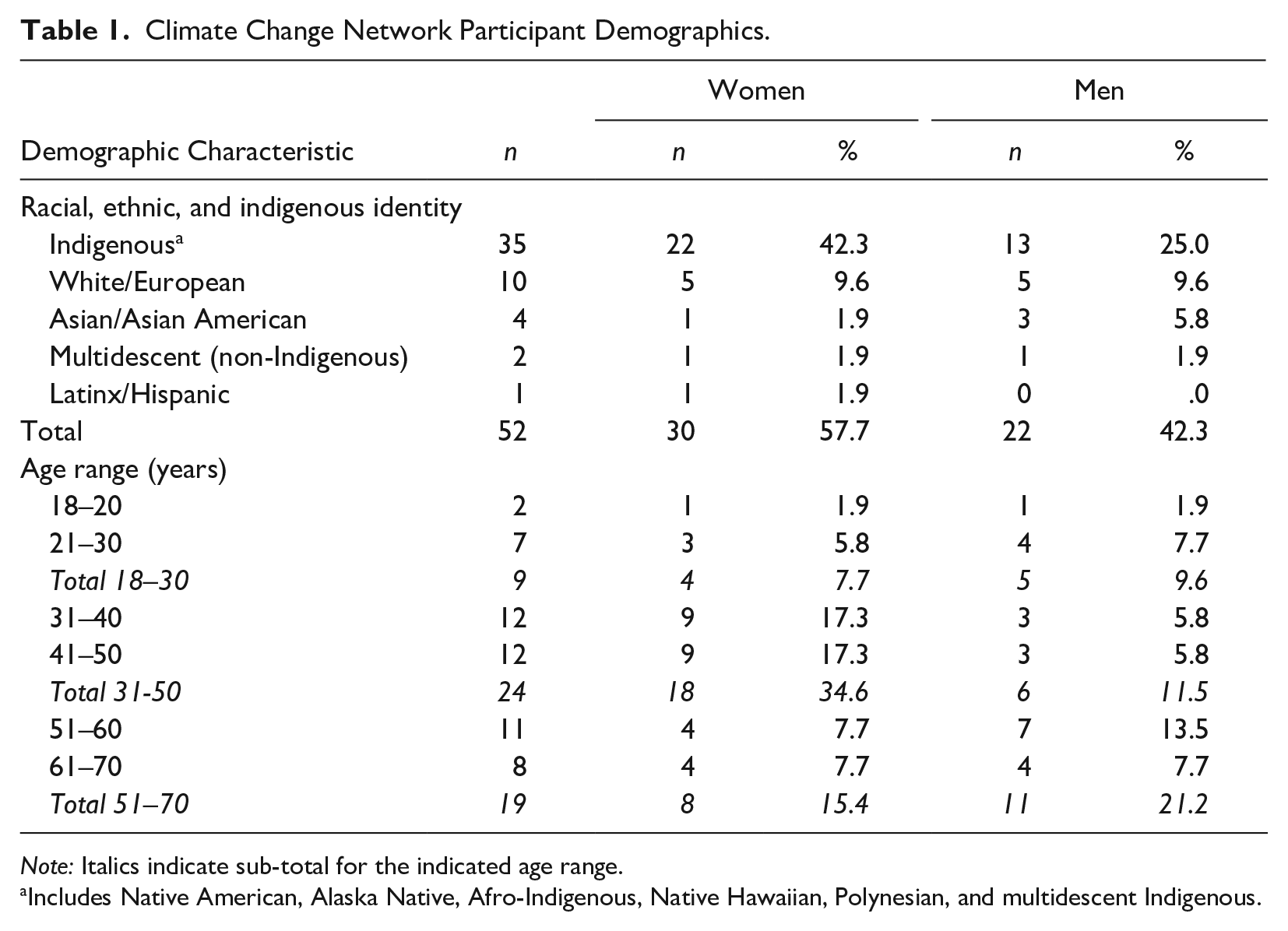
Note: Italics indicate sub-total for the indicated age range.
Includes Native American, Alaska Native, Afro-Indigenous, Native Hawaiian, Polynesian, and multidescent Indigenous.
To summarize members’ employment and community affiliations, about half worked for the U.S. federal government, non-Indigenous nongovernmental organizations (NGOs), or nontribal academic or research institutions. Another third were affiliated primarily with Native Nation governments, tribal communities or NGOs, tribal colleges and universities, or tribally owned companies. Overall, members were well distributed from across U.S. regions. Two participants were from the Caribbean and five from global regions outside North America. Indigenous members gathered from across Native Nations, including Native Hawai’i and Native Alaska. Participants’ spatial representation in order of most to least attendees was as follows: Hawai’i, North Central Plains, Alaska, Midwest, Southeast, South Central, Southwest (including California), Northeast, and Pacific Northwest. These participants focus on climate change as scientists, educators, tribal government leaders, community members, through NGOs, and so on. Many members identified with multiple roles, for example, through their employment and tribal or community affiliations.
Network Analysis and Central Actors in Environmental Organizations
Network data analysis involved manual entry of the 52 × 52 matrix for each of the four collaborative relationship types and a 5 × 52 matrix for actors’ identities. I imported these from an Excel spreadsheet (Microsoft, Redmond, WA) into UCINET and NetDraw software (Borgatti, Everett, and Freeman 2002) to determine central actors on the basis of a suite of visualization and measurement approaches. I then exported analysis results back into Excel for examination of central actors’ structural positions and identities. This study focuses on central actors because they tend to influence the movement of knowledges and how things get done (Borgatti, Everett, and Johnson 2013). Where relational ties represent a positive type of connection, central actors are likely to have greater power, with impacts on the legitimacy of governance (Borgatti et al. 2013). Network methods differentiate between types of relational connections. Bonding ties between those with similar characteristics or positions can signal strong trust and mutual influence. Conversely, these actors may lack exposure to diverse ideas. Their similarities can bring constraining effects through imposition of norms or perspectives (Newman and Dale 2007). In contrast, bridging ties connect diverse actors, groups, or resources. These might be weaker ties that sever more easily, but they can link to otherwise distant parts of a network (Burt 2004).
Social network studies on environmental change support the idea that diversity in networks helps broaden knowledge and adaptation capabilities, while clustered subgroups can lead to in-group and out-group conflict dynamics (Bodin and Crona 2009; Fischer et al. 2014; Prell, Hubacek, and Reed 2009). Cross-difference ties are necessary to increase governance legitimacy, belief in collective action, and confidence to engage complex problems. At the same time, there should be sufficient cohesion around goals to hold the network together. Studies on climate change networks show how similarities between actors can produce insular dynamics shaped by central people, institutions, and ideologies (Corbera et al. 2016; Jasny, Waggle, and Fisher 2015; Leifeld and Fisher 2017). These similarities tend to reduce friction; however, networks that lack diverse viewpoints may encounter reduced trust by those at peripheries.
With multiple ways to assess central actors in a network, I compared three approaches to yield a range of results: degree, eigenvector centrality, and betweenness (Borgatti et al. 2013). Degree indicates the quantity of ties to other actors. Those with many ties have potential to mobilize the network or move information quickly. They often appear in network visualizations as the most central actors. 5 A second approach, eigenvector centrality, additionally considers the centrality of adjacent actors. In this measure, actors connected to other highly connected actors receive higher rank. The status of central actors can further accrue through the status of who they know (Bonacich 1987). Betweenness measures a member’s links between otherwise unconnected groups of participants. High betweenness means removal of that person, even if they do not have many ties, disconnects other people from each other. Those with high betweenness measures play bridging roles that tend to diversify the network through links to peripheral perspectives or people.
Findings
The findings first document measurements of central actors and network visualizations for each collaboration type in this study: climate knowledge transfers, decision-making and climate policy efforts, and place-based climate adaptation partnerships. 6 Participatory methods then examine inclusive governance among leadership in the national-scale environmental partnership between Indigenous and non-Indigenous climate scientists.
Intersectional Central Actor Analysis
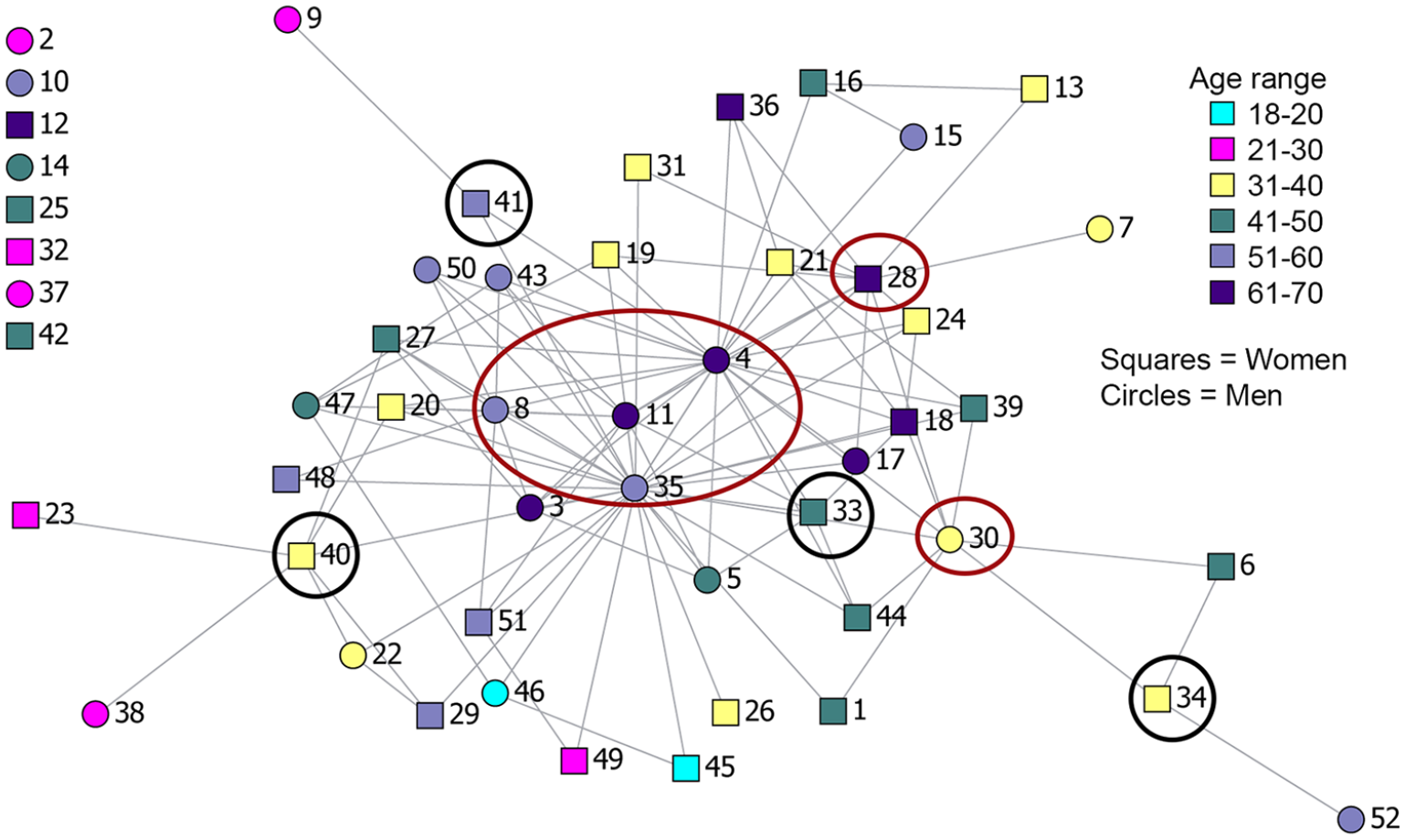
For each collaboration type assessed, I provide a network visualization and data table identifying central actors with their attributes. The visualizations supplement the detailed tables to illustrate how central actors varied for each of the three measurements. In the figures, lines between people represent relational ties, and the number next to each node is the actor’s identifying number, which remains constant throughout this study. Actors listed in a column to the left of an image are isolates with zero ties to other participants. Circled central actors indicate high degree, eigenvector, or betweenness centralities. In the tables, I placed a line below the eight most central actors using a combination of the three centrality measures; this reflects a decision to focus on the top 15 percent of central actors for each type of collaboration. Where fewer relational ties were present or there was a large drop in degree between the first to eighth actors, only six or seven participants could reasonably emerge as centrally located in relation to other members (circled in red in the figures). Additional people shown below the cutoff line at eight central actors identify those not central on the basis of degree or eigenvector centrality but with high betweenness measures (circled in black in the figures). The tables differentiate actor centrality for one-way and reciprocated ties. Reciprocated ties, in which both participants selected each other, represent a stronger connection. However, both one-way and reciprocated ties assist understanding of network relationships and are therefore used.
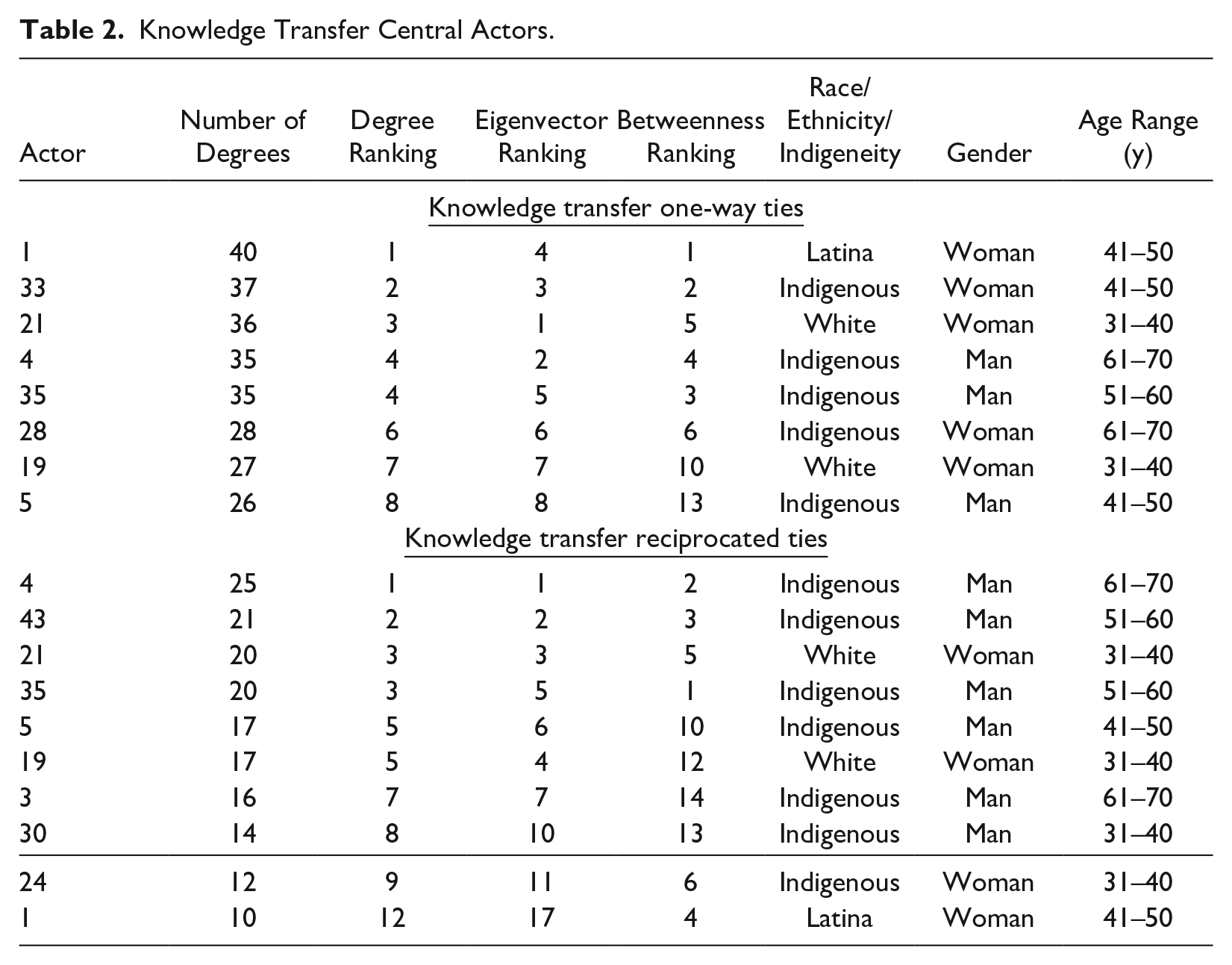
Figure 1 and Table 2 illustrate central actors for knowledge transfer ties. The most central shown inside the large red circle were women and men with various racial, ethnic, and indigenous identities. Ages ranged from 31 to 70 years. For reciprocated knowledge ties, all central actors were Indigenous men aged 31 to 70 or White women aged 31 to 40. Two Indigenous women (numbers 33 and 28) were centrally located for one-way ties, but neither was central on the basis of reciprocated ties. In members’ reported reciprocated connections, there were no actors with small numbers of ties but high betweenness measures. However, in one-way ties, actors 24 and 1 illustrate high betweenness (ranking at numbers 6 and 4, respectively) but low degree and eigenvector centralities. The results indicate that although these two women, one Indigenous and one Latina, were not centrally located for reciprocated ties, they played bridging roles that connected disparate parts of the network. All those aged 18 to 30 were found at the peripheries of this knowledge network.
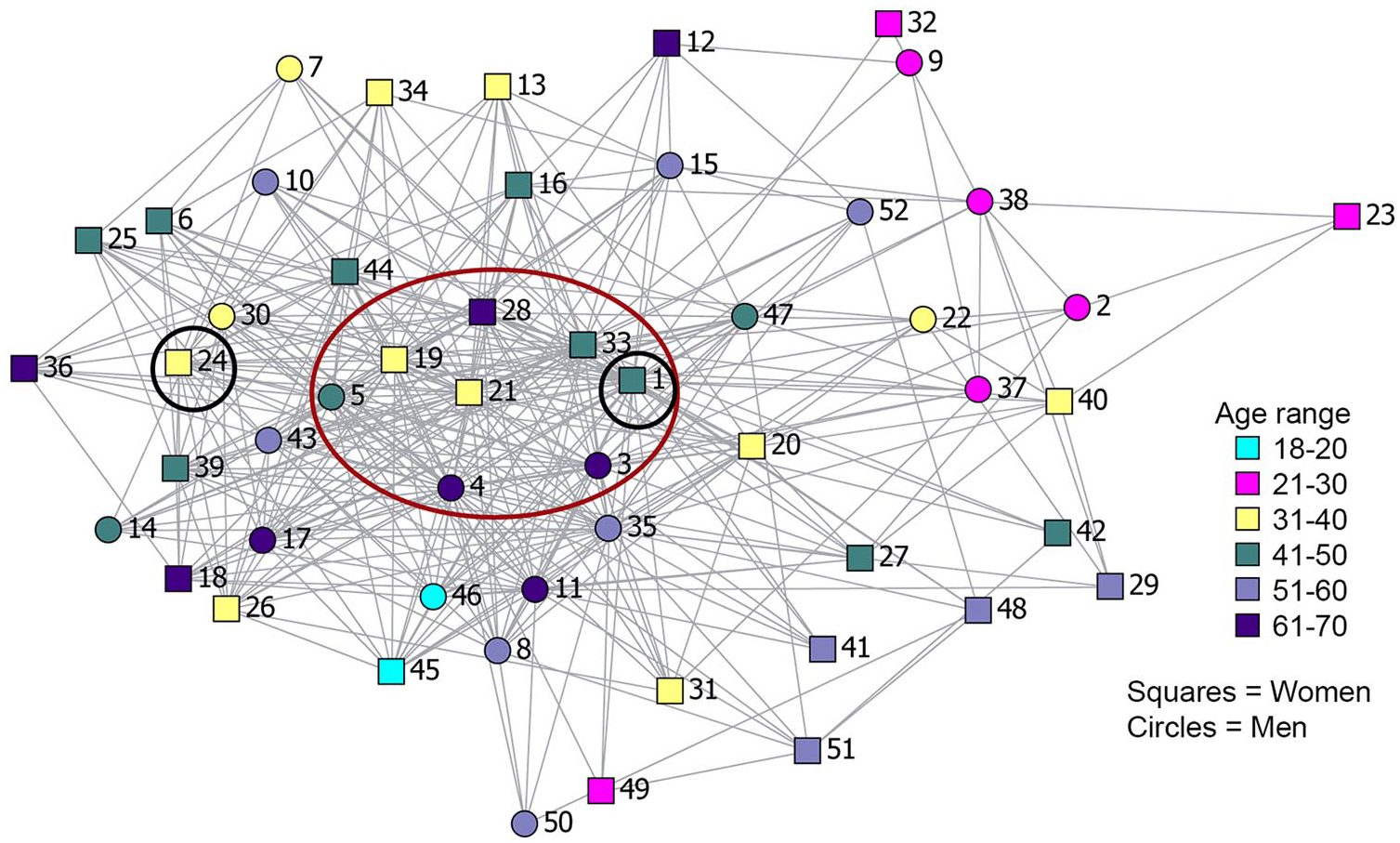
Knowledge transfer central actors (N = 52).
Knowledge Transfer Central Actors.
For decision-making and climate policy connections, Figure 2 and Table 3 identify central actors as primarily Indigenous men, aged 51 to 70, for both one-way and reciprocated ties. One Indigenous woman (actor 28) and one non-Indigenous youth also shared central roles. However, the Indigenous woman was not among the same core cluster in Figure 2 as the grouping of men. Members 40 and 16, both Indigenous women circled in black, emerged with small numbers of connections but high betweenness measures. The women in these bridging roles were different members than those bridging within the knowledge network. Figure 2 also shows that all those aged 21 to 30 were found at perimeters of the decision-making and climate policy network; four became isolates and two connected only through bridging by an Indigenous woman, member 40.
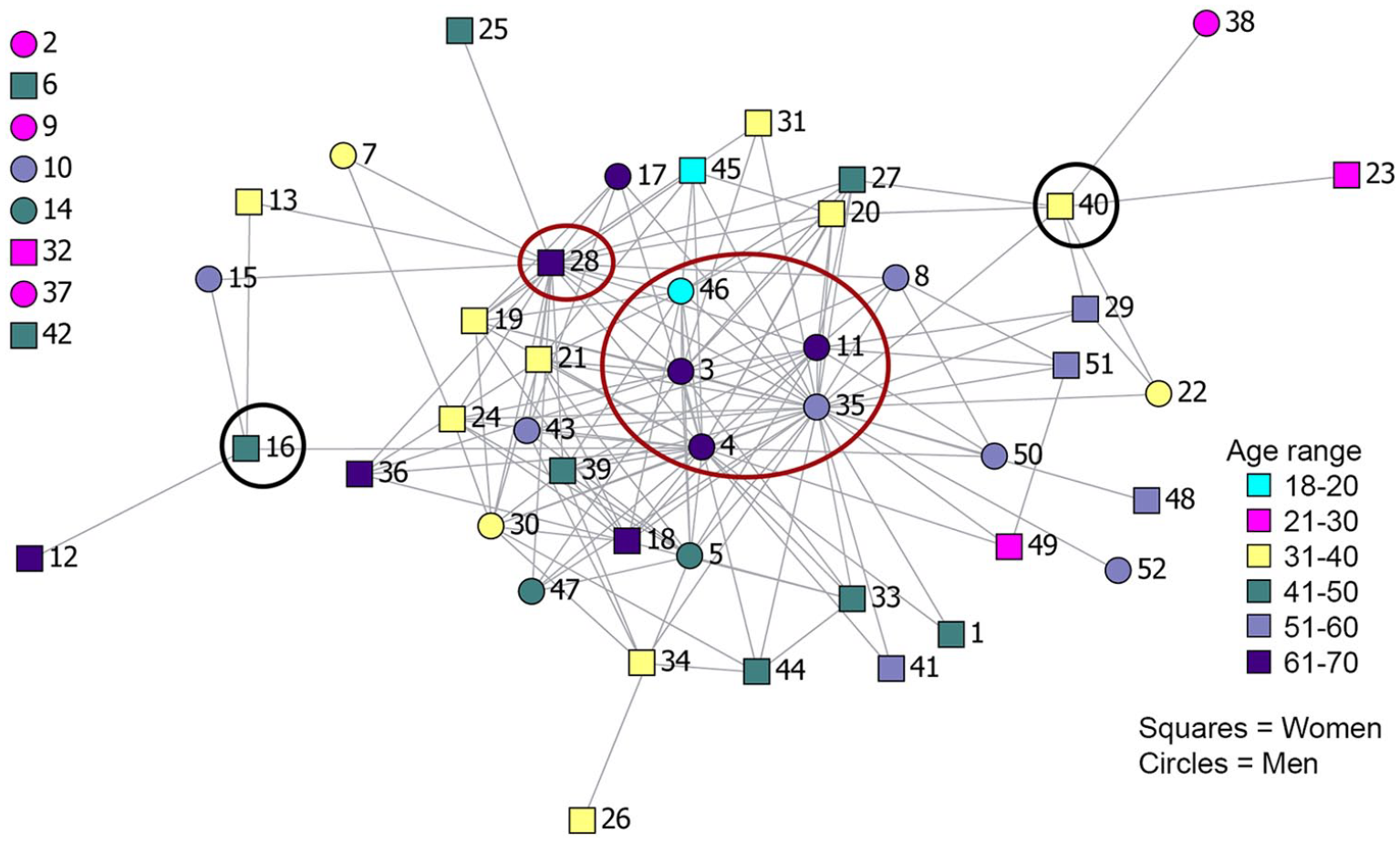
Decision-making and policy central actors (N = 52).
Decision-Making and Policy Central Actors.
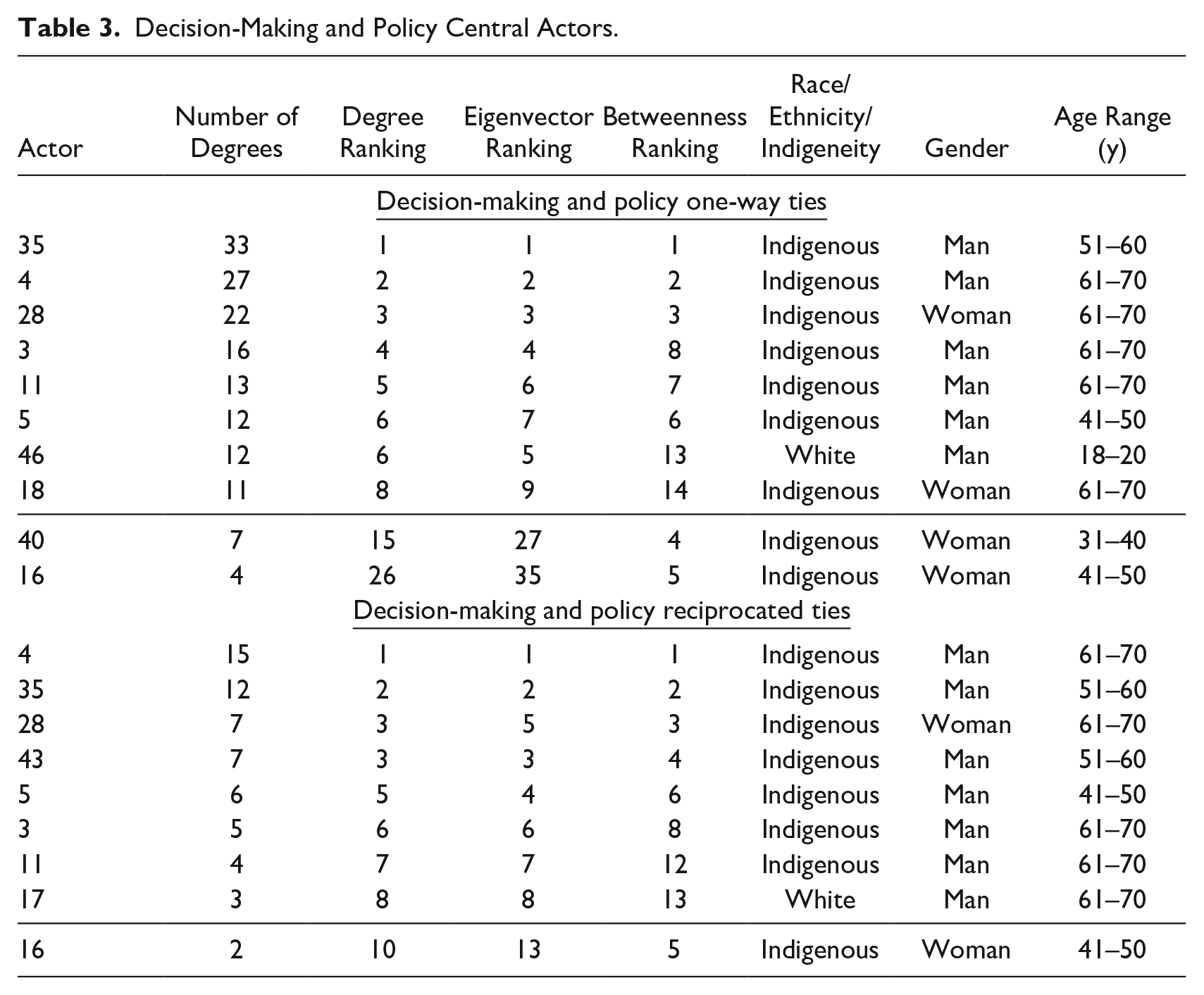
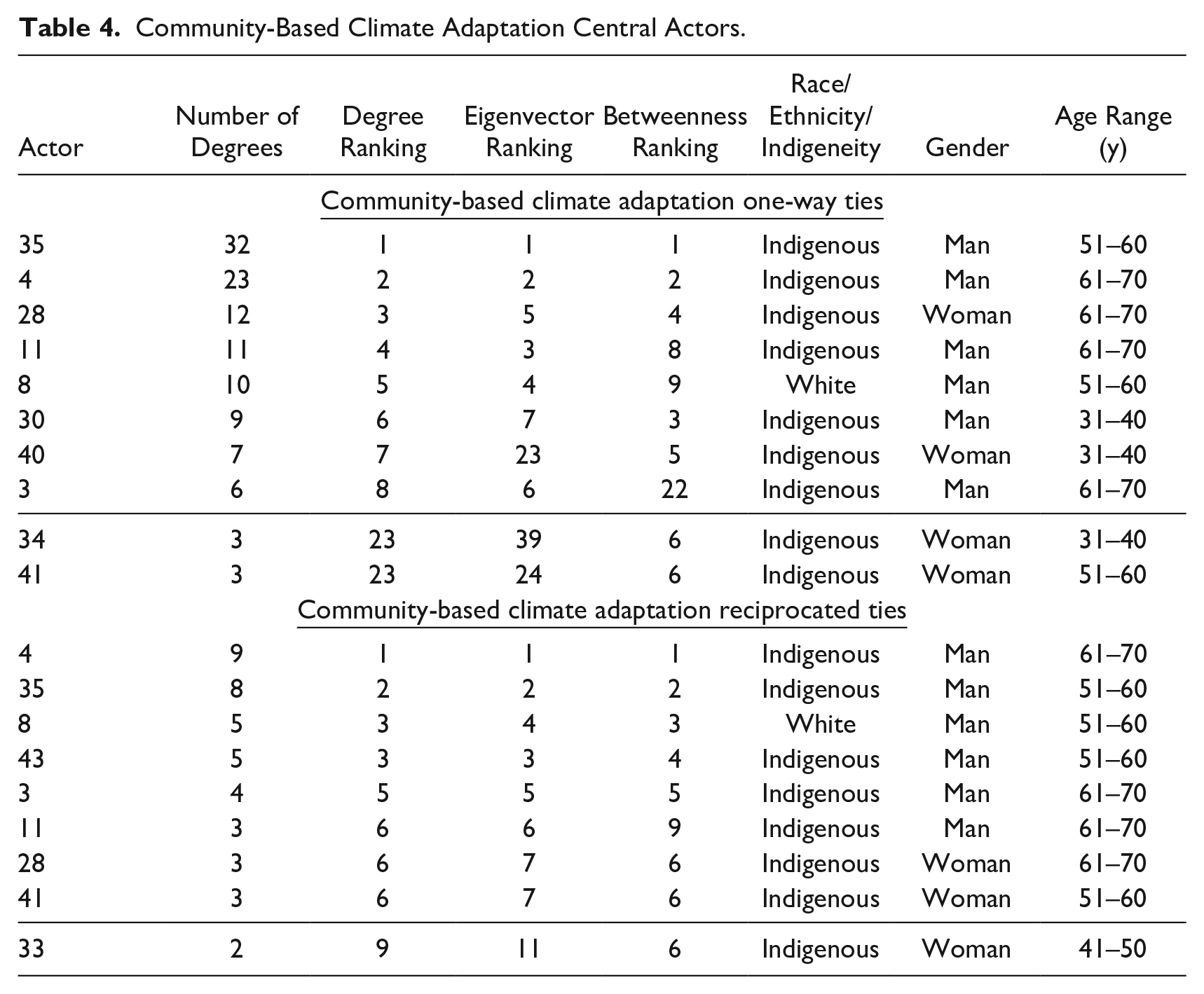
Figure 3 and Table 4 illustrate central actors for community-based climate adaptation partnerships; as seen in decision-making and policy ties, the majority were elder Indigenous men. Actor 28, an elder Indigenous woman, was central in one-way ties but dropped to a lower position for reciprocated ties. Again, actor 28 did not appear in the same core cluster as the Indigenous men. One White man, actor 8, also played a central role. Similar to the other collaboration types, four Indigenous women (actors 33, 34, 40, and 41) reflected high betweenness, which provided bridging to connect distant actors. Yet again, three of these four Indigenous women circled in black were not the same members who played bridging roles in either set of prior results. In Figure 3, the peripheral locations of all 18- to 30-year-olds were particularly stark, and three became isolates. The community-based climate adaptation partnerships revealed similar patterns as the decision-making and policy network, although some of the specific actors moved positions.
Community-based climate adaptation central actors (N = 52).
Community-Based Climate Adaptation Central Actors.
Overall, social network analysis of central actors indicated that Indigenous women and youth were underrepresented. Elder Indigenous men predominated, with some variance by type of collaboration. The knowledge network had centrally located women, yet for reciprocated ties these were all White women. One elder Indigenous woman, actor 28, recurred in one-way ties’ central positions. In two of three cases, member 28 dropped much lower for reciprocated ties. Ultimately, this actor was selecting many collaborators who did not select her back. This was also the case for actor 33, an Indigenous woman shown as central in one-way, but not reciprocated, knowledge ties. Indigenous women were the most predominant network participants (42.3 percent), further pronouncing their underrepresentation in central roles indicated by social network dynamics.
Grouping age and gender, the most populous participants were women aged 31 to 50 (34.6 percent), followed by men aged 51 to 70 (21.2 percent). Indigenous men aged 51 to 70 were most central overall on the basis of network relationships. Women aged 31 to 50 years emerged as central in other ways: White women were central actors in reciprocated knowledge ties, and Indigenous women consistently played bridging roles. Of the seven members with smaller numbers of ties but high betweenness, all were women, six were Indigenous, and one was Latina. All but one of these seven women were in the 31-to-50 age group. Analysis indicates that these seven women connected members who would otherwise disconnect from the network, including multiple young people. The 18-to-30 age range constituted 17.3 percent of all participants, with four women and five men. However, young people were found mostly at network peripheries or as isolates lacking relational connections to other members.
Structural Leadership Roles in the Organization
This section describes findings on visible and less visible leadership roles in the organization using participatory techniques. By “visible,” I refer to key organizers of the network and those who ran communications and events up front. Less visible leadership involved various supporting activities observed over time. The most visible leadership roles were held by White women aged 31 to 40 and elder Indigenous men. A small group of these members began the network and provided leadership since its inception. They made core decisions about event attendees and the program. A tally over three years of events indicated that the numbers of formal presentations by Indigenous women and by non-Indigenous women in the network were approximately the same. Indigenous men made 50 percent more presentations than either group of women. White men gave fewer, with only one third the number of presentations made by either group of women. A small set of about three youth, Indigenous and non-Indigenous, generally presented their reflections or creative projects developed during workshops. Indigenous women and young people were not among up-front communicators or organizers, indications of their underrepresentation in visible leadership roles. Appearing on the program illustrates beneficial representation during events. However, it does not equate to decision-making power that comes with governance roles.
Indigenous women engaged in other less visible labors to support the organization, such as facilitating small-group discussions on a climate change focus area (e.g., water, health, livelihoods, energy, displacement). At each event, the organizers also solicited a group of women, many Indigenous, to take extensive notes during gatherings. Organizers used these notes to construct event summaries sent out to network members and funders. As I participated with others in this note taking, there were conversations about the practice as potentially intrusive and colonially reminiscent. Indigenous members in particular have asked during event discussions and evaluations, Who benefits from these notes—who else uses them, and what are the protections for the knowledges shared? Multiple Indigenous participants discussed gender dynamics in this (and other) climate science organizations. During events and dialogues, some Indigenous women voiced experiences of patriarchy and White privilege operating within the group. These related to behind-the-scenes unpaid labor, relational dynamics, and lack of central leadership opportunities for Indigenous women in decision-making and visible roles. Indigenous youth were also absent from governance spaces. At the same time, some members expressed general gratitude that Indigenous women and youth were in the network with an amount of opportunity to contribute presentations during events.
In summary, Indigenous women and youth were underrepresented in central roles as indicated by social network analysis and organizational governance. Yet Indigenous women consistently had bridging ties to otherwise isolated members. This bridging provided network cohesion and fostered member diversity, a factor in ideological diversity. Indigenous young people were most often situated at peripheries or disconnected from the network altogether; some youth connected back to the network only through bridging ties by Indigenous women. This is significant because Indigenous women also supported the network as session facilitators, extensive note takers, and by giving presentations. Despite these many important contributions, Indigenous women did not have governance roles in the organization. With few exceptions, elder Indigenous men occupied central network positions and gave the most presentations. White women and elder Indigenous men provided up-front organizational leadership in this cross-cultural climate change initiative. Overall, the most central actors in the environmental partnership on the basis of social network analysis coupled with decision-making were elder Indigenous men and White women aged 31 to 40. In efforts to diversify climate sciences, the group did engage Indigenous participants in central roles, only without gender or age diversity. 7
Discussion and Conclusion
As Indigenous peoples assert and reinvigorate inclusive governance, environmental partnerships too often fail to address the difference between diverse participants and diverse leadership. Inclusive Indigenous decision-making in climate change initiatives creates space for Indigenous science practices that benefit Native peoples and rebuild interpersonal and multispecies relationships. Cross-cultural environmental change organizations seeking to collaborate with Indigenous peoples will encounter and must aim to address patriarchy, colonialism, and racism to be trustworthy partners. This study reveals ongoing disturbing settler colonial patterns among core governance in a national-scale effort to bring together Indigenous peoples and climate scientists; however, it also finds partial disruptions of uneven power relations in environmental science fields. The initiative fostered leadership opportunities for Indigenous men who remain underrepresented in dominant sciences. These gains did not extend to Indigenous women, gender-nonbinary persons, or young people. Although this research demonstrates differential benefits from diversity initiatives in climate science, it also draws on Indigenous theorization to interrogate participation within institutional science practices as a primary indicator of liberatory advancement. Indigenous feminist theories provide explanations for the mixed results; resurgence of inclusive Indigenous governance threatens White supremacy and heteropatriarchy, upending their undeserved benefits. As a result, Indigenous women, queer/two-spirit persons, and youth continue to experience everyday settler colonial social formations, sometimes within projects specifically focused on diversity and reanimation of traditional ecological knowledges.
Cross-cultural environmental partnerships are not exempt from Indigenous peoples’ evaluation standards or values (Hoover 2017; McGregor 2004; Whyte 2014, 2016). As coalitions form to contend with climate change, environmental science initiatives, even those with innovative intents, need their own adaptive reconfiguring to embrace Indigenous self-determination. The insular leadership clusters produce internally reinforcing meanings and practices that bypass valuable alternative perspectives. Patterned exclusions among central actors affect the quality of the sciences produced, efforts at complex problem solving, and institutional signals about empowerment. Indigenous women and youth experience disadvantages from settler colonial patriarchy alongside discrimination in environmental science fields. These are exemplified through their peripheral locations in the network, voiced perspectives during events, and absences from decision-making roles. The findings question the strength of organizational legitimacy given a lack of diverse Indigenous members in governance; however, this arose as more problematic to some network participants than others. Reduced legitimacy can formulate from within an organization, whereby some members lose a sense of efficacy, or from outside a group by observers or those who no longer choose to participate.
How non-Indigenous climate scientists and researchers engage within collaborative processes carries implications for decolonizing environmental science practices. Mostly absent in this discussion so far are White men, because of their limited presence in central positions and, to some degree, in the group overall. At times, network members noted during events that non-Indigenous climate scientists were missing opportunities through the network to learn respectful collaboration that centers Indigenous leadership. Organization members hosted workshops on ethical cross-cultural practices, even offering specific trainings for climate scientists at their workplaces. However, lower than anticipated attendance at these trainings raised concerns about non-Indigenous climate scientists’ intents in environmental partnerships. The network experienced tensions between transparency in the documentation of activities and protections for Indigenous knowledges that have frequently been co-opted to advance the goals of outsiders (Smith 2012). What would motivate more non-Indigenous climate scientists to engage cross-cultural collaborative endeavors as learners and advocates, while ensuring that diverse Indigenous peoples set key agendas? Beyond diverse participants, environmental partnerships require inclusive decision-making, and active support for science pipeline development through mentoring, paid employment, grants, and culturally relevant research opportunities for underrepresented populations.
In looking behind efforts to revive traditional knowledges, Indigenous values point to long-standing reciprocal relationships with places, more-than-human species, and other people as means to reconfigure science practices that align with Indigenous peoples’ multifaceted pursuits of good living. Inclusive Indigenous decision-making with gender and age diversity centered on Indigenous values is neither a far-fetched proposition nor pursuit of an impossible return to a static past (Denetdale 2006; Robertson 2015). Reclaiming balanced power to overcome settler colonial oppressions is exemplified in the continued maintenance of traditional kin networks and through environmental movements already led by Indigenous women, youth, and queer/two-spirit people (Dhillon 2016; Jacob 2013; TallBear 2016). Environmental science partnerships can coalesce alongside these avenues to transform systemic and relational features of scientific fields, particularly through inclusive governance that alters priorities while broadening science benefits. Challenging settler colonialism in situ places importance on gender and racial justice aligned with Indigenous peoples’ self-determination and land restitutions; Indigenous and non-Indigenous climate change collaborators would take actions to ensure the dislocation of colonial orderings, including within organizational decision-making and labor compensation. However, this national-scale partnership lacked evidence of extending these particular opportunities to Indigenous women and youth, who play key roles in environmental movements. Because Indigenous women were the most represented population in the network, it was not evident at the outset what analysis might reveal, even as workshop dialogues raised concerns about social positioning among visible leadership.
This study demonstrates how cross-cultural environmental initiatives meant to empower can also reproduce disturbing inequalities. Diversity efforts, absent clear attention to imbalances of multiple oppressions, may well bolster settler colonial, gendered, and race-based privileges. Theorization arising from Indigenous studies strengthens racial and ethnic theories that at times lack attention to Native American lives resisting settler colonial formations (Fenelon 2016; McKay forthcoming; Norgaard and Reed 2017; Robertson 2015). Indigenous feminist analytics provide explanations for why environmental sciences are deeply challenged to embrace diverse Indigenous peoples in decision-making roles. Indigenous women made clear contributions to the climate science organization through knowledge sharing, behind-the-scenes labor, and consistent bridging roles that fostered network cohesion. Ultimately, Indigenous women and youth were not among core governance that was instead dominated by Indigenous men and White women. For this to change, Indigenous values of relational reciprocity and self-determination will need to supersede the rhetoric of diversity in environmental fields that has thus far broadly benefitted White women. Collaborative climate change groups must institute inclusive Indigenous governance as one rebalancing factor to adapt environmental science in solidarity with Indigenous peoples’ resurgences. This mixed-methods social network study illustrates intersectional processes based not only on actor identities but on interpersonal connections, structural positions in the national-scale organization, and participatory scholarship. Findings open the range of vision for combined relational-structural dynamics in process that move beyond who is present and toward everyday navigation of entrenched social inequalities. The case demonstrates the importance of inclusive Indigenous governance to decolonize environmental partnerships and the potential lack of legitimacy should unexamined notions of tradition be used to obscure settler colonial dominance.
Footnotes
Acknowledgements
Thank you to Dorceta Taylor, Kyle Powys Whyte, and M’Lis Bartlett for valuable comments on iterations of this article. A version of this article was presented at the 2018 annual meeting of the American Sociological Association. Thank you to session organizer Michelle Jacob, discussant Dwanna McKay, and the Section on Racial and Ethnic Minorities for insightful feedback. Errors and omissions are mine.
Funding
The author disclosed receipt of the following financial support for the research, authorship, and/or publication of this article: This research was supported in part by grants from the University of Michigan’s Rackham Graduate School, the California State University Chancellor’s Doctoral Incentive Program, and Bryn Mawr College.