




Abstract
Executive Summary
Millions of Venezuelans have fled their country in hopes for a better future outside the political and financial turmoil in their home country. This paper examines the self-reported needs of Venezuelans in the United States and Colombia. Specifically, it looks at perceived discrimination in each country and its effect on the service needs of Venezuelan immigrants. The authors used data from a larger project conducted in October to November 2017 to perform a qualitative content analysis on the specific services that participants and others like them would need following immigration. The sample consisted of 647 Venezuelan immigrant adults who had migrated to the United States (n = 342) or Colombia (n = 305).
Its findings indicate statistically significant differences between the two countries. Venezuelan immigrants in the United States were more likely to identity mental health and educational service needs, while those in Colombia were more likely to list access to healthcare, help finding jobs, and food assistance. When looking at perceived discrimination, means scores for discrimination were significantly greater for participants who indicated needing housing services, who indicated needing assistance enrolling children in school and who indicated needing food assistance, compared to participants who did not list those needs. Venezuelans who had experienced greater negative context of reception were less likely to indicate needing mental health services, where 11.9 percent of those who did not perceive a negative context of reception responded that they needed mental health services.
Evaluating existing service networks will be essential in working to bridge the gap between the services provided to and requested by Venezuelans. Collaboration between diverse government actors, community-based organizations (CBOs) and other stakeholders can help identify gaps in existing service networks. CBOs can also facilitate communication between Venezuelan immigrants and their new communities, on the need to invest in necessary services.
Introduction
According to the Internal Displacement Monitoring Centre (IDMC), more than 59.1 million people have left their homelands and moved to another country because of natural or human-made disasters (Mcauliffe and Triandafyllidou 2021). Emigration occurs for many reasons — some people move in pursuit of improving their economic opportunities, whereas others leave to escape violence or political persecution (ibid.). In recent years, Venezuela has been besieged by street violence, economic collapse, and government repression. As a consequence, approximately 7.32 million people have fled the country since 2016 (UNHCR 2023). This number represents a 14,000 percent increase over the number of Venezuelans who sought asylum or refugee status in other countries prior to 2014.
Colombia is home to the greatest number of Venezuelan refugees and migrants (2.48 million; World Migration Report 2022). Prior to the COVID-19 pandemic, it was estimated that 5,000 Venezuelans crossed into Colombia each day (OAS 2020; UNHCR 2023). The United States also remains a top destination for Venezuelan asylum seekers. As of 2021, an estimated 640,000 Venezuelans had emigrated to the United States, with the majority settling in Florida (Pew Research Center 2023). Between January 2017 and January 2019 alone, 58,076 asylum applications in the United States were filed by Venezuelans, with each application representing a family of four (CBP 2019).
Given the large numbers of Venezuelan immigrants in both Colombia and the United States, and the acute traumas that many of these individuals have experienced in Venezuela (e.g., violence, government repression, and severe economic collapse), there may be large gaps in the availability of services provided by these destination countries to meet the needs of Venezuelans. Comparing Venezuelan immigrants in the United States and Colombia provides a unique opportunity to compare cultural adaptation and service needs across two countries with different economic, social, cultural, and historical systems and backgrounds. Whereas the United States has a long history of receiving immigrants (Portes and Rumbaut 2014), Colombia has not historically been an immigrant-receiving country. Prior to Venezuelan immigration in 2014, most Colombians were not accustomed to encountering immigrants (Pérez 2018; Rueda 2019). The United States and Colombia therefore differ in their ability and experience in meeting the needs of new residents. Gaps in services, in turn, may be exacerbated by different contexts of reception and rates of discrimination (Schwartz et al. 2018; Salas-Wright et al. 2021).
Cultural Stressors and Service Needs
Immigration often leads to important changes in individuals’ lifestyles and life trajectories. Immigrants frequently must come to terms with new languages (or dialects), new cultural customs, and new laws (Demes and Geeraert 2013). They may also experience cultural stressors such as discrimination and negative context of reception (e.g., marginalization and exclusion from opportunities), which may have deleterious effects on their mental health (Lorenzo-Blanco et al. 2017). Adjustment may be even more difficult for individuals who experienced trauma in their home countries (Perreira and Ornelas 2013). For example, post-traumatic stress may complicate efforts to adjust to the destination society, and immigrant parents with severely traumatic experiences may experience difficulties with parenting (Santa-Maria and Cornille 2007; Salas-Wright and Schwartz 2019;). Venezuela represents a sending context characterized by severe government repression, rampant street violence, and almost complete economic collapse. Many Venezuelans face poverty, lack of social support, mental health challenges, and reduced quality of life (Carroll et al. 2020), both in Venezuela and when immigrating. In December 2019, the Brookings Institute (Bahar and Dooley 2019) reported that the Venezuelan crisis — including the emigration of millions of people to other countries in the Americas — had surpassed the Syrian civil war and had become the largest refugee crisis in modern history.
The present study finds that Venezuelans in Colombia reported significantly more discrimination, and a worse context of reception, compared to Venezuelans in the United States. It stands to reason, then, that the service needs expressed by immigrants may differ according to their experiences prior to and following migration. Specifically, we would expect Venezuelans, as a traumatized population, to list mental health services to a considerable degree. We would also expect Venezuelans in Colombia, who tend to perceive more discrimination and a worse context of reception, to list significantly more services than Venezuelans in the United States.
Immigrants’ needs, concerns, and fears can be considered within the framework of Maslow’s (1943) hierarchy of needs. Maslow outlined five tiers that define a person’s psychological and physiological health. In ascending order, these categories include physiological (basic needs such as food and shelter); security (the need for a secure and safe environment); social (personal affection and interaction with others); esteem (acceptance of self); and self-actualization (full realization of a person’s character and potential). The first three tiers appear to be most relevant to immigrants’ immediate service needs. Many of the needs identified by immigrants and refugees are related to food, shelter and stable work (Ayón 2014). In political climates characterized by opposition to asylum seeking and undocumented immigration, immigrants often report on needs for legal services and community empowerment (Ayón 2018; Kerwin and Nicholson 2021). Immigrants from war-torn, repressive, or economically distressed countries may also identity the need for mental health services (Salami, Salma and Hegadoren 2018). Immigrant parents may also seek out services for their children’s mental health, physical health, and educational success. Furthermore, service needs are likely to differ according to the extent of cultural stress (e.g., discrimination and negative context of reception) experienced by migrants; those experiencing greater amounts of cultural stress may be more likely to express needs for mental health and community support services (Salas, Ayón and Gurrola 2013).
Enumerating service needs provides information that policymakers can use to address these needs, whether across segments of a population or targeting different segments for different services. Exploratory mixed-method research on service needs can also lead to longitudinal work on service need satisfaction, where specific needs can be enumerated at earlier points, and outcomes (including the likelihood of need satisfaction) can be examined thereafter. Understanding the experiences and needs of Venezuelan immigrants is essential in order to provide the necessary resources to enable them to thrive in a new environment.
Barriers to Service Utilization
The welfare of immigrant populations is directly related to access to resources that allow them to survive and thrive in their destination country. In studies of other populations, service barriers include low rates of citizenship or lack of legal status, low levels of education, low English proficiency (in the United States), low income, and lack of familiarity with the ways and culture(s) of the destination country (Hacker et al. 2015). Cultural stressors represent additional barriers that can marginalize immigrants from the society where they live, and that may be likely to distance them from the services they need. Indeed, research has documented that individuals who perceive greater degrees of discrimination may be less likely to seek services — though they may still require services (Trivedi and Ayanian 2006; Williams et al. 2019).
No information is currently available regarding the services that Venezuelan immigrants in different receiving countries believe that they (or others like them) need. Given that cultural stressors such as discrimination and negative context of reception serve to marginalize immigrants from their destination communities (Salas-Wright and Schwartz, 2019), one might suppose that these stressors may serve as barriers to service access and utilization. Given the magnitude and scope of the Venezuelan crisis, it is urgent to examine the specific services that these individuals are likely to require in various destination countries.
The Present Study
In the present study, we recruited a sample of Venezuelan immigrants in the United States and Colombia. We asked them to complete Likert-type measures of perceived discrimination and negative context of reception, and to answer open-ended questions about the specific services that they, or other Venezuelan immigrants like them, would likely need in the country (United States or Colombia) where they had settled. We then conducted a mixed method analysis by coding the service need responses and cross tabulating the service need categories against (a) the country of settlement (United States or Colombia), (b) the relative presence or absence of cultural stressors, and (c) the extent of cultural stressors experienced. Analyzing cultural stressors both dichotomously and continuously allows us to compare service needs enumerated by individuals experiencing some degree of cultural stress versus those enumerated by persons not experiencing cultural stress, as well as to examine the effects of degrees of cultural stress on service needs.
Only Venezuelans who responded to the following prompt were included in the analysis:
“Are there any services that might be helpful to you and your family in the US/Colombia? Services can mean a lot of different things, including help finding a job, help finding housing, English language instruction, legal assistance for immigration or other issues, or counseling for you or your children.”
The present study was guided by two aims. First, what categories of service needs would emerge, and how would these needs differ between immigrants to the United States versus to Colombia? Secondly, how would service needs differ between participants who reported high versus low levels of discrimination and negative context of reception?
Methods
Participants and Procedures
The study used data from a larger project conducted in October-November 2017. Data collection focused on cultural stressors, mental health, and service needs. The sample consisted of 647 Venezuelan immigrant adults who had migrated to the United States (n = 342) or Colombia (n = 305). All but six of the US participants were living in Florida, primarily in Miami-Dade County (73.7 percent). In Colombia, 97 percent of participants were living in Bogotá. Seventy-three percent of participants in the US had arrived in the country less than two years prior to their assessment date. Eighty-one percent of participants in Colombia had arrived less than one year prior to their assessment date. Community organizations were engaged in both the US and Colombia to recruit participants. In Colombia, a space was provided by a community partner, Corporacion Nuevos Rumbos, to allow participants to complete the online survey on their mobile devices. Corporacion Nuevos Rumbos is a non-profit organization led by Colombian researchers and dedicated to the prevention of socially relevant problems. In the United States, 22 seed participants were recruited from the community organization, Raices Venezolanas, and a chain referral procedure was used to recruit the remainder of the sample (Schwartz et al. 2018). Raices Venezolanas provides recently arrived Venezuelans in Miami, Florida with bedding, clothing, networking, housing, and job information.
Participants had to be over the age of 18 years, be of Venezuelan origin, have children under 18 years of age, and have immigrated within the five years prior to assessment. Participants completed an electronic survey consisting of several parts, including a demographic questionnaire, qualitative prompts regarding their pre-migration experiences in Venezuela and their post-migration experiences in the United States or Colombia, and standardized scales measuring negative context of reception (Schwartz et al. 2014; Salas-Wright et al. 2018) and perceived discrimination (Phinney and Santos, 1998). The larger project was approved by the Institutional Review Boards at the University of Miami and Boston College, as well as by the ethics board at Corporación Nuevos Rumbos in Bogotá.
Measures
Service Needs
We asked participants to respond to an open-ended prompt about services that they or other Venezuelan immigrant adults would likely need. Participants listed a mean of 1.5 services (range 0–7). Of the 647 participants in our sample, 571 (88.2 percent) listed at least one service need and were included in the analyses for this article. Participants who answered and those who did not answer the service needs question did not differ significantly by gender or level education. However, they did differ by country, with only 7 individuals in Colombia who did not answer (2 percent) and 69 individuals in U.S. who did not answer (20 percent; χ2(1) = 49.334, p < .0001, φ = 0.29.
Discrimination
The Perceived Discrimination Scale (Phinney and Santos 1998; Salas Wright et al. 2021) is a 7-item questionnaire used to assess perceived discrimination. The items refer to being regarded with suspicion or as inferior because of one’s nationality or ethnicity. Each item allows participants to indicate the frequency statements, such as “Employers treat me unjustly or negatively because I am Venezuelan” using a 5-point Likert scale from Never to Always. Cronbach’s alpha for this study was 0.91 in the US sample and 0.86 in the Colombian sample. 1
Negative Context of Reception
The Negative Context of Reception Scale (Schwartz et al., 2014; Salas-Wright et al. 2021) is a 6-item questionnaire used to measure perceived negative context of reception. Items refer to a feeling of being unwanted or “shut out” because of one’s nationality or ethnicity. Each item allows participants to indicate the degree to which they agree or disagree with statements, such as “People from my country are not welcome here” using a 5-point Likert scale from Strongly Agree to Strongly Agree. Cronbach’s alpha for this study was 0.86 in the US sample and 0.77 in the Colombian sample.
Analytic Strategy
The present study utilized participants’ written service need responses to perform a qualitative content analysis (Burnard 1996) to examine the specific services participants or others like them would need following immigration. Qualitative content analysis is a methodological approach that involves an objective, systematic, rule-guided qualitative text analysis. The first three authors (C.S., L.O., and R.S.) read all participant responses in detail and created one codebook, which included code names, definitions, sample quotes, and coding decision rules. Coders were paired (C.S. with L.O, L.O. with R.S., and R.S. with C.S.) and transcripts were independently coded by each member of the coding pair. Coders routinely met to discuss ratings and to review any discrepancies in the ratings. If new codes emerged during the review, the codebook was further modified, and the transcripts were recoded according to the new structure of the codebook. After all transcripts were coded, percentage agreement was calculated to ensure acceptable intercoder agreement and reliability of the codebook. Initial percentage of agreement between coding pairs ranged from 95 percent to 100 percent on independently coded transcripts, with coding pairs reaching 100 percent consensus on all final codes. Research team members entered all final codes into Dedoose, a qualitative software program used to perform a content analysis of themes and to extract coded responses (Dedoose Version 8.2.14, 2019). To ensure explicit and comprehensive reporting of findings, the consolidated criteria for reporting qualitative research (COREQ) checklist guided the reporting of study method and results (Tong, Sainsbury and Craig 2007).
We then conducted a series of mixed-method analyses to examine the links between service needs and cultural stress experiences. We examined cultural stressors both as continuous indicators and as dichotomized grouping variables (i.e., differentiating between respondents indicating never/rarely experiencing each cultural stressor versus those indicating greater experiences of each cultural stressor). We use both continuous and categorical cultural stress indicators because, for some variables, cut points may be able to differentiate people with greater versus fewer experiences or symptoms (e.g., Henry, Grant and Cropsey 2018). For continuous cultural stress variables, t-tests were used to compare the extent of cultural stress between individuals listing versus not listing each service. For dichotomous cultural stress variables, chi-square analyses were performed to compare services requested by cultural stress experiences (perceived discrimination and negative context of reception). We also used chi-square analyses to compare service needs between the US and Colombia services overall, and by gender within each country and across the entire sample.
Results
Service Needs Coding
Overall agreement rates among the three raters ranged from 87 percent to 100 percent. Thirteen categories emerged from the coding. These were legal services, mental health services, healthcare needs, assistance finding jobs, assistance with housing needs, assistance enrolling children in school, food assistance, childcare services, clothing, medication access, help with obtaining a working permit, transfer of career capacity, and educational services.
Within the sample as a whole (collapsing across countries), “Finding jobs” was the most commonly listed need (45.5 percent of the sample) followed by “Legal services” (20.1 percent of the sample), “Educational services” (mostly English language classes in the US; 20 percent of the US sample), “Finding housing” (17.2 percent of the sample), “Healthcare access” (16.3 percent), and “Mental health services” (6 percent of the sample). Descriptive statistics indicated that participants enumerated an average of 1.5 services each. In total, 41 participants did not list any services, 246 participants listed one service, 166 participants listed two services, and 118 participants listed three or more services.
Differences Across Countries
Our findings indicate statistically significant differences among various service needs between the two countries; immigrants to the U.S. were more likely to require mental health (χ2(1) = 27.247, p < .0001, φ = 0.218), childcare (χ2(1) = 4.397, p = .036, φ = 0.088), and educational services (χ2(1) = 94.958, p < .0001, φ = 0.408), whereas those in Colombia were more likely to list access to healthcare (χ2(1) = 47.774, p < .0001, φ = 0.289), help finding jobs (χ2(1) = 4.397, p < .05, φ = 0.344,), food assistance (χ2(1) = 6.465, p = .011, φ = 0.106), housing assistance (χ2(1) = 15.738, p < .0001, φ = 0.166), and assistance enrolling their children in school (χ2(1) = 15.224, p < .0001, φ = 0.163; see Table 1). Furthermore, the prevalence of some requests for services differed significantly across gender. In the U.S. sample (34 percent male, 66 percent female), more women requested educational services (χ2(1) = 5.096, p = .024, φ = 0.137,); and in Colombia (42 percent male, 58 percent female), more women requested services to enroll children in school (χ2(1) = 5.836, p = .016, φ = 140). Across the full sample (38 percent male, 62 percent female), more women requested educational services (χ2(1) = 4.806, p = .028, φ = 0.115), assistance enrolling children in school (χ2(1) = 7.593, p = .006, φ = 0.092), and mental health services (χ2(1) = 4.860, p = .027, φ = 0.092).
Service Needs by Country of Residence and Gender.
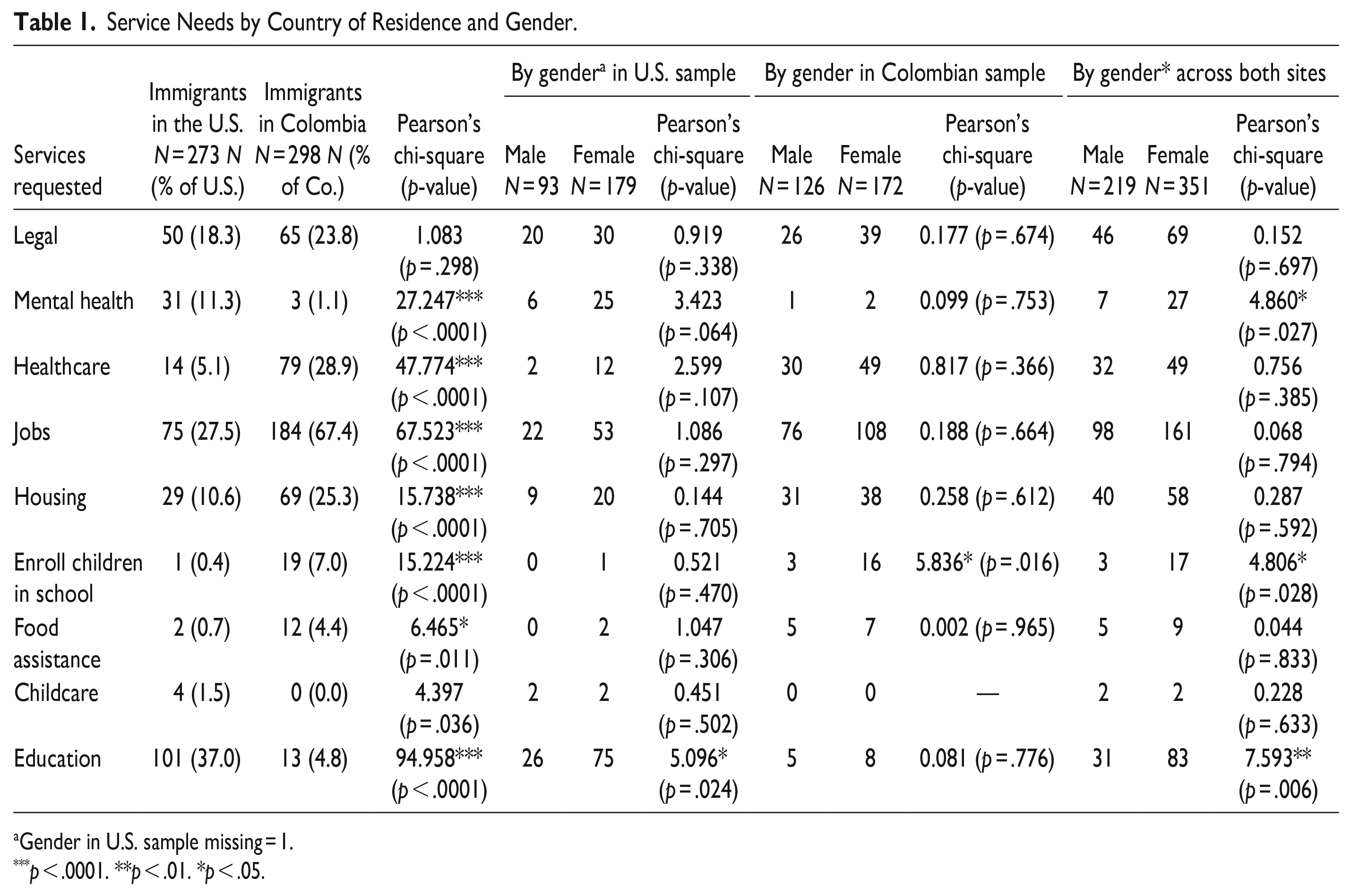
Gender in U.S. sample missing = 1.
p < .0001. **p < .01. *p < .05.
Associations Between Service Needs and Cultural Stressors
There were also significant associations between service needs and the experiences of perceived discrimination and negative context of reception (Table 2). We first report results for dichotomized cultural stress variables, and we then report results for continuous cultural stress variables. For discrimination, binary variables were created by categorizing individuals into (a) those who responded Never or Rarely to all scale items, indicating having experienced no or minimal discrimination, versus (b) all other individuals as having had experienced discrimination Sometimes, Often, or Always. For perceived negative context of reception, binary variables were created by categorizing individuals who responded Disagree or Strongly Disagree to all scale items as having had little or no experiences of negative context of reception, and all other individuals as having stated either Neutral, Agree, or Strongly Agree to at least one statement regarding negative context of reception. Across both countries, Venezuelans who had experienced greater perceived discrimination were more likely to indicate needing healthcare services (20.2 percent vs. 10.7 percent; χ2(1) = 8.137, p = .004, φ = 0.121), assistance finding jobs (50.7 percent vs. 36.7 percent; χ2(1) = 9.902, p = .002, φ = 0.138), and food assistance (3.4 percent vs. <1.0 percent; χ2(1) = 4.586, p = .032, φ = 0.091). Those who experienced less perceived discrimination, on the other hand, were more likely to indicate needing educational services (25.0 percent vs. 16.0 percent; χ2(1) = 6.635, p = .010, φ = 0.112).
Service Needs, Perceived Discrimination, and Negative Context of Reception.
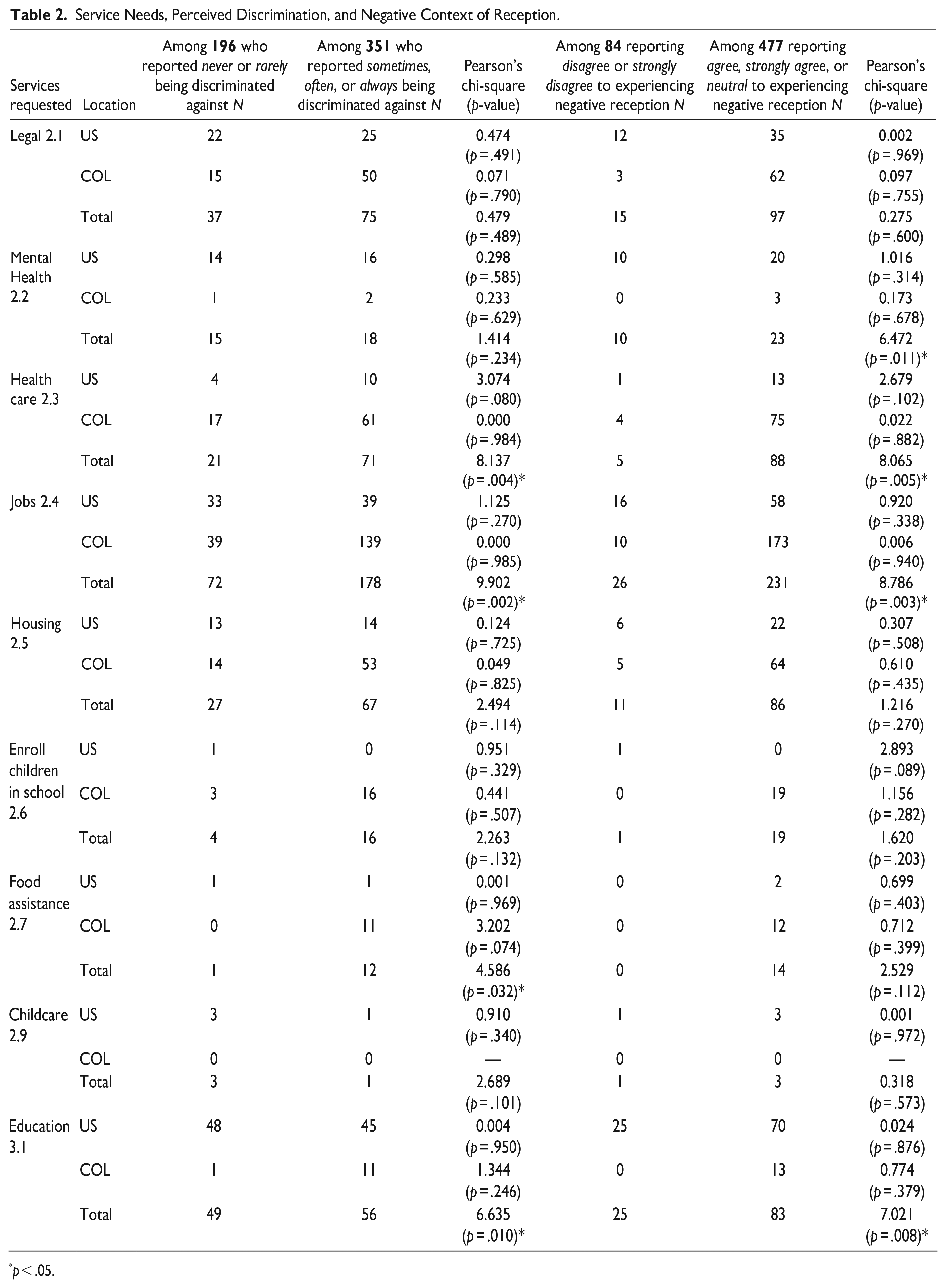
p < .05.
With regard to perceived context of reception across both countries, Venezuelans who had experienced greater negative context of reception were less likely to indicate needing mental health services (χ2(1) = 6.472, p = .011, φ = 0.107), where 11.9 percent of those who did not perceive a negative context of reception responded that they were in need of mental health services, compared to 4.8 percent of those who did report such perceptions. Individuals reporting less negative context of reception were also more likely to indicate needing educational services (29.8 percent vs. 17.4 percent; χ2(1) = 7.021, p = .008, φ = 0.112). Those who experienced greater negative context of reception, on the other hand, were more likely to indicate needing assistance finding jobs (48.4 percent vs. 31.0 percent; χ2(1) = 8.786, p = .003, φ = 0.124).
Results for continuous cultural stressor variables are presented in Table 3. When looking at perceived discrimination, means scores for discrimination were significantly greater for participants who indicated needing housing services (t = −1.970, p = .049), who indicated needing assistance enrolling children in school (t = −2.188, p = .029), and who indicated needing food assistance (t = −2.730, p = .007) compared to participants who did not list those needs. Mean discrimination scores were significantly lower for participants who indicated needing educational services compared to those who did not (t = 2.295, p = .022). Negative context of reception scores were significantly higher for participants who indicated needing assistance finding jobs (t = −2.045, p = .041), assistance enrolling children in school (t = −2.217, p = .027), and food assistance (t = −2.373, p = .018), compared to participants who did not indicate needing these services. Negative context of reception scores were significantly lower for participants requesting mental health services (t = 2.730, p = .007) and educational assistance (t = 2.831, p = .005), compared to participants who did not indicate needing these services.
Mean Scale Scores by Service Requested.
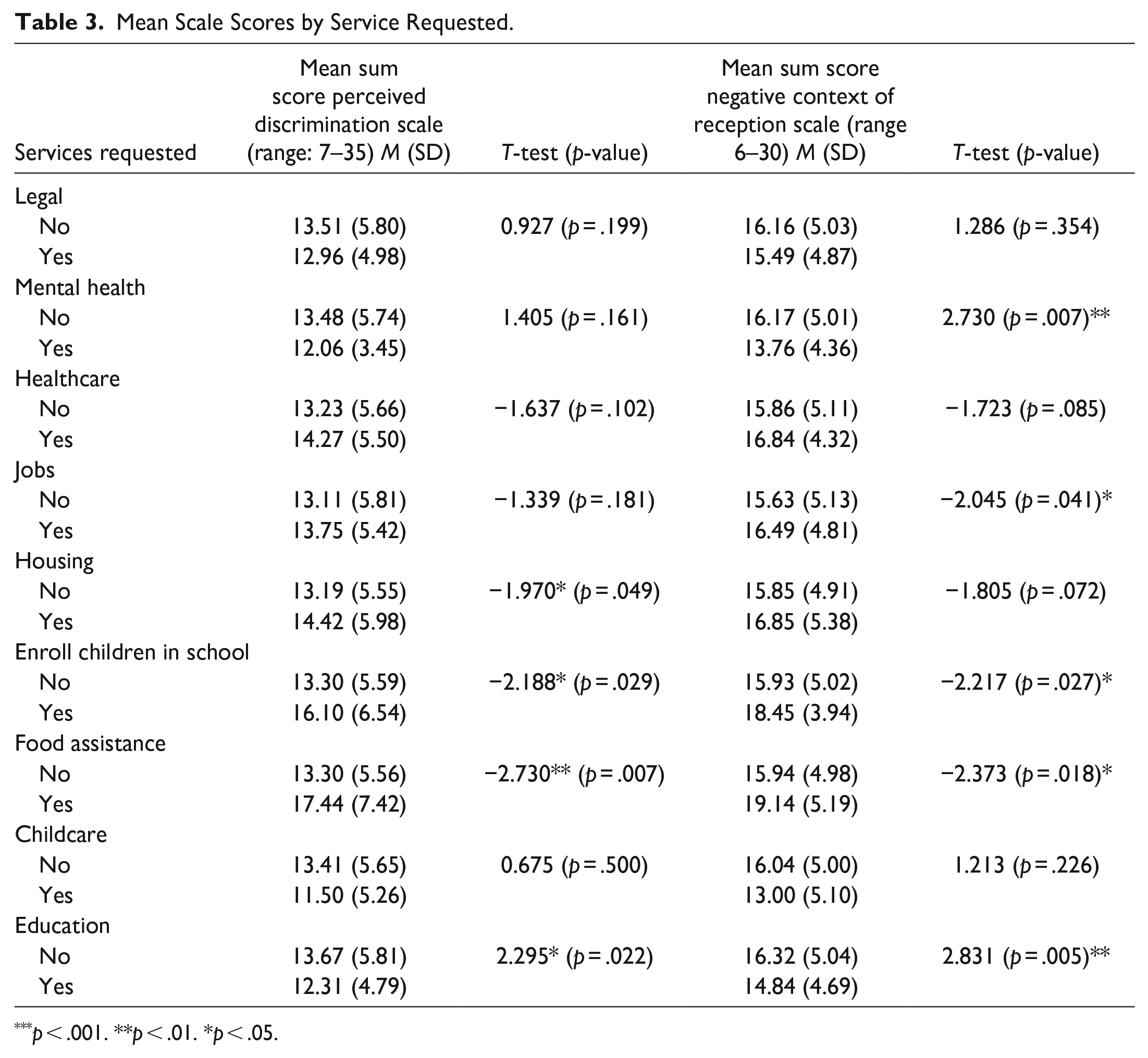
p < .001. **p < .01. *p < .05.
Limitations
The present findings should be interpreted in light of at least three important limitations. First, the study was conducted with a cross-sectional convenience study sample of Venezuelan immigrants. It is important to conduct longitudinal studies on acculturation, cultural stressors, and service need utilization among Venezuelan immigrants in their new environments. Second, although both the United States (specifically the state of Florida) and Colombia are among the countries and regions with the largest Venezuelan communities, other areas should be studied as well. In recent years, Latin American countries, particularly Peru and Brazil, have also received large numbers of Venezuelan immigrants. Venezuelans have also migrated to European countries such as Spain and Italy. Third, although we asked about service needs, we did not inquire as to whether or not participants were pursuing or meeting the needs that they enumerated. Indeed, unmet service needs are likely quite different from needs that are being satisfied. Future research should examine the extent to which service needs are being met, barriers are encountered when trying to access services, and experiences they would want to share with other immigrants.
Discussion
Improving service provision for immigrants can increase long-term mental and physical health as well as increase immigrant contributions to the communities where they are settling. Accordingly, in the present study, we surveyed a sample of Venezuelan immigrants in the United States and Colombia — two of the primary destinations for this population — and compared these responses across the two destination countries and between participants reporting (vs. not reporting) experiences of discrimination and perceptions of a negative context of reception. Venezuelan immigrants are an important population with whom to study service needs, given the epidemic levels of street violence, economic collapse, and governmental repression taking place in Venezuela.
The service needs that participants enumerated reflect three levels within Maslow’s hierarchy of needs — basic needs (e.g., food, healthcare access, and housing), esteem needs (e.g., mental health services, and legal services), and higher-order needs (e.g., educational services and transfer of career capacity). Many Venezuelan immigrants, especially in the United States, are college educated — perhaps explaining (at least to some extent) the presence of educational services and transfer of career capacity among the needs listed. More concerning, however, was the prominence of housing needs (17 percent of the sample), healthcare access (16 percent), and legal services (20 percent) — suggesting that considerable shares of the sample did not have access to stable housing, did not have a regular health care provider or lacked health insurance, and had unmet needs in obtaining legal status in the country where they had settled. 2 Fortunately, food needs were listed only by a small proportion of the sample — indicating that food insecurity was fairly rare in our sample. Nonetheless, the needs enumerated by participants serve as a guide in terms of services that governments and non-governmental organizations (NGOs) must anticipate if they are to adequately care for this large and growing population that is settling in countries throughout the Americas.
To some extent, our findings are not consistent with prior work suggesting a high prevalence of service needs among immigrants and refugees (Pumariega and Pumariega 2005; Cabieses and Oyarte 2020). The mean number of 1.5 service needs listed by each participant (among the 10 services that emerged from qualitative coding) suggests that — to the extent to which this sample is representative of Venezuelan immigrants in the United States and in Colombia — the majority of participants are managing fairly well in their new environments. However, a nontrivial proportion of our sample (7.2 percent) listed three or more services, suggesting that some Venezuelan immigrants are not able to access items or activities required for completing daily tasks and reestablishing themselves in a new country. It is important to note that the short answer format for the service needs question might have resulted in participants listing fewer services (i.e., as a way of reducing completion time for the overall survey). On the contrary, listing fewer services might be consistent with literature suggesting that most immigrants and refugees are resilient and adjust fairly well to their new homelands (Cobb et al. 2019). To the extent to which this explanation is accurate, those individuals who appear to be struggling in their destination contexts likely require special attention from policy makers and service providers.
Venezuelans settling in the United States generally listed different service needs compared to Venezuelans settling in Colombia. Individuals in the United States were more likely to indicate needing English-language education. This finding was expected given the status of Spanish as the national language of both Venezuela and Colombia, whereas immigrants to the United States generally need to master English if they are to open businesses or work in professional occupations. Immigrants to the United States also were more likely to list childcare. Participants’ responses to questions about concerns regarding children (not summarized in this article) suggests that participants in the United States generally brought their children with them, whereas participants in Colombia were more likely to have left their children with relatives in Venezuela. With that said, however, participants in Colombia were more likely than those in the United States to need help enrolling their children in school. This discrepancy may be attributed to the widespread availability of free public education in the United States, in contrast to the privatization of education prevalent in South American nations. Moreover, participants in Colombia were more likely than those in the US to list housing as a service need — perhaps reflecting the greater representation of people without college degrees (75 percent in Colombia vs. 52 percent in the US) in the Colombia sample. Further work is necessary to explore reasons for differences in service needs for Venezuelans immigrating in the United States versus in other Latin American countries.
Patterns of associations between service needs and cultural stressors appeared to depend, at least in part, on whether cultural stressors were analyzed as continuous variables (reflecting the precise degree of cultural stress experienced) or as dichotomous variables (reflecting whether or not one has experienced appreciable levels of cultural stress). For negative context of reception, all of the patterns emerging for the dichotomous indicator also emerged for the continuous indicator, suggesting that context of reception may best be operationalized in terms of the continuous extent to which Venezuelan immigrants felt excluded or unwelcome in the United States or in Colombia. For discrimination, however, 50 percent (four out of eight) of the significant findings for the continuous and dichotomous indicators were unique (i.e., did not emerge for both indicators). This finding suggests that the association between service needs and experiences of discrimination depends on whether one examines whether or not participants have experienced discrimination versus how much discrimination participants have experienced. Specifically, participants reporting at least some discrimination were more likely than other participants to list needs for healthcare and jobs, but these patterns did not replicate for the continuous discrimination indicator. Conversely, greater levels of discrimination (as a continuous indicator) were associated with greater likelihood of listing needs for housing and for help enrolling children in school — but these patterns did not replicate for the dichotomous discrimination indicator.
Findings that did replicate across both the dichotomous and continuous discrimination indicators included increased likelihood of listing needs for food and decreased likelihood of listing English language education (in the United States). These patterns might suggest that poorer people, who are more likely to report food insecurity, may also be more likely to experience discrimination (Fuller-Rowell, Evans and Ong 2012). Poorer immigrants may also be likely to be perceived as threats to the destination country or region (Piazza 2011). Wealthier people may also have greater access to the resources needed to fit into the destination culture.
Two services — English-language instruction and mental health care — appeared to be endorsed less strongly by participants experiencing greater amounts of cultural stress. These patterns may be explained within the context of the rejection-identification model (Branscombe, Schmitt, and Harvey 1999) and in terms of taboos against seeking mental health services within some Latin American cultural groups. First, the rejection-identification model suggests that individuals who perceive themselves as being rejected by the “mainstream” culture within the destination society may withdraw from that mainstream culture and immerse themselves even more strongly within their cultural heritage. Venezuelan immigrants in the United States who experience discrimination may be less interested in learning a new language and interacting with English-speaking U.S. residents. Although at least some of the discrimination that Venezuelan immigrants experience (especially in South Florida) may come from other Hispanic groups (Vos et al. 2021) these immigrants may nonetheless avoid seeking opportunities to become involved with or learn the language of their host counterparts upon experiencing discrimination.
The findings for mental health services are in line with research suggesting that many Hispanic immigrants view seeking treatment for mental health problems as a sign of weakness (Lopez et al. 2018). Perceiving a negative context of reception may also reinforce the belief that one is not a part of the destination society and may prevent immigrants from seeking treatment for mental health issues. Given the seriousness of the Venezuelan crisis — previous work with this same sample indicates that more than half of the immigrants surveyed met criteria for elevated levels of depression and more than 25 percent met criteria for elevated symptoms of post-traumatic stress (Schwartz et al. 2018) — identifying ways to reduce discrimination and to improve the context of reception for Venezuelan immigrants in the United States and Colombia is an urgent public health priority. Individuals in the United States demonstrated a higher demand for mental health services compared to their counterparts in Colombia. This divergence could be associated with the income disparities between the two groups. In the United States, where many individuals reported higher income levels, their service requests spoke to esteem and self-fulfillment needs, reflecting a focus beyond basic necessities in line with Maslow’s hierarchy of needs.
In addition, Venezuelans who experienced greater negative context of reception were less likely to indicate needing mental health services. Several factors may play a role for this discrepancy. First, it is possible that Venezuelans who have experienced a negative context of reception have developed coping mechanisms to deal with the challenges they face and, as a result, they may be less likely to acknowledge or report on the need for mental health services. In other words, they might be more resilient and self-reliant in dealing with their mental health needs. Another explanation may be that individuals in both countries may face significant stigma and barriers when it comes to seeking mental health services. Those who perceive negative context of reception might be less inclined to seek help due to fear of discrimination, cultural differences, or other barriers that make accessing mental health services difficult.
Individuals expressing a need for help finding work also were more likely to report a more negative context of reception compared to individuals who did not list finding work as a service need. Integrated threat theory (Stephan, Stephan and Gudykunst 1999) defines realistic threats as fears that immigrants (or other outgroup members) will take resources away from the national ingroup. Jobs are an important such resource, and there is a common belief that immigrants take jobs away from destination-society individuals (Chomsky 2018). It is essential for immigrants to receive assistance finding jobs, as well as for destination-society to receive help in understanding why immigrants looking for jobs are not a threat to the national ingroup.
In the US sample, the high number of women requesting educational services may signify a proactive approach among women in pursuing educational opportunities. Conversely, in Colombia, where more women seek services for enrolling children in school, this trend could align with traditional gender roles, emphasizing women’s roles as primary caregivers. Furthermore, the increased demand for mental health services among women compared to men suggests that women might encounter distinct challenges and responsibilities related to family welfare and personal development. These gender disparities in service requests may be influenced by societal expectations and cultural norms. It is worth noting that in the United States, there may be a more open and inclusive approach to equal opportunities, which could contribute to these observed differences.
Now that we have reviewed the needs that were listed in our study, we will advance some general recommendations. At the broadest level, and across the various needs that participants listed it is crucial to develop a comprehensive picture of the phenomena at play including Venezuelan culture, recent political events and the trauma that these events have caused, and how specific migration experiences inform immigrants’ view of actual and perceived needs (Falicov 2016). In addition to the psychosocial factors affecting immigrants’ adaptation to their host country, external factors, such as basic needs, require attention and understanding. Public health approaches should involve interventions and policy integrating these needs by providing community education, developing community advocates and resources, and providing transitional services. Outreach is also necessary to inform this population about available services and to encourage immigrants to utilize these services (Leduc and Proulx 2004). It is especially imperative to reduce the gaps in health access and use of health services by migrant populations (Cabieses and Oyarte, 2020). Especially given key differences between Venezuelans migrating to the United States and those migrating to Colombia– as well as the links between cultural stressors and needs for healthcare, food assistance, finding jobs, and educational support– culturally competent social work, legal, educational, and healthcare professionals are essential to help engage Venezuelan immigrants and help to ensure that their needs are met. In communities with established Venezuelan populations, such as South Florida, earlier arrivals might be engaged to assist newer migrants in meeting their service needs.
Policy Recommendations
The present study is one of the first to examine service needs among a new and growing Venezuelan immigrant population. As international migration continues to increase
particularly forced migration flows driven by dictatorial governments, civil wars and other disasters — public health experts need to assess the needs of these populations. Specific to the recent Venezuelan exodus, it appears that important needs are not being met, such as housing, work, English-language instruction, help obtaining legal residency in the destination country and healthcare access. Upon arrival, access to healthcare and housing need to be available for refugee and asylum-seeking populations. Especially with regard to crisis migrant populations, mental health assessments and services also appear to be necessary. During resettlement, legal services, economic opportunities, and education become additional necessities, especially as Venezuelans (and other migrant populations) are quite diverse in terms of education, income, language ability, and familiarity with the destination culture.
Providing a successful start for Venezuelans in their new communities requires knowledge of their most pressing needs. Evaluating service networks, in turn, will be essential to bridging the gap between the services provided and those requested by the incoming population, including access to housing, healthcare, education, legal services and economic opportunities.
The federal government should play a central role in formulating and funding comprehensive resettlement policies. It can allocate resources to establish language acquisition programs and provide financial support for mental health services targeting crisis migrants. Collaboration with CBOs and other stakeholders can help identify gaps in existing service networks and can facilitate communication between Venezuelan immigrants and their new communities. State governments can work to identify gaps in services. They can also collaborate with public health institutions to ensure access to healthcare services for Venezuelans and to facilitate partnerships with NGOs specializing in education and mental health support.
At the local level, municipalities can promote social inclusion that includes efforts to promote intercultural understanding and dialogue sessions. They can allocate resources to create community centers where immigrants can access information about housing, employment opportunities, and legal services.
NGOs can offer direct support to immigrants by providing educational resources, legal aid, and assistance with finding housing. For example, NGOs can establish language schools and cultural exchange programs.
Lastly, public health institutions can conduct mental health assessments for Venezuelan immigrants, offering counseling services and support groups tailored to their needs. They can also work with local authorities to address healthcare access disparities.
Footnotes
Declaration of Conflicting Interests
The author(s) declared no potential conflicts of interest with respect to the research, authorship, and/or publication of this article.
Funding
The author(s) received no financial support for the research, authorship, and/or publication of this article.
1
Cronbach’s alpha is a statistical measure used in research and psychometrics to assess the internal consistency or reliability of a set of related items or questions within a questionnaire or test. It quantifies the extent to which these items, often used to measure a particular construct or trait, all measure the same underlying concept. A higher Cronbach’s alpha indicates greater internal consistency among the items, suggesting that they are effectively measuring the intended construct as a group ( ,).
,).
2
A recent study on the needs of resettled refugees has similarly highlighted housing, healthcare, and (also) childcare needs (Kerwin and Nicholson 2021). In addition, a 2022 immigrant legal needs study has underscored the insufficient charitable legal capacity available for immigrants and refugees in the United States, including in Florida where most Venezuelans have settled (). This study is likewise consistent with this paper’s findings.