




Abstract
Drawing on the concept of a “complex humanitarian crisis,” this paper describes how outflows of migrants from Central America were transformed into such a crisis by intransigent immigration and border policies enacted in both Mexico and the United States. We describe the origins of the migration in U.S. Cold War interventions that created many thousands of displaced people fleeing violence and economic degradation in the region, leading to a sustained process of undocumented migration to the United States. Owing to rising levels of gang violence and weather events associated with climate change, the number of people seeking to escape threats in Central America has multiplied and unauthorized migration through Mexico toward the United States has increased. However, the securitization of migration in both Mexico and the United States has blocked these migrants from exercising their right to petition for asylum, creating a growing backlog of migrants who are subject to human rights violations and predations both by criminals and government authorities, leading migrants to label Mexican routes northward as a “corridor of death.” We draw on data from annual reports of Mexico's Red de Documentación de las Organizaciones Defensoras de Migrantes (Network for the Documentation of Migrant Defense Organizations) to construct a statistical profile of transit migrants and the threats they face as reported by humanitarian actors in Mexico. These reports allow us to better understand the practical realities of the “complex humanitarian crisis” facing undocumented migrants, both as unauthorized border crossers and as transit migrants moving between the southern frontiers of Mexico and the United States.
Policy makers need to address:
Governments must recognize that the humanitarian crisis facing migrants is not confined to border regions but unfolds at places of both origin and destination as well as within extended geographies of transit in-between. The current refugee protection regime and asylum system are ill-matched to the needs and vulnerabilities of today's migrants. In an era of rapid climate change, rising state failures, and escalating violence, people are not moving so much to advance economically as to escape a growing array of threats not covered by the 1951 Refugee Convention, which needs to be updated. Developed nations must honor rather than elide their obligations under international law to accept asylum applicants and fairly adjudicate their cases, Since a large fraction of the Central Americans arriving at the southern US border have relatives in the United States, creating a pathway to legal status for unauthorized US residents would relieve a lot of the pressure on the asylum system by enabling authorities to release applicants to the support and care of legally resident relatives rather than placing them in an overburdened detention system. Governments need to scale back the securitization and criminalization of migration, which have made human mobility an increasingly precarious and risk-filled activity that contributes to rather than forestalls the proliferation of crime and violence. Human rights and humanitarian agencies need to revisit their missions to derive new ways of working conjointly and in parallel with each other and with governments to better understand and meet the needs of migrants in the 21st century.
Published statistics from US Customs and Border Protection (CPB) (2021a) reveal that from 1998 through 2020 some 7,216 migrants perished along the US-Mexico border, and the Mesoamerican Migrant Movement (2016) estimates that upwards of 70,000 Central American migrants disappeared in Mexico between 2006 and 2016. The Mexican government's own Registro Nacional de Personas Desaparecidas o no Localizadas (National Registry of Disappeared or Missing Persons) (2022) lists 101,510 persons who vanished without a trace between 1964 and 2022. Given these statistics, it is unsurprising that Mexico has become known as El Corredor de la Muerte (the Corridor of Death) among the Central American migrants, refugees, and asylum seekers who traverse its territory on their way northward.
The rising visibility of Central American migrants occurs against a backdrop of declining undocumented migration from Mexico, one that paradoxically was accompanied by a sharp increase in migration by Mexicans holding legal temporary labor visas. From 2000 to 2018 the number of Mexicans apprehended at the border dropped from 1.6 million to 152,000 and the number of undocumented Mexicans living in the United States fell by 1.6 million persons (Warren 2020).
As immigration from Mexico declined, undocumented migration rose from Central America's “Northern Triangle” (i.e., El Salvador, Guatemala, and Honduras), with a net inflow of 258,000 migrants between 2008 and 2018 (Warren 2020). Although undocumented migration along the Mexico-U.S. border has long been framed as a “humanitarian crisis” (Huspek, Martinez, and Jimenez 1998; Falcón 2001; Meneses 2003), the most recent iteration of that framing dates to 2014 when 68,541 unaccompanied minors were apprehended (three quarters from the Northern Triangle) and President Obama's initial policy of taking them into custody sparked a debate on the legality and morality of incarcerating children (Lind 2014).
In the years since 2014, the movement of Central Americans toward the US border has continued, with notable surges in 2016, 2019, and 2021. Over the five years from 2016 to 2021, some 4 million unauthorized migrants were apprehended along the Mexico-US border, 49.3 percent from the Northern Triangle compared with just 37.3 percent from Mexico and 13.4 percent from other nations (U.S. Customs and Border Protection 2021b). Northern Triangle migrants generally arrive at the border seeking asylum, not employment, as evidenced by the prevalence of children and families among them.
Information documenting the situation of migrants transiting Mexico is scarce and fragmented. Amnesty International (2010) refers to transit migrants as “invisible victims” of a rising tide of violence and exploitation. In response to this perceived crisis, the Servicio Jesuita de Migrantes (Jesuit Migration Service) organized the Red de Documentación de las Organizaciones Defensoras de Migrantes (Network for the Documentation of Migrant Defense Organizations). Commonly known by its Spanish acronym REDODEM, the organization seeks to document the perilous circumstances of transit migrants within Mexico and along its northern and southern borders (REDODEM 2021). The network currently manages 23 facilities throughout the country, providing humanitarian assistance, spiritual counseling, legal advice, and health care to transit migrants. Each year from 2013 through 2019, REDODEM has issued a report on the status and welfare of migrants, using data obtained from migrants who registered to access the organization's services, yielding a cumulative sample of around 200,000 migrants that we draw upon in the current analysis.
We begin by tracing the origins of Central American migration to Cold War policies pursued by United States during the 1980s. We then move on to describe how international migration has increasingly been “securitized” and how Central American migration has been further complicated by gang violence and climate change to create a “complex humanitarian emergency.” Drawing on official statistics from Mexico and the United States, we document the blocked pathways the migrants experience in their search for sanctuary and using data from REDODEM's annual reports we construct a statistical profile of transit migrants and the humanitarian threats they face. This statistical profile serves to outline some of the practical realities of the humanitarian crisis denounced in Mexico by civil society. We end with a summary of our findings and an appraisal of the changing nature of international migration and the policy challenges it poses in the 21st century.
Origins of Central American Migration
Central American migration emerged from civil wars and counterinsurgency operations that crested in the 1980s as part of the US strategy of Soviet containment (Chomsky 2021). In Guatemala the story goes back to 1954 when a coup covertly organized by the CIA deposed democratically elected President Jacobo Arbenz to arrest the spread of “communism” in the region (Bowen 1983). In subsequent years, with US support the Guatemalan regime undertook a campaign of genocidal military suppression that fell heavily on the indigenous Mayan population, causing many to flee northward to the United States (Roniger 2010).
During the 1980s, the United States armed and trained death squads in El Salvador, also in the name of fighting communism (Arnson 2000). The resulting violence and its economic disruptions brought about the widespread displacement of people from the countryside and poor urban neighborhoods, leading to mass migration toward the United States (Stanley 1987; Jones 1989; Stoltz Chinchilla, Hamilton, and Loucky 2009). Because both Guatemalans and Salvadorans were fleeing nations ruled by right-wing regimes supported by the United States, politically they could not be accepted as refugees or asylum seekers and instead were compelled to enter without authorization, joining Mexicans as part of the growing undocumented population (Massey, Durand, and Pren 2014).
Unlike migrants from Mexico, however, those from El Salvador did not have well-developed migrant networks or social institutions to support their arrival, adaptation, and integration into U.S. society, yielding fragmented interpersonal ties, social marginalization, and a fraught process of settlement (Menjívar 2000). Young men especially found themselves jobless on the streets of South-Central Los Angeles where they were targeted by well-established Black gangs, leading them to form their own gangs, known as maras, in self-defense (Dudley 2020). These maras mainly developed in LA's Central American community (Carlson and Gallagher 2015). With the acceleration of deportations from the United States during the 1990s and 2000s, thousands of mara members were expelled to their countries of origin (Massey 2020a), making the rise of the infamous mara salvatrucha in the region a direct export from the United States (Wolf 2012).
Honduras was drawn into the cycle of violence later during the 1980s when the Reagan Administration used it as a staging area for counterinsurgency operations in El Salvador and Guatemala and later as a base for recruiting, training, and equipping an army of “Contras” to invade Nicaragua in order to overthrow the leftist Sandinista regime. Years later, when a military coup deposed democratically elected President Manuel Zelaya in 2009 shortly before national elections, the Obama Administration publicly condemned the coup but behind the scenes tacitly accepted it, preferring to have Zelaya, whose policies threatened the nation's wealthy elite, out of power and outside the country during the elections (Cassel 2009).
Prior to 1980, there was little migration from Central America to the United States, either documented or undocumented. During the 1970s, legal immigration from the Northern Triangle averaged just 5,000 entries per year. During the 1980s the figure rose to more than 13,000 per year and reached 18,000 in the 1990s. In 1980, on the eve of the US intervention, the number of undocumented Salvadorans and Guatemalans living in the United States was estimated at just 38,000 and 30,000, respectively, with the number of Hondurans being too small to estimate (Warren and Passel 1987). Ten years later the undocumented populations had risen to 298,000 Salvadorans, 118,000 Guatemalans, and 42,000 Hondurans (INS 2002); and in 2018 the respective numbers reached 730,000, 620,000, and 450,000 (Baker 2021).
Although the civil wars ended in the late 1980s and the rate of undocumented out-migration peaked, migration from the region never returned to the status quo ante. Civil warfare was replaced by gang violence and the region's economies never recovered from the destruction of the 1980s. To escape these conditions, migrants continued to head northward, but unlike those who departed in the 1980s these later migrants had ties to friends and relatives living north of the border they could draw upon to gain entry and settle (Massey, Durand, and Pren 2014). Although the United States cannot be held solely responsible for Central America's problems, it nonetheless played a central role in rendering economic turmoil and civil violence endemic throughout the region (Fasquelle 2011; Taylor-Robinson 2013; Massey 2020b).
The Securitization of Migration
In the context of the Cold War, President Ronald Reagan in the 1980s declared border control to be an issue of “national security,” warning Americans of “a tidal wave of refugees—and this time they’ll be ‘feet people’ and not boat people—swarming into our country seeking safe haven from communist repression to the south” (Massey, Durand, and Malone 2002, 86). Reagan's linking of undocumented migration to national security was the leading edge of a broader trend in immigration policy known as the securitization of migration (Huysmans 2000; Bigo 2008; Buzan, Waever, and de Wilde 1998).
Since the 1980s, immigrants generally and unauthorized migrants in particular, have increasingly been framed as threats to national security, justifying the implementation of vigorous enforcement measures both along borders and within nations (Bourbeau 2011; Gerard 2014). Despite abundant evidence documenting the failure of harsh enforcement measures to control unauthorized migration (see Chavez 1997; Meneses 2003; Castles 2004; Spener 2009; de Leon 2015; Brigden 2018; Durand and Massey 2019), the United States has continued to expand enforcement efforts at a great cost in human suffering.
Securitization in the United States
In 1981 the Reagan Administration proposed legislation granting the president power to declare an “immigration emergency” and close the border, a provision that ultimately became part of the 1986 Immigration Reform and Control Act (Massey, Durand, and Malone 2002). That act inaugurated a multi-decade militarization of the Mexico-US border (Massey 2005). From 3,700 officers and a budget of $151 million in 1986, the US Border Patrol grew over the ensuing decades to peak at more than 21,000 officers with a budget of $3.5 billion in 2011. Although the number of officers ceased to grow after this date, the Border Patrol's budget continued to climb, reaching a record $4.9 billion in 2021 (American Immigration Council 2021).
We began this article by noting the cumulative toll of more than 7,000 deaths along the Mexico-US border from 1998 through 2020. Figure 1 combines statistics from U.S. Customs and Border Protection (2021a) with data marshaled by Eschbach, Hagan, and Rodriguez (2001) and Sands (2021) to reveal a toll of 10,031 fatalities from 1985 through 2021, likely an underestimate given the perishability of human remains in the high desert and lower Rio Grande Valley (de Leon 2015). Although border deaths were actually declining from 1985 to 1993, the launching of Operation Blockade in El Paso in 1993 and Operation Gatekeeper in 1994, increasingly pushed migrants away from crossing points in urbanized areas such as San Diego/Tijuana and El Paso/Juarez into ever more remote and dangerous sectors of the border (Massey, Durand, and Pren 2016; Boyce, Chambers, and Launius 2019). From 1993 to 2005 the annual number of border deaths rose from 67 to 492. Thereafter it declined to a low point of 365 in 2010 before rising to another peak of 471 and then dropping to 251 in 2015. Deaths then fluctuated a bit through 2020 before surging to 557 in 2021, the largest number ever recorded.
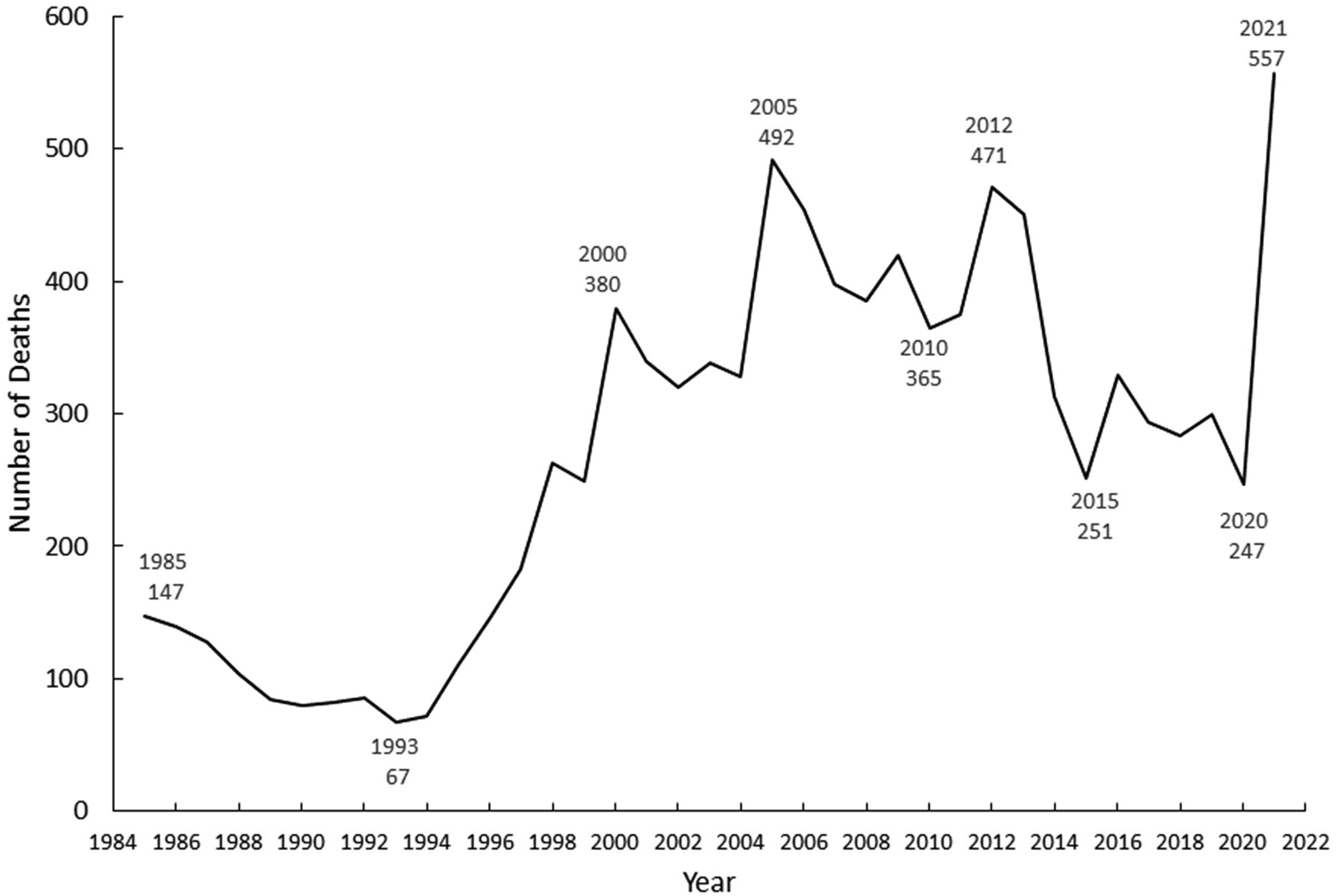
Deaths along the Mexico-US border 1985–2021.
Given the foregoing statistics, it is hardly surprising that unauthorized migration has increasingly become associated in public consciousness with warfare and crime. Chomsky (2014, 2–3) speaks of “border wars” in which international frontiers come to feel like “warzones.” Stumpf (2013) labels the situation at the Mexico-U.S. border a “crimmigration crisis,” given that U.S. immigration law, which is ostensibly civil, has been heavily criminalized over the years (García Hernández 2021). Border militarization and crimmigration define the context in which Central Americans now migrate toward the United States.
Donald Trump famously announced his candidacy alleging that Mexicans were “bringing crime; they’re rapists;” and that “it's coming from more than Mexico. It's coming from all over South and Latin America.” His remedy, of course was to build a 2,000-mile wall along the border, and upon entering office he not only began to construct it, but also announced a new “zero-tolerance policy” toward asylum seekers (Congressional Research Service 2021). Under both US and international law, migrants have a right to proceed to a port of entry along the border and request asylum in the United States.
Since December 2019, however, asylum seekers have been subject to one of two fast-track asylum review processes, either the “Prompt Asylum Claim Review” (which applies to non-Mexican single adults and family units) or the “Humanitarian Asylum Review Process” (which applies to Mexican single adults and family units). Under these programs, asylum seekers are held at detention centers near the border and given just 48 hours to contact family, friends, and attorneys, leading to rapid processing in mass trials and quick removal (Shepherd 2020).
Since March 20, 2020, asylum seekers have also been turned away from the border under what had been a little-known provision of US public health law (section 265 of Title 42), used by Trump to achieve his longstanding goal of closing the country to asylum seekers, yielding over 1.8 million expulsions since the pandemic began (American Immigration Council 2022). Prior to the invocation of Title 42, those removed to Mexico languished on the streets or in squalid camps until in desperation many attempt to cross (or re-cross) the border without authorization, yielding not only deaths but disappearances. Since 1994, more than 5,500 migrants have “disappeared” while attempting an unauthorized border crossing (Patiño Houle and Torres 2019).
As a result of these policy shifts, the number of migrants apprehended and removed from the United States rose by a factor of 2.7 during the period from March 2020 through September of 2021, further aggravating the humanitarian crisis unfolding in the borderlands. Immigrant advocates condemned Trump's policy as cruel, unconstitutional, and a violation of international law (Aguilera 2019) and human rights activists denounced the detention of women and children as immoral (Habitat for Humanity 2021). During the 2020 presidential campaign, candidate Joseph Biden promised to pursue a more “humane” border policy; but since his inauguration, federal courts have blocked his attempts to do so, and US border policies have proven to be little different from those of his predecessor (Kocher 2021; Shear et al. 2021). Title 42 expulsions continued uninterrupted through 2021, leading to a renewed outcry of indignation in September of that year when a video of horse-mounted Border Patrol agents lassoing running migrants went viral (Rose 2021).
Securitization in Mexico
A key feature of the securitization of migration in wealthy nations is the “outsourcing” of enforcement to third party states to prevent the arrival of migrants at their borders, yielding a new system of enforcement by “remote control” (FitzGerald 2019). Beginning in the 1990s, under pressure from the United States, Mexico enacted a succession of initiatives intended to deter Central Americans from crossing its southern border and making their way northward. These initiatives, subsidized by the United States, have been defended by Mexican officials as necessary to “combat organized crime” and “protect migrants." They include Operativo Guardián (Operation Guardian in 1994), el Plan de Acción de la Alianza para la Frontera (the U.S-Mexico Border Partnership Agreement in 2002), the Alianza para la Seguridad y la Prosperidad de América del Norte (the Alliance for Security and Prosperity in North America in 2005), the Iniciativa Mérida (the Merida Initiative in 2007), and the Iniciativa más allá de Mérida (the Beyond Merida Initiative in 2011).
Each new program has functioned to multiply the presence of Mexican police and military personnel stationed along the nation's borders and patrolling its internal migration routes. In 2014, Mexican President Enrique Peña Nieto launched the Programa Frontera Sur (the Southern Border Program), justifying it as a means of “protecting the rights of migrants” and “better managing” ports of entry “to promote regional security and prosperity” (Secretería de Gobernación 2015). As one critic noted, however, “under pressure from the U.S. government, Mexico has gradually enforced strict immigration policies aimed at shutting down transit lines along its southern border… crackdowns [that] are accompanied by increased human rights violations” (Castillo 2016).
Figure 2 draws on data from Mexico's Instituto Nacional de Migración (National Migration Institute) to show migrant detentions and deportations during years from 2001 through 2021 (Instituto Nacional de Migración 2021a). The implementation of the 2002 US-Mexico Border Partnership under President Vicente Fox was followed by a surge in both detentions and deportations, which rose sharply to peak at 240,000 apprehensions and 232,000 deportations in 2005. Thereafter, the numbers declined to low levels during the Great Recession but surged once again after Peña Nieto implemented his Southern Border Program in 2014, increasing to 198,000 detentions and 181,000 deportations in 2015 before dropping back to figures of 94,000 and 82,000, respectively, in 2017.
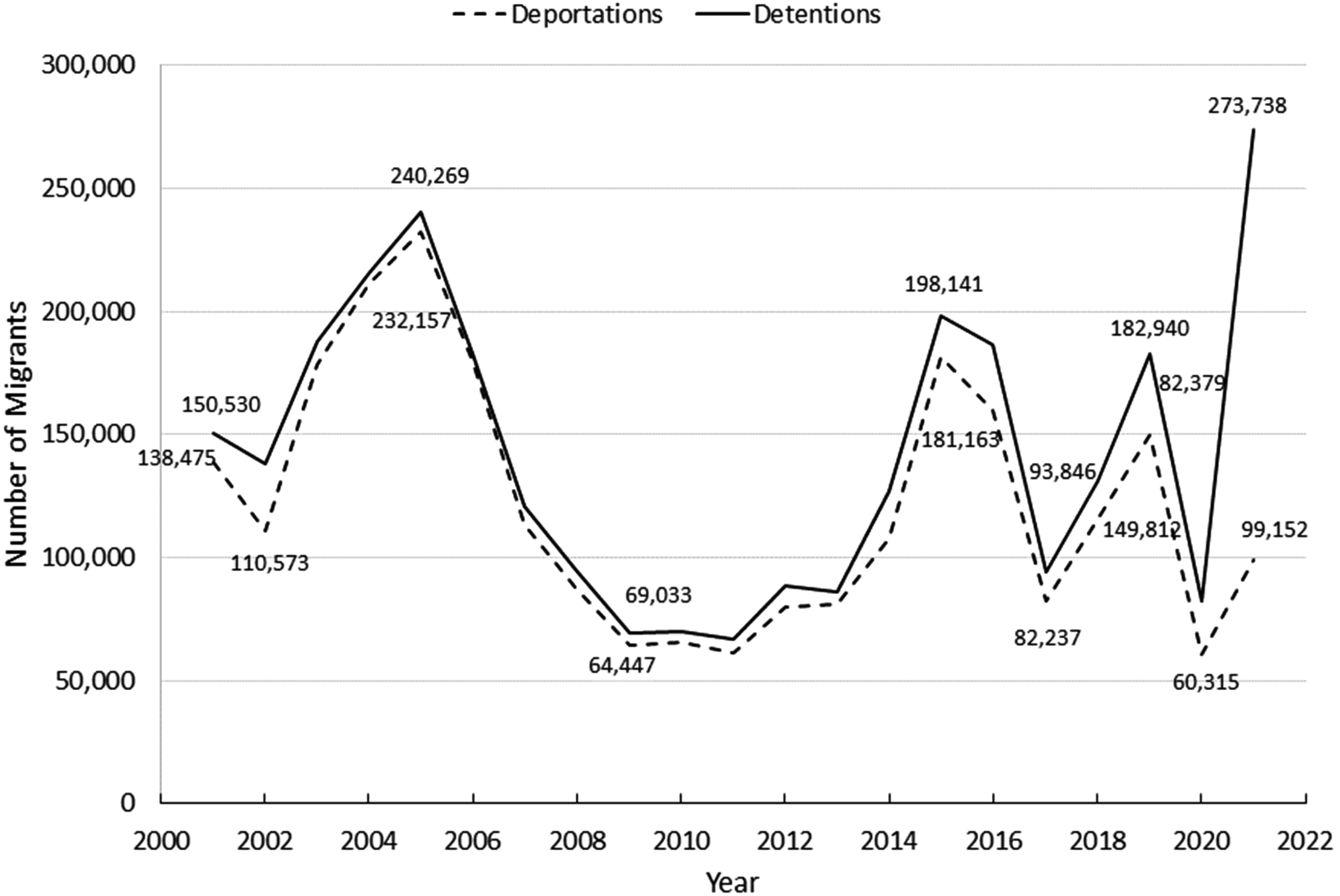
Mexican detentions and deportations 2001–2021.
Conditions for transit migrants have not improved under President Andrés Manuel López Obrador (popularly known as AMLO). On the contrary, in March of 2019 he created a 60,000-person National Guard and ordered its deployment throughout the nation to combat undocumented migration. In that year, detentions rose back to 183,000 with deportations climbing to around 150,000. Although as a candidate AMLO had called for professionalizing Mexico's police and withdrawing the military from public security duties, he nonetheless created the National Guard mostly by borrowing military police from the Army and Navy and combining them with federal agents controlled by the Ministry of Defense (Meyer 2019).
Although detentions declined in 2020 owing to the COVID pandemic, they surged once again to reach a record 274,000 in 2021, opening up a large gap with deportations, which numbered only 99,000. Transit migrants apprehended in Mexico today now are less likely to experience a quick deportation, leading to more time spent in the crowded detention centers that are being constructed throughout the country. According to the Global Detention Project, Mexico has one of the largest detention systems in the world. In 2020 the country operated 60 detention centers, euphemistically called estaciones migratorias (Global Detention Project 2021). Alison Mountz (2020) argues that detention centers in Mexico and elsewhere are part of a global system of detention centers that imprison asylum seekers and conceal persistent human rights violations.
The spread of Mexico's immigration enforcement efforts away from the borderlands into the country's interior has, in effect, created a wall that separates foreigners from Mexicans wherever migrants might be found. As one report put it: The wall that divides the two countries, whose measures double the one that was built in 2011 – is a constant reminder of this situation. This ‘wall’ is a symbol of national security politics. It has become a vertical line that crosses the whole country; it is a wall of security and persecution against the migrant population from the north to the south of Mexico (Dimensión Pastoral de la Movilidad Humana 2012, 32).
From 2001 through 2021 some 2.94 million migrants were detained in Mexico and 2.54 million were deported, with 90 percent of the former and 95 percent of the latter being sent back into the Northern Triangle. Although the percentage of detainees from the Northern Triangle was fairly stable over the period, as shown in Figure 3 the relative contributions of the three countries has changed substantially. In the two most recent surges, Hondurans vaulted to the fore, with 78,000 detentions in 2019 and 98,000 in 2021, compared to respective figures of 52,000 and 65,000 for Guatemalans and 21,000 and 19,000 for Salvadorans.
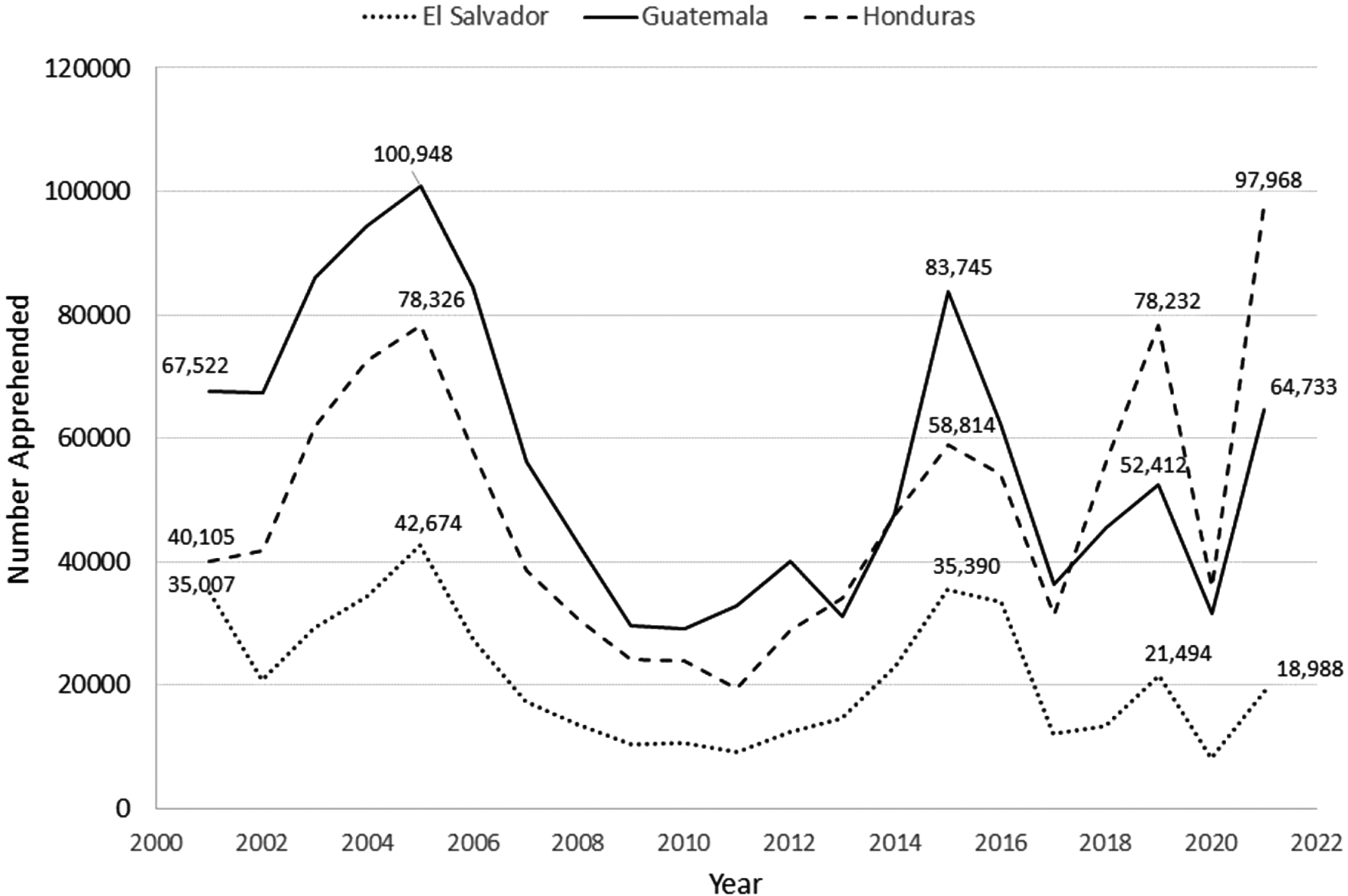
Migrants detained in Mexico by country of origin.
Although migration has been securitized in both Mexico and the United States, the two countries nonetheless differ in terms of the nature and extent of criminalization. The United States has declared both the movement of undocumented migrants and any form of support provided to them to be unlawful, including humanitarian assistance (Boyce 2019). It has also declined to ratify multilateral conventions protecting human and migrant rights. In Mexico, however, the INM has gone so far as to issue guidelines to protect the rights of transit migrants, though admittedly they only apply once a migrant is apprehended. Nonetheless, unauthorized migration itself is not criminalized and Mexico is one of the few nations to have ratified the International Convention on Protection of the Rights of All Migrant Workers and the Members of their Families.
The INM actually offers assistance to migrants through a variety of initiatives such as the Programa Paisano (the Paisano Program, aimed at Mexican migrants returning from the United States), the Programa de Repatriación (the Repatriation Program, for migrants deported from the United States), Grupo Beta (the Beta Group, a police force tasked with protecting migrants along the border), Oficiales de Protección a la Infancia (Officials for the Protection of Minors, aimed at migrant children), and the Estrategia Integral de Prevención de Delitos, Secuestros y Extorsión (Comprehensive Strategy to Prevent Crimes, Kidnappings, and Extortion, intended to protect migrants in transit) (Instituto Nacional de Migración 2021b).
In 2012 the Mexican government also created a humanitarian visa enabling migrants to remain in Mexico to permit the prosecution of crimes they had suffered or witnessed. However, even though the purpose of the visa was humanitarian, in practice it has been little used. From 2011 to 2013 there were only 93 applications in all of Mexico, and of these just 49 were granted (Wolf et al. 2013, 254). Mexican officials explain these low numbers as stemming from a lack of interest among migrants, a lack of knowledge about the visa, or frustration at the complexity of the process. The Instituto para la Seguridad y la Democracia (INSYDE 2021) found that the INM generally favors issuing exit permits rather than humanitarian visas.
In the end, humanitarian visas are very difficult to obtain without the assistance of a civil society organization; and Mexico's Comprehensive Strategy to Prevent Crimes, Kidnappings, and Extortion was deemed ineffective by the Comisión Nacional de los Derechos Humanos (CNDH), which noted that kidnappings actually rose after it was implemented (Wolf et al. 2013, 279). In addition, assistance to migrants decreased after the Tamaulipas massacre of 2010. Whereas 226 migrants were assisted in that year, the number fell to 157 in 2011, and 129 in 2012 (Wolf et al. 2013). Irregular status continues to mean vulnerability, precarity, and a lack of access to human rights protection (Inter-American Commission on Human Rights 2021).
Complicating the Context
Although the term “humanitarian crisis” has no universally recognized definition, the term is often used interchangeably with “humanitarian emergency,” which has been defined by the Humanitarian Coalition (2021) as “a series of events that represents a critical threat to health, safety, security or well-being of a community or other large group of people, usually over a wide area.” The threats facing transit migrants in Mexico today comprise what is known as a “complex humanitarian emergency,” a term coined in the 1980s during the UN's efforts to assist displaced persons in East Africa. It recognizes that some emergencies “have multiple causes, involve multiple local actors, and compel an international response” (Calhoun 2008, 84).
Within Mexico, the turning point in awareness came in 2010 when the bodies of 72 Central American migrants were discovered mutilated and decapitated at a ranch in the Mexican border state of Tamaulipas. The discovery rendered transit migrants suddenly visible and brought them to the attention of human rights activists everywhere. Although human rights issues along the Guatemala-Mexico border have tended to remain out of sight, Human Rights Watch (2021) reports that Mexican polices are putting lives at risk through its mass expulsion of people into remote jungle areas.
In addition, the legacy of economic degradation and political violence arising from the US intervention has been exacerbated by the effects of global climate change and the treatment of environmental distress as a national security matter (Boyce et al. 2020; Dalby 2014; Gilbert 2012). During 2010, for example, the Obama administration made climate change a top national security threat (Gilbert 2012; Boyce et al. 2020, 399); and in 2017 Trump withdrew the United States from the Paris Climate Agreement and made cuts in the acceptance of international refugees (Boyce et al. 2020). Back-to-back Category 4 hurricanes devastated Honduras in late 2020, displacing some 4.6 million people (Americares 2020). In the following year, the number of Hondurans apprehended at the Mexico-US border climbed to 309,000, nearly eight times the number recorded in the prior year (CBP 2021b). Among those apprehended, 60 percent were unaccompanied minors or persons traveling in family groups rather than single adults traveling alone.
In Mexico, cartel violence has risen to record levels and climate change has produced an onslaught of droughts, floods, and other severe weather events. Although violence appears to generate more internal than international migrants (Massey, Durand, and Pren 2020), substantial evidence has accumulated to suggest that severe weather events and environmental changes associated with climate change have become important drivers of migration from Mexico to the United States (Munshi 2003; Hunter, Murray, and Riosmena 2013; Nawrotzki et al. 2015) as well as from Central America (Kaenzig and Piguet 2014; Spencer and Urquhart 2018; Baez et al. 2017; Lynch 2019; Sigelmann 2019). These environmental events have generally been met by a “geopopulationism” policy framework (Bhatia et al. 2020), which holds that climate change migration can somehow be managed by the militarization of nation-state borders (Gilbert 2012; Boyce et al. 2020; Dalby 2014; Baldwin, Methmann, and Rothe 2014).
In the Northern Triangle, the intertwined effects of economic stagnation, endemic violence, and climate change occur within a context of widespread corruption, official impunity, and poor governance, complicating the situation to produce a very threatening environment. This realization leads us to question a “minimalist” perspective that views migration as driven primarily by climate change and fails to recognize the influence of other factors such as poverty, lawlessness, and violence. Figure 4 succinctly summarizes the current decision-making context for migrants contemplating a trip through the corridor of death. It uses four bar charts to display key indicators computed separately for the Northern Triangle, Mexico, and the United States, averaging across the period 2013–2019, the time span covered by REDODEM's annual reports.
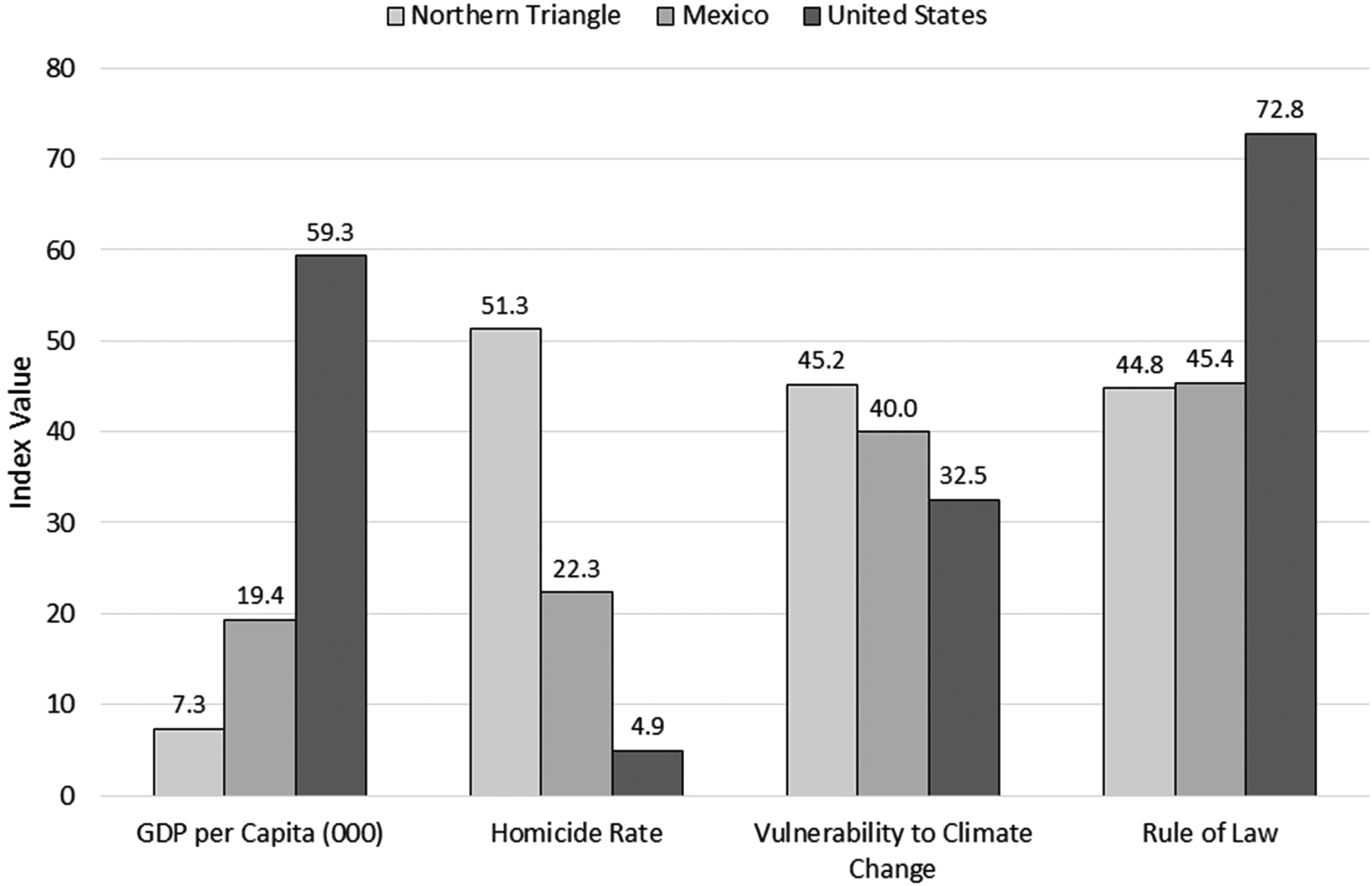
Selected indicators of safety, security, and wellbeing in Mexico, the United States, and the Northern Triangle 2013–2019.
The first indicator is GDP per capita, measured in constant 2017 international PPP dollars (World Bank 2021). These data show that with respect to earnings potential, the Northern Triangle lags well behind both Mexico and the United States. Its value of $7,300 is just 38 percent of that in Mexico ($19,400) and a mere 12 percent of that in the United States ($59,300). The second indicator is the homicide rate, expressed in deaths per 100,000 residents derived from the UN Office on Drugs and Crime (UNODC 2021). These measures reveal the Northern Triangle to be the most life-threatening region in the world, with an average murder rate of 51.3. By most standards Mexico also displays a very high homicide rate, but its average 22.3 per 100,000 for the period is just 43 percent of that in the Northern Triangle. Nonetheless, in 2018 the rate hit 29.1, Mexico's highest level since 1961, compared to a rate of just 4.9 per 100,000 in the United States.
The third measure we consider is the index of vulnerability to climate change developed by the Notre Dame Global Adaption Initiative (2021). It assesses a country's exposure and sensitivity to the negative effects of climate change in six vital sectors: food, water, health, ecosystem service, human habitat, and infrastructure. Of the three regions considered, the Northern Triangle is clearly the most vulnerable, with an index value of 45.2, though Mexico is not far behind at 40.0, yielding just a 12 percent reduction in risk by moving to Mexico. The position of the United States is far more favorable at 32.5, yielding a 28 percent reduction.
Our final indicator assesses the degree to which the rule of law prevails in each region. The measure was developed by the World Justice Project (2021), which drew on national surveys of more than 138,000 households and 4,200 legal practitioners and experts to measure how the rule of law is experienced and perceived in countries throughout the world. In contrast to the prior three comparisons, we observe little difference between the Northern Triangle and Mexico with respect to the rule of law. Whereas the index value was 44.8 for the Northern Triangle, Mexico's index was only marginally higher at 45.4, a 1 percent differential. In contrast, the index value of 72.8 for the United States was 63 percent greater.
The foregoing analysis reveals substantial incentives for migrating out of the Northern Triangle with respect to potential earnings, homicide risk, vulnerability to climate change, and access to the rule of law. Given that the risk of homicide is still quite high in Mexico and offers little improvement in the rule of law, migrants moving out of the Northern Triangle into Mexico have clear incentives to proceed further northward toward the United States if they wish to substantially lower risks associated with homicide and lawlessness.
This reality is clearly reflected in border apprehension statistics compiled by the US Department of Homeland Security. For many years, the US Border Patrol did not bother to record the nationality of persons apprehended along the Mexico-US border, since almost all were Mexicans. Beginning in 2007, however, the Border Patrol began to tabulate arrests by nationality (CBP 2021b). Figure 5 draws upon these data to show monthly changes in the national origins of apprehended migrants during fiscal years 2017 through 2021, revealing huge shifts in national origins over this five-year period (the US government's fiscal year runs from October through September).
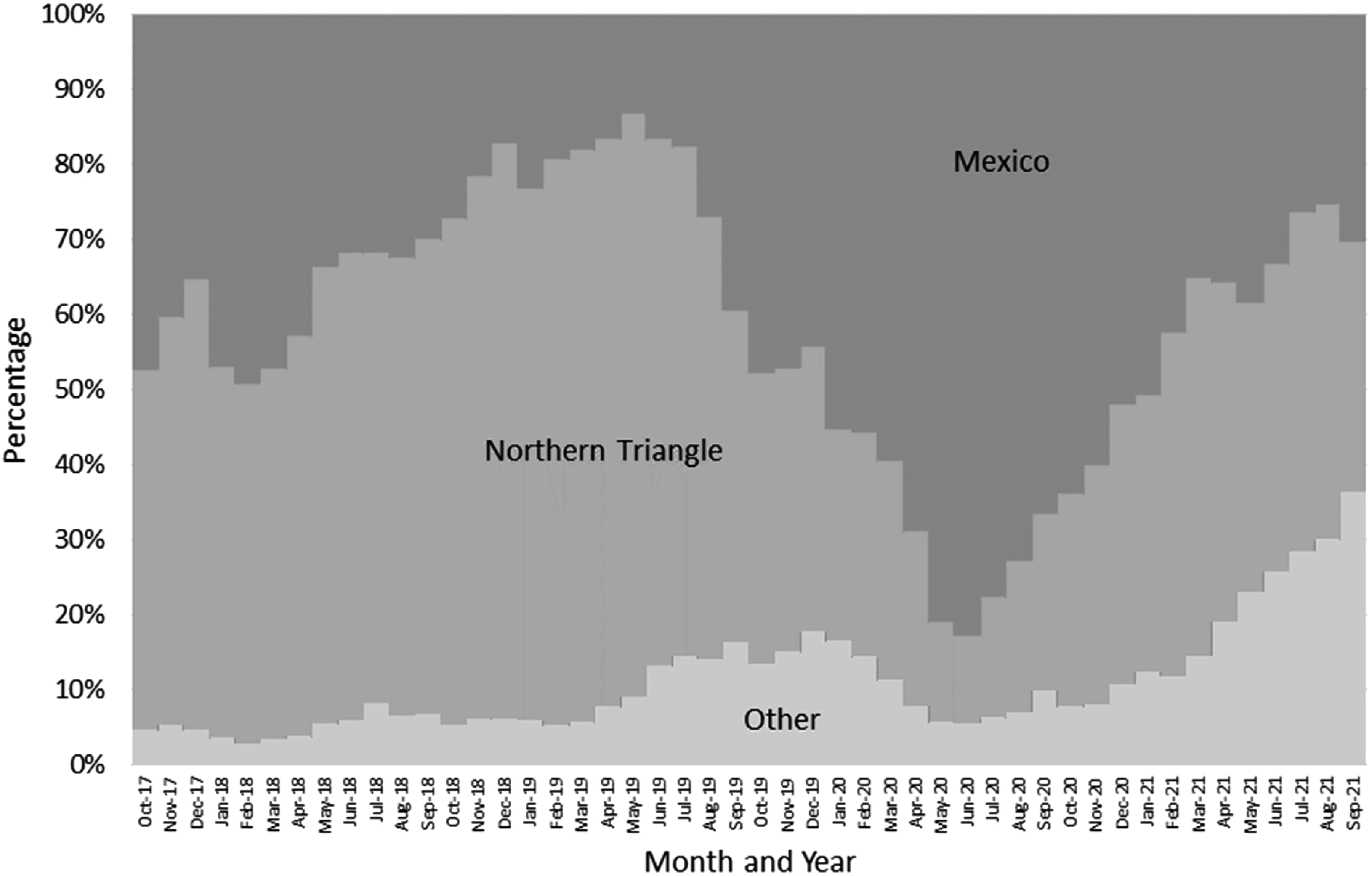
Origins of migrants apprehended along the Mexico-U.S. border by month and year 2017–2021.
As of October 2017, apprehensions were no longer dominated by Mexicans and over the ensuing months their share fell even further (albeit with ups and downs). In May of 2019 Mexicans comprised just 13.2 percent of those apprehended. In that same month, the share of Northern Triangle migrants reached an apogee of 77.7 percent. Thereafter the share of Mexicans rose again to peak at 82.7 percent in June of 2020, in the midst of the pandemic. From that point on, however, the share of migrant apprehensions from the Northern Triangle and other regions rose once again as the share of Mexicans shrank. At the end of Fiscal Year 2021, the shares were relatively evenly distributed across origin categories, with 30.3 percent of those apprehended coming from Mexico, 33.3 percent from the Northern Triangle, and 36.4 percent from other nations, an unprecedented surge for the latter category.
In 2017, the Border Patrol began tabulating apprehensions by family status, dividing captured migrants into three groups: single adults, unaccompanied minors, and those in family units. These data are presented by month in Figure 6. Historically, flows across the Mexico-US border were dominated by single adults traveling alone, mostly males of working age either seeking employment or females pursuing family reunification (though sometimes also labor). From October of 2017 through May of 2019, however, we see an unprecedented surge in both unaccompanied minors and migrants traveling in family groups. At the latter date, 63.6 percent of those apprehended at the border were members of a family unit and 8.6 percent were unaccompanied minors, leaving just 27.8 percent as single adults, an unprecedented shift in the composition of border crossers away from the historical norm.
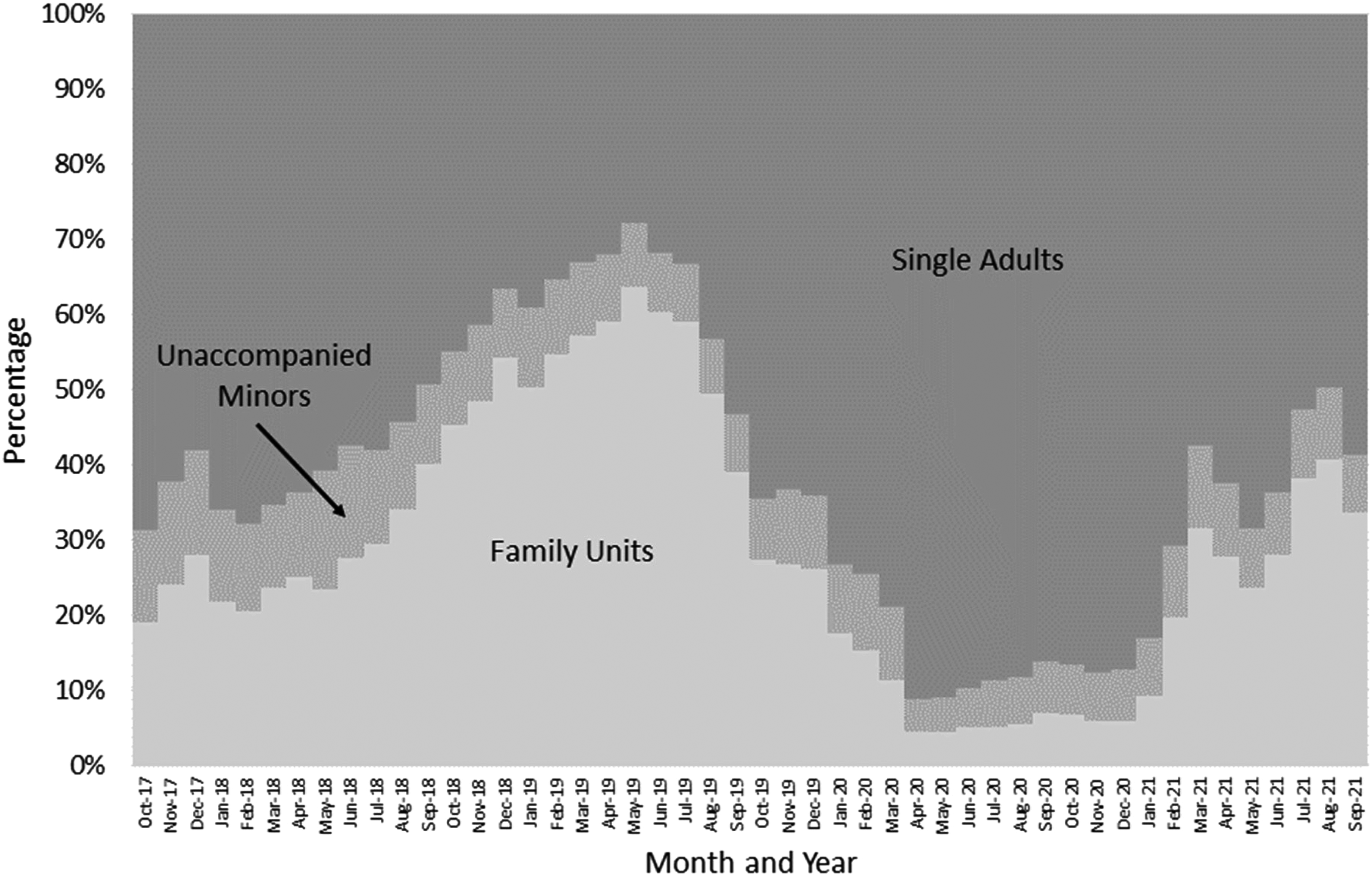
Family status composition of apprehensions by month and year 2017–2021.
After May of 2018, the share of single adults among those apprehended began to rise, reaching peak of 91.2 percent in April of 2020. The dominance of single adults continued to prevail through December of 2020. In 2021, however, the share of families and minors among apprehended migrants once again began to rise, achieving local peaks in March of 2021 and August of 2021, when the share of adults fell to values of 57.4 percent and 49.5 percent, respectively, as the percentage of family members rose to 31.6 percent and 40.6 percent, with the corresponding shares of minors being 11.0 percent and 9.9 percent.
Blocked Pathways to Sanctuary
Government agencies and civil society organizations face daunting challenges in attempting to manage these new migratory flows. Nowhere is poverty considered to be a legitimate reason for the granting of asylum or refugee status, nor in most cases is being a crime victim, a person fleeing civil violence, or someone fleeing extreme weather events (Meissner, Hipsman, and Alexander Aleinikof 2018; Davidson 2019). There is still no legal recognition of the concept of climate or environmental refugees, despite climate change emerging as a major driver of migration in the 21st century (Berchin et al. 2017; Biermann and Boas 2010). Although “Climate Change Induced Displacement” (CCCID) has been recognized in protocols dealing with climate change, international refugee law remains inadequate in extending protection to those impacted by environmental distress (Fornalé and Doebbler 2017). Although migrants may be entitled under international law to request asylum, governments are not obligated to grant it.
Even when an asylum petition is accepted, a fair adjudication is not guaranteed and is inherently subjective and difficult to predict the outcome; and the degree of human rights protection afforded to migrants varies widely across rather arbitrary categories. The United Nations High Commissioner for Refugees (UNHCR) has recognized the need to ensure protections for the growing variety of migrants arriving at and crossing borders without authorization (Crisp 2008). The Global Commission on International Migration also confirms the need to protect migrants who do not fit neatly into the category of “refugee” or “asylee” (Betts 2010). Whatever the reason for migration, crossing borders and moving through countries without the benefit of legal status entails significant threats to human rights (Menjívar 2006). Protection may be needed for many reasons, but whatever the motivation for migration, accepted humanitarian principles dictate that people's movements be dignified, safe, and secure (see United Nations 2018). Vulnerable migrants nevertheless continue to face widespread exclusion from wealthy nations, which resist signing multilateral treaties spelling out humanitarian principles and immigrant rights and often don’t adhere to the agreements they have signed (Betts 2010).
A prime example occurred in December of 2018, when the Trump Administration instated a set of actions known as the “Migrant Protection Protocols” (MPP) but which is more commonly labeled the “Remain in Mexico Program” (Boyce 2019). The MPP required asylum-seekers to “remain in Mexico” for the duration of their legal case and allowed them to enter the United States only for initial processing and subsequent court appointments. Under Trump, more han 71,000 asylum seekers were sent back to Mexico to await court hearings, with 29,000 still pending when he left office. Although President Biden sought to end the MPP in June of 2021, this effort was blocked by a federal court pending further litigation that was not resolved until the end of June 2022 when the Supreme Court Ruled that Biden could indeed terminate the program, yielding an additional 5,114 asylum seekers being returned to Mexico in the interim (TRAC Immigration 2022). Médecins Sans Frontières (2020) reported that among those receiving medical attention, reported kidnappings rose by 75 percent after the implementation of the MPP program.
In Mexico asylum claims increased by 1,067 percent between 2011 and 2016, but the government's budget for processing such claims dropped from 26 million pesos in 2015 to 22.5 million pesos in 2016 (REDODEM 2016, 133). Public knowledge of Mexico's asylum policies is not widespread. In 2018, 61.7 percent of the migrants registered at REDODEM's shelters said they did not know anything about applying for asylum (REDODEM 2018, 45). While outwardly affecting sympathy for Central American migrants Mexico, like the United States, continues to pursue securitization. In January of 2019 the Mexican government gave out some 13,000 visiting cards to serve as temporary visas for migrants arriving in caravans, but a month later it arrested and detained most of them for possible deportation (REDODEM 2019, 22).
With both the Mexican and U.S. governments failing to acknowledge much less act upon scale of the humanitarian crisis, the stark reality is that the pathway to security and safety for Central Americans escaping threats in the Northern Triangle is substantially blocked. Rather than humanitarian assistance, migrants instead face punitive regimes of apprehension, detention, and deportation. Although the Biden Administration sought to terminate Trump's Migrant Protection Program in June of 2021, the action was later blocked by a federal judge and at this writing the protocols are still in force, pending further action within the US judicial system.
A Profile of the Excluded
We now turn our attention to the situation of migrants and asylum seekers as reflected in REDODEM's annual reports, supplemented by interview and observational data compiled at several of its shelters in 2012. The REDODEM data were gathered from interviews with migrants who registered to access the network's shelters but retained the right to opt out of answering any question. Data collection at the shelters was a work in progress that evolved over time, as noted by one shelter worker: There is an evolution from giving food and shelter to begin to mobilize their problems at other levels, even with dialogues with the (Mexican) state. Before they [the migrants] used to say they kidnapped me, or something happened to me and we simply gave them our blessing and they continued their journey, because there was nothing else to offer (Interview of June 2012).
The systematic surveying of registered migrants began in 2013 when donated computers enabled some shelters to begin systematic record keeping. When people would gather together for meals, shelter personnel would simply ask for a show of hands (“Who is from Honduras? Who is from Guatemala?”) and then proceed to count and write the numbers down on a notepad. According to the founder of one shelter, the collection of data constituted an important part of REDODEM's humanitarian mission: It helps if you have data on the person, of who you are serving. Before, all [the migrants] were lumped up, but you did not know who you were serving. To know the names of persons, they are not numbers. Where they are from because their families also ask about them. Sometimes they disappear and the register helps us to know where they stayed to provide follow up (Interview of April 2012).
In addition to improving the services offered to migrants, the data are also used to build a moral and political case for humanitarian action on their behalf. “What we have learned is that the profile of Central Americans is that of a potential criminal, a mara salvatrucha (a gang member), so we also have to change this perception” (Interview of June 2012). The information also serves to help track the movements of migrants who later disappear. “What is concrete is that the information has helped to localize them. In other parts there are dozens of disappeared migrants that we need to track, and we do not even know where to start” (Interview of July 2012).
The main challenges facing REDODEM in collecting these data stem from the fact that the data are collected publicly in the presence of others and are compiled by untrained volunteers. In four REDODEM shelters visited in the course of fieldwork, we found it was a constant challenge to maintain privacy during registration. As a result, migrants all too often refused to answer certain questions out of fear, or reluctance to share memories of grueling experiences or sensitive information publicly, leading to the underreporting of crimes, harassment, and victimization, as explained by one informant: We are attempting to create this mechanism (of sharing information), because in first place you cannot expect people to open up themselves. If you have just been kidnapped, you arrive with adrenaline (in your body) and distrust at the outset. If something happened to me, then with that report it is enough. Maybe later in another more private setting information can be shared. It is something very strong (fuerte), and with so many persons, the very perpetrator can be right there in the corner of the room. And I insist this is something that is evolving… The number of people that arrive does not allow for enough time to conduct a proper interview and there is no infrastructure for a private space. Some shelters are big, yet others have very limited space (Interview of July 2012).
The migrants registering at REDODEM shelters cannot be assumed to be a random sample of all transit migrants in Mexico. Not all migrants who move through Mexico make use of REDODEM's services. Many migrate with assistance from smugglers and stay in safe houses controlled by cartels. Those entering shelters generally claim to be travelling alone, which might explain the relatively low number of women in the REDODEM database (see below). Women from Mexico and Central America are more likely to travel in the company of others, most often family members (Cerrutti and Massey 2001; Massey, Fischer, and Capoferro 2006). They are also more prone to travel in spontaneous “caravans” that come together near the Guatemalan border as migrants organize themselves for self-protection. Given that shelters are the only formal spaces in which humanitarian assistance is distributed, entrants into the network's database are also likely to be selected on the basis of need and vulnerability.
Despite these problems, the interviews nonetheless enable the systematic analysis of data on the characteristics of migrants and the risks they face while in transit and during border-crossing. The REDODEM data are the only independent source of quantitative information on transit migrants within Mexico. Figure 7 presents a series of bar graphs constructed to describe the social composition of migrants registered with REDODEM (see the annual reports of 2013 through 2019 listed in the references). The data are pooled across years, but because some questions were not asked every year and the focus of questioning changed over time, sample sizes vary depending on the variable under consideration.
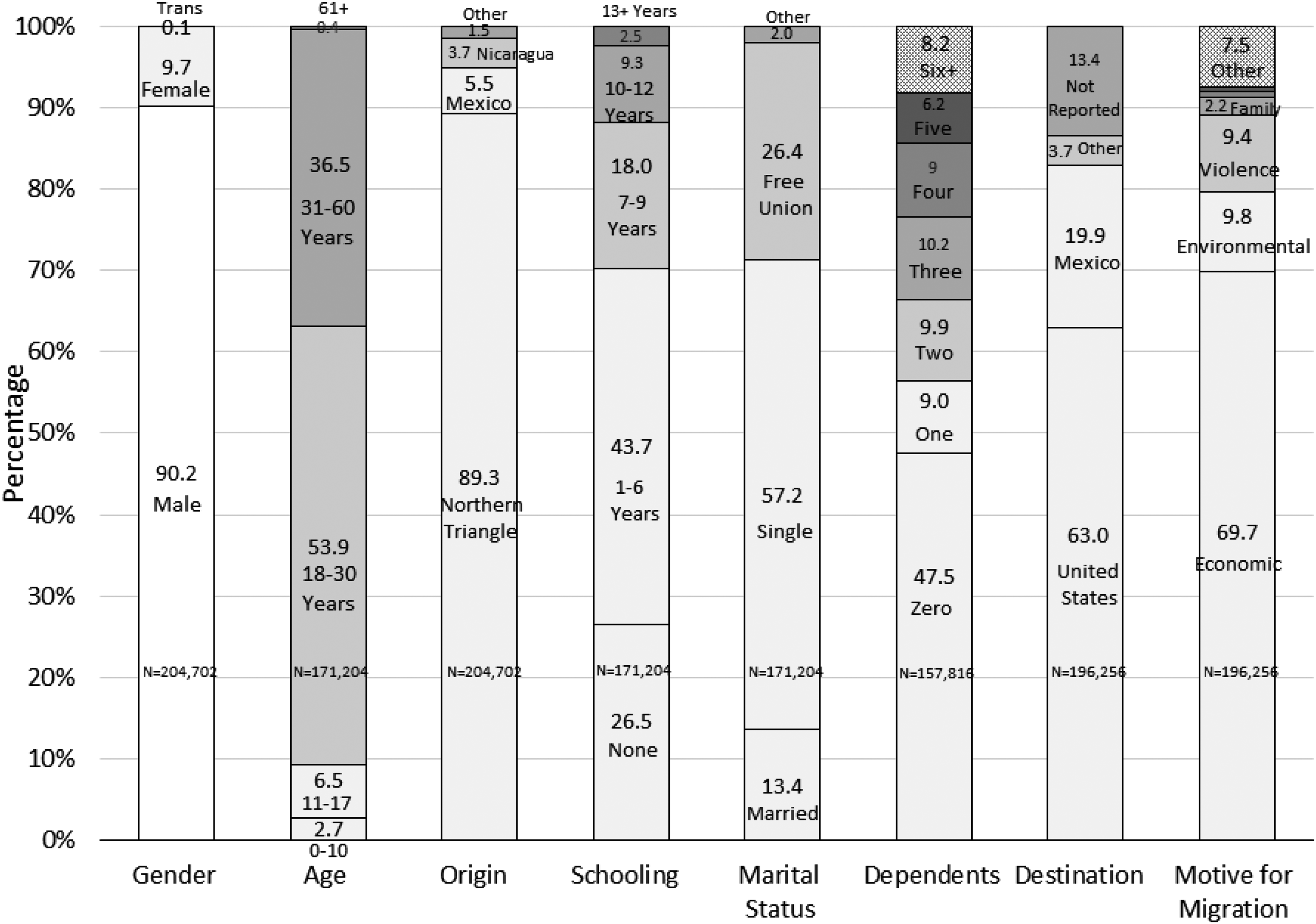
Characteristics of migrants registered at REDODEM shelters 2013–2019.
Gender was one question asked of all registrants in all shelters in all years, yielding a total sample of 204,702 migrants of which 90.2 percent were male and 9.7 percent were female, with just 0.1 percent reporting a non-binary gender identity (see the first bar chart on the left of the figure). Age was compiled and fully tabulated in REDODEM reports from 2013 through 2018, but age was only gathered from around half of all registrants in 2013 and was only reported for young people in 2019, yielding a sample of 171,204 migrants. As can be seen in the second bar chart from the left, the modal category was 18–30 years of age, which contained 53.9 percent of all registrants. The next largest category was 31–60 years, containing around 36.5 percent of the sample. Just 0.4 percent were older than 60, and relatively few were minors under the age of 18 (9.2 percent in total, with 2.7 percent being under the age of 11 and 6.5 percent aged 11–17). However, many minors likely overreport their age.
Information on whether minors were accompanied by an adult was compiled only in 2018 and 2019. Of the 3,458 minors tabulated in 2018, 54.9 percent were not accompanied by an adult, with the percentage ranging from 85.6 percent of those under age 11 to 44 percent among those aged 11 to 17. In 2019 3,857 minors registered with REDODEM, but results are clouded by missing data in 17.9 percent of the cases. Among those interviewed, 32.1 percent were accompanied and 50.0 percent were unaccompanied, but if we ignore the missing cases the shares shift to 60.9 percent unaccompanied and 39.1 percent accompanied. Under the age of 10, 70.5 percent were unaccompanied whereas among those aged 10–17, 55.1 percent were unaccompanied.
As shown in the third column of Figure 7, the overwhelming majority migrants who reported their nationality to REDODEM hailed from the Northern Triangle (89.3 percent), with the remainder mostly coming from Mexico (5.5 percent) and Nicaragua (3.7 percent). Since 2014, the percentage of Northern Triangle migrants has remained relatively stable, fluctuating around 89 percent. However, the national origin composition of migrants within this region has shifted dramatically. Figure 8 illustrates this fact by graphing nationality separately by year from 2013 to 2019. Whereas in 2013 two-thirds of all registrants were either from Guatemala (44.0 percent) or Nicaragua (26.4 percent), over the ensuing years these percentages fell precipitously, and by 2019 their respective shares had fallen to 8.1 percent and 7.1 percent. In contrast, the share of Hondurans rose from 6.4 percent to 76.1 percent over the period. According to the United Nations Office on Drugs and Crime (2022), the homicide rate in Honduras stood at 36.3 per 100,000 person, whereas the rates in El Salvador and Guaemala were 37.2 and 26.0, respectively, compared to just 6.3 in the United States
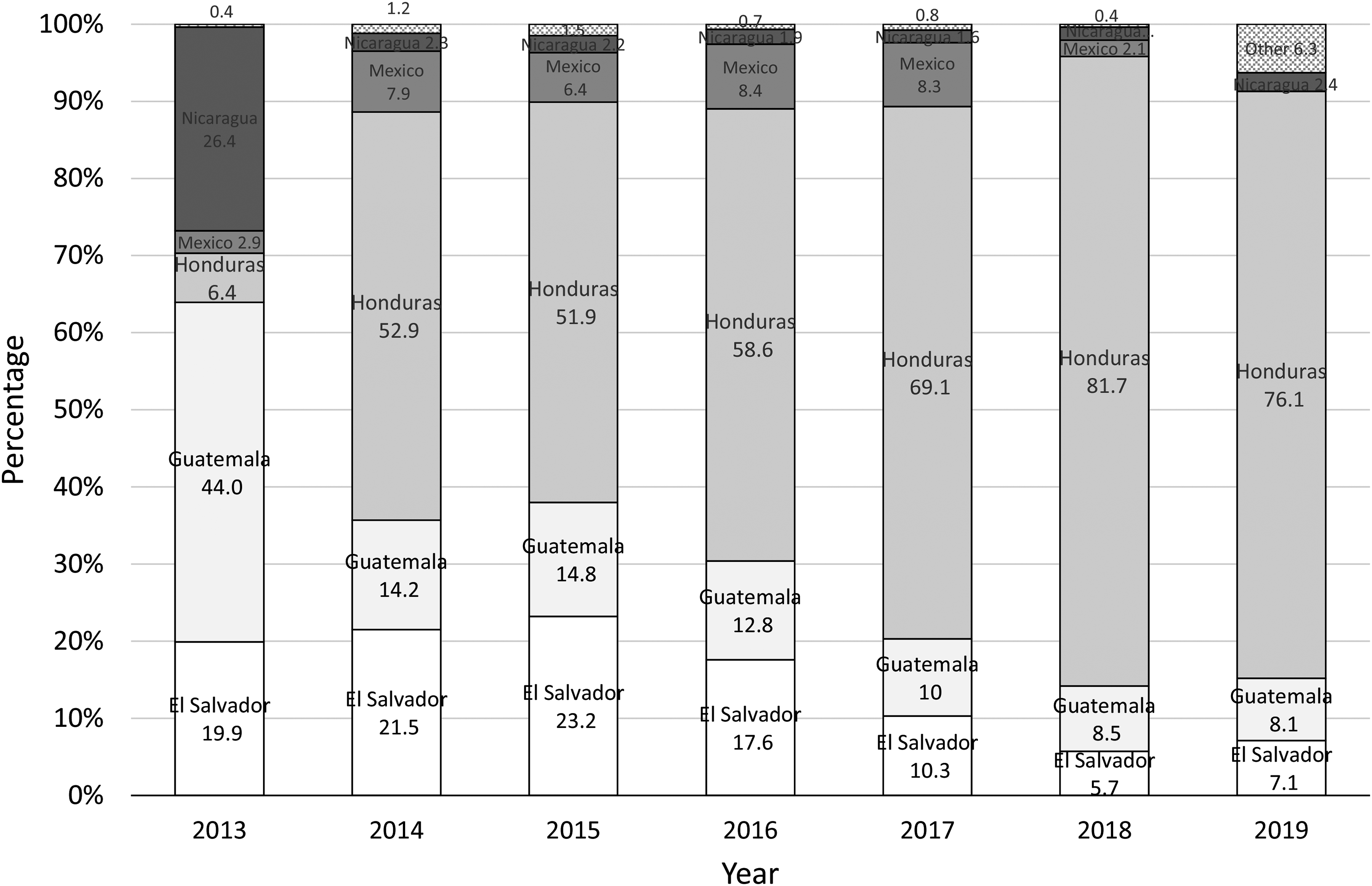
National origin of migrants registered at REDODEM shelters 2013–2019.
Returning to Figure 7, the fourth column shows the distribution of migrants by years of education, revealing that the large majority (70.2 percent) had completed no more than a primary education (six or fewer years of schooling), including 26.5 percent who reported no schooling at all. Only 18.0 percent reported some secondary education (seven to nine years) and just 9.3 percent had some college preparatory schooling (10–12 years), leaving just 2.5 percent to report having any college experience. Turning to the column showing the distribution of migrants by marital status, we see that 57.2 percent were single and 26.4 percent were in a stable nonmarital union, leaving just 13.2 percent who were formally married and 2.0 percent divorced, widowed, or separated. As shown in the fifth column, almost half of all migrants (47.5 percent) stated that they had no dependents, with the others being relatively evenly distributed across the remaining categories: 9.0 percent with one dependent, 9.9 percent with two, 10.2 percent with three, 9.0 percent with four, 6.2 percent with five, and 8.2 percent with six or more dependents.
The next-to-last column in Figure 8 examines the ultimate destination that the migrants were trying to reach, with 63.0 percent setting their sights on the United States, 19.9 percent saying their final destination was Mexico, 3.7 percent reporting some other nation, and 13.4 percent not reporting a destination. As shown in the final column, when asked about their motivation for migration, the large majority (69.7 percent) said they were moving for economic reasons, with 9.8 percent stating were moving for environmental reasons, 9.4 percent seeking to escape violence at their place of origin, and 2.2 percent migrating for family reasons, with 8.8 percent departing for a miscellany of other motives.
These reports should be interpreted with caution, however, as migrants tend to have a hard time reporting the underlying reasons for their decisions to migrate (Dick 2018). Economic issues are usually given as the proximate cause for their departure, but the lack of economic opportunity might reflect the effects of violence, climate change, or other exogenous circumstances that go unmentioned. As we have seen, other data clearly reveal that apart from economic considerations, migration is likely to be incentivized by high rates of homicide, rising climate vulnerability, and widespread lawlessness in the Northern Triangle region.
The Human Cost of Exclusion
The foregoing vicissitudes are by no means eliminated by entering Mexico and given this reality, REDODEM asked registrants in its 2013 and 2017 surveys to report on any crimes and abuses they had experienced. A total of 13,491 migrants reported some incident of concern and as shown in the first column of Figure 9, this number constituted 9.8 percent of the sample, though the true frequency is likely to be underreported for reasons already stated. Of those incidents mentioned by the registrants, 81.7 percent were reported by the victim of the offense and 18.3 percent were reported by someone who witnessed the incident in question.
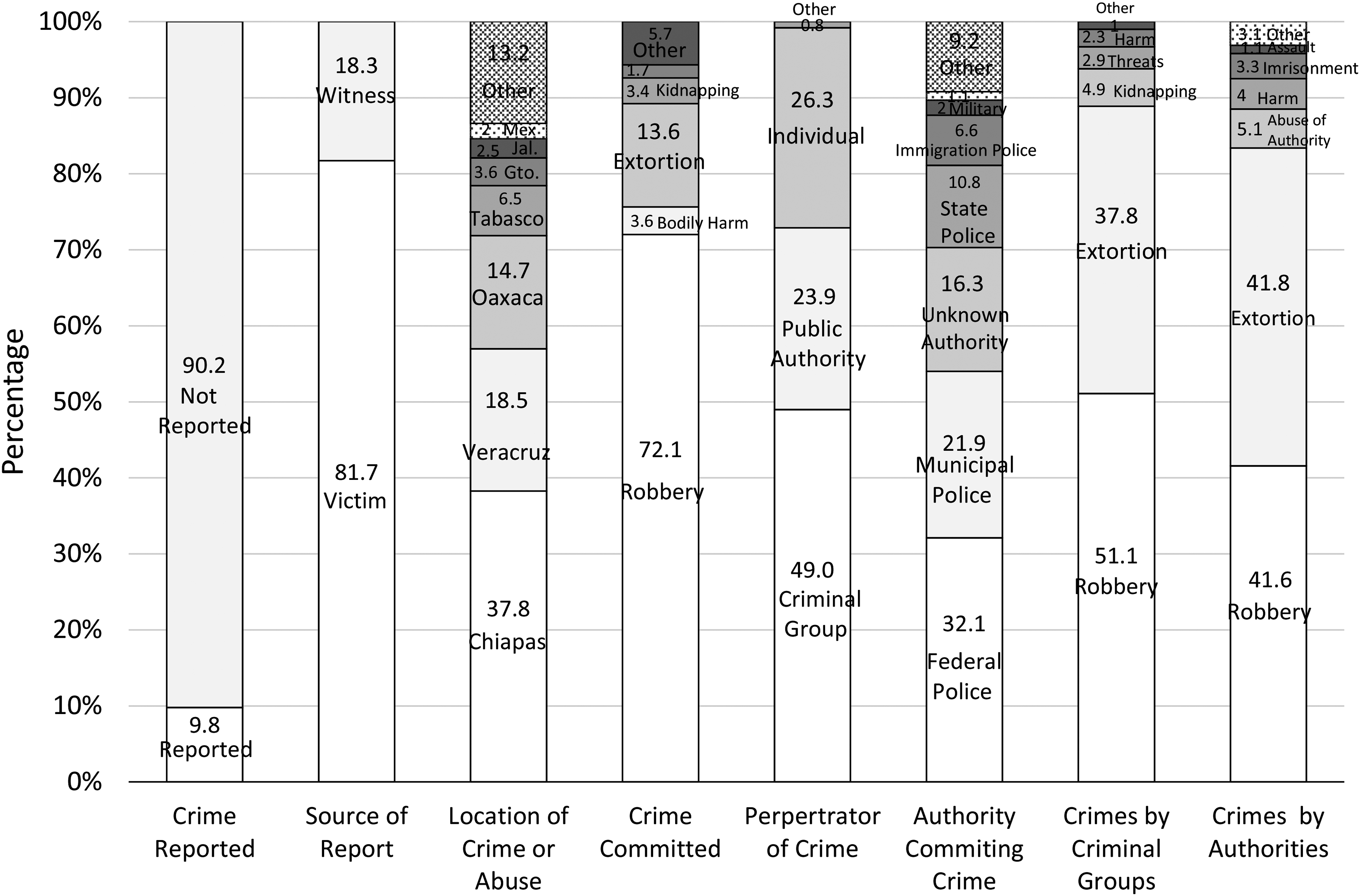
Crimes and abuses reported by migrants registered at REDODEM shelters in 2013 and 2017 (n = 13,491).
Migrants from the Northern Triangle generally enter Mexico by crossing into the southern state of Chiapas, most commonly by fording the Suchiate River near the Mexican city of Tapachula. The Usumacinta River also forms part of the border between Chiapas and Guatemala, and portions of the border are over land, but crossings in these sectors are rare because the territory is remote, unpopulated, and has few transportation routes. Once in Chiapas, migrants proceed northward principally through Oaxaca or Veracruz, though it is also possible to pass into Tabasco before moving on to Veracruz. The third column in Figure 10 shows the state in which the reported crimes or abuses occurred and unsurprisingly given the geography just described, the four most frequent locations were in Chiapas (37.8 percent of the reported incidents), Veracruz (18.5 percent), Oaxaca (14.7 percent), and Tabasco (6.5 percent). Together these states were responsible for 78 percent of the reports.
The most common transgression was robbery (see the fourth column in Figure 9), which accounted for 72.1 percent of the incidents reported. It was followed by extortion (13.1 percent), bodily harm (3.6 percent), kidnapping (3.4 percent), and abuse of authority (1.7 percent), plus a range of less frequent victimizations grouped into the “other” category (5.7 percent). About half (49.0 percent) of the crimes or abuses were committed by members of a criminal gang (see the fifth column), but in keeping with the weak rule of law depicted in Figure 4, nearly a quarter (23.9 percent) were committed by public authorities. Most of the remainder of the victimizations were perpetrated by individuals acting alone (26.3 percent of the total) .
Reflecting the widespread corruption of public security in Mexico, the large majority of crimes and abuses committed by public authorities were carried out by police forces (see the sixth column): 32.1 percent by federal police, 21.9 percent by municipal police 10.8 percent by state police, and 6.6 percent immigration police. Another 16.3 percent of the transgressions were initiated by unknown public authorities, with 2.0 percent of being effected by members of the military, 1.1 percent by members of the federal judiciary, and 9.2 percent by assorted other officials.
Both criminal groups and public authorities specialize in the same kinds of crimes, however (see the final two columns). Among the infractions committed by criminals, robbery accounted for 51.1 percent and extortion for 37.8 percent, and among those committed by authorities the respective shares in these categories were 41.6 percent and 41.8 percent. Beyond robbery and extortion, offenses committed by criminals included kidnapping (4.9 percent), threats (2.9 percent), and bodily harm (2.3 percent). Additional offenses committed by public authorities included abuse of authority (5.1 percent), bodily harm (4.0 percent), false imprisonment (3.3 percent) and assault (1.1 percent).
From April to December of 2019, REDODEM staff members undertook a special analysis of reports by 34 victims of mistreatment by public officials in the process of apprehension. Together they reported 39 acts of predation by authorities, including physical abuse (69 percent), no reason given for their apprehension (23 percent), sexual assault (2 percent), destruction of documents (2 percent), and bribery (2 percent). Most of the aggressions (69 percent) were perpetrated by immigration agents from the INM, followed by police officers (23 percent), military personnel (8 percent), and unknown government agents (5 percent—see REDODEM 2019, 176). In addition, 45 migrants reported instances of abuse while being held in detention, listing 102 incidents of mistreatment, including physical aggression (26 percent), verbal harassment (19 percent), not providing information about the length of detention (12 percent), denial of hygiene, clothing, or a secure place to sleep (12 percent), denial of physical needs (8 percent), denial of communication with family members (7 percent), denial of medical attention (7 percent), denial of food and water (6 percent), sexual solicitation (2 percent), and solicitation of money (1 percent). Of these aggressions, 78 percent were carried out by immigration agents, 15 percent by private security guards, and 7 percent by other or unknown authorities (REDODEM 2019,178).
Conclusion
In this paper we examined the origins and evolution of the humanitarian crisis that is presently unfolding in Mexico's “corridor of death,” within which a large number of deaths and disappearances have been recorded in recent years. Large-scale migration from Central America's “Northern Triangle” can be traced to the Reagan Administration's political and military intervention in the region during the 1980s, when the United States trained, funded, and supplied paramilitary death squads in El Salvador and Guatemala, and later armed and supplied an army of “contras” in Honduras to invade Nicaragua in hopes of overthrowing the Sandinista regime.
The paroxysms of violence that followed displaced hundreds of thousands of migrants, both directly as people sought to avoid the violence itself and indirectly through the effect that violence had in stifling economic. Whereas most Nicaraguan migrants escaped the mayhem by moving southward into Costa Rica, those from El Salvador, Guatemala and Honduras moved northward into Mexico and onward toward the United States (cf. Lundquist and Massey 2005; Massey, Durand, and Pren 2014). As already noted, because migrants from the Northern Triangle were escaping nations allied with the United States, politically they could not be accepted as refugees or asylum seekers and most entered without authorization.
Although civil warfare ended after the peace accords of 1987 (which Guatemala only ratified in 1996) and the Sandinista regime lost power in Nicaragua's 1990 elections, out-migration from the Northern Triangle continued owing to economic stagnation stemming from the decade of open warfare and the subsequent escalation of violence sparked by the mass deportation of US gang members in the late 1990s and early 2000s (resulting from the securitization of migration in the United States—see Massey 2020a). Migration in the 1990s was facilitated by social networks that had formed during the 1980s, linking residents of sending communities in the Northern Triangle to relatives and friends at points of destination throughout the United States (Massey, Durand, and Pren 2014).
In addition to poverty and violence, out-migration from both Mexico and the Northern Triangle increasingly stems from weather events and ecological changes associated with global warming. In recent years, they have been joined by other migrants fleeing similar circumstances in other countries to create a “complex humanitarian emergency” embracing manifold causes and multiple nations. Official statistics reveal a population of migrants increasingly composed of family groups and children from the Northern Triangle seeking to escape threats in their home communities rather than accessing opportunities for employment in the United States or Mexico.
Both nations are pursuing restrictive immigration policies and repressive border enforcement actions, and the number of migrants languishing in informal camps or in crowded detention centers has consequently risen in both countries as have deportations. Slack (2019) has documented the super-charged punishment faced by deportees politically, socially, legally, and culturally, leaving them extremely vulnerable within border areas. These hostile contexts of reception are associated with increased nativism and xenophobia under the populist presidencies of Donald Trump and Andrés Manual López Obrador. Documented violations of national and international treaties have multiplied to threaten basic human rights on an ever-wider scale.
In addressing this unfolding humanitarian emergency, policy makers need to address three distinctive features of the current crisis. First, it is no longer confined to border regions but unfolds at places of both origin and destination, as well as within extended geographies of transit. Second, the current refugee protection regime offers a very blunt instrument that is ill-matched to the needs and vulnerabilities of today's migrants, including the lack of legal recognition for climate refugees. In an era of rapid climate change, rising state failures, and escalating violence, people are not moving so much for to advance economically as to escape a growing array of threats not covered by the 1951 Refugee Convention. Third, the securitization and criminalization of migration and climate policies have made human mobility an increasingly precarious and risk-filled activity that under current policies paradoxically contributes to the proliferation of crime.
Although humanitarian and human rights protocols are in place to address the resultant suffering, they differ as to what kind of suffering matters and diverge in how the suffering is to be addressed. In this context, civil society, humanitarian action agencies and human rights institutions need to revisit their missions to derive new ways of working conjointly and in parallel to better understand and meet the needs of migrants in the 21st century. Humanitarian and rights organizations are currently splintered on how to address migration as a human right, given that Article 13 of the Universal Declaration of Human Rights specifies a right to emigrate but not to immigrate. Policy makers tend to see the issue as one of security or as a short-term emergency to be managed, without seeking to address the underlying causes or ameliorating long-term suffering. A unified consensus about how, when, and for how long to intervene has not been reached.
As unauthorized migrants traverse Mexico's corredor de la muerte, they encounter multiple organizations and agencies seeking to help them, at times through humanitarian acts such as providing water, food, and shelter, and at other times through a spirited defense of their legal rights while also working to expose the mal praxis of national security policies. Boyce et al. (2020, 400) refer to the work of social activists as an “alter-geopolitics,” echoing Koopman (2011, 281) by advocating a politics that works to “keep a larger us safe by building connections with former thems.” We suggest this inclusivist approach be considered at a policy level by seeking to address inequalities manifested in access to protection, especially considering violence, poverty, climate refugees, and children (inclusive of those who have “joined” gangs)—issues that at times are interwoven.
What we are witnessing now in North America is the transformation of international migration from a well-ordered system based on the movement of workers seeking opportunities within an expanding North American economy, into a new system of disordered migration undertaken by families and dependents desperately seeking to escape threats linked to rising civil violence, weather events, and state failures. If the late 20th century was dominated by migrants of hope, the early 21st century appears to be dominated by migrants of despair. In this sense, the humanitarian crisis now unfolding in North America's “corridor of death” is a harbinger of the future in the rest of the world.
Footnotes
Declaration of Conflicting Interests
The author(s) declared no potential conflicts of interest with respect to the research, authorship, and/or publication of this article.
Funding
The author(s) received no financial support for the research, authorship, and/or publication of this article.
