



Abstract
The process of repairing misperceptions has been identified as a contributor to effortful listening in people who use cochlear implants (CIs). The current study was designed to examine the relative cost of repairing misperceptions at earlier or later parts of a sentence that contained contextual information that could be used to infer words both predictively and retroactively. Misperceptions were enforced at specific times by replacing single words with noise. Changes in pupil dilation were analyzed to track differences in the timing and duration of effort, comparing listeners with typical hearing (TH) or with CIs. Increases in pupil dilation were time-locked to the moment of the missing word, with longer-lasting increases when the missing word was earlier in the sentence. Compared to listeners with TH, CI listeners showed elevated pupil dilation for longer periods of time after listening, suggesting a lingering effect of effort after sentence offset. When needing to mentally repair missing words, CI listeners also made more mistakes on words elsewhere in the sentence, even though these words were not masked. Changes in effort based on the position of the missing word were not evident in basic measures like peak pupil dilation and only emerged when the full-time course was analyzed, suggesting the timing analysis adds new information to our understanding of listening effort. These results demonstrate that some mistakes are more costly than others and incur different levels of mental effort to resolve the mistake, underscoring the information lost when characterizing speech perception with simple measures like percent-correct scores.
Introduction
There is a growing appreciation for listening effort in clinical hearing science (Pichora-Fuller et al., 2016; Zekveld et al., 2018), complemented by studies aimed at understanding the mechanisms of what aspects of speech communication are effortful for listeners who are hard of hearing. Repetition accuracy is the most common outcome measure of speech perception abilities, but a percent-correct score fails to capture how the listener arrived at their answer—particularly the cost of recovering from a perceptual mistake in the process of inferring the correct answer.
In virtually any study of speech recognition, misperceptions are uncontrolled and emerge unpredictably at any moment during listening. Two listeners who both show 75% correct repetition accuracy could be making different mistakes, and it would not be possible to explain their different listening experiences without understanding the difference between those mistake patterns. There are various types of misperceptions a listener can make during perception (phonetic mistakes, segmentation errors, syntactic errors, semantic substitutions, etc.), and these different types of misperceptions incur different amounts of listening effort (Winn & Teece, 2021). A mistake that results in a sentence that is still sensible incurs less effort than a mistake that forces the rephrasing of a sentence or lingering ambiguity. For example, if the sentence “My son has a dog for a pet” were misperceived as “My son brought his dog to the vet”, the sensible nature of the misperception means that it is less likely to incur as much effort as the misperception “My son has a dent for a pet,” which might result in continued attempts to resolve the seeming ambiguity (for more discussion, see Winn & Teece, 2021).
With commonly used testing materials, it can be difficult to prospectively control when misperceptions occur during an experiment, relegating comparison of these mistakes to retrospective analyses. Winn and Teece (2021) used such a retrospective design to reveal that mistakes on earlier words in a sentence incur higher amounts of effort than making mistakes on later words, and the observed effort was linked specifically to semantic processing, rather than the degree of acoustic–phonetic matching of the stimulus and response. Presumably, the extra cost of early-sentence mistakes was attributable to the listener having to revise expectations that were violated by later context in the sentence, akin to perception of garden-path sentences (Christianson et al., 2001; Huang & Ferreira, 2021), but where the predicted path was being disrupted by later words in the sentence. Conversely, accurate predictions for the final word based on earlier words would facilitate easier repair compared to an earlier missing word that lacked sufficient preceding information to narrow the range of possibilities. These observations underscore the notion that listening effort cannot be captured by a mere tally of repeated correct and incorrect words or degree of phonetic match to the original stimulus. Incidentally, that study also introduced a testing method to prospectively induce misperceptions at a specific time during a sentence to estimate the effort of mentally repairing misperceived words. However, that design only included mistakes early in a sentence, toward the goal of specifically examining retroactive use of context. The present study extends that study design by controlling the time of misperceptions and the contextual information listeners have available to resolve the ensuing ambiguity, toward the goal of discerning the impact of misperceptions earlier or later in a sentence.
Pupillometry as a Measure of Listening Effort
There are multiple methodological tools that can be used to quantify listening effort, such as changes in reaction time or subjective report. However, the current research question demands the ability to measure moment-by-moment changes in effort as language processing unfolds in real time, because the core question is about earlier and later moments of processing within the same sentence. Pupillometry is a tool that can measure changes in pupil dilation before, during, and after language processing (Engelhardt et al., 2010; Winn, 2023) and can reflect degrees of ambiguity and postsensory processing of the input (Satterthwaite et al., 2007). Changes in pupil dilation have a long history of being correlated with changes in cognitive demand across a variety of tasks (Kahneman & Beatty, 1966; Sirois & Brisson, 2014), with pupil dilation generally increasing when more effort is exerted (van der Wel & van Steenbergen, 2018), so long as there is sufficient motivation to complete the task. As opposed to the slowly varying changes in tonic pupil size that are thought to reflect alertness (McGinley et al., 2015), short phasic changes in pupil size are the key physiological signature of momentary listening effort used in previous studies (Beatty, 1982; Gabay et al., 2011; Zekveld et al., 2018) and are what will be examined in the present study.
The key advantage of analyzing phasic pupil dilations is the ability to quantify when effort occurs and how long effort lasts, rather than just how much. Although it is customary to report summarized response of peak pupil dilation and peak latency to quantify the amount of effort in a given task (Ayasse et al., 2021; Wendt et al., 2018; Zekveld et al., 2010), there is additional information that can be gained by observing the full-time course of changes in pupil dilation by designing experiments with this specific goal in mind (Johns et al., 2024; Steinhauer et al., 2022; Winn, 2023). Sustained increases in pupil dilation following the peak could reflect the listener having to reconcile remaining linguistic ambiguity after the initiation of that effort. Quantifying the precise timing of when effort occurs during listening, and the duration for how long this increase in effort lasts, can offer new insight into the relative cost of mistakes at different times during a sentence, as well as the ways that contextual cues and hearing status might interact with that cost. While the pupil response is delayed relative to when a specific event occurs (Aston-Jones & Cohen, 2005; Verney et al., 2004), this delay is rather consistent (typically around 500–700 ms), especially across trials with events that are time-locked within the stimuli (as opposed to being randomly jittered), and thus relative changes in the timing of pupil dilation are still a useful tool for the comparisons of interest in the present study, which focus on the relative differences of when effort occurs in response to earlier and later events during a trial.
Sentence Context
Sentence context will play an important role in the current study for two reasons. First, people who are deaf or hard of hearing have been shown to rely more heavily on contextual cues, which can be shown in both accuracy scores (Hunter, 2021; O’Neill et al., 2021; Patro & Mendel, 2016; Pichora-Fuller et al., 1995; Vickery et al., 2022) and listening effort (Hunter & Humes, 2022; Winn, 2016). This is especially true for cochlear implant (CI) listeners (Başkent et al., 2016; Dingemanse & Goedegebure, 2022; Winn, 2016), likely because they hear an auditory signal that is highly degraded, requiring more compensation from nonauditory cognitive processes. The second reason is that the ability to repair misperceptions likely depends on the availability of remaining contextual cues within the utterance (or across utterances) to resolve linguistic ambiguity.
In ideal situations, listeners can use context to rapidly predict upcoming words as the speech signal unfolds in real time (Federmeier, 2007). However, some evidence suggests that CI listeners are less likely to use context quickly (Winn, 2016; Winn & Moore, 2018), perhaps as a result of refraining from full commitment to lexical decisions until they can be more certain in what they heard (Farris-Trimble et al., 2014; McMurray et al., 2017). CI listeners may rely more heavily on using context retroactively, which has been shown to be an effortful process (Winn & Teece, 2022). It is tempting to speculate on the comparisons between CI listeners using context in a way that is typically framed as predictive (Hunter & Humes, 2022; Winn, 2016) versus using context framed as retroactive (Winn & Teece, 2022). However, studies focusing on these uses of context have used different methods in terms of stimulus design and outcome measures that prevent fair comparison. For example, while the study by Winn and Teece (2022) verified that listeners used context to mentally repair misperceptions early in a sentence, previous work on predictive context mainly inferred the use of context through accuracy scores for sentence-final words, without being able to confirm if any earlier misperception took place. Therefore, it remains unclear whether the use of context to repair words at different time points during a sentence elicits a different amount or duration of effort.
The Present Study
Combining the previous described impact of sentence context on listening effort, the present study aims to evaluate how listeners use context in different parts of the sentence to resolve linguistic ambiguity and the effect this has on listening effort. By designing stimuli where the same sentence could have a word missing either earlier or later in the same sentence, we can directly compare how different types of sentence context impact the timing of changes in pupil dilation, the impact on the duration of the pupil response, and the potential differences in effort between CI and older and younger typical hearing (TH) listeners. The approach of distorting or removing a portion of the signal was introduced by Warren (1970) as perceptual restoration, and later extended by Winn and Teece (2021) to address situations where the listener does not feel a sense of actually having heard the word, but instead needs to actively infer it based on later information.
The present study has main hypotheses: (1) The timing of pupil dilation resulting from missing words will be related to the position of those words within the sentence; sentences with earlier-masked words will have an earlier increase of pupil size compared to sentences with late-masked words because the mental repair process will have begun sooner. (2) Sentences with earlier-masked words will have a larger increase and duration of pupil size compared to sentences with late-masked words, because for words early in a sentence, listeners cannot take advantage of preceding contextual information to help resolve any linguistic ambiguity; they must hold that ambiguous word in memory while they wait to accumulate more information. (3) Consistent with previous studies, CI listeners will show prolonged pupil dilation because they could be less likely to take advantage of sentence context as it unfolds in real time. (4) Responses that demand repair but which are not repaired successfully will produce prolonged pupil responses as a result of the listener's persistent effort to resolve ambiguity in the sentence.
Methods
Participants
All participants in this study were native speakers of North American English and reported no history of language or learning disabilities. Three groups of listeners were recruited. For the CI group, a total of 20 listeners participated in this study (14 female and 6 male) with an average age of 65.3 years old (s.d. = 11.3 years old, range = 34–77 years old). All CI listeners were able to converse freely during face-to-face communication, and none reported cognitive difficulties. To account for the effect of age, 20 older (OTH) and 21 younger (YTH) listeners were also recruited. The OTH listeners (13 female and 7 male) had an average age of 70.8 years old (s.d. = 5.3 years old, range = 60–84 years old). The YTH group (19 female, 1 male, and 1 nonbinary) had an average age of 25.1 years old (s.d. = 5.25, range = 20–44). Listener ages are shown in Figure 1.
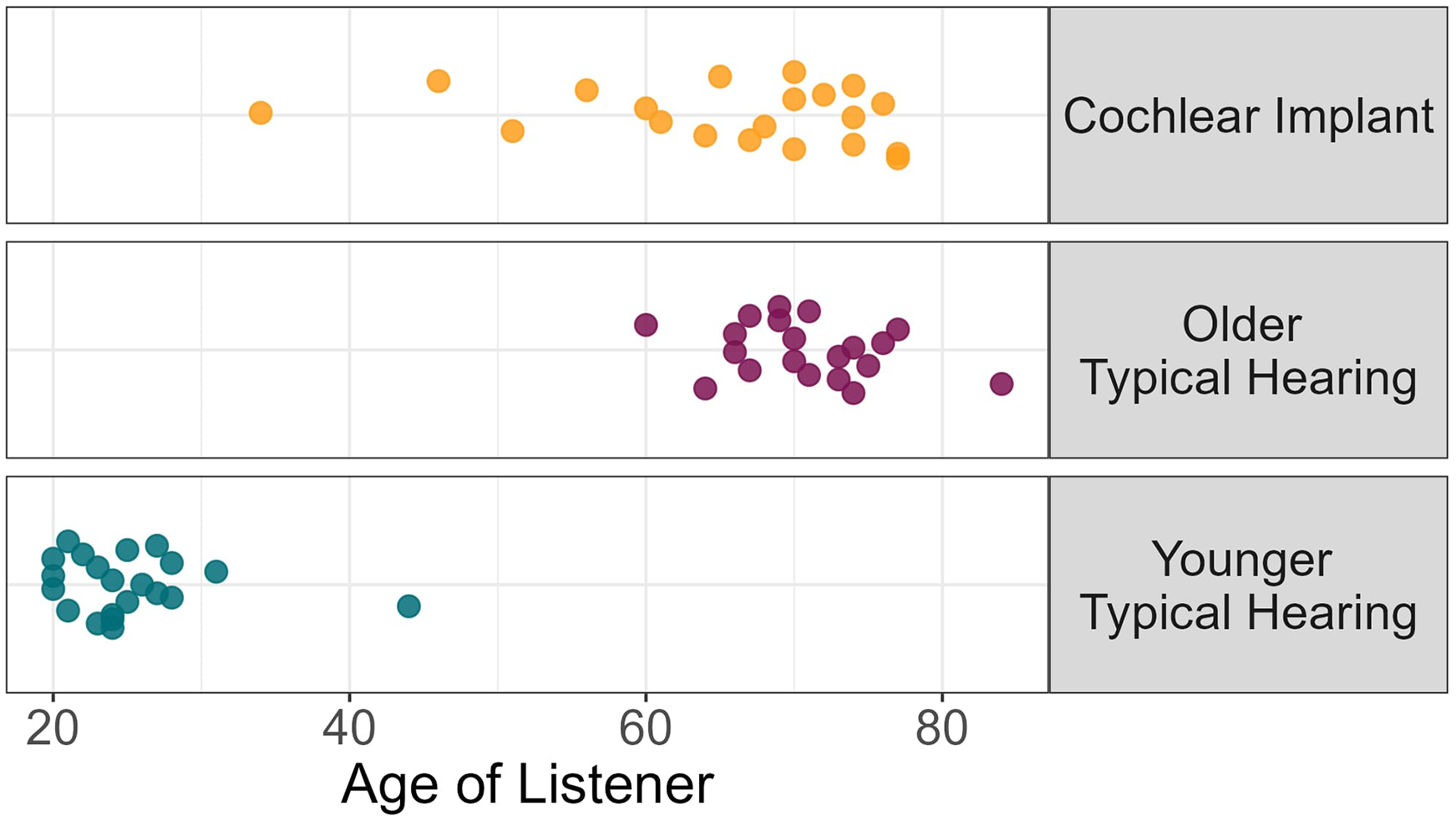
Distributions of listener ages for the three different hearing groups (color online).
Our initial intention was to treat all TH listeners as a singular group rather than separating them by age. However, small but noticeable differences were observed in the pupil response between OTH and YTH listeners, both in terms of larger changes in pupil dilation for younger listeners, and differences in the morphology of pupil response over time. While age differences in pupil reactivity are not novel in itself (Bitsios et al., 1996), we decided to treat them as two separate groups. Normal hearing status was confirmed by pure-tone audiometry screening via air conduction at 25 dB HL from 250 to 4000 Hz. Participants were not evaluated for visual acuity. All gave informed written consent of procedures that were approved by the Institutional Review Board at the University of Minnesota, which stands on Miní Sóta Makhóčhe the homelands of the Dakhóta Oyáte.
CI listeners all had at least 1 year of experience with their device (median experience 7 years) and were postlingually deaf. There was a median of 30 years duration of deafness until first implantation among the CI group, which included 5 unilaterally and 11 bilaterally implanted individuals, along with 4 bimodal listeners. No listeners with single-sided deafness were included. Those listeners who regularly used a hearing aid in the contralateral ear to manage moderate to profound hearing loss continued using the hearing aid during the experiment to best simulate their everyday listening experience.
Stimulus Variations
Stimuli included 108 sentences written and recorded by our lab, with sentences having an average of 8.69 words, an average duration of 2.98 s, with intensity normalized to 70 dB. Each sentence was designed so that there were at least three semantically related key words, such that when the earliest or latest of these words were masked by noise, it could be inferred from the remaining related words that were intact. Importantly, this enabled the same sentence to be used as a stimulus in either the early- or late-missing word variations, which is crucial in order to address the research question. The “fully intact” version was the fully spoken sentence with no alterations. The other two versions were designed to force the listener to engage in the mental repair process to disambiguate the missing word. In the “early repair” condition, an early target word was replaced with noise, and in the “late repair” condition, the final word was replaced with noise. The stimulus types are illustrated in Figure 2. All sentence manipulations were done in Praat (Boersma & Weenink, 2024). For sentences with early missing words, the average starting position of the missing word in the sentence was word position 3, which occurred on average at 0.586 s (s.d. = 0.25 s) into the sentence, with late missing words on average occurring at 2.42 s (s.d. = 0.467 s). The average duration of the missing word was 0.407 s for early masked words and 0.551 s for late masked words. This difference in duration is best explained by typical phrase-final lengthening rather than word complexity. The noise used to replace the words was matched in duration and intensity to the target word, and the frequency spectrum matched the long-term spectrum of the entire stimulus corpus. The noise burst was spliced at the nearest zero crossing with no onset or offset ramp applied to the noise.

Three different stimulus types, all variations of an example sentence “We built sandcastles on the beach.” Replacing either “sand” or “beach” with speech-shaped noise would create the early-masked or late-masked conditions, respectively (color online).
The contextual constraint on the words was verified using an online cloze probability test (Kutas & Hillyard, 1984), where a separate group of 30 online participants were shown text versions of the sentences with missing words and had to type what they thought the missing word was. These responses were then analyzed to determine if a particular sentence had either high or low cloze probability, with high probability considered to be situations in which at least 67% agreement in responses to any individual item (Block & Baldwin, 2010). Both missing-word variations of a given sentence had to have a high cloze probability in order to be included in the final stimulus list. Using this criterion, 108 of the original set of 119 candidate sentences had high cloze probability and were included as stimuli for the experiment. Sentence presentation was divided into four blocks, with Blocks 1–3 having 28 sentence presentations and Block 4 with 24 sentences (108 trials in total). It was important the sentences to be highly intelligible to minimize mistakes on other words in the sentence. Sentences were recorded by a person who was sex-assigned female at birth from Wisconsin, with an emphasis on a clear speaking style and effort to minimize regional dialects of particular vowels (e.g., /æ/-/eɪ/ variation in “bag”). Stimuli are available here: https://osf.io/ksnyx/.
Procedure
Each participant completed a sentence repetition task with a total of 108 stimuli presented over four blocks of listening, which resulted in 36 trials for sentences that were in the fully intact, early-word masked, and late-word masked condition, respectively. Each stimulus list began with an intact sentence, followed by a pseudo-random ordering of sentence type, with no more than three consecutive trials of the same sentence type. All 108 of the original sentences were split into three different presentation lists where the presentation order of the sentences had been randomized before the participant arrived. Ordering of the sentences within each block had an equal number of trials (9) for each sentence type across all four blocks. Listeners were randomly assigned to one of the three ordered lists, which was counterbalanced across listeners. Within a listening block, listeners heard a random presentation of all three sentence types, with the exception of the first trial in each list, which was always intact.
During the experiment, listeners sat in a chair with their head position stabilized by the forehead bar of a chinrest whose base was sufficiently lowered to allow comfortable jaw movement for speaking. They visually fixated on a red cross in the middle of a medium-dark gray background on a computer screen that was 50 cm away. Each trial was initiated by the experimenter, and the participant heard a beep marking the onset of the trial. There was 2 s of silence and then the sentence was played at 65 dBA through a single loudspeaker in front of the listener. Two seconds after the offset of the sentence, the red cross turned green, which was the cue for the listener to give their verbal response. They were instructed to repeat what they thought was spoken, filling in missing words when necessary. The participants’ verbal responses were scored on paper, with incorrect responses documented for further analysis of error patterns. The participant's eye position and pupil size were recorded by an SR Research Eyelink 1000 Plus eye tracker recording at 1000 Hz sampling rate, tracking pupil diameter in the remote-tracking mode, using the desktop-mounted 25 mm camera lens. Lighting in the testing room was kept constant. A schematic of an example trial is shown in Figure 3.

Schematic of overall task design. Listeners were instructed to fixate on the red crosshair on the screen. A beep was played to signal that the sentence would start 2 s later. One of the three sentence types was presented at random. After the sentence was over, they waited another 2 s before the crosshair turned green indicating the listener should repeat the sentence they heard (including the missing word). Changes in pupil diameter were measured throughout the trial as an index of listening effort.
Analysis
Intelligibility
Repetition accuracy was scored in real time by the experimenter and participant responses were manually entered into a data-tracking spreadsheet after the experiment visit for further analysis. For trials where a target word was replaced with noise, any response that was not semantically coherent with the stimulus was counted as an error, as well as any errors elsewhere in the sentence. If the participant's guess at the word replaced by noise was not the “intact” version of the word but still made sense (e.g., “Please clean the floor with this broom”, instead of “Please sweep the floor with this broom”), it was counted as correct. In the case of intact sentences, the target word was defined as the word that would have been masked by noise in the alternate version of the stimulus, to facilitate fair comparison across stimulus types. We also tracked whether participant responses were linguistically coherent, and the presence of multiple errors within trials. An example of an incoherent response would be “The plant hit the soccer ball with the door” (see Winn & Teece, 2021 for further discussion of incoherent responses). The goal of evaluating repetition accuracy in this way was to track whether participant responses had any errors, rather than only focusing on the number of errors within the response. This approach was taken specifically because the words in high-context sentences are not independent; multiple errors within a sentence would not be a conclusive sign that multiple words were misperceived. For example, misperception of a word might result from the listener trying to create coherence with an earlier word that was misperceived, and participants tend to produce these secondary errors when trying to resolve linguistic ambiguity. Winn and Teece (2021) and Gianakas et al. (2022) provided evidence of this effect in both forward and backward directions within the sentence and suggested that a secondary error tends to reduce effort because it promotes coherence.
To evaluate the differences in overall intelligibility between listener groups, errors were estimated on a per-trial level using a binomial (i.e., logistic) mixed-effects model that included fixed effects and interactions between condition (sentence type) and hearing, as well as random intercepts and correlated random effects of condition per listener. Estimated marginal means were calculated from this model to statistically compare the difference in intelligibility scores across hearing groups and express them in plain terms. Intelligibility scores between YTH and OTH listeners were extremely similar (96.4% and 96.6%, respectively) with no statistical differences observed between the groups and thus were treated as a singular group for the intelligibility analysis. The following model formula was used in the prevailing model:

Although tracking any error in the participants’ verbal responses already reveals the impact of stimulus type and listener group, there is additional information to be gained from analyzing the different types of errors that were made by CI listeners and how those errors may be related to mental repair. Sentence repetition scores were analyzed in more depth for the CI group using a series of GLMMs that estimated various outcome measures, including (1) the presence of any error within the response and (2) errors on words other than the target word. These models were restricted only to CI listeners because TH listeners did not make many errors, resulting in implausibly high or low beta estimates due to model estimates including values at or close to 0. The model for estimating the presence of an error on words other than the target had the same structure as the model for any errors. Other types of errors, such as target word errors and incoherent responses, were also counted; however, these errors were not frequent enough to be statistically evaluated. The model formula was declared as follows:


Pupillometry Data Preprocessing
Pupil data were processed as described by Winn et al. (2018) and Winn and Teece (2022). Blinks were detected as a decrease in pupil size to 0 pixels, with the stretch of time corresponding to the blink expanding backward by 80 ms and forward by 120 ms to account for the partial occlusion of the pupil by the eyelids during blinks. The signal was low-pass filtered at 5 Hz using a fourth-order Butterworth filter and then down-sampled to 25 Hz. The baseline pupil size was calculated as the mean pupil size in the time spanning 500 ms before stimulus onset to 500 ms after sentence onset. Each pupil size data point in the trial was expressed as the proportional difference from the trial-level baseline.
Trials were discarded if 30% or more data points were missing between the start of the baseline to 3 s past the onset of the stimulus. CI listeners on average had fewer trials discarded due to missing data (12.7%) and less variation among individuals (s.d. of 1.9%) compared to TH listeners (average of 19.6% trials discarded with s.d. of 1.5%). Other outliers and contaminations were automatically detected through an algorithm that accumulated multiple “flags,” many relating to high-intensity low-frequency fluctuations (hippus) activity during baseline. Flags included baseline slopes that deviated by more than 2 s.d. from other baselines in the block, significant slope of change in pupil size during the baseline, or a reduction in proportional dilation by at least 1.5% immediately after the stimulus onset (indicating strong constriction when dilation was expected). Proportional dilations of 40% or more were flagged, given the expected maximum around 30% (greater proportional dilations usually indicate a contamination during baseline). Three or more flags resulted in a trial being dropped. If a participant had fewer than 12 trials remaining in any condition following outlier detection, that participant's entire data set was dropped. One CI listener and two TH listeners were excluded from analysis for this reason, leaving 61 total listeners to be included for analysis.
Pupillometry Data Analysis: GAMM
Our goal is to quantify differences in the timing and duration of listening effort when listeners have to mentally repair a missing word. To achieve this goal, filtered data that were summarized for each individual in each stimulus condition were estimated using generalized additive mixed-effects models (GAMMs; van Rij et al., 2019). One of the distinct advantages of using GAMMs is the ability to identify stretches of time where there is a meaningful difference between curves, and this can be done during the entire time course of the pupil response during listening and linguistic processing. GAMMs model the data using a combination of Gaussian basis functions that are summed in weighted combination to match the shape of nonlinear data (e.g., the pupil response) allowing for statistical analysis of the entire pupil response function without the need for different analysis windows. The number of basis functions to calculate each smooth function can be specified for each predictor variable and each interaction term, as well as the specified random effects. Another advantage of GAMMs is accounting for the autocorrelation of time-series data (Baayen et al., 2016) or the tendency for the data point at time t to be similar to its preceding data point at time t − 1, which is problematic because it increases the probability of Type I errors. GAMMs have previously been used to model pupillometry data in studies of listening effort (Boswijk et al., 2020; Porretta & Tucker, 2019; Winn, 2024). The details of the GAMMs model presented here are below, and we refer to van Rij et al. (2019) for a more thorough overview of using GAMMs to analyze pupillometry data.
All the models and statistical analyses were executed in R (R Core Team, 2021) and R Studio (RStudio Team, 2020). GAMMs were implemented using the R package “mgcv” version 1.8-42 (Wood, 2023; Wood, 2017), and the R package “itsadug” version 2.4.1 (van Rij et al., 2022) was used for interpretation, validation, and visualization of the statistical analyses. For each model, an initial model was used to calculate the autocorrelation lag value (rho) that would be used in the final model. Model terms included hearing group (CI, OTH, and YTH) and stimulus type (early masked word, late masked word, and fully intact) as fixed effects with different smooth functions fitted over time for each interaction of group and stimulus type. There were random effects of time as a smooth factor for each listener for each stimulus type. Multiple models were computed with different default groups and default stimuli to evaluate across all of the comparisons of interest. An example of a final model terms is shown below, with YTH as the default hearing group and fully intact sentences as the default stimulus-related effects.
bam(pupil ∼
# parametrics
is_CI + is_early + is_late + is_early_CI + is_late_CI +
is_OTH + is_early_OTH + is_late_OTH + # basic smooth for time s(time, k = 20, bs = “cr”) + # difference curve for hearing group s(time, by = is_CI, k = 20, bs = “cr”) + s(time, by = is_OTH, k = 20, bs = “cr”) + # interactions of condition x hearing s(time, by = is_early, k = 20, bs = “cr”) + s(time, by = is_late, k = 20, bs = “cr”) + s(time, by = is_early_CI, k = 20, bs = “cr”) + s(time, by = is_late_CI, k = 20, bs = “cr”) + s(time, by = is_early_OTH, k = 20, bs = “cr”) + s(time, by = is_early_OTH, k = 20, bs = “cr”) + # random time smooth per listener s(time, Listener, bs = ‘fs’, m = 1, k = 5) + # random time smooth per listener interacting with condition s(time, Listener, by = is_early, bs = ‘fs’, m = 1, k = 5), s(time, Listener, by = is_late, bs = ‘fs’, m = 1, k = 5), # inputs for computational efficiency method = “fREML”, discrete = TRUE, family = “scat”, nthreads = cores_to_use, # account for autocorrelation of each timepoint in the data AR.start = start_event, rho = 0.957, data = df)
Results
Intelligibility
Intelligibility scores (percentage of sentences that were repeated with all words correct) were high for all sentence types for both listener groups, with performance at 85.5% for CI listeners and 96.5% for listeners with TH. These high intelligibility scores indicate that performance did not decrease into the range where motivation and effort to complete the task would render the pupil data difficult to interpret (Wendt et al., 2018).
CI listeners made a statistically greater number of errors on sentences that demanded mental repair, as shown by the estimated marginal means and confidence intervals for this analysis in Figure 4. There was no statistical difference in the error rates for sentences that involved early versus late repair for CI listeners. When separated by sentence type, CI listeners had intelligibility scores of 79.2% when an early word was masked, 84% when a late word was masked, and 93.3% when the sentence was fully intact. Listeners with TH showed near-ceiling levels of performance, with 95.9%, 95.6%, and 97.9% for each sentence type, respectively, with no statistical difference between performance for the three stimulus types.
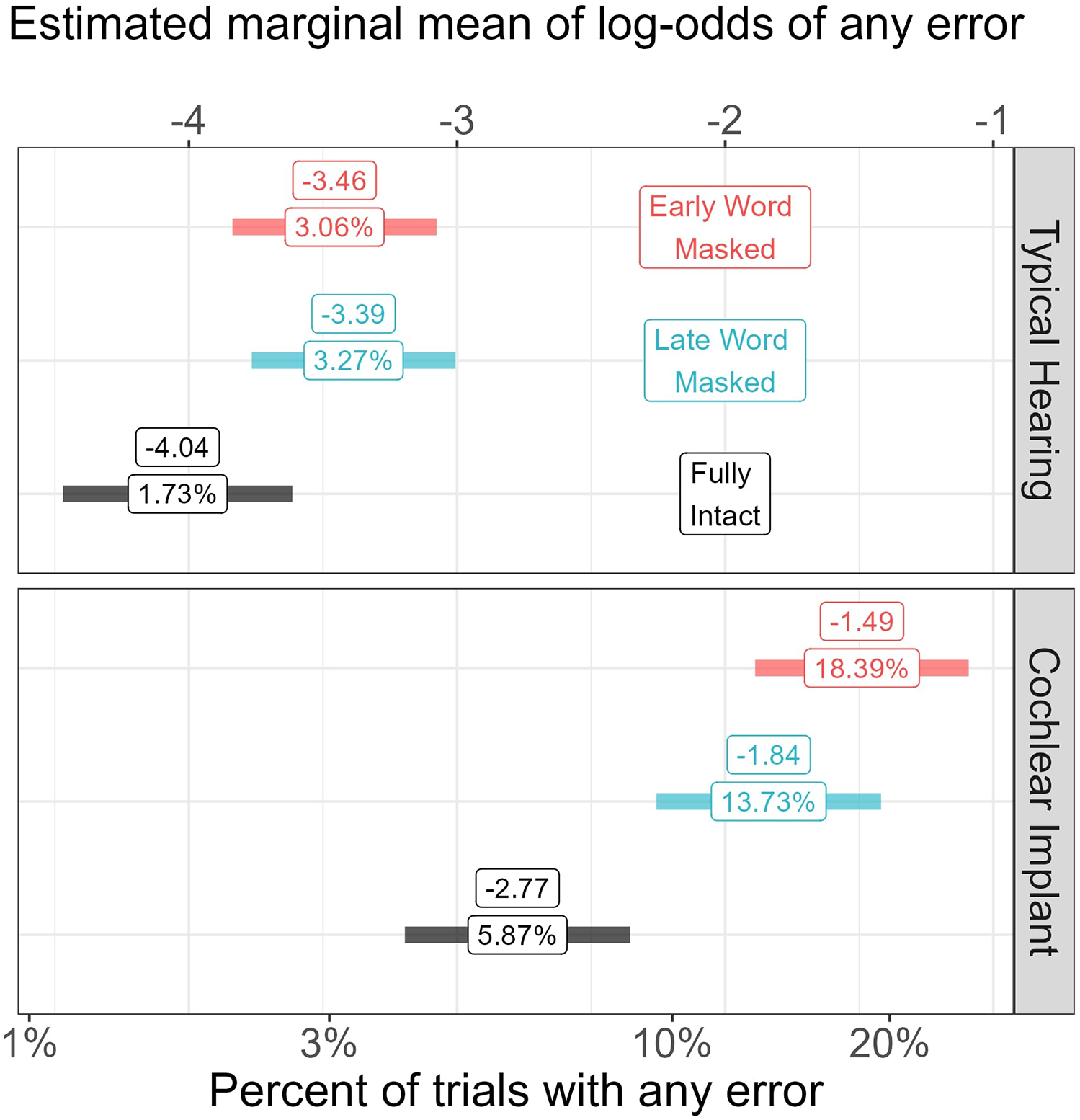
Model estimates of the prevalence of making an error on any word in the sentence, represented as model-inherent log odds (top x-axis) and converted to percentage (bottom x-axis) for ease of reading. The marginal means estimates for each of the different sentence types are shown with the shaded ribbons indicating the estimated 95% confidence interval (color online).
There was a clear ordering effect of sentence type, with CI listeners making the most errors when an earlier word was missing compared to a late missing word (coefficient β = 0.36, z = 2.32, p = .02), and fewer errors overall when the sentence was fully intact (β = −1.00, z = −4.71, p < .001). The estimated marginal means show that there was no overlap in the 95% confidence bands across the listener groups for any stimulus type, suggesting a significant increase in errors for the CI group.
Different Kinds of Errors for CI Listeners
Figure 5 shows the percentage of errors by CI listeners for each specific error types, along with a panel showing data for the previous tally of any error. TH listeners did not make enough errors to warrant analysis. The number of true target errors for CI listeners (not correctly repairing the masked word, or in the case of intact sentences, making an error on the word that would have been masked) was small enough that no statistics were conducted. A raw count of target-word errors for CI listeners revealed more errors for sentences with early (n = 45) or late (n = 26) missing words compared to those same words when the sentence was fully intact (n = 10). The second panel shows that the number of times that listeners made an error on the target word was rather similar across the stimulus conditions. That is, even when the sentence was intact, there were some mistakes at a rate roughly comparable to when the words were physically replaced with noise.

Percentage of responses that contained any errors, for the CI listener group only. Each panel is a different type of error, colored by the different stimulus conditions. Individual listeners are represented by points with connecting lines across the stimulus conditions within a panel (color online).
The third panel of Figure 5 illustrates how mentally repairing a missing word affected perception elsewhere in the sentence. Compared to when the sentences were fully intact, there were more errors on nontarget words when CI listeners had to repair earlier (β = 1.02, z = 4.27, p < .001) or later (β = 0.69, z = 2.86, p = .004) missing words. Although CI listeners made more errors elsewhere in the sentence when forced to repair an early missing word (n = 112) versus a late missing word (n = 86), this difference did not reach the conventional criterion for statistical significance (β = 0.33, z = 1.715, p = .086).
No statistical comparisons were made for incoherent response, although they occurred more often when repairing early (n = 30) or late (n = 20) missing words compared to when the sentence was intact (n = 7).
Pupillometry
Main Effects of Stimulus Type (Mental Repair of Missing Words)
Changes in pupil dilation for each group when listening to the different sentence types are shown in Figure 6. The results of the GAMMs analysis are shown as colored bars at the bottom of each panel, which denotes regions of statistical differences between the curves colored by which sentence type resulted in a larger increase in pupil dilation. Model summary tables can be found online as Supplemental Digital Content 1.

Average proportional change in pupil size for each listener group in response to the three stimulus types (thick colored lines). X-axis is time in seconds, with 0 representing sentence offset. Small error bars represent the average position and duration of the missing word for the different stimulus types. Ribbons around the line indicate one standard error. Stretches of time that were found in the GAMM to be statistically different are shown at the bottom of the plot as lines labeled with the two comparison pupil lines above (color online).
The largest effects observed were for stimuli with missing words early in the sentence, which elicited greater pupil dilation across multiple comparisons of interest. First, larger increases in pupil dilation were observed for sentences with early-masked words compared to intact sentences, with each listener group showing a similar duration of increased pupil dilation that is consistent with the timing of the missing word in the sentence (YTH: −1.40 to 4 s relative to sentence offset; OTH: −1.46 to 4 s relative to sentence offset; CI: −1.24 to 4 s relative to sentence offset). Second, sentences with early missing words also elicited greater pupil dilation than sentences with later missing words, but the duration of this difference varied by age and hearing status. Greater pupil dilation for early- versus late-masked words was observed for younger TH listeners only during the listening phase of the trial (between −1.72 and 0.52 s, results reported as time relative to sentence offset), with no differences being observed after the peak in pupil dilation that corresponds to sentence offset. Older TH and CI listeners also showed a similar duration of increased pupil dilation during sentence presentation (OTH: −1.64 to 0.68 s; CI: −1.56–0.68 s). However, unlike the YTH group, the CI and OTH groups showed increased pupil dilation in response to early- versus late-masked stimuli that persisted after sentence offset as well (1.24 for CI, 1.56 for OTH, both extending to the end of the analysis window at 4 s).
Sentences with late-masked words elicited greater pupil dilation compared to fully intact sentences after the end of the sentence presentation (for YNH: between −1.88 and −1.64 and −1.48 and 0.12 s; for OTH: between −0.60 to −0.04 s; and for CI: between −1.32 and −0.20 s). However, the fully intact sentences unexpectedly elicited larger increases in pupil dilation during sentence presentation compared to the late-masked sentences for at least some stretch of time for all groups. An additional analysis of the data verified that this pattern was not dependent on the type of stimulus presented in the previous trial.
Differences Between TH and CI Groups
Whereas each group demonstrated increased pupil size in response to stimuli that demanded mental repair compared to sentences that were intact, the degree of this increase was different across groups. The difference of pupil dilation between repair conditions and intact conditions was compared across groups using a GAMM that included interaction terms between stimulus type and hearing groups. Figure 7A shows the modeled differences of pupil responses within groups for each stimulus comparison (left three panels; significant stretches already described above), and the comparison of these difference curves between hearing groups (Figure 7B, right panels).

Difference curves from the GAMM results, illustrating differences between curves from Figure 6, and also illustrating differences between groups. (A) The curve represents the modeled difference between stimulus types, with meaningful stretches of time above or below zero shown in color corresponding to which sentence type was greater for the comparison. Colored regions are the same stretches of time shown as color bars in Figure 6. (B) Modeled effect of hearing groups on the difference curves. Each row represents the modeled difference of pupil responses for each stimulus type comparison across groups, with the letter labels in each panel indicating which curves are included in the comparison from section A. Colored regions show stretches of time where a particular group had a statistically larger difference between curves, with older listeners shown in purple and CI listeners shown in yellow (color online).
For both YTH and CI groups, there were increases in pupil dilation resulting from early-masked versus intact sentences, for early-masked versus late-masked sentences, and also for late-masked versus intact sentences (left and right column of Figure 7A). All of these increases were significantly larger for the CI group (middle column of Figure 7B). For both OTH and CI groups, there were increases in pupil dilation resulting from early-masked versus intact sentences, for early-masked versus late-masked sentences, and also for late-masked versus intact sentences (middle and right column of Figure 7A). Just as for the comparison of CI to YTH, the increase in pupil dilation for early-masked sentences compared to intact sentences was significantly larger for CI listeners compared to OTH listeners (top right panel Figure 7B). However, the increased dilation observed for early-masked versus late-masked stimuli and the increased dilation for late-masked versus intact stimuli both were not statistically different across the CI and OTH groups (rightmost column of Figure 7B, middle and lower panels). Within the TH group, the increase in pupil dilation resulting from early-masked versus intact stimuli was larger for the older listeners (top left panel in Figure 7B), but no other differences emerged across age groups within the TH sample. Taken together, these results suggest that there is an effect of age and that when accounting for age, there remains a separate effect of using a CI for mentally repairing words early in a sentence.
Effect of Repetition Accuracy on Pupil Responses
Incorrect responses tend to result in a larger or more sustained increase in pupil dilation (Winn et al., 2015; Zhang et al., 2021), and the difference in performance scores across stimulus types invites analysis of intelligibility effects on the current data from CI listeners (there were not enough incorrect trials for TH listeners to analyze). Pupil responses for the CI listener group for correct and incorrect trials for each sentence type are shown in Figure 8. The elevation in pupil size was observed when sentences demand repair is sustained for a longer amount of time when the repair was not fully successful (i.e., when there was still a mistake in the response), compared to when the word was correctly inferred. For sentences with early-masked words, incorrect responses led to increased pupil dilation from 0.99 to 4 s relative to sentence offset, which was a longer duration than the corresponding effect for errors in sentences with later-masked words (1.33–4 s relative to sentence offset). This result is consistent with generally larger effects of early mistakes in semantically coherent sentences (Gianakas et al., 2022; Winn & Teece, 2021). For sentences that were presented fully intact, the pattern of sustained pupil dilation for incorrect responses was only briefly different than when the response was correct (2.03–3.13 s relative to sentence offset), although fewer errors were made for those stimuli overall (n = 49) compared to sentences with an early-masked word (n = 150) or a late-masked word (n = 116).

Effect of repetition errors on pupil responses, for CI listeners only. Pupil responses for correct trials are shown in solid lines, with responses from incorrect trials shown in dashed lines. Stretches of time where there was a statistical difference between the two pupil curves are designated by a dashed line below the curves, with “n” indicating the number of trials contributing to each curve.
The CI listeners showed prolonged elevated pupil dilation following early-masked trials and also showed a higher rate of mistakes on these trials. Therefore, there was a possibility that the effect of hearing was simply an expression of what happens when any listener makes a mistake, regardless of hearing status. We repeated the analysis using only trials with correct responses, confirming that the effect of hearing (prolonged elevated pupil dilation in CI listeners compared to YTH listeners following trials with early-masked words) persisted. Supplemental Digital Content 1 contains the results of this follow-up analysis.
Discussion
The present study aimed to address the question of how the position of a misperceived word impacts listening effort and intelligibility. By prospectively designing sentences with missing words at different word positions within a sentence, we could ensure the mental repair process happened at specific moments, even though it can normally be uncontrollable or undetectable simply based on the participant response. Crucially, the stimuli with early- and late-position words were drawn from the same set of sentences, toward the goal of comparisons that were unavailable in previous studies.
Consistent with previous work, listeners exerted more cognitive resources to disambiguate sentences with missing words, as indicated by increases in pupil dilation that were larger and more rapid compared to when all the words in a sentence were available (Figure 6). The main novel result was that sentences with earlier-masked words had larger increase and duration of extra pupil dilation compared to sentences with late-masked words. One likely explanation is that the late-masked words have the advantage of preceding disambiguating information before the missing word that could help resolve any linguistic ambiguity in advance, whereas stimuli with early-masked words forced the listener to hold some uncertainty until gathering sufficient contextual clues later on. Although it is likely that the burst of noise also elicited some physiological response, the noise was matched in duration and intensity to the speech it replaced, and the responses were longer lasting for the early-masked words, suggesting that some factor other than pure acoustic stimulation was involved.
Consistent with previous literature (Winn et al., 2015; Zhang et al., 2021), incorrect responses in the current study produced greater pupil dilation in the moments after the sentence ended. The larger increase in pupil dilation for incorrect responses could be an indication that the listener is still grappling with some unresolved linguistic ambiguity created by the missing word, resulting in lingering effort after the sentence. Taken together, these results suggest that a mere tally of the number (or percent) of errors in a sentence loses valuable information about the unequal impact of making perceptual mistakes earlier or later in an utterance.
Compared to listeners with TH, CI listeners showed increased duration of increased pupil size when disambiguating missing words, especially when those missing words occurred earlier in the sentence, suggesting more time needed to recover from the process of mentally repairing missing words. Effects of early-repaired words on listening effort persisted even when avoiding the common pitfall of comparing older CI listeners to a group of TH listeners who are much younger, even comparing the CI group to a TH group with roughly similar age range produced a similar effect of early-repaired words (Figure 7B) and trial correctness (Supplemental Figure 1). In contrast to the robust effects of repairing early words, the increased pupil dilation resulting from late-masked words was partially explained by the impacts of age or response accuracy. These results are consistent with the notion that different mistakes incur different amounts of disruption during listening, suggesting that intelligibility errors should not be lumped together as a linear sum.
Within the TH listener groups, older listeners showed sustained increases in pupil dilation after the sentence when repairing earlier missing words compared to younger listeners perhaps due to the added cognitive demands of holding the sentence in memory as the listener waited for additional context to resolve the ambiguity of the missing word. These specific processes may have disproportionally impacted older listeners due to limitations in working memory or cognitive processing as a result of aging (Gilchrist et al., 2008). This result provides preliminary evidence of an age effect on listening effort during the mental repair process that is independent from hearing status. Perhaps OTH listeners had greater difficulty taking advantage of context information as the sentence unfolded in real time, which would have aided the quicker resolution of the missing word. However, older listeners in the current study were able to take advantage of sentence context to infer a missing final word without any difference from the younger TH group, suggesting that the speed of using context is not necessarily affected by age in all situations. However, we advise caution of this interpretation as the present study was not designed prospectively to examine the impact of age on the mental repair process and listening effort, and thus the current evidence should be considered preliminary.
Another unexpected finding was that the CI listeners—who were primarily older—showed greater overall pupil dilation than the older group of TH listeners. Age is among the factors that have historically been linked with overall levels of pupil dilation, and yet these two similarly aged groups showed noticeable differences. Although it is tempting to speculate that the CI listeners might have exerted greater effort for the task simply because of their history with identifying more strongly with their own hearing status compared to a person with typical hearing, we are reluctant to offer a firm explanation for this because of the wide range of individual differences in pupil dilation and differences because of basic arousal.
There was an unexpected decrease in pupil dilation for the late-masked stimuli compared to the intact stimuli during the presentation of the sentence. We have verified that this is not an unintended consequence of the low-pass filter parameters that would transform a sharp increase into a shallower change that begins before the causal event. Looking at individual pupil traces, only a minority of listeners in each group show this specific trend (10 out of 41 TH and 6 out of 20 CI). It is not clear whether this pattern reflects some unique aspect of linguistic processing. This result is difficult to explain because the listener had no way of knowing whether the trial type would be intact or late masked during the early portion of the stimulus. However, this effect of unexpected lower pupil dilation for late-masked stimuli emerged more strongly for both listener groups when the previous trial was also a late-masked sentence.
Increases in pupil dilation can also be interpreted to reflect changes of multiple psychological states, including motivation (Koelewijn et al., 2018), arousal (Beatty & Lucero-Wagoner, 2000), working memory (Robison & Unsworth, 2019), attention (Miller et al., 2019), surprisal (Preuschoff et al., 2011), and vigilance (Rajkowski et al., 1994). However, given that the stimulus types were randomly mixed within the testing block, we are confident that these other factors are unlikely to explain the stimulus-related effects (i.e., motivation and arousal probably did not change trial to trial). The brief bursts of noise (although matched in intensity to their corresponding segments of speech) might have introduced some surprisal that contributes to momentary increases in pupil size, although the persistence of the increased pupil size following early masked words compared to late words suggests that surprisal alone cannot explain the effects observed here. In addition, other aspects of the stimulus could result in sudden and rapid changes in pupil dilation, such as the sudden onset of noise that was used in the present study to replace missing words. However, given the regularity of when the noise occurred, the control of intensity to match the replaced word and the observed changes in pupil dilation reflecting the specific timing aspects of the missing words in a sentence present results are likely to be minimally impacted by the onset of the noise burst.
On the Importance of Measuring the Timing (Not Just the Magnitude) of Effort
The observation of lingering effort in cases of successful and unsuccessful mental repair of missing words invites concern about the potential implications for perceiving continuous speech, which typically lacks extended moments of silence that the listener can use to reevaluate and repair previous perceptions. Listeners with severe-profound hearing impairment have suggested there is a significant time lag between hearing and understanding, and feelings of being “behind” due to the extra effort needed to follow the conversation (Hughes et al., 2018). Recent work verifies that misperceiving one word has downstream consequences for the accurate perception of later sentences if the listener cannot quickly resolve the mistake (Winn, 2024). Testing with two full sentences reveals that some listeners experience severe reduction in performance that would not have been evident by testing one sentence (Svirsky et al., 2024), validating the notion that lingering effort in single-sentence stimuli might overlook difficulties that have implications for real-world interaction.
One of the complications of relying solely on magnitude of pupil dilation is that it is variable across individuals in a way that might or might not be related to true differences in listening effort. There was less pupil dilation observed for the OTH compared to the CI group, which likely results form a combination of well-known age effects on pupil reactivity, in addition to likely increased engagement and effort with the task by the CI group, since they have hearing loss. However, we are reluctant to draw firm conclusions based only on these absolute dilation differences because the weight of each of these counteracting effects is not known.
A Caveat on Interpreting the Use of Context and Sentence Coherence
Taking advantage of sentence context as a compensatory listening strategy is one potential approach to explore how language processing interacts with listening effort. A common method for evaluating the influence of sentence context on perception is to have high- or low-probability sentences (Bilger et al., 1984) or to have sentences that are either semantically coherent or incoherent (O’Neill et al., 2020; Signoret et al., 2018; Van Engen & Peelle, 2014). In several recent studies involving CI listeners, incoherent responses are shown to elicit larger signatures of effort compared to other types of responses or planned stimulus variations (Winn, 2024; Winn & Teece, 2021, 2022). However, a crucial caveat that must be considered when interpreting these studies is the increase in effort resulting from incoherent perceptions might hinge on the listener's expectation that the sentences should be coherent. This caveat might explain why Mechtenberg et al. (2024) observed the unexpected result of larger pupil responses for a clear speaking style compared to a conversational style. Notably, all of the stimuli in that study were contextually incoherent, so the clear hyperarticulated speaking style might have made the anomalous sentence content even more noticeable and striking. The influence of the listener's expectation for sentence coherence (or expectation of any other reliable pattern) could alter their approach to listening and their allocation of effort in the task. This idea could be explored by a study that directly compares responses from a random mix of stimulus types against results from a blocked design where the listener has clear expectations for stimulus type. The current study can also be contextualized by this idea; perhaps the increased signs of effort for repaired sentences would be diminished if the listener expected to repair every sentence and increased if the repaired stimuli were less frequent (i.e., more surprising).
Conclusion
Mentally repairing a misperceived word elicits increased effort, particularly when that word occurred earlier in the sentence, and especially when the repair process was unsuccessful. Elevated listening effort lingers longer after the sentence for CI listeners, especially when needing to repair an earlier missing word. These patterns suggest that not all words should be weighted equally when assessing a listener's perceptual accuracy for words within a sentence. When CI listeners repair missing words, they are also more likely to make mistakes on words elsewhere in the sentence (both earlier and later), even though those words were presented in the clear. These patterns further highlight how participant responses do not reflect perceptual accuracy on a word-by-word level, but rather the processing of the entire utterance, which is affected by commitment to a sentence parsing established as the sentence unfolds and continues to solidify by the end of the sentence.
Supplemental Material
sj-jpg-1-tia-10.1177_23312165251320789 - Supplemental material for Repairing Misperceptions of Words Early in a Sentence is More Effortful Than Repairing Later Words, Especially for Listeners With Cochlear Implants
Supplemental material, sj-jpg-1-tia-10.1177_23312165251320789 for Repairing Misperceptions of Words Early in a Sentence is More Effortful Than Repairing Later Words, Especially for Listeners With Cochlear Implants by Michael L. Smith and Matthew B. Winn in Trends in Hearing
Supplemental Material
sj-docx-2-tia-10.1177_23312165251320789 - Supplemental material for Repairing Misperceptions of Words Early in a Sentence is More Effortful Than Repairing Later Words, Especially for Listeners With Cochlear Implants
Supplemental material, sj-docx-2-tia-10.1177_23312165251320789 for Repairing Misperceptions of Words Early in a Sentence is More Effortful Than Repairing Later Words, Especially for Listeners With Cochlear Implants by Michael L. Smith and Matthew B. Winn in Trends in Hearing
Footnotes
Acknowledgments
Participant recruitment and data collection were assisted by Katherine Teece, Emily Hugo, Tereza Krogseng, Miski Mohamed, and Lexi Olson. Statistical analysis was aided by input from Stefanie Kuchinsky, Nick Pandža, and Michael Johns. The experiment design was assisted by our late colleague Akira Omaki.
Declaration of Conflicting Interests
The authors declared no potential conflicts of interest with respect to the research, authorship, and/or publication of this article.
Funding
The authors disclosed receipt of the following financial support for the research, authorship, and/or publication of this article: This research was supported by NIH-NIDCD F32 DC021076 (Smith) and R01 DC017114 (Winn).

Supplemental Material
Supplemental material for this article is available online.
References
Supplementary Material
Please find the following supplemental material available below.
For Open Access articles published under a Creative Commons License, all supplemental material carries the same license as the article it is associated with.
For non-Open Access articles published, all supplemental material carries a non-exclusive license, and permission requests for re-use of supplemental material or any part of supplemental material shall be sent directly to the copyright owner as specified in the copyright notice associated with the article.

