




Abstract
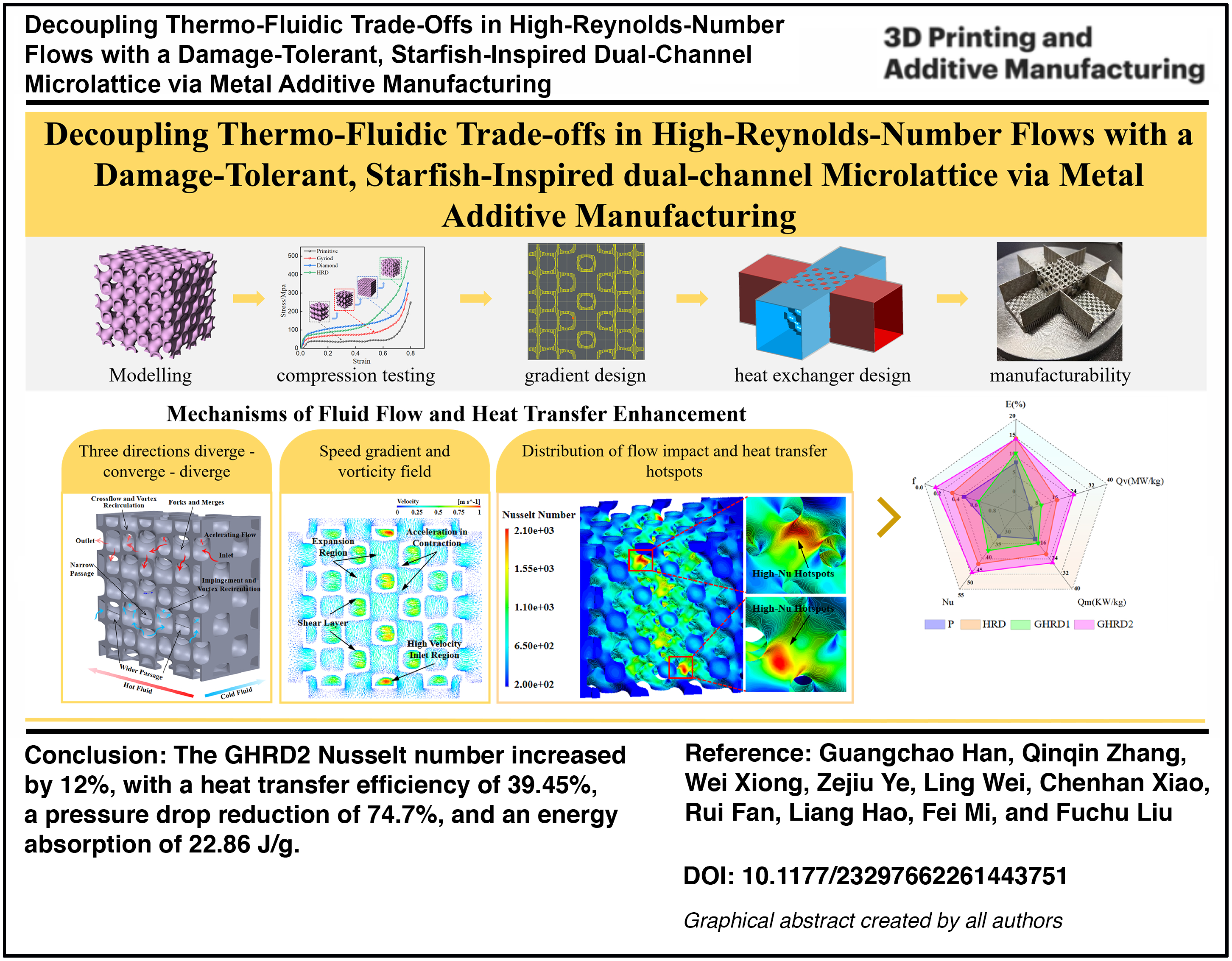
Advanced thermal management systems in high-Reynolds-number regimes face a fundamental trade-off: enhancing convective heat transfer invariably incurs prohibitive pressure drops. To address this scaling crisis, we introduce a proof-of-concept, bio-inspired design paradigm translating the damage-tolerance principles of the starfish skeletal microlattice into a fluid impedance-matching layer. Fabricated via laser powder bed fusion, a dual-channel heat exchanger featuring a continuous converging-diverging porosity gradient was investigated. Rigorous numerical simulations and conducted physical experiments validate its fundamental performance decoupling. Compared to a uniform baseline at Reynolds number 2000, this bio-inspired structure achieves a 74.7% pressure drop reduction while increasing the Nusselt number by 12%. Crucially, an anti-gradient control group catastrophically failed mechanically and fluidically, proving that precise impedance alignment—not arbitrary aperiodicity—drives this decoupling. The superior performance is governed by an enhanced scaling law (
Get full access to this article
View all access options for this article.
References
Supplementary Material
Please find the following supplemental material available below.
For Open Access articles published under a Creative Commons License, all supplemental material carries the same license as the article it is associated with.
For non-Open Access articles published, all supplemental material carries a non-exclusive license, and permission requests for re-use of supplemental material or any part of supplemental material shall be sent directly to the copyright owner as specified in the copyright notice associated with the article.
