



Abstract
Prior research has extensively documented the protective effects of immigrant concentration on crime. However, little is known about how newcomers of distinct nationalities influence crime in the aggregate, particularly over time. This study examines how immigration measures disaggregated by country of origin impact violent and property crime rates and drug-related arrests in Texas counties from 2000 to 2019. Results from a series of fixed-effects linear regression models show no discernible relationship between various nationality measures and violent crime rates. However, increases in the Honduran, Salvadoran, Indian, and overall foreign-born population were associated with within-county decreases in property crime rates, while percent Salvadoran and percent Vietnamese were related to fewer drug arrests. We discuss the implications of these findings for research, theory, and current debates on U.S. immigration policy.
Keywords
Introduction
The notion that immigrants increase crime has been widely disputed in prior research (Rumbaut and Ewing 2007). Dozens of studies published over the past two decades reveal that immigration often has a null or inverse association with crime, especially in places that have experienced the largest increases in their foreign-born population (Han and Piquero 2022; Sampson 2008; Stowell et al. 2009). As Stanford economist Ran Abramitzky notes, “recent waves of immigrants are more likely to be employed, married with children, and in good health . . . far from the rapists and drug dealers that anti-immigrant politicians claim them to be” (quoted in Crawford 2023). Scholars argue that the protective effect of immigration is, in part, a function of newcomers breathing new life into communities by strengthening local economies and conventional institutions (e.g., schools and churches) that are vital conduits of social control (Lee, Martinez, and Rosenfeld 2001; Vélez 2009).
Despite mounting evidence illustrating the crime-deterring benefits of immigrant concentration, empirical scholarship in this line of work is limited in three notable respects. First, prior research tends to operationalize immigration using monolithic indicators such as percent foreign-born (Nielsen and Martinez 2005; Stowell and Martinez 2007). The issue with this conceptual approach is that it fails to account for the rich diversity of the current immigrant wave (Bursik 2006; DiPietro and Bursik 2012). Compared to previous eras, immigrants today are more likely to be non-White and arrive with varying human capital skills, legal statuses, and migration motives (e.g., asylum and economic)—factors that, on the one hand, are associated with one’s nationality or country of origin and, on the other hand, might predict the likelihood of criminal conduct (Kubrin, Hipp, and Kim 2018; Ramos, Piatkowska, and Hernandez 2023). In this vein, prior studies on immigration and crime that have used an all-encompassing measure of the foreign-born population may be confounding nationality differences in the immigration pool and potentially yielding ambiguous results (DiPietro and Bursik 2012; Stowell and Martinez 2009).
Second, from those aggregate studies that do employ nationality measures of the foreign-born, virtually all rely on cross-sectional data. This methodological decision is problematic considering that theoretical explanations posit that immigration’s impacts on communities (e.g., ethnic heterogeneity and crime rates) occur over time (Kubrin 2013; Ousey and Kubrin 2009; Wadsworth 2010). In addition, one advantage of longitudinal studies is that they are better than cross-sectional analyses at reducing selection bias—an issue that becomes more relevant when distinguishing the foreign-born by country of origin. For instance, with cross-sectional data, it is possible that nationality groups from lower socioeconomic backgrounds (e.g., Mexico and Haiti) will have a positive association with crime because they settle in places with already high levels of criminality, not because of any actual changes to the social fabric of the community (e.g., informal social control) or the offending patterns of these groups. Third, prior studies using country of origin measures have been limited to just a handful of cities (e.g., Houston, TX, Miami, FL) or a specific region of a state (i.e., Southern California; Kubrin et al. 2018; Stowell and Martinez 2007). Thus, it is unclear whether or how the dynamic relationship between immigration and nationality affects crime in other contexts.
The present study addresses these limitations by using county-level data from 2000 to 2019 to examine how specific measures of immigration affect violent, property, and drug-related crimes in Texas. Specifically, we investigate the extent to which within-place changes in the percentage of the county population from Mexico, El Salvador, Honduras, India, and Vietnam account for within-place changes in violent and property crime rates and drug arrests for 113 Texas counties. Building on prior knowledge, the current study moves beyond uniform measures of the foreign-born to examine how distinct indicators of immigration impact crime across Texas counties and over time. To our knowledge, this study is the first to examine the dynamic relationship between immigration, nationality, and crime, which is important considering that longitudinal studies are regarded as more rigorous research designs than cross-sectional analyses (MacDonald et al. 2013; Ousey and Kubrin 2018). Furthermore, investigating the link between country of origin and crime in Texas is notable for two reasons. For one, Texas is a border state with the second-largest foreign-born population in the country (Hahn and Medina 2024). Second, the state has spent billions of dollars in recent years to secure its border with Mexico and eliminate what officials say is the threat of drugs, crime, and undocumented immigrants from entering Texas communities (Department of Public Safety n.d.). Hence, Texas’s large foreign-born population and its hardline approach to addressing immigration matters within its jurisdiction represent a notable context to examine the longitudinal relationship between nationality and crime.
Background
Theory and Prior Research on Immigration and Crime
Early sociological research relied on the tenets of social disorganization theory to explain the link between immigration and crime (Feldmeyer 2009; Martinez and Lee 2000). According to this perspective, immigration exacerbates the structural conditions of the community by encouraging residential turnover and ethnic heterogeneity, which then weakens social ties and the neighborhood’s capacity to regulate the behaviors of its members (Han and Piquero 2022; Lee et al. 2001). Another argument rooted in the social disorganization perspective is that the positive association between immigrant concentration and crime is spurious (MacDonald et al. 2013; Martinez, Stowell, and Lee 2010). In many of the inner-city neighborhoods examined by Shaw and McKay (1942) and others (Thomas and Znaniecki 1920; Thrasher 1927) during the early twentieth century, crime was a constant fixture of these communities, regardless of the immigrant groups that lived there. As such, scholars pointed to the role of social structure (e.g., ethnic heterogeneity and informal social control) in the causation of crime (Bursik 2006; Martinez et al. 2010).
Recently, scholars have begun to rethink how immigration affects crime in the aggregate. While social disorganization remains a viable theory for explaining variation in crime rates across place, the destabilizing impacts associated with immigration are no longer applicable (Ramey 2013). Indeed, empirical scholarship published over the past two decades reveals that immigrant concentration often has a negative or null effect on a number of crime-related outcomes, including homicide (Martinez et al. 2010; Stowell and Martinez 2007; Vélez 2009), robbery (Feldmeyer 2009; Wadsworth 2010), aggravated assault (Reid et al. 2005), and drug overdose deaths (Feldmeyer et al. 2022). In light of these findings, scholars have introduced the immigration revitalization thesis to argue that the influx of immigrants into the community strengthens social ties, expands local economies, and bolsters conventional institutions, which then increases social control and reduces crime (Han and Piquero 2022; Vélez 2009).
There are several reasons why the immigration revitalization perspective may be more relevant than social disorganization in explaining immigration’s impacts on community crime today. One is that immigrants are generally regarded as a self-selected group that comes to the United States to work hard and pursue economic and educational opportunities not available in their home countries (Butcher and Piehl 2007; Martinez, Lee, and Nielsen 2004). Immigrants—regardless of their legal status—also fear deportation, making them more likely to engage in conformist behavior and avoid the attention of criminal justice officials (Lee et al. 2001; Light and Miller 2018). Furthermore, studies show that foreign-born individuals have higher rates of marriage and employment than their native-born counterparts—characteristics that are negatively associated with criminality at both the individual and macro level (Martinez et al. 2004; Ousey and Kubrin 2009).
Another plausible explanation for the inverse association between immigration and crime is the settlement patterns of contemporary immigrants. Whereas newcomers arriving during the early 1900s settled in disorganized and high-crime areas due to their socioeconomic status, immigrants today tend to reside in ethnic enclaves that provide them with access to a host of social capital resources (e.g., employment and housing; Barranco, Harris, and Feldmeyer 2017; Desmond and Kubrin 2009). Put differently, the inflow of immigrants into an area is no longer interpreted as one of invasion and disruption to the existing network of relationships that bind a community together (Martinez et al. 2010). Rather, new arrivals often settle near other co-ethnics in communities that serve as “mini-homelands” and provide them with the resources needed to successfully adapt to the host society (Desmond and Kubrin 2009; Ramey 2013).
Extending Immigration-Crime Research to Account for Nationality
Although research has largely debunked widespread claims linking immigrants with criminality, the evidence accumulated thus far raises additional questions that warrant empirical attention. One issue is whether the immigration-crime relationship varies when the foreign-born are disaggregated into specific groups such as by nationality (Stowell and Martinez 2009; Tonry 1997). This concern is not new, as research dating back to the works of Sellin (1938), Taft (1936), and Park and Miller (1921) identified differences in criminal involvement based on immigrants’ country of origin. As Taft (1933:74) asserts, the “bad record [high crime rates] of nationalities with especially difficult problems of adjustment might be offset by the good record [low crime rates] of immigrants with lesser adjustment problems” in an all-encompassing measure like foreign-born.
Nearly a century later, Taft’s appeal for distinguishing between different nationality groups is still echoed by scholars today (Bursik 2006; Kubrin et al. 2018). As Kubrin (2013:12) writes, “while aggregate research can document a relationship between immigration and crime at the neighborhood, city, or metropolitan levels, this conclusion does not illuminate the precise groups responsible for the effects.” The need for more detailed indicators of immigration is warranted given the diversity of the current immigrant wave (Stowell and Martinez 2007). As noted above, immigrants today enter with varying human capital skills, assimilation experiences, and migration motives—factors that are all associated with nationality and quite possibly, criminal behavior (Kubrin et al. 2018; Ramos et al. 2023). In the discussion below, we highlight how these factors may contribute to variation in crime across immigrants from different countries of origin.
Human Capital
Research shows that immigrants from Latin America (e.g., Mexico and Honduras) generally arrive with low rates of educational attainment, constitute a larger share of the undocumented population, and experience widespread discrimination in the United States (Portes and Rumbaut 2014; Rumbaut and Ewing 2007). According to criminological theory and prior research, immigrants from this region of the world should have a higher proclivity for crime for several reasons. For one, strain and economic deprivation arguments suggest that because of these groups’ low levels of human capital and vulnerable legal status, Latin American immigrants will be concentrated in employment positions that offer little pay and few prospects for upward mobility (Butcher and Piehl 2007; Ousey and Kubrin 2009). As such, these immigrant groups will possibly turn to economically motivated crimes (e.g., burglary) to achieve the “American Dream.” Relatedly, some argue that the link between economic deprivation and crime is more relevant to today’s immigrants due to America’s post-industrial economy and the loss of manufacturing jobs that provided early European immigrants with ample opportunities to bolster their socioeconomic status (Morenoff and Astor 2006). In addition, immigrants with limited means may be more likely to settle in disorganized and high-crime neighborhoods that increase their exposure to violence, concentrated poverty, and other social problems (Hagan and Palloni 1999). In contrast, immigrants from India, China, and South Korea may be associated with lower rates of crime because they tend to live in more advantaged neighborhoods due to their high levels of college attainment and median household incomes (Kubrin et al. 2018; Tonry 1997).
Assimilation
Nationality groups also differ in their assimilation experiences. A well-documented finding in the literature is that the probability of engaging in criminal activity increases across generations (e.g., first- versus second-generation immigrants) and the longer immigrants have lived in the country (Rumbaut and Ewing 2007; Tonry 1997). Hence, groups with a longer history of settlement may display a higher risk for crime than more recently arrived immigrants due to differences in assimilation (Kubrin et al. 2018). Ramos et al. (2023) illustrate this point in their study of nationality and misconduct in Florida prisons. They found that incarcerated persons born in Cuba exhibited a significantly higher probability and frequency of inmate misconduct than both natives and other immigrant groups (e.g., Jamaicans and Mexicans). While the authors did not include a measure for acculturation in their study, they speculated that Cubans’ longer history of settlement in Florida may indicate that this group is more assimilated (relative to other immigrant groups in the study) and explain their higher probability for disciplinary infractions in prison. Also critical is the role of immigrant enclaves in shielding residents from the adverse consequences of assimilation (Morenoff and Astor 2006; Zhou and Bankston 2006). Over a century ago, Park and Miller (1921) found that differences in crime across nationality groups (e.g., Japanese, Italian, and Polish) were largely attributed to their communities’ ability (or lack thereof) to mitigate the “Americanization” problem and decrease contacts with the native-born. More recently, Desmond and Kubrin’s (2009) analysis found that the crime-reducing effect associated with immigration was strongest for Asians, suggesting that immigrant communities vary in their capacity to reduce residents’ involvement and exposure to violence. Taken together, to the extent that immigrants differ in their assimilation experiences and the structural conditions of their communities, one should expect heterogeneity in criminal offending across country of origin.
Migration Motives
Another factor that may explain variation in crime rates across groups is their reasons for migrating. Most immigrants—whether they arrive with little formal education or to fill high-skilled jobs—come to the United States to pursue economic opportunities (Butcher and Piehl 2007). According to Kubrin et al. (2018), the distinction between economic and non-economic motives for migrating has important implications for criminality. Immigrants who come to the United States for economic reasons often do so voluntarily, plan their journey in advance by securing a place to live and work before leaving their home countries, and display a willingness to adapt to a new culture (Lee et al. 2001; Nielsen and Martinez 2011). On the other hand, non-economic migrants such as asylum seekers and refugees may lack many of these qualities and thus, encounter greater difficulties integrating into mainstream society (Tonry 1997). To make matters worse, some refugees arrive with a range of physical and mental health problems due to their experiences with war and trauma in their home countries, which may enhance their risk for offending (Bauer, Lofstrom, and Zimmermann 2000; Kubrin et al. 2018).
Prior Research on Immigration, Nationality, and Crime
Despite the qualitative and potentially consequential differences that characterize distinct nationality groups, only a handful of aggregate studies have attempted to disentangle the foreign-born by country of origin (Kubrin et al. 2018; Stowell and Martinez 2007, 2009). These investigations have generally revealed heterogeneous effects in the relationship between immigration, nationality, and crime. For example, Kubrin et al. (2018) analysis of Southern California neighborhoods revealed that the spatial concentration of Mexican immigrants and Central American asylum seekers was positively associated with violent crime, while percent Chinese was inversely related to violence. In another study, Stowell and Martinez (2007) examined the relationship between ethnic-specific measures of immigration and different types of homicide (i.e., overall, instrumental, and expressive) in Miami, FL, and Houston, TX. They found that the percent Cuban, Nicaraguan, and Honduran were associated with fewer instances of expressive and instrumental homicide in Miami neighborhoods, while the percent Haitian exerted no effect. In Houston neighborhoods, the relationship between all four countries of birth measures—percent Mexican, Chinese, Vietnamese, and Salvadoran—and homicide was null. In interpreting these findings, Stowell and Martinez (2007) stress the importance of not only accounting for how different nationality groups impact the immigration-crime relationship, but also how this association is shaped by local contexts.
Importantly, as noted above, studies using country of origin measures are limited because they are all cross-sectional. Prior research has identified several limitations in using cross-sectional data to examine the aggregate effects of immigration on crime (Ousey and Kubrin 2009; Wadsworth 2010). For one, theoretical arguments posit that the (dis)organizing impacts of immigration on local communities unfold over time, suggesting that a longitudinal design is more appropriate for capturing this social change (Kubrin 2013; Martinez et al. 2010). Furthermore, longitudinal studies provide a more rigorous evaluation of causality than cross-sectional analyses due to their ability to control for time-invariant confounders and mitigate selection bias (MacDonald et al. 2013; Ousey and Kubrin 2009). Concerning the latter, because longitudinal analyses such as fixed-effects focus on within-place change, they ignore any between-place differences in the immigration-crime relationship that may be biased by the tendency for certain groups to self-select into places with already high (or low) levels of criminality. Evidence also shows that cross-sectional and longitudinal research can yield conflicting results, even within the same study (Ousey and Kubrin 2018). For instance, Wadsworth’s (2010) evaluation of 458 U.S. cities found that percent foreign-born was positively associated with homicide and robbery in 1990 and robbery in 2000. Yet, time-series regression models revealed that increases in cities’ percent foreign-born population from 1990 to 2000 were inversely associated with changes in robbery, while immigration’s effect on changes in homicide was null (also see Butcher and Piehl 1998). More importantly, Ousey and Kubrin’s (2018) meta-analysis revealed that longitudinal studies generated the largest inverse effect between immigration and crime and should be given more weight due to their stronger research designs. In light of this evidence, we contend that the benefits of employing a longitudinal design in immigration-crime research are also applicable and warranted when disaggregating the foreign-born by nationality.
The Current Study
Prior literature has offered valuable insights into the role of immigration on crime in the United States. However, questions remain regarding how various nationality groups might differentially influence aggregate crime rates. The present study leverages longitudinal data from Texas to evaluate these questions. In particular, this study incorporates county-level measures of immigration disaggregated by the five largest countries of origin for immigrants in the state: Mexico, India, El Salvador, Vietnam, and Honduras (American Immigration Council 2020). Collectively, these groups account for nearly 70 percent of Texas’ foreign-born population yet differ considerably in terms of their education levels, legal statuses, migration motives, and assimilation experiences—factors that likely have direct consequences for the relationship between nationality and crime.
To illuminate the possible heterogeneous effects between nationality and crime within Texas counties, one could argue that immigrants from Mexico, El Salvador, and Honduras will be positively associated with area crime rates due to these groups’ low rates of educational attainment and vulnerable legal status (Nielsen and Martinez 2011; Rumbaut and Ewing 2007). Data from the Pew Research Center reveals that less than 10 percent of immigrants from Mexico and Central America hold a bachelor’s degree, which suggests that newcomers from this region may be disproportionately channeled into structurally disadvantaged neighborhoods that increase their exposure to crime and other social ills (Krogstad and Radford 2018; Martinez et al. 2004). Moreover, because of their limited socioeconomic status and confinement to secondary labor market jobs, Mexican and Central American immigrants may turn to illegitimate opportunities, such as crime to achieve the American Dream (Feldmeyer 2009; Ousey and Kubrin 2009). To compound these issues, estimates show that immigrants from Mexico, El Salvador, and Honduras account for over four-fifths of Texas’s undocumented population, which further suppresses wage earnings and their employment prospects (Light and Miller 2018; Migration Policy Institute n.d.). Finally, political and media commentary often associate these immigrant groups with drug cartels, transnational gangs (e.g., MS-13), and higher levels of crime and drug-related violence (Feldmeyer et al. 2022; Lee et al. 2001; Martinez et al. 2004).
While it is plausible for Mexican, Salvadoran, and Honduran immigrants to experience a higher risk for crime due to their limited monetary resources upon arrival, an alternative possibility is that these criminogenic conditions are offset by these groups’ sizable presence in Texas. Latino immigrants, particularly those of Mexican descent, make up roughly half of the state’s foreign-born population (American Immigration Council 2020). As such, Latino immigration in Texas may follow the processes outlined in the immigration revitalization perspective, with these groups principally settling in ethnic enclaves that preserve cultural ties, provide ample opportunities for employment, and the means to successfully adapt to American society. In addition, although many Americans view employment in the secondary labor market as undesirable because of their low pay, working-class immigrants are more likely to perceive these jobs as opportunities for economic advancement when compared to wage earnings in their home countries (Martinez et al. 2004). This frame of reference, along with their economic motives for migrating, may indicate that employment in low-wage jobs is unlikely to lead to strain and maladaptive responses (e.g., crime) among low-income migrants as economic deprivation theory would predict. Also important, although public narratives tend to associate Mexican immigrants with “bringing drugs . . . [and] crime” into the United States, there is no evidence to support this claim (quoted in Schwartz 2015). Rather, research shows that immigration, including undocumented immigration, is associated with lower levels of violence (Light and Miller 2018) and drug-related arrests (Light, Miller, and Kelly 2017). These findings have important implications for nationality, considering, as noted above, that Mexican and Central American immigrants account for most of the undocumented stock in the United States (Passel and Krogstad 2024).
The challenges and experiences that Indian and Vietnamese nationals encounter in the United States are vastly different than those of their Mexican and Central American peers. The largest wave of Vietnamese nationals arrived in the United States as refugees following the fall of Saigon in 1975 (Bankston 1995; Batalova 2023). As refugees, Vietnamese immigrants were eligible for housing assistance, food stamps, and other resources that played a vital role in promoting their successful adaptation to U.S. society (Portes and Rumbaut 2014). The federal government initially settled Vietnamese refugees in cities throughout the country. However, familial and cultural ties drew many to later migrate and establish their own ethnic communities in cities such as Los Angeles, Houston, and New Orleans (Bankston 2014; Zhou and Bankston 2006). Furthermore, although college attainment rates among Vietnamese immigrants (29 percent) are slightly lower than the native- and foreign-born average (35 and 36 percent, respectively), they are much higher than that of other nationality groups (Batalova 2023).
Indian nationals are the second-largest immigrant group in both Texas and the United States (Greene and Batalova 2024). They are also one of the most successful given their high levels of college attainment, overrepresentation in professional jobs, proficiency in English, and median household incomes that are almost double that of the U.S. average (Greene and Batalova 2024). According to the Migration Policy Institute, Indian nationals accounted for 72 percent of all H-1B visas for high-skilled workers in fiscal year 2023. However, compared to other immigrant groups, Indians are less likely to settle in ethnically distinct neighborhoods and make up a larger portion of recent arrivals (Bankston 2014; Hanna and Batalova 2020). Finally, studies show that Asians, including Indian and Vietnamese nationals, are often typified as “model minorities” due to their socioeconomic achievements and overall low rates of criminal involvement (Johnson and Betsinger 2009; Rumbaut and Ewing 2007). Taken together, the discussion above indicates that there are ample reasons to expect heterogeneous effects when examining the immigration-crime relationship across these five nationality groups, with some groups possibly exhibiting a positive association with crime versus others that do not.
Methods
Sample
We use data from the Texas Uniform Crime Reporting (UCR) program and the U.S. Census Bureau to examine the association between immigration, nationality, and crime in Texas from 2000 to 2019. 1 Texas has a total of 254 counties. However, only those counties with a total population of at least 20,000 residents at all four waves (2000, 2005–2009, 2010–2014, and 2015–2019) were retained in the analysis, leaving a total of 113 Texas counties. 2 While this exclusion resulted in a loss of over half of all Texas counties, the 113 counties retained in the analysis contain over 90 percent of the state’s population. Moreover, while most foreign-born residents continue to reside in metropolitan areas, evidence shows that immigrants are increasingly moving to suburban and rural areas (Shihadeh and Barranco 2013; Singer 2004). As such, counties represent a useful aggregate to capture the shifting settlement patterns of foreign-born groups and have been used in prior research on immigration and crime (Barranco et al. 2017; Feldmeyer et al. 2022).
Dependent Variables
This study analyzed three dependent variables. Data for all three measures come from the Texas UCR (https://www.dps.texas.gov/section/crime-records/uniform-crime-reporting-program-ucr-overview). 3 The first outcome measure is the Violent Crime Rate, which is defined as the rate (per 100,000 residents) of reported murders, robberies, and aggravated assaults in each county. The second dependent variable is the Property Crime Rate. This measure is defined as the number of reported burglaries, thefts/larcenies, and motor vehicle thefts in each county per 100,000 residents. Third, because of stereotypical notions connecting certain nationality groups (e.g., Mexico) with illicit drug markets (Martinez et al. 2004; Ousey and Kubrin 2009), we also include a measure for the Drug Arrest Rate. We define drug arrests by calculating the rate of arrests (per 100,000) for the sale, manufacture, or possession of opium/cocaine, marijuana, synthetic narcotics, or other illicit drugs. Distribution tests revealed that data for violent and property crime rates in Texas counties were normally distributed, while drug arrests were positively skewed. As such, we logged the Drug Arrest Rate measure to achieve normality. To account for year-to-year fluctuations in crime, the outcome measures for each wave are calculated by taking a three-year average for the following periods: 2000 to 2002, 2007 to 2009, 2012 to 2014, and 2017 to 2019.
Independent Variables
The study’s main independent variables account for the five largest nationality groups in Texas, which include migrants born in Mexico, India, El Salvador, Vietnam, or Honduras. Using Census data, we obtained the percentage of the foreign-born county population originating from these countries, yielding five disaggregated nationality measures: Percent Mexican, Percent Indian, Percent Salvadoran, Percent Vietnamese, and Percent Honduran. The study also incorporates an all-encompassing measure of Percent Immigrant, capturing the percentage of the overall foreign-born county population. The purpose of this latter variable is to examine whether the immigration-crime relationship varies when using Percent Immigrant versus the five distinct indicators. For ease of interpretation, all six immigration measures are standardized in the multivariate models.
We incorporate numerous control variables to isolate the relationship between immigration, nationality, and crime. The first set of controls includes Percent Unemployed, Percent Public Assistance, Percent Black, Percent Rent, Total Population (logged), Percent Divorced, and Percent Young Males (15–34 years of age). We also incorporate a measure of Percent Professional to account for the percentage of the county population employed in professional or managerial positions. Data for these measures come from the U.S. Census Bureau; specifically, the 2000 Decennial Census and the American Community Survey’s Five-Year estimates for 2005 to 2009, 2010 to 2014, and 2015 to 2019.
Furthermore, because prior research suggests that increases in immigration bolster formal social control agencies, the present study also includes a measure of Police Per Capita (logged) for each county using three-year averages for 2007 to 2009, 2012 to 2014, and 2017 to 2019 (Ousey and Kubrin 2009; Stowell et al. 2009). For the first wave (i.e., 2000–2002), we rely on police per capita information for 2005 since it is missing for earlier time periods. Summary and correlation statistics for all variables are presented in Table 1.
Correlations, Means, and Standard Deviations for All Variables.
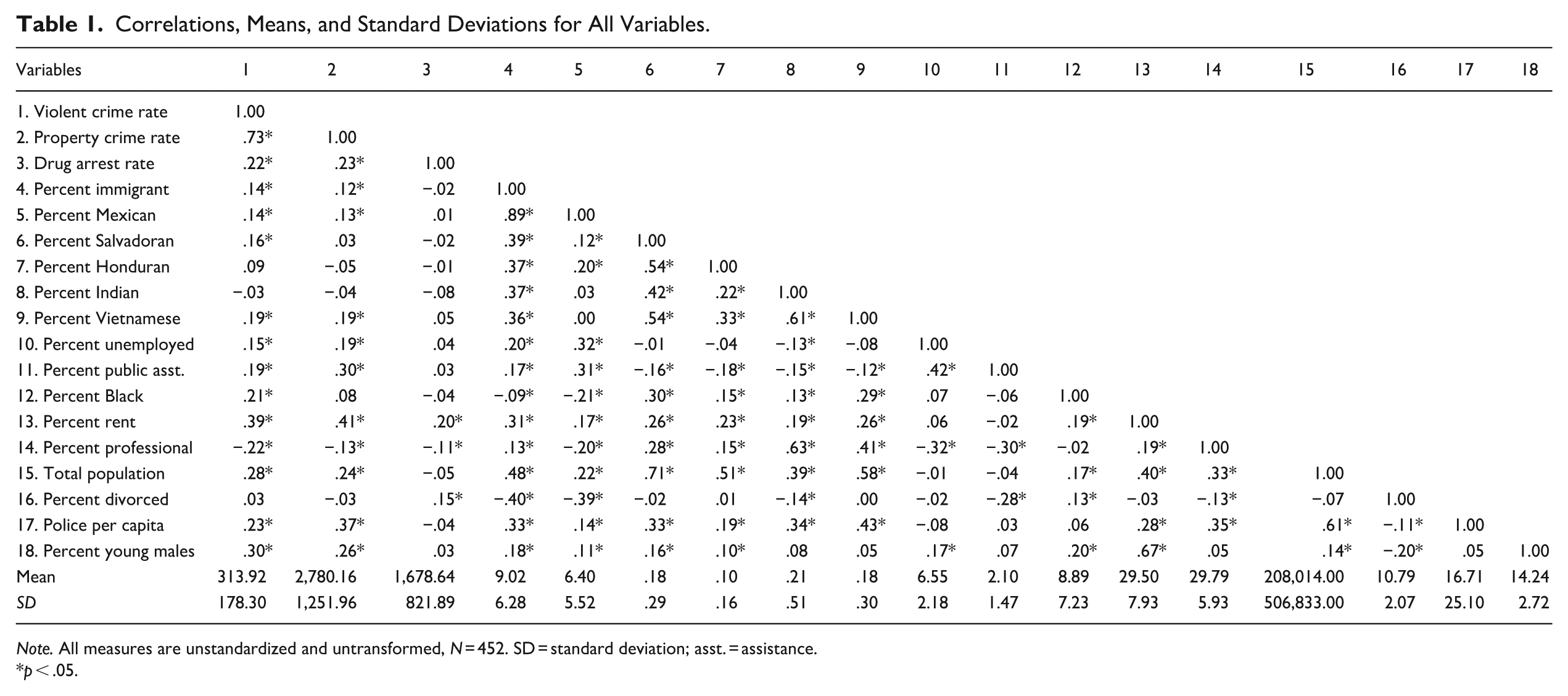
Note. All measures are unstandardized and untransformed, N = 452. SD = standard deviation; asst. = assistance.
p < .05.
Analytical Strategy
Since the current study relies on panel data to investigate the relationship between immigration, nationality, and crime in Texas, multivariate models are estimated using fixed-effects linear regression via the xtreg command in STATA version 18 (StataCorp 2023). We used fixed-effects regression over other panel methods for three reasons. First, because Texas counties are unique in terms of their social, political, and economic characteristics, accounting for between-county effects is not appropriate. Second, fixed-effects modeling requires fewer assumptions than other panel methods, and a Hausman test confirmed that a fixed-effects estimator is preferred over random-effects (Allison 2005). Third, by accounting for only within-county effects, fixed-effects models control for all unmeasured, time-invariant factors that may affect crime across Texas counties (Allison 2005). All independent variables are lagged by one wave to ensure causal ordering, and each model is estimated using robust standard errors. We also include lagged measures for each outcome in the models to increase the robustness of the study’s findings. Furthermore, diagnostic checks using the variance inflation factor (VIF) and correlation tests revealed no evidence of multicollinearity. 4
Results
Violent Crime
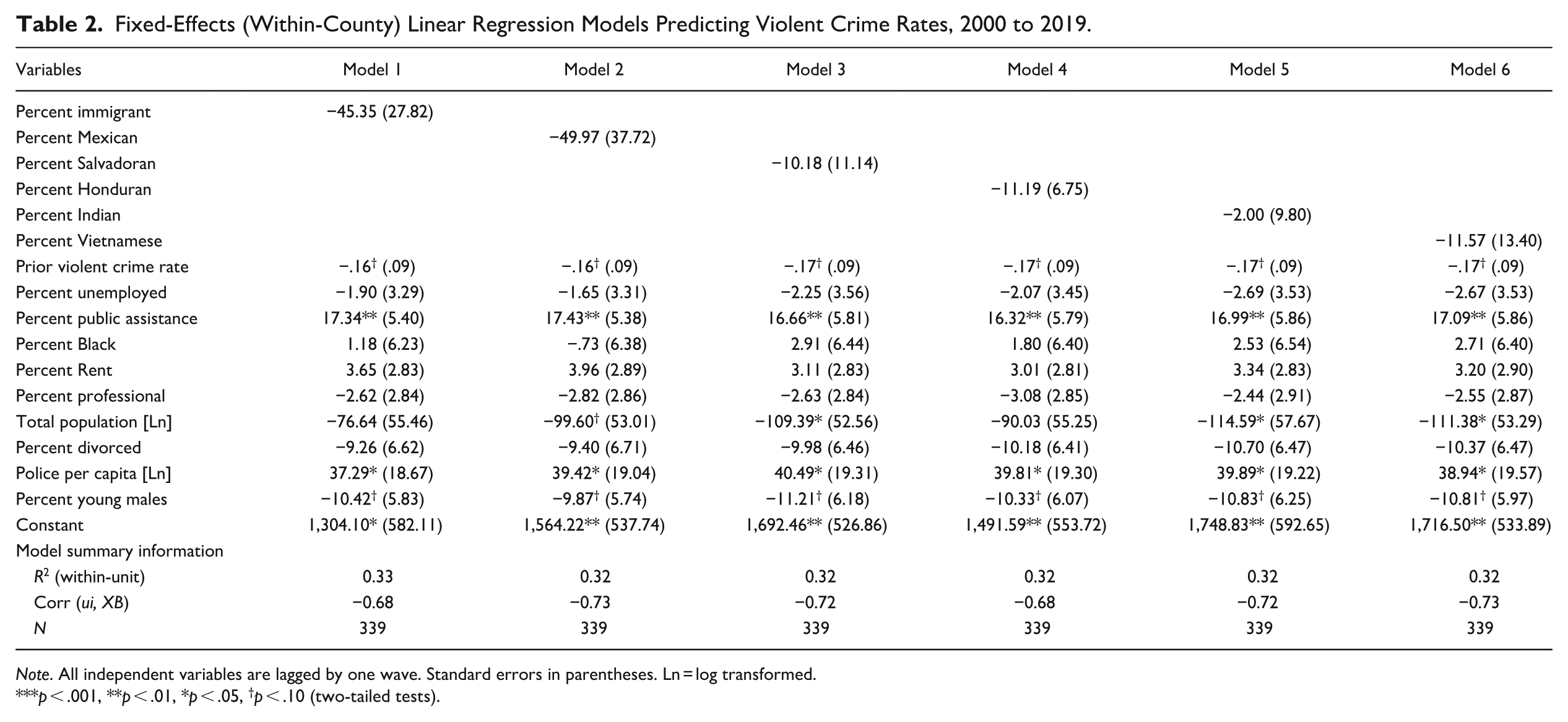
Table 2 presents the findings from the fixed-effects linear regression models, which examine the association between immigration, nationality, and violent crime in Texas counties. Model 1 of Table 2 serves as a baseline to show how the commonly used immigration measure, percent immigrant, predicts within-county changes in violent crime rates. Results from Model 1 indicate that there is no association between immigrant concentration and violent crime rates, a finding that has been documented elsewhere (Ousey and Kubrin 2018). Model 1 of Table 2 also reveals a few significant associations between the covariates and violent crime rates. Specifically, the analysis shows that counties that have an increasing percentage of residents on public assistance and more police per capita experienced higher rates of violence, which is consistent with prior research (Baumer et al. 2022; Lee, Maume, and Ousey 2003). In contrast, increases in percent young males are related to fewer violent crime incidents at the county level. Also interesting, the lagged measure for violent crime was negative and marginally significant, suggesting that counties with higher levels of violence in the prior wave experienced larger decreases in violent crime.
Fixed-Effects (Within-County) Linear Regression Models Predicting Violent Crime Rates, 2000 to 2019.
Note. All independent variables are lagged by one wave. Standard errors in parentheses. Ln = log transformed.
p < .001, **p < .01, *p < .05, †p < .10 (two-tailed tests).
Given the qualitative distinctions between immigrants from different countries of origin, the central focus of this study is to examine whether the relationship between immigration and crime varies across different nationality groups. To this end, we decomposed the all-encompassing measure of percent immigrant to account for the foreign-born population’s country of birth. Models 2 to 6 of Table 2 examine the association between nationality and violent crime for Texas’ five largest immigrant groups, separately. The results from Models 2 to 6 show that the coefficients for all five nationality groups are negative but not statistically significant. Taken together, there is no evidence to suggest that immigration, whether defined as a uniform measure or when disaggregated by nationality, has any impact on within-county changes in violent crime.
Property Crime
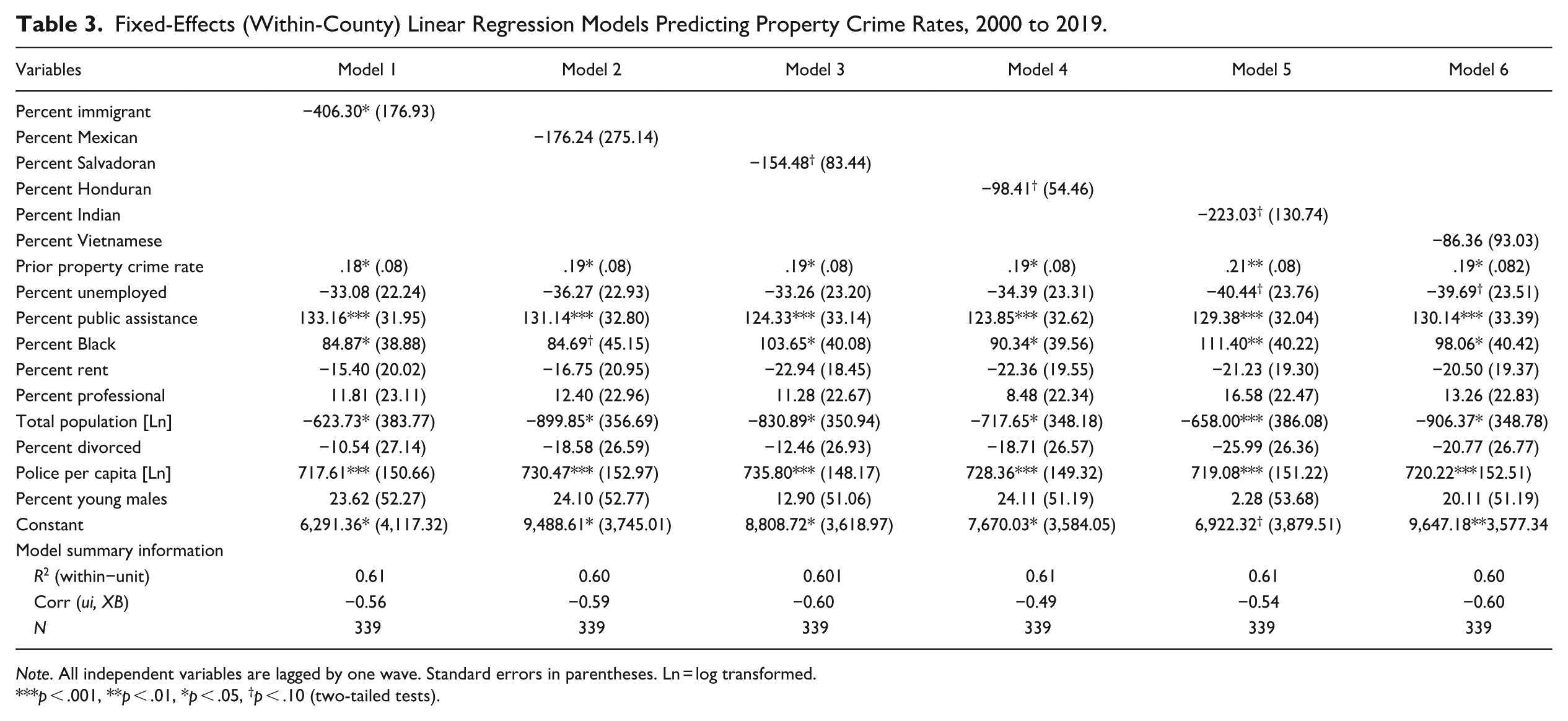
Table 3 presents the results documenting the effects of immigration and nationality on property crime rates in Texas. Like the previous set of results, Model 1 of Table 3 denotes the effects of immigration on crime using percent immigrant. The results indicate that increases in percent foreign-born are inversely associated with property crime rates within Texas counties, net of controls (b = −406.30, p < .05). Specifically, for each standardized unit increase in immigrant concentration, property crime rates are expected to decrease by roughly 406 incidents. In Models 2 to 6 of Table 3, we replicate this analysis using our five nationality measures. The results reveal that there is no association between Mexican (Model 2) and Vietnamese (Model 6) immigration and property crime rates. In contrast, Models 3 to 5 demonstrate that changes in Salvadoran (b = −154.48, p < .10), Honduran (b = −98.41, p < .10), and Indian (b = −223.03, p < .10) immigration are inversely related to changes in property crime rates. This suggests that a one standardized unit increase in percent Salvadoran, Honduran, and Indian immigration is associated with nearly 154, 98, and 223 fewer property crime incidents, respectively. As for the covariates, lagged measures for property crime, percent public assistance, percent Black, and police per capita were all positively associated with property crime rates, while increases in a county’s residential population were associated with lower rates of property crime.
Fixed-Effects (Within-County) Linear Regression Models Predicting Property Crime Rates, 2000 to 2019.
Note. All independent variables are lagged by one wave. Standard errors in parentheses. Ln = log transformed.
p < .001, **p < .01, *p < .05, †p < .10 (two-tailed tests).
Drug Crime
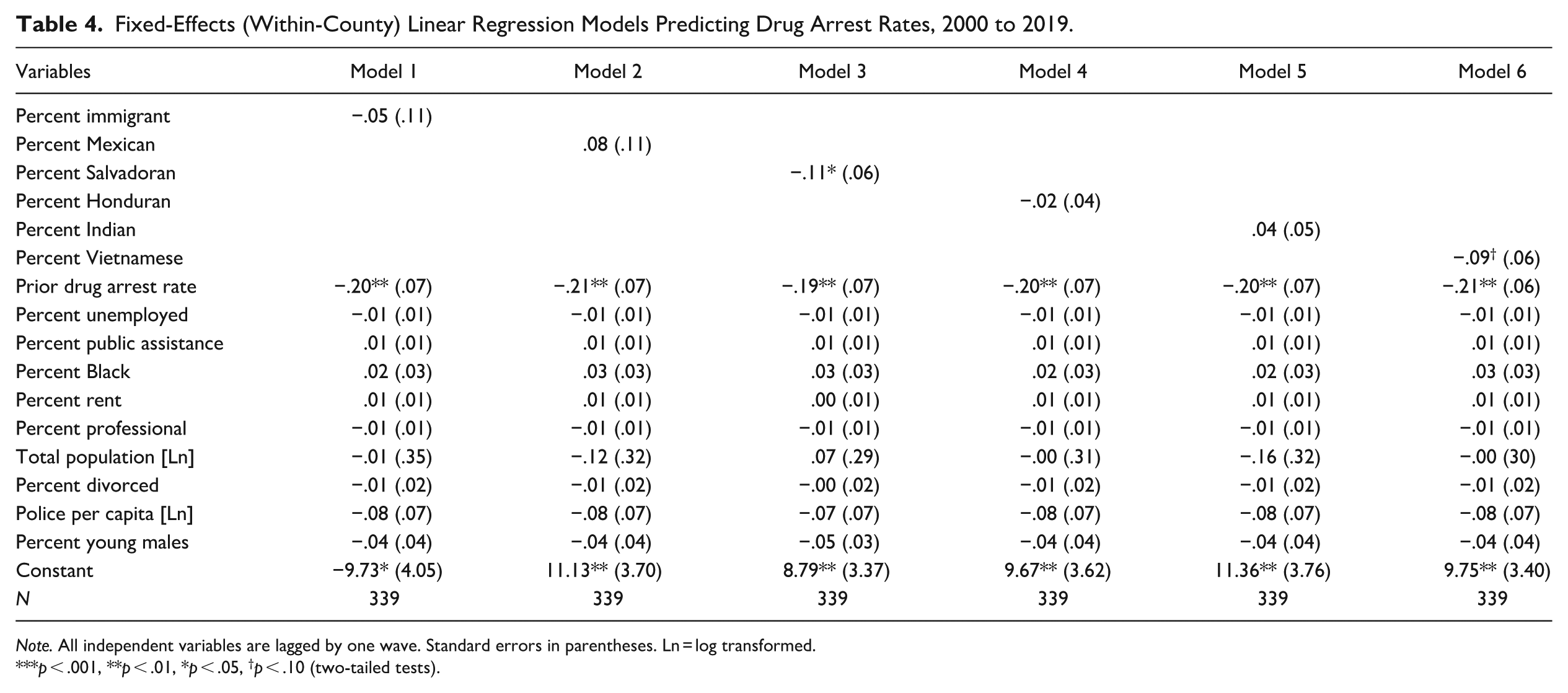
Finally, Table 4 examines the relationship between all six immigration measures and drug arrests. As noted above, the purpose of including drug arrests as an outcome measure is that certain immigrant groups are often typified as participants in the illegal drug market (Lee et al. 2001; Kubrin and Ishizawa 2012). However, the findings in Table 4 indicate that both Salvadoran (b = −.11, p < .05) and Vietnamese (b = −.09, p < .10) immigration are associated with lower rates of drug arrests, while the effects for all other immigrant groups are null. That is, for every one standardized unit change in Salvadoran (exp(−.11) = .90) and Vietnamese (exp(−.09) = .91) immigration, the county drug arrest rate is expected to decrease by roughly 10 percent and 9 percent, respectively. In sum, despite public rhetoric blaming immigrants for America’s drug crisis, the evidence presented here indicates that county immigration levels have a null or sometimes negative association with drug arrests.
Fixed-Effects (Within-County) Linear Regression Models Predicting Drug Arrest Rates, 2000 to 2019.
Note. All independent variables are lagged by one wave. Standard errors in parentheses. Ln = log transformed.
p < .001, **p < .01, *p < .05, †p < .10 (two-tailed tests).
Discussion and Conclusion
The purpose of this study was to examine the longitudinal relationship between immigration, nationality, and crime in Texas. While the emerging consensus among scholars is that immigrant concentration is either inversely related to crime or yields no effect, largely unaddressed is whether this association remains true when the foreign-born are disaggregated into distinct categories, such as by nationality (Bursik 2006; Kubrin et al. 2018). Although some scholars have begun employing country-specific measures in their evaluations of the macro-level impacts of immigration on crime, the studies published thus far are all cross-sectional (Kubrin et al. 2018; Stowell and Martinez 2007). The role of temporal design in the immigration-crime nexus is important considering that longitudinal studies offer a more rigorous test of causality than cross-sectional analyses and are more adequately suited to assess theoretical positions that treat immigration as a source of social change that unfolds over time (Kubrin 2013; Ousey and Kubrin 2009). Finally, existing scholarship on nationality and crime is limited to just a handful of cities (Miami, FL; Houston, TX) or a localized region of a state (i.e., Southern California). Thus, it is unclear whether or how the relationship between country of origin and aggregate crime varies across place.
The present study addresses these limitations by investigating the within-county effects of immigration and nationality on violent, property, and drug crimes in Texas from 2000 to 2019. The findings revealed that immigrant concentration was associated with decreases in property crime rates but exerts no impact on violent crime or drug arrests (Kubrin et al. 2018). Moreover, the results for the ethnic-specific measures showed that percent Salvadoran, percent Honduran, and percent Indian were all negatively associated with within-county changes in property crime, while percent Salvadoran and percent Vietnamese were inversely related to drug arrests. Taken together, by accounting for country of birth, our models yielded statistical relationships that would not have been observed had we only employed uniform measures of immigration.
Overall, we contend that the findings in this study are consistent with the economic motives of migration and the immigration revitalization perspective more generally. As noted previously, immigrants who migrate for economic reasons may have a lower propensity for criminal behavior considering that they move to the United States to take advantage of job opportunities, higher wages, and other incentives (e.g., improved living conditions and upward mobility) not available in their home countries (Kubrin et al. 2018; Tonry 1997). Among the nationality groups in this study, we found that those with low (e.g., El Salvador and Honduras) and high (e.g., India) levels of human capital have an inverse or null association with aggregate crime, suggesting that economic motives and labor market attachment likely play a significant role in explaining the crime-reducing effects of immigration—a key tenet of the immigration revitalization perspective (Kubrin and Ishizawa 2012; Vélez 2009).
More broadly, although the conceptual arguments presented earlier suggest that disaggregating the foreign-born by country of origin would yield heterogeneous effects in the immigration-crime relationship (i.e., some groups having a positive association with crime), there was no evidence to support this position. Rather, the findings indicate that nationality groups, particularly those from marginal backgrounds, can overcome their disadvantaged position and reduce crime in the local community, or at worst, exert no effect. It is also possible that the similarity in findings observed across different nationality groups is a product of employing a longitudinal study and mitigating the threat of selection bias that plagues prior research. Indeed, cross-sectional analyses using all four waves of data revealed that of the 72 coefficients generated, over half (45) were positive, and 18 of these were significant. In contrast, the negative coefficients produced in the cross-sectional models were all null (results available upon request).
The finding that all nationality groups have a null or sometimes inverse association with crime is significant given Texas’s enforcement-centered approach to immigration. Over the past two decades, Texas has spent billions of dollars on initiatives that aim to deter migrant crossings along the southern border (Serrano 2024). Like other local and state immigration enforcement programs, the motivation for these initiatives is the supposed connection between immigrants and high rates of criminality (Light and Miller 2018; Zatz and Smith 2012). A recent newsletter from the Texas Department of Public Safety (DPS), for example, indicates that since the launch of Operation Lone Star in March of 2021, there have been more than 45,300 criminal arrests, and law enforcement agencies have seized over 504 million lethal doses of fentanyl (Department of Public Safety n.d.). However, as The Marshall Project reports, these data are misleading because they include arrests that have no connection with or are hundreds of miles from the U.S.-Mexico border (Kriel et al. 2022). Furthermore, with the recent election of President Trump, Texas has already intensified its immigration control efforts by cooperating with the federal government in conducting immigration raids and sending additional troops to the border (Salhotra 2025). While it remains to be seen how changes in immigration enforcement will affect crime in Texas and across the nation, the evidence from this study and many others (Light and Miller 2018; Ousey and Kubrin 2018) indicate that there has never been any basis for fighting crime through immigration control.
While the present study broadens current knowledge on the immigration-crime nexus, the findings must be interpreted within the context of its limitations. One limitation is that more than half of Texas counties were dropped from the analysis. While the counties that remained contain over 90 percent of the state’s population, it is possible that these cases fail to capture the growth of immigration in rural areas or those with a total population of 20,000 or less (Crowley and Lichter 2009). Related to this point, the sample size for this study is relatively small at 339 cases. Using one-year estimates from the American Community Survey (ACS), rather than the five-year estimates, would have resulted in a larger sample by including more waves. However, the one-year estimates would also omit more counties, considering that only those with a total population of at least 60,000 are included in the survey.
Another limitation is that this study relied on crimes reported to the police. It is well documented that official statistics are susceptible to missing data due to nonreporting, and some research suggests that this issue is more likely to plague areas with larger immigrant populations (Gutierrez and Kirk 2017). As such, it is possible that Texas counties that experienced increases in their foreign-born population may have experienced reductions in crime because of less crime reporting, not actual decreases in criminal behavior. In light of this possibility, future research should replicate this study using data from the National Crime Victimization Survey (NCVS), which is less susceptible to nonreporting than the UCR (Martínez-Schuldt and Martinez 2017). As a robustness check, additional analyses were conducted using homicide counts as the outcome measure. The findings revealed that the percent Salvadoran, Honduran, and Indian immigration was all inversely associated with homicide, while the effects for all other measures were null (results available upon request).
Furthermore, while this study relied on county-level data, this level of aggregation may be too broad to capture the effects of immigration on crime. The mechanisms and social processes described in frameworks such as the immigration revitalization perspective are often expected to occur at smaller levels of aggregation, such as the census tract or block group. While data limitations for our crime measures precluded us from conducting our analyses at any unit smaller than the city or place level, it is critical that future research examine the relationship between country of birth and crime at lower levels of aggregation. Although a few studies have already examined the relationship between nationality and crime using neighborhood-level units like census tracts, these studies are limited because they are all cross-sectional (Kubrin et al. 2018; Stowell and Martinez 2009). In addition, the operational definition used for drug arrests warrants further attention. In the present study, we defined drug arrests by including arrests for all drug abuse violations. While this classification has been used in prior research (Light et al. 2017), it is unclear whether immigration and nationality affect arrests for specific drug types (e.g., cocaine and heroin) or for certain racial/ethnic groups (e.g., Hispanics). These issues should be addressed in future research.
In conclusion, the analyses from the present study reveal that immigrants from the five largest nationality groups in Texas have had an inverse or null association with crime rates over the past two decades. These findings, we argue, continue to highlight the myriad benefits associated with the immigration revitalization perspective. As sociologists, MacDonald and Sampson (2012) highlight in their New York Times Op-ed, “in the regions where immigrants have settled in the past two decades, crime has gone down, cities have grown, poor urban neighborhoods have been rebuilt, and small towns that were once on life support are springing back.” Immigrants, therefore, served as a vital ingredient for helping American cities recover from the impacts of deindustrialization and will likely be depended on again as dwindling populations and declining labor shortages loom on the horizon for the U.S. economy (Bier 2023). Moving forward, it is imperative that immigration-crime studies keep pace with the “changing face” of the foreign-born population. As more and more immigrants continue to call America home, scholars must continue to unpack whether or how the diversity of the current immigrant wave impacts the relationship between immigration and crime. While the present study found little evidence to show that the immigration-crime relationship varies by country of origin, our research should not serve as a panacea for other scholars looking to examine this issue in other locales with different immigrant groups.
Footnotes
Declaration of Conflicting Interests
The authors declared no potential conflicts of interest with respect to the research, authorship, and/or publication of this article.
Funding
The authors received no financial support for the research, authorship, and/or publication of this article.
