




Abstract
This study examines the mechanisms and relationships between ethnic and cultural identities and economic outcomes among Kurdish and Turkish migrants from Turkey and their descendants in Germany. It extends migrant adaptation theories by exploring the crucial role of multiple and hybrid identities using a mixed-methods approach. The results highlight differences between migrants and descendants, indicating that economically successful descendants embrace multiple identities, including German identity, more than migrants. In contrast, economically unsuccessful descendants primarily identify as Turkish, whilst migrants more closely align with Kurdish identity. The findings indicate that, contrary to assimilationist approaches, economic success is closely related to the coexistence of source and destination country identities and the flexibility to adjust their relative importance over time. The study identifies human capital, social capital, and engagement within or beyond the ethnic economy, alongside diverse social and business networks, as key mechanisms linking identities to economic outcomes. It concludes that integration policies fostering multiple identities, rather than complete assimilation, are likely to be more effective in improving migrants’ economic success. The study therefore calls for further research into the impact of multiple and hybrid identities on economic outcomes, including the underlying mechanisms.
Introduction
This study examines the mechanisms underpinning the establishment of connections between identities and economic outcomes, drawing comparisons between migrant populations and their descendants. It engages theoretical frameworks such as the assimilationist theory, network approach, social capital and human capital concepts, and the enclave perspective pertaining to the intersection of migrant adaptation. As shown in the Data and Methods section, this study employed a mixed-methods approach to collect data and assess findings from a field study comprising surveys and interviews conducted in Berlin in 2023. Through the application of developed data collection and analysis techniques, the study specifically delves into the multiple and hybrid ethnic and cultural identities prevalent among Kurdish and Turkish migrants from Turkey and their descendants in Germany, whilst also investigating the associated economic outcomes. It elucidates how these identities influence their economic outcomes, with a focus on discerning both disparities and similarities between migrants and their descendants. This comparative perspective facilitates an understanding of the identities within these closely linked groups, whilst also highlighting their economic trajectories in Germany.
The primary aim of the study is to examine how ethnic and cultural identities influence the economic outcomes of migrants and their descendants by identifying the mechanisms through which this relationship operates. To address this, the study conceptualizes the use of social and economic networks and social capital, the acquisition and utilization of human capital, and positioning within or beyond the ethnic economy not as independent explanatory variables, but as mechanisms shaped by ethnic and cultural identities. In this manner, the study demonstrates that identity is not merely a background factor but a structuring force that shapes the pathways through which migrants and their descendants navigate economic life in Germany.
Investigating the relationship between migrants’ identities and economic outcomes poses considerable challenges, particularly in uncovering the underlying mechanisms. This relationship is likely to be bidirectional: although economic outcomes may influence the formation and evolution of identities, ethnic and cultural identities can also influence economic success (Hall 1996; Karan 2017; Portes and Rumbaut 2001). However, given the focus of this research on examining the effects of identities on the economic outcomes of migrants and their descendants, the study highlights the role of identities in shaping the economic performance of these individuals.
Another challenge is the precise use of terminology, necessitating the clarification of complex concepts. Here, the term “migrant” is an inclusive category encompassing Kurdish and Turkish immigrants, undocumented individuals, refugees, asylum seekers, and related groups. Multiple identities refer to individuals maintaining several ethnic or cultural identities simultaneously, whereas hybrid identities describe the changing weights (relative importance) of identities over time. Ethnic identity is an individual’s affiliation with one or more ethnic groups, typically grounded in shared ancestry, language, religion, and traditions (Phinney 1990), whilst cultural identity refers to how individuals engage with and internalize cultural values, norms, and practices encompassing both their ethnic heritage and the wider society in which they exist (Hall 1996). By adopting a relationally constructed ethnic identity perspective (Barth 1998; Brubaker 2004), the study conceptualizes identity not as fixed but as continuously shaped by social interactions, lived experiences, and institutional environments. From this perspective, cultural identity is understood as dynamic and influenced by migration, social networks, and economic participation; thus, it includes—but extends beyond—ethnic identity since migrants continually negotiate their sense of belonging based on their lived experiences and social contexts. Since identity influences value systems—and thus individuals’ choices and decisions at home, at work, and in social and economic spheres—and has economic consequences (Akerlof and Kranton 2000; Constant 2014), this study employs ethnic and cultural identities as core analytical categories to examine their influence on the economic outcomes of migrants and their descendants.
In this context, rather than aiming for broad generalizations, this study prioritizes the identification of critical mechanisms linking identities to economic outcomes based on surveys and interviews with 50 participants. By emphasizing these mechanisms, this study provides insights into aspects of the causal relationship between migrants’ identities and their economic integration, thereby filling a gap in the existing literature where cross-sectional studies often failed to definitively establish such a relationship. It highlights the impact of multiple and hybrid identities as sources of the critical mechanisms shaping economic success, positioning it as a pioneering contribution to the literature on the influence of identities on economic outcomes. It also illustrates how migrants’ and descendants’ multiple and hybrid identities influence their labor market outcomes and economic patterns. It further underlines the need for qualitative and mixed-methods research in the case of Germany (where quantitative approaches have predominated) and aims to stimulate further studies in this area. In doing so, it proposes insights for policymakers and future research, indicating the need for novel perspectives on integration amidst ongoing immigration debates.
The study begins with a literature review on the economic implications of migrant identities and brings together apparatuses of key theoretical perspectives on migrant adaptation. This is followed by a Methodology section based on a mixed-methods research design. This section, along with Table A1, provides detailed information on the participants’ demographic, economic, and identity profiles. The results of the study are then presented, focusing on the relationship between ethnic and cultural identities and economic outcomes. The discussion is structured into three sections, examining (1) the role of networks and social capital, (2) human capital, and (3) engagement within and beyond the ethnic economy as mechanisms linking identity to economic success. The paper concludes by reflecting on migrant adaptation and highlighting its key contributions.
Literature Review and Theoretical Concepts: Migrant Adaptation
The intersection of theoretical frameworks on migrant adaptation and the economic impact of identities is the theoretical trajectory of this study. Traditional assimilation theories of migrant adaptation, largely rooted in US-based scholarship (Alba 1990; Gordon 1964; Portes and Rumbaut 2024), conceptualize adaptation as the transmission of cultural norms from a majority “core” to a migrant “periphery,” with acculturation being an initial step (Gordon 1964). Although early theories envisioned linear assimilation being influenced by race, religion, and language, recent studies highlight the fluid, fragmented, and hybrid nature of migrant identities (Fletcher 2012; Hall 1994; Wagner 2016). Hybridization frameworks emphasize the complex interplay of origin and destination identities, offering nuanced insights into adaptation processes (Verkuyten et al. 2019; Wiley et al. 2019).
Migrants’ economic outcomes have been extensively investigated (Den Butter, Masurel, and Mosch 2007; Gorinas 2014; Jean et al. 2010; Ruiz and Vargas-Silva 2018), leading to a consensus that migrants typically exhibit inferior performance in labor markets when compared to existing populations in destination countries. Moreover, notable disparities in economic outcomes among migrant populations within destination countries have been identified (Kesici 2020, 2022; Khattab 2012; Morales 2008). Furthermore, existing research indicates the persistence of a tangible gap in economic outcomes between first-generation migrants and their descendants (i.e., 1.5, second and third generations; Beicht and Walden 2019; Constant et al. 2010; Groger and Trejo 2002; Smith 2003), revealing that descendants benefit from a significant generational advantage and experience greater success in labor markets attributable to the educational opportunities available in destination countries.
Identity economics (Akerlof and Kranton 2000, 2010; Fine 2008; Schöb 2013) provides a framework for combining research on migrants’ adaptation and economic outcomes, revealing how ethnic and cultural identities influence their economic outcomes. By using quantitative tools such as the “ethnosizer” (Constant, Gataullina, and Zimmermann 2009; Constant and Zimmermann 2008) and “modernization index” (Gorinas 2014), studies based on this approach categorize migrants along an acculturation spectrum, showing that strong identification with the destination country correlates with improved labor market outcomes (Battu, Mwale, and Zenou 2007; Drydakis 2013). Studies based on these models indicate that migrants exhibiting a weaker identification with their destination country or a stronger attachment to their country of origin tend to have worse economic outcomes, whilst those exhibiting a stronger identification with their destination country can improve their employment prospects (Battu et al. 2007; Bisin et al. 2011; Constant et al. 2011; Drydakis 2012, 2013; Nekby and Rödin 2007). Although some studies note such interactions among specific groups, such as among female migrants (Casey and Dustmann 2010; Gorinas 2014), others suggest that balancing dual commitments to origin and destination communities optimizes economic outcomes (Carillo, Lombardo, and Venittelli 2023; Epstein and Heizler 2015).
Although this existing literature effectively establishes the relationship between identities and economic outcomes, it provides limited insights into the underlying mechanisms facilitating this relationship. The few studies (Battu et al. 2007; Constant et al. 2011) that explore these mechanisms identify factors such as educational attainment, intergenerational identity transmission, and social networks as key channels linking identities to economic outcomes. However, this literature generally overlooks different forms of belonging, the entangled nature of identities (Ince-Beqo and Ambrosini 2022), 1 and the mechanisms between identities and economic outcomes. Such oversight also weakens the ability to distinguish or compare migrants and their descendants. To address these limitations and examine the mechanisms mediating the relationship between identity and economic outcomes, this study draws on network theory, the social capital concept, the human capital approach, and the enclave hypothesis.
Network theory underscores the significance of social ties in shaping migrant integration by facilitating economic and social adaptation (Massey et al. 1993). Granovetter’s (1973) “strength of weak ties” concept highlights how diverse and expansive networks enhance access to employment opportunities and resources. Complementing this, Portes and Rumbaut (2001) show that such networks support economic advancement whilst also strengthening ethnic identities and promoting multiple identity formation. Furthermore, network theory and the social capital approach are closely related since both emphasize the value of social relationships. Network theory focuses on the structure and dynamics of social ties, whilst the social capital approach emphasizes the resources (e.g., trust, information, and support) that individuals can access through these networks. Together, they explain how social connections facilitate opportunities and influence economic outcomes (Lin 2002). Social capital theory examines how networks function as resources for (economic) adaptation. Lin (2002) describes social capital as “resources embedded in a social structure which are accessed and/or mobilized in purposive actions.” Bourdieu (1986) connects social capital to social positioning, whilst Coleman (1988) emphasizes its collective benefits in fostering trust and facilitating economic and social participation. Putnam’s (2000) framework, which distinguishes bonding, bridging, and linking social capital, highlights the role of networks in strengthening community resilience and enhancing social cohesion.
Social capital theory highlights the importance of ethnic and cultural ties in accessing economic opportunities (Portes and Rumbaut 2024; Putnam 2000), whilst human capital theory emphasizes the roles of skills, education and destination country knowledge in economic integration (Becker 1964; Chiswick 1978). Accordingly, human capital theory explains destination country-specific skills, such as language proficiency and accumulated knowledge, as key determinants of productivity and earnings (Becker 1964; Chiswick 1978). Building on this, the present study adopts a broad conceptualization of human capital, incorporating elements of cultural capital (Bourdieu 1986), such as familiarity with social norms. This is particularly pertinent in the context of migration, where cultural capital can be considered an embedded dimension of human capital. In such cases, cultural familiarity plays a crucial role in determining the extent to which skills and education translate into economic success (Bauder 2003).
The conversion of various forms of capital such as economic, cultural, social, and symbolic capital has been a central theme in Bourdieu’s (1986) theoretical framework and has received particular attention in the context of entrepreneurship (Karan 2017; Pret, Shaw, and Dodd 2016). Whilst acknowledging this broader literature, the present study draws more specifically on the approaches of Granovetter (1985) and Portes (1998), which emphasize the transformation of social and human capital into broader economic outcomes. Consistent with this perspective, and as outlined in the Data and Methods section, the analysis of participants’ economic outcomes goes beyond narrow measures of economic capital. Instead, a multidimensional framework of economic outcomes is adopted that incorporates not only income and savings but also broader indicators of labor market participation, such as working conditions and employment history.
Finally, the enclave hypothesis suggests that ethnic enclaves provide economic opportunities through employment and entrepreneurship (Light and Gold 2000; Portes and Jensen 1987, 1989). However, these spaces can also limit mobility by confining migrants to secondary labor market segments 2 or exposing marginalized groups to exploitation (Kesici 2020; Zhou 1992). Together, these theoretical approaches provide complementary perspectives on the relationship between migrants’ ethnic and cultural identities and economic outcomes. Each can be leveraged to elucidate different mechanisms through which identity and economic integration are interconnected.
With this background, the present study advances the existing literature and theoretical approaches by incorporating the analysis of multiple ethnic and cultural identities as the coexistence of both source and destination country identities, as well as hybrid identities reflecting the historical evolution of these individual identities among migrants and their descendants. Thus, rather than adhering to the conventional integration-assimilation-separation-marginalization framework, this study positions participants on a scale of economic success, analyses their (multiple and hybrid) ethnic and cultural identities, and then explores the interactions and mechanisms between these identities and economic (labor market) outcomes using a more nuanced methodology (detailed in the following section) to address the prevailing gaps.
Data and Methods
This study is based on fieldwork conducted in Berlin, Germany, spanning 2023 to 2025. Berlin was selected as the study area due to its well-established ethnic enclaves of Kurdish and Turkish populations and their self-sufficient ethnic economy, predominantly comprising service sector businesses. These enterprises are spatially concentrated in neighborhoods such as Kreuzberg and Neukölln, where the enclaves manifest a strong presence through businesses and community organizations (Marcińczak and Bernt 2021).
As part of the fieldwork, I engaged in migrant gatherings and visited community centers, socio-cultural institutions, businesses and residences, conducting informal interviews with individuals involved in the ethnic economy and community organizations. The visits and informal discussions helped identify participants for formal surveys and interviews and enriched the collected data. Following preliminary investigations and field observations, I scheduled 50 appointments with migrants from Turkey or their descendants who were born or educated in Germany. Interviewee recruitment methods included random sampling, outreach through organizations, cafés, workplaces, and community leaders, and occasional use of the snowball technique.
Building on the frameworks established by Creswell and Plano Clark (2018) and Creswell (2021), I implemented a dual mixed-methods approach, thereby integrating convergent parallel and embedded designs in this study. First, I used a convergent parallel design to collect qualitative and quantitative data simultaneously through surveys and interviews. These data streams were analyzed separately and then combined to provide a comprehensive interpretation of the findings. This approach allows for the corroboration and supplementation of findings, thereby increasing the validity and depth of the analysis. Second, I incorporated an embedded design, wherein qualitative data from interviews served as the primary focus for addressing the core research questions and capturing the complexity of participants’ experiences. Meanwhile, quantitative data derived from surveys played a supplementary role by addressing specific sub-questions and providing quantitative support for the qualitative findings. This integrated methodological approach ensures a nuanced, multi-dimensional analysis of the research questions.
In each meeting, participants completed a survey and participated in a semi-structured, in-depth interview. Both the surveys and interviews captured detailed information about respondents’ demographic and economic profiles, ethnic, religious and cultural identities, gender, and language proficiencies in English, German, Kurdish, Turkish, and other languages. This approach allowed participants to articulate their ethnic and religious identities and cultural features alongside their economic circumstances. The surveys identified income groups and included items designed to quantify participants’ identities and language proficiencies on a scale ranging from 0 (complete absence or disagreement) to 10 (complete presence or agreement). For example, survey items 11, 12, and 13 asked respondents to rate statements (about their ethnic identity), such as “I feel myself as a German,” “I feel myself as a Turk,” and “I feel myself as a Kurd,” with the additional open-ended option “I feel myself as a . . ..” Interviews expanded upon these surveys by allowing participants to go into further detail about their economic situation, identities, and language use. Interview questions, such as “How would you describe your ethnic identity or identities?” and “Which languages do you use with family, friends, and at work?,” encouraged respondents to expand on their survey responses, adding rich qualitative insights.
Therefore, aligned with the embedded design, the study effectively integrates quantitative and qualitative dimensions through a mixed-methods approach (Creswell 2021), ensuring a comprehensive understanding of the research questions. However, despite implementing methodological approaches to mitigate bias, the study encountered limitations, including challenges in accessing specific groups, the absence of standardized data, and constraints related to time and resources. Nonetheless, these limitations are considered to have a minimal impact on the validity of the findings.
Demographic Profiles and Identities of Descendants and Migrants
I conducted 50 surveys and semi-structured, in-depth interviews in Turkish and German (according to the interviewee’s language preference), each lasting approximately 45 minutes. Interviewees comprised 21 descendants (11 women; 10 men) and 29 migrants (9 women; 20 men), encompassing mostly workers and self-employed individuals.
I also used a dual mixed-methods approach (Creswell 2021; Creswell and Plano Clark 2018) to analyze the survey and interview data, integrating thematic, narrative, and interpretive methods. Thematic analysis identified, organized, and interpreted patterns, enabling the systematic examination of recurrent ideas and trends across responses. Narrative analysis focused on participants’ personal accounts, offering insights into their subjective experiences, motivations, and social contexts. Interpretive analysis explored the meanings participants assigned to their experiences, examining how cultural, social, and individual factors shaped their perspectives on identities, economic activities, and adaptation. By integrating these analysis methods, the approach bridged quantitative survey patterns with qualitative interview depth, thereby enhancing the richness and validity of the findings.
During the analysis phase, five student descendants (one woman; four men) and three retired migrants (one woman; two men) were excluded from the dataset due to their economic inactivity. Following this refinement, the average age of the participants was 40 years for descendants and 53 years for migrants. Most descendants are single, whereas most migrants are married. Most descendants and migrants have children. Comparing descendants and migrants in terms of education may be imprudent due to the differing educational systems of Germany and Turkey, as well as the age disparity between the two groups. Nonetheless, it appears that descendants tend to have a higher level of education. Most descendants hold German citizenship or dual citizenship in Germany and Turkey, whilst most migrants have permanent or temporary residence permits in Germany.
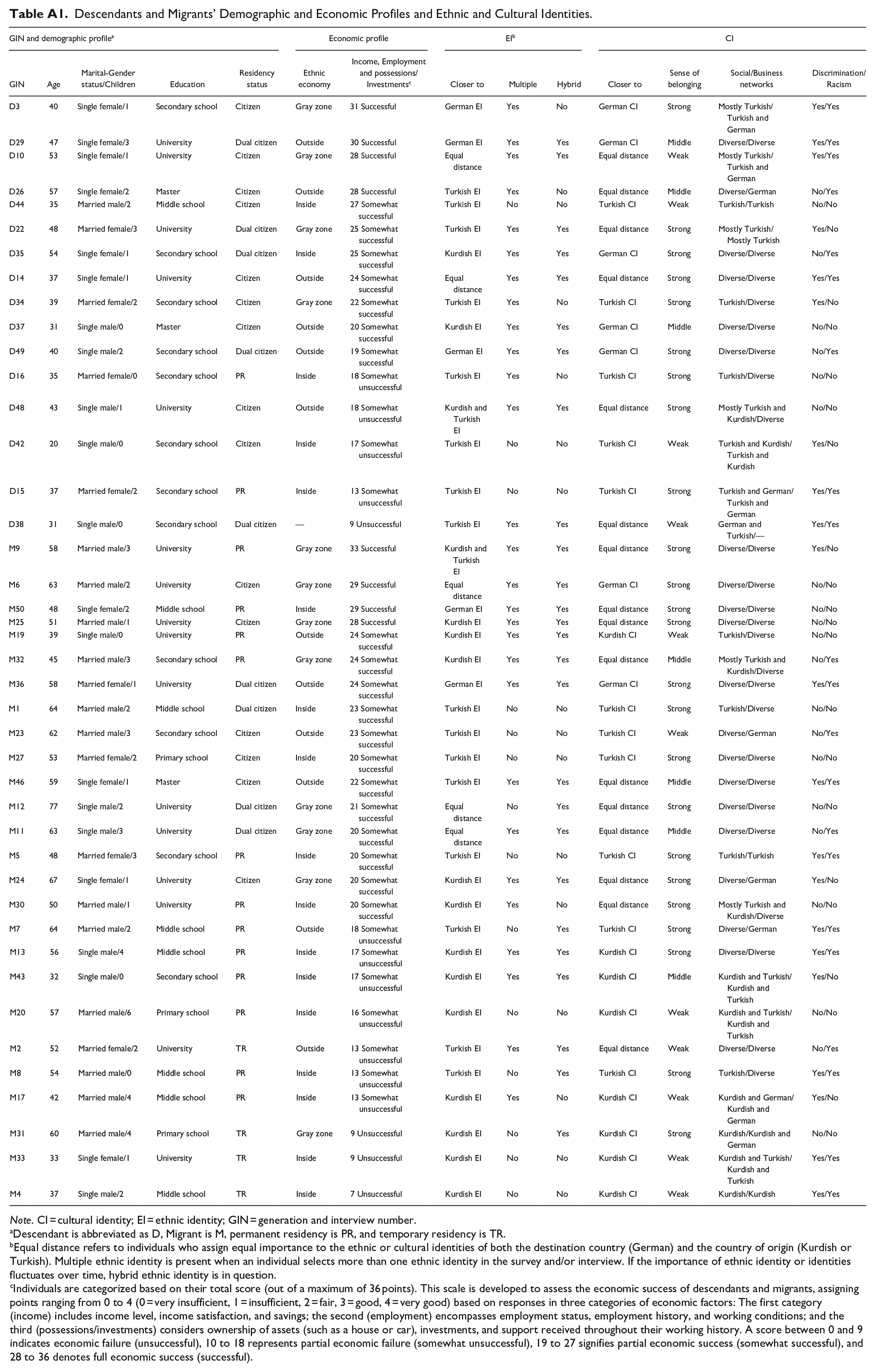
As summarized in Table A1, descendants and migrants identify their ethnic and cultural identities as German, Kurdish, Kurdish and Turkish, or Turkish,
3
with many of them possessing multiple and hybrid ethnic identities. Although some descendants maintain an equal distance between the primary identities of their parents’ country of origin (Turkey) and the country where they were born or received education (Germany),
4
some migrants attribute equal importance to the primary identities of both the destination country (German) and country of origin (Kurdish or Turkish):
So, we live bilaterally. You are born and raised there [Turkey] until the age of 20, then you live here [Germany] until the age of 60. So, it is possible to live in that duality. (Interviewee 6, aged 63, male)
Although a strong sense of belonging to Germany was exhibited by most descendants and migrants, some had a moderate or weak sense of belonging. Their social and business networks tend to be informal and vocational, whilst their family networks are kinship-based. These networks comprise people with German, Kurdish, Turkish, and other backgrounds. Although the results regarding exposure to discrimination and racism are mixed, most respondents reported experiencing at least one of these. Some respondents reported no exposure to either, whilst others reported exposure to both.
Economic Profiles of Descendants and Migrants
I constructed economic profiles for each participant to assess their level of economic success. I converted my qualitative and quantitative data into measurable values by developing a scoring scale informed by Fakis et al. (2014) and Halevi Hochwald et al. (2023). This scale evaluates the economic success of both migrants and their descendants, assigning points ranging from 0 to 4 (0 = Very insufficient, 1 = Insufficient, 2 = Fair, 3 = Good, 4 = Very good) based on responses across three categories of economic factors. The first category (income) includes income level, 5 income satisfaction and savings, whilst the second (employment) encompasses employment status, employment history and working conditions, and the third (possessions/investments) considers ownership of assets (e.g., house or car), investments and support received throughout their working history. Aligned with the embedded design of a mixed-methods approach (Creswell 2021; Creswell and Plano Clark 2018), only the scoring of income levels was derived from survey data, whilst scores for the eight remaining sub-categories were evaluated through a detailed qualitative analysis of the interviews. As shown in Table A1, based on the total points (out of a possible 36), individuals scoring 0 to 9 points are classified as (economically) unsuccessful, 10 to 18 points as somewhat unsuccessful, 19 to 27 points as somewhat successful, and 28 to 36 points as successful. This classification scheme was used to categorize participants according to their level of economic achievement in Germany.
For instance, in survey 14, a descendant respondent reported a MII between €4,251 and €5,750 and MHI between €4,501 and €5,250, resulting in an income level score of 3 points. In interview 14, she indicated that her income was sufficient and satisfactory, earning 4 points for income satisfaction. She confirmed her ability to save money, receiving another 4 points. Employed in a secure public sector job, her employment status scored 4 points. Her satisfactory employment history, with no unemployment (except for 1.5 years of parental leave), earned her 4 points. Due to her enthusiasm to perform her profession despite her challenging work, she received 2 points for working conditions:
My working conditions are challenging. I mean, I love my profession, but I feel a bit like this . . . I think it is a very difficult profession in Germany . . . Someone who knows how to protect themselves can do it. It is very intense. You need to be very disciplined. (Interviewee 14, aged 37, female)
She did not own a house or car (scoring 0 points for possessions) and had no investments (scoring 0 points for investment status). Finally, she received support from family and friends but not from public institutions like the Federal Employment Agency, earning 3 points for support status. Therefore, the total score of 24 points places her at the somewhat successful level.
After analyzing each participant’s survey and interview data in the same manner, the results indicate that 4 descendants and 4 migrants are economically successful, 7 descendants and 12 migrants are moderately successful, 4 descendants and 7 migrants are moderately unsuccessful, and 1 descendant and 3 migrants are unsuccessful (see Table A1).
I also consider whether they operate within the ethnic (migrant) economy of Kurdish and Turkish individuals, outside it, or in the gray zone. 6 This ethnic economy can be conceptualized as a network of work, production and consumption embedded with its own characteristics within Germany’s broader economic framework (Kesici 2020; Light and Gold 2000). The ethnic economy comprises small, typically family- or relative-owned businesses that usually require labor for challenging tasks, with the owners often actively participating in the workforce. This economy occupies secondary segments of labor markets and is predominantly sustained by Kurdish and Turkish workers, entrepreneurs, suppliers, and consumers. They primarily work in small service sector businesses such as restaurants, cafés, travel agencies, jewelry shops, cleaning firms, and grocery wholesalers, as well as in the construction sector as subcontractors (Pécoud 2002).
Results: Economic Outcomes of Ethnic and Cultural Identities
The results of the analysis focusing on revealing the links between respondents’ economic performance and their identities serve as a foundation for the subsequent discussion, which delves into the mechanisms mediating the relationship between identity and economic outcomes.
The demographic characteristics and identities of participants reveal a positive correlation between educational attainment and economic success among both descendants and migrants: higher levels of education are consistently associated with greater economic achievement. Likewise, residency status demonstrates a significant relationship with economic outcomes. With few exceptions, individuals possessing German citizenship or dual citizenship (German and Turkish) exhibit higher levels of economic success compared to those holding permanent or temporary residency permits in Germany. Employment within, outside or at the intersection of the ethnic economy also influences the economic outcomes of migrants and their descendants. Economically unsuccessful and moderately unsuccessful individuals are more frequently employed within the ethnic economy, whilst economically successful and moderately successful individuals are distributed across the ethnic economy, the non-ethnic economy, and the gray area.
Intriguingly, the economic performance of my interlocutors is linked to their ethnic and cultural identities. As summarized in Table A1, economically successful and moderately successful individuals are more likely to maintain an equal balance between their source (Kurdish or Turkish) and destination (German) ethnic and cultural identities, or to align more closely with German identity.
7
Specifically, most successful descendants and migrants either align closely with destination ethnic and cultural identity or maintain an equidistant stance between the ethnic and cultural identities of their source and destination countries. These traits are especially prevalent among economically successful descendants. For example, one of the most successful descendants described her ethnic and cultural identities in response to my inquiry as follows:
Well, it always made me think a lot. I mean, during my entire life. Of course, more when I was younger, but now I’m actually more relaxed. Now I feel like a German with Turkish roots. (Interviewee 29, aged 47, female)
However, economically unsuccessful and moderately unsuccessful individuals tend to identify more closely with their source (Kurdish or Turkish) identities. As presented in Table A1, the characteristics of having a closer alignment with German ethnic and cultural identities or maintaining an equal distance are absent among economically unsuccessful and somewhat unsuccessful participants. Therefore, economic success tends to be lower among individuals who are more closely aligned with their source ethnic and cultural identities, indicating a correlation between reduced economic achievement and association with the ethnic and cultural identities of one’s country of origin. 8
A notable distinction between descendants and migrants also exists. Economically unsuccessful and moderately unsuccessful descendants are more aligned with Turkish ethnic and cultural identity, whereas unsuccessful migrants tend to be closer to Kurdish identity. This discrepancy among descendants can be attributed to the smaller proportion of working-age Kurdish descendants in Germany, as previously discussed. However, the migrant case is more complex: Kurdish migrants are more prone to economic disadvantage due to their more recent immigration history (predominantly as asylum seekers), compounded by limited formal education and insufficient German language proficiency (Engin 2019; Kesici 2021; Sirkeci 2000; Wahlbeck 2002). Although Turkish migrants predominantly moved to Germany seeking employment and improved living standards, most Kurdish migrants arrived as asylum seekers, escaping state violence, discrimination and repression in Turkey (Ammann 2005; Kesici 2022, 2023; Yonucu 2022). As a result, undocumented, asylum-seeking or refugee Kurdish migrants are particularly vulnerable to exploitation. They often face precarious employment characterized by low wages, long hours, and dire working conditions in Germany. Additionally, Kurdish migrants usually struggle to leverage their ethnic social capital. In many cases, they must conceal their Kurdish identity, particularly within the ethnic economy, due to ethnic penalties originating from Turkey and persisting in Germany. (Dwyer et al. 2016; Kesici 2023).
A remarkable characteristic of economically successful individuals is that most of them report having multiple ethnic identities, indicating a positive correlation between economic achievement and multiple ethnic identities. 9
As seen in Table 1, among economically successful and moderately successful individuals, 10 (out of 11) descendants and 11 (out of 16) migrants reported having multiple ethnic identities. This suggests that possessing more than one ethnic identity is prevalent among economically successful respondents. For example, one of the most successful descendants described her multiple ethnic identities in response to my inquiry as follows:
Multiple and Single EI of Descendants and Migrants.
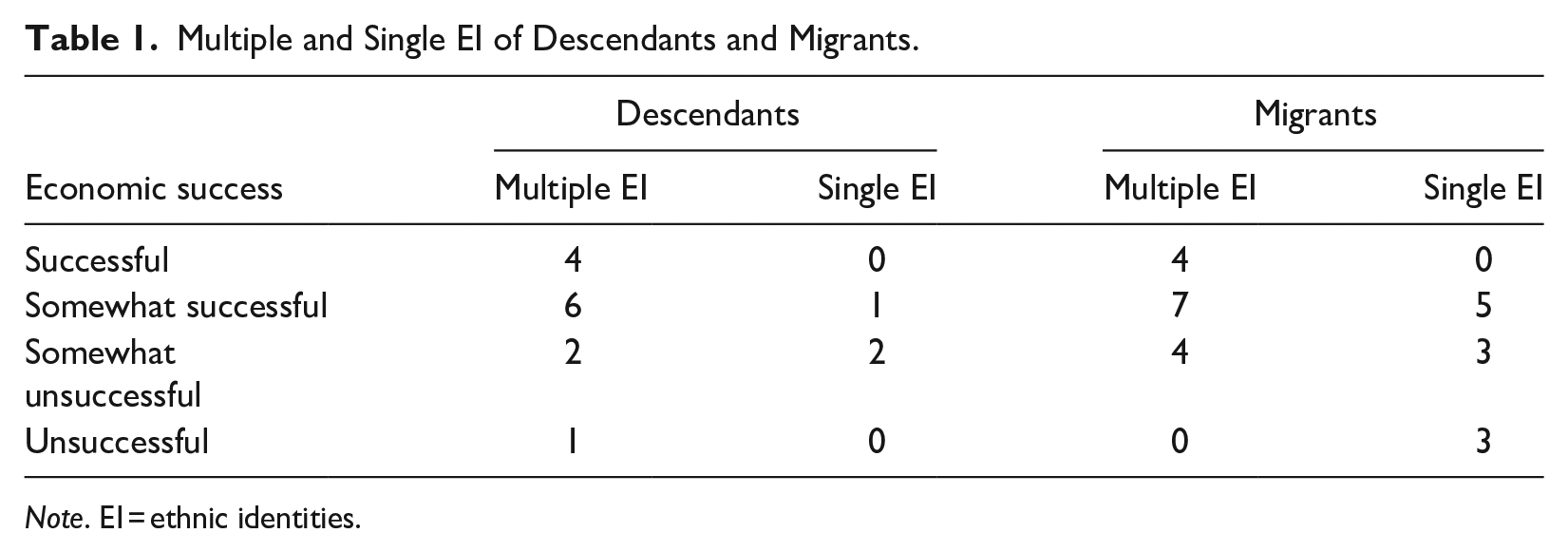
Note. EI = ethnic identities.
I mean, I think I have many identities. Alevi-Kurdish identity comes from my family. It is said that my grandmother was Armenian. So, of course, I feel Alevi, Kurdish and Armenian. But my socialisation also happened in Turkey. I lived there for several years. So, I feel a little bit Turkish. I defend the rights of Muslims. I am also a little bit Muslim. I have been in Germany for many years. I was born in Germany. I am a little bit German. So, I can’t say that I have a certain identity. I mean, a bit of everything. (Interviewee 10, aged 53, female)
Notably, multiple ethnic identities are more prevalent among economically successful descendants than among their migrant counterparts. As the prevalence of multiple ethnic identities decreases, economic success also diminishes in both groups. However, this trend is more evident among economically unsuccessful and somewhat unsuccessful migrants when compared to their descendant counterparts. This observation provides further insights into the relatively favorable economic outcomes observed among descendants when compared to migrants reported in existing studies (Beicht and Walden 2019; Constant et al. 2010; Groger and Trejo 2002; Smith 2003).
Hybrid ethnic identity emerges as another notable characteristic among economically successful individuals. Overall, 7 (out of 11) successful and moderately successful descendants reported that the importance of their ethnic identity or identities has shifted during their education and working history in Germany. Similarly, 11 (out of 16) economically successful or moderately successful migrants indicated that the importance of their ethnic identity or identities has evolved since they migrated to Germany. This suggests that possessing hybrid ethnic identities is also prevalent among economically successful descendants and migrants. In contrast, among the economically unsuccessful or moderately unsuccessful individuals, only 2 (out of 5) descendants and 6 (out of 10) migrants reported having hybrid ethnic identities, suggesting that hybrid identities are less prevalent in these groups.
The sense of belonging in Germany—a significant aspect of ethnic and cultural identities (Karst 1985)—is more pronounced among (economically) somewhat successful descendants when compared to their successful, moderately unsuccessful and unsuccessful counterparts. Similarly, this sense of belonging is stronger among successful migrants when compared to those who are moderately successful, somewhat unsuccessful or unsuccessful. Remarkably, alt-hough all successful migrants demonstrate a strong sense of belonging, this trait is only exhibited by one successful descendant. A link may exist between the sense of belonging and experiences of discrimination and racism since differences in the sense of belonging among the most successful individuals reflect their exposure to such experiences in Germany. Nearly all of the most successful descendants reported encountering both racism and discrimination, whilst none of the most successful migrants reported experiencing racism, and only one mentioned discrimination.
Discussion: Mechanisms of the Relationship Between Identities and Economic Outcomes
This study provides critical insights into the relationship between identities and economic integration by addressing aspects of causality often overlooked in cross-sectional research. It conceptualizes social and business network utilization, leveraging social capital from various networks and developing human capital with destination country-specific knowledge, alongside engagement with the ethnic economy as mechanisms shaped by ethnic and cultural identities. Therefore, this study reaffirms the significance of networks and uncovers additional critical mechanisms that mediate the relationship between identities and the economic success of migrants and their descendants.
Use of Networks and Social Capital
This study highlights that various networks—including social, informal, family and kinship, business and professional networks—and social capital serve as key mechanisms linking participants’ identities to their economic outcomes, in line with the network approach (Massey et al. 1993) and related literature (Battu et al. 2007; Carillo et al. 2023; Epstein and Heizler 2015). Through an integrated perspective combining network and social capital theories, this study demonstrates that individuals with multiple and hybrid identities enhance their employment prospects and economic success by strategically leveraging various networks and social capital associated with these identities. It also highlights that the presence of diverse ethnic groups within social and business networks constitutes a critical factor distinguishing economically successful individuals. For example, a highly successful migrant who interacts with Germans, Kurds, and Turks in his social circle described his business networks as follows:
It’s all there. Because I work in a language school. The students are all foreign [migrants], but almost all teachers are German . . . I also work with German organisations to do those courses . . . I work with the Jobcentre, Federal Employment Office, etc. I’m in contact with them. So, it [his business network] is mixed. (Interviewee 25, aged 51, male)
The heterogeneity and scope of these networks, along with the various forms of social capital they provide, indicate that a wide range of knowledge and labor market information is available to migrants and their descendants who can access different networks. This access constitutes a critical resource for enhancing their labor market integration and improving their prospects for economic success.
Granovetter’s (1973) concept of the “strength of weak ties” and Putnam’s (2000) typology of bonding, bridging, and linking social capital can be used together to better illustrate how networks and social capital function as mechanisms through which identities influence economic outcomes. Integrating these approaches provides a nuanced understanding of how identity configurations shape access to economic opportunities for migrants and their descendants.
Drawing on Granovetter’s (1973) concept, this study suggests that multiple and hybrid identities have a similar function to “strength of weak ties” in enabling individuals to access and navigate wider social networks beyond close-knit ethnic enclaves. The findings reveal that individuals who demonstrate greater openness to multiple and hybrid identities are more likely to mobilize diverse resources through extensive and heterogeneous networks. These networks facilitate critical forms of knowledge, including access to language learning (German and English), vocational training in line with labor market requirements, and support from a wide range of actors, including family, friends, NGOs, employment agencies and public institutions. Notably, these mechanisms directly contribute to their ability to secure stable employment and start businesses both within and outside the ethnic economy.
Simultaneously, Putnam’s (2000) conceptualization provides analytical depth to distinguish between forms of social capital that either constrain or enable economic advancement. Among economically unsuccessful individuals, particularly migrants, social capital is primarily limited to bonding capital, which is characterized by strong, inward-focused ties within homogeneous ethnic communities. Whilst these ties provide immediate support and employment opportunities (often within the ethnic economy), they also lock individuals into the secondary labor market and limit their long-term economic mobility. For example, the case of an economically unsuccessful Kurdish migrant illustrates the limiting effects of an exclusive reliance on bonding capital: he identifies exclusively with the Kurdish identity, exhibits a weak sense of belonging in Germany and has limited German language proficiency, predominantly using Kurdish and Turkish in social and business interactions. After migrating to Germany in 1989, he did not continue his profession, did not pursue vocational training, and experienced periods of unemployment. His employment history consists of low-paying jobs entirely within the ethnic economy, eventually leading him to establish a small coffee shop within this economic niche. As a result, he faces precarious working conditions, long working hours and low income in this business (Interviewee 20, aged 57, male). In contrast, economically successful individuals, especially among the descendants, extend their social capital to include bridging and linking capital. Bridging capital facilitates connections across diverse groups, fostering inclusivity, whilst linking capital enables relationships with institutions and individuals in positions of power. These extended forms of social capital provide access to wider economic opportunities, including broader labor markets, institutional resources and upward mobility, underlining the importance of networks and social capital in shaping economic trajectories.
Human Capital Development
This study also explores another mechanism for understanding how ethnic and cultural identities mediate migrants’ economic outcomes through human capital theory (Bauder 2003). Participants in this study with multiple and hybrid ethnic and cultural identities are more effective in acquiring the individual skills required by labor markets in Germany through their identities and are thus more likely to experience economic success. The coexistence of Kurdish and/or Turkish alongside German ethnic and cultural identities facilitates access to a broader spectrum of human capital, encompassing skills, knowledge, education, language proficiency, and entrepreneurial capabilities. This expanded human capital base is crucial for enhancing economic participation and labor market integration. One compelling example is that of an economically successful migrant who embraced multiple and hybrid identities. A key factor in her economic success in Germany was the way her identities facilitated the development of her human capital. Through these identities, she accessed vocational and language training, built connections with people from diverse backgrounds, gained experience in various roles (e.g., running her own businesses), and learned to leverage opportunities such as securing bank loans (Interviewee 50, aged 48, female).
In contrast, the restricted alignment of economically unsuccessful individuals with the dominant German ethnic and cultural identities in their country of residence, coupled with the absence of multiple and hybrid identities, constrains their access to a broader spectrum of human capital. This limitation adversely affects their economic integration and labor market participation, thereby contributing to unfavorable economic outcomes. For economically unsuccessful individuals, the persistence of rigid ethnic identities suggests resistance to adaptation, thereby hindering their ability to adapt to dynamic economic conditions. Their limited integration into the dominant (German) ethnic and cultural identity, combined with the lack of multiple and hybrid ethnic identities, limits their access to broader economic and labor market opportunities. As a result, both migrants and descendants with limited identity flexibility face structural barriers that hinder their economic mobility and integration.
Ethnic Economy Engagement
Drawing on the theoretical framework of the enclave hypothesis, this study identifies engagement within or beyond the ethnic economy as the final mechanism through which participants’ ethnic and cultural identities affect their economic outcomes. Enclaves serve as culturally familiar spaces in which migrants’ identities are preserved and utilized for economic purposes (Portes and Jensen 1987, 1989), facilitating the establishment of ethnic businesses that leverage community networks for labor and customer acquisition (Light and Gold 2000). However, as demonstrated by Kesici (2022) in the context of an enclave economy in London, the exclusive dependence of certain participants on the ethnic economy in Berlin restricts their access to mainstream markets, thereby reinforcing economic marginalization by confining them to secondary segments of the labor market.
Distinctions emerge between migrants and their descendants, as well as between economically successful and unsuccessful individuals, in terms of their positioning within and beyond the ethnic economy. Descendants are more likely to work in sectors outside the ethnic economy, whilst migrants are predominantly employed within the ethnic economy. Similarly, economically successful individuals tend to secure positions outside the ethnic economy, whilst their unsuccessful counterparts remain within its boundaries. Compared to migrants and economically unsuccessful individuals, descendants and economically successful individuals exhibit greater familiarity with the legal and administrative system, language and general culture of Germany, demonstrate greater openness to change and possess multilingual skills (including English). These attributes of destination country-specific human capital enhance their access to employment opportunities beyond traditional business sectors and the ethnic economy. For example, survey and interview responses from an economically successful descendant who received her education in Germany, with four years of middle school experience in Turkey, illustrate these dynamics. She identifies with both Turkish and German ethnic and cultural identities, has a moderate sense of belonging in Germany and possesses strong proficiency in both German and Turkish, using both languages in her social and professional interactions. After graduating with a master’s in management, she has never experienced unemployment and has consistently advanced in her career, engaging in extensive vocational training in Germany. She currently holds a top managerial position in an international education company, where she has progressed through various levels. Her position affords her flexible working conditions and hours, as well as a high income (Interviewee 25, aged 57, female).
The ability to work beyond the ethnic economy significantly improves prospects for economic advancement, including higher incomes, greater employment stability, favorable working conditions and greater opportunities for investment and savings. This capacity is closely linked to the integration of both source and destination country identities, as well as to an alignment with the dominant identity in their country of residence. Such integration makes a wider range of knowledge accessible, which plays a key role in economic success and labor market participation. However, successful descendants often face structural barriers such as discrimination and racism toward the upper segments of the labor market (Çelik 2015). Descendants indicated that experiences of discrimination and racism were more prevalent during their education and as they advanced in their careers toward higher-level labor market positions in Germany. For example, one of the most successful descendants described her experiences as follows:
For example, when I was trained in the hospital, there were discriminatory behaviours against me most of the time. Other interns, doctors, nurses, etc. didn’t see me as a female Turkish doctor there at first. They did not accept me so easily. So, when they saw me, they said, “Oh, Putzfrau” [cleaning lady] or “Can you translate?” I mean, I’m not here for translation; I’m a doctor. I have other skills; I have certain knowledge. I studied at the Charité [University Medicine Berlin], where Turks were rare in the university clinic. Yes, and there was a bit of racism from some professors and so on. I mean, I felt it, but it gave me such an ambition for a while. Not at the beginning, I felt small at that time. (Interviewee 29, aged 47, female)
The pursuit of better employment opportunities—often perceived as being reserved for “native Germans”—appears to be a significant factor contributing to these experiences. Competing in high-return labor market positions likely exacerbates these experiences, which may subsequently contribute to the weaker sense of belonging observed among successful descendants.
Conclusion
By employing a mixed-methods approach to data collection and analysis, this study examines the mechanisms underlying the relationship between ethnic and cultural identities and economic outcomes among Kurdish and Turkish migrants from Turkey and their descendants in Germany. The study suggests that, contrary to assimilationist frameworks, economic success is more closely associated with the coexistence of identities from both the source and destination societies, as well as the flexibility to adjust the relative importance of these identities over time. It identifies three mechanisms that link identities to economic outcomes: networks and social capital, human capital, and the ethnic economy. These mechanisms are evident in the utilization of social and business networks, the mobilization of social capital from diverse networks, the development of human capital incorporating destination country-specific knowledge, and participation in the ethnic economy.
The findings identify various networks and forms of social capital as central mechanisms through which ethnic and cultural identities influence economic outcomes. Individuals open to multiple and hybrid identities strategically leverage diverse and broader networks to improve language proficiency, access vocational training, and enhance employment prospects, career advancement and economic success through support from family, NGOs, and public institutions. Economically unsuccessful participants primarily rely on bonding social capital (Putnam 2000) within ethnic networks, which provides immediate economic support but confines them to the secondary labor market. However, economically successful individuals, particularly descendants, also use bridging and linking capital (Putnam 2000) to connect with diverse social and institutional networks, thereby enabling broader economic mobility.
The findings also suggest that individuals with multiple and hybrid identities are better at developing human capital, such as diverse skills, knowledge, education, language proficiency, and entrepreneurial abilities. This, in turn, enhances their economic participation. In contrast, those with rigid ethnic identities and limited integration into the dominant German cultural framework face restricted access to human capital, limiting their labor market opportunities. This human capital perspective, which encompasses cultural capital, highlights both the role of openness to acquiring new qualifications within the country of residence in economic success and the structural barriers faced by individuals with limited identity flexibility that reinforce labor market inequalities.
Finally, the findings identify employment within or beyond the ethnic economy as another key mechanism linking identities to economic outcomes. Notably, migrants and economically unsuccessful individuals are more likely to work within the ethnic economy, whilst descendants and economically successful individuals secure employment beyond its boundaries. This distinction is largely attributed to the multiple and hybrid identities of the economically successful respondents, who have greater familiarity with Germany’s legal, administrative, and cultural systems. Their multilingual skills and openness to change also enhance their access to diverse economic opportunities. Working outside the ethnic economy is associated with higher incomes, stable employment, and better working conditions. However, successful descendants often encounter structural barriers, including discrimination in education and career advancement, particularly at higher-level positions within the labor market. These experiences contribute to their weaker sense of belonging, highlighting the ongoing challenges they face despite achieving economic success.
Overall, this study illuminates such vital theoretical and methodological improvements whilst also suggesting directions for future research and integration policies in Germany and other immigrant-receiving countries. Future studies should further explore the effects of multiple and hybrid identities on economic outcomes and the mechanisms underlying these relationships. Moreover, integration policies that promote assimilation to force migrants and their descendants to fully adopt the destination country identity at the expense of the source country identities are not likely to be effective. Instead, policies that promote the coexistence of multiple identities, openness to diverse ethnic and cultural identities, and social mobility beyond the ethnic economy could yield more favorable economic outcomes for both destination countries and migrant populations.
Footnotes
Appendix
Descendants and Migrants’ Demographic and Economic Profiles and Ethnic and Cultural Identities.
| GIN and demographic profile a | Economic profile | EI b | CI | ||||||||||
|---|---|---|---|---|---|---|---|---|---|---|---|---|---|
| GIN | Age | Marital-Gender status/Children | Education | Residency status | Ethnic economy | Income, Employment and possessions/Investments c | Closer to | Multiple | Hybrid | Closer to | Sense of belonging | Social/Business networks | Discrimination/Racism |
| D3 | 40 | Single female/1 | Secondary school | Citizen | Gray zone | 31 Successful | German EI | Yes | No | German CI | Strong | Mostly Turkish/Turkish and German | Yes/Yes |
| D29 | 47 | Single female/3 | University | Dual citizen | Outside | 30 Successful | German EI | Yes | Yes | German CI | Middle | Diverse/Diverse | Yes/Yes |
| D10 | 53 | Single female/1 | University | Citizen | Gray zone | 28 Successful | Equal distance | Yes | Yes | Equal distance | Weak | Mostly Turkish/Turkish and German | Yes/Yes |
| D26 | 57 | Single female/2 | Master | Citizen | Outside | 28 Successful | Turkish EI | Yes | No | Equal distance | Middle | Diverse/German | No/Yes |
| D44 | 35 | Married male/2 | Middle school | Citizen | Inside | 27 Somewhat successful | Turkish EI | No | No | Turkish CI | Weak | Turkish/Turkish | No/No |
| D22 | 48 | Married female/3 | University | Dual citizen | Gray zone | 25 Somewhat successful | Turkish EI | Yes | Yes | Equal distance | Strong | Mostly Turkish/Mostly Turkish | Yes/No |
| D35 | 54 | Single female/1 | Secondary school | Dual citizen | Inside | 25 Somewhat successful | Kurdish EI | Yes | Yes | German CI | Strong | Diverse/Diverse | No/Yes |
| D14 | 37 | Single female/1 | University | Citizen | Outside | 24 Somewhat successful | Equal distance | Yes | Yes | Equal distance | Strong | Diverse/Diverse | Yes/Yes |
| D34 | 39 | Married female/2 | Secondary school | Citizen | Gray zone | 22 Somewhat successful | Turkish EI | Yes | No | Turkish CI | Strong | Turkish/Diverse | Yes/No |
| D37 | 31 | Single male/0 | Master | Citizen | Outside | 20 Somewhat successful | Kurdish EI | Yes | Yes | German CI | Middle | Diverse/Diverse | No/No |
| D49 | 40 | Single male/2 | Secondary school | Dual citizen | Outside | 19 Somewhat successful | German EI | Yes | Yes | German CI | Strong | Diverse/Diverse | No/Yes |
| D16 | 35 | Married female/0 | Secondary school | PR | Inside | 18 Somewhat unsuccessful | Turkish EI | Yes | No | Turkish CI | Strong | Turkish/Diverse | No/No |
| D48 | 43 | Single male/1 | University | Citizen | Outside | 18 Somewhat unsuccessful | Kurdish and Turkish EI | Yes | Yes | Equal distance | Strong | Mostly Turkish and Kurdish/Diverse | No/No |
| D42 | 20 | Single male/0 | Secondary school | Citizen | Inside | 17 Somewhat unsuccessful | Turkish EI | No | No | Turkish CI | Weak | Turkish and Kurdish/Turkish and Kurdish | Yes/No |
| D15 | 37 | Married female/2 | Secondary school | PR | Inside | 13 Somewhat unsuccessful | Turkish EI | No | No | Turkish CI | Strong | Turkish and German/Turkish and German | Yes/Yes |
| D38 | 31 | Single male/0 | Secondary school | Dual citizen | — | 9 Unsuccessful | Turkish EI | Yes | Yes | Equal distance | Weak | German and Turkish/— | Yes/Yes |
| M9 | 58 | Married male/3 | University | PR | Gray zone | 33 Successful | Kurdish and Turkish EI | Yes | Yes | Equal distance | Strong | Diverse/Diverse | Yes/No |
| M6 | 63 | Married male/2 | University | Citizen | Gray zone | 29 Successful | Equal distance | Yes | Yes | German CI | Strong | Diverse/Diverse | No/No |
| M50 | 48 | Single female/2 | Middle school | PR | Inside | 29 Successful | German EI | Yes | Yes | Equal distance | Strong | Diverse/Diverse | No/No |
| M25 | 51 | Married male/1 | University | Citizen | Gray zone | 28 Successful | Kurdish EI | Yes | Yes | Equal distance | Strong | Diverse/Diverse | No/No |
| M19 | 39 | Single male/0 | University | PR | Outside | 24 Somewhat successful | Kurdish EI | Yes | Yes | Kurdish CI | Weak | Turkish/Diverse | No/No |
| M32 | 45 | Married male/3 | Secondary school | PR | Gray zone | 24 Somewhat successful | Kurdish EI | Yes | Yes | Equal distance | Middle | Mostly Turkish and Kurdish/Diverse | No/Yes |
| M36 | 58 | Married female/1 | University | Dual citizen | Outside | 24 Somewhat successful | German EI | Yes | Yes | German CI | Strong | Diverse/Diverse | Yes/Yes |
| M1 | 64 | Married male/2 | Middle school | Dual citizen | Inside | 23 Somewhat successful | Turkish EI | No | No | Turkish CI | Strong | Turkish/Diverse | No/No |
| M23 | 62 | Married male/3 | Secondary school | Citizen | Outside | 23 Somewhat successful | Turkish EI | No | No | Turkish CI | Weak | Diverse/German | No/Yes |
| M27 | 53 | Married female/2 | Primary school | Citizen | Inside | 20 Somewhat successful | Turkish EI | No | No | Turkish CI | Strong | Diverse/Diverse | No/No |
| M46 | 59 | Single female/1 | Master | Citizen | Outside | 22 Somewhat successful | Turkish EI | Yes | Yes | Equal distance | Middle | Diverse/Diverse | Yes/Yes |
| M12 | 77 | Single male/2 | University | Dual citizen | Gray zone | 21 Somewhat successful | Equal distance | No | Yes | Equal distance | Strong | Diverse/Diverse | No/No |
| M11 | 63 | Single male/3 | University | Dual citizen | Gray zone | 20 Somewhat successful | Equal distance | Yes | Yes | Equal distance | Middle | Diverse/Diverse | No/Yes |
| M5 | 48 | Married female/3 | Secondary school | PR | Inside | 20 Somewhat successful | Turkish EI | No | No | Turkish CI | Strong | Turkish/Turkish | Yes/Yes |
| M24 | 67 | Single female/1 | University | Citizen | Gray zone | 20 Somewhat successful | Kurdish EI | Yes | Yes | Equal distance | Strong | Diverse/German | Yes/No |
| M30 | 50 | Married male/1 | University | PR | Inside | 20 Somewhat successful | Kurdish EI | Yes | No | Equal distance | Strong | Mostly Turkish and Kurdish/Diverse | No/No |
| M7 | 64 | Married male/2 | Middle school | PR | Outside | 18 Somewhat unsuccessful | Turkish EI | No | Yes | Turkish CI | Strong | Diverse/German | Yes/Yes |
| M13 | 56 | Single male/4 | Middle school | PR | Inside | 17 Somewhat unsuccessful | Kurdish EI | Yes | Yes | Kurdish CI | Strong | Diverse/Diverse | Yes/Yes |
| M43 | 32 | Single male/0 | Secondary school | PR | Inside | 17 Somewhat unsuccessful | Kurdish EI | Yes | Yes | Kurdish CI | Middle | Kurdish and Turkish/Kurdish and Turkish | Yes/No |
| M20 | 57 | Married male/6 | Primary school | PR | Inside | 16 Somewhat unsuccessful | Kurdish EI | No | No | Kurdish CI | Weak | Kurdish and Turkish/Kurdish and Turkish | No/No |
| M2 | 52 | Married female/2 | University | TR | Outside | 13 Somewhat unsuccessful | Turkish EI | Yes | Yes | Equal distance | Weak | Diverse/Diverse | No/Yes |
| M8 | 54 | Married male/0 | Middle school | PR | Inside | 13 Somewhat unsuccessful | Turkish EI | No | Yes | Turkish CI | Strong | Turkish/Diverse | Yes/Yes |
| M17 | 42 | Married male/4 | Middle school | PR | Inside | 13 Somewhat unsuccessful | Kurdish EI | Yes | No | Kurdish CI | Weak | Kurdish and German/Kurdish and German | Yes/No |
| M31 | 60 | Married male/4 | Primary school | TR | Gray zone | 9 Unsuccessful | Kurdish EI | No | Yes | Kurdish CI | Strong | Kurdish/Kurdish and German | No/No |
| M33 | 33 | Single female/1 | University | TR | Inside | 9 Unsuccessful | Kurdish EI | No | No | Kurdish CI | Weak | Kurdish and Turkish/Kurdish and Turkish | Yes/Yes |
| M4 | 37 | Single male/2 | Middle school | TR | Inside | 7 Unsuccessful | Kurdish EI | No | No | Kurdish CI | Weak | Kurdish/Kurdish | Yes/Yes |
Note. CI = cultural identity; EI = ethnic identity; GIN = generation and interview number.
Descendant is abbreviated as D, Migrant is M, permanent residency is PR, and temporary residency is TR.
Equal distance refers to individuals who assign equal importance to the ethnic or cultural identities of both the destination country (German) and the country of origin (Kurdish or Turkish). Multiple ethnic identity is present when an individual selects more than one ethnic identity in the survey and/or interview. If the importance of ethnic identity or identities fluctuates over time, hybrid ethnic identity is in question.
Individuals are categorized based on their total score (out of a maximum of 36 points). This scale is developed to assess the economic success of descendants and migrants, assigning points ranging from 0 to 4 (0 = very insufficient, 1 = insufficient, 2 = fair, 3 = good, 4 = very good) based on responses in three categories of economic factors: The first category (income) includes income level, income satisfaction, and savings; the second (employment) encompasses employment status, employment history, and working conditions; and the third (possessions/investments) considers ownership of assets (such as a house or car), investments, and support received throughout their working history. A score between 0 and 9 indicates economic failure (unsuccessful), 10 to 18 represents partial economic failure (somewhat unsuccessful), 19 to 27 signifies partial economic success (somewhat successful), and 28 to 36 denotes full economic success (successful).
Acknowledgements
I would like to thank Dr Deniz Yonucu for her comments, which improved this study.
Data Availability
Data collected via field study by the author cannot be shared openly but are available from the corresponding author upon reasonable request.
Declaration of Conflicting Interests
The author declared no potential conflicts of interest with respect to the research, authorship, and/or publication of this article.
Funding
The author disclosed receipt of the following financial support for the research, authorship, and/or publication of this article: This work was supported by the German Research Foundation (Deutsche Forschungsgemeinschaft [DFG]; Project number: 510754613).
