




Abstract
In this study, we examine the practices parents adopted to engage their elementary school-aged children in academically and socioemotionally nurturing activities during the 2020 to 2021 school year, when the pandemic forced schools to pivot to remote-only instruction. Analyzing parenting practices during this profoundly unsettled time, we argue, provides a window into potential mechanisms to narrow persistent class-based inequalities. Both socioeconomically advantaged and disadvantaged parents adapted a variety of resources to facilitate their children’s engagement. However, parents’ ability to ensure their children’s consistent learning engagement varied with the degree to which the resources available to them at home aligned with remote school expectations. Congruence between family resources and school expectations enabled both class advantaged and disadvantaged parents to adapt those resources in ways that facilitated their children’s learning engagement. This finding elucidates the role social context plays in conditioning the link between family resources and children’s academic engagement, highlighting opportunities for educators to interrupt the reproduction of inequality by placing a greater premium on resources that are broadly accessible to parents across social classes.
Scholarship in the sociology of education and the family positions parenting practices and school expectations as key contributors to the intergenerational reproduction of inequality. Though parenting practices vary across social class (Lareau 2011; Streib 2013), educational systems disproportionately reward the resources of advantaged families (Bourdieu 1973; Calarco 2014; Carter 2003) while overlooking disadvantaged families’ cultural wealth (Valenzuela 1999; Yosso 2005).
Most scholarship in this literature observes the relationships between families and schools during relatively settled times, when actors draw on well-established expectations and behaviors as they negotiate social life (Swidler 1986). In this article, by contrast, we examine parenting practices across social classes during a profoundly unsettled time: the 2020 to 2021 pandemic-induced remote school period. In spring 2020, the Covid-19 pandemic disrupted the lives of families and children around the world, particularly in places, like the United States, where prolonged school closures forced families to bring day-to-day schooling practices into their homes. By disrupting traditional routines and introducing new remote school expectations, the pandemic challenged parents’ abilities to rely on traditional efforts and resources to meet those expectations. In unsettled times, Swidler (1986: 279) argues, “[p]eople formulate, flesh out, and put into practice new habits of action.”
Between October 2020 and March 2021, we conducted in-depth interviews with 37 parents of elementary schoolchildren and 10 teachers and staff members to understand the habits of action that parents formulated to maintain their children’s academic and socioemotional engagement. In line with social reproduction scholarship (Bourdieu and Passeron 1977), we anticipated that class-advantaged parents would report greater success in maintaining their children’s engagement relative to class-disadvantaged parents. Indeed, we find that most class-advantaged families adapted flexible jobs, the labor of significant others, their knowledge, and/or financial resources to maintain their children’s learning engagement. These efforts facilitated children’s consistent learning engagement throughout remote school.
However, we also document instances in which class-disadvantaged parents adapted similar resources to engage their children consistently and instances in which both class-advantaged and disadvantaged parents struggled to adapt resources. We argue that examining how parents navigated new school expectations amidst a period of profound disruption highlights the role that congruence plays in shaping children’s learning experiences. Parents in congruent home-school circumstances—when they had access to jobs, significant others, school-based knowledge, and/or financial resources that provided them with the flexibility to meet changing school expectations—reported consistent levels of children engagement.
Consistent with recent studies, our findings demonstrate that socioeconomically advantaged and disadvantaged families participate in a shared parenting culture that prioritizes their children’s school success, even at high costs to parental well-being (Cuevas 2019; Haley-Lock and Posey-Maddox 2016). Each of the parents we interviewed went to considerable lengths to accommodate remote school expectations. In many ways, these expectations benefited relatively advantaged families, particularly those in which at least one parent could put aside paid work to support their children’s learning. However, by making classroom dynamics more visible and creating opportunities for extended family to support children, remote school opened opportunities for class-disadvantaged parents. By highlighting the experiences of class-disadvantaged parents in congruent home-school circumstances who achieved consistent child engagement and class-advantaged families in less congruent home-school circumstances who struggled, our analysis draws new attention to the role that school expectations play in conditioning the value of resources and their impact on the intergenerational reproduction of inequality.
Unsettled Times: COVID-19 and a Transformed Social Context
The pandemic brought about a profound change in the relationship between schools and families, particularly for parents of children in elementary school grades. Swidler (1986) refers to these periods of social transformation as unsettled because individuals adopt new strategies of action as they experiment with unfamiliar habits and/or new ways of organizing behaviors. Understanding that children develop amidst an interconnected system of micro, meso, and macro contexts (Bronfenbrenner 1993; Shelton 2018), we seek to understand the interdependent home and school dynamics shaping children’s school lives against the backdrop of a global health crisis. We understand the pandemic as a macro-level contextual change that influenced youth by inducing shifts in their meso- (school) and micro-level (household) contexts.
The pandemic transformed routine family and school life by creating new school responsibilities for parents and other caregivers. The shift to remote school during spring 2020 required parents across the socioeconomic spectrum to take on educational and supervisory roles previously delegated to teachers and other administrators. Parents needed to create space in their home for students to learn, ensure that children were logged into the correct online classroom, continuously monitor students’ classroom participation, address technological and emotional issues, create opportunities for children to interact with peers, and engage with other forms of informal learning. Remote school also required parents to assume counseling responsibilities as they devised reward systems to motivate children who found remote school isolating and boring. Additionally, whereas after-school clubs and other activities previously served as outlets for children’s physical and mental well-being, parents were now tasked with continuing socioemotional nourishment during after-school hours. In effect, schools expected extensive child oversight. Providing this oversight required enormous labor (time, energy, and attention), coupled with specialized knowledge, to assist children on technological, academic, and socioemotional needs. Parents were challenged to adapt the resources that would enable them to secure this labor and knowledge.
Background Literature
Cultural Reproduction and Community Cultural Wealth
Our work is grounded in the Bourdieusian theory of social and cultural reproduction, as informed by contemporary scholarship on community cultural wealth (Yosso 2005). Bourdieu describes how upper- and middle-class families use their privileged cultural knowledge to secure social advantages for their children (Bourdieu and Passeron 1977). As Bourdieu’s theory of cultural capital has gained purchase in the sociology of education, many understand it as implicitly attributing persistent intergenerational inequalities to the cultural deficits of poor and minoritized families (Davies and Rizk 2018; Yosso 2005). While this interpretation is arguably a misappropriation of Bourdieu’s theory (Tichavakunda 2019), its prominence in the literature on the intergenerational reproduction of educational inequality is consequential because it places the blame on marginalized families for what might more appropriately be understood as institutional failures to solicit, respect, and respond to marginalized families’ efforts (Yosso 2005).
A critical reading of Bourdieu avoids this deficit framing by paying attention to how expectations institutionalized in schools and workplaces privilege the behaviors and lifestyles associated with a dominant class (Bennett, Lutz, and Jayaram 2021; Carter 2003; Lareau and Weininger 2003; Tichavakunda 2019). While families across social class, racial, and ethnic lines articulate similar hopes and aspirations for their children and broadly subscribe to a shared ethos of intensive parenting (Bennett, Lutz, and Jayaram 2012; Ishizuka 2019; Randles 2021), inequalities persist in families’ abilities to realize their shared aspirations. One reason the resources class-advantaged parents deploy elicit disproportionately large school rewards is because these parents draw upon privileged access to information about educators’ formal and informal expectations (Crozier, Reay, and James 2011; Olivos, Jimenez-Castellanos, and Alberto Monroy Ochoa 2011). Middle-class parents, for instance, consult their social networks to learn about school quality (Fong 2019), to gain access to school opportunities (Cornwell and Cornwell 2008; Lareau and Horvat 1999), and to resolve children’s educational challenges (Horvat, Weininger, and Lareau 2003). This privileged information shapes how advantaged families structure children’s free time, petition school authorities, and train children to interact with authorities (Calarco 2014; Lareau 2011; Murray et al. 2020). Excluded from privileged networks and lacking experience with elite education, marginalized families, meanwhile, have relatively little access to unspoken rules and other valuable institutional information (Bennett et al. 2021).
This is not to say that marginalized families lack valuable assets for raising resilient and successful youth. Informed by the notion of community cultural wealth, growing research draws attention to how marginalized families leverage their resources to advance their children’s education. Latino parents adapt community values, like notions of familism, consejos (advice narratives), and emotional support to enhance their children’s educational development (Delgado-Gaitan 2001; Valdés 1996). Immigrant families also draw on the support of their extended families and community networks (Hondagneu-Sotelo and Avila 1997; Poza, Brooks, and Valdés 2014). Marginalized families further draw upon the resilience and relentless work ethic developed in oppressive life circumstances to support their children’s school performance (Carreón, Drake, and Barton 2005). Moreover, when contending with institutional expectations that stigmatize their children, Black parents resist deficit-oriented narratives by advocating for their children in race-conscious ways (Love et al. 2021). Though school authorities may not hold them in the same regard as the strategies employed by more advantaged families, parenting strategies available to socioeconomically disadvantaged parents have the potential to broaden academic opportunities for their children (Bennett et al. 2021; Chin and Phillips 2004; Valdés 1996). Taken together, the research on cultural reproduction and community cultural wealth suggests that families across the socioeconomic spectrum deploy resources to advance their children’s development and educational success, but that advantaged parents’ privileged access to educators’ preferences and expectations often generates inequalities.
Parenting and Flexibility
Flexible resources have surfaced as instrumental in facilitating children’s engagement when parents contend with a host of competing responsibilities (Chin and Phillips 2004; Haley-Lock and Posey-Maddox 2016). Despite the perceived class-based associations of some resources, particularly those eliciting academic advantages (i.e., jobs), socioeconomic status accounts for only a portion of the variation in resource flexibility. As an example, while the rigidity of hourly or fixed shifts often precludes low-income and working-class parents from greater involvement in their children’s schooling (Haley-Lock and Posey-Maddox 2016), it is not uncommon for workers in highly paid managerial roles to work long hours, typically during a fixed work week, that corresponds closely with school time (Gerstel and Clawson 2015; Maume 2016). In contrast, many low-status positions offer fewer hours and/or more variable schedules (Luce et al. 2014; Maume 2016)—work arrangements that gig work has reinforced (Reynolds and Kincaid 2023). While these patterns often contribute to economic inequalities, they may weaken the association between family socioeconomic status and the flexibility available to parents. Similarly, while upper- and middle-class parents count on expert knowledge within their close circle of contacts (Fong 2019) or can afford to hire caregiving support (Macdonald 2011), it is not uncommon for parents in low-status contexts to mobilize ethnic, religious, kinship or community ties for information and support (Hondagneu-Sotelo and Avila 1997; Poza et al. 2014; Zhou and Bankston 1994). The evolution of the workplace, coupled with an improved understanding of marginalized communities’ cultural wealth, reveals greater nuance in the extent to which flexible resources are available to parents across the socioeconomic spectrum.
Against the backdrop of a relatively settled cultural period, studies assessing parents’ practices in schools have largely assumed an inert school environment with relatively established, albeit biased, educator expectations (Calarco 2020; Horvat et al. 2003; Lareau 2011). How parents across the socioeconomic spectrum adapt resources that may facilitate their children’s learning engagement amidst a transformed environment—when both home and school demands undergo radical transformation—is less clear. This gap in the literature is theoretically important because it broadens understandings not solely of how parents adapt resources to meet new school demands but on the contexts under which those resources are viewed as yielding rewards.
Data and Methods
Covid-era remote school provides an opportunity to investigate how educator expectations and school-based practices interact with family resources to shape parents’ engagement practices in an unsettled time. Between October 2020 and March 2021, we interviewed 37 parents, 7 schoolteachers, and 3 staff members affiliated with 2 focal schools in a mid-sized urban school district. We collected data for approximately 6 months, during which all respondents participated in remote school. Though parents constituted our primary respondent population, we enrolled teachers as study participants to gain deeper insights surrounding children’s engagement. We adopt pseudonyms for school names, respondents and other potentially identifying characteristics.
School Sites
Oakdale Elementary and Carnes Elementary are in the same eastern state and enroll pre-kindergarten through fifth-grade students. Table 1 summarizes key demographic characteristics for each school, including how school characteristics compare to our study sample. While both schools are in the same region, Carnes is situated in a suburban community, while Oakdale is more centrally located relative to the region’s urban core. Both schools carried out fully remote classroom operations throughout the study period.
School and Sample Characteristics.
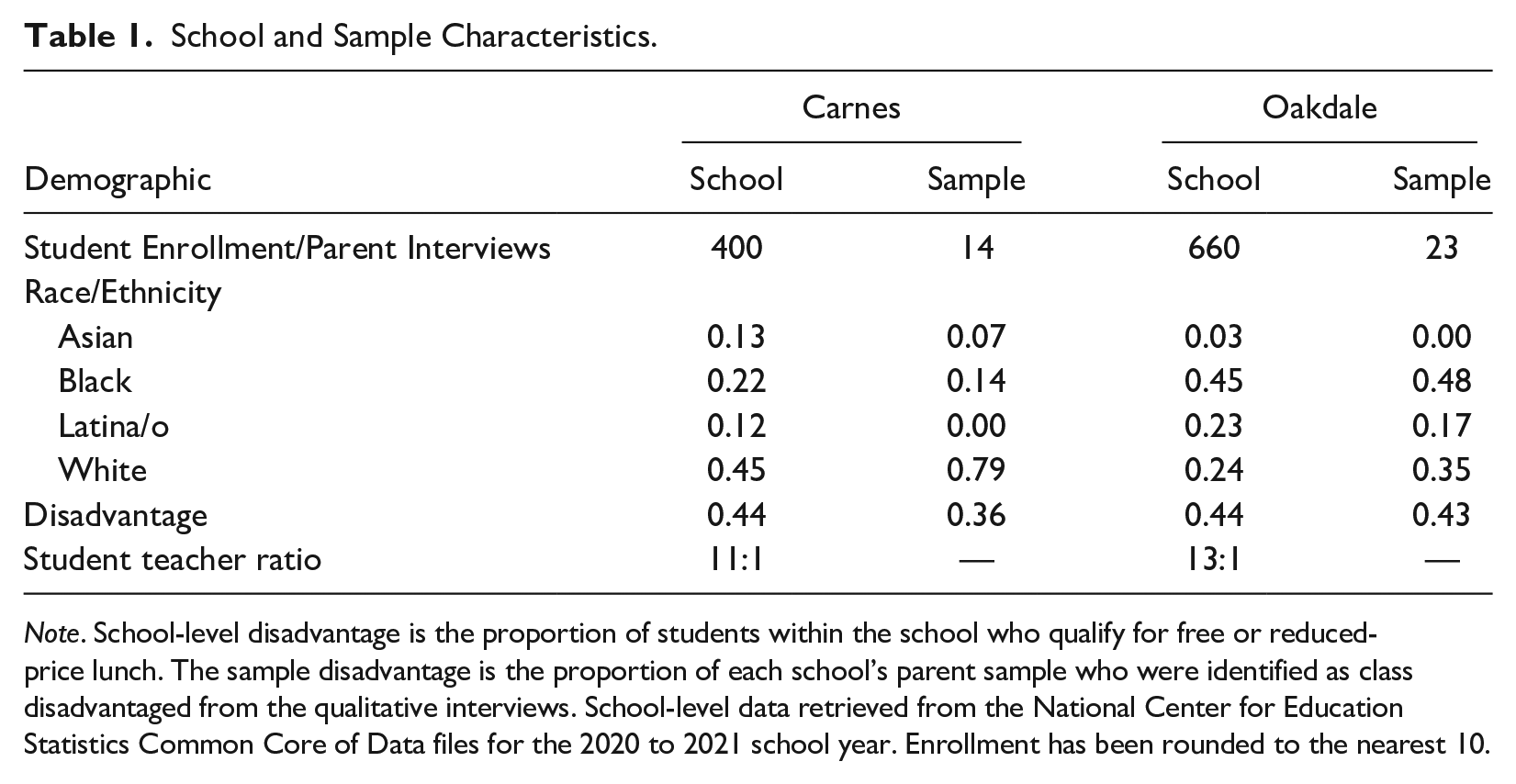
Note. School-level disadvantage is the proportion of students within the school who qualify for free or reduced-price lunch. The sample disadvantage is the proportion of each school’s parent sample who were identified as class disadvantaged from the qualitative interviews. School-level data retrieved from the National Center for Education Statistics Common Core of Data files for the 2020 to 2021 school year. Enrollment has been rounded to the nearest 10.
Recruitment, Data Collection, and Analysis
All parents whose children attended either Oakdale or Carnes during 2020 and employed teacher and staff members were eligible to participate in our study. School administrators initially shared our study invitation via email, electronic newsletters, and other mass communication channels with parents and staff. We supplement our administrator-led recruitment strategy with snowball sampling to increase the representation of respondents from low socioeconomic backgrounds given their initial lower study enrollment counts.
We conducted most interviews through Zoom video but arranged phone interviews when necessary. To test interview instruments and better understand the dynamics of an online setting, we first conducted pilot interviews with two parents who attended a separate school in the community. We transcribed all interviews and took detailed notes as we conducted them. Each interview lasted approximately 1 hour, and we provided a $50 honorarium to all study participants. Despite this incentive, our sample likely underrepresents parents juggling overwhelming children, job, and household needs who could not afford the time to participate in our study. We draw on the teacher and staff interviews to help address this limitation.
We adopt the data analysis spiral (Creswell 2007: 150–51) to understand study patterns and use NVivo to assist with data management. The data analysis spiral views key steps in qualitative research such as data collection, management, memoing, coding, and interpreting as interrelated. We thus move about the analytic process in a circular and iterative fashion rather than a linear one (Creswell 2007). Interviewer notes, research team discussions, and the questionnaire helped generate a list of preliminary themes that informed a classification system on NVivo and facilitated triangulation—drawing on multiple sources (i.e., questions, notes, reflections) to inform our assessments (Creswell 2007). We added emergent codes when several respondents reported sharing an experience previously unidentified. After coding the transcripts in NVivo, we created an Excel database where relevant codes were transformed into subfiles.
Study Participants and Socioeconomic Background
Although we strived to mirror the social class and racial-ethnic demographic characteristics of each school, White parents, and socioeconomically advantaged parents are somewhat overrepresented among study respondents relative to overall school populations. In Table 2, we list characteristics for all respondents. Nineteen parents self-identified as White, 13 as African American or Black, 4 as Latina/o, and 1 as Asian. We identified 22 class advantaged and 15 class-disadvantaged parents. The parent sample included 31 women and 6 men. We also interviewed 6 White, 3 Black, and 1 Latino teachers/staff members. Our total sample includes 47 interviews.
Respondent Characteristics.
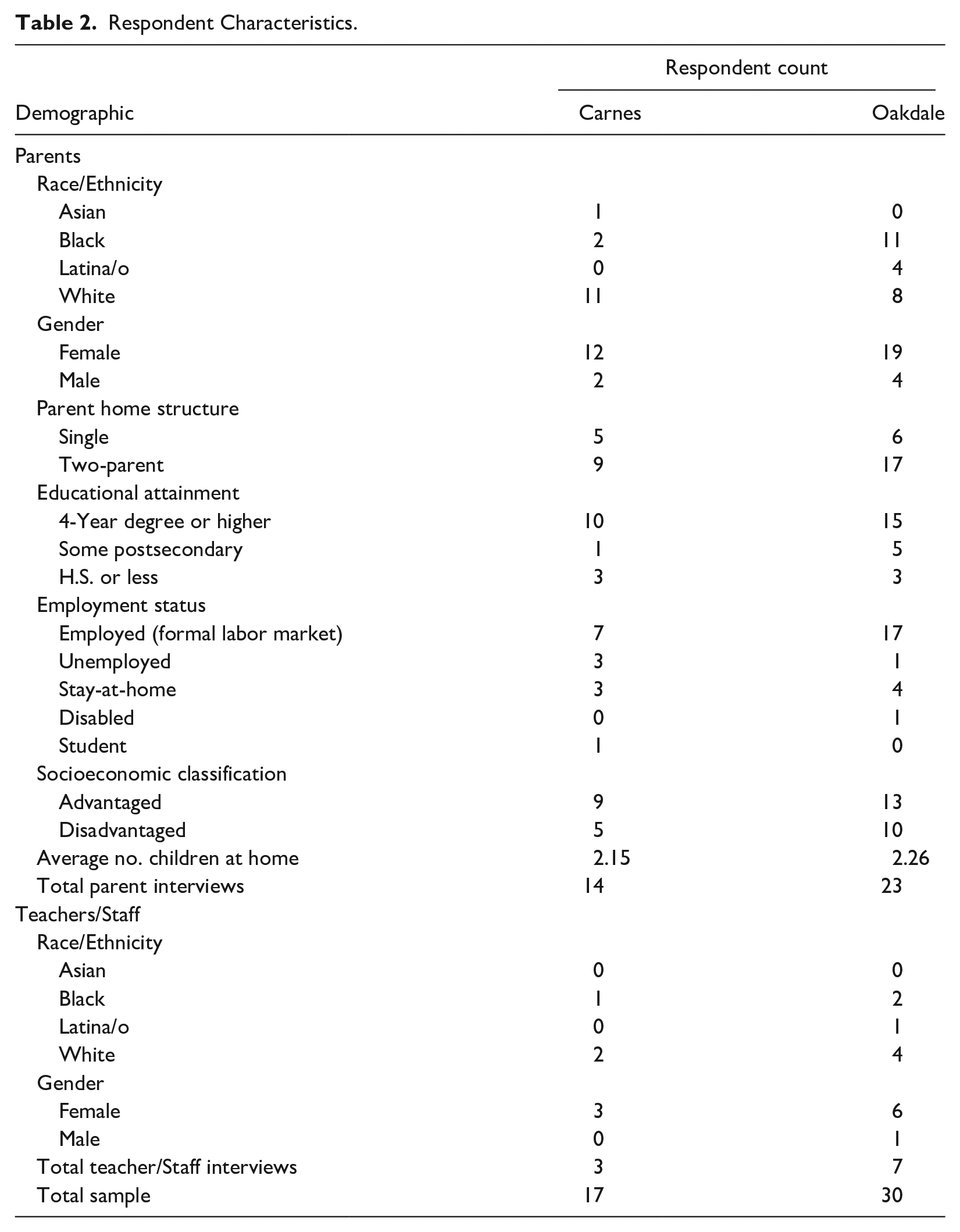
Consistent with existing measures of social class, we classified parents as advantaged or disadvantaged based on their levels of education and occupation (Chin and Phillips 2004). Class-advantaged parents held at least a 4-year degree and indicated cognitive-skill dependent occupations, like physician’s assistant or web developer. Class-disadvantaged parents, on the other hand, possessed 2-year college degrees or lower levels of schooling and indicated a service or blue-collar profession, like construction or restaurant work. Social class classifications were straightforward when spouses held relatively equivalent levels of education and occupational status. For single, work-at-home (stay-at-home parents who engage in unpaid domestic labor), and recently unemployed parents, we draw on level of education, most recent occupational status and overall household financial stability to inform our classifications. As an example, though one parent indicated a less-than-a-college degree level of education, her former job in banking coupled with her husband’s job in consulting, led us to classify her as class advantaged. In contrast, despite holding a bachelor’s degree, we classified another parent as class disadvantaged since she had recently quit her job as an aesthetician, and the family depended on welfare assistance. Our classifications intend to capture the complexity of parents’ class standing relative to the moment in time.
Resource Adaptation and Engagement
We capture parents’ practices or habits of action through their ability to adapt resources.
Resource Adaptation
We conceptualize adaptation as manipulating a resource for the purpose of supporting children’s academic and socioemotional engagement. In our study, parents commonly adapted one or a combination of the following: (1) Jobs, which consisted of modified work arrangements, (2) Significant others, often a spouse, grandparent, neighbor or another family member, (3) School-based knowledge, primarily inclusive of technological, academic, communication and other interpersonal skills. We also include a broad familiarity with socioemotional skills indispensable for youth development as part of this resource. Finally, (4) financial resources also play an important role in the set of resources parents could draw on to facilitate children’s learning engagement. Because of the importance of adaptation, congruent resources possessed an important qualitative characteristic—flexibility.
Engagement
Our measure of engagement relies on parents’ perceptions of the extent to which children’s efforts during remote school were directed toward learning. This definition follows widespread measures of student engagement, which rely on teachers’ evaluations of students’ behavior, but adapts it for the remote school context (Fredricks, Blumenfeld, and Paris 2004). Because socioemotional health was a top concern among parents during a period of unusual social isolation (Mott Poll Report 2020), we include time spent on both academic and socioemotional nourishing tasks in our definition of learning engagement. We characterize the effectiveness of engagement practices based on parents’ accounts of the extent to which children participated in learning activities. Parents maintaining consistent child engagement reported that their families adhered to consistent school and extracurricular routines. Their children regularly logged on for remote instruction, and they were generally satisfied with their children’s learning. Parents classified as sustaining periodic child engagement cited specific instances of engagement disruptions that at times included concerns about their children’s academic progress or socioemotional well-being. To be clear, parents classified as sustaining periodic child engagement did not find remote school unmanageable. Rather, while parents classified as achieving periodic engagement regularly engaged their children in learning, they cited substantial disruption in that engagement.
Relying on parents’ perceptions of their children’s engagement is imperfect. Parents’ standards and expectations for what constitutes engagement may vary across social class. Although we would have liked to supplement parent accounts with direct observations, pandemic health concerns rendered this strategy unsafe and impractical. Direct observations of engagement, however, carry their own limitations since they primarily speak to the frequency of an occurrence rather than its quality (Fredricks et al. 2004). Drawing on parents’ perceptions of their students’ engagement enables a unique advantage precisely because of the highlevel of parent and teacher exchanges during this period. Parents were the only actors that could adjudicate between what they observed at home, the reports teachers provided, and the interventions deemed necessary.
Findings
Learning Engagement Amidst Transformed Social Contexts
In Table 3, we list parents’ access to the resources that surfaced in our data as most decisive during remote school. The successful adaptation of a flexible job, significant other, school-based knowledge, or financial resource is how parents could access the labor necessary to provide child oversight. As an example, parents who possessed flexible knowledge were able to assist their children with a variety of technical and academic tasks with relative ease and without undermining other household needs. Though resources are understood to share class-based associations, it is important to consider these in context. For instance, while high levels of school-based knowledge are most prevalent in upper middle-class communities, unusually high levels of education were not always necessary to assist with elementary-level skills. Similarly, relying on a significant other for assistance could be accessible to working-class parents living near family or middle-class parents in homogenous neighborhoods. Apart from financial resources, the pandemic’s impact on routine family life, coupled with remote-school expectations for elementary-aged children, loosened the class-based associations of the resources central to our study.
Respondent Characteristics and Access to Resources Facilitating Engagement.
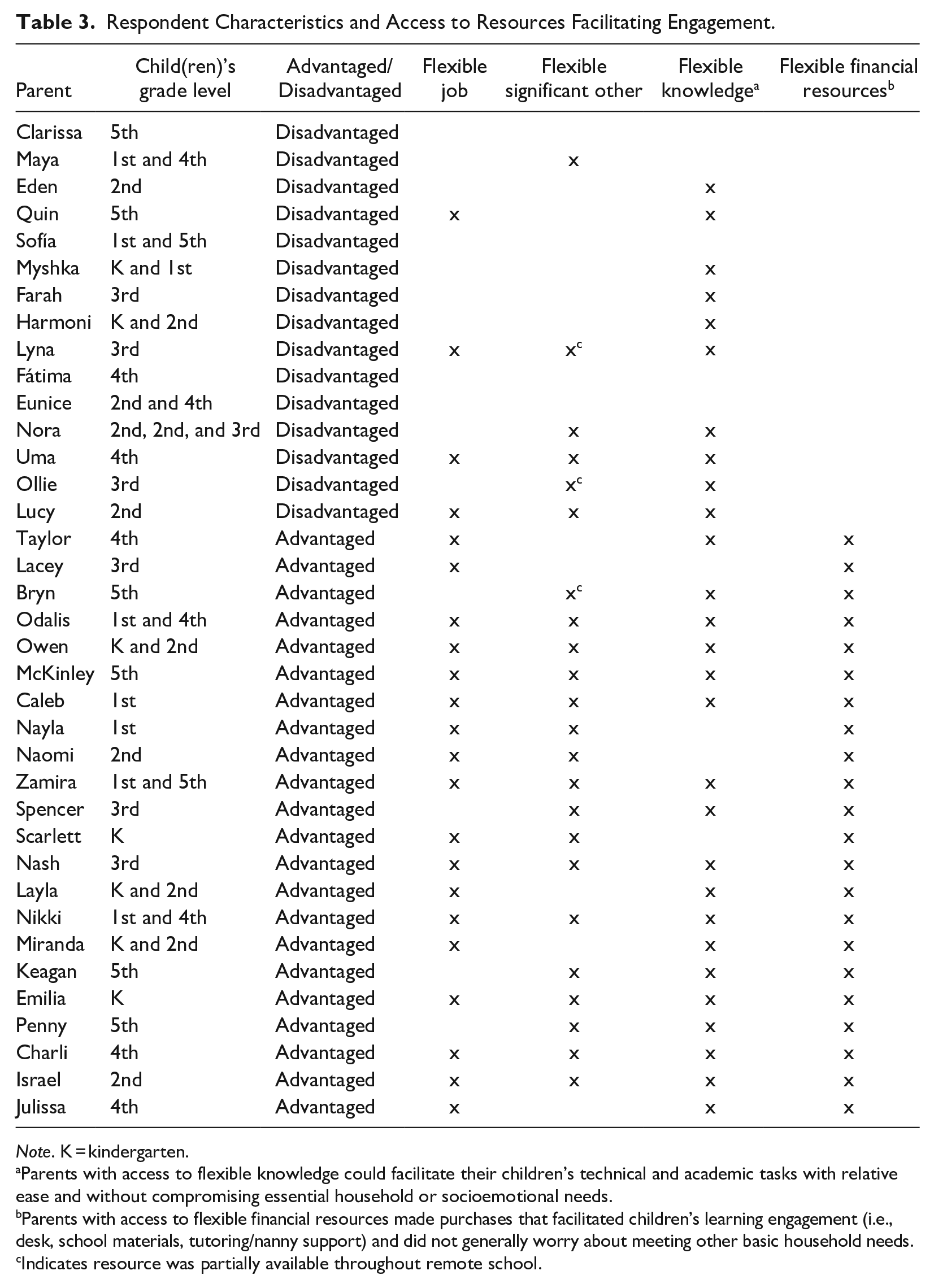
Note. K = kindergarten.
Parents with access to flexible knowledge could facilitate their children’s technical and academic tasks with relative ease and without compromising essential household or socioemotional needs.
Parents with access to flexible financial resources made purchases that facilitated children’s learning engagement (i.e., desk, school materials, tutoring/nanny support) and did not generally worry about meeting other basic household needs.
Indicates resource was partially available throughout remote school.
Our findings are organized to underscore the role that structural circumstances played in shaping parent practices. First, we demonstrate how home circumstances (micro-level) that were most congruent with school expectations (meso-level) facilitated parents’ abilities to ensure their children’s consistent learning engagement. Home circumstances were congruent with school expectations when parents had access to a job, significant other, school-based knowledge, and/or financial resources, which possessed some degree of flexibility. This flexibility shaped the extent to which parents could adapt their labor to meet their children’s engagement needs. As depicted in Figure 1, 81 percent of class-advantaged parents in our sample benefited from a combination of flexible resources that enabled them to carry out consistent child engagement. Being able to ensure children’s steady engagement echoes prior research documenting a greater prevalence of structured activity among middle-class children (Bodovski and Farkas 2008; Weininger, Lareau, and Conley 2015).
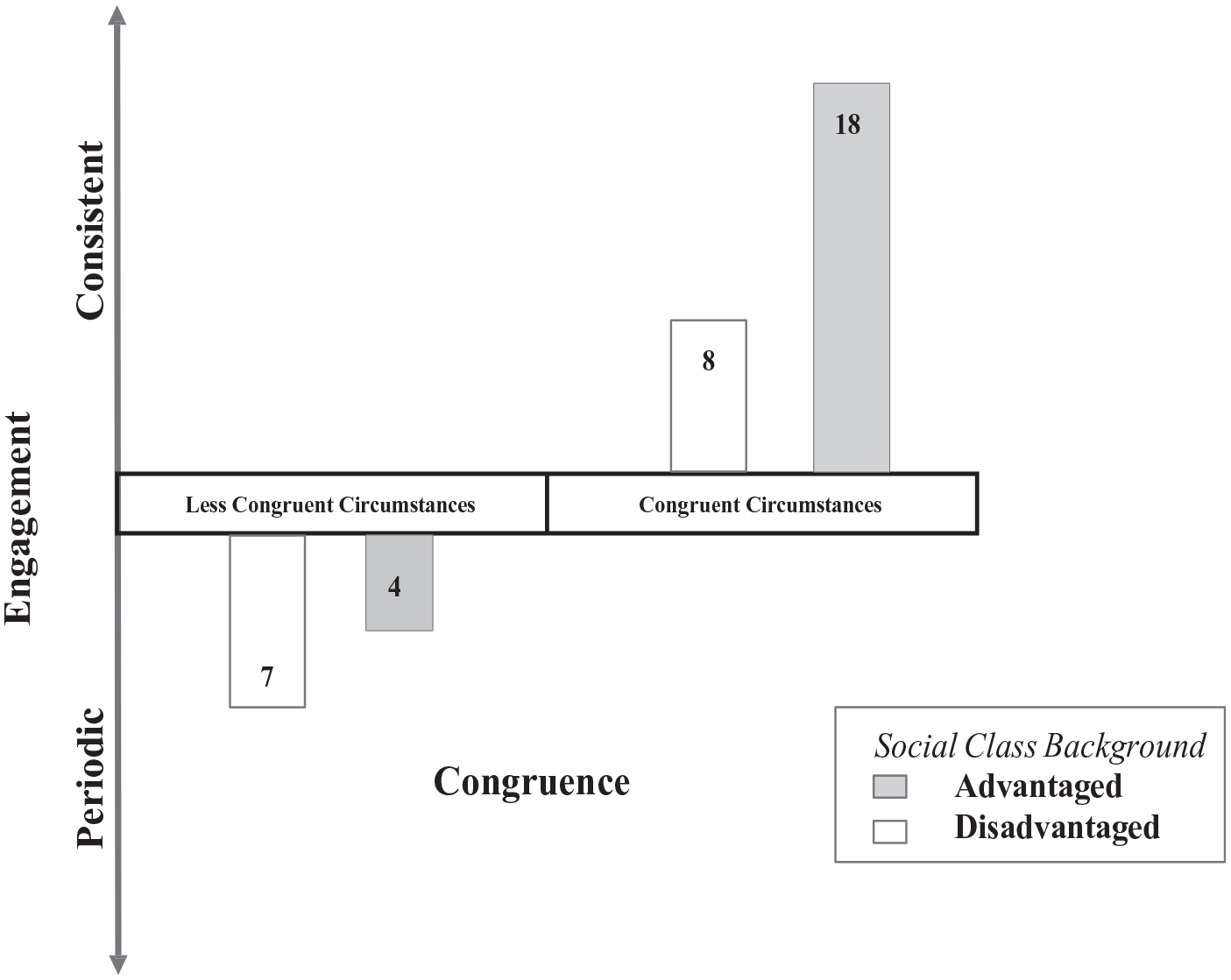
Child engagement based on social class background.
Our data, however, uncover something less expected. We detect home circumstances congruent with remote school expectations also among a robust number of class-disadvantaged parents (50 percent). These parents had access to jobs, significant others, school-based knowledge and/or financial resources that enabled them to adapt their labor to sustain their children’s learning engagement (Figure 1).
In contrast, we trace periodic child engagement, characterized by greater learning disruptions, to household circumstances that were less congruent with school expectations. Roughly, half of class-disadvantaged and 20 percent of class-advantaged parents reported less consistent child engagement. These parents shared employment, significant others, and school-based knowledge resources that were less flexible, thus imposing limits on their ability to adapt labor.
In a final section, we use teacher and staff accounts to demonstrate that the least congruent home circumstances forced parents to accept high levels of disrupted child engagement. This occurred when parents contended with severe job, significant other, knowledge, and financial constraints. We underscore how a lack of financial resources could inhibit congruence, yet a generous supply could facilitate it.
Congruent Home Circumstances and Consistent Child Engagement
Congruent home circumstances occurred when parents had access to jobs, significant others, school-based knowledge, and/or financial resources that possessed some degree of flexibility. By manipulating these resources, parents could free up the labor necessary to address their children’s learning engagement needs on a consistent basis.
Class Advantaged
The flexibility to work-from-home represented a crucial advantage during remote school because it allowed parents to be actively involved in their children’s school activities. Being able to rearrange their work schedule or break away from a computer screen without fear of employer reprimand enabled class-advantaged parents to maximize the time and attention they could devote to their children. As Israel, a software developer parent of one described,
It’s also worked kind of well, at least for myself, because I work from home . . . I can engage him [son] more when he does need help and the teachers aren’t available or can’t . . . [It’s] easier for me to just pull away from what I’m doing and help him directly.
To ensure his second grader’s consistent school and socioemotional engagement, Israel downloaded supplemental curriculum materials and enrolled his son in an extracurricular art activity. Adapting his labor to address his son’s learning needs thus depended on a flexible job. During nonschool hours, however, Israel turned to his mother to keep her grandson engaged on activities like reading and outdoor play. Thus, when it wasn’t always possible to pull away from work, parents adapted the labor of significant others to fill learning engagement gaps. Other class-advantaged parents who held flexible jobs emphasized the benefits of “block[ing] off time” on their work calendars or “reschedul[ing] meetings” to assist children on school assignments.
In addition to adapting their labor or their parents’ labor, some class-advantaged parents collaborated with their partners to keep children engaged. Caleb, for instance, who worked in marketing, and his wife, took a “more hands on and active participant[s]” approach in their daughter’s education largely because they held work-from-home jobs and could modify their work schedules. During the onset of the pandemic, Caleb and his wife accessed activities like coding or mindfulness games to keep their daughter academically involved. The couple also provided content that could allow her to have a “creative outlet” when they realized they wouldn’t be able to engage her for extended periods. But doing so took considerable planning. “Bend[ing] our schedules to accommodate her’s [daughter’s]” required Caleb and his partner to regularly map out and adjust their work schedules. When job demands limited their ability to adapt their labor, class-advantaged parents sharing Caleb’s home circumstances designed schedule shifts with their spouses, whose flexible jobs freed up another source of labor.
A final subset of class-advantaged parents adapted their labor by creating the flexibility their jobs did not allow. A recent immigrant to the United States, Penny contended with uncertainties related to the pandemic and her family’s transition to a foreign country. Penny had worked in banking and her husband in consulting. When grappling with the responsibility of acclimating her family to a new country, her daughter’s school responsibilities and a son with adaptive needs, Penny decided to quit her job. Doing so enabled Penny to build a routine for her daughter and granddaughter during remote school, which consisted of reading time followed by greater variety after school,
And then we do PE. So we’ll do exercises for 20 minutes myself, with the two little girls. And then they’ll go shower. They’ve got a chore that they have to do every day. We do . . . some form of art, and then I’ll set the table. I’ll make dinner, and we’ll have dinner together.
Being able to sustain a consistent routine required the support of Penny’s college-aged daughter, the mother of her grandchild, who also lived at home. Because Penny’s daughter took online college classes, she assisted the two elementary-aged girls during remote school by adapting her school-based knowledge. Thus, not only did the financial resources of Penny’s husband provide the stability that allowed Penny to quit her job, but her daughter’s labor also enhanced the academic support the children received.
Spouses’ financial resources enabled three other parents to adapt their labor by quitting their jobs or taking a leave. Parents’ perceptions surrounding these career sacrifices cohered around a singular theme. While they looked forward to resuming their careers, they viewed their responsibility to engage their children in learning and support their spouses as preserving the overall health of their family.
Flexible jobs facilitated parents’ adaptation to children’s learning engagement needs, particularly when those jobs involved skill sets that were in high demand during remote school. A third-grade schoolteacher, Zamira experienced considerable overlap between her job’s responsibilities and her 1st and 5th graders school tasks. In addition to the flexibility her work-from-home job allowed, Zamira’s teacher experience also enabled her to keep track of her children’s academic pacing guides. As she summarized,
I’m very on it, as far as making sure I’m checking every message from their teacher and giving them extra work on top of that.
Zamira adapted her skill set by adding extra activities onto her children’s schedules to sustain their consistent engagement and ensure they wouldn’t fall behind.
Access to a variety of resources congruent with school expectations enabled class-advantaged parents to adapt their labor to facilitate their children’s engagement. Having access to a constellation of flexible resources not only ensured that one could readily substitute for another but that a single resource would not be overburdened.
Class-Disadvantaged
Parents’ abilities to sustain varying degrees of child engagement did not divide neatly across class lines (see Figure 1). Fifty percent of class-disadvantaged parents described sustaining the type of consistent child engagement documented in class-advantaged homes. Because we trace these parent practices to the congruence between their home circumstances and remote school expectations, we interpret this cross-class variation as reinforcing that a resource’s effectiveness varies based on how structural circumstances open or inhibit opportunities to adapt it.
As an apartment property manager, part-time college student, parent of two and primary income provider, Lucy worked with modest socioeconomic resources. During the onset of the pandemic in spring 2020, Lucy’s family grappled with technological challenges that precluded the children from logging into class. Overcoming these technological difficulties, however, demanded joint school and parent efforts. Lucy was relieved that by the start of the school year in August 2020, Carne’s remote school operations were more organized. Anytime there were outages, such as when Google Meets went offline, the school delivered prompt alerts. Additionally, Lucy invested in better internet service, which required her to incur $50 more each month. To facilitate her children’s engagement, she further adapted the labor of her significant others. Lucy’s husband and relatives helped her maintain a schedule that allowed her to balance her children’s school needs, her own schoolwork, and her job. Finally, Lucy’s admission, “I can’t imagine if I had to go to the office every day,” underscores the pivotal role that work flexibility played in facilitating her children’s consistent engagement. Alongside her husband, Lucy created flashcards for her children. She increased reading time, printed extra online materials, prohibited TV time during the week, and assisted with homework.
In other instances, adapting the labor of multigenerational supports became decisive not just for children’s engagement but for parents’ well-being. When teachers had yet to provide any instructional materials, Ollie designed a schedule for her child,
And she’d start with her reading. Then she’d have kind of a bit of a break, where she would do like a PE type of thing. So she’d either get on the bike and ride that or she would do a dance class or a thing at home, like a kind of obstacle course . . . And then after that, she would play some games with [a] math focus.
Her daughter’s school and health needs, coupled with the uncertainty of the pandemic, and the fear of losing her student visa if she could not meet her own collegiate responsibilities, culminated in a panic attack that drove Ollie to seek therapy. It wasn’t until Ollie’s mom (also a participant in our study) immigrated into the country and could assist with her granddaughter that Ollie could restore stability. Ollie’s circumstances when her mom and other online supports were not available included, “stress and panic and chaos and disorder.” By becoming available as a flexible resource, Ollie’s mother helped her achieve greater alignment between her home circumstances and remote school demands. This congruence enabled Ollie to continue adapting her labor to foster her daughter’s consistent engagement.
Because children’s grandparents inserted stability into otherwise tumultuous environments, class-disadvantaged parents who benefited from the assistance of multigenerational supports conveyed relief and gratitude. Realizing that pandemic stressors risked overwhelming everyone; however, class-disadvantaged parents were cautious about unduly taxing grandparents and generally viewed them as back-up.
A subset of class-disadvantaged parents created congruence by paying hefty financial and physical tolls to adapt their labor. These parents provided their children daily academic assistance, communicated with teachers and supplemented their children’s schooling with learning games, matching cards, online resources, or other activities. To meet children’s engagement needs, several parents went on unemployment after being laid off. Several others worked night shifts or reduced their work hours. To provide her 5th grader academic support, Quin, an online English as a Second Language (ESL) teacher, described the potentially detrimental health consequences of adapting her labor, “So, I normally work when he’s sleeping. So, I start working at two in the morning and I work all the way until it’s time for him to go to school. Then I help him during the day.”
All parents in our study, regardless of level of privilege, drew on the resilience of their labor to meet remote school expectations. Facing difficulties in the extent to which existing household resources could facilitate children’s learning engagement, class-disadvantaged parents sacrificed their own needs to provide for their children (see Randles 2021). Parents made potentially detrimental lifestyle adjustments to create the flexibility that would enable them to adapt their labor.
Less Congruent Home Circumstances and Periodic Child Engagement
Like the cross-class variation documented among parents who observed consistent child engagement, both class-advantaged and -disadvantaged parents reported periodic rather than consistent child engagement. We trace these less-than-ideal outcomes to home circumstances that did not quite align with school expectations. In these examples, even as some resources enabled parents to adapt their labor, others were not always flexible.
Class-Advantaged Parents
Four class-advantaged parents shared frustrations related to what they felt were sub-optimal remote school schedules for their children. Taylor was a senior consultant and on the Parent-Teacher Organization (PTO) leadership board for Carnes Elementary. Considering a remote school structure had not yet been instituted, the early part of the pandemic (spring 2020) did not present major complications for her fourth-grade son, whom Taylor and her husband kept on a steady routine. According to Taylor, however, during the shift to remote school in the fall, “the wheels fell off.” Her son’s academic struggles had less to do with the work he needed to complete than with his parents’ abilities to manage their work schedules as Taylor explained,
Every single assignment we turn in is like, late. Every single—I mean, it’s just, it’s not like an overwhelming amount of work. It’s just managing the work that’s so hard. On top of that, it’s like you’re trying to manage all of your meetings.
Once, after both Taylor and her son broke down over a math problem, Taylor bribed him with candy so he could complete it. She had resigned herself to accept the 12 hours of screen time that her son got every day, watching YouTube, playing Roblox or “whatever he’s doing.” Unable to achieve sufficient job flexibility, Taylor struggled to engage her child in learning.
Though higher levels of educational attainment relative to class-disadvantaged parents often facilitated school knowledge adaptation for advantaged parents, this was not always the case. Naomi’s family had changed school districts because they felt remote school in her daughter’s old school lacked structure. Naomi, a program manager parent of two, modified her work-from-home job schedule to assist her daughter with school needs. She also counted on her mother’s adapted labor since her mother looked after the baby and occasionally cooked meals for the family. While Naomi had deployed a variety of resources, she struggled to maintain her daughter’s consistent school engagement. Her daughter, for instance, thrived when receiving individual instruction and performed poorly if she worked alone. Not only did Naomi have limited time, but she also did not feel properly skilled to assist her daughter,
And I’ve never had to do that [teach concepts] right, because I’ve always had her in school . . . I put [her] in these after school programs that have these tutors, and so it’s like I’ve had to learn how to teach her concepts. And it’s not my strong suit.
Though Naomi’s school-based knowledge complemented an in-person school environment, attempts to adapt it during remote school yielded more limited rewards.
Because the partners of Taylor, Naomi, and two other class-advantaged mothers were not generally available to assist with children’s remote school needs, our findings support women’s disproportionate caregiving responsibilities during the pandemic (Augustine and Prickett 2022). Taylor, for instance, referenced a New York Times article about women’s unequal caregiving responsibilities and Naomi shared, “I’m the one managing school” considering her husband was not available once he began his workday.
Class Disadvantaged
Despite engaging in extensive labor adaptation efforts, just under half of the class-disadvantaged parents in our study did not have access to the array of flexible resources required to meet school expectations. Moreover, human capital associated with lower levels of education and/or limited English proficiency at times posed limits on the extent to which parents could utilize their school-based knowledge to assist children.
Fátima, a mother of two and restaurant cook was furloughed in the early stages of the pandemic. Though Fátima’s furlough limited the family’s income, Fátima seized on the opportunity to assist her children with login issues and keep them engaged in some of the well-being activities that class-advantaged parents described. Fátima assigned her children household chores and took them on walks. When she returned to work part-time, however, Fátima, could no longer provide the same oversight. Fátima now provided her fourth grader remote school assistance via phone while at work. Facing the risk of employer reprimands every time she took her son’s call constrained her ability to assist her son in the ways she would’ve liked. On Fátima’s workdays, her fourth grader watched TV, ate snacks, spent free time with their dog, or played with his tablet, an activity Fátima discouraged. While Fátima initially carried out consistent home-school routines for her children, an inflexible job constrained her ability to continue adapting her labor to engage her children.
Maya, a fast-food restaurant manager and single mother of three, contended with similar work limitations. When the local daycare closed and her children’s father could not look after them, Maya adapted her labor by occasionally missing work. Since the transition to remote school, Maya provided her daughters greater academic oversight. However, this level of school involvement was difficult to sustain. When asked about attending one-on-one meetings with teachers, Maya responded,
Not yet because, like I said, I’ve been so busy in between family, home and work . . . I don’t really be having time to actually communicate with just one teacher. I have a conference. I’m not there right now because I’m so tied up.
Because Maya could not work from home, she occasionally asked her children’s father to look after them. Limited flexible resources, however, yielded mixed rewards. Though she was content with the progress of one of her daughters, Maya also actively helped the other catch up on missed assignments.
In other instances, partners that did not fully appreciate the responsibilities of remote school introduced challenges that undermined children’s consistent learning engagement. Eunice was a work-at-home mother of three whose husband worked as a restaurant manager. Because widespread closures had reduced her husband’s work hours, Eunice contended with the engagement of her 2nd and 4th graders, a high school son, and the unexpected activity of her husband. Rather than assisting Eunice, who assumed complete responsibility for the children’s learning, Eunice’s husband at times exacerbated her anxiety. When Eunice stressed about having to run to the store to obtain school materials, these worries culminated in disputes with her husband who believed that her daughters should simply not complete those school assignments. Eunice at times snapped when her husband was present but not supportive, “Cállate porque las niñas están en las tareas [Shut up because the girls are doing their homework].”
Like class-advantaged parents, Eunice adapted her school-based knowledge when she followed-up with teachers on technological complications or assignment requirements. She also carried out structured activities for her daughters such as painting, reading, and grocery store trips. The uncertainty of the pandemic, coupled with heightened stress levels, however, overwhelmed Eunice, “Yo me sentía, así como ahogada, como quiero salir corriendo. [I felt, like suffocated, like I want to run away.]” This exhaustion led Eunice to make after-school enriching activities optional for her daughters. As she mentioned, “Ni me quedaba ni ánimos como para decir a las niñas vamos a sacar un libro [I lacked motivation to tell the girls, ‘let’s grab a book’].”
In stark contrast to Ollie, who also described being on the verge of burnout, Eunice did not have access to a flexible significant other. Her husband’s cavalier attitude, coupled with overwhelming school and home demands, exacerbated her stress. This limited father involvement coincides with research documenting more equitable caregiving among working-class couples when spouses work opposite shifts (Meteyer and Perry-Jenkins 2010). Since Eunice was a full-time, work-at-home parent, this responsibility appeared to absolve her husband of most caregiving responsibilities—a finding we also document across several class-advantaged parents in our study.
Finally, adapting school-based knowledge did not come easy for some class-disadvantaged parents. With only a junior-highlevel education, Sofía, a work-at-home mother of three, eagerly participated in her children’s schooling. She proactively texted teachers about assignment confusions during remote school, kept her children on strict school schedules and lectured that remote school “no es un juego [is not a game].” Yet, Sofía found it easier to help her 1st grader than her 5th grader due to her limited knowledge adaptability. While her 1st grader’s school tasks involved drawing, writing, and verbal participation, her 5th grader’s tasks were more computer-dependent. On one occasion, Sofía tried to assist her fifth grader on a project,
Y yo le digo, “hay hijo, pero pues trato de decirte cómo hacerlo, pero pues tú me dices que no, que así no.” [And I tell him, “Oh sweetheart, I’m trying to tell you how to do it, but well, you tell me no, that [it’s] not like that.”]
Her son’s frustration with schoolwork would evolve into a frenzy about wanting to go back to in-person school, which would prompt Sofía’s younger daughter to join in on the protest. Sofía could ensure the steady academic progress of her 1st grader since her teacher was bilingual, but her 5th grader’s teacher was not. Sofía thus worried not solely about her son’s learning progress, but his socioemotional health too, as he had started to bite his nails. She attributed this anxiety to her 5th grader’s remote school difficulties, “Yo me imagino que él se pone un poco tenso por no saber hacer sus trabajos [I imagine he gets stressed because he doesn’t know how to do his work].”
Frustrations related to knowledge adaptability also arose when parents had low technological literacy. Eunice’s relentless efforts to help her daughters login to class added to the stress her husband imposed. Unlike other parents who relied on their networks for assistance, Eunice’s circle of moms contended with the same struggles she did. As Eunice explained,
Ellas también al igual como yo, igual y bien perdidas con lo de la tecnología. Y sus hijas eran de no entrar a la clase simplemente porque la mamá no podía entrar. Entonces era ese cambio también que afectó demasiado, el yo no saber y pos tratar de involucrarme más. [Like me, they were so lost with technology and their daughters would not be able to login to class simply because their mom couldn’t join. So that change had a big impact [on] my inability to be more involved.]
Sofía and Eunice’s knowledge adaptation challenges magnify significant heterogeneity within social class categories. Whereas class-disadvantaged parents who completed their schooling in the United States or may have been exposed to computer-dependent forms of communication (email, Zoom) through their jobs could adapt their knowledge to assist their children, Sofía and Eunice were both stay-at-home parents who had undertaken schooling in a country where English was not the dominant language. While they adapted exceptional cultural capital through their involvement in their children’s schooling, they nonetheless experienced limits in the extent to which their technical skills could be adapted. The experiences of these mothers underline that contextual factors associated with the acquisition of knowledge and how it is practiced condition its adaptability.
The cross-class variation we document among parents who observed periodic engagement reinforces that a resource’s effectiveness depended on how well the assortment of flexible resources available at home could meet school expectations. Despite having access to other flexible resources, children’s learning engagement became susceptible to disruption when parents did not have access to a critical one. This lack of congruence influenced the extent to which parents could adapt their labor to facilitate their children’s school engagement.
Least Congruent Home Circumstances and Disrupted Engagement (Teachers and Staff)
Our sample likely overrepresents parents experiencing somewhat favorable remote school contexts and underrepresents those experiencing undue stress. Interviews with teachers and staff, which shed light on extreme student circumstances, deepen our understanding of underrepresented parent experiences. Like the patterns of cross-class variation documented above, teachers and staff described disrupted engagement predominantly among class-disadvantaged families but also among some class-advantaged families.
School staff voiced concerns about students who did not engage in the online classroom for extended periods. Some students did not engage because they were forced to assume caregiving roles. As Ms. Donna, a school health professional, explained:
We also found a child that just seemed really unengaged in class whereas before she had been a really, really good student and very participatory in class . . . And we found out later that she was in charge of taking care of a little sister.
This student’s earlier school engagement suggests her parents took proactive efforts during in-person instruction. During remote school, however, her parents’ inability to adapt their labor prevented their daughter from engaging in the online classroom.
Though teachers did not always disclose the social class backgrounds of their students, most acknowledged the constraints that low socioeconomic circumstances imposed on parents’ ability to adapt their labor. A lack of resources critical during remote school, such as reliable internet or a quiet workspace, for instance, hindered engagement. That resource adaptation posed greater challenges for class-disadvantaged parents became clear when more than halfway through our interview, Mr. Walter politely pointed out that our interest in learning about school needs while understandable, overlooked a bigger problem. “I’m sorry to tell you . . . The reality is, the biggest need right now is food. Right now, it’s clothes. The biggest thing is to know when you will pay the next rent.” Parents made grim tradeoffs when essential household needs and inflexible jobs inhibited their ability to adapt their labor to facilitate their children’s school engagement. As Mr. Walter, a community outreach staff member explained,
Like one parent said to me, “If I have to choose between school, or work, I will let my student repeat the year.”
Employment demands and caregiving needs challenged parents’ ability to make the adaptations necessary that would facilitate their children’s learning engagement. Our teacher findings, however, underline that while dire socioeconomic disadvantages fundamentally disrupted engagement, socioeconomic advantages also enabled parents to establish the home circumstances that would restore engagement.
A Carnes Elementary school specialist, Ms. Emmerson had mixed feelings about an “extremely gifted” student’s decision to opt out of remote school. Witnessing their child’s boredom, the child’s parents concluded remote school did not suit her learning needs and decided to homeschool. As Ms. Emmerson shared,
She I think, hated the screen so much and hated whatever we were doing so much that she sort of played her mom into, “it’s so intolerable for you that we’re just going to quit.”
The student’s parents used their socioeconomic resources to create congruence between the child’s unique needs and school expectations. (The child’s mother worked as an event planner and her father as a physician.) By bringing school home, these parents redefined school expectations in ways that would facilitate their daughter’s learning. This congruence would enable the child’s parents to adapt their labor to assist their daughter.
This family’s circumstances underline the role that children’s proclivities play in shaping parent practices (see Chin and Phillips 2004)—a finding we document among parents across class backgrounds in our study. Teacher and staff accounts nonetheless reinforce that when home circumstances and school expectations do not align, traditional class resources or a lack thereof facilitate or inhibit the ability to bridge these gaps.
Discussion
The pandemic disrupted school routines and introduced new expectations for families across society. Building on prior research examining the role parenting practices and school expectations play in the reproduction of inequality (Bennett et al. 2021; Calarco 2014; Love et al. 2021), we sought to understand the practices class-advantaged and -disadvantaged parents adopted to maintain their children’s engagement during this unsettled time. By tracing the constellation of flexible resources that parents adapted to sustain their children’s learning engagement, our findings illuminate the role that congruence between circumstances in one’s local context and the demands of a particular time and place play in conditioning the value of a resource.
All parents we interviewed reported channeling enormous time and energy to maintain their children’s engagement. Parents who had access to jobs, significant others, school-based knowledge, and financial resources that were flexible described keeping their children tuned in to online instruction, supplementing with cognitively stimulating activities, and/or structuring after-school play on a consistent basis. Access to these resources freed up the labor required to address children’s engagement needs. Parents suspended enriching activities when competing work and family responsibilities limited their ability to adapt resources. The regularity of children’s engagement thus hinged on the extent to which parents’ household circumstances—the set of flexible resources available at home—aligned with remote school expectations. Misaligned household circumstances, on the other hand, ranging from inflexible jobs and significant others, limited parents’ abilities to adapt their labor. Our findings suggest that while social class position may provide access to a large range of financial, occupational, and educational resources, local contexts condition their value. A shifting remote school environment, for instance, placed a premium on resources that were broadly distributed across social classes (i.e., flexible jobs, significant others, school-based knowledge). Financial resources and specific levels of education, while helpful, were not always decisive.
Social reproduction scholarship has long held that resources derive value in relation to the fields or social contexts in which they are employed (Bourdieu and Wacquant 1992; Lareau and Horvat 1999). It is also incumbent on resource holders to activate resources to achieve a desired outcome (Lareau and Horvat 1999). Our study shows, however, that parents experienced more consistent child engagement when they had access to resources most critical during remote school—those that enabled them to adapt labor. Parents contended with engagement challenges when available resources limited their ability to adapt their labor. We thus contribute that congruence—when the resources required to meet institutional expectations are accessible to an individual—shapes the extent to which one can adapt, twist, bend, and otherwise activate the ones most necessary for the situation at hand. These two components—congruence and adaptation—represent a critical mechanism by which contexts condition the value of resources. It is, after all, difficult to adapt a resource when it is simply not available or when doing so introduces greater instability into one’s local environment (see Sherman and Harris 2012). Situating resources within the contexts that facilitate targeted forms of adaptation elucidates why socioeconomically disadvantaged parents who possess lower stocks of resources relative to their middle-class counterparts achieve childrearing outcomes that defy odds (Bennett et al. 2012; Randles 2021) and enable forms of school success that are at times, more effective (Domina 2005).
A remote school context that redefined how children engaged in learning and demanded that parents adapt different combinations of resources unwittingly highlighted the value of resources accessible to parents across class backgrounds. By shedding light on the meso- and micro-level processes implicated in creating opportunities for parents and children across class backgrounds, our research underlines how families can mobilize community wealth in ways that disrupt the reproduction of inequality. As an example, because household circumstances play an independent role in shaping children engagement (Chin and Phillips 2004; Ishizuka 2019), designing, and supporting school practices that are congruent with resources accessible to parents is likely to foster greater parent involvement. Moreover, because individuals from class-disadvantaged backgrounds draw on cultural skills to create opportunities for mobility (Bennett et al. 2012; Streib 2017), and we identify similar efforts taking place during periods of large-scale disruption, we view our study implications as cutting across routine and pandemic or other crisis-related school contexts.
Because we view learning engagement as a crucial precursor to academic success (Lee 2014), our findings carry important implications for the potential disruption of class inequalities. However, without documenting students’ academic outcomes, whether the resources that parents enacted during the pandemic translate into academic gains for their children remains to be seen. Moreover, while the design of this study enables us to identify a set of critical resources during this period, we are unable to specify the precise number of resources that enabled parents to achieve consistent engagement. We view our study as providing a springboard to pursue these important questions utilizing alternative methodological approaches (i.e., qualitative comparative analyses). Finally, we centralize social class dynamics in our assessment of children’s school engagement because this approach captures prevalent themes in our data. Yet, race and ethnicity, too, play important roles in shaping interactions between families and schools (Love et al. 2021). Future work that can assess the relationship between parents’ race and children’s engagement in a comprehensive way is encouraged.
Though the remote school environment was unprecedented, it is by no means the first social phenomenon requiring parents to adapt labor to meet their children’s needs. When and if schools can recognize that other similarly disruptive contexts such as a disaster evacuation, school threat, family member’s unexpected health diagnosis, or parents’ drawn-out divorce will require context-specific resources to fulfill expected levels of child engagement, they may be able to open advantages that were before solely distributed to the socioeconomically privileged.
Footnotes
Acknowledgements
The authors wish to thank Amy Petts, participants of the University of North Carolina at Chapel Hill Carolina Seminar on Educational Inequality and audience members at the 2023 American Educational Research Association’s annual meeting for feedback provided on earlier versions of this manuscript.
Declaration of Conflicting Interests
The author(s) declared no potential conflicts of interest with respect to the research, authorship, and/or publication of this article.
Funding
The author(s) disclosed receipt of the following financial support for the research, authorship, and/or publication of this article: This work was supported by the National Science Foundation (#2049594).
