




Abstract
Systemic racism explains historical and contemporary anti-black exclusion, violence, and exploitation in the United States. Yet, Black people routinely resist systemic racism’s effects. This study asks whether racial capital (i.e., Blacks’ belief in the significance of systemic racism) associates positively with political activities. It also attempts to replicate previous findings showing educational attainment directly predicts political activities. Finally, it asks whether educational attainment moderates the association between racial capital and political activities. Analyses of nationally representative data from the Outlook on Life Surveys, 2012, indicate racial capital associates positively with political activities. Further, educational attainment directly predicts political activities and seemingly attenuates racial capital’s positive association with political activities. However, racial capital associates positively with increased political activities among Black people with an associate degree or more.
Keywords
Introduction
In August 2014, in Ferguson, MO, Officer Darren Wilson shot and killed Michael Brown, an unarmed Black youth. Brown’s body lay in the street for hours, visible to his community and the world through social media. Wilson’s account of events leading to Brown’s death differed from eyewitness accounts (Associated Press 2019). In March 2020, in Louisville, KY, police officers executed a no-knock search warrant at Breonna Taylor’s apartment (Oppel Jr., Taylor, and Bogel-Burroughs 2022). During an exchange of gunfire with Taylor’s boyfriend, Louisville police officers shot Taylor five times, fatally wounding her. Taylor received no first aid from law enforcement or emergency responders (Duvall and Costello 2020). In May 2020, in Minneapolis, MN, Officer Derek Chauvin killed George Floyd by kneeling on his neck for nearly 9 minutes (Hill et al., 2020). Multiple bystanders recorded Floyd’s murder and cries for help and posted the footage on social media. Unsurprisingly, Black activists protested in Ferguson, Louisville, and Minneapolis because these killings exposed systemic racism (Feagin 2006; Feagin and Ducey 2018).
Systemic racism reinforces itself through institutions (Feagin 2006; Feagin and Ducey 2018; King and Smith 2005; Ray 2019), giving Black people innumerable opportunities to engage in political participation. For example, Black activists protest against environmental racism (Brown 2022), educational inequality (Lockhart 2019), and substandard housing (Lipsitz 2011; McGee 1991; Williams 2004). Although we know much about correlates of political participation, scholars neglect racial capital (i.e., Blacks’ belief in the significance of systemic racism; see Bento and Brown 2021:23; Gorman 2024). To fill that gap, this study addresses whether racial capital associates positively with political activities. It also attempts to replicate previous findings showing educational attainment directly predicts political activities. Finally, it asks whether educational attainment moderates the association between racial capital and political activities. Analyses of nationally representative data from the Outlook on Life Surveys, 2012, indicate racial capital associates positively with political activities at the bivariate level, as does educational attainment, net of controls. In line with expectations, educational attainment moderates the association between racial capital and political activities. Racial capital associates positively with political activities among Black people with an associate degree or more.
Systemic Racism
Systemic racism imbricates anti-black practices, white supremacy, legacies of economic disparities, and an ideological frame created by whites to rationalize their privilege and unjust enrichment (Du Bois [1903]1994; Feagin 2006; King and Smith 2005; Mills 1997). It is permanent and foundational to the United States (Feagin 2006; King and Smith 2005; Mills 1997; Ray 2019). It is not aberrant or abnormal in U.S. society. It is business as usual. Feagin (2006:16) posits, “U.S. society is an organized racist whole with complex, interconnected, and interdependent social networks, organizations, and institutions that routinely imbed racial oppression.” Black people encounter systemic racism through neglect from government agencies, increased criminal justice contact, environmental racism, substandard housing, community under-development, biased or nonexistent healthcare, racial terrorism, state-sanctioned violence, substandard education, under- and unemployment, and so on (Alexander 2010; Feagin 2006; Feagin and Ducey 2018; Gorman 2024; King and Smith 2005; Korver-Glenn 2018; Mills 1997; Pager and Shepherd 2008).
Patterns of whites’ unjust enrichment and Black people’s unjust impoverishment prove systemic racism (Du Bois [1903]1994; Feagin and Ducey 2018; King and Smith 2005; Mills 1997). For example, before the U.S. Civil War, whites regarded Black people as chattel–property they could buy, use, sell, beat, rape, exploit, and discard. Whites stole Black people’s labor, destroyed their life chances, and prospered.
After emancipation, laws known as the Black Codes relegated formerly enslaved Black people into exploitative labor systems controlled by former white slave owners (Hinton and Cook 2021; Mills 1997). Sharecropping and convict leasing mimicked slavery, preserving antebellum racial hierarchies (Blackmon 2008; Curtin 2000; Haley 2016; Hinton and Cook 2021; Muller 2018; Oshinsky 1997). Congress attempted to repeal the Black Codes with the Civil Rights Act of 1866 and the Reconstruction Amendments. Specifically, the 14th and 15th Amendments established Black people’s U.S. citizenship and addressed the Black Codes draconian effects (Hinton and Cook 2021). However, amending the U.S. Constitution did not protect Black people from systemic racism. Racist whites regained political power, and Jim Crow took hold in the South with de facto segregation operating outside the South (Du Bois [1935]1998; Feagin and Ducey 2018; Hinton and Cook 2021). Whites also exploited supposed free Black people through land theft, racial terrorism, and unequal access to education, housing, and employment. Whites thrived during this period because of suppressed black economic competition. White European immigrants embraced whiteness and surpassed Black people economically (Baylor 2009; King and Smith 2005; Kennedy 2022).
In today’s post-civil rights era, Black people experience police brutality, employment and housing discrimination, predatory lending, mass incarceration, racial terrorism, unequal access to healthcare, unequal access to education, precarious opportunities for political participation, and so on (Alexander 2010; Carter and Welner 2013; Feagin and Ducey 2018; Oliver and Shapiro 2006; Sohn 2017; Soss and Weaver 2017). Further, the United States operates ostensibly as a carceral state, meaning police departments operate as the government in black communities, exposing Black people to coercion, containment, digital and physical surveillance, and predation (Khan 2022; Soss and Weaver 2017). Thus, slavery's legacy endures (Feagin and Ducey 2018).
Systemic racism reproduces itself via institutions (Feagin 2006; Feagin and Ducey 2018; King and Smith 2005; Mills 1997; Ray 2019). Put bluntly, institutions concretize advantages and disadvantages of systemic racism because whites control institutions and decide who receives benefits from and through them. U.S. institutions operate as coalitions under a white supremacist racial order (King and Smith 2005). Institutions use racialized processes to shape Black people’s statuses, resources, and opportunities. They reproduce economic domination of Black people, and legal and carceral institutions reinforce that domination (Feagin 2006; Hinton and Cook 2021; King and Smith 2005; Soss and Weaver 2017). For example, in response to protests in Ferguson, Louisville, and Minneapolis, local and state law enforcement agencies deployed anti-personnel vehicles, military-grade weapons, and violence against U.S. citizens (Lawson, 2018; Steidley and Ramey 2019). Furthermore, white elected officials in local and state governments proposed laws criminalizing demonstrations, marches, and protests they deemed illegitimate (Eidelman 2021; Epstein and Mazzei 2021). Citizens convicted under these laws will suffer repercussions when seeking education, employment, and housing and face restricted opportunities for political participation (Epstein and Mazzei 2021).
Racial Capital
Bento and Brown (2021: 23) defined racial capital as Black’s “belief in the significance of systemic racism.” Racial capital captures whether Black people appreciate the broad and fine strokes of anti-black practices, white supremacy, and how those strokes maintain legacies of economic and other disparities, and the white racial frame justifying the painting. It contradicts the notion U.S. society operates as a color-blind meritocracy where anyone can achieve economic success through hard work. It signifies Black people’s agency. To wit, Black people with high levels of racial capital acknowledge systemic racism as a significant obstacle and reject poor work ethic and resistance to traditional values as primary explanations for black-white inequality (Bento and Brown 2021). Consequently, they pursue ways to resist systemic racism.
Bento and Brown’s (2021) invocation of racial capital differed from others’ conceptualizations. For instance, other conceptualizations highlight benefits of whiteness and white privilege (see cunningham 2002; Halewood 2012; Inwood, Brand, and Quinn 2020) or racial resources (i.e., knowledge, experiences, meaning, and language) biracial individuals use to negotiate society as insiders in white and black communities (Waring 2016). I argue racial capital is a type of capital overlooked in mainstream conceptualizations (e.g., cultural, human, and social capital; Bourdieu 1986; Coleman 1988, 1990; Portes 1998). It is dissimilar to other forms of capital, which are often reducible to financial capital (Bourdieu 1986; Portes 1998). For example, social capital captures how individuals and groups benefit from social networks and involvement in civic and social organizations (Bourdieu 1986; Coleman 1988, 1990; Portes 1998; Putnam 1995, 2000). The larger one’s social network is and the more connected they are through civic and social organizations, the more social capital they may access. Through social capital, individuals may gain access to employment, subsidized loans, investment tips, and protected markets, thereby increasing financial capital (Bourdieu 1986; Coleman 1988, 1990; Granovetter 1973; Portes 1998). In this study and Bento and Brown’s (2021) study, racial capital taps lived authenticity, linked fate, and a desire for anti-racist mobilization. Thus, Black people benefit from believing in the significance of systemic racism. Racial capital does not lead directly to increased financial capital and it does not depend on social connectedness or social networks. It can, however, potentially increase one’s social capital. For instance, high levels of racial capital can lead one to join civic and social organizations with like-minded individuals who desire to challenge systemic racism, thereby increasing their access to social capital. In turn, those relationships can lead to increased racial capital alongside increased cultural capital, financial capital, and human capital.
Black Political Participation
Black people resist systemic racism through political participation (Feagin 2006; Feagin and Ducey 2018). After emancipation and during Reconstruction, Black people resisted through electoral participation (Du Bois [1935]1998). The 15th Amendment established Black men’s right to vote. Black people served as elected officials in Congress and participated in statewide political conventions and local meetings convened by churches and fraternal organizations (Cobb and Jenkins 2001; Du Bois [1935]1998; Foner 1987; Hosmer and Fineman 1978). However, this amendment inspired backlash from racist whites, who then established Jim Crow (see above). While disenfranchised during Jim Crow, Black people resisted systemic racism through non-electoral participation. For example, Black people joined political and civil rights organizations, sustained extended business boycotts, signed petitions, and participated in demonstrations, marches, and protests (Jones-Eversley et al., 2017). In response to Jim Crow and racial terrorism, Black people mobilized as part of the Southern Christian Leadership Council (SCLC) and marched from Selma, Alabama, to Montgomery, Alabama (Combs 2014). Whites responded with violence. Most recently, Black people mobilized during the Black Lives Matter movement in response to police officers killing unarmed Black men and women (Jones-Eversley et al., 2017).
Previous studies identified several correlates of political participation (Abramson and Aldrich 1982; Aldrich 1993; Blalock 1967; Farris and Holman 2014; Miller et al., 1981; Putnam 1995, 2000; Shaw, Foster, and Harris Combs 2019; Verba and Nie 1972; Wilcox and Gomez 1990; Giles and Evans 1985, 1986). Leighley and Vedlitz (1999) identified socioeconomic status (SES) (e.g., educational attainment, income, and wealth), psychological resources (e.g., political trust, political interest, political efficacy, and sense of civic duty), social connectedness, group identity, and group conflict. Among Black people, SES, social capital, and group identity are among the most robust predictors of political participation (Dawson 1994; Farris and Holman 2014; Ginwright 2007; Gurin, Hatchett, and Jackson 1989).
SES and Black Political Participation
Many scholars agree class divisions exist among Black people in the United States, with those from different economic strata experiencing life differently (Dawson 1994; Dawson, Brown, and Allen 1990; Gurin et al., 1989; Lacy 2007; Landry and Marsh 2011; Wilson 1980). However, scholars disagree about the implications of these divisions. For example, Wilson (1980) theorized increased economic polarization among Black people signaled a shift toward SES as a more salient determinant of life chances than racism in the black community. Dawson (1994) noted despite increased economic polarization, Black people still represented a united front regarding public opinion, partisanship, and electoral behavior (i.e., voting).
Prior studies of non-electoral participation (e.g., joining political or social organizations, participating in marches or demonstrations, and signing petitions) found high SES Black people participate in more political activities (Dawson et al., 1990; Farris and Holman 2014; Gurin et al., 1989). Scholars proffered multiple explanations for the association between SES and political participation. Verba and Nie (1972) theorized high SES individuals develop social connections (i.e., social capital) and civic orientations, such as political efficacy, leading to political participation. Brady, Verba, and Schlozman (1995) proposed a practical explanation: those with available time can participate in demonstrations, marches, meetings, organizations, and protests, and those with more money can donate to causes and organizations. Gurin and colleagues (1989) noted high SES Black people showed increased interest in electoral politics, competence in their understanding of politics, and belief in their political efficacy. Further, they stated middle-class Black people had the strongest sense of group solidarity and most frequently belonged to black political organizations. They theorized education mattered more than family income, though both index SES (Brady et al., 1995; Verba and Nie 1972; Willeck and Mendelberg 2022).
This study examines educational attainment because it is a more stable marker of SES (i.e., less susceptible to market forces) relative to income or wealth. Further, race and SES intertwine under racial capitalism (Robinson 1983). Thus, Black people’s income and wealth levels are depressed and vulnerable at every education level, relative to similarly-educated whites (Dawson 1994; Lacy 2007; Landry and Marsh 2011; Oliver and Shapiro 2006). Further, educational attainment hypothetically mitigates against systemic racism’s deleterious effects (Du Bois [1903]1994, [1940]2007). Thus, it is especially relevant in the context of investigating racial capital.
Hypotheses and Study Contribution
I address three hypotheses.
Racial capital (i.e., belief in the significance of systemic racism) would associate positively with political activities.
Educational attainment would directly predict political activities.
Educational attainment would moderate the association between racial capital and political activities. Specifically, the positive association between racial capital and political activities would increase as educational attainment increases.
This study makes multiple contributions to the literature. First, it discusses the theoretical meaning of black political participation in the context of systemic racism. Second, it increments empirical scholarship on Black people’s political participation by introducing racial capital as a correlate (Bento and Brown 2021). Third, it specifies the social-psychological significance of racial capital as a form of agency (see Gorman 2024).
Methods
Data
The GfK Knowledge Network conducted the Outlook on Life Surveys, 2012; Robnett and Tate 2012) on behalf of the University of California, Irvine. Investigators randomly sampled respondents from the GfK Knowledge Network–an Internet panel designed to represent the U.S. population of non-institutionalized adults. Specifically, four groups comprised the target population: (1) African American/Black males aged 18 and older; (2) African American/Black females aged 18 and older; (3) white/other race males aged 18 and older; and (4) white/other race females aged 18 and older, all non-institutionalized U.S. residents.
To construct the GfK Knowledge Network, investigators recruited potential respondents through household probability-based sampling and provided participating households with Internet access and hardware (e.g., computers), if necessary. Once recruited, investigators emailed potential respondents and instructed them to visit their online member page for survey administration. Investigators fielded two waves. This study relies on Wave 1 data only because Wave 2 excluded racial capital and political activity questions. At Wave 1 (16 August 2012 through 31 August 2012), investigators sampled 4,150 potential respondents and completed 2,294 interviews. Non-responders received automated email reminders on day three of each field period and additional customized email reminders throughout each field period to maximize completion rates. The response rate for Wave 1 equaled 55.3 percent.
Respondents answered questions about voting, party identification, feminism, religiosity, political orientation, sexual behavior, perceptions of opportunity for success, views on interracial dating, linked fate, and relations with law enforcement, among other topics. Demographic variables included age, gender, race, ethnicity, sexual orientation, citizenship, income, and educational attainment. For additional information on the research design, sampling frame, and data collection process, or to access the questionnaire/codebook and these data, visit the Inter-university Consortium for Political and Social Research: https://www.icpsr.umich.edu/icpsrweb/ICPSR/studies/35348.
Variables
Dependent Variable
Summation of five questions measured political activities. The questions were: (1) “In the last twelve months, have you worked with others or joined an organization in your community to do something about some community problem?” “Please indicate if you have done any of the following activities in the last 2 years to address problems such as neighborhood crime, drug trafficking, quality of education, the safety of children, etc.” (2) “Contacted a public official or agency,” (3) “Attended a protest meeting or demonstration,” (4) “Taken part in a neighborhood march,” (5) “Signed a petition in support of something or against something.” Response categories were “Refused,” “Yes,” and “No.” Political activities ranged from 0-5.
Zero-Order Tetrachoric Correlations Among Political Activities Among Black Respondents in the Outlook on Life Surveys, 2012.
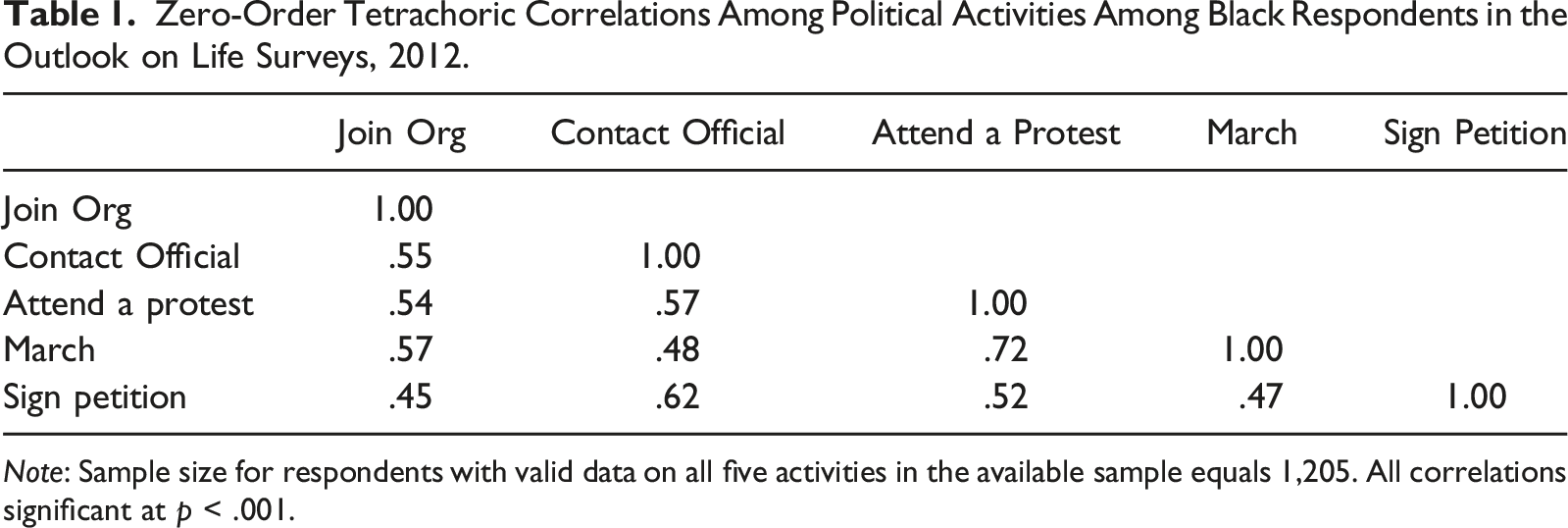
Note: Sample size for respondents with valid data on all five activities in the available sample equals 1,205. All correlations significant at p < .001.
Independent Variables
Respondents’ mean scores on six questions captured racial capital (Bento and Brown 2021:23). The questions were: (1) “Society has reached the point where Blacks and Whites have equal opportunities for achievement.” (2) “Over the past few years, Blacks have gotten less than they deserve.” (reverse coded) (3) “Irish, Italian, Jews, and many other minorities overcame prejudice and worked their way up. Blacks should do the same without any special favors.” (4) “It’s really a matter of some people not trying hard enough; if Blacks would only try harder they could be just as well off as Whites.” (5) “Generations of slavery and discrimination have created conditions that make it difficult for Blacks to work their way out of the lower class” (reverse coded) (6) “Discrimination against Blacks is no longer a problem in the U.S.” Response categories were: 1. “Agree strongly,” 2. “Agree somewhat,” 3. “Neither agree nor disagree,” 4. “Disagree somewhat,” and 5. “Disagree strongly.” The scale ranged from 1 = low racial capital to 5 = high racial capital. Its Cronbach coefficient alpha was .69.
The racial capital questions customarily measure symbolic racism or modern prejudice among whites (Henry and Sears 2002; McConahay and Hough 1976; Sears and Henry 2003), but when used among Black people and coded as rejection of symbolic racism or modern prejudice, they indicate racial capital (see Bento and Brown 2021). Black people may still endorse attitudes congruent with symbolic racism (e.g., denial of continuing racial discrimination, believing Black people should work harder, and are demanding too much too fast). However, as Tesler and Sears (2008: 99) noted, symbolic racism’s meaning among Black people is unclear. Bento and Brown (2021) argued Blacks’ who reject symbolic racism, or modern prejudice, believe in the significance of systemic racism.
Figure 1 shows the unweighted univariate distribution of racial capital. Its negative skew confirms Black people in the estimation sample tend to believe in the significance of systemic racism. Unweighted univariate distribution of racial capital.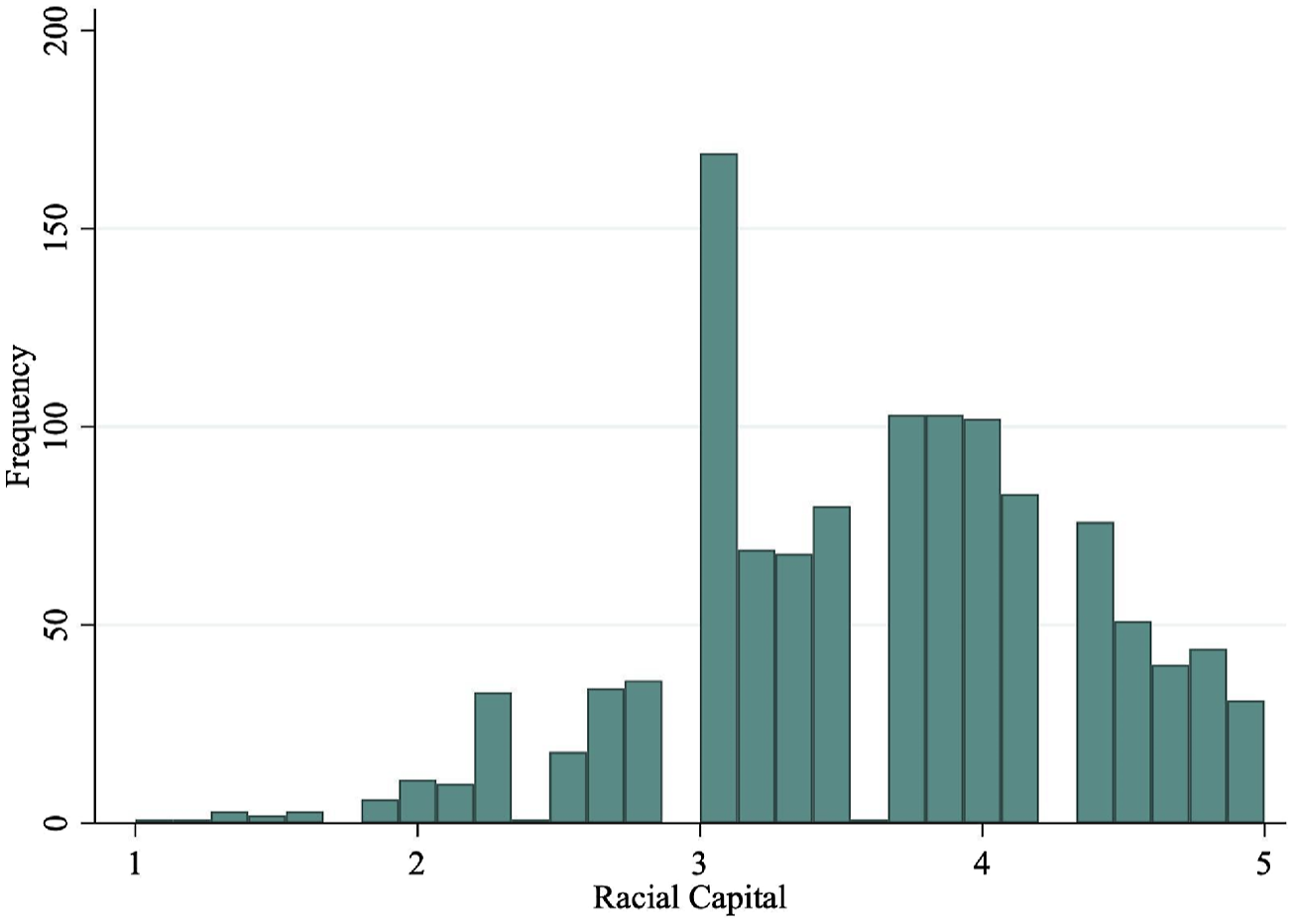
Preliminary analyses used a six-category educational attainment variable (i.e., “Less than high school diploma,” “High school graduate,” “Some college, no degree,” “Associate degree,” “Bachelor’s degree,” “Graduate or professional degree”). Predicted probabilities showing increases in political activities at the associate degree level and higher supported use of a dichotomy: 0 = less than an associate degree and 1 = associate degree or more.
Studies examining the sociological implications of earning an associate degree are scant, especially for Black people. However, the U.S. Department of Labor reported Black men and women outnumbered white, Hispanic, and Asian men and women among associate degree holders in the U.S. workforce in 2022 (see https://www.dol.gov/agencies/wb/data/annual-data/educational-attainment-laborforce-sex-race-). Further, Kim and Tamborini’s (2019) study examined the long-term financial benefits of sub-baccalaureate degrees. They found associate degree holders have higher 20-year cumulative earnings since high school graduation than some college/no degree and vocational degree holders. Moreover, their earnings were 24 percent higher than high school graduates. Finally, they found, except for business and STEM degrees, associate degree holders’ annual earnings overlapped with those of bachelor degree holders.
Control Variables
Descriptive Statistics for Political Activities, Racial Capital, Educational Attainment, and Control Variables Among Black Respondents in the Outlook on Life Surveys, 2012.
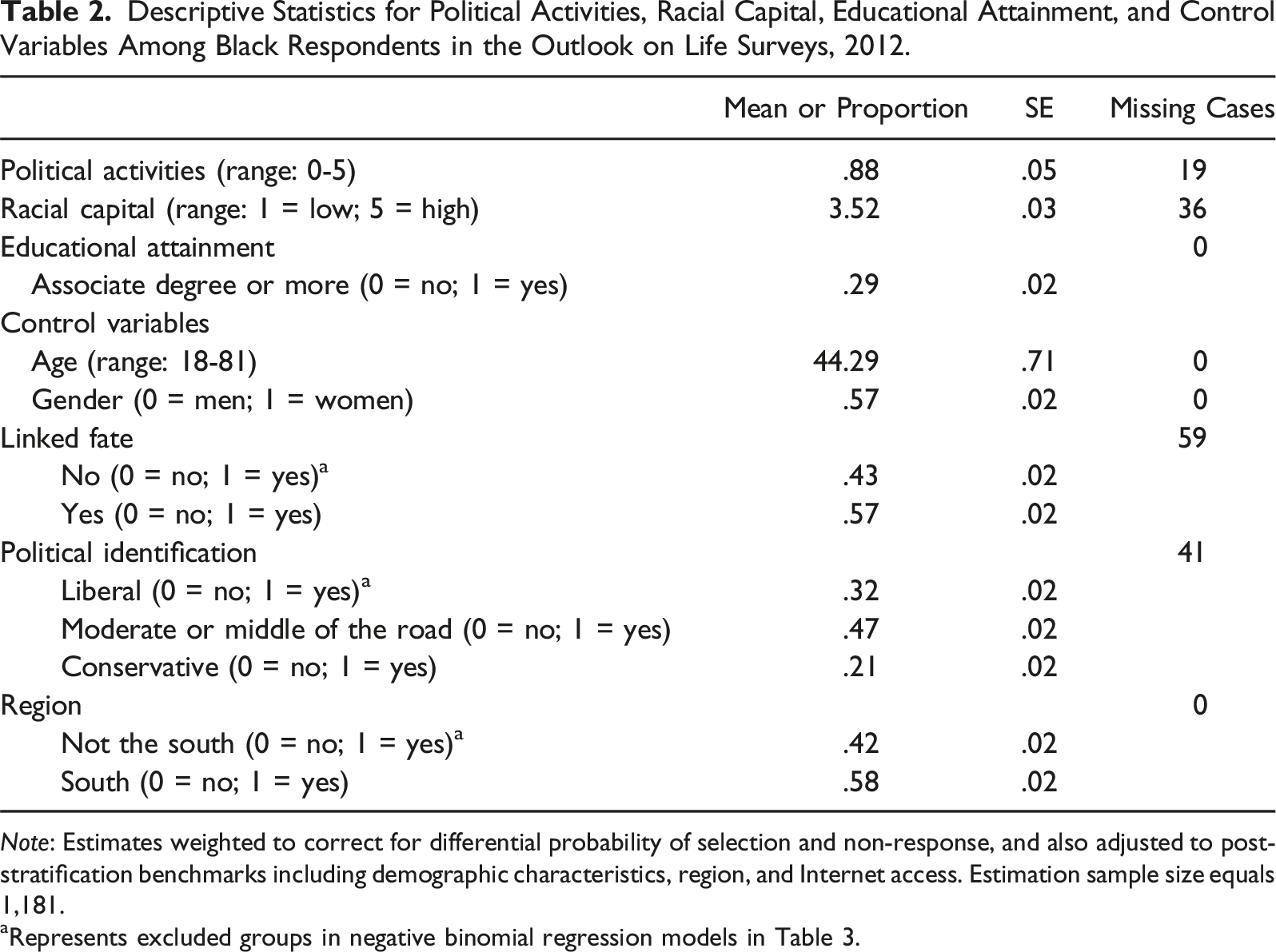
Note: Estimates weighted to correct for differential probability of selection and non-response, and also adjusted to post-stratification benchmarks including demographic characteristics, region, and Internet access. Estimation sample size equals 1,181.
aRepresents excluded groups in negative binomial regression models in Table 3.
Analytic Strategies
Using svy commands and subpop subcommands in Stata 18, a sampling weight available in the data (i.e., W1_WEIGHT2) corrected for differential probability of selection, nonresponse, and adjustment to post-stratification benchmarks including demographic characteristics, region, and Internet access [see Robnett and Tate (2012) for detailed information]. I deleted missing cases listwise (see the last column in Table 2). The estimation sample size was 1,181 out of an available sample size of 1,278 Black respondents in Wave 1. The dependent variable originates from a count probability distribution with overdispersion. Thus, negative binomial regressions addressed my hypotheses. The Stata command file is available upon request.
Results
Table 2 reports descriptive statistics for political activities, racial capital, educational attainment, and control variables among Black respondents. On average, respondents participated in less than one political activity. The mean for racial capital equaled 3.52. Over 70 percent of respondents had less than an associate degree, whereas 29 percent had an associate degree or more. Respondents were about 44 years old. Fifty-seven percent were women. About six in 10 respondents thought what happens generally to Black people in this country would impact their lives. Forty-seven percent were politically moderate or middle of the road, 32 percent were liberal, and 21 percent were conservative. Over half lived in the South.
Estimates From Negative Binomial Regression Models Predicting Political Activities on Racial Capital, Educational Attainment, and Control Variables Among Black Respondents in the Outlook on Life Surveys, 2012.
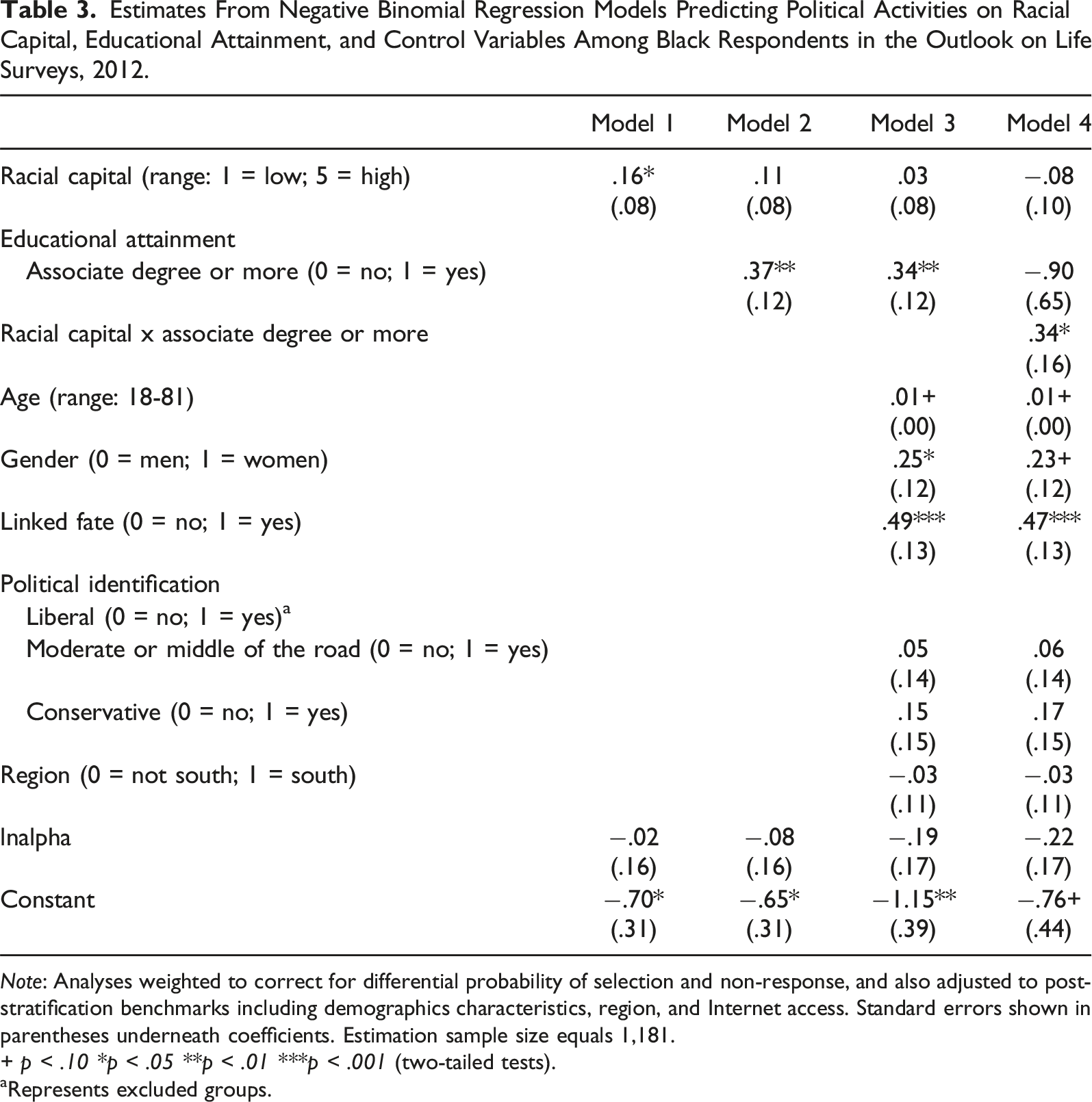
Note: Analyses weighted to correct for differential probability of selection and non-response, and also adjusted to post-stratification benchmarks including demographics characteristics, region, and Internet access. Standard errors shown in parentheses underneath coefficients. Estimation sample size equals 1,181.
+ p < .10 *p < .05 **p < .01 ***p < .001 (two-tailed tests).
aRepresents excluded groups.
Model 2 shows the multivariate association between racial capital, educational attainment, and political activities. Holding educational attainment constant, racial capital did not associate positively with political activities, indicating less support for H1. Educational attainment directly predicted political activities. Specifically, an associate degree or more associated with a .37 increase in the expected log count for political activities relative to having less than an associate degree. That means respondents with an associate degree or more participated in 45 percent more political activities (IRR = 1.45, p < .01) than those with less than an associate degree.
Model 3 added control variables to the model. Net of control variables, racial capital remained insignificant, contrary to H1. Educational attainment directly predicted political activities. Specifically, an associate degree or more associated with a .34 increase in the expected log count for political activities relative to having less than an associate degree. That means respondents with an associate degree or more participated in 40 percent more political activities (IRR = 1.40, p < .01) than those with less than an associate degree. Consequently, I found support for H2. Figure 2 plots educational attainment’s main effects in Model 3. For respondents with less than an associate degree (i.e., the red bar), the predicted number of political activities was .78. For respondents with an associate degree or more (i.e., the green bar), the predicted number of political activities was 1.10. Predicted number of political activities by educational attainment.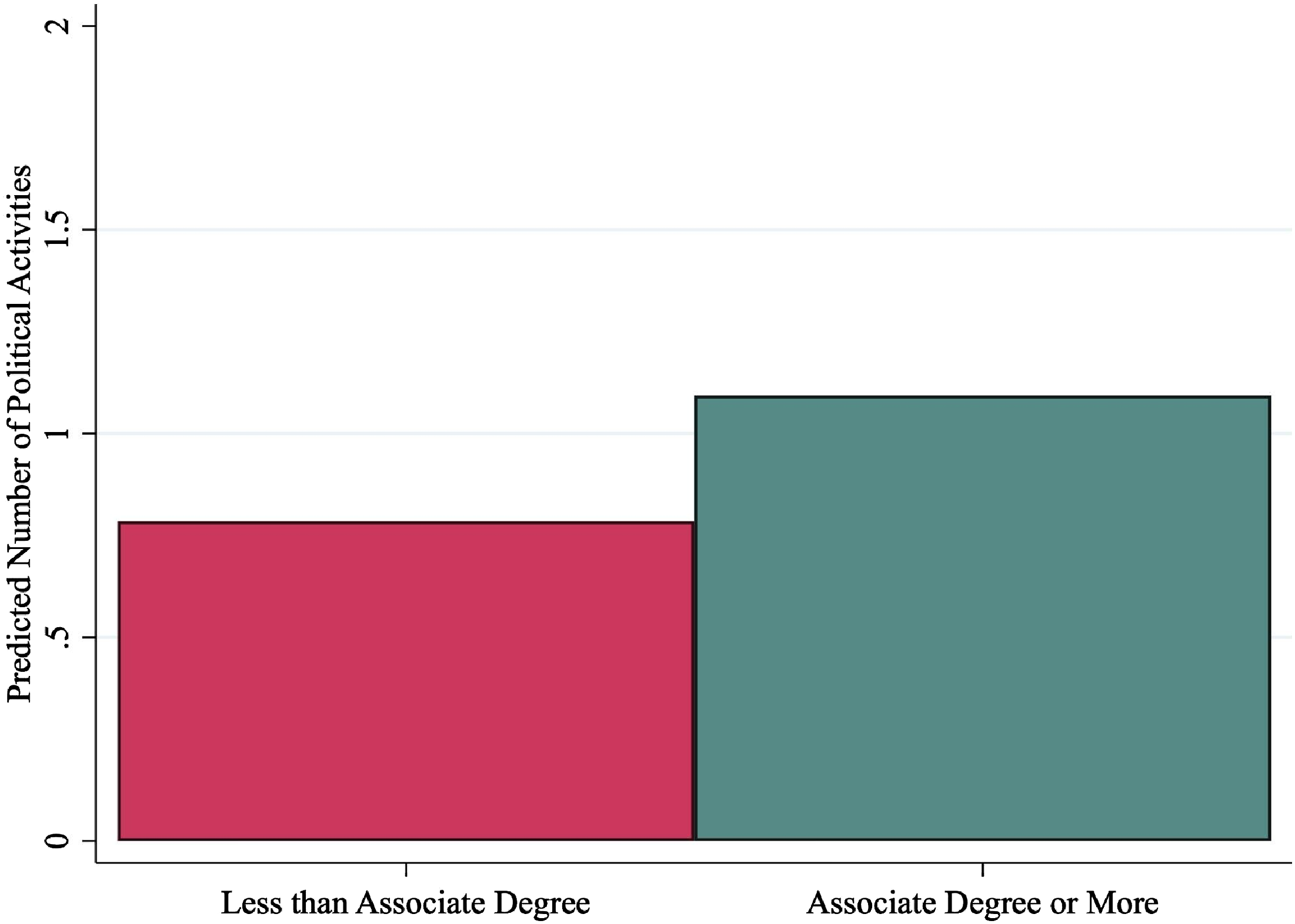
Regarding control variables, age positively and marginally predicted political activities. Women reported engaging in significantly more political activities than men. Feeling linked fate associated with increased political activities.
Row 3 in Model 4 addressed H3. It included a statistical interaction between racial capital and educational attainment. Net of control variables, educational attainment moderated the association between racial capital and political activities (b = .34, p < .05), supporting H3. Figure 3 plots the statistical interaction. For respondents with less than an associate degree (i.e., the red bars), the predicted number of political activities at the lowest level of racial capital (x = 1) was .92. As racial capital increased, the predicted number of political activities decreased. At the highest level of racial capital (x = 5), the predicted number of political activities was .68. This decline was not statistically significant. In contrast, for respondents with an associate degree or more (i.e., the green bars), the predicted number of political activities at the lowest level of racial capital (x = 1) was .56. As racial capital increased, the predicted number of political activities increased. At the highest level of racial capital (x = 5), the predicted number of political activities was 1.58. This increase was statistically significant. Therefore, I found modest evidence to support H1 and strong evidence to support H3. Regarding control variables, women reported engaging in marginally more political activities than men. Feeling linked fate associated with increased political activities. Predicted number of political activities on racial capital by educational attainment.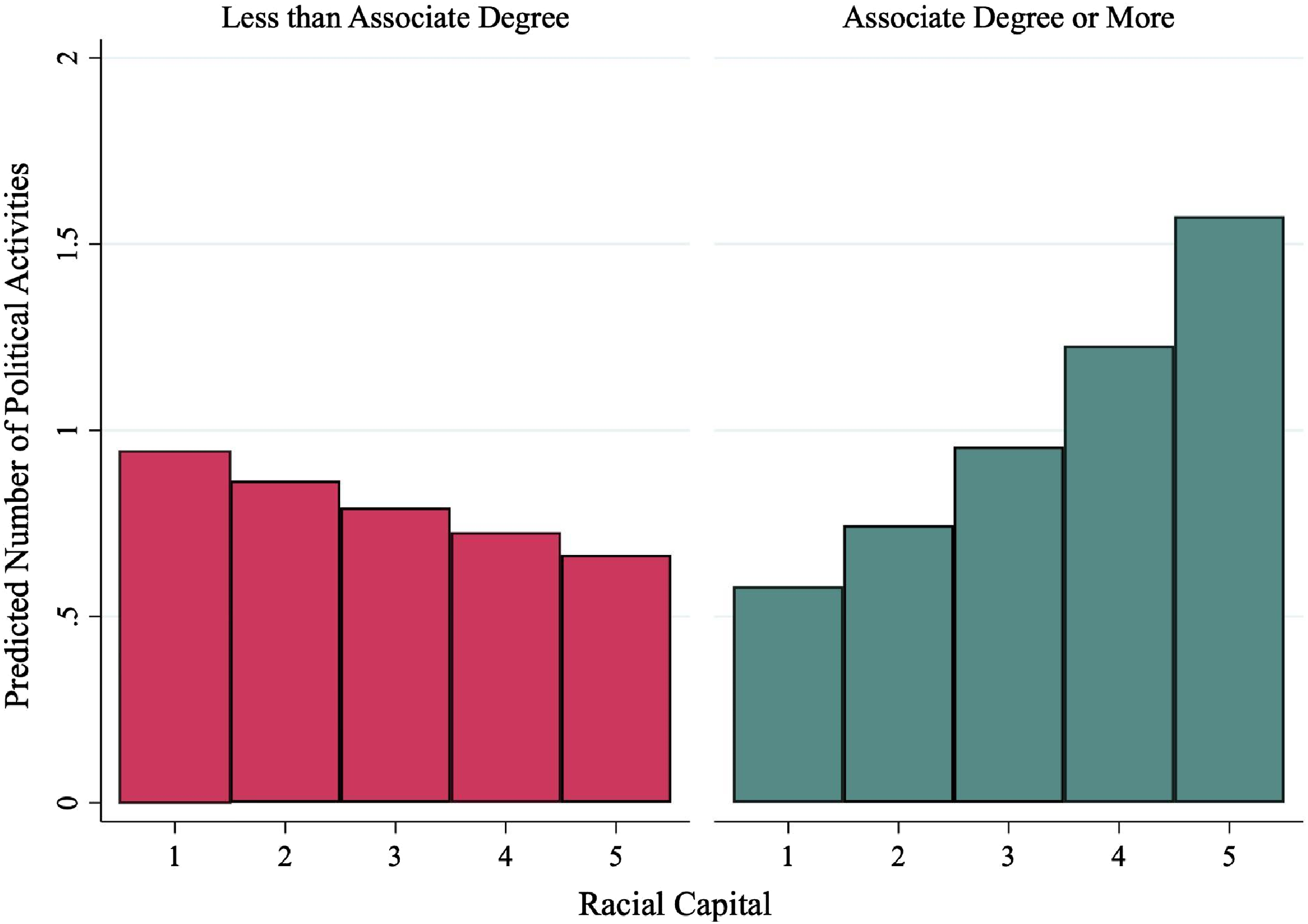
Sensitivity Analyses
In analyses not shown, I disaggregated political activities and ran models predicting each variable separately. Racial capital only associated with “taken part in a neighborhood march” (b = −.42, p < .05). I omitted “taken part in a neighborhood march” from the political activities summated variable and re-ran models in Table 3. Its omission did not alter patterns reported here, confirming no single political activity drove the present results. In analyses not shown, I re-ran Models 3 and 4 in Table 3 with household income as a control variable. Household income was not a significant correlate (−.00, p = .87; and −.00, p = .90, respectively) and did not alter patterns reported here. In analyses not shown, following Bento and Brown’s (2021:23) lead, I re-ran Models 3 and 4 in Table 3 with a quadratic term for racial capital to examine nonlinearity in racial capital’s association with political activities. Model 3 added racial capital’s quadratic term as an independent variable. Net of educational attainment and the control variables, the linear racial capital and quadratic term coefficients were not significant. Model 4 added a statistical interaction between educational attainment and racial capital’s quadratic term. The interaction coefficient was not significant. I found no evidence of diminishing political activities among those with an associate degree or more.
Discussion
With nationally representative data from the Outlook on Life Surveys, 2012, this study examined whether racial capital (i.e., Blacks’ belief in the significance of systemic racism) associated positively with political activities. I expected Black respondents with high levels of racial capital would participate in more political activities. At the bivariate level, racial capital associated positively with political activities, providing some support for H1 (see Table 3, Model 1). At the multivariate level, racial capital associated positively with political activities among respondents with an associate degree or more, providing additional support for H1 (see Table 3, Model 4).
Educational attainment directly predicted political activities, confirming H2 (see Table 3, Models 2 and 3). This result corroborates findings from prior studies showing educational attainment directly predicts political activities (see Brady et al., 1995; Leighley 1995; Leighley and Vedlitz 1999; Verba and Nie 1972). Compared to their counterparts, respondents with an associate degree or more likely have more time, income, and civic skills, which tend to influence non-electoral and electoral participation positively (Brady et al., 1995). Additionally, those with high educational attainment likely adopt psychological orientations motivating non-electoral and electoral participation (Gurin et al., 1989; Leighley and Vedlitz 1999; Rasmussen and Nørgaard 2018).
In line with expectations, educational attainment moderated the association between racial capital and political activities. Among those respondents with less than an associate degree, racial capital associated negatively with political activities, though not significantly. In contrast and as stated above, racial capital associated positively with political activities among respondents with an associate degree or more, confirming H3 (see Figures 2 and 3).
Self-blame or system blame attributions may explain this pattern of findings (Crocker et al., 1999; Neighbors et al., 1996). On the one hand, those with an associate degree or more and low racial capital participate in fewer activities than those with an associate degree or more and high racial capital (see Figure 3). I suspect those with an associate degree or more and low racial capital may be financially stable and elect not to challenge the status quo. Instead, they may take credit for their life circumstances and feel unmotivated to challenge systemic racism. They may think other Black people should work as hard as they did to achieve similar success. They likely saw Barack Obama’s ascension to the presidency (investigators collected these data in the fall of 2012) as proof systemic racism receded. Thus, they may feel Black people have no excuse–hard work and perseverance are sufficient in their minds (Gorman 2024; Ikard and Teasley 2012; Reed and Louis 2009; Teasley and Ikard 2010; Welburn and Pittman 2012).
On the other hand, Black people with an associate degree or more and high racial capital may practice political activities to challenge systemic racism. This group likely has high levels of internal political efficacy (see Gurin et al., 1989; Leighley and Vedlitz 1999; Rasmussen and Nørgaard 2018). They blame the system for racial disparities in life chances. This finding echoes Du Bois’ theory of education and racism. Du Bois ([1903]1994, [1940]2007) theorized educational attainment facilitates a richer understanding of racism and activates Black people’s second sight. High educational attainment may reveal racialized structures in society and enable Black people to perceive their social position through the veil (see Du Bois [1903]1994) and resist accordingly. Related, Gorman (2024) argued Black people develop a desire for anti-racist mobilization when they appreciate the significance of systemic racism. All that to say, scholars need panel data to assess the direction of the causal relationships between racial capital and educational attainment, and racial capital and political activities.
The interaction between racial capital and an associate degree or more is important because educational attainment facilitates cultural, social, and financial capital. Thus, compared to their counterparts, highly educated Black people in this study likely hold significantly more capital and live significantly different lives. This finding may manifest the growing social class cleavage among Black people in the United States. To sum, the field needs further inquiry into racial capital’s associations with other forms of capital.
Black people’s racial capital and political activities probably increased in the decade since investigators collected this study’s data. Publicity surrounding the killings of Michael Brown, Sandra Bland, Freddie Gray, John Crawford, LaQuan McDonald, Philando Castille, Breonna Taylor, George Floyd, and others highlighted systemic racism and induced political activity. Moreover, responses to these events by police and elected officials prove white-controlled institutions provide cover for the police or deny systemic racism completely. Police encounters occurring in the last decade confirmed what many Black people already knew about systemic racism. Put bluntly, denying systemic racism today should be more difficult. Increased educational attainment and potential spikes in racial capital should lead to more political activity among Black people. Additionally, social media’s utility for spreading information and protest planning may change the association between racial capital and political activities for those with less than an associate degree (i.e., racial capital may associate positively with increased activities for all Black people today, regardless of educational attainment).
Limitations and Future Directions
This study has limitations scholars should address in future research. First, investigating the association between racial capital and political activities using panel data would be ideal because of changes in political polarization, partisanship, and publicity surrounding systemic racism. Further, Bento and Brown (2021) and Gorman (2024) theorized linked fate as part of the capital gained when Black people believe in the significance of systemic racism. With panel data, scholars can increment research on racial capital by investigating the temporal order of its association with linked fate. Additionally, scholars should replicate the present results using more recent data. High-profile killings of Black people by police (see Introduction) and post-Trump-era white extremism (Long 2023; Stevenson 2019) may strengthen the link between racial capital and political activities. Still, the Outlook on Life Surveys, 2012 are the most recent data available, including racial capital, political activities, and educational attainment variables. Third, scholars should examine the association between racial capital and electoral participation (e.g., voting, campaigning, and monetary contributions).
In future studies of political activities, scholars should code educational attainment more carefully to focus on respondents with associate degrees. The associate degree is a neglected level of human capital. It can lead to increased financial capital and better economic outcomes relative to lower levels of educational attainment (see Methods section; Kim and Tamborini 2019). Further, associate degrees can lead to well-paying employment (e.g., air traffic control, applied health and nursing, and information technology). Considering ongoing attacks on race-conscious admissions at primarily white institutions (PWIs) and record high admissions and possible overcrowding at historically black colleges and universities (HBCUs), associate degrees may soon become more popular among Black people. Fourth, future research should examine gender differences in the association between racial capital and political activities. For instance, Farris and Holman (2014) found women are more likely than men to practice electoral participation. Fifth, scholars should capture political activities on social media platforms. We need broader operational definitions of political activities in today’s increasingly digital world. Social media platforms’ utility for communication, socialization, and radicalization during political turbulence emerged globally in the past decade (Mundt, Ross, and Burnett 2018; Tudoroiu 2014).
Footnotes
Acknowledgements
I thank members of the Racism and Racial Experiences (RARE) Workgroup at Rice University for their critical feedback on an early manuscript draft and perpetual encouragement.
Declaration of Conflicting interests
The author(s) declared no potential conflicts of interest with respect to the research, authorship, and/or publication of this article.
Funding
The author(s) received no financial support for the research, authorship, and/or publication of this article.
