




Abstract
The global outbreak of COVID-19 abruptly upended work and family life. Yet, little is known about how fathers combined paid and unpaid labor during this unprecedented historical period. Drawing on 35 semi-structured interviews with fathers who primarily telecommuted from home, I identify four strategies fathers used to combine paid and domestic labor: interim primary caregiving, egalitarian tag-teaming, transitional tag-teaming, and hands-on traditional fathering. Findings suggest that these work-family strategies primarily depended on wives’ physical presence in the home. The fathers who described doing the most domestic labor said their wives worked outside of the home. When wives were physically present in the home, fathers’ domestic behavior varied by the extent to which they endorsed the new fatherhood ideal—defining good fathering as involvement in both paid and domestic labor. Yet, change in fathers’ domestic behavior was limited. None of the fathers I interviewed described doing most of the domestic labor when their wives were physically present at home. Taken together, fathers’ domestic behavior depends on wives’ physical presence in the home and their normative perception of men’s responsibility to the family, suggesting that fathers do not perceive domestic time availability simply by differences in the couple’s paid work hours.
Before the outbreak of the novel coronavirus (COVID-19) pandemic, there was gradual progress towards gender egalitarianism in Western countries. The ideal cultural model of breadwinner fathers (Bales and Parsons 1955; Fox, Pascall, and Warren 2009; Hays 1996; Townsend 2002) shifted to the new fatherhood ideal—expecting men’s involvement in both paid and domestic labor (Borgkvist et al. 2020; Elliott 2016; Gerson 2011; Kaufman 2013; Petts, Shafer, and Essig 2018). However, more American adults reported endorsing gender-traditional parenting roles during the COVID-19 pandemic than before the pandemic (Mize, Kaufman, and Petts 2021), suggesting fatherhood norms may have regressed as domestic demands intensified (Dunatchik et al. 2021; Landivar et al. 2020; Lyttelton, Zang, and Musick 2022; Moen, Pedtke, and Flood 2020). Yet, little is known about how fathers understood their role in the family during this unprecedented period of global history.
This research investigates how fathers navigated work and family responsibilities during the first year of the COVID-19 pandemic. I draw on semi-structured interviews with fathers in different-sex marriages who described varied family circumstances during the pandemic—wives who worked outside of the home, wives who telecommuted from home, and wives who were not employed—and identify fathers’ strategies for combining paid and domestic labor, termed work-family strategies (Becker and Moen 1999). I focus on a sample of fathers who primarily telecommuted from home because they had more exposure to domestic life than fathers who primarily worked outside of the home. By clarifying fathers’ priorities at a period of history when paid and domestic demands came in direct competition, this article explores the extent to which the new fatherhood ideal is institutionalized in the family.
Fathers During COVID-19
The global outbreak of COVID-19 presented a shock to work and family life. Many schools transitioned from in-person to online instruction from home, childcare became increasingly inaccessible, and many workplaces stipulated telecommuting from home (Dunatchik et al. 2021; Sevilla and Smith 2020). Many families had to dramatically reorganize work and family life, which may have unsettled family norms and shifted how some fathers interact with their families. Indeed, Swidler (1986) argues that in unsettled cultural periods, people develop new strategies of action or ways of organizing individual and collective action to achieve life goals.
The upending of work and family life during COVID-19 may have changed how some fathers perceive their role in the family. Traditionally, the cultural definition of good fathering was providing for the family financially (Hanlon 2012; Medved 2016; Townsend 2002). Fathers tended to focus on paid labor and be emotionally detached from their children, in alignment with traditional masculine ideals of stoicism (Williams 2009). In the 1980s, the contemporary ideal for good fathering emerged. This new fatherhood ideal emphasizes paternal qualities that have been traditionally linked to femininity, such as high involvement, nurturance, and emotional attentiveness (Elliott 2016; Miller 2011), and being an equal partner with wives (Gerson 2011). Pre-pandemic studies suggest that gender-based inequalities in childrearing and housework persist (Bianchi et al. 2000, 2012; Craig 2006a), even among the highly educated who are most likely to endorse the new fatherhood ideal (Craig 2006b; Daminger 2019; Kamp Dush, Yavorsky, and Schoppe-Sullivan 2018); however, the new fatherhood ideal allows men to be emotionally and practically engaged with their families without rejecting masculinity (Hunter, Riggs, and Augoustinos 2017; Townsend 2002). The intensified domestic demands during the pandemic may have prompted more fathers to adopt behaviors consistent with the new fatherhood ideal than before the pandemic.
Rising time in the home during COVID-19 may have also prompted changes in domestic labor allocation. The time availability perspective predicts that couples rationally allocate housework based on who is available at home and how much housework needs to be done, irrespective of gender (Coverman 1985; England 1986; Hiller 1984). Fathers who began telecommuting from home during the pandemic—thus, eliminating time commuting to and from a workplace—may have increased their contribution to childrearing and housework. Fathers who began telecommuting from home may have also gotten greater exposure and awareness of domestic demands, prompting increases in their time spent on childcare and housework (Ruppanner et al. 2021; Shafer et al. 2020). Consistent with these perspectives, some studies found that gender-based gaps in housework and especially parenting time narrowed in the early months of the pandemic (Carlson and Petts 2022; Carlson, Petts, and Pepin 2022; Chung et al., 2021; Craig and Churchill 2021; Ruppanner et al. 2021; Shafer, Scheibling, and Milkie 2020).
Yet, this shift towards domestic gender equality proved temporary. Fathers’ share of domestic responsibilities declined by the fall of 2020, when many fathers increased their paid work hours, and some returned to the workplace after telecommuting from home (Carlson and Petts 2022). What ultimately shaped how fathers navigated work and family life during this historic period?
There is evidence that fatherhood norms regressed during the pandemic, which likely influenced fathers’ paid and domestic behavior. Mize, Kaufman, and Petts (2021) found increased support for fathers as disciplinarians, and decreased agreement with the statement that it is essential for fathers to play with their children and that fathers should spend less time working, consistent with traditional fatherhood norms, among U.S. adults between March 2019 and August 2020.
Indeed, gender scholars argue that performing (or avoiding) childrearing and housework is an enactment of men’s and women’s gender ideologies, or subjective emotional meaning of appropriate gender roles in the family (Coverman 1985; Ferree 1990; Hochschild 1989; South and Spitze 1994). Hochschild (1989) classically defined three gender ideologies: (1) egalitarian where men and women are expected to share paid and domestic labor equally; (2) transitional where men and women are expected to share paid and domestic labor, but men are expected to be primarily responsible for paid labor and women are expected to be primarily responsible for domestic labor; and (3) traditional where men are expected to specialize in paid labor and women are expected to specialize in domestic labor. Evidence suggests that fathers’ gender ideologies became increasingly traditional over the course of the pandemic, which may explain declines in their share of domestic labor in the fall of 2020 (Carlson and Petts 2022).
Fathers’ identities, or subjective meanings attached to social statuses (e.g., man, husband, and father) (Rane and McBride 2000), provides another explanation for their paid and domestic behavior during the pandemic. According to identity theory, roles (e.g., breadwinner, homemaker, disciplinarian, and nurturer) are ways individuals enact identity (Rane and McBride 2000; Stryker 1968; Stryker and Serpe 1994). Roles tend to be either consciously or unconsciously prioritized, referred to as psychological centrality or salience, respectively (Rane and McBride 2000; Rosenberg, 1979; Stryker 1968). For example, men with a salient father identity tend to be more engaged fathers than men with a salient career identity (Adamsons and Pasley 2016; Goldberg 2015; Hofferth et al. 2013; McGill 2014; Rane and McBride 2000).
With rising job precarity and evidence of increasingly traditional fatherhood norms during the pandemic (Mize, Kaufman, and Petts 2021), fathers’ career identity may have gained salience over their father identity. Pre-pandemic scholarship on men’s work-family strategies have found strategies consistent with salient career identification: traditional breadwinners, sole earners with few domestic responsibilities, and neotraditional dual-earners, primary earners that do not share domestic labor equally (Damaske et al. 2014). Others suggest identification with the family: egalitarian partners, who value both their wives’ and their own careers and split domestic labor equally through intricate daily schedules, and Superdads, who sacrifice sleep and leisure to fulfill career and family obligations (Cooper 2000; Damaske et al. 2014; Kaufman 2013). Yet, little is known about fathers work-family strategies during the first year of the COVID-19 pandemic.
Current Study
How did fathers navigate work and family responsibilities during the first year of the COVID-19 pandemic? This paper is the first to address this question by analyzing semi-structured interviews with fathers in different-sex marriages who primarily telecommuted from home—and were, thus, exposed to the intensified domestic demands—during this unprecedented period of global history. For variability, my sample includes fathers whose wives either worked outside of the home, telecommuted from home, or did not work. Existing literature has not yet explored fathers’ work-family pandemic narratives. In fact, some studies have interviewed fathers to better understand the pandemic domestic experiences of mothers (Calarco et al. 2021; Carian and Abromaviciute 2023). This paper seeks to fill this gap.
Methods
Participants
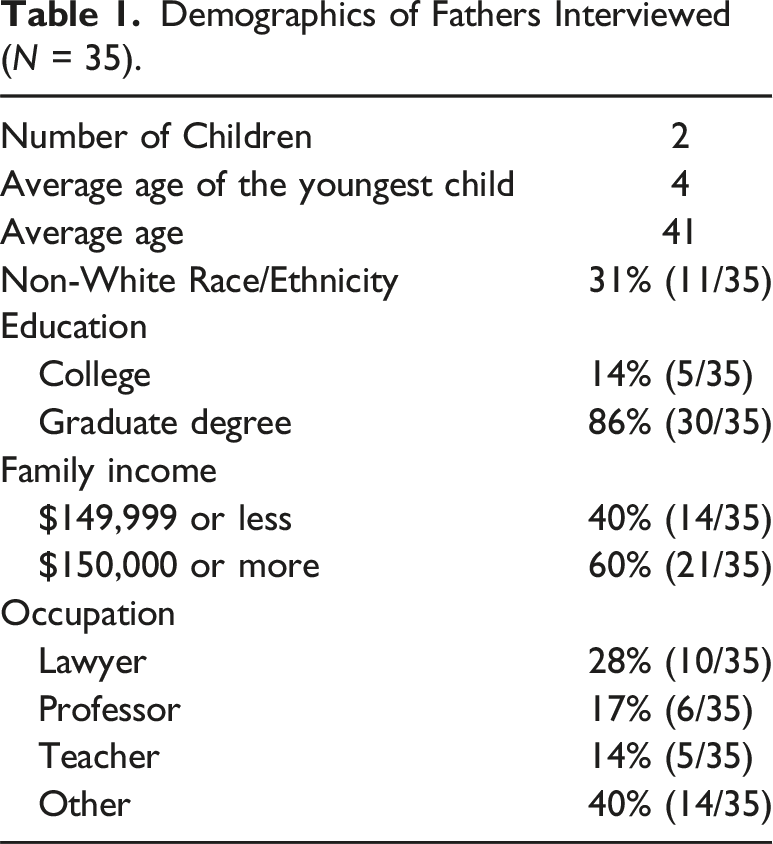
I analyze 35 semi-structured interviews with fathers in different-sex marriages from a total of 167 parents I interviewed between December 2020 and March 2021. The remaining interviews in the greater sample, not analyzed in this paper, were with mothers. I recruited participants by emailing workers at hospitals, law firms, universities, and primary and secondary schools in the U.S. with a solicitation for the study. I targeted white collar workers who were likely to have a college education, given college-educated men are more likely to endorse the new fatherhood ideal than men who are less educated (DeMaris, Mahoney, and Pargament 2013; Hofferth and Goldscheider 2010; Petts, Shafer and Essig 2018). Although I contacted hospitals to recruit both fathers and mothers, all my interviews with hospital workers were with mothers, not included in this sample. This is not a random sample; however, I aimed for differences in job flexibility and type of work to explore how structural constraints influenced fathers’ paid and domestic behavior.
The solicitation email included language about work and family balance. I required all participants to be employed, living with a partner, and the parent of a child aged 10 or younger. I restrict the sample to fathers of young children because young children tend to require more supervision than older children. I did not impose restrictions based on spouses’ employment status, nor on geographic location in the U.S. I did not offer participants compensation.
Demographics of Fathers Interviewed (N = 35).
Procedure
Participants answered a questionnaire which began with screening questions, such as “Do you have a child ten years of age or younger?” and “Are you currently employed?” to ensure appropriateness for the study. When participants did not meet the inclusion criteria, the questionnaire ended. For those who indicated they met the inclusion criteria, the questionnaire proceeded with items on demographics, estimated hours spent on housework and parenting in an average week, whether the family outsourced housework and childcare, children’s school status (in-person, hybrid, or fully remote) if applicable, paid work status (remote or partially or fully in-person), job characteristics, and more. The questionnaire asked whether the pandemic changed participants’ circumstances. I adapted survey items from existing surveys, including the Panel Study of Income Dynamics and the American Life Panel, and validated measures (e.g., DiRenzo, Greenhaus, and Weer 2011). After completing the questionnaire, participants could provide contact information for a semi-structured interview.
Forty-one fathers indicated they were interested in participating in a semi-structured interview. Two fathers were excluded because they verbally confirmed they did not meet the inclusion criteria, despite their answers on the questionnaire. Four others did not respond to my follow up email to schedule an interview. I did not find systematic differences in questionnaire answers between fathers who did and did not participate in the interview.
I conducted interviews by phone, Zoom, Google Meet, and Microsoft Teams within 1 day of questionnaire completion. Some examples of questions are: “How has your parenting role changed during the pandemic?”, “How does your spouse or partner support your work-family balance?”, “Who is responsible for the cooking?”, “Who is responsible for the cleaning?”, “Who is responsible for supervising the children (and at-home education, if applicable)?”, and “In what ways do you think your family has interrupted your work?” Because I obtained extensive background information on my respondents from the questionnaire, I proceeded to the in-depth questions quickly and my interviews ranged between 30 minutes and 54 minutes. I recorded all interviews with each participant’s consent.
Data Analysis
I used flexible coding, which combines inductive and deductive analytic strategies, and axial coding, which organizes existing codes into thematic categories (Deterding and Waters 2021; Strauss 1998). After conducting a close reading of each transcript, I highlighted the sections of the transcript relevant to the paper (indexing). Next, I wrote memos of emergent themes across participants. I applied 25 demographic and family codes (attributes) to each participant, including age, race or ethnicity, education, job title, number of children, age of youngest child, and more.
Next, I coded the transcripts based on how fathers described sharing domestic labor with their wives, and the explanations they offered. First, I coded how fathers described who did most of the following tasks: childrearing, cooking, and household cleaning (he did more, his wife did more, and the couple shared the task equally). To identify their work-family strategies, I coded how fathers reacted when paid work and family conflicted (prioritizing paid work, prioritizing family, and attempting to be “Superdads”). Next, I coded how fathers talked about their role in the family, such as perceiving domestic labor as their wives’ responsibility, being the only parent available in the home to watch the children, and being the family breadwinner. I also coded how fathers talked about their role in the family and how they perceived time with their children.
I developed four thematic categories of fathers’ work-family strategies based on wives’ physical presence in the home and employment status (wife works outside of the home, wife works from home, wife is not employed), which represent the headings in the results section. I lightly edited interview quotes for clarity, such as removing “um,” “you know,” and “like,” and attributed quotes to pseudonyms to protect participant anonymity.
Results
What were fathers’ work-family strategies during the global outbreak of COVID-19? The fathers I interviewed described four work-family strategies that hinged on wives’ physical presence at home. Fathers whose wives worked outside of the home used the (1) interim primary caregiving strategy to navigate work and family responsibilities, where they temporarily prioritized domestic over paid labor because they were the only adult at home. When wives worked inside the home, the extent to which fathers endorsed the new fatherhood ideal influenced their work-family strategies. Fathers whose wives telecommuted from home described either (2) egalitarian tag-teaming, where fathers traded off who in the couple prioritizes domestic over paid labor on a monthly or weekly basis, or (3) transitional tag-teaming, where fathers who are not primary earners prioritized paid over domestic labor. Fathers with homemaker wives used (4) hands-on traditional fathering to meet work and family responsibilities, where they primarily depended on their wives domestically, but increased their domestic support.
Interim Primary Caregiving
The pandemic prompted some fathers I interviewed (9 of 35) in dual-earning couples to perform more domestic labor than their wives. These fathers described temporarily prioritizing domestic over paid labor because they were the only parent telecommuting from home and did not have access to childcare. Many fathers expressed frustration, suggesting they did not want this family role. I call this work-family strategy interim primary caregiving.
Most said their wives were unavailable during paid work hours because they worked outside of the home in healthcare. Eddie, a father of two pre-school aged children, explained, “My wife is a nurse, and her hospital works with COVID patients … If she has a work shift Monday through Friday, then I’m pulling full-time dad and full-time employee simultaneously.” Jeff, a father of a four-year-old, echoed, “My wife works in healthcare and had to continue going into the office … Becoming a full-time stay-at-home parent, I guess, was the first big change in responsibilities when COVID first started.” Aaron, a father of two pre-school aged children, shared, “She works as a clinical faculty member … I had more responsibilities that could be temporarily deferred or ignored … I was sort of the main person to step in when everything fell apart.” Luke, a father of two school-aged children, said of his wife, “She works in ENT … I’m definitely watching the kids more [than her] because I’m working from home.”
The family also did not have access to childcare. Before becoming an interim primary caregiver, Aaron said the couple attempted “a series of ad hoc arrangements that fell apart for partly pandemic-related reasons—one-by-one.” Eric, a father of two, said he became an interim primary caregiver because daycare for his five-year-old was not an option, “We don’t feel comfortable sending her [to daycare] every day still. So, I’ve become the primary caregiver for her and also help out my third-grade daughter.” Eddie became an interim primary caregiver to protect the other children at daycare, “We had a discussion with the director … We all agreed it was best to not send our kids because my wife works with COVID patients.” Jorge, a father of a newborn, said his extended family was uncomfortable with his wife’s healthcare job, “We just could not get help from family … Her mom is like, ‘Sorry, I just can’t help out with the baby as much as I want because you’re interacting with folks that have COVID regularly.’” These fathers did not choose to become interim primary caregivers—they were compelled into domesticity by being the only parent at home.
Interim primary caregiving was demanding. The fathers I interviewed described prioritizing domestic over paid labor, often postponing job responsibilities until the evening. Mateo, a father of a newborn, said, “During the day, while the baby’s awake, I can’t really put in as many hours as I feel I need to for work … I try to work at night when the baby is sleeping.” Eric also worked nights, “My workday typically starts after midnight.” When Eddie is “going solo,” he works while his children are sleeping, otherwise he’s a full-time dad: I’ll wake up and get going between six and six-thirty hoping to get ninety minutes of work in before the kids wake up … It’s hit or miss, but then they both go down [for a nap] at three. So, then that gives me another couple hours [of work] leading into dinner time. Then, it’s full-time dad … I’ll log back on to work at nine-thirty, ten o’clock after they’re in bed.
Interim primary caregiving was temporary based on who was available at home. Once their wives returned home—and, thus, a critical domestic resource became available—fathers wanted to catch up on their jobs. Jorge said, “As soon as she comes home it’s almost like a tag team like, ‘Okay, you got her, okay, I’m gonna go do the work that is waiting for me,’” even though it was difficult for her, “On her side, it’s sacrificing … We had to have a conversation, ‘As soon as I get home, can you give me fifteen minutes to just breathe before you give her to me?’” Eddie traded off with his wife when she was available because she is typically the primary caregiver, “I mean, she is mom … On her days off, she’s very much part of what’s going on,” even when it was tiring for her, “If she’s got a really rough couple of days … She might nap at the same time the kids do.” Despite being “the primary caretaker out of pure necessity,” Caleb relinquished his duties to his wife when she was available, “It’s endless hot potato. I mean, there’s just no way around it. The only way you can create time for the other person to do their job is by getting the baby.” Jeff said of his wife, “She helps out on days that she’s here by taking the lead and when she comes home by taking the lead and then on weekends.”
Many fathers expressed discontent with interim primary caregiving, suggesting that this work-family strategy was unlikely to extend beyond the pandemic because it was not based on their preferences. Jeff expressed resentment: It’s hard to not get frustrated at times with a four-year-old. It’s important to know she’s just four-year-old and it’s not her fault that society has collapsed, and we have to change the way we’re doing everything … I got fed up with making breakfast, lunch, and dinner … After a bunch of months where I was the only one doing that, I just said, ‘I can’t just drop what I’m doing every time somebody needs to eat! … I can’t keep being a servant twenty-four-seven!’
Fathers also expressed discontent with interim primary caregiving because, like many mothers during the pandemic, this work-family strategy adversely impacted their careers. Before the pandemic, Jorge had a side job to earn extra income the family depended on. During the pandemic, he dropped this position, which threatened his sense of masculinity: “I was crashing and burning … I was like, ‘Hey, I can’t do these two—I can’t do my job and the side gig’ … She’s like, ‘Okay, well I’m gonna have to go back full-time’ … For me, that was hard as a husband.” Wayne, a father of two school-aged children, gave up work opportunities, “I actually have given up my project leadership roles because I had no idea what’s going on and I knew it [caring for the kids and working] was really challenging.” Eric said he was less productive, “There are only so many hours in the day and a number of those hours need to be dedicated to helping a third-grader master division and keeping a five-year-old entertained.” Jeff said his academic department penalized him, “They recently just decided that I should teach another course because my research isn’t going on as well as they think it should.”
Although the physical absence of wives, rather than the new fatherhood ideal, influenced this work-family strategy, many fathers I interviewed perceived the increased time they had with their children as valuable. Eddie expressed gratitude for being able to witness his children’s developmental milestones: I got to see my son take his first steps. I got to watch my daughter learn how to count and identify shapes and sing songs and goof around. That availability at this stage of their lives, even with everything else, is unprecedented. Especially given the gender norms of the world we live in men end up feeling kind of cut off from their families. Like they just don’t have enough time … It’s been sort of a forced yearlong parental leave, which comes with a lot of emotional benefits even though it come to the costs. I’m in a way grateful for that.
Egalitarian and Transitional Tag-Teaming
Most of the fathers I interviewed (17 of 35) were in dual-earning couples where husbands and wives both telecommuted from home. Because wives were available, the extent to which these fathers endorsed the new fatherhood ideal influenced their work-family strategies.
Less than half (6 of 17) suggested that the couple’s careers were equally important. Unlike egalitarian partners who develop intricate daily schedules (Damaske et al. 2014), these fathers described balancing domestic labor equally by switching who in the couple assumed the most domestic labor on a monthly and/or weekly basis. I call this work-family strategy egalitarian tag-teaming.
Sam, a father of two pre-school aged children, provides a good example of egalitarian tag-teaming. He expressed a commitment towards equality: I know most people would perceive their own work as more important than the other’s and so we try to keep talking about that and thinking about that to make sure it hasn’t dramatically gone out of balance. It started right in the beginning with me just saying, ‘I’ve got it. I’ll cover the days and we’ll go from there.’ So, that was the spring from March through April, May, June … I had them one hundred percent of the time during the day. I put them to bed, and then I would work nights … I was doing basically all the meals and the majority of the household duties because I was up during the day and around.
When his wife “got a new job,” Sam said the couple tried to return to “the same model as we did pre-pandemic” of daily equality, “That allowed us to get closer to a fifty-fifty split.” However, the couple traded domestic duties on a weekly basis, per their job schedules, “I had a really busy week with a conference and other things, and my wife did basically everything and then the following week, we flipped and did the other. It’s been really fluid.”
Chris, a father of three school-aged children, provides another good example of egalitarian tag-teaming. The couple traded parenting over months to accommodate each other’s jobs: In the beginning, it was me. So, for the first couple of months—April to May. And then we switched off partly because my book was due—I was working towards a book deadline which I did make by December … We’ve switched back because she burned throughout her paid time off and my book is done. We take turns.
While Sam and Chris described egalitarian tag-teaming over months, other fathers described egalitarian tag-teaming on a weekly schedule throughout the pandemic. Tom, a father of one school-aged child, considered his wife’s job schedule rather than assuming domestic labor was her responsibility, “We try to be flexible with each other’s schedules. When someone can make time to be doing something else [domestic]—they do that.” The couple each specialized in domestic labor 2 days per week: She has days off Tuesdays and Wednesdays, which wouldn’t be optimal, but it kind of works for us now because that means that on those days, she’s able to work with my daughter and I’m able to focus on work a little more. On Saturdays and Sundays, I’m able to focus on taking care of house stuff and my daughter while she focuses on work. We are certainly coworkers at this point in time—indirect coworkers. So, each week on Sunday we share each other’s schedules and make sure things look good. We have our calendars blocked off with each other’s work times and we kind of huddle up at the beginning of each week and make sure we don’t have any conflicts.
Joe, a father of three school-aged children, expressed wanting to share childcare fairly with his wife, “Once the pandemic started, we split it basically fifty-fifty. I work in the morning, and then she works in the afternoon. So, we basically just cut down to half time.” Likewise, Will, a father of two, wanted to share care of the couple’s baby fairly, prompting him to work nights, “We split the duties with the baby pretty evenly [over the week] … We just switch off watching him and then I just work usually late at night to make up for the lost time.” Will did not expect his wife to care for his older son because he is “from a prior marriage, and I have sole custody of him, so I consider him more kind of my almost exclusive responsibility.” He also described doing the housework, “I do all of the cooking and most of the housework.”
The rest (11 of 17) described sharing domestic labor with their wives, but expected their wives to do more domestic labor than themselves. Unlike neo-traditional dual earners, these fathers did not describe themselves as primary breadwinners (Damaske et al. 2014). Many had a salient career identity. Some did less domestic labor during the pandemic than before the pandemic to accommodate their jobs, suggesting these men did not endorse the new fatherhood ideal to the same extent as egalitarian tag-teamers. I call this work-family strategy transitional tag-teaming.
Sean, a father of two, provides a good example of transitional tag-teaming. He had some domestic responsibilities during the pandemic, “I’ll make dinner … I will usually put our older daughter to bed.” However, he described doing less parenting during the pandemic than before the pandemic because he prioritized his job, “I have a pretty demanding job … I am less available as a co-parent during the pandemic than I was outside of the pandemic … She has to be sort of single parenting.” His wife did most of the housework, “She handles all of our laundry right now … She’s handled a lot of other tasks around the house that I just haven’t had time for.” He characterized his lawyer job as more demanding than his wife’s job—in healthcare administration during a global pandemic—justifying the inequality, “I think my job tends to require that I work a lot more hours than hers. And so, I think—unfortunately or fortunately—she’s there to pick up the time that I missed.”
Mark, a father of two school-aged children, said he and his wife “switch off watching the kids whenever we can.” Yet, how they shared parenting aligned with transitional tag-teaming because he conceded she supervises the children more than he does: She spends more time during the daytime hours with them and she often times will take them on the weekends because she doesn’t have an academic job. She has an office job and so she doesn’t have to work quite often on the weekends whereas I do.
Other fathers echoed prioritizing their careers over their wives’ careers, leaving their wives to do the most domestic labor, in alignment with transitional tag-teaming. Scott, a father of a newborn, said the couple initially shared childcare equally, but ultimately prioritized his career: My wife and I were fifty-fifty up until my daughter was about nine months. At that point we were going to put her into daycare because I was finishing school and my wife was working full-time … When I started my job, I continued to work full-time. My wife actually went down to three days a week. She definitely takes on more of the burden than I do. We kind of share the cooking duties, but she will handle a lot more of the cooking. The nanny will do some of the laundry. We used to have a maid that would come clean the house once every while. The nanny will vacuum. Then depending on how busy I am—if I’m super busy, I just come down there, I eat, I go back up, and I’m working for hours. She’s got to do dishes, she’s got to cook, she’s got to clean everything. Sometimes if I can do it, I’ll do that as well, but it’s much less.
Hands-On Traditional Fathering
The remaining fathers in my sample (9 of 35) said they were sole earners, and their wives were homemakers. These fathers typically depended on their wives domestically, but their endorsement of the new fatherhood ideal prompted them to relieve their wives of some domestic tasks. I call this work-family strategy hands-on traditional fathering.
The hands-on traditional fathers I interviewed said the couple had gender-traditional family roles that predated the pandemic. They expressed gratitude towards their wives for being homemakers, suggesting they preferred specializing in paid work while their wives took care of the home. Bryan, a father of one school-aged child, perceived that his wife had more domestic skills than he did, which he recognized as gendered, “She’s sort of our leader and tells us things that need to be done that maybe I would miss because I’m focused on working. She’s also just better at running a household than me. I know this is some peak dude shit, but she is.” Ethan, a father of two school-aged children, expressed appreciation towards his homemaker wife for supporting his career, “She is pretty amazing … I’m trying to build this business … Her mindset is, ‘We need to prioritize what you’re doing’ … She’s very supportive of it.” Ben, a father of four, echoed, “She’s amazing. She’s a stay-at-home mom and that’s what she did before the pandemic … She was very encouraging with me working.” Kevin, a father of three school-aged children, said, “My wife does most of it [domestic labor] … She’s a trooper.” He was the only sole-earning father in my sample to talk about the couple’s family roles in terms of money, “I pretty much just got to make the money so I just kind of do what I want as long as I’m making money.”
Yet, sole-earning fathers did not focus exclusively on paid labor during the pandemic. Many expressed sympathy towards their homemaker wives, prompting them to assume the hands-on traditional father work-family strategy. Ben expressed guilt, “Even though she’s willing to and encouraging me on my work I do feel some level of guilt and the need to help and support her. I don’t expect her to do it [domestic labor] by herself.” John, a father of four, said, “She’s got her hands full of just taking care of the kids. That’s a full-time job and it’s mostly her job … It’s a lot of work … We’re sharing more in the responsibilities.” Ethan echoed, “She’s not working and so she’s really responsible for helping them in school … It’s a lot … She was like, ‘I need to take some time for myself’ … [that’s] expanded—checking in with each other.” When I asked how his homemaker wife supports him, Peter, a father of two, answered, “It’s probably the other way around. It’s more me helping because I mean the reality is she’s born the brunt of the burden here … I came in and took on bigger fractions, but she still has the greater percentage of burden.”
Hands-on traditional fathering involved doing more housework during the pandemic than before the pandemic; however, domestic labor remained primarily wives’ responsibility. Ethan started cleaning the dishes, “She’s gotten very into cooking during this time, which she is responsible for—the planning, getting the groceries … I support that a little bit by cleaning up and lending a hand there.” Michael, a father of one school-aged child, described cooking for his homemaker wife and daughter, “I make extra meals. I make things or have things available so that they can eat whenever they need to.” Ben did housework on the weekends, “I cook all the meals on the weekends. Head up the cleaning projects and things like that.” Peter said he “stepped up” his household cleaning, “She still probably does more of it, but that’s an area where I’ve probably stepped up a little bit more because it’s easy to take ten minutes if I’m taking a ten-minute break to clean up.” Although he admitted his homemaker wife cooked more than he does, he also prepared some meals, “I take care of breakfast for the boys every day … Sometimes I’ll do the lunch, but she more or less does the lion share of cooking, and she does virtually all the grocery shopping.”
Hands-on traditional fathering also included facilitating some of the children’s schooling, which tended to infringe on fathers’ job schedules. Ben said his workday got longer: I take time out of my work to teach my kids a science class … I also do a PE class with my kids where I take them out and we go and run and exercise … My workday has gotten longer because I’ve got school responsibilities in the middle of the workday.
The hands-on traditional fathers I interviewed expressed valuing their roles in their children’s development. This suggests that the new fatherhood ideal extends to fathers who prefer traditionally gendered family roles. Bryan appreciated being more available for his son than his father was for him: I didn’t know him. I don’t know anything about him, really … He was at work constantly, and as a result of that we didn’t spend much quality time together … Every day, I play video games with my son and every day I’m teaching him some kind of lesson, either a hard lesson or an easy one about just life and living. My dad was a physician … He got called out at three in the morning or whatever, but we were used to that … I’ve spent more time in the last ten, eleven months around my daughters than I ever was able to spend around my parents.
Conclusion
How did fathers navigate work and family responsibilities during the first year of the global COVID-19 pandemic? This paper is the first to identify the work-family strategies of fathers who primarily telecommuted from home during the pandemic, when paid and domestic demands came in historic competition (Dunatchik et al. 2021; Landivar et al. 2020; Lyttelton, Zang, and Musick 2022; Moen, Pedtke, and Flood 2020) and family norms may have shifted (Swidler 1986). I found four work-family strategies, which I call interim primary caregiving, egalitarian tag-teaming, transitional tag-teaming, and hands-on traditional fathering.
I found that wives’ physical presence in the home was the most critical determinant of fathers’ domestic behavior. Fathers whose wives worked outside of the home described temporarily doing more childrearing and housework than their wives. However, changes in these fathers’ domestic behavior was limited. Many expressed discontent and frustration, suggesting that specializing in domestic labor was not their choice.
When wives were physically present in the home, the extent to which fathers endorsed the new fatherhood ideal influenced their work-family strategies. The fathers who were most committed to the new fatherhood ideal prioritized the needs of the home over their own jobs for months or over each week. These fathers expressed a desire to be equal partners with their wives. Other fathers prioritized paid over domestic labor to varying degrees. Fathers whose wives did not work described taking time out of their job schedules to help with parenting and housework, suggesting the new fatherhood ideal matters even in families with gender-traditional roles. The fathers who seemed the least committed to the new fatherhood ideal described offloading the domestic labor to their telecommuting wives to focus on their own jobs. Yet, there were limits to these fathers’ domestic contribution. None of the fathers I interviewed described doing more domestic labor than their wives when their wives were physically present at home.
Moreover, my findings suggest that the new fatherhood ideal is not a primary motivator for fathers’ work-family strategies. The breadwinner model appears to be a salient mental model for many of the fathers I interviewed, despite external conditions during the pandemic that made it more possible to adopt behaviors consistent with the new fatherhood deal than before the pandemic. This finding may help to explain why the gender-based gap in domestic labor only briefly narrowed in the beginning of the pandemic, but re-widened when some workplaces and schools re-opened in the fall of 2020 (Carlson and Petts 2022).
All of the fathers I interviewed talked more extensively about childrearing than about housework, consistent with prior research suggesting that telecommuting from home has a greater effect on fathers’ time spent childrearing than on fathers’ time spent on housework (Carlson, Petts, Pepin 2021; Craig and Churchill 2021; Del Boca et al. 2020; Dunatchik et al. 2021; Lyttleton, Zang, and Musick 2022). Despite the new fatherhood ideal (Elliott 2016; Gerson 2011; Miller 2011), housework may persist in being a non-normative task for men. It is also possible that fathers talked more about childrearing than housework because the rise in childrearing demands was more substantial and more pressing than the rise in housework demands.
This study provides a critical test of theoretical perspectives for domestic labor allocation, through the eyes of fathers. For example, this study suggests the time availability perspective should be updated to expand how available time for domestic labor is defined. Time availability is classically defined by differences in the absolute time each member of the couple is at home at the end of the paid workday, irrespective of gender (Coverman 1985; England 1986; Hiller 1984). However, my interviews suggest that when one member of the couple spends more time physically in the home than the other, that adult assumes most of the domestic labor, irrespective of their paid work hours or their gender. This definition of availability should consider the physical presence of both co-residential partners and domestic workers, given rising family dependence on outsourcing childrearing and housework (Kornrich and Roberts 2018), which was critically limited during the pandemic.
Although this paper provides some insight into fathers’ pandemic experiences, it has limitations. Social distancing requirements and parents’ time constraints during the pandemic made data collection challenging. I was unable to pair interviews with ethnographic data or interview both members of the couple, which could clarify whether there was bias in fathers’ answers. Some participants may describe family myths, or versions of reality that do not align with the truth about the couple’s domestic equality (Hochschild 1989), but I am unable to verify fathers’ perspectives with their wives’ perspectives, or through my own observation.
This paper also cannot speak to working class families who may have had to continue to work in a workplace throughout the pandemic, altering their work-family strategies. This paper also lacks representation of fathers of color, and fathers who earn less than their wives. Future research should interview a more socioeconomically diverse group of fathers than in this paper.
Despite these limitations, this paper presents fathers’ pandemic work-family narratives, which have been critically understudied. The four pandemic work-family strategies I identified demonstrate that fathers’ domestic behavior principally depends on the physical availability of their wives, and then on their commitment to the new fatherhood ideal (Elliott 2016; Gerson 2011; Miller 2011). While the new fatherhood ideal may have prompted some men to increase their share of domestic labor during the COVID-19 pandemic, the “second half” of the gender revolution—when husbands and wives willingly share domestic labor equally—is not yet realized (Goldscheider, Bernhardt, and Lappegård 2015).
Footnotes
Acknowledgements
I am grateful to Chaitra Hardison and the three anonymous referees for feedback in developing this project.
Declaration of Conflicting Interests
The author(s) declared no potential conflicts of interest with respect to the research, authorship, and/or publication of this article.
Funding
The author(s) received no financial support for the research, authorship, and/or publication of this article.
