




Abstract
We investigate how women’s family, work, and education statuses are configured over the life course, defining different pathways throughout adulthood. Using data from the National Longitudinal Study of Adolescent and Adult Health, we conduct a repeated measures latent class analysis to explore the various pathways of family, work, and education that women take between their late teens and early forties. Additionally, we investigate the extent to which these pathways vary by race and socioeconomic background. We find seven distinct pathways. In three of the pathways, women are likely to become mothers at an earlier age, but differ in terms of education and work patterns. Three other pathways include women who focus primarily on college in early adulthood, but differ in terms of their work and family patterns. An additional pathway comprises women who remain largely independent while working and continuing education into adulthood. Pathways vary significantly by race, parents’ education, and early family poverty. This study highlights the fluidity of women’s work and educational experiences across adulthood, and articulates significant nuances in the different combinations of women’s family, work, and education across demographic backgrounds.
Introduction
Over the last several decades, the domains of work and family have become increasingly blended, with dual earner households and working parents making up the majority of families in the U.S. (Glavin and Schieman 2012; Kalleberg 2008). Given the lengthening of education into later years of adulthood (Radford, Cominole, and Skomsvold 2015), the modern experiences of work and family have also become increasingly combined with continuing years of schooling, and being a student often only one of several statuses that individuals occupy in their adulthood (Augustine, Prickett, and Negraia 2018; Cuzzocrea and Magaraggia 2012; Remenick 2019). Furthermore, as individuals move through transitions between different life stages and changing roles, such as the role of becoming a parent, a returning student, or an employee at a new job, they are often required to accumulate and configure these various roles in new and blended ways. This is particularly true in the context of how women’s complex experiences of family, work, and education unfold in tandem, which not only sets the course for future employment pathways and persisting economic inequalities (Damaske and Frech 2016; McLanahan and Percheski 2008; Radford, Cominole, and Skomsvold 2015; Weisshaar and Cabello-Hutt 2020) but also has significant implications for women’s stress and well-being (Lippert and Damaske 2018). Applying the life course perspective, we examine the diverse patterns of how women’s experiences of family, work, and education are configured from age 18 into their thirties and forties (Amato et al. 2008; Augustine 2016; Damaske and Frech 2016; Doren and Lin 2019; Oesterle et al. 2010), including the sequencing of marriage relative to work and schooling, the timing and number of children, patterns of full-time and part-time work, and the timing and levels of women’s completed education. Prior research highlights the significance of women’s educational trajectories in shaping women’s experiences of work and family, and vice versa (Moen and Han 2001; Sweet and Moen 2007). However, rather than viewing education as an antecedent to work–family challenges or as a separate experience from work and family, we explore women’s combined statuses in education, work, and family, paying particular attention to the different levels of education that women pursue and complete throughout adulthood. The complexities presented by extending education across a longer period of the life course—whether continuously or as returning students with greater demands of family and work—call for a closer examination of how these experiences may be jointly navigated (Augustine, Prickett, and Negraia 2018; Deutsch and Schmertz 2011). Specifically, we examine how women’s diverse patterns of family, work, and education evolve over the life course and how these dynamic experiences may vary based on women’s background characteristics. By doing so, we are able to articulate the longitudinal patterns, or pathways, of how women’s varying roles are ordered and combined, between the period spanning from the beginning of the transition to adulthood (age 18) into middle adulthood (thirties and forties).
We address two main research questions. First, what are the various pathways of family, work, and education taken by women as they transition from their late teens to early forties? To this end, we explore specifically how women’s statuses in family, work, and education change over the life course as women combine and configure their roles across these realms in varying ways. Our analysis identifies how many distinct pathways of family, work, and education women are most likely to experience, and how prevalent each of these pathways are relative to one another. In addition to women’s practice of agency in combining multiple demands and roles in creative ways, we recognize that not all women have access to the same resources and opportunities, especially based on structural constraints experienced unequally by race and socioeconomic status. Thus, our second question examines to what extent these pathways of family, work, and education vary among women and may be impacted by factors such as race and socioeconomic background. We use data from the National Longitudinal Study of Adolescent and Adult Health and apply a repeated measures latent class analysis (LCA) to answer these central questions. Access to longitudinal data from women’s late teens into their early forties and the use of more detailed educational measures enable us to explore women’s distinct combinations of family, work, and education with greater specificity compared to previous similar studies.
Background Literature
Women’s Pathways of Family, Work, and Education
When considering the challenges of combining family, work, and education throughout adulthood, the unpaid and unequal care responsibilities taken on by women have been well documented and found to persist, even despite increases in women’s employment and moderate improvements in the division of household labor (Chung and van der Lippe 2018). Women across racial groups continue to be significantly more likely to have non-steady employment trajectories and lower levels of employment throughout their lives, compared to white and Hispanic men (Weisshar and Cabello-Hutt 2020). Previous studies looking more closely at the interconnected patterns of women’s family, work, and education point to several impeding and facilitating factors which impact women’s relationships to these statuses in varying ways. Structural factors at work, such as flexible schedules, reliable benefits, and manageable hours, serve as critical resources for effectively combining dual responsibilities of family and work, and maintaining steady employment trajectories throughout the life course (Cha 2013; Blair-Loy and Cech 2017; Damaske 2011)—resources which are often limited to women who have completed higher levels of education. Depending on the timing of childbirth, women may also experience cumulative effects that carry into later years of adulthood, such as disadvantages to education and employment prospects among those who become mothers in their teenage years (Edin and Kefalas 2005; Johansen, Nielsen, and Verner 2020). However, studies also find variations in these pathways across different contexts; notably, direct economic disadvantages appear to be more pronounced for women from higher SES backgrounds, possibly because of the higher opportunity cost of becoming a young parent, but the long-term effects of teenage motherhood on the next generation’s educational attainment are actually mitigated among higher SES families (Johansen, Nielsen, and Verner 2020; SmithBattle 2007).
Our present work is informed by several key studies within the work–family literature that have explored similar questions around women’s varying experiences throughout the life course. We build on the work of qualitative scholars who provide rich illustrations of how women actually combine motherhood, work, and education in various ways. In particular, Gerson (1986, 2011) explores how women’s expectations about work and family from younger years may change or not throughout adulthood. She finds that not only women’s cultural values but also their socioeconomic backgrounds and opportunities in the labor force shape work–family orientations. Gerson emphasizes the importance of understanding families from a longitudinal perspective—that is, as family trajectories rather than static family structures. The work of Duquaine-Watson (2017) and Katz (2019) details the dynamics of how some women navigate the challenges of higher education as single mothers. Overall, these studies provide a deeper understanding of the underlying reasons for single mothers’ decisions to go to college and to stay in college or not, as they balance the demands and expectations of these complex roles.
Building on this broader perspective on women’s experiences with work, family, and education, we also consider numerous quantitative studies, such as Damaske and Frech (2016)’s work which explores the longitudinal patterns of women’s work between ages 25–45. They find six pathways, including increasing, steady, decreasing, reentry, stay-at-home, and overwork, which are significantly related to women’s early beliefs about gender and expectations for work and family. In a similar vein, Weisshaar and Cabello-Hutt (2020) examine the work trajectories of men and women, and find that employment trajectories are significant predictors for wage inequality by gender over the life course. In another comparative study, Aisenbrey and Fasang (2017) examine work–family trajectories among adults in the United States and Germany; their findings suggest that work–family patterns across the life course differ not only by gender, but even more so by social class in the U.S. context. Generally, we find that these and other demographic studies tend to include education as an antecedent or a background characteristic of women’s work patterns (Gilliland 2020; Killewald and Zhuo 2019), focusing more specifically on trajectories of work at the population level. In our present study, we expand the scope of women’s pathways to consider how the diverse and unequal experiences of work are directly interconnected with changes in family and education statuses, often as simultaneous processes, throughout adulthood.
Particularly relevant to our study, we consider the work of Amato and colleagues (2008), which provides a more thorough illustration of the diverse experiences of young women, based on different combinations of parenthood, marriage, cohabitation, school enrollment, and completed education. By focusing on women’s early experiences between the ages 18 and 23, this study captures important variations in the transition to adulthood, but further investigation is needed, especially as women are increasingly likely to continue their education as “nontraditional” or “reentry” students later in the life course (Augustine 2016; Remenick 2019). Taking a similar approach, Oesterle and colleagues’ work (2010) compare men’s and women’s pathways from ages 18 to 30, using latent class analysis to examine distinct patterns of employment status, school attendance, marital status, and having children. In comparing these pathways by gender, their study highlights the importance of recognizing the interconnectedness of family with education and work in women’s lives, relative to that of men. However, we aim to expand on this work specifically by taking into account the different levels of women’s completed education, which have critical implications for job stability and opportunities long-term, as well as different types of jobs that provide varying degrees of work–family support.
Diverse Pathways among Women based on Race and Socioeconomic Background
Among the various background characteristics related to women’s experiences of family, work, and education, we focus on race and socioeconomic background as significant structural factors shaping women’s pathways throughout adulthood. Drawing from the work–family and higher education literatures, our review focuses first on the racial and socioeconomic inequalities of women’s work and family experiences, and then on the inequalities in women’s education—reflecting the extant bodies of scholarly work. The literature makes clear the different ways in which women combine work and family, the patterns of how much education women complete throughout the life course, and how likely or unlikely these experiences are based on race and socioeconomic status. We integrate our understanding of these inequalities in our analysis of how women’s combined pathways may unfold in diverse ways throughout adulthood.
Racial and Socioeconomic Inequalities in Women’s Work and Family
Comparing the patterns of work and family in the U.S. to those of other countries, scholars note that women in the U.S. are far more likely than men to combine single parenthood and unstable low-prestige work (Aisenbrey and Fasang 2017). Such cross-cultural comparisons highlight the significance of socioeconomic inequalities across work and family especially in the U.S. context. Deeply interconnected with these observed socioeconomic differences, scholars find that women’s work and family pathways in the U.S. vary significantly based on race, poverty, and early family characteristics. For instance, non-white women who work prior to becoming parents are generally found to be more likely to maintain their employment status after the transition to parenthood, in contrast to white women who are relatively more likely to reduce their work after marriage and childbearing, especially when children are young (Damaske 2011; Damaske and Frech 2016; Lu, Wang, and Han 2017). This may be because marriage is often a key element of achieving income security in adulthood within the experience of white women, but income security in the trajectories of many Black women tends to be achieved more so by securing stable jobs independently from marriage—as has been the case historically among many Black families who are disproportionately impacted by lower incomes and higher representation of Black men in the criminal justice system (Western and Wildeman 2009; Willson 2003). Furthermore, non-white women may generally be more likely than white women to see maternal employment as carrying fewer personal costs and more benefits to children, expecting to combine work and family responsibilities simultaneously and to work earlier in a child’s life (Damaske 2011; Roos 2009). Based on these studies, we expect white women to be more likely than non-white women to experience pathways in which marriage and having children are combined with decreased work hours.
At the same time, broader socioeconomic factors, such as early poverty, parents’ education, and unemployment rates, significantly shape women’s experiences of work throughout adulthood (Damaske and Frech 2016; O’Rand 2006; Willson, Shuey, and Elder 2007)—although to varying degrees based on different levels of socioeconomic status. Specifically, while short-term interruptions in employment following childbirth may occur for women across socioeconomic statuses, women with the highest socioeconomic backgrounds and professional training are most likely to experience the smallest long-term declines in employment over the life course (Byker 2016; England, Garcia-Beaulieu, and Ross 2004). In contrast to women from higher socioeconomic levels who may still have the option or flexibility to reduce working hours after having children—as they may have more job security or are able to rely on their partner’s earnings and other available resources—women without a college degree are effectively less likely to be able to afford declines in work after having children, despite having fewer job prospects (Musick, Bea, and Gonalons-Pons 2020). Among women with the most socioeconomically disadvantaged backgrounds, opportunities to work full-time are likely to be even more limited, with many relying on the essential support of extended family and kinship networks (Gertsel 2011). The present study is informed by this nuanced understanding of socioeconomic differences, as we aim to articulate and elaborate on these varying patterns of work and family throughout adulthood.
Racial and Socioeconomic Inequalities in Women’s Education
Significant variations in women’s pathways by race and socioeconomic background encompass not only work–family experiences, but educational trajectories as well. Studies highlight the importance of taking into account race and socioeconomic background to contextualize differences in the timing and impacts of education throughout the life course, as well as the constraints that are present particularly for non-white women to continue and complete higher levels of education (Baker, Andrews, and McDaniel 2017; Hout 2012; Ovink 2017). For instance, Black women are especially likely to continue their post-secondary education at community colleges, and among those who graduate and transfer to complete their bachelor’s degrees, community college has been found to increase the likelihood of pursuing graduate degrees as well (Walpole, Chambers, and Goss 2014). Overall, despite substantial increases in access to higher education among women and students of color, studies continue to document gaps in retention and degree completion between individuals from higher and lower income families, which builds upon persisting patterns of educational inequality stemming from systemic racism and historical oppression (Bailey and Dynarski 2011; Silver 2020; Walpole, Chambers, and Goss 2014). Due to differences across families in their ability to afford the costs of higher education, low income students are significantly more likely to take on student loans and more so in larger amounts (Baker, Andrews, and McDaniel 2017; Martin and Dwyer 2021; McCabe and Jackson 2016). Even after enrolling in college, inequalities in the costs of staying enrolled as a student, gaining a sense of inclusion and belonging, and successfully completing higher education degrees, often while working, are especially pronounced for non-white students, compared to their white counterparts (Addo, Houle, and Simon 2016; Houle and Berger 2015). Accordingly, we are interested in examining how women’s pathways vary between white and non-white contexts (specifically, Black, Hispanic, and Asian/other race). We expect to find significant differences in women’s pathways of education based on race and socioeconomic background, such as Black women being more likely to attend community colleges and women of lower socioeconomic backgrounds more likely to combine work with education in their pathways across adulthood.
Data and Methods
Data and Sample
We draw on data from Waves 3 to 5 of the National Longitudinal Study of Adolescent to Adult Health (Add Health) to examine women’s pathways of family, work, and education. The Add Health study consists of a nationally representative, school-based sample of adolescents who were first interviewed in 1994–1995 (grades 7–12). The study includes measures on a broad range of demographic, social, familial, socioeconomic, and behavioral data, following individuals in subsequent waves of data collection in 1996 (Wave 2), 2001–2002 (Wave 3), 2008–2009 (Wave 4), and 2016–2018 (Wave 5). This longitudinal design is ideal for observing pathways of change on these measures over the life course. We limit our analytical sample to women who were surveyed in Waves 3–5 and participated in at least one follow-up survey. This leads to an analytical sample of 8,101 women observed between the ages 18 and 43.
Analytic Strategy
In order to examine the changes in women’s family, work, and education statuses across adulthood, we conduct a repeated measures latent class analysis (LCA) using SAS version 9.4 (Lanza et al. 2015). LCA is a data reduction technique that identifies latent subgroups of individuals (i.e., latent classes) in the population with distinct patterns of responses to observed and categorical individual survey responses, known as indicators (Lanza et al. 2007). LCA relies on a person-centered approach which focuses on individuals as the unit of analysis, rather than variables in association to one another (as in multiple regression or factor analysis). As such, this approach enables us to address our question about how many distinct pathways of family, work, and education best describe women’s experiences across these domains throughout the life course, and further informs us about the probabilities of each person belonging to one of these pathways identified in the LCA model (Barban and Billari 2012; Collins and Lanza 2010; Macmillan and Eliason 2003). Specifically, in our repeated measures LCA, we examine how varying patterns across indicators unfold as longitudinal pathways, with each measure in the statistical model varying independently across individuals. Using the repeated measures LCA approach allows us to capture distinct patterns that unfold over the life course without imposing restrictions across time, as opposed to estimating probabilities of transitions across latent states or having later states be dependent on previous states (McCarthy et al. 2016).
We structure our data in person-age format; in other words, we have repeated observations for each respondent at different ages. Given that we are interested in describing pathways over the life course, relying on age to take into account the dimension of time in our models is most appropriate (Pallas 2003; Yang et al. 2021). We define age in categories: emerging adulthood (ages 18–25), young adulthood (ages 26–33), and middle adulthood (ages 34–43). 1
Covariate Analysis
To address our second research question about how pathways of women’s family, work, and education vary by race and socioeconomic background, we conduct an LCA with covariates (Collins and Lanza 2010; Lanza et al. 2015). Previous literature indicates that women’s race and socioeconomic background make it more or less likely for them to experience certain patterns of family, work, and education, although the pathways themselves may not be defined uniquely based on these characteristics. As such, we add race and socioeconomic background as active covariates to our LCA model of women’s pathways (Magdison and Vermunt 2001), assessing how each covariate shapes the likelihood of belonging to a specific latent class and significantly predicts overall membership in the latent class pathways.
Measures
Descriptive Statistics of Measures Used in Latent Class Models, N = 8,101.
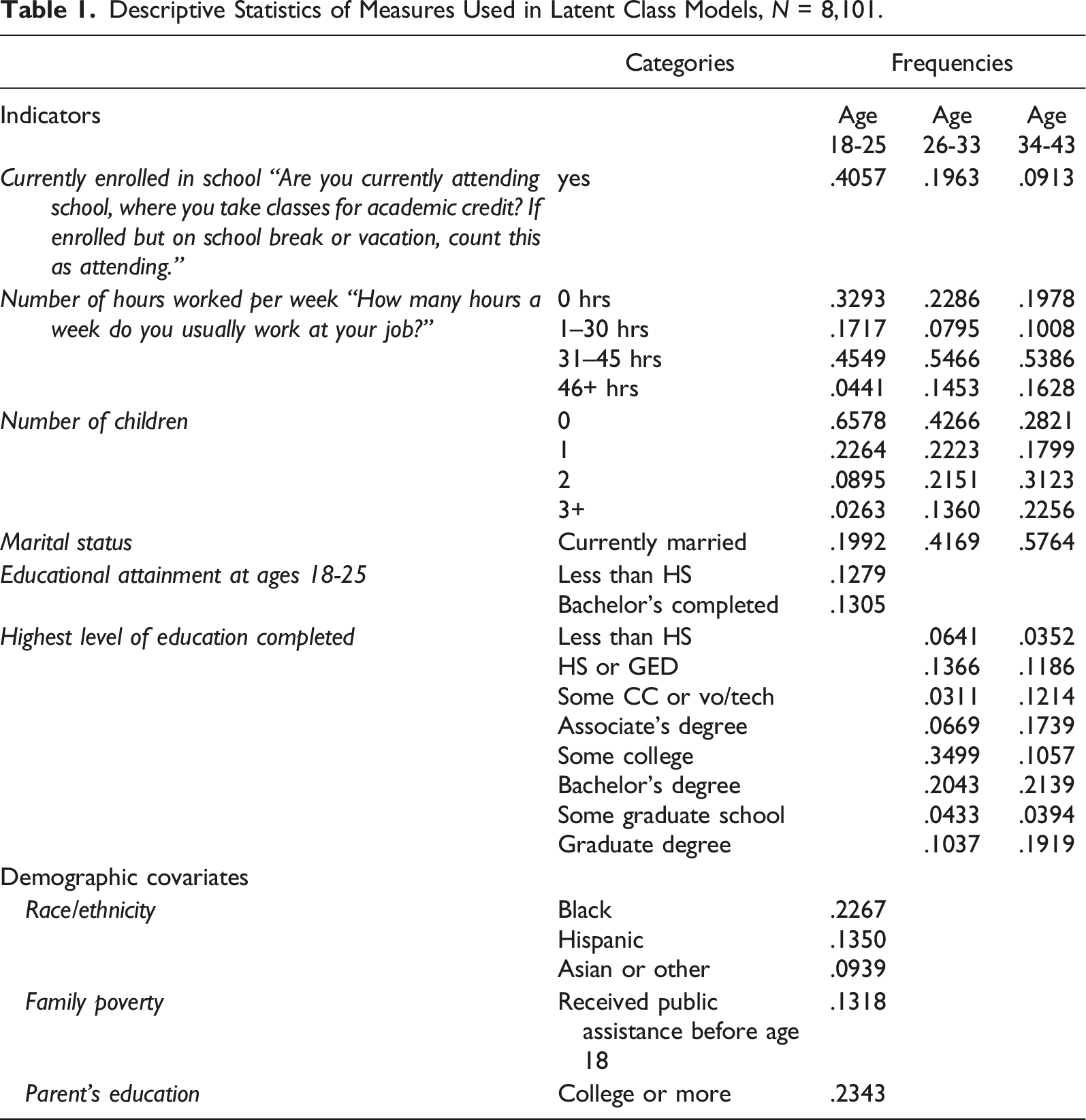
As our indicator of women’s academic enrollment status, we include a binary measure of whether or not individuals are currently enrolled in a school, that is, currently attending high school, community college, vocational/technical school, university, or graduate school.
As our indicator of educational attainment, we use a categorical measure of the highest level of education completed in young adulthood (ages 26–33) and middle adulthood (ages 34–43). This measure distinguishes whether the individual has completed less than a high school degree, a high school diploma or GED, some community college or vocational/technical school, an associate’s degree, some college, a bachelor’s degree, some graduate school, or a graduate degree. In emerging adulthood (ages 18–25), given respondents’ younger age and limited observations at higher education levels, we include binary measures of high school completion and bachelor’s degree completion as our indicators of educational attainment.
As the indicator of employment status, we use a categorical measure indicating the range of hours that individuals are typically working in a week, including 0 hours (not working), 1-29 hours, 30-45 hours, and 46 or more hours per week.
As indicators of family status, we use a binary measure of marital status (whether individuals are currently married or not) 3 and a categorical measure of the number of children, specifying whether respondents have no children, one child, two children, or three or more children.
In the covariate analysis, we use a categorical indicator of race (i.e., white, Black, Hispanic, Asian or other race) to examine how women’s pathways of family, work, and education vary across racial groups. To examine variation by socioeconomic background, we account for parents’ education (i.e., whether or not parents have a college degree or higher) and early family poverty (i.e., whether or not the respondent’s family received public assistance before age 18).
Results
Identifying Pathways of Women’s Family, Work, and Education
LCA Fit Statistics Summary.
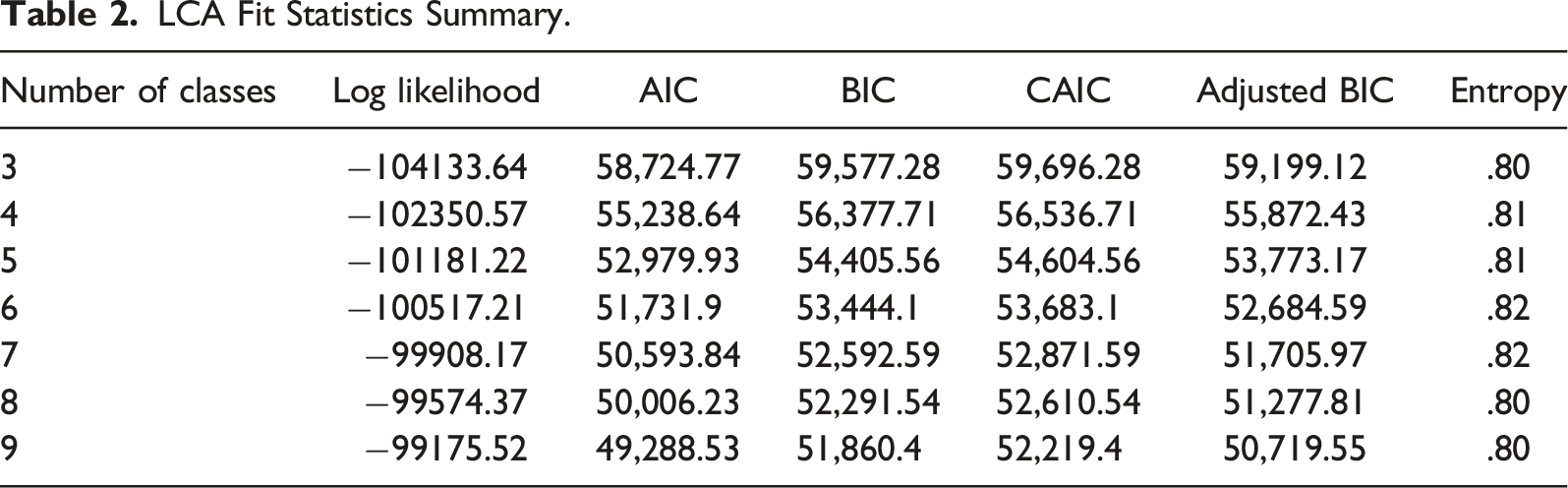
Description of the Latent Class Pathways
LCA Item Response Probabilities (ρ) for the Seven Pathways of Women’s Family, Work, and Education.
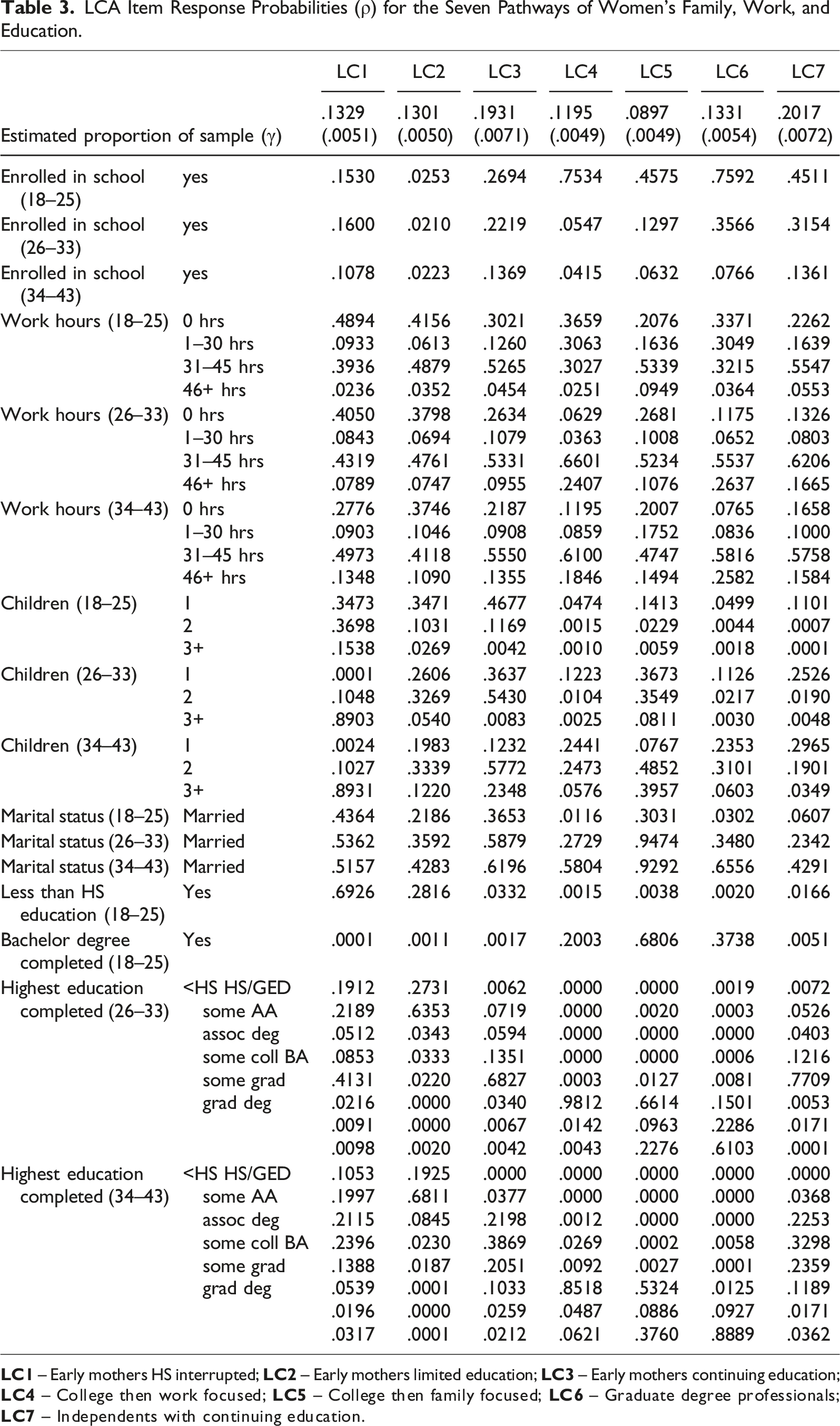
Based on the unique characteristics of each pathway emerging from the rho estimates in Table 3, we have assigned descriptive names to the seven latent classes: Early Mothers with HS Interrupted for LC1, Early Mothers with Limited Education for LC2, Early Mothers with Continuing Education for LC3, College then Work Focused for LC4, College then Family Focused for LC5, Graduate Degree Professionals for LC6, and Independents with Continuing Education for LC7. Here, we present an overview of the seven pathways, grouping the latent classes based on their similarities, and describing each based on their unique differences across transitions of family, work, and education throughout adulthood.
The first three pathways consist of “early mothers,” including LC1 (Early Mothers with HS Interrupted, γ = 13.29 percent of the sample), LC2 (Early Mothers with Limited Education, γ = 13.01 percent), and LC3 (Early Mothers with Continuing Education, γ = 19.31 percent). Women in these three pathways are more likely to have children between the ages 18 and 25, compared to all other pathways in our sample (i.e., probabilities of having one or more children in emerging adulthood are ρLC1 = 87.09 percent, ρLC2 = 47.71 percent, ρLC3 = 58.88 percent). However, each of these pathways illustrates a different pattern of how family, work, and education are configured together throughout adulthood. In particular, the Early Mothers with High School Interrupted (LC1) have the highest proportion of women without a HS diploma between the ages 18 and 25 (ρ = 69.26 percent), but this proportion decreases dramatically, as the majority of this group has completed a HS education or higher by their late twenties and early thirties (ρ = 19.12 percent less than HS). Some of the women in this group also continue their education to complete an associate’s degree by their late thirties and early forties (ρ = 23.96 percent). This educational pattern contrasts with the Early Mothers with Limited Education (LC2), who have a relatively lower proportion of women with less than a HS education at ages 18–25 (ρ = 28.16 percent), but also have the highest proportion of women whose education does not go beyond a HS diploma or GED throughout adulthood (ρ = 68.11 percent at ages 34–43). Lastly, among the three “early mothers” pathways, the Early Mothers with Continuing Education (LC3) have not only the lowest proportion of women without a high school diploma at ages 18–25 (ρ = 3.32 percent) but also the highest proportion of women continuing their post-secondary education into their thirties and forties (ρ = 10.33 percent with a bachelor’s degree and ρ = 38.69 percent with an associate’s degree at ages 34–43). In terms of work, compared to LC3, the women in LC1 and LC2 are more likely to not be working throughout adulthood (e.g., ρLC1 = 48.94 percent, ρLC2 = 41.56 percent not working at ages 18–25). Furthermore, about half of the Early Mothers with Continuing Education (LC3) and Early Mothers with High School Interrupted (LC1) are married by ages 26–33, while the Early Mothers with Limited Education (LC2) are slightly less likely to ever get married (ρ = 42.83 percent at ages 34–43).
We identify the next three pathways as women who notably complete their post-secondary education earlier in adulthood, namely LC4 (College then Work Focused, γ = 11.95 percent of the sample), LC5 (College then Family Focused, γ = 8.97 percent), and LC6 (Graduate Degree Professionals, γ = 13.31 percent). These three pathways are similar in their low likelihoods of having children or being married between the ages 18 and 25 (into their thirties as well for LC4 and LC6), while they focus on completing their post-secondary education during these earlier ages of adulthood. Specific to the College then Work Focused pathway (LC4), women in this group begin with a relatively low likelihood of working during college years (ρ = 36.59 percent not working, ρ = 30.63 percent working part time as emerging adults), then have the highest likelihood of working once they have finished college (ρ = 93.71 percent at ages 26–33, ρ = 88.05 percent at ages 34–43). Few women in this pathway continue their education beyond a bachelor’s degree (ρ = 6.21 percent with a graduate degree at ages 34–43). In terms of family, women in LC4 appear to delay marriage and childbearing during their twenties and early thirties as they focus on work, after which they are more likely to get married, have children, and in some cases, reduce their work hours by middle adulthood (ρ = 58.04 percent married, ρ = 54.9 percent with children at ages 34–43).
This pattern of focus on college then work differs from the College then Family Focused group (LC5, γ = 8.97 percent), which consists of a high proportion of women who complete their college education by age 25 (ρ = 68.06 percent), after which the likelihood of being married and having children dramatically increases in young adulthood (ρ = 94.74 percent married, ρ = 80.33 percent with children). Some of the women in LC5 continue their education after being married and having children, completing a graduate degree by ages 34-43 (ρ = 37.6 percent). Overall, work appears to be a more consistent part of LC5 women’s lives, throughout their late teens to early forties, which suggests that many women in this group are combining their work with education and family responsibilities well into middle adulthood.
The third pathway consisting of women who are focused first on their post-secondary education are the Graduate Degree Professionals (LC6, γ = 13.31 percent), who have the highest proportion of women with a graduate or professional degree by ages 34–43 (ρ = 88.89 percent). Women in this pathway follow a similar overall pattern as the College then Work Focused women in LC4, with a lower likelihood of being married and having children until ages 34–43, and a pattern of increasing work throughout adulthood (initially low as emerging adults, then higher at ages 26–43). In terms of family, women in this group notably have the lowest proportion of women with children, compared to those who are married in their twenties and thirties (34.8 percent married, 13.73 percent with children in young adulthood).
Finally, we refer to women in last pathway (LC7) as Independents with Continuing Education (γ = 20.17 percent of sample). This latent class consists of women who are likely to continue their education through community college and vocational/technical school into their thirties and forties (ρ = 55.51 percent with associate’s education or degree at ages 34–43). While this pattern of education may be similar to that of Early Mothers with Continuing Education in LC3, women in LC7 are clearly distinct from LC3 in that they are likely to remain unmarried and without children until much later in the life course (ρ = 23.42 percent married, ρ = 26.64 percent with children at ages 26–33). While most other latent classes in our study seem to reflect pathways that are shaped primarily around education or family, this final group appears to be more focused on work throughout their twenties and thirties, while continuing to pursue some post-secondary education over a longer stretch of their adulthood.
For further visualization of the seven pathways of women’s family, work, and education patterns, we include a graphical summary illustrating a subset of the rho estimates in Figure 1. Graphical Summary of the Seven Latent Class Pathways of Women’s Family, Work, and Education.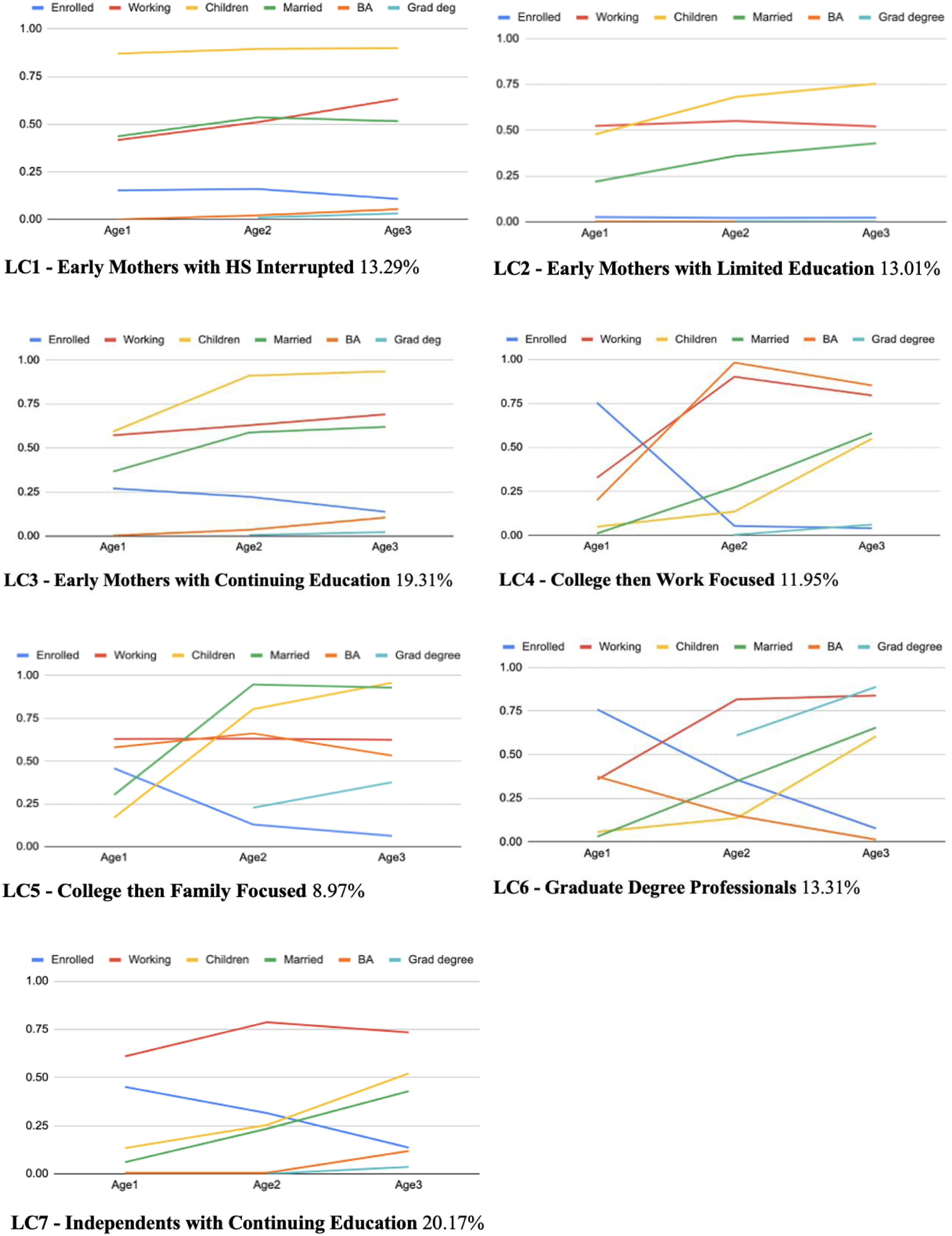
Covariate Analysis of Race and Socioeconomic Background
LCA with Covariates for Seven Pathways of Women’s Family, Work, and Education (Beta Estimates).
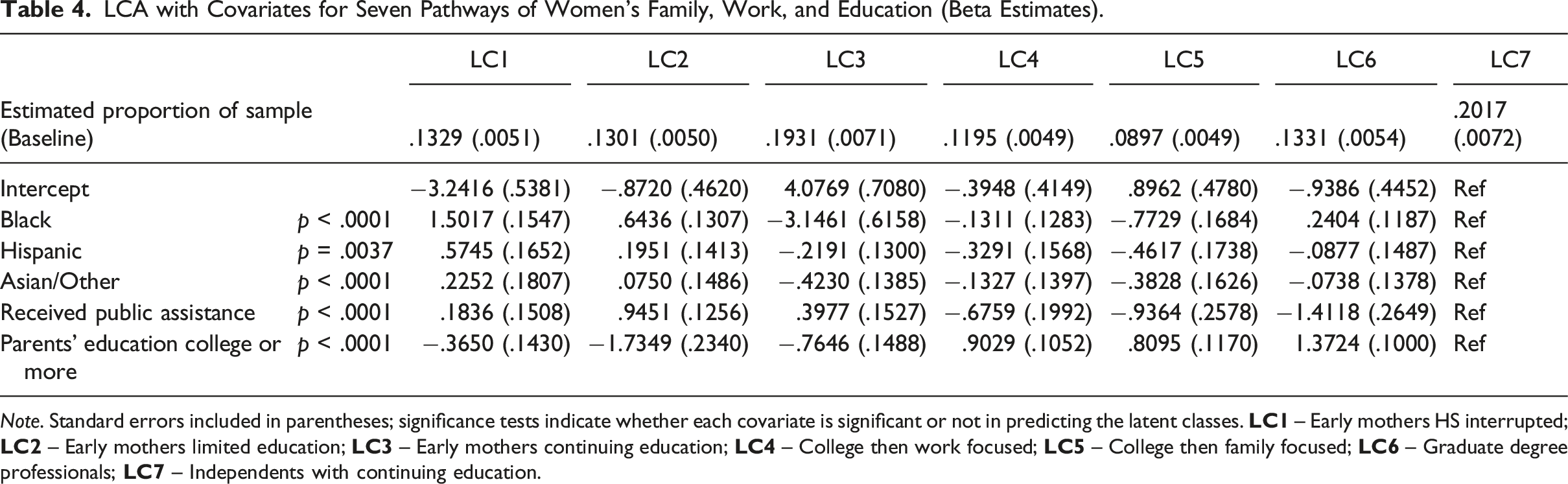
Note. Standard errors included in parentheses; significance tests indicate whether each covariate is significant or not in predicting the latent classes.
First, in contrast to the Independents (LC7), we find that Graduate Degree Professionals (LC6) are significantly less likely to have experienced family poverty as children and to have parents with a college educational background. Experiencing this pathway of family, work, and education appears to be related primarily to socioeconomic background.
A closer look at the three pathways with women more likely to experience early motherhood reveals that Early Mothers with Limited Education (LC2) are significantly more likely than Independents (LC7) to be Black, to have experienced family poverty as children, and to have parents with less than a college education. Early Mothers with HS Interrupted (LC1) are significantly more likely to be Black or Hispanic, and to have parents with less than a college education. Early Mothers with Continuing Education (LC3) are significantly less likely to be Black or Asian (compared to white), while more likely to have experienced family poverty as children and to have parents with less than a college education. We find that all pathways of early motherhood are significantly related to having a less advantaged socioeconomic background, but not all are related to race in the same way: the experience of early motherhood without substantial interruption in high school or limited educational opportunities long-term appears to be most common among white women, compared to non-white women in these contexts.
Turning to the two final pathways, we find that the College then Work Focused group (LC4) is significantly less likely to have experienced family poverty as children, and to have parents with a college educational background. The College then Family Focused group (LC5) is significantly more likely to be white, to not have experienced family poverty as children, and to have parents with a college educational background. While both college-centered pathways reflect the experience of women with socioeconomically privileged backgrounds, we find that the College then Family Focused pathway is likely to be shaped by a combination of both race and socioeconomic factors.
Discussion and Conclusions
This study takes a longitudinal perspective to explore how women’s combined experiences of family, work, and education are configured from age 18 to their early 40s. Using repeated measures LCA, we present a thorough illustration of the diversity of pathways that women experience, particularly highlighting important differences within broader categories of life course events such as early parenthood, and distinguishing between different levels of higher education. Using a more detailed measure of education compared to previous similar studies, our work illustrates important variations in the timing of women’s educational enrollment and re-enrollment, as well as different levels of completed education (including community college and graduate school). We find seven distinct pathways that outline how women are configuring their family, work, and education roles between the ages 18 and 43, which in many ways extends the work of various qualitative studies on work and family (e.g., Duquaine-Watson 2017; Gerson 1986; 2011; Katz 2019) by using a statistical approach that articulates the overall structure of women’s combined experiences over the life course. Each pathway delineated in our study relates to a broader discourse of unequal opportunities and resources in women’s education and work, and further reflects historical inequalities in the role of work in mothers’ lives (Damaske 2011; Lu, Wang, and Han 2017; Willson 2003).
Among the seven pathways experienced by women throughout adulthood, we specifically find two in which women are likely to continue college education into their thirties and forties but differ in their timing of marriage and having children (i.e., Early Mothers with Continuing Education, Independents with Continuing Education); two other pathways in which women are likely to become mothers at an earlier age but whose educational trajectories differ in substantial ways (i.e., Early Mothers with High School Interrupted, Early Mothers with Limited Education); and three pathways in which women are likely to focus first on completing their college or graduate education, but differ in their timing of work and family throughout adulthood (i.e., College then Work Focused, College then Family Focused, Graduate Degree Professionals). By examining how family, work, and education are configured together, instead of viewing education as an antecedent or separate process from work and family, our results highlight the fluidity of education in many women’s lives, while challenging the notion that completing one’s education and transitioning from school to a full-time job are part of a discrete set of markers defining the transition to adulthood (Settersten, Ottusch, and Schneider 2015; Shanahan et al. 2005).
Linking our findings to broader patterns of how women from different racial and socioeconomic backgrounds are most likely to experience the configurations of family, work, and education as adults, we find that our pathways are largely consistent with theoretical expectations, but with key differences. Specifically, our analyses reveal that women who continue their education at community college in the Early Mothers with HS Interrupted (LC1) and Independents with Continuing Education (LC7) pathways are more likely to be Black, which is consistent with the literature. However, we also find that not all groups with higher attendance at community college are likely to be Black, including the Early Mothers with Continuing Education (LC3). Additionally, our findings indicate that it is not uncommon for many women to be enrolled in higher education into their thirties and forties, especially as “nontraditional” students who combine their education with work and family in some way (as in LC7), rather than completing their education without interruptions. While prior studies highlight that women who combine work with education across adulthood are more likely to come from lower socioeconomic backgrounds, we find that Independents with Continuing Education (LC7) have lower socioeconomic backgrounds compared to some groups (i.e., College then Family Focused and Graduate Degree Professionals) but not others (i.e., Early Mothers with Limited Education and Early Mothers with Continuing Education). Overall, our findings highlight the heterogeneity of women’s experiences which are effectively captured and described using our particular analytical approach.
In terms of socioeconomic differences, we find that some of the most socioeconomically disadvantaged individuals in our study, such as Early Mothers with Limited Education (LC2), are most likely to not be working full-time or at all by their thirties and forties. In contrast, some of the most socioeconomically advantaged women in the Graduate Degree Professionals group (LC6) are likely to work the longest hours per week throughout their thirties and forties compared to all other pathways, even after having children; this confirms studies that find women’s ability to work depends largely on their available resources and social environment (Damaske and Frech 2016; O’Rand 2006). Such inequalities are relevant to broader questions of how limited women’s experiences of achieving work–family balance may actually be, and the extent to which U.S. policies and attitudes impact these unequal experiences (Collins 2019). Further considering the overlapping effects of race and socioeconomic background, we find the College then Family Focused pathway (LC5) to be most likely among a particularly limited subgroup of women who are white, married, have highly educated parents, have high levels of educational attainment themselves, and are essentially able to afford reducing their work hours while managing other family responsibilities. While the present study does not include interactions between socioeconomic status and race due to data limitations, we invite future research to further investigate such intersectional differences in women’s pathways throughout the life course.
Our study summarizes the life course experiences of a specific cohort of women, who are in their thirties and forties by 2016–2018. In other words, this allows us to look at the pathways that many women who are adults today have taken in regards to their family, work, and education roles. However, our findings cannot speak to what these patterns would look like for younger or older cohorts. We invite future research to explore the pathways of other cohorts of women, including how some women may have experienced the COVID-19 pandemic and its effects on family, work, and education differently, depending on the specific conjunctures they experienced during these unique years (Johnson-Hanks et al. 2011; Sewell 2005). Additionally, we invite future work by quantitative researchers to continue this line of research by investigating how the diverse patterns of women’s transitions between family, work, and education may be impacted by other critical factors, such as occupational status, the specific characteristics of women’s jobs, as well as different types of support that women are able to draw upon formally, informally, financially, or instrumentally. Future studies by qualitative researchers may also expand on this work by exploring the underlying processes and mechanisms that may ultimately be involved in shaping these pathways and life course transitions across various contexts of women’s work–family lives.
Footnotes
Acknowledgements
We would especially like to thank Dr. Lisa D. Pearce for her support throughout the revision process of this study.
Declaration of Conflicting Interests
The author(s) declared no potential conflicts of interest with respect to the research, authorship, and/or publication of this article.
Funding
The author(s) disclosed receipt of the following financial support for the research, authorship, and/or publication of this article: This research uses data from Add Health, funded by grant P01 HD31921 (Harris) from the Eunice Kennedy Shriver National Institute of Child Health and Human Development (NICHD), with cooperative funding from 23 other federal agencies and foundations. Add Health is currently directed by Robert A. Hummer and funded by the National Institute on Aging cooperative agreements U01 AG071448 (Hummer) and U01AG071450 (Aiello and Hummer) at the University of North Carolina, Chapel Hill. Add Health was designed by J. Richard Udry, Peter S. Bearman, and Kathleen M. Harris at UNC Chapel Hill.
