




Abstract
Public understanding of violence against women, and appropriate solutions to tackling gender-based violence, have changed enormously over the past 50 years. In this paper, we study how violence against women is practically understood through organizational efforts to frame and combat it in the United States. We use topic modeling and dictionary-based content analysis to explore the missions and programming of 918 service and advocacy nonprofits directly involved in anti-violence work between 1998 and 2016. We find that, in contrast to earlier foci on direct crisis intervention, anti-violence organizations increasingly understand violence against women as a multifaceted problem that must be addressed by comprehensive programming. We also find that nonprofits increasingly use medicalized, criminal-legal, and bureaucratic language to describe their work, underscoring the tensions of institutionalization.
Public understanding of violence against women has changed enormously over the past 50 years 1 . Once publicly ignored or understood narrowly as “wife battery”—violence perpetrated by husbands against wives (Brownmiller 1975; Rose 1977; Tierney 1982)–violence against women is now recognized as a global phenomenon that occurs to women and girls, both at home and at work, and to women of all ethnicities, sexualities, and nationalities. Activists efforts’ against both domestic violence and sexual violence have driven redefinition of violence against women (Bevacqua 2000; Dobash & Dobash 1987; McGuire 2011; McMahon 2019), leading to widespread adoption of contemporary terms like “domestic violence,” “intimate partner violence,” “femicide,” and “sexual and relationship violence.” Moreover, organizations now have the capacity to confront violence against women in myriad ways, ranging from crisis intervention to long-term supports and services. For feminists and anti-violence activists, these changes are often viewed as a victory: organizations today arguably have more resources and frameworks to confront domestic and sexual violence than in the past.
However, the response to violence against women has also become institutionalized as anti-violence work has gained resources and legitimacy. Contemporary knowledge about violence against women is informed by not only activists, but also by legislation, criminal and civil legal systems, and hospitals that increasingly fund and integrate with anti-violence services. These institutions understand violence against women in specific ways, and advocates have raised concerns about the importation of frameworks from policing and medicine into anti-violence advocacy (Kim 2013; Mehrotra, Kimball, and Wahab 2016; Nichols 2013; 2011; Weiss 2020). Critics also suggest that the anti-violence field has “bureaucratized” as it has grown, fracturing broader efforts toward social change (Lehrner and Allen 2008; Mehrotra, Kimball, and Wahab 2016; Nichols 2013; Sweet 2019). Activists wonder if this institutionalization narrows the definition of violence against women and limits the ability of organizations to successfully respond to violence.
Unfortunately, it is challenging to directly assess whether definitions of violence against women are broadening, or narrowing, as no representative longitudinal surveys of organizations’ anti-violence practices exist and continuous surveys of such organizations may be resource intensive and impractical. In this article, we respond to this challenge by using computational text analysis to evaluate narratives about violence against women, particularly among organizations that work with women in crisis, or who advocate against violence. Anti-violence organizations are key “civil agents” (Alexander 2018:22) in the construction of violence against women as a social problem, and we argue that by following anti-violence organizations’ narratives about their activities, it is possible to understand the emerging horizon of how violence against women is conceptualized and combatted. We document the history of work by service and advocacy organizations in this area, as well as the contexts these organizations faced in developing their approach to solutions. Then, with text from a set of 918 anti-violence nonprofits from 1998 to 2016 we use topic modeling—a computational text analysis technique—to identify the narratives organizations chose in describing the problem as well as the directions organizations are heading. We also use dictionary-based content analysis to investigate whether anti-violence organizations have adopted “medicalized,” “criminal-legal,” and “bureaucratic-rational” paradigms in their services and advocacy over time.
Our results show that violence against women is increasingly understood as a multifaceted problem that organizations can intervene in through diverse social services for women. Partially qualifying critical accounts, topic models indicate that anti-violence organizations do increasingly combine extensive and holistic approaches with traditional crisis services in their service and advocacy work. However, dictionary-based analyses also suggest that anti-violence organizations are importing medical, criminal-legal, and bureaucratic paradigms into their programming even as they diversify their strategies overall. We argue these findings yield insights for not only scholars of gender and violence, but also research on the social construction of social problems, allowing researchers to understand how social problems dynamically change and evolve (Hilgartner and Bosk 1988:54; Best 1987). We argue further that our findings showcase how automated textual analysis can be used to track organizational activities across the United States, providing a practical solution to the costly task of surveying anti-violence work.
Changing Responses to Violence against Women in the United States
Violence against women came to the fore of American public attention in the early 1970s. Following decades of neglect (Johnson 1981), domestic and sexual violence was publicly named and confronted in the early 1970s by activist women who founded consciousness raising groups, solidarity networks, and formal organizations to address cultural patriarchy and gender inequality. Activist networks were often divided: between liberal feminists, radical feminists, socialist feminists, and anti-violence activists who did not identify as feminists at all (McMahon 2019), as well as along lines of race and class that tended to separate white women’s activism from Black women’s anti-violence activism occurring in Black-led organizations (Bevacqua 2000: 26–42; McGuire 2011; see also Mehrotra, Kimball, and Wahab 2016). Nonetheless, sustained activism spurred the formation of two distinct, but interrelated, movements against violence: a movement against relationship violence, later called “domestic violence,” and a movement against rape and sexual assault.
Initially known as the “battered women’s movement,” domestic violence activists sought to provide emergency services for women escaping violence committed by spouses or intimate partners. Activists, many who had themselves previously experienced battery, initially operated refuges out of their own homes before seeking resources to create the first “domestic violence shelters” (Tierney 1982). Second-wave feminists founded the first domestic violence shelters in the United States in 1973 (Rodriguez 1988; Schechter 1982), and within a decade nearly 1,000 shelters for women were registered with the National Coalition Against Domestic Violence (Dobash & Dobash 1987). Rodriguez (1988) describes the explicitly radical feminist politics of the pioneering Family Crisis Center in Hawaii, who combined consciousness raising about male domination with housing services. In Rodriguez’s (1988:237) account, the Family Crisis Center viewed itself as part of a political movement on behalf of “battered wives,” and explicitly used the framing of battery because “feminists resist the terms ‘domestic violence’ and ‘spouse abuse’ because these obscure the view that battering is a women’s issue.”
Simultaneously, activists throughout the 1970s founded formal organizations to broadly confront rape, sexual violence, and harassment. Black women, through civil rights organizations like the Committee for Equal Justice of the NAACP, had long led public campaigns and legal activism against sexual violence committed by white men against black women as part of the larger Black freedom struggle (McGuire 2011). In the early 1970s, however, young white women inspired by the civil rights movement began to experiment with a diversity of tactics to confront sexual violence in white communities, including teaching self-defense classes for women or even leading guerilla actions against men accused or convicted of rape (Bevacqua 2000: 66–69). These efforts eventually led to the formation of the first crisis hotlines and rape crisis centers for women, which expanded from Washington D.C. to 43 U.S. states between 1972 and 1974 (McMahon 2019:50). Motivated by transformational theories of women’s liberation, and skeptical of politicians and institutions like hospitals, police, and prosecutors, the first rape crisis centers often eschewed state funding and relied entirely on private donations (Bevacqua 2000).
Of course, scarce resources determined what both domestic violence and rape crisis organizations could actually provide. Organizations struggled to provide basic services for women where none existed prior, and services for women who were not young, married, and white remained rare in most cities through the 1990s (Ho 1990; Vinton et al. 1997). Educational and community outreach activities could be viewed as distractions. External directors of the Family Crisis Center in Hawaii observed by Rodriguez viewed consciousness raising activities as politically motivated deviations from the center’s core mission (Rodriguez 1988:246). These dynamics indicate that early anti-violence organizations prioritized crisis intervention over more diverse interventions that they would have liked to offer.
The contemporary context of anti-violence work is markedly different from its grassroots and resource-scarce beginnings. Anti-violence organizations today have both far more resources, pay far greater attention to the diversity of women affected by violence, and experience far more institutional legitimacy and oversight than the first shelters founded by feminist activists in the 1970s. First, anti-violence organizations objectively have more resources today than in the past. In 1994, the Violence Against Women Act (VAWA) began authorizing $60 million to more than 200 nonprofit organizations to “provide civil legal services to victims of domestic violence” (Farmer and Tiefenthaler 2003:167). This substantially expanded the funding available to anti-violence organizations in general, giving organizations room to expand services as they have become partners with local governments in privately administering public funding (Bumiller 2009).
This expansion of anti-violence services into American society has transformed the orientation of anti-violence organizations. Early anti-violence organizations tended to see their mission as helping women leave an abusive partner (Sullivan 2011). This orientation was straightforward in the context of movements on behalf of white, Western, “battered wives” (Rodriguez 1988), but problematic when women have diverse orientations to domestic violence informed by religious, cultural, and ethnic practices (Yoshioka and Choi 2005). Women also have varied capacity to leave abusive relationships, depending on their citizenship status, access to employment, and the size of their local cultural community of identification (Yoshioka and Choi 2005:514). Anti-violence organizations have reckoned with these heterogeneous needs as domestic violence shelters, crisis hotlines, and other organizations have expanded into various communities. Services for violence against women have become increasingly individuated and tailored around the outcomes preferred by the communities that nonprofits serve as a result.
However, the growth of resources for anti-violence organizations has also created new tensions in service and advocacy work. Advocacy organizations are now accountable to external stakeholders and funders, who emphasize the production of “organizational narratives” that describe responses to domestic and sexual violence for auditors and funders (Sullivan 2011; Sweet 2019). These evaluations can be at odds with organizations’ goals: Sullivan (2011:355) notes that domestic violence shelters are encouraged to reduce the number of women who report returning to an “abuser” post-intake, or who return for services at all, which may not be effective or helpful to women. Organizations working on violence against women are also not immune to processes of rationalization occurring generally in service and advocacy organizations, with intense pressure to be financially transparent, produce measurable impacts, and be accountable to external stakeholders (Barman 2016; Bergstrom-Lynch 2018; Brandtner 2021; Hovarth forthcoming; Korff, Oberg, and Powell 2015). Feminist ideals of horizontal governance and activist staff have conflicted with hierarchical staff models in the human services (Schechter 1982). Moreover, feminist observers have criticized the shelter movement for becoming “bureaucratic,” as this institutional shift in anti-violence initiatives distances organizations from their fundamental missions and the pressing needs of marginalized communities (Bumiller 2009; Lehrner and Allen 2008; Macy et al 2010; Markowitz and Tice 2002; Mehrotra, Kimball, and Wahab 2016; Nichols 2013). As a result, anti-violence organizations may be becoming rationalized and technical in their approach to social problems, and more bureaucratic in their structure, even as they diversify their anti-violence strategies (Mehrotra, Kimball and Wahab 2016).
Another critical transformation is the integration of anti-violence advocacy with state resources, legal regimes, and policing. Following decades of criticism from advocates who alleged that police did not take “wife battery” seriously (Berk and Loseke 1980) state and federal officials have significantly increased the scope of prosecuting and arresting activity by police in domestic violence cases. The VAWA of 1994 and its re-authorizations, for example, has funded the prosecution of sexual and violent crimes against women. VAWA also institutionalized violence against women as a specific domain of crime (Modi, Palmer, and Armstrong 2014:254), creating funding sources for domestic violence shelters while emphasizing the importance of coordination between law enforcement and shelter services. The blending of policing and anti-violence work has made criminal-legal interventions central to the work of advocacy organizations, who now prioritize efforts to report victimization or otherwise cooperate with law enforcement (McDermott and Garofalo 2004; Weiss 2020). However, criminalization may not benefit all women and may have unintended consequences for marginalized populations (INCITE! 2001; Kim 2013; Mehrotra et al 2016; Richie 2012). Weiss (2020, 2021) argues that the integration of policing with activism has led organizations to compartmentalize violence against women into distinct criminal activities (such as stalking, sexual assault, and domestic violence), to the neglect of a comprehensive approach. Organizational definitions of violence against women also now discipline women’s self-narratives about their experiences and circumscribe the range of responses available to them (Sweet 2019). Policing paradigms may even lead advocates to pressure clients into criminal cases despite mixed evidence for their need and efficacy (Kim 2013; Mehrotra, Kimball, and Wahab 2016; Xie and Lynch 2016).
Increasing connections between anti-violence organizations and public health, social work, and mental healthcare has similarly expanded the horizon of anti-violence services. Violence is increasingly recognized as a risk-factor for women’s health (Durazo 2006; Garcia-Moreno et al. 2005; Sweet 2015), so much so that medical accreditors now recommend that all “female patients” should be screened for domestic violence in hospitals (U.S. Preventive Services Task Force 2012). The “medicalization” of domestic violence and sexual violence has encouraged a preventative and therapeutic view of violence against women. Organizations today not only attempt to provide services for women in emergencies, but often seek to alter the life trajectories of women post-contact with organizations (Cattaneo and Goodman 2015). Services inspired by this perspective, such as school-based programs on dating violence, visits by community health workers to women and girls who have witnessed or experience violence, and workshops about the co-occurrence of sexual violence with other disorders like mental health and substance abuse, have become a key component of anti-violence programming (Garcia-Moreno et al. 2005:1,691). At the same time, the integration of anti-violence advocacy with health care systems and professionals possibly over-simplifies violence against women (Briones-Vozmediano et al. 2018). Medicalization may pressure anti-violence organizations to take a narrow approach to their work as they cooperate with highly-institutionalized sectors, such as hospitals and public healthcare organizations (Briones-Vozmediano et al. 2018; Sweet 2015; Wilkerson 2019).
In sum, the literature on anti-violence activism suggests three expectations. First, the expansion of resources to anti-violence organizations over the past 30 years implies that anti-violence organizations have more capacity today than in the past. Further, organizations have come to recognize the diversity and heterogeneity of the populations with whom they work. At a minimum, this suggests that contemporary anti-violence organizations are trending towards more diverse and extensive interventions in women’s lives, with less attention to crisis intervention alone, in their programming.
A topical focus on direct services and crisis intervention has declined over time in the narratives used by anti-violence organizations while a topical focus on diverse and multifaceted services has increased. However, the increasing resources available for anti-violence work has also been viewed as an accelerant to rationalization and bureaucratization pressures that exist in the nonprofit sector writ large (Bergstrom-Lynch 2018; Brandtner 2021; Korff, Oberg, and Powell 2015). Thus, anti-violence organizations may be becoming increasingly rational and technical in their approach to social problems, and more bureaucratic in their structure, as they diversify their anti-violence strategies.
The narratives used by anti-violence organizations increasingly signal bureaucratic and rationalized approaches. Furthermore, rising cooperation between anti-violence organizations and hospitals, police, and legal systems has encouraged the importation of medicalized and criminal-legal frameworks into anti-violence advocacy. Concerns about “risk-factors for violence” and the “co-occurrence” of violence with other mental and physical conditions may lead organizations to adopt health screenings and therapeutic practices into their own advocacy work, for example (Cattaneo and Goodman 2015; Garcia-Moreno et al. 2005.) Likewise, when organizations receive state funding that encourages shelters and crisis agencies to cooperate with police agencies, advocates will be more likely to raise concerns about prosecution, criminality, and the potential for conviction in their work.
The integration of anti-violence work with health institutions and criminal-legal systems has spread medical and policing language in anti-violence organizations. In what follows, we argue that automated textual analysis represents an effective way to investigate these questions and track emerging organizational conceptions of violence against women. Employing administrative records, we analyze 20 years of mission statements and programming undertaken by 918 anti-violence service and advocacy organizations in the United States, allowing us to directly evaluate how anti-violence organizations both describe violence against women and produce auditable records of confronting domestic and sexual violence. We then employ computational text analysis, including Structural Topic Modeling and Dictionary-Based Content Analysis, to track how organizational understanding of violence against women has evolved and transformed.
Data: Forms 990 and Anti-Violence Organizations
We investigate the priorities and approach of 918 nonprofit anti-violence organizations dedicated to domestic and sexual violence. We follow these 918 organizations over the period 1998–2003 and 2010–2016, yielding a total of 8,123 organization-year observations. Our data on the activities of service and advocacy organizations comes from Forms 990, an annual return required by the U.S. Internal Revenue Service (IRS) for nonprofit organizations.
We use mission statements and program service accomplishments texts in Forms 990 to classify organizations and their narrative understanding of violence against women. Missions describe “an organization’s unique raison d’etre” (Williams 2008:96), define its purpose (Minkoff and Powell 2006; Pope et al. 2018) and tend to describe the organization’s orientation in broad and general terms. Lists of program service accomplishments, meanwhile, account for items like clients served, types of services, or publications issued by an organization.
Mission and program service narratives in Forms 990, like organizational narratives in any state-facing document, could be critiqued as bureaucratic speak vulnerable to “value decoupling” (Meyer and Rowan 1977; Horvarth forthcoming). Contemporary nonprofit organizations face high levels of scrutiny from state regulators, funders, and nonprofit evaluators such as GuideStar and Charity Navigator, and nonprofits may respond to calls for accountability through “ritualistic assurances” (Feldman and March 1981:177)—the decoupling of internal practices from what is written in formal evaluations like Forms 990. Mission and program narratives in Forms 990 could thus be critiqued as unreflective of the internal evaluations, communications with staff, and efforts to reach funders and volunteers that occur in organizations confronting domestic and sexual violence.
However, as Horvath (forthcoming) explains, ideals of transparency in contemporary audit society have often resonated with nonprofit leaders invested in ideals of community accountability. For nonprofits facing calls for transparency, disclosures in mission statements and program service accomplishments present an opportunity to narrate organizations’ values, operationalize their “idealized, normative projections” into concrete practices (Power 1997:4), and ultimately define and communicate their internal standards of evaluation to outside stakeholders (Horvarth forthcoming). Moreover, because nonprofits leaders often feel constrained by externally defined, quantitatively oriented definitions of success, Hovarth (forthcoming: 26–34) finds that nonprofit leaders have substantially lengthened their disclosures by using them to demonstrate their organizations’ qualitative uniqueness and “bespoke performance standards” to stakeholders.
These transformations have created a closer correspondence between reporting documents and other nonprofit materials, increasing the utility of Forms 990 for research. In an auxiliary analysis, we examined 500 nonprofit websites across 5 categories of nonprofit organizations to assess the correspondence of language used in 990s and in other nonprofit materials. We sampled an average of 90 (minimum 73, maximum 106) organizations per category of nonprofit and assessed their websites for correspondence between the mission statement in the 990 and the website mission statement. Nonprofits were classified as having no web presence, a web presence but no mission reported on the web, a web presence and similar mission language between the 990 and the web, and a web presence with exact language between the 990 and the website. In every case that a mission statement (or equivalent) was found on a website, it used either exact language or similar language to what was reported in the Form 990. 91% of nonprofits had a usable website and 75% of those reported a mission on the website.
We argue, therefore, that Forms 990 can deepen previous qualitative research on anti-violence organizations by providing an accessible means to track how large numbers of organizations narrate their understanding of violence against women, operationalize their efforts to combat violence, and ultimately internally audit their practices and share their evaluations with funders.
Data for the 1998–2003 period come from a historic database of Form 990 filings available through the National Center for Charitable Statistics (NCCS). Data for 2010–2016, meanwhile, come from Form 990s available through the IRS e-filer database accessible on Amazon Web Services (about 60%–65% of all 990 filers). Data from 2003 to 2010 are missing because digitized nonprofit mission statements are not provided by the NCCS past 2003 and were not available in a machine-readable format until the release of the e-filer database in 2010. 163 organizations had data in the earlier period but not in the later period. Some of these organizations likely “died” while others may have never e-filed in the later period.
In each year, we concatenated name, mission, and all reported program service accomplishments and then pre-processed them to remove some punctuation and convert to lowercase, correct misspellings, and isolate words. 78% of text comes from program service accomplishments and the rest is from mission statements. Most organizations list three or fewer program service accomplishments. In our main analyses, we therefore limited each organization’s program service accomplishments to three to avoid unbalanced word counts. Results are similar with additional program service accomplishments included.
Our set of organizations focused on violence against women is a subset of all 501(c)3 nonprofits that filed Forms 990 and Forms 990EZ in the United States (∼150,000 nonprofits). We identified nonprofit organizations working on violence against women by focusing on two kinds of organizations: (1) organizations located in institutional fields that explicitly focus on violence against women (e.g., “Family Violence Shelters”), and (2) organizations located in adjacent fields (e.g., “Family Services”) that also mention both women and domestic and sexual violence in their mission and core programming. The IRS uses the National Taxonomy of Exempt Entities (NTEE) to classify nonprofits into categories and subcategories by purpose, type, or major function, such as Human Services, Education, and Housing organizations. We use three NTEE field subcategories to identify organizations that explicitly focus on violence against women: “Spouse Abuse Prevention” (I71), “Family Violence Shelters” (P43), and “Sexual Assault Services” (F42). We include all nonprofits—821—working in these three fields in our sample.
Of course, many service and advocacy organizations exist outside of these NTEE subfields and also combat domestic violence and sexual violence. To identify organizations located in adjacent fields, we analyzed the mission statements of organizations that fall into the first category (I71, P43, and F42) to reveal relevant terminology for programs devoted to violence against women that could help flag other fields where anti-violence work frequently occurs. We then determined which other NTEE subfields had at least 100 mentions of common terms 2 found in I71, P43, and F42 anti-violence organizations. This identified Victim Services (P62), Sexual Abuse Prevention (I73), Protection Against Abuse (I70), Family Services (P40), and Single Parent Agencies (P42) as additional NTEE subfields where at least some organizations focused on violence against women. We included additional organizations in our sample as anti-violence organizations if they were located in one of these fields and mentioned words from both of the following sets in their texts: (1) “women,” “woman,” “spouse,” “spousal”; and (2) “domestic violence,” “rape,” “raped,” ”batter,” “battered,” “abuse,” “abused.” We therefore also include nonprofit organizations working in fields adjacent to anti-violence work that prioritize working with women and domestic and sexual violence—an additional 97 organizations. 3 Similar procedures using text to identify gender have been used by Clayton, Josefsson and Wang (2017) in analyses of speeches in legislative assemblies, as well as by Pearson and Dancey (2011).
After identifying nonprofits working on violence against women in this way, we limited our sample to organizations that existed in the 1990s and which also mentioned the term “victim” or “victims” in their missions and programming at that time. This strategy excludes new organizations, allowing us to evaluate longitudinal change in how organizations target their services (although we cannot therefore evaluate whether new organizations are founded using different language). It also ensures all included organizations specifically mention working with individuals who have experienced trauma, who were widely understood as victims circa 2000 (Messamore and Paxton 2021). Altogether, we created a final count of 918 organizations that work on domestic violence and sexual violence.
Methods
We perform computational text analysis on our identified set of nonprofits to investigate how service and advocacy organizations describe their efforts to combat violence against women. Computational text analysis works with text as data, quantifying text and allowing comparison across many documents. We use two techniques popular in computational text analysis. First, we use topic modeling, an unsupervised inductive machine learning technique which is widely used to find hidden semantic structures (topics) in text. Second, we use dictionary-based content analysis to capture theoretically-relevant concepts directly.
Topic Modeling
Through an optimization process, topic modeling finds topics which best describe the relationship between the distribution of words across documents, the overall probability distribution of words, and the proportion of topics in a single document. Topic modeling is “unsupervised”: it finds a combination of probability distributions that best express the data without giving any theoretical a priori priority to a particular topic or word. That is, topic modeling is a bottom-up, inductive process of describing text, rather than requiring a top-down decision-making process. Topic modeling also acknowledges that a single document can consist of multiple topics, unlike other clustering techniques that assign one document to only one topic. Thus, topics cross documents, and individual documents are viewed as constructed from the combination of multiple topics.
We chose the Structural Topic Model (STM) algorithm. Early work (DiMaggio, Nag and Blei 2013; Fligstein et al. 2017) used the Latent Dirichlet allocation (LDA) algorithm as a simple but powerful model. However, more recently Bail et al. (2017) and Lindstedt (2019) stress that STM provides significant advantages to the analysis of longitudinal text data. Unlike LDA, STM uses not only the content of the document but also metadata (e.g., the year a document was created and document author attributes) as a parameter to determine the distribution of topics and words constituting the topic (Roberts, Steward, and Tingley 2019). Because we use longitudinal text data from 1998 to 2016, STM enables higher accuracy estimation than conventional LDA processes, and allows more interpretable results (Roberts, Stewart, and Tingley 2019).
Researchers must decide the number of topics that best describe the corpus of text under consideration. Two criteria are widely used in determining the number of topics: Semantic Coherence and Exclusivity. Semantic Coherence measures the internal coherence of topics (Mimmo et al. 2011). It shows how much the same words appear in different documents that are associated with a given topic. Conversely, Exclusivity assesses how much each topic is semantically distinguishable from other topics. Researchers typically try to balance the two, creating a set of coherent and distinct topics with minimal additional outlier or residual topics. We initially selected a range of 10 to 40 topics, ultimately finding that 15 was optimal at maximizing the balance of exclusivity and semantic coherence.
Although topic modeling automatically classifies documents, words, and topics in accord with a selected number of topics, the substantive meaning of each topic must still be determined. To appropriately connote and label each topic, we undertook a multi-step process. First, we used beta (β), the word probabilities within each topic, to provide a list of the 10 highest probability words in each topic. Figure A in the Appendix shows the words which have the highest β score of each topic – the most frequent words in each topic. Some words are frequent in multiple topics. Thus, we also considered FR/EX words (Bischof and Airoidi 2012). FR/EX stands for FRequency/EXclusivity and measures the relative uniqueness of words across topics. FR/EX words are the words that are both frequent and relatively exclusive to a topic. Among the most frequent words across topics, FR/EX produces those that are more likely to appear in a topic compared to others. A single FR/EX word can only appear in one topic and helps identify the essential meaning of one topic compared to another.
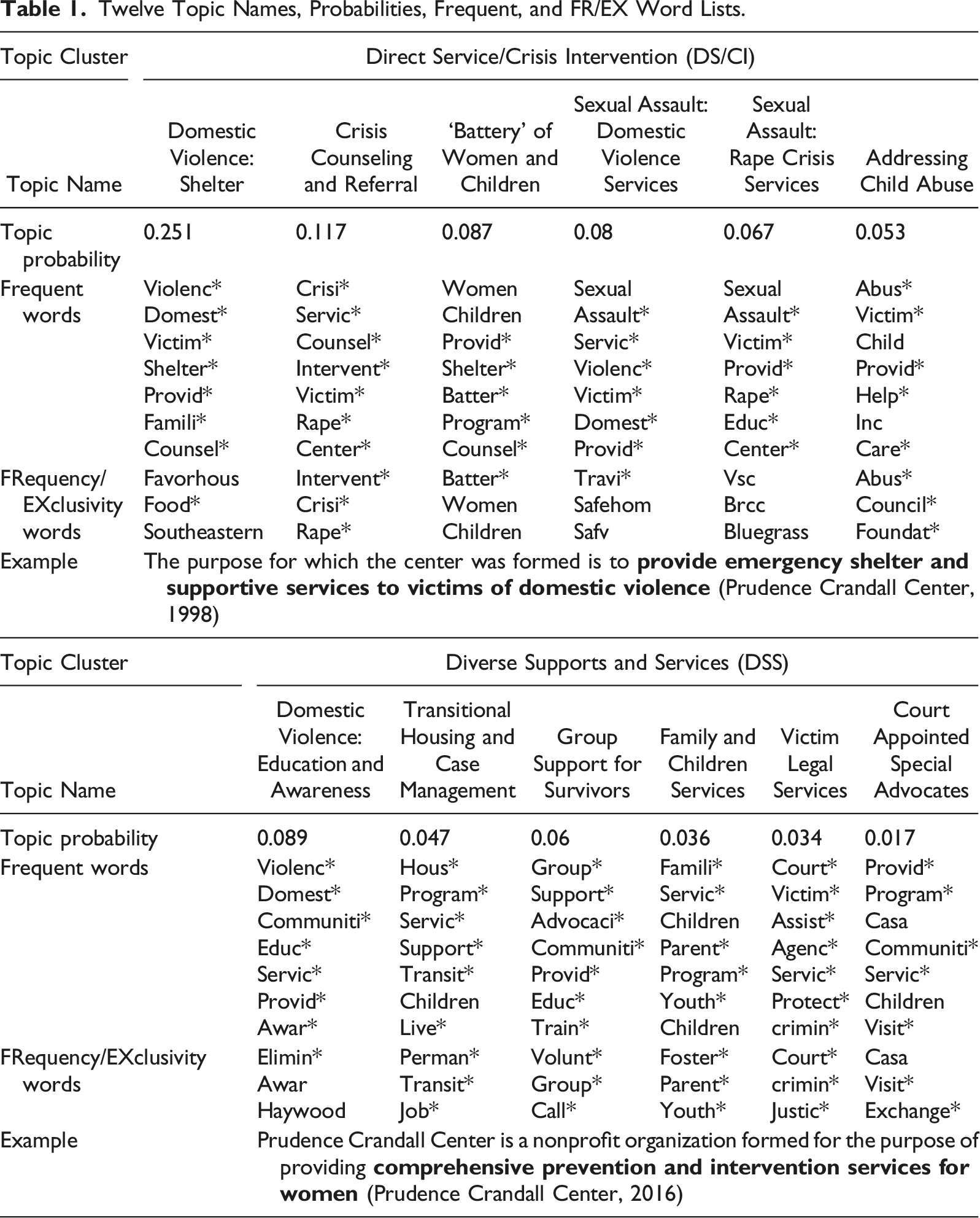
Twelve Topic Names, Probabilities, Frequent, and FR/EX Word Lists.
Armed with frequency and FR/EX, a team of four coders began by independently labeling the names of topics. Coders gave initial names to topics and also noted topics where there was ambiguity or potential overlap—where word probabilities and exclusive words were not sufficient to distinguish between two topics. Where coders noted ambiguity, we directly compared pairs of topics. We constructed the log of the ratio of β to allow direct comparison of pairs of topics. The log of the ratio of the βs provides information about the relative importance of words across the two topics by providing a measure of the greatest differences in word usage (Slige and Robinson 2017). Here is an example: We have two topics which are very similar: Sexual Violence: Domestic Violence Services and Sexual Violence: Rape Crisis Services. Because the two most frequent words of both topics are sexual and assault, it is difficult to distinguish the two topics from the simple frequency. Figure 1 shows the result of comparing β log ratio between these two topics. It is clear that one topic is about rape and crisis more than the other, and the topic on the left mainly refers to domestic violence. According to these results, we named two topics as Sexual Violence: Domestic Violence Services and Sexual Violence: Rape Crisis Services. The end of this multi-step process was unique topic names for 12 of the 15 topics, and 3 topics that remained undefined, that we combine as “Other Services.”
4
Beta Ratio Comparison between Two Sexual Assault Related Topics.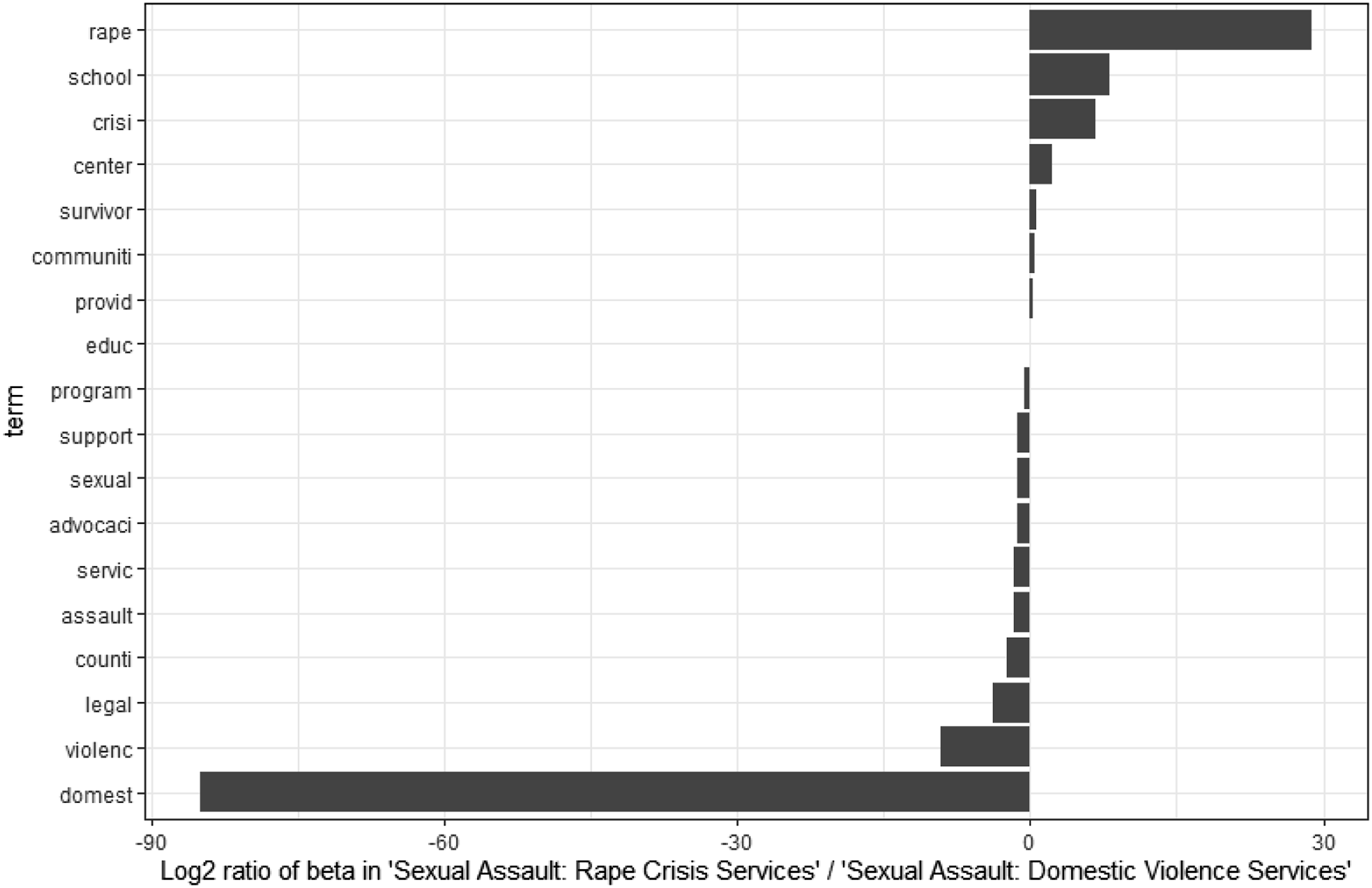
Dictionary-Based Content Analysis
A history of violence against women suggests that nonprofits would increasingly reference health or criminal/legal paradigms in their work, and that nonprofits would increasingly use rationalized or bureaucratic language to describe anti-violence programming. A limitation of unsupervised topic modeling techniques is that they do not allow such theoretically relevant trends to be evaluated directly, so we opted to use specific corpuses of words to follow trends in language that reference health and criminal-legal paradigms, as well as managerial and rational-technical language. One benefit of using a dictionary-based content analysis approach, compared to machine-learning algorithms, is that dictionaries “[provide] an explicit rationale not only for what is retained, but also for what is excluded from the analysis” (Weber 1990, p. 24) and allow for precise evaluation of specific theoretically-relevant concepts.
Here, we use three sets of dictionaries from LIWC (Linguistic Inquiry and Word Count) of Pennebaker et al. (2015), Chalkidis and Kampas (2018), and Brandtner (2021) to measure the use of particular concepts in mission statements and program service accomplishments. Dictionaries are theoretically and empirically curated lists of words. 5 Three dictionaries can be used to measure rising rationalization and bureaucratization: “work,” “cause,” and “managerialism.” Our work dictionary is modified from LIWCs dictionary and includes terms related to occupations and jobs such as employer*, client*, customer*, and business that represent a more bureaucratized and businesslike approach to a nonprofits work. 6 Nonprofits are further understood to be moving away from a “civil society” approach to one that stresses “managerialism” (Korff, Oberg, and Powell 2015). We use a dictionary constructed by Brandtner (2021) that contains three dimensions of managerialism: (1) assessment (evaluate*, benchmark*), (2) management (efficiency*, performance*), and (3) bureaucracy (procedure*, review*, report*). It not only reflects the degree of bureaucratization of an organization but also shows whether an organization takes a technical-rational approach to violence against women. Our “cause” dictionary, again modified from the LIWC original, is designed to most directly measure whether a nonprofit is attending to evaluation and effectiveness. Words such as effect*, affect*, influence*, evaluate, result*, and outcome* are suggestive of a focus on measurement, metrics, and effectiveness.
We used two additional dictionaries to assess nonprofit use of criminal-legal or medicalized terminologies. We again drew upon LIWC for the “health” dictionary, and relied upon selections of Law2Vec, created by Chalkidis and Kampas (2018), to construct a “criminal/legal” dictionary. The “health” dictionary in LIWC consists of words describing biological processes as well as technical medical terms (e.g., clinic*, disease*, chronic*, and gynecology*). The “criminal/legal” dictionary is a dictionary of terms that reference crime, courts and policing created in the work of Chalkidis and Kampas (2018) and reported by Ma et al. (2020:13). “Criminal/legal” is a subset of key terms that emerged from Chalkidis and Kampas’ (2018) Law2Vec word embeddings model, which uses 123,066 English-language documents to map associations between terms in legislative and court material. As described by Ma et al, (2020:12), Law2Vec broadly works by “translating legal text into numeric form in order to calculate the relationships between legal terms,” and these associations in turn can be used to create dictionaries of terms that reference legal themes. Thus, Ma et al. (2020) find that court records tend to refer to illegality by using terms like “unlawful,” “corrupt,” and “illicit,” and refer to felonies by mentioning “offense,” “misdemeanor,” and “convicted.” We use these key terms reported by Ma et al. (2020) to construct our “criminal/legal” dictionary.
Our main goal in this part of the analysis is detecting adoption of new language in organization text. With each dictionary, we created binary variables for whether an organization used any words in the dictionary in a given year. In other words, we assigned 1 if an organization mentions words in the dictionary and assigned 0 if it does not. In analysis, we traced the adoption of rational and bureaucratic language from 2010–2016. We follow rational and bureaucratic language only in the most recent time period because dictionary-based approaches, unlike topic modeling, are sensitive to variation in word counts across time. Over time, nonprofits generally expanded narratives describing their work in the 2010s, both due to IRS regulations but also as a choice to use these annual filings as a space to showcase their work (Horvath, forthcoming). Limiting to the most recent time period ensures that our text indicators reflect only deliberate changes to text rather than changes that occur from shifts in word count.
Results
Table 1 presents the 12 topics anti-violence organizations include when they write about efforts to combat violence against women across the whole period 1998–2016. Table 1 indicates each topic’s name, their 10 most frequent words, and three meaningful FR/EX words. Corresponding to prior understandings of the work of anti-violence organizations, and in preparation for our over-time assessment, we organize the 12 topics into two main categories based on our understanding of changes in thinking around this social problem. These are: topics that discuss violence against women in terms of Direct Services and Crisis Intervention (DS/CI), and topics that discuss violence against women in terms of Diverse Support and Services (DSS).
DS/CI topics are topics that discuss interpersonal acts of violence against women and efforts by organizations to intervene during and after these crises. We see these “DS/CI” topics in six topics discussed by anti-violence organizations: Domestic Violence: Shelter, Crisis Counseling and Referral, ‘Battery’ of Women and Children, Sexual Assault: Domestic Violence Services, Sexual Assault: Rape Crisis Services, and Addressing Child Abuse. In general, DS/CI topics tend to reflect traditional understandings of the role anti-violence organizations as emergency refuges for women and comprise the bulk (65.5%) of all organizations’ text (Schechter 1982). For example, discussions of shelter services in “Domestic Violence: Shelter” are the most common topic of all DS/CI topics and comprise a quarter of the text of anti-violence organizations. The second most common category among DS/CI topics is Crisis Counseling and Referral, which accounts for 11.7% of all text and indicates discussions of direct interventions into interpersonal violence by advocates. DS/CI topics also consist of two topics about sexual assault (Sexual Assault: Domestic Violence Services and Sexual Assault: Rape Crisis Services), representing discussion of general services for sexual assault survivors. Both topics have the words sexual and assault as their top two frequent words, with one focused on domest* and violenc* and the other on victim* and rape*. Each topic comprises 8% and 7% of text, respectively. These values suggest these topics are substantive and meaningful. 7 Note also that the topic Sexual Assault: Domestic Violence Services (8.0%) further illustrates that nonprofits can have a dual, or combined, focus on domestic violence services and sexual assault (O’Sullivan and Carlton 2001; Macy et al 2009; Macy et al 2010). Finally, ‘Battery’ of Women and Children (8.7%) reflects older language dealing with violence, while the Addressing Child Abuse (5.3%) topic indicates discussions of care to children impacted by gender-based violence.
Organizations and feminist advocates have also understood domestic and sexual violence as a complex and multifaceted problem requiring multiple points of intervention. We found that organizations did discuss a multifaceted response to violence against women through six topics: Domestic Violence: Education and Awareness, Transitional Housing and Case Management, Group Support for Survivors, Family and Children Services, Victim Legal Services, and Court Appointed Special Advocates. Less common across the whole period than DS/CI topics (34.5%), DSS topics tend to reflect public outreach programs, housing relocation and job training, victims services, and specialized programs. They also focus on a diverse set of supports, with education and legal services particularly prominent. Domestic Violence: Education and Awareness, when organizations discuss services that raise awareness about the social problem of violence against women, is the highest topic among the DSS topics (about ∼10%) and the third most common topic among organizations overall. Solutions to interpersonal violence like relocation, Transitional Housing and Case Management (4.7%), group therapy, Group Support for Survivors (6.0%, i.e., group*, support*, survivor*), or legal services, (Victim Legal Services, 3.4%, and Court Appointed Special Advocates, 1.7%) also appear under DSS. These topics also seem to reflect longer-term solutions to the crisis intervention programs discussed in DS/CI topics. For example, Transitional Housing and Case Management (4.7%) reflects a longer-term approach to housing than Domestic Violence: Shelters (25.1%). This topic suggests the need to go beyond providing temporary shelter to women in crisis, and indicates instances when organizations sought to help women find safe permanent housing free of previous violence. It is important to underscore, though, that these other topics generally appear less often than DS/CI topics in nonprofit statements. As Table 1 indicates, each topic individually tends to account for 5% of all text.
Our first expectation was whether organizations have diversified their services and approach to violence against women. To answer this question, Figure 2 investigates each topic’s proportion over time where years are indicated along the x-axis and the height of the bars indicates the proportion of all text that used a topic. Topics are stacked according to our two broad topic categories—DS/CI topics stacked below and DSS topics above. The white space is the proportion of the three unnamed “Other” topics. We further distinguish the two broad topic clusters through pattern and color. For DS/CI topics, we used solid patterns and dark colors. To clearly visualize our major topic cluster differences, gray/white colors with patterns are used for DSS topics. Consistent with our expectations, anti-violence organizations are increasingly using diverse and specialized programming while reducing older emphases on direct services and moments of crisis. As shown by the darker, solid stacked bars in Figure 2, DS/CI accounted for approximately 75% of the discourse describing violence against women in the late 1990s and early 2000s, but its proportion declined to under 55% in the 2010s. Meanwhile, the proportion of topics related to DSS significantly increased, rising about 13% between 1998 and 2016. Overall Topic Trend, 1998–2016.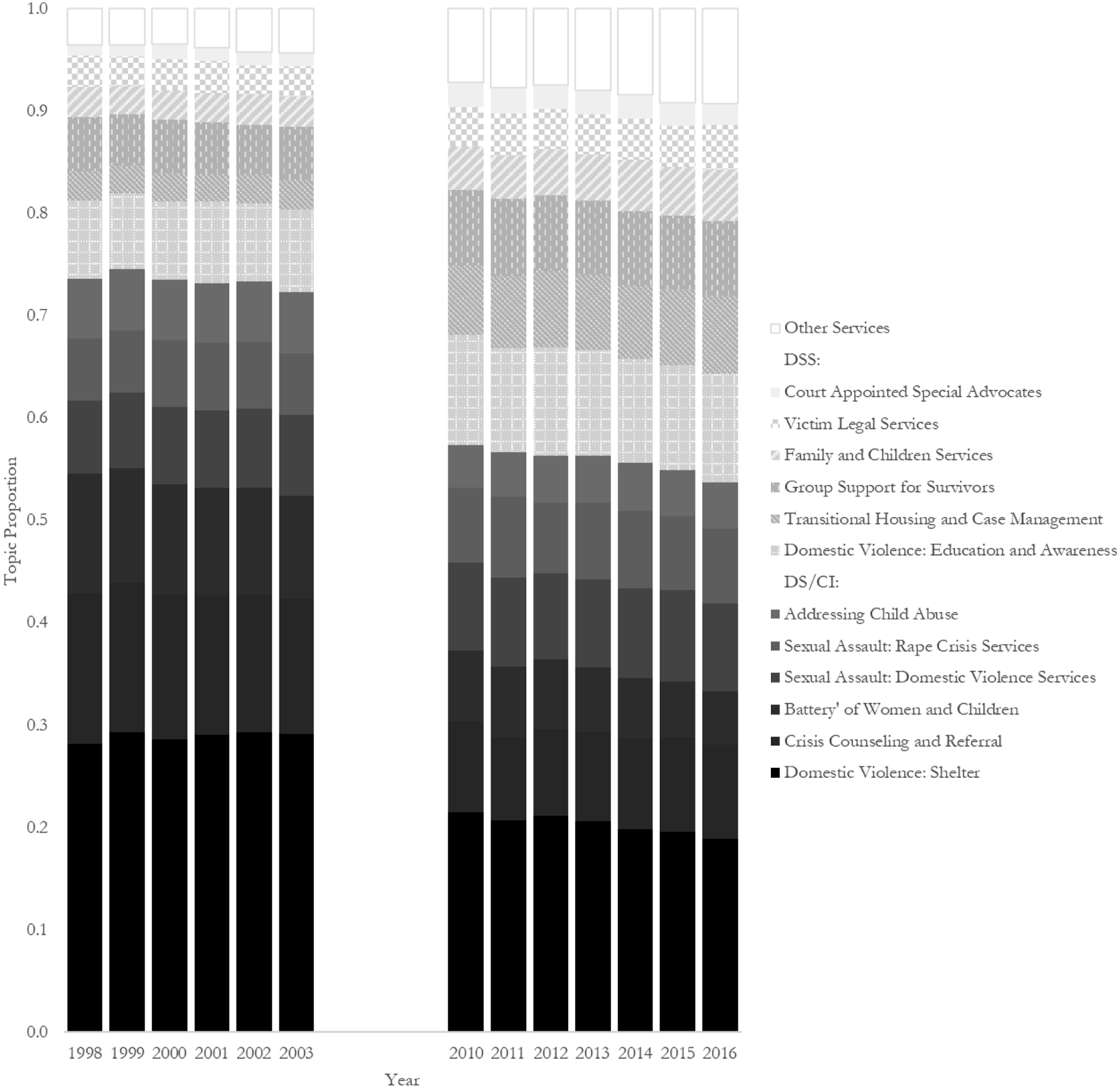
There are also important longitudinal trends within specific topics. Anti-violence organizations appear to discuss Domestic Violence: Shelter and Crisis Counseling and Referral topics significantly less than other topics when compared to 20 years ago. For example, the average topic proportion of Domestic Violence: Shelter in the late 1900s was 28.9%, but it declined to 20.3% in the 2010s. Not surprising is the similar decline in the use of “battery” as this term has fallen out of favor over time. Amid DSS topics, meanwhile, both Group Support for Survivors and Domestic Violence: Education and Awareness show more than 2% increases in discussion over the same time period.
The shift in emphasis to violence against women as a multifaceted problem has occurred within individual organizations. Consider two of the major program services of Women’s Information Service (WISE) of Vermont, a human services organization. Selections from the text of Women’s Information Service (WISE) in 2003, where words and phrases relating to DS/CI topics are italicized and those associated with DSS topics are bolded, show that the organization concentrated on providing emergency shelter, a hotline, and emotional support and problem solving: Domestic Violence –WISE advocates offer emotional
In 2016, though, WISE’s mission moved beyond education services, a crisis hotline, and shelter to include help with transitional housing and support groups. Programming expanded to many more diverse supports including yoga and equine therapy (see Sweet 2021 for the relationship between such programs and the modern approach to trauma in domestic violence work). WISE also began to discuss mobilization for social change and use the word prevention, suggesting greater attention to diverse solutions to violence against women: WISE leads the upper valley to end gender-based violence through WISE's confidential and free services include: 24-hour confidential crisis line, emergency shelter,
However, while anti-violence services have diversified, some critics have suggested that the institutionalization of violence against women has changed anti-violence work. Has the anti-violence field become more rationalized and bureaucratic as it has expanded? Figure 3 presents change over time in three measures of rationalization and bureaucratization - references to work, cause, and managerialism. The figure illustrates that reference to all three theoretical concepts increased over time. For example, in 2010, 38.4% of nonprofits referenced a managerial term (e.g., evaluate or performance) while in 2016 that percentage had risen to 44.5%—a six percent increase in only 6 years. As just one simple example, in 2011, the Center for Women in Transition, recorded that they “served 1,326 clients.” Not only is the Center for Women in Transition now using a managerial term, “client,” to refer to recipients of its programming but also reporting specific numbers – a distinctly managerial perspective. Nonprofits were always using work-related terminology at higher levels than cause or managerial words, but these increased as well. Reference to dictionary words signifying work increased from 59.2% to 64.5% over the period. Legal/Criminal and Health Related Terminology Trend, 2010–2016.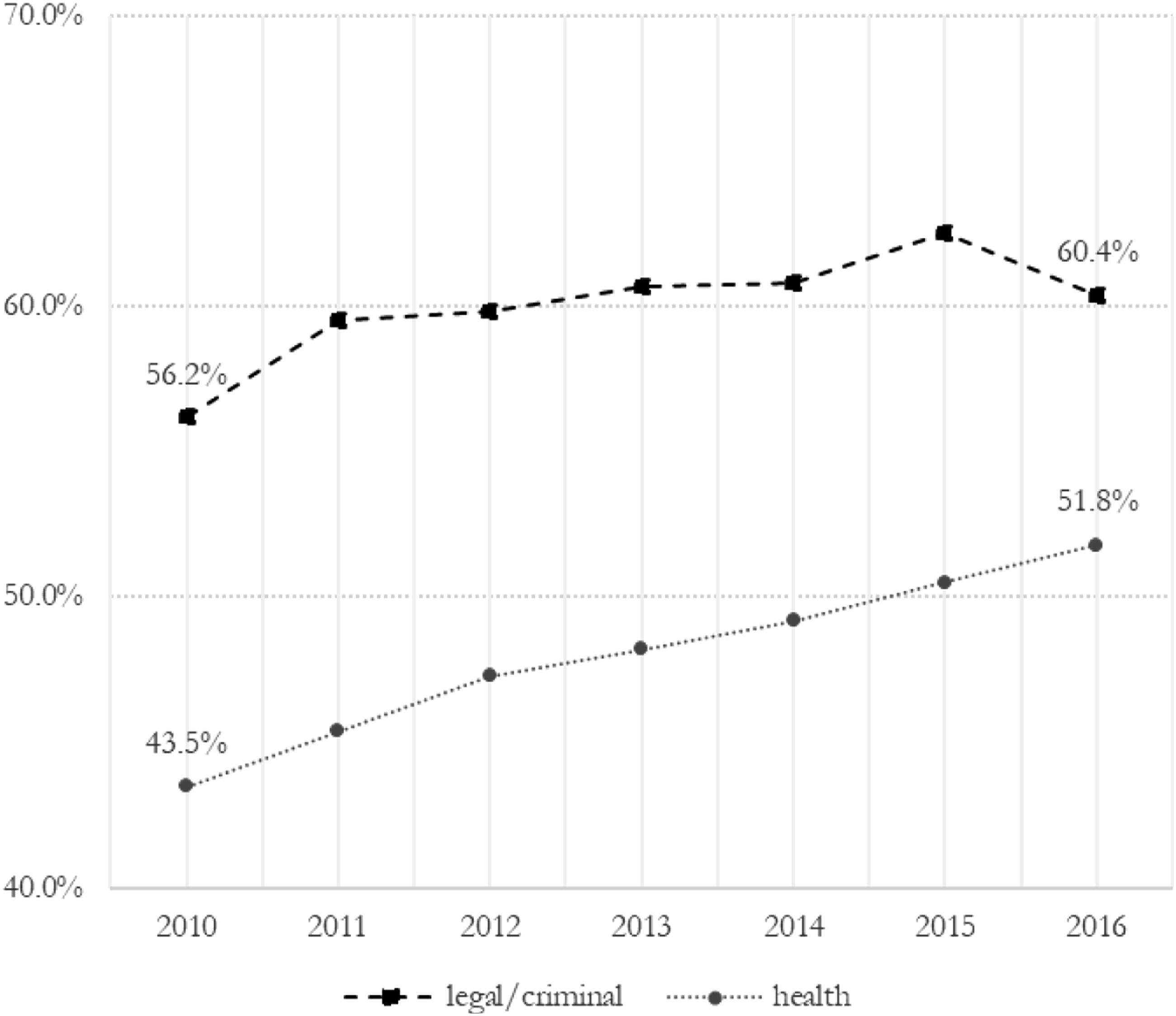
Use of words signifying “cause” also increases over time, from 30.0% to 38.7% between 2010 and 2016, indicating increased attention to effect and effectiveness. As an example, consider the California Partnership to End Domestic Violence which, between 2014 and 2015, changed the language in their program service accomplishments away from language that stressed “informing policymakers and the public” to advancing “solutions” and ensuring policies are “implemented” and “effective.” The new language stresses evaluation of programming to make sure solutions are not only actually implemented, but also effective in producing change. Further, the California Partnership to End Domestic Violence added language in 2015 signaling a shift to communicating about the “root causes” that contribute to domestic violence. This nonprofit is increasingly identifying violence against women as a social problem of which causes are discernible, and they consider it a goal to advance effective solutions for the problem. This perspective is in line with the literature on the rise of managerialism in nonprofit organizations, which reinforces accountability and stresses more measurable behaviors (Brandtner 2021; Bromley & Powell 2012).
Finally, anti-violence organizations increasingly work with hospitals, the police, and court systems as part of their service and advocacy. Figure 4 assesses our expectation that, as they integrate with other institutions, anti-violence organizations adopt medical or criminal/legal paradigms in their approach to the problem of violence against women. We see an 8.3% rise in the presence of language referencing health over the 6 year time period. Nonprofits are increasingly using terminology like clinic*, disease*, or chronic* to reference the problem of violence against women. For example, in 2015 The Georgia Network to End Sexual Assault (GNESA) noted that they “developed educational programs with law enforcement professionals directly involved with sexual assault victims.” In 2016, they modified this statement to include both additional health care workers, but also other members of the legal community: “GNESA developed educational programs and provided training to law enforcement professionals, victim advocates, Work, Managerialism, and Cause Related Terminology Trend, 2010–2016.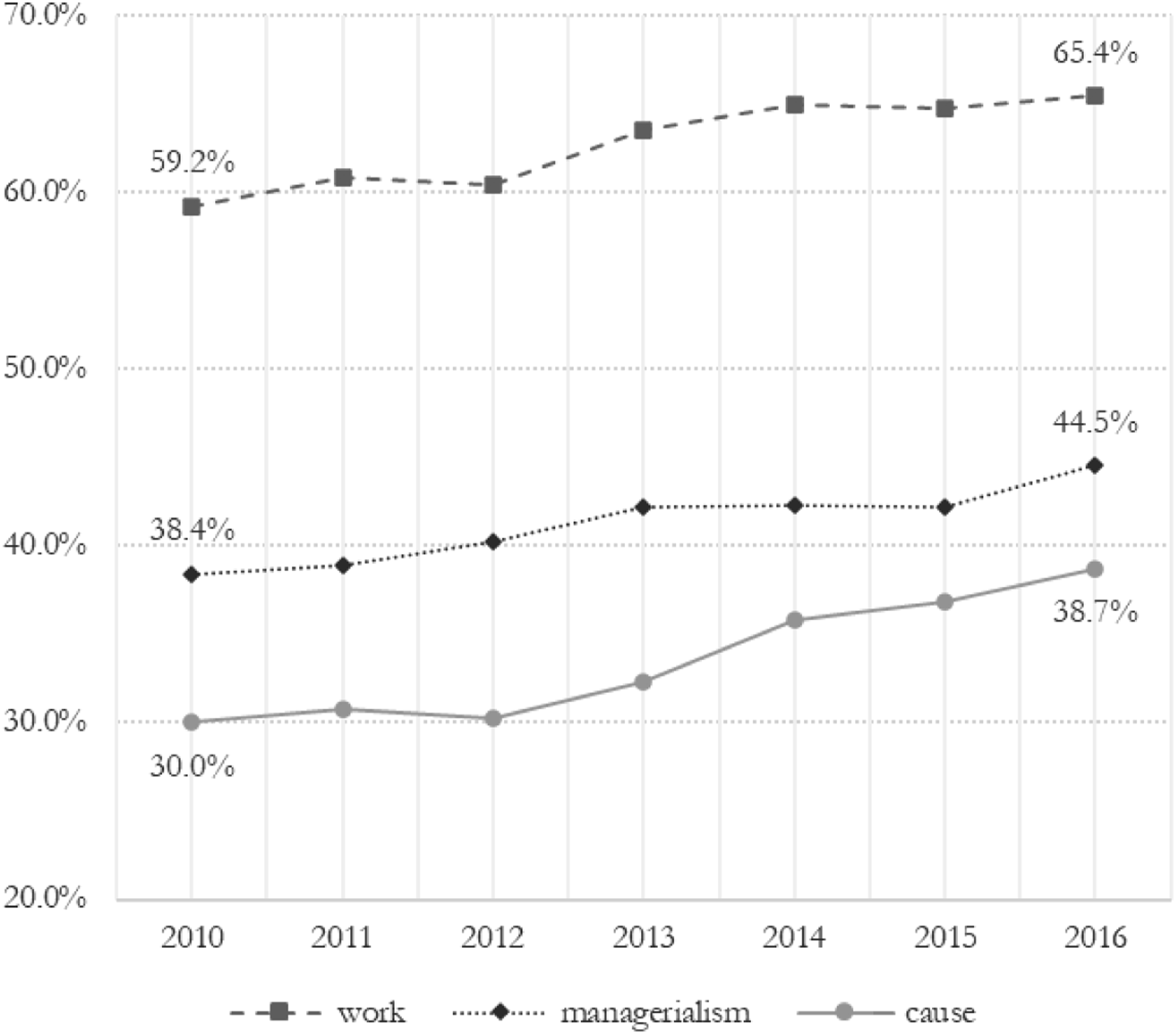
Or take The North Carolina Coalition Against Domestic Violence. Their 2016 program service accomplishments were modified to acknowledge both connections between physical and emotional health, but also the ties between domestic violence work and other institutions: This agency works to interrupt the cycle of violence, end the stigma attached to a difficult and taboo subject, and
We also see a modest increase in the use of criminal legal language. Criminal legal language was always more common than health language, but is currently growing more slowly. 56.2% of organizations used criminal-legal language of some type in 2010, and 60.4% in 2016. For example, Meriden-Wallingford Chrysalis in 2016 for the first time noted that their family violence victim advocacy, “provides information regarding the
Many of these trends are visible in how the Sexual Assault Crisis Center—Fox Cities changed its mission language between 2012 and 2013. In 2012, the Center used this language: “Assists victims of sexual abuse, consoles and advises sexual assault victims.” This changed in 2013 to “Counsel victims of sexual abuse, offer legal and medical advocacy, provide community education for sexual assault and provide support groups for our clients.” Not only did the Sexual Assault Crisis Center indicate the need for both medical and legal advocacy, but they began referring to “clients.” These concomitant changes highlight what Mehrotra, Kimball, and Wahab (2016:153) argue, that professionalization, criminalization, and medicalization are increasingly “braided together” in shaping the kinds of work that nonprofits undertake to combat domestic and sexual violence.
Discussion and Conclusion
We investigated the topical foci of the narratives used by anti-violence organizations and whether bureaucratized, medical, and criminal language have spread in organizations confronting domestic violence and sexual violence. Following a panel of 918 anti-violence organizations between 1998 and 2016, we find that anti-violence nonprofits have added discussions of preventative, long-term and specialized services to their funder and auditor-facing documents, including discussions of education and awareness programming, case management, and services for women and children after they leave shelters. Consequentially, while interpersonal violence and core services like sheltering and crisis counseling continue to be the most common topics discussed by anti-violence organizations, we find that advocates now give less attention to these services and more emphasis to the importance of holistic and individualized interventions.
These changes suggest a growing conceptualization of violence against women as complex and multifaceted, where “women” are understood as heterogeneous, and intersectional approaches to difference are seen as essential (Sullivan 2011). By incorporating women’s diverse needs into individually tailored, long-term responses, anti-violence organizations may be able to work with a greater variety of women across differences of race and ethnicity, immigration status, sexual orientation, and other distinctions (Yoshioka and Choi 2005). As such, contemporary anti-violence work has arguably begun to fulfill a longstanding goal of early grassroots anti-violence activists: to move beyond the base of the early “battered” women’s movement among white, married women (Bevacqua 2000; Macy et al. 2018).
However, while anti-violence work is increasingly multifaceted, our analysis also supports, using text as data, earlier research showing that the anti-violence space has departed from its grassroots and politicized origins. The nonprofit incorporation of anti-violence advocacy may impose bureaucratic management strategies on advocates, and feminists have long argued that the growth and professionalization of anti-violence work might lead to a narrower conception of violence against women that eschews long-term change (Ferguson 1984; Johnson 1981; Lehrner and Allen 2008; Mehrotra, Kimball and Wahab 2016; Schechter 1982; Sweet 2019; Weiss 2020; 2021). Employing dictionaries developed to explicitly understand nonprofit bureaucratization (Brandtner 2021; Korff, Oberg, and Powell 2015), we find that between one third and one half of all anti-violence organizations reference managerial discourse or rational-technical terminology when discussing their efforts to confront violence against women. Dictionary-based approaches also show that the proportion of organizations employing bureaucratic and rational-technical language increased in every year between 2010 and 2016, with roughly half of all anti-violence organizations referencing managerial terminology such as “performance”, “productivity” and “metrics” by 2016. Moreover, the most politicized topic we identified—“Domestic Violence: Education and Awareness”—only grew by 3% between the beginning and the end of the period, suggesting a modest increase in perspective.
This rise in bureaucratic and rational-technical language suggests that anti-violence organizations have experienced the same tendencies towards rationalization found within the nonprofit sector at large (Barman 2016; Barman and MacIndoe 2012; Bromley and Meyer 2021; Hovarth forthcoming). In acquiring funding and legitimacy, for example, anti-violence organizations have become subject to oversight from both private funders and state regulators who may expect nonprofits to conform to best practices (Weiss 2021). Pressure to demonstrate impact could also lead to “measurability bias” (Crary 2023; Espeland and Stevens 2008), though, leading to an emphasis on incremental tasks that do little to stop domestic or sexual violence. External stakeholders can also define the “fundable” clients that advocates should serve, precluding some women from support after victimization (Mehrotra et al. 2016:156; Sweet 2019), and impose values that fragment an organizations’ work. Weiss (2021) thus finds that anti-violence advocates are encouraged to differently treat related phenomena like stalking and domestic violence, and Lehrner and Allen (2008:231) note that “working at the individual-level makes it difficult for advocates, even those espousing a movement frame overall, to avoid falling into a reductive, individual-level analysis.”
Furthermore, our findings suggest a trend towards the criminalization of domestic and sexual violence services. Criminal and legal frameworks were already widespread in the anti-violence field in the 1980s and 1990s (Rodriguez 1988), and we find that the majority (60%) of anti-violence organizations mentioned crime and legal related terminology in their work as of 2016, reflecting the entanglement of anti-violence advocacy in the criminal justice system (Mehrotra et al. 2016:157). Among other examples, the VAWA and its reauthorizations have instituted mandatory incarceration requirements for domestic violence and encouraged shelters to refer women to police after incidents. This increased criminalization has particular consequences for marginalized populations (INCITE! 2001; Kim 2013; Mehrotra et al 2016). For example, arrests supported by shelters may fall disproportionately on low-income women and women of color (Richie 2012), increasing incarceration rates in such communities (Crenshaw 1991), and increasing the likelihood that low-income women and women of color will be killed by an abuser in retaliation after they are arrested (Sherman and Harris 2015). Nonprofit anti-domestic violence programs could thus create “collateral damage” if organizations do not actively work to address these dynamics (Mankowski, Haaken and Silvergleid 2002).
Finally, we find that that terms such as diagnos*, disease*, and illness* have become increasingly popular in organizational programming, indicating the medicalization of anti-violence work (Durazo 2006; Sweet 2015). Mental health advocacy is a key component of caring for survivors of domestic and sexual violence (Garcia-Moreno et al. 2005). Adopting a therapeutic and clinical approach, though, may prioritize disease over social ecology and may privilege deficits over strength and resilience. It also runs the risk of narrowing the pool of individuals considered qualified to work in the anti-violence space, either implicitly through a perceived need for medical expertise, or explicitly through increases in education or credentialing requirements. An emphasis on experts and medical staff (Dewey and St Germain 2014), and away from survivors’ personal goals and experiences, could thus reorient anti-violence organization away from public advocacy and toward clinical practice and therapies (Mehrotra et al. 2016:158).
In sum, our analysis indicates that the worldview of anti-violence activists has not narrowed as advocates have won recognition of violence against women. Increasing attention to diverse supports and services suggests that nonprofits are understanding their work as engaging with diverse communities that come with different perspectives, experiences, and ideas. The resulting multifaceted programming in the anti-violence space should help nonprofits interact with the myriad of stakeholders, many of whom may make decisions that impact funding or other resources. Thus, diversified programming better positions nonprofits to adapt to changing circumstances and handle unexpected challenges in the anti-violence space.
However, if bureaucratization, criminalization, and medicalization are “braided together” and growing in prominence, it also has the potential “to shape the kind of work made im/possible when it comes to ending” violence against women (Mehrotra et al. 2016). While we demonstrate that anti-violence organizations have diversified their services and often adopted a long-term and preventative orientation to domestic and sexual violence, these countervailing pressures may also have resulted in movement away from social change approaches that would propose a feminist politics (Nichols 2013; Weiss 2021). Instead, we propose that anti-violence organizations face a careful balancing act: attempting to imagine a cohesive strategy of social change, while also better serving more communities of women and managing tensions resulting from specialization, differentiation, and formalization.
Our use of topic modeling to track orientations to violence against women highlights the usefulness of emerging methodologies to social research. Topic modeling and dictionary-based content analysis offer a practical means to survey organizational activities across the United States that are usually undertaken through costly surveys (Sullivan 2011; Vinton et al. 1997). We also expand previous uses of automatic textual classification in sociology from studies of public issue framing (DiMaggio et al. 2013), cultural meanings (Kozlowski, Taddy and Evans 2019), and institutional behavior (Fligstein, Brundage and Schultz 2017) by bringing topic modeling to bear on the emergence of social problems (Alexander 2018; Spector and Kitsuse 1977). In particular, we demonstrate how textual analysis can facilitate a longitudinal analysis of social problems such as domestic and sexual violence. Social problems are socially constructed (Alexander 2018; Best 1987; Spector and Kitsuse 1977) with advocates’ efforts to solve social problems often causing such problems to coalesce. In proposing approaches to a solution, advocates highlight one aspect of a social condition as a “problem” while other aspects remain submerged (Best 1987; Hilgartner and Bosk 1988). This article helped elucidate the range of problem definitions, perspectives, and narratives used by anti-violence organizations to describe their work. The narratives used by nonprofits can have a significant impact on how people understand and talk about domestic and sexual violence and, ultimately, in creating and defining domestic and sexual violence as a social problem.
A number of limitations apply to this analysis. We do not have access to exhaustive lists of programs undertaken by nonprofit organizations, meaning that activities not reported in mission statements or program service accomplishments are omitted from our scope. This has the advantage of showcasing the issues that organizations see as most central to violence against women, but also means that our analysis is not a complete picture of all anti-violence advocacy. Perhaps more importantly, our analysis is limited to full Forms 990 filing organizations, meaning that the smallest organizations (those that report less than $200,000 in annual revenues) are not included. Further, our analysis is limited to e-filing nonprofits. Auxiliary analyses comparing e-filer data with the Business Master File that contains data on all registered nonprofits suggests that organizations that e-file are older and larger than organizations that do not e-file. This analysis is thus better thought of as analysis of relatively large anti-violence work, rather than grassroots organizations. Another limitation is our need to restrict analysis of rational and bureaucratic language to the 2010–2016 period. Anti-violence activists have wrestled with bureaucracy and rationalizing forces since the 1970s. The trends we identify in the 2010–2016 period are likely an extension of longer-term trends toward hierarchical, professionalized modes of service delivery. Finally, it is important to reiterate that this analysis applies only to violence against women as understood by nonprofit organizations that work with women in crisis. This analysis does not encompass the problematization of violence against women in media, or government, or other institutional domains.
Nonetheless, our research creates further opportunities for the study of anti-violence work and social problems. Survey researchers could extend or challenge our research, for example, by investigating how mental health organizations understand violence against women or how cooperation with police relates to organizational programming. Scholars of social problems, meanwhile, could use the procedures developed in this article to consider other unresolved questions, such as how social problems fade or disappear from public view entirely. Finally, our research invites opportunities for comparison with other domains, such as governments and media. In any case, our research fulfills a goal of those advocates who founded the first anti-violence organizations by expanding the range of perspectives on violence against women and its solutions in the United States.
Supplemental Material
Supplemental Material - Using Text as Data to Reveal Changing Organizational Perspectives on Violence Against Women in the United States
Supplemental Material for Using Text as Data to Reveal Changing Organizational Perspectives on Violence Against Women in the United States by Sumin Lee, Andrew Messamore, and Pamela Paxton in Social Currents
Footnotes
Acknowledgments
The authors gratefully acknowledge the generous support of grants from AmeriCorps (201502185 Principal Investigator: Paxton) and the National Institute of Child Health and Human Development (R24HD42849, Principal Investigator: Mark Hayward; T32 HD007081-35, Principal Investigator: R. Kelly Raley) awarded to the Population Research Center at the University of Texas at Austin.
Declaration of Conflicting Interests
The author(s) declared no potential conflicts of interest with respect to the research, authorship, and/or publication of this article.
Funding
The author(s) disclosed receipt of the following financial support for the research, authorship, and/or publication of this article: The author acknowledge the support of grants from AmeriCorps (201502185 Principal Investigator: Paxton) and the National Institute of Child Health and Human Development (R24HD42849, Principal Investigator: Mark Hayward; T32 HD007081-35, Principal Investigator: R. Kelly Raley) awarded to the Population Research Center at the University of Texas at Austin.

Supplemental Material
Supplemental material for this article is available online.
Notes
References
Supplementary Material
Please find the following supplemental material available below.
For Open Access articles published under a Creative Commons License, all supplemental material carries the same license as the article it is associated with.
For non-Open Access articles published, all supplemental material carries a non-exclusive license, and permission requests for re-use of supplemental material or any part of supplemental material shall be sent directly to the copyright owner as specified in the copyright notice associated with the article.
