




Abstract
Knowledge about whether and how students’ dispositions and ways of thinking are shaped by higher education has expanded rapidly in recent years. Drawing from in-depth interviews with 104 college students at a large public university in the United States, this study examined how participants described the relationship between individual experiences and social, historical, and political contexts. Findings indicate that most students understood the world in ways that were in conflict with stated university goals to foster understanding of the connections between individuals and broader contextual factors. The perspectives that emerged varied by socioeconomic status. Less socioeconomically advantaged students placed an emphasis on individual responsibility in ways that evoked self-blame for struggles. More socioeconomically advantaged students, by contrast, relied on contextualized explanations of their own lived experiences but refused to extend those explanations to understand the experiences of others. These perspectives contribute to the reproduction of inequality as students move through and beyond college. Presented findings extend conversations about how the potential transformative impact of higher education may be undermined by neoliberalism and marketization, which have reshaped the distribution of opportunities and resources in postsecondary institutions. Implications for addressing this inequality by framing education in more holistic ways are discussed.
Colleges and universities are understood to be places where students learn, where they develop new kinds of capacities, and where their ways of understanding themselves and the world expand. The past decade has witnessed rapid growth in knowledge about how students’ dispositions and ways of thinking are shaped by higher education. We have learned about how college impacts students’ self-concept and self-presentation (Cox 2020; Fine 2018; Koontz Anthony and McCabe 2015), perceptions of others (Aries and Berman 2013; Byrd 2017), goals for the future (Binder, Davis, and Bloom 2016; Peng, Glass, and Sassler 2022), sociopolitical attitudes and engagement (Campbell and Horowitz 2016; Lee 2018; Reyes 2018), and cultural dispositions more generally (Lee and Kramer 2013; Lehmann 2014).
Scholarly research frequently provides evidence that students develop in notable ways over the course of their college journeys (Chambliss and Takacs 2014; Cuba et al. 2016). Yet some studies show that while elements of students’ dispositions and ways of thinking may change during college, other components are more durable (Lee 2016; Silver 2020). A few studies even suggest that students generally change very little in college, with many failing to demonstrate growth in critical thinking or complex reasoning (Arum and Roksa 2011).
While this research represents important progress, it also raises questions that have yet to be answered. Key among these are questions about how students come to understand lived experiences in relation to broad social, historical, and political contexts. Such learning objectives are often integral to general education requirements (Aldegether 2017), major- or discipline-specific programs of study like sociology, history, communications, and political science (Arum, Roksa, and Cook 2016), and even to the goals articulated by the student affairs profession for learning beyond the classroom (Evans et al. 2009). While scholars have written a great deal about best practices for facilitating these forms of awareness (Ghidina 2019; Trautner and Borland 2013), to date we know little about whether college students actually develop understandings of the interconnections between individual experiences and social, historical, or political contexts (Palmer 2023).
Drawing from in-depth interviews with 104 college students at a large public university in the United States, this study examined how participants described the factors that influence lived experiences. Findings indicate that as students journeyed through college, most did not acquire conceptual tools for articulating the interconnected nature of the individual and broader context. In fact, participants described understandings that were in conflict with related learning objectives laid out by their university. Two main perspectives emerged, which varied by socioeconomic status. Less socioeconomically advantaged students placed an emphasis on individual responsibility that fostered self-blame for struggles. Meanwhile, more socioeconomically advantaged students used structural explanations of their own experiences but refused to extend those explanations to understand others’ experiences. Although these perspectives were distinct, neither conveyed the full range of personal and community benefits the university attributed to awareness of relationships between individuals and social, historical, and political contexts. In other words, students in both groups relied, at least in part, on individualistic ways of accounting for challenges that contributed to the reproduction of inequality. Rather than having a transformative impact, preparing students to be informed and engaged members of their communities, the university sustained perspectives that marginalized those who were less socioeconomically advantaged.
Dispositions, Self-Concepts, and Learning in College
While early literature on college students’ dispositions and learning stemmed primarily from the cognitive sciences and psychology (Evans et al. 2009), over the past two decades, sociologists have brought their own perspectives to this area of research (Arum et al. 2018). Drawing from the unique disciplinary strengths of these perspectives, scholars have examined how students’ experiences in higher education shape their dispositions and ways of thinking. For instance, sociologists have expanded knowledge about the ways college students develop a sense of self and related styles of self-presentation (Cox 2020; Fine 2018; Koontz Anthony and McCabe 2015). These understandings of oneself have consequences for the types of activities students engage in during and following college, and they can likewise impact students’ goals and aspirations (Fletcher and Tyson 2017; Peng et al. 2022). For example, in their study of two elite universities, Binder, Davis, and Bloom (2016) showed that elements of the college experience, including exposure to campus cultures and specific university structures pushed students toward similar career aspirations in a small segment of high-status sectors.
The ways students come to think about their identities, their goals, and how to present themselves to others have important consequences. Students develop and leverage self-narratives in college that link their past, present, and future in a manner that can be advantageous for their broader transition from adolescence to adulthood (Dalessandro 2019; Silva and Corse 2018). For instance, some students draw from college experiences—with curricular, co-curricular, and extracurricular involvement—to craft narratives signaling social status (Takacs 2020). These narratives can pay dividends in applications to graduate school or in the hiring process for prestigious jobs (Rivera 2011; 2012).
In addition to examining how college students come to think about and present themselves, many studies consider the impact of college-going on the ways individuals learn to see others and the sociopolitical attitudes they develop (Binder and Wood 2013; Campbell and Horowitz 2016; Reyes 2018). For instance, while some studies find evidence that college students come to hold more positive beliefs about racial or ethnic difference (Aries and Berman 2013; Chase 2010), others find that students actually learn new ways of justifying racial inequality (Byrd 2017; Warikoo 2016). Researchers have likewise shown that college attendance can reshape how students see and interact with family and friends from their home communities (Lee and Kramer 2013; Lehmann 2014; Rondini 2018).
Although these findings sometimes support the notion that higher education can offer a place for important learning and development (Chambliss and Takacs 2014; Cuba et al. 2016), many studies report more complex—and frequently disappointing—findings. In a project examining the identity strategies students acquired in college, Silver (2020) found that the versions of self-presentation students came to rely on were frequently driven by racist and sexist assumptions about what constituted appropriate interactional styles (e.g., beliefs about who could be a leader or who should provide care). Though some participants altered their self-presentation over the course of their journeys through higher education, such changes typically involved attempts to conform to the expectations of peers, rather than traditional conceptions of personal growth and development (Silver 2020).
Students from different sociodemographic groups frequently display different dispositions and ways of thinking in college, even within the same institutions. A great deal of this literature focuses on socioeconomic inequality. For instance, at elite universities, upwardly mobile students from less socioeconomically advantaged families report dramatic changes in their sense of self (Lee and Kramer 2013; Lehmann 2014; Stuber 2006). These experiences encourage some students to reimagine identities that allow them to achieve success in college settings while sustaining a “working-class self” (Reay, Crozier, and Clayton 2010, 1110–14). Literature documents similar inequality by race, ethnicity, and gender (Cox 2020; Hughey 2010; Ray and Rosow 2012; Silver 2020).
These differences among college students are not just about the identities and resources they bring to college. Research suggests they are also influenced by the divergent experiences students have on college campuses, which can vary widely based on the intersections of students’ socioeconomic status, race, gender, and other sociodemographic characteristics (Arum et al. 2018; Ovink 2017). These differences have been observed in students’ academic majors (Ma 2009), friendship networks (McCabe 2016), extracurricular involvement (Stuber 2011), and experiences with inclusion or exclusion (Beattie 2018; Nunn 2021). In other words, students from different sociodemographic groups can have very different experiences, even within the same postsecondary institutions.
Understanding Individuals in Context
The literature reviewed above has made important strides in building sociological knowledge about the ways students’ dispositions, self-concept, and learning are shaped by college attendance, and some studies have begun to link students’ experiences to specific social, historical, and political contexts (Hamilton & Nielsen, 2021; Stuber 2011). Less attention, however, has been dedicated to questions about how students themselves come to understand these connections between lived experience and broader contextual factors. This neglect is surprising given that social scientists have long emphasized the value of recognizing these types of connections.
In sociology, this emphasis can be observed in the work of scholars like C. Wright Mills (1959, 6), who described a capacity known as the sociological imagination, which he defined as one’s ability to understand “history and biography and the relations between the two within society.” Efforts to foster similar kinds of capacities can be found in a range of disciplines in the social sciences and humanities. Historians, for instance, emphasize the ways their college courses help learners “situate themselves in a larger context and stream of time” in order to foster “perspective taking and empathy” as they acquire “critical perspectives on the present” (Arum et al. 2016, p. 40). Teachers of communication likewise focus on building capacities to understand how perspectival differences are informed by the ways individuals are situated in broader context, and economists aim to develop students’ appreciation for how individual circumstances and behaviors are shaped by macroeconomic forces (Arum et al. 2016). More broadly, these types of learning objectives are central components of college and university general education requirements (Aldegether 2017).
Moreover, these capacities are emphasized by practitioners working in the field of student affairs who articulate the understandings that students are meant to develop in their engagement beyond the classroom (Pascarella and Terenzini 2005). For instance, as they become involved in student organizations and campus programs, practitioners claim that student should come to understand socially, historically, and politically situated aspects of individual identity, including recognition of the ways historical patterns of oppression and advantage shape individual experiences (Evans et al. 2009). These forms of awareness are often linked to students’ capacities for informed civic engagement, building healthy relationships, and maintaining positive self-concepts (Mayhew et al. 2016). In short, efforts to teach students to understand individuals in context are found in a range of fields of study and throughout a variety of facets of the college experience.
Research shows that acquiring capacities to understand individuals in context can convey many benefits for students and for the communities of which they are a part. Recognizing connections between biography and social context, for example, can help alleviate isolation or loneliness, while at the same time cultivating a sense of connection and greater appreciation for the complexities of the social world (Duarte 2009; Hackstaff 2010; Hirshfield 2022; Hoop 2009; Olsen 2016). These perspectives are integral to other capacities valued within colleges and universities like critical thinking, empathy, and collaboration (Ghidina 2019; Haddad and Lieberman 2002; Massengill 2011; Mayhew et al. 2016) as well as the promotion of civic engagement and social responsibility (Hironimus-Wendt and Wallace 2009; Trautner and Borland 2013). More broadly, literature highlights the development of these capacities as a “personally transformative experience” that individuals often find to be empowering in many respects (Stephenson, Stirling, and Wray 2015, p. 161; see also Peyrefitte 2018).
Despite the omnipresence of these learning objectives, scholars have struggled to assess the degree to which college students develop such perspectives. When scholarly consideration of these goals is found, it often focuses on teaching strategies, rather than empirical evaluations of student outcomes (Palmer 2023; Rousseau 2020). In cases where evidence of the perspectives that students develop is examined, these assessments are typically confined to a single classroom or a single teaching intervention, rather than examination of the impact of higher education more broadly (Palmer 2023). The present study attempts to address this gap in the literature.
Barriers to Understanding Individuals in Context
The examination of college students’ perspectives undertaken in this study is especially pressing given well-documented trends working against efforts to understand individuals in social, historical, and political context. Though many faculty and staff believe deeply in the transformative impact of higher education (Chambliss and Takacs 2014; Cuba et al. 2016), the marketization of postsecondary education in the United States complicates their efforts. In response to broader neoliberal trends of the late 20th century, U.S. college students were situated as consumers in a marketized higher education landscape (Labaree 1997). The term “neoliberalism” refers to a social, political, and economic philosophy that emphasizes belief in the free market, a corresponding laissez faire approach to economic policy, and a view of individuals as rational economic actors. Within higher education specifically, neoliberalism has undermined traditional conceptions of college as a “public good,” instead framing it as an investment made by individual consumers.
The fiscal austerity resulting from neoliberal policymaking fostered increasingly individualistic approaches to understanding the purpose of college and students’ relationships to higher education (Hamilton and Nielsen 2021). Research shows that neoliberal contexts often prompt individuals to dismiss structural explanations of lived experience in favor of explanations emphasizing personal accountability (Peyrefitte 2018; Pugh 2015; Stephenson, Stirling, and Wray 2014), and the result of these trends can be seen across the college experience. As early as the college application process, students are encouraged to focus on the benefits of college for career development and employment, rather than intellectual development or civic engagement (Hartley and Morphew 2008; Saichaie and Morphew 2014). After students enroll, an emphasis on economic outcomes can compromise their ability to explore new ideas as they encounter pressure to efficiently work toward completion and avoid challenging courses where they may receive lower grades (Brulé 2004; Titus 2008). Such patterns have been used to explain recorded declines in the time students dedicate to studying, and relatedly, what they learn in college (Arum & Roksa 2011).
Understanding students as consumers has fostered an environment where services are allocated using a buffet-style approach that requires students to find and employ resources on a self-serve basis (Bailey, Jaggars, and Jenkins 2015). Though spending on administrative services has increased in recent decades (Desrochers and Hurlburt 2014), many resources are used at low rates and may be especially inaccessible to students whose parents or guardians did not attend college themselves (Kuh 2009). The result has been described as a “do-it-yourself environment,” where neoliberal expectations for individual responsibility are reinforced (Roksa and Silver 2019). The dominance of these market-based assumptions about the value of higher education may counteract efforts to equip students with capacities to understand individuals in context.
Methods
This study relies on semi-structured, in-depth interviews to illuminate the ways college students come to think about the relationships between individual experience and broader social, historical, and political context. Lareau (2021) describes in-depth interviews as ideal for understanding individuals’ perspectives on the world around them. In the case of this project, my objective to examine how students perceive and contextualize lived experiences made this approach especially effective.
Data was collected at a large and diverse public university in the United States. The institution was characterized by the features Hamilton and Nielsen (2021) describe as typical of “the new university,” a type of public institution shaped by the fiscal constraints of neoliberal policymaking and 21st century demographic trends. In contrast to the elite institutions often studied in research on U.S. higher education, these universities serve student bodies with greater representation of racially and socioeconomically marginalized students.
Approximately 60% of undergraduates at the university identified as students of color, and 30% were from low-income, Pell Grant eligible families. Nearly four-in-ten students were part of the first generation in their families to pursue a bachelor’s degree. Moreover, university surveys indicated that 40% of students grew up in families where a language other than English was spoken. Though settings like these are often neglected in research on higher education in the U.S. (Byrd 2021), public 4-year institutions represent the largest sector of contemporary U.S. higher education (Silver 2020). Understanding how students today are learning to think about the world requires paying attention to these institutions.
Like many of its peer institutions, this university purported to endow students with understandings of how individual experiences are shaped by social, historical, and political contexts (Aldegether 2017; Arum et al. 2016). In addition to relevant major-specific objectives and goals for extracurricular engagement, the institution’s general education core included an objective stating that students should learn to “explain how individuals … are influenced by contextual factors.” The university catalog indicated that this objective could be met by taking courses in sociology, anthropology, business, economics, education, government, history, international affairs, or psychology. The university linked these outcomes to its broader mission to develop students who are informed and engaged members of their communities.
To gather data, I reached out to faculty, staff, and students who shared my call for participants with email lists for classes, student organizations, and a range of academic programs. Students with at least 1 year of experience in higher education were eligible to take part in an interview. These interviews were conducted over a videoconference platform and lasted approximately 75 minutes. Questions covered students’ experiences in higher education, their meaning making about those experiences, the things they had learned, and ways they interpreted their development during college. Additionally, I included questions about how students compared their experiences to those of other students. The interviews were recorded and transcribed for analysis. In total, 104 students took part in the study. I conducted 60 of the interviews, and the remaining 44 were conducted by three paid student research assistants.
Demographics.
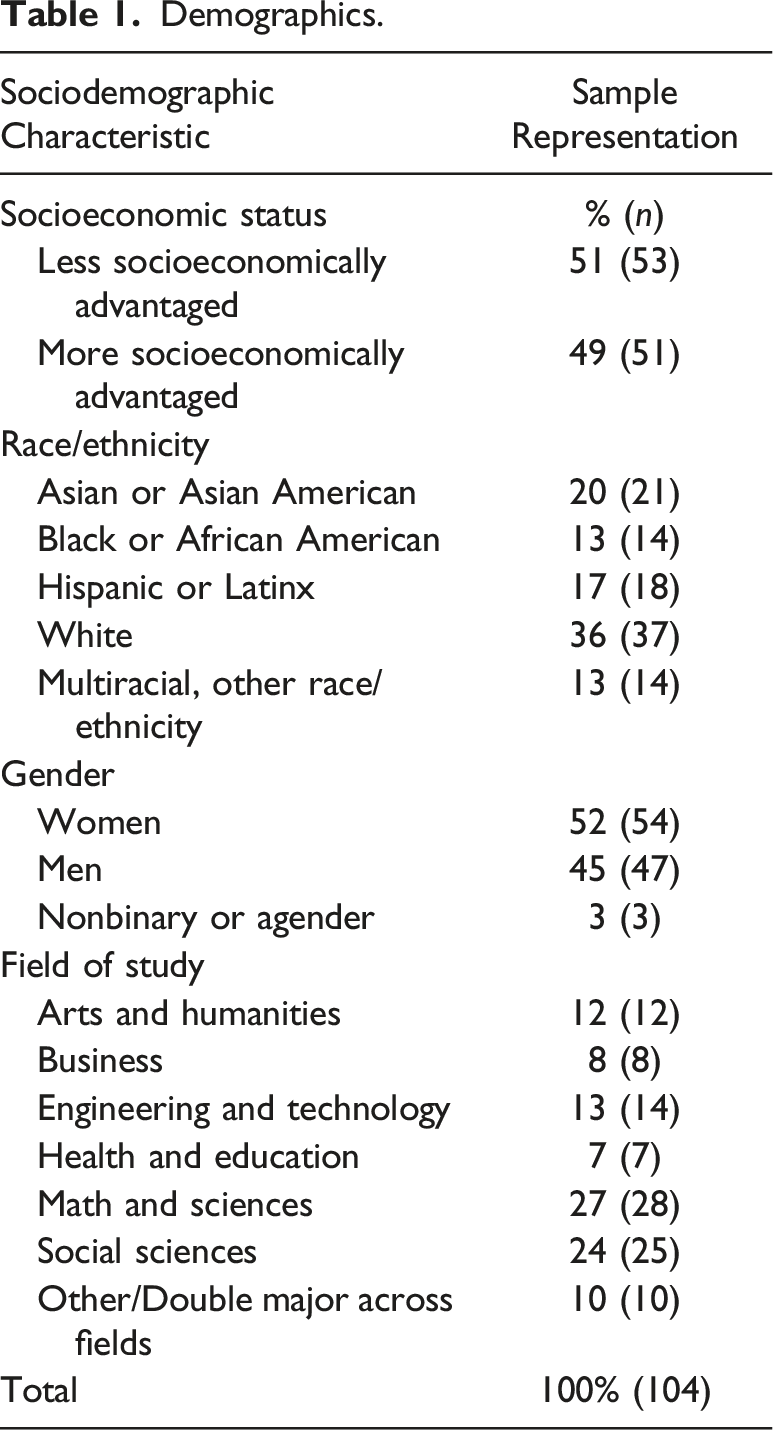
I collected an ethnographic archive of materials to contextualize the interviews, including fieldnotes and other documents, videos, and images that emerged as relevant to the study based on conversations with students. For example, some students mentioned experiences with university resources, programs, communications, and policies that I was able to find more detail about online. I compiled this information into an archive that included things like university newsletters, program schedules, promotional videos, social media posts, and resource pages. My fieldnotes explicated observations from these materials, connecting them to the perspectives students shared in interviews.
I analyzed the resulting transcripts and ethnographic archive, first by developing broad familiarity with the data, reading and re-reading the documents. Subsequently, a process of interpretive analysis involved open coding with Dedoose electronic coding software (Corbin and Strauss 2008). As I combed through students’ words and the ethnographic archive, I had the opportunity to “code [documents] for persistent ideas, gleaning relevant themes from this data, repeatedly returning to the texts to check and recheck themes, and linking codes and themes into analytic memos” (Pugh 2015). The analytic memos examined emergent patterns, placing my observations in conversation with my research question.
Considering my positionality was an important part of the research process. In addition to the ways my social location shapes my own familiarity with the topics explored in this project, as a White male faculty member who grew up in a middle-class family, I was also conscious of the ways students’ comfort discussing social, historical, and political context might be shaped by our differing social locations. I worked to build rapport with participants by expressing my openness to a diverse range of perspectives. Moreover, having student research assistants involved in data collection meant that more than 40% of the interviews were conducted by someone who shared participants’ student role.
This study has limitations worth exploring here. Conducting interviews at a single point in time cannot provide an adequate picture of how individuals might change over the course of their college journeys. Likewise, my data does not speak to the capacities students developed prior to enrolling. Ample research finds that socioeconomic status shapes K-12 students’ access to school resources and the tracks they are funneled into such that more and less socioeconomically advantaged students often have different learning opportunities prior to college (Lareau and Calarco 2012; Musto 2019; Tyson 2011). For that reason, I focus my analysis on exploring the understandings students displayed during their interviews, with recognition that further research will be needed to untangle the specific sources of these perspectives. Here, I work to understand the degree to which this institution was successful in ensuring that students could explain how individual circumstances are shaped by broader social, historical, and political contexts.
Findings
As I examined interview transcripts, it became clear that few students were displaying the understandings of “how individuals … are influenced by contextual factors” emphasized by the university. In fact, it turned out that participants described perspectives that were in conflict with such learning objectives. These perspectives took two main forms that corresponded with students’ socioeconomic status. Less advantaged students demonstrated a tendency to emphasize the independence of individual experience from broader social, historical, and political contexts. They cited self-reliance and individual effort as the most important variables influencing success or failure. Such perceptions encouraged students to engage in self-blame for the challenges they encountered.
More advantaged students, on the other hand, employed explanations of how social, historical, and political contexts impacted their own lived experiences. Yet they failed to extend similar explanations to understand the experiences of others. Like their less advantaged peers, these students pointed to individual effort as the primary explanation for how others fared, claiming that those who were diligent would be successful.
Based on insight from recent scholarship that some students’ dispositions and ways of understanding the world become more similar during college (Lehmann 2014; Rondini 2018), I explored the possibility of variation in students’ understandings by year of study. Though I do not have longitudinal data, if seniors’ capacities were more similar than those of sophomores, for example, that might suggest convergence in perspectives occurs over the course of students’ college journeys. As it turned out, the data did not reveal evidence of such convergence; the observed patterns held across year of study. I describe these patterns below in greater detail.
Less Advantaged Students
The contours of less advantaged students’ perspectives could be observed in my interview with Miguel, a working-class and first-generation college student majoring in international affairs whose family emigrated from Mexico when he was 7 years old. As he described obstacles encountered over the course of his college journey, clues about the social, historical, and political factors that influenced his journey emerged. Barriers to success arose in his first semester, when he struggled to navigate institutional bureaucracy. Financial challenges soon presented themselves as well: [T]here was a point in the first semester freshman year where I was not really sure if I was going to be able to come back … It was really bad actually. It was my first semester of first year, and I just didn’t think I was ever going to come back ... it was a very stressful time … I paid most of [my bill] off the first semester and then I realized I was a little short on it and I wasn’t going to be able to manage to pay off all of it.
Having already taken federal loans, Miguel realized, “I didn’t have the option of getting private loans … I was never going to get approved for them.” The situation became more dire when the university sent his remaining bill to collections, adding a late payment penalty. Eventually, a loan from “a friend of a friend” allowed Miguel to stay enrolled, but he continued struggling to fund college. With little material support from his family, he worried about becoming homeless if he was unable to afford the costs of room and board.
These experiences resonate with research documenting the challenges less advantaged students confront in higher education and in the transition to adulthood more broadly (Hamilton and Nielsen 2021; Silva 2013). In short, it was clear that his experiences were inextricable from the structural inequalities and realities of contemporary higher education that made college-going challenging for less advantaged individuals. Miguel, however, did not attribute these challenges to social, historical, or political patterns or even the meso-level features of his university. In response to my question about the most significant barriers to success he had encountered, he responded simply, “just myself.”
Miguel went on to illustrate how this individualistic explanation of his troubles linked to lessons he learned in college. When I asked about how he had grown or developed at the university, Miguel replied: I don’t think it’s a word, “independentizing,” [but college was] a very independentizing experience – I don’t know if I just made it up – it’s just a lot of independence on yourself … relying on yourself without relying on others is a very good thing I learned here … Because if you don’t have anyone around to rely on, it’s basically yourself. I survived, I guess. Barely.
In this way, Miguel exposed how his college journey offered few tools for developing contextualized explanations of lived experiences. In an ideal situation, the institution might have marshalled staff support to help students confronting similar circumstances to build or activate community cultural wealth and related social resources (Yosso 2005). Instead, Miguel had learned to attribute his experiences solely to individual effort.
The tendency toward self-blame that was evident in my interview with Miguel proved to be very common among less advantaged students. I asked Andre, a less advantaged White biology major about his biggest obstacles to success in college; his face was crestfallen as he replied, “Honestly, nothing except me. ‘Me’ is my biggest challenge to myself. That would be the only thing I can say, my inability to – like not performing the best, those things. This is my main hurdle … I have been lazy or did not want to do things.” Lucas, a less advantaged Latino student majoring in criminology likewise pointed to, “self-doubt and being my own worst enemy.”
These responses from Miguel, Lucas, and Andre were concerning for multiple reasons. First, self-blame was clearly painful for each of them. Moreover, these explanations of the obstacles they encountered at the university obscured the complexity of their experiences. All three of them had worked hard throughout college, and they had persisted in their studies despite encountering a range of structural barriers. Lucas, for example, had struggled to navigate the university, sharing that: Sometimes you don’t know where to go, just because you can’t go to your parents. Sometimes there’s times where I don’t even know if I should go to someone. I don’t even know, like, “is this right, is this how it should feel?” The fact that you’re the first one to go down this path, it gets scary sometimes.
Such experiences are common among first-generation college students (Nunn 2021; Roksa et al. 2020), and my ethnographic fieldnotes revealed that resources and offices at the university were organized in the disjointed fashion that amplifies challenges for less advantaged youth (Roksa and Silver 2019). Nonetheless, Lucas and other less advantaged students placed pressure and blame on themselves for moments when they struggled to meet their goals. 1
Participants described these individualistic understandings of their lived experiences as linked to specific ways of thinking they had developed over the course of higher education. Ingrid, a less advantaged White student majoring in geography, disclosed that early in her college journey, there were times when she felt as if the odds were against her. However, she went on to describe what she termed “a progressive mind shift.” She elaborated: I just I had this realization that like there’s no excuse – like, there’s really no excuse, except you’re not doing it right – and that the only barrier is myself. Everything else will eventually fall into place if you do the things that you need to do. Again, if there’s a problem, I try not to instantly forget about it. I just say, “you know, how can we approach this differently?”
Although she described this as a “realization” that had the effect of reshaping her perspective, this manner of understanding experiences could also be attributed to pressures that students encountered to adopt the types of individualistic explanations that were emphasized at the university. For instance, Ingrid’s claim that one should avoid looking for “excuses” aligned with language I found on university resource pages about the importance of “grit” and “resilience” (see also, Blume Oeur 2018; Golann and Torres 2020).
Flynn, a less advantaged Asian engineering major, described his experiences working through obstacles as times when he had learned “to really build up that diligence, to know what’s best for myself, and not only know what’s best for myself, but to actually put those words into actions to really do those things myself.” Ingrid and Flynn’s interviews illustrated the ways less advantaged students’ perspectives were linked to the neoliberal environment they encountered in higher education (Hamilton and Nielsen 2021). As Pugh (2015) explains, people often respond to such environments by adhering to a “one-way honor system” that imposes “strict rules” on individuals but fails to demand accountability from institutions.
Individualistic perspectives were not only a source of painful self-blame; they also made college-going a lonely experience. This was clear in my conversation with April, a less advantaged White biology major who described setbacks as she tried to navigate the university: It was tough trying to find the resources I needed at CU ... And when I did, it was a little bit overwhelming. Like the person I talked to ... gave me about 20 different things that I needed to get in touch with, or find more resources for, or call and see and maybe get directed somewhere else ... It’s a lot to navigate. It’s overwhelming.
Listening to these accounts, I wondered if April might blame the institution for her struggles. However, although she described these experiences as “overwhelming,” she was also quick to absolve the university of responsibility. “I have to also acknowledge that something that may be overwhelming for me might not be overwhelming for somebody else,” April explained, “perhaps they have [resources] set up perfectly for the average student, and I just don’t fall into that.”
The surprising thing about April’s quote is that institutional data made clear that the university served many students from less advantaged backgrounds. Regardless of this statistical reality, April perceived that she was an “atypical” student and often felt like she was navigating college alone. Without a way of connecting their lived experiences to broader social, historical, or political contexts, less advantaged students absolved the university of responsibility for supporting student success.
More Advantaged Students
More socioeconomically advantaged participants interpreted lived experiences in different ways. While less advantaged students relied on individualistic explanations of experience and engaged in self-blame for challenges, more advantaged students described the impact of social, historical, and political contexts in shaping their firsthand experiences. These perspectives varied at the intersections of race and gender.
More advantaged women and students of color described an awareness of how structural inequality, shaped by broader social, historical, and political contexts, informed their experiences through an intermingling of privilege and marginalization. An example of this perspective came from Caroline, a neuroscience major who acknowledged her own “privileged experience,” as a more advantaged White student. However, she did not believe that these privileges would be sufficient to ensure she reproduced her parents’ socioeconomic status. Instead, Caroline emphasized obstacles facing women in STEM fields, which she claimed amplified pressure to work harder. She acknowledged thinking about: How to be targeting [my efforts] and feeling like I might even have to target even more than like White guys who were able to just like stumble their way into the field and it worked for them. I’m like “oh, I’m working my butt off and still feel like I’m not gonna [succeed in my field].”
Likewise, a more advantaged Black math major named Valerie discussed widespread “stigmas” impacting people of color in the workplace, and Kailyn, a government major, described confronting vulnerability based on her social location as an Asian and Muslim student from an immigrant family: “I do feel vulnerable and [I encounter] a history that negatively impacts marginalized groups of people.”
More advantaged White men described their own experiences as being shaped primarily by privilege. For example, a film studies major named Calvin articulated his sense of being insulated from challenges: I think that there are a lot of aspects of my identity that provide me a blanket of protection … that comes from my family is sort of like upper-middle class, and I’ve never felt financially insecure. That comes from my race … like being a cis[gender] White man is sort of like a trifecta of privilege that I’ve learned about in the last couple of years, especially, but haven’t experienced as like a hardship in my life. And that’s not to say that I don’t have unexpected moments, but I think they’re made easier when I consistently have this privilege that comes through.
Describing the way this “trifecta of privilege” informed his experiences, Calvin joined Caroline, Valerie, and Kailyn in demonstrating an awareness of how broader contexts impacted his own experiences.
These ways of understanding one’s firsthand experience offered glimmers of a capacity to link individual experience to broader social, historical, and political context. However, it would be inaccurate to say that these students displayed these capacities consistently. While they relied on contextualized explanations to account for their own experiences, these participants consistently reverted to individualistic explanations when discussing the troubles confronted by others.
A clear example of these patterns showed up in my interview with Brian, a government and math major, who acknowledged having a “very privileged life” as a “White … middle class” student of “European heritage.” Yet moments later, he set aside this awareness as he reflected on what he had learned about success on a study abroad trip to Peru: I don’t care where you came from. I’ve interacted with people from every walk of life … I was in Peru for about a month, working with people building little farms to give them a renewable source of income. And you just meet so many different people. I think that, through all of that, what I’ve learned is none of your background matters. Like all that matters is the ideas and how you think, and that’s what I’ve kind of taken away from it.
After speaking in detail about how his own experiences were shaped by privilege, it was surprising to hear Brian claim that “what I’ve learned is none of your background matters” when he tried to account for the experiences of others. Like the less advantaged students described in the previous subsection, his claim that “how you think” is “all that matters” echoed the university’s emphasis on qualities like “grit” and “resilience.”
Similarly, Grace, a more advantaged Asian international affairs major spoke extensively about how her experiences were shaped by being an Asian American student from an immigrant family. She described how social, historical, and political contexts shaped the opportunity structures available to her family in Thailand, before they immigrated, as well as those found in the United States. Nonetheless, Grace claimed to be baffled by how anyone could struggle in college. “Another aspect of being a successful college student is to make sure … you explore opportunities … because [this university] has so many resources, there should really be no reason that you should fail any class.”
Just as less advantaged students’ individualistic perspectives encouraged them to absolve the university of responsibility for addressing inequality, more advantaged students often did the same. Rachel, a more advantaged Black student majoring in international affairs claimed that the university worked well for students who put in effort: I preach to everyone, like [the university] has a wealth of opportunities, like so much so that I can’t even do all of them … You have to look though. That’s the thing. You can’t just not ask for help or be looking for something. You have to go to those offices, or you have to look it up … You have to find the people that can help you first and also be willing to ask them for help to even begin with. You’ll be forced to advocate for yourself.
Neville, a more advantaged Asian student majoring in government, relied on a similar perspective when he discussed the importance of “search[ing] out opportunities by your own initiative.” As they emphasized the importance of “advocating for yourself” and taking “initiative,” Rachel and Neville implicitly acknowledged that the university was not structured to offer proactive support for students in need. Nonetheless, they used individualistic explanations to account for other students’ successes or failures.
Discussion
These findings offer new insight into the ways college students interpret lived experience, contributing to a growing literature on how students understand themselves and others (Binder et al. 2016; Lee 2016). Specifically, this study examined the degree to which participants displayed understandings of how individual experiences are shaped by broader social, historical, and political contexts. In contrast to stated university objectives to this effect however, I found that students described acquiring perspectives that failed to fully recognize contextual influences. Less advantaged students relied on individualistic explanations of success and failure, engaging in self-blame for challenges they encountered. Meanwhile, more advantaged students selectively described their own experiences as being shaped by broader contextual factors but refused to extend these understandings to the experiences of others. Presented findings illuminate previously unacknowledged cultural mechanisms contributing to the reproduction of inequality.
The perspectives adopted by less advantaged students created obstacles to success in higher education. Though research on community cultural wealth suggests that students from marginalized backgrounds enter college with various types of community support (Yosso 2005), the less advantaged students in this study emphasized the importance of individual resources rather than familial or institutional support. Reliance on individualistic explanations of one’s experiences led students to engage in self-blame for challenges and dissuaded many from seeking help or greater accountability from their institutions. Acknowledging these problems does not mean that postsecondary institutions should not encourage students to develop certain kinds of independence. To the contrary, such development is often cited as an important outcome of college attendance (Cuba et al. 2016; Evans et al. 2009). For some students, explanations of lived experience that stressed individual agency felt empowering, giving them a sense that they were prepared to persevere in the face of challenges. Likewise, some participants described an ability to rely on themselves as valuable for succeeding in neoliberal institutions. As Miguel noted, independence could be a strategy to “survive” in an insecure environment.
Yet in the context of marketized higher education where students are positioned as consumers (Hamilton and Nielsen 2021; Labaree 1997), such perspectives can also be oppressive. The self-blame that accompanied individualistic understandings of experience was painful for students, and research clearly documents the limitations of self-reliance in school settings where help-seeking is rewarded with valuable forms of support (Blume Oeur 2018; Nunn 2021). Presented findings underscored the fact that these perspectives could inhibit students’ comfort reaching out to university resources. In response to my question about whether he had used any institutional resources, Lucas reiterated that his success in college was, “up to me.” In sum, individualistic understandings of experience left less advantaged students feeling distraught and failed to provide tools for critiquing or changing the university.
For more advantaged students, displaying perspectives that selectively acknowledge contextual influences on one’s own experiences while individualizing the experiences of others may contribute to social reproduction. Research shows that socioeconomically advantaged students learn to present themselves in ways that accrue benefits as they apply to graduate school and employment opportunities (Posselt 2016; Rivera 2012; Takacs 2020). Moreover, crafting narratives that contextualize one’s life can provide a sense of meaning and help individuals process difficult experiences (Wilson 2011). As they acknowledge the influence of structural constraints on their own experiences, more advantaged students may find opportunities or motivations for working against such constraints, smoothing their paths toward middle-class adulthood. At the same time, however, their unwillingness to extend similar explanations to account for others’ experiences will likely perpetuate the inequities encountered by their less advantaged peers.
These findings raise questions about why more advantaged students acknowledged their own privileges instead of denying their existence and focusing solely on the marginalization they experienced. While my data do not speak directly to this issue, recent research suggests students could be learning to acknowledge privilege alongside marginalization to achieve success in certain middle-class settings (Bombaci and Pejchar 2022; Schmaling et al. 2015). For example, diversity statements and other discussions of racial and gender privilege have become commonplace in hiring processes for white-collar jobs (Byrd 2021; Laursen and Austin 2020). In this way, more advantaged students’ acknowledgment of privilege does not necessarily indicate genuine efforts to combat inequality. For many, these behaviors may function to extend their advantages as they transition to white-collar employment. The perspectives adopted by more advantaged students allowed them to discuss privilege in limited ways, without acknowledging the oppression of others. The result was that their own social position remained unchanged. This finding aligns with other studies showing that recognition of privilege or advantage does not always foster an ability to recognize one’s role in reproducing inequality (Crowley 2019; Warikoo 2016).
Another question raised by these findings is why more advantaged students displayed contextualized explanations of their own lived experiences while their less advantaged peers did not. As noted above, research demonstrates that socioeconomic status influences students’ educational tracks and access to school resources in ways that mean more and less socioeconomically advantaged students frequently have very different experiences prior to college (Lareau and Calarco 2012; Musto 2019; Tyson 2011). Without longitudinal data, I cannot specify when students developed their current perspectives, but my data offered some initial clues about college-level influences. For example, students’ perspectives may be developed or sustained through involvement in certain kinds of co-curricular and extracurricular opportunities. The more advantaged students in this study tended to have more extensive involvement in campus activities beyond the classroom (see also, Armstrong and Hamilton 2013; Stuber 2011). These activities provided venues for reflecting on one’s social location. Recall, for example, how Calvin described “being a cis[gender] White man” as “a trifecta of privilege that I’ve learned about in the last couple of years.” He explained that this learning occurred in conjunction with trainings for peer leaders on campus.
Additionally, more and less advantaged students often found themselves in different types of majors (see also, Mullen 2010). In my sample, approximately half of the more advantaged students majored in the arts, humanities, and social sciences, where social, historical, and political contexts were more frequently explored. Meanwhile, almost 80% of less advantaged students majored in STEM and applied fields where participants observed that these topics were not usually covered. Nonetheless, there were less advantaged arts and humanities majors and more advantaged STEM majors whose perspectives matched the patterns described above. In other words, the data suggested that although the distribution of students into majors may play a role, it is not fully determinative of students’ perspectives. Future longitudinal ethnographies could sort out the specific settings and factors that shape understandings of broader context, determining whether these perspectives were developed or reinforced in college.
My claims here do not assume that students fully internalize individualistic explanations for their own or others’ lived experiences. It could be, for instance, that the less advantaged participants in this study learned to present themselves in ways that aligned with external expectations about personal accountability (e.g., expectations of faculty, staff, parents, or employers), even if their actual perspectives remained more complex (Pugh 2013). Such a possibility is supported by the findings of studies documenting discrepancies between students’ professed aspirations and actual expectations as they pertain to educational attainment (see for instance, Sabates, Harris, and Staff 2011; Yates et al. 2011). It is possible that the participants in this study felt pressure to articulate individualistic explanations of lived experiences. Nonetheless, adopting such perspectives—in rhetoric or belief—has consequences for students’ college experiences and for the reproduction of inequality more broadly.
Conclusion
The findings presented here speak to growing concerns that higher education institutions are missing opportunities to teach students skills and perspectives for engaging equitably as part of diverse communities (Warikoo 2016). Such concerns have become elevated following the start of the COVID-19 pandemic, which prompted many to reevaluate common notions of what a college education could or should entail (Roksa and Robinson 2022). A range of scholars have critiqued U.S. colleges’ failures to foster effective civic education or prepare students to be members of a diverse democratic society (Aries and Berman 2013; Byrd 2017; Chase 2010). When it comes to helping students understand how individual experiences are shaped by broader contextual factors, institutions will likely continue to miss the mark as long as neoliberal practices, policies, and sensibilities remain the norm.
Research shows that many institutions encourage students to see themselves as customers or consumers within higher education (Harrison and Risler 2015; Titus 2008). Situating students as investors in an individual good makes it difficult to recognize the connections between individuals and the broader social, historical, and political contexts that shape their experiences. However, if colleges and universities take their missions seriously, efforts should be made to encourage students to develop interdependence and capacities to build and sustain healthy communities that provide mutual support.
Fostering students’ capacities to contextualize lived experiences requires framing education in more holistic ways (Rousseau 2020). For instance, studies show that students can benefit from practices designed to foster greater empathy and understanding (Hoop 2009; Massengill 2011). Assignments and activities that help students experiment with taking new perspectives and new roles may be especially promising (Silver 2020; Simpson and Elias 2011). Encouraging dialogue across vectors of difference is likewise valuable (Aries and Berman 2013; Chase 2010), and recent research suggests that community-based learning can support students in recognizing connections between individuals and broader context (Garoutte 2018). This work is not easy, but it is essential for higher education to fulfill its responsibilities to students.
Footnotes
Acknowledgments
The author would like to thank Matthew Ahlfs, Matthew Boero, Kristopher Cleland, Fanni Farago, and Tharuna Kalaivanan for their assistance with interviews and transcripts.
Declaration of Conflicting Interests
The author(s) declared no potential conflicts of interest with respect to the research, authorship, and/or publication of this article.
Funding
The author(s) disclosed receipt of the following financial support for the research, authorship, and/or publication of this article: This research was generously supported by an American Sociological Association (ASA) Fund for the Advancement of the Discipline Grant.