



Abstract
Studies of political articulation focus overwhelmingly on the role of parties in constructing political identities and group interests, relying on inter-party competition, given a sharp partisan divide. However, where party identification is less salient, local politicians forge alliances from disparate constituencies, cultivating varying political reputations that personify the concerns of distinct groups. By examining Alabama politics in the 1920s, focusing on the dramatically different relations with the Ku Klux Klan and business elites of Alabama’s three senators, we address how politicians generate supportive alliances in the absence of party competition. To this end, we extend articulation theories by examining how political actors—and not only their parties—cultivate support by presenting the concerns of local publics through their electoral persona. Drawing on archival material, we explore how Senators Oscar Underwood, J. Thomas Heflin, and Hugo Black came to represent key interest groups, forging distinct paths to electoral success. An exclusive focus on parties overlooks politicians’ reputation-building as a mechanism of political articulation.
Articulation theory has emerged over the past decades as an influential means to understand how inchoate political desires among interest-group publics are transformed into policy through organizational advocacy, highlighting the critical social function of political parties. Rather than reflecting social cleavages (Lipset and Rokkan 1967; Manza and Brooks 1999), parties actively construct them, “articulating” coherent blocs from disparate groups (de Leon, Desai, and Tuğal 2009, 2015), utilizing agenda politics to create a base of support. Addressing the transformation of interests to outcomes through the institution of the party provides a compelling model of how societies specify economic and value-based choices. Yet, despite this valuable approach, something (or, better, someone) is missing: the strategic career politician who articulates the interests of constituent groups. Although scholars focus on competing explanations centering on voters, parties, and the State, the role of the embedded policy promoter has been downplayed, despite the role of politicians as central agenda setters in the legislative process.
In articulation theory, parties are treated as dominant forces, despite the diverse perspectives of influential actors and the possible absence of significant rivals. Parties are but one means for citizen mobilization, evident in certain institutional environments. Following George Homans’ (1964) admonition to “bring men back in,” we extend articulation theory by emphasizing the meso-level role of politicians in cultivating issue-based reputations that both constitute and activate constituencies. Individual actors, supported by extra-party interest groups, can be vehicles or mobilizers for rival articulations. Parties are not inevitably central to political constructions (Eidlin 2016; Slez 2020) as is evident in intra-party struggles in states with dominant political orientations, currently such as California, Illinois, Utah, or Tennessee. The structure of political dominance leads to a single competitive field that operates within the domain of the leading party in which alliances become crucial to personal advancement. Thus, in highlighting the meso-level dynamics of reputational politics, we emphasize the intersection of macro political structures and micro political choices of voters. It is through the relations among civic actors in which collective action (including candidate support) reveals that personal interests are linked to obdurate structures.
To extend articulation theory, connecting personal reputation with ideological expression, we examine the agency of politicians in the so-called Solid South. As recognized, the label Solid South is misleading, given sharp regional and class divides (Key 1949; Caughey 2018; Bateman, Katznelson, and Lapinski 2018). The South is only “solid” given the institutional dominance of the Democratic Party and the commitment of the permitted electorate to White supremacy. The widely utilized metaphor of a singular, united South (Cash 1946; Reed 1986) erases sharp differences that generate alternate political positions.
During the 1920s, voters in Alabama (almost exclusively White) sent three men to the United States Senate. Each was a Democrat, although their politics and alliances differed. How, then, did politicians with such distinct identities create successful persona and alliances within a divided polity?
Two interest groups are particularly salient. In addition to economic elites, consisting of plantation owners and urban industrialists known as the “Big Mules,” each Senator had to negotiate Klan politics, given the prominence of the Ku Klux Klan during the middle years of the decade (1924–1928). The three had different coalitions, although each supported institutional segregation. 1 Even if partisan distinctions are not strong, individual politicians had to distinguish themselves from other claimants from these different political factions. In Alabama politics of the 1920s, political debates over racial policies were less salient because the 1901 Alabama constitution established a structure of explicit White supremacy that lasted until the 1960s Civil Rights movement and the Voting Rights Act of 1965. In other words, the Southern segregationists maintained social control by excluding race relations from the political agenda and preventing Black political participation (Schattschneider 1975 [1960]; Bateman et al. 2018; Caughey 2018). Thus, while White supremacy defined social relations in Jim Crow Alabama, racial contestation was marginal in the political arena in contrast to issues surrounding prohibition, religious tolerance, cotton prices, and labor rights (Feldman 2013). 2 These were the issues around which politicians chose allies, accepted antagonists, created agendas, and cultivated reputations.
In contrast to current studies of contentious politics, following the Gramscian perspective, which treat parties as the foremost political actors, we recognize the agency of politicians in burnishing reputations and forging alliances. While considering national electoral outcomes, a state might be characterized as politically uniform, the reality is more complex in light of intra-party politics as demonstrated by recent empirical work (Caughey 2018). In such contexts, politicians cultivate distinct reputations by situating themselves in their presentation of their politics by suturing a body of supportive constituents. In this, we emphasize the reputational work that results from alliance-building. In cases of weak party competition, politicians serve an articulating function.
Politicians and Local Politics
Max Weber’s (1958 [1918]) seminal work on vocational politicians in forming the modern rational-legal state emphasized their role as shaping state policies. Whether as targets of interest groups (Akard 1992; Kitschelt 2000), participants in systems of clientelism or corruption (Benson and Baden 1985; Piattoni 2001), or representatives of imagined communities (Finlayson 2003), politicians once were treated as central.
More recently, however, attention to politicians as significant actors has been eclipsed by an emphasis on parties (de Leon 2014). In competitive electoral systems, political parties are seen as the primary force that organizes the democratic process, given their ability to specify interests through collective discourse and their access to resources. In rivalrous politics, parties shape systems of nomination, voting, and appointments. When victorious at the polls, parties become collective agents of state power (de Leon 2014). Despite the centrality of parties to democratic governance, and the centrality of politicians to parties, scholarly attention to politicians’ agency has become surprisingly limited. 3 It is not that theorists deny that the individual actor matters, but that mattering is folded into party activity. Parties are often treated as remote organizations reflecting salient social divisions (Lipset and Rokkan 1967; Manza and Brooks 1999) or as autonomous organizations with objectives distinct from their constituents (de Leon, Desai, and Tuğal 2009, 2015; Lotesta and de Leon 2020).
Recent research has extended this latter position, identifying scope conditions on the constitutive power of political parties (Riley 2015; Eidlin 2016) and drawing attention to third-party actors in mediating party, society, and the state (Lotesta 2016; Mudge 2018). We are sympathetic to these efforts, yet even this research that highlights individual actors such as policy professionals and intellectuals as central to the political articulation overlooks the articulating role of politicians. Our goal is to argue that articulation theory applies beyond the scope of party competition and is valuable in the context of intraparty competition.
In part, the omission of the politician results from a focus on inter-party dynamics in which parties provide the point of competition. However, exploring intra-party dynamics, an underdeveloped area of research (Mudge and Chen 2014), highlights the agency of individual politicians to align their reputations with a set of social issues that activate coherent blocs of supporters thereby shape electoral outcomes (Petrocik 1996; Carpenter 2023).
We explore a political context—the Jim Crow South—where intra-party dynamics were especially salient. Politicians vying for public support in the region could not depend on party identification to signal their policy preferences given the dominance of the Democratic Party, a regime conflated with the state apparatus, effectively curtailing the electorate, marginalizing opposition parties and enforcing a racially segregated civil sphere (Mickey 2015). While some scholars conceptualize one-party South as “authoritarian” (Gibson 2005; Mickey 2015), our research supports recent empirical work that finds that Southern politicians were responsive to variation in the interests of those citizens who could participate in their election (Caughey 2018). In the case of a selectorate, where members of one party determine the outcome of an election, political actors must differentiate themselves through other means, including having reputations that constitute (and are constituted by) the groups they embrace or oppose and setting a policy agenda that prioritizes the issues those constituencies find most salient. Thus, reputations cannot be reduced to individual-level characteristics such as personality or work experience (Pich et al. 2020). Bloc-building is critical to politicians’ reputations, and, consequently, to electoral success. Extending articulation theory, we address the linkage of politicians and their allies as a means of creating appealing reputations and how those reputations, in turn, elevate policy positions and segmented publics.
Case Selection
We analyze the choices of three prominent Alabama politicians to gain support in this divided and contentious electoral landscape, examining their orientation to business elites and the Klan as they carved out a supportive constituency. In doing so, we demonstrate that politicians develop reputations that articulate their chosen constituencies, treating these constituencies as the basis of their political power and allowing the members of these groups to feel that they—and their most cherished issues—have a defender. To achieve this support, these politicians constructed agendas that would appeal to their base, sometimes creating new concerns (price support for agricultural products) or resurrecting old ones (tariffs and monetary policy). While these Senators operated on the national level, they also relied on the autonomy of Southern state governments in creating a local political base regional agendas. To be sure, not every policy could be placed on the agenda (notably issues that impacted segregation), but economic divides played out in primaries.
By examining Alabama politics in the mid-1920s, we select a case in which the Democratic Party is dominant, but with sharply differentiated interest groups with distinct policy preferences, leading to distinct agendas (cotton prices, tariff reform, or labor rights). While race is the underlying force of Southern politics, other salient issues shaped electoral dynamics, in part because White supremacy was unquestioned by voters (Feldman 2013).
However, Alabama voters recognized a salient divide between the “Big Mules”—the leading urban industrialists and plantation owners of the fertile southwest “Black Belt” counties—and the economically progressive forces of labor in the cities and poor farmers, especially in the hill country of Northeast Alabama (Johnson 1923). The division between the two regions was recognized (Key 1949) and resented in the poorer hill counites (Webb 1997:6). Indeed, the progressive movement flourished in Alabama and other parts of the Deep South during the 1920s (Bateman, Katznelson, and Lapinski 2018). Progressive demands included limits on child labor, regulation of corporations, penal reform, better education and health services, and improved infrastructure (Feldman 2013:41, 63).
Some who supported progressive reforms were affiliated with the Alabama Klan, a movement that grew rapidly in the early 1920s, peaking in the middle of the decade when economically progressive politicians were elected (McVeigh 2009; Gordon 2017). While sharing nativist themes with the First (Reconstruction era) Klan and the Third (Civil Rights era) Klan, the Second (1920s era) Klan was distinct. Unlike the first and third, which operated violently at night, the second served as a fraternal organization, like other groups of the era, despite their cloaked secrecy. But far from a fringe organization, this Klan was admired by millions who were not members (Gordon 2017:2).
Still, the organization was not without occasional cruel eruptions designed to terrorize opponents—Black and White—whom the Klan deemed moral offenders in an era of 100% Americanism. But in contrast to other eras of Klan ascendance, “anti-black prejudice was not a major theme for the second Klan” (Gordon 2017:40), in contrast to foreigners, Catholics, and Jews (Evans et al. 1924:10).
Significantly the Klan engaged in local politics. As Kenneth Wald (1980) describes Memphis, local Klan groups strove to affect electoral outcomes in the 1920s. This was the goal in Alabama as well. The 1926 election revealed the power of the Klan at its high-water mark as their preferred candidates triumphed, both on the state level and in municipal contests. With its wider agenda, including prohibition, the Second Klan shaped state governance. In 1927, The Nation wrote of its influence in Alabama: To say that Alabama is the most completely Klan-controlled State in the Union is to put the matter correctly . . . . [T]he Klan is so well entrenched politically, that so many judges, solicitors, sheriffs, jury commissioners are members of the Klan or submissive to it, that State and county governments are so thoroughly beholden to the Klan, that Alabama is a veritable Eden to the Knights. (Feidelson 1927:311)
Despite their nativist, racist, and anti-democratic beliefs, economically the Southern Klan was also a progressive organization (Walker 2005), defending poor Whites against policies that benefited wealthy plantation owners and corporate elites, and often supporting workers’ rights (Pegram 2018:374). Although originally welcomed by the elites, who saw in the Second Klan a bulwark for White supremacy, this view altered during the mid-1920s as the Klan’s economic progressivism became evident. In the words of historian Glenn Feldman (2013:42), the organization supported a “Whites-only economic liberalism.”
Within a few years the Klan collapsed, in part because of corruption, attacks by opponents, and capture by elite groups (Jessup 1997; McVeigh 2009). At its height in Alabama in the middle of the decade, the Klan reportedly had 115,910 members, but by 1930, the number had fallen to 1,349. The election of 1926 was a huge triumph, but Klan opponents won races for Governor and Senator 4 years later (Birmingham Age-Herald 1930).
To investigate reputation-building in this political context, our data are from archival material available at the Birmingham Public Library (BPL), the Hoole Archive at the University of Alabama (Hoole), and the Alabama Department of Archives and History (ADAH) in Montgomery. Given the collections, full references are not always available. These archival materials are supplemented by extant historical and sociological literature about the Southern Klan and Alabama politics.
Building a Base
During the decade of the Klan’s resurgence, Alabama sent three men to the United States Senate. Each was influential in national politics: Oscar W. Underwood (serving in the Senate from 1915 to 1927), J. Thomas Heflin (“Cotton Tom”; 1920–1931), and Hugo Black (1927–1937). We briefly describe each, before analyzing how, as individual political actors, they developed alliances or hostile relations with the Alabama Klan and with planters and business interests in the absence of a competitive partisan structure. Although the three men did not face each other in Democratic primaries, they were recognized as reflecting different segments of the electorate, and each was challenged in their primaries. Both Heflin and Black faced more conservative opponents. Heflin, excluded from the Democratic Party primary, lost in 1930 to the conservative John Bankhead II and Hugo Black, with Klan support, triumphed over two well-known conservatives. In the 1924 Democratic presidential primary, Underwood, while serving as the state’s admired senior Senator, faced off against (and defeated) a Klan-backed candidate. As we describe Underwood was tied to urban elites and plantation owners, whereas both Heflin and Black were linked to the Klan, small farmers (especially Heflin) and labor (especially Black).
Oscar Underwood (1862–1929), although largely unknown today, was a prominent Senator and twice candidate for the Democratic Party presidential nomination in 1912 and, more seriously, in 1924 (Johnson 1980). Born in Louisville, Kentucky and raised in St. Paul, Minnesota in a well-to-do family, Underwood received a law degree from the University of Virginia and moved to Birmingham, becoming active in the Democratic Party. He served in the House of Representatives from 1895 to 1915 and rose to become the majority leader from 1911 to 1915. He served in the Senate from 1915 to 1927, where he was minority leader (1920–1923), promoting conservative legislation, supported by big business. Although a segregationist who, as Senate minority leader, was crucial in organizing a filibuster to defeat anti-lynching legislation (the 1922 Dyer bill that had passed the House) because, he claimed, of concerns over state jurisdiction. But Underwood was also a fierce opponent of the Klan, which likely contributed to his decision not to stand for reelection in 1926.
During his terms in the House and Senate, J. Thomas Heflin (1869–1951) was known as a flamboyant, 4 loquacious, and charismatic Southern demagogue (Owens 1927; Michie and Ryhlick 1939). He was born to a prominent Alabama political family in the East Central part of the state, but he saw his role as representing Alabama’s impoverished farmers. Heflin explicitly defended White supremacy; his role in the 1901 constitutional convention contributed to the disenfranchisement of Black Alabamians. While in Congress, he fired shots at a Black man on a Washington streetcar for drinking liquor in the presence of a White woman, although he was never charged (Tanner 1967:17). 5 Heflin was praised for telling “Negro”-dialect stories on the floor of Congress (Tanner 1962) and, early in his Congressional career, made viciously racist remarks (Tanner 1967:8–9; Yeomans 1966:29, 68, 84). His belief in White supremacy was explicit. Heflin explained, “I believe as truly as I believe that I am standing here, that God almighty intended the negro to be the servant to the white man” (Feldman 2013:49). He trained in law, served in the House of Representatives from 1903 to 1920, and for a decade in the Senate, unopposed for re-election in 1924. In the Senate, Heflin did not emphasize racial issues, but focused on raising farm prices. Later in his career, Heflin became a vehement opponent of the power of the Catholic Church. Based on religion and prohibition, he refused to support the candidacy of Al Smith for President in 1928, a position that permitted opponents to deny him a place in the 1930 Senate Democratic primary (Thornton 1968; Dooley 1963). Heflin ran as an independent and was defeated. He took his exclusion from the primary to the floor of the Senate, but the election was not overturned.
Hugo Black (1886–1971) is remembered today as a principled defender of the First Amendment and a supporter of the rights of workers as a Supreme Court justice (Hamilton 1972). Born in East Central Alabama, Black did not graduate from high school but later received a law degree from the University of Alabama. As a young lawyer in Birmingham, he successfully ran for Jefferson County prosecutor, where he charged police officers accused of brutalizing African American suspects as well as pushing for illegal liquor to be confiscated. After serving in the army in World War I, he returned to Birmingham where he built a successful legal practice, defending workers but also taking cases supported by the Klan (Berman 1959). In 1923, Black joined the local Klan, but secretly resigned before announcing his Senate candidacy, although that resignation was not publicized by his friend James Esdale, head of the Alabama Klan. 6 With the implicit (and sometimes explicit) backing of the Klan and campaigning at Klan meetings throughout the state, Black was elected to the Senate in 1926, where he served until his court appointment in 1937 as a reliable New Deal supporter.
Reputation and Alliance
Oscar Underwood and the Big Mules
Percentage of Votes for Candidates by Region. 39
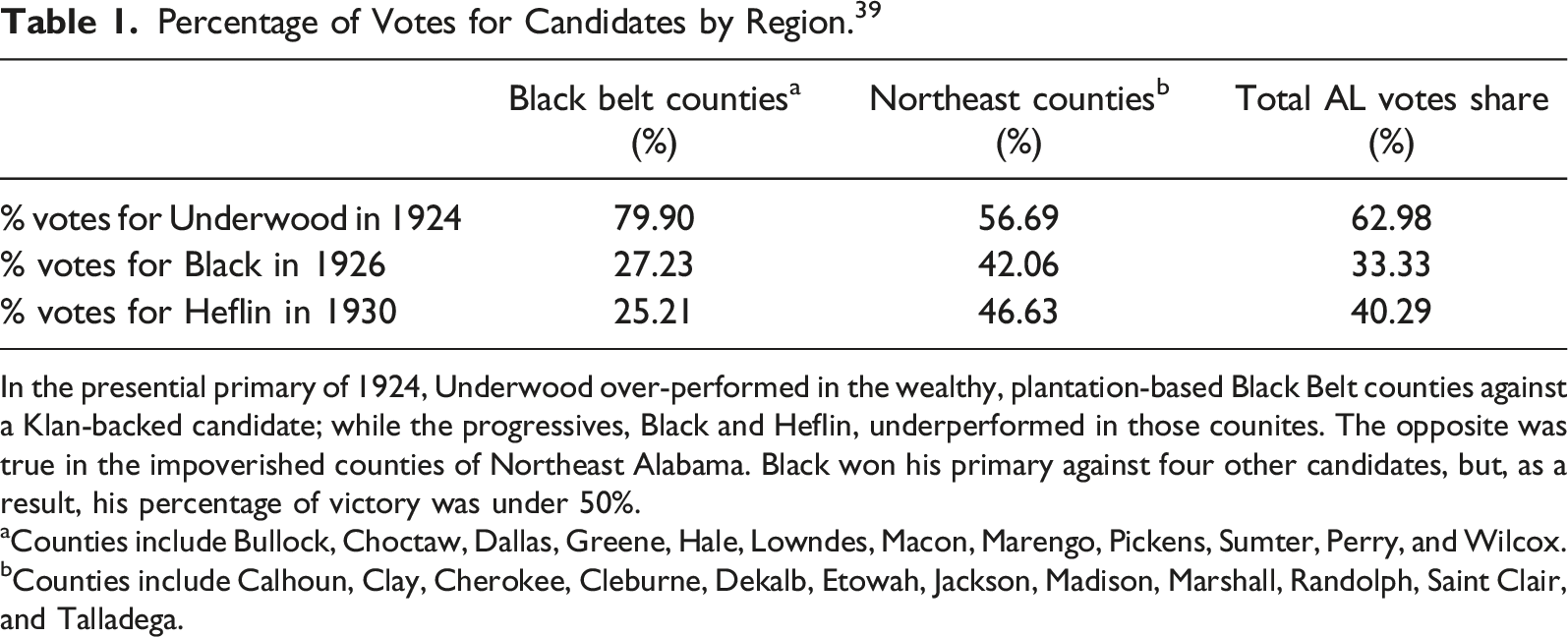
In the presential primary of 1924, Underwood over-performed in the wealthy, plantation-based Black Belt counties against a Klan-backed candidate; while the progressives, Black and Heflin, underperformed in those counites. The opposite was true in the impoverished counties of Northeast Alabama. Black won his primary against four other candidates, but, as a result, his percentage of victory was under 50%.
aCounties include Bullock, Choctaw, Dallas, Greene, Hale, Lowndes, Macon, Marengo, Pickens, Sumter, Perry, and Wilcox.
bCounties include Calhoun, Clay, Cherokee, Cleburne, Dekalb, Etowah, Jackson, Madison, Marshall, Randolph, Saint Clair, and Talladega.
Written after stepping down as Senator, his book Drifting Sands of Party Politics (Underwood 1928), issued by a major New York publisher, reveals a politician aware of history, thoughtful in his beliefs, avoiding oratorical flourishes and described as “a perfectly informed business man [sic]” (Bowers 1928:xvii). He rejected the “radical” (i.e., progressive) elements of the Democratic party and opposed the power of “special interests,” in which category the Ku Klux Klan fell. Underwood (1928:404, 407) believed that politicians working together could produce better governance, claiming that, Where our danger lies is not from a majority of the mass of all the people . . . but it comes from majorities reflected in legislative bodies induced by the fear or influence of the organized blocks, classes and clans who have taken upon themselves the purpose to govern our country in order that they may achieve political power.
Underwood’s image, as he presented it, was as a politician who considered what was best for all.
This led to his fervent rejection of the Klan and their alliance with prohibitionists and the Anti-Saloon league. The responsibility of the politician is to stand against “organized wealth, organized religion, and organized prejudice” (Underwood 1928:409; see Springen 1962). This separated Underwood from pressure groups like the Klan but permitted him to speak for elites that did not consider themselves interest groups but responsible citizens.
Underwood’s Economic Conservatism
In contrast to the two other Senators, Oscar Underwood was no populist, but a conservative Democrat (Bateman, Katznelson, and Lapinski 2018:314), a friend to business interests, opposed by the American Federation of Labor. He proudly claimed credit for anti-labor legislation in 1920, outlawing railroad strikes and explaining to the admiring Birmingham Chamber of Commerce that if labor raised its “mailed fist,” “I will say ‘Here you must stop.’” In arguing against a tax increase on the wealthy in 1917, Underwood and his conservative and economically comfortable backers wished “to make audible the distress of the cotton planter and manufacturer” (Bateman, Katznelson, and Lapinski 2018:336, 360). This agenda positioning, providing voice to the concerns of planters and businessmen, was central to his political reputation, and distinct from progressive politicians of the period such as Tom Heflin.
Those Underwood spoke for were described by opponents as “machine politicians, ultra-conservatives and reactionaries . . . . the Old Guard” (Milton 1924:80). A leader on tariff legislation, said to hurt farmers and workers by imposing duties on imports, raising prices on consumer products, he represented the interests of economic elites, his most prominent supporters. Indeed, while Underwood often claimed to be a “Jeffersonian” (supporting States’ Rights), he was seen as akin to Calvin Coolidge. The San Francisco Argonaut (1923) wrote, In the possible event of Mr. Coolidge’s failure to gain the nomination . . . and in the further possible event that republican choice may fall upon some western man of radical type, democratic strategy would probably seek a man of conservative character – a man likely to draw support from conservative republican ranks. Senator Oscar Underwood is such a man.
While cultivating strong support among well-to-do Alabamians as a prominent Birmingham lawyer, he was denounced by the Committee of Allied Labor Organizations, that claimed that Underwood’s career was “characterized by his lack of sympathy with the great masses of the people and by subservience to the selfish big business and financial interests” (Johnson 1980:374). More critically, a letter writer notes that Underwood presented the views of the Trusts, What a pity that the great ability of Senator Underwood has been lost to the masses and won for the trusts! Senator Underwood has favored every law introduced . . . by lobbyists for the trusts. . . . He is errand-boy for the Steel Trust on the Democratic side of the senate chamber, and the bosses know where to find him any hour of the day or night.
7
In a similar vein, a Georgia newspaper proclaimed, judging his support of “predatory interests,” He belongs to the reactionary elements of the Democratic party, and has never shown a disposition to line up with the plain people in their struggle against class rule and special privilege. . . . His affiliation with Wall Street and the big corporate interests of the country are too close. He is not a man of the people, but rather a defender and champion of certain interests that are inimical to the welfare of the people.
8
While these attacks did not match his preferred image, Underwood embraced the value of conservatism in politics, noting, “I don’t belong to the radical group, and neither does true democracy.” 9 This sharp contrast with the self-presentations of Heflin and Black suggests the alternative means by which a politician could articulate class values in Jim Crow Alabama.
Underwood: Nemesis of the Klan
In detailing Oscar Underwood’s principled opposition to the Ku Klux Klan, we emphasize that he was not a beacon of enlightened racial equality or that policies that he endorsed directly benefitted African Americans. Perhaps the Klan’s offense was their egregious directness and their base among the (White) working class. As minority leader in the Senate and as a strong believer in States’ Rights, Underwood, as noted, managed the successful opposition to the Dyer anti-lynching bill. He asserted that the 1920s Klan was more dangerous than the post-Civil War Klan that he found virtuous. 10 Even in attacking the 1920s Klan, Underwood condemned their secrecy and religious intolerance, not their racism.
Still, Underwood’s attack on the Klan became central to his political persona, and many of his elite backers agreed. He spoke of “the criminal class in the Ku Klux Klan,” 11 while admitting that many “good citizens” belonged and many of their ideas were legitimate, despite his claim that their secrecy conflicted with the Bill of Rights. 12 For Underwood, the Klan’s attempt to be an “invisible government” was at the heart of his opposition in contrast to the visible government of wealthy, educated elites that he represented. This was evident in his objection to Klan members being masked in public. 13 Underwood pushed, unsuccessfully (but just barely), for the Democratic Party to condemn the Klan in their party platform in 1924 (Allen 1955:261–62). He recognized that Klan members were not his core supporters. His decision, given the animosity that he deliberately provoked, contributed to his defeat for the 1924 Presidential nomination. Other than in Alabama, where he was a favorite son, he received few delegates throughout the South (Allen 1955:273). In retrospect, Underwood believed he “lost the South” because of his vote against the 18th (Prohibition) Amendment and “because I was opposed to the Klan, and openly so.” 14 Whether brave or not brave enough, Senator Underwood felt that his attack on the Klan was a moral crusade as much as to his claim to be an open-minded national figure not beholden to Southern racial politics. He commented—in Boston—that he considered the enmity of the Klan, “one of the finest tributes of his public career.” 15
As he travelled to Cleveland, Boston, Mississippi, and throughout Texas, Underwood spoke at length about the dangers to democracy of the secretive, hooded Klan (Springen 1962). In a widely reported address in Houston, Underwood explained, When any group of men unite in a secret order to run the laws and the government, their action strikes at the very heart of government. . . . When men have secret organizations for the purpose of governing, then they are striking at the very principles of government.
16
In a letter to a supporter, Senator Underwood went further, I am opposed to the Ku Klux Klan or any other secret organization engaging in political organization in the United States either for the elevation of their nominees to public office, or for the defeat in political contests of those who will not subscribe to their secret dictates. . . . I shall conduct my campaign for the Democratic nomination for the Presidency four-square against Klans, cabals and all other secret conspiracies aimed at enforcing upon candidates obligations that cannot be made public.
17
In response, the Klan targeted Underwood, with one Klan-oriented paper describing him as the “Jew, Jug, and Jesuit candidate” (Johnson 1980:387). Despite the admiration that some felt for Underwood’s democratic ethos (Springen 1962:292–3; Allen 1955:102), having such a powerful group as his devoted enemy had consequences. Late in 1924, a large crowd of 7000 Klansmen watched “Senator Underwood” be buried in effigy in a Birmingham park. 18 Less dramatically, Klan supporters distributed a pamphlet listing Congressional legislators who were foes of the group. Senator Underwood headed the list. 19 Just as his stand on the Klan crippled his Presidential ambition, their strong opposition contributed to his decision not to contest the 1926 Senatorial contest, leaving the way open for Hugo Black’s candidacy, representing working class Alabamians. Underwood’s professed principles might have served him well as a national candidate, but not for the voters that he hoped to represent. Here, as elsewhere, national appeal, necessary for the minority leader of the Senate, conflicted in important respects with the home style necessary for continued political viability.
“Cotton Tom” Heflin: Big Man of the Klan
Tom Heflin found his greatest support in the impoverished Hill Country of Northeast Alabama but was rejected in the Black Belt counties (see Table 1 for results from his 1930 Senatorial election defeat against conservative John Bankhead II). Heflin was widely scorned by plantation owners, state newspapers, and national elites as a Southern demagogue. However, like many Populists, he promoted policies that might be lionized as progressive. 20 His speeches attacked Wall Street banks, trusts, and the nascent Federal Reserve with the need for government support of agricultural prices, while coupled with a profound nativism and impassioned support for prohibition. These positions drew attention to economic issues that were not then on the public agenda and made Heflin, in effect, a spokesman for members of the Klan in Alabama (and throughout the nation), as well as gaining the admiration of local small farmers. His continuing efforts—rhetorical and legislative—to raise cotton prices endeared him to his struggling constituents as their tribune (Yeomans 1966). Both elements of Heflin’s politics—economic populism and nativist divisions—were integral to his political identity, building a base and developing fierce opponents. What provoked scorn from national elites could, when properly managed, serve to build local esteem, given different policy demands as well as suspicions of the motives of outsiders.
Heflin’s Progressive Economics
Although it is now common to emphasize a demagogue’s socially divisive positions, economic beliefs matter as well, although the linkage of “Wall Street” intrigues with conspiracies by Catholics (and Jews) connects the two perspectives. Early in his Senatorial career, Heflin spoke for the concerns of his constituents by attacking the Federal Reserve’s policy of deflation, a strategy that depressed agricultural prices, gaining him the moniker, “Cotton Tom” and earning him the scorn of elite newspapers including the New York Times, the Wall Street Journal, and the Birmingham News, as well as bankers and financiers.
Heflin’s progressivism was widely reported, and his attacks on the Eastern wing of the Republican Party often reflected an economic populism. In Heflin’s words, “I care but little for what the greedy plutocrats and those who misrepresent the people have to say about me.”
21
Addressing the Senate, Heflin railed against “predatory interests,” adding of his journalistic opponents, “I, for one, feel complimented when I have one of these pusillanimous and villainous sheets assail me. . . . We are driving the sword of righteous indignation up to the hilt in the bowels of scandal and crime in the Capital of the Nation.”
22
His opposition to the deflationary moves by the Federal Reserve, coupled with the absence of credit to poor farmers, was praised by farm groups, even by Midwestern Republicans, such as Kansas Senator Arthur Capper, who remarked that “Senator Heflin led the fight in exposing the evil workings of deflation . . . if he should never do another important thing in his public career his great service in this matter entitles him to a high and prominent place in the history of our country.”
23
A small-town newspaper noted, prior to his unopposed reelection, “The people of the cotton growing states owe to Tom Heflin’s fight against the cotton monopoly the difference between the present price of cotton today and what the crop would be worth at ten cents a pound. . . . . It was his fight that saved the price of cotton.”
24
Even those critical of Heflin, such as one journalist who described him as an “infamous buffoon,” noted, “Always, he was a friend of the farmer, particularly the cotton farmer, hence his nickname. Heflin fought tirelessly for higher cotton prices, once pushed through a bill to advertise cotton abroad, and sought to clean up the cotton futures market” (Eddins 1978). Another critic of Heflin’s later career noted that he believed, probably with ample justification that the planters were being victimized by the speculators . . . . He was a Progressive and his vote could be counted on by the other Progressives . . . . With all his shortcomings, his professions of devotion to the common man are undoubtedly sincere. (Owens 1927:274–75)
However one might judge Heflin’s demagoguery, he embodied the interests of impoverished workers and farmers. These positions led to attacks by elites, the constituency that favored Underwood. Horace Hood, the owner of the Montgomery Journal, wrote to Heflin, “You are going through what I have gone through for twenty years – paying the penalty for fighting big business. . . . You know they are grooming a candidate to run against you the next time, and big business will make available all the money this candidate may need in the effort to accomplish your defeat.” 25 Some opponents even claimed that Heflin was a Bolshevik. One opponent wrote to Heflin, “LENIN is dead, TROTZKY [sic], exiled. RUSSIA needs an able and big minded leadership. When are you leaving?” 26 Given the Klan’s suspicion of coastal elites, Heflin’s economic stance struck a chord with many members of the Invisible Empire, including those beyond Alabama. A Klan group in Spencer, North Carolina wrote to Senator Heflin commending him on his attack on “the money HOGS of Wall Street.” 27
Heflin’s Passionate Nativism
On the Senate floor, Heflin became known for his anti-Catholic diatribes. 28 Heflin’s attacks on the Catholic Church and their Papist “plots” were filled with venom and, while vigorously repudiated by members of his own party, gained the support of those, like members of the Klan, who demanded a Protestant America. Heflin spoke of the “secret, cunning and insidious work of the Catholic clergy and hierarchy” and warned of “such insidious activity of the Pope of Rome in America.” 29 Atticus Mullin, a political columnist for the conservative, establishment (and, hence, anti-Heflin) Montgomery Advertiser, asserted that Heflin believed that Catholic assassins stalked him on the streets of Washington (Feldman 2013:70). 30 This anti-Catholicism was consistent with his stand on Prohibition, linked rhetorically to a hostile racism. Heflin claimed that there would “be no peace with liquor flowing and niggers full of rum” (Feldman 2013:68). Catholics, likewise, were seen as heavy drinkers.
The close relationship between the Klan and Senator Heflin was recognized. Heflin spoke regularly at Klan gatherings, both in Alabama and elsewhere, including Pittsburgh and Philadelphia (the group paid for his addresses (Tanner 1967:129)).
31
Heflin supported many Klan concerns, their White Protestant biases, and reflected their moral order. James Esdale, the Grand Dragon of the Alabama Klan and an enthusiastic backer of Hugo Black as well, wrote to Heflin, I want to take this opportunity to congratulate, commend, and encourage you in the valiant fight you are putting up for Protestant, Christian Americanism in America. . . . I want to say that our boys everywhere are speaking in nothing but the highest terms of the valiant fight you are carrying on.
32
Heflin’s archive is filled with letters of support by those who recognized in his anti-Catholic and prohibitionist stances their own perspective. Some even wished that he run for President. 33 Heflin was reportedly seen lunching at the Senate restaurant with the Imperial Wizard of the Klan Hiram Evans (Tanner 1967:175). Motions of support were sent from Klonklaves of local Klan groups throughout Alabama and as distant as Texas, New York, Ohio, Wisconsin, and Maryland.
Heflin did not make his membership in the Klan, an ostensibly secret organization, public; 34 however, his affiliation, official or not, was well-known. He was dared to declare his affiliation. R. B. Creager, the Republican committeeman from Texas, demanded such an accounting, saying “I challenge you specifically to declare on the floor of the Senate your past and present klan [sic] affiliations,” Heflin declined to respond. To be a supporter of the Klan provided reputational benefits; to be a member, not so.
Hugo Black: Civic Virtue in White Robes
Hugo Black is a Dixie paradox. Although justly recalled as a prominent civil libertarian and a supporter of labor on the Supreme Court, Black freely and apparently sincerely joined the Robert E. Lee Klavern #1 in Birmingham in 1923. It was not until he was planning his campaign for the Senate that he secretly resigned his membership, although he did not announce that to the voters of Alabama. His affiliation with labor, however, was never in doubt, as well as his profound skepticism of the activities of big business. In contrast to both Underwood and Heflin, Black’s relationship to the Ku Klux Klan was more enigmatic. At first a crucial ally, his association with the group became a reputational liability. His support of labor remained a basis of support throughout his career.
Progressivism in a Hooded World
During his early adult years in Alabama, Hugo Black treated his support for the Klan and his support for labor as consistent, as he advocated for the interests of both, often overlapping, groups. Hugo Black would be unknown today had he not benefited from Klan support in his first election, running with labor approval as well. Neither would have sufficed for victory (Webb 2004). In that election, he ran against two major candidates linked to moneyed elites and one well-known Klan supporter, although the Alabama Klan (although not national headquarters in Atlanta) made clear its support for Black.
Black was described critically by the Montgomery Advertiser as “the darling of the Ku Klux Klan.”
35
In winning the 1926 Democratic nomination for Senate against four opposing candidates, he received most support, like Heflin, from the Hill Counties of Northeast Alabama and least from the wealthy Black Belt counties of the Southwest (Table 1). After his victory, Black addressed Klan groups, thanking them and endorsing what he described as their civic mission, although never explicitly embracing their racism. He hoped, rhetorically at least, to transform the Klan into a conventional—even progressive—community organization. Perhaps he knew better. According to the New York Times, Black told the group, I know that without the support of the members of this organization I could not have been called, even by my enemies, the “Junior Senator from Alabama.” (Applause.) I realize that I was elected by men who believe in the principles that I have sought to advocate and which are the principles of this organization. . . . My friends, I thank you. I thank the Grand Dragon. He has stood by me like a pillar of strength. (New York Times 1937)
While his talk preached tolerance, it did so by claiming that this tolerance reflected Klan values. In his early years in the Senate, Black made several concessions to the prejudices of his White constituents, cementing the support of his coalition. Black opposed an anti-lynching bill and questioned whether African Americans should be permitted to vote (Hamilton 1972:279; Berman 1961:39). After a runoff against a former governor, Black won re-election in 1932, still very much a Southern Democrat, if a progressive one, refusing to condemn the prosecution of the Scottsboro boys (Hamilton 1972:206–12).
Unlike his Senate colleague, Tom Heflin, tolerance towards Catholics led Black in 1928 to support the nomination of Al Smith as the Democratic candidate, although without enthusiasm. In the Senate, Black was primarily concerned with labor issues and after the election of Franklin Roosevelt became recognized as a strong supporter of the New Deal. His increasingly pro-Roosevelt stance made his re-election in 1938 doubtful given the divisions in Alabama politics (Alabama 1937).
Was Hugo Black in 1926 a supporter of the Klan in their racial attitudes? Was his goal to articulate their progressivism? Or was he simply an ambitious joiner? In their stand on prohibition and in their resentment of elites, Black’s sympathies were squarely with the Klan. Yet, despite being the attorney in several Klan-supported cases, biographers find no pattern of animus, and he maintained friendships with Catholics and Jews. As a lawyer on the make, Black was indeed a “joiner,” and the Klan was only one such organization to which he pledged membership, along with the Masons and the Knights of Pythias (Lerner 1937:368; Pruden 1945:180).
When nominated to the Court, Black was fortunate that a six-part Pulitzer Prize-winning series by Ray Sprigle in the Pittsburgh Post-Gazette, depicting his role in the Klan, was published after his confirmation and after Black had left for a Parisian holiday. Upon his return, he disavowed support for the (then-moribund) Klan,
36
and the controversy eventually died down. His supporters, including the prominent liberal journalist, Max Lerner (1937:367–68), emphasized Black’s progressivism, his alliance with President Roosevelt, his support for union causes, and painfully defended his joining the Klan as an act of pragmatic politics and reputation work, That a man like Black should have come to join the Klan is one of those facts monstrously hard to grasp until you approach it not as a moral problem but simply as a piece of political behavior. Black’s career was that of a progressive in politics, and in the South in the decade after the World War such a career inevitably crossed that of the Klan.
Lerner goes on to assert the Klan’s progressivism, The common people had been captured by the Klan, for it buttressed them against problems they could not understand with principles that seemed eternal. The Klan assumed, moreover, a radical attitude on many specific issues which appealed to the progressives.
This puts the best face on Black’s early alliance, even though it recognizes that, like Heflin and Underwood, he is strategically attempting to cultivate a network of support, which in Black’s case included the Klan, the Prohibitionists, and the unions.
The Politician as Articulator
Our cases reveal not only the sharp political divides of 1920s Alabama but more crucially the need for successful politicians to create alliances as they reflect and define local interests, generating a positive reputation among a group of voters. How they created alliances and enmities matter in attaining political power. In this case—and in the Jim Crow South generally—it is not the party that is crucial, but the rival politicians and their allied groups that struggle for dominance. In absence of a partisan divide, individual actors must develop reputations and associated agendas that articulate the concerns of allies.
To be sure, none of these Senators opposed state-sponsored segregation—impossible given the selectorate in the Democratic primary—but their views of the Klan and economic justice were distinct, as were their networks of supporters. This division is evident in a letter responding to an inquiry of Rev. J. C. Kearns, S.J., Dean at Loyola University of New Orleans by his friend, industrialist P. H. Callahan, as to why Senator Heflin was so vehemently anti-Catholic. Callahan incisively writes, In a great many of the states there are two or more factions within the Democratic Party and in Alabama as you know one of them was known as the Senator Underwood crowd which had the backing of the financial utility and business interests and also the practical politicians in the cities. After serving ten or twelve years in Congress Heflin concluded to run for the United States Senate . . . the Underwood crowd was bitterly opposed to him for he was a Bryanite [populist] with political ideas that were not relished by conservatives and the money class. . . . to his surprise [he] learned that the Catholics were lined up solidly with the Underwood faction. . . . Heflin is a type who will not forgive-and-forget the Catholics for lining up with “the interests” against him.
37
Perhaps this suggests that politicians are cynically strategic, but Callahan recognizes that alliances with their associated policy preferences matter when crafting reputations in a fragmented party.
The scope of this paper extends beyond the peculiarities of Alabama—or Southern—politics. While few states reveal the deep national party loyalty of the states of the Deep South, we find similar patterns of partisan dominance elsewhere. Consider Vermont where from 1856 to 1975 all Senators were Republican, but divisions remained within state politics. Even in one-party systems, political rivalries, conflicting interest groups, and policy divides shape how positions are presented and alliances forged.
The larger point is to recognize the importance of alliance-building as consequential for a political sociology that takes seriously the choices of politicians in crafting their careers and their reputations. Within any political organization there are multiple bases that are available for cultivation. A politician can articulate the concerns of labor, business, farmers, women, racial or ethnic communities, moralists, or nativists, and promote an agenda to address these concerns. Each of these groups can fit within a party, although some fit more easily than others.
When interest groups are influential, career politicians must develop relations with those groups that they believe will provide meaningful and majority support. These groups are both clients and controllers. Politicians construct appealing reputations and generate committed followers through their choices and rhetorical presentations, identifying themselves as champions of issues most relevant to their base. In other words, they come to stand for something in the public mind, not merely serving as puppets of political parties, but as representatives of ideas and publics. It is not merely ideas that matter, but that ideas matter as they are incorporated into public discourse.
As we demonstrate, this is particularly true when rival partisan affiliations are not central, as in primary contests. Here citizens do not choose a party but search for a voice. 38 In a closed primary, voters must consider salient issues as they are framed and reputations of candidates as they are imagined and as supported (or opposed) by neighbors and interest groups. The question for the politician, attempting to find a space within a party, is how to select issues, allies, and opponents congruent with their past, their preferences, and their placement. While articulation theory properly recognizes that parties are essential in organizing and solidifying American democracy, the choices of politicians as meaningful actors must not be ignored. To choose this vocation is to be propelled and limited by a reputation. The vector of articulation is not merely the party, but the politician as well.
Footnotes
Acknowledgments
The authors wish to thank Anthony Chen, Cedric De Leon, Margaret Somers, and Adam Slez for their comments on an earlier draft. We thank Taylor Moore and Mech Frazier for their research support and the archivists at the Birmingham Public Library, the Hoole Archives at the University of Alabama, and the Alabama Department of Archives and History for their help and kindness.
Declaration of Conflicting Interests
The author(s) declared no potential conflicts of interest with respect to the research, authorship, and/or publication of this article.
Funding
The author(s) received no financial support for the research, authorship, and/or publication of this article.