




Abstract
Sociological research on social movements and politics holds that advocacy organizations are typically trusted to be authentic agents of their constituents. At the same time, however, businesses and other outside interests often engage in covert “astroturfing” strategies in which they ventriloquize claims through apparently independent grassroots associations (but which are entirely funded and staffed to benefit the sponsor). These widespread and deceptive strategies may harm trust in advocacy groups overall, extending beyond those revealed to be involved, through a mechanism of categorical stigmatization. This study is the first to test how revealed covert patronage may “poison the well” for all advocacy groups, with implications for how social movements and other advocacy causes suffer harm from illegitimate political practices by other organizations. The authors carried out two survey-experiments in which a local advocacy organization was revealed to be operating, respectively, as a “front” for either a corporation or think tank; in each experiment, conditions varied depending upon whether the sponsor was presented as highly reputable, low reputation, or with no specified reputation. In both experiments, astroturfing led to significant declines in trust in advocacy groups overall. We highlight implications for theory and research on social movements, organizational theory, and political processes.
Keywords
Introduction
Civil society organizations that advocate for social change are typically understood to play a central role in fostering democracy, civic trust, and building skills for political participation and serving as a counterweight against the influence of powerful business actors and other elites (Tocqueville 1835 [2004]; Verba, Lehman Schlozman, and Brady 1995; Fung 2003). This is true to such an extent that when they are absent or less effective at organizing constituents, many worry about democratic deficits that limit representation and may generate political dysfunction (Fung and Wright 2003; Lee, McQuarrie, and Walker 2015; Norris 2011). In an era of rising distrust of elites (Bonikowski 2016), widening inequalities in representation (Bartels 2016), and the rise of anti-democratic political shifts (Whitehead and Perry 2020), these questions have become increasingly important considering how advocacy groups may potentially offset democratic limitations in other domains. 1 Social movement and organizational theories alike highlight the importance of maintaining the credibility and trustworthiness of advocacy groups for the sector’s ability to mobilize constituents, garner resources, and effect change in the political process (see Benford and Snow 2000; McCarthy and Zald 1977; McCammon 2009). But what happens when that very trust in advocacy groups is threatened?
One of the most prominent challenges to overall trust in advocacy groups is the practice of “astroturfing.” Coined by former Senator Lloyd Bentsen in 1985 to describe the false impression of a groundswell of grassroots civic participation (hence, faking the appearance of “grassroots” just as the artificial ground covering does), the term refers to political practices that involve outside support for participation (e.g., “paid protesting”), when an elite sponsor masquerades as having mass support, and/or when fraudulent techniques are used to generate participation (e.g., forged signatures) (see Cho et al. 2011; Lee 2010; Lyon and Maxwell 2004; Walker 2014). These practices, which exploit trust in associations in order to gain political advantage for a patron, are widely seen as illegitimate and raise many questions about authenticity for advocacy groups. 2 Since the 1970s in the U.S., there has, in fact, been a field of hundreds of firms that provide such services to paying clients, along with professionals working in-house at corporations (Kaynak and Barley 2019; Walker 2014), the work of which has generated a broader dialogue about these practices with notable press coverage. 3 Despite this, we need to develop a stronger sense of how perceptions of advocacy groups change when strategies are used that raise doubts about whether such organizations are, in fact, acting independently of their funders and other sponsors. While this point was raised in classic resource mobilization arguments around patronage of social movements (McCarthy and Zald 1977: 1232), we continue to lack a clear and direct account of how astroturfing affects support for advocacy. 4 When questionable practices emerge—such as patient advocacy groups shown to have tight connections to pharmaceutical firms lobbying on behalf of those companies, or consumer groups enlisted by sugar-sweetened beverage firms to oppose soda taxes, each of which we discuss below—this may have significant fallout not only for revealed groups but also for overall trust in advocacy.
The core astroturfing strategy is the creation of “front groups” that simulate the appearance of an independent association, but which are funded and staffed by an outside patron, such as a corporation, industry group, or wealthy individual (Givel and Glantz 2001; Lock and Seele 2017; Pfau et al. 2007). Prominent examples of front groups include Know Your Power (a front for energy firms; see Mix and Waldo 2015); the National Wetlands Coalition (a front for real estate and utility firms against environmental regulations; see Pfau et al. 2007), and Coalition for an Affordable City (a front for beverage industry interests fighting soda taxes; see Somji et al. 2016). In each of these cases and others we describe below, firms and industry groups sought to capitalize on the legitimacy of seemingly “independent” associations as an additional source of political power. Mobilizing apparently separate groups on behalf of a well-resourced sponsor may help them to have an additional lever in the policy process at moments when they feel threatened (Martin 2013), yet this should likely harm overall trust in advocacy groups. Thus, as we hypothesize below, we expect that the revelation of astroturfing by a corporate sponsor harms overall trust in advocacy groups.
But it is not only corporations and industry groups who sponsor these efforts. There are also, as we highlight below, numerous cases in which think nonprofit tank sponsors have supported astroturf campaigns, particularly those that mobilize public participation to advance ideological agendas; consider that the Commonwealth Foundation (a conservative think tank) funded activists to counter a teachers’ union protest in Philadelphia (Chang 2014), the “LEED Exposed” think tank worked to mobilize against green building standards (Johnson 2014), and the Progressive Policy Institute mobilized publics around technology issues (Blumenthal 2018). Thus, the sponsors of these campaigns vary by sector, and we also sought to examine that difference. Our second hypothesis, outlined below, states the expectation that revealed astroturfing by think tanks also harms trust in advocacy groups.
The current study provides the first direct evidence of how the exposure of a front group may “poison the well” and harm trust in advocacy groups, including those not at all involved in the practice, carried out via a series of online experiments. To the extent that revealed astroturfing harms overall trust in advocacy groups, it is plausible that those who hear reports of the practice may not trust other advocacy groups (and, therefore, possibly reduce their willingness to contribute time or money). This may have additional downstream implications, reducing overall participation in social movements and other advocacy, perhaps fostering further civic disengagement and cynicism about the advocacy process and politics more generally.
We also investigate the role of organizational reputations in shaping the way that these practices affect public perceptions. In organizational studies, many investigations expect that an organization’s reputation may provide a buffer against the fallout from negative disclosures (e.g., McDonnell and King 2013). In our case, we expect (and hypothesize below) that the disclosure that a low-reputation organization was orchestrating an astroturf campaign should be more harmful than a similar disclosure regarding a high-reputation sponsor, because observers will assume that such practices are more widespread than the case at hand, and that unsavory (and less trustworthy) actors are often behind them. Although other studies have shown that the revelation of front-group strategies generates significant reputational fallout (Lock and Seele 2017; Pfau et al. 2007), our study is the first to examine how organizational reputations may shape overall perceptions of trust in advocacy groups; this is important conceptually because it provides an understanding of an additional layer of “guilt by association” effects (e.g., Pontikes, Negro, and Rao 2010).
In conceptualizing this, we build from organizational theory on the role of categorical stigmatization, which emphasizes how evaluators may make judgments of organizations based on their membership in a category of organizations known to be engaging in stigmatized behaviors (Lashley and Pollock 2020; Piazza and Perretti 2015; Vergne 2012). In total, this body of research has made clear that evaluators often make judgments about whole categories of organizations on the basis of both established expectations and also due to stigmatizing events, such as scandals judged as emblematic (e.g., Jonsson, Greve, and Fujiwara-Greve 2009; see also Adut 2008). In our case, as we elaborate, we expect that prominent incidents involving revealed astroturfing by particular advocacy organizations will cause evaluators to be less trusting of all such organizations, precisely due to categorical stigmatization. As such, we advance beyond existing research on categorical stigmatization, which tends to focus more on the fallout from being associated with stigmatized industries (e.g., Lashley and Pollock 2020; Piazza and Perretti 2015; Vergne 2012) while overlooking how stigmatizing revelations may harm broader perceptions of otherwise more trusted organizational types (but see Vasi and King 2019).
We next review research on trust in advocacy more generally, considering an overview of research findings and exploring a few key examples from diverse societal domains. We then consider the mechanism of categorical stigmatization, followed by a consideration of the practice of astroturfing in particular, setting our expectations about how the revelation of this practice is likely to affect trust in advocacy groups (and how this might vary depending upon the sector and reputation of the sponsor). We then review our findings and highlight the importance of this study for how we understand the effects of astroturfing on trust in advocacy groups.
Trust in Advocacy Groups
Advocacy organizations depend upon the trust of their members and other constituents in order to operate effectively (Becker 2018; Hou et al. 2017). And in general, on a broader societal level, we tend to understand the nonprofit sector as a space that is less driven by the economic pressures of markets and the political force of the state, which therefore relies more heavily upon the goodwill of voluntary supporters (Hall 2002). Although this is obviously quite an imperfect way of understanding how the sector works in practice (Prakash and Gugerty 2010), such characterizations are real in their consequences, as we explain.
Research on trust in advocacy organizations illustrates certain key themes. Nonprofit organizations overall are deeply dependent upon relations of trust to maintain access to resources in the form of donations and other types of in-kind support, and scandals (and other forms of stigmatization) may harm such relations considerably (Bekkers 2003). They are also increasingly turning toward quantification and the use of evaluation metrics, which are intended to build trust in their practices, expenditures, and internal governance and staffing (Jepson 2005; Sloan 2009). Although there has been some skepticism that changes in the broader civic sector have led to a crisis of confidence (O’Neill 2009), such groups nonetheless continue to enjoy higher levels of trust than for-profit companies (Witesman and Fernandez 2013).
For advocacy groups in particular—often as part of broader social movements—their supporters and outside audiences typically expect that they are acting as authentic representatives (Keck and Sikkink 1998). While there is always some concern that the interests of an outside patron may have influence as part of normal politics, most patrons play a background role in the support they provide and how that support is perceived by various audiences. Still, there are cases in which the support of a patron becomes a topic of public inquiry—and, indeed, donors are attracting more attention in the contemporary politics of philanthropy (Reich 2018)—thus raising critical questions for a variety of audiences about the authenticity and trustworthiness of advocacy. We now consider two poignant examples.
Pharmaceutical Firms Funding Patient Advocacy Groups
For one particular type of advocacy group, there has been extensive research investigating how corporate sponsors exploit trust in advocacy groups to gain advantages: patient advocacy groups (e.g., Best 2012). Such groups come in many forms, from activist campaigns to raise awareness of rare medical conditions to widespread and all-encompassing disease advocacy campaigns closely linked to cause-marketing (consider, for instance, the work of the Susan G. Komen Foundation around breast cancer; see Strach 2016). Such groups have significant political impacts, such as in shaping research budgets at the NIH (Best 2012).
Several studies have investigated the close ties between, for instance, pharmaceutical companies and patient advocacy groups linked to the conditions that particular drugs treat. Most well-known among these are the ties between drugmakers and the National Alliance on Mental Illness (NAMI; see Lewis-Fernandez et al. 2016; Rothman et al. 2011; Rothman 2011), which generally advocates for the treatment of mental illness using psychiatric drugs rather than therapy; this has led to critical questions about NAMI’s arms-length independence from funders. Such concerns are amplified by the fact that many advocacy groups receiving pharmaceutical funding are inconsistent about disclosing those donations (Rothman et al. 2011). Importantly, observers have repeatedly raised concerns about whether such covert support affects trust in advocacy groups. One report argued that because so many patient groups receive this funding, there is a general worry that all patient groups “have been silent or slow to complain about high or escalating [drug] prices” (Kopp, Sydney, and Elizabeth 2018).
The Beverage Industry and Advocacy Groups Fighting Soda Taxes
A major battle has emerged in recent years over local regulations intended to improve public health through new taxes on sugar-sweetened beverages. As public health scholars and advocates have noted, industry resistance to these efforts has been nothing less than fierce and has borrowed extensively from the 1990s-era playbook of tobacco firms (Nestle 2015).
And, just as the tobacco firms did with campaigns such as the National Smokers’ Alliance a generation ago (Givel 2007), the beverage industry has responded by creating numerous “citizen” groups to oppose local beverage taxes in legislative and regulatory battles. Such groups include Americans Against Food Taxes and Coalition for an Affordable City (Cohen 2014), as well as New Yorkers Against Unfair Taxes (Huehnergarth 2012), all of which have strong links to the beverage industry.
Similar to the case of pharmaceutical funding of patient advocacy groups, the anti-soda tax funding has larger implications. As Huehnergarth (2012) argued, these campaigns raise a set of larger questions for public health advocates about how to challenge the legitimacy of “phony grassroots coalitions.” And, as Levine (2018, emphasis added) put it most directly, “Because many of these activities use the anonymity granted [to] nonprofit organizations to mask their real origins, they pose a special risk to the entire nonprofit community.” We quantify and test that risk in what follows.
What these campaigns share is an outsized presence of external patrons, a linked advocacy group that presents itself as largely independent, and some exposure taking place that makes outside audiences question that apparent independence. While it is quite likely and expected that exposures would lead many public audiences to discredit the revealed front group and sponsor (Lock and Seele 2017; Pfau et al. 2007), what is less clear is whether this affects public trust in advocacy groups writ large. For this, our analytic expectations rely upon prior research on categorical stigmatization processes, to which we turn next.
Categorical Stigma
Although stigma is often, as in classic definitions (Goffman 1963), seen as a judgment that affects social evaluations of particular actors, observers also recognize that stigmatization may affect whole categories of actors (Lashley and Pollock 2020; Piazza and Perretti 2015; Vergne 2012) including those who do not themselves engage in stigmatized behaviors or otherwise have stigmatizing characteristics (Pontikes, Negro, and Rao 2010). When making social judgments, observers routinely use shortcuts and schemas that ease their cognitive processes of decision-making and evaluation (DiMaggio 1997), and this may make them generalize from specific observable instances to judgments of whole categories of actors. This applies in particular to how audiences evaluate organizations, in which classification schemes become lenses through which whole groupings of organizations are judged (Vergne 2012).
As mentioned earlier, we understand categorical stigma as the disapproval that organizations face by virtue of occupying a stigmatized category of organizations. Importantly, we note that this need not require that the category is stigmatized in an absolute fashion, but the category may be stigmatized in a relative sense, such as when a previously well-regarded category loses relative standing after a scandal.
In the present study, we investigate the relative level of trust that audiences have in advocacy organizations following the revelation of questionable political activities by a member of the category. Prior studies have also shown empirical evidence of categorical stigmatization in this relative sense, even if not typically conceptualized that way: consider how negative judgments of accounting firms increased after the revelation of Arthur Andersen’s role in the Enron scandal (Carnegie and Napier 2010), the general distrust of mortgage lenders that followed after the 2008 market meltdown (Ross and Squires 2011), or, closer to the advocacy domain in the present study, the fallout for international NGOs after the Oxfam scandal in Haiti (Prakash 2019). In our estimation, it is critical not only to study the fallout from connections to stigmatized organizational categories in this absolute sense but also categories that suffer relative harm.
We argue that this degree of relative change in categorical stigma can often have even more significant consequences than when an actor is associated with an absolutely stigmatized category: there may not be that much ground to lose when an already-stigmatized category of organizations faces additional harmful disclosures, but the shift from seeing a well-regarded field of organizations more negatively may be much more consequential. We now turn toward our topic of interest: how the practice of astroturfing may harm trust in political advocacy groups.
The Practice of Astroturfing
We focus on a particular type of political activity—one that is covert—which may have effects on public perceptions not only for the organizations revealed to be taking part, but for overarching perceptions of all advocacy groups. The practice of “astroturfing” is controversial but widespread: the firms that provide such services, by one estimate, work with 40% of Fortune 500 firms (Walker 2014). It is a strategy in which an organization ventriloquizes political claims-making through the channel of seemingly independent activist groups. Astroturfing—that is, faking the appearance of grassroots support—can be defined by three characteristics: when a sponsor masquerades as a mass movement, engages in fraudulent claims-making, and/or provides heavy (often material) incentives to everyday activists to support their interests. Groups in civil society play a distinct role in shaping public discourse as authentic representatives, ostensibly guided by moral principles (Prakash and Gugerty 2010). Paying sponsors often seek to trade on that authenticity to gain political advantage.
Although widespread, the practice of astroturfing is seen as unethical given that it trades on the standing of civil society groups to advance a sponsor’s interests (Cho et al. 2011). When exposed, there are reasons to expect that astroturfing will harm the reputation of the revealed sponsor as well as the sponsored organization (Pfau et al. 2007), which will have been shown to be falling short in terms of its ethical commitments.
The clearest and most direct manifestation of astroturfing is the creation of “front” organizations that appear to be independent civil society groups but are, in fact, either primarily funded by a sponsor and which are designed to lobby for the interests of the funder indirectly (Lyon and Maxwell 2004). There are numerous examples of this strategy found in a variety of case studies. For example, Mix and Waldo (2015) describe a front group called Know Your Power, funded by Chesapeake Energy, in a campaign to stop the Oklahoma public utility commission from permitting the Red Rock coal-fired power plant. The campaign involved only limited public engagement but nonetheless falsely claimed to represent “a statewide coalition of concerned doctors, health organizations, educators, citizens, businesses and students.” Other cases have been identified in varying domains: gambling (Bodensteiner 1997), climate change (Oreskes and Conway 2011), tobacco (Givel and Glantz 2001), pharmaceuticals (Hacker and Pierson 2008: 87), and many other areas, particularly involving heavily regulated industries.
Importantly, the practice of astroturfing is not limited to sponsorship by the business sector, as there have been a number of cases that have emerged in which nonprofit think tanks, foundations, centers, and institutes have been revealed as covertly sponsoring advocacy campaigns. The most prominent of such cases in recent years were revealed in a blockbuster series of articles in the New York Times (see Lipton and Williams 2016), illustrating that influential think tanks including the Brookings Institution and the American Enterprise Institute were covertly supporting a wide variety of advocacy causes; other cases include funding of the Tea Party movement by industry-linked nonprofits such as Americans for Prosperity and FreedomWorks (Skocpol and Williamson 2010), and the extensive funding of advocacy by the Open Society Foundations (Stone 2010). We therefore examine, in what follows, the effects of astroturfing not only for corporate sponsors but also for think tanks.
Research Expectations
The revelation of astroturfing should harm trust in advocacy groups, as individuals may expect that practices such as these are more widespread than they previously recognized, via the aforementioned mechanism of categorical stigmatization. Astroturfing practices are not widely understood among the general public, although there is a general sense of unease and distrust related to the role of corporate money in politics, as well as broader concerns about political misinformation (Lima 2018).
A variety of scholarship suggests that business interests tend to be common as sponsors of astroturfing campaigns and other forms of elite-sponsored efforts to mobilize public participation (e.g., Lee 2010). For this reason, our primary investigations examine whether astroturfing campaigns that are revealed to have a corporate sponsor will affect trust in advocacy groups. Thus,
At the same time, as mentioned earlier, a variety of case materials have revealed that think tanks also engage in astroturfing. In this study, then, we also seek to test whether the effects of astroturfing on trust in advocacy groups extend beyond cases in which a corporation is revealed to be a sponsor. We do so by examining whether the revelation that a campaign is sponsored by a nonpartisan think tank also harms trust. We expect that astroturfing as a tactic has negative effects on trust that extend beyond the specific distrust generated by having a business sponsor. Thus,
Lastly, we expect that these processes are likely to be affected by the organizational reputation of the revealed sponsor. For advocacy groups, the trust they enjoy is partly based on the expectation that they avoid associating with unscrupulous actors, as they are supposed to represent the authentic interests of local citizens in their communities. When it is revealed that an advocacy group has not only acted as a front for a covert sponsor but also that the covert sponsor is of ill repute, it seems reasonable to expect that trust in advocacy would be harmed even more significantly. This is consistent with the notion that network ties are often utilized as prisms through which audiences infer relational information about the company one keeps (Pontikes, Negro, and Rao 2010) and extends and enriches our examination of categorical stigmatization (Vergne 2012). More specifically, we expect that relative increases in the categorical stigmatization of advocacy organizations will be even more marked when the sponsored is revealed to be a low-reputation organization ex ante. Thus:
Methods
Overview
To assess these questions, we carried out two survey-experiments, using a between-subjects design. Survey-experiments are desirable for answering these research questions because (1) they give analysts a better handle on making causal inferences about the effects of stigmatizing disclosures on perceptions of trust than observational studies, (2) they allow analysts to have careful control over descriptions of organizations, their reputations, and the events in question, and (3) they allow for meaningful cross-sector comparisons (such as between corporate and think tank sponsors) in a fashion that would be impossible to carry out in observational studies; such well-matched cases would not likely be identifiable. Of course, as with all such studies, our experiments depend on the external validity of the experimental materials, such that they offer respondents a sense of realism. It is also critical that the control condition captures the baseline null treatment. As we describe below, although our cases are fictional, they are closely based on real-world events and make considerable efforts at plausibility.
The surveys were administered using Amazon.com’s Mechanical Turk (MTurk), an online labor market for enlisting and compensating participants to perform tasks ranging from filling out surveys to data gathering, in 2014 (Experiment 1) and 2015 (Experiment 2). The service has been used widely in political and social research (see Berinsky, Gregory, and Lenz 2012), and, while not representative of the broader U.S. population (especially overrepresenting younger people, women, and those on the political left), it includes vastly greater participant diversity than most convenience samples (ibid.; Buhrmester, Kwang, and Gosling 2011). Subjects were invited to fill out an online survey as an MTurk assignment for pay. Upon completing the survey, respondents were given a code to receive compensation.
Characteristics of the samples are described in Supplementary Appendix Table 1. After agreeing to participate and acknowledging the study’s informed consent, all subjects in both experiments responded first to an age question (screening out any subjects who said they were under 18), followed by a short series of pre-treatment survey questions on the respondent’s demographic characteristics and basic political attitudes. Toward the beginning of this list of questions, respondents were asked a question assessing their attentiveness to reading the instructions, and those that failed to show attentiveness (i.e., they failed a standard attention filter) were not permitted to complete the remainder of the survey. Thus, all respondents in the study’s final participant group passed the attentiveness screen.
After the pre-treatment questions, all participants in both experiments read a realistic (but fictional) news story in a local weekly newspaper describing a proposed real estate development project. 5 The story describes an effort by a developer, Asiago Realty, to build a new large-scale shopping center and office complex (“One Miramar”) in the San Diego area. The bulk of the story describes how a local civic group calling itself At What Cost? has sprouted up in response to the proposed development; it then elaborates the reasons why the group is strongly opposed to the development. There is also a brief mention that the corporate owner of a neighboring shopping center, Vista Development, is also against allowing the rezoning necessary to clear the way toward building One Miramar; in the second experiment, this is replaced with a passing reference to a nonpartisan think tank called the Responsible Growth Institute, which is opposed to the development. The account is loosely based on real events in San Diego with a corporate sponsor, and the news article and follow-up treatments borrow elements of the article’s details, although names and critical details are altered for present purposes. 6 Although this was not our primary goal in this research, the experiment also speaks to the concern often found in real estate development-related projects about the worry of elite co-optation of local grassroots actors (Robinson 2020).
Treatment Conditions: First Experiment (Corporate Sponsor)
After all respondents (N = 756) read the aforementioned article, respondents were randomly assigned to read one of five follow-up articles: four of these options were treatment conditions that reveal evidence that At What Cost? is a front group for the neighboring developer (Vista) and the fifth (as a control group) was assigned to read a short unrelated article about the benefits of meditation. We use this group as a benchmark against which to compare the groups for which some form of astroturfing is revealed.
In the first condition (which we will call high-reputation astroturf), respondents read a follow-up story that revealed evidence that At What Cost is a front for the developer of a nearby shopping center, including that AWC’s budget and website were covertly funded by Vista, that the primary leaders of the campaign have close ties to Vista and its consulting firm, and that the consulting firm has paid locals US$20/hour to attend a protest event. This condition also suggests that this revelation comes as something of a surprise, given Vista’s high reputation as a firm that gives substantially to philanthropy, has high employee satisfaction, and is seen as a leader in its industry by the local Chamber. The piece also includes a response by the original developer (Asiago), suggesting that they are outraged at their competitor’s actions. Additionally, the piece suggests that AWC is making efforts to change its leadership to address these concerns.
In the second condition (low-reputation astroturf), randomly assigned respondents read a follow-up story identical to the first condition, except for one paragraph that deals with Vista’s reputation. In place of the first condition’s suggestion that this comes as a surprise, the low-reputation astroturf condition says that this “piles on top of other problems… [as] the firm has faced considerable struggles in its public relations.” The piece then suggests that the firm has been called out for stingy donations to charity, its employees have low satisfaction, and they were found to be a laggard in their industry by the local Chamber.
In the third condition (no-reputation astroturf), respondents read an article identical to the first and second conditions, only the reputation paragraph is omitted entirely; it is important to include this condition to understand whether there would be similarities between the results for low reputation (as an explicit negative) versus the uncertainty of an unknown reputation.
In the fourth condition (both sides astroturf), respondents read a different article framed around the revelations that both the competitor firm (Vista) and the original developer (Asiago) were each sponsoring separate astroturf organizations (Asiago’s pro-development group was called Give Us One). In this case, it is revealed that the funding, staffing, and other infrastructure for each of these organizations is coming from their respective corporate backer. Both sides claim that the other is inauthentic. This condition was included in the first experiment only, as a check to see whether revelation that the practice of astroturfing is more widespread leads evaluators to become either more accepting or instead more hostile.
Treatment Conditions: Second Experiment (Think Tank Sponsor)
The treatment conditions in the second experiment were designed to be as similar as possible to the first experiment (omitting the fourth condition, which would not be viable given the change), only that the sponsor was revealed to be a nonpartisan think tank, which opposed the development project because of how tax breaks for the developer would contribute to public debt. We also included a smaller number of respondents (N = 261) given that the results from the first experiment gave us confidence that, assuming roughly similar effect sizes, our experiment would have sufficient statistical power with approximately 65 respondents in each of the four treatment conditions. In all conditions, the types of coordination between sponsor and revealed front group are largely the same. However, because the sponsor here is a think tank, the manipulations regarding reputation were altered slightly: high reputation was signaled by the organization winning awards, having high employee satisfaction, and showing high standing on a survey of the policy community; low reputation was signaled by the opposite of each. As in the first experiment, this paragraph was omitted for the no-reputation condition.
Outcome Questions on Trust in Advocacy Groups: Both Experiments
The primary outcome measure of interest followed shortly thereafter, as respondents were asked (on 7-point scales), respectively, whether they agree that “citizen advocacy groups” can be trusted “to do what is right” (ranging from strongly disagree to strongly agree) as well as a series of other questions outside the scope of the present research. Because there is not a widely used survey measure of trust in advocacy organizations, here we borrowed from two established surveys of trust in specific types of organizations: the American National Election Studies (ANES) and the Edelman Trust Barometer. The Edelman survey examines trust in particular leaders and organizations, asking respondents whether each can be “trusted to do what is right.” The ANES measure is primarily focused around trust in government, but also asks whether it can be trusted to “do what is right.” Although our measure is slightly different than the ANES measure (which uses a 5-point scale ranging from “never” to “always” (which invokes thoughts of past evaluations) we instead use a 7-point scale ranging from “strongly disagree” to “strongly agree” given the more present-oriented focus of our research. 7
Final Questions: Both Experiments
The conclusion of the survey asked a number of questions borrowed from a standard battery assessing respondents’ objective knowledge of politics, then asked a follow-up about whether they had searched for information to help answer questions. The survey concluded with a space for comments and also gave the information needed to collect compensation.
Results
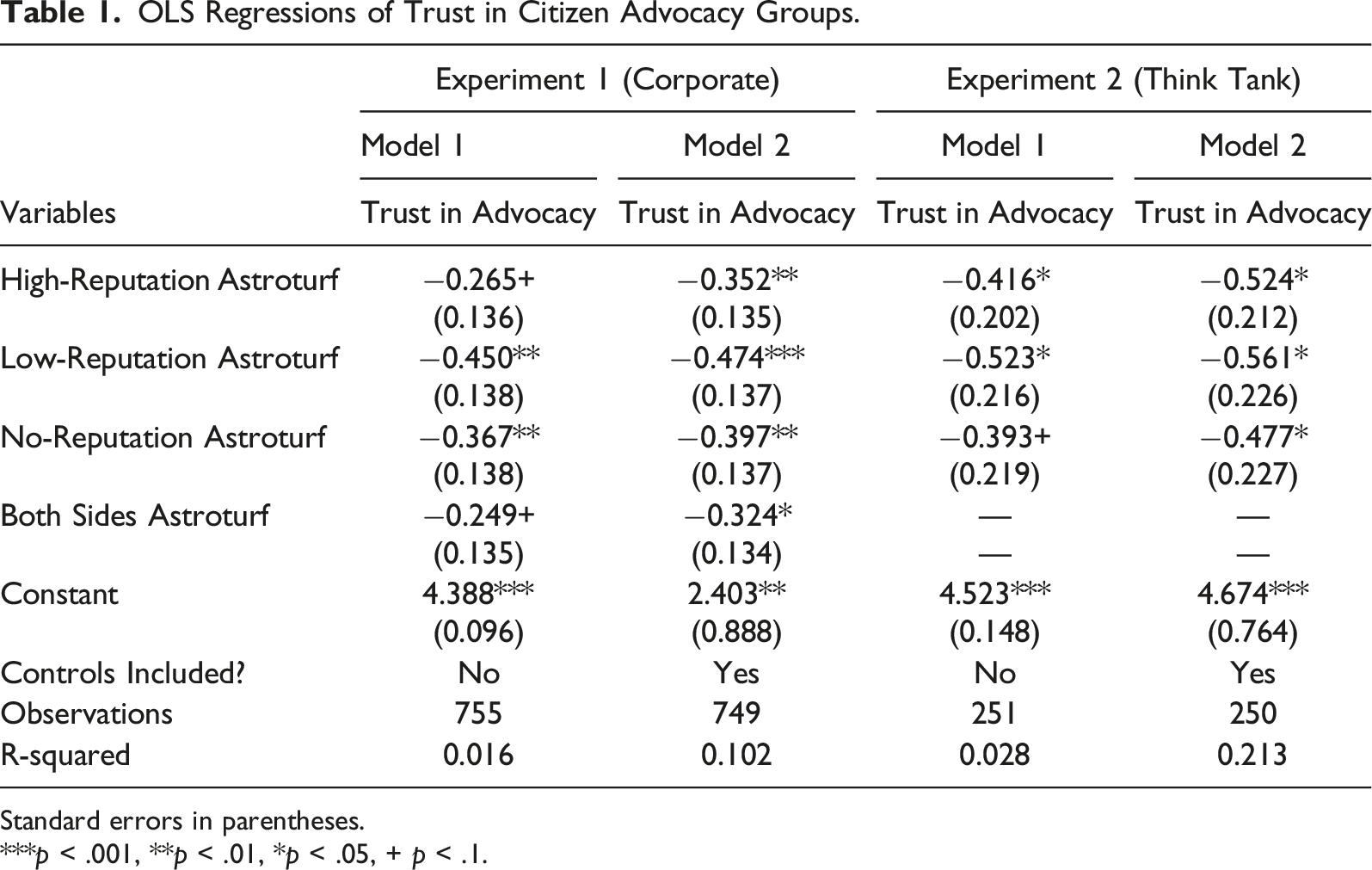
OLS Regressions of Trust in Citizen Advocacy Groups.
Standard errors in parentheses.
***p < .001, **p < .01, *p < .05, + p < .1.
First, we find consistent evidence in both experiments that astroturfing harms trust in advocacy groups (supporting Hyps. 1 and 2). Across the two experiments, we generally find that the revelation of astroturfing makes respondents significantly less likely to believe that advocacy groups in general can be “trusted to do what is right.” Thus, we find consistent evidence that covert patronage, when revealed, “poisons the well” for other advocacy groups who are not involved.
Importantly, these primary results make clear that it is the practice of astroturfing that is harmful to public trust rather than the sector of the organization revealed to be sponsoring such efforts. Thus, we find similar harms to trust in advocacy groups when the same practices are supported by non-business groups who sponsor the practice mainly for ideological reasons. Although there is likely to be a much higher level of distrust in the motives of corporations regarding their political activities in a context of increasing “dark money” forms of political engagement (Mayer 2016), our results make clear that the actions of think tanks and other types of sponsors may also generate changes to our trust in citizen organizations involved in the political process. Thus, as we reiterate below, the categorical stigmatization that follows from engaging in astroturfing appears to operate somewhat similarly regardless of the variation in revealed sponsor identity. 8
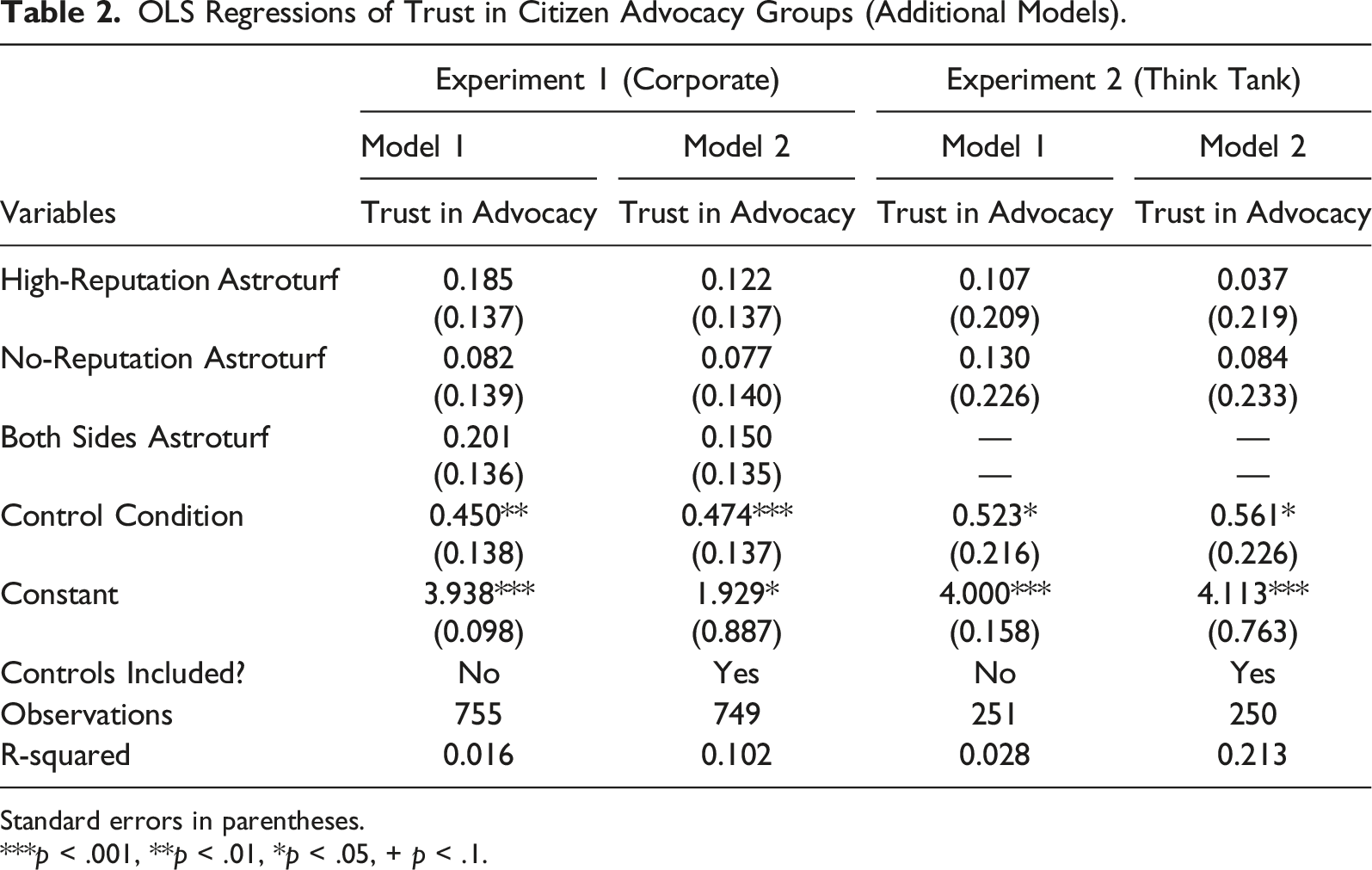
OLS Regressions of Trust in Citizen Advocacy Groups (Additional Models).
Standard errors in parentheses.
***p < .001, **p < .01, *p < .05, + p < .1.
Table 2 makes clear that although there is slightly less harm to trust in advocacy when the sponsor is revealed to be high reputation (or when no information is provided about the sponsor’s reputation), none of these differences between the low reputation and other treatment conditions are statistically significant. We therefore do not find evidence to support Hypothesis 3, ultimately making clear that the reputation of the revealed sponsor is not a significant factor in how revealed astroturfing affects trust in advocacy organizations. On the other hand, in additional models (not shown), of course, we find that the reputation of the sponsor has strong and significant negative effects on trust in the specific advocacy organization revealed to be involved in the campaign, as well as the specific corporate or think tank sponsor.
Discussion and Conclusion
Trust in a variety of societal institutions in the contemporary United States is at an apparent low point in modern history (Edelman 2018). Many see this as connected to a more wide-ranging loss of trust linked to democratic deficits, which may harm the broader polity, cause issues in representation, and foster further civic disengagement and/or the rise of anti-democratic forms of participation (Whitehead and Perry 2020). In such a context, it is critically important that conventional advocacy organizations—as sites that are often held out as spaces of civic re-engagement that may help to offset democratic deficits—are themselves trusted and seen as legitimate to public audiences.
As this paper has demonstrated, that trust cannot be taken for granted, as strategic actors will at times make use of advocacy organizations as “fronts” for their own interests, exploiting confidence in them to gain political advantage. This practice, as part of a broader set of tactics known as “astroturfing” (Cho et al. 2011; Lee 2010; Lyon and Maxwell 2004; Walker 2014), seeks to create the appearance of authentic grassroots participation, although all of the core funding and staffing is provided by the covert outside funder. Such practices are becoming more widespread given the expansion of public affairs consultants who provide these services to paying clients, and also because of changing rules around corporate electoral expenditures that have unlocked funding for “dark money” advocacy (Mayer 2016).
Our study tests how, when it is revealed that a local community organization is an undisclosed front for a third-party sponsor, trust in advocacy groups overall would be affected. We expected that this takes place through a mechanism of categorical stigmatization (Vergne 2012) in which evidence of stigmatized behavior in a specific instance generates a greater level of distrust in a whole category of organizations (advocacy groups). We set out with the expectation that astroturfing might cause not only a loss of trust in the particular organizations involved but also, more importantly, that those exposed to the revelation would lose trust in advocacy groups overall, including those not involved. Thus, astroturfing might “poison the well” for all advocacy groups.
More specifically, we were interested in three questions: whether revealed astroturfing harms trust in advocacy overall when the sponsor is a corporation, whether the same holds when the sponsor is a think tank, and whether the sponsor’s reputation conditions these effects for each sponsor type. We found support for two out of three of these expectations, indicating that the revelation of corporate-backed astroturfing harms trust in advocacy groups, and also that the same holds even when the sponsor is a different kind of organization (a think tank). Thus, it is not the sector of the sponsor that is consequential, but the nature of the practice in which astroturfing for any kind of sponsor is harmful for trust in advocacy organizations. Thus, the categorical stigmatization of advocacy groups follows more from the revealed inauthentic practice of supporting astroturfing than the sector of the sponsor.
On the other hand, we did not find support for the expectation that reputation had significant effects on trust in advocacy groups, even though of course it strongly affects perceptions of the specific organizations revealed to be taking part. What we make of these findings is that trust in advocacy groups—as critical sites of potential civic and political engagement in a context of low societal trust—is strongly and significantly affected when news comes out that an advocacy group is being used as a front by a covert sponsor, but that the specific characteristics of this sponsor are relatively less consequential for how this novel information is used for generalizing to all advocacy groups.
These findings are consequential for research on social movements and advocacy politics in the contemporary context. First, although it has become clear that a large volume of advocacy in society is funded by well-heeled patrons who often use such support as what Walker and Oszkay (2020) call “political intermediaries” for their interests, existing studies have tended to focus primarily on the consequences of revealed astroturfing for the specific organizations involved (e.g., Pfau et al. 2007; Lock and Seele 2017). What our findings make clear is that there are considerable spillover consequences for advocacy groups in general, who may find that their potential volunteer and donor pool is adversely affected by such revelations (even though there were not involved). Theories and research on advocacy patronage would benefit by incorporating a richer understanding of the risks of elite funding of advocacy. Second, such theories would also benefit from more carefully theorizing the covert nature of much patronage, following the lead of organizational scholars in doing so (e.g., Jia et al., fothcoming). And third, although there is growing interest in judgments of authenticity in the politics of social movements and advocacy (e.g., Luna 2017; Walker and Stepick 2020), we require a deeper understanding of how the revelation of engagement in inauthentic behavior affects advocacy outcomes; our study provides initial evidence into how trust in advocacy is harmed by such inauthentic behavior, but there are valuable avenues for future research here.
This study also advances research on categorical stigmatization, which has to date primarily (1) focused mainly on perceptions of business organizations and (2) within that focus has tended to emphasize linkages to whole industries that are stigmatized, such as arms dealers. We extend this body of research by looking at how categorical stigma affects organizations that are both outside the business sector and in which the affected organizations are, ex ante, typically accepted as legitimate. The value of such examinations is to make clear that when stigmatizing behaviors are observed among a limited set of actors, this can stigmatize whole categories of actors who were not involved. This finding encourages an updating of research on categorical stigma by examining both non-business organizations and also focusing more on how scandal-like incidents (Adut 2008) can harm overarching perceptions of an organizational type.
Many policymakers today are considering legislative, regulatory, and voluntary private reforms that would require greater levels of disclosure in politics, forcing transparency for companies and other sponsors of advocacy (e.g., Bebchuk and Jackson 2012). Some are arguing, similarly, that more disclosure is needed by advocacy groups (Rothman et al. 2011). Given that astroturfing campaigns are becoming more common and are supported by an entire industry of firms (Walker 2014), disclosure could possibly help improve public trust in advocacy. While greater transparency would surely not end the practice of astroturfing—and indeed may generate higher levels of cynicism and distrust in the short term based on the very same mechanisms we find in our analyses—there is some cause for cautious optimism around the benefits of a more informed public (e.g., Lyon et al. 2018).
There are limits to the research conducted here. First, while we sought to carry out our experiments in the most realistic fashion possible in order to enhance external validity, nonetheless we recognize that perceptions may operate differently in real-world contexts. Second, although we found that those randomly assigned to read the revelation stories were significantly less trusting of advocacy groups in the short term, there are questions about how durable and long-lasting the effect is; we do not know, for instance, whether subjects might be less trusting of advocacy groups a few weeks or years later. 9 Third, given that the case in our news stories involved one particular local community nonprofit, we do not know how different these perceptions would be for a larger and/or more national organization. Fourth and finally, there are limitations based on the survey samples in our experiments, which while being far larger than many experimental convenience samples, nonetheless are based around participants in online labor markets which are known to overrepresent certain social constituencies while underrepresenting others (e.g., Berinsky, Gregory, and Lenz 2012; Weinberg, Freese, and McElhattan 2014). While we do not have reason to believe that our causal effects would look very different under other conditions, we nonetheless encourage future research to examine these dynamics using nationally representative samples.
Our study bears implications for advocacy organizations, given that astroturfing by their peers may have spillover consequences for their own practices despite no wrongdoing on their part. Although there are few required disclosures under federal law regarding the funding received by charitable nonprofits (incorporated under IRS code 501(c)3 as charities or code 501(c)4 as social welfare organizations), one possible solution is to encourage greater levels of voluntary disclosure; this is a solution advocated by some observers (Rothman et al. 2011).
An additional consequence of the harm that astroturfing may cause to advocacy groups is not only that individuals may be less willing to make donations of money and time to such causes (a key feature of resource mobilization), but they may also become less appealing to corporate partners who seek honest and above-board partnerships. Earlier research (McDonnell 2015) identified that firms often seek out advocacy groups as partners in order to improve their corporate reputations; if such groups become seen as less trustworthy, this may lead to relative declines in such partnerships forming in the first place. We encourage additional research here also.
Lastly, our investigation is novel in that we investigated the practice of astroturfing, which is a widespread strategy intended to help an organization gain political advantage by covertly enlisting the support of civic and political advocacy groups. Although widely understood to be unethical by professional associations for corporate public affairs and public relations more generally, the practice is nonetheless quite widespread. We encourage future scholars to examine the second-order effects of other kinds of contentious organizational strategies, such as in corporate PR campaigns launched in response to boycotts, direct lobbying efforts, or following upon a firm’s strategic philanthropic giving. Additionally, based on the findings of our experimental study, there may be value in revising carefully selected historical cases of astroturfing (following the lead of Lee, 2010; Martin 2013) to examine the broader consequences of revealed astroturfing for other (uninvolved) organizations. We also invite other studies on the effects of astroturfing, such as whether public audiences become favorable to required disclosure of political spending following prominent disclosures of astroturfing. In addition, while it is established that firms engage in more pro-social activity after facing boycotts (McDonnell and King 2013) we also need to know more about the reputational work that firms and other sponsors must do to repair their reputations after revelations of questionable political activities.
Supplemental Material
Supplemental Material - Poisoning the Well: How Astroturfing Harms Trust in Advocacy Organizations
Supplemental Material for Poisoning the Well: How Astroturfing Harms Trust in Advocacy Organizations by Edward T. Walker and Andrew N. Le in Social Currents
Footnotes
Acknowledgments
The authors thank Rene Almeling, Graeme Boushey, Shana Gadarian, Brendan Nyhan, Oliver Schilke, and the audiences at the Oxford Centre for Corporate Reputation and the USC Price School nonprofit research colloquium series for helpful suggestions. The authors also acknowledge the support of the UCLA Center for American Politics and Public Policy.
Declaration of Conflicting Interests
The author(s) declared no potential conflicts of interest with respect to the research, authorship, and/or publication of this article.
Funding
The author(s) disclosed receipt of the following financial support for the research, authorship, and/or publication of this article: This work was supported by Center for American Politics and Public Policy, UCLA.
Supplemental Material
Supplemental material for this article is available online.
Notes
References
Supplementary Material
Please find the following supplemental material available below.
For Open Access articles published under a Creative Commons License, all supplemental material carries the same license as the article it is associated with.
For non-Open Access articles published, all supplemental material carries a non-exclusive license, and permission requests for re-use of supplemental material or any part of supplemental material shall be sent directly to the copyright owner as specified in the copyright notice associated with the article.
