



Abstract
This study examines the extent of class and racial inequalities in cultural capital development among recent adolescent cohorts in the United States. Informed by several decades of cultural capital research, I compare participation in four dimensions of cultural capital proposed by prior scholarship—highbrow consumption, omnivorous consumption, technical capacity, and social competence—by using nationally representative time-diary data to test for group differences in time-use patterns. Time investment has been long theorized but seldom tested as the means through which individuals develop cultural capital. Activities associated with technical capacity appear to have the greatest potential as the bases for both class and racial exclusions, as group differences are evident in both the prevalence and duration of participation. Smaller race and class differences are evident for omnivorous consumption, and low participation in highbrow activities is evident across all groups. Distinct patterns of time-use among Asian American adolescents suggest they are simultaneously advantaged and disadvantaged in their cultural capital acquisition, speaking to debates regarding their relative status in the United States.
Introduction
Over the past 40 years, researchers around the world have deployed the concept of cultural capital to study status group formation processes within their societies. One line of inquiry has examined cultural capital in terms of consumption. Researchers in this tradition have debated whether highbrow or omnivorous tastes in leisure and recreation differentiate status groups, and whether particular forms of consumption facilitate social reproduction or upward mobility (DiMaggio and Useem 1978; Gripsrud, Hovden, and Hallvard 2011). Another set of scholars has examined cultural capital in terms of aptitudes—social and technical skills valued within educational and occupational settings—that higher status families are more likely to cultivate in their children (Calarco 2011).
This study examines the extent to which these previously theorized forms of cultural capital—highbrow consumption, omnivorous consumption, technical capacity, and social competence—are currently associated with class and race 1 in the United States. Updates to cultural capital research are periodically necessary, as changes in valuation and access to cultural capital’s real-world manifestations affect their potential social functions. I look specifically at inequalities in cultural capital development among recent cohorts of adolescents. Adolescents have been a heavily studied age group in sociological subfields of health and education, but research on familial influence on adolescent cultural capital has been more common outside of the United States (Gripsrud et al. 2011; Jaeger 2009). Yet, adolescent experiences have independent and substantial effects on later status attainment and well-being, especially within the United States (Aschaffenburg and Maas 1997). Adolescent experiences also cannot be assumed to be mere extensions of early childhood socialization, as adolescents are less reliant upon parental initiative and may pursue tastes, activities, and affiliations through school and peer connections that may mitigate the impact of household characteristics (Crosnoe and Trinitapoli 2008). This study also tests whether cultural capital development differs by racial category, independent of class. Few studies have focused on racial differences in cultural capital development despite well-known racial disparities in access to relevant resources; existing works look at young children only.
To examine class and racial inequalities in adolescents’ cultural capital development, I analyze time-diary data collected through the American Time Use Survey (ATUS). Bourdieu and others have theorized that time investment is the key mechanism for cultural capital acquisition (Bourdieu 1986; Lizardo and Skiles 2012), but time-diary data have rarely featured in previous cultural capital research. Looking at the prevalence and duration of participation in activities to develop cultural capital, I find limited evidence of class differences in highbrow consumption among recent adolescent cohorts, and only small group differences in adolescents’ omnivorous consumption—theorized to facilitate processes of informal network formation in adulthood (Erickson 1996; Lizardo and Skiles 2012). However, substantial racial and class differences occur in activities associated with technical capacity, both in terms of probability of, and time spent in, participation. This is troubling because schools and workplaces still maintain that linguistic skills and the prioritization of institutional requirements are legitimate bases for recognition and rewards (Dumas and Sanchez-Burks 2015; Rivera 2015). Low participation in activities to develop social competence could further serve to negatively distinguish Asian Americans from other racial groups, though high time investment in activities to develop technical capacity could possibly mediate their relatively high socioeconomic attainment (Pew Research Center 2017). This study’s findings indicate which forms of cultural capital would most clearly result in group exclusion when used as criteria for selection, and which groups are most likely to be affected.
Background
Measuring Cultural Capital: Consumption and Aptitudes
Cultural capital can be broadly defined as internal or external resources that are acquired through accumulated labor and can be exchanged for social or economic profits (Bourdieu 1986). These resources can consist of embodied aptitudes, preferences, dispositions, and behaviors; objectified goods, artworks, performances, and even technical equipment and/or institutionalized credentials and honorifics. Beyond its potential use for individual profit, scholars have proposed a host of theorized social functions within numerous institutional and interpersonal settings. 2 Out of all of these proposed functions, Lamont and Lareau (1989) argued that cultural capital is most fruitfully understood as a means for exclusion and selection. Possession of cultural capital can justify membership into, and limit entry from, formal institutions as well as informal social networks. At the same time, cultural capital is often “appropriated on a private, i.e., exclusive, basis by agents or groups of agents” (Bourdieu 1986), advantaging these agents over others in consequential social arenas. When access to cultural capital differs consistently and persistently by family characteristics, it becomes a means to differentiate groups from one another and to reproduce inequality over generations.
Which embodied characteristics, objects, and institutional credentials work as cultural capital in the real world are contextually determined and can change over time, contingent upon prevailing systems of symbolic hierarchies (Bourdieu 1991; Holt 1997). Research based in the United States has most often operationalized cultural capital as particular consumption patterns or aptitudes. Many scholars of consumption have followed DiMaggio and collaborators’ early work based on 1960s surveys of a cohort of young white men in Wisconsin, which defined cultural capital as engagement with legitimated, highbrow arts 3 (DiMaggio 1982; DiMaggio and Useem 1978). Visits to museums and performing arts attendance still appear as cultural capital indicators in some U.S.-based studies (Dumais and Ward 2010; Gaddis 2013; Roscigno and Ainsworth-Darnell 1999). This research has largely tested the association of highbrow consumption with academic performance and educational attainment.
Other consumption researchers have challenged the emphasis on consecrated arts, arguing that the most lauded cultural tastes in the contemporary era are better described as omnivorous. Following Peterson’s (1992) study of musical preferences in the General Social Survey, these scholars observed that new elites are more likely to consume and participate in a wide spectrum of cultural goods and recreational pastimes than those recognized within upper-class institutions such as museums or elite universities (Bennett, Emmison, and Frow 1999; Sullivan and Katz-Gerro 2007). Numerous works have debated the boundaries of omnivorousness around the world (see Hazir 2018 for a review), with some scholars arguing that it maintains a core of highbrow consumption (Lizardo 2006) and others finding that omnivorous younger cohorts show little familiarity with canonical cultural works (Warde, Wright, and Gayo-Cal 2007). Regardless of the precise parameters of taste diversity, familiarity with a range of cultural objects and leisure activities appears advantageous for more informal processes of selection and exclusion such as social network formation (Lizardo, and Omar 2011) and hiring based on cultural or affective “fit” within organizations (Rivera 2012).
Another body of research rejects the fixation on cultural capital as consumption, following Lareau and Weininger’s (2003) admonition to study embodied aptitudes such as “technical capacity” and “social competence” over cultural and recreational tastes. Lareau and Weininger (2003) argued that it is these aptitudes, rather than aesthetic or leisure preferences, that have the strongest effects on status attainment in the United States. In her own work, Lareau (2003) found that middle- and upper-class parents concertedly cultivate their children’s “technical capacity” through training in more complex forms of language and greater prioritization of homework compared with working-class parents. Middle- and upper-class families also nurture their children’s “social competence” by involving them in more organized activities than do working-class or poor parents—specifically sports. Children’s participation in activities to foster their technical capacity and social competence accustoms them to their future obligations as middle-class workers. Children trained in technical capacity can better demonstrate the linguistic skills and the dedication to work tasks even beyond work hours that middle-class jobs require. Extracurricular commitments also train more advantaged children to both compete and collaborate with others toward productive goals, while the high-pressure, publicly scrutinized nature of organized sports helps prepare participants for performance-based assessments. U.S. research on cultural capital as aptitudes have repeatedly tested and largely confirmed Lareau’s arguments for the strong associations between family socioeconomic background and various indicators of social competence and technical capacity (Bodovski and Farkas 2008; Chin and Phillips 2001; Covay and Carbonaro 2010).
Despite the abundance of prior research, the topic of inequality in cultural capital acquisition deserves ongoing attention. For one, as noted above, what constitutes cultural capital can vary across societies and over time. A form of cultural capital may work effectively for exclusion and selection in one context or historical period, but be inconsequential within another. One way this could occur is if a manifestation of cultural capital loses its currency within the upper class. Bennett and colleagues (2009), for example, discovered substantial generational differences in U.K. arts consumption, such that upper-class young adults do not evince more knowledge of the legitimate arts than lower-class young adults. By extension, highbrow consumption measures originally proposed to describe the activities of 1960s cohorts may no longer be as relevant for processes of selection or exclusion in the present. 4
Another gap in U.S.-based research on cultural capital is its focus on younger children. 5 The relationship between family background and older adolescents’ cultural capital acquisition warrants greater scrutiny, as the substantial body of sociological research on adolescence has shown that this age period is distinct from earlier life stages (Crosnoe and Trinitapoli 2008), and consequential for later socioeconomic status (Hagan 1991). Although Bourdieu places greater emphasis on the importance of early childhood socialization for cultural capital acquisition, Erickson (1996) and Aschaffenburg and Maas (1997) reasonably argued that individuals may accumulate cultural capital during later life stages, opportunities for which may be more equally accessible than for young children. In particular, the strong associations between parental class and younger children’s involvement in organized activities to develop social competence may be less evident among adolescents, given their greater independence, interest in socializing with peers, and access to programming through schools and community organizations (Biddle, Bank, and Marlin 1980; Crosnoe and Johnson 2011; Gaddis 2013). However, parental influence may persist in activities associated with technical capacity such as homework completion and linguistic cultivation, given that they are often completed within the home.
Taken as a whole, the research summarized above suggests the following hypotheses:
Race as Its Own Axis of Inequality
Scholars have most often examined measures of family class as predictors of cultural capital acquisition. Bourdieu’s own empirical work in France dwells obsessively on the lingering effects of families’ class resources on the development of individuals’ durable dispositions and adult status. However, his theoretical writing notes that race or ethnicity may form the basis for status inequality in other societies (Bourdieu 1982), an insight dating back to Weber (1946) and Du Bois (1903). Research has offered ample evidence that ethnoracial categories, indeed, stratify and geographically segregate groups in the United States, limiting the sharing of knowledge and resources, and producing a multitude of unequal outcomes in education, work, health, and wealth (Emirbayer and Desmond 2015). These disparities have most severely and prolongedly affected black Americans (Massey and Denton 1998; Reskin 2012). As cultural capital theoretically serves as a medium for the intergenerational reproduction of disadvantage, black populations would be expected to exhibit lower rates of participation in activities associated with cultural capital development compared with whites, for whose benefit racial stratification regimes were designed (Omi and Winant 1986).
In contrast, Asian Americans’ overall socioeconomic attainment and low residential segregation levels might suggest status parity with whites (Kim and Sakamoto 2010; Pew Research Center 2017). However, a multitude of studies (reviewed by Lee and Kye 2016) have contested such assumptions, finding evidence that Asian Americans, in fact, underperform in earnings (Kim and Sakamoto 2014) and labor and dating markets (Balistreri, Joyner, and Kao 2015; Kim and Zhao 2014). Focusing on racial group differences in multiple cultural capital-building activities could shed light on Asian Americans’ almost equal, but separate, status. For instance, they may show high rates of participation in only one or two forms of cultural capital, facilitating their selection in some social arenas, but exclusion in others.
What the few works that have examined racial differences in cultural capital-related activities have found is that white elementary-aged children participate at higher rates in some activities related to highbrow consumption and social competence than racial minority children (Covay and Carbonaro 2010; Dumais 2006; Roscigno and Ainsworth-Darnell 1999). It is as yet unknown whether racial differences manifest in these or any other forms of cultural capital development among adolescents, who often have greater freedom from their parents than do children, but who may continue to face unequal access to opportunities and knowledge on account of their racial backgrounds. Given cultural capital’s role in mediating the reproduction of inequality, tentative hypotheses based on broader, longstanding patterns of racial inequality produce the following:
Time as a Mechanism
Bourdieu (1986) identified time-use as the primary means through which cultural capital is acquired. Individuals must invest their own time and effort to cultivate consumption preferences and aptitudes, even if it is parents who provide initial guidance and create the conditions for time investment. In this spirit, Lizardo and Skiles (2012) called for a focus on daily practice as the means through which cultural orientations develop.
Despite the centrality of daily time-use in theories of cultural capital, researchers have seldom used time diaries to approach questions of cultural capital and social reproduction, instead relying on frequency estimates of participation (Dumais 2008; Sullivan and Katz-Gerro 2007). Social scientists have most often used time-diary data to explore questions related to domestic divisions of labor and gendered child-rearing (Burgard and Ailshire 2013; Gracia et al. 2019; Wight, Raley, and Bianchi 2008) and to assess youth participation in an assortment of behaviors promoting psychosocial well-being (Desha, Nicholson, and Ziviani 2011; Kalil, Ryan, and Corey 2012; Vernon 2005; Wight et al. 2009). Some of these studies incorporate assorted measures that could be associated with technical capacity or highbrow consumption (Kalenkoski and Pabilonia 2012, 2017), but seldom discuss the implications of their findings in terms of cultural capital group disparities. 6
Although overlooked until recently in cultural capital research, time diaries can obtain more accurate comparisons of cultural capital acquisition than closed option surveys, as they remove typical sources of response bias. Comparisons of time-use diary methodology with objective criterion measures such as video camera recording and accelerometers have found that time-use diaries accurately estimate time-use patterns “without evidence of bias by education” and “validly and reasonably reliably represent[ing] the time-use of large populations” (Gershuny et al. 2019). Time-diaries require respondents to recount their activities over the course of a recent day or days, without prompting as to what those activities might be. For instance, a time-diary questionnaire might ask, “What did you do at 10 am yesterday?” rather than “How much time did you spend doing schoolwork last week?” As a result, time-diaries can effectively reduce response bias for socially desirable behaviors (Hofferth 2006; Presser and Stinson 1998). Respondents are not alerted as to what kind of information is most salient to researchers and are less tempted to affirm their affiliation with what they suspect are the positively viewed identities under study. Time-diary data are ideal for establishing whether group differences in cultural capital are evident in time-use patterns.
Group differences may be evident in a couple of ways. Nationally representative time-diary data can show whether some activities are more common on a day-to-day basis within particular groups, as well as if participants spend more or less time within those activities within a given day. For example, is it simply that reading is a more typical activity among members of some groups, or are group members who read also spending greater time reading on average? Rephrasing study hypotheses in terms of time investment produces the following propositions:
Data and Method
Data
The data for this study are the 2003–2018 years of the nationally representative ATUS, sponsored by the Bureau of Labor Statistics and administered by the U.S. Census Bureau. ATUS participants are selected from a subset of households who had completed their eighth and final interviews for the Current Population Survey (CPS). Once selected, ATUS respondents are interviewed three to four months after their last CPS interview about their activities during the previous 24-hour period. ATUS interviews collect limited household demographic information. Linked CPS interviews provide more detailed data.
As with the CPS, the ATUS sample universe consists of noninstitutionalized, nonactive military individuals over age 15 from across all 50 states. Computer-assisted telephone interviews are scheduled randomly over each week of the month and split evenly between weekdays and weekends. The sample size was 40,500 households for the first survey in 2003; all subsequent surveys have a sample size of 26,400. ATUS response reached a high of 57.8 percent in 2003, and a low of 43 percent in 2018. These response rates may be between 1 to 3 percentage points lower after accounting for poor quality surveys, which the Census Bureau removes from the ATUS files during processing. Poor quality surveys are those containing fewer than five activities, or surveys in which respondents refused or failed to specify their activities for three or more hours of their reported diary day.
Out of the approximately 201,151 respondents in the pooled 2003–2018 ATUS surveys, I use time-diary data for unmarried, childless respondents between the ages of 15 and 18 at the time of the survey, who reside with one or both parents, who are likely still enrolled in high school full-time, 7 and for whom there is information on parental education, parental occupation, and household income. These parameters produced a sample of 6,306 adolescent respondents, whose characteristics are presented in Table 1.
Survey Weighted Characteristics of Adolescent Respondent Sample (N = 6,306): American Time Use Survey, 2003–2018.
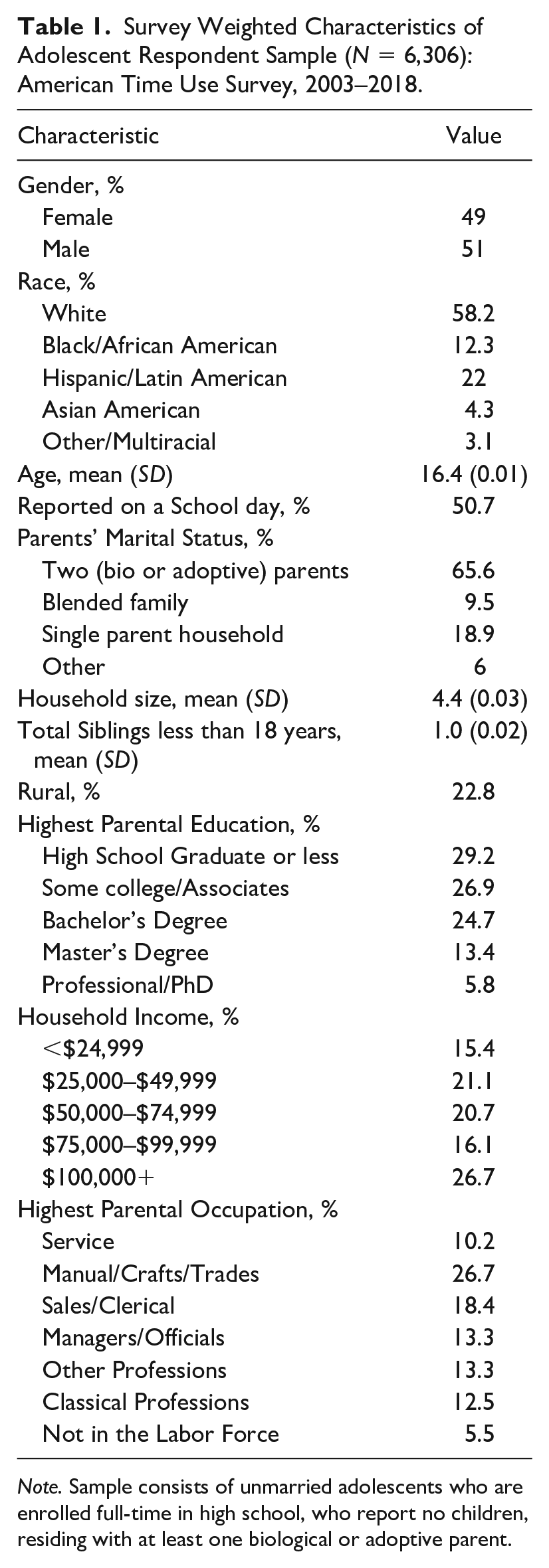
Note. Sample consists of unmarried adolescents who are enrolled full-time in high school, who report no children, residing with at least one biological or adoptive parent.
The ATUS is best understood as a representative sample of person-days in the United States (Frazis and Stewart 2009). This means that the ATUS permits conclusions regarding relative group differences in frequency and duration of activity participation, but that it is inappropriate to make absolute claims regarding individual respondents’ long-term participation patterns. As a hypothetical example, time-diary data would permit a researcher to state that a day in which a baseball was played was 3 times as likely to belong to a male than a female respondent in the United States, or that time spent playing baseball was two hours longer on average for women than for men. This captures the presence of national-level gender differences in the prevalence and duration of playing baseball. However, one cannot conclude that because any given respondent did not report playing baseball in their diary day, that they, in fact, never play baseball. I restrict my statements regarding this study’s findings accordingly.
Dependent Variables
I identify activities reported in the ATUS that match the four theorized manifestations of cultural capital: highbrow consumption, omnivorous consumption, technical capacity, and social competence. Table 2 summarizes sample participation in eligible activities. I look at both the odds of engaging in eligible activities and the reported duration of participation. I adopt this two-part strategy, rather than simply looking at total time spent in eligible activities, for two reasons. First, as discussed above, odds of participation and time spent in participation capture two distinct ways that groups may differ in their time investments. Second, several of the dependent variables have high zero counts, which if included would bias time estimates downward.
Sample Participation in Activities Related to Cultural Capital Acquisition (N = 6,306).
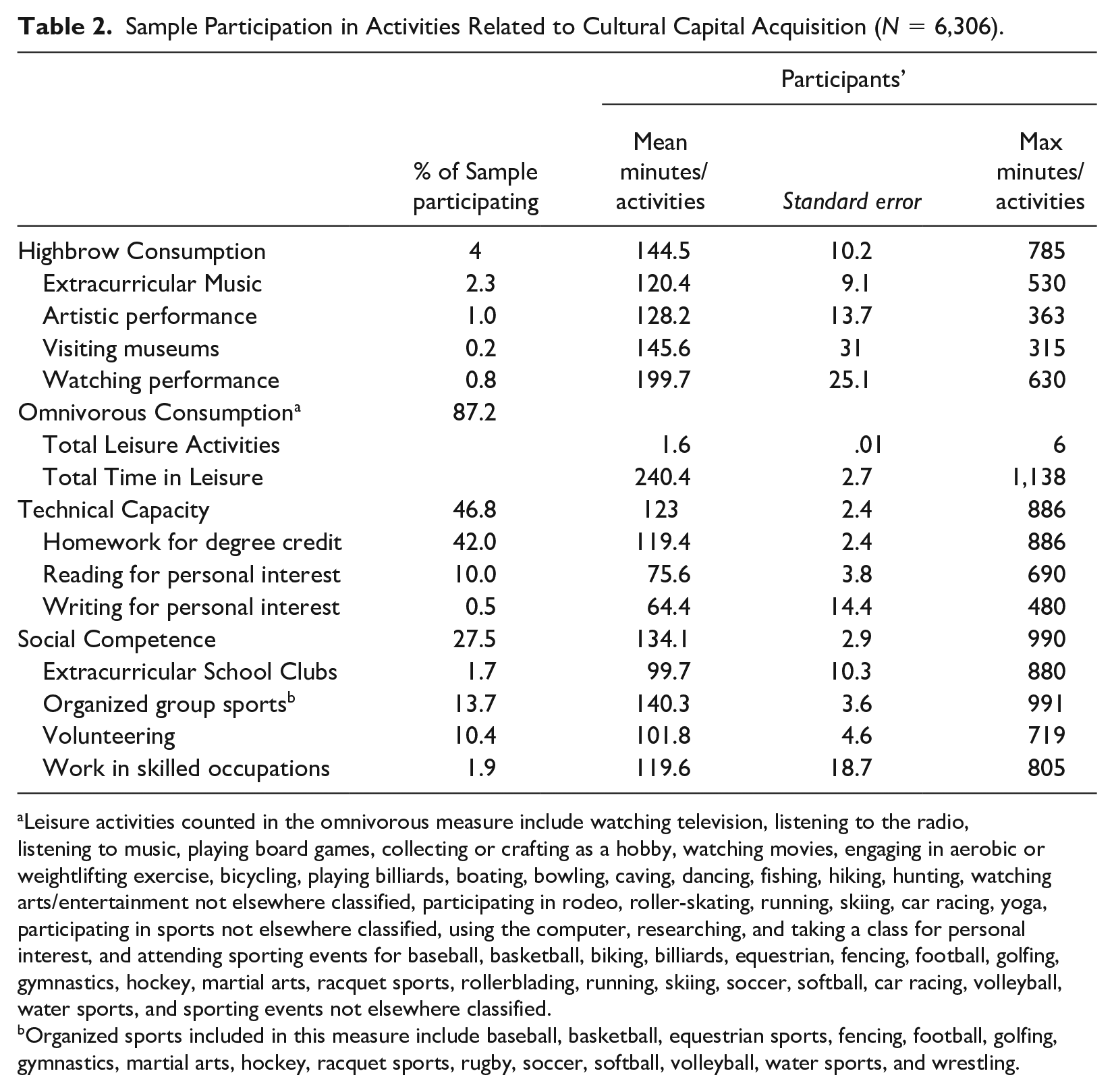
Leisure activities counted in the omnivorous measure include watching television, listening to the radio, listening to music, playing board games, collecting or crafting as a hobby, watching movies, engaging in aerobic or weightlifting exercise, bicycling, playing billiards, boating, bowling, caving, dancing, fishing, hiking, hunting, watching arts/entertainment not elsewhere classified, participating in rodeo, roller-skating, running, skiing, car racing, yoga, participating in sports not elsewhere classified, using the computer, researching, and taking a class for personal interest, and attending sporting events for baseball, basketball, biking, billiards, equestrian, fencing, football, golfing, gymnastics, hockey, martial arts, racquet sports, rollerblading, running, skiing, soccer, softball, car racing, volleyball, water sports, and sporting events not elsewhere classified.
Organized sports included in this measure include baseball, basketball, equestrian sports, fencing, football, golfing, gymnastics, martial arts, hockey, racquet sports, rugby, soccer, softball, volleyball, water sports, and wrestling.
Highbrow consumption
Following the tradition established by DiMaggio (1982), activities accounted for by ATUS that could be considered “highbrow” include extracurricular music performance, performing outside of school, attending performances, and going to museums. Highbrow consumption is, therefore, measured as whether or not respondents report participating in any of these eligible activities for their diary days, and as the total minutes spent by participants in these activities.
ATUS’s measures are not sufficiently fine-grained to distinguish between genres or types of musical or artistic performance. However, Lena (2019) showed that legitimation and formalized consecration processes have come to apply to the production of music, visual, and performing arts across genres. This renders such creative activities effectively “highbrow,” because highbrow culture is defined by its institutional recognition as “culture.” In contrast, I do not categorize reading as highbrow consumption because ATUS does not distinguish between reading literature or other forms of print material such as instruction manuals or newspapers—informational vessels that have yet to be formally consecrated in the same manner as other musical or performance mediums. I, instead, include reading in analyses of activities related to “Technical Capacity,” as linguistic aptitudes may be developed regardless of the nature of the reading material. 8
Omnivorous consumption
Because the ATUS offers only a 24-hour snapshot of respondents’ lives, I must employ an indirect measure of omnivorous consumption. First, I examine whether or not respondents engaged in any leisure. Second, I study the total number of different activities reported by respondents who report any leisure activity. I argue that this gets at one way that omnivorousness can be achieved—through variety during the course of even a single day’s leisure. To gain additional insight on how exactly omnivorousness is accomplished, I look at the average time spent per activity—the total minutes spent in leisure, divided by the total number of different activities.
Table 2 features a list of all individual activities measured by ATUS that were counted toward omnivorous consumption. The measure includes a range of recreational and leisure pastimes conducted in public and private settings, but excludes activities like cooking or shopping that might be undertaken for either recreation or necessity, because the data will not permit me to distinguish these cases from others. They also exclude participation in leisure activities included in other cultural capital dimensions (e.g., extracurricular music, performance, organized sports, reading, and writing) in order to limit ambiguous or overlapping results. 9
Scholars of omnivorousness who follow Peterson (1992) might argue that at least one highbrow and one lowbrow/quotidian leisure activity should be included in a diary day to be considered omnivorous consumption. I eschew this requirement due to aforementioned research indicating that highbrow components of omnivorousness may be specific to older generations, and, therefore, less relevant for recent cohorts of adolescents (Warde et al. 2007).
Technical capacity
I measure technical capacity as reported participation and participants’ time spent in eligible activities. According to Lareau (2003), activities to develop technical capacity cultivate linguistic skills and signal the prioritization of requirements imposed by schools (and, by extension, future workplaces). Activities measured by ATUS fitting this description include reading for personal interest, writing for personal interest, and doing homework or research for degree credit.
Social competence
I measure social competence as reported participation and participants’ total time in eligible activities. Again following Lareau (2003), I measure this outcome as participation in organized extracurricular activities that could potentially entrain adolescents in the behavioral and performance expectations of middle-class and professional jobs. Activities measured by ATUS fitting this description include school clubs, organized sports, and volunteer work. Table 2 contains a list of the organized sports included in this measure. I also included in this measure adolescents’ work in occupational fields typically requiring a college degree, as such experiences would be even more directly applicable to the achievement of middle-class futures than school clubs, sports, or volunteering. 10 Contradicting earlier researchers’ assumptions that youths’ labor force participation hurts their educational and status attainment prospects, Staff and Mortimer (2007, 2008) found that adolescent work experience can, in fact, improve labor market outcomes and smooth transitions to work in adulthood. Paid work has not been included within prior studies of cultural capital focusing on children for obvious reasons, but paid work in middle-class occupations is highly compatible with Lareau’s theory of what social competence activities should accomplish.
Independent Variables
Research on cultural capital has inconsistently examined which aspects of family background contribute to cultural capital acquisition. Duncan and Magnuson ([2003] 2012) pointed out that different components of socioeconomic status (SES) are associated with unique benefits for children’s development. In one of the few studies to incorporate all three measures of SES, Covay and Carbonaro (2010) found that parental education, occupation, and household income all have independent, significant, and positive association with young children’s participation in organized activities. I, therefore, include all three measures in this study to measure family class.
Parental educational attainment
I capture this measure of family SES as the highest educational level attained by either parent in the household, using five categories of educational attainment: (1) High school graduate or less; (2) Some college/Associate degree; (3) Bachelor’s degree; (4) Master’s degree; and (5) Professional degree/PhD professional degrees (e.g., MD, DDS, JD, DVM).
Household income
I recode available annual household income data into five categories: (1) Less than $24,999, (2) $25,000–$49,999, (3) $50,000–$74,999, (4) $75,000–$99,999, and (5) $100,000 or more.
Parental occupational category
With some updates, I largely follow Jonsson et al.’s (2009) meso-level occupational groupings to code ATUS’s detailed parental occupational information into seven categories: (1) Services, (2) Lower Manual/Crafts, (3) Sales/Clerical, (4) Other Professions, (5) Managers/Officials, (6) Classical Professions, and 7) Out of the Labor Force. 11 While Jonsson et al. argued that micro-class occupational schema better predict social mobility/reproduction than big class schema, micro-class groupings resulted in such small cell sizes that analysis was impossible. Meso-level groupings contain slightly more detail than the big class categories, so serve as a compromise. I use the father’s occupational category except when (1) the father is absent, (2) the father reports no occupation, (3) the mother’s occupation is in the classic professions and the father’s is not. In these cases, I use the mother’s occupation.
Racial background
I base racial categories on respondents’ self-reports as non-Hispanic white, non-Hispanic black, Hispanic origin, or Asian. Because only 3 percent of respondents self-report as Native American/Pacific Islander or Multiracial, I combine these into a single Other/Multiracial category. I use self-reports rather than parental race because parental race was not reported consistently, and analyses using the smaller set of cases that did report parental race did not differ substantively from analyses using self-reports.
Control Variables
Parental marital status
I code for parental marital status as (1) two biological/adoptive parents, (2) remarried parent/blended family, (3) single/divorced/widowed parents, and (4) single/divorced/widowed parent with other adult(s).
Other
I include controls for total siblings under age 18 in the household, rural residence, respondent gender, survey year, and whether or not the survey data reported on a school day or a weekend/holiday. I designated as a school day any day in which respondents reported taking a class for degree credit.
Analytic Method
For all descriptive and analytical statistics, I use survey weights provided by ATUS to correct for oversampling of some demographic groups, uneven distribution of samples across the days of the week, and gaps in response rates across genders.
I first conduct multivariate logistic regression to test the associations of parental class and racial category variables on respondents’ log-odds of engaging in activities associated with previously theorized dimensions of cultural capital. Logistic regression is the preferred analytic approach, given that my first set of dependent variables are binary indicators of whether or not a respondent engaged in some activity (Long 1997).
To examine the duration or extent of participation, I employ zero truncated Poisson models using cases that reported participating in eligible activities on their diary days, that is, omitting cases with “0” minutes spent in eligible activities. Truncated Poisson regression is the analytic method that is most appropriate for the study’s dependent variables of interest—count data that do not display overdispersion and in which values are not permitted to be zero (Cameron and Trivedi 2013; Long and Freese 2006).12,13 For omnivorous consumption, the dependent variable is the total number of activities engaged in by participants reporting any leisure activity, and average time spent per leisure activity. For individual activities categorized as highbrow consumption, technical capacity, and social competence, the dependent variables are minutes spent in eligible activities.
Results
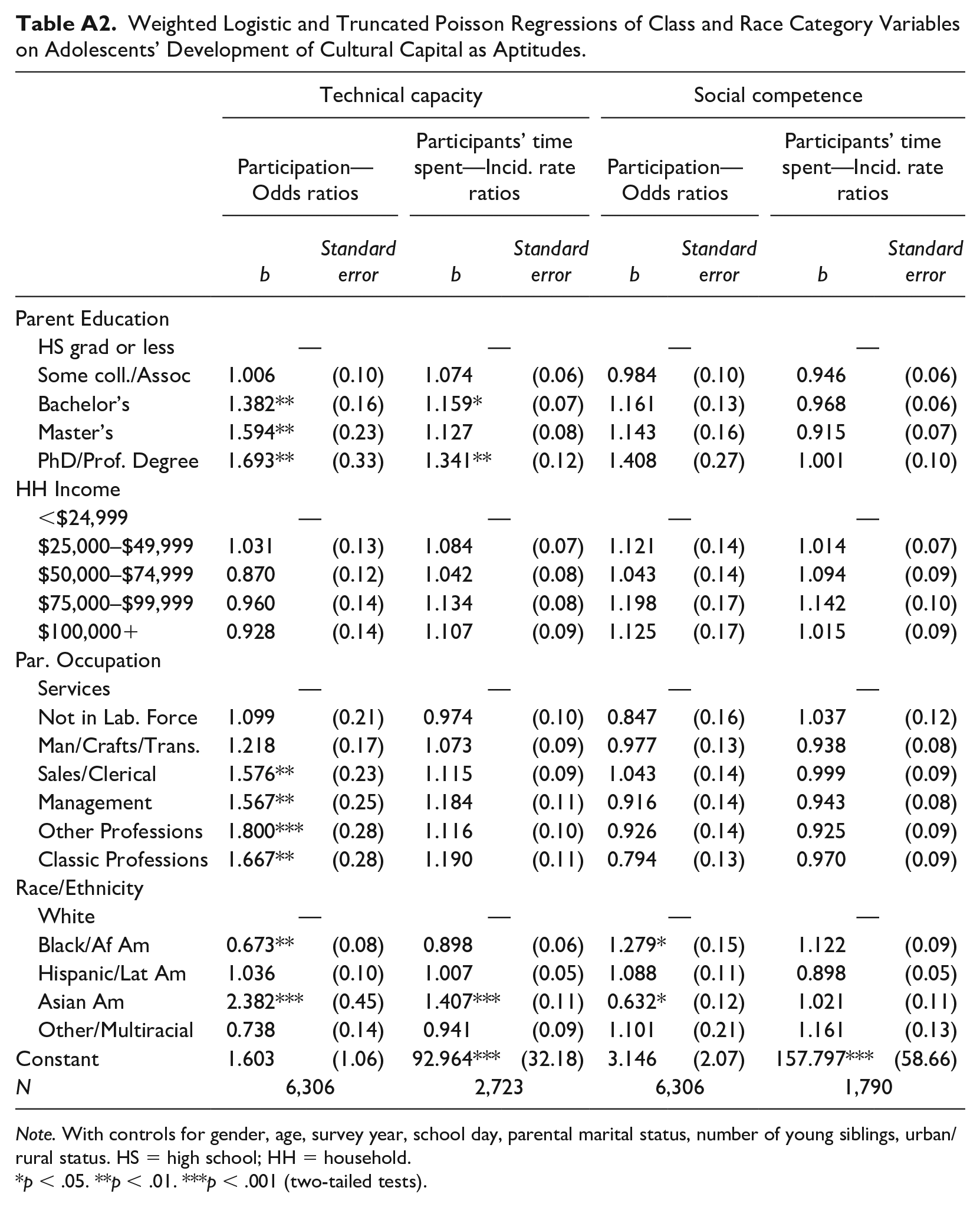
To simplify the presentation and interpretation of regression results, Figures 1 and 2 display statistically significant group differences as adjusted predicted probabilities and counts, illustrating marginal effects across class and race categories while holding other variables at their means. Gray boxes next to graphical representations of 95 percent confidence intervals contain numerical point estimates and denote statistically significant group differences revealed through postestimation Wald tests. Results in tabular format are provided as an appendix.
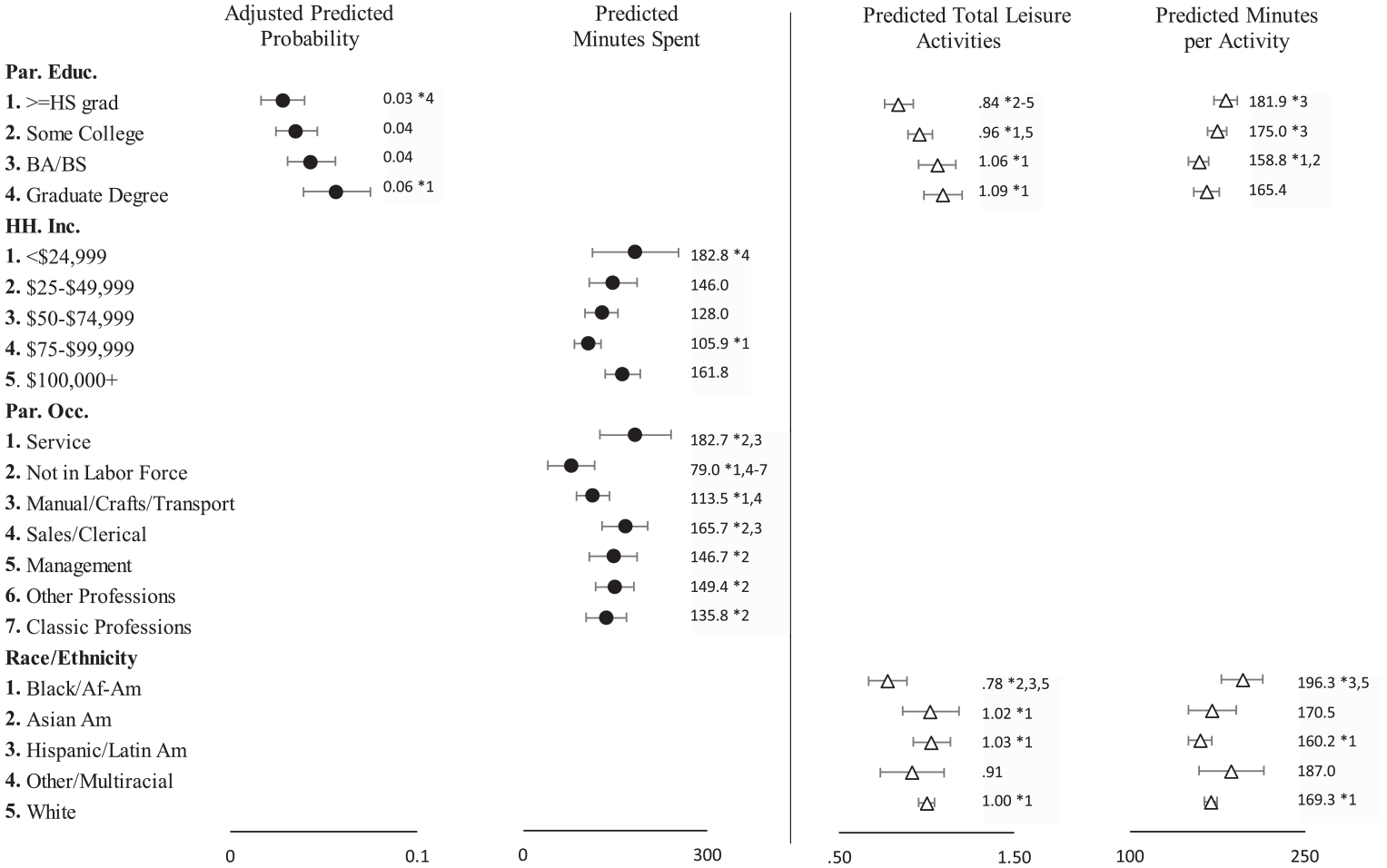
Adjusted predictions of reporting/time spent in highbrow and omnivorous consumption.
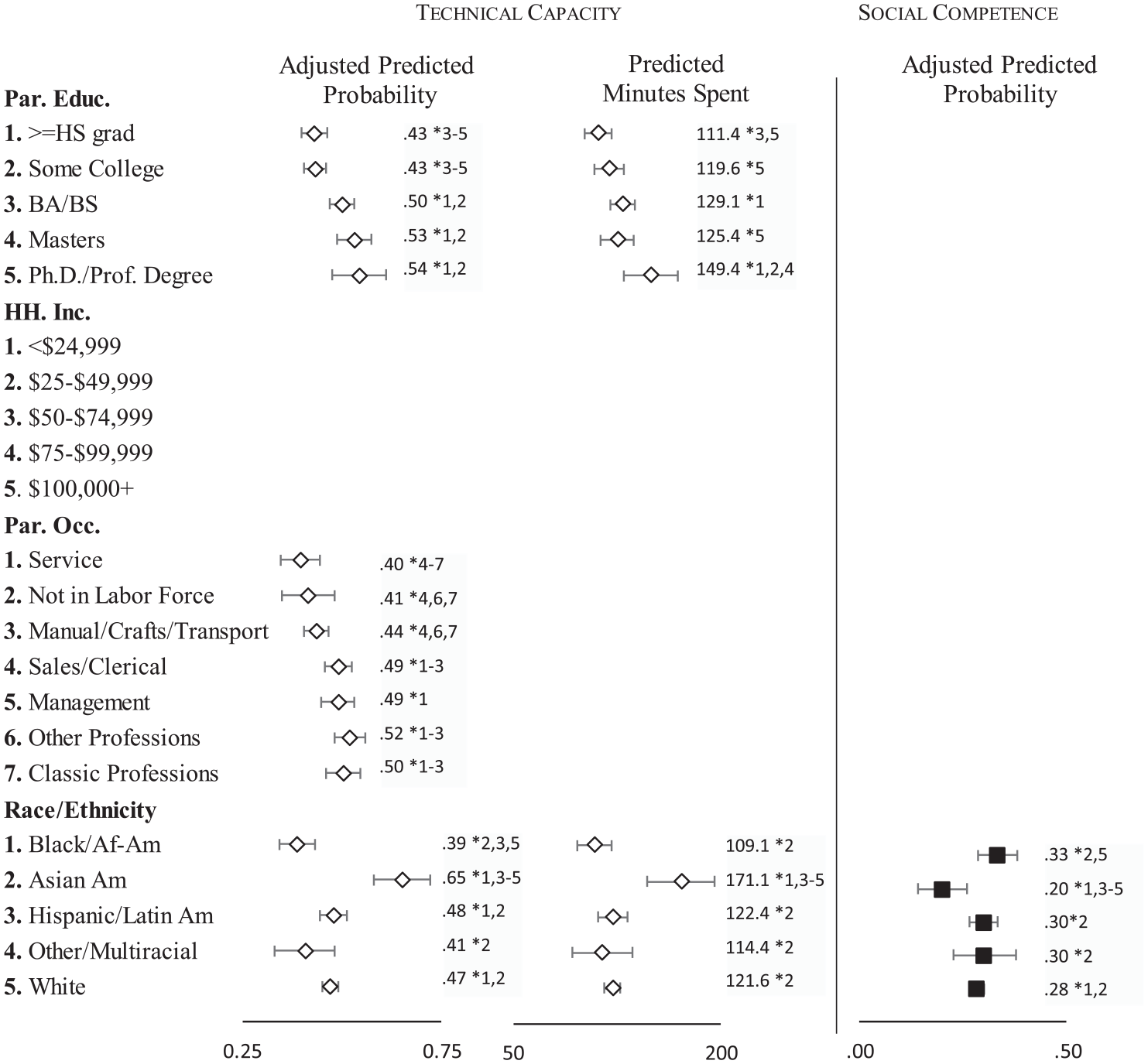
Adjusted predictions of reporting/time spent in technical capacity and social competence activities.
Highbrow Consumption
Table 2 shows that days with highbrow consumption activities are fairly rare in the ATUS adolescent sample, with only 4 percent of respondents reporting any highbrow activities during their diary day. Figure 1 shows that holding other factors at their means, highbrow activity days are roughly twice as likely to belong to a respondent whose parent has a Master’s degree than a respondent whose parent’s education ended at or before graduating high school, but this is a difference in probability of 6 percent versus 3 percent. Differences across other education categories are not statistically significant. Average time spent in highbrow activities varies across income and occupation groups, but not in any consistent direction.
No racial group differences are evident in participation or time spent in highbrow activities, offering no support for Hypothesis 3’s expectation that prevalence and duration of all activities to develop cultural capital should be lower for black adolescents.
Omnivorous Consumption
The majority of respondents in the sample (92.5 percent) report participating in at least one leisure activity, spending on average 4.5 hours on 1.6 eligible activities per diary-day (Table 2). No differences by race or class are evident in terms of odds in engaging in any leisure. Among respondents who report leisure activities, significant group differences are evident between the highest and lowest education categories. The least number of activities per diary day are associated with the High School grad or less category, which report .21 to .38 fewer activities compared with all other groups, and the most activities are associated with the PhD/Professional degree category, which report on average .26 to .38 more activities compared with the lowest two education groups. Minutes spent per leisure activity are somewhat negatively associated with education, with 16 to 23 fewer minutes per activity reported by the Bachelor’s degree category on average than the Some College or High School categories. As class differences in participation are more consistent across education categories for omnivorous consumption than for highbrow consumption, these results offer some weak support for Hypothesis 1, which anticipated greater class differences would be evident for omnivorous than highbrow consumption.
Racial group differences in omnivorous consumption more clearly support Hypothesis 3. Black adolescents are predicted to report 18 percent to 23 percent fewer leisure activities during their diary-days compared with white, Asian, and Latin American respondents, and to report 30 more minutes per activity compared with white and Latin American respondents.
Technical Capacity
Roughly 47 percent of respondents report engaging in at least one activity to develop technical capacity during their diary-days, with homework for degree credit being the most commonly reported activity (Table 2). Group differences are evident across parental education as well as occupation groups. Technical capacity days show a 43 percent likelihood of belonging to adolescents whose parents’ educations ended in high school or with some college, compared with 50 percent to 54 percent likelihood for adolescents whose parents have bachelor’s or graduate degrees. The Sales/Clerical and Professional categories show 5 percent to 12 percent higher probability of reporting technical capacity activities during their diary days compared with the 40 percent to 44 percent probability of reporting by the Service, Out of the Labor Force, and Manual/Crafts/Transport categories. Among those reporting any technical capacity activity, time is positively associated with education as well, with the largest difference being a 38-minute gap between the lowest and highest education groups.
Substantial differences in the probability of reporting any technical capacity are evident across racial groups. Days containing technical capacity activities show a 39 percent probability of belonging to black respondents—8 percent to 9 percent lower than for Latin Americans and whites, and 26 percent lower than for Asian Americans. This offers support for Hypothesis 3’s expectation for lower prevalence of cultural capital activities for black adolescents. But participants’ time spent in Technical Capacity activities differs significantly only for Asians, predicted to report roughly 45 to 60 more minutes than other groups.
Social Competence
A quarter of respondents report engaging in activities to develop social competence, with participation in organized sports being the most common activity (Table 2). There are no significant class differences in either the prevalence or duration of social competence activities. This null finding is consistent with Hypothesis 2, which anticipated that among adolescents, greater class differences should be evident in activities associated with technical capacity than social competence.
In contrast, the prevalence of social competence activities does differ significantly across racial groups. Days with social competence activities are 8 percent to 13 percent less likely to belong to Asian American respondents than to all other groups, consistent with Hypothesis 4’s expectation that Asian Americans would fail to show parity with whites in at least one dimension of cultural capital. However, contrary to Hypothesis 3, social competence activities are 5 percent more likely for black respondents than white respondents. No group differences are evident in participants’ time spent in social competence activities.
Discussion
Scores of studies on cultural capital have been published since the concept’s emergence in the 1960s. Researchers have tended to fall into two broad camps: those studying cultural capital as consumption patterns, and those studying cultural capital as aptitudes. Consumption scholars have debated what kinds of leisure and artistic preferences characterize different classes and demonstrated how tastes facilitate acceptance in informal and institutional settings. Aptitude scholars have shown that parental class differentially affects whether children form the work and social skills rewarded by schools and employers. This study brings together these previously theorized forms of cultural capital to compare the extent to which they are patterned by adolescents’ class backgrounds as well as by their racial categorization—an axis of inequality that has been relatively underexamined by prior cultural capital researchers (but see Carter 2003). It thereby offers an updated perspective on the potential of each dimension of cultural capital to reproduce class and race inequalities when used as the basis for selection and exclusion. This is also among the first studies to comprehensively analyze time diaries to test longstanding theories of time investment as a mechanism for cultural capital acquisition, and the first to focus on the time diaries of adolescents, whose time-use is especially consequential for status attainment in the United States but whose cultural capital development has received less attention than younger children’s.
Indeed, in a departure from research on younger children, I do not find significant class variation in the prevalence of activities to develop social competence among adolescents at the national level. This finding lends support for the study’s hypothesis that familial class might be less apparent for this age group given their greater mobility, interest in socializing with peers, and the provision of extracurricular opportunities by schools and community organizations. I had also hypothesized that class disparities might persist in activities associated with the development of technical capacity—reading, writing, and homework—as they are often conducted in the home, where parental influence is at greater play. In fact, of all the cultural capital dimensions, technical capacity shows the most substantial class differences at the national level, in both prevalence and duration of participation. This finding is troubling because of all the dimensions of cultural capital, the aptitudes encompassed by technical capacity continue to be treated as legitimate basis for adjudicating socioeconomic rewards (Dumas and Sanchez-Burks 2015; Rivera 2015). I find that days with technical capacity activities are more likely to belong to adolescents whose parents have Bachelor’s or graduate degrees than to adolescents whose parents work higher status jobs, and that adolescents with more educated parents spend greater time developing technical capacity as well.
Class differences in consumption, whether in terms of highbrow activities or omnivorous daily leisure, are comparatively less pronounced. Only 4 percent of the adolescent person-days sampled by ATUS contain activities associated with highbrow consumption, such as visiting museums and participating in/attending musical or other performances. Significant class differences are substantively small and not uniformly positive or negative. The associations between education and total leisure activities for omnivorous consumption are somewhat substantively small as well, with the least educated categories engaging in one to two fifths fewer activities than the most educated categories. Several possibilities may explain the modesty of this study’s findings regarding omnivorous consumption. Most studies observing omnivorousness to date have focused on comparisons of adults (Atkinson 2011; Bryson 1996) or nonrepresentative populations of youth (Khan 2010). It is possible that omnivorous orientations are more widely developed at a later age than adolescence—perhaps via college experiences. Future research can pursue the question of whether some dimensions of cultural capital are commonly developed at distinct life course stages. A second possibility is that this study’s measure of omnivorousness is too blunt an instrument to capture larger class differences that a more fine-grained indicator would bring to light.
Notwithstanding its flaws, the study’s measure of omnivorousness finds that racial gaps in omnivorous consumption are comparable in magnitude to some class gaps. For both total leisure activities and time spent per activity, similar size gaps distinguish black respondents from white, Latin American, and Asian American respondents, as distinguish lower and higher education categories. Racial disparities are also evident in aptitude measures. In terms of the likelihood of reporting a technical capacity activity, the magnitude of the gaps between black versus other racial categories are as large or larger than gaps between lower and higher education categories. However, social competence activities are 5 percent to 13 percent more likely to belong to black respondents than whites or Asian Americans. Compared with all other racial groups, Asian Americans are the least likely to report social competence activities, even as they outstrip others in the prevalence and duration of participation in technical capacity activities. This finding offers some explanation for prior studies’ findings regarding Asian Americans’ ambiguous standing in the U.S. racial order—high achieving by some measures (Kim and Sakamoto 2010), but falling short and continually racialized by others (Lee and Kye 2016). The study’s identification of racial gaps in time-use underscore observations that racial inequalities can persist independently of class inequalities (Phelan and Link 2015).
This study contains several limitations, which offer opportunities for future research. First, fuller explanation for the categorical inequalities identified in the study is necessary. Study hypotheses are based on earlier research on classed child-rearing strategies, racial inequalities in status attainment, and the characteristics of adolescence as a distinct stage in the life course. However, the study cannot establish what precise mechanisms are responsible for its findings, such as if household interference by parents, in fact, drives persistent group differences in technical capacity activities, or if institutions help to level differences in activities related to social competence. More research is also necessary to establish why exactly Asian and black adolescents’ time investments in cultural capital as aptitudes take the shape that they do, although segmented assimilation theories, studies of educational segregation, and research on communities’ strategies of cultural resilience offer some directions for inquiry (Clauss-Ehlers 2010; Portes and Zhou 1993; Tyson 2011). Qualitative methods could also investigate whether activities for social competence, even if they are engaged in at similar levels across class categories, differ in ways that are not detectable in the ATUS data. How similar are the norms, expectations, and interaction styles fostered through these activities if they are located within districts of varying socioeconomic status? This relates to another weakness of the study, which is that the limited number of adolescent cases in ATUS prohibits a more granular investigation of inequalities in cultural capital. This includes greater specificity in the types of activities that have social currency, and exploration of geographic variations in the development of cultural capital. U.S. localities differ in terms of their levels of intergenerational class mobility, income inequality, and racial segregation (Chetty et al. 2014), which could correlate with varying levels of categorical inequality in cultural capital. Analysis of a larger, adult share of the ATUS data population could address these questions.
It is important to stipulate again that the ATUS covers only a single 24-hour period in respondents’ lives, which renders suspect any claims regarding respondents’ long-term participation patterns. It is inappropriate to assume any given individual’s participation or nonparticipation based on this or any other study using ATUS data, or to conflate trends in group characteristics with the characteristics of single cases. But because the ATUS is a nationally representative sample of “person-days,” it permits valid observations regarding group differences in activity prevalence and duration, as this study has attempted. No comparably representative or reliable dataset recording time-use yet exists. In showing how activities to develop certain forms of cultural capital vary categorically among adolescents, who for all of their independence, are still constrained by the resources of their families and communities, this study suggests that informal and formal exclusion on these grounds would reproduce group inequalities. Using indicators of technical capacity, social competence, and omnivorous orientations as formal or informal criteria for selection or exclusion remains a form of de facto discrimination. Amelioration would require either relaxing those criteria or addressing what mechanisms are responsible for group disparities, something future cultural capital research could help to explore.
Footnotes
Appendix
Weighted Logistic and Truncated Poisson Regressions of Class and Race Category Variables on Adolescents’ Development of Cultural Capital as Aptitudes.
| Technical capacity |
Social competence |
|||||||
|---|---|---|---|---|---|---|---|---|
| Participation—Odds ratios | Participants’ time spent—Incid. rate ratios | Participation—Odds ratios | Participants’ time spent—Incid. rate ratios | |||||
| b | Standard error | b | Standard error | b | Standard error | b | Standard error | |
| Parent Education | ||||||||
| HS grad or less | — | — | — | — | ||||
| Some coll./Assoc | 1.006 | (0.10) | 1.074 | (0.06) | 0.984 | (0.10) | 0.946 | (0.06) |
| Bachelor’s | 1.382** | (0.16) | 1.159* | (0.07) | 1.161 | (0.13) | 0.968 | (0.06) |
| Master’s | 1.594** | (0.23) | 1.127 | (0.08) | 1.143 | (0.16) | 0.915 | (0.07) |
| PhD/Prof. Degree | 1.693** | (0.33) | 1.341** | (0.12) | 1.408 | (0.27) | 1.001 | (0.10) |
| HH Income | ||||||||
| <$24,999 | — | — | — | — | ||||
| $25,000–$49,999 | 1.031 | (0.13) | 1.084 | (0.07) | 1.121 | (0.14) | 1.014 | (0.07) |
| $50,000–$74,999 | 0.870 | (0.12) | 1.042 | (0.08) | 1.043 | (0.14) | 1.094 | (0.09) |
| $75,000–$99,999 | 0.960 | (0.14) | 1.134 | (0.08) | 1.198 | (0.17) | 1.142 | (0.10) |
| $100,000+ | 0.928 | (0.14) | 1.107 | (0.09) | 1.125 | (0.17) | 1.015 | (0.09) |
| Par. Occupation | ||||||||
| Services | — | — | — | — | ||||
| Not in Lab. Force | 1.099 | (0.21) | 0.974 | (0.10) | 0.847 | (0.16) | 1.037 | (0.12) |
| Man/Crafts/Trans. | 1.218 | (0.17) | 1.073 | (0.09) | 0.977 | (0.13) | 0.938 | (0.08) |
| Sales/Clerical | 1.576** | (0.23) | 1.115 | (0.09) | 1.043 | (0.14) | 0.999 | (0.09) |
| Management | 1.567** | (0.25) | 1.184 | (0.11) | 0.916 | (0.14) | 0.943 | (0.08) |
| Other Professions | 1.800*** | (0.28) | 1.116 | (0.10) | 0.926 | (0.14) | 0.925 | (0.09) |
| Classic Professions | 1.667** | (0.28) | 1.190 | (0.11) | 0.794 | (0.13) | 0.970 | (0.09) |
| Race/Ethnicity | ||||||||
| White | — | — | — | — | ||||
| Black/Af Am | 0.673** | (0.08) | 0.898 | (0.06) | 1.279* | (0.15) | 1.122 | (0.09) |
| Hispanic/Lat Am | 1.036 | (0.10) | 1.007 | (0.05) | 1.088 | (0.11) | 0.898 | (0.05) |
| Asian Am | 2.382*** | (0.45) | 1.407*** | (0.11) | 0.632* | (0.12) | 1.021 | (0.11) |
| Other/Multiracial | 0.738 | (0.14) | 0.941 | (0.09) | 1.101 | (0.21) | 1.161 | (0.13) |
| Constant | 1.603 | (1.06) | 92.964*** | (32.18) | 3.146 | (2.07) | 157.797*** | (58.66) |
| N | 6,306 | 2,723 | 6,306 | 1,790 | ||||
Note. With controls for gender, age, survey year, school day, parental marital status, number of young siblings, urban/rural status. HS = high school; HH = household.
p < .05. **p < .01. ***p < .001 (two-tailed tests).
Declaration of Conflicting Interests
The author(s) declared no potential conflicts of interest with respect to the research, authorship, and/or publication of this article.
Funding
The author(s) received no financial support for the research, authorship, and/or publication of this article.