




Abstract
This study investigates how the linguistic style of CEO digital communication influences audience engagement. Using an NLP pipeline with a panel regression model on a data set of 19,566 tweets from CEOs, this study reveals that linguistic clarity and an on-platform focus are the most robust predictors of engagement; syntactic complexity and the inclusion of external URLs consistently deter engagement metrics. The effects of stylistic choices like emojis and hashtags are less consistent and depend on the type of engagement being measured. These results offer an expanded understanding of digital communication for CEOs and provide direct implications for business communication pedagogy.
Introduction
Chief executive officers’ (CEOs’) written communications have traditionally been conveyed through both formal and informal channels, ranging from emails and print media (Men, 2015) to letters to shareholders. The annual letter to shareholders emerges as an important document by researchers and stakeholders alike (Amernic et al., 2010). As a signed, public-facing narrative for which the CEO is legally responsible, it is considered a rich source of data on managerial cognition. Its importance stems from it providing a direct glimpse into an executive’s mindset, revealing insights into the executive’s motivation, risk propensity, goals, and strategic attention (Barkley, 2020; Crombie & Samujh, 1999; Hyland, 1998; Lawal, 2025; Prasad & Mir, 2002).
The outcomes and impact of these mediums are characterized by their stability and the controlled context where messages are disseminated to a well-defined audience of stakeholders. However, the proliferation of digital platforms has transformed CEO communication, affording executives an unprecedented direct access to diverse stakeholder groups, introducing a different communicative environment. This new environment is characterized by the phenomenon of “context collapse,” wherein the intended audience becomes indistinct from a vast and heterogeneous public viewership (Marwick & Boyd, 2011).
Although the phenomenon’s roots lie in nondigital contexts (Meyrowitz, 1985; Moore, 2019), the work of Joshua Meyrowitz (1985) is particularly relevant. Meyrowitz explored how media environments can merge social situations and audiences, a process that has become a defining characteristic of social media platforms. In the modern social media environment, the phenomenon is further extended by the vast competing flow of information that is generated by millions of users, all of whom seek similar attention. As a result, the audience becomes unpredictable, and the efficacy of traditional, targeted message to specific groups might be diminished presenting complex challenges for CEOs to effectively communicate.
The existing body of research on CEO social media communication has established a valuable foundation that can provide more insights into this phenomenon. Originally, CEO presence in social media was often pursued with different objectives such as building corporate reputation (Grover et al., 2019), influencing stakeholder engagement during crisis (Yadav et al., 2024), establishing thought leadership (Magno & Cassia, 2019; Men & Tsai, 2016), and cultivating a personal brand (L. Wu et al., 2023). Furthermore, the content themes prevalent in CEO messages ranges from financial disclosures and strategic announcements to corporate social responsibility efforts and personal reflections (Capriotti & Ruesja, 2018; Huynh, 2023; Ingerson & Bruce, 2013; Malhotra & Malhotra, 2016). Attention has also been directed toward broader communication strategies, including message formality, interactivity, perceived authenticity, and the use of platform-specific affordances like hashtags and mentions (Huang & Yeo, 2018), linking these to outcomes such as engagement levels, corporate reputation, and stakeholder relations (Bao et al., 2023). Furthermore, given the increasing importance of platforms like X (previously Twitter) as a modern executive communication channel for CEOs (Craig & Amernic, 2020), the use of X’s data is also suggested as a pedagogical tool for business writing (Phan, 2024). However, the predominant focus within this literature has been on message content and high-level communication strategies. Consequently, the fundamental role of favorable linguistic style has received less systematic examination. This style includes structural and lexical properties that might influence follower engagement, particularly within the challenging environment of “context collapse” and competing informational flows. This omission is important because it might be ignoring one of the main mechanisms that foster engagement in complex online environments. Jameson’s (2014) case study of a CEO on Twitter, for example, revealed that stylistic elements like tone adjustment, URLs, and hashtags were not trivial but were instrumental in managing self-presentation and controlling the narrative across an undifferentiated audience of stakeholders presented by the “collapsed context.”
From this perspective, existing literature of CEO communication in digital environments, by concentrating primarily on what is communicated, potentially overlooks other drivers of immediate response that can be portrayed in various forms of engagement. The reason for this might be an implicit assumption that content is the principal, if not exclusive, driver of engagement. Furthermore, the sheer volume of social media data and the inherent rules of each platform also complicate deeper analysis of what drives engagement. This focus often diverts attention toward properties such as how the ease with which content is processed might substantially capture attention and affect initial reception. Obtaining positive engagement at first glance is an important first step in achieving message salience within a highly competitive information ecosystem such as social media. For example, although a singular “like” on a CEO message might appear to be a minor indicator, it represents an immediate, low-effort expression of endorsement (Labrecque et al., 2020). This effortless nature makes it a powerful tool for initiating engagement, establishing credibility, and augmenting reach on digital platforms, and this early social validation can set the stage for a broader amplification of the message. An expanded understanding of the factors that drive this initial engagement offers valuable insights for educators training future digital first business leaders and for practitioners aiming to optimize their digital communication strategies.
This study addresses this challenge by examining an underresearched characteristic of CEO communication on social media: its linguistic style, with a specific focus on features that enhance processing fluency. The central research question posed is: “To what extent do linguistic features associated with processing fluency in CEOs’ X messages predict audience engagement (e.g., likes, retweets, quotes)?” It is proposed that Processing Fluency Theory (PFT) (Alter & Oppenheimer, 2009; Reber et al., 2004), a robust cognitive framework, provides a theoretical lens through which to understand this relationship. The central argument is that messages exhibiting higher linguistic fluency (e.g., through simpler language, clearer syntax) are more easily processed. This ease of processing is predicted to trigger a response, which, in the context of social media platforms, is likely to manifest as an increased chance of performing various forms of engagement, such as likes, retweets, or quotes when the attention span is short.
This investigation offers insights for business communication scholars, educators, and practitioners along with those in allied fields like management and leadership studies. The findings particularly concern the micro-foundations of communication effectiveness in digital environments. This includes the cognitive mechanisms that minimize obstacles such as the context collapse and the overwhelming, algorithmic-guided flow of competing communication. Moreover, the study provides a methodological contribution. A scalable Natural Language Processing (NLP) pipeline is integrated with a statistical modeling approach, which allows the features of linguistic fluency to be operationalized within the “big-data” environment of social media. This combined approach is not only adaptable, in principle, to other short-form digital platforms, but it also offers potential tools and insights for communication training and assessment.
Theoretical Background
The Implications of CEO Messaging on Real-Time Public Communication Platforms
The digital transformation of corporate communication has been marked by the increasing presence of CEOs on social media platforms (Men et al., 2018; Tsai & Men, 2017). Among various platforms, X, with its “tweet-style” communication, has emerged as a particularly significant channel. This significance stems from its open, real-time, and often unfiltered nature that, independent of the platform’s future continuity, has sparked newer, similar alternatives (e.g., Threads, Mastodon, Bluesky). This development validates a clear affinity for this form of public-facing communication among different actors and illustrates why they must be trained to use it well.
The unique characteristics of the “tweet style” allow CEO communication to spread beyond traditional business circles, often influencing broader cultural conversations. For instance, a provocative tweet, such as Elon Musk’s April 2022 post about Coca-Cola, can achieve viral status, shaping the CEO’s public persona irrespective of its direct business implications. This direct access represents a move by the CEOs to exert greater control over their conversations, a form of disintermediation from traditional media gatekeepers, and a tool that can be used to execute strategy (Argenti, 2017). Furthermore, this type of communication is integral to impression management, where leaders consciously shape how they are perceived by various audiences, a concept extensively detailed by Goffman (1959) in his work on the presentation of self.
The prominence of this style as a communication tool, with Twitter (now X) as its initiator, has driven considerable research into how CEOs use the platform. Notable research has investigated their communication from multiple perspectives, examining content, approach, and engagement. For example, Huang and Yeo (2018), employing a heuristic-systematic model, explored how tweet characteristics influence processing and retweetability, finding that influential content spanned from thought leadership to business-aligned topics. A comparative analysis by Yue et al. (2019) revealed notable differences in the communication strategies of corporate CEOs vs startup CEOs. Their findings indicated that Fortune 200 CEOs more frequently discussed company vision and goals, used more emotional appeals, and maintained a more positive tone, often using X’s features like hashtags and mentions. In contrast, startup CEOs tended to exhibit higher levels of authenticity and informality, using humor and self-disclosure to foster engagement. Further research has focused on categorizing the content of CEO tweets and the CEO tweeting style. For example, at the tweet level, Ingerson and Bruce (2013) identified themes ranging from personal matters to philanthropy, and, more recently, T. Wu et al. (2022) identified six dimensions related to content, information, and emotion. At the CEO level, Malhotra and Malhotra (2016) classified CEOs into archetypes such as “Expressionists,” who share personal opinions, and “Business Mavens,” who focus on business content. These approaches in message and author style align with broader CEO aims of building influence, enhancing corporate reputation, and cultivating a relatable leadership persona (Lovejoy & Saxton, 2012).
These studies collectively show what CEOs communicate and the strategic styles they adopt. However, less systematic attention has been directed toward how the fundamental, micro-level linguistic features of their messages might shape audience reception and initial engagement, independent of the specific topic or broader strategic posture. This perspective can be significant not only for theory development but also for business communication pedagogy. The reason is that the “collapsed context” of social media conflates a communicator’s intended, addressed, and empirical audiences (Jameson, 2014), and this conflation potentially diminishes the effect of topic and strategic posture on digital channels. Consequently, an understanding of how micro-linguistic choices impact engagement can inform a focused and effective training for business leaders in digital environments.
Relevance of Processing Fluency for the “Tweet-Style” Digital Communication
The X platform, with its “tweet-style” digital communication, presents a compelling environment for examining the effects of linguistic fluency through the lens of PFT. Several inherent features of this style amplify the potential cognitive benefits of fluent communication. First, strict character limits and historically constrained messages force conciseness. This preference for brevity means that messages that are easier to process quickly are likely to have an advantage. Second, X is characterized by a rapid, continuous flow of information. Users typically scroll through vast quantities of content, dedicating limited attention to any single item. In such an information-dense and fast-paced setting, cognitive efficiency becomes very important. Messages that are linguistically complex or difficult to understand might quickly risk being overlooked or ignored, as users may have less tolerance for disfluent messages when their time and attention are highly constrained. Consequently, the immediate cognitive ease afforded by linguistic fluency may be particularly impactful in capturing initial attention and bringing out a positive response on the platform.
Understanding the drivers of engagement within this communication channel is increasingly important. This applies not only to digitally inclined business leaders but also to any leader who could turn the opportunity into a competitive advantage (Cartwright et al., 2021; Hwang, 2012; Rangarajan et al., 2017). Research has also identified effective CEO communication strategies in social media (e.g., Heavey et al., 2020; Yue et al., 2019). However, the specific impact of linguistic properties like simplicity and clarity remains less explored in the context of CEO communications on these digital platforms. This omission is notable, given that existing work in other domains has already highlighted the importance of clarity and comprehensibility for effective corporate communication (Kim, 2023). I argue here that linguistic choices promoting processing fluency (often manifesting as simplicity and clarity) are key facets of such effective communication, potentially influencing engagement on social media. This focus on how fluently a message is phrased offers a complementary perspective to content-based explanations for engagement and potentially for downstream outcomes such as stakeholder perceptions (Sun, 2024). The caveat is that the study of such linguistic features across large volumes of text needs scalable computational methods capable of processing stylistic variations in vast amount of data or “big-data.”
A Cognitive Basis for Fluency
PFT is a general psychological principle concerning human cognition. It posits that the subjective ease or difficulty with which an individual processes information significantly influences their subsequent judgments, evaluations, and actions (Alter & Oppenheimer, 2009). This experience of processing ease, or fluency, acts as a heuristic that can shape perceptions in predictable ways. When information is processed fluently, it often elicits a positive affective response. This positive feeling may arise because the fluent processing experience itself is inherently pleasant, or it may be misattributed to the stimulus being processed, leading to more favorable evaluations of the stimulus itself (Winkielman & Cacioppo, 2001). For example, stimuli that are easier to process are often judged as more familiar, more truthful, more likable, or even more aesthetically pleasing (Reber et al., 2004).
PFT is directly applicable to language. Linguistic features inherent in a text significantly impact the ease with which it can be processed, and its connection with digital communication environments is relevant because attention is scarce and competition for attention and engagement is intense. This preference for linguistic simplicity is rooted in foundational principles of cognitive processing related to lexical and syntactic construction. This concept, demonstrated by the “simpler-writing heuristic” (Shulman et al., 2024), is particularly relevant in the context of “tweet-style” messages. Lexical simplicity might be a central aspect for processing fluency in these environments. For example, texts using high-frequency, familiar words are processed more quickly, as these words are accessed more rapidly from our mental lexicon (Brysbaert et al., 2018). Similarly, shorter words, measured by character or syllable count, are generally easier to decode than longer, more complex ones, a principle foundational to classic readability formulas (Flesch, 1948). At the sentence or lexical level, shorter sentences can also reduce cognitive demand during rapid message interpretation. This reduction occurs because the reader needs to track fewer relationships between clauses and ideas (Flesch, 1948). Furthermore, needlessly complex writing often leads to negative evaluations of the author. Perceptions of an author’s intelligence, for example, can be negatively impacted by such sentence structures (Oppenheimer, 2006). This effect could be pivotal for the self-presentation of a business leader.
This suggests that the processing fluency advantage derived from linguistic fluency is a general cognitive tendency, one that likely extends to CEO communications on social media platforms. In the specific context of X, users typically scroll rapidly. Consequently, messages that are linguistically easy to process are more likely to be understood successfully and without friction. According to PFT, this ease of processing should increase the likelihood of a positive evaluation. On X, this evaluation may be readily expressed through quick engagement actions, such as clicking a button. This action represents an initial positive reception of the message.
Linking Linguistic Fluency on CEO messages to Social Media Engagement
The integration of PFT with research on CEO social media communication provides a theoretical basis for expecting linguistic fluency to enhance audience engagement with CEO messages on X. The main mechanism is that linguistic features enhancing processing fluency facilitates easier cognitive processing, which in turn generates a response. This response helps in achieving broader CEO aims, such as building influence, enhancing reputation, or shaping a desired persona. Therefore, linguistic fluency can be considered a central element as it helps create a favorable first impression and encourages a spectrum of initial reactions, from simple endorsements to more active sharing.
This study focuses on reactions such as “likes,” “retweets,” and “quotes” as an indicator of initial positive reception. Although these metrics do not necessarily imply deep cognitive engagement or endorsement of complex arguments, they are assessed as a fleeting positive evaluation, precisely the kind of outcome PFT suggests would be sensitive to processing fluency.
It is important to distinguish the explanatory power of PFT in this context from other theories of persuasion or engagement. For instance, the Elaboration Likelihood Model (ELM) (Petty & Cacioppo, 1986) posits two routes to persuasion: a central route, involving scrutiny of message arguments, and a peripheral route, relying on heuristics and superficial cues. Linguistic simplicity might be considered a peripheral cue. PFT’s primary contribution, however, is explaining the affective response to processing ease itself, which can generate an initial reaction. This focus differs from the more deliberative cognitive processes involved in attitude change via ELM’s central route. Consequently, PFT is particularly well-suited to explain immediate, often pre-conscious, positive evaluations, such as a “like.” ELM, in contrast, offers a more comprehensive framework for understanding how messages lead to enduring attitude changes.
To operationalize processing fluency, this study moves beyond a single, abstract measure and instead examines a set of specific, quantifiable linguistic features that prior literature has identified as indicators of cognitive and visual complexity (DuBay, 2004). These are grouped into two categories: traditional indicators of linguistic complexity and social media–specific features that influence processing ease in a digital context.
First, research consistently shows that longer sentences and longer words demand more working memory and cognitive resources to process (Khawaja et al., 2014; Mikk, 2008). Furthermore, the use of function words like prepositions and conjunctions often signals more complex syntactic structures and a higher density of ideas, increasing cognitive load (Tausczik & Pennebaker, 2010). In the fast and information-dense environment of X, messages that minimize this cognitive burden should be processed more fluently, generate a more positive affective response, and thus receive more engagement. This leads to the first set of hypotheses:
Hypothesis 1: Traditional markers of linguistic complexity in a CEO tweet are negatively associated with audience engagement. More specifically:
Hypothesis 1a: Average sentence length is negatively associated with the number of likes, retweets, and quotes.
Hypothesis 1b: The proportion of long words (i.e., more than 6 characters) is negatively associated with the number of likes, retweets, and quotes.
Hypothesis 1c: The proportion of prepositions is negatively associated with the number of likes, retweets, and quotes.
Hypothesis 1d: The proportion of conjunctions is negatively associated with the number of likes, retweets, and quotes.
Second, while features like hashtags and URLs are designed to increase connectivity and information access, recent research suggests they may paradoxically decrease processing fluency by increasing visual complexity and creating a “textual clutter” that disrupts the reading flow (Davis et al., 2019). Clicking on these elements also navigates the user away from the original tweet, potentially reducing the likelihood of direct engagement with the message (Schultz, 2017). Conversely, emojis function differently. Instead of adding syntactic or informational complexity, they serve as paralinguistic cues that can clarify emotional tone and meaning, thereby increasing processing fluency by reducing ambiguity. Therefore, I expect these social media features to have divergent effects on engagement (Deng et al., 2021).
Hypothesis 2: The presence of social media features in a CEO tweet is associated with audience engagement, with the direction of the effect depending on the feature’s function. More specifically:
Hypothesis 2a: The presence of hashtags is negatively associated with the number of likes, retweets, and quotes.
Hypothesis 2b: The presence of a URL is negatively associated with the number of likes, retweets, and quotes.
Hypothesis 2c: The presence of emojis is positively associated with the number of likes, retweets, and quotes.
This approach, operationalized through an NLP pipeline detailed in the Methodology section, positions specific, actionable linguistic choices as direct antecedents of audience engagement.
Methodology
Data Collection and Sample
The population for this study consists of CEOs of Fortune 500 companies who maintained an active public account on the X platform (Fortune, 2022). The initial data corpus was collected using the Twitter Academic Research Application Programming Interface (API), which provided a complete historical record of public tweets from these accounts through the fourth quarter of 2022. This process yielded an initial data set of 127,038 tweets authored by 61 distinct CEOs between January 2010 and December 2022.
To build a sample suitable for testing the study’s hypotheses, a multistep filtering protocol was implemented. This protocol represents a critical data preprocessing stage within the NLP pipeline, designed to enhance the validity of subsequent linguistic analysis. First, all retweets and quote tweets from the CEOs were excluded. This filter was applied to isolate original, self-contained messages, ensuring the linguistic content retrieved by the pipeline was attributable to the CEO. Second, replies to other users were removed from the sample. This step is critical because the linguistic style of replies is often constrained by the preceding conversation. Consequently, such posts are less representative of a CEO’s self-initiated communication strategy. Third, a language detection filter was applied to retain only tweets in the English language.
Following the application of these criteria, the final analytical sample comprised 19,566 original tweets from 59 CEOs. The panel data structure is unbalanced, a typical characteristic of observational social media data.
Measures and Variables
Audience Engagement
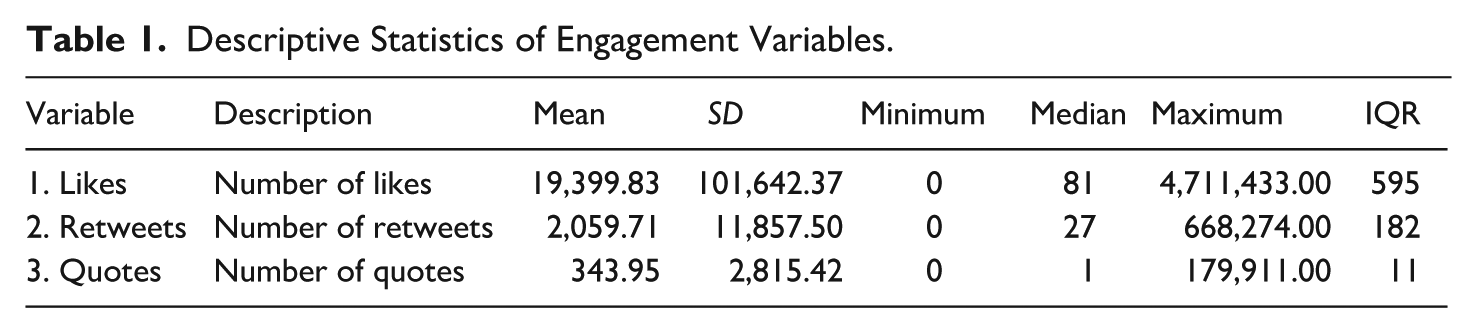
The dependent variables selected to measure audience engagement were “likes,” “retweets,” and “quotes.” These metrics offer tangible proof of audience reach and sustained interest (Fang et al., 2022). As is common with social media engagement data, these variables are count data and exhibited significant positive skewness. This means that most tweets receive a modest amount of engagement, while a small number of tweets receive an exceptionally high amount, creating a long tail in the distribution.
This skewness presents a challenge for ordinary least squares (OLS) regression, which assumes a linear relationship between predictors and the outcome, and that the model’s errors are normally distributed with a constant variance or homoscedasticity. When these assumptions are violated, the statistical inferences from the model can be unreliable. Consequently, a natural log transformation was applied to the dependent variables. This procedure addresses these issues in two important ways. First, it compresses the scale of the variable, reducing the influence of extreme values and making the distribution of the residuals more symmetric and normally distributed. Second, it models a more plausible multiplicative, rather than additive, relationship between linguistic features and engagement. Specifically, the new dependent variables were calculated as ln(x + 1), where x is the original count. The addition of 1 is a standard procedure to accommodate observations with zero engagement, which cannot otherwise be computed on a logarithmic scale.
Linguistic features
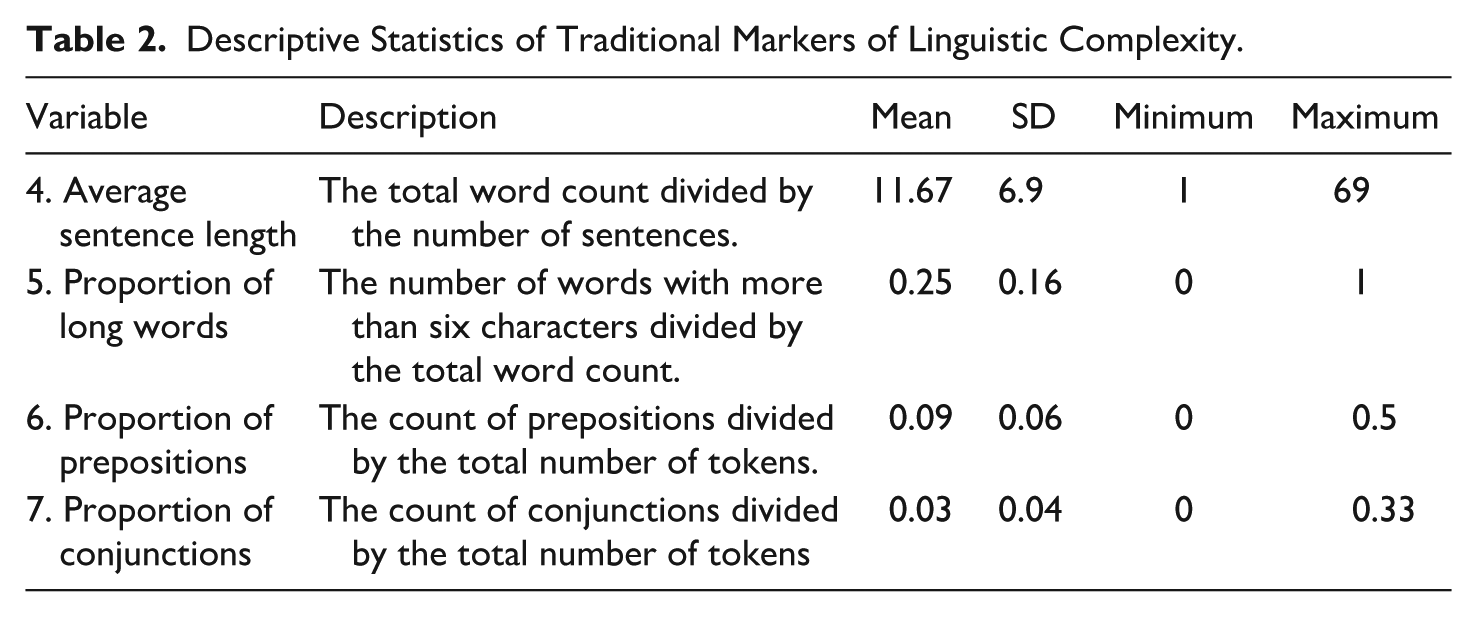
The theoretical construct of PFT was operationalized through a set of seven linguistic features detailed in the hypothesis development. These features were extracted computationally for each tweet through an NLP pipeline built using the “spaCy” library in Python, a tool for computational linguistic analysis (Vasiliev, 2020). The pipeline first tokenizes the text of each tweet, a process that segments the text into its constituent words and punctuation (i.e., “tokens”). Following tokenization, each token is tagged for its part of speech, allowing for the classification of words into categories such as nouns, verbs, and prepositions. This analysis allows for the precise calculation of theoretically grounded features. The specific features are as follows:
Average sentence length: The total word count divided by the number of sentences.
Proportion of long words: The number of words with more than six characters divided by the total word count.
Proportion of prepositions: The count of prepositions divided by the total number of tokens.
Proportion of conjunctions: The count of conjunctions divided by the total number of tokens.
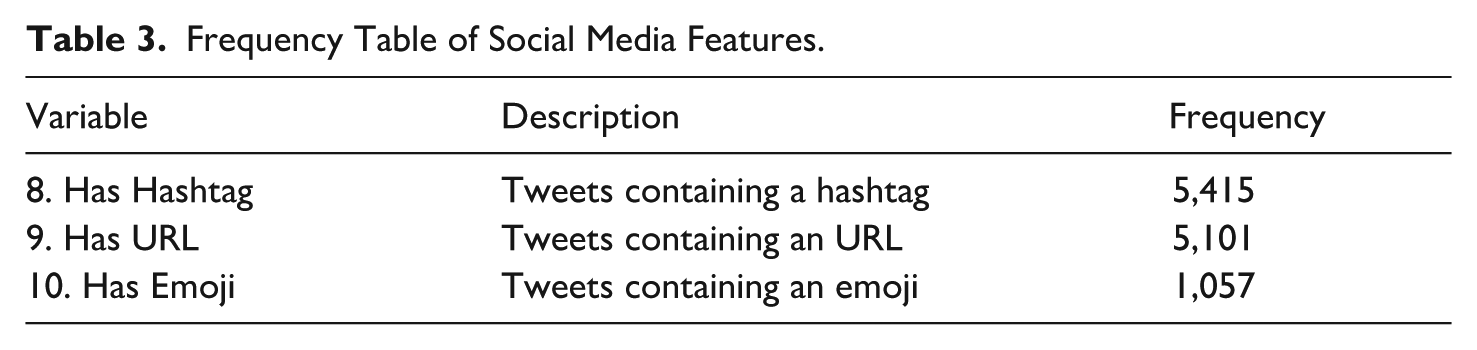
Presence of a hashtag: A dichotomous variable coded 1 if a tweet included at least one hashtag, and 0 otherwise.
Presence of a URL: A dichotomous variable coded 1 if a tweet contained “http” and 0 otherwise.
Presence of emojis: A dichotomous variable coded 1 if a tweet included at least one emoji, and 0 otherwise.
Tables 1, 2, and 3 present the descriptive statistics for all variables used in the analysis.
Descriptive Statistics of Engagement Variables.
Descriptive Statistics of Traditional Markers of Linguistic Complexity.
Frequency Table of Social Media Features.
Analytical Approach
The analytical approach was guided by the need to isolate meaningful patterns in communication style from the inherent heterogeneity of social media data. Specifically, CEOs differ not only in their industries, popularity, and audience size but also in their communication styles. Likewise, the platform environment itself is constantly changing. Addressing these sources of variation required a design that balanced the complexity of social media “big-data” with theoretical interpretability. Therefore, the study combined a scalable NLP pipeline with a panel modeling approach suited to capturing within-communicator variation over time. The NLP component translated the theoretical concept of fluency from PFT into measurable linguistic features across thousands of tweets. This process ensured that the analysis reflected patterns grounded in theory, rather than the correlational signals often derived from algorithmic text mining.
The subsequent modeling step focused on inference in a setting where the context is dynamic. For this reason, a two-way fixed effects (2FE) model was used as an interpretive strategy to separate what varies within a communicator (e.g., a CEO deciding whether to use a complex sentence or a hashtag in a given post) from what does not (e.g., their enduring brand identity, charisma, or industry norms). This design made it possible to test how shifts in linguistic fluency related to fluctuations in engagement while controlling for both individual and time invariant factors.
Although fixed effects models have been critiqued for their limitations in heterogeneity contexts (Imai & Kim, 2021), the linguistic features associated with fluency are studied as a non-absorbing or “flickering” post characteristics, more akin to momentary rhetorical choice than permanent policy adoptions such as in a Difference-in-Differences (DiD) scenario (de Chaisemartin & D’Haultfoeuille, 2020; Goodman-Bacon, 2021). Therefore, the 2FE estimator does not rely on the comparisons between early- and late-adopting groups; rather, the model is used to estimate the relationship between the variables while controlling for time- and unit-invariant factors. Framing linguistic style as a rhetorical choice in the digital environment aligns the methodological reasoning with the pedagogical argument of this article: CEOs might calibrate their expression to context, and the chosen 2FE approach captures this calibration by focusing solely on within-communicator variation, rather than between-group differences.
Within this design, both continuous and dichotomous features were analyzed as expressions of stylistic decision making. For continuous features, the 2FE model estimates the average effect of a marginal change in linguistic style against the user’s baseline communication patterns. For dichotomous features, the 2FE estimator is identified from direct within-unit comparisons over time, providing the message-by-message consequences of these choices. Although the resulting coefficients represent an average over any underlying effect heterogeneity, they provide a clear and interpretable quantity for the rhetorical choice to use a specific linguistic style. Therefore, this specification makes it possible to examine the association between the non-absorbing features of digital communication styles and audience engagement. This approach simultaneously controls for major sources of unobserved heterogeneity common in social media “big-data.”
In this context, CEO fixed effects control for all stable, unobserved characteristics of each CEO, such as their intrinsic appeal, industry, or company prestige, and time fixed effects specified at the year level, control for any unobserved factors that vary over time but affect all CEOs simultaneously, such as the launch of a new platform feature, a major global event (e.g., a pandemic), or a general shift in user behavior on the platform.
Separate regression models were estimated for each of the three dependent variables with the “linearmodels” package for panel regression in Python. The general form of the specified model is as follows:

where Y it is the log-transformed engagement metric for CEO i on tweet t, X it is the vector of the seven linguistic features, αi represent the CEO fixed effects, γt represent the year fixed effects, and εit is the idiosyncratic error term. To ensure the results were not sensitive to time-varying changes in CEO popularity, an alternative specification that included a control for the logarithm of the user’s follower count was also estimated. The results confirm the robustness of the main findings because this variable was not statistically significant and exhibited a large, unstable coefficient, which suggests that the entity fixed effect sufficiently captures the influence of a CEO overall popularity.
Results
Table 4 presents the results of the fixed-effects regression analyses predicting the natural log of likes, retweets, and quotes.
Two-Way Fixed-Effects Panel Regression Predicting Audience Engagement.
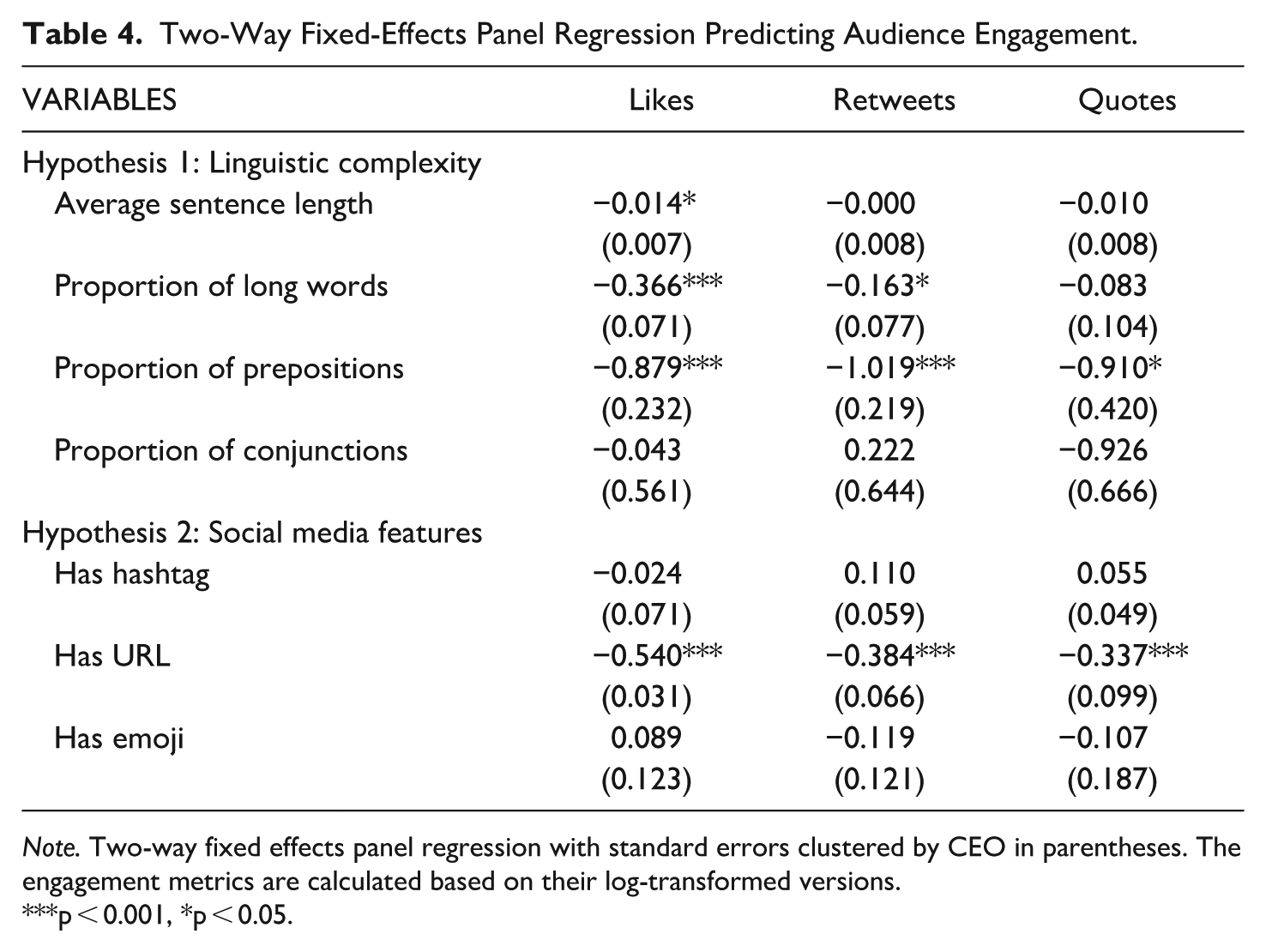
Note. Two-way fixed effects panel regression with standard errors clustered by CEO in parentheses. The engagement metrics are calculated based on their log-transformed versions.
p < 0.001, *p < 0.05.
The Impact of Linguistic Complexity (Hypothesis 1)
The first hypothesis predicted that markers of linguistic complexity would be negatively associated with engagement. The results shown in Table 4 offer strong support for this proposition. The proportion of prepositions, a proxy for syntactic complexity, was a robust and significant negative predictor across all three models: likes (β = −0.8785, p < 0.001), retweets (β = −1.0194, p < 0.001), and quotes (β = −0.9103, p < 0.05). This suggests that tweets with more complex sentence structures consistently receive less engagement. While the proportion of prepositions was a consistent negative predictor across all engagement types, other complexity markers showed more specific effects. The proportion of long words was negatively associated with likes (β = −0.366, p < 0.001) and retweets (β = −0.163, p < 0.05), while average sentence length was only a significant deterrent for likes (β = −0.014, p < 0.05) but not for retweets or quotes. The proportion of conjunctions had no discernible effect on any engagement metric.
The Role of Platform-Specific Features (Hypothesis 2)
The second hypothesis explored the impact of platform affordances. In partial support of Hypothesis 2, the presence of a URL was a powerful and consistent negative predictor of likes, retweets, and quotes (all p < 0.001). The effect was not only statistically significant but also practically meaningful: the coefficient in the likes model (β = −0.540) is associated with approximately 42% fewer likes (e−0.540−1 ≈ −0.42), a substantial penalty for directing users off-platform. However, contrary to expectations, the effects of other platform features were muted. After controlling for fixed effects, the presence of emojis had no statistically significant relationship with any form of engagement. Hashtags were found to have a marginal, positive association with retweets (β = 0.110, p < 0.10) but were not significant predictors of likes or quotes.
Discussion
A substantive discussion around the prose and rhetoric of social media communication has been absent from business communication pedagogy, as traditional communication channels have historically been prioritized (Joglekar et al., 2022). This study shows why clear communication on social media platforms is important, offering a new perspective for the pedagogy of business communication in the digital age.
Two key themes emerge from the analysis: clarity and on-platform focus. First, linguistic clarity appears to be a primary driver of engagement. This observation not only provides support for the central idea of PFT but also reinforces the principle of writing clearly and concisely, a tenet in business communication pedagogy (Calma et al., 2022; Helens-Hart, 2025; Phan, 2024). Tweets with higher syntactic complexity, indicated by a greater proportion of prepositions, received less engagement. This empirical finding is in line with the concept of “verbal play” (Jameson, 2014). In this practice, a CEO used informal, simple language to appear more approachable and “humanize” the executive role on X.
Similarly, the single largest and most consistent penalty to all forms of engagement was the inclusion of a URL, suggesting that from a platform-engagement perspective, directing user attention away from the immediate content stream is a costly choice. This on-platform focus suggests a new dimension of clarity for the digital context: self-containment. Therefore, business communication pedagogy should not only focus on teaching sentence-level simplicity but also on the value of creating on-platform, self-contained content that doesn’t demand the audience shift contexts. The practical implication for business leaders in social media is evident: prioritize clear, concise language and create self-contained content to maximize immediate audience interaction.
Furthermore, the effects of more superficial stylistic choices appear far less robust than previously thought. After controlling for all stable, CEO-specific characteristics, the benefits of features like emojis disappeared entirely. Contrary to Hypothesis 2c and another body of research (Davis et al., 2019), the presence of emojis had no significant effect on any engagement metric. Instead, it suggests that the marginal act of adding an emoji to a single tweet does not, on its own, drive engagement for high-status communicators. Any observed correlation in other studies may be attributable to unobserved, stable aspects of a CEO’s communication style (for instance, a more informal persona), which are captured and controlled for by the fixed effects in this study’s model. Similarly, hashtags only showed a marginal link to retweets because their discovery function appears far less powerful than hypothesized once CEO-level variance is accounted for. The practical implication is that stylistic options like emojis and hashtags are not universal drivers of engagement, and their impact is likely secondary to the core message’s fluency.
These findings move beyond the view of “simpler is better” to reveal a more sophisticated picture of communication effectiveness for business leaders on real-time public communication platforms. The study highlights that in a high-noise, low-attention, collapsed-context environment like X, CEOs not only should focus on generating engagement but also consider the fluency of the style, where a positive cognitive experience lowers the threshold for a platform endorsement (Reber et al., 2004). The story that emerges is one of flow and form, where the cognitive ease of the message itself is a more reliable predictor of reception than the decorative elements that often accompany it.
The study’s findings contribute to a reassessment of the rhetorical situation for business communication in the digital context, a need previously identified by Reinsch and Turner (2006). A key pedagogical implication is the required focus on how to conceptualize writing for “tweet-style” platforms. This training should involve an analysis of context, goals, and established voice under the lens of clear and concise writing, rather than a reliance on a set of simple best practices of fluent writing.
The methodological and theoretical approach grounding these pedagogical recommendations represents a step forward in the business communication literature. Methodologically, the use of computer-based analysis of human language with NLP allows for scalable and systematic analysis of large, unstructured text data sets where prior research dealing with social media “big-data” has relied on either detailed qualitative analysis of small samples or correlational analysis of large data sets (Andreotta et al., 2019; Bazzaz Abkenar et al., 2021). Theoretically, the focus on how messages are constructed, a dimension that has been underresearched relative to the message content (Deng et al., 2021; Villarroel Ordenes et al., 2019), and the empirical support for Processing Fluency Theory (Reber et al., 2004) helps refine the scholarly conversation on the linguistics of social media (Calude, 2023), supporting that in a collapsed-context environment, the cognitive ease of a message, or the way it flows based on the form, is a determinant of its reception.
Limitations and Future Research
The findings of this study should be interpreted in light of its limitations, each of which also suggests directions for future inquiry. First, the analytical design estimates the average within-CEO associations of linguistic features with engagement, which inevitably masks potential heterogeneity across CEOs, industries, and situational contexts. It is plausible that linguistic clarity may operate differently for CEOs in distinct sectors, which highlight the importance of the context for the pedagogic conclusions of this study. For instance, a clear message might considerably enhance engagement for a consumer-facing CEO in a regulated or conservative industry, but might not have the same impact for a CEO in a creative industry. Future research could investigate this contextual variation by focusing on particular industries or leadership styles. Doing so would refine the understanding of how their digital communication is shaped by audience expectations and institutional norms.
Second, the present model captures immediate, message-level effects of linguistic choices rather than the longitudinal evolution of a communicator’s style. As this study examined variation within individuals across posts, it does not account for broader communicational shifts that may unfold as CEOs adapt their communication over time. Future longitudinal analyses could trace how stylistic adaptation contributes to the building of engagement.
Third, the data set draws exclusively from CEOs of U.S.-based Fortune 500 companies, limiting the diversity of communicative norms represented. Cross-cultural comparative analyses would therefore be valuable to test the generalizability of these findings and to inform business communication pedagogy in global or intercultural settings.
Fourth, the analysis focused on textual communication. Communication on modern platforms might include text with images, video, and other visual cues. Future research incorporating visual–textual interaction could offer a more comprehensive understanding of digital communication effectiveness.
Finally, engagement indicators such as likes, retweets, and quotes capture audience attention but are not synonymous with persuasion or attitudinal change. Future experimental or mixed-methods studies could examine how variations in message clarity and fluency influence other responses such as trust, recall, or brand affinity.
Footnotes

Funding
The author received no financial support for the research, authorship, and/or publication of this article.
Declaration of Conflicting Interests
The author declared no potential conflicts of interest with respect to the research, authorship, and/or publication of this article.