




Abstract
Using a mixed methods approach that relies on conceptual metaphor theory, corpus linguistics, and discourse analysis, the study investigates the use and function of metaphor in a self-constructed corpus of U.K. bank chairman’s letters to shareholders during the study period, covering a state of relative stability (2002-2007), financial crisis and scandals (2008-2019), and the coronavirus pandemic (2020). We find evidence that bank chairmen use conventional metaphors to communicate with shareholders. Additionally, the choice of metaphors is conditional on the contextual environment in which banks operate. Further qualitative analysis of the metaphors supports a persuasive role that depends on the contextual environment.
Keywords
Introduction
The U.K. banking industry is a critical player in the U.K. economy, with total assets representing between 311.26% and 969.05% of U.K. gross domestic product between 2002 and 2022 (Statista, 2022). However, over the past 16 years, the U.K. banking industry has faced repeated crises and scandals, jeopardizing its reputation, legitimacy, and stability. The study posits that efforts to repair reputational damage arising from these crises partly involve language use. Specifically, in this study, we examine the use of metaphors in the chairman’s annual letters to shareholders (henceforth LTS) of five U.K.-listed banks from 2002 to 2020.
As a valuable instrument for examining how organizations use language to frame their practices and project their ideology (Hoßfeld, 2013), metaphor analysis has gained the attention of scholars investigating business and financial reporting narratives (Charteris-Black, 2004; Charteris-Black & Musolff, 2003; Skorczynska & Deignan, 2006). This attention is warranted and timely, considering the significant framing role metaphors play in shaping discourse, especially following the seminal work of Lakoff and Johnson (1980), who highlight the central role of metaphors in language, distinguishing between metaphorical concepts (or conceptual metaphors) and metaphorical expressions (or linguistic metaphors). Therefore, metaphors deployed by corporate leaders, such as bank chairmen in annual LTS, are not just ornaments. They are the results of the chairmen’s thoughts and guide their subsequent actions and thoughts. Therefore, business students, practitioners, and professionals must understand the place of metaphors in LTS as a form of business communication.
The present study aims to extend our understanding of the use of metaphor in bank chairman LTS by answering three research questions. First, we investigate the metaphoric source domains in U.K. bank chairmen’s LTS. The source domain orientation of the study is grounded on the fact that the source domains are reflected in linguistic metaphors (O’Mara-Shimek et al., 2015) and, therefore, the lens (metaphorical vehicles) through which we attempt to understand the evolution in the thinking of bank chairmen during different phases covered by the study. Second, we aim to study whether the deployment of metaphors in U.K. bank chairmen’s LTS is related to the contextual environment in which banks operate. A good metaphor analysis rests not only on catching metaphors but “in using metaphors to unravel the multiple patterns of significance and their interactions” (Morgan, 1986, p. 342, cited in J. Amernic et al., 2007). Therefore, our third research question attempts to interpret and explain instantiations of metaphors in the chairmen’s LTS to uncover the function of metaphors in the genre of chairmen’s LTS.
To answer these questions, we draw on critical metaphor analysis incorporating both qualitative and quantitative approaches to metaphor analysis (Charteris-Black, 2004; Koller, 2004; Musolff, 2004). We start by constructing a corpus of 88 annual LTS of five U.K.-listed banks between 2002 and 2020. We then identified metaphorical expressions in the LTS following Pragglejaz Group’s refined and extended Metaphor Identification Procedure (Steen et al., 2010). The source domain labeling was achieved by checking identified metaphorical expressions against attested examples in well-known metaphor dictionaries. Subsequently, we performed a chi-square test on the data to examine the association between the observed frequencies of source domains and the contextual environment of the banks.
Corpus evidence suggests 11 major metaphorical source domains employed by U.K. bank chairmen in their LTS over the study period, including Building, Journey, Plant, War, and Vision. We find a small but significant relationship between banks’ contextual environment and the frequencies of observed source domains. Our interpretive analysis also uncovers the persuasive use of metaphors in LTS, which is predicated on bank contextual environments, giving credence to the idea that this genre of corporate communication serves both communication and impression (persuasion) functions.
The remainder of the study is organized as follows. The second section discusses the theoretical framework and related work on metaphors, including those relating to financial reporting and LTS. The third section discusses the methodology, including research questions and the research context. The fourth section presents the results, and the final section concludes the study.
Literature Review
Theoretical Background: Conceptual Metaphor Theory
The essence of metaphor is understanding and experiencing one kind of thing in terms of another (Lakoff & Johnson, 1980, p. 5). This cross-mapping happens through a cognitive process by which two conceptual domains are linked, allowing one domain (the source) to provide a framework for understanding another domain (the target). From the perspective of the classical theory of metaphor, a metaphor is a novel or poetic linguistic expression (Lakoff, 1993, p. 203), a rhetorical flourish only within the realms of genius (Aristotle, ca. 335 BCE). As such, metaphors are not thought of as having a cognitive dimension and, thus, have no influence on thinking.
However, Lakoff and Johnson (1980), in their seminal book Metaphor We Live By, advance the conceptual metaphor theory (CMT), positing that the concepts that govern our thoughts are not just matters of the intellect; they also govern our everyday functioning down to the most mundane details (Lakoff & Johnson, 1980, p. 3). Therefore, contrary to the classical theory of metaphor, metaphors are not mere words (Lakoff, 1993) or ornaments (Postman, 1996, p. 174). They have the potential to affect emotions and thoughts (Kovecses, 2010); they are organs of perceptions through which we see the world as one thing or another (Postman, 1996, p. 174).
Having well-received in various academic fields, including healthcare, politics, economics, finance, and accounting, we adopt the CMT theoretical foundation for this study. Conceptual metaphors perform cognitive functions. They are fundamental to human thought processes, shaping how we understand and experience the world and allowing us to grasp abstract concepts by relating them to more concrete experiences. As an example, the conceptual domain of time is metaphorically understood in terms of money (TIME is MONEY) and reified in linguistic metaphors such as “You are wasting my time” or “opportunity cost of spending time on this task.” The cross-mapping through which this understanding happens involves metaphorical highlighting.
According to Lakoff and Johnson (1980), metaphors function by selectively highlighting aspects of the source domain, which invariably results, whether deliberately or not, in de-emphasizing (hiding) others (see also Kovecses, 2010, p. 91). In this frame, they become points of reference (Fitzgibbon & Seeger, 2002) with the potential to emphasize key themes and impose values and visions on the audience (J. Amernic et al., 2007). Therefore, they indicate leaders’ thinking and a basis for their actions or inaction (Mayer-Schoenberger & Oberlechner, 2002).
As a phenomenon of language, metaphors’ primary task is to make communication possible (Bontekoe, 1987, p. 209) by conveying complex ideas succinctly and vividly. They can simplify complicated concepts and make them more accessible (Gibbs, 1994). In addition to their communication and cognitive functions, metaphors also serve pragmatic functions. By evoking strong emotional responses, they help connect abstract ideas to sensory and affective experiences (Thibodeau & Boroditsky, 2011). Thus, as Breeze (2021) notes, metaphors can bypass ethical judgments and economic explanations and generate warm feelings through their strong emotional content. They are, therefore, a viable and powerful rhetorical tool for persuasion (Charteris-Black & Musolff, 2003).
Metaphors in Corporate Communication and Financial Reporting
The chairman’s (or CEO’s) LTS is a discretionary verbal account (Brühl & Kury, 2019) that has recently attained ubiquitous status in annual financial reports. Sometimes referred to as the president’s letter, the LTS is an unregulated and unaudited narrative (Geppert & Lawrence, 2008) with neither requirements nor restrictions on its content (Clatworthy & Jones, 2001). It is part of a “battery of belief-forming institutions” (Tinker, 1985, p. 82), allowing companies to carry out their communication strategy of sensemaking or mythmaking (David, 2001). The inherent flexibility of these letters allows the author to frame a message, present an image, or strengthen the company’s legitimacy (Martins et al., 2019) to create a positive impression in the readers’ minds (Clatworthy & Jones, 2006). Evidence also suggests that the LTS is not only the most read section of the United Kingdom’s accounting narratives (Hyland, 1998) but the longest established (Clatworthy & Jones, 2003).
Spearheaded by Amernic and his gang of researchers, LTS has received much attention from academic researchers in linguistics, finance, and accounting. For example, J. H. Amernic and Craig (2000) examine the visual and rhetorical devices employed by Walt Disney in his 1940 LTS amid market uncertainty and losses due partly to the European war. Regarding the nexus between metaphor and ideology, the authors provide verbal reifications of the journey metaphor, presenting Disney as an active, purposeful, and sentient company regardless of the existential threats reflected in the state of its balance sheet. Highlighting the importance of context in metaphor analysis, J. H. Amernic (1998) reports that under a more congenial business environment, Michael Eisner, the then Chairman and CEO of Disney, invoked the family metaphor in corporate communications with shareholders, employees, and customers to self-represent himself as the “strict father” that can be trusted to act “with authority and confidence.”
Regarding deploying metaphors in LTS during legitimacy crises, R. J. Craig and Amernic (2004a) conducted a micro-discourse analysis of LTS of the 2000 annual report of Enron and Joseph Berardino’s (then CEO of Andersen) 2001 testimony to the U.S. Congress regarding the Enron debacle. The authors uncover ideology-sustaining rhetoric in which the CEO drew from the source domains of sport, competition, and war to construct the company’s success story before the dawn of the scandal. The subsequent restatement of Enron’s 1997-2001 annual reports, the resulting scandal, and eventual bankruptcy would later undermine this success story. Additional evidence on the rhetorical and ideological deployment of metaphors during organizational crises can be found in studies such as J. H. Amernic and Craig (2007), J. Amernic and Craig (2013, 2017), Bujaki and McConomy (2012), and Tourish and Hargie (2012).
Away from their use in LTS in annual reports and supporting their pervasiveness in economic and financial reporting as a tool for communication and persuasion, metaphors have enabled management to communicate and create new perspectives (Fitzgibbon & Seeger, 2002) in other contexts, such as privatization (e.g., R. Craig & Amernic, 2004b), mergers and acquisitions (e.g., J. H. Amernic & Craig, 2001; Koller, 2002, 2003), downsizing (e.g., Hoßfeld, 2013; Aggerholm, 2014), restructuring and reorganization (e.g., Martins et al., 2019), and job advertisements (Engstrom et al., 2017). For example, R. Craig and Amernic (2004b) adopt an interpretive approach to uncover the metaphorical, rhetorical, and ideological framing of accounting in communications to employees by Paul Tellier, the CEO of Canadian National Railways, in the prelude to the successful privatization of the company (see also R. Craig & Amernic, 2006).
Metaphors and Bank Narratives
The idea that banks use communication episodes rhetorically to influence readers’ perceptions is gaining some attention. For example, drawing on the attribution theory, self-presentation (impression management) theory, and account giving, Brühl and Kury (2019) provide evidence indicating that U.S. and European banks use accounts as linguistic devices to influence the responsibility judgement of stakeholders in the aftermath of the global financial crisis. However, their study excludes metaphor analysis.
Regarding metaphors, J. Amernic and Craig (2022) identify ethical and perverse use of metaphors, including the stagecoach metaphor, in Timothy Sloan’s (CEO, Wells Fargo) opening statement to the U.S. Senate. They suggest that the CEO intended to frame the bank as dependable and committed to regaining public trust following a series of high-profile scandals. In a similar study, Tourish and Hargie (2012) examine the root metaphors deployed by U.K. bank CEOs to navigate their testimony to U.K. parliaments on the issues relating to the 2007-2008 financial crisis. Consistent with the documented high propensity of firms to diminish responsibility and shift blame for crises (e.g., Deignan, 1995), the authors report that the bankers used root metaphors that represented their faces as passive and pertinent learners with a collective group mindset (“the wisdom of the crowd”). The bankers were victims of the crisis confronted by market forces or a tsunami (Whittle & Mueller, 2012) over which they had no control. This account, an instance of “voluntary organizational forgetting” (Martin de Holan, 2011), counters the pervasive and widely popular image of greedy, negligent, and immoral villains (Whittle & Mueller, 2012) responsible for the collapse of the global economy.
Whether bank management metaphorizes their narratives when communicating directly with investors is gaining traction. After observing the striking positive tone in the LTS of U.K.-listed banks amid various financial crises and scandals, Breeze (2021) examines the discursive legitimation strategies in annual reports released a decade after the global financial crisis. Among other strategies, Breeze uncovers the “metaphorization” of corporate narratives using conventional metaphors drawn from the source domains of natural disasters, weather, ship, way, construction, and human body with the pragmatic effect of creating myths and obscuring the role of those responsible for the bank’s performance, even suggesting a survivor narrative for the naive reader.
Overall, while the extant literature examines banking narratives from a metaphor analysis perspective, it is still unknown which source domains are frequently in use, whether the frequency of source domains depends on the contextual environment in which the banks operate, and what pragmatic function the metaphors perform under the different contextual environments in which the banks exist. The knowledge of these issues is of significant and practical importance to business communication pedagogy, corporate training and communication strategies. This study stresses metaphor as a key tool in leadership communication by highlighting what and why metaphors are deployed to mirror and sway stakeholders’ sentiments. Teaching business communication to students and professionals might emphasize picking metaphors that match their big-picture plans, highlighting good values, and mitigating negative associations, especially during crises.
Therefore, we extend the study by Breeze (2021) to provide answers to these questions. Thus, unlike Breeze (2021), we take form- and meaning-oriented approaches to the study by drawing qualitative and quantitative evidence from different economic environments.
Methodology
Research Context and Research Questions
An interpretative text analysis requires an awareness of the subsisting contextual environment at the time of the text production (Mäkelä & Laine, 2011). The antecedents and consequences of the 2008-2009 financial crisis are well documented in the literature (see, e.g., Reinhart & Rogoff, 2009). To summarize, while this was a worldwide crisis rooted in the U.S. subprime mortgage market, it impacted U.K. banks. Although Barclays Bank, HSBC, Lloyds Bank, and Standard Chartered Bank survived the turmoil, it would be the death knell for HBOS, Bradford and Bingley, Northern Rock, and much later, Royal Bank of Scotland.
Perhaps more relevant to this study, the financial crisis and the resulting bailout had a telling effect on the public psyche and sentiments, culminating in a negative impact on banks’ reputation and legitimacy (Ruiz et al., 2016). While extensive media coverage of the financial crisis reduced around 2010 (Liu et al., 2017), U.K. banks had little respite as new scandals germinated to add to the already toxic public sentiment toward these banks. Table 1 summarizes major scandals and the fines and penalties for offending banks.
Key Scandal/Crisis 2008-2019 (Crisis Phase).

Figure 1 vividly shows the events’ impact on accounting and stock market performance during the study period. Although these scandals have varying impacts on banks, what is evident in Figure 1 is that the tainted reputation of the U.K. banking industry has affected not only accounting performance but also stock market valuations. Then came the COVID-19 pandemic, which, notwithstanding its financial impact, offered an opportunity for banks to repair and restore damaged relationships with customers and the public in general.
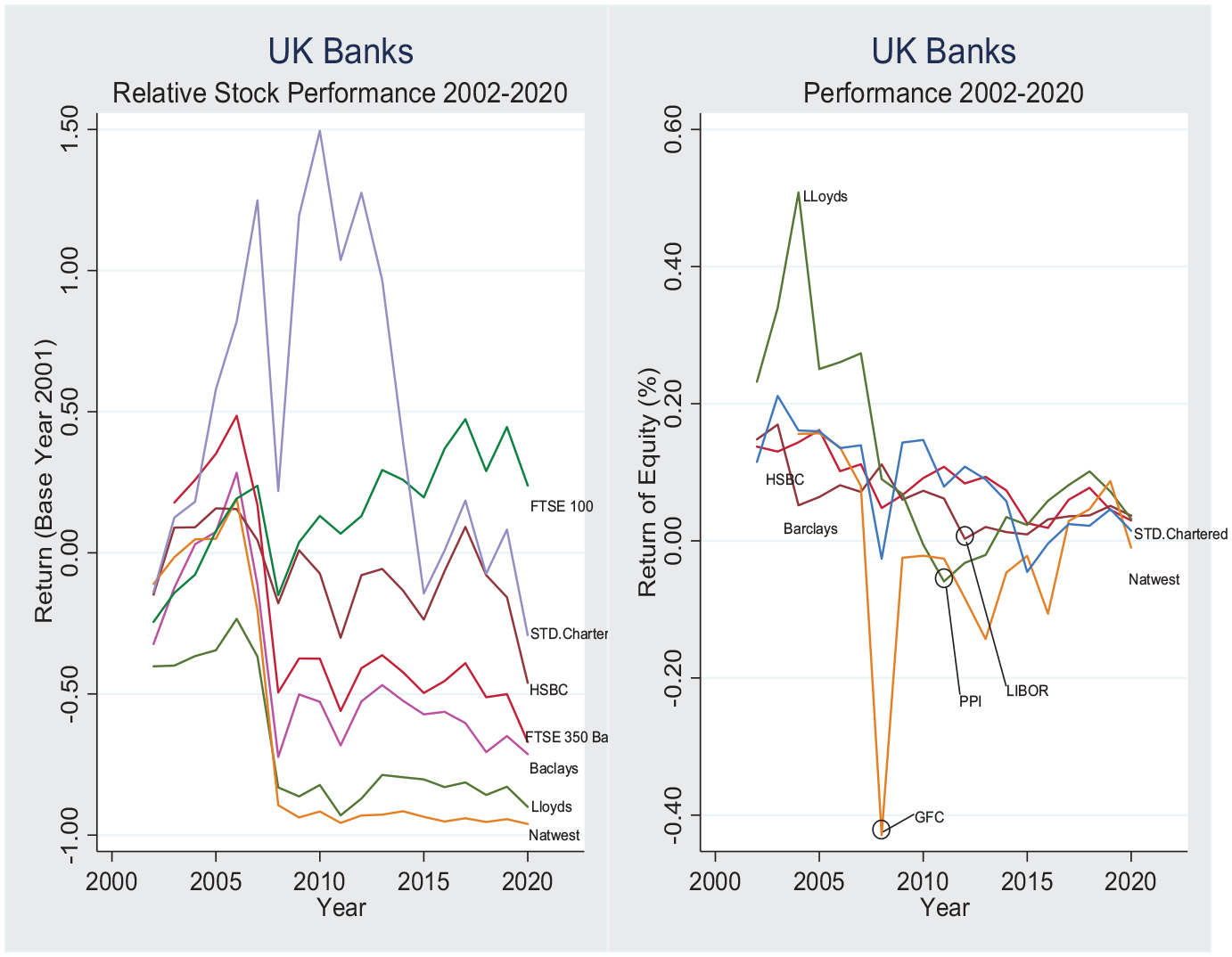
Stock and accounting performance.
Given the preceding discussion, we argue that the bank chairmen’s use of metaphors in LTS is conditional on the banks’ contextual environment. We classify the contextual environment into three subperiods: pre-crisis (2002-2007), crisis (2008-2019), and COVID-19 (2020). We then answer the following research questions: (a) What are the main source domains in U.K. bank chairmen’s LTS? (b) Do the identified metaphorical source domains depend on banks’ contextual environment? (c) What is the pragmatic function of the identified metaphorical expressions/source domains, given the contextual environment of banks? 1
Corpus Construction and Metaphor Identification Procedure
To answer the research questions posed in this study, we apply elements of the critical metaphor analysis (Charteris-Black, 2004) to a sample of U.K. banks. To construct the study sample, we require banks to be listed in the FTSE 100 throughout the study period, covering pre-crisis, crisis, and COVID-19. This requirement excluded failed U.K. banks, including Northern Rock, Bradford and Bingley, and HBOS. The restriction produced five FTSE 100 banks: Barclays Bank, Lloyds Bank, NatWest (Royal Bank of Scotland), HSBC, and Standard Chartered Bank. These banks, excluding Standard Chartered Bank, control about 85% of U.K. business accounts and 75% of current accounts (Moneyfacts, 2024), providing ample evidence of the representativeness of the study sample.
Next, we require sampled banks to have a chairman’s letter as part of the annual report for each year during the study period. However, we could not retrieve 17 chairman’s letters due mainly to the nonavailability of the letters, as for some banks, communicating through the chairman’s letter was a more recent phenomenon. In a minority of cases, our inability to retrieve the letters was due to the file format, which essentially made the extracted text file unreadable. This step of our sample construction resulted in the final corpus of 88 LTS, authored by 11 bank chairmen. All of these bank chairmen were male, eliminating the impact of gender on the results presented in this study. In addition, only two of the chairmen (Maarten van den Bergh of Lloyds Bank and José Viñals of Standard Chartered Bank) are non-British nationals. The final corpus consists of 135,622 tokens (Table 2).
Corpus Structure: U.K. Bank Chairman’s LTS.

Note. LTS = letter to shareholders.
Regarding metaphor identification, we acknowledge that although metaphors are ubiquitous (L. Cameron, 2003; Steen et al., 2010), catching metaphors can be arduous and notoriously subjective (J. Amernic et al., 2010; Koller, 2006, p. 241; Skorczynska & Deignan, 2006) as each metaphor analyst’s intuition of what constitutes a metaphor may differ (Gibbs, 2006). To increase our probability of correctly identifying metaphors, we rely on the corpus-based approach and previously attested Metaphor Identification Procedure Vrije Universiteit (MIPVU) approach (Steen et al., 2010).
The MIPVU requires a word-by-word manual analysis and, therefore, a time-consuming affair (Nacey et al., 2019), especially given the large number of tokens in our corpus. We acknowledge that every word or part of speech is potentially metaphoric (L. Cameron, 2003; Goatly, 1997) and a focus, for example, on nominal lexemes, in “metaphor theory is not representative of the diversity of use in naturally-occurring data” (Deignan, 2006, p. 109). However, because of the challenges we alluded to and relying on the documented evidence that nouns, verbs, adverbs, and adjectives are the most productive parts of speech in metaphor identification (L. Cameron, 2003; Koller, 2006; Krennmayr, 2015), we restrict our metaphors identification to these four grammatical classes.
We used the concordance tool in LancBox (Brezina et al., 2020) to concordance the four grammatical classes of interest using a collocational span setting of 20 words to the left and right. Next, we exported the 103,478 POS-tagged concordance lines to Microsoft Excel for further analysis. We took one additional decision before embarking on metaphor identification. Specifically, L. J. Cameron (2007) suggests that contrasting the concrete and basic senses of words required to establish their metaphorical use is most straightforward with nouns and lexically dense verbs. Therefore, we excluded proper nouns and delexicalized verbs such as auxiliary, modal, aspectual, and light verbs with low semantic content (Demjén et al., 2016). In addition to the previous data preparation steps, this step ensures we avoid the trap that the metaphors we uncover include “everything, including uninteresting words” (Nacey et al., 2019).
We analyzed the final concordance rows using MIPVU to identify metaphorical expressions anchored on each concordance word. Consistent with MIPVU, we assume that words are used metaphorically, whether consciously or unconsciously, when there is a disruption in “semantic coherence through the introduction of an alien conceptual domain” (Krennmayr, 2015, p. 535), resulting in a “tension between the literal source domain and a metaphoric target domain” (Charteris-Black, 2004, p. 35).
For example, take the node word foundations in the excerpt: “Barclays is going through a major transition. Critical progress was made in 2013 in putting in place the foundations for sustainable long-term success” (Barclays Plc, 2013, p. i). First, we determine the contextual meaning of foundation as “the most basic part of something from which the rest of it develops” (Macmillan English Dictionary, 2022a). Second, we determine whether the word (foundation) has a more basic contemporary meaning, being more concrete, related to bodily action, more precise, historically older, and not necessarily the most frequent meanings (Steen et al., 2010, pp. 5-6). Hence, we determine the more basic meaning of foundation as “the part of a structure of a building that is below the ground and supports the rest of it” (Macmillan English Dictionary, 2022a). Third, we determine “whether the contextual meaning contrasts with the basic meaning but can be understood in comparison with it” (Steen et al., 2010, p. 6). We conclude that the basic meaning of foundation can afford a mapping to its contextual meaning on the ground of some nonliteral comparison and is therefore metaphorically used; we marked foundation as a metaphor in this context. 2
The answers to our research questions require further semantic analysis to identify the source domain to which a linguistic metaphor belongs. However, identifying the source domain of a metaphorical expression is a challenge (Ho & Cheng, 2016). To tackle the source domain labeling challenge, in line with the approach in the literature, we checked each identified metaphor against metaphor dictionaries, including Master Metaphor List (Lakoff et al., 1991), Collins COBUILD dictionary (Deignan, 1995), and Metaphor Box (Macmillan English Dictionary, 2022b). Following this procedure, we assigned “foundations” to the Building source domain. For brevity, Table 3 presents sample excerpts of metaphorical expressions from the five most productive source domains according to standardized frequencies (see next section) to further illustrate the execution of the metaphor identification procedure.
Metaphorical Expressions in U.K. Bank Chairmen’s LTS.

To ensure the reliability of our results, we engaged two research assistants with a background in applied linguistics to help with metaphor identification and the assignment of these metaphors to source domains. We calculated Cohen’s Kappa to measure inter-rater reliability for the two analyses. After multiple rounds of discussion, Cohen’s Kappa coefficients were 0.90 (metaphor identification) and 0.92 (source domain assignment), suggesting a “strong” inter-rater agreement (McHugh, 2012) and providing a solid foundation for the quantitative analysis that follows.
Results and Discussion
Source Domains of Metaphors in Chairmen’s LTS
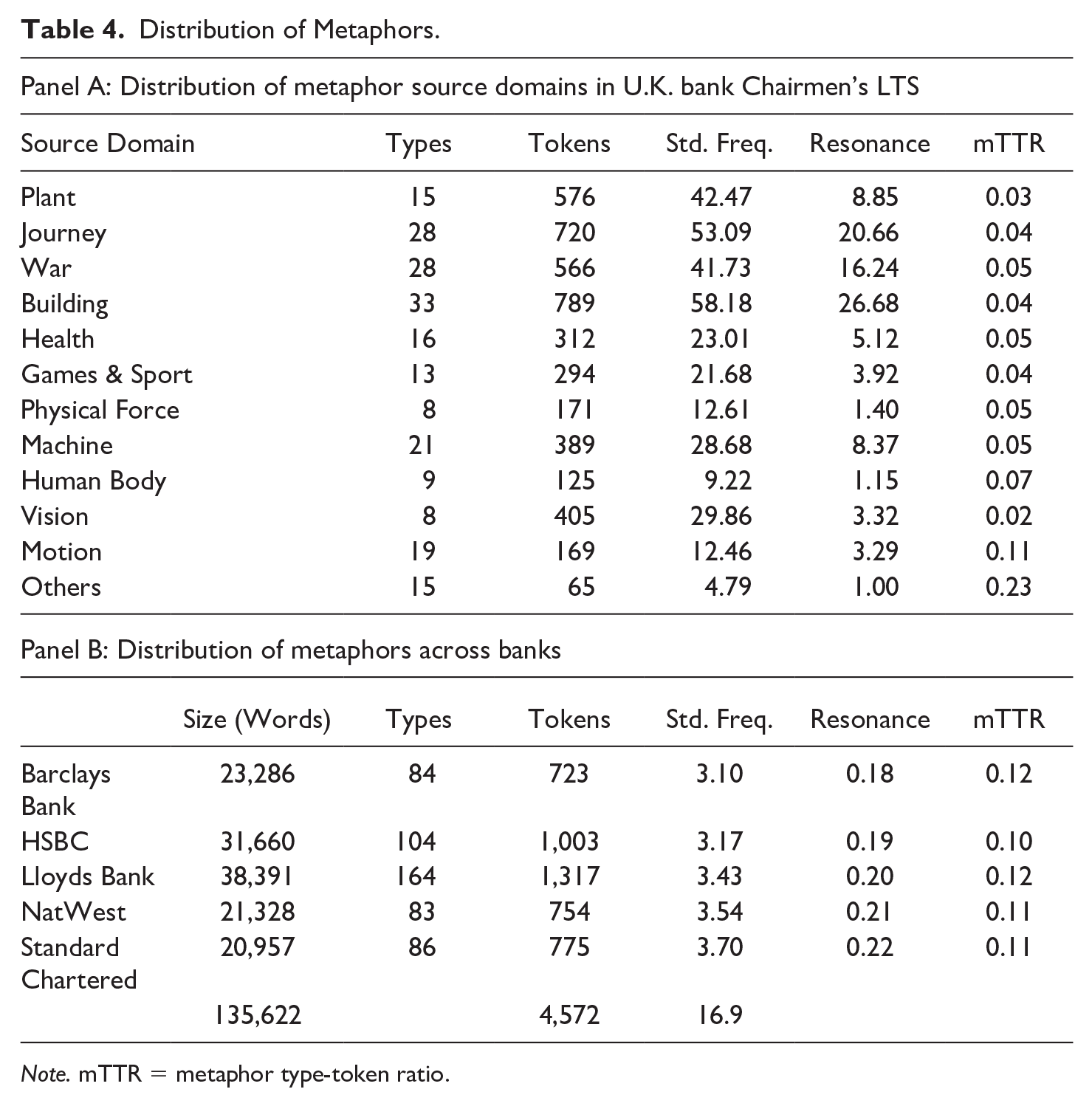
To answer our first research question, we present evidence on the manifestation and frequency of metaphors in chairmen’s LTS in Table 4. Panel A of the table shows the number of lexical units (types) and words (tokens) instantiated as metaphors. To gauge and compare the productivity of each source domain, we calculated two measures: standardized frequency and resonance. Standardized frequency is the number of tokens per 10,000 words and accounts for the variation of the number of tokens across subperiods and LTS. Resonance, the product of types and tokens for each source domain, indicates the productivity of metaphorical source domains in a corpus (Charteris-Black, 2004, p. 89). We express this variable as a percentage of total resonance.
Distribution of Metaphors.
Note. mTTR = metaphor type-token ratio.
Panel A also shows that in terms of frequency, the five most productive domains over the study period were Building, Journey, Plant, War, and Vision, with standardized frequencies of 58.18, 53.01, 42.47, 41.73, and 29.86, respectively. However, regarding resonance, Building, Journey, War, Plant, and Machine are the most productive source domains with resonance percentages of 26.68%, 20.65%, 16.24%, 8.85%, and 8.37%, respectively. Other prominent source domains include Health, Games and Sports, Physical Force, and Motion. There are also less productive source domains, including Natural force, Animal, Natural, and Weather, which we grouped as “Others”, especially for statistical analysis that comes up later.
In addition, the number of metaphor types varies across source domains. If we further divide the number of metaphor types for each source domain by the respective number of tokens, we arrive at the metaphor type-token ratio (mTTR), which measures how varied the source domain is regarding metaphors (Koller, 2004, p. 249). Given the same number of tokens, the more metaphoric types there are, the higher the mTTR and the more metaphor variation the source domain is. Apart from the “Others” source domain, the MOTION source domain is more diverse regarding mTTR. This may not be surprising as it combines different forms of physical movement: land, air, and water. Thus, although Building is the most productive source domain concerning frequency and resonance compared to MOTION, it exhibits more repetitions of metaphor types, suggesting lower lexical diversity. Evidence in Table 5 also points to variation in type, token, resonance, and mTTR across the different contextual environments of the study.
Distribution of Metaphor Source Domains Across Contextual Environments.

To gauge the contribution of each sampled bank to the productivity of metaphors, Panel B of Table 4 shows the distribution of metaphor types, tokens, standardized frequency, resonance, and mTTR across banks. Lloyds Banks produces the richest metaphors, at least in three metrics (types, tokens, and mTTR), with relatively high standard frequency and resonance values.
The Association Between Source Domains and Contextual Environment
To understand whether there was any difference in the use of metaphors during different contextual environments specified in this study, we compared the data in the subperiods in two ways: First, we compared using the relative frequency of metaphors. Second, we conducted a chi-square test of the association between the use of metaphors and contextual environment (Pre-crisis, Crisis, and COVID-19); we tested whether the observed cell frequencies (or joint probabilities) of the metaphors in our corpus are significantly different from expected frequencies under the null hypothesis that the use of metaphors is independent of the contextual environment.
Table 6 presents the cross-tabulation for the relative frequencies for the source domains–economic environment. The results suggest that the observed frequencies deviate from the expected frequencies. The chi-square test indicates a statistically significant association between source domains and contextual environment (chi-square = 473.73, df = 22, p value < 0.001). However, given a Cramer’s V coefficient of 0.189 (correlation coefficient = 0.04), this association seems weak (small).
Chi-Square Test of Association Between Source Domains and Contextual Environments.

Note. Figures in bold are statistically significant.
We further investigate which pairs of relationships contribute to this overall significant relationship. For this, we also present the adjusted standardized residuals, which measure the degree of deviation of the observed frequencies from the expected frequencies; the higher the adjusted standardized residuals, the more significant the deviation of a source domain is from what may be expected by chance, adjusted for sample size. A critical value of more than 1.96 indicates that the observed frequency is significantly larger than expected at the conventional level of 5% (Field, 2024).
To mitigate the risk of committing the Type 1 error, we calculated the p value associated with each standardized residual and compared this to the Bonferroni corrected p value of 0.0014 (0.05/36), assuming a significant level of 5%. After the Bonferroni correction, the relationship was only statistically significant for the Building and Plant metaphors. For example, we find statistically significant relationships between the Building metaphor and pre-crisis (adjusted standardized residual = −4.848, p value < 0.001), crisis (adjusted standardized residual = 6.040, p value < 0.001), and COVID-19 (adjusted standardized residual = −2.828, p value < 0.001). Conversely, we report a statistically insignificant deviation for Machine, War, Games and Sports, Human Body, Vision, and Motion metaphors, while we find mixed results for Health and Physical Force. 3
Interpretive Analysis
Koller (2002, p. 192), citing Widdowson (2000, p. 9), notes that quantitative analysis (corpus linguistics) describes the text, not the discourse. As variation in metaphorical use across different contextual environments may be a function of the communicative goal of chairmen’s LTS during different operating climates, we turn to the third and final research question: What is the pragmatic function of the identified metaphorical expressions/source domains, given the contextual environment of banks? While the conclusions we draw from the interpretive analysis regarding the pragmatic role of metaphors are similar but contextual, in line with the approach in the literature to avoid redundancy, we focus on the Building metaphor.
For this purpose, we selected the LTS written by the chairmen of Lloyds Bank for interpretive analysis. Our choice of Lloyds Bank is motivated by many factors. First, since metaphors are unevenly distributed across firms and contextual environments, Lloyd Bank provides a sample of LTS with the richest metaphors, measured in terms of types, frequency, and mTTR (Panel B of Table 4). Second, as metaphors are rarely relied on their own right (Charteris-Black, 2004, p. 61), Lloyds Bank’s LTS are also relatively rich in the use of ethical and evaluative words, which not only contribute to the rhetorical coherence of the letters but also help in explaining the pragmatic function of the metaphors. Finally, as reported in Section 4, the Building metaphor is the most productive source domain and explains a significant portion of the observed relationship between source domains and contextual environments.
Unsurprisingly, we find evidence of the conventional Building metaphor in the LTS authored during the crisis, as represented in the following sample excerpts.
This was, is, and will continue to be, a bank focused on customers’ needs and During my years as Chairman, we have done a great deal to The Group is now profitable, with a strong balance sheet and solid prudential foundations on which to
Excerpt 1 headlines the 2013 LTS and appears in the body of the letter, suggesting a deliberate use of the Building (building) and Vision (focused) metaphors as a pragmatic and rhetorical strategy during a challenging period in the bank’s history and the banking industry. This is consistent with the finding that Building metaphors carry positive undertones (Musolff, 2004).
The Building metaphor indicates a positive representation of the bank—a form of legitimization strategy during a crisis. The chairman of Lloyds Bank conceptualizes the bank’s relationships with stakeholders as an active, concrete, and deliberate process that requires attention, effort, and resources, including time. The phrase “lasting relationships” further highlights the purposefulness, resilience, permanence, and stability of the building (relationships) and indicates that this is not a one-time activity but, as with all lasting relationships and buildings, an ongoing commitment that is continually maintained, renovated, and reinforced to ensure they remain strong, stable, and functional.
Perhaps contradicting the assertion that “this was, is and will continue to be a bank focused on customers’ needs,” in Excerpt 2, the Chairman indirectly acknowledges a building that requires a rebuild of two of the damaged pillars—customer trust and colleague pride—an allusion to two social objectives that are fundamental to the bank’s reputation as a socially responsible corporate citizen. This finding supports a similar conclusion in similar studies suggesting that firms use LTS to persuade stakeholders to trust them (e.g., Palmer-Silveira & Ruiz-Garrido, 2014).
In Excerpt 3, the chairman asserts that the bank possesses the solid and robust resources for the building and rebuilding, including a profitable bank, strong balance sheet, and prudent foundation. Just as a building needs a strong foundation and careful construction to stand the test of time, relationships need a solid basis of trust, communication, and mutual respect. The Building metaphor deployed by the chairman suggests that the bank has laid these fundamental elements in place to ensure enduring customer relationships.
It is important to note that in none of the sampled excerpts was the social agent responsible for damaging the building (relationship) named or acknowledged—there is no linguistic evidence indicating the management of the banks is responsible for the financial crisis or the PPI scandal. This is an excellent example of how metaphors highlight desired aspects of the source domain while hiding social agents and undesired (negative) entailments to persuade the audience.
Although the metaphorical expressions encapsulated in the chairman’s use of Building metaphors are conventional, the motivation for using metaphors in the LTS is not neutral. The Building metaphor performs a pragmatic role of positively evaluating the bank’s process of repairing damaged stakeholder relationships by drawing on the construction and building source domain. The concrete source domain of building is mapped onto the target domain of bank-stakeholder relationships. Deployed in the context of the PPI scandal and financial crises, the chairman invites readers (stakeholders) to give the bank a “second chance.” We argue that the dominant conceptual metaphor during the Crisis period is (BANKING) RELATIONSHIPS ARE BUILDINGS, which carries the mini-narrative (undertone) that the bank is an expert builder.
The pre-crisis period also draws on the Building source domain, as seen in the following excerpts.
I am delighted to be able to report that the Group has delivered another strong performance— All of these businesses are focused on better meeting the needs of all our customers and ensuring that Lloyds TSB is a bank that continues to During 2006 we performed strongly throughout the Group but, equally importantly, each division continues to
The deployment of the conventional Building metaphor during the pre-crisis period supports the finding that the source domain of building is pervasive, as initially reported in this study. As with the image projected during the crisis period, the bank chairman positively evaluated Lloyds Bank as a builder—a social goal that resonates with society, particularly the readers of the LTS. However, a further examination of the collocations of the Building metaphor keywords points to similarities and differences in the communication function of the Building metaphor compared to the crisis period. For example, while the crisis period highlights trust and pride, the pre-crisis period highlights performance and franchise. Both periods, however, emphasize customer relationship and growth as the building blocks of success.
Robin Budenberg, the author of Lloyds Bank’s 2020 LTS, noted that the pandemic offered “a unique opportunity for banks to evidence their importance to customers and the economy.” As we argued in Section 3, the pandemic also provides a unique opportunity for banks to consolidate their legitimization strategy using language. For example, compared to other LTS by Lloyds Bank, the 2020 LTS contains the highest number of ethical words, including commitment, inclusion, and empathy.
Regarding metaphors, as with the pre-COVID-19 periods, the Building source domain metaphor also resonates throughout the LTS. However, the persuasive impact of this metaphor lies firmly in its use with the Health metaphor, as we see in the excerpts below: Our unique position allows us to Help Britain Given significant investment and transformation in recent years we are well positioned with strong Helping Britain We will help Britain
The deployment of Health metaphors, including keywords such as recovery, suggests a sick nation (“sick building”) whose mental, physical, and financial well-being has been impacted by the COVID-19 pandemic. The bank positions itself as a helper in a challenging medical situation. The text achieves its affective goal by drawing on the emotive word heart from the Human Body source domain (Excerpt 9). Thus, the health of Britain is central to Lloyds Bank. Just as help is needed to help the body rebuild after a chronic illness, Lloyds Bank is offering to help build (Excerpt 8) and rebuild (Excerpt 9), including providing solid foundations (Excerpt 9) to support (Excerpt 8) and protect customers, colleagues, and businesses.
In all the cases we examined, the Building metaphor plays a clear, persuasive role as it maps an abstract problem, social goal, or objective—for example, relationships, trust, and pride—with a familiar concrete concept (building). The more readers/stakeholders feel that the metaphor helps them understand the abstract, the easier it is for their attitudes to align with the implications of the metaphor in the chairmen’s LTS (Landau & Keefer, 2015). In addition to the (BANKING) RELATIONSHIPS ARE BUILDINGS conceptual metaphor that is evident in both the pre-crisis and crisis periods, the bank chairman seems to rely on the SICK BUILDING syndrome and the ECONOMY IS AN ORGANISM conceptual metaphor.
Conclusion
Previous studies have investigated the deployment of language, including metaphors, in financial reporting. The current study broadens this topical issue by looking at metaphors used in the LTS by U.K. bank chairmen. Our investigation is contextualized on banks’ operating environment from 2002 to 2022, featuring relative bank stability, financial crisis, and the coronavirus pandemic.
In analyzing the association between observed source domains and banks’ contextual environments, we find a significant relationship between banks’ contextual environments and the frequencies of observed source domains. However, the relationship seems small and is mainly driven by Plant source domains and, to a lesser extent, Building, Journey, Health, and Physical Force source domains. We also uncover the persuasive use of metaphors in LTS, giving credence to the idea that this genre of corporate communication serves both communication and impression (persuasion) functions. However, the patient (target) and social goal of persuasion depend on the contextual environment in which the banks operate. For example, while metaphorical expression during the financial crisis period focused on building trust, pride, and reputation, during COVID-19, bank chairmen were more concerned with building the financial and mental health of the nation.
The article contributes to the study and pragmatic use of metaphors, particularly in business and corporate communication. First, while there have been studies on the use of metaphor in financial reporting, studies on bank chairmen’s LTS are scarce and are often limited to the United States. We provide evidence on the main source domains employed in this genre, thus helping to characterize the potential cognitive and pragmatic functions of LTS. In addition, by showing the association between the metaphor source domain in use and the contextual environment of banks, our study gives credence to the context-sensitive nature of metaphor, revealing the underlying use of metaphor as a persuasion tool. Furthermore, this study contributes by building a corpus of bank chairmen’s LTS, thus creating a tailor-made database for studying metaphorical language in chairmen’s letters.
In addition, this paper’s results on metaphor usage in U.K. banks’ chairman letters point out how business communication teaching and company training sessions could stress metaphor as a key tool in leadership communication. By showing how metaphors are chosen to mirror and sway public views—like describing relationships as “building,” health and economic crises as “sickness,” and subsequent recovery as “healing”—the research indicates that company leaders adjust their language based on the situation, which can mold trust and make an organization seem more legitimate. Putting these ideas into practice during training can give future leaders a better grasp of how metaphors can sway people in tough times. Teaching might zero in on showing students and professionals how to pick metaphors that match their big-picture plans, highlight good values, and maybe play down any bad connections. Companies could then build on this by looking at how to use metaphors in different types of messages. This would help leaders create words that click with key stakeholders, adjust to tricky situations, and back up efforts to fix the company’s image. This training could also boost skills for talking during crises, letting leaders use metaphors to show they care even in times of crisis.
Finally, we acknowledge the general limitations of metaphor analysis, including whether metaphor use is deliberate or nondeliberate (Steen et al., 2010) and the subjective interpretation of metaphor entailments.
Footnotes
Declaration of Conflicting Interests
The author declared no potential conflicts of interest with respect to the research, authorship, and/or publication of this article.
Funding
The author received no financial support for the research, authorship, and/or publication of this article.
