




Abstract
Employee disclosure refers to the process of revealing personal information about oneself with others in a workplace setting. This type of disclosure also greatly influences organizational culture, policies, and workplace interactions. Modeling such disclosure scenarios using an organizational economics approach addresses communication challenges faced by businesses dealing with the respective disclosure(s). Further, it allows for uncovering the most effective ways to communicate disclosure procedures and policies to employees and employers. This, in turn, will lead to (a) improved corporate training practices for employee disclosure in business communication settings and (b) increased overall productivity measures for organizational members.
Introduction
It has become apparent, in recent years, that contemporary organizational design is becoming more responsive and adaptive to ongoing pressing societal challenges. With that said, in many instances, the actions taken by organizations to handle social issues are not the most effective for all parties involved (Dmytriyev et al., 2021; Eilert & Nappier Cherup, 2020). This can be because recent social issues coming to the forefront are complex in nature and require careful deliberations from those in decision-making positions within organizations. It is also the case that those in decision-making roles have significant time constraints, lack of expertise in the specific area, and pressure from external stakeholders, which can all negatively impact decision-making quality (Joseph & Gaba, 2020). Moreover, many organizations in developed countries have implemented technology and certain algorithms to replace HR processes (Leicht-Deobald et al., 2019), which has also contributed to issues when making responsive change to pressing social demands.
From this study, the focus is to target, and model, organizational challenges that arise with respect to a specific social issue that has seen increase in prevalence over the last number of years. A pressing social issue, as we see it today, is stigmatization toward individuals who fall into specific social groups or have certain social identities. This study will look specifically at those social identities that are classified as nonvisible or “invisible.” Invisible social identities cover a wide range of areas, but a large majority consist of disabilities (mental illness, neurodiversity, etc.), sexual orientation, and religious affiliations (Clair et al., 2005; Kang & Bodenhausen, 2015; Newheiser & Barreto, 2014; Olkin et al., 2019). Those who have stigmatized invisible social identities face many challenges in the workplace because of their identities (Joachim & Acorn, 2000; Mullins & Preyde, 2013; Santuzzi & Waltz, 2016; Santuzzi et al., 2014). One challenge is whether to tell others in the workplace about their invisible identity or not. This is also known as employee disclosure. Employee disclosure can be described as the act of an employee sharing personal information with others that may affect their workplace environment (Eldor & Vigoda-Gadot, 2017; Lee & Queenie Li, 2020; Von Schrader et al., 2014). To define disclosure more precisely, it is agreed to be when one verbally communicates to someone else about the said identity (Derlega et al., 1993), or can reveal their social identity through behaviors and certain nonverbal actions (Jourard, 1971). In the case of a self-disclosure, the underlying process involves the individual, with the invisible condition, to make a purposeful decision to undergo disclosing the condition to someone else. It should be noted that in each instance of disclosure within this context, the individual intended to disclose their identity to others within the organization. It should also be noted, however, that there are many different, unintended, ways that employers can find out about an invisible identity (or vice-versa) as well. For example, an employer can be notified about an employee’s invisible identity through other coworkers within the organization, other distance social networks, friends or family, and other unwanted situations (Cantarero et al., 2019). Regardless of if one’s identity is communicated through verbal, nonverbal, intended, or unintended fashion, there is a response that will be triggered throughout the organization.
The aim of this study is to transform business communication practices and corporate training to better align employees’ and employers’ knowledge in the topic of invisible social identity disclosure in the workplace. To achieve this, an organizational economics approach is deployed as a basis for modeling organizations’ responses to employee disclosure. Two specific subtopics of organizational economics, transaction-cost economics (TCE) and incentives/contracts, are utilized to better understand how organizations can best respond to disclosure dilemmas from their employees or employers. Three unique scenarios of employee disclosure are modeled. These three scenarios shed light on the different social contexts that one may find themselves in when it comes to a workplace disclosure decision.
As mentioned, there has been a sharp increase in prevalence of invisible social identities around the globe. In fact, according to the World Health Organization (WHO), there has been as much as a 25% increase in mental health conditions since the COVID-19 pandemic (World Health Organization, 2022a). Other invisible identities such has diversity in sexual orientation and religious affiliations/beliefs have also been on the rise in prior years. Religious beliefs have a clear rich past, with events taking place in many different geographic regions worldwide. Sexual orientation has also shifted in paradigm as of recent times but has a clear long history as well. In fact, Bullough and Bullough (1997) conducted an in-depth, comprehensive, review of sexual orientation ideals and research history dating from 1880 until 1980 (Bullough & Bullough, 1997). It is such that the thought of possessing an invisible social identity has been present, and relevant in society, for a long period of time. In fact, with regard to mental disorders, it was around 150 years ago, in the late 1800s, that two German psychiatrists—Kraepelin and Alzheimer—were developing methods to identify neurological causes of disease in some of their patients (Surís et al., 2016). This was used, mainly, to separate diseases such as dementia from other psychiatric illnesses on the basis of biological indicators. As we know today, there are a wide range of mental disorders that cover categories more than just what was progressed in the late 1800s and even the mid- to late 1900s. Moreover, it is also said that mental disorders are continuing to be on the rise, in prevalence, on a global level (World Health Organization, 2022b). Owing to global increases in prevalence of all sorts of invisible social identities among individuals, it will call for greater demand in coping with certain complex social situations.
Having suitable business communication practices, as well as increased targeted corporate training programs, within an organization’s human resources (HR) department will ultimately help to remedy the problems areas that were just mentioned. Moreover, with all staff within an organization being properly equipped with the right tools, and knowledge, through learning from business communication practices, and corporate training, the number of ongoing potential issues from having employees who identity in having an invisible identity will be minimized. This study will aid in achieving these aims by using a unique methodology. Integrating the concept of organizational economics will provide the ongoing framework, within the study, to look at the complex social dynamics that arise for those who have an invisible identity within the workplace.
This topic is important to be studied from an organizational economics approach for several reasons. Generally speaking, a key reason for its importance is due to the underlying economic systems, and political order, that is ever present in many global countries today. From this notion, it can be said that organizations are a product of the capitalist economic system that we find ourselves in, and this creates common underlying practices and decision making among the majority of organizations (George, 2014; Simon, 1991). To go one step further, organizations, from a historical context, have been originated in an effort for those in positions of power to have a greater form of control over resources of various kinds (Clegg, 1981). From these system structures that are in place, it is important to study, and thus model, the response to an employee disclosure from an organizational economics perspective. Given that each organization is unique in nature depending on factors such as size, industry, geographic area, and more, studying the decision making and responses of disclosure in the workplace from an organizational economics approach allows for capturing this information for most organizations in society .
Aims of the study, from integrating an organizational economics approach, are to enhance employee engagement, decrease turnover, and improve decision making for personnel within organizations. This, in part, can be completed by improving business communication and teaching practices within HR departments, which ultimately will increase productivity for respective businesses (Kalogiannidis, 2020). Another aspect that businesses can leverage are targeted corporate training programs (or sessions) that are focused, again, on fostering a more inclusive, supportive, and accommodating workplace by using what is learned through integrating an organizational economics approach to this topic. Like the notion of business communication and teaching practices, investment in corporate training practices will ultimately see increases to businesses’ overall productivity measures. Prior literature has also supported this notion (Clampitt & Downs, 1993; Litterst & Eyo, 1982; Okoro & Washington, 2012). There are, of course, some investments in corporate training practices that may see decreases to the overall productivity of the respective organization. This will have to do, in large part, to how targeted (or niche) the investment decision is. Essentially, it can be said that the more tailored, niche, and targeted the investment is for corporate training practices, the better off that firm will be after the respective investment.
Literature Review and Theoretical Framework
Regarding the structure of the following literature review, it is broken down into three main components or subsections. First, looking at the topic of employee disclosure; second, the topic of organizational economics; and third, focusing on the integration of both topics. With that said, providing an overview of employee disclosure and organizational economics will consist of discussion about key concepts and principles of each, and then looking at the application of the approach to human resources and organizational behavior for both concepts. Key concepts and principles within employee disclosure and organizational economics are plentiful, but the review will focus on a few that are most related to the premise of this article.
Looking at employee disclosure, for those with stigmatized identities, specifically, shows vast prior literature and research undertaken in the area. There have been many qualitative research studies undertaken (Chang, 2021; Gewurtz et al., 2022; Gould et al., 2022; Headey & Wearing, 1989; Kattari et al., 2018; Kulkarni, 2022; Marshall et al., 2020; Spiegel et al., 2016) as well as a range of quantitative studies in the similar topic area (Ellison et al., 2003; Konrad et al., 2012, 2013; Santuzzi & Waltz, 2016). One specific study, conducted by Kulkarni (2022), notes that recent literature on the topic of disclosure, and in particular disability disclosure, in the workplace focuses on three main theories to guide the body of work: social identity theory (1982), stigma theory (1963), and self-verification theory (1983) (Kulkarni, 2022). This study also investigates some of the societal structures and organizational factors such as nondiscrimination policies, availability of accommodation, and employee assistance programs, among others, that end up affecting the disclosure process for individuals.
What is talked about less throughout many of these studies looking at disclosure in the workplace are the actual, concrete, responses made by those who are at the other end of the disclosure (employers, in many cases). In fact, after conducting a thorough review of identity disclosure in the workplace, there was scant prior literature around this topic. That being said, there are two more recent papers (Li & Lee, 2023; White et al., 2023) that do give a contextual basis for employers’ response to such a disclosure in the workplace. I will briefly talk about the scope, and some key points, of each article.
Li and Lee (2023) use a socioecological model (SEM) approach to model the responses of organizations’ personnel from an employee disclosure situation. Within this SEM approach, there are three levels (individual, interpersonal, and organizational) that are all interrelated, and give emphasis to each subsequential level (Li & Lee, 2023). Essentially, the model used in the Li and Lee study suggests that employee disclosure is a decision that involves many facets, including the likes of individual, relationship, and sociocultural factors. Examples of these factors include, but are not limited to, individual characteristics, perceived consequences of disclosure, relationship quality, social norms, and cultural attitudes. Again, the main premise of the article is that this issue should be studied not from a single level but rather a multilevel perspective in order to give a most well-rounded, accurate, depiction of employee disclosure and the resulting responses by employers (Li & Lee, 2023). With that said, there are no clear findings that give suggestions or guidance on business communication, or corporate training practices, to improve organizational settings with regard to the ongoing burdens that those with nonvisible identities face.
Next, it is illustrated from the White et al. (2023) article that certain contextual factors are also important when it comes employers’ responses to disclosure. This article, however, looks closely into the perceptions and views from employees after getting news of a response from the employer – rather than modeling employers’ responses to such disclosures in the workplace. The paper also only focuses on those who possess a serious mental illness (SMI), instead of looking at many types of invisible social identities. In the paper, the authors conducted 40 semi-structured interviews with current or former employees in daily working jobs (White et al., 2023). The authors found that five main disclosure context patterns arose after undertaking conventional content analysis to the qualitative data which were collected. These five emerging patterns were as follows: seeking job accommodations, seeking protection, seeking understanding, responding to an employer’s symptom-based inquiry, and being exposed to a third party or event (White et al., 2023). In other words, these five patterns are what the authors found to be the rationale as to why employees would seek to disclose their identities to employers within a respective organization. Subsequently, there were responses undertaken by employers that were positive, negative, or ambiguous in nature. The authors investigated how the employer’s responses interacted with each of the five patterns, and if there were unique findings depending on the combination of pattern, and response, they were studying. This article by White et al. gives further insights into how employers who possess an invisible social identity seem to routinely respond to disclosure in the workplace. What it does not cover, however, are insights into clear organizational responses, or best practices to take, from such disclosures.
The following review of organizational economics is composed of looking at key concepts and principles within the topic, as well as its application to human resources and organizational behavior. For the context of this article, I will be touching on two specific concepts from organizational economics. The rationale as to why these two specific theories are best to integrate within this current work is twofold. One justification is that in both chosen concepts, there are important features, and theoretical underpinnings, that can be used to extend our understanding of organizational responses to the disclosure of invisible social identities. Second, given that prior literature surrounding the topic of organizations’ responses to identity disclosure is limited to (a) views from the employees themselves and (b) from an ecology theoretical foundation/model, it thus gives justification for incorporating an organizational economics foundation to look at such responses. The two main theories that will be discussed as a basis for the conceptual model in the article are TCE and incentives/contracts. Within each of the concepts exists much scholarly research (Ahluwalia et al., 2020; Ashraf & Bandiera, 2018; Athey & Roberts, 2001; Barney & Ouchi, 1986; Cuypers et al., 2021; Gibbons, 1998; Kaplan & Henderson, 2005; Shahab & Lades, 2021), which has helped shaped the concept to be what we see it as today. In fact, many of these original, pioneering, studies that brought fruition and attention to both transaction-cost economics and incentives/contracts have evolved, through new scholars extending their thoughts, over the last number of years. This evolution of the field has given more unique viewpoints on organizational issues in today’s complex business space. Next, I will give further background into the two branches as well as discuss the important integration these concepts have as it pertains to employee disclosure.
First, TCE has origins of related research dating back to the time before the formal concept was constructed as its own. In fact, as early as the 1930s there were notions of transaction being the basic unit of economic analysis, and this thought was advanced by John R. Commons in the year 1934 (O. E. Williamson, 1981). To put it generally, the primary purpose of TCE is to explain why transactions in certain institutional arrangements operate with different degrees of efficiency (Yang et al., 2012). This concept relates to looking at employee disclosure in many different aspects, for example, leveraging TCE to better understand how or why certain employees have greater difficulty than others when it comes to workplace disclosure. While one employee may reveal personal health information to a close friend they work with, another could disclose to a manager, and both would see different effects to their overall satisfaction levels as a result. Using TCE principles to aid in modeling these employer responses will enhance clarity and cohesion to improved business communication and/or corporate training practices within the topic area. With that being said, the TCE approaches to study organizational phenomena has typically been difficult to become a true dominating paradigm, in large part, because of the lack of verbal definitions (Barney & Ouchi, 1986). There has, however, been recent studies undertaken that have implemented a TCE approach as the main framework throughout their research (Ahluwalia et al., 2020; Ketokivi & Mahoney, 2020). These more recent studies have tied TCE approaches to supply chain management disciplines (Ketokivi & Mahoney, 2020), as well as in blockchain and start-up financing (Ahluwalia et al., 2020). Essentially, from both studies, the authors mention the organizational economics is now gaining more traction because of seeing a rise in more interdisciplinary work (Ahluwalia et al., 2020; Ketokivi & Mahoney, 2020). In fact, the use of TCE theory for the purposes of identity disclosure within organizations is quite interdisciplinary. Other past research has also used a wide variety of frameworks that have been interdisciplinary in nature to look at the topic of disclosure (Follmer et al., 2020; Hastuti & Timming, 2021). This shows that studying employee disclosure in organizations, and the responses undertaken by employers, can be looked at from a multitude of angles. The types of disciplines could include, but are not limited to, the fields of psychology, economics, sociology, ethics, management, and disability studies. The TCE approach tries to understand the ways governance structures and transactions can be organized in a way to improve each involved party’s situation (O. E. Williamson, 1981). As noted, this can be particularly useful in modeling organizational disclosure.
The second branch of organizational economics, incentives and contracts, is deemed to be important in understanding certain motives and decision-making processes (Kaplan & Henderson, 2005; Kocher & Sutter, 2006; Stone & Ziebart, 1995). Incentives are a key component of organizational economics that sometimes get overlooked as a result of the other known theories and frameworks within the discipline. Nonetheless, when it comes to incentives and contracts, the main economic perspective is quite straightforward. With that said, however, there is great messiness and ambiguity when translating the economics perspective into the reality of a complex organization faced with uncertainty and technological advancements (Kaplan & Henderson, 2005). It can generally be concluded that contract structures, with wages being included as incentives, differ depending on several factors. Such factors may include the employee’s professional or educational experience, firm size, the seniority of the employee, the division or department of the organization that the employee falls into, and more (Ashraf & Bandiera, 2018). There is also a set of literature that tends to focus more specifically at the decision-making processes for individuals, depending on the contracts, and thus incentives, that are in place for the said employee within the organization (Athey & Roberts, 2001; Gibbons, 1998; James, 2000; Milgrom & Roberts, 1988). A common theme from this stream of literature finds that both the structure of the contract in place, as well as some of the personal characteristics of the individual in the organization, have influence over the behavioral actions that take place. It is such that using principles from the subfield of incentives/contracts proves to be useful when focusing on modeling employee disclosure.
Each of the TCEs and the incentives/contracts within organizations both play an important role when it comes to disclosure. Specifically, incentives have the ability to play a pivotal role when it comes to corporate training practices and/or policy formulation within an organization (Hopkins, 2016). An example related to employee disclosure, incentives, and corporate training practices can be looked at from the individual employees’ stance on whether to disclose their condition (or not) to others. If incentives are outlined as part of the organization’s policy regarding identity disclosure, then the said employee may very well be inclined to go ahead and disclose the identity to their employer(s). In other words, the employee may be thinking internally about the costs and benefits of disclosing their identity in the workplace. If the incentive placed by the organization is too low, then the employee will choose to conceal their identity. On the other hand, if the incentive set out by the organization is higher than what they evaluate to be beneficial, then they will indeed disclose their identity and see increases to their overall satisfaction levels.
After mentioning each branch separately, it needs to be noted, however, that the intersection between employee disclosure and organizational economics, although limited in volume, has compelling literature as well. Below I discuss an important study that gives insight into how principles of organizational economics influence the disclosure for individuals. This article contains insights into how organizational economics topics have a clear impact for employee disclosure—on a multitude of levels. The 2004 article by Myers and Johnson looks, in detail, at how different peer relationships exist within organizations and what resulting disclosure decisions may stem from these such relationships. For example, from their study, Myers and Johnson group types of organizational peer relationships into three kinds: information peers, collegial peers, and special peers. Information peers’ purpose behind an interaction is to share information with a coworker. The information peer provides information about the organization and work-related tasks but provides little emotional support or feedback. The collegial peer relationship is marked by a moderate level of closeness, communication that is more intimate than communication in the information peer relationship, and friendship between coworkers begins to develop. The third type is the special peer, in which the primary purpose behind interaction is to engage in social confirmation, provide emotional support and personal feedback, and serve as a friend. The special peer relationship has the highest level of closeness and is the most intimate of the three types of peer relationships (Myers & Johnson, 2004). Results from their study interestingly showed that organizational disclosure was highest with the information peers’ group, compared with that of the other two. Organizational economics concepts are touched on, and intergrated, throughout. This study shows great opportunity for greater investigation into understanding how both TCE and incentives/contracts can play an important role in influencing organizational responses to employee disclosure.
From this review, it conveys that (a) there are multiple common social contexts in which disclosure decision-making processes can take place within an organization, and (b) both TCE and incentives/contracts can aid in modeling the responses taken by employers in these situations. To that end, unique scenarios will be explored in the following sections. Each will be explored through the lens of organizational economics as a baseline for the responsive decision being made by the organizational personnel, or employer(s).
Methodology and Model Application
Introduction to Methodology
Throughout the study, at the broad level, the methodology relates to organizational theory and related frameworks. The study employs a specific organizational theory topic, that being organizational economics, to give a solid base in understanding, conceptualizing, and modeling organizations’ responses to disclosure in the workplace. In terms of the specific branches of the organizational economics topic, both TCE and incentives/contracts are chosen to give greater clarity regarding responses undertaken by organizations. The rationale for choosing to utilize organizational economics theory with respect to this specific research question is that it provides a unique framework to enhance business communication, corporate training practices, and overall firm productivity for complex business problems in society. Further, by using an organizational economics approach, it allows for a more comprehensive grasp of the research problem. From this, it provides greater generalizable findings, affords validity to the study, and finally allows for sufficient replication.
Overall objectives that the present study aims to achieve are to understand the certain phenomena of employee disclosure and how these decisions impact businesses around the globe. Further, an aim is to integrate, and define, concepts related to the topics of organizational economics, employee disclosure, and organizational responses. Identifying key variables and looking further at how they are related to both unique employee disclosure settings and how organizations react to said disclosures is another goal of the present study. Lastly, a major objective of the study is to provide concrete, practical, implications of the theoretical framework for all relevant stakeholders (such as practitioners) surrounding the topic.
Design
In this article, the framework’s intent is to remedy any gaps within existing theories from employee disclosure and organizational responses to a disclosure to best serve their businesses. As a result of distinct economic systems that individuals from many developed countries around the world work in, several basic underlying decision-making structures are present in the organizations based in those regions. An organizational economics approach is one that implies both the employees and employers of an organization are acting and making decisions that (a) increase their personal utility measures based off of rational (bounded) (March, 1978; Simon, 1986) behaviors, and (b) attempt to increase their organization’s value, or market share, among competitors—all while noting the gaps in control from hierarchical organizational structures (Simon, 1991). Following from the work of scholars contributing to organizational economics (such as Oliver Williamson, Kathleen Eisenhardt, Herbert Simon, and more), as well as literature surrounding disability (or social identity) disclosure in the workplace, this article proposes unique insights using contextual constructs to shape the model.
From the present study, the proposed framework addresses the limitation of current models by integrating elements of organizational economics, such as firm structure and market performance, with individual, micro, factors like stigmatization and employee accommodations. From this integration, three propositions were derived for the study:
Proposition 1: Employee self-disclosure positively influences satisfaction levels to the highest degree.
Proposition 2: Employee disclosure in the form of other person(s) negatively influences satisfaction levels to the highest degree.
Proposition 3: Employee disclosure resulting from a nonverbal cue influences satisfaction levels to an extent between Proposition 1 and Proposition 2.
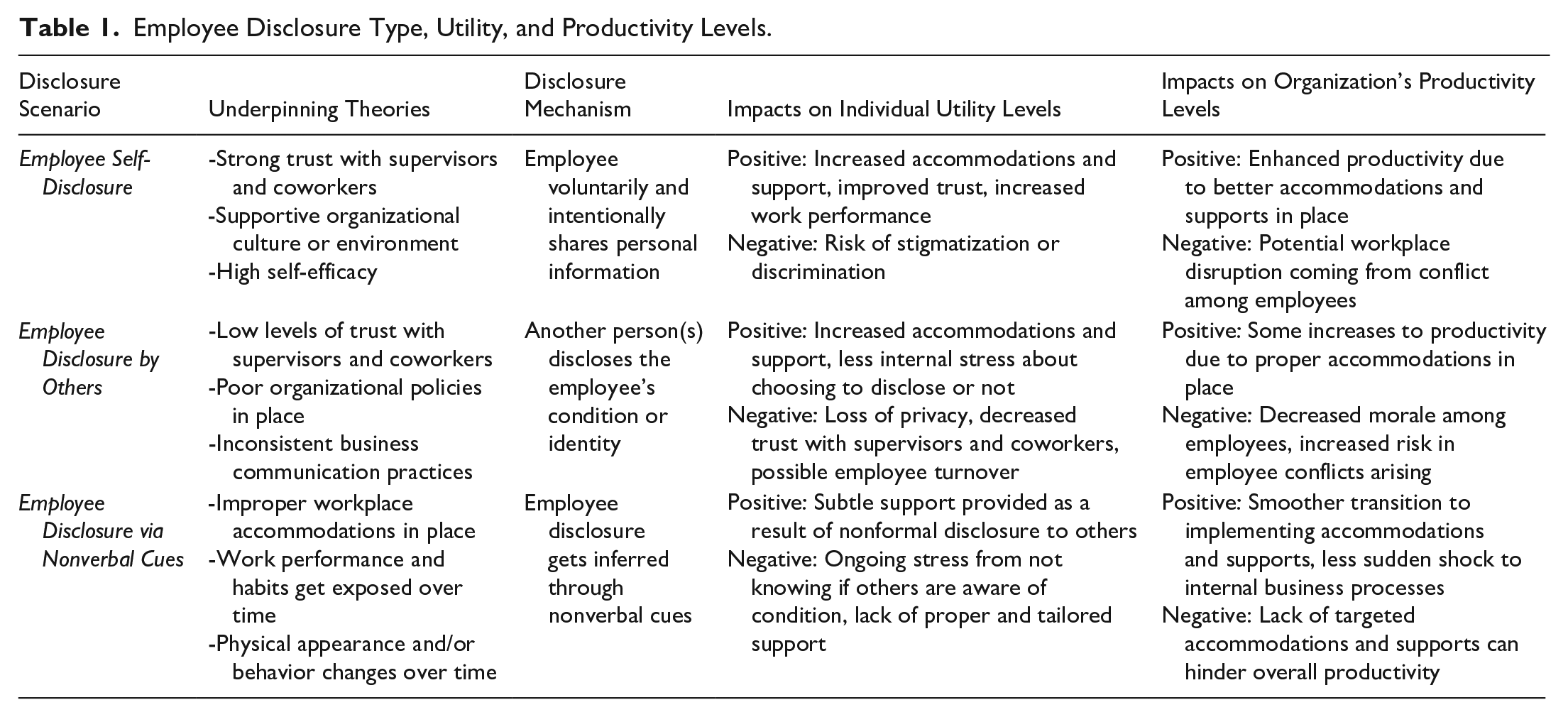
The relationship between common types of employee disclosure, employee responses to each type of disclosure, and the impacts to individual utility as a result, can be seen both from the model description subsection as well as in Table 1. In essence, each contextual setting of an employee disclosure to their organization will see a different level of satisfaction (utility) as a result in disclosing. Further, the model includes certain feedback loops that reiterate that organizational responses to disclosure can positively influence overall firm productivity.
Employee Disclosure Type, Utility, and Productivity Levels.
Model Description
The theoretical basis for this study stems from concepts related to both TCE and incentives/contracts. First, with respect to TCE, there are concepts such as asset specificity and transaction costs that are strongly related to an employee disclosure. Asset specificity and disclosure are incorporated in a way that the disclosure undertaken by the employee can be said to be a certain strategic “investment.” Further, the investment decision to disclose is one that is highly irreversible. This means that once an employee uses asset specificity and strategic choices to disclose at a certain time, this choice is then set and cannot be undone (Cuypers et al., 2021; Shahab & Lades, 2021). Second, transaction costs are also strongly related to the notion of employee disclosure. There are many transaction costs that an employee can undertake when preparing for a disclosure decision in the workplace. These costs include, but are not limited to, search and information costs, bargaining costs, and enforcement costs. In essence, each employee with a said invisible social identity (and who is considering disclosing their identity) will take on gathering as much information, by conducting searches, to decide whether disclosing is indeed beneficial or not. Using organizational economics processes—if the benefit is greater than the cost to disclose, then the said employee will go ahead and do so; on the other hand, if the employee foresees greater costs than benefits, then they will choose to conceal their identity for a longer period or wait until the situation and dynamics change.
Incentives/contracts also play an important role in the theoretical basis for the study. Both financial and nonfinancial incentives can be integrated through business communications to help entice more employees to disclose their identity in the workplace. Examples of financial incentives by the organization to disclose include offering bonuses or additional compensation for those employees who choose to disclose. Additionally, this can be a part of the written contract that an employee is offered for their role with the business. An example of nonfinancial incentives to disclose is guaranteeing workplace accommodations, such as modified duties, for individuals. When it comes to contracts, and how they relate to employee disclosure, several angles can be explored. One is that contracts for the firm can include a disclosure clause that could require employees to disclose specific conditions that would affect the organization. Another aspect related to contracts, and this type of workplace situation, is to include nondisclosure agreements (NDAs) for the protection of confidential information. In these cases, the employer is obligated to maintain confidentiality and provide ongoing support for those who disclose.
Regarding the model, several specifications exist. These include different equations, variables, and parameters that set up the base of exploration. From a combination of prior ideas in organizational economics, as well as behavioral assumptions of modeling identity disclosure in the workplace, the model consists of three unique scenarios of employee disclosure. Depending on how an invisible social identity gets disclosed will, in turn, affect the said utility of the individual whose identity is now known (Marshall et al., 2020; Ragins, 2008; R. L. Williamson et al., 2017). It is not in every instance that invisible social identities are disclosed from the person who has the invisible identity (self-disclosure). In some cases, the identity can be disclosed in an unwarranted way, such as by others who know about the identity or through some type of nonverbal communication cue that may disclose the identity (Ignatius & Kokkonen, 2007; Jourard, 1971; Rossman et al., 2017). It is with this in mind that the model considers the three unique cases of invisible identity disclosure in the workplace undertaken by employees. The first case of disclosure in the workplace is through self-disclosure, second being that of other person(s) (other than the employer) who know about the identity, and the third case being a nonverbal cue that ends up disclosing the identity. By extending the formulations brought forward by the employee disclosure literature, and to incorporate an organizational economics approach, we can begin to visualize a framework for understanding both the employee’s rationale into choosing to disclose (or not) as well as the response undertaken by organizations.
To model organizations’ response to all three cases, key equations, variables, and parameters are to be defined. It should also be noted that the unit of analysis for this model is at the individual, worker, level. To represent the utility of the employee, I will be using the notation u(ED). Furthermore, the coefficients of
The model represents an organization’s response to each case by using slightly differing variables and notation. The unit of analysis of responses are at the organization, firm, or group level. To model the organization’s response to such disclosure, a notable Cobb Douglas production function of a firm is incorporated to give a base for the decision-making structure for the organization (Bond et al., 2021). The Cobb Douglas production function is an economic concept that has been widely tested empirically (Douglas, 1976; Meeusen & Van Den Broeck, 1977) and one that gives accurate representations, to a degree, of firm output and production levels. The following notations are used in modeling the organizations’ output:
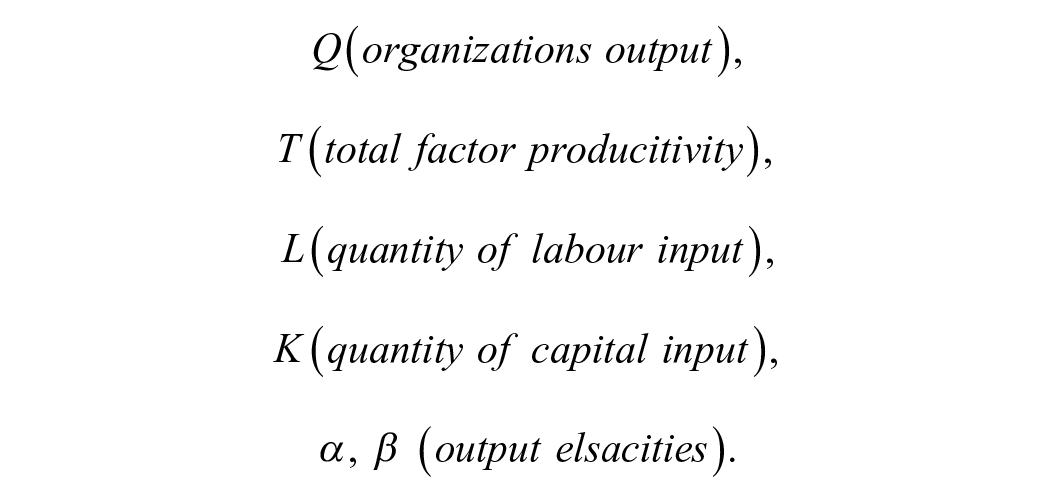
The Cobb Douglass production function equation follows as

where the total productivity factor is being multiplied together with the quantity of labor and the quantity of capital to get the desired output results. In essence, this equation is the underlying base for looking at the response of the organization from the unique view of the three scenarios that will be considered. Depending on the disclosure scenario, there will be different responses undertaken by the organization. Different responses can impact keeping the same, or increasing, the amount of output (denoted by equation (1)).
The equation representing the said individual’s utility is as follows:

where, due to each type of disclosure, we can assume specifics to the weighting of each variable. More contextual organizational responses will be discussed in the following sections.
Application of the Model
Appling both of equations (1) and (2) to the three different contextual disclosure situations give insights into possible responses taken by organizations to best remedy the employee disclosure. To that end, all the variables introduced can see specific impacts. In Scenario 1, the employee could see a slightly negative impact towards privacy value due to having a higher value before the disclosure. Job performance—given that there are sufficient workplace accommodations and/or corporate training practices in place—may have an associated positive weight. Social interactions—now that the individual has disclosed—could see either a negative or positive associated weight to the variable. The workplace accommodation variable is a constant throughout all three situations, as we are assumed to be considering the same level of accommodations (or same organization) for all employees for each scenario.
In Scenario 2, the employee in the organization has their identity disclosure to the employer through other persons. To clarify the terminology of “other persons,” this refers to others in the organization (excluding the employer or the HR department) who have knowledge of the condition of the employee with the said identity. Privacy can see negative impacts from the personal information of the identity not being disclosed in a self-warranted fashion. Job performance, given that there are sufficient workplace accommodations, may have an associated positive weight—given that the employer now knows from other person(s) in the organization that the individual indeed has a certain identity. Social interactions, from the disclosure coming from others, may see a negative associated weight to the variable. In other words, there will be disruptions to many social relationships because of the information being leaked to the employer from other employee(s). Finally in Scenario 3, the employee in the organization has their identity disclosed to the employer through a nonverbal cue. Privacy can see negative impacts from the personal information of the identity not being disclosed in a self-warranted fashion. Job performance, given that there are sufficient workplace accommodations as in the other scenarios, may have an associated positive or negative weight. Job performance will be either negative or positive because of the uncertainty of the employer going ahead and treating the nonverbal cue as something they need to deal with internally. In other words, the nonverbal cue may not necessarily warrant the use of workplace accommodations for the employee (for a few different reasons). Social interactions from the disclosure coming from a nonverbal cue could see either a negative or positive associated weight to the variable as well.
Ethical Considerations
Because of the very nature of the topic of invisible identity disclosure and organizations, ethical considerations need to be carefully thought about. Some ethical components to consider include, but are not limited to, confidentiality, nondiscrimination and equality, cultural sensitivity, legal compliance, and psychological safety. All these aspects are important to think about in their own respect. For example, depending on the country, or even district, that the model is being implemented in, there will be certain laws and regulations that would apply. These same regulations may not apply in a different geographic region, for example. This is important to know beforehand to ensure that all the ethical guidelines set by professional organizations and regulatory bodies are followed. Another vital ethical consideration is to incorporate corporate training practices that are inclusive to all employees—regardless of the type of background or cultural identity they may possess. For example, there are significant personal differences among respective cultures.
Results
Based off the model application, and the conclusions that followed, it gives multiple confirmations for the three propositions outlined in the methodology section. It can be seen, from using the model, that positive impacts to utility levels are at the highest degree for scenarios involving employee self-disclosure. Subsequently, the impacts to individual utility are worst for those in a scenario where other person(s) disclose the identity, and the middle ground for those who have their identity disclosed from a nonverbal cue. Results also illustrate that many different motivations, or rationales, can exist for an individual to go ahead and disclose their invisible identity. Some examples can include personal, organizational, or relational, factors.
In Table 1, results are organized to give insights into how each disclosure scenario can ultimately impact both (a) the individual utility levels and (b) the total productivity levels for organizations. To summarize the findings, from modeling the responses of organizations to a disclosure in the workplace, Table 1 shows that the results can greatly differ depending on the type of disclosure that takes place. When there is a self-disclosure of an identity that takes place within the organization, this is deemed to be the “best” case scenario for the firm, from an organizational economics approach lens (compared with the other two scenarios studied). It can be the best case for the organization because of the individual’s satisfaction being greatest from the decision, and thus translating to a higher total productivity factor as well. On the other hand, when there is a disclosure taking place either by other person(s) telling the employer about it, or if there is a nonverbal cue that leads to a disclosure of the condition to the employer, there can be increased costs for the organization. These two scenarios may make the organization “worse-off” regarding overall economic circumstances and output levels. Moreover, the responses taken by the organization will differ depending on the type of disclosure that takes place within it as well.
From these results, it gives justifications to incorporate, and be certain of, proper corporate training practices for businesses. Moreover, organizations will want to adopt transparent corporate training practices to see positive returns to the training programs, and thus have the greatest increase to the firms’ output levels. There are many unique cases and social contexts that are present in these scenarios, but what have been discussed are just a few common themes for improvement based on our results. These themes can very well be implemented within business structures as well.
Discussion and Conclusion
In this section, the limitations of the proposed model will be discussed in detail, in addition to areas for future research and, finally, the important implications for organizational economics. There are several noteworthy limitations that come from the proposed modeling of the organization’s responses to employee identity disclosure. One notable limitation of the model is that it does not take into account the organization size, industry type, or overall structure, all of which can influence the response to such a disclosure decision by an employee within the organization. Another limitation of the model is that there are numerous real-world complexities that are not captured in the model. A few examples of such complexities can include the numerous other ways (other than the three scenarios focused on) that an identity can be disclosed in the workplace. These alternative disclosure methods could potentially be through a company survey, interactive workshop, or in a forced nature. Finally, the variables included in the model could be quite different in size for each individual/employee. For example, the utility levels of one employee who has a more subtle invisible identity compared to one who has a significant limiting identity will see differences to the variables mentioned (Patel et al., 2020), as well as to supports and accommodation. There is a lack of measurement of these constructs within the model in certain situations.
Apart from the limitations within the model itself, there are also some generalizability concerns that should be discussed. The main problem area, with respect to generalizability, for the modeling of the organizations’ response is the sheer uniqueness that each organization (on a global level) possesses in terms of many different factors (Ege et al., 2020). Simply put, the board of directors, or upper management, will almost always have different personnel within it—and thus have personnel with differing opinions when it comes to the best course of action to take after an employee decides (or not) to disclose their identity at work (Venugopal et al., 2020). It is thus difficult for the model to make complete generalizability claims.
When it comes to areas for future research, there are many new research streams to be undertaken in the general topic of identity disclosure in the workplace. In fact, particularly with disability prevalence on the rise globally (World Health Organization, 2022b), it is a very important topic area to gain further knowledge and research insights. One specific area for future research may be to indulge deeper into the underlying individual decision-making processes that exist for those who have an invisible social identity. Put differently, there is room for research into the rationale behind the timing, location, personnel, and more about how someone chooses to disclose their invisible identity.
With that said, there are also two proposed recommendations that organizations can take from the study to help remedy the possible incurred costs of an employee disclosure. The first recommendation is to create a strong line of dialogue between those in upper management positions and employees toward the bottom of the said hierarchy in the organization, with respect to the teaching of business communication. In other words, the amount of information asymmetry, related to teaching of business communication practices, among the members in the organization should be minimized (Bergh et al., 2019; Dawson et al., 2010). By doing so, the burden of dealing with the negative consequences from a disclosure from other persons would be less likely to take place. In essence, having all members of the organization on the same page in terms of the business communication teaching that is in place will enhance the organization’s response to an identity disclosure. There will also be less tendency to keep information from others, and secrecy and other forms of deception will be limited (Eisenhardt, 1989). These factors will contribute to the overall increases in productivity for the respective firm. A second recommendation is for organizations to adopt very seamless, and transparent, corporate training practices. For example, there could be brainstorming sessions put on within the organization, on a biweekly basis, where refinements to corporate training practices are the key points of discussion. In doing so it can significantly mitigate the risk of detrimental disclosure events taking place in future scenarios. An adaptive HR policy, such as a pre disclosure form, may help achieve both higher productivity and risk mitigation. While it is known that these policies do exist in some organizations and even geographic areas, it is not the case for all organizations in either developed or even developing countries as well. These types of policies can be considered at all levels in where it is feasible to do so.
Lastly, it is important to mention that results from this article can build pathways to meaningful research in other similar topic areas. There are vast amounts of pressing social issues at the forefront for business practice today. For example, some may include reducing racial barriers in hiring (Carter, 2020; Quillian & Midtbøen, 2021), increasing minority groups being in leadership positions (Coe et al., 2020; Shore & Chung, 2022) and having sufficient accommodations for employees with disabilities (Crampton & Hodge, 2003; Gates, 2000; Konrad et al., 2013). From the modeling in this article, results can also shed light into the importance of adaptive HR policy initiatives as well as the importance of proper and sufficient workplace accommodations for those who need them. In total, there are great opportunities to study further into the area of invisible social identity disclosure processes, and responses, in the workplace. It is to that end where we need researchers, policy makers, and community partners, to work in synergy to improve the well-being for those living with invisible social identities.
Footnotes
Declaration of Conflicting Interests
The author declared no potential conflicts of interest with respect to the research, authorship, and/or publication of this article.
Funding
The author received no financial support for the research, authorship, and/or publication of this article.
