



Abstract
Few studies to date examined the emotional unrest that results from communication across cultures in multinational teams (MNTs). Through examination of 12 in-depth interviews and a focus group of respondents from MNTs, this study investigates the impact of language-induced emotions in MNTs resulting from a corporate language mandate. Even with highly proficient linguists, MNTs still experience collaborative difficulties caused by language differences and associated emotions. Issues identified include loss of information, ambiguity over equivalence of meaning, variability in sociolinguistic competence, and problems of adjustment to cultural norms. The research also pinpointed several lingua-culturally adaptive behavioral strategies relating to international leadership.
Introduction
In a global environment, organizations are becoming increasingly diverse in relation to culture and language. Language diversity of the employees, combined with varying social contexts in which groups and teams operate, makes the understanding of intercultural interaction a vital prerequisite for success.
A comparison of nationally based, mono-cultural teams with multinational teams (MNTs) has shown that both types of teams face similar procedural and interpersonal challenges (Behfar et al., 2006). A multinational team (MNT), as defined by Snow et al. (1996, p. 32), “entails differences among members in language, interpersonal styles, and a host of other factors. Such differences can create a balance (cohesion and unity) or an imbalance (subgroup dominance, member exclusion, and other undesirable outcomes), depending on how they are handled.” The necessity to communicate, to share knowledge, network, and build relationships are all essential challenges for most companies and are all dependent on how language is used (Holden, 2002, cited in Horn et al., 2020).
Existing literature on international business (IB) language-sensitive studies highlights the increasing level of research interest into language diversity in MNTs. Our article focuses primarily on the few studies that have either directly or indirectly recognized the impact of language diversity on the emotions of MNT members and its consequences. Global organizations require such teams to perform at their best (Butler, 2011) by enjoying the rewards of diversity while avoiding potential pitfalls (Stahl et al., 2010).
MNTs typically operate virtually across time zones and frequently require use of a common language. However, under closer examination, how good is their communication and how does this language mandate impact the emotions of the team members? Emotions act as key drivers for motivation by prompting bursts of energy to elicit action (Izard, 1993). Both motivation and emotion stem from the same Latin root “movere,” meaning to move. In view of this, the study focuses on deepening our understanding of the impact of emotions within the multilingual context of MNTs.
To achieve this, it is important to first consider the role of the corporate language and that of MNTs as well as the research contributions made to date.
The role of a corporate language in international business
The area of language diversity in IB has only come to the fore over the last three decades and continues to develop as a field of inquiry (Tietze & Piekkari, 2020). It has been alluded to as “the most neglected field in management” (Reeves & Wright, 1996, backcover) or “the forgotten factor” (Marschan et al., 1997, p. 591). Indeed, there is still much to discover about the role of language in multinational corporations (MNCs). As Maclean (2006, p. 1377) appropriately points out, “Companies deal with language challenges every day. They cope, the world continues to turn. How they do so, however, remains largely absent from the literature.” Since this highly pertinent statement, scholars focused on the role of the corporate language and how it related to other languages (Angouri, 2014; Janssens & Steyaert, 2014). Furthermore, language-based research has started to examine a view of language that is more related to social practice, and this research has focused on the context of headquarters-subsidiary relations (Barner-Rasmussen & Aarnio, 2011; Barner-Rasmussen & Björkman, 2005; Björkman & Piekkari, 2009; Harzing & Feely, 2008; Harzing & Pudelko, 2014; Harzing et al., 2011; Luo & Shenkar, 2017). As highlighted in their review of recent studies, Karhunen et al. (2018) state that meaning is created by taking actions in the world, and analysis needs to focus on how such actions are enabled or constrained in multilingual contexts through the distinct uses of language within groups with different social practices.
Unsupported multilingualism in exchanging information cross-border can lead to countless problems, such as critical exchanges and misunderstandings, culminating in lengthy discussion as well as lost revenues that affect the bottom line (T. B. Neeley & Kaplan, 2014). The problems arising when English is used for cross-border communication are highlighted in a recently published book focused on communication strategies of Chinese and French businesses. Tréguer-Felten (2018) describes how speakers of good English often fail in their communication because of their own culturally embedded communication strategies. In this sense, English becomes a synthetic outer wrapper of culturally led acts of communication. The consequence of proper communication becomes an illusion of true success.
The Vital Role of Multinational Teams
MNTs typically communicate via the corporate language, usually English, which can lead to differences in language proficiency levels between native speakers (NSs) and non-native speakers (NNSs) (Li et al., 2019). When the pressure and strain to communicate in a foreign language is felt by employees, depending on the context, negative emotions bubble up and shape their capacity for action and so can impact performance. Up until now, research into the area of MNTs and how their leaders manage the emotions induced by differing proficiency levels in the corporate language is limited (Ayoko & Konrad, 2012; T. B. Neeley et al., 2012; Tenzer & Pudelko, 2015). Those that have researched the area of IB look more at the challenges of working in a cross-cultural context and the inherent leadership challenges (House et al., 2004) or the cultural differences in how emotions are expressed (Mesquita & Albert, 2007; Wang et al., 2020). Therefore, before embarking on our study, it is important to examine the most pertinent findings to date in the context of IB as well as the role of MNTs.
The Emotional Impact of Language Barriers
Instead of defining emotions as properties of the mind, emotions should be situated at the interface between mind and context and are both navigated and informed by social context. Cross-cultural research into emotions suggests that emotions align closely with cultural models of self and relationships and therefore emotions draw from cultural models in creating reality (Wierzbicka, 1999). Therefore, by incorporating social context into the definition, emotion is not separate from culture but aligned with it (Mesquita, 2007).
Similarly, language can be interpreted through a number of different lenses according to culture and values (Stadler, 2018). To date, scholars have tended to focus on cultural differences in relation to team management. While culture does play a role in relation to language, the specific language elements and their impact on emotions within the team have been omitted (Harzing & Feely, 2008; Holden, 1987; Marschan-Piekkari et al., 1999; Wang et al., 2020; Welch et al., 2005). This is because of the general assumption that English is accepted everywhere as the language of business. Furthermore, in view of the fact that language has been regarded in IB literature as a minor problem that can be solved by a corporate language, translators, translation software, and linguistically competent employees (Welch et al., 2005), there has been little cross-fertilization of ideas between disciplines, and this might explain the lack of research in language (Harzing & Feely, 2008).
Peltokorpi and Clausen (2010), in their exploration into the causes and consequences of cultural and linguistic barriers between the Nordic regions and Japan, maintain that language and cultural values have different consequences in intercultural communication. They encapsulated this into three reasons: First, a shared working language does not guarantee perfect understanding because cultural values establish themselves through language usage and communication styles tend to create obstacles to receiving and decoding the message effectively (J. K. Henderson, 2005; von Glinow et al., 2004). The diversity of language does not only allude to the variety of different mother tongues but also to people hearing in different ways as their different mechanisms for interpretation make sense of the information received. The second reason emphasizes a second-language speaker’s reluctance to speak up. Indeed, it has been found that very often this results in fewer ideas being contributed, less active roles undertaken, and subjects difficult to express being ignored (Corder, 1983). Third, language barriers often form socially divisive constructs, stronger than cultural values because of the functional and psychological barriers they impose on social interaction (Giles & Johnson, 1981; Harzing & Feely, 2008).
Indeed, this appears a commonly held approach. Voss et al. (2014) also endorse this in their case study focused on MNT work in Luxembourg. The authors highlight the anxiety caused by misunderstandings due to language proficiency; it can even impact coordination within the team (Lauring & Selmer, 2010; Tenzer et al., 2021). Communication style frequently differs between team members according to their cultural background; some cultures prefer a more direct, others a more indirect, implicit approach to communication and this, too, can contribute to misunderstandings and conflicts. Despite multinationals adopting corporate languages for communication at work, other languages are often used in informal situations between coworkers (Lauring & Selmer, 2010). Hence, employees prefer to communicate with those with whom they identify and feel comfortable with. Again, this often leads to in and out groups, creating a culture of exclusion—the them and us scenario. Similar situations leading to the formation of silos can also start out when lower-proficiency speakers, searching for words, briefly switch to their native language during meetings to ease their anxiety. Such instances of code-switching are often deemed as “annoying, rude and disrespectful” (Vigier & Spencer-Oatey, 2017, p. 24) and can cause negativity in others because they feel excluded from the conversations they do not understand (Aichhorn & Puck, 2017; Hinds et al., 2014; Tenzer & Pudelko, 2015). This has also been termed “linguistic ostracism” by Dotan-Eliaz et al. (2009).
These few studies have made important contributions in bringing the emotional impact of language barriers to the fore. The studies emphasize the important challenge of ambiguity and misunderstandings but fail to observe any of the properties that govern conversation or the importance of establishing speaker meaning. Understanding the cultural and linguistic influences on team affective states is a key to building a cohesive team climate (Tenzer & Pudelko, 2020). These aspects are amplified in the case of language barriers apparent in speech. This study addresses this gap by examining the distinct complexities of language and drawing on them in the findings. Hence, we arrive at our first research question: How does the emotional impact of mixed proficiency levels in the corporate language manifest itself in MNTs?
By investigating the emotional responses triggered through communicating in a foreign language, several contributing factors are likely to be uncovered. The concept of speaker intention and speaker meaning (sociopragmatics) is particularly prevalent in cross-lingual communication. Although some previous studies in the IB context give a cursory mention (Aichhorn & Puck, 2017; Tenzer & Pudelko, 2015), most authors do not consider the challenges of speaker intention and the key differences in the conventions of conversation: the conscious choices made by individuals in speech, the key constituents required in order to make conversation a success, the conversational manoeuvres marked by signals of direction that result in anxiety and ambiguity. All of these challenges become amplified through differences in language and culture and culminate in language barriers that elicit emotions. This essential new component feeds into and informs the research we conducted in this study where we explore in depth how language barriers elicit emotions, the challenges of which the respondents are aware and how these can be diminished.
Aims of This Study
Contrary to earlier studies in IB, which highlight anxiety and frustration as a result of lack of proficiency in the corporate language (Dragojevic et al., 2017; Harzing & Feely, 2008; T. B. Neeley et al., 2012; Roessel et al., 2019), our study builds on extant research by analyzing the elicitation of emotions through cross-cultural interactional (pragmatic) meaning, drawing on the disciplines of linguistics and psychology. Our second research question is, What are the potential challenges that arise for MNTs and what strategies do they apply to address them?
It investigates how communication can only succeed when the emotional impact of different ethnographies embedded in the speakers’ utterances is taken into consideration. This includes the context (and challenges) surrounding the interpersonal communication and the ethnocentric bias of the speaker’s native language. An added factor to be examined is the language proficiency level of the sector. With reference to the EF English Proficiency Index (cited by Tran & Burman, 2016), our study examines the extent to which respondents from an industry sector with a higher proficiency level in the corporate language experience emotional responses to speaking a corporate language at work. The information technology sector is a different sector to the one highlighted in the previous study by Tenzer and Pudelko (2015) where the focus was on large automotive organizations based in Germany. The teams consisted of consultants, where communication skills are an integral part of their service offering and where, particularly in Information Technology, much of the terminology has been generated in English and shared globally (Ehrenreich, 2010).
Materials and Methods
Given the lack of research into the impact of different linguistic proficiency levels on emotions in MNTs, it was decided that a qualitative, exploratory, and inductive approach would be the most appropriate. Without any preconceived ideas about the emotional challenges of multilingual settings, it allowed us to listen and learn from the research participants’ subjective perceptions based on 12 semistructured interviews with two MNTs and the views of the focus group composed of MNT members from different multinational organizations from the same sector.
The purpose of the focus group was to triangulate the results from the interviews. The focus group discussion tabled questions that explored further the research questions and resultant key themes highlighted in the interviews. A comparison could therefore be drawn between the responses from the individual semistructured interviews with the responses of a socially interacting group. Focus groups are frequently used in combination with other methods but not often acknowledged as part of a triangulation strategy (Caillaud & Flick, 2017).
By drawing on different perspectives or sources, it is possible to utilize different bearings to attain a correct position and validate the answers to the research questions (Valentine, 2005). They provide an additional, collective dimension to the perceptions of MNT members of speaking a common corporate language with different levels of language proficiency. Hence, in this study, the participants could discuss their opinions and experiences with other MNT members who share a similar working environment.
Conducting a focus group online brought many benefits to this study. The fact that most global MNTs operate virtually most of the time (Jarvenpaa & Leidner, 1999; Zander et al., 2012) meant that the participants were familiar with the medium of video conferencing (Zoom). The focus group was conducted in September 2020 amid the COVID restrictions and, at that time, would have made it extremely difficult to conduct this meeting face-to-face. In any event, for MNCs with globally dispersed MNTs, this is a familiar environment. Since then, the use of online focus groups is becoming increasingly popular as a research method (Gamhewage et al., 2022).
In selecting participants for the focus group, eight new respondents were sourced from the professional services sector, the same sector as for the semistructured interviews. As they were not all members of the same MNT, it was possible to gather a variety of viewpoints from different MNT perspectives to draw comparison with the results from the semistructured interviews.
Participant Selection and Data Collection
By using an inductive approach of the project, allowing the exploration of the how aspects (Pratt, 2009), participants were sourced who would provide a wealth of information at a personal level which fits perfectly with the aim of the study. Based on the EF English Proficiency Index (cited by Tran & Burman, 2016) professional services along with consulting and engineering sectors achieve the highest proficiency levels. Literature on language in International Business reveals that studies to date have focused on different industries with, according to the English Proficiency Index for Industries, potentially lower proficiency levels (EF English Proficiency Index, as cited by Tran & Burman, 2016). Tran and Burman (2016) also highlight that the larger the business, the greater the fluency levels. Our study investigates the impact on emotions of working with mixed proficiency levels and cultural differences among MNTs with a potentially higher command of the corporate language.
Personal experience of cross-border collaboration had confirmed the importance and relevance of cross-cultural and cross-lingual interaction and why communication impacts outcomes in teamwork. To source participants and raise awareness, a YouTube video was posted on LinkedIn (Weinzierl, 2018), highlighting salient points from published literature to date and the potential findings of the planned study. The research proposal attracted a significant level of interest, and leaders of MNTs working across language barriers/differences were approached.
For the semistructured interviews, two teams from two different global information technology corporations, both engaged in consultancy, showed a particular interest in participating.
As can be seen in Table 1 below, 12 research participants took part in the interviews—six from each of the global information technology companies. For the purposes of the study, the teams from the two multinational corporations (MNCs) are referred to as Tech 1 and Tech 2. Tech 1 participants were members of a global marketing team, specializing in the Industrial sector and part of a large information technology consulting firm, headquartered in the United States. Tech 2 participants were members of a global Design Thinking team also from a global information technology firm with headquarters in Germany and the United States.
Summary of Semistructured Interview Participants.
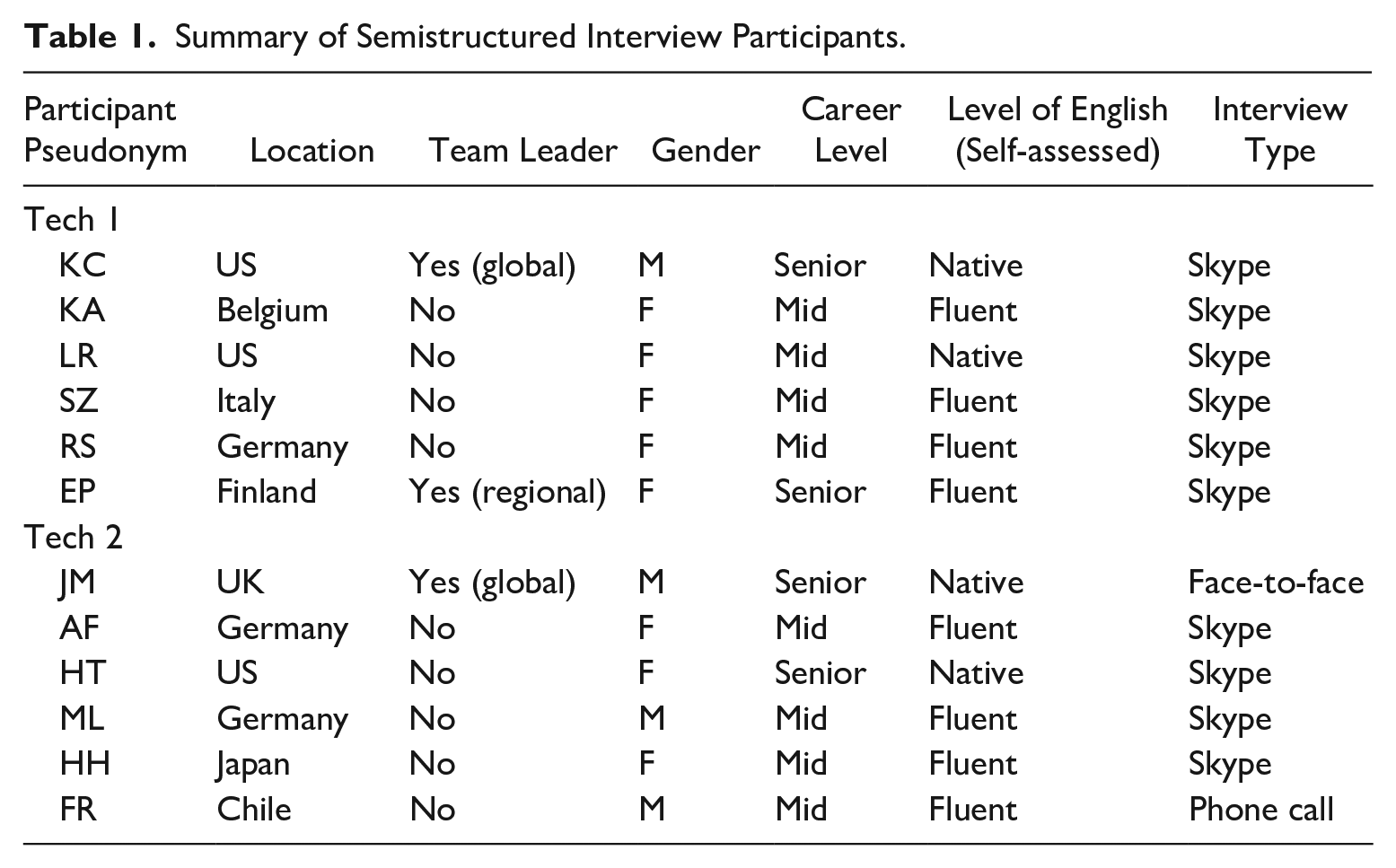
The interview participants were not only members of global teams that collaborated virtually, but also were members of their own local and regional teams. The participants comprised nine women and three men and were 75% midcareer and NSs of the company corporate language, English. The interviews lasted between 45 minutes and 100 minutes.
For both Tech 1 and Tech 2, the corporate language is English. However, locally, the team members communicate predominantly in their local languages (e.g., French, German, Italian, and Japanese). If participants were interviewed in their native languages, richer results might have been obtained. Talking about emotions is difficult at any time, but in a foreign language, it can be especially challenging (von Glinow et al., 2004). The use of a translator was considered but discounted as it might have detracted from building a rapport where the team members felt they could speak freely on a one-on-one basis. Hence, it was decided that the most expedient way was to conduct the interviews in English. The semistructured interviews took place between August 2018 and November 2018. The composition of the semistructured interviews sought to draw on some of the themes identified in the literature review and to gather material to answer the research questions. The questions were looking for critical incidents, experienced by the interviewees, and the specific triggers that elicited emotions from speaking the corporate language, English, in international team collaboration. The interviews focused on the matter of working with different levels of linguistic proficiency in the corporate language and cultural differences.
In selecting participants for the focus group, additional respondents from the professional services sector were approached, the same sector as for the interviews, and significant interest was shown from the respondents who volunteered. As they were not all members of the same MNT, based on their seniority levels and backgrounds, they were reflective of an equivalent global group, and it was therefore possible to gather a variety of viewpoints from different MNT perspectives to compare with the results from the interviews.
This method required collecting data from a purposefully chosen group of eight individuals rather than a statistically representative sample of a broader population. Table 2 shows the composition of the eight individuals who took part in the focus group.
Summary of Focus Group Participants.
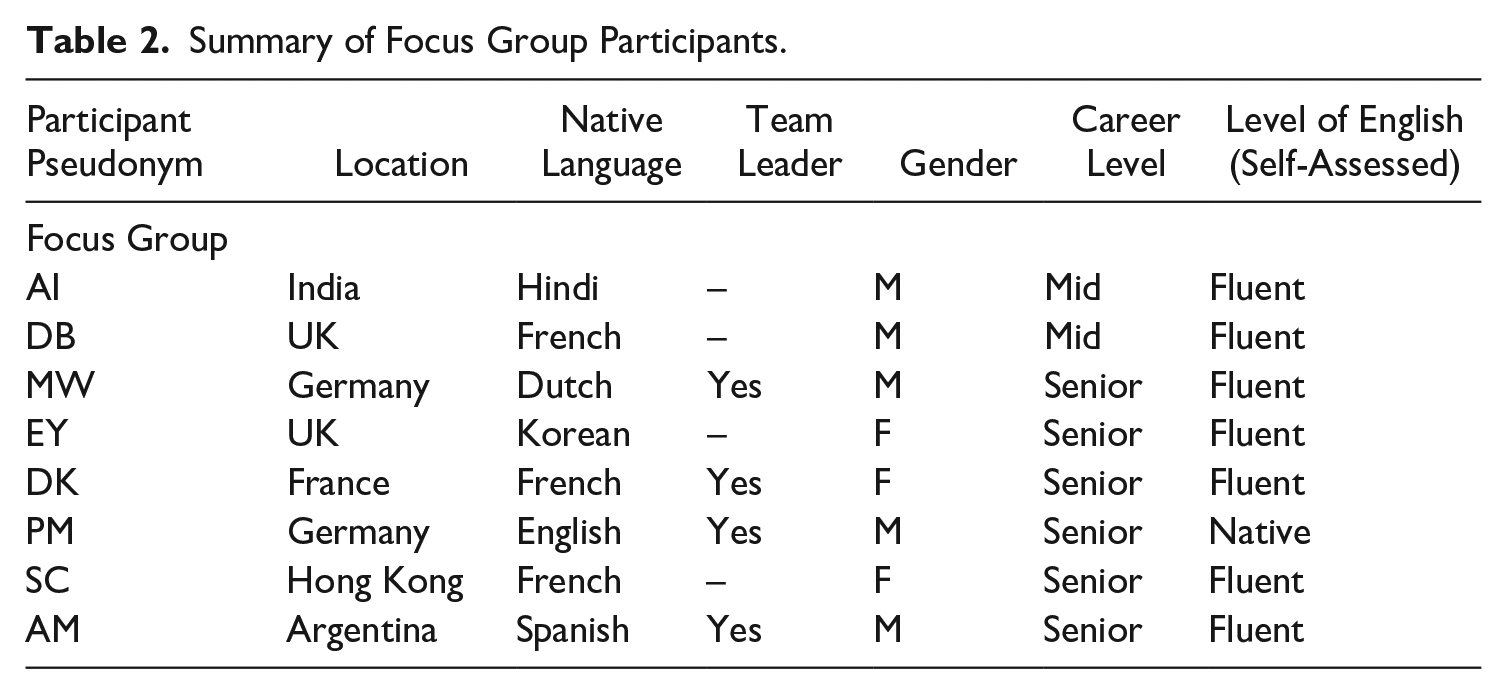
The respondents were situated in a variety of locations globally, as can be seen in the above table, and therefore the focus group was conducted via Zoom video conference and lasted 75 minutes. Participant information sheets were sent to each candidate so that they were prepared for what the process entailed. On agreeing to participate, each participant assessed their own level of proficiency in English (their corporate language). The understanding of fluency for this study will be that it indicates a smooth manner of speaking, calling up linguistic knowledge while under the pressure of near instantaneous processing (Lennon, 2000, cited in Foster, 2020).
Details of the questions asked in both the interviews and the focus group can be found in Appendix 1.
Data Analysis
The process of Thematic Analysis was used to analyze data for both studies as it allows the researcher to identify, report themes within the participants’ understanding, and to analyze patterns within the data (Braun & Clarke, 2006). The following process of analysis was followed. It should be stressed that the approach was highly iterative and reflective as it requires the researcher to move back and forward between phases:
Phase 1: Familiarization with the data. The researcher reread the responses of each interview candidate and the focus group respondent several times to become completely immersed in the content.
Phase 2: As a highly iterative activity, the coding process was conducted by hand. Doing it this way allowed the researchers to find commonalities and relationships in anticipation of generating themes.
Phase 3: In generating the initial themes, not only the frequency of the themes was considered but also the saliency of each individual code in its relevance to the research inquiry (Buetow, 2010). The data was collated into two tables according to its relevance to the research question.
Phase 4: Reviewing the themes: at this point, the themes were verified against the data set to determine whether they tell a convincing story and also one that answers the research question. This phase often requires the researcher to check back and forth several times as some themes often have a pattern of shared meaning supported by a central concept or idea.
Phase 5: Defining and naming themes: Here the researchers developed a detailed analysis of each theme, working out the scope and focus of the theme and required them to devise an informative name for each theme.
Phase 6: Writing up: During this phase, the researchers wove together the analytic narrative and data extracts to contextualize the analysis.
From the philosophical point of view, the inquiry for both studies adopts a critical realist approach as this best suits the nature of the two research methods conducted with the MNT members. Both the semistructured interviews and the focus group explored the assumed reality of the participants as they collaborate with their fellow MNT members both globally and locally by examining in detail their everyday experiences as they work across language barriers (Brönnimann, 2021). The reality perceived by the respondents through experience is multilayered and complex and as such can affect behavior (Fleetwood, 2005). This is reflected in how the research questions are addressed in the next section.
Trustworthiness and Reliability of the Study
Assuring the maximum level possible of quality and objectivity in qualitative research is now recognized as essential when validating knowledge creation (Ahmed Dunya et al., 2011, D’Cruz et al., 2007, Gerstl-Pepin & Patrizion, 2009).
To enhance the reliability of the analysis, a process of parallel coding and analysis took place with the research results. The two analysts worked separately to analyze, identify, and define initial themes to ensure the same or nearly the same results were obtained (Lincoln & Guba, 1985). Before embarking on the whole process of parallel coding, a leading expert in qualitative methodology verified the alignment of the coding approaches of the two analysts by reviewing a sample. On completion, the two analysts’ results were largely concurrent and, where initial agreement was not immediately present, this was resolved after a short discussion.
Results and Discussion
Research Question 1: How Does the Emotional Impact of Mixed Proficiency Levels in the Corporate Language Manifest Itself in MNTs?
Contrary to Tenzer and Pudelko’s (2015) study, where language and culture were separated, our findings revealed a tightly coupled relationship between language and cultural factors that culminate in three distinct areas that triggered emotions:
a. i. Emotional: The emotions elicited are either felt by the individuals themselves or at a distance, through observing others. ii. Cognitive: Feelings can be changed by altering the mode of thinking. iii. Practical: Practical measures are undertaken to allow for potential challenges.
For example, emotional accommodation was required and given by Interview Respondent HT as she saw her time slipping away when working with her multilingual team. She felt frustrated that she was delivering the training in English, and her course delegates needed extra time while they translated for each other, but also empathized with their situation.
On the one hand it can be a little frustrating, I have kind of a luxury that I don’t have to speak their language. . . . I feel that because they are working so hard to learn my language or speak my language . . . I think it takes some extra empathy. (HT)
There were several incidents both in the semistructured interviews and the focus group that triggered the accommodation of emotions. For example, Focus Group Respondent AI feels frustration at the misunderstanding with his Chinese supplier: And we said—but on the call you said OK—and that can be frustrating. Later we learn that in China it’s common to say OK and it means “I am hearing you,” but you still need confirmation. (AI)
Unlike previous IB language-sensitive studies (Mesquita & Albert, 2007; Tenzer & Pudelko, 2017; Wang et al., 2020), different types of accommodation in the face of language barriers have been identified after analysis of the interviews: emotional, cognitive, and practical. The anecdotal evidence illustrated that some form of accommodation was a key reaction to language barriers. It could be emotional or cognitive, or a practical measure to achieve successful collaboration. Practical measures could take the form of foresight in making practical arrangements to enable better understanding or simply allowing more time for clear translation. When such practical measures are not implemented, tension was liable to arise that could augment any latent emotions, such as stress or frustration, already present. Team leader Interview Respondent JM expressed annoyance at his own lack of foresight in adapting his plans to be able to listen to a conference call headed up by a team member from the Far East with a marked NNS accent. The background noise of driving in the car meant that he could not hear his colleague speaking clearly enough to follow the call to the extent of asking the questions he would have liked, and this caused him to feel annoyance.
It was annoyance really. I should have seen who was presenting and thought a bit deeper into it—rather than this is a call—I should have been more respectful to the person who was presenting and make sure I was in an office like this with a headset on. (JM)
b.
Of course it depends on the people as well but at work sometimes you can feel people turning silent in calls or do not answer questions. (DB)
This comment suggests that the silence could be due to a fear of loss of face, possibly as a consequence of poor proficiency level or cultural reasons. For example, in the Far East, team members do not speak up in front of their managers in collective meetings (Kitayama et al., 2004).
The respondents in the semistructured interviews also expressed how they experienced anxiety at presenting in the corporate language. For example, Respondent AF expressed feeling at a disadvantage when speaking in English formally in front of others.
For sure I feel the language differences. I always think I cannot make myself—I am not as eloquent as other people are and I always think that I cannot make myself as clear as I would in German. (AF)
As can be seen from these examples, these emotions were either felt by the individual themselves or felt by others observing the constraint in their colleagues.
Being muted and constrained by linguistic proficiency requires recognition from managers and colleagues alike in making practical arrangements in some form or being observant and mindful of others’ needs. To alleviate such pressures and be productive and successful, leaders need to create an open communication where all team members can express themselves both in writing, informally and vocally, and to manage time so that such arrangements do become integrated into MNT collaboration.
c.
An example from the semistructured interviews highlights this vividly. As part of her professional development, semistructured Respondent HH attends an international course at a German university. Although the course is attended by 90% German participants, 10% are non–German speaking and the course is titled “international”; therefore, the course content was expected to be conducted in English. Despite this, very often the course leader would start addressing the whole class in German, forgetting 10% of the participants who are non–German speaking. Respondent HH describes how she felt isolated by this but was reticent to cause a stir by coming forward to let the instructor know that she did not understand. Then one day, when this happened again, another member of the class put up their hand.
So I think it’s unfair that I didn’t say anything even though I felt uncomfortable. In this class, one Swedish girl finally expressed her feeling by saying—“What’s that?”—a little bit ground break! And finally, the instructor realized—aah—this is something offensive to foreigners . . . OK this is what we are talking about in German. And I was so amazed and somehow thankful to her . . . I was afraid to speak up. (HH)
Respondent HH was afraid to speak up herself for fear of loss of face. As a Japanese participant in the course, her cultural background reinforced this emotion significantly. Sitting there, she was not sure if all the other non-German participants did not understand—or was it just her? To put her hand up and openly state her inability to understand could mean serious embarrassment. She also acknowledges her frustration at her instructor in not recognizing this and acting earlier to maintain the class interaction in the agreed course language—English.
The ambiguity of reading and understanding true responses of others when communicating through different levels of language proficiency in the corporate language leads to significant insecurity and the forming of perceptions. Not only is the speaker communicating a message in translation but how that message lands and is understood by the other person in their own cultural context is completely different, as was stated by Focus Group Respondent DB: Sometimes, it makes you nervous as it can be lost in translation even if we believe people understand, the meaning of a word can be understood differently from a country to another. (DB)
In the face of such multilingual communication across cultures, several examples of potential ambiguity, pitfalls, and sensitivities are visible—all of which require either cognitive accommodation coupled with the readiness to learn from others or determination to play by the rules to reach the required register for effective communication.
Clearly highlighted is the importance of context in language and cross-lingual ambiguity. The examination of this challenge is new to language-sensitive studies in IB, and examples have been provided to illustrate each theme. The participants do not suggest a solution for every challenge; in some cases, the essential message is one of raising awareness. From the responses, there are several perspectives supporting effective team leader intervention to improve the outcomes of MNTs.
Each interview respondent raised aspects of cultural difference relating to the context of their interactions between NSs and NNSs in the corporate language, thus emphasizing the importance of considering language and cultural context together when exploring language-sensitive challenges. Figure 1 presents an overview of the findings from both the semistructured interviews and the focus group.
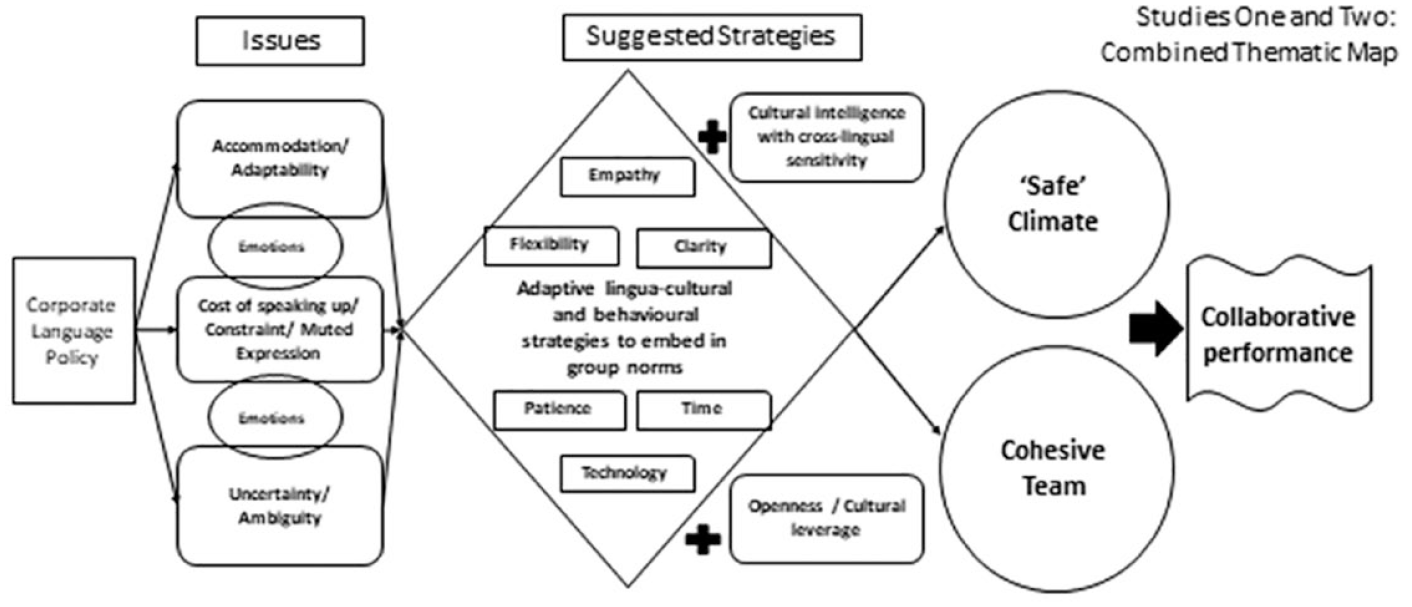
Illustration of key themes and strategies identified in the semistructured interviews and the focus group.
While there is a strong alignment of the themes identified in both the semistructured interviews and the focus group, a different emphasis was identified in relation to how emotions were expressed. Those in the focus group expressed them predominantly either as observations or at a distance, whereas in the semistructured interviews there were several instances where the respondents spoke of experiencing the emotions themselves. This may have been influenced by the collective setting of a focus group and the exchange of opinions in front of others; the more confidential setting of the one-to-one interview allowed one to delve into each participant’s personal thoughts and feelings.
What Are the Potential Challenges That Arise for MNTs and What Strategies Do the Teams Apply to Address Them?
The second question explores the complex communication issues faced by the research participants when collaborating with individuals from different cultural backgrounds.
Challenges
Ambiguity and Uncertainty caused by language-induced misunderstandings and mistranslations was highlighted in some form by all the participants in both the semistructured interviews and the focus group. Certain instances highlighted how language is never expressed in a vacuum; context is necessary for full meaning to be established.
A characteristic example of this can be found from Focus Group Respondent AI’s description of a conversation with Chinese colleagues. He had assumed that “OK” denoted agreement by them to carry out a specific piece of work, only to discover a week later, on the planned delivery date, that the work agreed had not even been started. Moreover, the Chinese maintained that they had never agreed to do the work.
A similar problem was experienced by other participants, who highlighted emotions such as the frustration and tension that occur when the intended message is not understood by the receiver (in spite of the appearance of agreement having been reached).
This aligns closely with Respondent AF’s account in the semistructured interviews of her experiences where she received verbal agreement from her Chinese colleagues, only later to discover that this was not the intended message. Her experiences of working with the Chinese made her feel uncertain in how to read the signs—the language said one thing but clearly there was more to understand: It makes me feel insecure because . . . I have experience with Chinese people who say yes, yes, yes! And then afterwards they would not do anything for different reasons, but they wouldn’t say it openly. So that’s a little bit difficult—at least the feeling of insecurity and uncertainty. (AF)
The above illustrates how language is never expressed in a void and needs to be understood against the context and culture in which it is used—a vivid example of cross-cultural pragmatics. Thus, Chinese children are taught from a young age to develop their ability to understand implicitly, for in Chinese culture, inference is a key part of interpretation (Meyer, 2014). From the perspective of an outsider to the culture, the words cannot be taken at face value. Their interpretation requires knowledge of the culture and context.
Another example of uncertainty in interpretation was recounted by Respondent DK from her experience of adjusting her approach to performance feedback when delivering it to an English manager. She explained that when feedback was conveyed in the French way to non-French team members, particularly British, it was likely to cause offence, because of cultural expectations. This is because France is a high-context culture where meaning is not explicit. French feedback recipients generally look for what is hidden between the lines and expect feedback to be critical and negative (Bacouel-Jentjens & Brandl, 2015). Focus Group Respondent DK explained how she discovered the need for performance feedback delivery to be adjusted when sent to an English manager. Her reason for this was that when it was conveyed in the French way, it was likely to cause offence, because of cultural expectations.
Take the French, they are very assertive and contradicting, if you would speak the way you would normally speak, so just translate it, you would be extremely aggressive and possibly cause offence. . . . An English manager will always start with what worked well, what didn’t work so well, and so on. As a French, not used to the British culture, you will hear what worked well and your focus and ears will be closed when the actual feedback comes. So, they think it is all going very well when it is not. (DK)
In the United Kingdom, a popular social science concept is the feedback sandwich, used by a feedback giver to highlight to the feedback receiver their good performance followed by some constructive feedback (declaring lower-level performance), finishing again in a positive vein with generally good news (Schartel, 2012). This supports pragmatic theories of intended meaning, common ground, and cooperation, which are found in English culture—a high-context culture (Hall, 1976; Hofstede, 2001). It suggests that in the United Kingdom, a feedback receiver should not consider their performance to be excellent when the feedback giver softens the initial approach with some positive feedback prior to reporting on weaker performance. This is an interesting example, highlighting the low-context communication culture in France (Hall, 1976; Hofstede, 2001), where an explicit and direct approach to communication in performance management discussions is preferred.
Uncertainty over levels of proficiency was also identified as leading to other challenges, for example, what might be lost as a result of speaking up. Individuals felt held back by the potential consequences of their lower proficiency in corporate language. This theme is also reinforced by other concerns, revealed in the following section.
Linguistic constraint
In alignment with the semistructured interviews, the Focus Group participants reported their NNS colleagues feeling threatened by the consequences of speaking up in the corporate language, describing situations where NNS team members felt held back in their contributions to meetings, as highlighted by Semistructured Interview Respondent FR: It will be very challenging because I have not enough of the fundamentals in terms of communication skills with other languages in order to obtain this information. (FR)
While acknowledging reticence in speaking up, Focus Group Respondent MW highlighted that there may be other root causes, for example, cultural norms in group setting.
I think we also have to think about the cost of speaking up—some people could be uncomfortable with speaking in front of the manager in a country that is big on hierarchy, so I think it is often difficult to learn the meaning from a wider aspect and a broader issue when it comes to language. (MW)
An example of this in the Far East is multiple face where social obligations force individuals “to be many things to many people” (Lewis, 2012, p. 95).
The anxiety generated when team members are forced to present their colleague’s work at short notice, emphasizes the vulnerability and potential loss of face felt by NNSs when asked to speak in front of an audience without due preparation, as recalled by AM when a colleague declared: Guys, I am not going to present this because I don’t speak English, I don’t speak English well. And everyone in the team gets nervous and says . . . but you’ve got to present this, you’re the one who made the presentation—you know everything about it. (AM)
Presenting another’s research at short notice is challenging even as an NS, but the exposure is greater for an NNS. This highlights the need to accommodate the requirements of other team members when faced with such tasks (Baider & Cislaru, 2014). Semistructured Interview Respondent HH highlighted this aspect where she expressed her vulnerability in sharing her lack of understanding with her colleagues and was fearful of losing face when attending a class at a German university.
The cost of speaking up, highlighted by MW as a source of anxiety and uncertainty, has been raised by other researchers (Cheng et al., 1999; Tenzer & Pudelko, 2015). Aichhorn and Puck (2017) highlighted in their study that insufficient proficiency in the corporate language leads to significant anxiety, which may be increased by comparison with others whose level of proficiency is greater or who are NSs (Clement et al., 1994; Ewald, 2007; Tóth, 2010; Young, 1992).
The lack of trust
In their study, Tenzer and Pudelko (2017) highlight the potential impact on trust formation and knowledge sharing from negative emotions that result from different linguistic proficiency levels in MNTs. The challenges of uncertainty, the fear of exposing one’s linguistic deficiency, and the anxiety produced in these situations can create a barrier to sharing information. In exploring further examples of stilted collaboration, Respondent EY told of her experience of legal negotiations moving from a position of reticence to share information to one of openness and trust when her client’s opposition recognized not only her fluency in the Korean language but also a sense of cultural affinity. Respondent EY recounts the negotiations as follows: I think that was a huge contribution to them. They felt that they could trust me, not only because of the language, but because I could read the sensitivity between the two cultures. (EY)
This example shows how leveraging cultural knowledge and affinity can reduce challenges in negotiations in business situations.
Knowledge exchange is significantly influenced by the perceived trust between individuals and the extent to which an overlap exists between members of dyads within a group (Yildiz, 2016) and, in light of the fact that the speakers of different native languages hold different “bundles” of knowledge, this only reinforces the advantage of language diversity in MNTs (Harrison & Klein, 2007). Furthermore, trust is the glue that holds most collaborative relationships together (Tenzer & Pudelko, 2014). A lack of trust can also be triggered by a negative perception of language competency and its relationship to one’s position in the organizational hierarchy.
Hierarchies
The idea that organizational hierarchy is related to proficiency levels was also highlighted by Focus Group Respondent DK: We tend to consider that below a certain level of hierarchy, it has to be in the local language and when it’s corporate teams, project teams, transversal teams, the assumption is that they can speak the corporate English, and they don’t have to speak their local language. So, there is a correspondence between the level and the hierarchy and the ability to speak English. (DK)
In the context of multinationals, this function has been identified as gatekeeping in that it can divide NSs (often in the context of home country nationals working in the corporate language) from local employees operating in their home contexts (Brannen et al., 2017; Piekkari et al., 2014). As expressed by Respondent DK, there is an expectation that below a certain level within the organization, proficiency in the corporate language was unlikely. This reinforces a sense of perceived superior status by corporate language speakers and may lead to the disempowerment of employees who lack language competence (Logemann & Piekkari, 2015; Vaara et al., 2005).
Such perceptions of language proficiency level corresponding to organizational hierarchy are not uncommon and are known to affect the organizational hierarchy (Yamao & Sekiguchi, 2015).
A strong command of the corporate language allows employees to transfer knowledge and collaborate with their fellow team members with ease. This is an important way for the organization to achieve competitive advantage, by operating efficiently through its intraorganizational set of connections (Kogut & Zander, 1993, cited in Peltokorpi, 2015). Knowledge transfer often requires a process of expression that makes tacit and explicit knowledge held by the individual becoming more explicit and accessible to others, thus enabling collaboration and exchange of thoughts and ideas (Welch & Welch, 2008). In international negotiations, multilingual skills are essential to achieve a successful outcome (Govindarajan & Gupta, 2001; J. K. Henderson, 2005; Schweiger et al., 2003, cited in Beeler & Lecomte, 2017). However, as one might expect in an international setting, language not only emboldens fluent speakers of the common language, but also handicaps those who are the less adept (Bourdieu, 1991; Vaara et al., 2005). This view is endorsed by the interview participants. The variance in English proficiency by the NNS English speakers in the team required both team members and team leaders to adapt, making supplementary arrangements to ensure that the smooth flow of communication, essential to team collaboration, continues.
Strategies identified
The participants suggested several strategies to mitigate the challenges experienced in their interactions between NS and NNS in MNTs.
Flexibility
Several of the respondents emphasized the need for flexibility in approach toward working with language diversity. The potential for misunderstandings and ambiguity was ever present. An attitude of helping out coupled with respect and tolerance, as highlighted by Focus Group Respondent SC, was suggested as necessary to ensure smooth operation.
It’s really about trying to be flexible and understanding and making it as easy as possible for the teams to do what they have to do and being easy about the ask in terms of what you need from them and by when, and to give them support and then provide that support in an as simple and flexible way as possible. (SC)
This supports the findings of other scholars in promoting linguistic awareness to support productive group collaboration (Krulatz et al., 2018; Ngo & Loi, 2008).
Providing Clarity
In light of the ever-present possibility of misunderstandings and ambiguity, the participants emphasized the need to provide clarity. A recommendation by one participant, Respondent PM, to keep language simple is reminiscent of the suggestion by Kankaanranta and Louhiala-Salminen (2013) that grammar and structure are less important and what matters is shared understanding of specific expertise. The importance of grammatically correct language was also debated in the study by Nurmi and Koroma (2020), who found that when language was oversimplified, it failed to convey the accuracy required. However, the overall recommendation from the focus group participants was to use simple sentence constructions and vocabulary wherever possible.
Differences in time zones, available technology and diverse working practices provide constant challenges in working cross-border virtually (L. S. Henderson et al., 2016; Vuchkovski et al., 2023). One participant, Respondent AM (Focus Group) recommended a post-call review with team members either by phone or in writing to ensure that a common understanding had been established. This approach supports Respondent HH’s strategy (semistructured interviews) who ensured clarity by following up with an email, giving a short summary. In addition to following up video and conference calls in writing, one participant, Respondent SC (Focus Group), recommended that captions be displayed on the screen during video conference calls to enhance clarity of content: I find this a lot in the current project I work in—there’s a lot of large deployments of systems, there’s a lot of people on the call—sometimes over 100. Not everybody is a) extravert, b) able to digest the information and c) think what that means for their country and have time to ask a question. So, I think it’s important that you give people the opportunity to reflect and then play back and ask additional questions—so maybe have a follow-up, multiple times in French with the French team or give them time to join another call with another team. (SC)
A postmeeting call to clarify the points discussed may help the NNS, mystified by discussion in the corporate language, particularly when many people are on a call with high-speed conversation. This supports the comments by Respondents EP and HT in the semistructured interviews.
They kind of woke up and understood that we have a person here or a couple of personnel here who cannot join the discussion if a discussion is going on in any other language that they do not understand. . . . It is part of my job to ensure that everybody in the team first of all understands each other and secondly gets along. If they can’t do that, then at least I make sure that everybody understands each other. (EP) My colleagues who have the most difficult time with English are definitely my colleagues from Asia . . . and when they do speak up, it’s like very broken English—so yes, I think it’s a combination of both (language and culture). I think it’s my job as facilitator and coworker to create a space where you know your ideas are valid so whatever you need to get the message across, do it. (HT)
They endorse the need for additional intervention by a team leader, both as observant facilitator and moderator, who alerts the team to the mix of languages present and allows for more time for NNS contributions.
This view aligns with Semistructured Interview Respondent KC’s approach who is also very aware of the need to adapt to lingua-cultural norms. When presented with a team call where all the participants were German speakers, he decided to wait for the call summary: I knew that if I joined the call, then that call would be conducted in English. (KC)
Allowing more time
The strategies, highlighted in both the semistructured interviews and the focus group to ensure more clarity and a common understanding is reached, take time to implement. Extra time needs to be allowed to facilitate a shared understanding (Morrison-Smith & Ruiz, 2020). This was also emphasized by Focus Group Respondent MW: You have to act as a moderator and make it clear that there is a big mix of languages in the group, that people are given more time and ask for their opinion. (MW)
And borne out by Semistructured Interview Respondent HH’s concerns that emphasizes the value of being ready to take time to achieve a common understanding: They [the Japanese people] tend to spend more time to come to one conclusion and after they have a complete status quo of a certain goal, the level of work is very very high, probably. The big problem of working with Japan is that other people have more time to iterate along the way, their level of completeness is not that great along the way. . . . Japanese tend to be very perfectionist—before they are ready, they will not share the result. (HH)
In their semistructured interviews, Respondent KC and others emphasize the requirement for additional flexibility by all members of the team, to facilitate common understanding. This may be needed because of misinterpretations or missed deadlines. The very nature of working in a multilingual environment calls for adaptability, also stressed by Semistructured Interview Respondent RS: So depending on who you have on the call, I find myself trying to speak slower or trying to find a more simple wording and just to ensure that if there are people on the call, who don’t understand, they can follow and understand what I am trying to get across. (RS)
Cultural and linguistic sensitivity
As highlighted earlier, the challenge of the linguistic constraint led to several suggestions from focus group respondents, in particular, the need for cultural and linguistic sensitivity. Indeed, given differing proficiency levels leading to a reticence to speak up, Respondent DK highlighted the importance to leverage differences and to include colleagues with perceived lower proficiency levels in English to create an environment where the individuals do not feel judged or threatened: So, I guess being in a multinational environment, having a common language and having a common basis and confirming that this is solid—that’s the understanding but also playing the strength of cultural language intimacy and proximity to get to a good result. So, working in a multinational environment, not thinking only about what’s common but what’s different and can be used as an opportunity. (DK)
Respondent PM, in support for a climate of openness, recommended the introduction of ground rules early on, so that that team members feel sufficiently comfortable to speak up and even push back and ask for clarification without being judged. This supports the idea of negotiation of meaning, the process by which two interlocutors identify and resolve communication breakdown with requests for clarification to address comprehension difficulties. Such sensitivity helps to establish trust but can only be created when promoted by the team leader with ground rules, as set out by Respondent PM.
The concept of ground rules to support cultural and linguistic differences has long been supported by researchers (Earley & Gardner, 2005; Gluesing et al., 2003). Indeed, when new groups are formed and begin work on projects before considering rules and procedures, conflicts are more likely (Lau & Murnighan, 2005). However, few substantive empirical studies support these claims (Vigier & Spencer-Oatey, 2017). In their study, Vigier and Spencer-Oatey (2017) test the implementation of rule development in three culturally and linguistically diverse project teams. Where differences in language proficiency levels were greater, it took longer for the rules to become established, while feelings of inequality and imbalance were stronger. Although the study appeared slightly artificial in nature, in that the teams were only formed for a short internal corporate program and solely observed in their early stages, it indicated the need for further research into the use of leadership and ground rules in establishing a nonjudgmental safe climate.
Several focus group participants (Respondents DK, PM, EY, DB, and AM) called for greater awareness of emotions of fear and mistrust that can occur in a language-diverse team and strongly advocated cultural awareness and knowledge in cross-border interactions, particularly socio-pragmatics. For example, Respondent DK supported the need for an awareness of socio- and cross-cultural pragmatics when she highlighted that a knowledge of the English language from the NNS perspective was very different from that spoken by English NSs.
Absolutely. It is a mistake to think that working internationally is just sharing the same language because English as a foreign language is certainly very different from the native English spoken by the Brits. You need to know what group you are in and what the cultural levels are. (DK)
The importance of raising awareness of differences was emphasized by many participants, in particular by Respondent DK, who described a team-building exercise she had experienced that used caricatures of the different nationalities in the team. In spite of the light-hearted vein in which this was expressed, and the support received from the rest of the group in relation to team building through humor, such exercises risk reinforcing prejudices prevalent in MNTs (J. K. Henderson, 2005).
Indeed, while the cultural dimensions of Hofstede (1980, 2001) and the GLOBE project by House et al. (2004) may supply a reference point in relation to general cultural knowledge, there is a danger of stereotyping at the individual level, causing offence (Brewer & Venaik, 2012; Fiske & Durante, 2016). Stereotyping and generalization often arise innocently in MNTs. Similar remarks to those, expressed in jest by Respondent DK, were echoed by Semistructured Interview Respondent AF where she expressed views on different nationalities, culminating in the creation of generalizations. Initiatives are needed to steer away from such concepts and promote the concept of the individual as a composite of many cultures, as promoted by Rosinski (2008).
The concept of composite cultural identity, sometimes termed as a glocal identity (Robertson, 1995), stresses the local within a global environment and embraces the idea that people become integrated into two, three, or more cultures. This may happen as a result of exposure to a variety of environments, for example, frequent business travel, educational initiatives, immigration, and international partnerships. The concept of a global citizen is not new but is recognized today as including previous and new local ethnic identities. In this sense, glocal identity may be considered as a new ethno-cultural identity, complemented by acculturation strategies (Bobowik et al., 2022; Tomlinson, 2003; Tubin & Lapidot, 2008). Multilingualism plays a significant role in facilitating this social and multicultural freedom of movement and contributes to worldwide collaboration (Soldatova & Geer, 2013).
The practice of code-switching (alternating between two or more languages in conversation) is often regarded as an instance of the expression of ethnic and cultural identities, and instances of this can lead to negative emotions in NSs. Indeed, this was reported as an example of foreign language anxiety by other scholars (Aichhorn & Puck, 2017; Tenzer & Pudelko, 2015). Although some references were made in this study, it was not a predominant concern among the participants. Ethnography-orientated sociolinguists and psycholinguists consider code-switching an expression of ethnic identity, the product of voiced social meanings, shaped by the speaker by code-switching (Gumperz, 1982). Nevertheless, every act of speaking or even keeping silent can signify choice of an identity (Le Page & Tabouret-Keller, 1985). The speaker selects the language that represents the most convenient recourse for them at the time. Therefore, together with the language they select, the most convenient identity is adopted at the same time (Morlan & Byrne, 2023; Ponterotto et al., 2006).
Furthermore, analysis of the focus group findings identified an interesting strategy, also raised in the semistructured interviews, that crystallizes in the form of cultural leverage, learning from cultural difference, the reframing of cultural norms to allow an individual to see a cultural difference to their advantage. Some focus group members also raised the matter of national cultural stereotypes humorously. This was discussed in conjunction with the notion of composite cultural identities and the use of Cultural Intelligence (CQ) to develop better collaboration. Although CQ does not correlate with cross-lingual sensitivity, the concept, brought together in combination or as an extension, is a new concept and calls for further research.
The concept of cultural intelligence (CQ) is the capability to cross boundaries and work effectively in multiple cultures. Therefore, it requires the ability to interact effectively with individuals from all cultural backgrounds. As a cognitive and behavioral concept, CQ effectively operates above cultures and encompasses 20 items and four different theoretical dimensions (Metacognitive, Cognitive, Motivational, and Behavioral) that correlate with each other and can be measured on the CQ scale (Ang et al., 2007). Considerable research has taken place in recent years into practical applications of CQ in organizational psychology in the areas of leadership and intercultural adjustment (Ang, Van Dyne & Rockstuhl, 2015; Kadam et al., 2021; Nosratabadi et al., 2020). These mainly take the form of addressing bias and of openness to experience and are included in the fundamental four dimensions or capabilities (intellectual efficiency, ingenuity, curiosity, aesthetics and depth) (Ahmadi et al., 2011; Saini, 2018). Assessments have been made as to how each of the dimensions correlate to competencies. Although all subfactors of behavioral CQ relate to verbal and nonverbal or prosodic (tone, rhythm, pauses, pose, and imitation by the speaker) communications skills, few scholars have directly addressed the correlation between language proficiency and CQ. Albana and Yeşiltaş (2022) maintain that high scores in CQ can even soften the negative impact of language ostracism and the reluctance to share information, and a positive relationship has been identified between foreign language fluency and overall CQ (Chen & Fang, 2022; Khorakiwala, 2009).
CQ covers not only knowledge of the world but also of cultural diversity and cultural settings. So, it can support the formation of identity in a multilingual environment and thus with an MNT. Through meta-knowledge and meta-skills, an individual may retain their primary cultural values while adopting a new vision of the world. Adding a dimension of specific language sensitivities and an understanding of cross-cultural pragmatics to the concept of CQ would allow to provide a more complete construct, measuring and developing culturally intelligent international managers in MNCs.
Leveraging cultural diversity
In her example of using her understanding and linguistic knowledge to create a better solution for both sides of a negotiation, respondent EY gave a vivid example of cross-cultural and cross-lingual leverage to achieve unity in diversity taking advantage of and developing tangible differences and alternative points of view to bridge cultural and other boundaries. By considering cultural orientations and different mindsets, one can avoid stereotyping and achieve mutual understanding (Rosinski, 2008).
Very few studies have explored the area of cultural and cross-lingual leverage. Distefano and Maznevski (2000) conducted a study of cross-cultural teams with scant reference to language but highlighted the aspects that can be employed to create a leverage of ideas in MNTs. While acknowledging that every team is unique, they compiled a set of principles that map differences developed within the team with a view to synergizing them. In the process, compromise is avoided, and new approaches are reviewed in order to develop a fuller understanding.
As reported in the study by Brannen and Salk (2000), negotiations appear to be a common context for cross-cultural leverage, as in the case of Respondent EY’s experience in negotiation with her client’s opponent. The study by Brannen and Salk (2000) reports the testing of assumptions in the context of creating a group culture in a German-Japanese joint venture, showing how negotiated outcomes are possible. Another study reports the use of boundary spanning and cultural leverage in relation to negotiating cultural identity (Yagi & Kleinberg, 2011).
The participants of both studies also suggested strategies to alleviate the linguistic challenges experienced working in an MNT. While a strong alignment of the themes is evident, a different emphasis was identified in relation to how emotions were expressed. In the focus group, the accounts of emotions are always given as observers rather than experienced. This may be due to the fact that a focus group setting allows for groups to discuss openly and does not safeguard privacy to the same extent as a one-on-one interview. Furthermore, an interesting strategy emphasized in the focus group, and also raised in the semistructured interviews, crystallizes as cultural leverage, learning from cultural difference, through the reframing of cultural norms to allow an individual to see a cultural difference to their advantage. Some focus group members also raised the matter of national cultural stereotypes humorously. This was discussed in conjunction with the notion of composite cultural identities and the use of CQ to develop better collaboration. Although CQ does not correlate with cross-lingual sensitivity, the concept, brought together in combination or as an extension, is a new concept and calls for further research.
Contextual Positioning of the Themes
The alignment of themes identified in both the interviews and the focus group highlights the cogency of the findings. Nevertheless, it is important to draw comparison with the difference in weighting of the themes in the focus group discussion. The respondents were asked about the emotions felt in relation to having to communicate in a corporate language (English) when collaborating with other team members. Some included emotions, particularly as the result of misunderstandings and exposure in speaking up. However, emotions were not raised as frequently in the focus group as they were in the interviews. Furthermore, the variety of critical incidents where emotions are expressed is not as visible in the focus group; their statements are more inclined to take the position of an observer, for example “that can be frustrating” (Respondent AM) or “and there is some tension” (Respondent AI). Furthermore, the emphasis, particularly at the beginning of the discussion, is on opacity, ambiguity and misunderstandings, and practical accommodation (including techniques to work around the issues). Emotions (observed) are then raised to describe the feelings resulting from the ambiguity, the cost of speaking up or constraint (muted expression) and trust in a similar way to the interviews.
The reasons for the difference in emphasis are likely to stem from two areas, namely, the collaborative experiences of the participants working with multilingual team members and the group environment. A semistructured interview is more intimate. The interviewee can share personal experiences. The online focus group environment has a different ambience. In this case, a group of eight participants from around the world who had not met each other before came together online. Although the focus group participants were all happy to share experiences from their collaboration cross-border, nothing shared was of a particularly sensitive nature or from a situation where respondents made themselves vulnerable. Furthermore, the focus-group meeting lasted just over 1 hour, while the semistructured interviews lasted over 14 hours and were one-to-one meetings with guaranteed anonymity.
The themes were couched in questions that would stimulate a response easily. Direct questions for incidents where the participants had experienced emotions resulting from proficiency levels in English were unlikely to elicit an immediate response. Therefore, the moderator introduced the relevant issues in such a way as to be both accessible and targeted, to extract the data, for example: Tell me about your experience of working with colleagues with different proficiency levels in the corporate language and any issues that arise that cause emotions to bubble up and affect communication. How do they deal with any issues that arise?
Although focus groups and semistructured interviews are similar in that they are conversational and informal in tone (Longhurst, 2003), semistructured one-on-one interviews allow one to build rapport and trust more rapidly—interviewees are prepared to give details of events that are more sensitive to them. However, focus groups provide a setting that is closer to real life, because the discussion runs freely with minimal intervention from the moderator (Gundumogula, 2020; Kitzinger, 1994; Wilkinson, 1998).
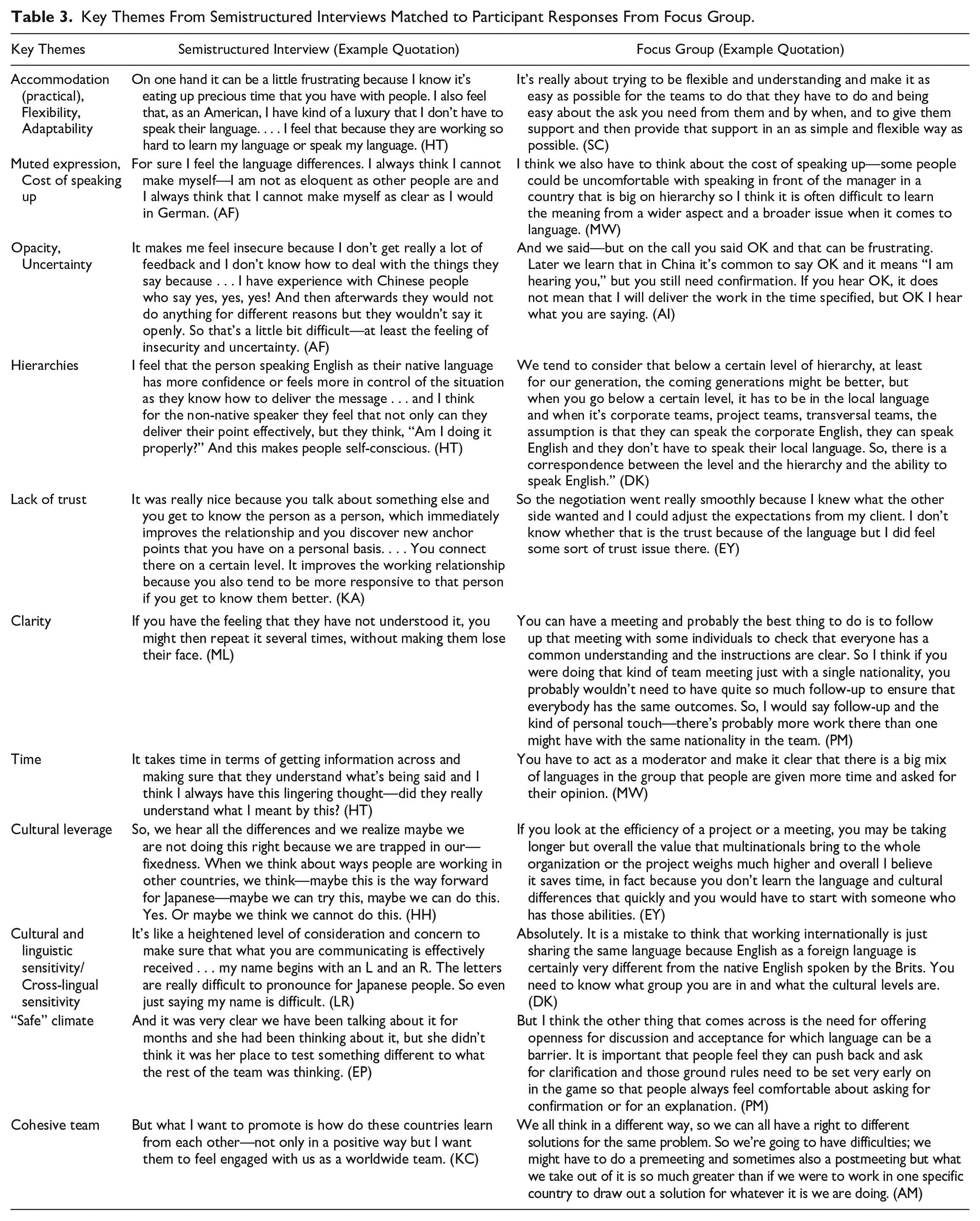
When directly compared, the key themes identified in the focus group produce distinct matches with those of the semistructured interviews. The data from the interviews, because of its volume and richness, gives more critical incidents and strategies than the focus group, but, as shown in Table 3 below, the key themes highlighted in focus group were also raised in the semistructured interviews.
Key Themes From Semistructured Interviews Matched to Participant Responses From Focus Group.
Contribution to IB Language-Sensitive Literature
Previous studies that have reported negative emotions as a result of language barriers have raised awareness that a challenge exists (Aichhorn & Puck, 2017; Cheng et al., 1999; Giles & Ogay, 2007; T. B. Neeley et al., 2012; Scott, 2007; Tenzer & Pudelko, 2015; Vigier & Spencer-Oatey, 2017). This study highlights the key themes of accommodation, muted expression, and opacity/ambiguity, which elicit emotions in the face of language differences. In contrast to previous IB language-sensitive studies in this area, this study identifies the key theme of accommodation/adaptability, breaking it down into three categories in which team members show accommodative behavior: emotional (present/absent), cognitive, and practical. It also reports muted expression (also referred to as linguistic constraint) as a key theme that, although mentioned in a few other studies (Aichhorn & Puck, 2017; Cheng et al., 1999), this study highlights how this can elicit emotions not only in those feeling reticent to speak a foreign language but also how emotions bubble up by those observing them as well. The third theme identified is opacity/uncertainty/ambiguity has been raised in a couple of extant IB language-sensitive studies but not directly in relation to emotions. This study demonstrates how this linguistic ambiguity can elicit emotions. It also provides full detail and examples of sociological aspects of language that are directly related, such as speaker intention, cross-cultural pragmatics, and negotiation of meaning, to enable recognition of these instances for future studies and MNT leaders.
Moreover, the selection of MNTs from the professional services/consulting sector, as a basis for the research study, is new. In contrast to previous studies (T. B. Neeley et al., 2012; Tenzer & Pudelko, 2015) that chose sectors with lower levels of proficiency, for example, automotive and telecom, according to the Workforce English Proficiency by Industry Index (EF Proficiency Index, cited by Tran & Burman, 2016), this decision supports the notion that even with higher levels of proficiency in the corporate language, emotions continue to bubble up when collaborating across language barriers. MNTs made up of members with mixed proficiency levels impact emotions across all business sectors, even when the interlocutors are from a sector identified as demonstrating the highest level of fluency in English—professional services, consultancy (EF English Proficiency Index, as cited by Tran & Burman, 2016).
Additionally, this study differs from some studies that seek to uncouple language and culture (Brannen et al., 2017; Tenzer & Pudelko, 2015). Cultural context is essential for the understanding of meaning in language and the roots of human responses, as borne out through the results (Jiang, 2000; Yağiz & Izadpanah, 2013). This study, by conserving the cultural link, provides a fuller representation of the bond between language and culture, as illustrated by the many examples of cross-cultural pragmatics and contextual scenarios provided by the participants of both studies. Furthermore, by viewing the world through the prism of critical realism, it can be detected that the way knowledge is held and communicated by individuals originates from their culture, environment, and experience (Joseph, 2004).
Also, this study employs a multimethod approach, which highlights the impact of the data collection method on the emphasis of the results. To our knowledge, this is the first study in IB language-sensitive literature to collect data using a focus group. This approach emphasizes a different dynamic through gathering the perceptions of different team members in a group environment. The team members discussed how they felt about the challenges of collaborating in the corporate language, English, in a multilingual environment. This dynamic highlighted the open environment where the moderator facilitated the discussion.
Furthermore, using two qualitative methods also raises awareness of two different dynamics in reporting the findings. Interviews yielded more incidents where distinct emotions were personally experienced and observed. The perceptions of the focus group reflected findings through a group dynamic. The challenges and strategies correlated and reinforced those of the first study as well as proposing a slightly adjusted emphasis with additional strategies to mitigate the critical challenges.
Finally, both studies generated several strategies, suggested by the participants, to combat many of the root causes of emotional triggers in MNT collaboration. In contrast to other studies that suggest reactive measures to deflect emotions (T. B. Neeley et al., 2012; Tenzer & Pudelko, 2015), many of them promote preventative measures to halt the root cause.
Theoretical Framework
The results of the analysis have been incorporated into our theoretical framework (see Figure 2) and highlight the novel contribution to IB language-sensitive studies in language-induced emotions in MNTs.
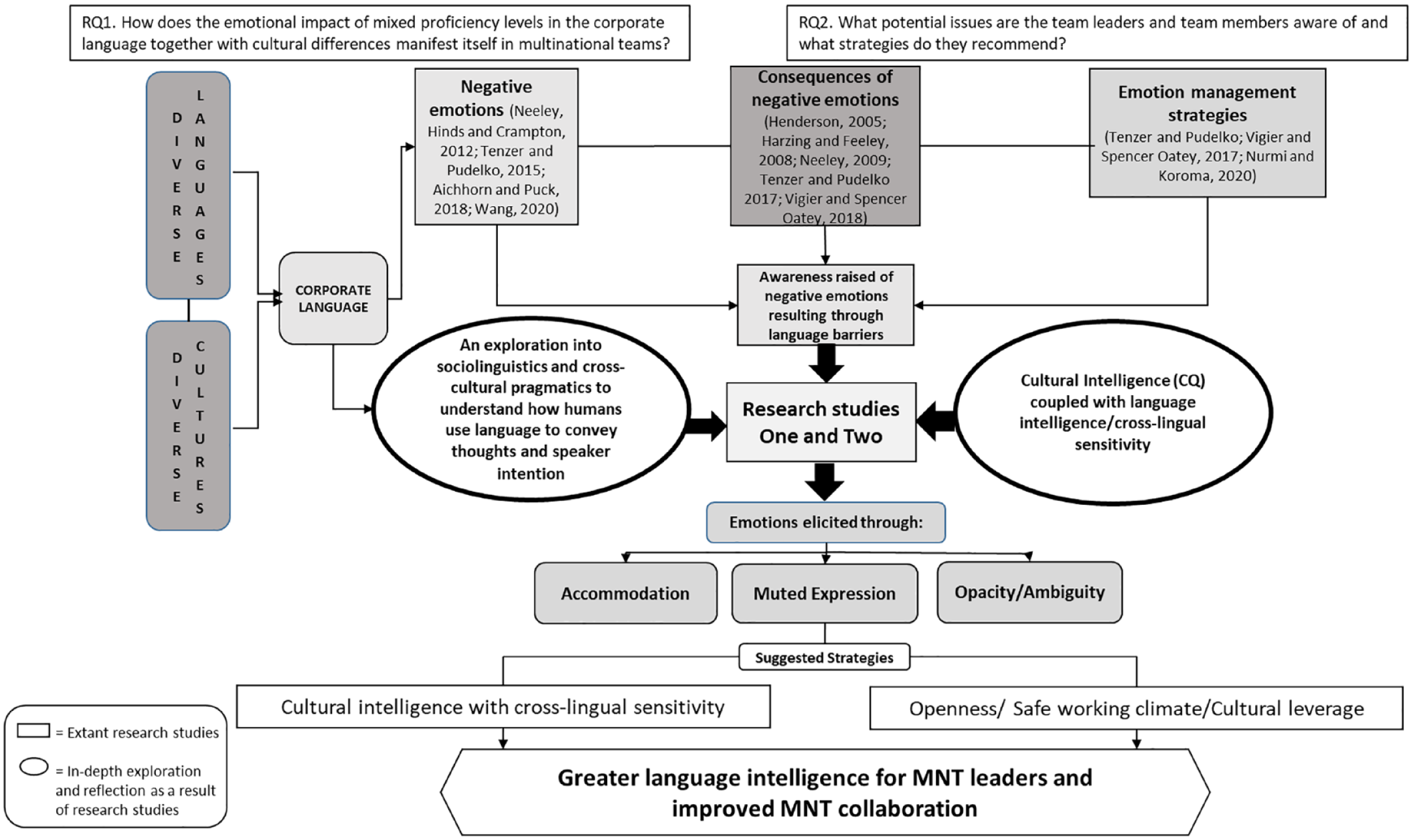
Theoretical framework.
Studies that have reported negative emotions as a result of language barriers have raised awareness that an issue exists. This study highlights the key themes of accommodation, muted expression, and opacity/ambiguity that elicit emotions in the face of language differences. In contrast to previous IB language-sensitive studies in this area, this study identifies the key theme of accommodation and subdivides it into three categories in which team members display accommodative behavior: emotional (present/absent), cognitive, and practical. It also reports muted expression as a key theme that, although alluded to in other studies, this study highlights how emotions are triggered not only in those feeling inhibited in speaking a foreign language but also how emotions are triggered in those observing them as well. The third theme identified is opacity/ambiguity. Again, also termed as uncertainty (as highlighted in the focus group), it has been raised in a couple of extant IB language-sensitive studies but not directly in relation to emotions. This study demonstrates how this linguistic ambiguity can elicit emotions. It also explores why this is so and provides detail and examples of sociological aspects of language that are directly related, such as speaker intention, cross-cultural pragmatics, negotiation of meaning, to enable recognition of these instances for future studies and MNT leaders.
The results from both the interviews and the focus group highlight strategies to mitigate the challenges faced by MNTs in the face of language barriers. On closer analysis and in consideration of the emphasis of accommodation, some of these results suggested similar actions to those of CQ but with greater knowledge of language (language intelligence). Other strategies emphasized strongly the need for an environment where they felt safe and not judged by their language proficiency. This would also diminish the feeling of being constrained from speaking up and allowing an individual to speak up in the case of misunderstandings. Other strategies focused on a feeling of open-mindedness and readiness to build a cohesive team. These align with other MNT studies but nonetheless are especially important in a multilingual team environment where sensitivities may easily be exposed. One other strategy was that of leveraging cultural diversity. Already widely reported as a key to innovation and borne out in this study, this aspect can greatly contribute to building new synergies and improved cross-border collaboration.
Limitations
Our study has several limitations, which suggest directions for future research in this area.
First, the proficiency levels of the MNT members of both studies were self-reported as “fluent.” Working arrangements did not allow the testing of linguistic proficiency. An opportunity to test proficiency levels might have provided greater clarity in relation to the precise proficiency level in the corporate language of each team member. However, the degree to which this would have influenced the findings is debatable. This is because the findings of previous studies (T. B. Neeley et al., 2012; Tenzer & Pudelko, 2015) (using different sectors with lower proficiency levels) and of this study (using data from a sector with generally higher proficiency level in English) indicate that collaborating with team members of mixed proficiency levels elicits emotional responses in MNTs. Second, what is key to this study is how these emotional responses manifest themselves in the key themes, not reported in these earlier studies. The suggested strategies presented through this study focus primarily on recommendations for MNT leadership to enact and develop through their team leadership style. As emotions continue to play a role even at higher levels of proficiency. It is recommended that further research using different industry sectors with different proficiency levels be carried out to demonstrate their value in diminishing language proficiency asymmetries and to extend the insights from participants.
Thirdly, the semistructured interviews were based on global MNTs operating mostly virtually. An opportunity to carry out additional studies with MNTs operating physically together would have allowed a comparison between the results of virtual teams with face-to-face teams. Fourth, although the sample included a variety of ages, the two teams were relatively small to allow comparison between experiences of younger and older generations; only three respondents had entered the labor market before all the cross-border mergers of the 1990s. Also, bearing in mind shifts in educational policy and changing markets, age and global working experience may have an impact on NNSs’ language proficiency and acuity for CQ. Thus, future research could include additional variables such as individual characteristics, for example, age, education, and global experience. Furthermore, different sectors, such as international retail and manufacturing, might yield useful results because, so far, very little language-sensitive research has been conducted in these sectors.
Fifth, while the interviews and focus group data have captured dynamic data in relation to critical incidents triggering emotions, it would be useful to explore additional research designs, for example, capturing emotions in real time, as suggested by Kouamé and Liu (2021), who propose the exploration of intraindividual differences under observation through the use of diaries and other qualitative approaches. Stimulated recall is another instrument that can be used to gather what people are thinking as they interact. In this case, research participants either listen to a recording or view a video recording of their behavior in a certain situation and are then invited to reflect on their cognitive processes during the recorded event (Dempsey, 2010).
Final Thoughts
This study contributes to the growing literature on language diversity in MNCs by emphasizing the crucial role of leadership in managing emotions and resultant challenges in MNTs. It also brings to the fore an added layer of complexity in relation to the concept of diversity in the workplace. While much of the literature promotes the ease of knowledge sharing and communication through the adoption of a common corporate language, many of the challenges continue to be dismissed. This in-depth investigation shows that MNCs cannot simply assume that they have written off communication challenges by using a corporate language, but that its use needs to be tempered by specific leadership behaviors and lingua-cultural strategies. The study advances the research into emotions as a result of language barriers by highlighting key triggers that elicit emotions and also highlights the fundamentals of language that provoke the challenge. The contribution of our study to IB language-sensitive literature is comprehensively presented at the end of the article.
A common thread running throughout this study is the call for MNCs to invest time in the development of language management in organizations. Misunderstandings and ambiguity, reluctance to speak up, misfired communication, and uncertainty can result in loss of information and strategy misalignment. While the mandate of a standard language allows the ease of a universalist approach in general communication, it is vital that MNT leaders are ready and equipped to help guide their team members in communicating across lingua-cultural barriers by leading with empathy in creating a safe climate, setting down ground rules, and demonstrating CQ and cross-lingual sensitivity. By following these strategies, negative emotions will be minimized, and team productivity will grow.
Appeals for diversity awareness currently embrace gender, age, ethnicity, and race. Inclusion of language diversity would elevate the importance of the role of language and highlight how humans transfer thought in all social interactions both in the workplace and personally and should be integrated into international human resources management diversity initiatives.
Footnotes
Appendix 1
Declaration of Conflicting Interests
The author declared no potential conflicts of interest with respect to the research, authorship, and/or publication of this article.
Funding
The author received no financial support for the research, authorship, and/or publication of this article.
