



Abstract
Communication instructors have long insisted on the importance of audience adaptation. But they have said less about (a) the dimensions along which adaptation might proceed or (b) how a student might learn the art of adapting. In this article, I contribute toward addressing these two deficiencies. I suggest a dimension for adaptation—the value frameworks (or value vocabularies) in which people express evaluations of better and worse. And I propose that instructors teach adaptation by imitation. In addition to elaborating on these ideas, I also offer materials for use in classes.
In this article, I provide materials that management communication instructors (and others) can use to teach the concept of audience adaptation. I take the work of Jonathan Haidt (2012) as an example of an audience analysis (a description of how U.S. residents respond to discourse) and then propose a way in which advocates might adapt messages to appeal to various segments of that audience. While my work concerns one specific aspect of verbal behavior—the value frameworks that I derive from Haidt’s (2012) “moral modules”—the article can also serve as a model of one way to translate audience analysis into audience adaptation.
In the first section of the article, I discuss audience analysis and adaptation. In the second, I draw on Haidt’s (2012) concept of moral modules to develop six value frameworks. In the third, I explore imitation as an instructional method. And in the fourth section (and the appendices), I offer teaching materials for teaching audience adaptation.
Audience Analysis and Adaptation
In her articulation of a macro theory of management communication, Shelby (1986, 1988, 1991, 1998) supplemented the rhetorical tradition with modern behavioral studies. She used the latter to update and extend the former, an effort she described as attempting “to bring contemporary persuasion theory to the attention of business communication scholars” (Shelby, 1986, p. 9). Shelby’s goal was to update rhetoric, supplementing the observations of Aristotle, Cicero, and others with modern observations and theoretical insights. She described her work as one that “appropriately combines the rhetorical with the instrumental” (Shelby, 1998, p. 387), that is, as one that encompasses both, on one hand, rhetorical theory and, on the other, the teaching of communication skills to business students.
The resulting theory proposed that “if managers identify available alternatives (options), make informed choices among them (strategy), and implement the options chosen (skill), they can . . . increase the probability of communicating successfully” (Shelby, 1988, p. 14). Shelby (1988, pp. 21, 22) explained that advocates should examine receiver variables such as “attitudes, beliefs, [and] values” because such “cognitive-evaluative structures . . . determine how individuals perceive, understand, and judge new messages.” Such examination allows advocates to “determine the relative force of the [available] options, that is, their relative effectiveness, efficiency, and quality” (Shelby, 1988, p. 18). “Put simply, to move a reader or hearer closer to—or farther from—the behavior a communicator desires . . . depends on how successfully the writer or speaker chooses appropriately from among the various rhetorical options at his or her disposal” (Shelby, 1998, p. 388). Thus, Shelby distinguished between audience adaptation (choosing the most appropriate rhetorical options) and its prerequisite audience analysis (studying the audience to estimate the relative force of the available options); she placed both at the heart of management communication. (See also Rawlins, 2019.)
In this article I focus on audience adaptation. However, the link between the two requires an introductory overview of audience analysis.
Audience Analysis
Recommendations to engage in audience analysis (or, more frequently, “reader analysis”) have been a staple in business communication since at least 1925 (Suchan & Dulek, 1988, p. 29), frequently consisting of “a series of guided questions” for the advocate to ponder (Lam & Hannah, 2016, p. 28). Scholars have produced an extensive literature—for helpful introductions, see Lam and Hannah (2016) and Ross (2013)—but not without controversy (Cohen, 1990; Suchan & Dulek, 1988).
The literature describes audience analysis from at least three perspectives. Educators such as Antony Jay (1971b) and Andrew Abela (2013) propose a perspective I call audience dynamics. Based on anthropological research (Jay, 1971a) and his observations while working for the British Broadcasting Corporation (Jay, 1971b, p. vii), Jay focused on the number of auditors (e.g., assemblies of 10, 40, or 250 people) and their seating arrangements and interpersonal relationships (1971b, chap. 7). He argued that the larger the group, “the more they become one,” requiring a presenter “to appeal not to the diverse minds but to the common emotions” (pp. 70, 73). Similarly, Abela (2013, pp. 113-121) distinguished between “ballroom” and “conference room” presentations. And, while he did not develop the idea, Cicero had something similar in mind when he called attention to audience size, “whether it is large, small, or an individual” (ca 55 B.C.E./2001, 2.211).
We can trace a second approach, audience demographics, back to Aristotle’s (ca. 350 B.C.E./2007, book 2, chaps. 19-17) recommendation that speakers note personal characteristics of audience members. References to demographics continue to appear in public speaking textbooks today (e.g., O’Hair et al., 2004, pp. 36-38). These authors care less about demographic characteristics per se than about personal attributes that may be associated with them. For example, Aristotle believed that age and social standing were predictably associated with emotions and character traits.
Today, we have access to a third perspective—audience dispositions, which emerged in the business communication literature through Suchan and Dulek’s (1988) discussion of “perceptual sets” and Ross’s (2013) discussion of “predispositions.” Modern analysis of audience member psychology—for example, “psychographics”—has proved useful in preparing messages for a variety of audiences (e.g., Crowley et al., 2022; Stalgaitis et al., 2020). In one sense, audience dispositions differs from audience demographics in degree, with the former a more advanced version of the latter. In another sense, modern understanding of human behavior differs so much from the use of demographic stereotypes as to constitute a difference in kind.
Communication instructors can use all three perspectives. They can consider audience dynamics when teaching oral presentations. They can apply both the demographics and the dispositions approaches to either auditors or readers.
I assume a dispositions approach. While I do not propose a particular technique for audience dispositions analysis, I have in mind some of the insights one finds in the work of Ross (2013), Cardinal (2022), Shelton (2020), and Gonzalez (2022).
While Ross (2013, p. 94) focuses narrowly on environment-related communication, he describes a systematic process for developing a good understanding of a target audience. The interview questions developed by Ross (2013, pp. 108-109) could be adapted to gather information about preferred value frameworks, either systematically as described by Ross or more intuitively as described by Yook (2004).
The Ross (2013) procedures could also be refined in light of issues raised by Cardinal (2022), Shelton (2020), and Gonzalez (2022). Cardinal (2022, pp. 351-353) explores the complexities of audience analysis in an era of superdiversity, providing lists of questions and suggestions intended to make the analysis more precise and accurate. Shelton (2020, p. 21) proposes “centering” the disadvantaged, a step that should keep them from being overlooked (cf. Perelman, 1982, p. 35, on presence). And Gonzalez (2022, chap. 7) provides examples of adaptation within the arena of preferred languages.
Audience Adaptation
While the audience analysis literature is large, the audience adaptation literature is sparse and scattered. Specific examples of audience adaptation in the literature include selecting an appropriate topic to appeal to an audience (Henning, 2012/2013), selecting an appropriate medium (Seroka, 2021), adjusting verbal behaviors (Dowdey, 1987; Rafoth, 1985; Rubin & Piché, 1979; Street, 1979), adopting an appropriate genre (Valeiras-Jurado, 2020), and interacting with the intended audiences in order to fine-tune a document (Spilka, 1990). I am not aware of any effort to organize the various forms of adaptation. In this article, however, I focus on a form that does not appear to have attracted attention—expressing arguments in terms of favored value frameworks. It is a form of adaptation directly concerned with “cognitive-evaluative structures . . . [that] determine how individuals perceive, understand, and judge new messages” (Shelby, 1988, p. 22). And it clearly fits within Burke’s (1969, p. 5) reference to “speech, gesture, tonality, order, image, attitude, [and] idea.” (Ethical challenges posed by audience adaptation—articulated clearly by Perelman and Olbrechts-Tyteca, 1969, p. 25, passim—will be noted in a subsequent section of the article.)
To be blunt, some authors seem to assume that audience adaptation automatically follows from audience analysis. Cohen (1990), for example, speaks of audience analysis but the brunt of his criticism falls on the unnamed second step in the process, audience adaptation: Some [textbooks or guides] even offer you a list of [audience analysis] questions you are to answer before you begin writing. And if you answer in detail all the questions, you will There is only one hitch: They do not go on to tell you exactly
Of course, communicators do sometimes adapt spontaneously. Psycholinguists, using concepts such as “audience design” (Clough et al., 2022) and “recipient design” (Valeiras-Jurado, 2020) have shown that speakers adjust their communication efforts (e.g., speaking louder or slower) in attempts to make their messages more accessible.
However, the sort of audience adaptation that I am recommending seems to be more difficult. Experienced teachers have observed that “students often struggle to understand and implement” audience adaptation (Seroka, 2021; see also Henning, 2012/2013). Potential explanations for students’ struggles include human nature, a lack of sufficient maturity, a lack of experience, and a lack of instruction. Setting aside (for the moment) human nature, we must acknowledge the other challenges.
Research shows that, as human brains mature, persons begin to adapt their communication behavior based on how they perceive their target audience (Clough et al., 2022; Hoffmeister & Shettle, 1983). This “cognitive development model” (Rubin & Piché, 1979, p. 293) implies that audience adaptation will come more naturally to older students than to younger ones (or, perhaps, to a larger percentage of older students). Thus, a professor teaching business communication to undergraduates may need to provide more explanation and more practice to achieve a given level of student performance than will a professor teaching management communication to Master of Business Administration (MBA) or Executive MBA (EMBA) students.
Professors have also noted the difficulty they encounter in providing students with experience. In many instructional settings, the only audience for student work consists of other students (Seroka, 2021). That environment limits the extent to which students can gain adaptation experience and, consequently, has required instructors to exercise creativity (e.g., Seiter & Gass, 2007).
Faculty members do not control the mental maturity of their students; and they have limited opportunities to provide their students with nonstudent audiences. But, as discussed in the following section, they can address the lack of instruction.
Value Frameworks
In the United States in recent decades, advocates have sometimes disparaged the intellectual and moral attributes of those with whom they disagree. This occurred frequently enough to attract academic research, and Haidt (2012) and his colleagues have found that persons at different points on the political spectrum tend to express their concerns with different vocabularies (e.g., Graham et al., 2009).
Evolved Modules
The research by Haidt and his colleagues explains some communication failures (Graham et al., 2009; Haidt, 2012; Haidt & Kesebir, 2010). It also provides one of the most interesting modern treatments of ethics and moral reasoning—matters that transcend political differences and often shape decision making about a variety of topics.
Haidt and his coauthors noted that judgments of right and wrong appear to be instantaneous rather than based on analysis. They explain this fact as a consequence of evolution. In their view, perceptions of right and wrong evolved along with humanity and are, consequently, now intuitive (Haidt & Joseph, 2004). They also noted that perceptions of right and wrong emerge in various forms. Humans do not have a single right-versus-wrong detector but, instead, several.
Haidt and Joseph (2004, p. 60) refer to the right-versus-wrong detectors as “modules,” describing them as “little bits of input-output programming, ways of enabling fast and automatic responses to specific environmental triggers.” While our understanding of the brain remains a work in progress (e.g., Arbib, 1999a, 1999b; Fodor, 2000; Pinker, 1997), the evidence appears to indicate both general purpose “central processing” capability, and an array of domain specific modules or schemas (Arbib, 1999b; Carruthers & Chamberlain, 2000; Fodor, 1983) such as envisioned by Haidt. Haidt’s team links each of the proposed modules to recurring issues in the lives of ancient humans. For example, the need to care for one’s offspring encouraged the development of a compassion and caring response. The need to secure one’s share of the benefits of joint efforts encouraged the development of a sense of fairness. Consequently, humans usually respond to suffering with feelings of compassion; to cheating, with anger.
Haidt refers to the result as “moral foundations theory” (2012, p. 124). The theory does a good job of explaining why various moral systems seem to agree on many issues, and why intuitions of right and wrong seem so often to precede (rather than follow) intellectual analysis. Of course, Haidt has not ruled out analysis. Nor does he suggest that all moral behavior is instinctual. “Most of us,” Haidt has written, “can think of times when we questioned and revised our first intuitive judgment” (2012, p. 67). So, the point is not that thinking doesn’t matter but, rather, that we should be aware of our intuitive reactions—in part because those reactions often shape subsequent thinking (“I know this is wrong—now I’ll figure out why”).
Haidt’s work describes moral responses as fast, effortless, and consistent across humanity because humans have inherited a common set of moral modules. Naturally, some persons might have a stronger “unfairness detector” than do other persons. But, more probably, education, habits, or experiences cause a person to rely more heavily on some moral modules than on others. And—to cut to the chase—if a receiver is likely to respond in terms of whether a proposal seems fair, then advocates who can express their arguments in terms of fairness (i.e., to adapt to the audience) should increase their chances of success.
Haidt and his colleagues believe they have identified six moral modules: care/harm, liberty/oppression, fairness/cheating, loyalty/betrayal, authority/subversion, and sanctity/degradation. As summarized in Table 1, these “little switches” in people’s brains now produce quick emotional responses (Haidt, 2012, pp. 123, 125, 172-173). As these modules (sensitized by education and polished by habit) take the form of vocabularies and principles they become what I call “value frameworks.”
Intuitive Moral Modules, the Bases for Rhetorical Moral Frameworks.
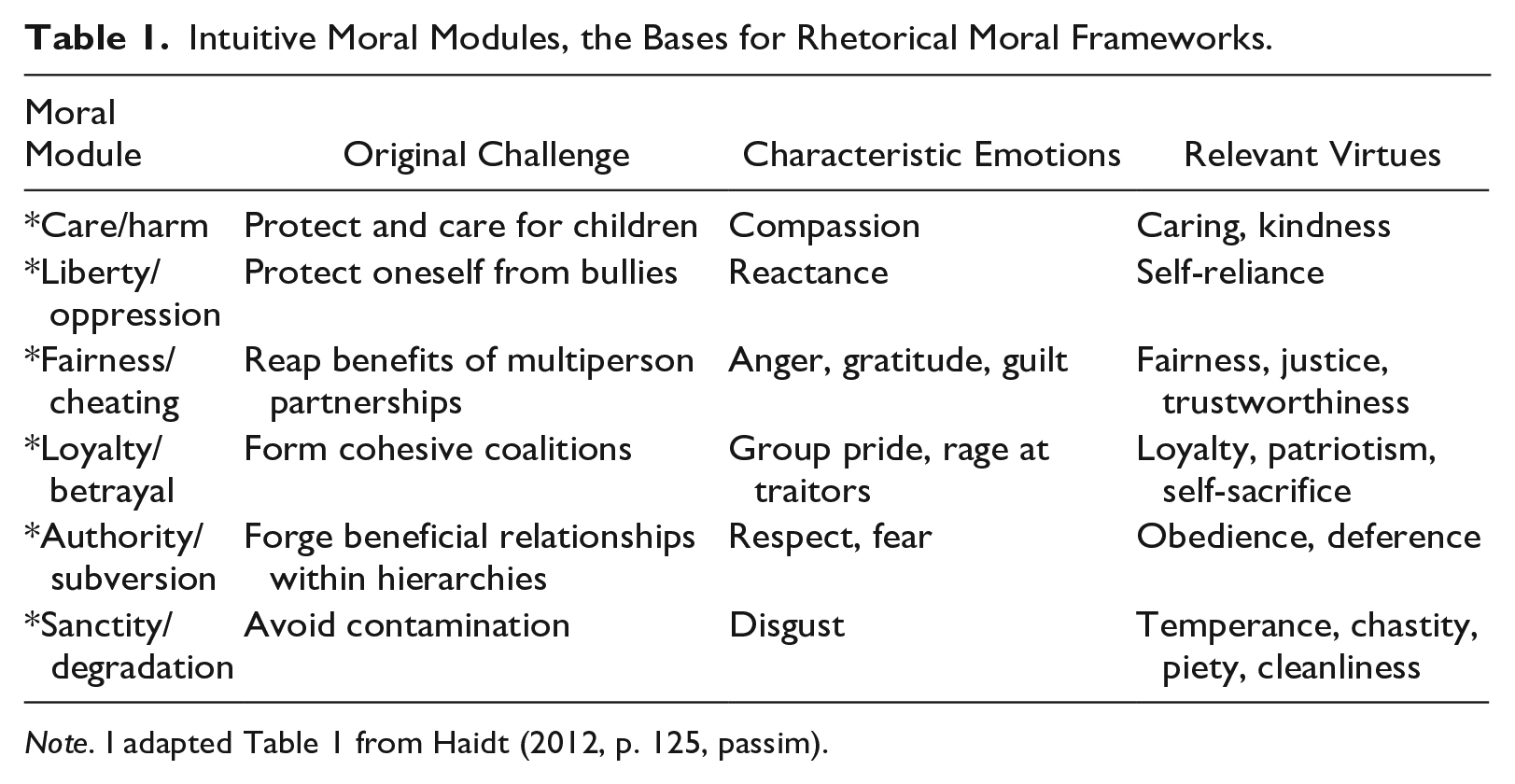
Note. I adapted Table 1 from Haidt (2012, p. 125, passim).
Data show that people at different points on the political spectrum in the United States tend to express themselves using different value frameworks (Haidt, 2012). For example, progressives often speak in terms of fairness and care. On the other hand, an argument expressed in terms of authority or sanctity more often comes from people at the conservative end of the spectrum.
Haidt does not claim that concerns about fairness and care necessarily lead to progressive political stances, nor that concerns about authority and sanctity necessarily lead to conservative ones. In fact, Haidt does not seem to have explored the question of how these differing rhetorical postures took shape, focusing instead on trying to understand current behaviors and what well-intended citizens of all political persuasions might do about them. In short, Haidt (2012, chap. 12) would like to help his fellow citizens to “disagree more constructively.”
I draw the following conclusions from Haidt’s work: (a) humans appear to have at least six moral modules (or schemas); (b) each module gives rise to a value framework (a specific but flexible vocabulary and one or more moral principles); (c) experience, education, one’s associates, and habits encourage an individual to frequently use a preferred set of value frameworks; and (d) a person’s preferred value frameworks drive the individual’s initial reaction to events or ideas, and can shape the individual’s subsequent thinking. This leads me to conclude that an advocate can increase the chances of persuasive success by expressing an argument in terms of the value framework(s) favored by the target audience.
Emergent (Burkean) Universals
While I am relying on the behavioral science work of Haidt, a parallel rhetorical perspective also deserves acknowledgment. As Rueckert (1963, pp. 11-12) notes, Kenneth Burke (1953, pp. 150, 48, 149) argued that the “relationship between the [human] organism [agent] and its environment [scene]” gives rise to “psychological universals” including “various kinds of moods, feelings, emotions, perceptions, sensations, and attitudes.” These universals emerge because humans share aspects that are “inborn in the germ-plasma of man”; “there are some stock patterns of experience which seem to arise out of any system of living” (Burke, 1953, pp. 48, 171)—such patterns can result in commitments to care, liberty, fairness, loyalty, et cetera. And, consequently, one way for an advocate to identify with a target is to defer to the target’s preferred way of categorizing better and worse (Burke, 1969, pp. 54-59). “You persuade a man only insofar as you can talk his language by speech, gesture, tonality, order, image, attitude, idea, identifying your ways with his” (Burke, 1969, p. 55). In short, we can understand both the existence of widely shared value frameworks, and the persuasive potential of those frameworks through the lens of Burkean rhetoric.
Modules, Universals, and Leverage
Whether one thinks of value frameworks as an outgrowth of evolved mental modules (Haidt) or as a consequence of psychological universals that emerge from experiences (Burke), the advocate’s task remains the same—to leverage some of the target’s current beliefs or values to change other beliefs or values.
The rhetorician may have to change an audience’s opinion in one respect; but he can succeed only insofar as he yields to that audience’s opinions in other respects. Some of their opinions are needed to support the fulcrum by which he would move other opinions. (Burke, 1969, p. 56)
Identifying a particular value (or value vocabulary) as a target person’s preferred way of assessing better and worse does not guarantee argumentative success. But it should increase the likelihood that the receiver will listen open-mindedly to the argument. Alternatively, an advocate who learns to express ideas in terms of multiple value frameworks—rather than relying on a single framework—should have a better chance of adjusting to various audiences.
Imitation as an Instructional Strategy
How might we help our students learn to adjust to audiences? One long-used method consists of providing examples to imitate (Rawlins, 2019). Or, to borrow language from Seiter and Gass (2007), by showing students how to do it.
In the introductory sections of book 2 of On the Ideal Orator, Cicero (ca. 55 B.C.E./2001, Book 2 Chaps. 2-3) recalls that, as a boy, he was sometimes in the home of the prominent orator Lucius Licinius Crassus and sometimes felt free to personally question Marcus Antonius. May and Wisse (2001) summarize the evidence as follows: We may assume that his father regularly took young Cicero to the Roman Forum. . . . When Cicero “came of age” . . . he was officially introduced to the legal expert Quintus Mucius Scaevola, whom he then often followed in the forum, in order to learn about law; . . . . In these ways, Cicero learned by practice, in line with the traditional Roman emphasis on practical experiences, on respect for one’s elders, and on the following of great examples. (p. 7; see also Cicero, ca. 45 B.C.E./2022, pp. 99-105.)
Thus, in addition to interaction with teachers, Cicero learned by observation and imitation.
Indeed, imitation played a continuing role in instruction: “Imitation was the single most common instructional method in the West for well over two millennia,” roughly “from the time of Gorgias” until the middle 1900s (Muckelbauer, 2003, p. 62). “The principle of imitation inspired ancient education from beginning to end” (Cribiore, 2001, p. 132).
We should recognize, however, that imitation changed its meaning as students advanced in knowledge and maturity. Cribiore (2001) writes that imitation of literary models was at the core of a program in rhetoric: through close reading of the texts, it became possible to assimilate vocabulary, style, and organization of the elements of discourse. . . . But acquiring the wings of eloquence meant going some steps beyond that. . . . The literary texts of the past were appropriated . . . but they were also transcended. (p. 225)
Muckelbauer’s (2003) work provides a useful description of the various meanings of imitation.
Muckelbauer (2003, p. 68) describes the “first movement of imitation” as “an effort to produce an absolutely faithful replica.” Thus, people who wish to understand the inner workings of a master’s prose may find it helpful to copy passages. As one modern writer explains, “I have found that because it forces you to slow down, simply copying a passage is a great way—much better than mere reading—of internalizing an author’s sensibility and cadences” (Yagoda, 2004, p. 229). Persons wishing to learn the art of oratory may, similarly, practice imitating both the text and the delivery (e.g., gestures, rate of speaking) of notable speakers.
“The second movement of imitation,” according to Muckelbauer (2003, pp. 76, 77, 79), recognizes the unlikelihood of exact duplication and, therefore, calls on the subject “to reproduce the model differentially,” to “reproduce the effect of the model.” Drawing on Aristotle, Muckelbauer (2003, p. 80) states, “Unlike repetition-of-the-same, the resulting copy does not aspire to internal correspondence with the model, but only to the capacity to induce its effects.” Writers or speakers, having observed the impact of an expert rhetorician, may devote their efforts to understanding the mechanisms by which the expert’s rhetoric produced results.
Muckelbauer (2003, pp. 83, 84) describes “inspiration,” the “third mode of imitation,” as one that “functions quite differently” from the other two. It has two important characteristics: first, that it “transmits itself through a kind of infectious quality” and, second, that it produces a “capacity to be carried out of oneself,” that is, “losing oneself in response to a model” (Muckelbauer, 2003, p. 86). “Of course, it is also quite clear that this inspiring movement of imitation only functions in concert with one (or both) of the other two movements”; indeed, the three movements “are fused in any actual practice of imitation” (Muckelbauer, 2003, pp. 86, 88).
We might summarize by saying that a student who observes an orator or a writer responding to a situation might identify a linguistic style and, on a subsequent occasion, attempt to duplicate the style (movement one). The same student might observe the effects of the advocate’s style and, on a subsequent occasion, use a different style in an attempt to produce the same type of effect (movement two). Furthermore, the same student might understand the model’s behaviors as showing that humans can respond to situations with rhetoric and be inspired, subsequently, to do the same but potentially using different dimensions of rhetoric. In the first movement, the student encounters the model as someone who demonstrates a particular style. In the second movement, the student encounters the model as someone who demonstrates the results that a well-chosen style can produce. In the third movement, the student encounters the model as a person who demonstrates the potential of rhetoric. “What the ideal student will learn through imitation is not only a style or an ethical rule; he [or she] will acquire the capacity to respond to actual situations. In effect, he [or she] will learn to imitate responsiveness itself” (Muckelbauer, 2003, p. 87). Cicero (ca. 45 B.C.E./2022, p. 21) seems to have had something like Muckelbauer’s third movement in mind when he expressed the hope that those attempting to imitate the Attic orators would “borrow the blood and healthy juices . . . [not just] the bones and membranes.”
I hope—by suggesting assignments and providing examples of what I call “seed arguments”—to provide tools that can show students how to express arguments using various value frameworks. I hope that students may examine examples of arguments expressed in various frameworks (examples that—Movement 1—they can imitate), may develop their own language for appealing to various value frameworks (Movement 2), and be inspired to persuasively articulate their views throughout their careers (Movement 3).
Teaching the Value Frameworks
Invention (Rawlins, 2019), which includes the identification and articulation of arguments, provides one potential arena for imitation. The rhetorical handbooks of Cicero’s day seem to have devolved into dry “paint-by-the-numbers” lists of arguments. Cicero, in contrast, recommended beginning with a set of more abstract commonplaces. Cicero (ca. 55 B.C.E./2001, Book 2, chaps. 145b-177) noted that Aristotle and Theophrastus had proposed commonplaces that were general rather than specific and that required the orator to use commonplaces as a beginning point for situationally appropriate arguments.
Haidt’s work allows us to identify six value frameworks. I conceive of a “framework” as being rooted in one of the moral modules (Haidt, 2012), as being expressed in a standard (but flexible and evolving) vocabulary and/or a moral principle, as providing a starting point for arguments addressing an array of topics, and therefore, a kind of “sociocultural topoi” (Rawlins, 2019, p. 30). I describe each of the six frameworks with a single word: Compassion, Liberty, Fairness, Loyalty, Obedience, and Reverence (see Appendix A). A person wishing to decide whether to favor or oppose a specific policy might, therefore, cycle through a series of questions such as, In what ways could I argue that the policy would (or would not) be compassionate?
Instructional Challenges
Students who participated in debate competitions during high school or college, or MBA students concurrently studying Law, may quickly embrace the intellectual exercise of generating arguments using a specified vocabulary. Other students may initially assume that a specific action simply is (or is not) compassionate (or fair, etc.)—an instructor may need to help those students embrace the activity of appreciating multiple perspectives and developing appropriate arguments.
Finding it hard to understand the perspectives of other people can result from previously mentioned factors such as youth, insufficient experience, and lack of instruction. But it would be wrong either to assume that this difficulty affects only some human beings (e.g., the young) or to assume that this difficulty can be easily eradicated by maturation, accumulating experience, or instruction. The basic and enduring problem is human nature.
As embodied creatures (Murphy, 2006), humans are always located at a specific place, in a specific circumstance, at a particular moment. The consequences of this reality appear to include a perpetual striving for an objective “view from nowhere” (Nagel, 1986) that can be achieved only partially at best, an obstinate tendency to draw distinctions between “us” and “them” (Haslam, 2004, chap. 2, passim), and great difficulty in fully understanding other people (Buber, 1970; Levinas, 1987). The task of articulating an argument in terms of someone else’s value frameworks may, therefore, strike some as difficult to the point of discouragement.
My experience has been that developing arguments to defend positions to which one does not personally subscribe frequently has the effect of provoking thought (and curiosity) about the humanity of the “others” for whom one is trying to speak. The process of searching for arguments (the “available means of persuasion”) can push one to examine previously avoided information sources. It can prod one toward conversations with previously avoided people. It can produce reconsideration of previously dismissed arguments. Such dynamics contribute, I believe, to the phenomenon of self-persuasion (Aronson, 1999).
To help management communication students embrace the task of writing or speaking from various value frameworks, I recommend a discussion in which class members try to (a) identify all the persons affected either directly or indirectly, long- or short-term, and (b) to explore all the ways—positive, negative, and unintended—in which the persons might be affected. (This can, and should, include acknowledgment of the difficulty of seeing the world through the eyes of others.) Such discussion will help students understand the complexity of the issue, and almost certainly provide materials for arguments, both pros and cons. Such discussion should occur at a time that will allow each student to do additional thinking (talking, reading, remembering, etc.) before completing the assignment.
Expressing arguments in specified vocabularies may feel awkward at first, for faculty as well as students. But, just as learning to express oneself in a second language becomes more natural and fluent with experience, so practice allows one to express oneself more naturally in the audience’s values.
The process of encouraging students to adapt to audiences should also acknowledge the ethical challenges that sometimes emerge. Perelman and Olbrechts-Tyteca (1969, pp. 23-26) have discussed the “problem of harmonizing the scruples of the man of honor with submission [adaptation] to the audience,” noting that “it should not be thought . . . that it is always honorable to succeed in persuasion, or even to have such an intention.” As Scult (1989, p. 161) has observed, Perelman and Olbrechts-Tyteca call on the rhetor to consult not only the predilections of a particular audience, but the speaker’s “own inclinations” and, to the extent that it is humanly possible, the standards of the “universal audience.” Consequently, teachers who encourage audience adaptation should recognize the possibility that students may experience the activity as a moral hazard. And, in some instances, kowtowing to an audience would be a moral failure. Perceptive instructors will, therefore, proceed carefully and respect students’ moral postures (even when the instructor recognizes a posture as one that deserves scrutiny).
Instructional Materials
To implement my proposal, I have developed an array of materials. First, I have prepared a teaching note (TN) for use as a student handout (Appendix A). Second, I have identified four cases that can be used either for classroom instruction or as bases for student assignments (Appendices B-E).
In the TN I offer an introduction to the concept of value frameworks, delineating each of those derived from Haidt’s (2012) moral modules. I also suggest some ways to begin the process of developing arguments within each of the frameworks.
I describe the assignments in the following paragraphs. (I include student hand-outs for each assignment in Appendices B-E.) I have described the ways in which I would use the assignments, but have also suggested some alternatives (e.g., converting a written assignment into an oral one). In every case, I have provided “answers” but in the form of “seeds” rather than fully elaborated arguments. I do not mean to imply that the “seed answers” I have provided are the only approach to developing an argument within a given framework—I seek, rather, to provide illustrations.
I offer four assignments as options. An instructor might choose to use one of the options as material for lecture or discussion, using one of the other options as assigned work. It is also possible that one or more of the options could be, at times, inappropriate in some classrooms or on some campuses. For example, Assignment 1 concerns an effort to assist persons who have been the victims of abuse. Assignment 3 describes an organization seeking to enhance its efforts in support of diversity, equality, and inclusion. And Assignment 4 refers to the death of an animal trainer. If these (or other) aspects of an assignment seem to pose an excessive risk—either as a triggering event for a previously victimized student or as an undesired political provocation—an instructor should alter the assignment or choose a different one. Indeed, an instructor should feel free to exercise creativity and discretion (e.g., exploring only some of the value frameworks rather than all six) in using these materials. That is, adapt to the student audience.
Assignment 1: Recruiting workers for SAAFE House
This assignment (see Appendix B) requires students to prepare a “letter to the editor,” encouraging the reader to volunteer to work at SAAFE House, an organization that helps the victims of assault and family violence. I based it on an assignment, described by Schieber (2019, pp. 91-96), that supports an organization in Huntsville, Texas.
I developed this assignment as a persuasive letter. But you could adapt it as an oral presentation.
When used as a persuasive “letter to the editor,” each student should be assigned a specific value framework and asked to encourage volunteers while using that framework. After the letters have been completed, one good example from each framework can be distributed in class for purposes of discussion.
Here are “seed arguments” illustrating how each of the value frameworks might be deployed to encourage support of SAAFE House:
Assignment 2: Meeting the Challenges of Small Town America
This assignment (see Appendix C) concerns Brew Fest (Dolechek et al., 2023), a craft beer event developed by the Downtown Ford Development Corporation (DFDC). The authors based the case on a study of an actual small town, disguised as Ford, Texas. As a distinctive feature, the authors provide a video about Brew Fest.
The case emphasizes the concept of communication agility and would fit well into a unit or course that explores that concept. The case also notes that many small towns have struggled in recent decades and identifies the DFDC (and Brew Fest) as a successful effort to maintain small town communities by attracting guests and strengthening local businesses. Students with an interest in the future of small towns may find this case particularly interesting.
The case was published in the summer 2023 issue of the Federation of Business Disciplines Journal (FBDJ), an online, open-access journal. A description of the FBDJ is available (https://fbdonline.org/journal/journal-about/) and individual issues can be accessed online (https://fbdonline.org/journal/journal-volumes/).
I developed the assignment as a series of email texts encouraging Ford residents to volunteer as Brew Fest recovers from the COVID-19 pandemic. But you could turn the assignment into a series of oral presentations for groups of citizens.
Members of the class could read all the email messages articulated in terms of a specific framework (e.g., Loyalty), discuss the effectiveness of the messages, and consider whether (and how) additional messages using the same rhetorical framework might be expressed.
Here are “seed arguments” illustrating how each of the value frameworks might be used to encourage volunteers for Brew Fest:
Assignment 3: Justifying Diversity, Equity, and Inclusion at a Museum
This assignment (see Appendix D) uses a case about diversity, equity, and inclusion (DEI) at a museum—the Museum of Immersion—located in the Midwestern region of the United States (Van Linden et al., 2022). The authors based the case on real events at Newfields in Indianapolis, Indiana, but altered names in the published case.
The case emphasizes the concept of DEI maturity, defined as when an organization has achieved a high level of diversity, equity, and inclusion and can begin to focus on maintaining that condition. Students with an interest in DEI concepts as they apply to not-for-profit organizations may find this case particularly interesting. The case appeared in the 2022 issue of the Journal of Business Ethics Education.
I developed the assignment as an oral presentation, a message to explain and justify DEI policies to summer interns. You could, however, adapt it as a written assignment such as the text for a training brochure.
When used as an oral presentation assignment, each student might be assigned a value framework and graded on the extent to which he or she develops arguments expressed in the vocabulary of the assigned framework.
Members of the class might listen to all the presentations expressed in a specific framework (e.g., Compassion) and then discuss the effectiveness of the arguments they heard, and whether additional Compassion framework arguments might have been offered.
Here are “seed arguments” illustrating how each of the value frameworks might be deployed in encouraging the summer interns to support the DEI policies:
Assignment 4: Defending a Business Under Attack
This assignment (see Appendix E) uses a case about a public controversy between Sea World and a variety of critics including the People for the Ethical Treatment of Animals (PETA). Sea World attracted negative public attention in 2010 when one of the orcas (Tilikum) grasped a trainer (Dawn Brancheau) and carried her to the bottom of the pool where she drowned. A subsequent documentary film—Blackfish (Oteyza & Cowperthwaite, 2013)—renewed and heightened the controversy, creating a crisis for Sea World. The case has been analyzed by Waller and Iluzada (2020) and can be used to introduce or to develop issues around crisis management. (Portions of the 1-hour-23-minute film could be shown in or outside of class.)
This assignment asks the students to defend Sea World. Please note, however, that students should not feel that they must reproduce the arguments advanced by Sea World at the time. The assignment asks students to express arguments in an instructor-assigned value framework. (Undergraduate students might interview an older member of their family about memories of the Sea World controversy.)
The following paragraphs offer the “seeds” of potential arguments in defense of Sea World.
Concluding Comments
Seiter and Gass (2007) have written that: The simple act of telling students how important it is to identify and adapt their messages to an audience’s value, demographics, personalities, and so forth is not enough. Instead, we believe that students understand and attach more meaning to this skill when it is shown to them. (p. 45)
I share that view. In this article, I attempt to make it easier for a person who teaches management communication to show students how they might adapt to audiences. I regard audience adaptation as important—I believe we should teach it.
I have prepared these materials with MBA and EMBA students in mind. Those working with younger students may find it helpful to introduce audience adaptation gradually, beginning with a simpler assignment such as selecting the topic for a speech (e.g., Henning, 2012/2013) or adapting an on-campus, face-to-face presentation for video presentation off campus (Seroka, 2021), before moving on to adaptation by way of value frameworks. But even lower-division undergraduates can understand the logic of value frameworks and the importance of understanding the values that drive others.
Too many of our students approach a persuasive assignment as one of self-expression—“this is why I (the advocate) think you should do this.” To avoid this mistake, faculty sometimes encourage students to consider “what’s in it for me” from the perspective of the audience—an approach that encourages the student-advocate to think about the audience but may still allow the student to describe the claimed benefit in terms of the student’s values (e.g., “a fairer world”). We will better prepare our students to be effective advocates if we can help them to approach such assignments as occasions for audience adaptation—“I’d like to explain why you—given your values—should do this.” In the words of Perelman and Olbrechts-Tyteca (1969, p. 24), “the ardent enthusiast” is concerned only with what the speaker considers important while the effective, that is, the adaptive communicator is one who “seems animated by the very mind” of the audience.
Footnotes
Appendix A
Appendix B
Appendix C
Appendix D
Appendix E
Acknowledgements
None.
Declaration of Conflicting Interests
The author declared no potential conflicts of interest with respect to the research, authorship, and/or publication of this article.
Funding
The author received no financial support for the research, authorship, and/or publication of this article.
