



Abstract
Despite management theorists’ decades-long attention to the robust sustainability of complex organizations, adaptive management practices remain undertheorized. Management is evolving from a hierarchically organized effort in pursuit of strategically determined goals into a facilitation of layered, distributed, autonomous agents able to learn from their errors and ensure the entire system’s long-term survivability. A rhetorical perspective on pedagogy allows us to better prepare our students for success in the 21st century’s adaptive organization as well as contribute to theoretical scholarship of effective organizations.
Despite the discipline’s roots in tradecraft and popular psychology (Brooks, 1991), pedagogy in business communication has been enhanced with the explicit application of rhetorical theory (Getchell & Lentz, 2018). To better understand the exigencies, genre, and discourse norms of the business context, scholars have usefully employed rhetorical theorists as varied as Aristotle (Scotto di Carol, 2014), Lloyd Bitzer (McCord, 2016), Wayne C. Booth (King, 2009), Kenneth Burke (Brummett, 2022), Kara Finnigan (Cyphert, 2018), Robert Kaplan (Shauki et al., 2022), Kathleen Jamison (Cyphert, 2004b; Kedrowicz & Taylor, 2016), and Carolyn Miller (Ludewig, 2017). In addition to informing and enhancing our pedagogy, these rhetorical perspectives highlight the critical role that business communication instruction plays in both cultural production and cultural critique.
Ancient instructors of public oratory bore responsibility for preparing Greek youth to interpret and respond to rhetorical events in specific ways—to learn and emulate the appropriate and effective public decision making of their community. Those teachers were dismissed, as instructors of business communication sometimes have been, as purveyors of a knack—dealing with the minutiae of format or delivery for narrow pragmatic ends. Across intervening centuries, rhetorical scholars have successfully refuted that depiction, demonstrating the critical role that discursive formations (Foucault, 1972) play in maintaining legitimacy and power. As communication instructors proclaim and train, they act as agents of culture by elevating some behaviors over others and by discarding guidelines that no longer reflect the community’s rhetorical norms (Brummett, 1984; Sullivan, 1994).
As classroom teachers, we seldom concern ourselves with the power structures that we aim to reinforce, although we might perceive an ethical dilemma in guiding students toward conformity to a managerial power structure designed to control their workplace behavior (Cohen et al., 2005). That contradiction appears troubling, but a rhetorical perspective embraces the dual role of communication educators to maintain normative values while simultaneously fostering citizens’ ability to recognize and respond to the need for rhetorical change (Cyphert, 2022). Attention to rhetorical principles can thus offer ethical guidance, but periods of rapid normative change demand an especially sensitive pedagogical response.
Over Western civilization’s first few millennia, both pedagogues and rhetorical theorists had grown accustomed to rhetorical norms that evolved across ages and eras (Black, 1980; Ehninger, 1968). Communication instructors could guide their students with confidence in the seemingly timeless rules that defined and explained effective and appropriate rhetorical practice. That historic stability was upended with the social, cultural, and environmental upheavals of the 20th century, swiftly exacerbated with technological, health, political, and economic challenges of the 21st, which have resulted in a uniquely dynamic rhetorical environment.
Contemporary communication practices and normative rules have changed rapidly over the past century, and the current business environment seems to be in a state of permanent revolution. Business communication instructors see the effects, with employers seeming to expect a new set of communication proficiencies every semester. However, we can see and understand much more when we observe the evolving communication practices of the contemporary business environment from a rhetorical perspective.
Under stable cultural conditions, communication pedagogy naturally and easily fosters rhetorical conformity by elevating tried and true behaviors over others, but the capacity to discard guidelines when they no longer reflect the community’s rhetorical norms (Brummett, 1984; Sullivan, 1994) requires that teachers play a sentinel role as well. Before we can guide students in the appropriate use of fashionable or temporarily practical discourse practices, we must recognize them as such, and we must similarly recognize when emerging practices are taking on a normative status. As a field, we have played our sentinel role well, staying close to our business colleagues with a characteristic willingness to adapt to change (Victor, 2006), and this success suggests a special advantage in theory-building scholarship.
Long before sequestered theorists can begin to catalog and map evolving practices or model emerging rhetorical norms, instructors of communication have already adapted their course materials. Our position on the front lines of practice allows us—perhaps forces us—to recognize the business community’s emergent practices and evolving rhetorical norms on the fly. Viewing our own pedagogical adaptations through a rhetorical lens calls attention to the relationships and patterns that organize seemingly disparate corporate activities into a coherent whole. Our adaptations in instructional practices are not merely reactions to a changing corporate environment; we are demonstrating, testing, and forming a rhetorical understanding of the corporation as a discourse community.
This article aims to illustrate the value of this scholarly perspective by way of a systematic (albeit brief) examination of currently emerging norms and practices in business communication. To the extent that communication practices reflect the business community’s rhetorical response to this century’s technological, political, and economic challenges, a rhetorical analysis illuminates the evolving social, epistemological, and discursive values of the business community. Rhetorical analysis does not merely enhance the effectiveness of our own business communication pedagogy; our unique position allows us to develop a richer and more complete understanding of the business community itself.
Methodology: A Rhetorical Analysis of Emerging Communication Practices
Realtime classroom adjustments do not always lead to rhetorical analysis, but significant new business practices are often described in the pedagogical literature. Data collection for this study thus begins by locating emerging practices reported in recent business communication journals. A theoretical framework of rhetorical norms and normative evolution then guided a categorization of the research in terms of salient rhetorical factors, and the authors’ findings were examined with an explanatory hypothesis drawn from the scholarship of emerging management practice.
A list of eight recognized (Council of Australian Business Deans, 2022; Scimago Institutions Rankings, 2022) academic journals that publish scholarship on business communication practice or pedagogy were identified. Utilizing the journals’ online indexes, articles describing specific business communication practices over the past ten years (2012-2022) were located:
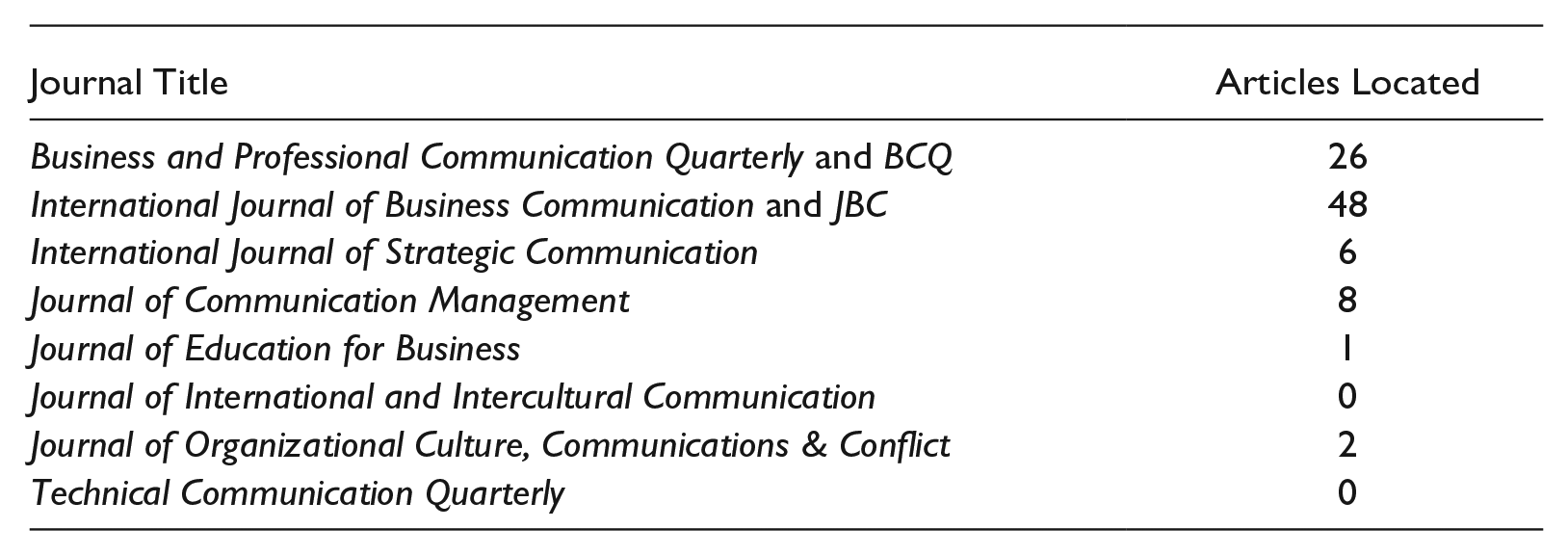
Other scholarship that focused on instructional methods, linguistics, specific national cultures, cognitive processes, organizational relationships, or external communication offered insights into emerging practices but were not included in this analysis. This left 91 published articles that provide a usable sample of business communication technologies, genre, and contexts for analysis.
Contemporary business’s rapidly changing communication practices suggest that a useful rhetorical analysis ought to draw specifically from the scholarship of rhetorical evolution (Black, 1980; Brummett, 1984; Cyphert, 2001; Farrell, 1993; McKerrow, 1989). Any human community sustains itself with a stable system of collective decision-making, governed implicitly with norms of moral relationships, actionable knowledge, and appropriate discourse, but “no community exists in stasis” (Cyphert, 2001, p. 379), and a sustainable rhetorical system must provide mechanisms for innovations and adjustments in the face of external pressures, social change, and emerging technological affordances.
Changing conditions erode the effectiveness of established decision-making methods, and as the community develops new methods, its system of rhetoric evolves to sustain them. A community’s adherence to its emerging methods of collective decision making are discursively enforced with shifting moral judgments about who should serve as participants in the various aspects of communal decision-making, philosophical negotiations about what knowledge sources and thought processes best support collective decision-making, and an evolving sense of decorum to govern how collective decision making is most appropriately and effectively performed (Cyphert, 2001). The 20th century witnessed normative change across all three elements of the West’s rhetorical system. Civic participation is no longer the exclusive province of White, landowning males. Feminist and non-Western epistemologies now share social and political credibility with Western analytics. Appropriate public discourse now includes visual, performative, and environmental meaning-making. As expected, rhetorical norms of the business community have transformed alongside those of the greater culture, and business communication pedagogy has transformed accordingly (Du-Babcock, 2006; Waldeck et al., 2012), adapting to increasing numbers of non-male, non-Western, and non-White professionals, broader attention to subjective, cultural, and tacit knowledges, and adoption of visual, performative, and physical communication modalities.
As the business community has responded to an increasingly unpredictable environment of complex interactions and limited resources well into the 21st century, observers have described the normative shifts largely in terms of managerial practice. From ancient times, humans have organized themselves to accomplish tasks as varied as agriculture, shipbuilding, water distribution and warfare, with various hierarchical and distributed structures. With the industrial revolution and explosive growth of corporate enterprise, the modern notion of management emerged as an intentional system of “getting things done through others” (Koontz & O’Donnell, 1955, p. 3). Subsequent theorists (e.g., Drucker, 2008; Herzberg, 1968; Mintzberg, 1973; Peters & Waterman, 1982; Senge, 1994) have refined best practice but continue to presuppose hierarchical relationships among managers who set goals and organizational members who plan, organize, and implement plans to meet those goals. As shifting conditions call for new ways of choosing and organizing collective corporate action, the results are typically described as shifts in management practice, but a rhetorical perspective permits a richer understanding of these normative shifts.
The presumption that organizations should be structured to implement premeditated goals is itself the product of a specific rhetorical context. Most management scholars observe changes in the effectiveness of various practices to meet stated business goals and interpret those activities from within the framework of Western individualism, empiricism, and free market economics that gave rise to the industrial revolution in the first place. Rhetorical norms of the Enlightenment sustain a goal-directed hierarchy as the normative method of collective organizational action, and despite evolving practice and significant changes in the structure, complexity, and social integration of modern organizations, management theories developed after World War II persist as the norm (Suddaby et al., 2011). Only through a rhetorical lens do adjustments in the underlying norms of appropriate relationships, actionable knowledge, and effective decision making come into focus, and while still relatively uncommon, rhetorical analysis has become an increasingly appreciated methodology in management scholarship (Browning & Hartelius, 2018).
An Analysis of the Rhetorical Evolution in the Business Community
Given that any rhetorical community sustains itself with norms of moral participation, actionable knowledge, and appropriate discourse performance, and that these evolve in response to internal or external exigencies (Cyphert, 2001), the first round of analysis was simply to categorize the primary topic of the published research into these four normative functions: participants in contemporary communication processes, sources of information being utilized for business decisions, appropriate communication methods, and emerging exigencies that call for an adaptation or adjustment in business communication practice.
The second step of analysis involved a review of the rhetorical and management scholarship relevant to emerging communication practices. Corporate discourse has been examined from multiple directions, but two streams of research focus specifically on norms of collective decision making. A summary of that scholarship led to working hypotheses of emerging norms within each rhetorical function.
One important driver of corporate change for the past century has been the increasing resource demands of a global economy. Across the early 2000s, the popular business press documented corporate recognition that sustainable business practices required “continuous, successful adaptation to an ever-changing environment” (Cyphert, 2021, p. 243). At that time, theorists in corporate social responsibility (CSR) predicted that responsive discourse practices would come to value relationships over administrative goals, replace instrumental communication methods with holistic information processing, and use performative, material discourses at least as often as explicit linguistic argument (Cyphert, 2004c; Cyphert & Saiia, 2009).
Over the next two decades, practitioner advice has demonstrated the general corporate adoption of such practices (Cyphert, 2021), which management and organizational theorists have begun to describe in terms of complex, adaptive, learning or self-organizing organizations (Freedman, 1992; Holling, 1978; Senge, 1994; Stacey et al., 2000; Walters, 1986). The corporate understanding of effective management is observed to be shifting away from its original definition as an explicit, top-down effort to efficiently marshal resources in pursuit of strategically determined goals toward an organizational effort to inspire “antifragile” structures of layered, distributed, autonomous agents able to harness and learn from their own errors and drive system-level decisions that ensure the entire organization’s long-term survivability (Taleb, 2012). These emerging principles have been described in terms of networked relationships, implicit epistemologies, and visual and performative decision-making processes (Senge, 2000; Stacey et al., 2000).
Both the CSR and management literatures draw on newly understood principles of complex adaptive systems, so a great deal of conceptual overlap might be expected. This leads us to consider a third set of hypotheses based on an assumption that emergent discourse practices are effective because they support complex, adaptive organizations, which are defined as successfully functioning aggregates of myriad autonomous, simple choices (Cilliers, 1998; Holland, 1995) made within an information environment that offers value feedback (Cilliers, 1998; Waldrop, 1992) and diverse options (Holland, 1995) to allow spontaneous, collective learning (Capra, 1997; Johnson, 2007).
These three literatures hypothesize specific business practices across all three foundational rhetorical norms of participation, epistemology, and performance. Reviewing each set of articles categorized as focusing on each parameter, we looked specifically for evidence to support the relevant hypotheses.
Who Participates: Identity, Power, Participation, and Relationship
Over the past ten years, 14 business communication articles (15.4%) addressed business practices in terms of the participation of specific classes of business professionals. Seven addressed communication practices between supervisors and subordinates (Bisel et al., 2012; Braun et al., 2019; Clifton, 2012; Kingsley Westerman et al., 2018; Mikkelson et al., 2015, 2019; Steele & Plenty, 2015), three investigated the effects of communication practices with diverse employees (Favero & Heath, 2012; Lauring & Klitmøller, 2017; Lee et al., 2021), three examined generational changes (Hall, 2016; Omilion-Hodges & Sugg, 2019; Rentz, 2015), and one looked specifically at creating organizational identity among new employees (Rajamäki & Mikkola, 2021). Descriptions of contemporary practices were noted, along with any indication that these were new or emerging methods or that participation norms were evolving. Authors’ assessments of perceived causes, exigencies, or consequences were also examined, along with any explanatory references to management or rhetorical theories. All three working hypotheses were supported to some extent, but a rhetorical frame offers other insights as well.
More attention to the specifics of relational communication was clearly deemed a priority for effective business and managerial communication pedagogy, but relationships were not valued over task management as predicted in the CSR literature. Instead, a balance of effective relational and task communication was generally recommended. However, when recognizing the emergent rhetorical system as three mutually reinforcing parameters (Cyphert, 2000, 2001), the increasing importance of relational communication becomes more obvious. For instance, the emerging communication technologies discussed in the selected articles are overwhelmingly valued for their capacity to build relationships with a variety of stakeholders, and very few communication techniques were deemed valuable for instrumental purposes. Similarly, rhetorical analysis presupposes the existence of rhetorical community, which only exists when normative processes reinforce themselves and each other over time (Farrell, 1993). Thus, when internal social media platforms are described in terms of their role in the construction of organizational identity as foundational to workers’ capacity for participation (Madsen, 2016), their rhetorical function becomes apparent, further reinforced by Madsen’s observation that the platforms allow the sharing of organizational narratives, an emerging epistemological tool also recognized by authors examined. Such mutually constitutive reinforcement across all three normative categories is to be expected (Cyphert, 2000, 2001), and their observation in practice is noteworthy.
All authors recognized the value of supervisor-subordinate relationships, and several investigated the specifics of effective relational communication, demonstrating the importance of appropriate communication channels (Braun et al., 2019), and embedding positive relational cues within all communication (Mikkelson et al., 2019). There was some indication that authors recognized the importance of relationships as a newly emerging social or ethical value, but causes were more typically traced to the same broadened participation seen in the larger culture that demanded practices to allow diverse language use in multinational organizations (Lauring & Klitmøller, 2017; Lockwood & Song, 2020) and the inclusion of newly enfranchised underrepresented groups (Lee et al., 2021) and younger (i.e., Millennial, Gen Y) workers (Omilion-Hodges & Sugg, 2019; Rentz, 2015) in the contemporary workplace.
Similarly, the recommendations of adaptive management theorists for networked relationships were only tangentially observed. Perhaps because of an instructional focus on the preparation of students for entry-level positions, this research focused on internal communication functions, even though broader reviews demonstrate the importance of competent communication with clients, vendors, competitors, and venture capitalists (Waldeck et al., 2012). Similarly, researchers investigating specific technologies addressed both internal and external communication contexts, and James Porter (2017) emphasized that communication channels able to maintain “ongoing and fruitful relationships” constitute a “primary purpose of professional communication” (p. 175).
No communication practices were specifically identified to support distributed decision making or autonomous choice agents called for by complexity theorists, but some authors recommended practices that support an emerging norm of broad participation both within and across traditional boundaries of corporate problem solving. As Bisel et al. (2012) point out, micro-level analyses of supervisor-subordinate interactions must be understood in terms of structural effects on organizational learning. Similarly, communication practices developed by successful organizational newcomers are shown to involve “developing reciprocity, seeking and perceiving acceptance and becoming an active member” (Rajamäki & Mikkola, 2021, p. 18).
A rhetorical perspective foregrounds the fundamental importance of community membership. The fully participating citizen does not spring forth in a moment. Children and barbarians, shaped by normative disciplines, grow into the role (Cyphert, 2001). New employees learn the rhetorical rules of their new community and their rhetorical competence vetted before they can be trusted to participate (Cyphert, 2004a). The practices described by several authors involve more than simply expanding participation to more diverse organizational members. The observed practices aim as well toward “boatrocking” (Bisel et al., 2012, p. 135) and “active” membership (Rajamäki & Mikkola, 2021, p. 24). Many writing instructors refer to this rhetorical growth as development of the students’ voice. The emerging adaptive organization cannot survive unless every member has the communicative and rhetorical competence to fully participate in its collective learning, sensemaking, and decision making. Practices that foster a broader capacity for meaningful participation seem to support the hypothesized evolution toward autonomous decision-making behaviors.
What Counts: Knowledge, Knowers, and Relevant Data
Another 21 articles (23.1%) focused on the knowledge sources used in business communication practice. Three tackled artificial intelligence resources (Getchell et al., 2022; Naidoo & Dulek, 2022; Salomonson et al., 2013), three assessed the communication of emotions (Casado-Molina et al., 2022; Pickering, 2018; Xu & Wu, 2020), three focused on tasks of information gathering and storage (Craig & Allen, 2013; Gómez & Ballard, 2013; Young, 2018), five on the visualization of data (Jones et al., 2020; Kernbach et al., 2015; Laidroo, 2019; Melis & Aresu, 2022; Toth, 2013), and four on the business uses of personal stories (Yang, 2013) and narrative more generally (Aggerholm, 2014; Laskin, 2018; Rawlins, 2014). Three articles directly address the norms of rational thinking expected in the business environment (Geertshuis et al., 2015; Mandhana, 2022; Simonsson & Heide, 2018). Articles were examined in terms of knowledge sources identified as well as norms of evidence, decision support, or information use within an effective business context, anticipating support for the predictions of CSR theorists, models of learning organizations, and complexity research more generally.
As with participation norms, theoretical predictions of more holistic, nonlinear epistemology have only been partially realized. A broader range of epistemologies supports more diverse participation, however, and the implicit cognitive processes required for interpretation of visual data displays and narrative have been documented elsewhere. The CSR prediction that holistic rules would replace instrumental standards was not upheld, but the research recognizes that organizational structure and communication networks are critical and more relevant to success than a message’s adherence to specific genre constraints (Bisel et al., 2012; Craig & Allen, 2013; Gómez & Ballard, 2013; Simonsson & Heide, 2018; Young, 2018). Authors identified emergent rules of error identification (Simonsson & Heide, 2018), information allocation and collective reflexivity (Gómez & Ballard, 2013), channel symmetry (Young, 2018), and boundary crossing (Jameson, 2014). Dron Mandhana (2022) and Bisel et al. (2012) make the further point that individual competence is only part of professional success; communicators cannot function effectively without an organizational network that provides contextual and structural support for effective communication practices.
Professional uses of implicit forms of reasoning and tacit knowledge are well documented in this selection of articles, including emotional content (Casado-Molina et al., 2022; Pickering, 2018; Xu & Wu, 2020). Important communications are no longer exclusively textual, and many authors addressed the specifics of visual display (Jones et al., 2020; Kernbach et al., 2015; Laidroo, 2019; Melis & Aresu, 2022; Toth, 2013) and narrative structure (Aggerholm, 2014; Laskin, 2018; Rawlins, 2014; Yang, 2013).
A fundamental shift from analytical, goal-seeking, planning practice toward an “authentically non-teleological” reliance on tacit process of the organization as a whole (Stacey et al., 2000) were not observed, although theoretical articles beyond the scope of this project demonstrate the business communication field’s awareness of these larger issues (Fillion et al., 2015). Management theorists have not fully accepted the philosophical transformations implied by complexity theorists (Mowles & Norman, 2022; Stacey et al., 2000; Taleb, 2012), so we should not be surprised that corporate communication practices do not yet reflect any widespread devaluation of explicit analysis.
We do find discussions of ongoing rhetorical evolution. Visual images are not merely illustrative displays, but understood by these authors as critical elements of ethos, playing roles in impression management (Jones et al., 2020; Laidroo, 2019; Melis & Aresu, 2022) and affect (Kernbach et al., 2015), and logos, tapping into the implicit cognitive processes (Toth, 2013) that managers are learning to utilize more fully. Similarly, storytelling has evolved from a secondary tool of pathos and ethos toward acceptance as a form of logos for its psychological functions in “deliberate decision making, rational planning, and control” (Yang, 2013, p. 132).
Communication practices described in these articles showed no evidence of the simple choices and immediate feedback loops called for by complexity theorists, but these structural features constitute internal information gathering and decision-making processes that lie outside the discipline’s traditional scope. Enhancing employees’ capacity for autonomous decision making were named as the goal of relationship building (Bisel et al., 2012; Rajamäki & Mikkola, 2021) as well as several technologies discussed in the next section, but the specifics of any emerging business practice are yet to be explored.
How to Decide: Performative, Material Discourses With Multiple Players
Not surprisingly, most (48.4%) pedagogical attention to communication practices dealt with the specific communication technology used. A total of 44 articles examined both traditional communication formats, such as text documents (Bremner, 2014; Decock et al., 2020; Diaz, 2013; Duncan & Hill, 2014; Koskela, 2018; Maier & Anderson, 2014; Nell et al., 2018) and meetings (Baraldi, 2013; Ewing et al., 2019; Nielsen, 2013; Scott et al., 2013; Tiitinen & Lempiälä, 2022), and formats deemed new, including electronic and social media (Bülow et al., 2019; Hastings & Payne, 2013; Jameson, 2014; Jansen & Janssen, 2013; Kiddie, 2014; Machili et al., 2019; Macnamara & Zerfass, 2012; Marlow et al., 2018; Moore, 2019; Rapanta & Cantoni, 2017; Stephens & Barrett, 2016; Turnage & Goodboy, 2016), internal communication platforms (Anders, 2016; Aten & Thomas, 2016; Cardon & Marshall, 2015; Cowan & Horan, 2021; Darics, 2014, 2020; Gode, 2019; Madsen, 2016, 2017; Pazos et al., 2013; Porter, 2017; Rollins & Lewis, 2012; Uysal, 2016), cell phones (Washington et al., 2014), and teleconferencing (Halbe, 2012). Several authors addressed the increasing importance of interpersonal communication across various settings (Bradley & Campbell, 2016; Hynes, 2012; Jian & Dalisay, 2018; Mazzei et al., 2012; Van De Mieroop & Vrolix, 2014). The articles were examined in terms of performative and material discourse options with special attention to distinctions between linguistic and performative forms, support for holistic sensemaking processes that might support the predictions of CSR theorists, models of learning organizations, and complexity research more generally.
Once again, the predicted changes have not fully materialized, but the research confirms the general direction of normative change. The articles were first examined in terms of the CSR theorists’ predictions that performative, material discourses would be valued equally with explicit linguistic argument. While it could not be said that these authors discounted linguistic communication elements, attention to performative and material elements of any communication encounter was clear. Channel choices matter to relationships (Jansen & Janssen, 2013) and competence in the performance that is interpersonal communication is critical (DeKay, 2012; Hynes, 2012; Jian & Dalisay, 2018). Several investigations focused on the materiality of the communication channels themselves, noting their fundamental importance (Porter, 2017) as well as the interrelationships between relational and cognitive elements of professional communication (Darics, 2014; Halbe, 2012; Madsen, 2017; Rapanta & Cantoni, 2017; Tiitinen & Lempiälä, 2022) and the rhetorical potential of textual genre (Koskela, 2018).
On the other hand, a number of authors explored the growing assumptions that relationship building was key but demonstrated that a lack of relational elements did not necessarily compromise the effectiveness of customer service (Decock et al., 2020), employee appraisals (Van De Mieroop & Vrolix, 2014), or conflict interactions (Bülow et al., 2019), suggesting that explicit linguistic content remains central to business communication practice.
As noted in the previous section, visual rhetoric has emerged as a significant element of business communication, fully supporting the predicted move toward epistemological norms of holistic apprehension of visual information and the need to master visual technologies. Within this sample, there were virtually no examinations of specific visual technologies (i.e., graphics platforms, presentation and report decks, video production, etc.), but by 2012, these had been widely adopted and perhaps offered no new research questions. Only Twitter seemed to pose a performance query (Stephens & Barrett, 2016).
Instead, researchers’ attention has shifted to more nuanced issues of balancing content and visual sources of knowledge as well as message design to accommodate multiple communication channels (Diaz, 2013). Emergent practices associated with internal communication networks garnered the most attention. Several authors explored existing norms, such as gender usage patterns (Moore, 2019), organizational position (Turnage & Goodboy, 2016), and task effectiveness (Pazos et al., 2013), but several demonstrate the emerging concern for more robust communication networks discussed earlier. Younger workers expect enterprise social networking platforms will be the primary tools for team communication in the future (Cardon & Marshall, 2015). Research demonstrates the capacity of internal communication networks to integrate diverse communication and information sources for more effective information sharing and collaboration (Anders, 2016), building a sense of community (Uysal, 2016) and facilitating multiple, diverse perspectives (Aten & Thomas, 2016).
Complexity theorists’ predictions that communication practices should foster diversity and multiplicity of options was the most obvious finding within the articles addressing specific technologies. Rather than concern for form or content, authors seemed to show a consistent focus on the twin goals of accessing and sharing information across multiple, diverse sources or stakeholders. Specific topics included the strategic uses of email to engage multiple perspectives (Hastings & Payne, 2013; Machili et al., 2019), managing communication designed for multiple audiences (Duncan & Hill, 2014), messages produced by diverse participants (Baraldi, 2013; Bremner, 2014; Nielsen, 2013), and utilizing diverse information sources (Craig & Allen, 2013). Only a few authors explicitly mentioned the goal of organizational learning (e.g., Scott et al., 2013), but they describe communication practices that would facilitate the diversity and multiplicity of perspectives and options required for that result.
Rhetorical Exigencies and Reviews
A fourth group of 12 articles (13.2%) focused primarily on specific contexts of increased interest to business communication scholars: after-hours communication (Kim & Chon, 2022), startups (Wolf et al., 2022), change management (Dulek, 2015), and distributed or virtual organizations (Aritz et al., 2018; Berg, 2012; Lockwood & Song, 2020; Newman et al., 2020; Smith et al., 2018; Viererbl et al., 2022). Three articles reviewed emerging practices across business organizations more generally (Coffelt & Smith, 2020; Cyphert et al., 2019; Waldeck et al., 2012). While these authors did not make distinctions between new and continuing communication practices, the described situations provided useful insights. Dulek (2015), for instance, describes contrasting communication practices as one organization changed from controlled to open information sharing, a key element of complex systems. Two reviews of entry-level skill requirements emphasize the degree to which competence depends on socialization within the organization’s rhetorical norms (Coffelt & Smith, 2020; Cyphert et al., 2019) and a study of virtual team practices noted that the combination of tools and practices in context is critical (Newman et al., 2020).
Conclusions and Implications
Rhetorical change is continuous, incremental, and largely invisible to those involved in the evolutionary process. Even when observed, specific practices might not be interpreted as evidence of emergent norms. Those who resist or ignore the rhetorical norms of a community are typically presumed to be ignorant, deviant, or foreigners (Cyphert, 2010), and we find several authors assuming that normative differences are violations rather than adaptive change. Smith et al. (2018) for example, recognize the importance of Instant Messaging to job satisfaction of teleworking employees, but register surprise that a “supplementary” (p. 60) communication channel could be so important. Gen Z values are observed to reflect predictable normative change, but some researchers conclude that younger workers should not expect their preferences to be supported in the workplace (Omilion-Hodges & Sugg, 2019; Rentz, 2015) or to function as change agents (Kiddie, 2014).
Reviewing the past decade of scholarship with a predictive rhetorical model, however, discovers evidence of evolving practices that seem to support the theoretical predictions that contemporary management will increasingly require communication practices that support broad and robust organizational relationships, diverse sources and methods of knowledge gathering and use, and broadly participative techniques for collaborative decision making. Although this result is gratifying, two additional points can be drawn.
First, rhetorical concepts in the classroom provide explanations for communication practice that are more satisfying to the young workers, early adopters and new employees described in the research. These employee categories represent the students currently in our classrooms, and they are not well served by normative instruction that teaches traditional business practice as an ideal form (Darics, 2020). New entrants cannot be expected to see, respond to, or ultimately design change unless they are able to recognize exigencies as actionable moments; rhetorical norms adapt only as new voices become functioning participants in the discourse community (Cyphert, 2022). A practical treatment of rhetorical theory leads to better pedagogy: To the extent that we understand and teach the relationships among corporate actions, expectations, and communications, we better prepare our students for a future of continuously evolving norms. Those who approach business communication as rhetorical critics, seeking to recognize, define, and explain the emerging rhetorical norms of business practice, are advancing pedagogy in ways that we ought to recognize, embrace, and applaud.
Second, this exploration highlights the potential to leverage the discipline’s sentinel position to make significant advances in theory. To instructors’ credit, business communication pedagogy responds to shifts in corporate practice, but ad hoc investigations of emerging practice create confusion that can be avoided by taking a theoretically grounded rhetorical perspective. For example, the move away from assertive, instrumental epistemologies toward more holistic cognitive values has been read as support for feminist values (Lipman, 2022), missing the theoretical observation that both business organizations and Western culture more generally have begun to recognize the limitations of hierarchical structure, logical positivism, and agonistic discourse forms (Foss & Griffin, 1992; Fox Keller, 1985). Similarly, important complexity principles of information sharing are missed when relationship building practices are explained as solace for workers craving more attention to their “emotions and personality” (Nason, 2017, p. 115).
Rhetorical theory systematically identifies patterns of change and provides a capacity to posit causal relationships. Even this brief examination of emerging practices offers insights into the dynamics of rhetorical evolution. Contemporary practices appear to support complex, adaptive management theories while explaining seemingly disparate management practices associated with knowledge management (Garfield, 2017), adaptive learning organizations (Sarder, 2016; Senge, 1994), and distributed decision making (Vantrappen & Wirtz, 2017), offering the potential to understand and advance the development of effective organizational decision making. In an era that faces hugely disruptive discourse practices driven by the inevitable corporate adoption of virtual reality, artificial intelligence, and whatever comes next, a rhetorical perspective offers an explanatory framework. Technology drives change, to be sure, but a sustainable rhetorical community necessarily evolves norms to ensure its continuing capacity for effective collective action.
Western cultures have historically relied on academics to interrogate and retheorize dominant norms (Diaz-Guerrero, 1985), even as we guide our students to productively and effectively communication in accordance with those norms. The dual role we play as pedagogues and scholars includes inherent contradictions; we socialize our students into normative values, roles, and practices of the business community, even as we recognize, and sometimes research, the power disparities and structural disciplines that are sustained by those same values (Darics, 2021). Our challenge is to embrace that dual role. With careful attention to specific instances of business practice, we can better guide our students even as we advance theories of rhetorical change and management practice. As we explain these practices within a rhetorical frame, we are also able to identify emerging norms of who is allowed to participate, what forms of knowledge are deemed valuable, and how appropriate discourse facilitates decisions that effectively sustain the organization. Aided by a rhetorical perspective, we can identify and interrogate normative assumptions and emerging principles of organizational success and contribute to scholarship from within our own pedagogical position.
Footnotes
Declaration of Conflicting Interests
The author declared no potential conflicts of interest with respect to the research, authorship, and/or publication of this article.
Funding
The author received no financial support for the research, authorship, and/or publication of this article.
