



Abstract
This study examines how leaders’ strategic use of motivating language, direction-giving, empathetic, and meaning-making, encourages employee support for Corporate Social Advocacy (CSA). Grounded in Motivating Language Theory and the Theory of Engagement, we argue that such communication enhances employees’ psychological meaningfulness of CSA and their perceived value alignment between the initiative and the organization. These perceptions serve as psychological mechanisms linking leadership communication to employees’ advocacy intentions, positive megaphoning, and organizational trust. An online survey of U.S. full-time employees revealed that all three language types increased perceived psychological meaningfulness, while only empathetic and meaning-making language strengthened perceived value alignment after accounting for employees’ personal issue attitudes. Both psychological meaningfulness and value alignment significantly predicted employees’ supportive responses. The findings highlight the distinct contributions of motivating language dimensions and emphasize their strategic importance for fostering employee engagement and internal support for organizational advocacy efforts.
Keywords
Introduction
Companies are increasingly expected to take public positions on salient sociopolitical issues, ranging from climate change and immigration to gun control, LGBTQ+ rights, and gender pay equity (Austin et al., 2019; Browning et al., 2020; M. Dodd, 2018; J. K. Kim et al., 2020). Patagonia’s opposition to Arctic drilling (Patagonia, 2023) and Delta Airlines’ decision to end NRA member discounts illustrate how such engagement has moved beyond symbolic messaging toward active efforts to shape public opinion and influence policy (Y. Kim, 2025a, 2025b). Scholars conceptualize this phenomenon as corporate social advocacy (CSA), defined as corporate communication and action on sociopolitical issues intended to influence public opinion and policy (Y. Kim & Meganck, 2024). As CSA has grown in visibility, it has drawn increased attention from diverse stakeholders, including consumers, shareholders, and employees (Bedendo & Siming, 2021; Hambrick & Wowak, 2021), and has emerged as a prominent research domain in public relations and business communication (Y. Kim & Meganck, 2024).
Despite this growing interest, CSA research has focused primarily on external consequences, particularly reputational risks and stakeholder backlash associated with controversial issue engagement (Rim et al., 2024), while internal stakeholders, especially employees, remain comparatively understudied (Y. Kim & Meganck, 2024). This gap is consequential as employees are not only key stakeholders but also direct interpreters and implementers of CSA initiatives. Without employee buy-in, even well-intentioned CSA efforts may fail internally before achieving external impact. Accordingly, recent scholarship emphasizes an “inside-out” approach that prioritizes internal alignment and employee endorsement (Y. Kim, 2024b, 2025b; Y. Kim & Meganck, 2024). When employees perceive CSA as a genuine reflection of organizational values and as meaningful, it is more likely to sustain organizational credibility and resonate externally. Conversely, when CSA is perceived as misaligned or performative, internal resistance can emerge and undermine organizational effectiveness (Yang et al., 2022). Understanding how employees cognitively interpret CSA and come to support it is therefore essential to the success of corporate social initiatives.
To address this, this study draws on motivating language theory (Sullivan, 1988) and proposes that leaders’ use of motivating language in internal CSA communication is central to shaping employees’ perceptions of CSA and fostering their support. Motivating language comprises three dimensions: direction-giving language, which reduces uncertainty and clarifies expectations; empathetic language, which acknowledges employees’ feelings and concerns; and meaning-making language, which connects organizational actions to broader purpose and values (Sullivan, 1988). Prior research demonstrates that motivating language strengthens trust, enhances team dynamics, and promotes employee advocacy across organizational contexts (J. Mayfield & Mayfield, 2010; Thelen & Men, 2023). Recent CSA research similarly identifies leadership communication as a key determinant of employee responses to sociopolitical initiatives (Y. Kim & Meganck, 2024; Yang et al., 2022).
Building on this foundation, this study advances prior studies by focusing on the psychological mechanisms through which motivating language shapes employee responses to CSA. Existing research has largely emphasized relational mechanisms, particularly employees’ identification with their leaders or organizations, as the primary pathway linking leadership communication to employee support (Kim & Meganck, 2025; Thelen, 2021; Yang et al., 2022; Yue, 2025). While important, identification-based explanations do not fully account for how employees evaluate the meaning and value congruence of CSA initiatives themselves. Identification-based support and cognitively evaluative support represent conceptually distinct forms of endorsement. The former is relational in origin: employees may support CSA as an extension of organizational attachment, deferring to its decisions out of belonging or loyalty. The latter is grounded in employees’ substantive appraisal of whether CSA is socially meaningful and genuinely reflective of the organization’s core values, a form of endorsement anchored in judgment rather than relational sentiment, and therefore more stable and more likely to translate into consistent advocacy behavior. This distinction carries particular weight in the CSA context, where employees bring pre-existing values, beliefs, and political orientations to their evaluations of organizational positions (Hambrick & Wowak, 2021). In such contexts, employees are unlikely to rely solely on relational cues; rather, they actively assess whether CSA initiatives are socially meaningful and truly reflective of organizational values. This process aligns with dual-process theories of attitude formation, which distinguish between peripheral processing driven by affective cues and central processing driven by substantive evaluation of the message itself (Petty & Cacioppo, 1986). Attitudes formed through central processing are more stable, resistant to counter-persuasion, and predictive of behavior than those formed through peripheral routes (Ajzen, 1991; Petty & Cacioppo, 1986). Identification-based explanations, while valuable, are therefore insufficient to fully explain when and why employees genuinely endorse CSA. This study addresses this gap by focusing on two key evaluative mechanisms including psychological meaningfulness of CSA and perceived company-CSA value alignment. Accordingly, this study asks how leaders’ motivating language in CSA-related internal communication shapes employees’ perceptions of CSA as meaningful and value-aligned, and how these perceptions translate into supportive employee behaviors.
This study makes three contributions. First, it extends motivating language theory to the CSA context by examining how leadership communication shapes employee interpretations of sociopolitical initiatives. Second, it identifies psychological meaningfulness and perceived value alignment as distinct mediating mechanisms, offering a theoretically precise account that moves beyond identification-based explanations. Third, by disaggregating the dimensions of motivating language, it demonstrates that empathetic and meaning-making language play a particularly critical role in fostering value alignment and trust in contested sociopolitical contexts. These findings are expected to reposition CSA from a reactive, risk-laden practice to a strategically integrated organizational endeavor grounded in employee understanding and support.
Literature Review
Leadership Communication and CSA
Internal communication plays a critical role in shaping employee attitudes and behaviors by enabling coordination toward organizational goals and fostering relationships across hierarchical levels (Berger, 2008; Men & Stacks, 2014; Welch & Jackson, 2007). This function becomes particularly consequential in the context of corporate social advocacy (CSA), where organizations engage with contested sociopolitical issues that require not only external positioning but also strong internal alignment. Because CSA often involves value-laden and potentially divisive issues, employee endorsement is essential for sustaining organizational coherence and credibility (Kim & Meganck, 2025; London, 2018). Accordingly, internal communication serves as a central mechanism through which organizations align employees’ understanding of and engagement with CSA initiatives. Within this process, leadership communication occupies a uniquely influential role. Leaders are responsible for interpreting organizational actions, articulating their significance, and guiding employees toward shared understanding, particularly in situations characterized by ambiguity or controversy (London, 2018; Men & Stacks, 2014). In the CSA context, where employees must make sense of organizational positions on sociopolitical issues, leadership communication becomes a primary lens through which such initiatives are understood and evaluated. As a result, recent scholarship has increasingly emphasized the importance of leadership communication in shaping employee responses to CSA (Kim & Meganck, 2025; Yang et al., 2022). Emerging research has begun to examine how leadership communication functions in CSA-related contexts. For example, Hong and Ji (2022) demonstrate that transparent leadership communication in CEO activism influences employees’ advocacy behaviors through attributional processes. Dong and Ramli (2024) show that transformational leadership enhances employee support for advocacy initiatives, while related work indicates that such leadership strengthens employee–organization relationships and promotes advocacy behaviors (Kim & Meganck, 2025). Similarly, Ghorbanzadeh et al. (2023) find that leaders’ empathetic and attentive communication fosters stronger relational bonds and encourages employee advocacy. These studies underscore the importance of leadership communication in mobilizing employee support for CSA. However, they predominantly conceptualize leadership communication at a general or style-based level (e.g., transparency, transformational leadership), offering limited insight into how specific communicative features shape employees’ interpretations of CSA initiatives themselves. To address this gap, this study adopts Motivating Language Theory (Sullivan, 1988). By focusing on distinct language functions, this approach offers a more precise understanding of how leadership communication shapes employees’ interpretations of CSA initiatives.
Leadership’s Motivating Language in the Context of CSA
Motivating Language Theory (MLT), initially proposed by Sullivan (1988), provides a robust and empirically supported framework for understanding how leaders’ strategic use of language influences employee motivation and organizational outcomes (M. Mayfield & Mayfield, 2004). Central to MLT is the premise that effective leadership communication extends beyond the transmission of information and functions as a strategic mechanism for motivating employees. This is achieved through the deliberate use of three distinct but complementary forms of language: direction-giving language, which provides essential clarity and guidance; empathetic language, which fosters interpersonal connection and understanding; and meaning-making language, which aids employees in comprehending the broader purpose and significance of their contributions. Prior research has consistently demonstrated that leaders’ use of motivating language positively influences a range of employee outcomes in organizational settings, including job satisfaction, performance, innovation, and organizational commitment (J. Mayfield, 1970; J. Mayfield et al., 1998; M. Mayfield & Mayfield, 2004). These studies show that such language use fosters a more engaged, satisfied, and productive organizational environment by reducing uncertainty, building trust, and facilitating meaning-making among employees. More specifically, direction-giving language provides employees with clear, concise information regarding expectations, goals, and reward structures, thereby reducing ambiguity and enabling employees to allocate effort more effectively (J. Mayfield & Mayfield, 2009). Empathetic language emphasizes expressions of appreciation, validation, emotional openness, and encouragement, signaling leaders’ concern for employees’ well-being and fostering supportive relationships (J. Mayfield et al., 1995; Sullivan, 1988). Meaning-making language assists employees in understanding organizational culture, values, and the rationale behind decisions, often through stories or metaphors that communicate deeper purpose and significance (J. Mayfield & Mayfield, 2009; Thelen et al., 2022).
Recognizing the positive roles of leaders’ motivating language in organizational contexts, a growing body of research has begun to apply MLT to corporate social initiatives, including corporate social responsibility (CSR) and corporate social advocacy (CSA). This line of work demonstrates that motivating language enhances organizational citizenship behaviors (Gutierrez-Wirsching et al., 2015), strengthens employee advocacy (Men, 2014a; Thelen & Men, 2023; Yue, 2025), and fosters positive communication climates that promote employee identification with leaders and organizations (J. Mayfield & Mayfield, 2017; Yue et al., 2021). Across this body of work, motivating language has largely been treated as a relational signal that strengthens employee identification, which in turn encourages support for corporate social initiatives (Y. Kim & Meganck, 2024; Yang et al., 2022). A recent study (Kim & Meganck, 2025) extends this line of research by showing that leaders’ motivating language can produce broader organizational effects, including greater organizational trust and stronger employee support for CSA. Specifically, this study suggests that motivating language embedded in the broader leadership communication climate, even when not directly addressing CSA content, can indirectly shape employee responses by prompting reciprocal reactions across organizational contexts. While this finding advances our understanding of the relational effects of motivating language, it does not fully explain how leaders’ intentional use of motivating language in CSA-specific internal communication shapes employees’ interpretations of CSA initiatives.
To summarize, prior research has established the relational value of motivating language, emphasizing how it strengthens organizational identification and elicits reciprocal employee responses. While valuable, this body of work primarily highlights indirect pathways through which leadership communication influences employee support, whereby positive impressions of leaders’ language generate generalized affective responses toward the organization, which then carry over to CSA. As a result, it does not fully account for how motivating language shapes employees’ substantive judgments about CSA initiatives themselves, particularly the cognitive evaluative processes through which employees assess whether CSA is meaningful and aligned with organizational values. From a sensemaking perspective, employees actively interpret organizational actions to understand their meaning, implications, and alignment with organizational identity (Weick & Weick, 1995). Accordingly, the value of Motivating Language Theory in this context lies in explaining how leadership communication directly shapes employees’ interpretations of the focal issue, CSA itself, rather than primarily operating through indirect pathways such as how such language influences employees’ general feelings toward the organization. Therefore, unlike previous studies, this study proposes that employees’ perceptions of CSA initiatives (specifically, psychological meaningfulness and perceived company-CSA value alignment) as shaped through leaders’ motivating language, function as critical evaluative mechanisms through which employees determine whether such initiatives merit support.
Motivating Language and Psychological Meaningfulness of CSA
In this study, psychological meaningfulness of CSA is defined as the extent to which employees perceive their organization’s CSA efforts as inherently important, valuable, and worthwhile, reflecting a broader sense of purpose and contribution to the social good. This conceptualization builds on Kahn’s (1990) theory of engagement, which posits that individuals fully invest themselves in their work roles when key psychological conditions are met, among which psychological meaningfulness is central. Psychological meaningfulness has consistently been identified as a primary driver of employee engagement, satisfaction, and motivation (May et al., 2004; Thelen et al., 2022), reflecting employees’ belief that their contributions matter and thereby encouraging deeper involvement and discretionary effort (Cascio, 2003; Michaelson et al., 2014). Kahn (1990) suggests that psychological meaningfulness emerges when employees perceive their roles as intrinsically significant, particularly when such perceptions are reinforced by alignment with personal values, clarity regarding one’s role and its broader organizational relevance, and supportive interpersonal interactions. Subsequent research further highlights that meaningfulness is strengthened when employees perceive a clear overarching purpose and hold confidence in its inherent value (Lips-Wiersma & Wright, 2012; Robertson et al., 2020), enabling them to interpret their work as an authentic and purpose-driven activity rather than a purely instrumental task. Given the often contentious nature of CSA, employees may hold diverse personal views on the sociopolitical issues involved. Under such conditions, whether employees perceive CSA as meaningful at an organizational level becomes a critical determinant of their support. Leadership communication is therefore essential in shaping this perception.
A substantial body of research highlights the critical role of leadership communication in fostering psychological meaningfulness (Sullivan, 1988; Thelen et al., 2022), and the three dimensions of motivating language each contribute to this process in distinct ways. Direction-giving language enhances clarity by helping employees understand the purpose, scope, and organizational relevance of CSA initiatives, thereby reducing ambiguity and enabling more purposeful engagement (J. Mayfield & Mayfield, 2017; Men et al., 2022). Empathetic language fosters trust and supportive relationships by signaling genuine concern for employees’ well-being, strengthening the relational conditions under which meaningfulness is constructed (Sandelands & Boudens, 2000). Meaning-making language helps employees interpret the broader societal significance and moral grounding of CSA, situating organizational actions within a larger framework of purpose and values. Empirical research consistently demonstrates that these dimensions of motivating language are positively associated with employees’ psychological meaningfulness (Binyamin & Brender-Ilan, 2018; Thelen et al., 2022), and emerging evidence in corporate social initiative contexts provides initial support for extending this logic to CSA specifically (Kim & Meganck, 2025). Accordingly, we propose:
Motivating Language and Perceived Company-CSA Value Alignment
The strategic importance of company–issue fit, also referred to as issue–company congruency, is well-established within the CSR literature (Du et al., 2010; H. S. Kim & Choi, 2014; Y. Kim & Ferguson, 2019; Schmeltz, 2014). Prior research consistently demonstrates that a high degree of congruence between a company’s characteristics and its CSR initiatives elicits more favorable stakeholder evaluations, while low fit often demands additional cognitive processing and can generate skepticism or complex public responses (Du et al., 2010; Y. Kim & Ferguson, 2019; Schmeltz, 2014). While company–issue fit has been extensively examined in CSR research, studies on CSA have focused less on perceived alignment between an organization and the sociopolitical issues it advocates (Y. Kim, 2025b). Instead, a significant portion of CSA research has emphasized personal-level value alignment, the degree to which individuals perceive congruence between their own values and the company’s advocacy stance (Jin et al., 2023; J. Liu & Getz, 2024). Such alignment fosters organizational identification, brand engagement, and stronger stakeholder relationships (Hydock et al., 2020; Jin et al., 2023). Despite these established benefits, the influence of perceived congruence between CSA and the company itself remains comparatively underexplored.
This gap is partly attributable to early CSA conceptualizations that restricted advocacy to controversial, “hot-button” topics often disconnected from core business operations (Y. Kim & Meganck, 2024). Recent scholarship, however, reconceptualizes CSA as encompassing a broader spectrum of sociopolitical topics, including both emerging divisive issues and those with established social consensus, through which organizations deliberately articulate deeply embedded corporate values, shape public opinion, and cultivate social capital (Y. Kim, 2024b, 2025b; Y. Kim & Meganck, 2024). When implemented strategically with careful attention to value-congruence, CSA can evolve into a potent public relations practice that achieves societal impact while strengthening relationships with key stakeholders, including employees (Y. Kim & Meganck, 2024). This study therefore examines how leaders’ motivating language shapes employees’ perceived company-CSA value alignment, defined as the degree to which employees perceive correspondence between an organization’s core values and the sociopolitical issues it champions. This focus distinguishes the present study from prior work centered on personal stakeholder values (Jin et al., 2023; J. Liu & Getz, 2024) and addresses a gap in understanding how leadership communication fosters value alignment between a company and its social initiatives.
Consistent with the established effectiveness of storytelling in conveying organizational identity, values, and purpose (Beverland & Luxton, 2005), leaders’ motivating language is proposed as a key mechanism for shaping perceived company-CSA value alignment. Meaning-making language positively influences perceptions of organizational authenticity and reinforces employees’ understanding of an organization’s values and identity (Yue et al., 2023), enabling employees to grasp the alignment that CSA endeavors to represent. Empathetic language, by conveying genuine care and a human-centered approach, fosters value congruence by allowing employees to perceive corporate behaviors as authentic and relatable (Mullins & Syam, 2014). Direction-giving language articulates how CSA efforts correspond to the organization’s broader goals and vision, solidifying employees’ perception of how corporate behaviors reflect organizational culture (Y. Kim & Meganck, 2024; J. Mayfield et al., 2015). These dimensions of motivating language are essential for cultivating a robust perceived value alignment between the company and the sociopolitical issues it champions. Accordingly, we propose:
Effects of Psychological Meaningfulness of CSA and Company-CSA Value Alignment
This study posits that the psychological meaningfulness of CSA and perceived company-CSA value alignment are key drivers of three positive employee outcomes: advocacy intention, positive megaphoning, and organizational trust. Advocacy intention refers to employees’ active willingness to support, defend, and promote the company’s CSA initiative, both within and outside the organization, by speaking positively about its stance and efforts on the specific sociopolitical issue at hand (Y. Kim & Meganck, 2024). As such, advocacy intention is scoped specifically to employees’ responses toward CSA initiatives themselves. Positive megaphoning, by contrast, captures a broader form of favorable employee expression, describing employees’ voluntary and favorable communication about the organization as a whole to external stakeholders, encompassing actions such as sharing positive information, recommending the company, or defending its reputation (Y. Kim, 2023). Given its voluntary, verbal, and externally oriented nature, positive megaphoning has been conceptualized as a form of employee communication behavior (ECB; Kim & Rhee, 2011; Lee & Kim, 2021; Thelen, 2021), and is therefore conceptually distinct from, albeit related to, broader organizational citizenship and advocacy behaviors. Organizational trust reflects employees’ confidence in the company’s integrity, benevolence, and competence (Hon & Grunig, 1999).
Effects of Psychological Meaningfulness of CSA
Drawing on Kahn’s (1990) theory of engagement, psychological meaningfulness is a fundamental condition that enables individuals to fully invest themselves in their work across cognitive, emotional, and behavioral dimensions. Similarly, self-determination theory (Deci & Ryan, 2000) identifies meaningfulness as a key driver of intrinsic motivation. A substantial body of research consistently shows that perceived meaningfulness predicts positive employee outcomes, including job satisfaction, organizational commitment, and proactive behaviors (Li & Tan, 2013; Lin et al., 2020; May et al., 2004; Thelen et al., 2022). Building on this foundation, we argue that psychological meaningfulness of CSA functions as a proximal motivational mechanism that shapes employees’ behavioral and attitudinal responses. When employees perceive CSA initiatives as meaningful, they are more likely to experience a sense of purpose and motivational vitality that sustains engagement and encourages proactive behavior (Binyamin & Brender-Ilan, 2018; Ryan & Frederick, 1997). Prior research shows that meaningful work is positively associated with advocacy intentions, suggesting that employees who find their work meaningful are more inclined to support and promote their organization externally (Thelen et al., 2022). Psychological meaningfulness is also expected to foster positive megaphoning. Although voluntary external communication involves social risk and discretionary effort (Dyne et al., 2003), meaningfulness provides a strong internal justification that enables employees to overcome hesitation and engage in constructive expression (Binyamin & Brender-Ilan, 2016). Employees who experience higher levels of meaningfulness are therefore more likely to engage in positive organizational discourse and advocacy behaviors (Z. Liu et al., 2022; Walden & Kingsley Westerman, 2018). Finally, psychological meaningfulness is expected to strengthen organizational trust. When employees perceive CSA as meaningful, they are more likely to experience positive affect and a sense of being valued and respected, which in turn deepens trust in the organization (Chen et al., 2018). Thus, we propose:
Effects of Perceived Company-CSA Value Alignment
The alignment between corporate initiatives and organizational values has long been recognized as a critical determinant of stakeholder responses in CSR research (Becker-Olsen et al., 2006; Ellen et al., 2006; Y. Kim & Ferguson, 2019). Grounded in schema theory (Bartlett, 1932), perceived congruence facilitates information processing by allowing stakeholders to interpret organizational actions within existing cognitive frameworks, while perceived misalignment generates inconsistency and often elicits skepticism or negative evaluations (Schmeltz, 2014).Extending this logic to the CSA context, perceived company-CSA value alignment reflects the degree to which employees view the organization’s advocacy as consistent with its core values, identity, and vision. When such alignment is perceived, employees can more readily interpret CSA initiatives as coherent and credible organizational actions, increasing the likelihood of favorable responses. Prior research demonstrates that value alignment promotes supportive behaviors—including advocacy and positive word-of-mouth—while reducing negative reactions such as resistance and disengagement (Du et al., 2010; Hong & Li, 2020; Yang et al., 2022). Strong value alignment has also been shown to encourage positive megaphoning, as employees are more willing to externally promote and defend the organization when its actions are perceived as consistent and value-driven (Men, 2014; Schade et al., 2022). Alignment further enhances organizational trust by reinforcing perceptions of authenticity, appropriate motivation, and relevance (Y. Kim & Ferguson, 2019; Schaefer et al., 2019). In the CSA context, where sociopolitical engagement is inherently contested, perceived alignment is especially consequential in shaping whether employees respond with support or skepticism. Recent scholarship supports this reasoning, showing that stakeholders who recognize alignment between corporate values and advocacy efforts respond more favorably (Overton et al., 2021), and that positioning CSA as an extension of core organizational values is a key strategy for cultivating employee support (Y. Kim & Meganck, 2024). Building on this reasoning, we propose:
Figure 1 illustrates the hypothesized relationships among the variables.

Conceptual model.
Method
This study utilized an online survey administered to full-time employees in the United States during February 2025.
Sampling and Data Collection
The target population for this study comprised full-time employees residing in the U.S. To ensure a representative sample that mirrored the demographic distribution of the U.S. population, a quota sampling method was employed. Prolific, a leading online research participant recruitment platform, managed the distribution of recruitment invitations according to the predefined quota specifications. Potential participants who received an invitation and met the initial criterion of being a full-time employee in the U.S. were directed to a Qualtrics survey platform. Here, they were first presented with an informed consent document. Following consent, participants completed two additional screening questions. The screening questions evaluated two key aspects: participants’ awareness of CSA initiatives in their workplace and their recollection of leadership’s internal communications pertaining to CSA. A plain language definition of CSA was provided prior to these questions. Subsequently, participants were prompted to describe specific examples of CSA within their organizations and to indicate any related internal communications from leadership they had received. This screening process ensured that only participants with demonstrable awareness of their employers’ CSA activities and associated internal communications from leadership could proceed to the main survey. To ensure sample quality, responses with unusually short completion times or failed attention checks were automatically removed via Prolific’s screening mechanisms, yielding a final analytic sample of valid, complete responses. The main survey consisted of measures for the key study variables and standard demographic questions.
Participants
A total of 528 full-time employees participated in the online survey. The sample was comprised of 53.6% (n = 283) men, 45.5% (n = 240) women, 0.4% (n = 2) non-binary individuals, and 0.6% (n = 3) who preferred not to answer regarding gender. The average age of participants was approximately 40 years old (M = 40.89, SD = 13.75).Racially, participants identified as 64.6% (n = 341) White/Caucasian, 15.7% (n = 83) Black/African American, 7.6% (n = 40) Asian/Asian American, 8.1% (n = 43) Hispanic/Latino, 0.4% (n = 2) American Indian/Alaska Native, and 3.6% (n = 19) as another race/ethnicity. In terms of educational attainment, 6.6% (n = 35) held a high school diploma or equivalent, 18.6% (n = 98) reported some college with no degree, 43.6% (n = 230) possessed a Bachelor’s degree or equivalent, 22.2% (n = 117) a Master’s degree or equivalent, and 4.4% (n = 23) a professional degree. Household income distribution showed 9.5% (n = 50) earned less than $30,000; 22.2% (n = 117) earned between $30,000 and $59,999; 16.5% (n = 87) earned $60,000 to $79,999; 12.1% (n = 64) earned $80,000 to $99,999; and 39.8% (n = 210) earned more than $100,000. Current job tenure was well-distributed, with 6.4% (n = 34) reporting less than 1 year, 28.2% (n = 149) reporting 1 to 3 years, 25.6% (n = 135) reporting 4 to 6 years, 10.8% (n = 57) reporting 7 to 9 years, and 29.0% (n = 153) reporting 10 years or more. Regarding job position, 34.7% (n = 183) were in non-management roles, 21.8% (n = 116) in lower-level management, 33.0% (n = 174) in middle-level management, and 10.6% (n = 56) in upper-level management. The industry sectors represented varied widely, with the most common being healthcare and social assistance (13.6%, n = 72), information (11.7%, n = 62), finance and insurance (10.0%, n = 53), retail trade (9.8%, n = 52), and educational services (9.7%, n = 51). Regarding company size, the largest proportion of participants (30.1%, n = 159) worked in companies with 1,500 or more employees. Other company sizes were distributed as follows: 13.8% (n = 73) worked for companies with 100 to 249 employees, 10.4% (n = 55) with 0 to 24 employees, 10.2% (n = 54) with 250 to 499 employees, 9.8% (n = 52) with 50 to 99 employees, 8.5% (n = 45) with 25 to 49 employees, 7.4% (n = 39) with 500 to 749 employees, 5.9% (n = 31) with 1,000 to 1,499 employees, and 3.8% (n = 20) with 750 to 999 employees.
Measurements
To measure leaders’ motivating language, items were adapted from established scales (J. Mayfield & Mayfield, 2017; Men et al., 2021). This construct encompasses three dimensions: direction-giving, meaning-making, and empathetic language. The original wording of items was modified to specifically reflect the CSA context of this study. The direction-giving dimension within CSA communication was assessed using six items (J. Mayfield & Mayfield, 2017; Men et al., 2021). The empathetic language dimension was measured using 10 items (J. Mayfield & Mayfield, 2017; Men et al., 2021). The meaning-making dimension was measured with six items (J. Mayfield & Mayfield, 2017). Psychological meaningfulness of CSA was assessed using a six-item scale adapted from existing research (Binyamin & Brender-Ilan, 2018; May et al., 2004). Perceived value alignment was assessed using a five-item scale adapted from previous research (Y. Kim & Ferguson, 2019). The original wording of these items was modified to suit the specific context of the current study. Respondents were asked to evaluate how closely the CSA aligns with the company’s core values. Employees’ advocacy intentions toward CSA initiatives were measured using a four-item scale adapted from existing studies (Y. Kim & Meganck, 2024). Positive megaphoning intention was assessed via four items drawing upon previous research (Y. Kim, 2017, 2025b). Finally, trust in the organization was measured with five items adapted from Hon and Grunig (1999). Personal attitudes toward the CSA were measured using a semantic differential scale adapted from MacKenzie and Lutz (1989). Participants indicated their overall attitude toward the company’s CSA stance on a seven point scale anchored by bad/good, unfavorable/favorable, and negative/positive. All other study variables were measured using seven point Likert type scales. Internal consistency reliability for all scales, as indicated by Cronbach’s alpha coefficients, exceeded .90. All factor loadings for each item were above 0.80. The detailed information on the measurement can be found in Table 1.
Measurements.

Confirmatory Factor Analysis, Reliability, and Validity
The data analysis followed a two-step approach. First, confirmatory factor analysis (CFA) was conducted using AMOS 29 to assess the measurement model, along with tests for composite reliability, convergent validity, and discriminant validity to establish the model’s overall reliability and validity. This was followed by structural equation modeling (SEM) to test the hypothesized relationships. The CFA results indicated a great model fit (χ2/df = 2.52, CFI = 0.955, TLI = 0.951, NFI = 0.938, and RMSEA = 0.05). We assessed the composite reliability, along with convergent and discriminant validities, of the measurement model. Discriminant validity confirms that a construct’s indicators are distinct from those of other constructs, preventing inappropriately high correlations. Conversely, convergent validity evaluates how well measurement items align with their target construct, ensuring they consistently measure the intended latent variable. These assessments were conducted using Composite Reliability (CR), Average Variance Extracted (AVE), Maximum Shared Variance (MSV), and Maximum Reliability (MaxR(H)). As Table 2 shows, all CR values surpassed the recommended threshold of 0.70, and CR values were greater than their corresponding AVE values. Additionally, all AVE values exceeded the 0.50 benchmark, and every MSV value was lower than its corresponding AVE value. These results confirm the measurement model met the criteria for both convergent and discriminant validity, indicating no notable concerns regarding reliability or construct validity.
Discriminant Validity, Convergent Validity, and Composite Reliability.
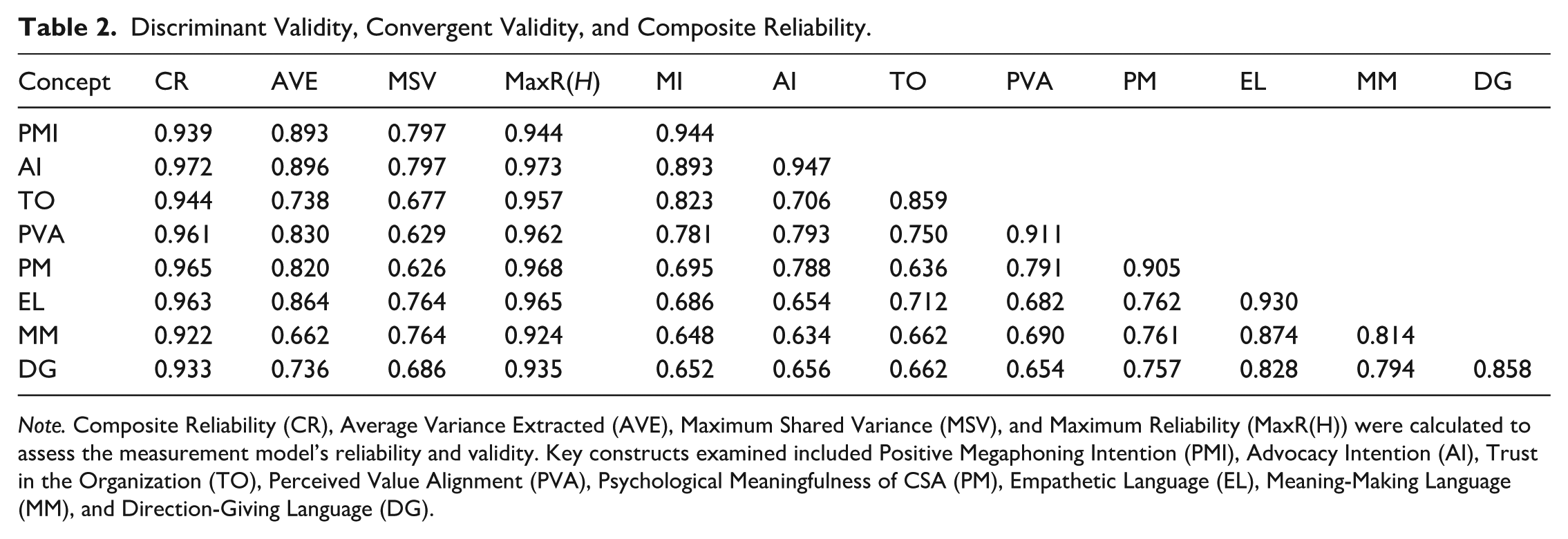
Note. Composite Reliability (CR), Average Variance Extracted (AVE), Maximum Shared Variance (MSV), and Maximum Reliability (MaxR(H)) were calculated to assess the measurement model’s reliability and validity. Key constructs examined included Positive Megaphoning Intention (PMI), Advocacy Intention (AI), Trust in the Organization (TO), Perceived Value Alignment (PVA), Psychological Meaningfulness of CSA (PM), Empathetic Language (EL), Meaning-Making Language (MM), and Direction-Giving Language (DG).
Results
To test the proposed hypotheses, two separate structural equation modeling (SEM) analyses were conducted using AMOS 29, one with a control variable and one without. Given prior research highlighting the strong influence of individuals’ personal stances on CSA initiatives (Rim et al., 2022), personal attitudes toward the CSA were included as a control variable. AThe model without the control variable demonstrated excellent fit (χ2/df = 2.7, CFI = 0.968, TLI = 0.920, NFI = 0.966, and RMSEA = 0.15). The model including the control variable also showed excellent fit (χ2/df = 1.7, CFI = 0.953, TLI = 0.920, NFI = 0.950, and RMSEA = 0.16). However, the significance of some paths differed between the two models, as shown in Figure 2. To rigorously account for the influence of personal attitudes toward the CSA, we report the model with the control variable.
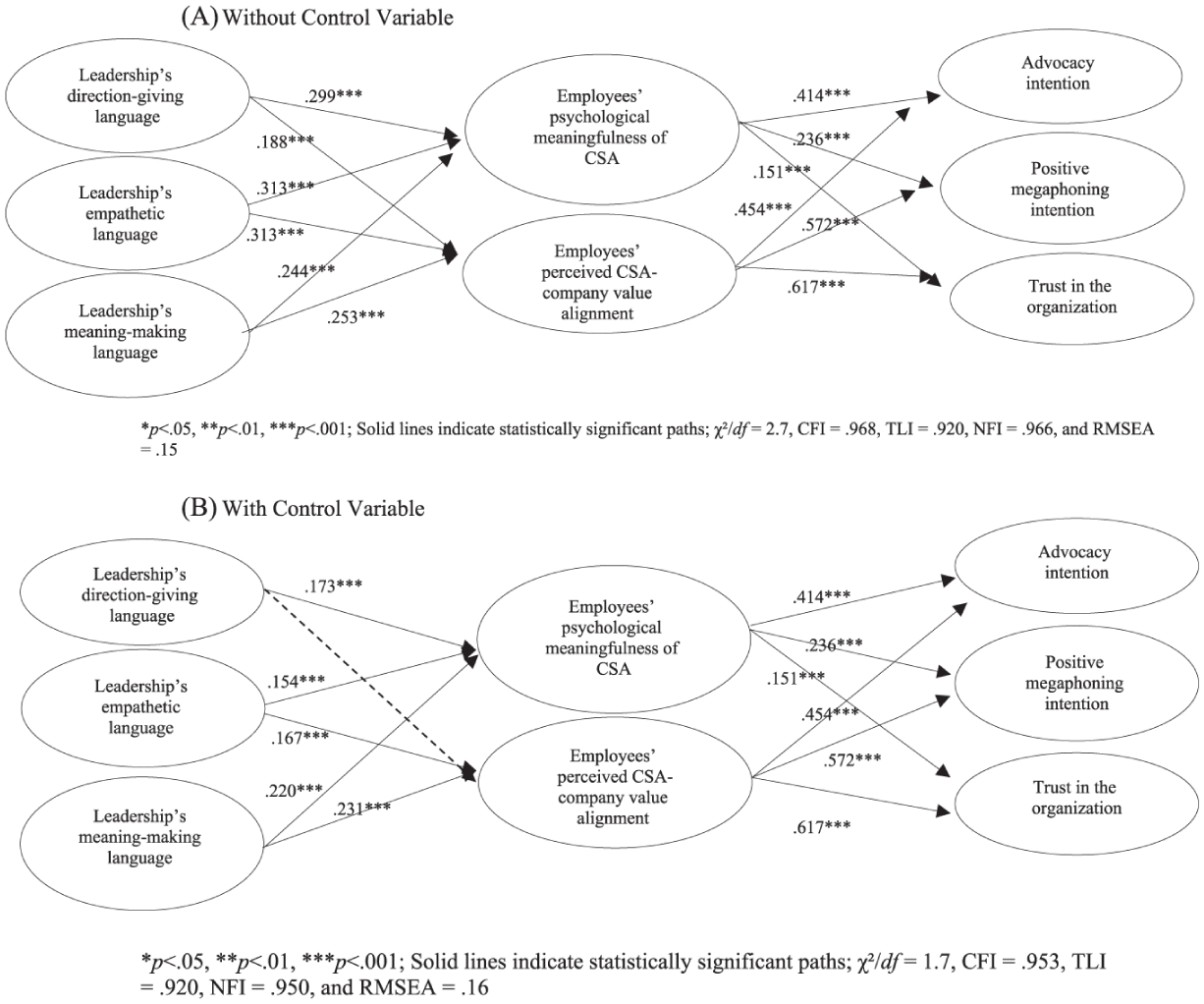
Standardized coefficient scores: (a) without control variable and (b) with control variable.
H1 predicted that leadership’s motivating language in CSA internal communication would be positively associated with employees’ psychological meaningfulness of CSA. The paths from direction-giving language (β = .173, p < .001), empathetic language (β = .154, p < .001), and meaning-making language (β = .220, p < .001) to psychological meaningfulness of CSA were all positive and statistically significant. Therefore, H1a to c are supported. H2 predicted that leadership’s motivating language in CSA internal communication would be positively associated with employees’ perceived value alignment between the company and its CSA initiative. After controlling for employees’ personal pre-existing attitudes toward CSA, direction-giving language did not have a significantly positive impact on perceived value alignment. Empathetic language (β = .167, p < .005) and meaning-making language (β = .305, p < .001), however, did significantly and positively influence this perception, even when controlling for personal beliefs. Therefore, H2a was not supported, but H2b and H2c were supported. H3 predicted a positive association between employees’ psychological meaningfulness of CSA and employee-related outcomes. The paths from psychological meaningfulness of CSA to advocacy intention (β = .414, p < .001), positive megaphoning intention (β = .236, p < .002), and trust (β = .151, p < .001) were all positive and statistically significant. Therefore, H3a, H3b, and H3c were supported. H4 posited that perceived company-CSA value alignment would positively influence employee outcomes. The paths from perceived company-CSA value alignment to advocacy intention (β = .454, p < .001), positive megaphoning intention (β = .572, p < .002), and trust (β = .617, p < .001) were all positive and statistically significant. Therefore, H4a, H4b, and H4c were supported. Additional mediation analyses using bootstrapping in AMOS 29 were conducted to examine the mediating roles of the proposed constructs in the relationship between leadership’s motivating language and the outcome variables. The results indicated that both constructs showed significant mediating effects. As shown in Table 2, the indirect effects of direction-giving language on advocacy intention (β = .105, p < .01) and positive megaphoning (β = .083, p < .05), mediated through psychological meaningfulness of CSA and perceived company-CSA value alignment, were statistically significant. However, its indirect effect on trust was not significant. Empathetic language showed significant indirect effects on trust (β = .126, p < .01), advocacy intention (β = .140, p < .001), and megaphoning intention (β = .132, p < .005), via the same mediators. Meaning-making language demonstrated significant indirect effects on trust (β = .151, p < .001), advocacy intention (β = .414, p < .001), and positive megaphoning intention (β = .236, p < .001), with these effects mediated by psychological meaningfulness of CSA and perceived company-CSA value alignment. That is, the mediation analyses revealed that both meaning-making and empathetic language exerted significant indirect effects on all three outcome variables (advocacy intention, positive megaphoning, and trust) through psychological meaningfulness of CSA and perceived company-CSA value alignment. Direction-giving language also produced significant indirect effects on advocacy intention and positive megaphoning through the same mediating mechanisms, but not on trust (Table 3).
Direct and Indirect Impact (Standardized Coefficients).
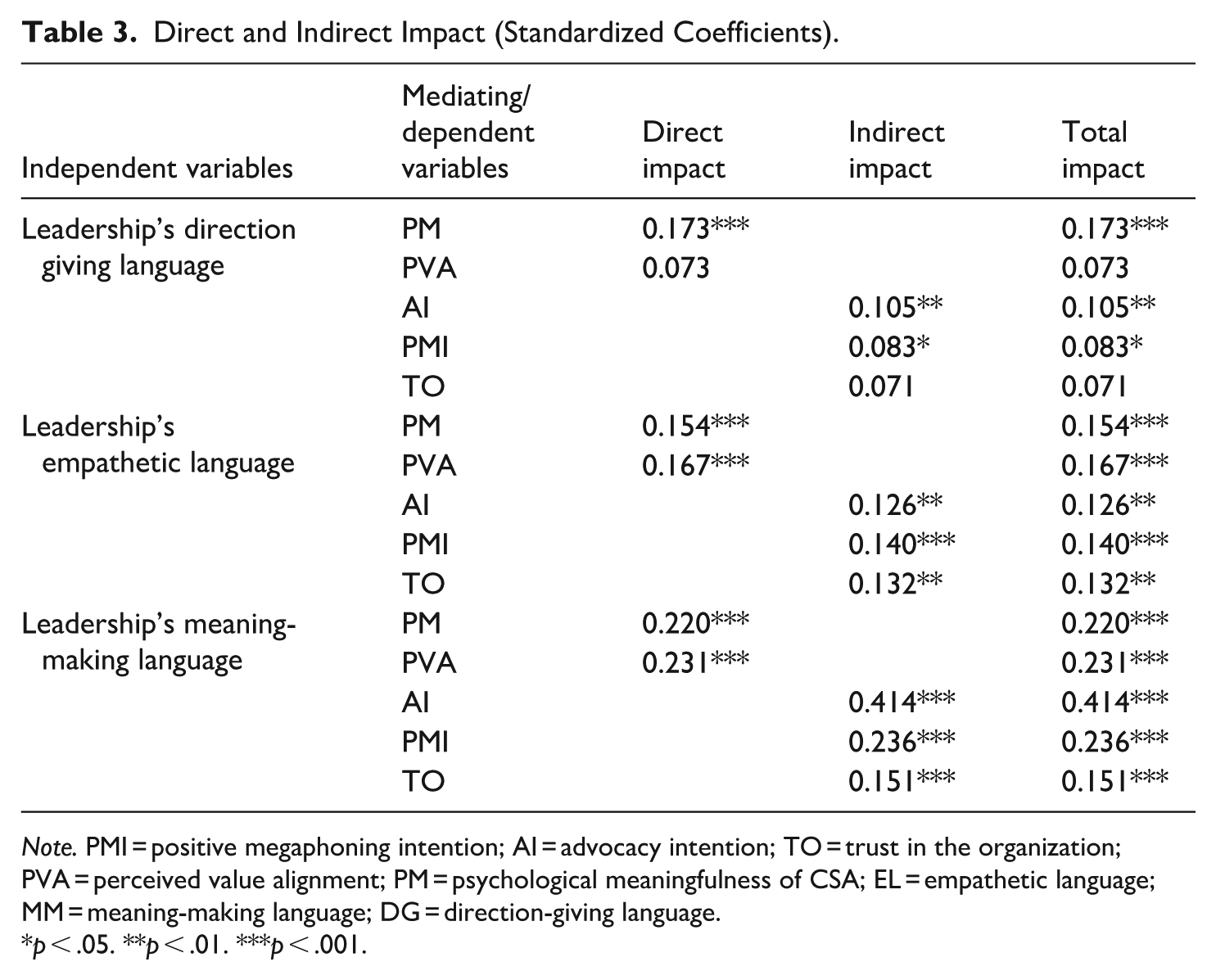
Note. PMI = positive megaphoning intention; AI = advocacy intention; TO = trust in the organization; PVA = perceived value alignment; PM = psychological meaningfulness of CSA; EL = empathetic language; MM = meaning-making language; DG = direction-giving language.
p < .05. **p < .01. ***p < .001.
Discussion
First, the results demonstrate that all three dimensions of motivating language—direction-giving, empathetic, and meaning-making—positively influence employees’ psychological meaningfulness of CSA. Leaders’ use of these communication strategies helped employees perceive CSA initiatives as purposeful, significant, and intrinsically worthwhile. Notably, the positive influence on psychological meaningfulness remained consistent, irrespective of whether employees’ pre-existing personal attitudes toward the sociopolitical issues central to their organization’s CSA were controlled for in the analysis. Previous CSA research has highlighted the substantial risks associated with advocacy on contested social issues, often showing that employee support hinges on personal alignment with an organization’s stance and that misalignment may lead to resistance or disengagement (Hambrick & Wowak, 2021; Hong & Li, 2020; Rim et al., 2024). In contrast, the present findings suggest that leaders’ motivating language can partially offset these risks by shaping how employees interpret CSA initiatives themselves.
Consistent with engagement theory, psychological meaningfulness emerges when individuals perceive both a clear purpose and inherent value in an activity (Kahn, 1990; Lips-Wiersma & Wright, 2012; Robertson et al., 2020). The findings indicate that motivating language fulfills these conditions in the CSA context. Direction-giving language clarifies purpose and expectations, empathetic language communicates care and inclusion, and meaning-making language situates CSA initiatives within a broader organizational and societal narrative. Together, these communication strategies appear to help employees move beyond purely individual evaluations of sociopolitical issues and instead interpret CSA initiatives as official corporate actions that reflect collective organizational values. While prior research has established the role of motivating language in fostering psychological meaningfulness at work (Sullivan, 1988; Thelen et al., 2022), this study extends that insight to CSA, demonstrating how leadership communication specifically enhances employees’ psychological meaningfulness of corporate advocacy efforts.
Second, the findings reveal a more differentiated pattern for perceived CSA–company value alignment. Empathetic and meaning-making language positively influenced perceived value alignment, whereas the effect of direction-giving language became nonsignificant once employees’ personal attitudes toward the CSA issue were controlled. Consistent with prior research highlighting the strong influence of personal stances on CSA initiatives (Rim et al., 2022), this underscores the importance of accounting for employees’ pre-existing beliefs when examining responses to organizational advocacy. The pattern further suggests that not all motivating language dimensions operate equally in shaping value congruence judgments. Empathetic language may signal authenticity, care, and moral concern, while meaning-making language more explicitly connects advocacy to organizational identity and broader societal purpose, making both particularly salient for alignment perceptions. Direction-giving language, by contrast, is better suited to clarifying goals, expectations, and appropriate responses than to communicating value-based coherence. This aligns with prior work suggesting that the relative influence of motivating language dimensions varies by communication context and outcome (Men et al., 2022; Sandelands & Boudens, 2000). In the CSA context, where meaningfulness and value consistency are central, employees appear to rely more heavily on empathetic and meaning-making cues than on instrumental guidance when evaluating whether organizational advocacy genuinely reflects its values.
Third, both psychological meaningfulness and perceived company-CSA value alignment positively predicted employees’ advocacy intentions, positive megaphoning intentions, and trust in the organization. These findings indicate that employees’ interpretations of CSA initiatives not only shape advocacy-related outcomes but also spill over into broader relational outcomes, particularly trust, which is foundational to employee-organization relationships (Hon & Grunig, 1999). The positive effects of psychological meaningfulness support engagement theory (Kahn, 1990) and align with research showing that meaningfulness fosters engagement, proactive behavior, and well-being across work contexts (Z. Liu et al., 2022; Walden & Kingsley Westerman, 2018). The present study demonstrates that these effects extend to CSA, underscoring the role of meaningfulness as a transferable psychological resource. Similarly, perceived value alignment facilitated positive employee responses, consistent with schema-based explanations suggesting that congruence allows stakeholders to process organizational actions more fluently and favorably (Bartlett, 1932; Schmeltz, 2014). Prior CSR and CSA research documents the benefits of value congruence for stakeholder evaluations (Du et al., 2010; Hong & Li, 2020; Yang et al., 2022), and the present findings extend this logic to internal employee responses. Notably, while all dimensions of motivating language indirectly enhanced advocacy and positive megaphoning, only empathetic and meaning-making language exhibited significant indirect effects on organizational trust. This suggests that in CSA contexts, instrumental clarity alone is insufficient for cultivating trust; rather, employees rely on signals of authenticity, care, and value coherence.
Theoretical Implications
Theoretically, this study advances motivating language theory and CSA scholarship in several important ways. Whereas some prior studies conceptualize motivating language as a unified construct and emphasize its ripple effects through employee identification (e.g., Kim & Meganck, 2025), this study disaggregates motivating language into its constituent dimensions and examines how each operates through distinct psychological mechanisms. By focusing on psychological meaningfulness and company-CSA value alignment, the findings illuminate alternative pathways beyond identification through which leadership communication shapes employee support for CSA. Drawing on engagement theory, this study positions psychological meaningfulness as a central explanatory mechanism in the CSA context, highlighting how employees derive intrinsic value from advocacy initiatives independent of their personal sociopolitical alignment. In doing so, the findings shift attention from relational attachment to organizations toward employees’ interpretations of CSA initiatives themselves. Additionally, by emphasizing company-CSA value alignment rather than personal-level alignment, this research reframes CSA as a strategic corporate social initiative embedded in organizational identity and values, rather than as a reactive or episodic form of public communication. This perspective aligns with more recent conceptualizations of CSA as part of a broader portfolio of corporate social initiatives alongside CSR (Y. Kim & Meganck, 2024; Kim & Meganck, 2025) and contrasts with earlier views that treated CSA as isolated, issue-driven messaging (M. D. Dodd & Supa, 2014).
Practical Implications
This study also offers meaningful practical implications. If leaders aim to strengthen employees’ perceptions of value alignment between CSA initiatives and the organization, prioritizing empathetic and meaning-making language is likely to be most effective. At the same time, because all three dimensions of motivating language contribute to psychological meaningfulness, direction-giving language remains an important component of CSA communication. Leaders can strategically adjust the emphasis placed on each dimension depending on whether the primary goal is to clarify purpose, convey values, or foster emotional connection. For example, leaders can use direction giving language to reduce uncertainty by clearly communicating what the organization is doing, why it is doing so, and how employees can respond or participate, helping set expectations and clarify roles. Empathetic language can acknowledge employees’ feelings and concerns, especially given the socially and politically charged nature of CSA topics, fostering a sense of care and psychological safety. Meaning making language can connect CSA actions to the organization’s broader values and societal purpose, helping employees interpret these initiatives as principled and meaningful. Moreover, the findings underscore the role of leadership communication in mitigating employee concerns when CSA initiatives do not align perfectly with individual viewpoints. By situating CSA within a broader organizational narrative and articulating its purpose and values, leaders can encourage advocacy, positive megaphoning, and trust even in politically sensitive contexts. These insights are particularly relevant for senior executives and public relations practitioners responsible for designing and managing internal communication around corporate social initiatives.
Limitations and Future Research
Despite its contributions, this study has limitations. Although we controlled for employees’ personal attitudes toward CSA issues, future research could examine how motivating language influences personal-level value alignment alongside company-level alignment to provide a more nuanced understanding of these dynamics. In addition, this study did not collect information on participants’ political affiliation. Political affiliation may play an important role in shaping employee responses to CSA initiatives, as reactions to CSA topics are often influenced by individuals’ political orientations. Accordingly, future studies on CSA are encouraged to consider political affiliation as an important control variable. The findings are most applicable to medium and large organizations with formal leadership communication structures; small organizations or B2B contexts may exhibit different patterns due to closer interpersonal relationships and distinct communication norms. Finally, because the study was conducted with U.S.-based employees, cultural differences may limit generalizability. Future research should explore these relationships in diverse national and cultural contexts, where interpretations of CSA and leadership communication may vary substantially.
Footnotes

Ethical Considerations
This study was reviewed and approved by the Institutional Review Board of the University of Texas at Austin. The study involved minimal risk and complied with ethical standards for research involving human participants.
Consent to Participate
All participants provided informed consent prior to participation in the study.
Consent for Publication
Not applicable.
Funding
The authors received no financial support for the research, authorship, and/or publication of this article.
Declaration of Conflicting Interests
The authors declared no potential conflicts of interest with respect to the research, authorship, and/or publication of this article.
Data Availability Statement
There are no publicly available data associated with this study.