




Abstract
Perceiving appreciation at work has positive individual and organizational outcomes. Managers in particular are attributed with responsibility to communicate appreciation to employees and to support cultivating an appreciative working environment. This study aims to provide an in-depth analysis of managers’ communication responsibility based on qualitative diaries conducted in five European countries in 2025. The empirical material offers insights into structural challenges, emphasizes specific critical aspects in communicating appreciation, and explains why managers themselves often feel not appreciated at work (and lack in the appreciation of others). The present study contributes to leadership discourses by offering sensitive insights that enable a reflective debate about formally assigned and intrinsically acknowledged communication responsibility in an organizational context. The chosen design does not allow generalizability; the data is limited to the perspective of managers from big organizations (<250 employees) in Europe.
Keywords
Introduction
Appreciative communication appears to be a valuable lever and an effective complement (Stranzl et al., 2025) to other approaches and leadership styles for strengthening internal relationships within organizations (e.g., Kang & Sung, 2017; Kim et al., 2023; Lee et al., 2019; Mazzei et al., 2012; Men, 2015; Men et al., 2020; Tkalac Verčič & Men, 2023; Yue et al., 2025). Promoted as a powerful job-resource, appreciation touches elementary human needs (Stocker et al., 2014). It can help maintain, enhance, and protect self-esteem and buffer stressors (Semmer et al., 2007; 2019; Stocker et al., 2019), which is guiding for someone’s motivation to belong and contribute in an organizational setting. In detail, scholars have shown that perceiving appreciation fosters job satisfaction (Elfering et al., 2017; Garrido-Vásquez et al., 2020; Muskat & Reitsamer, 2019; Pfister et al., 2020a; Stocker et al., 2010, 2019), job engagement and motivation (Gulyani & Sharma, 2018, Einwiller et al., 2021), affective commitment (Einwiller et al., 2021), feelings of success (Pfister et al., 2020a), and organizational citizenship behavior (Hagelstein et al., 2025). Furthermore, it reduces turnover intentions (Apostel et al., 2018; Davis et al., 2021). Beyond job-related effects, occupational psychologists particularly connect appreciation and health-relevant concepts. For instance, scholars found that a lack of appreciation can serve as a social stressor, negatively impacting self-reported subjective wellbeing (Semmer et al., 2019). Positive appreciation experiences can buffer stress (Stocker et al., 2010), lower depressive symptoms (Kranabetter & Niessen, 2019; Pfister et al., 2020b; Pohrt et al., 2022), anxiety (Pfister et al., 2020b) and lower-back pain (Elfering et al., 2017). Moreover, Auer et al. (2024) found recently that workplace appreciation can have an impact on the development and progression of coronary heart disease (CHD) risk. Drawing on this rich body of evidence (overview see Wahl et al., 2025), cultivating an appreciative working environment seems to be indispensable for workers and sustainable organizations—naturally raising the question of who bears this responsibility.
Recent studies argue particularly from an employee-perspective on the very specific communication responsibility of different kinds of managers (e.g., Stranzl & Ruppel, 2024; see also Beck, 2016; Stocker et al., 2014): “I think the higher the level, the more it can be expected—because it’s their job to make everyone happy. Coworkers should do it too, but it’s the managers’ responsibility (Data scientist)” (Stranzl & Ruppel, 2024, p. 288). This formal attribute is reinforced by the positive effects of an appreciative leadership style (e.g., Apostel et al., 2018; Davis et al., 2021; Kranabetter and Niessen, 2019; Pohrt et al., 2022; Stocker et al., 2019). But where do managers get the idea of communicating appreciation to their employees? Who taught them relevance and practice? As Stranzl and Ruppel (2024) conclude in their research on employee appreciation, managers might experience pressure to take their responsibility seriously based on the myriad number of possibilities to express it and the very different expectations of those who receive it. The seriousness of a communication responsibility is not solely determined by employees’ expectations—responsibility has always an extrinsic (formal attribution) and an intrinsic (own acknowledgment) dimension (Andersson, 2019; Smith, 2015). We argue that especially the second dimension—one’s personal recognition and acceptance of a responsibility—plays a pivotal role if and how managers engage in appreciative communication towards employees. Reflecting on previous research findings with this theoretical background, structural prerequisites as well as individual experiences of appreciative communication processes become apparent. First, scholars stress appreciation as a strategic issue. Related dependencies and obstacles shape if and how managers can address their communication responsibility (e.g., resources, communication education, managers personal perception of appreciation) (Stranzl & Ruppel, 2024). Second, appreciative communication at work is far from being a seamless or idealized process—Beck (2016) has shown that, particularly from an employee perspective, critical aspects such as fairness, authenticity, sincerity need to be considered.
Linking the positive effects of appreciation with challenging aspects of communicating it, we take a deep dive to unbox the complexity of managers’ communication responsibility through a diary study. The study contributes to research on internal relationship building (Kim et al., 2025) and the value of appreciative communication (Stranzl et al., 2025). Furthermore, our empirical data material encourages critical reflections on manager’s communication responsibility (e.g., Pfister et al., 2020a, 2020b; Stranzl & Ruppel, 2024; Stocker et al., 2019) and adopting an appreciative leadership style (e.g., Stocker et al., 2014). Hence, this study complements existing discourses “of leadership as a social, discursive, and co-constructed phenomenon” (Yue et al., 2025, p. 217).
The paper starts with reflections about the communication responsibility of managers in the context of appreciation. This is followed by a description of the method used. After, study results are presented in detail and discussed from a strategic communication perspective. The paper closes with limitations and some further ideas for future research.
Managers’ Responsibility in Cultivating an Appreciative Working Environment
As a starting point, we define appreciative communication at work in this paper according to Stocker et al. (2019) as “communicating that one values someone else; the term may refer to (1) unconditionally acknowledging the person as an individual or (2) acknowledging his or her performance, behavior, or qualities” (p. 333). Various forms are recognized as effective, e.g., communicating thank you, praise, giving feedback, offering development opportunities, sending a gift, raising salary, or giving a bonus (e.g., Stocker et al., 2014; Stranzl & Ruppel, 2024). Beyond the individual level, scholars have shown the importance of cultivating an appreciative working environment (see effects). This “cultivation process” is based on the endeavors of different communicators (e.g., Beck, 2016; Stocker et al., 2014, 2019; Stranzl & Ruppel, 2024): Besides coworkers, internal departments and specific role holders, the public and customers/clients/external partners, managers (particularly supervisors) are first and foremost attributed with a specific communication responsibility (e.g., Pfister et al., 2020a, 2020b; Stocker et al., 2014, Stranzl & Ruppel, 2024). Despite co-workers and customers more frequently show appreciation to employees (Hagelstein et al., 2025; Stocker et al., 2014), managers are the ones who are taken for granted in their appreciative communication due to their role and power: Being an appreciative leader combines “positive relationship-based, socio-emotional leadership behaviors” (Stocker et al., 2014, p. 74) that acknowledge employees’ individuality and “a personalized interaction of leaders with the people they lead” (p. 74). Empirical material highlights in particular employees’ preferences for managers recurring verbal and personal appreciative communication in the context of the US and Europe (Beck, 2016; Hagelstein et al., 2025; Stocker et al., 2014; Stranzl & Ruppel, 2024). Recognizing managers’ important contribution stimulates our thinking what supports and limits the adoption of this communication responsibility. Fittingly, Stocker et al. (2014) claim early that knowing the importance of appreciation “is not equivalent to implementing this knowledge in everyday life” (p. 90), offering an important connection point to look beyond a formal attribution.
Communication responsibility is a term frequently used in practice. In research, it gains attention in the fields of sustainability, CSR, (internal) crisis and change communication to designate, explain, or foster a certain outcome (e.g., support, innovation, commitment). In this sense, communication responsibility can be formally attributed to different kinds of organizational actors (e.g., CEO, managers, employees, specific role-holders/departments). Andersson (2019) develops a theoretical perspective for employees’ communication responsibility. Drawing on the philosophical work of Smith (2015), Andersson emphasizes that a formal attribution of a communication responsibility includes accountability and justification of related thoughts, emotions, and actions. Within this understanding, Andersson shifts our perspective from employees being passively (formally) attributed with a communication responsibility to employees being actively responsible for their communication. It comprises employees’ personal awareness and reflection on their agency and practices. Hence, responsibility entails always both an extrinsic (formally assigned) and an intrinsic (personally acknowledgment) dimension. The latter implies that someone internalizes responsibility regardless of the presence/absence of a judging entity. Importantly, “this acknowledgement [dimension] can be assumed to manifest in employees talk and acts as these are the only visible assessment criteria on which it is possible to judge if employees take responsibility” (p. 62). Based on this duality, Andersson (2019) defines employee communication responsibility “as an internalized sense of responsibility for communication that influence employee’s observable communication behavior” (p. 62). In the context of appreciation, we see great potential to broaden the picture from a solely formal attribution to managers’ personal acknowledgment of this communication responsibility. Through centering managers challenges, we can reflect on the difficulties that are connected to being an appreciative leader. Accordingly, we understand managers’ communication responsibility in cultivating an appreciative working environment as both formally assigned and individually internalized, shaping their practices. At this point, we would like to stress the role of workplace expectations.
Drawing on social exchange theory (Blau, 1964), Stranzl and Ruppel (2024) emphasize the relevance to align appreciative communication and employees’ expectations. In our view, the same applies to managers. Expectations constitute what is given and received in terms of rewards in workplace interactions, shaping individual perceptions. They are critical for individual satisfaction with interactions (Blau, 1964). Three types of expectations are guiding: First, general expectations, defined as “achievement needs and aspirations, [who] are governed by prevailing values and social standards, and by the previously experienced attainments of individuals” (p. 145). Then, particular expectations which a person has of another person, the person’s behavior, and the rewards that this person brings into the relationship. Last, comparative expectations, where individuals weigh the profits of being part of the interaction. Comparative expectations constitute a common standard that makes comparison between relationships possible. What we take is that if and how managers engage in appreciative communication depends on their various expectations in terms of appreciation. These are guided by the organizational environment and their individual interactions.
Structural Challenges Associated with the Appreciation Communication Responsibility
At an organizational level, awareness and treatment of workplace appreciation as a strategic issue is a relevant condition to whether managers engage in employee appreciation (Stranzl & Ruppel, 2024). This is connected to guidance, resources (e.g., time, money, support), and education (e.g., Kranabetter & Niessen, 2019; Pohrt et al., 2022; Stranzl & Ruppel, 2024). Here executives’ efforts are relevant as they shape “culture, character, and value of the organization” (Yue et al., 2021, p. 21). Also, supervisors and middle managers are often not directly involved in strategic communication processes—they are highly dependent as receivers on the communication from the top (Heide et al., 2018). How appreciation and internal communication is understood and practiced in terms of top-down informing, two-way symmetrical, sensemaking through participation is therefore guiding management communication at all levels (Heide et al., 2018; Yue et al., 2025). But what if there is no strategic approach to appreciation? Appreciative communication will be more likely seen as an implicit and individual task depending on individual characteristics and leadership styles (Stranzl & Ruppel, 2024; Stocker et al., 2014). Following, we assume different challenges (e.g., being aware of the power of appreciation, having an idea about appropriate forms, devoting time) for different manager groups in terms of appreciation, shaping if and how they internalize their communication responsibility:
Critical Communication Situations Associated with the Appreciation Communication Responsibility
At an individual level, management communication that unconditionally acknowledges a person and related performance, behavior and qualities (Stocker et al., 2019) seems to be difficult. Beck (2016) leads this more critical discourse and emphasizes from the perspective of employees: Besides missing general opportunities to appreciate someone, managers struggle with authenticity, sometimes withhold appreciation (“Once there was a power struggle on our team, and our manager was withholding gratitude,” p. 345), give undeserved thank-you (“I’ve had hurt feelings when others got thanks and it wasn’t deserved,” p. 346), over-appreciate someone (e.g., “I hear my manager say several times an hour, ‘Love you guys so much. You’re doing great.’ I can’t stand it,” p. 345), or are unfair in their selection (“There’s a bonus for some reason, and people get concessions that you don’t get. It makes you feel like, ‘Oh, my job’s not as important,” p. 346). Furthermore, the COVID-19 pandemic forced discussions about instrumentalizing appreciation to push employees through their personal and job-related limits (Cox, 2020; Stranzl & Ruppel, 2023). Referring here again to social exchange theory (Blau 1964), “the dilemma of leadership is that the attainment of power and the attainment of social approval make somewhat incompatible demands on a person” (p. 203). Furthermore, such experiences in workplace interactions shape future expectations and practices. This study, therefore, looks at critical appreciation situations that are potentially guiding if and how managers internalize communication responsibility:
Personal Experiences Shaping Appreciation Engagement
Managers’ personal perception of appreciation is seen as a relevant aspect if and how they engage in appreciative communication (Stocker et al., 2014; Stranzl & Ruppel, 2024): “Supervisors should (. . .) not only be focused on as sources, but also as recipients of appreciation” (Stocker et al., 2014, p. 90). Generally, we know very little about managers’ diverse perceptions of appreciation. However, their expectations and experiences give a better understanding of why cultivating an appreciative working environment may be a difficult, non-linear discursive process that requires more strategic attention:
Research Method
To answer the three research questions, a diary study was conceptualized at the end of 2024. The diary method can be used to study micro processes, conducting within-individual data. By creating a scenario where participants are enabled to share experiences, expectations, and visions on a regular basis, this method offers the ability to dive deep into a specific narrative or rare phenomena over time (Olorunfemi, 2024; also see Bolger et al., 2003). In our case, we decided to collect managers’ experiences with appreciation over the course of a working week. Particularly in the context of management research, scholars point to the major strengths of gaining access to daily work situations of managers that cannot or hardly be assessed otherwise, especially those who are connected to emotions. Furthermore, the method gains rich and detailed material from multiple perspectives in various scenarios and time frames, unboxing complex communication management processes. Another advantage is that people can express something in their own words without interruptions (Prange et al., 2024). Olorunfemi (2024) complements this by stressing that diaries give no option to navigate the quality and nature of the data (can also be a disadvantage). Last, diary studies make it possible to capture information close to an event, working against the bias of retrospectivity and losing data. In the context of communicating appreciation at work, we see this as the biggest advantage.
Study information—The data was collected in five countries during February 2025. Participants were introduced to fill out a diary over five working days in a row. After completing the study, participants received a practical report and the option to engage with the researchers to discuss the findings.
Sampling procedure—In total, 16 managers participated in the study (see
Diary instrument—The diary instrument was initially tested in four countries at the beginning of January 2025 (n = 4). Pre-testers were asked to fill out the diary for only one day and evaluate it in terms of its comprehensibility, understandability, and usability. After, some questions, the design, and length were adopted. Importantly, the guiding diary was conceptualized in English and translated to four different languages. The translation was accompanied by native speakers. The final diary contained sociodemographic questions and general questions about workplace appreciation (e.g., preferences, challenges). These questions had to be filled out only on day one. Furthermore, the diary included daily questions that addressed participants’ experiences and expectations of daily appreciation.
Ethical considerations—As our participants have management responsibility (e.g., responsibility for staff and budget, and access to business strategy), we consider them as vulnerable group. Following, their participation underlies very strict data protection; no specific information can be given about the organizations and individuals. Participants received besides a general study description, an in-depth clarification about their rights, data protection and storage, anonymization, and debriefing in a separate document. Furthermore, we define the topic “appreciation” per se as “sensitive”, potentially increasing our participants degree of vulnerability (e.g., a lack of appreciation can lead to negative emotions and effects during the individual reflection process). To address this, the diary as such contained appreciative messages and the researchers try to mediate strong value for participation in this study.
Data analysis—After the field phase, the diaries were translated to English again. Here, special attention was paid to the translation process—the raw data material in the original language serves as important reference point during the whole analysis. The diaries are initially analyzed though a topic analysis guided by Udo Kuckartz (2014). Main topics were collected through a deductive coding system based on knowledge about employees’ expectations (practices, challenges) about workplace appreciation (see Beck, 2016; Stocker et al., 2014; Stranzl & Ruppel, 2024). The subsequent analysis was based on inductive coding, where special attention was given to every single entry. This was followed by elaborating on conclusions for strategic internal communication and in particular management communication.
Methodological limitations—Qualitative research, and especially the diary method, has their main limitation in terms of its generalizability. Furthermore, our research method is characterized by one-way communication—compared to in-depth interviews, diaries allow no further stimulation and reflective questions directly from the researcher. Olorunfemi (2024) stresses in this context that the data material can be even briefer compared to a qualitative in-depth interview, as the absence of moderation potentially limits the motivation to share and reflect insights. In our case, the length and in-depthness of diaries varied, but the combined material provided a rich and nuanced picture of managers’ perceptions and experiences. Weaknesses are also seen in finding participants who show “willingness, ability, and time to systematically record experiences” (Prange et al., 2024, p. 732). Such commitment and dedication are rarely needed in other research methods. Recruitment therefore strongly is based on our own network, which we see as a limitation. From a sampling perspective, this study is also particularly limited to the sizes of the organizations and the variety of branches and sectors.
Results
Participants broadly align with Stocker et al. (2019) in conceptualizing appreciative communication as both personal and professional forms of recognition. It includes acknowledging an individual’s qualities and lived experiences, as well as their contributions to work processes. While some managers frame appreciation as an embedded organizational value that reflects cultural maturity, others view it as a concrete communicative responsibility that must be practiced deliberately to foster motivation and team cohesion. These orientations coexist, reflecting diverse understandings of how appreciation is internalized and practiced in managerial roles.
Another important finding is that in daily interactions, appreciation is typically directed toward colleagues with whom managers have regular contact: on average three to five people. This interpersonal proximity shapes who is likely to receive appreciation, with little evidence of efforts to extend it beyond one’s immediate work environment. Most appreciation is expressed verbally through short “thank you” messages or informal praise, while developmental or feedback-based forms appear less frequently. Expressions of appreciation are commonly triggered by visible work behavior: for instance, when employees demonstrate professionalism under pressure, offer creative solutions, take initiative, or support collective team outcomes.
Structural Challenges
The first research question explores structural challenges such as obstacles and dependencies, that shape if and how managers engage in appreciative communication. Across the diary entries, one overarching condition stood out: a pervasive overload of responsibilities. Managers consistently described a professional environment in which competing tasks, urgent demands, and limited resources left little room for intentional interpersonal gestures, appreciation included. People have too much on their plates. (P1) I am involved in too many projects, so it's difficult to focus my energy. (P14) The day was quite intense, with many back-to-back meetings, making it difficult to focus on other tasks. (P15)
While the time pressure itself was burdensome, several participants emphasized that these constraints were intensified by systemic factors, such as high turnover, understaffing, or lack of organizational coordination: There is an overwhelming amount of work, and the lack of resources and organization in my company further contributes to this challenge. (P7) Over the past six months, we' ve had a 50% employee turnover rate while hiring very few new people. This has resulted in an increased workload for already overburdened employees. (P7)
Appreciation, under such conditions, often became the first communicative responsibility to be deprioritized. Fast-paced work environments rarely offer time to pause or reflect, even when such moments might be critical: In fast-paced projects, it’s easy to move on to the next task without pausing to reflect on contributions. (P15)
Generally, three specific barriers were identified: lack of time, uncertainty about the right moment, and the difficulty of consistency. These practical obstacles illustrate that even when managers value appreciation, they often struggle to act on it in a sustainable way: We can show each other much more appreciation. It is easily forgotten in the flow of tasks. (P11) Sometimes I find it difficult to find the right moment for verbal praise or detailed feedback. . . due to a tight schedule and heavy responsibilities. (P7) Due to the high standards, I have in my work, where certain things are implied for me, I should compliment my colleagues more often. (P5)
Beyond that, managers described a lack of structural guidance or shared standards around appreciation. Several noted that appreciation was not clearly defined or strategically integrated into their organization’s communication practices. This absence created ambiguity—not just about how to appreciate, but whether it was expected at all. Although I strive to promote a culture of appreciation as a managing director, I sometimes wish that appreciation is also more proactively lived by other leadership levels, such as the board. (P1) The lack of positive feedback I feel from time to time really applies everywhere in the organization—colleagues in other departments, co-workers, management colleagues. (P12)
Such observations suggest that appreciation often remains an informal, individualized practice, depending on personal leadership—unevenly distributed across teams and units. Some managers explicitly pointed to fragmentation, or to the absence of a shared value system: There are big variations between different parts of the organization. In some parts/units, there are major problems with the internal climate, cooperation, and treatment, while in other things work well. (P12)
The role of hierarchical structure emerged as particularly relevant for managers in lower positions. These participants described a strong dependency on upper-level communication—both in terms of receiving strategic direction and observing role models for appreciative behavior. When decisions were made without transparency or when leadership failed to acknowledge contributions, managers felt their own efforts were undermined: Final decisions often come from the top, which not only limits autonomy but sometimes completely overrides employees’ suggestions, leading to a loss of motivation and a lack of feeling valued. (P7)
At the same time, visible appreciative behavior from senior leaders was described as meaningful: The CEO always thanks everyone in his internal emails and in meetings. My colleagues do the same, so I would say my overall perception is positive. (P16)
Some participants argued for expanding responsibility beyond hierarchical flows, suggesting that peer-to-peer appreciation should be encouraged as part of the internal communication culture: More peer-to-peer appreciation could further strengthen our positive workplace atmosphere. (P15)
Another structural constraint relates to relational distance, particularly in large or distributed teams. Especially higher-ranked managers expressed difficulty in knowing enough about their team members’ task and challenges to provide specific or authentic feedback. This limitation was not just logistical but epistemic: higher managers lacked access to personal details that would make appreciation feel meaningful. I often do not notice much of what my team members and colleagues do, so I cannot appreciate it. (P3) I never see them in action and therefore find it difficult to give them feedback on how they carry out their work. (P12)
Participants also highlighted the diversity of employee expectations. Some staff sought regular verbal recognition; others preferred subtle affirmation. Knowing and navigating these preferences—especially under time pressure—added an additional layer of complexity. My personal challenge are the different expectations regarding appreciation: Some employees need frequent feedback, while others prefer more subtle recognition. (P1) She is the type of person who needs praise and confirmation that she is doing a good job. (P5)
Finally, environmental and organizational contexts—such as remote work—shaped the possibility space for appreciation. While some appreciated the calm and detachment of home offices, others saw digital conditions as obstacles to genuine interpersonal contact: Thumbs up are given in team meetings, but a personalized ‘thank you’ or positive feedback is less frequent. (P12) When I work from home, the atmosphere is excellent—no office gossip, no office ‘spies’, no office ‘witches’, so my soul was at peace. (P8)
Together, these reflections point to a consistent pattern: appreciative communication is not a neutral interpersonal gesture, but a structurally conditioned act. It is shaped—and at times contrained—by workload, access to resources, knowledge about importance and practices, and the broader communication culture of an organization.
Critical communication situations
To deepen our understanding of managerial communication responsibility, we examined the critical challenges associated with expressing appreciation. One central finding concerns the explicitness of appreciative communication. Participants reported considerable variation in how overtly appreciation is expressed, perceived, or expected in their organizations. While some managers deliberately and regularly communicate appreciation, others experience such expression as personally difficult or even unnecessary. A recurrent observation was the absence of explicit appreciation, as reflected in diary comments such as: “I did not receive any explicit words of appreciation today.” This diversity is illustrated by the following quotes: There are individual people who consistently have a very positive influence by explicitly expressing positive comments or saying something nice. (P3) Leaders consistently highlight individual and team successes, and there’s a genuine effort to celebrate achievements, milestones, and personal growth. (P15) That he explicitly mentions that I did something well or that he is glad to have me on the team happens maybe 2 to 3 times a year. (P3)
Several participants emphasized that hierarchy plays a role in shaping how freely appreciation is communicated. While it may feel natural to express appreciation toward employees, showing appreciation upward—to superiors—was described as awkward or less common. Furthermore, many participants linked their behavior to personal traits, particularly extroversion or a communicative disposition: It depends a lot on what you choose to give and see. (P9) I’m an extrovert and find it easy to thank for good work. It’s a strong value from my parents and it comes naturally. (P9) I have no difficulty, never have. I always express my appreciation, either by email or verbally. (P16)
Conversely, managers who claimed not to need appreciation themselves were often reluctant to offer it to others: I have no need for attention, praise, and recognition, so it is not natural for me to show it to others, although I am aware that many of my colleagues need it. (P6)
Here, self-perception and communication values shape how responsibility for appreciation is enacted. In addition, participants described how personal relationships and emotions influence their appreciative behavior. Positive feelings toward colleagues made expressions of appreciation easier, while frustration, fatigue, or interpersonal tension often diminished the impulse to engage appreciatively: My appreciation for others drops when I realize that they are either stupid or ignorant (or both). Then I have to make an effort not to get too caught up in it. (P4) Sometimes I am also grumpy with my team members, so I do not want to say anything appreciative because I do not want them to think that everything is fine. (P3)
These examples underscore how emotional states, both one’s own and those of interaction partners, directly shape the feasibility of appreciative communication. Shouting, arrogance, or emotional pressure on others was often described as a barrier to maintaining an appreciative tone. Another recurring challenge was balancing criticism and appreciation. Many participants stressed that appreciation and corrective feedback must be calibrated to avoid misinterpretation or emotional harm: It is not always an easy balancing act to know when to listen and coach, and when to give solid advice, when an employee is feeling frustrated and a bit lost. (P12)
In this context, several managers also emphasized the role of language meant as precision and clarity and for valuing people. Misunderstandings or ambiguous wordings were seen as risks in feedback situations: The challenge is to give appreciation to people, so they get the message right and it becomes positive. (P10) There is room for improvement in the language used. Words are important for valuing people. (P14)
Last, participants reflected on the complexity of fairness in appreciative communication. Some reported discomfort when appreciation appeared unevenly distributed or when they observed others being treated unfairly: One of our employees is continuously criticized by a senior manager. Even though there is room for improvement, I feel that the negative judgement is unfair. (P9)
Being an appreciative leader includes acknowledging a communication responsibility that requires reflexivity, sensitivity, and deliberate expression, especially when navigating professional hierarchies, personality differences, and emotional tensions.
Managers Experiences with Appreciation
The empirical material also sheds light on how managers receive appreciation, both from their employees and from superiors or peers. Participants refer to a variety of appreciation senders, including employees, co-managers, colleagues from other departments, the CEO, suppliers, and external partners. They value a range of communicative and symbolic forms, from transparent communication and verbal expressions of gratitude to feedback, recognition of achievements, and constructive critique. Other appreciated forms include coaching, inclusion in strategic processes, bonus payments, career opportunities, and time for rest or reflection. One manager, for instance, appreciated that a colleague “tried to show respect for my efforts and ideas through constructive criticism and advice, indicating that the presentation would be useful in the future, even though it did not fully meet the audience’s needs at the moment” (P8).
Despite the recognition of these diverse forms and sources, many participants described appreciation as sporadic, vague, or misaligned with their expectations. In diary entries, when asked whether they had received appreciation that day, responses ranged widely—from “occasionally” and “not very often” to “rather rarely” and simply “no.” This variability was reflected in affective reactions: managers reported a spectrum of negative emotions when they felt unappreciated, including frustration, disappointment, regret, and even loneliness. These reactions underscore that appreciation is not merely a relational gesture but a resource with emotional and motivational consequences. The diary entries point to several structural and interpersonal reasons why appreciation is perceived as insufficient or inconsistent by managers. First, responsibilities for expressing appreciation to managers are often undefined. Some managers are unsure whether their contributions are seen at all and who, if anyone, is expected to appreciate them: “I can’t say, probably it is exactly the problem that no one is really responsible” (P3). One participant noted: In my current role (one level higher up in the organization), I feel a bit more lonely. I don’t get at all that much appreciation from my manager nor my peers. I am probably at the lowest level of appreciation during my career now, which is a contrast compared to the highest and best level in the role I had before. (P10)
Second, organizational hierarchies complicate upward appreciation. While participants generally accept the asymmetry of organizational appreciation, they nonetheless value appreciation from below: Appreciation ‘from bottom to top’ is not a matter of course, and I appreciate it all the more. (P3) Third, appreciation is often communicated implicitly or ambiguously, if at all. Several managers noted that workplace culture favors politeness or neutrality over explicit appreciation: Many people are nice and polite and always say hello, but concrete appreciation does not always come naturally—it’s a bit of a ‘health is silent’ culture. (P12) Although I perceived that employees were engaged in the workshop at the workplace meeting, no one came up to me afterwards, or later in the day, and thanked me for a good organization or similar. (P12)
Fourth, the nature of managerial work itself often remains invisible to others. Efforts that occur behind the scenes—such as coordination, mediation, or safeguarding team morale—frequently go unnoticed: I feel that my direct supervisor (and those further ‘up’ anyway) does not really know what I do every day. (P3) In cross-functional projects, where the focus is often on end results, there can be moments where the behind-the-scenes work isn’t fully visible. (P15)
Fifth, mismatches in role perception exacerbate this invisibility. Colleagues and superiors may lack awareness of the complexity and workload embedded in managerial roles, leading to unrealistic demands or poorly timed tasks: I received an email stating that I need to complete some administrative step by next Tuesday that some ‘manager’ urgently needs, for which I have to request external information. I am annoyed about this because I do not like receiving tasks with such tight deadlines. . . just because the colleague cannot manage his deadlines. (P3)
Sixth, managerial competence is not always fully acknowledged. Despite proven capability, some participants felt they had to re-establish their credibility repeatedly—to clients, teams, or senior leaders: My first challenge is to obtain appreciation from the new CEO for the contribution I offer. . . I am aware that a small mistake is enough to destroy the trust built over many years of work. (P13) He didn’t listen to my point of view about a project. I have more expertise than him, so I wanted to change some aspects, but he didn’t agree. (P14) I did not feel that my comment was acknowledged. (P7) I had prepared intensively for a conversation, but my contribution was hardly acknowledged. (P1)
Discussion
The aim of this research article was to unbox managers’ communication responsibility in terms of appreciation by focusing on their structural challenges, critical situations, and personal perspectives. We found that appreciation in an organizational setting is not a neutral, and easy managed communication act. Rather, many different personal and structural aspects impact if and how appreciation is practiced, if and how someone adopts this communication responsibility.
While appreciation is highlighted as a strategic issue in research (see Stranzl & Ruppel, 2024; Stranzl et al., 2025), one of the most significant conclusions of this study is that appreciation is not perceived or handled as a strategic issue. This does not mean that managers do not perceive appreciation as important and engage in appreciative communication (or receive it). The diaries confirm that individual managers are often aware of their colleagues and employees need for appreciation. Also, managers realize that it is part of their responsibility to appreciate others at work—especially their employees. However, there is often no general or collective discussion about appreciation, there is a lack of guidelines for practices and how to deal with challenges, and there is no shared understanding of the value of appreciation (high ambiguity). Consequently, our study emphasizes that appreciative communication is very much dependent on each manager’s personality, time, confidence in giving appreciation, current emotions, existing relationships. Following, the appreciation process risks becoming quite random and exclusive, rather than being provided to all organization members in a conscious way. Some of the diary entries clearly demonstrate that being part of an appreciative environment makes it both easier and more motivated to communicate appreciation to others. It becomes not only an individual responsibility, but also a collective responsibility, facilitated in various ways. Our data therefore supports the call to treat appreciation strategically (Stranzl & Ruppel, 2024), outlining various challenges that are connected to missing such an approach. In the following, we will discuss what a strategic approach to appreciation could entail.
Systematically encouraging and facilitating discussions about appreciation and its value—a kind of meta-communication (Heide & Simonsson, 2011)—is one way to adopt a strategic approach to appreciation. The managers’ diary entries highlighted the need to talk about individual expectations, needs, difficulties, and wants/preferences in relation to appreciation. There are of course challenges in fulfilling each employee’s expectations, but the meta-communication process can foster anchor points about what it is reasonable to expect and fulfil regarding this responsibility. Also, getting knowledge about other practices can be helpful in finding an individual appreciative leadership style. Meta-communication is also important on a dyadic or group level but can also cultivate an appreciative working environment on an organization level. Andersson (2019) supports this by showing the effectiveness of an open communication climate to get in touch with a communication responsibility.
A strategic approach to appreciation relies furthermore on the personal involvement, engagement, and vision of those leading an organization. CEOs and executives are important role models and, not surprisingly, the ones with a change agency (also see Men et al., 2020; Yue et al., 2021). They can decide to devote time and resources to a topic. Being provocative by recognizing workplace appreciation as important as financial stability or employee engagement might be key to getting people on board. In this sense, a strategic approach to appreciation also includes education at different levels. We have a broad discourse showing the value of management communication education (e.g., Bergman, 2020; Zerfass & Franke, 2013). What we would like to emphasize here is that education in terms of appreciation cannot be top-down stated nor can it be a side management project. Rather, specific communicators, particularly those with high communication agency (e.g., CEO, CFO, diversity/sustainability manager, employee representative, senior manager), need experienced communication support and open spaces to share needs and demands, and reflect on their communication responsibility. Then appreciation can be strategically established as an organizational value that can also be realized by different internal and external stakeholder groups (see Andersson, 2025).
In this line, our study demonstrated furthermore that a rather one-sided focus on managers is problematic (see also Heide & Simonsson, 2011). Despite managers seize high responsibility in cultivating an appreciative environment, their challenges point to define and practice strategic communication more broadly: Several managers reported difficulties in finding the time to recognize all their employees. Being a manager is often a stressful job involving a wide range of duties and responsibilities. Managers at different levels also find it difficult to show appreciation because they do not have insight into their staff’s daily work, i.e. they do not have the knowledge required to provide genuine appreciation. Another problem with the strong focus on managers’ responsibility is that managers themselves lack appreciation for their contributions—leading to negative emotions and disconnection from explicit appreciative communication towards others. It seems that the managers participating in the study missed appreciation both from their managers, employees and colleagues. Peers at various levels and in various positions need to take responsibility for appreciating each other, both to contribute to an appreciative environment and because peers often have more insight into each other’s work. “Upward appreciation”—employees giving appreciation to their superiors—can be challenging due to hierarchy and authority. However, the diaries also indicate that employees do so seem to be aware of managers’ need of appreciation. Concluding, fostering employee’s internalization of their communication responsibility (Andersson, 2019) in terms of appreciation is also part of addressing appreciation strategically.
Implications
Our study confirms and illustrates empirically the importance of distinguishing between the extrinsic and the intrinsic dimensions of communication responsibility (see also Andersson, 2019). Based on our reflections, we can outline concrete advantages of this differentiation: Perceived structural challenges of those attributed with a specific communication responsibility become visible and can be considered. Not only that, it is furthermore possible to discuss a communication responsibility in connection to personal characteristics, emotions, and preferred communication style. Also, different kinds of expectations (see Blau, 1964) that result partly from prior and current work experiences, and the social environment are at the center of attention when discussing if and how a communication responsibility is enacted. Then, personal knowledge and approaches to the topic can be reflected upon and developed. Last, by highlighting relationships that are connected to a communication responsibility, people and their needs become visible.
Furthermore, our empirical results strengthen the perspective that appreciative leadership should not be dependent on the individual leader, but can be co-constructed and incorporated into the organizational discourse. For this process, a strategic approach is needed. To extend this thinking, we therefore suggest to focus on the concept of “appreciative leadership” (Stocker et al., 2014) and consider it as a major part in leadership communication theories (overview see Yue et al., 2025).
From a practical perspective, our study argues that an appreciative working environment can be cultivated when managers get the chance to internalize their sense of responsibility. Personal awareness help managers and supervisors in overcoming difficulties such as lack of time and physical distance. To better support them, it is therefore recommended to include theories and techniques of appreciative communication in internal training programs. Also, it is recommended to approach and include managers from all hierarchies in an internal discourse about the importance of workplace appreciation, appropriate signals that align with the organizational culture, and potential challenging aspects (i.e. including meta-communication, see Heide & Simonsson, 2011). To achieve this, we advocate creating internal physical spaces where managers can come together to develop their own approach and familiarise themselves with the organisation’s strategic agenda in terms of appreciation.
Limitations and Outlook
This study is based on qualitative material, gathered through diaries in five countries in Europe. From a methods perspective, some diary entries reveal new questions or ask for more details. It would have been interesting to follow up this study with in-depth interviews that allow interaction and reflections. Therefore, combining diaries and interviews with the diary writers in a mixed methods approach seems highly relevant for future studies. Furthermore, our questions and the respective empirical data do not allow generalizability; however, we offer deep insights into managers’ perception of appreciation and the complexity of appreciative communication. Following, this study provides important connection points for studies testing the influence of factors that shape a communication responsibility. Based on Andersson (2019), we have defined management communication responsibility in the context of appreciation as consisting of two dimensions: a formally attributed sense of responsibility and an internalized sense of responsibility. In our study, we focused on the latter. Future studies could fruitfully combine this approach with a focus on formally assigned responsibilities, for example by analysing how communication responsibility for appreciation is articulated in policy documents, staff appraisal guidelines, or internal surveys. Further studies could also explore appreciation as part of feedback communication to understand how negative or improving feedback relates to appreciation. Moreover, we found that upward appreciation is critical and usually managers do not receive positive feedback while this would be desirable for them. The reason is that usually organizational culture favours neutrality. This reminds us of a climate of silence when employees do not feel comfortable in voicing (Bisel & Okpaireh, 2025). Last, another intriguing field could be to research on the dynamics and the differences of appreciative communication between remote and onsite work (Stranzl & Ruppel 2023; Stranzl et al., 2025).
Footnotes
Appendix
Participant information.
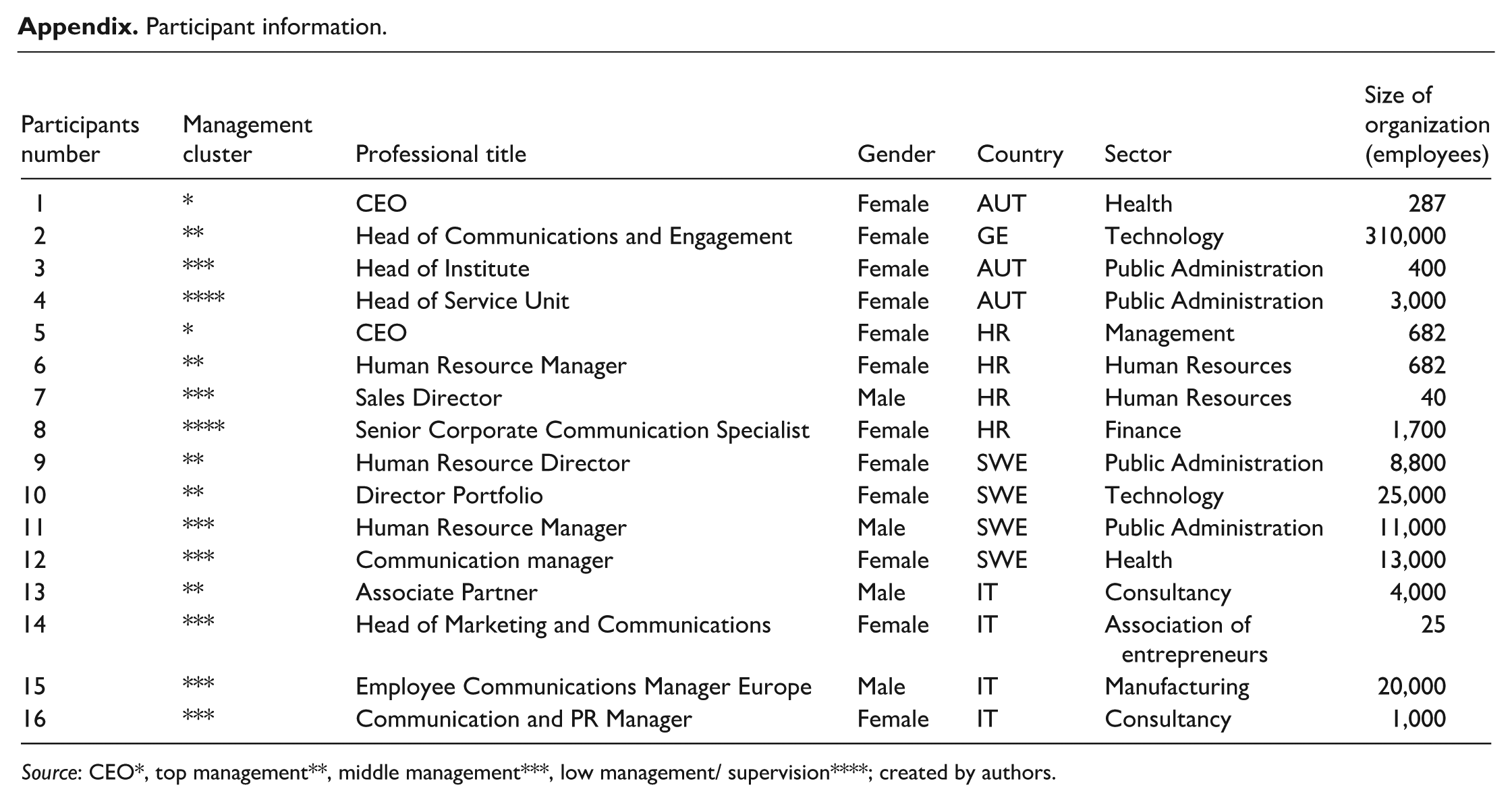
| Participants number | Management cluster | Professional title | Gender | Country | Sector | Size of organization (employees) |
|---|---|---|---|---|---|---|
| 1 | * | CEO | Female | AUT | Health | 287 |
| 2 | ** | Head of Communications and Engagement | Female | GE | Technology | 310,000 |
| 3 | *** | Head of Institute | Female | AUT | Public Administration | 400 |
| 4 | **** | Head of Service Unit | Female | AUT | Public Administration | 3,000 |
| 5 | * | CEO | Female | HR | Management | 682 |
| 6 | ** | Human Resource Manager | Female | HR | Human Resources | 682 |
| 7 | *** | Sales Director | Male | HR | Human Resources | 40 |
| 8 | **** | Senior Corporate Communication Specialist | Female | HR | Finance | 1,700 |
| 9 | ** | Human Resource Director | Female | SWE | Public Administration | 8,800 |
| 10 | ** | Director Portfolio | Female | SWE | Technology | 25,000 |
| 11 | *** | Human Resource Manager | Male | SWE | Public Administration | 11,000 |
| 12 | *** | Communication manager | Female | SWE | Health | 13,000 |
| 13 | ** | Associate Partner | Male | IT | Consultancy | 4,000 |
| 14 | *** | Head of Marketing and Communications | Female | IT | Association of entrepreneurs | 25 |
| 15 | *** | Employee Communications Manager Europe | Male | IT | Manufacturing | 20,000 |
| 16 | *** | Communication and PR Manager | Female | IT | Consultancy | 1,000 |
Source: CEO*, top management**, middle management***, low management/ supervision****; created by authors.
Acknowledgements
We thank all our participants for their valuable time and engagement to foster this important discourse.

Ethical Considerations
Ethical approval is not applicable
Consent to Participate
Participants gave their written consent to participate in this study including their agreement on the use of anonymized and pseudonymized data for publication.
Funding
The authors received no financial support for the research, authorship, and/or publication of this article.
Declaration of Conflicting Interests
The authors declared no potential conflicts of interest with respect to the research, authorship, and/or publication of this article.
Data availability Statement
The raw data material cannot be shared with the community as data protection and anonymity was guaranteed to our participants.