




Abstract
In 2018 and 2019, Boeing made headlines after two 737 Max aircrafts were involved in fatal crashes. The same issue was to blame for both incidents: the airplane’s Maneuvering Characteristics Augmentation System, which is responsible for stabilizing the airplane, failed on both occasions. Boeing was charged with conspiracy to commit fraud and agreed to pay over $2.5 billion; a clear case of corporate wrongdoing. Using corpus-assisted methods to analyze a 31,872-word-corpus of Boeing’s press releases related to the incidents, this paper explores the key discourses found within them, and how they link to Coombs’ crisis communication strategies. It identifies Boeing’s key semantic domains to explore the ways through which they attempt to protect their brand identity and restore trust. In particular, findings suggest that Boeing promote inclusivity, offer clarity and transparency, emphasize their safety record, and they project confidence and knowledge. At the same time, they are clearly constrained in how much they can say due to potential legal repercussions.
Introduction
Boeing is an American multinational company that designs and manufactures a whole range of products in the aerospace industry, and is currently one of top aircraft producers in the world. The company attracts both public and private customers, in part due to its reputation for producing safe and reliable aircraft. In late 2018 and early 2019 however, Boeing made headlines after two 737 Max aircrafts, the latest addition to its fleet (980 had been produced, as of November 2022), were involved in two fatal crashes, leading to the deaths of 346 passengers and crew members. These crashes, caused by faulty equipment onboard the aircraft, led to the grounding of the Boeing 737 Max fleet for almost 2 years and the result of this action, combined with the associated legal fees that were necessary in the aftermath, cost Boeing an estimated $20 billion (Nerkar & Ember, 2024).
For the general public, the crisis was the result of gross corporate misconduct on Boeing’s part. Legal processes, in the aftermath of the crashes, determined that Boeing were squarely at fault, and as such this is a clear case of corporate wrongdoing. 1 Errors in the aircraft computer system led to human tragedy; something that was avoidable, given it was the result of faulty equipment that the company should never have released in the first place. For Boeing, this became a large-scale corporate crisis, with the company’s future on the line. When markets opened, on the first day after the second crash, Boeing’s stock price sank 11% (and as much as 13% during intraday trading)—their largest decline since the 9/11 attacks in 2001 (Bloomberg, 2019).
In the wake of the scandal, Boeing had to navigate public relations and legal challenges to ultimately restore trust in their brand. The present paper examines how Boeing handled this, as reflected in the press releases issued throughout the crisis. In particular, it addresses the following two research questions:
RQ1: What are the key discourses found in Boeing’s press releases related to the Boeing 737 Max crisis?
RQ2: In Coombs’ terms, what are the key crisis communication strategies used in Boeing’s press releases related to the Boeing 737 Max crisis?
In addressing these questions, we are able to build up a picture of how Boeing discursively constructed their particular case of corporate wrongdoing, how they responded, linguistically, to the events, and how they attempted to restore trust in their brand. It is hoped that the results of this study will inform how corporate wrongdoing is, or can be, handled by corporations in their public relations material. It will offer an insight into how companies accused of wrongdoing negotiate their responsibility, often in response to outside pressures. On a methodological level, it will explore how a corpus linguistic approach to analysis can offer a more nuanced picture of a particularly high-pressure and difficult situation—for both the victims and the corporation involved.
There are several benefits to employing a corpus linguistic approach to analyze press releases. I outline three here. The first is that corpus-assisted methods allow the analyst to conduct a comparative analysis of lots of data at once. Rather than examining individual press releases, conducting a close reading of each, and identifying strategies across them, using corpus methods allows the analyst to get a birds-eye view of Boeing’s response strategy over the whole crisis, and compare that with their regular messaging. The second is that because it is a primarily data-led approach, it avoids cherry-picking the data. Rather than subjectively selecting press releases, the focus is on broad trends established by the statistics, then focusing on individual press releases where appropriate; “the numbers tell you where to look closer” is a popular adage in corpus linguistics. The third is that results are supported by statistics, which adds robustness to the argument. It is the researcher’s job to interpret and make sense of the output, but the primary starting point of the analysis is a product of statistical analysis, thus being somewhat more “objective.”
The Literature Review section begins with an overview of the Boeing 737 Max crisis, detailing the main events in the form of a timeline, stretching from the first crash through to its legal settlement. This section also explores academic literature in relevant fields, starting with a theoretical account of crisis communication (e.g., Coombs, 2006), followed by other work within (critical) discourse studies that have looked at corporate wrongdoing (e.g., Fuoli, 2013; Lutzky, 2024). The Data and Methods section reports on the dataset used (i.e., the two corpora created specifically for this investigation) and it offers an introduction to the corpus-assisted method (Baker, 2024; Gillings et al., 2023; Partington et al., 2013). In particular, it discusses the main tools used: key semantic tag analysis, and concordance analysis. It also details how these two fields of work—both theoretical accounts and discursive perspectives on crisis communication—are brought together within the present investigation. We then move on to the analysis proper, before summarizing the key findings in the Conclusion, offering some finalthoughts and potential paths for future work.
Literature Review
We begin with a brief overview of the Boeing 737 Max crisis, written in the form of a timeline. In retrospect, we now know that the history of the crisis stretches back to at least 2016, when Boeing engineers approved a redesign of the Maneuvering Characteristics Augmentation System (MCAS), and they subsequently requested that references to the system be removed from the operations manual. However, the timeline below begins on 29 October 2018, the day of the first crash, which had the knock-on effect of uncovering other key events. The timeline thus details key points where important events in the past became relevant.
We then move on to a discussion of work in crisis communication with a particular focus on Coombs’ (2006) Situational Crisis Communication Theory. Given the theoretical nature of this work, it advises practitioners on how they should match their communicative responses to the level of crisis and reputational threat likely to be posed. Towards the end of this section, we shift to empirical work within the field of (critical) discourse analysis and corpus linguistics—that is, work which is closer to the present paper—to explore how companies in the past have actually responded, linguistically and discursively, to crises.
The Boeing 737 Max Scandal: A Timeline
29 October 2018: Lion Air Flight 610 crashed directly after take-off from Jakarta (Indonesia), killing all 189 people on board. Indonesia’s National Transportation Safety Committee finds that the issue was caused by a glitching Angle-of-Attack (AOA) sensor that caused a knock-on effect on the MCAS (a flight stabilizing feature). MCAS is designed to tilt the plane back to an optimal flying position if the plane is at risk of going vertical and stalling. Here, when the AoA erroneously thought the plane was going vertical, it over-corrected and sent the aircraft toward the ground. The pilots had to follow a sequence of instructions to regain control—something they were not equipped to do (Gates, 2019).
6 November 2018: Boeing issued an Operations Manual Bulletin outlining a procedure to counteract this over-correction. This bulletin included Boeing’s first reference to MCAS, under the vaguely-named “pitch trim system”; this was the first time that pilots became aware of its existence (Herkert et al., 2020).
10 March 2019: Ethiopian Airlines Flight 302 crashed directly after take-off from Addis Ababa (Ethiopia), killing all 157 people on board. Ethiopian investigators found that the MCAS was again to blame, and that flight crew had indeed attempted to follow procedures to regain control.
10 March 2019 to 13 March 2019: 737 Max aircraft are grounded worldwide, with the USA being among the last countries to do so (Herkert et al., 2020).
May 2019: Media reports reveal that Boeing did not consult its pilots during the development of MCAS, nor were they briefed on how MCAS operated, or that the whole system relied on a single AoA sensor (Tangel & Pazstor, 2019).
October 2019: Transcripts reveal that Mark Forkner (chief technical pilot involved in the plane’s development) knew that the system was acting erratically during flight simulations and had notified colleagues (Gelles & Kitroeff, 2019). Transcripts also revealed that Forkner was granted permission from the FAA to remove mention of MCAS from the Max pilot manual, and so Boeing would not need to require pilot retraining. In a message to a fellow pilot, Forkner says “I basically lied to the regulators (unknowingly),” but it is unclear what this specifically refers to (Gelles & Kitroeff, 2019).
29 & 30 October 2019: Boeing CEO Dennis A. Muilenberg testifies to two US Congressional Committees.
December 2019: Whistleblowers claimed that they warned Boeing leadership about potential risk due to the company cutting corners (Marsh & Wallace, 2019). On 23 December, Muilenberg is removed as CEO and replaced by David Calhoun (Klee, 2024).
27 May 2020: Boeing resumed production of the Boeing 737 Max.
29 December 2020: American Airlines becomes the first US airline to resume commercial operations.
7 January 2021: Boeing settles to pay over $2.5 billion after being charged with fraud for concealing safety information from the FAA (US Department of Justice, 2021).
Theoretical Approaches to Crisis Communication
When classifying a crisis, two distinctions can be made. The first is in whether a crisis is internally generated and the affected company is responsible, or whether it is externally generated and thus beyond the company’s control. The second is in making a distinction between whether a crisis happens suddenly and unexpectedly, or whether it evolved gradually over an extended period of time (Darics & Koller, 2018). In the case of the Boeing 737 Max scandal, it is clear that the crisis was internally generated and fault lies with the company concerned, but it is less clear how to categorize its onset time. Whilst the catalyst for the crisis was undoubtedly the Lion Air flight crash in October 2019, whistleblower testimonies do support the idea that there was an ongoing internal crisis with respect to working conditions and leadership. Given that these two distinctions have repercussions for where responsibility and thus blame lies, it is important to ascertain them early on in a crisis to determine which communication strategy is most optimal to deal with it effectively.
When an organization is involved in a crisis, then its public image is highly likely to be threatened to such an extent that it becomes an issue. As such, one of the many tasks for the communications team is to either maintain or repair the organization’s image. Whilst this can be achieved via non-verbal and non-discursive means (e.g., by giving a form of compensation), the organization’s language use is vital, especially in the immediate aftermath of the crisis. Breeze (2012, p. 4) suggests that this should focus on “providing reasons, grounds or acceptable motivations for actions that have been or could be criticized by others.” The type of crisis determines how the company should respond: internally generated crises, for example, require the company to take responsibility and they may issue an official corporate apology. Yet if the crisis is externally generated, then apologizing on someone or some other organization’s behalf can potentially do more harm than good. Work in crisis communication thus examines the optimal responses to a range of different scenarios.
Seminal works within crisis communication are Benoit’s (1995) Image Repair Theory (IRT) and Coombs’ (2006) Situational Crisis Communication Theory (SCCT). The former, IRT, consists of a typology of strategies that can be employed by the organization in response to crises. It has five main strategies, some of which have individual components within them which can be drawn upon depending on the individual case: (1) denial (i.e., denying the act in question, or shifting the blame); (2) evading responsibility; (3) reducing offensiveness (i.e., reducing negative perceptions of the organization as much as possible); (4) corrective action (i.e., restoring the situation or making changes to prevent it reoccurring); and (5) mortification (i.e., admitting responsibility and requesting forgiveness). Generally speaking, there is considerable support for IRT within the crisis communication literature, with numerous published case studies where analysts have tested the utility of the theory and assessed its predictive power. Whilst useful for those working with crisis communication, because it offers advice in crisis recovery, it focuses on public relations as a whole, rather than being about communication specifically. As such, some strategies, such as “corrective action,” are something that can be mediated by language, but may not be a communicative act. For example, the corrective action may take the form of compensation; something that is communicated, but is not a communicative strategy per se.
The other key work within crisis communication, SCCT, is one such theory that focuses on communication specifically. It “is premised on matching the crisis response to the level of crisis responsibility attributed to a crisis” (Coombs & Holladay, 2002, p. 166) and is thus flexible enough to recommend different communicative strategies depending on the organization’s role in the crisis. SCCT categories crises into three clusters, according to the level of responsibility that the organization has for the crises. On the lower end of the responsibility scale is the victim cluster, whereby the organization is also a victim of the crisis and they are likely to experience only a mild reputational threat. Somewhere in the middle is the accidental cluster, whereby organizational actions leading to a particular crisis were unintentional, and as such there is a moderate reputational threat. At the high end of the scale is the preventable cluster where organizations put people at unnecessary risk by taking poor action or violating a particular rule, and thus the crisis results in a severe reputational threat (Coombs, 2006).
Coombs (2006, p. 248) then details a series of potential response strategies, depending on which of the three clusters the crisis belongs to. For crises falling into the victim cluster, the organization may choose a “deny response option,” whereby they deny their involvement either by attacking the accuser (if they are known), scapegoating someone or some other group, or outright denial. For crises falling into the accidental cluster, the organization may choose a “diminish response option” to downtone and mitigate their involvement, perhaps by offering an excuse or justifying/minimizing the damage. And finally, for crises in the preventable cluster, organizations may opt for a “deal response option,” including ingratiation (i.e., reminding stakeholders of the organizations’ good work), expressing concern, regret, or offering compassion to the victims, or they may opt to issue a formal apology, indicating that they are willing to take full responsibility (Coombs, 2006, p. 248). Given the Boeing 737 Max case falls into the preventable cluster, we would expect the communicative response to contain elements of these latter strategies under the “deal” response. Throughout the remainder of the paper, I opt to focus on SCCT rather than IRT, as the former focuses on communicative strategies, rather than organizational actions as a whole.
Discursive Approaches to Crisis Communication
The works discussed so far are theoretical and normative; they offer suggestions as to how organizations should respond to different types of crises and have been distilled into a form of best practice guidance to ensure maximum efficiency and impact. That is not to say that organizations always follow that guidance, however. Rather than taking a broad theoretical perspective, work from a (critical) discourse analytical perspective has instead tended to study individual cases of corporate wrongdoing, and individual organizational crises, and examined how those organizations have responded linguistically. This has either been achieved via fine-grained critical close reading, or via corpus linguistic methods whereby there is the opportunity to analyze more data at once. These are the two approaches discussed here.
One of the most prominent scholars applying (critical) discourse analysis to corporate wrongdoing is Ruth Breeze. An exemplary paper in this regard is Breeze (2012) which examined legitimation strategies used by oil companies in the wake of the 2010 oil spill in the Gulf of Mexico. Realizing that oil companies made reference to the oil spill in their annual reports, Breeze (2012) found that they attempted to legitimate both individual companies and the industry at large by enacting a dramatized survivor narrative. The discursive effect of this was in giving the impression that the company has been “forced to combat” some external force, and they were therefore engaging the public’s solidarity as stakeholders (Breeze, 2012, p. 12). Jaworska (2023) similarly focused on how corporations embroiled in wrongdoing use narrative to their advantage. In examining a selection of responses to cases of corporations’ own wrongdoing, Jaworska (2023) finds that Uber used personal storytelling (p. 103), whilst Wells Fargo used a frame of “connection and community to evoke a feel-good mood and empathy” (2023, p. 101). In papers such as these, it is easy to draw parallels between linguistic choice and communicative crisis response, as discussed in the previous subsection.
Taking a corpus-assisted perspective, however, allows one to scale up the size of the dataset. This was the approach taken by work such as Fuoli (2013), Lutzky (2024), and Ras (2020, 2021). Fuoli (2013), for example, collected a corpus of CEO letters published before and after the 2010 Gulf of Mexico oil spill. Given BP’s responsibility in this case, Fuoli examined how BP’s response differed to that of other major oil companies, as represented in their CEO letters. He found that BP’s letters contained more expressions of affect, along with more epistemic and modal markers, and more personal pronouns (Fuoli, 2013). Given that the crisis was internally-generated in this case (and in the preventable cluster), these linguistic techniques were necessary in their attempt to re-establish trust in the aftermath.
Such an approach, however, may not be necessary when dealing with crises in the victim cluster. Lutzky (2024), also utilizing a corpus linguistic methodology, examined a corpus of tweets posted by Ryanair in early 2022, in the midst of the COVID-19 pandemic. This was an interesting case, because rather than the crisis being preventable, as in BP’s case, this was the result of outside pressures and thus the threat to their reputation was relatively low. Her analysis finds that Ryanair essentially reframed their crisis communication as a form of promotion; they took a “sociopolitical stance in the vaccination debate by positioning [themselves] as a pro-vaccination airline,” and even took to making fun of celebrities that went against that stance (Lutzky, 2024, p. 48). This analysis thus demonstrates how the approach to crisis communication differs linguistically, depending on the cause.
Finally, Darics and Koller (2018) linked Coombs’ (2006) response strategies with particular linguistic features. For example, they suggest that ingratiation likely features more positive evaluation (e.g., positively loaded adjectives), and minimization strategies may contain more hedging to downtone the statement. Likewise, denials may result in distancing language (e.g., passivation), grammatical negation, and comparatives. In light of this, we can begin to see how such an approach at the intersection of crisis communication and discourse analysis may prove fruitful, not only in academic work, but also in the training of practitioners who must deal with these crises in the corporate setting.
Taken collectively, this paper fills a gap by bringing together both theoretical and discourse analytical perspectives. The former typically does not interact with the organizations’ discourse material to capture their individual voice, whilst the latter only typically does so in smaller datasets. As such, the present paper brings them together and employs a corpus-assisted methodology to examine how those strategies are mediated on a large scale, over the course of an entire crisis. It uses corpus-assisted methods to not only examine the key discourses found within Boeing’s press releases, but also to determine which of Coombs’ (2006) crisis communication strategies were used by the company to deal with it.
Data and Methods
Data
In order to accurately capture Boeing’s voice and explore how they themselves negotiated their position and began to recover from the crisis, the data used in this paper was taken directly from Boeing’s own website. Two separate corpora were collected for this analysis: the 737 Max Corpus, made up of press releases that were related in some way to the relevant incidents outlined in the literature review; and the Press Release Corpus consisting of other press releases published over the same period, but unrelated to the incidents. Exploring these two datasets therefore allows us to explore what makes Boeing’s statements on the 737 Max scandal distinct, when compared against their usual everyday messaging on unrelated topics. These texts have been strategically constructed with careful planning and revision, and so whilst they are not a direct insight into the inner workings of Boeing during the time of the crisis, they are still naturally occurring texts that were produced in response to it.
Data for the two corpora was collected from the Boeing Media Room. 2 This website provides information and resources for journalists across all of Boeing’s subsidiaries (e.g., “Commercial,” “Defense,” and “Space”) and as such, all of their press releases are published directly to this site. The website’s filtering options were used in order to limit press releases published between the 29th October 2018 and the 24th February 2021—the dates of the first and the final official statements published by Boeing, on that website, concerning the 737 Max incidents. Those press releases that had something to do with the 737 Max incidents were included in the 737 Max Corpus; those that had nothing to do with the incidents were included in the Press Release Corpus. Any boilerplate text (e.g., the date, contact information for the relevant press officer) was removed so that each file in the corpus only consisted of the press release’s header and main body content. In total, the search parameters above returned 729 press releases. This was reduced to 475 when filtering out duplicates, of which 54 went to the 737 Max Corpus, and 421 to the Press Release Corpus.
Deciding which corpus to categorize press releases into was relatively easy in the majority of cases, but borderline cases were ultimately a subjective decision that was then applied consistently across similar articles. To be categorized as part of the 737 Max Corpus, the press release had to be a response to something that has happened as a result of the incident (e.g., expressing sympathy; legal responses; and resuming operations) and they should mention the incident outright. 3 To be categorized as part of the more general corpus, the press release should not address the incident at all. Borderline cases were those that were about leadership changes and those that reported on new bulk orders of the aircraft. It was ultimately decided to include those press releases that discussed leadership changes amidst the crisis (given the changes were in response to the crisis), but those simply reporting on new orders were categorized into the general corpus. Whilst reports of airlines purchasing a bulk order of new 737 Max was a not-so-subtle signal that airlines were again giving their trust to Boeing, it still did not relate to the incidents directly, and were thus included in the general corpus. There were also a handful of press releases related to incidents other than those focused on here (e.g., a Boeing 707 cargo plane incident in Iran; a Miami Air flight skidding off a runway), and these too were thus categorized into the general corpus. Whilst their inclusion in the 737 Max Corpus would have given us an insight into how Boeing present themselves in times of crisis, they were unrelated to this particular case of wrongdoing and thus removed.
The corpus was uploaded to Wmatrix, a popular corpus analysis program (Rayson, 2008). Whilst other corpus analysis tools can be used to conduct a corpus-assisted analysis, Wmatrix is unique in that the USAS semantic tagger is integrated within it. The USAS semantic tagger assigns 1 of 232 semantic domains to each word within the corpus, and then Wmatrix allows the analyst to see which of those domains are either “under” or “overused” within a particular corpus. In total, the 737 Max Corpus consisted of 31,872 words, and the Press Release Corpus consisted of 228,051 words.
Corpus-Assisted Discourse Analysis
The particular method used in the present paper is corpus-assisted discourse analysis (CADS), now a well-established method used within linguistics. It draws theoretical inspiration from discourse analysis and combines that with the corpus linguistic methodological toolkit (Baker, 2024; Gillings et al., 2023; Partington et al., 2013). It allows the researcher to explore how discourses are constructed and solidified through repeated and incremental patterns (Baker, 2024; Stubbs, 2001). In other words, if a particular linguistic pattern (be it grammatical, semantic, pragmatic, or discursive), is used time and again, by a range of speakers in a similar context and to achieve a similar aim, then the result is the construction of a certain discourse. A corpus-assisted analysis has frequency at its heart: theoretically speaking, the more times an item occurs, the greater saliency, prominence, and attention is afforded to it within a corpus. The methods used in CADS, outlined here, allow us to unpack those constructions for critical assessment. CADS has been usefully applied to projects stretching across a range of disciplines, and increasingly, corpus-assisted methods are being utilized by those interested in business communication and business discourse (for overviews, see Gillings et al., 2024; Gillings & Kopf, 2024; Jaworska, 2017; Lutzky, 2021; Mautner, 2021; Pollach, 2012). With that said, its uptake has not yet been as strong as one might hope.
This paper primarily makes use of two corpus-assisted techniques to explore Boeing’s messaging on the 737 Max scandal. The first is key semantic tag analysis: the comparison of two corpora to determine which semantic tags occur statistically more frequently in one over the other. The comparison is between the 737 Max Corpus (the study corpus) and the Press Release Corpus (the reference corpus). The choice of reference corpus is very important within this type of analysis, as it has a direct effect on tags we find. If we were to compare the 737 Max corpus to a reference corpus such as the Corpus of Contemporary American English (Davies, 2008), then it is likely that semantic tags related to transport and air travel would appear as salient. However, given that our reference corpus here is much closer in topic, then the tags will be somewhat more nuanced; related in some way to the scandal or the 737 Max specifically. This therefore allows us to determine what was unique about Boeing’s reporting on the scandal itself, and the discourses invoked by their specific messaging on this topic, rather than very general key tags related to the company and their everyday operations.
The other main corpus-assisted technique used in the present investigation is a concordance analysis. Concordancing refers to seeing words of interest within their linguistic co-text (typically around 10 words on either side), conducting a form of vertical reading, and then seeking patterns across them. This is the more qualitative side to a CADS analysis: results derived from statistical evidence (in the present case, a key semantic tag analysis) instruct the analyst where they should conduct close-reading on a more fine-grained level. Different research questions lend themselves to different types of concordance analysis (see Gillings & Mautner, 2024 for discussion). Some analyses require the researcher to systematically read through each and every concordance line, whereas in others, the researcher need only eyeball them and make a qualitative holistic judgement. Similarly, some analyses require categories to be imposed on the concordance lines in a top-down fashion, whereas in others, categories are developed bottom-up and come organically from the data. Here, I carry out what Gillings and Mautner (2024) refer to as a Type 3 unstructured bottom-up analysis, whereby I review the lines to gradually build up an idea of the discourses expressed within them. As such, the approach ties quantitative patterns to the linguistic context—something that is key when working with discourse data.
Analysis
Wmatrix was used to conduct the key semantic domain analysis, comparing the 737 Max Corpus with the Press Release Corpus. Key semantic domains were identified using a three part procedure (as also used in Chan & Gillings, 2024). Firstly, they were filtered using the log-likelihood test where a critical value of 6.63 (p < .01, 1%) was imposed. Secondly, they were filtered using an effect size measure, %DIFF, whereby those keywords with an effect size lower than 50 were discarded. This means that to be considered key, a semantic domain must appear more than 50% more frequently in the study corpus than in the reference corpus (Gabrielatos & Marchi, 2012). Thirdly, a minimum frequency of 50 was imposed, meaning that collectively, all of the words tagged as that semantic domain appeared over 50 times in the study corpus. This procedure means that we can be sure differences between the corpora are both large and statistically meaningful.
Table 1 below shows the 13 key semantic domains that meet this criteria. The first column shows the label given to the semantic domain in Wmatrix, the second column shows the log-likelihood (significance) score, the third column shows the %DIFF (effect size) score, and the fourth column shows the five most frequent words that were tagged as belonging to that semantic domain.
Key Semantic Domains in the 737 Max Corpus.
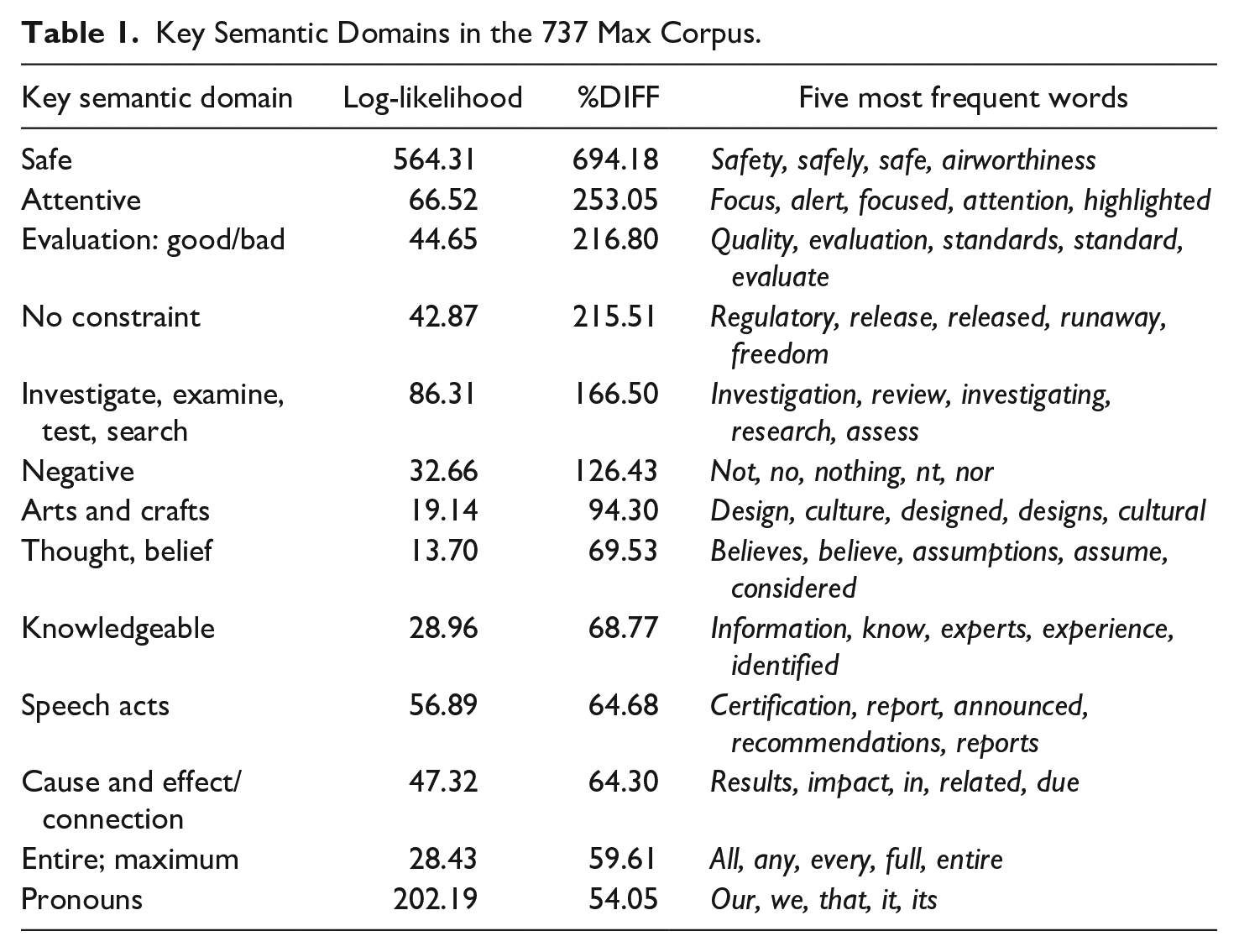
The remainder of this section has been organized according to key strategies identified by the key semantic tag analysis. In conducting the analysis, I began by looking at concordance lines of words that were tagged as belonging to each semantic domain. This vertical reading of lines allowed me to understand the main usages of each word, also going back to the original press releases in their entirety where additional context was necessary. With that knowledge in mind, the next step was to group the key semantic domains into broader categories, here referred to as “discourses.” This was difficult in some cases, as some word usages could have reasonably belonged to other categories, and other words did not yield any new insights so it was difficult to categorize them one way or another. In the former case, the focus was on broad trends; in the latter, they were removed from categorization. 4 In any case, it is these areas that translate into the key ways that Boeing’s press releases about the scandal differ from their regular messaging; how they wish to portray themselves and restore brand image in the aftermath of a crisis. Through this analysis, we find that through their press releases, Boeing attempt to promote inclusivity, offer clarity and transparency, promote their safety practices, and project confidence and knowledge. In each section, we will also explore why those specific linguistic choices were made by Boeing, and consider their utility with respect to the crisis communication strategies laid out in the literature review.
Promoting Inclusivity
The semantic tag analysis identified “Pronouns” as key in the 737 Max Corpus; that is, press releases related to the scandal use pronouns significantly more frequently than in the regular messaging. The most frequent pronouns used in the 737 Max Corpus are our (occurring 425 times), we (319 times), that (113), it (86), its (61), their (55), and us (40). Relatively speaking, our and we are used 1.33 and 1.00 times per million words in the study corpus, yet only used 0.64 and 0.44 times per million words in the reference corpus. In both cases, then, they are used more than twice as frequently when discussing the crisis.
To find out why this might be the case, we can examine the collocates (i.e., words which appear within a span of five words to the right) and concordance lines to find out what Boeing are actually referring to when our and we are used. Through this method, we can see that when our is used, Boeing often use it to refer to a number of key stakeholders. Our collocates with customers in 68 cases; team(s) in 15 cases; suppliers in 12; passengers in 11; people in 7; employees in 6; then engineers and experts in 3 cases each. Customers, passengers, and suppliers here refer to the three key external stakeholders, with the remainder referring to their internal staff make-up. The particular social actor that collocates with our differs depending on the type of press release being issued. Whilst all press releases are available for the public to view via their online media room, some are clearly more focused on their employees, whereas others are more likely aimed at commercial airline partners. In Example (1), from 5th April 2019, CEO Dennis Muilenburg announces a new committee to assess the effectiveness, design, and safety of their airplanes. This is likely to be of interest to all, and so all three internal and external stakeholders are referenced at the same time, and in the same utterance:
Example (1): Our continued disciplined approach is the right decision for our employees, customers, supplier partners and other stakeholders as we work with global regulators and customers to return the 737 MAX fleet to service and deliver on our commitments to all of our stakeholders. (2019-04-05.txt)
These are the key stakeholders that Boeing, ideally, need to keep on side. The use of a possessive pronoun (e.g., our) implies that both Boeing and the social actor are inextricably linked—that they are naturally found together and that relationship is not up for negotiation. In this case, Zimmermann et al. (2013) argue that “using first-person plural pronouns (e.g., we us) emphasizes [the self’s] embeddedness into social relationships.” It signals a sense of belonging and ongoing involvement between the two entities.
A similar effect can be observed for the use of we. In Boeing’s case, we refers to the organization, giving the impression that everyone in the organization speaks as a single collective, rather than a series of individual voices. Mautner (2019) suggests that the effect of this is to “mak[e] the corporate voice sound a great deal more personal than using the name of the organization would.” Consistently referring to themselves as Boeing would come across as abnormally impersonal, and something that they would want to avoid in the wake of a crisis.
Examining the concordance lines of we, and particularly the verbs following the pronoun, we can see that the company is “supporting this proactive step” (2019-03-13_2.txt); “coordinating closely with our customers” (2019-04-05.txt); “investing heavily” (2019-10-22_4.txt); and “progressing on our journey of excellence” (2021-01-27_2.txt). Overwhelmingly, the pronoun collocates with positively-loaded verbs of doing (an effect also found in Mautner, 2019, in her examination of texts produced by Volkswagen in response to their own crisis). In Coombs’ (2006) terms, this is a form of ingratiation—reminding stakeholders of the organizations’ good work, with the ultimate aim of building a positive image of the brand.
We can also see evidence of Coombs’ other communicative strategies belonging to the preventable cluster. In particular, in Examples (2) and (3) below, we observe Boeing offering compassion to the families and loved ones of those on board.
Example (2): We extend our heartfelt condolences and sympathies to the families and loved ones of those onboard. (2018-11.27.txt)
Example (3): “The tragic loss of life in both accidents continues to weigh heavily on all of us at Boeing, and we have the utmost sympathy for the loved ones of those on board,” said Dennis Muilenburg, Boeing chairman, president and CEO. (2019-07-17.txt)
What we do not see, however, is an outright apology where Boeing take direct responsibility for the incidents that occurred. In Goffman (1959) terms, a true apology must contain some loss of face, yet that does not seem to be forthcoming in Boeing’s press releases. According to Darics and Koller (2018, p. 114), for an apology to be perceived as such by the audience, the speaker must use some explicit “expression of regret such as ‘sorry’, ‘apologies,’” and they must also use one of the following strategies: taking responsibility, explaining or accounting, offering repair, or promising forbearance. They note that “simply expressing regret without taking responsibility does not make for a good apology, or indeed an apology at all” (Darics & Koller, 2018, p. 115).
The explicit apology marker, sorry, only occurs five times in three press releases. In particular, Boeing are sorry for “the lives lost and the pain these accidents have caused worldwide” (2019-04-04_2.txt); “the loss of life” (twice, in 2019-04-29_3.txt); and “the tragic loss of lives” (2019-07-03.txt). Instead of taking responsibility for the preventable action, they instead apologize for the outcome. For sake of completeness, running a concordance for the term responsibility provides similarly evasive commentary, where the company takes responsibility for eliminating risk (e.g., 2019-04-29_3.txt) and “designing, building and supporting the safest planes in the skies” (e.g., 2019-04-04_2.txt). Again, a far cry from an admission of responsibility in Coombs’ and Darics and Koller’s terms.
The lack of an outright apology is something that Breeze (2021) also identified in her corpus of annual reports from five FTSE-listed UK banks, throughout the period 2009-2018. Ultimately, she finds that canonical apologies (i.e., explicit expressions of remorse) were minimal, and any vocabulary which typically signals as an apology (e.g., sorry or responsibility, as above) is typically mitigated. Instead, she notes that banks utilize strategies along a sliding scale from explicit apology to “vague allusions to regret in which the apologizer is distinct from the perpetrator,” with “quasi-apologies” (reference to past apologies, generic apologies, distanced apologies, and mitigated apologies) appearing between these two ends (Breeze, 2021, p. 59). Whilst a more fine-grained analysis of apology markers would be necessary to examine the exact spread of these types, it is clear that Boeing make use of these quasi-apologies to achieve a “break in the chain of responsibility” (Breeze, 2021, p. 51; see also Breeze, 2024).
A final function of we seems to be Boeing aligning themselves with the wider aerospace industry and the regulators, as in Example (4) below.
Example (4): This overarching focus on safety spans and binds together our entire global aerospace industry and communities. We’re united with our airline customers, international regulators and government authorities in our efforts to support the most recent investigation, understand the facts of what happened and help prevent future tragedies. (2019-03-18.txt)
Given that the aerospace industry is known for its safety, Boeing can strategically portray themselves as belonging to that in-group (through the use of both we and our), and thus taking on those connotations.
Offering Clarity and Transparency
The second key feature of Boeing’s press releases related to the incidents is that they use language which could be seen as (1) offering clarity on the situation, and (2) offering transparency, ensuring that their decisions are on-record and accountable. This strategy was identifiable via the semantic tags “Thought, belief” and “Speech acts.” The most frequent words tagged as “Thought, belief” are believe(s) (occurring 21 times), assumption(s) (10), assume (5), considered (5), and feel (4). The most frequent words tagged as “Speech acts” are certification (occurring 48 times), report (38), announced (25), recommendations (22), and reports (12). Taken as a whole, these words are used to give an insight into Boeing’s official position at the time of writing the press release.
The first category that this paper considers is “Speech acts.” The label given to the category is perhaps misleading at first glance, and it does not quite make sense within this context. A speech act is understood in pragmatics as an utterance that not only presents information in some way, but performs an action too (Sbisà, 1995). What we find here is that Wmatrix has tagged nominalizations that would be typically used to perform a speech act in their verbal form (e.g., certify, recommend). In any case, we can use the output to our advantage and observe that Wmatrix has pointed us toward official procedures that Boeing are involved in, as part of their recovery process. For example, in Example (5), we see that report is used when Boeing responds to official reports released by the National Transportation Safety Committee:
Example (5): The report does not include records as to the installation or calibration of the new sensor, nor does the report indicate whether the sensor was new or refurbished. Although the report states that the pilot was satisfied by the information relayed by the engineer that the AOA sensor had been replaced and tested, on the subsequent flight the pilots again experienced problems with erroneous airspeed data, and also experienced automatic nose down trim. (2018-11-27.txt)
Here we can see Boeing essentially going through the key aspects of the report and pointing out what it does and does not state. As such, by identifying areas of the report that were lacking, Boeing begin to cast doubt on it. This is important for Boeing, because not only does it give audiences a new line of questioning (away from the organization itself), it also begins to identify areas in the report which might later become important in a legal context. 5 In Coombs’ (2006, p. 248) terms, it is an attempt at minimizing the degree of damage and suggesting that there may be more to the issue than initially meets the eye in the official report. Interestingly, such a strategy is part of the “diminish response option,” namely “excuse” whereby the “Crisis manager minimizes organizational responsibility by denying intent to do harm and/or claiming inability to control the events that triggered the crisis.” (Coombs, 2006, p. 248). Response options within the “diminish” strategy are typically reserved for crises in the accidental cluster, so this could be seen as Boeing attempting to shift public opinion toward the incidents being “accidental” rather than “preventable.”
Other frequent items in the “Speech acts” category are used to offer clarity and provide an update on their progress. Certification is used when the company discusses their software’s re-certification (“We’re nearing completion and anticipate its certification and implementation on the 737 MAX fleet worldwide in the weeks ahead,” 2019-04-04_2.txt). Given that re-certification is essentially an admission by the Federal Aviation Administration that Boeing’s new software is safe (i.e., a token of trust), continually referring to the process throughout their press releases is a form of persuasion. Announced serves a similar purpose—that is, to persuade readers that they are focusing on safety and that the safety of their aircraft is paramount—in that it refers to official announcements Boeing have made related to the crisis (e.g., that they established a “permanent Aerospace Safety Committee” (2020-09-16.txt), a “$100 million fund to provide near-term financial assistance to the families of the victims” (2019-10-22_4.txt), and so on).
As for the “Thought, belief” category, the verb believe is used to signal that the committee and board are both in alignment and working toward the same goal, projecting strength, and offering transparency in their work. It is a way of signaling the official organizational stance on a matter. We can observe this in Example (6):
Example (6): “The committee and the board believe these recommendations, along with actions already taken by the board, will strengthen engineering at the company, bolster the safety policies and procedures for the design, development and production of Boeing products and services, and further improve board and management oversight and accountability for safety not only at Boeing, but throughout the global aerospace industry.” (2019-02-25_2.txt)
Whilst the term believe is used in Example (6) to make their official stance clear, in other press releases, Boeing themselves actually problematize the use of the verb in their “forward-looking statements,” and make clear that they cannot be held responsible for those statements in the future. This admission is found in four press releases in the 737 Max Corpus, typically where what they are reporting on has some form of implication on financial matters (e.g., a quarterly report, or a statement on when Boeing expects the 737 Max to return to service, as in Example [7]).
Example (7): Certain statements in this release may be "forward-looking" within the meaning of the Private Securities Litigation Reform Act of 1995. Words such as “may,” “should,” “expects,” “intends,” “projects,” “plans,” “believes,” “estimates,” “targets,” “anticipates,” and similar expressions generally identify these forward-looking statements. Examples of forward-looking statements include statements relating to our future financial condition and operating results, as well as any other statement that does not directly relate to any historical or current fact. Forward-looking statements are based on expectations and assumptions that we believe to be reasonable when made, but that may not prove to be accurate. (2020-01-21_1.txt)
This form of metalinguistic commentary on the use of certain terms is prescribed under the Private Securities Litigation Reform Act of 1995 which provides a safe harbor for companies in shielding them from liability in the event their statements turn out to be wrong. To receive that protection, the respective forward-looking statement must be identified as such, and the necessary disclaimer should also accompany it (as in Example 7). As a result, then, whilst Boeing use the term believe so frequently that it becomes key, they are also acutely aware of its vagueness.
Promoting Safety
By far the most key semantic domain in the 737 Max Corpus is “Safe”—it appears 694.18% more frequently in the study corpus in comparison to the reference corpus. The most frequent words tagged as belonging to this domain are safety (appearing 249 times), safely (32), safe (27), and airworthiness (5). The frequent usage of the word safety is, in many ways, unsurprising. Given that a crisis has occurred in which their aircraft lacked adequate safety standards, it is obvious that safety is at the forefront of the company’s strategy going forwards.
Looking toward individual concordance lines, the term safety finds itself as part of noun phrases, typically organizational names: European Union Aviation Safety Agency, National Transportation Safety Board, National Transportation Safety Committee, Aerospace Safety Committee, and National Safety Council. It also finds itself as part of the phrase safety review board, Boeing Safety Promotion Center, Product and Services Safety organization, and Safety Management System, referring to substructures within Boeing’s own organization. Combined, these usages amount to 74 out of 249 instances.
Other than these usages, which tend to appear in fixed noun phrase structures, what we see is that rather than Boeing discussing safety issues throughout the crisis, they instead (1) focus attention on the fact that safety is a key tenet of the company values that they have always striven to uphold (Example [8]), and (2) how they are making improvements in the future (Example [9]).
Example (8): This expansion would serve to reinforce Boeing’s longstanding safety culture and remind employees and the flying public of the company’s unyielding commitment to safety, quality and integrity. (2019-05-25.2.txt)
Example (9): “My team and I embrace our board’s recommendations and are taking immediate steps to implement them across the company in partnership with our people, while continuing and expanding our ongoing efforts to strengthen safety across Boeing and the broader aerospace industry.” (2019-09-30_2.txt)
Taking a social constructionist perspective, the frequent use of the term solidifies the relationship between Boeing and safety. The more times a specific word or construction is used, the more likely it is to create a particular discourse and thus become second nature (Stubbs, 2001). As Boeing has been associated with good safety procedures and standards in the past, they seemingly wish to capitalize on that good nature and rebuild the trust that was lost.
This message is also reinforced by the key semantic domain “Evaluation: Good/bad,” with the most frequent words being quality (33), evaluation (12), standards (6), standard (3), and evaluate (2). In fact, quality was a frequent collocate of safety, appearing (within a span of five words to the left and right) 22 times. And in 13 of those cases, the term integrity is also used, suggesting the company uses the tripartite structure “safety, quality and integrity” to represent the key company values, as in Example (10) below.
Example (10): We hold ourselves to the highest standards of safety, quality and integrity in our work because the stakes could not be higher. (2019-04-29_3.txt)
Again, in Coombs’ (2006) terms, this represents an example of ingratiation. Here, Boeing are reminding people of the company’s good work of the past, and their commitment to the future.
Projecting Confidence and Knowledge
Similar to Boeing’s reaffirmation of safety, the organization also projects knowledge and confidence, as evidenced by the semantic domains “Knowledgeable” and “Entire; maximum.” The most frequent words found within the former are information (44), know (16), experts (13), experience (8), and identified (6). In the latter, the most frequent words are all (75), any (33), every (20), full (11), and entire (9). By simply viewing this word list of the most frequent items, we can begin to build up a clear indication of Boeing’s strategy. In effect, through their press releases, Boeing build up the image that their in-house experts are the very people that are part of the charge toward increased safety operations, and their management team have so much experience in the industry that they are able to navigate the crisis effectively. This is seen in Example (11) and (12) below:
Example (11): Boeing experts, working as technical advisors to the U.S. National Transportation Safety Board, have supported the KNKT over the course of the investigation. The company’s engineers have been working with the US Federal Aviation Administration (FAA) and other global regulators to make software updates and other changes, taking into account the information from the KNKT’s investigation. (2019-10-25.txt)
Example (12): He added, “Dave has deep industry experience and a proven track record of strong leadership, and he recognizes the challenges we must confront.” (2019-12-23_2.txt)
In Example (11), Boeing experts are referred to as “technical advisors,” working with the FAA to implement changes in light of the KNKT’s (Indonesia’s National Transportation Safety Committee) findings. Referring to Boeing’s staff as “technical advisors” is, at that point, a strategic linguistic choice in an attempt to restore trust to their employees. By the time this press release was issued on 25th October 2019, it had already been made public (via a whistleblower) that faults with the MCAS system had not been made widely known when it was first discovered years previously. Boeing were under investigation by this point, rather than acting in a purely advisory role.
Terms such as know also instill a sense of confidence in the reader. All 16 instances of the verb are proceeded with “we”: “We know how to do it” (2019-04-04_2.txt); “we know we can always be better” (2019-04-29_3.txt); “we know we can break this link in the chain” (i.e., the chain of events leading to the crisis; 2019-04-29_3.txt). This construction suggests that Boeing are the ones in control, and have a plan for how to restore safety and trust. This is further supported by the use of every: “we are taking every step possible” (2019-10-18.txt); “drive operational excellence into every aspect of our operations” (2021-01-13_2.txt); “Boeing is taking every measure to fully support this investigation” (2019-01-14_2.txt). Ultimately, the use of such strategies is to offset past wrongdoing by promising improvements in the future (a strategy also noted by Breeze, 2021; there in a banking context where admissions of guilt are offset by a statement of future intent).
Conclusion
The analysis presented in this paper goes some way toward strengthening our understanding of how companies use language strategically amidst a crisis, in their recovery from a case of corporate wrongdoing. The purely statistical key semantic tag analysis pointed us toward areas of interest, and then a more qualitative reading of concordance lines revealed the specific discourses, and the specific crisis communication strategies, that Boeing used within their press releases. In response to research question 1, the key discourses found within the press releases are: promoting inclusivity within the company, offering clarity and transparency, promoting their safety practices, and projecting confidence and knowledge of and about the situation. Through a corpus-assisted lens, we can see how Boeing’s strategic language use is not isolated to one single press release or statement, but instead forms a pattern across the dataset. These foci gradually build up a particular discourse about the company and the incidents, and incrementally frame a certain image for the reader.
This paper has also shown how corpus-assisted methods can be used to find traces of Coombs’ (2006) crisis communication strategies, particularly those under the “diminish” and “deal” responses (the latter of which is the expected response for incidents in the preventable cluster). In response to research question 2, there were three main areas of intersect. First, in finding that Boeing wish to promote inclusivity, there is evidence of Coombs’ (2006) ingratiation strategy, belonging to the preventable cluster. Here, in combining pronoun we with positively loaded verbs of doing, Boeing create a bond between their brand and positivity. In this regard, we can also observe Boeing using Coombs’ (2006) “compassion” strategy by offering compassion to the families of victims. Second, in offering clarity and transparency in their press releases, Boeing strategically cast doubt on the official reports produced by the National Transportation Safety Committee and thus attempt to minimize the degree of damage on the company. Such a strategy is in keeping with Coombs’ (2006) “justification” strategy (under the “diminish” category); something we would not expect to see as frequently in preventable crises, given its potential to backfire. Here, however, it is used by Boeing to encourage readers to think critically about the reports. Third, in promoting safety and reminding people of the company’s stellar safety record of the past (and their commitment to the future), Boeing again engage in a form of ingratiation. In linking discursive strategies, identified by the key semantic tag analysis, with Coombs’ (2006) crisis communication strategies, this approach has thus offered something new to the literature: a novel methodological technique of strategy identification. Indeed, rather than focusing on theoretical strategic response, and rather than focusing on small-scale discourse analytic work, this paper has been able to examine that strategic communication on a larger scale.
On a practical level, it is hoped that the findings of this paper will be useful to those working in corporate communications. In particular, by examining how organizations have actually responded to cases of corporate wrongdoing in the past, those tasked with managing crisis responses in the future will be able to assess for themselves whether such strategies are likely to work effectively or not in their own contexts. Such an approach is not to be taken for granted; for as discussed in the literature review, most academic work in this area has been theoretical and normative, rather than focused on actual real-life language use. In reality, crises do not unfold “by the book,” and cases studies such as this provide a critical assessment for practitioners to learn from in future.
The present paper was still albeit restricted in its focus. Press releases can give us an insight into the company’s response to a crisis, but that is a naturally sanitized version of the events that unfolded. They are a form of strategic communication—carefully planned texts that have undergone many rounds of revision before public release. As such, they do not give us a direct insight into Boeing’s inner workings. For that, other text types, such as email communication or internal websites, would be more appropriate. Press releases also do not give us an insight into the response by individual members of Boeing staff, and instead this paper has consistently referred to “Boeing” as its own entity, rather than its make up of several thousand independent members of staff in reality. Again, for that, other forms of communication from senior management, employees, and other internal stakeholders would be more appropriate.
Future work in this area may wish to develop along several dimensions. One extension could be with regard to the company under investigation. Boeing is a relatively recent case, with an ample amount of data for analysis in the public realm, but likewise it is equally important to critically assess the response from companies involved in other crises. Another extension could be in the particular stakeholder group under analysis. This paper has examined the company’s own response to a corporate crisis, but future work may wish to consider the media response (e.g., how newspapers recontextualize and reinterpret crises, as in Ras, 2020, 2021), or even the response from the general public (e.g., the effect that crises have on the public and how their language use can give us insights into brand perception). As Faulkner (2011, p. 45) rightly argues, “a socially [. . .] significant portion of the art of the accusation is to shape ‘community feeling’ toward the wrongdoing,” and by examining these other perspectives, we can build up a clearer picture of how wrongdoing is both constructed and reflected by different stakeholders. The corpus-assisted methodology can be equally useful in these cases too, paving the way for more fruitful research at the intersection between corporate wrongdoing, crisis communication, and discourse studies.
Footnotes
Declaration of Conflicting Interests
The author(s) declared no potential conflicts of interest with respect to the research, authorship, and/or publication of this article.
Funding
The author disclosed receipt of the following financial support for the research, authorship, and/or publication of this article: This work was supported by the C.R. Anderson Research Fund (CRARF), awarded through the Association for Business Communication.
Ethical Approval and Informed Consent Statements
Ethical approval was not required for this project.

Data Availability Statement
Data collected for this project is publicly available and is available on request from the author.