




Abstract
Despite annual investments of $8 billion by U.S. organizations on diversity, equity, and inclusion (DEI) training, many DEI programs are derailed by resistance from members whose attitudes and behaviors the programs are intended to address. The current study tested the effectiveness of a narrative-based inoculation strategy designed to mitigate resistance attributable to psychological reactance. Participants (N = 273) were randomly exposed to either a single-message assignment-to-DEI-training notification or a dual-message inoculation condition in which they received a pro-DEI-training message before receiving the assignment-to-DEI-training notification. The inoculation condition produced lower levels of reactance and greater positive attitude change in favor of DEI training, with reactance mediating the effects of the message conditions on change in attitude toward DEI training and political ideology moderating the effects of reactance. The results contribute to the field by demonstrating the potential utility of inoculation strategies for promoting DEI training and other organizational initiatives.
Keywords
Promoting the practices and principles associated with diversity, equity, and inclusion (DEI) programs has been a focus of corporate social responsibility (CSR) efforts for many organizations (Kosterich & Ziek, 2023). However, much of the focus of organizational communication research and practice regarding DEI and CSR efforts has been on improving the organization’s image among external stakeholders (Katz & Miller, 2018; Dong et al., 2023; Duthler & Dhanesh, 2018). There has been relatively little attention given to the effects of such efforts on internal stakeholders (Dong et al., 2023; Kim et al., 2010) or how to successfully promote engagement with such efforts among internal stakeholders (Dong et al. 2023).
The task of persuading employees to willingly engage in organizational DEI training initiatives can pose a formidable challenge (Al-Gharbi, 2020; Kalinoski et al., 2013; Lipman, 2018). Employees’ reluctance to participate in DEI training can stem from various factors. Some employees may have concerns about potential discomfort, fear of confrontation, or apprehension about discussing sensitive topics in a group setting (Bezrukova et al., 2016). Some may resent the imposition of DEI training as a mandatory activity, leading to feelings of forced compliance and limited autonomy (C. H. Miller et al., 2006). Some may harbor preconceived notions or misconceptions about DEI topics, such as skepticism regarding the effectiveness of DEI training in driving meaningful change within the organization (Dobbin & Kalev, 2018; Lipman, 2018), or perceiving diversity initiatives as unnecessary or irrelevant to their work (Kawasaki & Zou, 2023). Such perceptions and beliefs can exacerbate into high levels of reactance (i.e., active or passive resistance) when employees are assigned to DEI training, potentially undermining the efficacy of the training not just for those employees but for their entire training classes and indeed the entire DEI initiative.
The present study aims to fill gaps in the research into organizational communication regarding DEI efforts by investigating potential message intervention strategies to increase employee willingness toward engaging in DEI training programs. While extensive research exists concerning the exploration of factors contributing to employee resistance toward DEI training initiatives, or why employees are not willing to participate in DEI training, a limited body of literature has been devoted to the investigation of intervention strategies in this context, or how we can encourage them to participate. Given the multifaceted challenges and prevailing employee reluctance encountered by different organizations in effectively promoting DEI training, organizational leaders’ efforts could benefit from development of a replicable theory-based persuasion strategy that can effectively cultivate greater receptivity and more positive attitudes toward assignments to DEI training to help in overcoming the initial resistance, skepticism, and disengagement exhibited by employees toward DEI training initiatives.
The benefits of successful DEI efforts are well documented (Kalinoski et al., 2013; Katz & Miller, 2017; Leslie, 2019). Nevertheless, many organizational DEI initiatives are derailed by resistance on the part of organizational members to what they perceive to be mandated changes to their workplace attitudes and behaviors (Dobbin & Kalev, 2018; Lipman, 2018; J. Miller, 2023). Inoculation theory provides a framework for “pretreatments” (McGuire, 1964) designed to influence an individual’s reaction to a forthcoming stimulus such as a persuasive message or, as in the current study, an assignment to mandated DEI training. Inoculation has proven to be an efficacious strategy in diverse domains including politics and public health. Particularly within the political sphere, the preemptive dissemination of attenuated misinformation has demonstrated the capacity to safeguard individuals from the development of misconceptions (Compton et al., 2021). Coming at the problem of resistance from a different theoretical direction, narrative persuasion has often been proposed as a strategy to avoid or overcome a target audience’s tendency to resist persuasion (Hamby et al., 2017; Moyer-Gusé & Nabi, 2010). In response to the call for research surrounding the effectiveness of storytelling at different organizational levels and the identification of consistent characteristics of effective organizational stories (Barker & Gower, 2010), the present study examines the potential efficacy of a narrative-based inoculation strategy as a means of mitigating the reactance experienced by employees upon being assigned to DEI training programs.
DEI Training: Historical Context, Current Developments, and Uncertain Effectiveness
DEI training programs have their roots in affirmative action programs started in the 1960s and 1970s in many organizations in response to the Civil Rights Act of 1964, as well as to that era’s history of race-related civil unrest and increased public awareness of widespread discrimination in hiring practices. These factors contributed to an influx of women and people of color into organizations that had been predominantly male and White (Swanger, 1994). Although affirmative action programs helped address the effects of discriminatory hiring practices, they did not eliminate discrimination in the organizations that were undergoing rapid change in their workforce demographics. This necessitated revisions to both formal and informal policies and practices to integrate newcomers into the organizational fabric (Jamison, 1978; Katz & Miller, 2018). In the wake of these programs, newly arriving women and people of color were often treated with distrust and regarded as under-qualified “affirmative action hires” or “diversity hires” by the “traditional” organizational members (Katz & Miller, 1995), and the programs themselves were—and continue to be—resented by many traditional members for showing undeserved favoritism to the newcomers (Lipman, 2018).
Early training programs designed to address issues of managing a suddenly more diverse workforce focused on accepting and tolerating differences of race and gender and improving communication between demographic groups so they could work together effectively (Jamison, 1978; Pasztor, 2019; Swanger, 1994). Recent DEI training programs have shifted their focus toward recognizing and appreciating diverse perspectives and skillsets within the workforce. These programs aim to cultivate inclusive organizational cultures that leverage individual differences to yield superior outcomes for all employees (Mayfield & Mayfield, 2023; F. A. Miller & Katz, 2002; Pasztor, 2019). Nonetheless, concerns persist regarding their approach to addressing unconscious biases, with some White men feeling marginalized and portrayed as antagonists (Lipman, 2018; J. Miller, 2023).
Reports suggest U.S. organizations spend around $8 billion annually on DEI training programs (McKinsey & Company, 2017). This ongoing investment underscores the potential for positive returns for successful DEI efforts, not only in reducing discrimination-related lawsuits and enhancing public relations but also in tangible benefits such as improved workplace productivity, reduced employee turnover, and a greater ability to cater effectively to a diverse customer base (Kalinoski et al., 2013; Katz & Miller, 2017; Mayfield & Mayfield, 2023).
Workers in most U.S. organizations have some experience with DEI programs in their workplace (Minkin, 2023). But whatever the motivation and potential benefits of the programs, many researchers and observers of organizational performance report underwhelming results for a significant portion of DEI training initiatives (Al-Gharbi, 2020; Dobbin & Kalev, 2018, 2021; Kalev et al., 2006; Pasztor, 2019). In fact, a recent meta-analysis found that the overall effect size for DEI training is rather small against the conventional statistical benchmark, especially for stand-alone and awareness-based trainings (Kawasaki & Zou, 2023). Consequently, workplace inequalities that prompted affirmative action policies and subsequent DEI programs endure. In many leading U.S. corporations, executive positions remain predominantly occupied by White males, while women and people of color are disproportionately concentrated at lower organizational levels, often experiencing lower compensation, fewer benefits, and limited advancement opportunities (Guynn & Fraser, 2023, para. 4). The limited evidence of DEI training effectiveness may be attributed to the resistance encountered in nearly all organizational change endeavors (Beer et al., 1990; Hughes, 2011), a challenge that is particularly pronounced within DEI training programs (Dobbin & Kalev, 2016; Gubler et al., 2022).
Theories of Psychological Reactance, Inoculation, and Narrative Persuasion
The theory of psychological reactance (Brehm, 1989) is frequently cited by researchers describing situations in which behavioral directions or suggestions lead to resistance rather than compliance (e.g., Burgoon, et al., 2002; C. H. Miller et al., 2006; Ringold, 2002). The theory suggests that such behavioral directions can be perceived as threats to a person’s sense of personal freedom or autonomy, which can provoke reactions such as “ignoring the persuasive attempt, derogating the source, and even producing even more of the undesired behaviors as a means of demonstrating choice or restoring attitudinal freedom” (Burgoon et al., 2002, p. 215). Ringold (2002) further posits that these reactions, collectively termed “reactance,” are most likely to manifest among populations whose behaviors are in greatest need of change. In suggesting that the more authoritative the source, the greater the threat to freedom, C. H. Miller et al. (2006) note that “psychological reactance theory predicts that the more directive and controlling a persuasive message is perceived to be, the more likely its position is to be rejected” (p. 223).
Although inoculation theory (McGuire, 1961a, 1961b, 1964; McGuire & Papageorgis, 1962; Papageorgis & McGuire, 1961) has most often been proposed as a strategy to prevent persuasion, the current study examines how it can be used to facilitate persuasion by inoculating members of a target audience from unwanted resistance to a persuasive effort. The theory draws upon a biological metaphor of vaccination, in how a person’s immune system builds resistance against a disease by first overcoming a weakened version of that disease (Compton et al., 2022; O’Keefe, 2002). In that sense, the theory focuses on the application of “pretreatments” designed to make a person “less susceptible to persuasive messages than [. . .] without these pretreatments” (McGuire, 1964, p. 192). The theory posits that individuals are more adept at resisting persuasive arguments against beliefs they have experience in defending, such as their political or sports affiliations, but less effective at defending beliefs considered “cultural truisms”—convictions so deeply ingrained within their social milieu that they are rarely challenged or doubted.
For example, in McGuire’s (1964) seminal study of inoculation against persuasive attempts to undermine participants' convictions about the importance of tooth brushing, he demonstrated the efficacy of a “refutational defense” strategy (p. 202). This approach involved exposing participants to arguments against tooth brushing—for instance, the claim that “too frequent brushing tends to damage gums and expose vulnerable parts of the teeth to decay” (p. 203)—and then providing them with brushing-supportive arguments to refute these opposing views. McGuire found that participants exposed to this refutational approach were more capable of withstanding future attempts to challenge their beliefs about tooth brushing than those who were only presented with pro-tooth brushing arguments. Indeed, a later meta-analysis conducted by Banas and Rains (2010) revealed that inoculation messages outperform both one-sided messages and no-exposure controls in enhancing resistance to subsequent counter messages.
While inoculation theory has been employed to prevent certain attitudes or beliefs from taking hold in a target audience, narrative persuasion has been proposed by scholars as a way to induce target audiences to experience and adopt attitudes and beliefs they might never have otherwise considered (Green & Brock, 2000; Hamby et al., 2017; Moyer-Gusé & Nabi, 2010; van Laer et al., 2014) and therefor as a route to avoid or overcome resistance to a potentially counter-attitudinal suggestion. Narrative persuasion’s effectiveness in altering attitudes is often attributed to the phenomenon of transportation (Green & Brock, 2000; Hamby et al., 2017; van Laer et al., 2014). Transportation is the process by which the audience of a story becomes immersively transported into the narrative, suspending their sense of current context and self. In this “transported” state, audience members can empathize and identify with characters within the story who express values or make decisions they would typically reject or counter-argue against outside of this immersive experience. By transporting the audience, narratives have the unique ability to impart information and advocate for behaviors and attitudes the audience might otherwise resist or oppose (Moyer-Gusé, 2008; Moyer-Gusé & Nabi, 2010). The “measurable images” (Green & Brock, 2002, p. 321) evoked by narratives can be pivotal in changing attitudes because when individuals become immersed in the mental imagery, they are more inclined to suspend initial resistance, thereby attenuating the reactance response. Extensive research on narrative persuasion underscores its potential to foster attitude change by creating emotional connections, encouraging identification with characters and situations, and diverting attention away from their initial resistance, all of which align with reactance mitigation (Bilandzic & Busselle, 2013). Applied in the context of the current study, preemptive presentation of counterarguments within a narrative empowers individuals to both resist reactance and reconsider their attitudes toward DEI training.
Applications in the Organizational Communication Context
In the existing literature, scholars have shown that theories of inoculation and narrative are applicable to theory-building and understanding stakeholder behaviors in organizations. Inoculation is widely used in the crisis communication context, in which defending against damaging change to organizational reputation is the counter-persuasive goal (Wigley & Pfau, 2010). Relating to narrative, Barker and Gower (2010) proposed the storytelling model of organizational communication (STMOC), asserting that storytelling is evolving into a comprehensive solution to meet the diverse communication requirements of today’s heterogeneous workforce. Empirical evidence has shown that narrative communication can be effective in changing people’s attitudes and behaviors in organizational and workplace contexts. For example, Gans and Zhan (2023) found that, compared to a directive behavioral message, a message strategy incorporating narrative persuasion was more effective in influencing employee intention to speak up in ways to support their organizations. Moreover, in examining narratives within corporate communication associated with initial public offerings (IPOs), Martens et al. (2007) found that the complexity and ambiguity present in the narratives within a venture’s IPO prospectus exerted a distinct influence on investors’ resource allocation decisions.
Reducing Psychological Reactance With Narrative Inoculation
Instructions to participate in DEI training have been acknowledged as provoking resistance (Lipman, 2018). To mitigate the anticipated psychological reactance arising from the behavioral directive implied in an organizational assignment to DEI training, we propose the implementation of a narrative inoculation message, drawing inspiration from McGuire’s (1964) “refutational defense” framework as well as from Green and Brock’s (2000) narrative-induced transportation. The rationale behind this approach is to reduce employees’ psychological reactance by initially presenting arguments within the narrative that align with a negative reaction toward the DEI training assignment—a reaction consistent with the concept of reactance itself. Subsequently, the narrative strategically introduces refutational counterarguments designed to bolster support for the DEI training. To maximize the efficacy of the narrative inoculation message aiming at increasing DEI training willingness, the narrative portrays the experience of a fellow employee whose attitudes and emotions are crafted to foster a heightened sense of similarity with the employees. By engendering this sense of relatability, the narrative aims to “transport” the reader along with the narrator in transitioning from initial negative reaction and skepticism through grudging acceptance to, finally, a more fully positive personal endorsement of the DEI training assignment. When one is immersed in a narrative communication, intentions of persuasion and perceived threats to personal freedom are typically less conspicuous when compared to other forms of communication (Dillard & Shen, 2005). Consequently, the likelihood of eliciting reactance is diminished. This exercise in narrative transportation, used as an inoculation strategy, is designed to mitigate the expected reactance response to the subsequent training assignment among employees.
Considering the compelling roles of inoculation and narrative transportation in mitigating reactance, we posit that a strategic integration of the inoculation message strategy with narrative persuasion will mitigate employees’ reactance response and thereby enhance their receptiveness to engaging in DEI training programs. By strategically fusing these two distinct yet complementary persuasive techniques, we aim to create a multifaceted and potent means of reducing resistance and fostering a more favorable disposition toward the subject matter under consideration.
Based on the above discussions, we propose the following hypothesis:
H1: Receiving a narrative-based inoculation message before an “assignment to DEI training” message will lead to reduced levels of psychological reactance compared to receiving the “assignment to DEI training” message alone.
Psychological reactance has been widely shown to promote resistance and more negative attitudes toward subjects under consideration. Reducing psychological reactance should mitigate negative change in attitude toward a subject. Therefore, we propose:
H2: Participants exposed to a narrative-based inoculation message preceding an “assignment to DEI training” message will exhibit a more pronounced positive attitude shift in support of DEI training compared to participants who solely receive the “assignment to DEI training” message.
Knowing that a particular approach works has value for practitioners. Knowing why it works can point the way toward broader applications and theoretical implications. Extant research has consistently demonstrated that psychological reactance constitutes a substantial determinant influencing attitude change (Rains, 2013); in other words, a persuasive effort produces reactance which in turn affects the valence and magnitude of attitude change. Therefore, we propose:
H3: The influence of message strategy on attitude change will be mediated by psychological reactance.
Influence of Demographic Factors
As noted above, the roots of DEI training programs were planted in groundbreaking efforts to integrate and include women and people of color into workplaces that had been overwhelmingly and monolithically White and male (Jamison, 1978; Pasztor, 2019; Swanger, 1994). Perceptions persist that DEI programs are still primarily for the benefit of women and people of color, so there appear to be clear differences in attitudes toward DEI training based on race and gender (Lipman, 2018; J. Miller, 2023). A large body of research suggests that political ideology will also influence attitude toward DEI training. Possibly because the Republican Party is increasingly constituting itself as White and male (Pew Research Center, 2020), there is a substantial partisan divide regarding the value and desirability of DEI programs, with 78% of workers who identify as Democrats rating workplace DEI programs as a good thing while only 30% of workers who identify as Republicans feel that way (Guynn, 2023; Minkin 2023). DEI programs are increasingly coming under fire from Republican politicians as part of their “war on woke” (Parker & Goodwin, 2023). From January through May, 2023, anti-DEI legislation was introduced by Republican officials in 20 different states, with three of those bills already signed into law by the states’ Republican governors (Lu et al., 2023). Perhaps in conformation with group identity, even workers who only identify as “lean Republican” tend to embrace the total Republican Party policy package (Levendusky, 2009), which now includes anti-DEI as part of anti-woke (Parker & Goodwin, 2023). It is clear that political identity is likely to play a significant role in participants’ reactions to the DEI training assignment message conditions. Therefore, we propose:
H4: Political identity will moderate the mediation effects of reactance on the influence of the message conditions on attitude change such that level of conservatism will be positively correlated with level of reactance and negatively correlated with attitude change.
Method
Sample
The participants of this study were recruited from Prolific.co, a research platform that connects researchers with a network of over 130,000 active participants and manages data collection. Prolific implements various measures to ensure data quality, including requiring non-VOIP phone numbers and IDs to verify participant accounts, verifying participant IP/ISP quality, ensuring each participant has a unique payment account, bot detection, and real-time monitoring of participant usage patterns (Hillman, 2023). To compensate participants, Prolific requires a rate of at least $8.00 per hour. In this study, participants completed the survey in approximately 12 minutes on average, receiving a compensation of $2. Compared to Amazon’s MTurk, another commonly used platform, Prolific has been found to be superior in various aspects (Palan & Schitter, 2018; Stanton et al., 2022). The study was conducted as an online survey hosted by the QuestionPro platform. Acknowledging the potential issues of using online research participant pools, we followed recommended best practices for communication researchers in designing and implementing online experiments (Sheehan, 2018).
After removing incomplete responses and those failing attention checks, the total number of valid responses was 273. Of these, 48.7% identified as female, 47.6% as male, 2.6% as non-binary, and 1.1% preferred not to disclose their gender. Participants’ ages ranged from 18 to 85 years (M = 39.43, SD = 14.23). The majority of participants, 82.1%, had graduated from college, and 79.1% earned at least $60,000 annually. Among the 195 participants who responded to our worker status question, 53.3% were employed full-time, 19% were employed part-time, 16.9% were unemployed, and 4.0% were retired. In terms of race and ethnicity, 67.4% of participants identified as White, 6.6% as Asian or Pacific Islander, 11.4% as Black, 5.9% as Latino/a or Hispanic, 5.5% as multiracial, 1.1% as Native American, and 0.7% as Middle Eastern. Of the 267 who responded to both the race and gender questions, 31.9% identified as White and male, while 65.9% identified as women and/or non-White.
Study Procedures and Experimental Stimulus
Upon enrolling in the study on Prolific, participants were provided with a hyperlink that directed them to the QuestionPro survey, where they agreed to a detailed informed consent statement before proceeding. The study employed a between-subjects experimental design in which participants were assessed for their pre-existing attitude toward DEI training then asked to “Please put yourself in the place of an employee who received the following content in your work email from your current employer,” and randomly assigned to one of four message conditions: a male or female “control” condition or a male or female “inoculation” condition, then re-assessed for attitude toward DEI training as well as levels of psychological reactance, narrative transportation, and demographic factors.
Control Conditions
In the control conditions of the experiment, participants were presented with an email from the CEO of the company regarding “assignment to DEI training.” The email was titled “DEI training to begin June 6.” To address potential gender effects, we randomly assigned participants to emails sent by either a male or female CEO, with a stock photo of a male or female executive accompanying the email. In the email, the CEO informed the recipients about an organization-wide initiative that aimed to improve workplace effectiveness and teamwork through the principles and best practices of diversity, equity, and inclusion and required their attendance. The email also provided the schedule for the training, including the dates and times. Following the email, participants were asked to respond to questions regarding the number of training sessions and the training schedule to confirm they had read the email attentively. They were then directed to complete the survey’s various attitude and demographic measures.
Narrative Inoculation Conditions
For participants randomly assigned to the inoculation conditions, the assignment-to-training message from the CEO was preceded by an email message in the form of a personal narrative from a fellow worker. The personal narrative consisted of a story from either Gary or Gayle about their personal DEI training experience, accompanied by a stock photo of a male or female blue-collar worker. Again, to address potential gender effects, genders of worker and CEO were aligned: if the CEO was female, the worker was also female.
The worker’s story related Gary or Gayle’s initial skepticism toward the DEI initiative, followed by their realization that the training had given them a new perspective on the value of diversity, equity, and inclusion. Specifically, they learned that diversity encompasses various differences among individuals, but that equity and inclusion are necessary to ensure that everyone feels valued and can contribute their best work in the workplace. After reading the narrative message, participants were then exposed to the CEO’s assignment message. As with the control conditions, individuals in the inoculation conditions were then asked questions confirming their attention to the messages and then directed to complete the rest of the survey’s measures. The stock photos depicting the fellow worker and the feelings and situation described in the narrative were intended to maximize a sense of similarity with individuals most likely to react negatively to the DEI training assignment. (see Supplemental Appendix for study design, message conditions, and attitude measures.)
Manipulation Checks
In the current study, the primary experimental manipulation involved exposing a random selection of survey participants to a pro-DEI personal narrative prior to seeing an assignment-to-DEI-training message—in other words, inoculating them against a negative reaction to the assignment message—with exposure to just the assignment-to-DEI-training message as the control condition. A secondary manipulation involved using female or male figures (portrayed using fictitious names and stock photos) as the sources of the narrative and assignment messages.
In situations such as these, the appropriate role of a manipulation check is to assess activation of the intended mediating effects of the manipulations, as suggested in Figure 1 (O’Keefe, 2003).

Focus of manipulation check on potentially mediating psychological state.
It is not necessary to test whether study participants consciously perceived the presence or absence of a prefatory message before their training-assignment message or whether the prefatory message endorsed or derogated DEI training, but it is appropriate to test whether the different message conditions produced differences in the intended psychological state of narrative transportation. To test for differences in levels of narrative transportation produced by the pro-DEI message and the control message, an additional message condition was added to the analysis in which level of narrative transportation was assessed immediately after exposure to the pro-DEI message. The difference in levels of narrative transportation produced by the control message and the pro-DEI message when assessed immediately after were compared using an independent-samples t-test, which showed the pro-DEI message condition (M = 25.42; SD = 6.01; n = 149) produced greater levels of narrative transportation than the control message condition (M = 23.42; SD = 5.19; n = 135; MD = 2.00; SE = 0.67; t (282) = 2.99; p = .002; 95% CI =0.68, 3.32).
Except perhaps as an attention check, it is also not necessary to test whether study participants consciously noted the gender of the message sources. The goal was to test whether the gender differences of the message sources (whether observed consciously, subliminally or completely ignored) produced any differences in psychological state or persuasive outcome. Our tests identified no significant differences in mediating or outcome effects in this regard, so the male and female source conditions were collapsed into non-gendered control and inoculation conditions, and gender differences relating to the message sources are not addressed in the analyses that follow.
Measures
All attitude variables were assessed by asking for level of agreement with various statements using 7-point Likert-type scales with endpoints anchored at 1 (Strongly Disagree) and 7 (Strongly Agree).
DEI Attitude and Attitude Change
Participants’ attitudes toward DEI training were measured before and after exposure to the message conditions using the same 6-item measure. Sample item included statements like “DEI Training is a good idea” and “DEI Training will just make extra work (reverse coded).” The Cronbach’s alpha for the pre-message-exposure DEI Training assessment was .94. For the post-exposure assessment, it was .96. Attitude change was calculated by subtracting the pre-exposure measure from the post-exposure measure.
Narrative Transportation
Used in the manipulation check, participants’ levels of narrative transportation were measured using Slater et al.’s (2006) 5-item measure. Sample items included “I could picture myself in the scene of the situation,” “I wanted to learn how things would work out,” and “I was mentally involved in what I was reading.” The Cronbach’s alpha reliability score was .75.
Psychological Reactance
Following the example of Moyer-Gusé and Nabi (2010), Dillard and Shen’s (2005) 4-item measure was used to measure reactance. Sample items included “the implied message of the content threatened my freedom to choose” and “the implied message of the content tried to manipulate me.” The Cronbach’s alpha was .91.
Political Party Ideology
Party ideology was measured using one question item, “Conservative or Liberal? Which best describes you politically?” with anchors ranged from 1 (very strongly conservative) to 9 (very strongly liberal).
Measurement Validity
Prior to the analysis, we examined the skewness and kurtosis statistics of all measures and found all within the absolute value of 2, indicating acceptable univariate normality (Hancock et al., 2010). Thus, the original data were used without transformation. To ensure the validity of our measured constructs, we conducted a confirmatory factor analysis (CFA) in Mplus 8.0. DEI attitudes before and after treatment and reactance were entered into the model as latent variables. In the CFA, we added error covariance paths for items that used similar wordings to account for potential method effects. The CFA revealed that the factor loadings for all the constructs were strong and statistically significant (see Table 1). Although the Chi-square test was significant (χ2 = 199.49, df = 89, p < .001), the goodness-of-fit indices (RMSEA = 0.067, CFI = 0.98, SRMR = 0.04) suggested a reasonable fit between the data and the model (Hu & Bentler, 1999).
Factor Loadings of Confirmatory Factor Analysis.
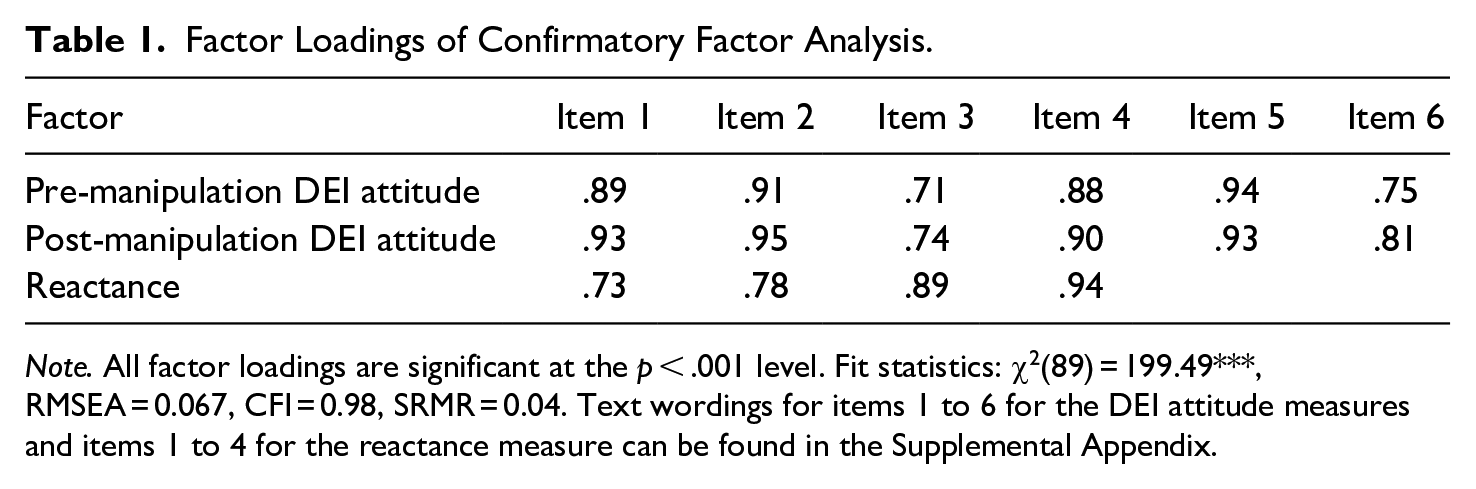
Note. All factor loadings are significant at the p < .001 level. Fit statistics: χ2(89) = 199.49***, RMSEA = 0.067, CFI = 0.98, SRMR = 0.04. Text wordings for items 1 to 6 for the DEI attitude measures and items 1 to 4 for the reactance measure can be found in the Supplemental Appendix.
Results
Analytical Strategies
The present study employed the statistical software package SPSS 29.0 to conduct the necessary analyses to test the proposed hypotheses. Mediation and Moderation analyses were performed using the widely-used PROCESS 4.2 macro in SPSS (Hayes, 2022). Descriptive statistics for the measured variables, including means, standard deviations, and bivariate correlations were compiled and presented in Table 2.
Means, Standard Deviations, and Bivariate Correlations.
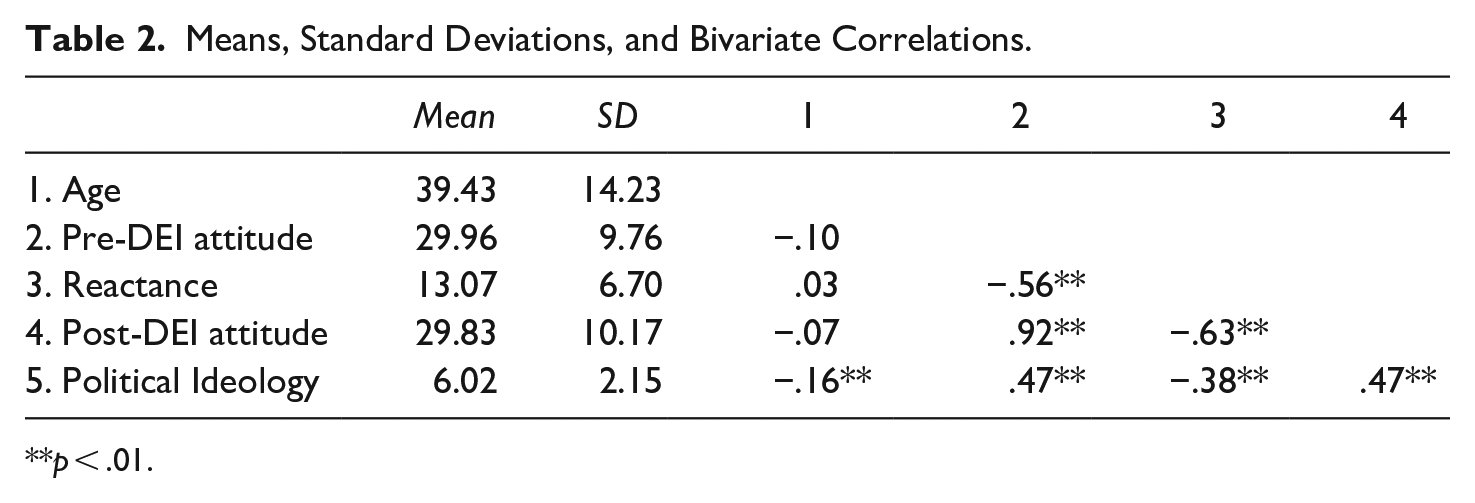
p < .01.
Testing of Hypotheses
Hypothesis 1: Inoculation Against Psychological Reactance
H1 stated that a message condition including an inoculation message prior to the “assignment to DEI training” message would produce lower levels of reactance than a message condition consisting of an “assignment to DEI training” message only. We conducted a one-way ANOVA to test the hypothesis. The omnibus F test was significant, F (1, 271) = 11.29, p < .001, partial h2 = 0.04, indicating that overall, the two message conditions had differential effects on reactance regarding DEI training. The narrative inoculation condition had significantly lower reactance (M = 11.75, SD = 6.34) than the control condition (M = 14.42, SD = 6.81; MD = -2.77, SE = 0.80; 95% CI = -4.24, -1.11). Therefore, Hypothesis 1 was supported. Please see Figure 2 for a means plot.
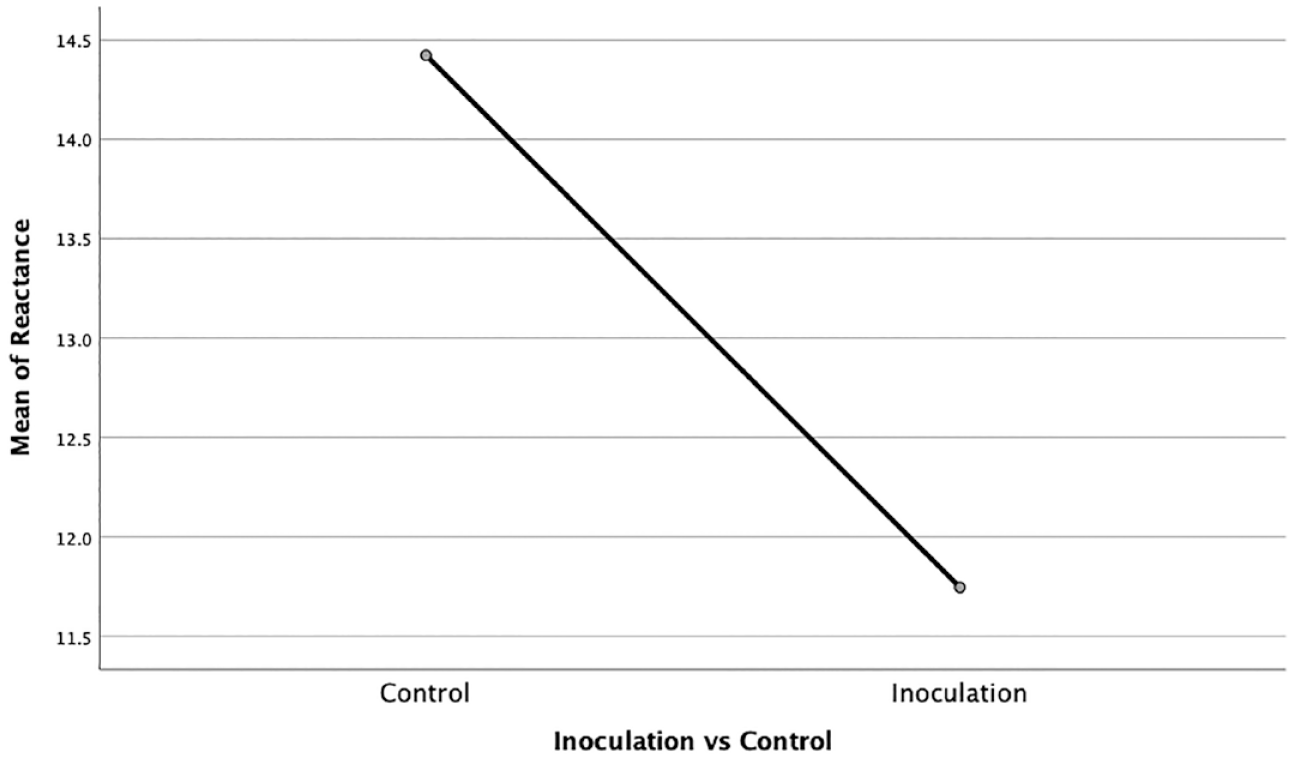
Psychological reactance by message condition (narrative inoculation vs. control).
Hypothesis 2: Inoculation to Facilitate Attitude Change
H2 stated that participants exposed to an inoculation message prior to receiving an “assignment to DEI training” message would express greater positive attitude change in favor of DEI training than participants who received an “assignment to DEI training” message only. We conducted a one-way ANOVA to test the hypothesis. The omnibus F test was significant, F (1, 271) = 19.51, p <.001, partial h2 = .07, indicating that overall, the two message conditions had differential effects on attitude change regarding DEI training. The narrative inoculation condition had significantly greater attitude change (M = .88, SD = 3.98) than the control condition (M = -1.15, SD = 3.58; MD = 2.03, SE = 0.46; 95% CI = 1.12, 2.93). Therefore, Hypothesis 2 was supported. Please see Figure 3 for a means plot.
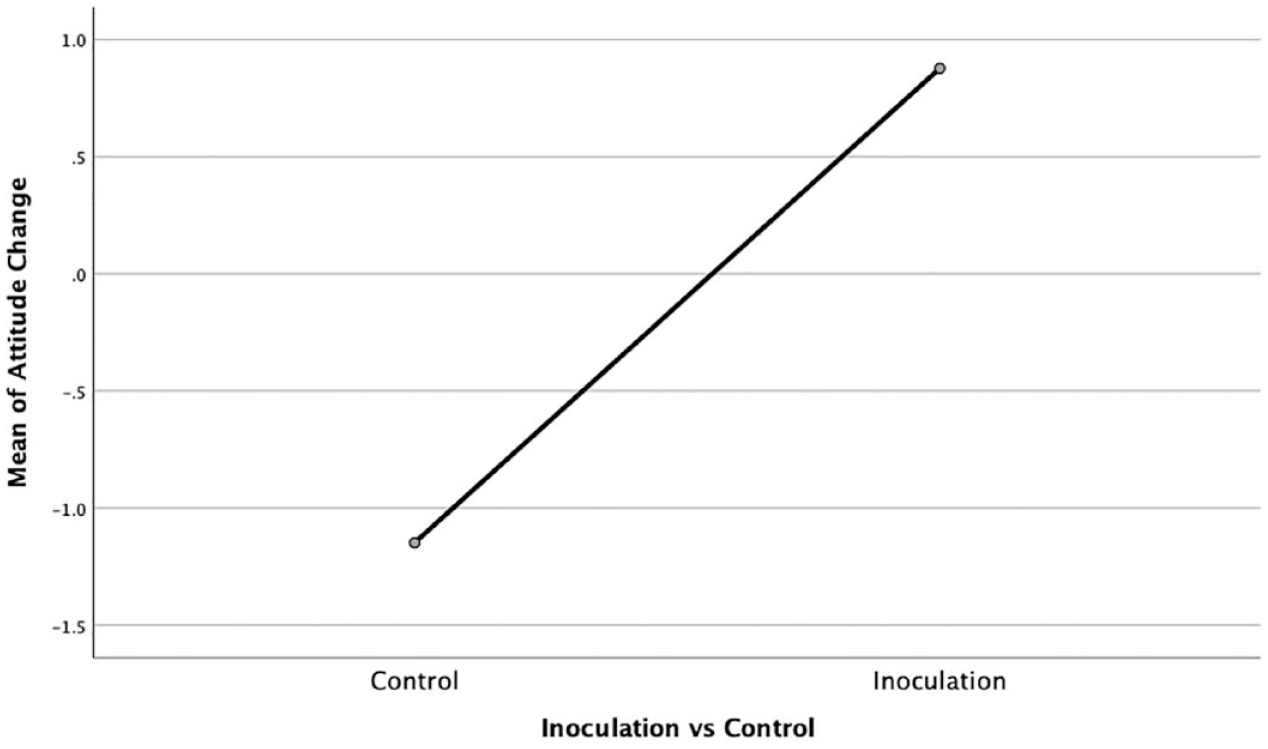
Attitude change by message condition (narrative inoculation vs. control).
Hypothesis 3: Reactance Mediates Effect of Message Condition on Attitude Change
Hypothesis 4: Moderated Mediation with Political Identity as a Moderating Effect
H3 stated that psychological reactance would mediate the effect of the different message conditions (narrative inoculation vs. control) on attitude change. H4 stated that political identity would moderate the mediation effects of reactance on the influence of the message conditions on attitude change such that level of conservatism will be positively correlated with level of reactance and negatively correlated with attitude change.
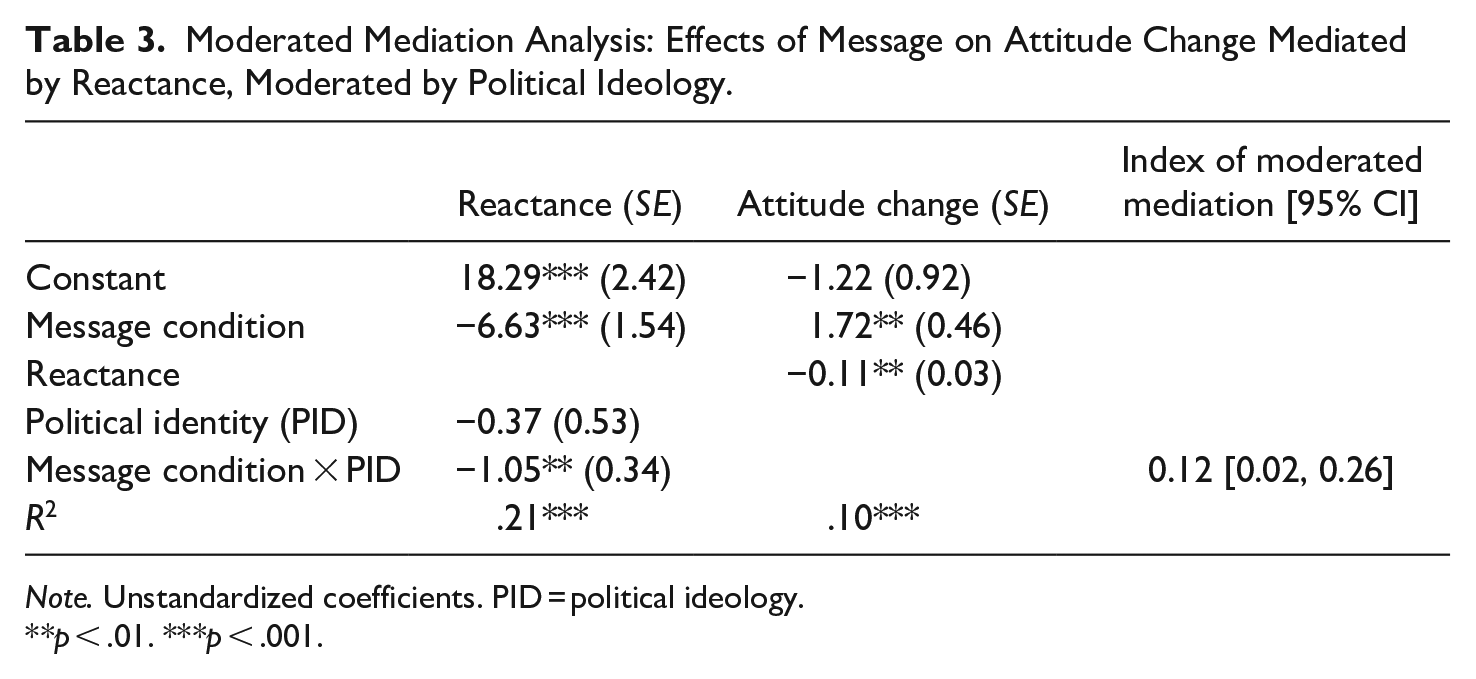
To test these hypotheses, we conducted a moderated mediation analysis in PROCESS macro (i.e., Model 7), with attitude change as the dependent variable, message condition as the primary independent variable, psychological reactance as a mediating factor and political ideology as a moderating factor. The results showed that the relationship between the different messages conditions and attitude change regarding DEI training was mediated by reactance. As Table 3 illustrates, the unstandardized regression coefficients between message condition and reactance were statistically significant (B = -6.63, SE B = 1.54, p < .001,). Further, the unstandardized regression coefficient between reactance and attitude change was statistically significant (B = -.11, SE B = .03, p < .001).
Moderated Mediation Analysis: Effects of Message on Attitude Change Mediated by Reactance, Moderated by Political Ideology.
Note. Unstandardized coefficients. PID = political ideology.
**p < .01. ***p < .001.
The unstandardized indirect effect for message conditions on attitude change through reactance (message condition→ reactance → attitude change) was .76. Unstandardized indirect effects were computed for each of 5,000 bootstrapped samples, and the 95% confidence interval was computed by determining the indirect effects at the 2.5th and 97.5th percentiles. Both indirect effects’ confidence intervals did not include zero. Thus, the indirect effects were statistically significant, indicating that the effect of the difference between the narrative inoculation condition and the control condition on attitude change is mediated by reactance. Therefore, H3 is supported. However, after adding reactance as a mediator, there was still significant direct effect of message conditions on attitude change (B = 1.72, SE B = 0.46, p < .001), indicating that this can be considered a partial mediation.
Further examination of Table 3 reveals a first-stage moderated mediation by political ideology (PID). As Table 3 illustrates, the unstandardized regression coefficient between the message conditions and attitude change was statistically significant (B = 1.72, SE B = 0.46, p < .001), as well as was the unstandardized regression coefficient between reactance and attitude change (B = −0.11, SE B = 0.03, p < .001). Furthermore, the interaction effect of message conditions and political ideology on reactance was statistically significant (B = −1.05, SE B = 0.34, p < .01). In other words, when one becomes more liberal, the effect of narrative inoculation on reactance is stronger. The indices of moderated mediation (Hayes, 2022) showed that the indirect effects for message conditions on attitude change via reactance is moderated by political ideology (B = 0.12, p < .05), as shown in Figure 4. Therefore, H4 is supported.
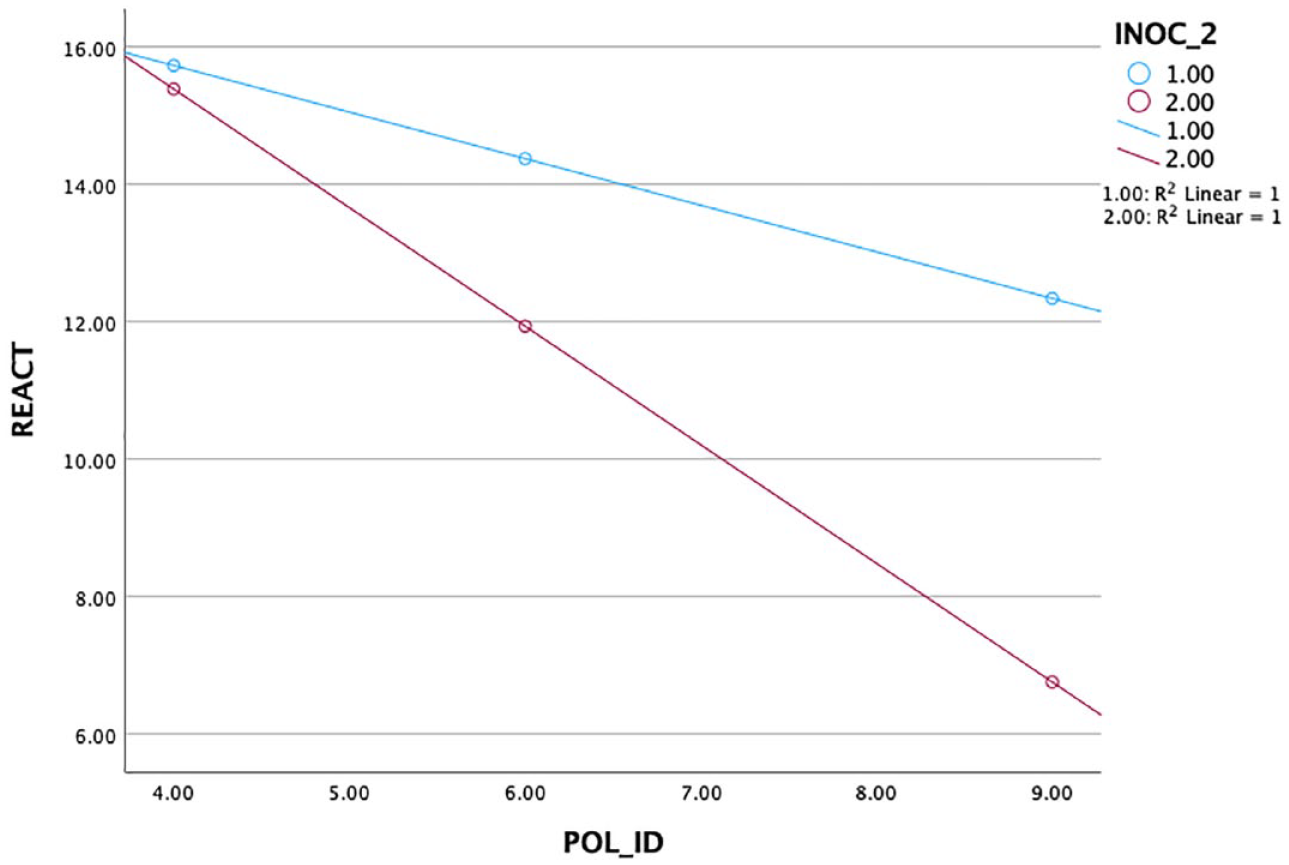
Moderated mediation: Psychological reactance by political ideology and message condition.
Although prior research and current news reports suggest that race and gender would each be likely to influence attitude toward DEI training, our analyses did not identify any effects of race or gender on attitude change. Race and gender were also not significant first-stage moderators for the mediation.
Discussion
Inspired by inoculation theory, this study examined the effects of two different assignment-to-DEI-training message strategies: a single-message (control) strategy consisting of an email from the CEO informing the individual of the assignment, and a dual-message (inoculation) strategy in which the individual received a pro-DEI-training narrative message from a hypothetical co-worker before receiving the assignment email from the CEO. Specifically, the study examined whether and how the different message conditions influenced employees’ attitude toward organizational DEI training.
Previous research details the use of inoculation strategies to strengthen resistance to persuasive attempts at behavioral control (e.g., Compton et al., 2022) in ways that would increase likelihood and strength of incidence of psychological reactance in response to such control efforts in which individuals perceive their freedom of choice or autonomy is threatened or restricted. In this case, we applied an inoculation strategy to minimize and mitigate the effects of reactance. The purpose of the prefatory pro-DEI-training message was to inoculate recipients against a possible reaction of psychological reactance in response to being assigned to participate in the training program.
Psychological reactance has been recognized as a significant barrier to attitude change and behavior adoption (Quick, 2013). Overall, the results of the study indicated that the narrative inoculation strategy was indeed effective in diminishing employees’ levels of psychological reactance compared to the single-message control strategy. It also fostered a more positive attitude toward DEI training programs when compared to the single-message control strategy. This finding suggests that organizations can successfully mitigate employees’ resistance and enhance their acceptance of DEI training initiatives by employing this kind of narrative inoculation strategy.
In our study, participants exposed to the pro-DEI-training inoculation message prior to receiving the assignment-to-training message experienced greater levels of positive attitude change toward DEI training than participants exposed to the assignment-to-training message alone. Our analyses indicated that this effect was mediated by reactance. In fact, participants in the control (i.e., assignment alone) condition expressed a negative change in attitude to toward DEI training while participants in the inoculation condition expressed a positive change in attitude. Although we employed a narrative strategy to utilize the power of transportation in mitigating reactance, and our manipulation check verified that the narrative inoculation message condition produced significantly greater levels of transportation than did the control condition, our analyses did not identify a significant mediating effect of transportation on reactance. Therefore, the significantly lower levels of reactance produced by the inoculation condition compared to the control condition cannot be directly attributed to transportation, but it is not unreasonable to infer that the transportative nature of the narrative may have contributed to the effectiveness of the inoculation.
The study also revealed that participants’ pre-existing political ideology played a significant role in the relationship between the effects of message condition and reactance. Specifically, the more liberal an employee was in their political beliefs, the stronger the association between the message conditions and reactance reduction. This implies that individuals with more liberal political leanings may be more receptive to the narrative inoculation strategy and, therefore, exhibit a greater decrease in reactance compared to their conservative counterparts. These findings suggest DEI initiatives and training assignments will continue to be a harder sell to organizational members who identify as conservative.
Theoretical and Practical Contributions
The effects of narratives, psychological reactance and inoculation theory have often been studied by health communication researchers, but rarely together (Compton et al., 2022). The current study breaks new ground by examining their effects in the organizational communication context (Reynolds-Tylus, 2019). This study makes several theoretical contributions to the organizational communication literature. By adopting a narrative-based inoculation approach, the research demonstrates the potential of proactively addressing and mitigating employees’ negative reactions, that is, psychological reactance, thereby reducing resistance associated with DEI training assignments. While the existing literature extensively explores the effectiveness of DEI training (e.g., Dobbin & Kalev, 2018; Kalev et al., 2006; Kalinoski et al., 2013; Kawasaki & Zou, 2023) with a focus on its design and content, this study offers a novel perspective by investigating how pre-training messages can effectively shape employees’ attitudes toward DEI training, fostering greater engagement and participation. The study also sheds light on the mediating role of reactance in the persuasive efforts pertaining to DEI training. Furthermore, by affirming the effectiveness of inoculation as a viable strategy for attenuating reactance within organizational settings, the research underscores the significance of reactance as a critical factor influencing the outcomes of persuasive communication endeavors, particularly concerning potentially controversial topics. By providing empirical evidence of the effectiveness of the narrative-based inoculation approach, the study offers valuable insights and practical implications for organizations seeking to promote a more inclusive and equitable work environment. Additionally, the study enriches the growing body of literature on DEI training by expanding the knowledge base on how this type of inoculation strategy can be leveraged to counteract reactance and foster more favorable attitudes toward DEI and other training initiatives within organizations.
The theory of cognitive dissonance (Festinger, 1957) posits that an attitude once formed is difficult to displace. This suggests that the most effective time to influence an attitude is before it is formed. Although a person may have an established attitude toward DEI training, it is less likely that person would have a well-established attitude toward being assigned to participate in DEI training until stimulated to think about it by a notification of assignment such as with the CEO email in the current study. In addition to its use of counterarguments and rebuttals, the inoculation strategy employed in the current study sought to engage in affective priming (Janiszewski & Wyer, 2014; Minton et al., 2017) to expose study participants to a positive evaluation of the DEI training experience before they were stimulated to form attitudes about it by receiving the assignment email from the CEO.
The practice of preemptive priming is common in advertising (Cialdini, 2016; Minton et al., 2017) to create a more-likely favorable reception for a sales message that might otherwise be regarded as intrusive or manipulative, that is, the sort of message that would often trigger psychological reactance. This practice has potential applications in a wide range of other contexts. Consider, for instance, your range of possible reactions to a request to be a reviewer or reader of this paper if it included the following quote from a noted scholar: “I thought I would object to the premise of this paper, but to my surprise I found its reasoning innovative and insightful.” Considering the likelihood of triggering reactance with any persuasive message, no matter how pro-social its intent (Scherr & Müller, 2017), it may be wise to make inoculative priming a part of every message creator’s campaign to-do list.
Limitations and Implications for Future Research
The nature of this study presents limiting factors in its methodology and sample. Conducted as an online experiment with its basis in a hypothetical situation, the current study cannot claim the same level of validity as might be offered by actual employee reactions to a job-dependent training assignment in a real-world organization. In some ways, however, the low-pressure anonymous nature of the survey may have produced more honest reactions from the study participants than if they were actual employees worried that their jobs might be on the line. Although reasonably typical of the nation’s population as a whole in terms of race and gender, the participants in the current study were significantly more liberal (Gallup, 2022) and had significantly higher levels of education, with more than 80% having graduated college versus less than 40% for the nation as a whole (U.S. Census Bureau, 2022). These factors may have skewed participants’ attitudes to be more favorable toward DEI training than the population as a whole but would likely have had a limited effect on their levels of attitude change in response to the experimental message conditions.
In creating a narrative-based pro-DEI-training message to be used in the study’s inoculation message condition, only one message type and one message valence were tested, which meant there were an infinite number of theoretic, typographic, photographic and verbiage variables we did not include in the study. Our messages were constructed in the form of emails, and although emails are commonly used for organizational communication, voicemail and video recordings are additional forms of communication that may have produced different levels of engagement leading to differing levels of reaction among recipients. We also did not test an anti-DEI-training inoculation message, which might have provided an interesting contrast in comparison with the effects of the pro-DEI-training inoculation.
Because we were testing the theoretical effects of inoculation, we did not include testing of the effects of the pro-DEI-training message delivered alone or following the assignment-to-DEI-training message. The theory of cognitive dissonance (Festinger, 1957) and more recent studies of debiasing (Walter & Murphy, 2018) suggest that even a powerfully persuasive message would be less effective if presented after the worrisome stimulus rather than before.
In many organizations, DEI training initiatives are implemented as part of wider organizational change efforts (e.g., Jamison, 1978; Kalev et al., 2006; Leslie, 2019; F. A. Miller & Katz, 2002; Minkin, 2023). The current study was not designed to examine the role of DEI training in such change efforts, or how greater success of a DEI training initiative might lead to measurable organizational change. The downstream effects of successful DEI training have rarely been measured in any systematic way (Katz & Miller, 2017). This would seem to be a valuable focus of future research. Considering the effects of political ideology on attitudes toward DEI training, a potentially fruitful additional variable to include in future studies might be explicit identification of political partisanship for the inoculation message sources to assess whether an explicitly conservative character would provide a more effective inoculation against reactance than an explicitly liberal or neutral character. Another potential variant could be inoculating against the construal of DEI training as a political issue, providing a weak argument for such a construal followed by strong counter-arguments supporting the rationale for DEI training as a bottom-line business issue that will provide a solid return on investment in terms of productivity, profits, and market share.
Conclusion: A Case for Widespread Inoculation
The results reported above clearly suggest the narrative-based pro-DEI-training message produced positive change in attitude toward DEI training. Research in the areas of cognitive dissonance (Festinger, 1957) and debiasing (Walter & Murphy, 2018) suggest that using such a message as part of an inoculative, affective-priming strategy to preemptively influence attitude could have broad application in promoting a wide range of organizational initiatives, not restricted to training assignments. Whether to guard against depredations of a coronavirus, the flu, or psychological reactance, inoculation appears to be a healthy strategy for a wide range of human applications.
Supplemental Material
sj-docx-1-job-10.1177_23294884231216952 – Supplemental material for Let’s Influence That Attitude Before It’s Formed: Inoculation Against Reactance to Promote DEI Training
Supplemental material, sj-docx-1-job-10.1177_23294884231216952 for Let’s Influence That Attitude Before It’s Formed: Inoculation Against Reactance to Promote DEI Training by Roger Gans and Mengqi Monica Zhan in International Journal of Business Communication
Footnotes
Authors’ Note
The current manuscript is an original work of research that is not under consideration and has not been published elsewhere.
Declaration of Conflicting Interests
The author(s) declared no potential conflicts of interest with respect to the research, authorship, and/or publication of this article.
Funding
The author(s) received no financial support for the research, authorship, and/or publication of this article.

Supplemental Material
Supplemental material for this article is available online.
Author Biographies
References
Supplementary Material
Please find the following supplemental material available below.
For Open Access articles published under a Creative Commons License, all supplemental material carries the same license as the article it is associated with.
For non-Open Access articles published, all supplemental material carries a non-exclusive license, and permission requests for re-use of supplemental material or any part of supplemental material shall be sent directly to the copyright owner as specified in the copyright notice associated with the article.
