




Abstract
The topic of health-promoting leadership has often been investigated on its impact on health outcomes. However, it is still unclear if healthpromoting leadership has an impact on other well-being parameters at work besides health. Another leadership behavior, the leaders’ listening skills, can benefit well-being parameters at the workplace, such as job satisfaction, which in turn lowers turnover intention. In the present study, we investigate the relationship between health-promoting leadership, the leaders’ listening skills, job satisfaction, and turnover intention to get a clearer picture about the effects of different leadership behaviors on the employees’ well-being. The results of an online-study with 354 Austrian and Slovenian workers showed that both types of leadership behaviors had a direct effect on the employees’ job satisfaction and an indirect effect on turnover intention through job satisfaction. Listening was found to have a stronger direct impact on job satisfaction. The findings indicate that both leadership behaviors are able to support well-being at the workplace.
Introduction
The way in which leaders communicate with their employees can affect employees strongly. The leaders’ communication at the workplace can improve the employees’ work life, for example, respectful communication is related to higher organizational commitment and thus to lower turnover intention (Brown et al., 2019; Mayfield & Mayfield, 2007). How leaders communicate with their employees, depends on their mindset, which is reflected in their leadership behavior. Therefore, leadership behavior plays an important part in the communication between leader and employee (Tourish, 2019).
Health-promoting leadership is a specific leadership behavior that benefits employees by creating health-promoting working conditions (Jiménez, Winkler, & Bregenzer, 2017). Employees with leaders who engage in health-specific leadership behavior experience more recovery and have higher overall state of health (Dunkl et al., 2015; Franke et al., 2014). Next to the health-related outcomes, other important work-related outcomes of health promoting leadership, such as job satisfaction and turnover intention have been less investigated. Therefore, the aim of the study is to answer the question if health-promoting leadership can improve other work-related outcomes next to health, such as job satisfaction and turnover intention.
Health-promoting leadership is defined as a combination of different leadership behaviors with the aim to design a healthy workplace for the employees (Jiménez, Winkler, & Bregenzer, 2017). Leaders that engage in a health-promoting leadership are able to directly or indirectly influence their employees’ health. Influencing employee health directly can include leadership behaviors such as taking responsibility for employee health and encouraging employees to participate in health promotion activities as direct effect (see also Wegge et al., 2014).
As for the indirect effects of health-promoting leadership, leaders are able to support a healthy working environment by creating working conditions to assure healthy workplaces. In the concept of health-promoting leadership, specific conditions are stated that can be either supportive or critical for employees: workload, control, reward, community, fairness, and values (Jiménez, Winkler, & Dunkl, 2017). These conditions base on the concept of the areas of worklife (Maslach & Leiter, 2008). This concepts states that misfits between the employees and certain conditions at the workplace can result in negative health outcomes for the employee. By changing these working conditions, leaders indirectly influence employee health by creating working conditions that can be experienced as health-promoting. In the present study, the focus is set on the indirect approach, where leaders engage in behaviors that create health-promoting working conditions (Jiménez, Winkler, & Dunkl, 2017).
Among leadership behaviors communication plays an important role. One approach in leadership research that focuses on the communication between leader and employee is the concept of “listening in leadership,” which refers to the leaders’ listening skills. As stressed by Lloyd et al. (2015), leaders’ listening skills are important since they signalize managerial openness and have motivational benefits for employees. Listening is a multifaceted process (Bodie et al., 2012). Conceptualizations of it have ranged from studying listening attitudes and skills (e.g., Mishima et al., 2000) to behaviors (e.g., Lloyd et al., 2017), and differ in terms of underlying theory and measurement (Lloyd et al., 2017). For a conceptual framework for listening in the supervisor-employee relationship, we refer to Rogers’s (1975) definition of empathic listening as an appreciating and non-judgmental way of perceiving and responding to an individual. In this study, we investigate the leaders’ listening skills in addition to health-promoting leadership. Therefore, the study helps to answer the question whether these two leadership behaviors have the same effect on workplace outcomes (such as job satisfaction and turnover intention) or whether their effects differ. To our knowledge, investigating the effects of listening in addition to health-promoting leadership has not been done, before.
It is important that listening quality captures the individual’s perception of being attended to, accepted, and appreciated (Rogers, 1975). Contributing to mutual exchange of information, fruitful interactions, and strong relationships, effective listening may create a positive interpersonal work experience that reflects positively on the organization and translates into more positive work outcomes. Research shows that a relationship-oriented, respectful and supportive working environment increases the employees’ identification with the organization (Liu et al., 2013). The link between leadership and identification with the organization is explained in the social identity theory of leadership (Hogg et al., 2012). In this theory, the behavior of leaders can influence how strongly an employee can identify with the workgroup, and a stronger identification with the workgroup is related to higher job satisfaction and lower turnover intention (van Dick et al., 2004).
The social identify theory of leadership could explain why leadership behavior can support the employees’ job satisfaction and turnover intention. Research in the field of health-promoting leadership usually focuses on health-indicators such as physical health or stress (Franke et al., 2014; Jiménez et al., 2017) and not on more distal variables such as job satisfaction. The concept of health-promoting leadership focuses heavily on providing workplace resources (Jiménez et al., 2017). Indeed, research shows that health-promoting leadership is positively related to the employee’s perception of resources at the workplace (Gurt et al., 2011; Jiménez et al., 2017). Having higher resources could lead to a more positive evaluation of the working environment and a stronger identification with the organization which is linked to job satisfaction (Morris & Venkatesh, 2010). According to that, we hypothesize that health-promoting leadership shows a direct relationship with job satisfaction.
H1: Health-promoting leadership is positively related to the employees’ job satisfaction.
In line with social identity theory of leadership (Hogg et al., 2012) and research by Lloyd et al. (2017), positive leadership communication, such as respectful listening, should benefit the employees’ job satisfaction as well. Employees with leaders who listen are more satisfied with their leaders (Arendt et al., 2019) and have a higher overall job satisfaction (Kubota et al., 2004). Active listening is related to higher respect and focused attention (Jonsdottir & Fridriksdottir, 2019), which leads to a higher job satisfaction (van Quaquebeke & Eckloff, 2010).
H2: Leaders’ listening skills are positively related to the employees’ job satisfaction
Job satisfaction is an important parameter at the workplace and dissatisfaction might have serious consequences at work, such as turnover or turnover intention (Jiménez, 2002; Mobley et al., 1979; van Dick et al., 2004). For organizations turnover is a very important economic parameter (Shaw, 2011; Shaw et al., 2005). One of the precursors of turnover is the turnover intention of employees (Mobley et al., 1979) and therefore turnover intention is one of the most frequently studied outcomes in the organizational context. In the unfolding model of turnover (Lee et al., 1999), turnover is described as a complex process which is influenced by incidences at work—described as shocks. If an employee experiences a shock at his/her workplace, he/she might reconsider his/her organizational attachment and start to evaluate the current job situation in various ways, per example by searching for job alternatives. Lower levels of job satisfaction may also function as a trigger, leading to considering other alternatives. The role of job satisfaction for turnover intention is found in the cybernetic model of job satisfaction (Jiménez, 2006) as well. The cybernetic model of job satisfaction describes job satisfaction as a comparison between the current work situation and the aspiration level (Büssing et al., 1999) and the major goal is to obtain a homeostatic condition of satisfaction. If the comparison between the current state and the aspiration level of job satisfaction is negative, regulative mechanisms are mobilized to get the satisfaction level back to an acceptable level (Jiménez, Dunkl & Stolz, 2015). One of the strategies of regulating the satisfaction level is the exit-strategy, that is, to leave the job or—the previous step—to have at least the intention to leave the job, which can be primarily seen as an emotion regulation strategy. Altogether, current research supports the following hypotheses:
H3: Job satisfaction is negatively related to turnover intention
Research shows that job satisfaction can partially explain changes in the employees’ turnover intention (Jiménez, 2002). However, research needs to consider further factors that might have an effect on this relationship (Yücel, 2012). One important factor at the workplace is leadership. Leadership behaviors are known to have an influence on the employees’ company loyalty and can be an important factor for turnover and turnover intention (Allen et al., 2010). Leaders influence their employees with their behavior and can increase social identity among their co-workers (Hogg et al., 2012). Thus, leaders might be able to change not only job satisfaction, but also the turnover intention of employees by creating more social cohesion. Leadership has been repeatedly connected to turnover intention. Positive leadership styles are able to influence turnover intentions negatively, thus lowering the turnover intention of employees (Wells & Welty Peachey, 2011). Health-promoting leadership changes working conditions in a positive way, which could result in a more positive evaluation of the working environment and more commitment to the organization. Highly committed employees are less likely to quit the job (Tett & Meyer, 1993). Therefore, we state following hypothesis:
H4: Health-promoting leadership is negatively related to turnover intention.
As for the leaders’ listening skills, Lloyd et al. (2015) argue that employees who experience leaders as bad listeners develop a negative attitude toward their supervisor and this might get them to quit their job and seek a different work environment. In their study, they found high correlation between leaders’ listening skills and turnover intention. According to the social identity theory of leadership (Hogg et al., 2012), a respectful communication at the workplace leads to a stronger identification with the workgroup and thus, to a stronger commitment to the organization (see also Brown et al., 2019). High commitment lowers turnover intention (Tett & Meyer, 1993). Therefore, we formulate the following hypothesis:
H5: Leaders’ listening skills are negatively related to the employees’ turnover intention.
Another explanation for the relationship between these variables may be the conceptual overlap between the perception of leadership and job satisfaction. Job satisfaction is an evaluation of the overall working environment, involving the evaluation of the social climate at work. Usually, the social climate at work consists of leaders and co-workers. Both influence the overall perception of the social working environment. It is even stated, that the relationship with the supervisor might be a stronger predictor for well-being at the workplace than the relationship with co-workers (Jiménez, Dunkl, & Peißl, 2015). Therefore, the perception of leadership plays an important part when it comes to the employees’ evaluation of job satisfaction. The link between leadership behaviors and turnover intention seems to be strong as well, indicating a direct relationship (Wells & Welty Peachey, 2011). However, research shows that leadership is not directly related to turnover intention when job satisfaction is included as a mediator (Coomber & Barriball, 2007). Thus, we also expect job satisfaction to be a mediator between health-promoting leadership/listening skills and turnover intention:
H6: Job Satisfaction partially mediates the relationship between health-promoting leadership/leaders’ listening skills and turnover intention
In the present study, we aim to answer two questions: First, we want to investigate if health-promoting leadership can improve other work-related outcomes next to health, such as job satisfaction and turnover intention. Second, two leadership behaviors are studied simultaneously: health-promoting leadership and the leaders’ listening skills. This will help to answer the question if both leadership behaviors have the same effect on job satisfaction/turnover intention or if one leadership behavior is a better predictor than the other.
All proposed relationships can be found in Figure 1.
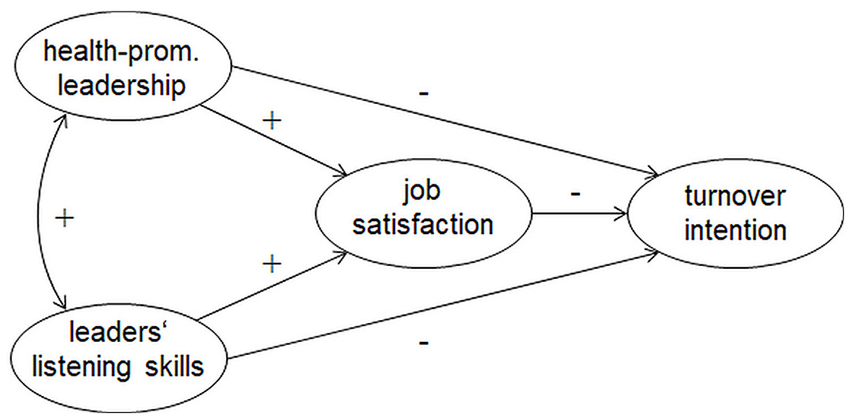
Hypothesized model.
Method
Sample and Procedure
Austrian and Slovene workers were invited to participate in an online study. The invitation to the online study was sent out in cooperation with a well-known German market research company. Participants who did not fulfill the requirements of (I) having a job with at least 10 working hours per week and (II) having colleagues at work were selected at the beginning of the study and weren’t able to participate in the online-study further on. By this selection method, we got a total sample of 354 participants. From this sample, 48.3% were from Austria and 51.7% were from Slovenia. The sample consists of 49.7% men and 50.3% women. 26.8% of the participants are up to 30 years old, 33.1% are between 31 and 40 years old, 25.1% are between 41 and 50 years old, and 15% are 51 years and older. Most of them have a graduate degree (42.4%) and 6.5% have a management position. The participants worked in different industrial sectors, most of them in manufacturing (16.1%), public sector (12.1%), telecommunication (8.8%), education (7.9%), and health care (7.9%).
Instruments
All measures were available in their German versions for the German-speaking (Austrian) sample. For the Slovenian sample, the questionnaires were translated into Slovene by a professional translator and then back-translated by a second translator. Differences in the back translation were discussed by the research group and the translators before the final translation was send out to the Slovenian sample.
Health-promoting leadership conditions (HPLC)
This questionnaire (Jiménez, Winkler, & Bregenzer, 2017) measures seven dimensions of health-promoting leadership from the employee’s point of view: health awareness, workload, control, reward, community, fairness, and value-fit. Every dimension has three items which makes 21 items in total. One example item for the dimension health awareness is “In the last 4 weeks my leader took care that the health of the employees’ is highly valued” and for the dimension reward “In the last 4 weeks my leader took care that work is appreciated.” A 7-point-Likert-scale from 1 (never) till 6 (always) is used. The internal consistencies of the dimensions range from .85 to .94.
Leaders’ listening skills
The leaders’ listening skills were measured with the Facilitating Listening Scale (FLS, Bouskila-Yam & Kluger, 2011). The FLS assesses the listening behavior of leaders from the employee’s perspective. The items are presented with the following instruction sentence: “When my current supervisor listens to me, most of the time, s/he. . .”; followed by eight items. Example items are “. . . is interested in what I have to say” or “. . . makes me comfortable so I can speak openly.” The items are presented on a 7-point-Likert scale ranging from 1 (never) to 7 (very frequently). In this study, the German version of this scale (Lloyd et al., 2015) was used. The internal consistency of the FLS is .97.
Job satisfaction
With the screening version of the Profile Analysis of Job Satisfaction (PAJS-SC; slightly adapted version of Lepold et al., 2018), several aspects of job satisfaction are measured with 16 items. The items can be clustered into three areas (organizational, social, and the work environment). One example item for the social area of job satisfaction is “Satisfaction with the relationship to my direct colleagues.” One example item for the organizational area of job satisfaction is “Satisfaction with the chances of moving up and making career.” Answers scales range from 1 (very satisfied) to 5 (unsatisfied). For an easier interpretation of the results the scores were recoded, so high values within this scale refer to high job satisfaction. The internal consistencies of the three job satisfaction areas range from .71 to .92.
Turnover intention
Turnover intention was measured by a scale of three items (Jiménez, 2002). These three items should show different aspects of the intention to quit the job or to change the field of work within the organization: (1) The thought of looking for a new job already entered my mind, (2) I would prefer working in a different business, and (3) I have already looked for another job. Responses are based on a 1 (yes), 2 (rather yes than no), 3 (rather no than yes), to 4 (no) scale. For an easier interpretation of the results the scores were recoded, so high values within this scale refer to high turnover intention. The internal consistency of the scale is .97.
Data Analysis
A confirmatory factor analysis (CFA) using the method of structural equation modelling (SEM) with maximum likelihood method of estimation was performed. In terms of simplification, second-order latent constructs for the HPLC and Job Satisfaction were recalculated in order to get at a more parsimonious structure for the structural model. Therefore, average scores were calculated for the corresponding indicators leading to a single composite indicator.
Unlike conventional hypothesis tests, SEM tests the null hypothesis. This means that the model covariance matrix has to be statistically equal to the population covariance matrix under the assumptions that the observed variables have a multivariate normal distribution, that a sample size is large enough, and that none of the tested parameters is at a boundary (Hu & Bentler, 1999; West et al., 2012).
A significant chi-square (χ2) indicates a non-perfect fit of the model to the data. The analysis of a covariance structure has relied on a chi-square likelihood ratio test to assess how well a model fits, but some studies have indicated that it is very sensitive to the sample size, number of items, and number of factors in the model (Anderson & Gerbing, 1984; Bollen, 1989). Therefore, also other fit indices should be used in addition to the chi-square to assess the model fit. For model fit assessment, following fit indices were calculated: Adjusted Goodness of Fit Index (AGFI), Goodness of Fit Index (GFI), the Comparative Fit Index (CFI), and the Root Mean Square Error of Approximation (RMSEA). AGFI, GFI, and CFI are goodness-of-fit indices, showing how good the data fits the theoretical model. Therefore, high values should be obtained. The RMSEA measures the model discrepancy in the population and thus should be as low as possible. Usually a standard of 0.90 is recommended for the GFI and AGFI however, previous studies showed, that those two indices are highly sensitive to the large samples (Bollen & Stine, 1990; Shevlin & Miles, 1998). Therefore, we used alternative fit indices, namely CFI and RMSEA. According to the prevailing literature a standard of CFI higher than .95 and a standard of RMSEA lower than .08 or .07 is recognized as indicative of good fit (Hu & Bentler, 1999; MacCallum et al., 1996; Steiger, 2007). To include more certainty about our reported values, the 95% confidence intervals (CIs) were calculated for each estimated path. These intervals show the 95% probability where the true values lie. For the analyses, SPSS 22.0 and AMOS 22.0 were used.
Results
Descriptive Statistics
As can be observed from Table 1 the reliability (Cronbach’s Alpha) of the measures all fulfill the minimum threshold of .70.
Means (M), Standard Deviations (SD), Internal Consistencies, and Correlations Among All Study Variables.
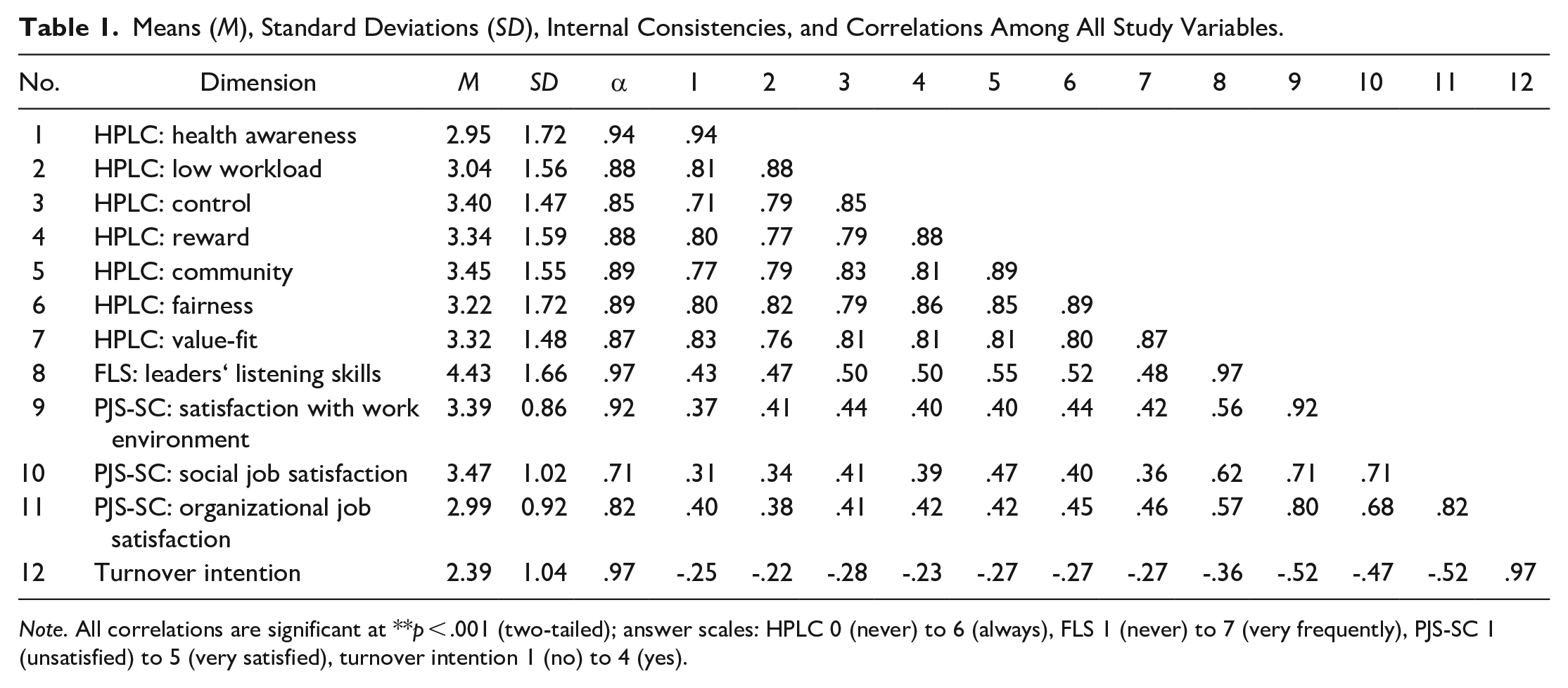
Note. All correlations are significant at **p < .001 (two-tailed); answer scales: HPLC 0 (never) to 6 (always), FLS 1 (never) to 7 (very frequently), PJS-SC 1 (unsatisfied) to 5 (very satisfied), turnover intention 1 (no) to 4 (yes).
The correlation table (Table 1) shows that all dimensions measuring health-promoting leadership are positively related (.71 to .86) and show moderate positive correlations with leaders’ listening skills (.43 to .55). Correlations between the HPLC and job satisfaction dimensions are moderate (.31 to −.47). Lower correlation coefficients (−.22 to −.28) can be found when correlating the HPLC with turnover intention.
For listening, the relationships with job satisfaction are high, (.56 to .62); the correlation with turnover intention is moderate (−.36). The correlations between the job satisfaction dimensions and turnover intention range between −.47 and −.52.
Structural Equation Modeling (SEM)
To test our hypotheses, the theoretical model (Figure 1) was tested with SEM. In the structural equation modelling, health-promoting leadership (operationalized with the HPLC), leaders’ listening skills, job satisfaction and turnover intention were included as latent factors, operationalized by their assigned dimensions as manifest variables.
The model of the work part shows an adequate fit (AGFI = .85, GFI = .88, CFI = .96, RMSEA = .07; χ2(179) = 494.115, p < .001).
The predicted paths were in the expected direction (Figure 2). As predicted, health-promoting leadership and leaders’ listening skills are correlating positively (.56). As expected, health-promoting leadership and leaders’ listening skills are positively related to job satisfaction (health-promoting leadership: β = .22, p < .001; listening: β = .55, p < .001). The direct effect of health-promoting leadership and leaders’ listening skills on turnover intention is non-significant. Job satisfaction in turn has a negative effect on turnover intention (β = −.67, p > .001).
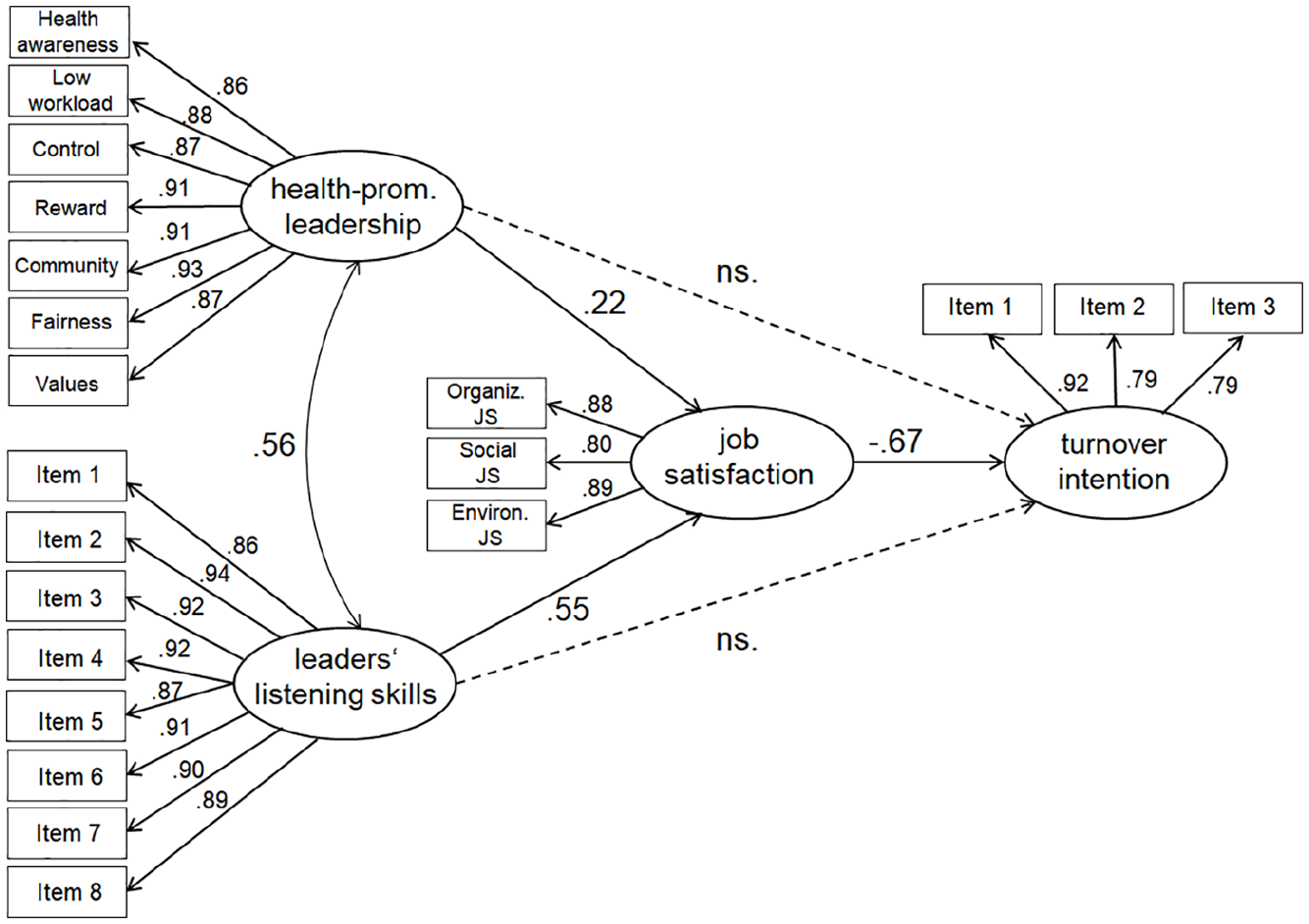
Regression coefficients for the model.
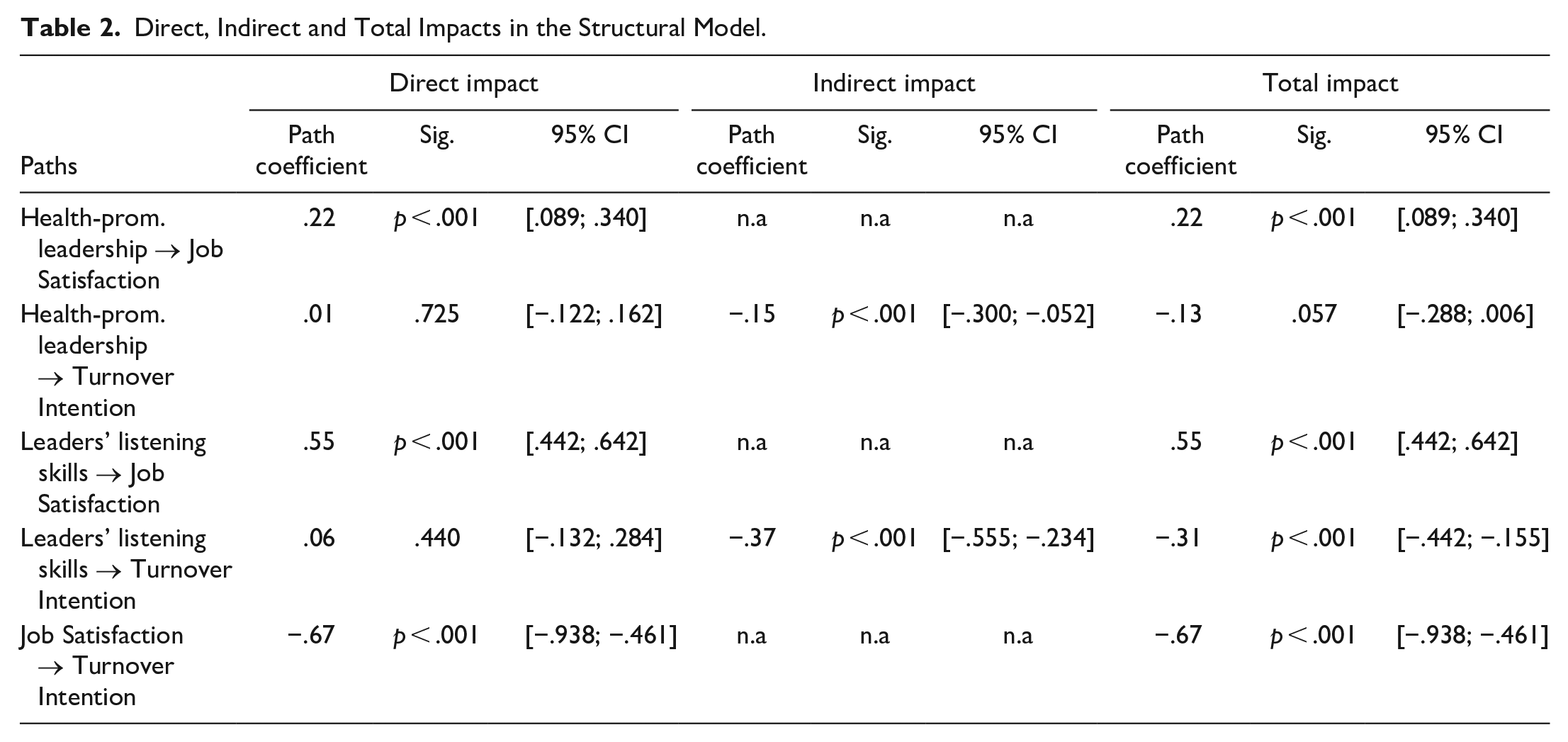
The mediating effect of job satisfaction is presented in Table 2 and was tested with a procedure proposed by Baron and Kenny (1986). The significance of indirect effects was assessed with bootstrapping, following the procedure of Preacher and Hayes (2008). As can be observed in Table 2 and Figure 2, health-promoting leadership (β = −.15, p < .001) and leaders’ listening skills (β = −.37, p < .001) have a negative indirect effect on turnover intention through job satisfaction. Therefore, also H6 is supported. The empirically found model with all significant regression coefficients is shown in Figure 2.
Direct, Indirect and Total Impacts in the Structural Model.
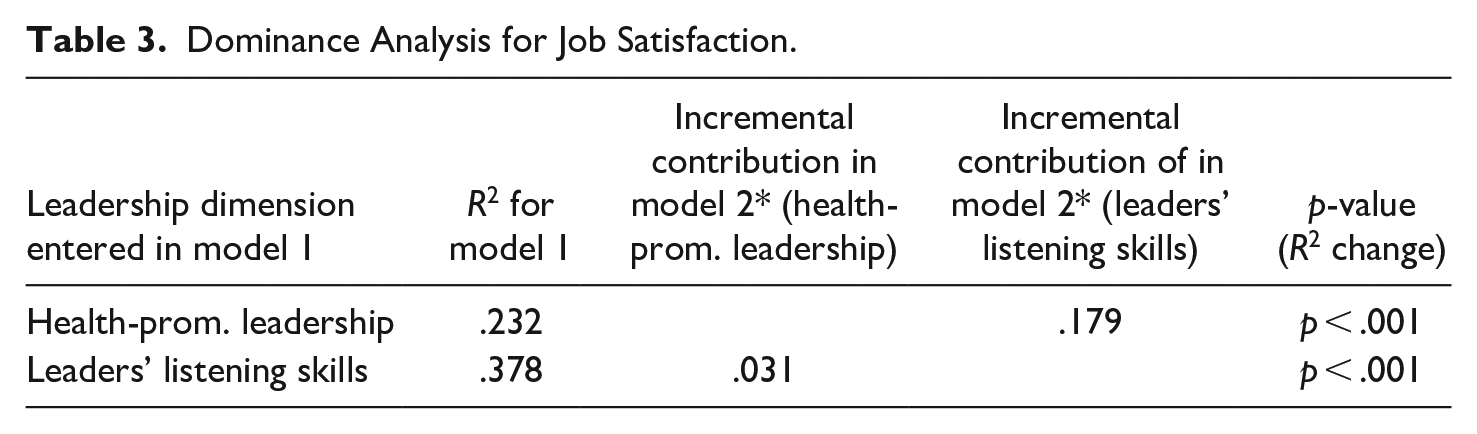
To determine if the relationship between leadership behavior and job satisfaction is stronger for the leaders’ listening skills than for health-promoting leadership, a dominance analysis was conducted with a two-step regression analysis (Piccolo et al., 2012). To test if the leaders’ listening skills adds additional variance to health-promoting leadership for job satisfaction, health-promoting leadership was entered in the first step (model 1) and leaders’ listening skills in the second step (model 2). Next, to test if health-promoting leadership adds additional variance over leaders’ listening skills when predicting job satisfaction, leaders’ listening skills was entered in the first step and health-promoting leadership in the second step. The variance explained for job satisfaction is presented in Table 3. When health-promoting leadership was entered in the first step, it accounted for 23% of the variance in job satisfaction. When leaders’ listening skills was subsequently entered in the second step, it added 18% predictive validity for job satisfaction. The other way around, health-promoting leadership only adds 3% predictive validity for job satisfaction in addition to leaders’ listening skills. Therefore, leaders’ listening skills might be a stronger predictor for job satisfaction than health-promoting leadership.
Dominance Analysis for Job Satisfaction.
Discussion
The contribution of our study was twofold: First, we answered the question if health-promoting leadership can improve job satisfaction and reduce turnover intention. Our results show that health-promoting leadership can go beyond supporting health at the workplace and leads to more satisfied employees as well. Second, our study showed that health-promoting leadership and the leader’s listening skills have different effects on job satisfaction and turnover intention. More precisely, the results provide strong support for the importance of both leadership behaviors for well-being at the workplace, but the leaders’ listening skills seem to be a more important predictor for job satisfaction and—in the long-term—commitment.
Our first hypothesis (H1), where we expected that health-promoting leadership is positively related to the employees’ job satisfaction was fully supported by our results. The aim of health-promoting leadership is to change working conditions in a way that they can support employee health. This means that leaders influence working conditions with their leadership behavior to enhance resources at the workplace. When employees experience their working conditions as resourceful and supportive, they will have the feeling that their supervisors actually care for them and this increases job satisfaction at the workplace. This result can also be explained by the cybernetic model of job satisfaction of Jiménez (2006). When employees experience their leaders to be supportive regarding their working conditions, the comparison between the current state of working conditions and the aspiration level will be positive, causing high job satisfaction. Consequently, their aspiration level will rise so they have higher expectancies of their leaders. Specifically, they will have a closer look at the relationship between them and their leaders, especially whether they feel supported or not. This aspect may help to explain the results of the following research questions.
Similar results were found for our second hypothesis (H2). The leaders’ listening skills are positively related to the employees’ job satisfaction which is in line with previous research (Kubota et al., 2004; Lloyd et al., 2015). Active listening creates a feeling of being accepted and appreciated and supports a positive working environment. On the other hand, the feeling of not being listened to might create a feeling of being excluded or not being a worthy member of the team, which is seen in a reduced job satisfaction. A job dissatisfaction reduces the commitment to the organization and the turnover intention to quit rises, which is in line with hypothesis 3 (H3).
In our fourth and fifth hypothesis (H3, H4), we expected a direct relationship between both leadership behaviors and turnover intention. This relationship should be partially mediated by job satisfaction (H6). Our findings did not confirm this assumption. Instead, the relationship between both leadership behaviors and turnover intention was fully mediated by job satisfaction.
These findings support our assumption, that job satisfaction is an important mediator in the relationship between leadership behaviors and turnover intention. Job satisfaction can be defined as an emotional and cognitive evaluation of aspirations toward the job environment and personal experiences (Büssing et al., 1999; Jiménez, Dunkl, & Stolz, 2015). One dimension of job satisfaction is the evaluation of the social environment which includes the satisfaction with the leaders. Therefore, it is coherent that health-promoting leadership and leaders’ listening skills are directly related with job satisfaction as in our study. The non-significant direct paths to turnover intention could be explained by that, too. The positive evaluation of the social environment (e.g., the leaders) could enhance the expectations and the awareness towards leaders so this relationship is more important and “absorbs” the variance fully.
The relationships between health-promoting leadership and job satisfaction seems to be lower than between leaders’ listening skills and job satisfaction. A further regression analysis revealed that indeed the leaders’ listening skills account for much more additional variance beyond health-promoting leadership when predicting job satisfaction. Consequently, it can be summarized that leaders’ listening skills are a more important predictor for job satisfaction than health-promoting leadership. An increased job satisfaction might not be the major focus of health-promoting leaders. However, although it is not the major goal of health-promoting leaders to increase job satisfaction, the results show a significant relationship between both constructs. An increased job satisfaction might occur because leaders design the employees’ working environment in a health-promoting way, which leads to an overall higher satisfaction with certain aspects of the work environment. More precisely, if a leader supports a respectful community at the workplace or enhances the personal latitude, the satisfaction with the working climate or the working task will increase.
However, it seems that active listening from the leader is a much stronger predictor to job satisfaction. Active listening creates a feeling of being respected and understood, which could increase the overall evaluation of the working environment. Leaders with high listening skills know and understand the concerns and wishes of their employees and might further aim to improve their employees’ working experience. By active listening, single employees can be supported and encouraged directly, which might have a stronger overall impact on their working experience.
Limitations
One of the limitations in this study is using cross-sectional data to test the hypothesized relationships. Especially in case of mediation effects, causal interpretations must be done with caution. This means that it could be also possible that job satisfaction has an effect on the perception of health-promoting leadership. However, past research indicates that this path seems to be unlikely and job satisfaction seems to be the outcome of leadership. Therefore, we believe that the presented model is plausible, as the results support previous findings. Nevertheless, other assumptions could be investigated in future research.
Another limitation concerns common method bias, because all data are self-reported data obtained from participants at one point in time. This might lead to social desirability which affects the answers given in the study. To confront this issue, the participants were assured of strict anonymity and were encouraged to give honest answers (Podsakoff et al., 2003). Although it is possible to obtain data from leaders about their leadership behavior, it is common to assess leadership behavior from the employees’ point of view. This is often a more accurate assessment of leadership behavior, as the self-view of leaders might not overlap with the actual leadership behavior perceived by the employees. In addition, the employees’ perception is the one that determines their experience and behavior at work.
An additional limitation of our study is that health-related outcomes as well as some workplace outcome variables (e.g., engagement, performance) were not included. Past studies have investigated the relationship between health-promoting leadership and stress, recovery and burnout (Jiménez et al., 2017). However, health parameters in the sense of physical or mental health could be included as well. Therefore, we suggest that future studies include more different outcome variables and to explain and predict the relations among health-promoting leadership, health outcomes, and workplace outcomes.
Theoretical Implications
Our findings complement previous studies about health-promoting leadership by showing that health-promoting leadership can improve job satisfaction, which enhances the commitment to the organization. This adds an additional point to health-promoting leadership, which is not only to enhance health outcomes but job satisfaction and commitment, as well. In the social identity theory of leadership (Hogg et al., 2012), leadership behavior, such as respectful communication in leadership, leads to a stronger identification with the workgroup and the organization, which could have an impact on how the work environment is evaluated. A more positive evaluation of the work environment is visible in a higher job satisfaction and lower turnover intention. If the current work situation is at least the same as the aspiration level, a positive evaluation of the work environment and thus a higher job satisfaction occurs (Jiménez, 2006).
The findings also show that listening is a much stronger predictor of job satisfaction and turnover intention than the multifaceted concept of health-promoting leadership. A reason could be seen in direct and indirect pathways. Health promoting leadership can be seen as an activity which enhances resources so negative consequences of stress can be reduced (Jiménez et al., 2017). Having more resources also can lead to higher job satisfaction. Therefore, the relationship between health-promoting leadership and job satisfaction can be seen more indirectly, whereas the relationship between listening and job satisfaction is a more direct relationship. Therefore, health-promoting leadership and listening are on different pathways regarding job satisfaction and turnover intentions.
This points to the importance of listening in the leader-employee relationship. In recent leadership theories, the focus lies on two-way communication between leader and employee (e.g., leader-member-exchange, LMX, Graen & Uhl-Bien, 1995), where the leader’s listening skills seem to be one part of a respectful communication. However, in line with our findings, we strongly suggest to investigate listening as an independent factor in leadership research. The importance of investigating listening as a distinct part of leadership behavior is also emphasized in the works of Kluger and Zaidel (2013) and Lloyd et al. (2015). Future studies should focus more strongly on the importance of listening skills in the working context and how respectful listening can improve the working environment.
Practical Implications and Conclusion
Companies want to have motivated employees who want to stay in their organization. One of the most important factors for that is positive leadership. The organization and its leaders are socially responsible for the health and well-being of their employees. Health-promoting leadership and leaders’ listening skills have to be seen as key aspects for the organizational culture and the well-being of employees. Therefore, health-promoting leadership and leaders’ listening skills should be addressed in leadership training programs. Listening “should become an integral part of leadership education, training, and development” as emphasized by Lloyd et al. (2015, p. 520) in the conclusion of their results. On the other hand, showing positive leadership behavior is only possible if integrated into the culture of an organization. Therefore, the working conditions of the leaders have to be assessed and changed if necessary to prepare a secure ground for the personal skills of the leaders. As people can only act on the basis of their environment, the way to improve well-being at the workplace with leadership has to be done in two steps. We therefore propose that any program to enhance the organizational environment (e.g., workplace health promotion programs) should first analyze the environmental conditions for leadership and second, based upon this analysis, a personal skills training (e.g., coaching, mentoring, intergenerational cooperation) should be implemented.
Footnotes
Authors’ Note
This manuscript is original and is not under consideration or published elsewhere.
Declaration of Conflicting Interests
The author(s) declared no potential conflicts of interest with respect to the research, authorship, and/or publication of this article.
Funding
The author(s) disclosed receipt of the following financial support for the research, authorship, and/or publication of this article: Data were collected within the project “culture4leadership,” funded by the state of Styria within the “grenz-frei” framework.
