




Abstract
Background:
Injured-list (IL) time reflects the clinical and competitive impact of pitching injuries, but determinants of cumulative injury burden have rarely been evaluated league-wide using integrated workload and pitch-tracking data.
Purpose:
To leverage large-scale public data to identify pitcher characteristics associated with cumulative time-loss IL burden due to shoulder and elbow injuries, accounting for exposure and role.
Study Design:
Case-control study.
Methods:
This study analyzed aggregated data from the study period between 2015 and 2025 for 1445 Major League Baseball pitchers (≥1000 pitches). Injury burden was defined as cumulative IL days per pitcher over the study period and stratified into shoulder (S), elbow (E), and a total combined (S+E) category using public injury designations. Candidate predictors included pitcher demographic characteristics, advanced performance metrics, pitch-tracking characteristics, and within-game pitch-to-pitch delta measures reflecting adjacent-pitch variation in velocity and release characteristics. We used negative binomial models to estimate incidence rate ratios (IRR) for IL days, accounting for differences in pitching exposure by including the natural logarithm of total pitches thrown as an exposure offset and adjusting for pitching role using the percentage of appearances as a starting pitcher. Candidate predictors were screened in univariate models and then entered into multivariable models.
Results:
The cohort accrued 147,765 total IL days (47,022 shoulder; 100,743 elbow). In multivariable models, higher strikeout rate (IRR, 1.24), 4-seam velocity (IRR, 1.18), and 4-seam spin (IRR, 1.13) were independently associated with greater combined S+E burden (all P < .001). Joint-specific models revealed divergent signals: greater release extension was associated with lower shoulder injury burden (IRR, 0.87; P < .001), whereas higher pitch-to-pitch velocity delta (IRR, 1.08; P = .009) was specifically associated with greater elbow burden. Univariate screening identified several additional factors significantly associated with cumulative and joint-specific outcomes, including arm angle, pitch usage (eg, changeups and sliders), and "Plus" metrics.
Conclusion:
Cumulative injury burden is driven by a high-performance phenotype, but risk signals diverge meaningfully by joint. Shorter release extension and greater pitch-to-pitch velocity delta emerged as distinct, potentially modifiable correlates of shoulder and elbow injury burden, respectively. These findings identify mechanical and consistency-based signals that warrant prospective investigation to refine individualized workload management and injury prevention.
Overhand pitching imposes extreme, repetitive biomechanical demands on the shoulder and elbow, exposing these joints to substantial cumulative stress across a pitcher's career. 8 In modern baseball, performance incentives favor pitches with greater velocity, spin, and pitch movement (ie, horizontal and vertical movement), potentially increasing joint loading and contributing to the persistent burden of upper-extremity injury. 14 Despite widespread implementation of workload monitoring and injury-prevention strategies, including pitch count tracking, usage limits, and scheduled rest between outings, shoulder and elbow pathology continues to impose substantial burdens on player development, roster availability, and competitive performance in Major League Baseball (MLB), with significant direct and indirect costs.21,25,32 Accordingly, there remains a critical need to better characterize pitcher traits associated with upper-extremity injury burden and to identify potentially modifiable correlates.
The growing availability of public MLB injured-list (IL) data and high-resolution pitch-tracking data for every pitch thrown in games enables large-scale, longitudinal evaluation of injury burden and its associations with pitcher characteristics. While the broader sports medicine literature includes varied study designs examining pitcher injury risk, much of the work leveraging these publicly available, large-scale pitch-tracking and IL data has focused on discrete surgical endpoints—most prominently ulnar collateral ligament reconstruction—with comparatively fewer studies on shoulder pathology, such as capsulolabral injury and surgery.20,22,23 These investigations have yielded valuable mechanistic insights and reported short-term changes preceding injury or surgery, including decreases in pitch velocity and alterations in release point.6,19 Yet surgery-anchored case-control frameworks impose important limitations in a population characterized by frequent time loss and recurrent arm symptoms. Endpoints defined by operative intervention capture only a subset of clinically meaningful pathology and may overlook the substantial burden associated with nonoperative injury, recurrence, and prolonged or repeated IL stints. As a result, analyses restricted to surgical cohorts can exclude large segments of the league and limit inference regarding cumulative injury burden over time. In this context, arm health may be more appropriately characterized using longitudinal measures of time loss to quantify injury burden, rather than a single event-based endpoint.
Even with these previous advances, the literature provides limited evidence on which pitcher characteristics are associated with cumulative arm-related time loss at a league-wide level, particularly when shoulder and elbow burden are evaluated separately, and differences in pitching exposure and role are accounted for. Using IL time as a continuous burden outcome, paired with pitch-tracking data recorded for every pitch thrown in games, allows arm health to be evaluated on the same scale that teams experience it: availability. Accordingly, the purpose of this study was to leverage MLB IL and pitch-tracking data during the study period to identify characteristics associated with cumulative IL burden due to shoulder and elbow injuries, accounting for pitching exposure and role (starter vs reliever). We evaluated candidate characteristics spanning pitcher characteristics, performance profile, pitch mix, and pitch quality (eg, velocity- and spin-related measures), as well as within-game pitch-tracking patterns, including the consistency of tracked kinematic parameters across pitches and the magnitude of average pitch-to-pitch changes. We hypothesized that greater IL burden would be associated with higher-intensity performance characteristics (eg, velocity, spin, strikeout rate), greater adjacent-pitch fluctuation in velocity and release characteristics, and that the direction and magnitude of these associations would differ between shoulder- and elbow-specific burden.
Methods
Study Design, Objective, and Cohort
This study examined cumulative time-loss injury burden among MLB pitchers using aggregated publicly available data from the start of the 2015 season through the end of the 2025 season, encompassing the Statcast era. The primary objective was to identify pitcher characteristics associated with greater cumulative shoulder and/or elbow IL burden, first by screening a broad set of candidate predictors in exposure- and role-adjusted models, and then by fitting a smaller, clinically interpretable multivariable model to identify variables independently associated with IL burden after accounting for correlated measures. Pitchers were included if they threw ≥1000 MLB pitches during the study window to ensure adequate exposure for stable estimates and to exclude players with extremely limited MLB participation whose injury history would not be meaningfully represented (primary cohort; N = 1445 pitchers). A prespecified sensitivity cohort requiring ≥2000 pitches was analyzed to assess robustness (N = 1065 pitchers). Outcomes were cumulative IL days attributed to the shoulder or elbow, analyzed as (1) total upper-extremity IL days (primary outcome); (2) shoulder-specific IL days; and (3) elbow-specific IL days (secondary outcomes). Because public IL reports capture in-season time loss, the burden was reflected only in days missed during MLB seasons and did not include time lost during the offseason. This study was exempt from institutional review board review (not human subjects research under 45 CFR 46.102).
Data Sources and Candidate Predictors
Player characteristics, performance metrics, and pitch-tracking variables were gathered using BaseballR 31 and linked using MLBIDs across FanGraphs 7 (performance and IL listings), MLB (demographics), and Statcast 33 (pitch-level tracking). Shoulder- and elbow-related IL placements were additionally identified using Spotrac 35 body-part filters, then manually verified through targeted searches for confirmatory team or media reports before linkage to pitchers in the cohort. 13 During this process, IL placements were confirmed to involve the throwing shoulder or elbow, and obvious nonmusculoskeletal conditions (eg, lacerations, contusions) were excluded when identified. The final dataset included 1445 pitchers, 7,702,924 tracked pitches, and 147,765 IL days (47,022 shoulder; 100,743 elbow). All pitcher-level predictors and outcomes were aggregated across the 2015-2025 study period.
Candidate predictors were selected a priori to reflect clinically and mechanically relevant domains. Demographic characteristics included height, weight, body mass index, throwing hand, birth country, mean age across seasons, and primary fastball type (4-seam fastball [FF] vs sinker [SI]). Traditional pitching performance measures included strikeout percentage (K%), walk percentage, swing-and-miss rate, and pitches per inning. We also incorporated composite pitching metrics from FanGraphs (Stuff+, Location+, Pitching+) that are model-based, integrating pitch-tracking inputs with game context and outcomes to quantify pitcher performance relative to the league average.20,22,24 Stuff+ summarizes the underlying physical characteristics of pitches (eg, velocity, movement, and release features) in relation to their observed effectiveness. Location+ captures pitch command by comparing pitch locations to league-wide expectations given pitch type and count. Pitching+ integrates pitch quality and command with contextual factors to provide an overall measure of pitching effectiveness and run prevention. 24
Pitch-level tracking data were acquired from Baseball Savant, which provides complete records of all pitches thrown in MLB games using MLB's in-stadium optical and radar-based tracking system (Statcast).26,33 Release and slot characteristics included arm angle (angle of the line connecting the throwing shoulder to the ball at release relative to the horizontal plane), release extension (distance toward home plate at release), vertical release position (Pos Z), and horizontal release position (Pos X), defined relative to the pitching rubber and measured from the catcher's perspective (Figure 1). Extension and release position coordinates (Pos X, Pos Z) were normalized by dividing by pitcher height (cm) to express values as a height-normalized ratio (feet/cm), facilitating comparison of release mechanics across pitchers of different stature, with Pos X expressed as an absolute value to remove handedness-related directionality. The mean plate height (height at which the pitch crosses the plate) was also recorded. Pitch characteristics included pitch type, velocity, and spin for the 6 most frequently recorded pitch types in MLB, as classified by the Statcast system: changeup (CH), curveball (CU), cutter (FC), FF, SI, and slider (SL).

Illustration of pitch release kinematic measurements. Pos X represents the horizontal release position, the horizontal distance of the ball at release from the center of the rubber. Pos Z represents the vertical release position, which is the height of the ball compared with the rubber. The arm angle is the horizontal angle between the pitcher's throwing shoulder and the ball at release. Image reproduced with permission from Mastroianni MA, Dillon MR, Frappa N, et al. Pitch-tracking risk factors and warning signs for ulnar collateral ligament injuries in Major League Baseball pitchers. Am J Sports Med. 2026:3635465251411298.
Pitch-to-Pitch Delta Measures
To characterize adjacent-pitch changes in pitch-tracking characteristics, we quantified pitch-to-pitch “delta” metrics, defined as the mean absolute change between consecutive pitches for each pitch level variable (eg, velocity, spin, arm angle, extension, Pos X, Pos Z) within an inning. Inning-level delta values were then averaged across all innings thrown by each pitcher to yield a pitcher-level summary measure. These delta metrics capture the typical magnitude of pitch-to-pitch change within game sequences rather than pure within-pitch-type mechanical variability. Accordingly, they may reflect both repertoire sequencing (eg, alternating fastballs and off-speed pitches) and release-to-release fluctuations in throwing mechanics. Although previous pitching biomechanics and case-control studies have operationalized variability using standard deviation-based measures,6,16,17 delta metrics were selected here to emphasize local pitch-to-pitch changes and support comparisons across pitchers with heterogeneous workloads and roles over time.
Predictor domains were selected based on established or hypothesized links to upper-extremity tissue stress in pitchers. Velocity, spin, and performance metrics were included, given evidence that higher-velocity pitching increases joint loading at the elbow and shoulder,1,3 and previous MLB cohort data linking high-performance characteristics to ulnar collateral ligament (UCL) reconstruction (UCLR) and capsulolabral injury risk.20,22 Release and slot characteristics were selected based on biomechanical studies associating sagittal- and frontal-plane trunk mechanics with elbow varus torque and shoulder loading,29,34 as well as previous pitch-tracking studies reporting release-point alterations preceding injury. 19 Pitch-type usage was included, given its clinical and operational relevance, as the upper-extremity implications of pitch mix and modern pitch design remain a subject of significant interest and ongoing debate. 14 Pitch-to-pitch delta metrics were included, given evidence that preinjury release-point variability is elevated in pitchers who subsequently undergo UCLR 19 and because these adjacent-pitch measures may capture both pitch-type sequencing and release-to-release fluctuations that shift mechanical demands across consecutive pitches. Demographic characteristics were included, given their potential relationship to pitching exposure patterns and injury susceptibility over time.
Statistical Analysis
IL days were modeled using negative binomial generalized linear models to account for overdispersion in IL day counts. All models adjusted for total throwing exposure using log(total pitches) and for pitcher role using percentage of games started (0-100, continuous). For the primary screening step, each predictor was tested in a separate exposure- and role-adjusted model. Continuous predictors were standardized (z-scores) to allow comparison across different units; incidence rate ratios (IRRs) therefore reflect the multiplicative change in expected IL days per 1-SD increase in the predictor. Categorical predictors were modeled with prespecified reference groups. IRRs with 95% CIs and P values were reported; P < .05 was considered statistically significant, and results were interpreted as hypothesis-generating, given multiple comparisons. Primary analyses were repeated in the ≥2000-pitch cohort to confirm robustness. Separate multivariable negative binomial models were then fit for each outcome (total upper extremity, shoulder, and elbow IL days) to estimate mutually adjusted associations. Multivariable predictors were selected using a domain-based approach to limit collinearity while preserving clinical interpretability, with log(total pitches) and percentage games started forced into all models. Measures with incomplete availability across the full study window (including select FanGraphs “Plus” metrics and arm angle available only from 2020 onward) were excluded from multivariable models. Final multivariable models used complete-case data (N = 1431), standardized continuous predictors, and are presented as adjusted IRRs with 95% CIs and P values.
Results
A total of 1445 MLB pitchers met the inclusion criteria (≥1000 pitches) between 2015 and 2025, representing 7,702,924 tracked pitches and 147,765 upper-extremity IL days (47,022 shoulder; 100,743 elbow). The mean cumulative IL burden per pitcher was 102.3 ± 135.1 days for total upper-extremity injuries, including 32.5 ± 63.7 shoulder IL days and 69.7 ± 118.2 elbow IL days. The pitchers had a mean age of 28 ± 3.2 years and a mean body mass index of 27.1 ± 2.5 kg/m2 (Table 1). The majority were right-handed (74.2%) and born in the USA (76.7%), and 28% threw an SI as their primary fastball (Table 1). Total pitch exposure was significantly associated with injury burden across all outcomes (Figure 2). The strongest correlation was observed for total upper-extremity IL days (r = 0.26; P < .001), followed by elbow (r = 0.21; P < .001) and shoulder (r = 0.17; P < .001).
Cohort Demographic Characteristics a
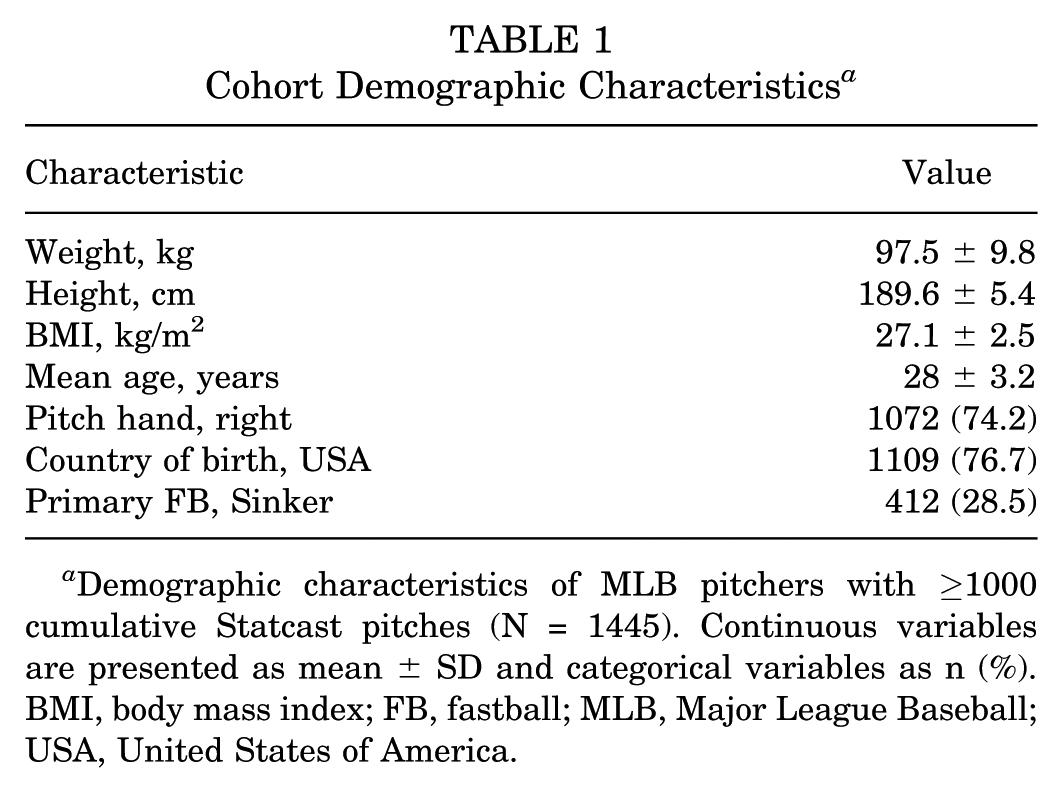
Demographic characteristics of MLB pitchers with ≥1000 cumulative Statcast pitches (N = 1445). Continuous variables are presented as mean ± SD and categorical variables as n (%). BMI, body mass index; FB, fastball; MLB, Major League Baseball; USA, United States of America.
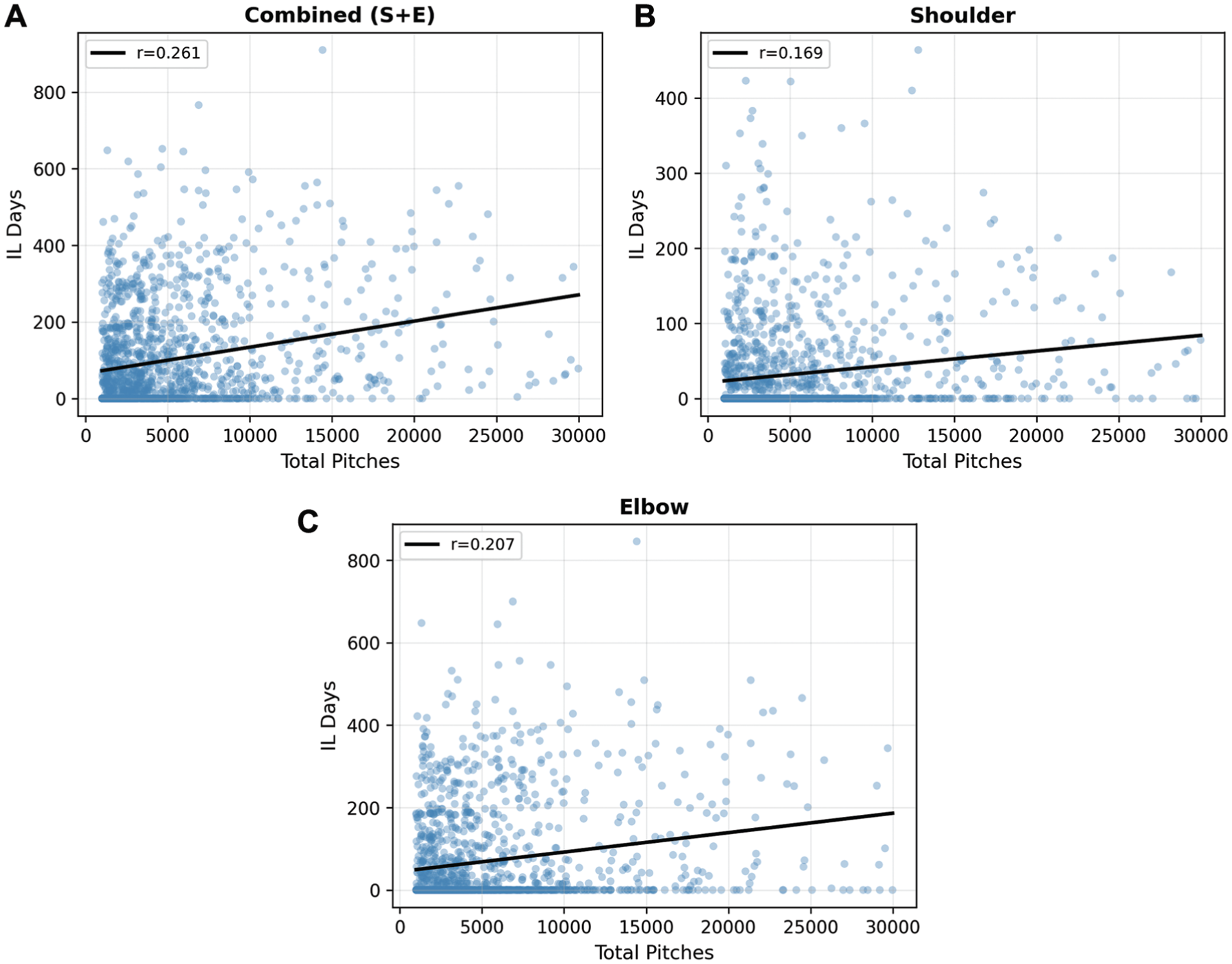
Association between cumulative pitch exposure and upper-extremity injury burden. Scatter plots showing the relationship between total Statcast pitches and IL days for (A) combined (shoulder + elbow), (B) shoulder, and (C) elbow outcomes. Each point represents 1 pitcher (N = 1445). Trend lines with Pearson correlation coefficients are shown. All correlations are significant at P < .001. IL, injured list; S+E = shoulder plus elbow.
Univariate Analysis
Across the prespecified candidate set (43 predictors spanning demographics/performance, release/pitch characteristics, and pitch-to-pitch delta measures), 29 of 43 predictors were significantly associated with total upper-extremity IL days, 23 of 43 with shoulder IL days, and 29 of 43 with elbow IL days (Supplementary Tables 1-3). Predictors significantly associated with greater burden across all 3 outcomes included higher strikeout rate, higher swing-and-miss rate, higher Stuff+, more overhand arm angle, higher changeup velocity, higher curveball velocity, higher 4-seam fastball velocity and spin, higher sinker velocity and spin, and higher slider spin, whereas greater changeup usage and greater extension delta were associated with lower burden across all 3 outcomes. The largest standardized effect sizes for total upper-extremity IL burden were observed for higher strikeout percentage (IRR, 1.38), higher swing-and-miss percentage (IRR, 1.35), and higher fastball velocity and spin metrics (eg, 4-seam velocity IRR, 1.29; 4-seam spin IRR, 1.27). Demographic associations were comparatively limited and outcome-specific: older age was associated with lower total and elbow IL burden, whereas greater height, right-handedness, and United States birth were associated with greater shoulder IL burden.
Several predictors demonstrated opposite-direction associations between shoulder and elbow IL burden, despite adjustment for exposure and role. Most notably, greater release extension was associated with lower shoulder IL days (IRR, 0.89) but higher elbow IL days (IRR, 1.11). Similarly, extension delta (pitch-to-pitch change in extension) was associated with higher shoulder IL days (IRR, 1.07) but lower elbow IL days (IRR, 0.85). Figure 3 summarizes the top standardized univariable associations for total upper-extremity IL burden, and Figure 4 contrasts standardized IRRs for shoulder versus elbow IL outcomes.
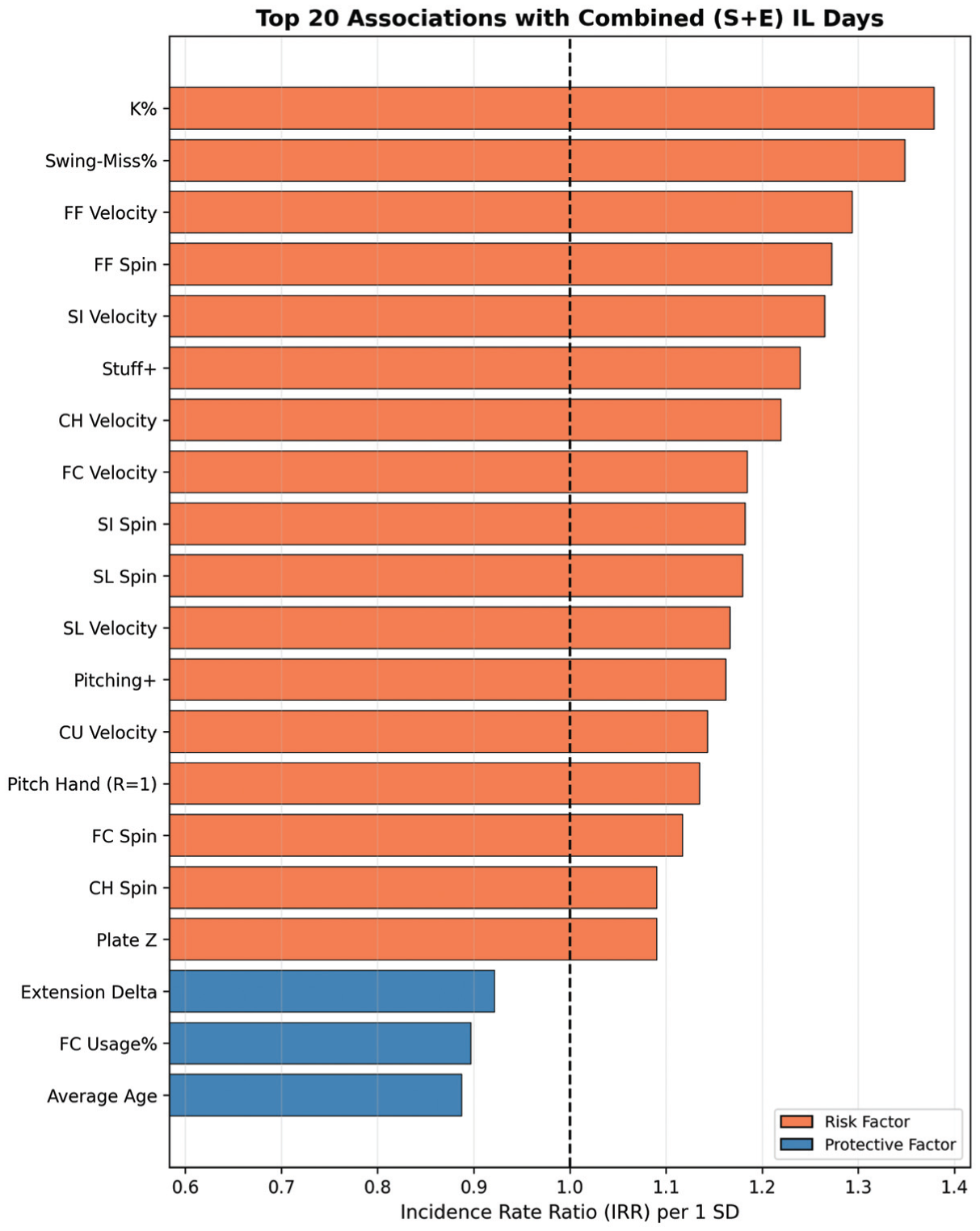
Top 20 strongest univariable associations with combined shoulder and elbow (S+E) IL days. Horizontal bar chart displaying IRR per 1 SD increase, adjusted for log(total pitches) and percentage games started. Bars to the right of the dashed line (IRR, 1) indicate risk factors; bars to the left indicate protective factors. Negative binomial GLMs; N = 1445 pitchers. CH, changeup; CU, curveball; E, elbow; FC, cutter; FF, 4-seam fastball; GLM, generalized linear model; IL, injured list; IRR, incidence rate ratio; K%, strikeout percentage; rpm, revolutions per minute; S, shoulder; SI, sinker; SL, slider.

Comparison of predictor effects on shoulder versus elbow injury burden. Scatter plot showing standardized IRR (per 1 SD) for shoulder (y-axis) vs elbow (x-axis) outcomes. Only predictors significant (P < .05) in at least 1 outcome are shown (top 25 by effect magnitude). Points in orange indicate universal risk factors (IRR >1 for both); blue indicates universal protective factors (IRR <1 for both); gray indicates divergent effects. The dashed diagonal line represents equal effect on both outcomes. IRR, incidence rate ratio.
Among pitch usage metrics, changeup and cutter usage showed protective associations with elbow burden (IRR, 0.93; P = .012; IRR, 0.86; P < .001, respectively), while greater slider and 4-seam fastball usage were associated with higher elbow IL burden (slider: IRR, 1.07; P = .016; 4-seam: IRR, 1.06; P = .038). Sinker usage was similarly associated with lower elbow burden (IRR, 0.92; P = .004), whereas greater curveball usage was associated specifically with higher shoulder burden (IRR, 1.14; P < .001). Full pitch-type usage, velocity, and spin results are provided in Supplementary Table 2.
Multivariable Analysis
In the multivariable model for total upper-extremity IL days (Table 2), strikeout rate, 4-seam velocity, and 4-seam spin remained independently associated with greater injury burden. A 4.7-percentage-point higher strikeout rate was associated with 24% more IL days (IRR 1.24 [95% CI, 1.16-1.32]; P < .001). A 2.5-mph higher 4-seam velocity was associated with 18% more IL days (IRR, 1.18 [95% CI, 1.10-1.26]; P < .001), and a 144-rpm higher 4-seam spin rate was associated with 13% more IL days (IRR, 1.13 [95% CI, 1.07-1.20]; P < .001). The mean age, adjusted Pos X, and velocity delta were not significant after adjustment (all P > .05).
Multivariable Analysis of Independent Predictors of Combined S+E IL Days a
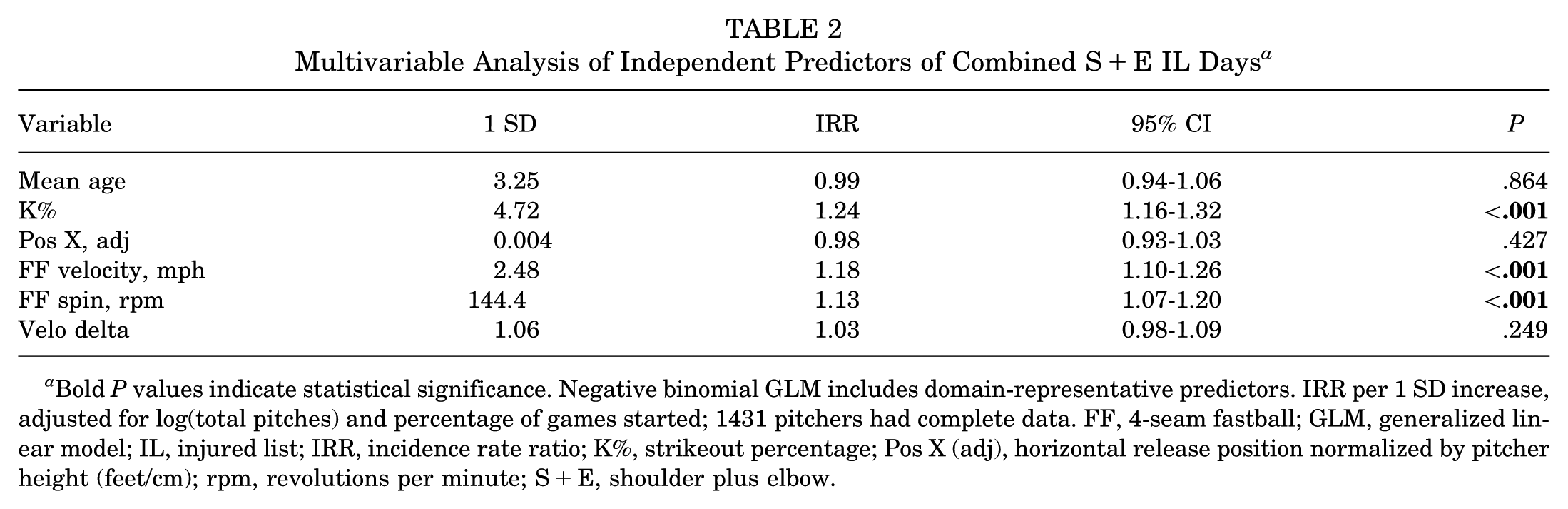
Bold P values indicate statistical significance. Negative binomial GLM includes domain-representative predictors. IRR per 1 SD increase, adjusted for log(total pitches) and percentage of games started; 1431 pitchers had complete data. FF, 4-seam fastball; GLM, generalized linear model; IL, injured list; IRR, incidence rate ratio; K%, strikeout percentage; Pos X (adj), horizontal release position normalized by pitcher height (feet/cm); rpm, revolutions per minute; S+E, shoulder plus elbow.
In the multivariable model for shoulder IL days (Table 3), a 4.7-percentage-point higher strikeout rate was associated with 18% more shoulder IL days (IRR 1.18, [95% CI, 1.11-1.27]; P < .001), and a 2.5-mph higher 4-seam velocity was associated with 11% more shoulder IL days (IRR, 1.11 [95% CI, 1.04-1.18]; P < .001). Height-adjusted release extension was inversely associated with shoulder IL days (IRR, 0.87 [95% CI, 0.83-0.92]; P < .001), while 4-seam spin showed a smaller positive association (IRR, 1.07 [95% CI, 1.01-1.13]; P = .027). Velocity delta was not significant (P = .257).
Multivariable Analysis of Independent Predictors of Shoulder IL Days a
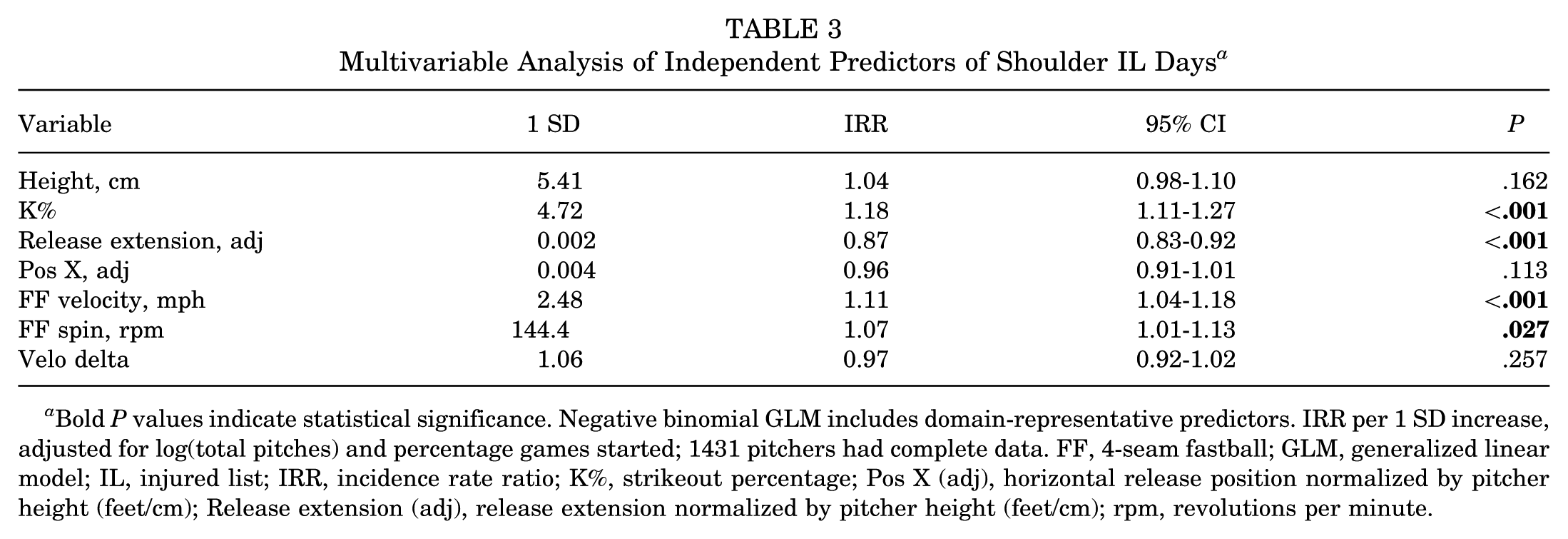
Bold P values indicate statistical significance. Negative binomial GLM includes domain-representative predictors. IRR per 1 SD increase, adjusted for log(total pitches) and percentage games started; 1431 pitchers had complete data. FF, 4-seam fastball; GLM, generalized linear model; IL, injured list; IRR, incidence rate ratio; K%, strikeout percentage; Pos X (adj), horizontal release position normalized by pitcher height (feet/cm); Release extension (adj), release extension normalized by pitcher height (feet/cm); rpm, revolutions per minute.
In the multivariable model for elbow IL days (Table 4), a 4.7-percentage-point higher strikeout rate was associated with 27% more elbow IL days (IRR, 1.27 [95% CI, 1.19-1.36]; P < .001). A 2.5-mph higher 4-seam velocity was associated with 21% more elbow IL days (IRR, 1.21 [95% CI, 1.13-1.30]; P < .001), and a 144-rpm higher 4-seam spin was associated with 16% more elbow IL days (IRR, 1.16 [95% CI, 1.10-1.24]; P < .001). Velocity delta also remained independently associated with elbow IL burden, with a 1.1-mph higher velocity delta associated with 8% more elbow IL days (IRR, 1.08 [95% CI 1.02-1.14]; P = .009).
Multivariable Analysis of Independent Predictors of Elbow IL Days a
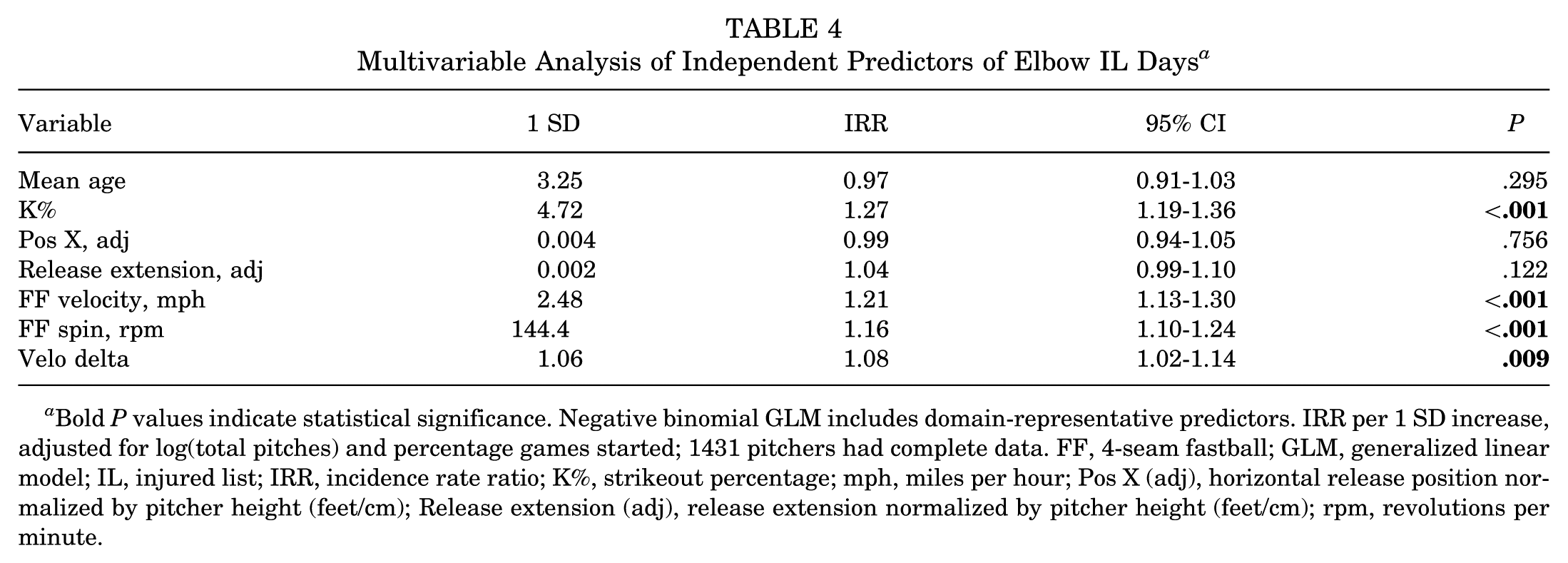
Bold P values indicate statistical significance. Negative binomial GLM includes domain-representative predictors. IRR per 1 SD increase, adjusted for log(total pitches) and percentage games started; 1431 pitchers had complete data. FF, 4-seam fastball; GLM, generalized linear model; IL, injured list; IRR, incidence rate ratio; K%, strikeout percentage; mph, miles per hour; Pos X (adj), horizontal release position normalized by pitcher height (feet/cm); Release extension (adj), release extension normalized by pitcher height (feet/cm); rpm, revolutions per minute.
Discussion
The primary findings of this study were that fastball velocity, spin rate, and strikeout percentage were independently associated with greater cumulative upper-extremity injury burden, while joint-specific mechanical correlates emerged for the shoulder and elbow. In adjusted models, shorter release extension was associated with greater shoulder burden, and greater pitch-to-pitch change in velocity was associated with greater elbow burden. This analysis also introduced novel pitch-level metrics that quantify adjacent-pitch changes within games, identifying several previously unreported variables that were significant in joint-specific screening analyses. Using over a decade of public IL data linked to high-resolution pitch-tracking data, these findings reinforce the established association between high performance and injury risk while generating new hypotheses regarding the roles of mechanical consistency and pitch sequencing in shoulder and elbow pathology. Conceptually, this work extends previous injury-risk research by shifting the unit of analysis from discrete, surgery-anchored endpoints to cumulative IL burden attributable to the shoulder and elbow, while accounting for exposure and role. This approach may more closely reflect how arm health is experienced and managed in professional baseball.
The most robust and consistent correlates of burden were metrics of pitching dominance, including higher velocity, higher spin, and strikeout-oriented performance. At the study-period scale, this supports a performance tradeoff framework in which traits that improve run prevention may also reflect or require sustained mechanical and physiologic demands that increase cumulative tissue stress and contribute to injury burden over time. This pattern is consistent with previous MLB case-control studies linking velocity and spin characteristics to UCLR and capsulolabral surgery,19,20 as well as with biomechanical literature demonstrating higher joint loading at the elbow and shoulder during higher-velocity pitching. 15 It also parallels concerns raised in league-level discussions that the sport-wide emphasis on elite “stuff,” amplified by pervasive pitch-tracking technology, may contribute to rising injury rates. 14 Consistent with this, Stuff+, a composite metric integrating velocity, movement, and release characteristics into a measure of overall pitch quality, 24 was among the strongest univariate predictors of IL burden across all 3 outcomes, directly supporting the link between elite pitch quality and cumulative arm burden. Notably, spin was a consistent positive correlate across pitch-specific univariable models and remained an independent predictor in multivariable models. Recent laboratory data found no association between spin and elbow varus torque across pitch types, 11 but our results suggest spin-dominant profiles nonetheless track with higher cumulative arm burden in real-world professional pitching populations. Whether this reflects the biomechanical demands of spin generation itself or the underlying mechanics used to produce high-spin profiles, which may involve suboptimal delivery patterns that increase joint stress, cannot be determined from pitch-tracking data alone and warrants direct biomechanical investigation.
Furthermore, our analysis of pitch usage aligns with emerging concerns surrounding modern pitch design. Greater reliance on sliders was associated with higher injury burden at the elbow, which is increasingly relevant given the well-documented rise in slider usage during the pitch-tracking era. 27 In contrast, while primary fastball type itself was not associated with injury burden, repertoire-level patterns were informative. Higher overall 4-seam fastball usage was associated with greater elbow IL burden, whereas greater sinker, changeup, and cutter usage showed protective associations. Notably, the changeup has been previously proposed as a comparatively protective pitch in biomechanical and epidemiologic studies, potentially due to its lower velocity, reduced spin, and greater reliance on pronation-dominant mechanics.9,28 Collectively, these findings suggest that pitching profiles that rely less on sustained exposure to specific pitch-specific mechanical demands, particularly 4-seam fastballs and supination-dominant breaking balls, may be associated with reduced cumulative elbow stress.
Joint-specific models further indicated that correlates of cumulative injury burden can diverge meaningfully between shoulder and elbow outcomes. A particularly informative example was height-adjusted release extension, which was independently associated with lower shoulder burden, while univariate analyses suggested a positive association with elbow burden. Greater release extension reflects ball release occurring farther down the mound (closer to home plate) and likely reflects more forward positioning of the trunk in the sagittal plane. Previous biomechanical studies examining sagittal-plane trunk mechanics have shown that increased forward trunk flexion is associated with higher elbow varus moment and torque, providing a plausible mechanism by which pitchers who consistently release the ball farther out may accumulate greater elbow loading over time.18,34 These same studies also demonstrate associations between forward trunk positioning and increased pitch velocity, which may explain why the extension signal attenuated in adjusted elbow models once velocity was included.18,34 In contrast, to our knowledge, sagittal-plane trunk mechanics have not been identified as primary determinants of shoulder kinetics in laboratory settings. The inverse association observed here, therefore, raises a complementary hypothesis: reduced release extension may reflect a more proximal or “shortened” delivery in which the shoulder bears a greater share of velocity generation and post-release deceleration. Such a pattern is directionally consistent with established posterior shoulder loading and deceleration-phase injury mechanisms in pitching,5,8,30 and may reflect broader proximal kinetic chain inefficiency that shifts mechanical demand to the glenohumeral joint. Together, these findings identify release extension as a clinically interpretable pitch-tracking metric that warrants targeted kinematic investigation to determine whether modifying extension redistributes joint loading in a joint-specific manner and whether it could inform individualized injury mitigation strategies.
This study also highlights the value of pitch-to-pitch delta measures, which are not captured by season-averaged summaries. Greater pitch-to-pitch change in velocity was independently associated with elbow injury burden, suggesting that increased adjacent-pitch fluctuation tracks may predispose to elbow injury. Because consecutive velocity differences are largely driven by alternating pitch types with distinct velocities, this metric likely captures sequence-level pitch-mix heterogeneity. Several other pitch-to-pitch deltas, including spin, arm angle, and extension, were also significant in univariate screening analyses, suggesting that adjacent-pitch changes in release and pitch characteristics may likewise capture sequence-level information not reflected in season-averaged summaries alone. Collectively, these findings raise the hypothesis that the sequencing of mechanically distinct pitches across consecutive throws may be associated with elbow injury burden. However, this effect cannot be fully isolated from repertoire composition and usage patterns in the current dataset. Importantly, this sequence-level signal should be distinguished from overall pitch usage, which showed a mixed pattern in the present study. Accordingly, these findings do not suggest that all off-speed pitches are uniformly protective or that pitch switching itself is inherently harmful, but rather that the order and magnitude of pitch-to-pitch changes may carry independent information beyond overall repertoire composition. An additional, complementary explanation is consistent with adaptive change theory,4,12 which describes how repetitive valgus extension loading can drive chronic anatomic adaptations at the elbow (eg, olecranon osteophyte formation) that alter how valgus stress is accommodated during throwing and may contribute to joint stability. Consistent with this concept, the high prevalence of chronic magnetic resonance imaging abnormalities in asymptomatic throwers suggests that adaptation is common even in the absence of symptoms. 10 When considered alongside recent case-control pitch-tracking evidence demonstrating greater preinjury release-point variability in pitchers who later underwent UCLR, 19 these findings support further study of pitch-to-pitch release variation and sequencing as potential correlates of elbow injury burden.
Previous predictive modeling efforts in baseball have addressed related questions but differ meaningfully from the present burden-based approach. Oeding et al 28 used machine learning to predict next-season injuries using season-aggregated inputs and combined shoulder and elbow injuries. That framing is well-suited for short-horizon forecasting but inherently limits joint-specific inference, cannot capture pitch-to-pitch stability or sequencing, and reduces a wide spectrum of clinical severity (eg, brief stints versus season-ending time loss) to a single classification. In addition, because the unit of analysis is the pitcher-season, the same pitcher can contribute observations to both the “injured” and “healthy” groups across different years, even when their season-level metrics are very similar, which can dilute the contrast between groups. Bullock et al 2 modeled subsequent IL days in Minor League Baseball pitchers, providing useful insight into short-term risk in a different population, but without the MLB-scale pitch-tracking resolution needed to evaluate within-game variability, pitch-to-pitch delta phenotypes, or joint-specific burden at the career level.
These findings outline several priorities for future research. First, joint-specific associations identified here, particularly release extension and pitch-to-pitch stability metrics, should be validated and mechanistically interrogated using integrated biomechanical and clinical data. Second, longitudinal modeling approaches, including machine learning applied to pitch-resolved time series combined with injury history and nonpublic clinical factors (eg, strength, range of motion), may improve prospective prediction and help define actionable thresholds. Finally, population-level correlates should be translated into individualized, mechanism-driven hypotheses that can be tested prospectively. For example, if a pitcher demonstrates high shoulder burden in conjunction with short release extension, future work could evaluate whether targeted mechanical changes that increase release extension alter shoulder and elbow loading and, thus, injury risk.
Limitations
This study is not without limitations. Reliance on publicly available IL and reporting data sometimes precludes a specific diagnosis for each player. IL days may serve as an imperfect proxy for true injury incidence and severity because roster strategy, option status, competitive context, and rehabilitation philosophy can influence whether (and for how long) a player is listed, independent of tissue damage. In addition, injuries accumulated outside the 2015-2025 study window were not captured; therefore, previous pathology and preexisting vulnerability could not be fully accounted for. Players may also continue pitching through symptoms without an IL placement, meaning some individuals with higher-risk mechanics or greater underlying pathology could appear to have a lower burden if they accrued fewer IL days. Furthermore, the dataset is naturally susceptible to survivorship bias; pitchers who accrue a significantly high IL burden are more likely to be released or forced into retirement. As a result, older pitchers remaining in the sample may represent a more resilient subset, potentially confounding the observed relationship between age and injury burden.
Methodologically, the study-period-aggregated approach improves stability and captures the overall burden, but it necessarily averages across meaningful within-pitcher changes. Pitchers may alter mechanics, pitch mix, intent, and repeatability across seasons due to coaching, aging, fatigue management, or previous injury, and aggregating data can therefore obscure periods of elevated risk or recovery-related adaptations. Likewise, Statcast-derived release-point and ball-flight metrics describe performance characteristics (eg, velocity, spin, movement) and release parameters but do not reveal the underlying joint loads or kinetic mechanisms that produce those performance endpoints. Critically, the analysis could not include nonpublic clinical and physical characteristics such as strength, range of motion, previous imaging findings, tissue quality, nongame throwing workload, and training/throwing programs, or detailed biomechanics, which are plausibly related to injury burden and may confound associations. Despite adjustment for exposure and role, residual confounding and selection effects remain possible; thus, findings should be interpreted as associative and hypothesis-generating rather than causal.
Conclusion
A high-performance phenotype drives cumulative injury burden, but risk signals diverge meaningfully by joint. Shorter release extension and greater pitch-to-pitch velocity delta emerged as distinct, potentially modifiable correlates of shoulder and elbow injury burden, respectively. These findings identify mechanical and consistency-based signals that warrant prospective investigation to refine individualized workload management and injury prevention.
Footnotes
Appendix
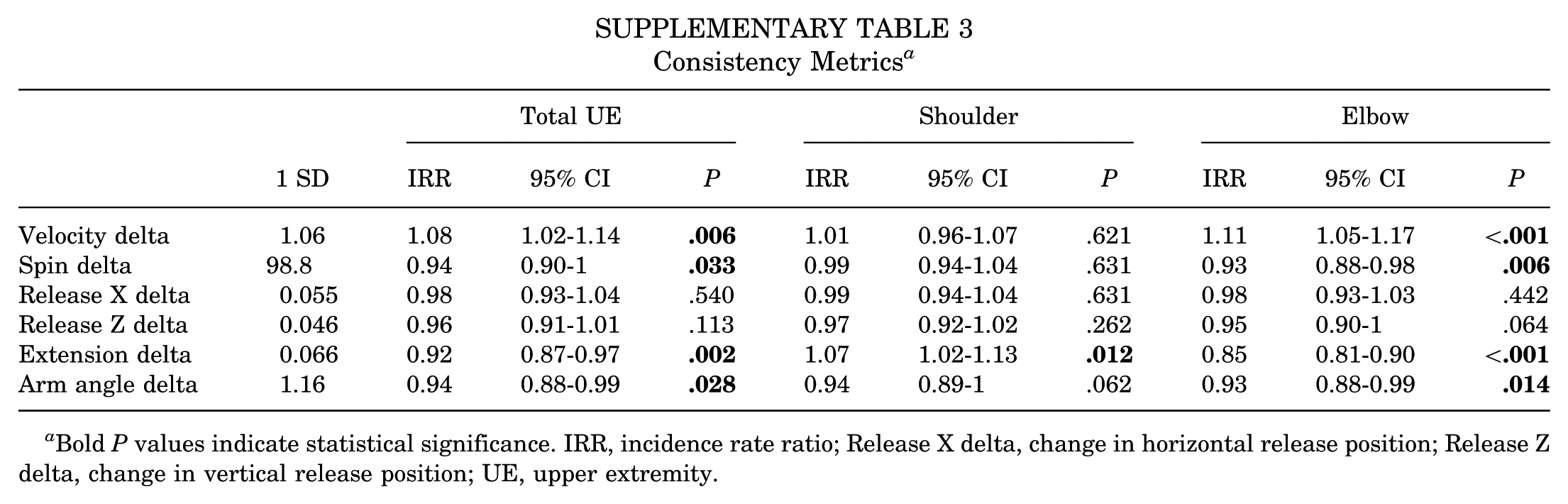
Consistency Metrics a
| 1 SD | Total UE | Shoulder | Elbow | |||||||
|---|---|---|---|---|---|---|---|---|---|---|
| IRR | 95% CI | P | IRR | 95% CI | P | IRR | 95% CI | P | ||
| Velocity delta | 1.06 | 1.08 | 1.02-1.14 |
|
1.01 | 0.96-1.07 | .621 | 1.11 | 1.05-1.17 |
|
| Spin delta | 98.8 | 0.94 | 0.90-1 |
|
0.99 | 0.94-1.04 | .631 | 0.93 | 0.88-0.98 |
|
| Release X delta | 0.055 | 0.98 | 0.93-1.04 | .540 | 0.99 | 0.94-1.04 | .631 | 0.98 | 0.93-1.03 | .442 |
| Release Z delta | 0.046 | 0.96 | 0.91-1.01 | .113 | 0.97 | 0.92-1.02 | .262 | 0.95 | 0.90-1 | .064 |
| Extension delta | 0.066 | 0.92 | 0.87-0.97 |
|
1.07 | 1.02-1.13 |
|
0.85 | 0.81-0.90 |
|
| Arm angle delta | 1.16 | 0.94 | 0.88-0.99 |
|
0.94 | 0.89-1 | .062 | 0.93 | 0.88-0.99 |
|
Bold P values indicate statistical significance. IRR, incidence rate ratio; Release X delta, change in horizontal release position; Release Z delta, change in vertical release position; UE, upper extremity.
Acknowledgements
This research did not receive any specific grant from funding agencies in the public, commercial, or not-for-profit sectors. The authors would like to thank MLB and Baseball Savant for making Statcast data publicly available, which enabled this study.
Final revision submitted March 21, 2026; accepted March 26, 2026.
One or more of the authors has declared the following potential conflict of interest or source of funding: C.S.A is a paid consultant for Arthrex and the head team physician for the New York Yankees.
Ethical approval was not sought for the present study.
