



Abstract
Background:
Wrestling is a high-impact sport characterized by rapid, forceful movements, posing a considerable injury risk to athletes who are often evaluated in emergency departments (EDs) across the United States. This study examines the principal mechanics, distributions, and epidemiological trends of wrestling-related injuries.
Hypothesis:
(1) Upper extremity injuries would be the most common, (2) young men would be the most affected group, and (3) sprains/strains would be the most frequent diagnosis.
Study Design:
Descriptive epidemiology study.
Methods:
Patients evaluated at US EDs for wrestling-related injuries between January 1, 2015, and December 31, 2024, were identified using the National Electronic Injury Surveillance System database. Patient characteristics, injury location, diagnosis, disposition, and mechanisms of injury were recorded. Data analysis was calculated using national estimates (NEs) and linear regression to assess trends and associations.
Results:
From 2015 to 2024, US EDs reported approximately 10,508 cases (NE, 370,089) of wrestling-related visits. Of these, 88.4% involved males (NE, 326,985). Pediatric patients (≤18 years of age) accounted for the majority of injuries, accounting for 84.9% of all cases (NE, 314,166), with a mean age of 15.9 ± 6.2 years for the entire cohort. The lowest number of wrestling-related injuries occurred in 2020 (NE, 20,270), while the highest number was reported in 2024 (NE, 57,026). The most commonly injured body regions were the shoulder (15.2%; NE, 56,150) and head (13.1%; NE, 48,619). Sprains and strains represented the most frequent injury type at 27.6% (NE, 102,253).
Conclusion:
This study showed that males constituted the predominant majority of ED visits from wrestling injuries, with shoulder and neck strains being the most prevalent. The significant rise in injuries from 2020 to 2024 highlights the necessity for preventative measures and heightened awareness of wrestling safety, especially in recreational environments, where occurrences are notably elevated.
Wrestling is a physically demanding, high-contact sport that requires strength, agility, and technical skill, often placing athletes at increased risk for musculoskeletal injuries due to accumulated biomechanical stress on the body. The current literature outlines that wrestling-related maneuvers frequently lead to many orthopaedic injuries, with commonly affected body parts being the knee, shoulder, head, and neck, with a high volume of concussions.9,15 Research conducted during the 2005-2006 academic year on wrestling revealed an injury rate of 2.33 injuries per 1000 athlete-exposures in high school and 7.25 injuries per 1000 athlete-exposures in collegiate wrestling, making it a sport with one of the highest injury rates, only behind football.4,22 The frequently impacted anatomic tissue in the knee is the medial collateral ligament (MCL), with careful attention warranted for lateral collateral ligament (LCL) injuries, while acromioclavicular injuries are predominant in the shoulder. 9 Additionally, back and neck injuries often occur as a result of torsion and direct impact, affecting the cervical vertebrae and intercostal muscles. 9
The repercussions of wrestling-related injuries surpass immediate physical damage, posing considerable risks to young athletes, including permanent disability from fractures, traumatic brain injuries, and, in rare instances, death. 16 Prevalent injuries addressed in the emergency department (ED) are strains, sprains, and fractures, with common surgical treatments including meniscal repair, anterior cruciate ligament reconstruction, and labral repair in the shoulder.13,17 Additionally, wrestling injuries exhibit elevated recurrence rates relative to other sports, with studies showing a high recurrence rate for knee injuries (22%), spinal injuries (13%), and shoulder-specific injuries (17.3%), resulting in extended recovery durations and discontinuation of athletic involvement.3,5,10 These findings highlight the necessity of focused injury prevention initiatives and evidence-based guidelines within this high-risk demographic.
Despite the increasing prevalence and clinical relevance of wrestling-related injuries, there is a deficiency of extensive large-scale epidemiological data analyzing national trends and injury patterns over a prolonged period of time. Previous research has been constrained to short durations and smaller cohorts, limiting their ability to comprehensively evaluate national trends. An understanding of the mechanisms, injury sites, and impacted demographics is crucial for effective preventative and management measures. The purpose of our study was to ascertain demographic patterns and temporal trends and characterize the type and location of wrestling-associated injuries. We hypothesized that upper extremity injuries and concussions would be the most prevalent diagnoses, with higher rates of injury observed in adolescent men during competitive activities.
Methods
National Electronic Injury Surveillance System Database
This retrospective study utilized data from the National Electronic Injury Surveillance System (NEISS), a publicly available, de-identified database managed by the US Consumer Product Safety Commission. The data were collected from the EDs of approximately 100 hospitals, selected as a probability sample to represent hospitals across the United States. By assigning a statistical sample weight to each patient case based on the inverse probability of selection, national estimates (NEs) of injuries can be calculated nationwide.
Extraction of Patient Data
The NEISS database was queried for all wrestling-related injuries reported to US EDs between January 1, 2015, and December 31, 2024, resulting in a total of 10,508 cases during the study period. Product code 1270 was used to identify patients with injuries solely attributed to wrestling, distinct from injuries sustained from other combat sports such as jujutsu, mixed martial arts, and karate. Information extracted from each case included date of ED visit, demographic information (age, sex, and race), injured body part, injury location, and an ED narrative provided by the health care team. Health care professionals provided narratives describing the mechanism of injury for each patient case, which were then documented by trained coders.
Patient and Injury-Related Variables
Patient characteristics were recorded, including sex (male or female), race (White, Black/African American, other, Asian, American Indian/Alaska Native, Native Hawaiian/Pacific Islander, or not stated), and age (pediatric, ≤18 years of age; adult, >18 years of age). The numbers of injuries were recorded and separated by year. Injured body parts were coded and categorized as lower or upper arm, ankle, ear, elbow, eyeball, face, finger, foot, hand, head, knee, lower or upper leg, mouth, neck, pubic region, shoulder, toe, lower or upper trunk, wrist, all parts of body, or not recorded. Injury diagnoses were coded as anoxia, avulsion, concussions, contusions/abrasions, crushing, dental injury, dermatitis/conjunctivitis, dislocation, foreign body, fracture, hematoma, hemorrhage, internal organ injury, laceration, nerve damage, poisoning, puncture, strain or sprain, or other/not stated. Location of injury included home, farm/ranch, street or highway, other public property, mobile/manufactured home, industrial, school/daycare, place of recreation or sports, or not recorded.
Statistical Analysis
The NEISS coding manual was used to identify codes assigned to each category. NEs were calculated by multiplying the number of NEISS cases by each respective case weight. Linear regression analysis was conducted to identify annual wrestling injury trends throughout the study period.
Results
US EDs reported 10,508 cases (NE, 370,089) of wrestling-related injuries from January 1, 2015, to December 31, 2024. Of these cases, 88.4% of the injuries were sustained by males (NE, 326,985), while 11.6% were sustained by females (NE, 43,105). The race most affected was White, accounting for 60.0% of the cases (NE, 222,190), while the most affected age group was the pediatric population (≤18 years of age), representing 84.9% of total cases (NE, 314,166). The mean age of injured patients was 15.9 ± 6.2 years, with a range of 2 to 77 years (Table 1).
Demographic Information of Wrestling-Related US Emergency Department Visits a
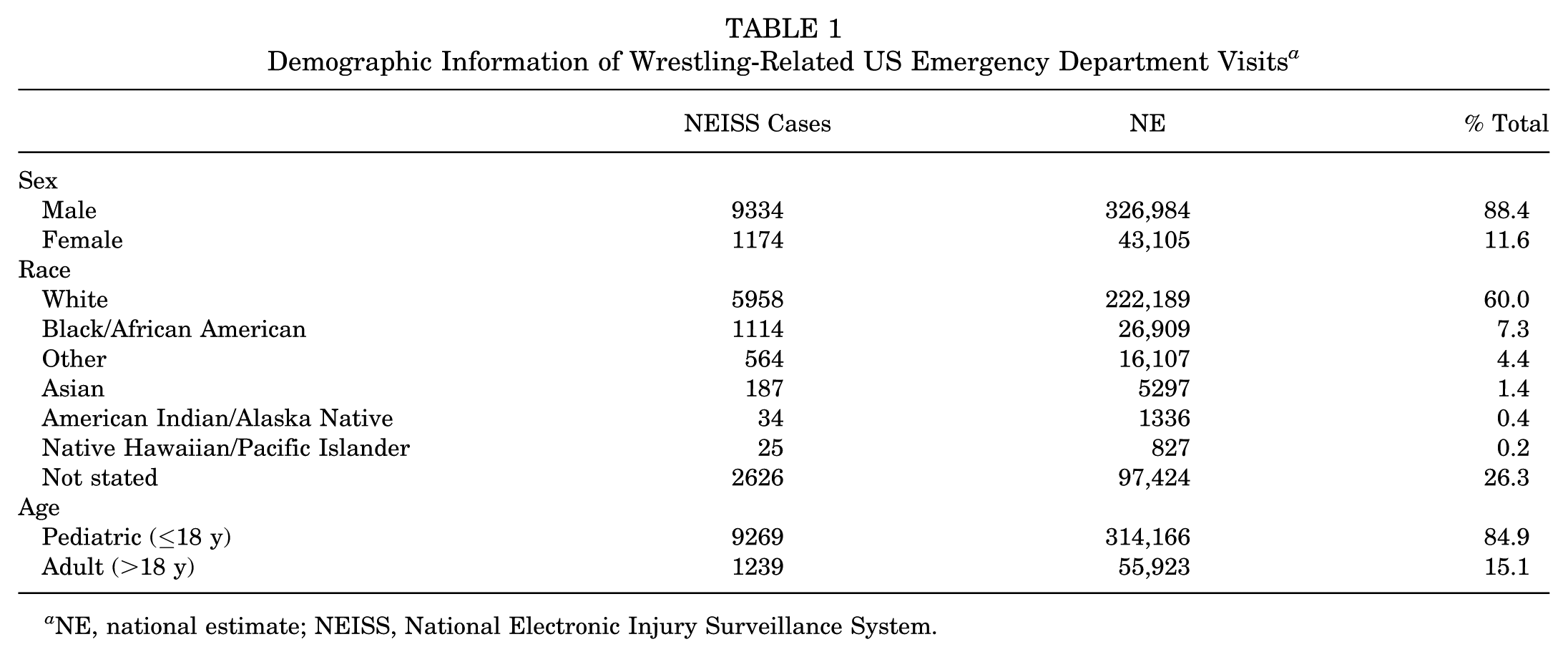
NE, national estimate; NEISS, National Electronic Injury Surveillance System.
NEISS National Estimate
Annual injury data were plotted for the past decade, showing the lowest number of injuries reported in 2020 (NE, 20,270; 5.5%) and the highest number of injuries reported in 2024 (NE, 57,026; 15.4%). Linear regression analysis from 2015 to 2024 did not show a significant change in injuries over time (R2 = 0.059). However, between 2020 and 2024, there was a significant rise in wrestling-related injuries (R2 = 0.98) (Figure 1).

National estimates of wrestling-related US emergency department visits between January 1, 2015, to December 31, 2024.
Based on all wrestling-related injuries evaluated at US EDs during the past decade, stratification of injured body parts was recorded (Table 2). Injury data indicate that the most commonly injured body part due to wrestling was the shoulder, composing 15.2% of all injuries (NE, 56,150). This was followed by the head at 13.1% (NE, 48,619), the knee at 9.7% (NE, 35,864), and the upper trunk at 8.3% (NE, 30,818). The least injured body part was the upper leg at 0.4% of total injuries (NE, 1306).
Distribution of Wrestling-Related Injured Body Parts According to US Emergency Department Visits a

NE, national estimate; NEISS, National Electronic Injury Surveillance System.
NEISS National Estimate
Injury diagnoses for wrestling-related EDs varied, with the majority of injuries occurring due to a strain or sprain at a percentage of 27.6% of all total injuries (NE, 102,253). The second most common injury was due to a fracture at 17.2% (NE, 63,692), followed by contusions and abrasions at 9.2% (NE, 34,145) (Figure 2). Location of wrestling injuries was most prominent at places of recreation or sports, with 56.3% of all incidents (NE, 208,331). Afterward, school/daycare was the second most common at 29.1% of all injuries (NE, 107,657), followed by other public properties at 1.8% (NE, 6505) (Figure 3).

Distribution of wrestling-related diagnoses evaluated at US emergency departments.

Location of wrestling-related injuries evaluated at US emergency departments.
Discussion
The major findings of our study demonstrated that injuries were most prevalent in males, and the pediatric population was the age group most affected by these injuries. Additionally, injuries were most frequently reported among the White population. Overall, wrestling-related injuries gradually decreased toward the beginning of the 10-year period and were the lowest in 2020, but increased dramatically in the years ensuing, reaching an all-time high in 2024. Strains and sprains were the most common diagnoses, with the shoulder being the most commonly injured anatomic region, followed closely by the head. Most injuries occurred at recreational or sports facilities, with schools and daycares being the second most common locations.
The elevated prevalence of injuries among male athletes aligns with physiological disparities as described in previous literature, in which male wrestlers have significantly greater fat-free mass and anaerobic peak power relative to females, contributing to their increased injury rates. 20 However, with the rising popularity of wrestling among females and the continued sanctioning of the sport by state federations, it is possible that female injury rates will jump in the coming years. According to the National Federation of State High School Associations (NFHS) high school participation survey, girls’ participation substantially rose from 31,654 participants in the 2021-2022 season to 64,257 participants in the 2023-2024 season. 12 The pediatric population represented 84.9% of all wrestling-related injuries, which could be attributed to their increased participation at the middle or high school level, along with repetitive stress on their developing musculoskeletal system. 19 However, older and more experienced athletes face greater injury risks due to the higher intensity and pace of their wrestling involvement, but further research is necessary to prove this hypothesis. 22
EDs in the United States for wrestling-related injuries saw a sharp decrease in 2020, followed by a substantial rise from 2020 to 2024. The observed trends are likely due to the COVID-19 pandemic, where social distancing and facility limitations reduced participation in close contact sports. Although previous literature has indicated that approximately 71% of adolescents maintained physical activities during lockdown, with 66% participating in school sports and 50% in community sports, these figures represent general activity as opposed to high-contact sports like wrestling. 8 As restrictions eased, the return to play led to increased injuries from a combination of deconditioning and diminished preparedness after prolonged de-training during lockdowns, suggesting a postpandemic rebound effect on injury rates. These findings contrast with existing literature, which reports a declining incidence of wrestling-related injuries in recent years. 17 The observed increase in injuries may be due to the inclusion of both adults and children, which could have introduced distinct injury patterns or risk factors. Additionally, the extended analysis period may reflect broader trends in the sport, such as increased competitive levels and evolving training techniques, pointing to a growing public health concern for wrestling participants.
The distribution of wrestling-related injured body parts showed that the shoulder was the most injured anatomic area, aligning with findings from Pasque et al 14 and Snyder et al 17 However, this differs from data reported by Myers et al, 11 who found that youth wrestlers were most likely to injure their wrist, hand, and fingers, followed by the head or neck. Wrestlers are commonly thrown to the mat from the standing position and break their falls with an outstretched arm; however, if they are unable to extend their arm due to an opponent trapping it, they bear all of the force directly on their shoulder, leading to injury.6,7 The second most commonly injured location was the head, which can arise from wrestlers being slammed to the ground, head-to-head collisions with an opponent, or being struck in the head by an opponent's bony prominence.1,7,23 The knee ranking the third most injured location may be attributed to the various wrestling positions that place the knee under pressure from different angles, which is especially prevalent during takedown defense, where most knee injuries occur. These awkward positions can predispose athletes to injuries such as MCL and LCL sprains/tears, as well as meniscal tears. 21
Wrestlers frequently apply force against joints, explosively shoot toward an opponent's legs, or forcefully throw opponents to the mat, each of which significantly contributes to the risk of strains, sprains, and fractures.2,18 The majority of wrestling-related injuries originated in recreational or sports setting, reflecting wrestler participation in practice facilities or during tournament events. This pattern is consistent with NFHS high school participation data, which reported an all-time high of 356,131 high school wrestlers in the 2023-2024 season, a number that has been continually rising. 12 The second most common location of injury was at school or daycare settings, attributed to the prevalence of high school wrestling programs and frequency of practices held throughout the winter season.
These findings have valuable clinical and practical implications for reducing future wrestling-related injuries. First, targeted prevention strategies should aim to reduce the frequency of sprains and strains experienced by the wrestling community, with a greater emphasis on the pediatric population. This may involve coaches and referees more closely monitoring matches and practices to ensure that athletes are not overexerting joints and muscles beyond safe limits. Coaches can help minimize risk by ensuring athletes are not using improper techniques and engaging in dangerous maneuvers. Importantly, the observed spike in wrestling injuries after the COVID-19 pandemic highlights the need for structured return-to-play programs that allow athletes to gradually acclimate to the physical demands of the sport, reducing the risk of injury after prolonged inactivity.
There are several important limitations to consider in the study design when analyzing the 10 years of wrestling-related injury records. The study relied on data from the NEISS database, which only captures injuries obtained from US EDs. This underestimates the total incidence of national wrestling-related injuries as milder cases that do not require ED care are excluded, skewing the data toward more acute presentations. Additionally, NEISS functions as a stratified probability sample of US hospitals designed to represent the national population. However, it has limited capacity to identify the geographic distribution of wrestling participation rates, which potentially influences case capturing. When analyzing the data, a significant number of injury diagnoses were recorded as “other/not stated” (21.5%), and injury location data were missing for approximately 46,593 patients. These gaps reflect inconsistent diagnostic reporting and uncertainty regarding injury origin. These limitations highlight the need for improved reporting practices in EDs to more accurately characterize sports-related injuries across the United States. The NEISS database also lacks detailed information about mechanism of injury, limiting the ability to understand how and in what positions wrestling-related injuries occur. Furthermore, ED reports are narrative based and contextual, affecting the consistency and accuracy of documented injury information.
Conclusion
Our study showed that during the decade from 2015 to 2024, males accounted for the overwhelming majority of ED visits due to wrestling-related injuries, with shoulder and neck strains or sprains being the most common. The alarming increase of these injuries from 2020 to 2024 underscores the need for preventative strategies and increased awareness of wrestling safety, particularly in recreation settings, where incidence is especially high.
Footnotes
Final revision submitted December 15, 2025; accepted December 23, 2025.
One or more of the authors has declared the following potential conflict of interest or source of funding: A.D.M. reported consulting or advisory relationships with Arthrex and consulting or advisory activities and stock ownership with Restore 3D. AOSSM checks author disclosures against the Open Payments Database (OPD). AOSSM has not conducted an independent investigation on the OPD and disclaims any liability or responsibility relating thereto.
Ethical approval was not sought for the present study.
