Abstract
Objectives:
Intra-articular hemarthrosis contributes to the expression of various cytokines in articular injuries of knees. Exposure of articular cartilage to blood has been confirmed to induce irreversible cartilage damage. Intra-articular hemarthrosis occurs after anterior cruciate ligament (ACL) reconstruction (ACLR). Despite improvements of the knee instability by surgery, ACL injury may be a potential the risk of cartilage degeneration, which might result in intra-articular hemarthrosis after ACLR. Purpose of this study is to evaluate the influence of intra-articular hemarthrosis on activities of a disintegrin and metalloprotease with thrombospondin motifs (ADAMTS) family and matrix metalloproteases (MMPs) in the acute phase after anterior cruciate ligament reconstruction (ACLR).
Methods:
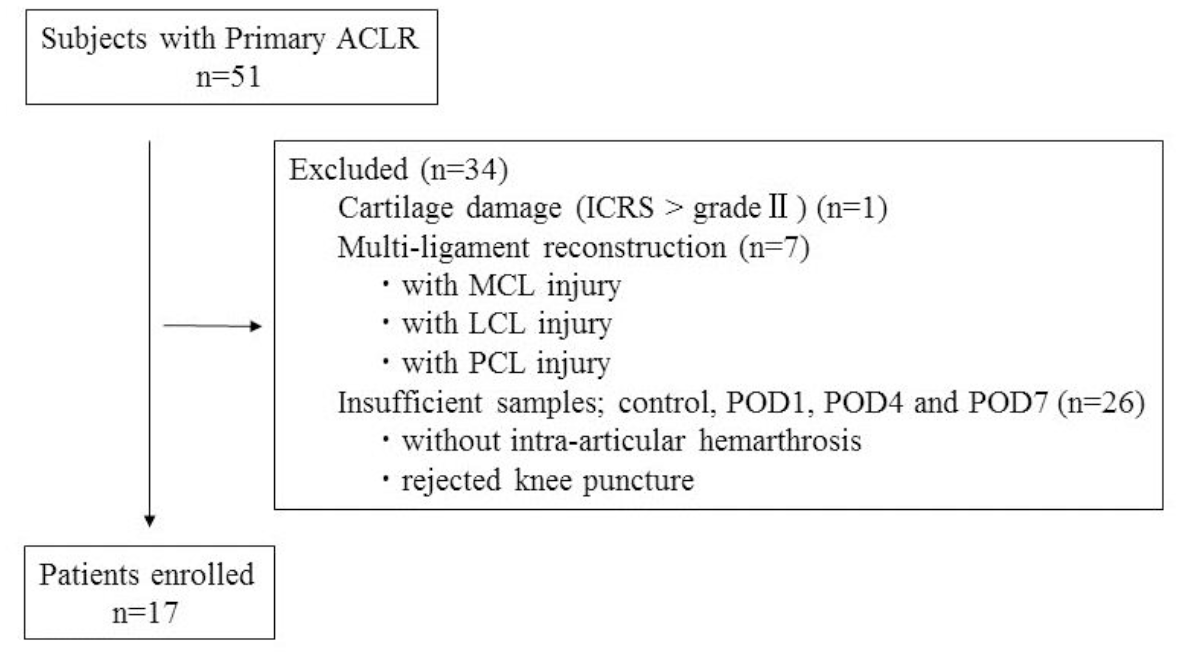
Intra-articular hemarthrosis was collected from 17 patients who underwent primary ACLR on postoperative day POD1, POD4 and POD7. As control samples, synovial fluid without intra-articular hemarthrosis was obtained from ipsilateral knees prior to ACLR. ADAMTS-4, -5, and -9 and MMP-2 and -9 were measured by enzyme-linked immunosorbent assay (ELISA). Expression levels of each proteinase in intra-articular hemarthrosis and SF are presented as mean ±standard deviation (SD). Differences in levels of each proteinase among the four groups (control, POD1, POD4 and POD7) were compared using the Wilcoxon test. GraphPad Prism version 9 (GraphPad Software, San Diego, CA, USA) was used for all analyses, with the significance level set to 5%. This study protocol was reviewed and approved by the Committee for Ethics of University of Miyazaki (accession no. O-0149). Written informed consent for publication of this report was obtained from patients or their guardians as required.
Results:
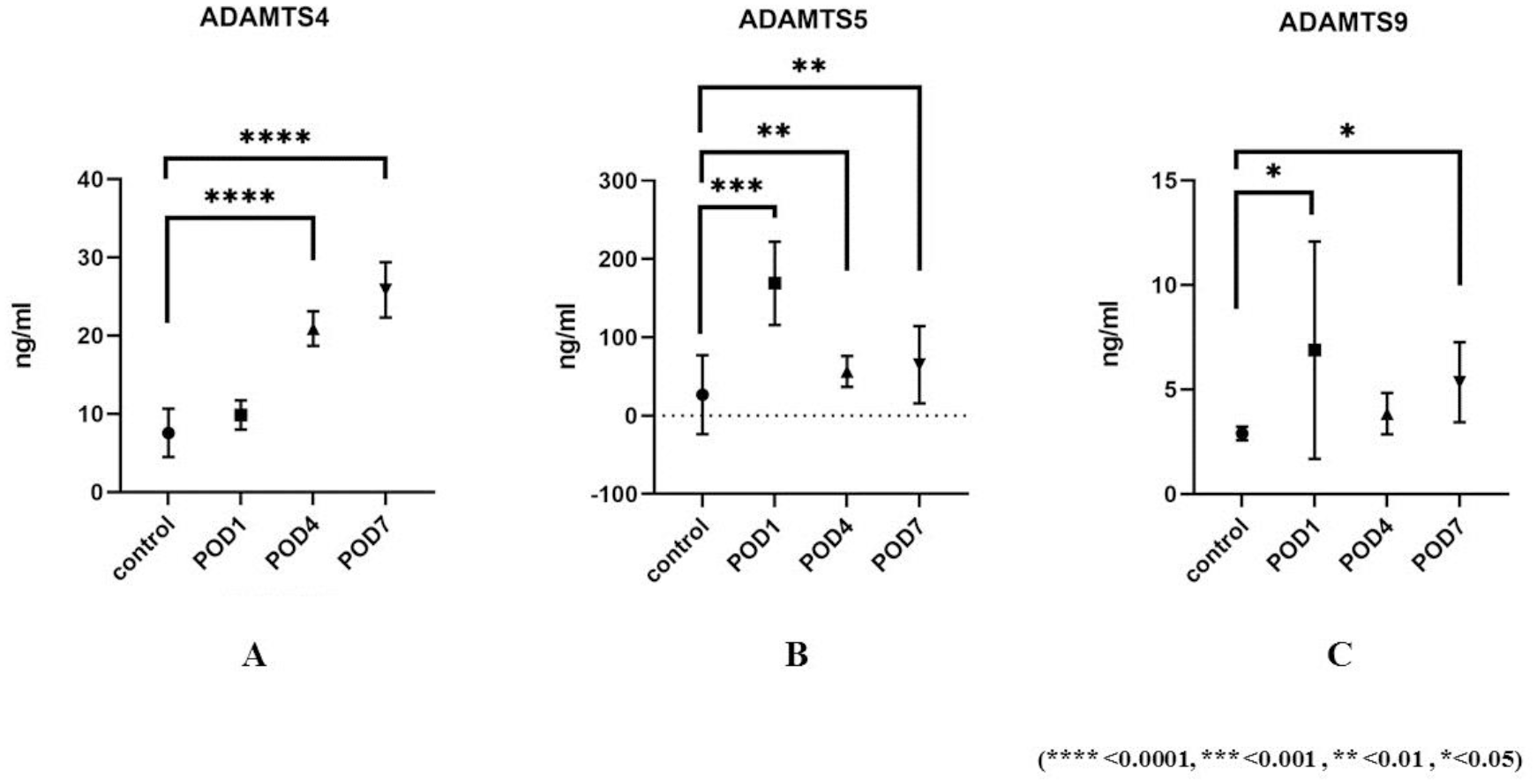
Control, POD1, POD4 and POD7 samples were collected from 17 patients (7 males and 10 females). The mean age was 24.5 ± 8.5 years (range, 17–40 years). The mean BMI was 24.8 ± 3.7 kg/m2 (range, 20.2–32.3 kg/m2). Expression levels of ADAMTS-4 were significantly higher in POD4 and POD7 samples than in control (Pc-4<0.0001, Pc-7<0.0001). Expression levels of ADAMTS-5 were significantly higher in POD1 samples than in control samples (Pc-1=0.0007). MMP-2 expression levels in POD4 and POD7 samples were significantly increased compared to control samples (Pc-4=0.0017, Pc-7=0.0013). Expression levels of MMP-9 were increased in POD1, POD4 and POD7 samples, significantly higher than in control (Pc-1<0.0001, Pc-4<0.0001, Pc-7=0.0004).
Conclusions:
ADAMTS-4, ADAMTS-5, MMP-2 and MMP-9 were all elevated in postoperative samples compared to control samples in the acute phase after ACLR. ADAMTS-4 and -5, as important mediators of aggrecan cleavage in OA knee cartilage, remained high during the study. These changes in the acute phase after ACLR seem likely to contribute to cartilage degeneration. Various limitations must be acknowledged in this study. First, the sample size was small. Second, we did not undertake a long-term analysis of SF after ACLR. If proteinases continue to be present in surgical knees, cartilage degeneration and posttraumatic OA may result. Finally, we did not examine serum results, as previous studies failed to show good correlations between serum and SF concentrations.