Abstract
Objectives:
Hallux Rigidus and Hallux Valgus can lead to long term morbidity and a significant reduction in ambulatory capabilities. First metatarsophalangeal joint (MTP) arthrodesis utilizing a plate and screw construct has been biomechanically and clinically validated to achieve union rates exceeding 90% in addition to offering pain relief and increased function. MTP arthrodesis is achieved through static compression with a stainless steel or titanium alloy construct. These constructs provide the highest level of compression at the time of implant insertion however factors including bone resorption at the fusion site or stress relaxation in the bone can result in gapping at the fusion site and significantly increase the risk of nonunion. Thus, an alternative compressive approach utilizing a nickel-titanium allow (Nitinol) was developed to potentially address these risk factors. Nitinol offers dynamic compression due to its inherent superior elasticity and shape memory which enables the construct to recover lost compression and reduce gap formation; factors which the traditional plate and screw construct cannot address. There is a paucity of data comparing the biomechanics of a Nitinol staple and screw construct on MTP fusion versus a standard plate screw construct. The primary aim of this study was to analyze biomechanical outcomes such as failure load, proximal phalanx deflection after cyclic loading, and deflection at time of failure between a plate and cross screw construct and a 4-prong Nitinol and cross screw construct. We hypothesize that the Nitinol staple/screw construct will yield a higher failure load and noninferior deflection after cyclic loading and at time of failure compared to the plate/screw construct group.
Methods:
4 matched pairs of fresh frozen cadaveric human feet (mean donor age: 49.5 years (range 29-65); 3 males) were tested. Each specimen was exposed using a standard dorsomedial surgical approach. Following dissection, a fellowship trained foot and ankle orthopedic surgeon performed either a plate and cross screw (PLATE) construct repair or a 4-prong nitinol staple and cross screw (NITINOL) repair on the randomized left or right laterality. The first ray was dissected away from all soft tissue attachments except the sesamoids and plantar plate. Specimens were then potted in polymethylmethacrylate (PMMA), and two pins mounted with black spheres were placed into the phalanx and first metatarsal parallel to the longitudinal axis of the bone. The specimens were mounted in 10° degrees of plantar flexion relative to the base of a dynamic tensile system (Instron). A high-definition camera was positioned perpendicular to the specimen and tracked relative position of the two pins along the sagittal plane during testing. A 20 N compression load was applied, and the initial position of the end effector was recorded. A cyclic loading protocol from 20-90N at 1 Hz for 100 cycles was applied to simulate physiologic walking in a short leg walking cast for six weeks. Following this cyclic loading process, the applied load was decreased to 20 N and the position of the end effector was recorded. The specimens were then pushed to failure at 1 mm/s with ultimate failure load and mode of failure being recorded. Deflection at failure was calculated as the difference in the end effector’s initial position and its position at the point of failure. Stiffness was determined as the slope of the linear region of the force/displacement data. Joint gapping after cyclic loading was calculated as the difference in distance in the sagittal plane between the phalanx pin and the metatarsal pin from the initial loading point to the post-cyclic loading point. Significance level was set as p<0.05.
Results:
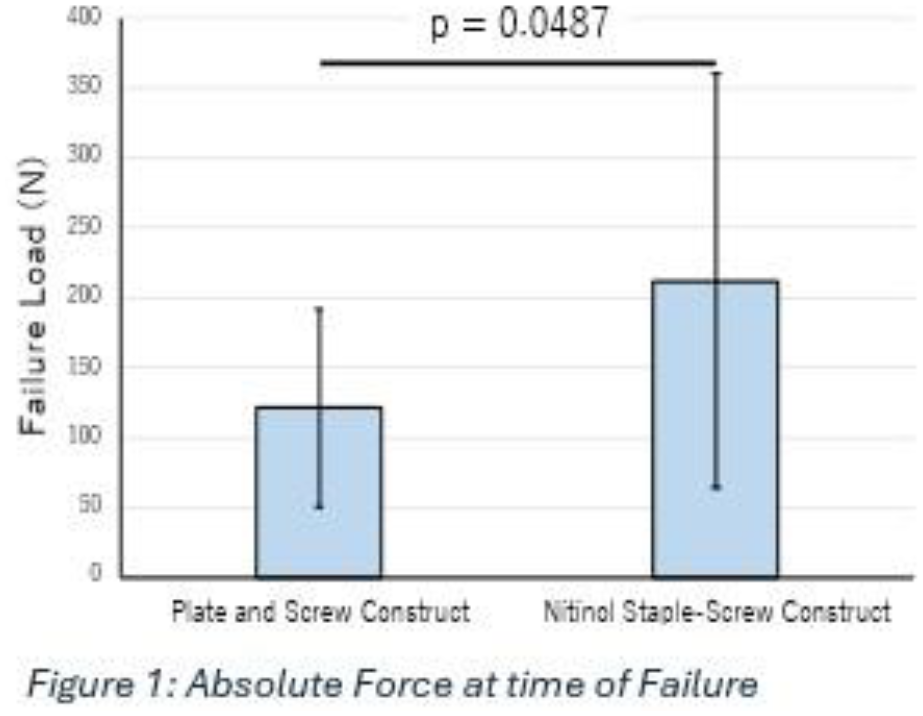
Graphical display of the results can be found in figures 1 and 2. There was a statistically significant difference in failure load between the PLATE and NITINOL constructs; however, there was no statistically significant difference in degree of deflection after cyclic loading or time of failure. The failure load for the PLATE construct was 121 +/- 70.6 N while the NITINOL construct failure load was 212 +/- 148 N (p=0.048). PLATE construct deflection after cyclic loading was 9.9 mm +/- 8.9 mm while NITINOL was 6.75 mm +/- 4.11mm (p=0.239). The deflection at time of failure was 20.6 mm +/- 9.27 mm for PLATE construct and 19.1 +/-3.07 mm for the NITINOL construct (p=0.789). The modes of failure differed between the two testing groups as the PLATE construct primarily failed by the plate bending and the NITINOL construct failed with the entire construct cutting out of the bone.
Conclusions:
This preliminary data reveals significant biomechanical differences between the standard plate and cross screw and Nitinol and cross screw constructs. The increased failure load achieved by NITINOL construct may allow for earlier postoperative weightbearing and lower arthrodesis nonunion risks at the 1st MTP joint. The insignificant differences seen in displacement after cyclic loading highlight similar efficacy of both repair types in the immediate post-operative period. The displacement at time of failure was similarly insignificant and can be attributed to the differences in mode of failure. The higher failure load of the Nitinol staple-screw construct may represent an alternative approach to MTP fusion that may allow for earlier postoperative weightbearing and lower the risks of arthrodesis nonunion.