Abstract
Objectives:
To identify risk factors for recurrent instability following a proximal or distal patellofemoral stabilizing procedure in patients with patellofemoral instability
Methods:
Patients with a history of patellofemoral instability and undergoing primary proximal and distal patellofemoral stabilizing surgery between January 2010 and December 2019 were included. We excluded patients having revision surgery, iatrogenic medial patellofemoral instability, and instability due to congenital disorders. The following data was collected: Age, Sex, BMI, diagnosis (first-time dislocator vs. recurrent dislocator), Surgery (Patellar Tendon imbrication, Lateral Retinacular Release, MPFL Reefing, MPFL Reconstruction, Tibial Tubercle Osteotomy), TT-TG distance (mm), Skeletal Maturity (Immature vs Mature), Caton-Deschamps Index, Recurrent Instability (Yes vs No). Statistical analysis was performed using the chi-square test, student T-test, and multivariate logistic regression.
Results:
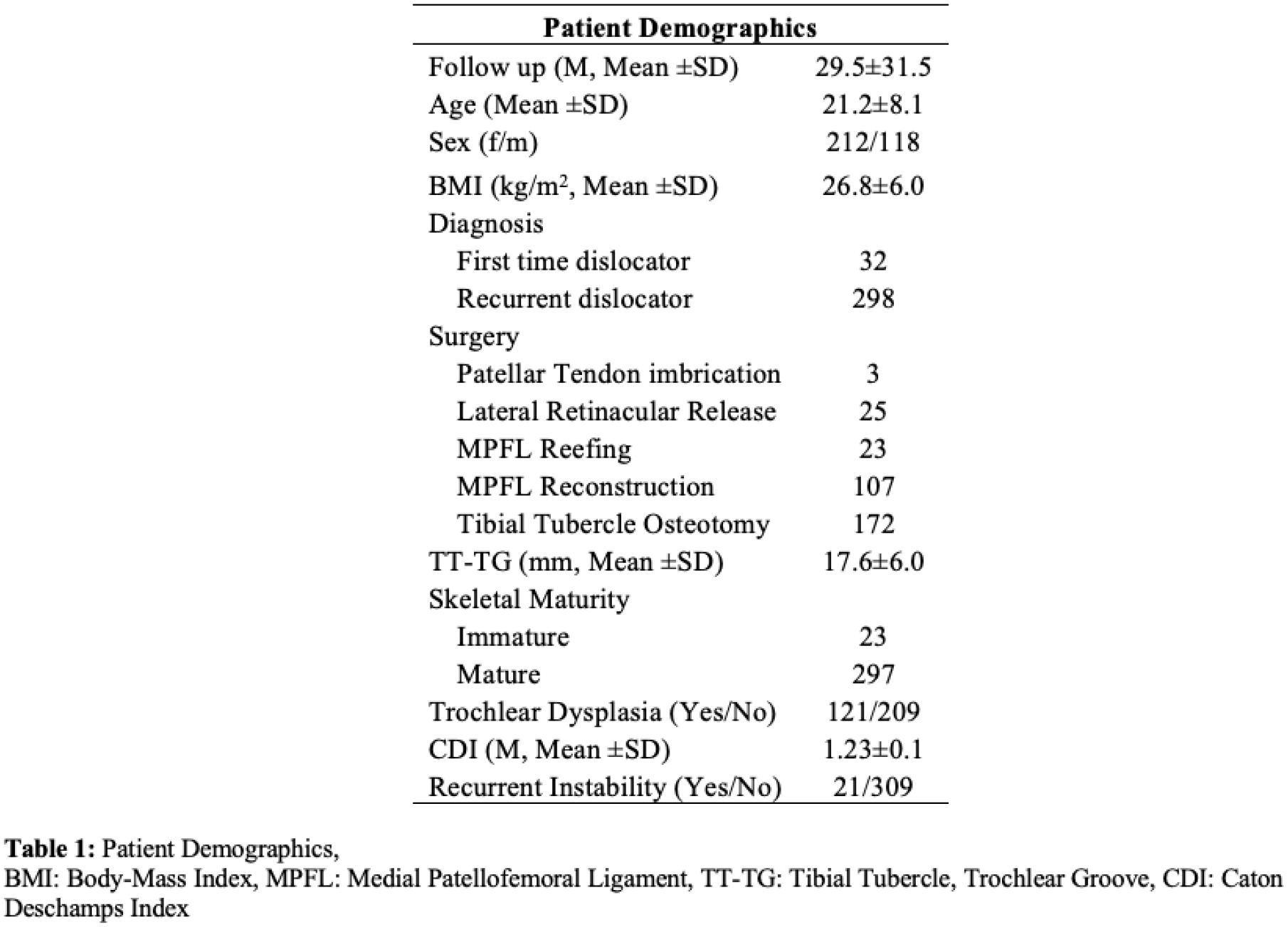
After exclusion criteria were applied, a total of 420 patients were identified, of whom 330 had complete follow-up data (78.6%). Follow up period was 29.5±31.5 months (Table 1). The overall rate of recurrent instability was 6.5%. The mean age was 21.2±8.1 years. There were 212 female and 118 male patients. The mean BMI was 26.8±6.0 kg/m2. There were 32 first-time dislocators and 298 recurrent dislocators. The mean TT-TG was 17.6±6.0mm, and the mean CDI was 1.23±0.1. There was trochlear dysplasia in 121 patients and no dysplasia in 209 patients. Data on surgery types is shown in Table 1. Multivariate regression analysis identified female sex (
Conclusions:
The rate of recurrent instability after a primary patellofemoral stabilizing surgery is 6.5%. Female sex and skeletal immaturity are found to be risk factors for recurrent instability. The female sex has 4.95 times higher risks for recurrent instability, and skeletal immaturity has 9.09 times higher risks. Patients with recurrent instability are significantly younger. However, age was not identified as a risk factor as it likely shared variance with skeletal maturity and sex.