Abstract
Objectives:
Historically, horizontal cleavage meniscus tears have been debrided with single leaflet preservation, but more recently this has been challenged by repair of these tear types. While circumferential meniscus repair with all-inside and inside-out instrumentation has been described, there remains a paucity of literature regarding the clinical outcomes of this technique. Our purpose was to assess clinical outcomes and reoperation rates of circumferential meniscus repair for horizontal cleavage tears at minimum 2-year follow-up.
Methods:
Patients with isolated horizontal cleavage tears of the meniscus (Fig. 1a) undergoing primary circumferential meniscus repair (Fig. 1b), including both inside-out and all-inside suturing techniques, at a single institution between 2015 and 2022 were eligible for inclusion and analyzed retrospectively. Arthroscopic images and operative notes were examined to confirm circumferential meniscal repair. Patient demographics, surgery details, and clinical findings were extracted from the institutional electronic medical records. Exclusion criteria consisted of patients not consenting for research, less than 2-years of clinical follow-up, and concurrent ipsilateral repair of a non-horizontal cleavage tear. Patients were not excluded if they had a concomitant anterior cruciate ligament reconstruction (ACLR). Thirty-seven patients met the criteria for inclusion in this study. Knees were analyzed for laterality, number of sutures, suturing technique, concurrent injuries, concurrent procedures, and surgical history. Visual Analogue Scale (VAS) for pain, Tegner, and International Knee Documentation Committee (IKDC) scores were collected at minimum 2-year follow-up and analyzed. Return to sport (RTS) and revision surgery were analyzed.
Results:
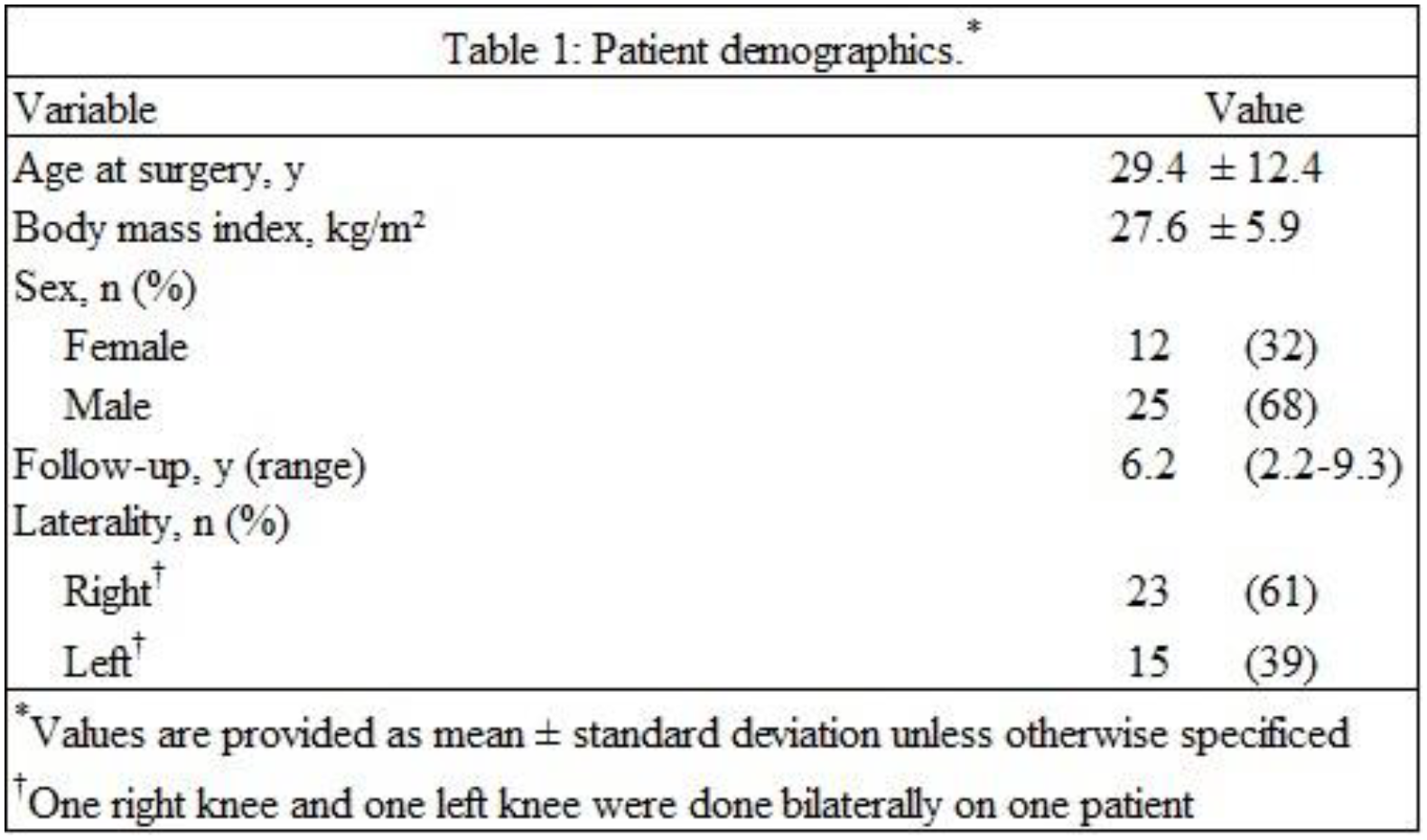
Thirty-seven patients (25 male, 12 female; mean age, 29.4 ± 12.4 years) who underwent circumferential meniscal repair of a horizontal cleavage tear were included in the study and followed for a mean of 6.2 years (range, 2.2-9.3 years, Table 1). There was a total of 38 knees (23 right, 15 left). One patient (3%) had bilateral circumferential meniscal repair surgeries done at separate times. Three (16%) patients failed primary repair and had secondary partial meniscectomy.
Similar numbers of circumferential meniscal repairs were performed on lateral and medial menisci, 21 (55%) and 17 (45%), respectively. An average number of 3 ± 2 sutures were used at the time or repair with one of 38 menisci (3%) having a hybrid combination of both all-inside and inside-out suture technique, 24 menisci (63%) had all-inside technique, and 13 menisci (34%) had inside-out technique. Concurrent procedures included 4 ACL reconstructions (3 autograft, 1 allograft), and 8 chondroplasties (4 patella, 2 trochlea, 1 medial femoral condyle, and 1 unspecified, Table 2).
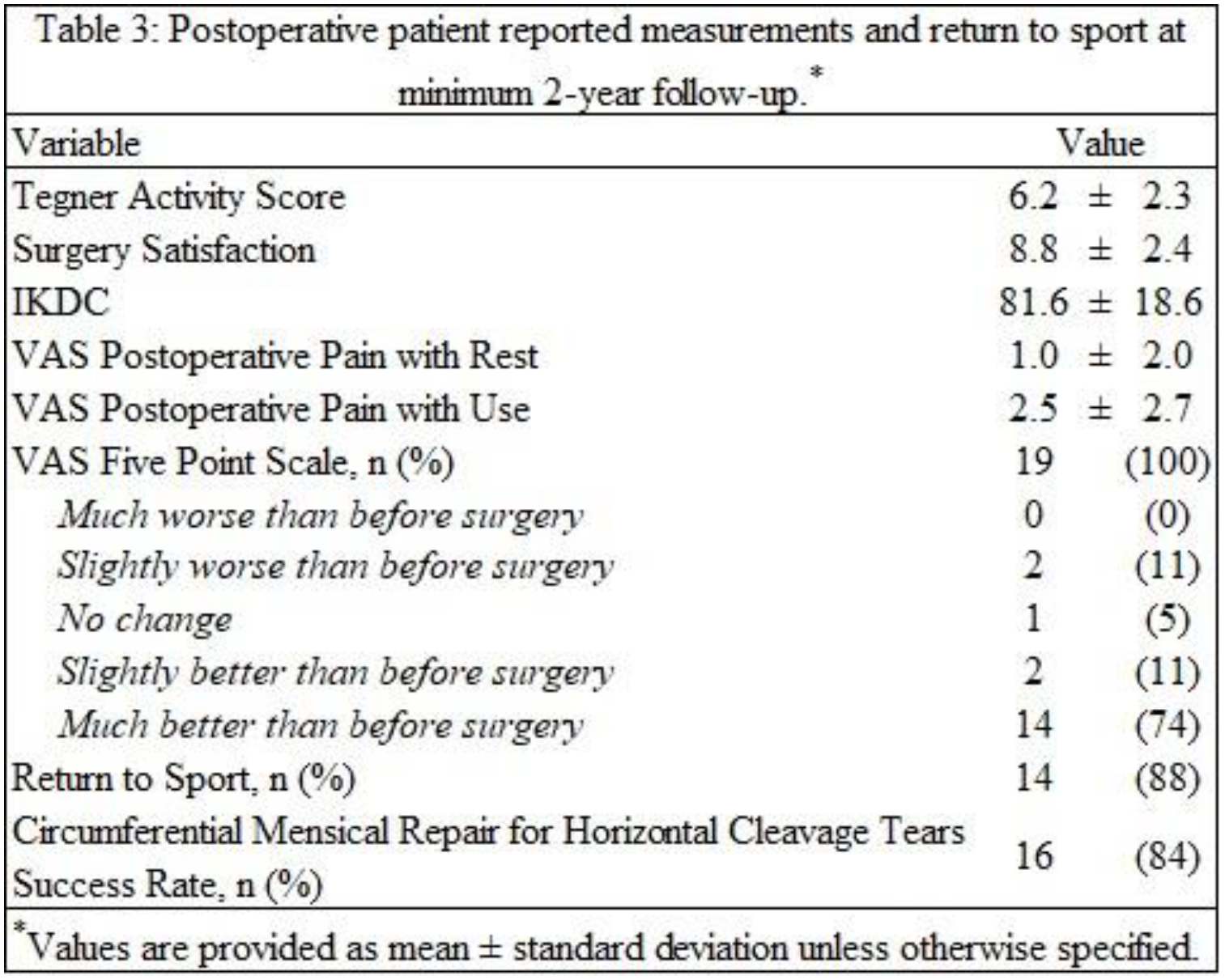
At the time of final follow-up, patients reported mean Tegner activity scores of 6.2 ± 2.3, VAS pain with rest of 1.0 ± 2.0, VAS pain with use of 2.5 ± 2.7, and IKDC of 81.6 ± 18.6. When asked, using a VAS Five Point scale, how their knee is currently compared to before their surgery, 14 (74%) feel much better than before surgery, 2 (11%) feel slightly better than before surgery, 1 (5%) feels no change when compared to before their surgery, 2 (11%) feel slightly worse than before surgery, and no one felt much worse than before surgery. Sixteen patients were involved in sports before their surgery. Of those that played sports before their surgery, 14 (88%) returned to sport (Table 3). The most common sports played were hockey (19%), volleyball (19%), tennis (13%), and football (13%). Levels of sport played before surgery included 7 (44%) recreational, 6 (38%) high school, 2 (13%) college, and 1 (6%) club. Levels of sport played after surgery for those who returned to sport included 6 (43%) recreational, 2 (14%) high school, 5 (36%) college, and 1 (7%) club with a significant increase in levels of sport played after surgery (p ≤ 0.006) compared to before surgery.
Conclusions:
At an average of 6-years of follow up, there was an 84% success rate of circumferential meniscal repair for horizontal cleavage tears. Most patients who play sports, return to sport and do so at the same or higher level and report successful PROMs. Circumferential meniscal repairs should be considered for patients with horizontal cleavage tears.