Abstract
Objectives:
The clinical success of osteochondral allografts (OCA) has driven the widespread demand for OCA tissue despite limited graft availability attributed to the tissues’ 28-day shelf-life and donor supply. Despite decades of basic science research evaluating various media formulations and cryopreservation technologies, little is known about the mechanism contributing to chondrocyte death during storage. A recent study associated elevated lipid oxidation and bioactive lipid metabolites with chondrocyte death during prolonged storage. Based on these findings, the purpose of this study was to investigate if a novel antioxidant formulation would mitigate lipid oxidation and improve the maintenance of cartilage health during prolonged storage of OCA tissue.
Methods:
Fresh human osteochondral allograft tissues were obtained from an accredited US tissue bank. Cores were harvested immediately and stored using current industry standard media (SM), a novel antioxidant formulation (AO), or media containing an anti-inflammatory corticosteroid (CS). One harvested core was immediately analyzed per donor tissue to determine baseline viability and sulfated GAG synthesis. Cores were stored for 28 days in one of the designated storage media formulations. Following storage, each core was analyzed for (i) chondrocyte viability in each zone of the cartilage using LIVE/DEAD assay and (ii) sulfated GAG synthesis using 35S incorporation. The relative measure was calculated by subtracting donor matched baseline values. One-sample t-test of relative measures compared to the zero-value.
Results:
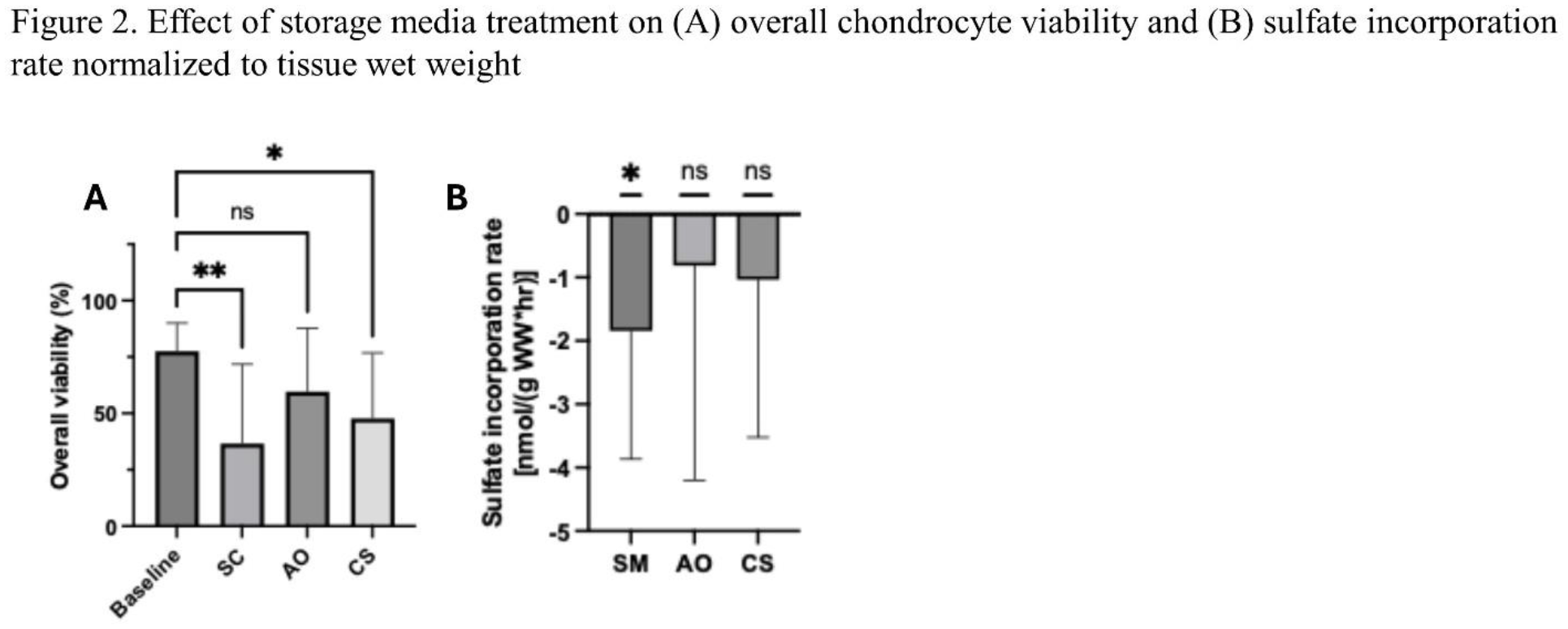
Relative to the baseline group, the SM showed a significant reduction in cell viability across en face, superficial, middle, and deep cartilage zones (Figure 1). The AO treatment showed the least reduction (P=0.37; not significant) in percent viability in the en face region compared to both SM (P=0.02) and CS (P=0.04) treatments. Both AO and CS groups showed less deterioration in viability (not significant) compared to the SM in middle and deep zones. The AO group maintained overall chondrocyte viability across all zones compared to baseline (Figure 2). Both SC (P<0.01) and CS (P=0.03) groups showed a significant decline in overall viability compared to baseline. Consistent with the viability data, the sulfate incorporation rate was significantly reduced in the SM group (P=0.02) but maintained in the AO (P=0.54) and CS (P=0.31) groups.
Conclusions:
Consistent with previous data the current industry standard media led to significant deterioration in chondrocyte viability after 28 days of storage. The addition of an antioxidant formulation used to target potential lipid oxidation showed improvements in both the maintenance of chondrocyte viability and function during prolonged storage.