Abstract
Objectives:
To evaluate return-to-sport (RTS) rates and patient reported outcome measures (PROMs) following hip arthroscopy for femoroacetabular impingement (FAI) in active football players with a minimum of 5-years follow-up.
Methods:
All active football players who underwent hip arthroscopy for FAI from 2010-2019 were identified. Preoperative radiographic measures including lateral center edge angle, Tönnis angle, alpha angle, and acetabular depth were obtained. Patients were evaluated for post-operative RTS and revision surgery data at final follow-up. Modified Harris Hip Score (mHHS), Hip Outcome Score (HOS), HOS Activities of Daily Living (HOS-ADL), HOS Sports Specific Subscale (HOS-Sports), Tegner Activity Scores, Visual Analogue Scale (VAS) for pain, and surgery satisfaction were collected at a minimum 5-year follow-up. Descriptive and comparative statistical analysis was performed using R software (version 4.4.1).
Results:
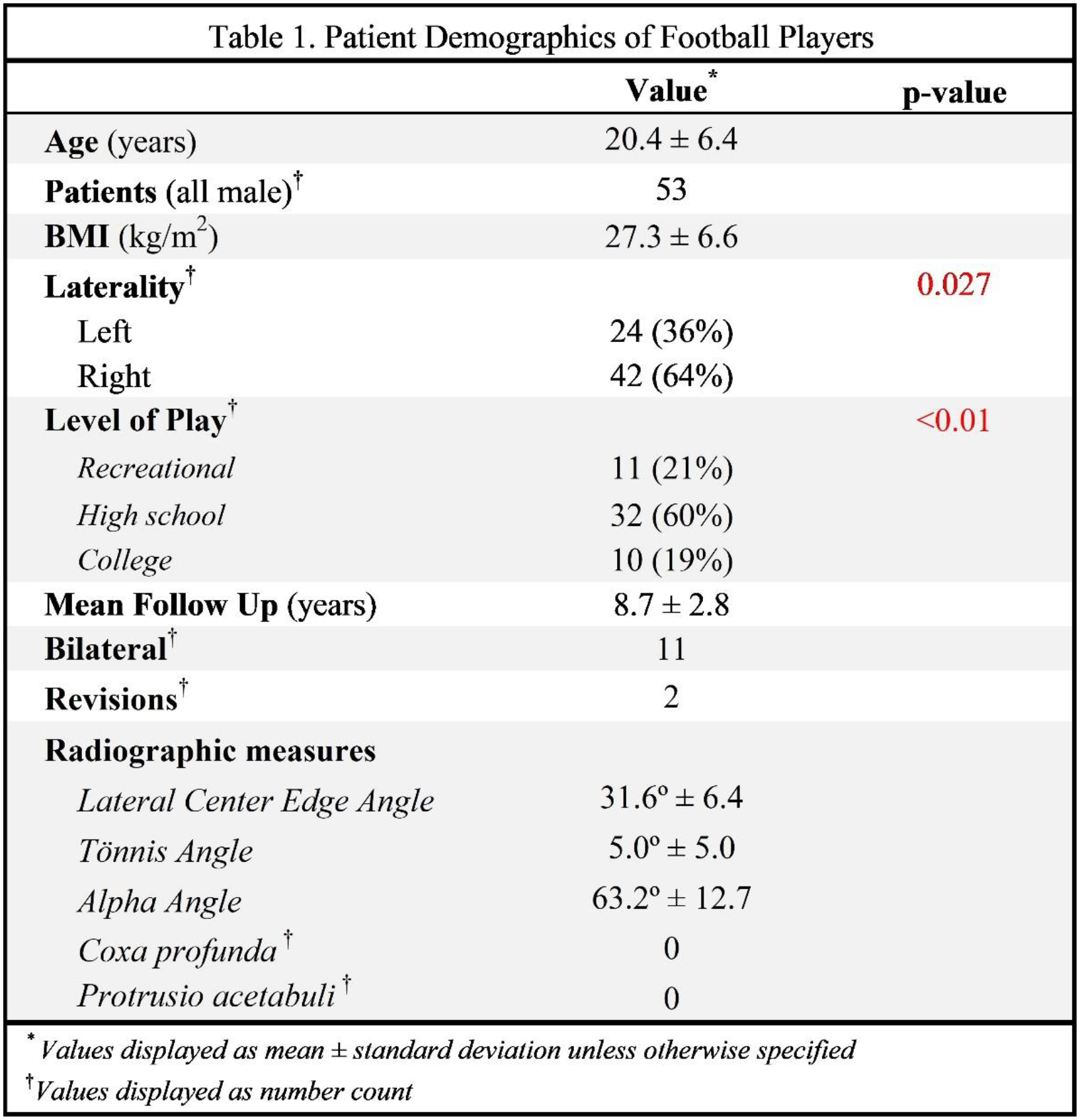
Sixty-six hips from 53 male patients were included. The mean age was 20.4 ± 6.4 years and mean BMI was 27.3 ± 6.6 kg/m² (Table 1). Mean follow-up was 8.7 ± 2.8 years. The majority (60%) were high school players and 19% were college players. Figure 1 displays the most commonly affected positions which included wide receiver (32%), defensive lineman (26%), and tight end or offensive lineman (16%). There were 11 bilateral cases and 2 revisions. The mean lateral center edge angle was 31.6º ± 6.4, the mean Tönnis angle was 5.0º ± 5, and the mean alpha angle was 63.2º ± 12.7.
There was significant improvement in all PROMs from baseline to a minimum 5-year follow-up (p<0.04). Fifty-four percent of athletes returned to football postoperatively and the average overall surgery satisfaction rating was 8.1/10. Among those who didn’t return, 14% cited hip-related reasons, while 67% cited non-hip related reasons such as priorities changing or graduating (Figure 2). Athletes who returned to football had significantly higher mean HOS-ADL (p=0.049), HOS-Sport (p=0.042), and Tegner level before surgery (p=0.023) compared to those who did not return (Table 2).
Conclusions:
Football players undergoing hip arthroscopy for FAI demonstrate significant improvements in outcome scores at a minimum 5-year follow-up with a moderate return-to-sport rate. Athletes who are able to return to football report higher patient reported outcomes compared to those who do not. Player position may also influence incidence and outcomes. Although football players demonstrate significant improvements following hip arthroscopy, the moderate RTS rates highlights the demanding nature of the sport and need for improved perioperative counseling.