Abstract
Objectives:
“Kissing lesions” are femoral neck injuries that arise from repetitive contact between the femoral neck and the acetabulum in patients with femoroacetabular impingement syndrome. Historically, kissing lesions are thought to occur at a state of deep hip flexion beyond 90 degrees. However, this angle has not been quantified in vivo and will therefore be the purpose of this study.
Methods:
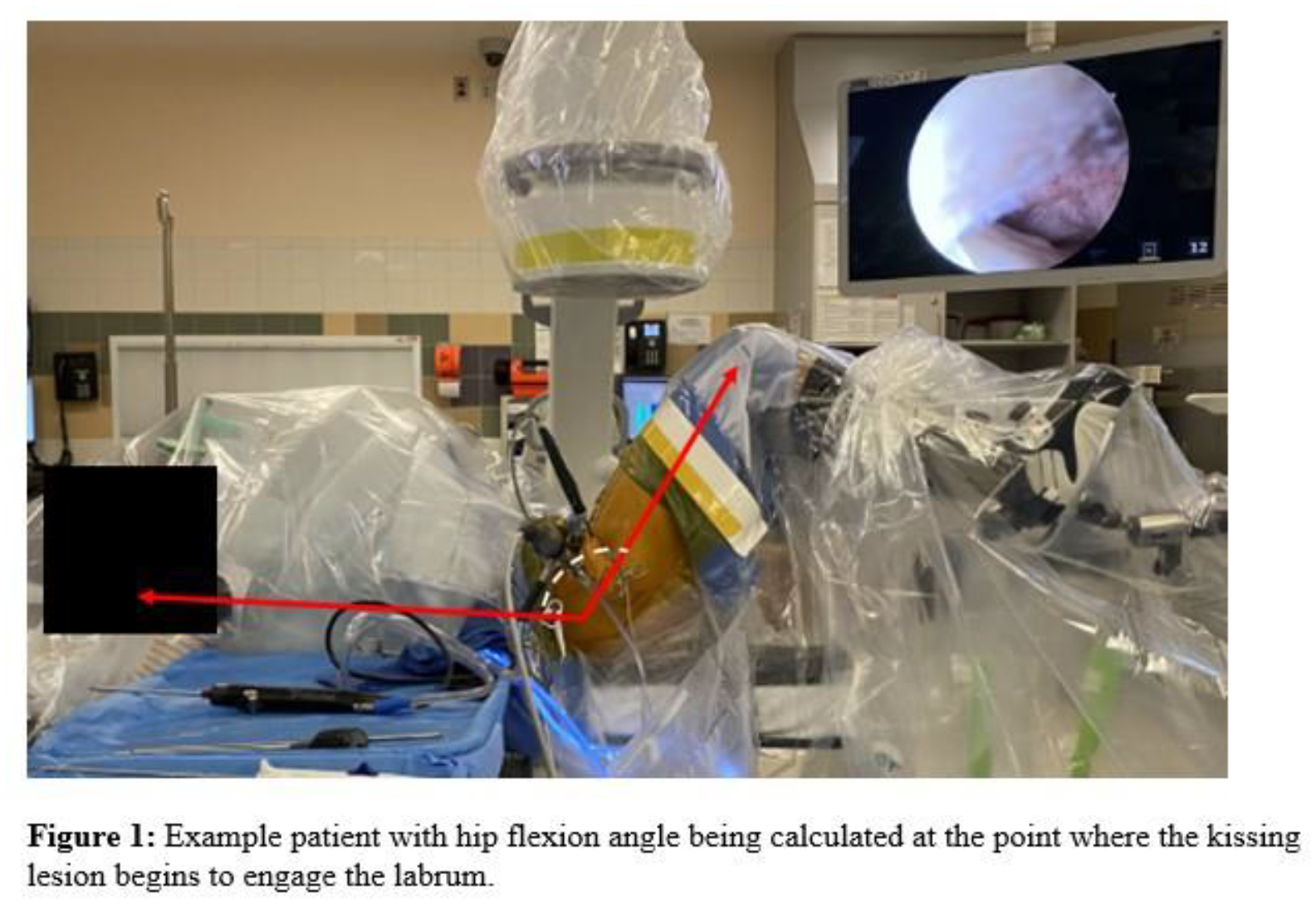
Patients undergoing a primary hip arthroscopy with intraoperatively identified kissing lesions were included. Patients were flexed at the hip until the labrum began to engage the kissing lesion. Photos were taken at this position and degree of hip flexion was calculated (Figure 1). Comparisons were made via two-tailed t-tests. Additionally, all available preoperative PROMIS v2.0 – Physical Function scores were reviewed and placed into a linear regression model to determine if there was an association between preoperative function and kissing lesion angle.
Results:
A total of 112 patients were analyzed in this study. Mean age was 30.5 ± 10.7 years, mean BMI was 26.2 ± 5.6, 39 were males, and 73 were females. Mean degree of hip flexion to achieve a kissing lesion was 63.1 ± 11.6 degrees with a range from 39.8 to 94.9 degrees across all patients. Males had a mean flexion angle of 65.9 ± 10.8 degrees compared to females who had a mean flexion angle of 61.6 ± 11.7 (p=0.064) to achieve a kissing lesion. Patients
Conclusions:
On average, patients required 63 degrees of flexion to engage their arthroscopically identified kissing lesions, with very few requiring >90 degrees flexion. This finding challenges the previously held notion that these lesions are a deep flexion issue and may explain why some patients experience discomfort at lower flexion angles. However, the degree at which a person engages their kissing lesion does not appear to impact their preoperative PROMIS score.