Abstract
Objectives:
To determine whether early improvements in patient-reported outcome measures (PROMs) 6 months after hip arthroscopy predict five-year outcomes.
Methods:
A retrospective review of prospectively-collected data identified patients ≥18 years that underwent hip arthroscopy by a single surgeon for the treatment of symptomatic labral tears secondary to femoroacetabular impingement (FAI). Included patients had a Tönnis grade <2 and complete PROMs at baseline, 6-month, and minimum 5-year follow-up. The minimal clinically important difference (MCID) for the modified Harris Hip Score (mHHS), 8 points, was used to stratify patients into cohorts based on high improvement (HI) versus low improvement (LI) at 6 months. PROMs were compared between these cohorts at 1, 2, 3, 4, and 5 years postoperatively by rates of MCID achievement and linear mixed effects modeling. Subsequent surgery rates were compared.
Results:
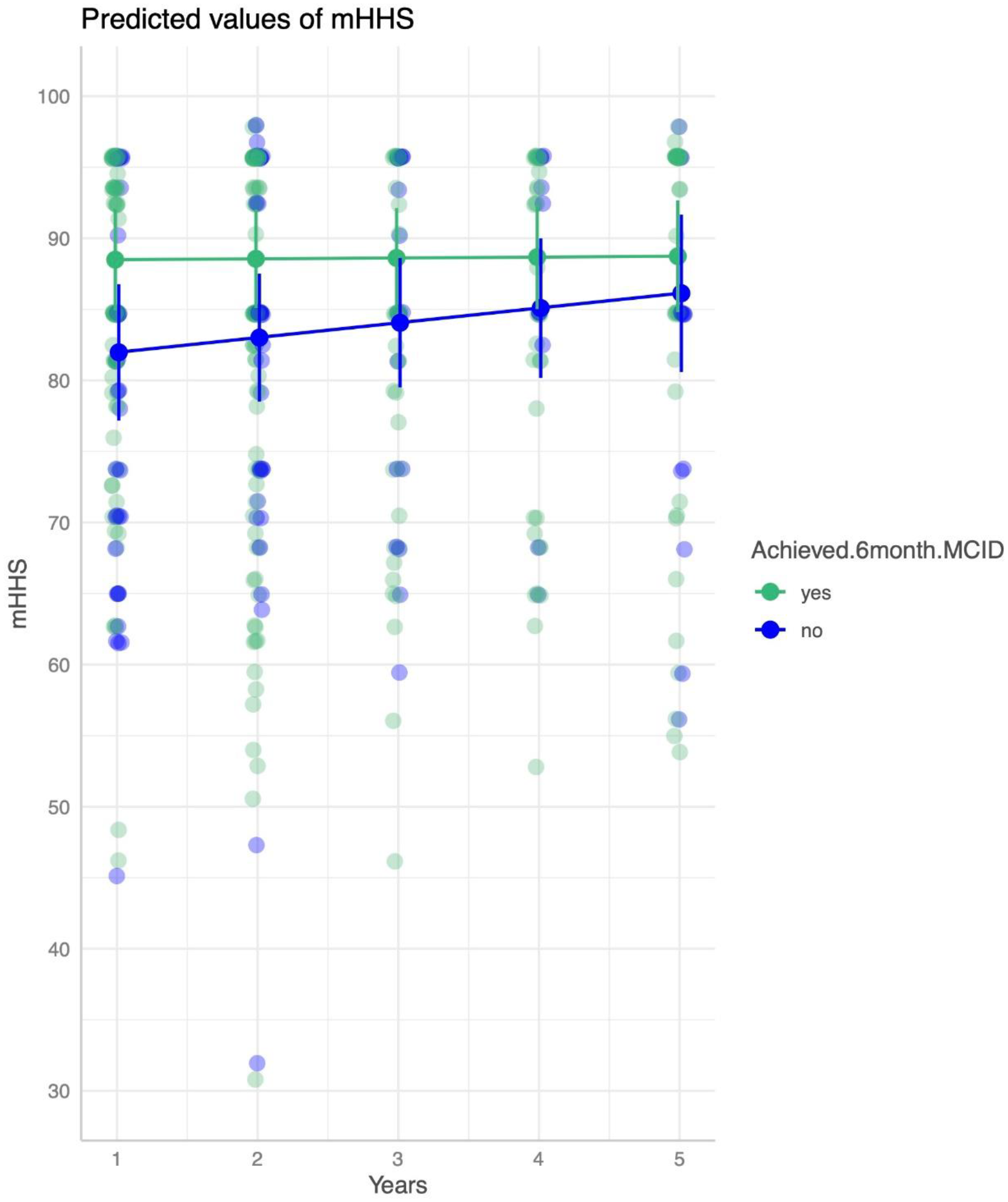
Overall, 175 patients (age, 37.2 ±11.4 years, 52.0% female) met inclusion criteria. Of these, 131 HI patients were compared to 44 LI patients. At 5 years, 88.3% of HI patients reached MCID, versus 42.1% of LI patients (p<0.001) (
Conclusions:
Early improvements in PROMs following hip arthroscopy, assessed by 6-month MCID, predicted clinically meaningful outcomes at 5-year follow-up, underscoring the importance of progressive but cautious recovery during these six months. Despite this, LI patients continued improving for 5 years and by absolute PROM scores, did not differ significantly from HI patients at 5-year follow-up, demonstrating that late functional improvement is still possible in patients in the event of a poor 6-month rehabilitation period.